
By Richard Winters
My Rating: 5 out of 10
4-Word Review: He hears a murder.
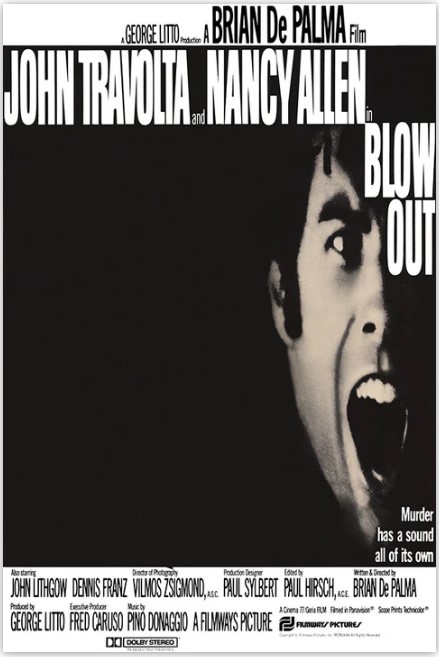
Jack (John Travolta) works as a sound effects technician for a film studio that specializes in low budget horror movies. He gets instructed by his producer Sam (Peter Boyden) to come-up with a more realistic sounding scream, as well as other audio noises, for the most recent exploitation production that they’ve been working-on. Jack then goes out one night to capture the necessary noises, but while doing so witnesses a car drive-off the road and into a nearby river. He immediately jumps into the water and saves a passenger named Sally (Nancy Allen), who had been sitting in the backseat, but he’s unable to get to the driver. Later it’s revealed that the driver was a candidate running for governor and Sally was his escort and pressure is put on Jack by the campaign officials not to reveal this to the press. Jack also comes to the realization, while going back and listening to what he had recorded, that the car going to into the river was no accident as he had initially thought, but instead it had been caused by a gunshot from an undisclosed assassin who intentionally shot at the tire so the vehicle would swerve-off the road, but when Jack goes to the authorities about this they don’t believe him.
The film is noted for having been heavily inspired by the Michaelangelo Antonioni’s classic Blow-up, which came-out 15 years earlier and focused on a photographer who inadvertently witnesses a killing via a picture he takes, while this one is on what the protagonist hears. This could also be considered quite similar to The Conversation, a masterpiece that was released in 1974 and dealt with a sound expert that gets in over-his-head with a criminal underground. Both of those films though were better than this one, which has some flashy camera work, but little else.
I did like Travolta. This was the first film where he becomes essentially an adult and no longer stuck in that quasi-age of a post teen growing into manhood and needing to prove himself. Here we get the bona fide thing and the character’s cynical nature about his job and being stuck in an industry that he doesn’t really respect, or all that excited about, is a refreshing change-of-pace from his more wide-eyed, idealistic roles of the past. The behind-the-scenes look at the movie business, including all the posters from actual horror films that line the walls of the studio hallways, and the wannabe starlets dying to break-in even if it meant just letting-out a simple voice-over scream in order to be a part of the cast, I enjoyed and helps add an authentic ambience to what it would be like working in that type of culture.
The character development, or if you could even call it that, is incredibly weak. Nancy Allen is especially annoying not so much for anything she does, she actually puts-on an effective Brooklyn accent, but more for her cliched character. Portraying a prostitute as a blank-eyed, dim-witted simpleton, who still has a ‘heart-of-gold’, is about as overused as it gets making it a laughable caricature and succeeding at causing one long eye roll every time she appears and opens her mouth. The gangsters and police officials are equally contrived though Dennis Franz plays his role, as the corrupt low-life pimp, with such amusing gusto that I was willing to forgive his scenes, and was even entertained by them, but found the rest of the supporting cast to be wasted and transparent.
There are also a few too many plot holes. For instance, the assassin, played by Jon Lithgow, sneaks into an auto repair shop late at night, to remove the tire from the car that had been retrieved from the river, so no one would find out that it had a bullet hole, but wouldn’t the police have thought about looking for that already? The fact that they don’t seems shockingly shoddy as the first thing to investigate after any accident is the cause and not immediately removing the tire and sending it away to a lab for further analysis seems beyond incompetent. Some may argue that the police were paid-off to look the other way and were a part of the ‘cover-up’, but if that were the case then they would’ve still removed the tire, knowing that it was crucial evidence, and then just conveniently ‘lost it’ versus leaving it on the vehicle in some unguarded repair shop that anyone could walk into.
Having Travolta drive his jeep through a parade and nearly kill hundreds of people in the process and then crash into a storefront window where pedestrians come to his aid and call for an ambulance seemed questionable as well. Maybe it was a more innocent era, but I would’ve thought those same people would’ve beaten the crap out of him when they caught-up versus helping him as they would’ve presumed, he had plowed into the parade intentionally and therefor deserved some rough ‘street justice’ for having put so many lives at risk.
Revealing who the killer was in the second act and the reasons for why he did it ruined the suspense and would’ve been more intriguing had the viewer only figured out his identity right when the protagonists do, which comes near the end of the third act. I also thought his killing of other prostitutes who looked similar to Allen, in order to create this fictional serial killer known as the “Liberty Bell Killer, were rather fake. For one thing if a bad guy is intent on killing somebody and stalking them, they come prepared with their own weapons and not hope to inadvertently pick-up some sharp object along the way like he does here. The scene inside a public restroom where he stands over the toilet stall wall in order to strangle his would-be victim who’s standing on the other side and the woman does not sense someone hoovering over her, she looks around, but doesn’t bother to look-up, is baffling since his body was blocking the overhead light and his shadow would’ve tipped her off that there was someone above.
Spoiler Alert!
The biggest head-scratcher gets saved for the end where Travolta essentially gives-up on pursuing the bad guys, even after Allen is murdered, and goes back to his ordinary life as a sound man though in a more guilt-ridden state. The explanation for this is that when Lithgow throws the film of the assassination into the lake along with the audio tape that means the evidence was ‘gone forever’, but it really wasn’t. He had made a copy of the audio tape already and the film was from motion picture stills he had obtained from a tabloid magazine, so all he had to do was buy another copy of the magazine, resync the pics up with his audio tape copy, and his evidence to take to the authorities would be as good as new.
My Rating: 5 out of 10
Released: July 24, 1981
Runtime: 1 Hour 48 Minutes
Rated R
Director: Brian De Palma
Studio: Filmways Pictures
Available: DVD, Blu-ray (Criterion Collection), Amazon Video, YouTube, Pluto TV, Tubi
 Scopophilia