
By Richard Winters
My Rating: 7 out of 10
4-Word Review: Assaulted woman gets revenge.
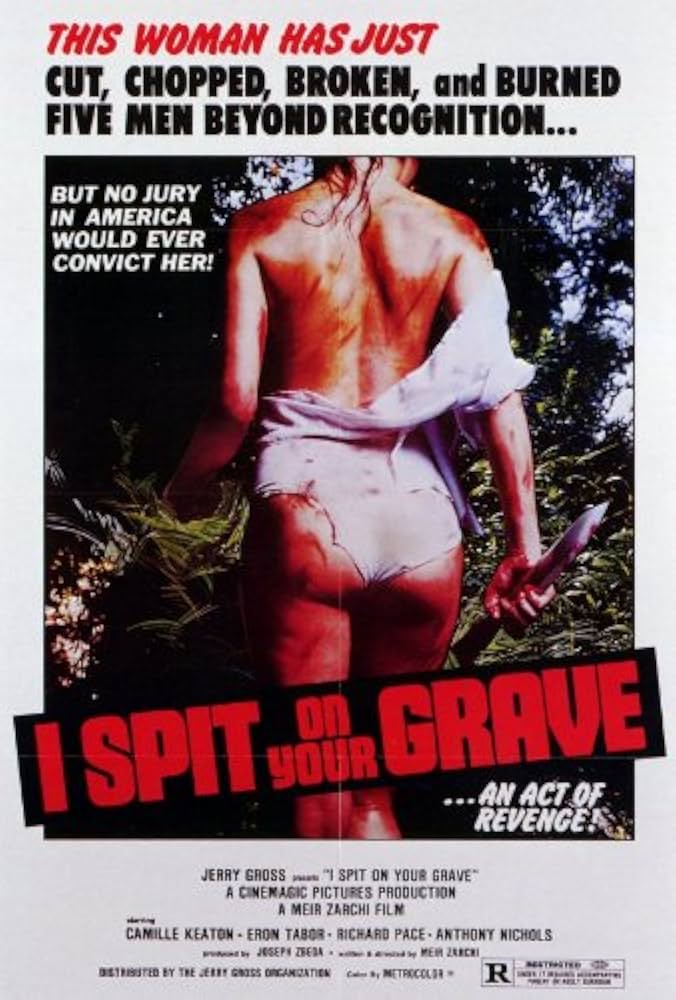
Jennifer Hills (Camille Keaton) is a writer who has decided to get away from the bustle of New York City by renting an isolated cabin by a river that’s just outside of Kent, Connecticut. It’s here that she hopes to finish her novel but finds it hard to do when she inadvertently attracts the attention of Johnny (Eron Tabor) a gas station attendant and two unemployed men named Stanley (Anthony Nichols) and Andy (Gunter Kleeman) who routinely upset her quiet environment with their motorboat. When delivery boy Mathew (Richard Pace), who is mentally disabled and social awkward, comes back to the men describing how when he delivered groceries to her, he ‘saw her breasts’, it gives them the idea to attack her and then ‘offer her up’ to Matthew, so he can finally have sex with a woman. The men chase Jennifer down while she’s relaxing in her rowboat and take her to the backwoods where each of them takes turns raping her over an extended period. Once they finally leave, they give Mathew a knife and tell him to kill her while they wait outside. Mathew though is too afraid to stab her, so he lies and tell them he did when he really didn’t. Eventually, after several weeks, Jennifer recovers from her injuries, both physical and emotional, and decides to seek out the unsuspecting men by killing them off in gruesome ways one-by-one.
This film was and still is highly controversial, some might say it’s the most controversial film ever made and universally condemned by both Roger Ebert and Gene Siskel on their show where they described it as ‘the worst movie ever made’. Ebert even went as far as to write in his review that it made him physically sick to watch it. His review though had a Streisand effect as it garnered it more attention and got people to come to the theater to ‘see what all the fuss was about’ eventually making it quite profitable and a cult classic that’s turned the franchise into marketable one that has given it several sequels and even a 2010 remake.
The inspiration for the story came in October of 1974 when writer/director Meir Zarchi was traveling with his friend and daughter in New York City neighborhood of Jamaican Hills where they came upon a naked, beaten-up woman who told them she had just been raped. When he escorted her to the police, he was appalled at the indifferent treatment she was given and he came home and almost immediately began writing the script.
Almost 2 years later, in August of 1976, he had acquired enough funding so shooting could begin. The argument though was whether this really was a ‘trenchant’ drama meant to expose the brutal nature of rape, versus sanitizing it as other movies at the time tended to do or was simply a cheap way to exploit a difficult subject for money. In a lot of ways, it seems to be the later as gang rapes like the one portrayed here don’t happen too often and it’s usually just one attacker. The fact that the men seem to go away and then suddenly reappear again unexpectedly out of nowhere makes it feel like it’s being played up for tension’s sake and attempting to get the most out of the horror then simply trying to intelligently examine the cruel event.
There’s also no scene showing Jennifer going to the police and being treated poorly, which was supposedly what enraged Zarchi so much during the real event. Without that element it’s harder to justify the plot and there really needed to be a segment showing that.
On the flip side I was impressed with the film’s overall grittiness. It’s like Zarchi had watched Last House on the Left but decided to take out the ill-advised ‘comic relief’ scenes and weird music and just left in the unrelenting tension and to that level it succeeds. Having no soundtrack at all, outside of some organ music that gets played when Jennifer visits a church, helps give it more of a realistic effect almost like we’re watching a documentary where the camera is simply turned-on and whatever terrible things happen is allowed to simply play-out unabated. This along with Keaton’s dynamic performance, where she essentially plays two women, one a victim and the other the perpetrator, is what helps the movie stand out and gives it it’s legs.
Spoiler Alert!
The complaints I had comes more with the third act where Jennifer carries out her revenge. The segment where she entices Matthew to have sex with her again in the woods by the river, so she can put a noose around his neck and hang him, didn’t feel genuine. I would think anyone who had been raped that they wouldn’t want anyone to touch them, or get intimate after such a traumatic event, so allowing herself to get naked and letting a man, one of her former attackers no less, get on top of her, just didn’t seem plausible from a psychological perspective. On the physical end it didn’t seem possible that a young thin woman would be able to pull the rope tight enough to hang someone who clearly weighed more than she.
The second killing where she takes Johnny back to her place and they get naked in her tub had the same problematic issues. She had a gun in her hand when she got out of her car, so why not just shoot him then and get it over with? Why take the chance of bringing him back to her house where he could overpower her? Also, how dumb does this guy have to be that he would completely let down his guard and not think that this woman, who’s assault he happily took part in, could be completely trusted and not try to lure him into a trap?
Her final attack on the two other men is flawed as well as it has her swimming out to the boat that one of them is on, but she comes onboard carrying no weapon. She only gets her hands on the ax when the other guy accidentally drops it into her boat as she tries to side swipe him, but that’s still a very stupid and dangerous way to go about things. If she’s fully intending to kill the guy she should come prepared with something already in hand when she confronts him.
Alternate Title: Day of the Woman
My Rating: 7 out of 10
Released: November 22, 1978
Runtime: 1 Hour 42 Minutes
Rated R
Director: Meir Zarchi
Studio: Cinemagic Pictures
Available: DVD, Blu-ray, PlutoTV, Roku, Tubi, YouTube
 Scopophilia