Tag Archives: Allen Garfield

Mother, Jugs & Speed (1976)

By Richard Winters

My Rating: 8 out of 10

4-Word Review: A corrupt ambulance company.

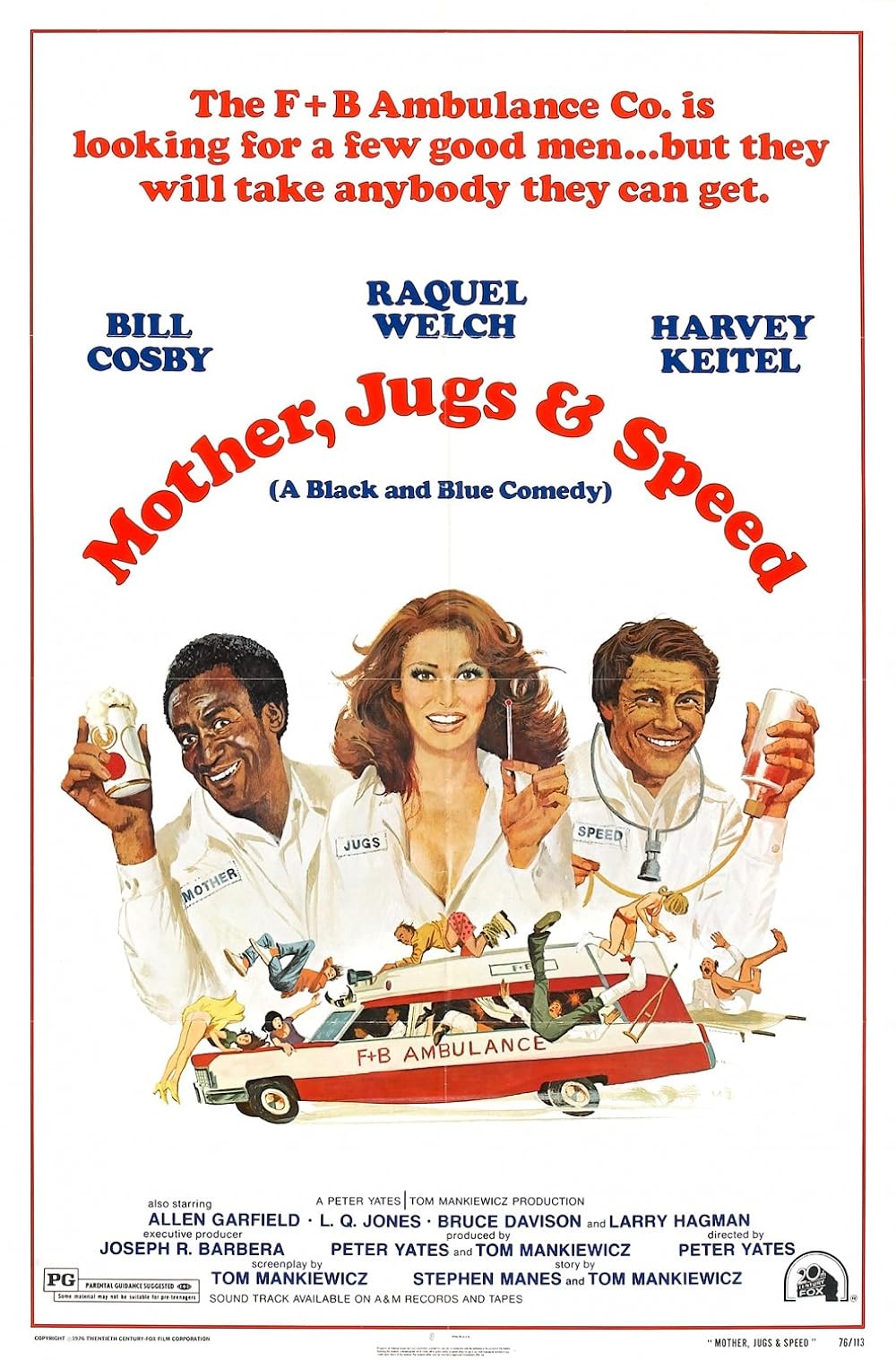
Mother (Bill Cosby) is a part of a team of ambulance drivers working for Harry Fishbine (Allen Garfield) who runs the F & B Ambulance company that is competing with Unity ambulance to get a contract with the city of Los Angeles. Harry is willing to do any underhanded deal that he needs to in order to keep the company competitive, which many times is at the patient’s expense. Tony (Harvey Keitel) is a former cop whose been suspended due to allegations of him dealing cocaine and thus gets hired to partner with Murdoch (Larry Hagman), a man whose compulsion for sex seems to know no bounds. Jennifer (Raquel Welch), nicknamed ‘Jugs’ due to her ample breast size, mans the switchboard, but longs to be a driver and is excited to finally get her certification, only for Harry to refuse to hire her due to sexist reasons.

The disco song ‘Dance’ by Paul Jabara, which gets played over the opening credits, may get some viewers to think it’s a silly 70’s flick, which it definitely isn’t. The concept was inspired by cartoonist Joseph Barbera, who after taking an ambulance ride, became intrigued with the idea of doing a movie about an ambulance company and hired noted screenwriter Tom Mankiewicz to write the first draft. Mankiewicz had plenty of success writing James Bond movies but was at a loss at how to approach this one and only after tagging along on some ambulance rides over a span of three nights was able to come up with the plot. He then bumped into Peter Yates at a party. Yates, best known for having directed Bullit, was interested in a change of pace by doing a comedy, but one that he hoped had ‘some bite’. Mankiewicz then immediately ran out to his car and dug the script out of his trunk and handed it to him and by the next day, after having read it during his flight back, Yates was solidly onboard.

As dark comedies go this one has to be one of the darkest and is compelled to look at every grim aspect of the human experience from drug addiction to poverty and the basic apathy people feel about their jobs and the little things they have to do and tell themselves in order to get through it. What surprised me though was that it was only given a PG-rating. Granted they never say the word ‘fuck’, nor is there any nudity, but it’s still very adult, nonetheless. Because it stars Cosby, who at the time was known for his family-oriented comedy it could’ve given parents the mistaken impression that this would be safe for kids, but it’s definitely not. There’s a lot of caustic humor including Hagman making jokes about having sex with 13-year-old twins and one moment where he attempts to get-it-on with a comatose patient. There’s even a shocking scene where somebody gets shot and killed, so what Jack Valenti and his MPAA board where thinking when they viewed it, I don’t know, but this is certainly not material for young eyes.

Mankiewicz’s acerbic script hits all the right targets, but the acting scores as well. Cosby is terrific as a sort of anti-hero who drinks while he’s driving and harasses nuns but also shows the required proportionate jaded sensibilities to handle the grim challenges. Hagman is outrageously crass but countered nicely by Bruce Davidson and Keitel, who manage to bring some likable qualities into the cast. The funniest person though, despite everything, is Garfield, who’s the perfect caricature of a shyster owner more than willing to do whatever it takes to stay afloat and his motivational rants, particularly the one that starts things out, are hilarious.

The only one that seems miscast is Welch, who despite being easy on the eyes, has never really shown to have much of an acting range. I did like her character’s arch where she’s finally given the chance to go on an ambulance run and learns the hard way that not every life can be saved, as well as a scene where she takes an ambulance on a joyride and gets pulled over by the cops, but sympathetic wise she’s kind of cold. She just doesn’t seem to have the ability to show vulnerability, which is what her character required it’s just a shame the part wasn’t played by Valerie Perrie, who would’ve been perfect, but she declined due to her unwillingness to accept a deferred payment.

Spoiler Alert!

My one caveat is the ending, which has Hagman taking some narcotics that causes him to have a psychotic reaction where he holds the owner’s wife Peaches, played by Valerie Curtin, hostage at the station, but this came off as too jarring. While Hagman’s character certainly had a creepy factor it was still done in a humorous way making him benign and just ‘one of the gang’, so having him go nutso without any type of forewarning didn’t make a lot of sense. Would’ve been better had some addicts looking for drugs robbed the station and held Hagman and Peaches at gunpoint and thus requiring the rest of the employees to work together to find a way to save them.

My Rating: 8 out of 10

Released: May 26, 1976

Runtime: 1 Hour 38 Minutes

Rated PG

Director: Peter Yates

Studio: Twentieth Century Fox

Available: DVD
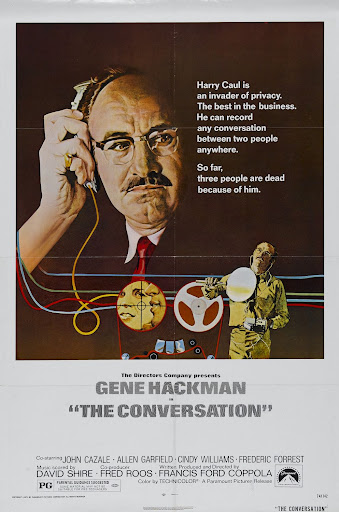
The Conversation (1974)

By Richard Winters

My Rating: 10 out of 10

4-Word Review: Someone is listening in.

Harry Caul (Gene Hackman) is a surveillance expert who specializes in listening into people’s private conversations and has a reputation of being quite good at it. Many wealthy clients hire him to record things from their enemies that they might not be able to attain otherwise. However, one of these assignments led to the death of three people and Harry, being a highly religious man, has felt guilty about it ever since. He begins to have the same concerns with his new assignment when he overhears a couple (Fredric Forrest, Cindy Williams) who he’s recording mention that ‘he’d kill us if he got the chance’. Harry is unsure if he wants to give the tapes up to his client as he’s frightened the same scenario as before will occur. Martin (Harrison Ford) the man representing the client becomes aggressive in getting the tapes and warns Harry that they’ll get their hands on them one way or the other. Harry, a private man, soon realizes that this client is just as sophisticated in surveillance technology as he and maybe even more so as he becomes aware that his phone and even his apartment is bugged.

Inspired by real-life surveillance expert Martin Kaiser, who was a technical consultant on the production, the film deftly explores how today’s modern technology has easily evaded our private lives and how no one is safe from prying eyes and ears a concern that has become even more pronounced in the decades following its release. Many presumed that it was a testament about the Watergate break-in, which occurred a year before the movie came-out and uses much of the same sound equipment used the by criminals in the real-life event, but in actuality the script, by Francis Ford Coppola, was already complete in 1965, but was unable to get any financial backing until his success with The Godfather. 

The film scores on just about all levels especially with the way it captures San Francisco. I loved the bird’s eye-opening shot of Union Square as well as the terrific use of the fog that gets used to great effect during a memorable dream sequence. The soundtrack by David Shire is quite unique as it’s made to replicate sound waves changing frequency. I liked too that quite a bit of time is spent showing Harry inside his editing studio where he puts together the tape he’s recorded from different sources into a cohesive whole and watching him do it, even if it’s from equipment that would be deemed dated now, is impressive and makes you appreciate the expertise of the character.

Acting wise this may be Hackman’s best, and he stated in later interviews that he considers this to be his finest work, though at the time he felt it was an extreme challenge playing such an introverted person when he himself was highly extroverted, but the payoff is rewarding as he displays characteristics unlike any other role he’s played. What impressed me most was his body posture, which is hunched over, and he walks with a pensive gait, which reveals to the viewer the character’s inner angst without it ever having to be verbally explained. It’s interesting too how he’s mostly shy and stand offish during the majority of it making him seem like a wallflower, but when the subject of his sound expertise comes into discussion, he’s suddenly bragging about his state-of-the-art machinery showing how even the most unassuming of people can still have a big ego and helping to create a protagonist who’s three-dimensional.

There’s also great support from a young Harrison Ford, who appears with a scar on his chin, who despite presenting himself in a composed manner and speaking in a controlled tone of voice is quite menacing. Terri Garr is excellent as a prostitute that Harry frequents and acts as Harry’s only social outlet as well as Allen Garfield playing a huckster whose also Harry’s rival and clearly has a way about him that gets under his skin. Great work too by John Cazale who works as Harry’s assistant and their relationship runs hot-and-cold and there’s even Robert Duvall in a small, but pivotal part.

Spoiler Alert!

While the film is expertly crafted, I did find the scene where Harry’s landlady leaves him a birthday gift inside his apartment to be problematic. We see that Harry has three different locks on his door, which keenly reveals what a private person he is and how paranoid he is to protect it, and yet when he opens up his door there’s an item sitting on the floor left by his landlord. Through a subsequent phone conversation, he has with her we learn that she was able to get in by using her master key, but it’s highly unlikely that she would have three different keys for each lock.

Another issue happens at the end when Harry tears his apartment apart in desperate attempt to find the covert listening device that’s been planted by the client and is able to listen and record everything he says and does. He isn’t able to locate it despite a thorough and exhaustive search and then spends the rest of the time playing his saxophone as it’s the only thing he has left, which is where it finally dawned on me that was probably where they implanted the bug and the movie should’ve had him dismantle that too and then if he was unable to find it there, after destroying everything else, he could be seen lying in the barren, darkened room in a fetal position and completely defeated, which might’ve left an even more lasting and riveting final image.

My Rating: 10 out of 10

Released: April 7, 1974

Runtime: 1 Hour 53 Minutes

Rated PG

Director: Francis Ford Coppola

Studio: Paramount Pictures

Available: DVD, Blu-ray, Amazon Video, YouTube

One From the Heart (1982)

oneheart

By Richard Winters

My Rating: 2 out of 10

4-Word Review: Break-up/make-up

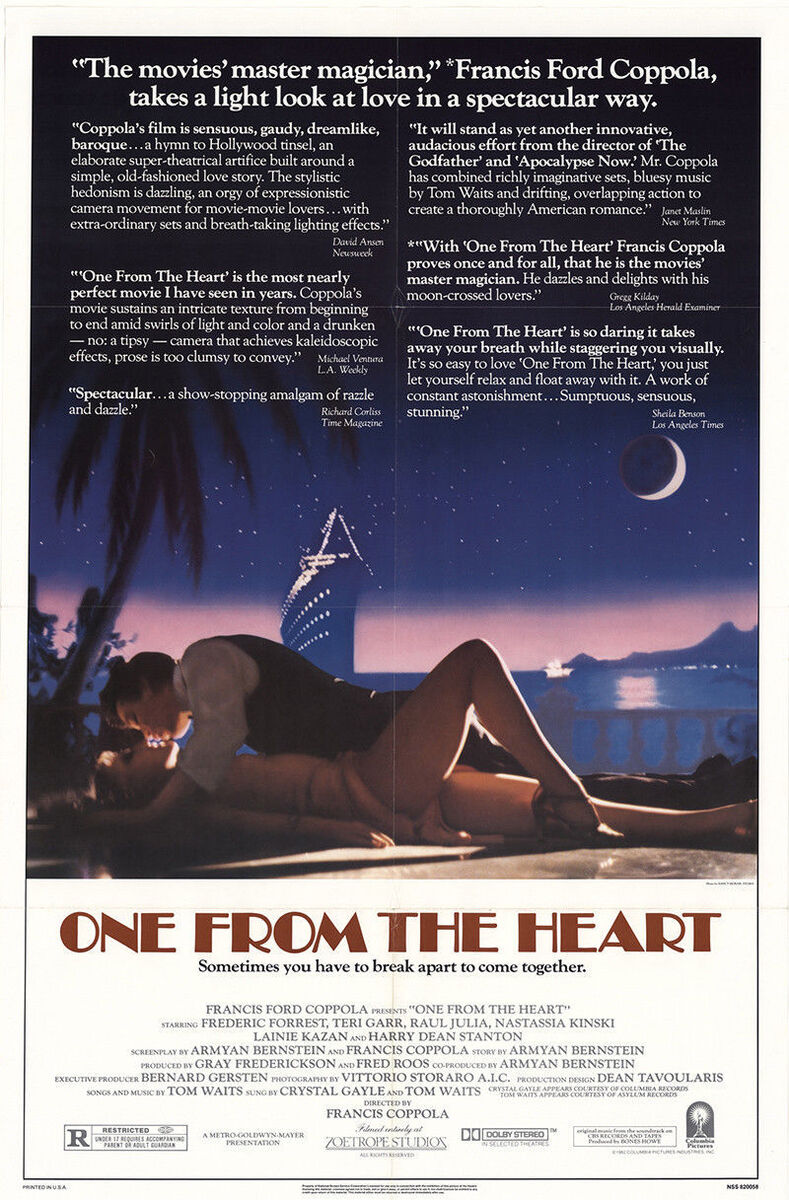
Hank (Frederic Forrest) and Frannie (Teri Garr) have been together for 5-years but while celebrating their anniversary at home the cracks in their relationship begin to show. Frannie is upset that they can never go out and wants more adventure. Hank doesn’t see this as a problem, so the two break up. Frannie meets Ray (Raul Julia) a waiter who has ambitions to become a singer. Hank gets together with Leila (Nastassja Kinski) who is much younger than him and lives the fast lifestyle. Each spends a night with their new partner, but end-up longing for their former mates when it’s over. Ray offers to take Frannie to Bora Bora, but will she really board the plane, or will Hank catch-up with her in time and convince her to move back with him?

The movie has a weird look about it and this is mainly because director Francis Ford Coppola decided he wanted to film the entire thing on the soundstage of his Zoetrope studios. This in retrospect seemed absurd as the setting was Las Vegas with one of the most flamboyant downtowns of any city, so if the real thing is already visually arresting why trump it with a fake one that isn’t half as exciting? The artificial presence kills the movie from the very start and what’s worse is that it was so painstakingly expensive to create the set design, which is massive, that it sent Coppola and his studio into bankruptcy of which it took many years to recover and all of it wouldn’t have been necessary if they had just shot it on-location, which would’ve been a thousand times better.

The lighting is one of the more annoying aspects particularly the red light that shines through the couple’s home window making it look like they live in the red-light district of Denmark, or near a police station. The outdoor scenes look as phony as you’d expect including having the night sky shown to have a ‘ceiling’ and the distant mountain vistas appearing as nothing more than a cheap matted on paintings. Everything comes-off as loopy like a great director whose ego got the best of him, and he made a massive artistic overreach for no other purpose then just to see if he could. The music interludes by Crystal Gayle and Tom Waits don’t work either. If a movie is intended to be a musical, as this one kind of is, then each song needs to sound distinct and at least moderately peppy, but here it comes-off like the same droning song that just never ends and adds little to the already goofy set-up.

The characters are poorly fleshed-out and, with the modest exception of Harry Dean Stanton and Elia Kazan, wholly uninteresting. The break-up is the biggest problem as the ‘squabble’ appears to be over nothing more than the fact that Hank didn’t take Frannie out on their anniversary, but to move-out because of something like that seems awfully trite. Normally for relationships/marriages to go really bad there needs to be a lot of anger simmering underneath the surface and this thing at best is just a tiff especially when at the beginning they seemed content with other. To make it realistic there should’ve been clear underlining animosity right away and not go from ‘happy couple’ to break-up with a snap-of-the-finger.

Not sure either if it’s exactly possible to get back together after the other partner has slept with someone else. Granted there could be some exceptions, but most people would consider it an extreme betrayal and unforgivable and certainly not something that they could just conveniently forget about and return back to the ‘happy couple’ that they were. Yes, in this instance they both cheated, but that makes things even worse. Who’s to say you can ever trust the other again? If one tiny disagreement can get each one to suddenly jump in the arms of a perfect stranger what’s to say that won’t get repeated in the future?

Garr, who appears topless in several scenes and even fully naked from the back in one moment, is okay. The supporting cast is also good especially Allen Garfield as Julia’s perturbed boss. I even found Kinski a bit mesmerizing with her singing and the way she was able to balance herself on a big orange ball that used to be the sign for the Spirit of 76 gas stations, but overall the thing is so thinly plotted, with too much emphasis being put on the garish set design, that it can all be summed up as a hopeless experiment gone wrong. Even Coppola has admitted in subsequent interviews that it’s a ‘total mess’, so if the director is warning you that his own movie doesn’t have much going for it, you’d better listen.

My Rating: 2 out of 10

Released: February 11, 1982

Runtime: 1 Hour 39 Minutes

Rated R

Director: Francis Ford Coppola

Studio: Columbia Pictures

Available: DVD, Blu-ray, Amazon Video, YouTube

Believe in Me (1971)

believe

By Richard Winters

My Rating: 6 out of 10

4-Word Review: Couple addicted to drugs.

Remy (Michael Sarrazin) is a medical student at a New York hospital, who finds himself increasingly addicted to speed and other drugs available to him through his job. Pamela (Jacqueline Bisset) is the beautiful new girlfriend he meets through his friend and fellow intern Alan (Jon Cypher) who’s also Pamela’s brother. The two hit-it-off and soon move into together, but the romance doesn’t last when Pamela becomes aware of Remy’s addiction. He convinces her that he can handle it and even gets her to try some of it despite her reluctance. This then leads to her becoming hooked as well and their lives quickly spiral out-of-control as they both lose their jobs, their money, and ultimately their dignity.

The early 70’s was  a peak era for drug culture movies with most getting a bad rap from the critics, which included this one. Certainly it does start out cringey with a sappy love song sung by Low Rawls that not only gets played over the opening credits, but also about 30-minutes in, which practically kills the whole thing with its heavy-handed melody and lyrics. The title is not so great either as it seems to imply a totally different type of movie like have someone sticking with another person through thick-and-thin, which really doesn’t happen here and in fact its the complete opposite.  ‘Speed is of the Essence’, which was the working title as well as the title of the New York Magazine article by Gail Sheehy of which the film was based was far more apt and should’ve been kept.

However, what I did like are that the characters aren’t teen agers, or a part of the counter-culture movement, which is where all the other drug movies from that period had. The blame in those films was always the same too: peer pressure and bad influences, but here that all gets reversed. Remy and Pamela are well educated and with Remy’s background is well aware of the dangers of drugs and essentially ‘knows better’ and yet becomes a victim to them anyway. Because he’s at such a high standing initially and not just played-off as being some naive kid, makes his downfall and that of his equally smart girlfriend all the more stark and gripping.

The performances are good too. Sarrazin and Bisset met while filming The Sweet Ride, that started a 6 year relationship and this was the one project that they did together. Sarrazin has been blamed as being too transparent an actor who’s instantly forgettable and melts into the backdrop. While I’ve usually found his acting credible he does have a tendency to be passive and lacking an imposing presence, but here he’s genuinely cranky and snarly. Even has some moments of anger, which is why the movie mostly works because the character is believable. There’s good support by Alan Garfield as his dealer who gets the final brutal revenge on Remy when he can’t pay up as well a Cypher whose advice to his sister when she’s down-and-out and asking for money is shockingly harsh.

Spoiler Alert!

The film has a few strong moments particularly when it focuses on the couple’s teenage friend Matthew (Kurt Dodenhoff) who also becomes hooked and goes through a scary mental and physical decline, but the ending lacks punch. It has Remy sitting outside his apartment saying he’s ‘lost his key’ (not sure if this was meant as a code word for them being evicted, but probably should’ve been). Pamela then leaves him there while she walks to a clinic in order to get sober, which for me was too wide-open. For one thing there’s no guarantee that Pamela would’ve been able to cleanly kick-the-habit as many people enter into drug recovery suffer many relapses. Leaving Remy alone doesn’t offer any finality. Either he dies from his addiction, or finds a way out, but we needed an answer one way, or another like seeing his lifeless body lying in the gutter, which would’ve given the film the brutal final image that it needed. The movie does give an honest assessment of the situation most of the way, so why cop-out at the end and become vague? The viewer had invested enough time with this that they should’ve been given a more complete and concrete character arch.

My Rating: 6 out of 10

Released: December 8, 1971

Runtime: 1 Hour 26 Minutes

Rated R

Director: Stuart Hagmann

Studio: MGM

DVD-R (dvdlady.com)

Cry Uncle (1971)

cry uncle

By Richard Winters

My Rating: 5 out of 10

4-Word Review: Murder, mystery and sex.

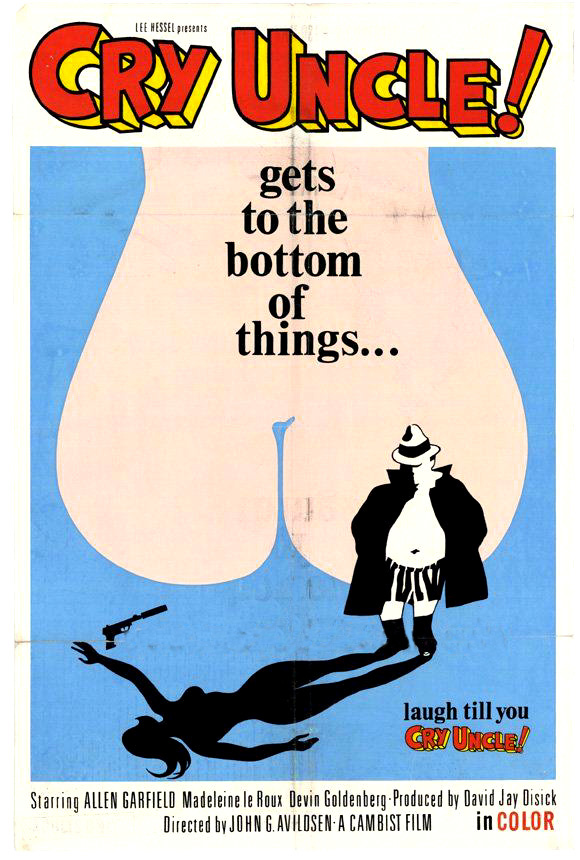
A down-and-out private eye (Allen Garfield) becomes embroiled in a complex case involving murder, intrigue, and a lot of sex.

This is one drive-in flick that definitely does not skimp on the sex. Not only is there a lot of it, but it is very explicit and done in outlandish ways. One features a couple having sex during the national anthem, while another has Garfield having sex with a prostitute while in front of a picture of Jesus. The most notorious though involves Garfield making love to a dead body while ragtime music plays in the background.

Garfield is quite amusing as a character that is always running his mouth off about something although the excessive shots of his nude overweight, out-of-shape body is enough to make anyone sick. Paul Sorvino is also funny in a cameo bit as a policeman plagued with a terrible case of smoker’s cough.

Although she delivers her lines well Madeleine Le Roux as the female lead is not sexy at all. Her face resembles that of Cruella De Vil’s in the Disney version of 101 Dalmatians and her body is very flat making her nude scenes unexciting. She also doesn’t seem too young either. Certain camera angles make her look like a youthful 30 while others give the impression that she is pushing 45.
The film is directed by John G. Avildsen who later went on to do Rocky and The Karate Kid. You can also spot famous schlock director/producer Lloyd Kaufman with a full head of curly hair playing a hippie.

For fans of low-grade, T & A, drive-in fare this one pretty much hits the target and makes the most of its low budget, underground roots although it is unable to sustain the slam-bang funny pace that it has at the beginning with a second half that is not as outrageous or inspired.

My Rating 5 out of 10.

Released: August 17, 1971

Runtime: 1Hour 27Minutes

Rated R

Director: John G. Avildsen

Studio: Cambist Films

Available: VHS, DVD, Amazon Instant Video

The Stunt Man (1980)

the stunt man

By Richard Winters

My Rating: 7 out of 10

4-Word Review: Convict becomes a stuntman.

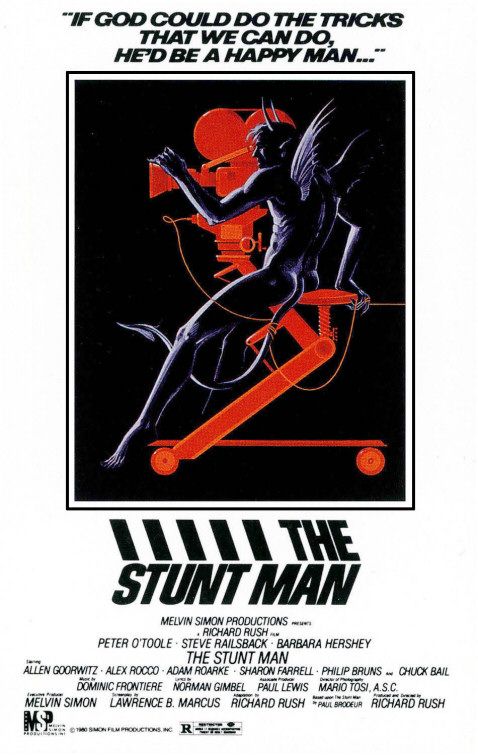
Cameron (Steve Railsback) is on the run from the cops who unknowingly comes onto a movie set and inadvertently causes the death of one of the stuntmen. Eli Cross (Peter O’Toole) the film’s God-like director takes a liking to Cameron and decides to hire him on as the replacement stuntman. Cameron is initially reluctant as he has no experience, but decides it would make a good cover from the police who are still after him. He starts an affair with the film’s leading lady Nina (Barbara Hershey), but finds that it may be Cross that he should be the most afraid of and who may be planning to film Cameron’s death during a difficult underwater stunt in order to add realism.

This is another one of those film-within-a-film type movies with this one faring a bit better than the others. One of the best ingredients it has is showing the behind-the-scenes politics that go on during any film production as well as hitting-the-nail-on-the-head with its caricatures.

Railsback is fun in a rare leading role. The way he can get intense as well as convey the rugged, ragged personality of a war-weary veteran on the run and just trying to survive is completely on-target. His best moments are simply his frightened and confused facial expressions that he has while going through many of Eli’s elaborate stunt routines and not sure if he will be coming out of it alive or not.

O’Toole is in peak form and was nominated for the Academy Award playing an egotistical director, which he modeled after David Lean. Having a director make a film advocating the horrors of war and violence, but then beat-up or threaten numerous crew members any time they make a mistake is perfect irony. My favorite moment of his is when they are showing rushes of Nina’s scenes from that day to her parents and then to their shock he throws in a few scenes showing Nina naked and in bed with another man. Then the next day he informs Nina about it simply to upset her and get the needed reaction that he wanted for the scene.

Hershey is splendid as a Hollywood actress who at times is quite jaded while at other moments is very naïve, child-like and emotionally fragile. Allen Garfield as the film’s exasperated and beleaguered screenwriter is also quite good. I also liked Chuck Bail who essentially plays himself as a stunt coordinator who tries to teach Cameron the fundamentals of the business.

Dominic Frontiere’s booming orchestral score is quite distinctive and at times even stirring particularly during the chase sequence. There is an abundance of ironies and twists that keep things interesting throughout and at points a bit surreal, but it’s missing that one final delicious twist or payoff and has an ending that seems a bit like a copout.

My Rating: 7 out of 10

Released: June 27, 1980

Runtime: 2Hours 11Minutes

Rated R

Director: Richard Rush

Studio: 20th Century Fox

Available: VHS, DVD, Blu-ray, Amazon Instant Video