Tag Archives: Alan J. Pakula

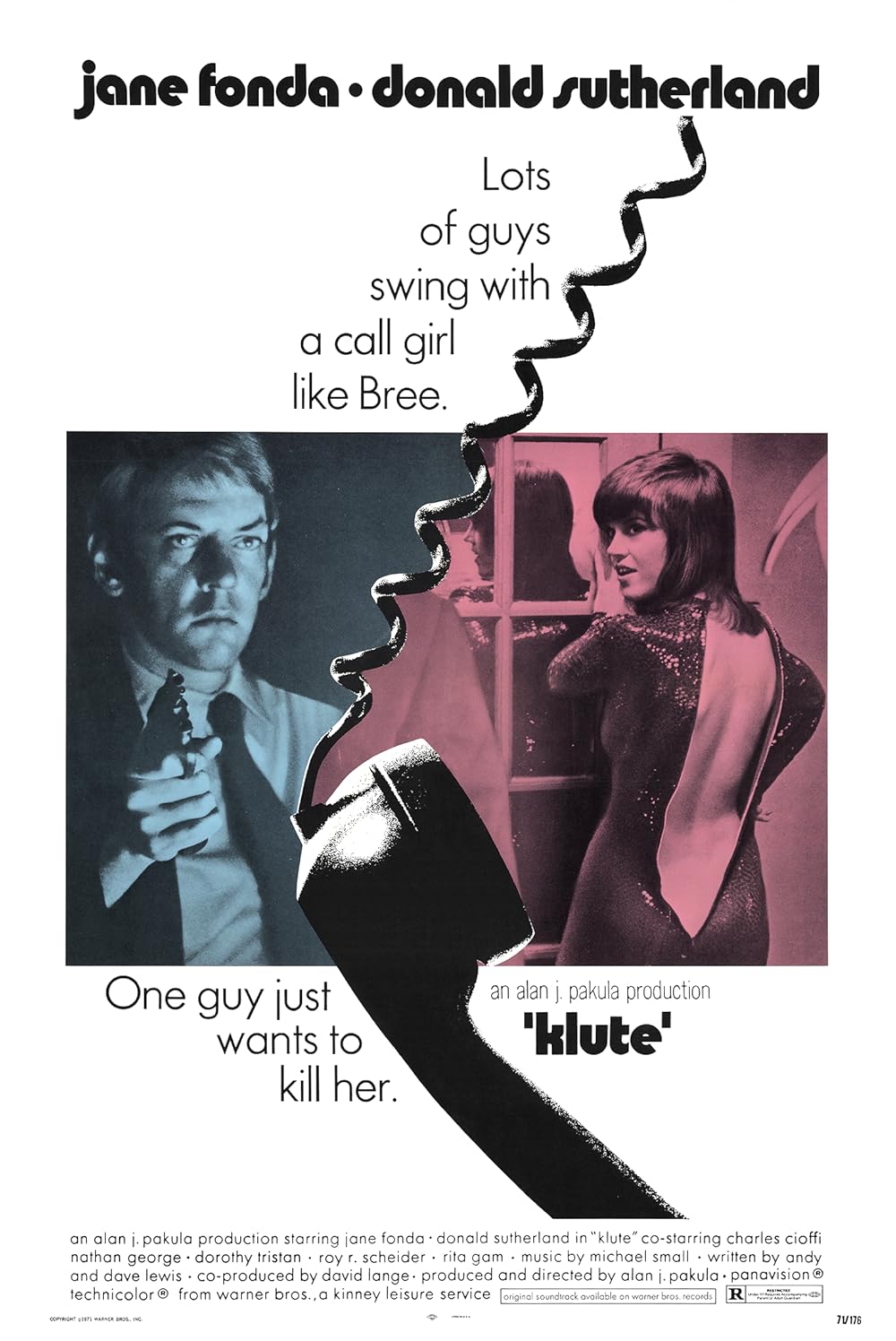
Klute (1971)

By Richard Winters

My Rating: 8 out of 10

4-Word Review: Detective falls for prostitute.

John Klute (Donald Sutherland) is a private detective who is hired by Peter Cable (Charles Cioffi) to investigate the disappearance of a CEO named Gruneman (Robert Milli). The only clue is an obscene letter found in Gruneman’s office that he wrote to a prostitute named Bree (Jane Fonda). When Klute initially tries to question her, she refuses to help, so he rents an apartment in her building, which allows him to bug her phone. Eventually the two become friendly and even form a bit of a relationship, but Bree is only able to offer a few clues mainly that one of the johns she saw two years ago who used Gruneman’s name beat her up, but when he shows her a picture of the real Gruneman she says he wasn’t the one. This forces Klute along with Bree’s help to try and track down the other prostitute’s that had seen the same john, but their efforts prove mostly futile even as the unidentified killer continues to stalk Bree and appears ready to close in.

Sometimes it’s hard to tell from a script, which was written by two brothers, if it’s going to make for a good movie, or not. This is clearly a great example for how it’s approached directorially can make all the difference. In other hands this could’ve been a blah programmer, but director Alan J. Pakula, along with cinematographer Godon Willis, adds so many stylized touches that it grabs you in from the very beginning and never let’s go. The evocative lighting is particularly impressive as is the editing and Michael Small’s soundtrack who wisely keeps the music subtle using only the light touches of a xylophone to help accentuate the suspense. What’s most amazing though is Bree’s apartment, which was completely constructed on a soundstage, complete with working toilet, but you’d never know it as it has an authentic cluttered, live-in look and realistic outside light and sound ambience coming in from the window making it one of the most believable set designs I’ve ever seen. Even if you’re not into the mystery just watching it for its production values along would be mesmerizing enough.

The acting adds yet another excellent dimension with Sutherland, wearing a boyish looking bowel haircut, disappearing in his role by giving a nuance performance that allows for Bree to get most of the attention. Fonda, who won the Oscar for her work here, is genuinely riveting and she adds a lot to the proceedings that wasn’t in the original script. One great example of this is when Bree listens to a tape recording of another prostitute getting violently attacked. It was written in that her character should respond with a look of fear, but instead Fonda impulsively broke out in tears, which helped to make her more likable when you can visibly see her empathy and emotions towards her peers. The wide mood swings that her character shows seemed quite authentic for that type of person. The romance angle works better than in most movies, as here it comes off more incrementally and not just all of sudden and it’s his unselfish actions that earns her love, but realistically due to their contrasting lifestyles never comes to a full, permanent fruition.

Charles Cioffi is also really good, but surprisingly never got enough credit. What impressed me was how ordinary he looked where he doesn’t stand out at all and could easily be a typical businessman seen anywhere. In most movies someone with a strange, or scary appearance gets cast as the bad guy, but in real life most killers blend in, like this one, and that’s why they’re able to get away with their crimes for as long as they do. I also liked how when he’s stalking Bree there’s a brief look of sadness in his eyes, like there’s a part of him that feels bad for what he’s about to do, which helps to make his character multi-dimensional. My only quibble is I wish we had seen a bit of his private life. Most likely a high corporate type like him would’ve been married and with a family and seeing him playing around with his kids, even briefly, would’ve made his dark side, when it finally comes about, all the more shocking, but still believable as I think there’s plenty of ‘happily’ married family men out there that could still harbor dark fantasies.

The supporting cast has some interesting moments too, which includes Roy Scheider in a rare turn as an antagonist, which he does well in, and Dorothy Tristan in a small, but pivotal part, as a drug tripping hooker. You can also spot Veronic Hamel, as an auditioning ad model, and Jean Stapleton, as a ditzy secretary, playing in minor roles before they became famous.

Spoiler Alert!

My only complaints with the story come mainly during Bree’s therapy sessions. The sessions themselves, especially the performance by Vivian Nathan as the psychiatrist, were well handled and one of the more realistic interpretations of a therapy session put on a film, but Bree’s ‘confessions’ didn’t totally jive. She says she feels ‘most in control’ when she’s doing tricks, but I’d presume it would be the other way. She packs no gun, so what’s to protect her if a guy gets rough? The idea that Cable would’ve been the only client that would have ever gotten violent with her seemed a stretch. Granted she’s a ‘high class’ call girl, but that still wouldn’t make her completely immune from having to deal with the occasional sickie. Rich guys can be dangerous too and sometimes even more so.

Hard to imagine that she couldn’t describe what the violent john who attacked her looked like especially since that was apparently a rare experience, so I’d think that would make him stand out even more so. His face would be so etched on her mind that she’d easily be able to tell Klute his appearance versus here where he just gets somehow forgotten in her mind along with all the rest.  The scene where she meets up with another client and he implies that he has a unusual turn-on that he’d like to play out and whispers it in her ear, but then when the sex does get shown, under the covers, it comes off as quite vanilla and I failed to see where the ‘kink’ was.

I also felt it was a mistake to reveal who the killer was during the second act and having it remain a mystery to the very end would’ve been creepier. The way it gets resolved, where the detectives are able to connect the same typographical error in the obscene notes to other correspondence that Cable had sent to Gruneman, seemed too easy. I just don’t think Cable would’ve been dumb enough not to have spotted that mistake himself before sending out. A better way would’ve had Bree unable to remember the killer’s identity due to him knocking her unconscious during their violent meeting and then struggle through therapy to bring those repressed memories back, which she would’ve eventually been able to do at the end.

My Rating: 8 out of 10

Released: June 23, 1971

Runtime: 1 Hour 54 Minutes

Rated R

Director: Alan J. Pakula

Studio: Warner Brothers

Available: DVD, Blu-ray (The Criterion Collection), Tubi, YouTube
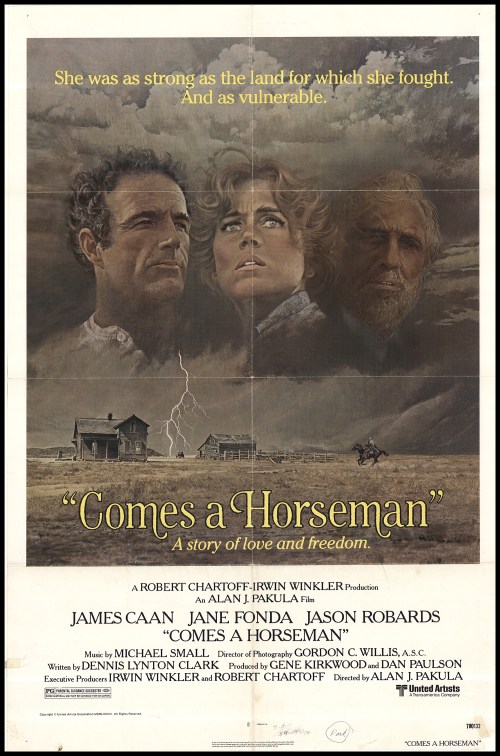


Comes a Horseman (1978)

By Richard Winters

My Rating: 6 out of 10

4-Word Review: Ranchers battle for land.

Recently widowed Ella (Jane Fonda) must struggle to run her ranch in the middle of the desolate west by herself. Frank (James Caan) is her neighbor who is being harassed by Jacob Ewing (Jason Robards) to sell his land and Ewing has also made a strong play for Ella’s property as well. Both refuse his offers and then band together to defend themselves and Ella’s ranch from Ewing and his men who are willing to do anything it takes in order to get what they want.

The film’s main charm is its stunning cinematography by Gordon Willis who captures the expansive western landscape in breathtaking fashion and this is indeed one film that must be watched on the big-screen, or in widescreen to be fully appreciated. Director Alan J. Pakula instills a wonderfully slow pace with a minimum of music, which gives the viewer an authentic feel for what life out in the country during the 1940’s must’ve been like.

I also really liked the fact that Ella and Frank didn’t immediately fall-in-love and jump into bed together. Too many times films made during the post sexual revolution depicted characters from bygone eras as being far more liberated than they really were and here they’re authentically reserved and in fact they don’t even show any affection for one another until well into the story and when it does happen it seems genuine instead of just sexual.

Jane gives an outstanding performance. Usually she commands the screen and gives off a sexual allure, but here she literally disappears in her role of a humble farm woman until you don’t see the acting at all. Former stuntman Farnsworth at the age of 58 makes an outstanding film debut in a supporting role that will emotionally grab the viewer.

The story, which was written directly for the screen by Dennis Lynton Clark, lacks depth and has too many elements stolen from other similar films. Stanley Kramer’s Oklahoma Crude, which came out 5 years has almost the exact same plotline, but done in a darkly comic manner. Both deal with a man moving onto a woman’s ranch to help as a farmhand. The woman initially rebuffs the male’s advances, but eventually softens. Both deal with an oil company pressuring her to sell her land and harassing her when she doesn’t and they both have a memorable scene involving a windmill.  The oil subplot, particularly in this film seems rather unimaginative and like it was thrown simply to create more conflict while Ella’s past relationship with Ewing and the dark secret that they share should’ve been more than enough to carry the picture.

The one thing though that really kills the picture is the ending where Ella and Frank find themselves being attacked and in an effort to build up the tension loud music similar to what’s heard in a modern-day thriller gets thrown in. This had been a movie that had been very quiet up until then and it should’ve stayed that way. The actions seen on the screen was more than enough to horrify the viewer and no extra music was needed. Hearing nothing more than the howling wind on the prairie would’ve made it more effective as it would’ve reminded the viewer how remote the location was and how no one else was nearby to help Frank or Ella. For a movie that tried so hard to recreate the feel of a past era only to suddenly go downright commercial at the very end is a real sell-out.

The fact that all the night scenes were filmed during the day using a darkened filter is another letdown. There have been many films that have been shot in actual nighttime darkness so why couldn’t this one? If you want to see a film set during the same time period with equally captivating visual approach, but stays more consistent in theme then I’d suggest Days of Heaven, which was also released in 1978.

My Rating: 6 out of 10

Released: October 25, 1978

Runtime: 1 Hour 59 Minutes

Rated PG

Director: Alan J. Pakula

Studio: United Artists

Available: DVD, Blu-ray, Amazon Video, You Tube

The Sterile Cuckoo (1969)

sterile cuckoo 1

By Richard Winters

My Rating: 7 out of 10

4-Word Review: This relationship is doomed.

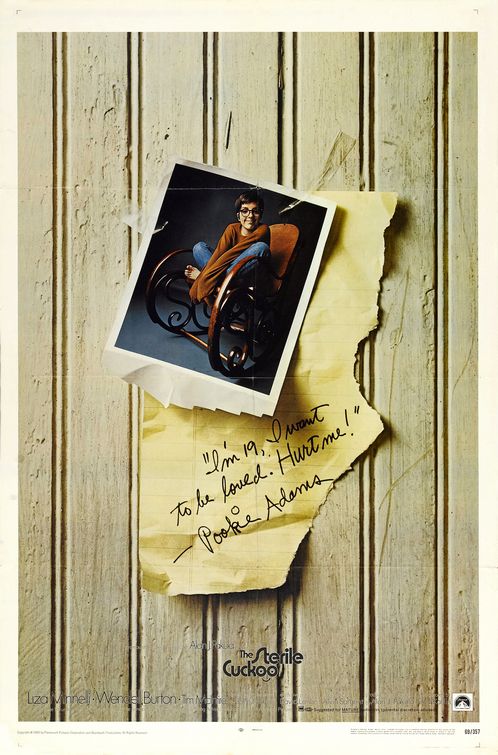
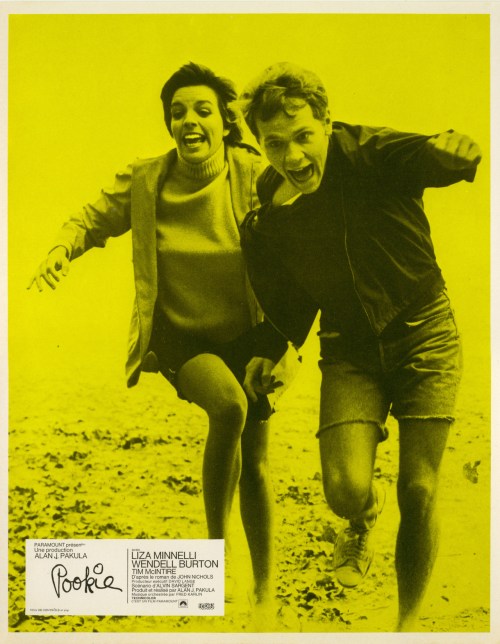
Mary Ann Adams (Liza Minnelli), who goes by the nickname of Pookie, is a complete social misfit who can’t fit-in anywhere.  As she waits at a bus stop to go off to college she meets Jerry (Wendell Burton) a shy and reserved young man who just happens to be attending the same school as she. Pookie immediately starts up a conversation with him and takes full advantage of his quiet nature to force herself into his life. The two soon begin to date, but Pookie’s inability to get along with others and her extreme insecurities make it almost impossible for the fledgling relationship to get off the ground.

This film marks the directorial debut of Alan J. Pakula and the result is nothing short of excellent. This is the type of movie that they don’t seem to make anymore where great sensitivity is taken to focus on a broken individual, but without ever making fun or demeaning them in anyway. The film’s pace is slow, but never boring and the emphasis is almost entirely on the nuances of its two leads. It also features one of the best and most memorable movie soundtracks to come out of the ‘60s.

The film is based on the novel of the same name that came out in 1965 and was written by John Nichols. It was even shot at Hamilton College in Clinton, New York where Nichols graduated in 1962. For the most part the script, by the prolific Alvin Sargent, stays quite faithful to the book with the only real big difference being that the story here encompasses only one year while in the book it was three. To me this revision was an improvement because the relationship was clearly doomed from the beginning and I couldn’t imagine it somehow lasting for three years let alone one to begin with.

Minnelli’s performance is Oscar worthy and the scene where she has a long talk on the phone with Jerry and the camera stays solely focused on her face is one the strongest moments in the movie and could only have been pulled off by a brilliant actress who somehow makes the viewer empathetic to this otherwise annoying character.

Burton, in his film debut, is equally strong and watching the two characters with such contrasting styles dealing with each other is the main catalyst that propels the story. Tim McIntire, as Jerry’s college roommate, is quite good as well playing the perfect composite of a partying college kid while also offering one of the film’s few moments of levity.

Some viewers have complained that the film lacks any wintertime shots even though the story takes place in Upstate New York where snow is inevitable and the story is supposedly spread over one full school year, but to me this is nitpicky. Clearly the film’s budget didn’t allow for shooting over an entire year and it wasn’t necessary anyways. The film captures the forestry region in such a vivid way that it almost becomes like a third character. It also in my mind made it more believable because I never felt this wacky, makeshift romance could last a full year and at best might’ve only existed for the fall semester before inevitably petering apart.

For me the only real criticism is the fact that we learn very little of about Pookie’s personal life. She mentions her relationship with her father quite a lot and we see him for a brief period at the beginning, but then that’s it even though it would’ve helped the viewer understand the character better had a backstory, or scenes involving her family life been shown.

The film is also incredibly sad to the point that it will make just about any viewer depressed after seeing it. On the technical end it’s flawless, but Pookie’s feelings of loneliness and the character’s extreme isolation eventually reaches out and sucks the viewer into it without any let up and it remains with them long after it’s over.

sterile cuckoo 2

My Rating: 7 out of 10

Released: October 22, 1969

Runtime: 1Hour 48Minutes

Rated M

Director: Alan J. Pakula

Studio: Paramount Pictures

Available: DVD, Blu-ray, Amazon Instant Video, YouTube

Rollover (1981)

rollover 1

By Richard Winters

My Rating: 3 out of 10

4-Word Review: What’s in account 21214?

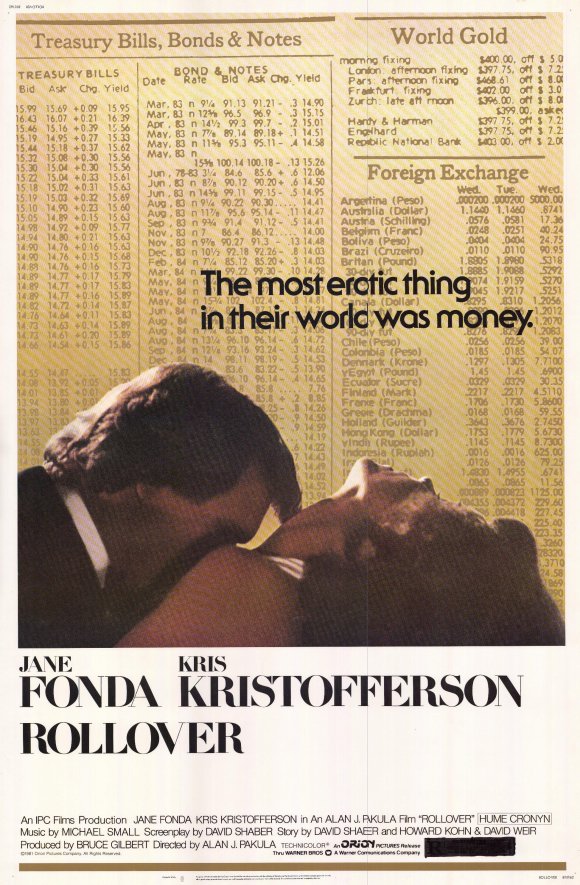
Hubbell Smith (Kris Kristofferson) is the newly appointed president of Borough National a bank that is in desperate need of money. He meets Lee Winters (Jane Fonda) the recent widow of the former chairman of Winterchem Enterprises who is looking to obtain a loan in order to purchase a Spanish processing plant. Hubbell broker’s the $500 million deal with some Arab investors and uses the finder’s fee portion to keep his bank solvent, but suspicions are raised when the money goes into a secret account named 21214 that no one knows anything about and can’t access. When Hubbell does some investigating he finds troubling answers that could lead to economic world collapse.

Director Alan J. Pakula approaches this thing like it is another Klute using not only the same star as that one, but similar type of music. Some of the camera work is dazzling and artsy, but I wondered if this was done to help enhance the script, or simply camouflage all of its holes. The story itself is too talky with a heavy reliance of financial business dealings that could become confusing for the average viewer. The two main characters are rather generic and their passionate making-out is tedious instead of sexy. The action is minimal, which includes a scene where Fonda gets trapped in a limo that is driven by a bad guy that had the potential for being exciting, but unfortunately gets underplayed.

Kristofferson with his Texas drawl is an awfully odd casting choice for a hot shot Wall Street businessman. He grows on you as the movie progresses particularly with the way he remains cool and detached even as his business dealings go horribly awry, but I still felt there were a hundred other actors that would have been better suited for the role.

Fonda is excellent and in many ways badly outplays her costar. Her character though doesn’t make a lot of sense as she is supposedly this famous and highly respected actress, much like Fonda herself and yet wants to be chairwoman of this chemical company instead of just selling her share of the stock after the death of husband and go back to acting, which to me would seem a lot more fun.

In an effort to keep the plot moving the film takes a few liberties with the plausibility. One of the major ones is when Hubbell wants to find out about the secret account and does so by breaking into the office of his superior where he finds in his desk drawer a notebook that lists the computer passcode, which seemed too convenient. In reality I would think a programmer would have to be hired in order to hack the system, which would have taken longer to play out, but also if done right heighten the tension as well as the believability.

Spoiler Warning!!

The film’s biggest transgression is the ending itself, which has the Arabs pulling the money out of the secret fund, which causes mass worldwide economic turmoil and chaos. Not only does this seem to create a whole new movie, but it also minimizes the two main characters and everything that we watched them do for the past two hours. A much better ending would have had the characters come up with some way to avert the collapse instead of the gloomy pessimistic way that it does take, which seems overblown and hard to believe.

End of Spoiler Warning!

My Rating: 3 out of 10

Released: December 11, 1981

Runtime: 1Hour 56Minutes

Rated R

Director: Alan J. Pakula

Studio: Warner Brothers

Available: VHS, DVD, YouTube, Amazon Instant Video

Love and Pain and the Whole Damn Thing (1973)

love and pain and the whole damn thing

By Richard Winters

My Rating: 6 out of 10

4-Word Review: Introverts fall in love.

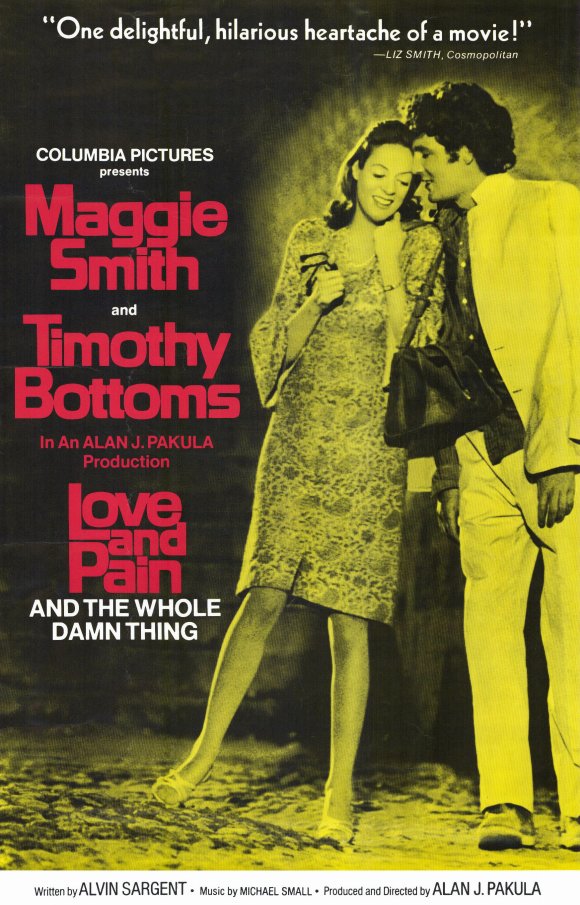
Walter (Timothy Bottoms) is a shy young man in his early 20’s riding through Spain as part of a cycling tour group. Impulsively he ditches this group and joins a bus touring one of which Lila (Maggie Smith) an equally shy woman in her 30’s is a part of. At first the two hardly speak, but eventually they get past their social quirks to form a tight, romantic bond.

The awkwardness and insecurities of the two characters is wonderfully captured and it is nice to see a film examine a romance between people that are not physically beautiful or affluent. The music score is subtle and Alan J. Pakula’s direction approaches the material in a nicely sensitive fashion along with the Spanish scenery that gives the production an exotic feel.

Smith is excellent as usual. Her performance and character is different from anything else that she has done making it a real treat to watch. The scene where she calls home to her family as well as the one where she gets locked inside a remote outhouse is quite amusing.

I would have liked to have seen a little more interaction with the other people on the bus as the supporting cast is almost non-existent and focuses too much on the two main characters making it seem like there are the only ones in the entire country of Spain, which gives the viewer a very isolated type of feeling. This may have been the intention and done as a way to show what it is like being introverted, but I didn’t care for it.

Although the two characters are offbeat the film follows too much of a romantic blueprint that eventually makes it formulaic despite a good start. Its biggest transgression is having one of the characters like in Love Story get afflicted with some mysterious illness that is never explained and put in to create cheap dramatic turmoil.

Overall though the film is okay and has a few touching moments. Those that enjoy romance may like it a bit better as well as fans of Maggie Smith.

My Rating: 6 out of 10

Released: April 19, 1973

Runtime: 1Hour 50Minutes

Rated R

Director: Alan J. Pakula

Studio: Columbia Pictures

Available: DVD