Tag Archives: 80’s Movies

Still of the Night (1982)

By Richard Winters

My Rating: 4 out of 10

4-Word Review: This teddy bear bleeds.

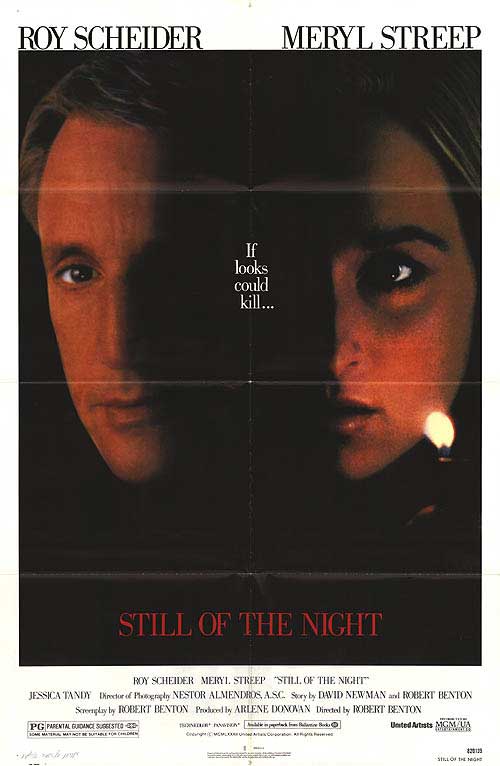
Successful psychiatrist Sam Rice (Roy Scheider) finds himself immersed in a tangled web of murder and deceit. One of his patients, wealthy art dealer George Bynum (Josef Sommar), is found murdered. A mysterious woman named Brooke Reynolds (Meryl Streep) visits him and states that she was George’s mistress and Sam suspects that she may be the killer. He tries to do his own investigation, but the police start to doggedly tail him thinking he may know more than what he is letting on.

This was yet another homage to Alfred Hitchcock, this time done by writer/director Robert Benton, who is an excellent filmmaker in his own right.  This one has all of the style, but none of the substance.  The concept is slickly handled, but it misses Hitch’s flair as well as his wry sense of humor.

Normally I have never been too impressed with Scheider as a leading man.  He has always seemed transparent and his range of characters as well as emotions that he can convey are limited. Here though, as an evasive middle-man, his acting abilities work quite well and I actually found him perfect for the part.

Streep does not fare as well.  Her acting is almost always impressive and I admire her prolific career, but this is one of her few roles that takes no advantage of her talents. She seems to have an almost ghost-like presence. I didn’t find her character to be compelling, nor intriguing. I had no interest in her fate nor her relationship with Rice.

Joe Grifasi was a poor choice as the lead investigator Joseph Vitucci. He showed none of the characteristics of a seasoned police detective and looked and acted more like a disheveled kid just out of college. The rest of the supporting cast is dull and cardboard. It would have been nice if one eccentric character had been put in to liven things up.

Probably the most interesting aspect of the whole movie is a nightmare segment that the George character has that comes in the middle of the story. I liked some of the creepy imagery that was used including a bleeding stuffed teddy bear. I also enjoyed how afterwards Sam debates the dreams meaning with his mother Grace (Jessica Tandy) who also has a background in psychology, but I thought it was a bit of a stretch when she suggests he go to the police about it as dreams can be interpreted in many different ways and hold no relevancy in a court of law. I thought it became even more far-fetched when at the end Sam uses some of the symbolism in the dream to figure out the identity of the killer.

The film has a few plot holes and certain things that just don’t add up.  Some of the ones that hit me was when Brooke talks about seeing George off in a cab that night and then the next morning reading in the papers that he had been murdered, which is preposterous.  Most newspapers go to press between ten and midnight, the dead body might not yet have even been discovered until later that day, or even a few days later. There is also a segment where Sam makes a $15,000 purchase on a painting he doesn’t even want at an auction simply so he can use it as an excuse to write a note on the bidding card warning Brooke that the police are after her. Also, when Sam does not find Brooke at her apartment her friend tells him that she is at her parent’s house in some town called Glen Cove, but she is not sure of the street name and yet Sam is able to find the place in the middle of the night with hardly any effort. Also, I found some of the conversations that George has with Sam during their sessions to be unintentionally funny.

There is enough intrigue to keep you somewhat interested, but the result is mild. I did like the idea of building the tension up through slow subtle means instead of the quick shocks that you see done in a modern suspense movie, but it is still slow going. The music played over the opening credits is more suited for a romance and does nothing to create the right mood for a thriller. The lighting in literally every shot is dark and shadowy, which certainly helps with the atmosphere, but after a while it gets to be too much. I was also not impressed with the climactic sequence. The protagonist is too helpless and defenseless and does not fight back, which severely limits the action. Having it occur at an ocean-side house does create a nice ambience, but the chase that is involved there could have been more extended and the camerawork during the segment is unimaginative.

My Rating: 4 out of 10

Released: November 19, 1982

Runtime: 1Hour 33Minutes

Rated PG

Director: Robert Benton

Studio: MGM/UA

Available: VHS, DVD, Amazon Instant Video
Happy Birthday to Me (1981)

happy2

By Richard Winters

My Rating: 3 out of 10

4-Word Review: This birthday isn’t happy.

            Virignia Wainwright (Melissa Sue Anderson) attends a private school where she is a part of a snotty clique whose members start getting killed off just before her 18th birthday. Due to a freak accident suffered years before she has blackouts causing suspicions that she may be the culprit. With the help of her psychiatrist Dr. David Faraday (Glenn Ford) they try to come up with some answers.

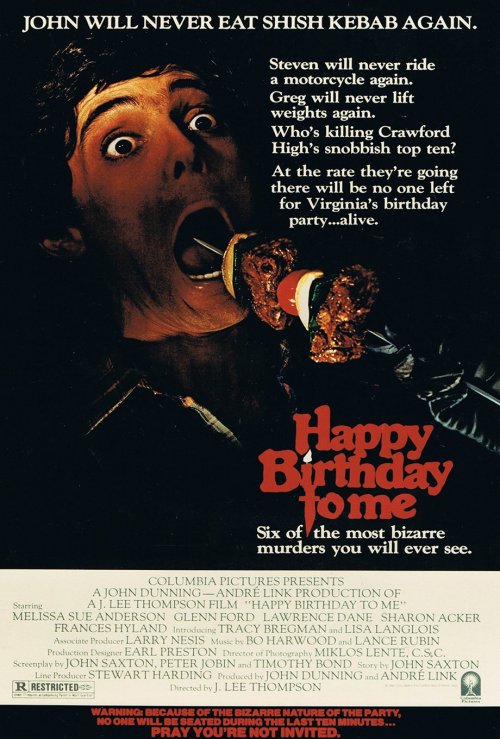
Despite being listed as a slasher film and having gained a loyal cult following I found the gore factor to be disappointing. The killings are quite brief and the camera quickly cuts away before much blood, or anything else is shown. The famous shish kebab murder that is captured on the film’s poster is poorly executed. Apparently there was more footage of the killings, but in order to get an R-rating director J. Lee Thompson was forced to cut a lot of it out. However, it would be nice to get a director’s cut version as I am sure today’s horror fans may feel cheated otherwise. The grossest sequence for me wasn’t the killings at all, but instead the scene where Virginia undergoes brain surgery and her skull is vividly cut open and one can see the brain pulsating and expanding inside. The deaths really didn’t seem all that creative and clever despite the film’s reputation and if anything my favorite death scene didn’t involve one of the killings but instead was the part where Virginia and her mother are riding in a car that goes off a bridge and then fills up with water, which is surprisingly intense.

I also had some major issues with the film’s opening murder that features a young girl getting strangled while inside her car. For one thing the killer’s hands didn’t seem to be all that tight around her neck and when the girl manages to escape there are no marks around her neck even though realistically there should be. Also, when she escapes she runs for only a few feet and then stops behind a nearby parked car and acts like she is now ‘safe’ even though most people would run several blocks and probably wouldn’t stop until they found someone else that could help, or the police. The victim also speaks, but if someone has been strangled as severely as she has her voice would have to be effected by it and she might not be able to say anything, or at least speak in a very raspy tone, which is not the case here.

For the most part I found the film to be boring and predictable. I never once got scared, or even all that intrigued. The movie is jammed with every cheesy 80’s horror movie cliché that you can think of. Normally film’s from this genre run no more than 90 minutes and sometimes even less. Going 110 minutes as this one does is much too long for a plot that is paper-thin.  However, the very macabre ending is excellent and almost makes up for it. The surprise twist isn’t bad either although a bit implausible.

Anderson, best known as Mary Ingals from the long running TV-show ‘Little House on the Prairie’, isn’t bad. A shot of her at the end where she is carrying a birthday cake and looks up and smiles is both chilling and sexy and quite possibly the film’s pinnacle. There is no nudity although director Thompson teases the viewer by having her undress to get into the shower, but the camera never gets past her bra and panties.

Hollywood icon Ford is wasted and his tired appearance is almost sad. His wardrobe features him wearing an open shirt showing his bare chest and it looks ridiculous for a man his age. There is another scene where the police dig up a skull on the school’s grounds and the Ford character asks to take a look at it and the police promptly hand it over to him, which I found to be equally ridiculous as that is a crucial piece of evidence that would only be handled by a forensic expert.

If anything Sharon Acker as Virginia’s alcoholic mother Estelle gives the best performance.  Her overwrought slightly hammy scene near the end gives the film some much needed energy.

There were a few other loopholes and inconsistencies that irritated me enough to be mentioned here. One is that years earlier Virginia had a birthday party and all her friend’s snubbed her and didn’t show up, so they could instead go to a party held by a girl who was more wealthy and popular, which made me wonder why then would Virginia want to remain friends with them like she did.  Another part involves a member of their clique named Alfred (Jack Blum) who the girls initially think is storing the severed head of one of their murdered friends. They later realize that this was simply a realistic looking plastic mold that he had made to resemble her, which makes them feel ‘relieved’ enough to continue to socialize with him. However, anyone who makes plastic molds of heads from someone they know that has just been killed seems just as creepy to me and enough to make most normal people concerned, which the characters here are not. There is also no explanation at the end for how the killer, whose identity I will not divulge, was able to come up with such an elaborate and realistic disguise. The gory effects are also not convincing and could have used Tom Savini’s help

Like I said I found the film’s ending to be pretty cool and enough for me to suggest this film to horror fans, but only if they are willing to stick around for it.

My Rating: 3 out of 10

Released: May 15, 1981

Runtime: 1Hour 50Minutes

Rated R (Violence, Language, Adult Theme)

Director: J. Lee Thompson

Studio: Columbia

Available: VHS, DVD, Amazon Instant Video
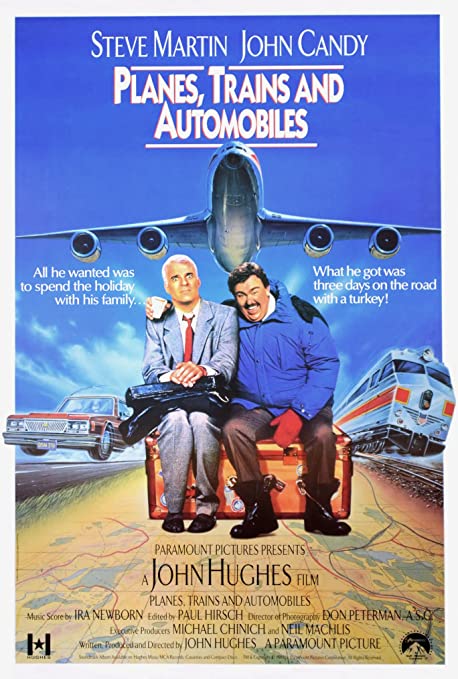
Planes, Trains & Automobiles (1987)

planes

By Richard Winters

My Rating: 6 out of 10

4-Word Review: Thanksgiving on the road.

This movie’s plot, which is threadbare , deals with a middle-aged businessman named Neal Page (Steve Martin) who is trying desperately to get home to Chicago to celebrate the Thanksgiving holiday with his family. During his trip he inadvertently meets Del Griffith (John Candy) an overweight, slightly obnoxious shower curtain hanger salesman. Neal initially cannot stand the man, but is forced to sit with him through his plane flight when he is not able to get the first class seat that he had reserved. Unfortunately due to a snowstorm their flight is rerouted to Wichita, Kansas and the two men find themselves paired together again as they try any means of transportation possible to get themselves to the Windy City. Along the way they begrudgingly start up a friendship.

Martin is okay as the exasperated businessman. This film marked a transition for him as he was now moving away from roles where he played clownish, vapid, but lovable idiots and more into crusty and curmudgeon middle-aged men. He is basically used for his annoyed reactions at all of Candy’s crazy antics and for that part he is fine, but there are a wide assortment of other actors that could have played the part just as well if not better. Martin at times still goes back to some of his old shtick like the dopey way he puts on a clenched teeth grin when he is trying to run real fast, which I never found to be particularly funny when he was doing it way back with skits on Saturday Night Live and still don’t find it funny when he continues to do it now.

Candy is by far the best thing about the film and ends up saving the movie from being an uninspired, goofy mess. The character does at times border on being a caricature, but fortunately writer-director John Hughes pulls back just enough to let you see him as a real person. He does indeed have some laugh-out-loud moments. I chuckled at the way he tries to clear his throat when the two men are stuck in a motel room together. The part where he manages to get both his coat sleeves stuck on some car seat levers and he is forced to drive the car with his two legs is hilarious. I also liked the way he gyrates to a Ray Charles song that he listens to while driving and the conversation that he has with a policeman (Michael Mckean) when their burned out shell of a car gets pulled over is a classic.  I thought the idea of having him be a salesman for shower curtain hangers hit just the right note of absurdity and the fact that he carries around a little box displaying all the different types of hangers he has was novel. The only thing I didn’t like about the character is that at the end we find out that he is somehow rendered homeless simply because his wife died 8 years before. This doesn’t make a lot of sense, for one thing he seemed to have a lot of success selling his merchandise, so I’m sure he had money and for another thing there are many men and women whose spouses end up dying, but that doesn’t mean they no longer have a home to go to. To me it just ends up being a cheap excuse for a sloppy sentiment and it should have been avoided.

The late John Hughes’s writing and directing leaves a lot to be desired especially for the sophisticated viewer. The humor that is used is extremely broad and many times downright cartoonish. He seems to be either not confident in himself as a filmmaker, or in the intelligence of his audience to ever be subtle and subdued, but it would have been nice if a little bit of that had been thrown in. He also uses way too many poor plot devices that are simply used to propel the paper-thin story along and would be considered hack writing at most and something that a third grader could come up with. For instance why does the engine of train that the two men are riding in suddenly break down? No logical explanation is given and what are the odds of that happening as well as having Neal’s rental car missing when all the rest of the cars are there. There is also the cab driver named Wolf who decorates his cab with all sorts of pornographic pictures and other provocative ornaments, which is at first funny until you realize that he supposedly works in Wichita, which is a small conservative city and no one would be riding his cab for long and he would be out of business. If there is no truth to the joke then the joke will fail, which it does here. The same goes for the crude, gross, and very hick pick-up truck driver that relies way too heavily on stereotypes and seems to be put in solely as filler.

I did like the fact that it was filmed on-location as the stark wintry like landscapes does indeed put the viewer in the holiday frame of mind. I also liked the fact that for the most part real snow is used. I was born and raised in Minnesota and I can spot the fake stuff right away and I always find it annoying. I liked that many performers from Ferris Bueller’s Day Off appear in brief cameos including: Ben Stein and Edie McClurg although it would have been nice if they were given a little more to do. Kevin Bacon also appears as does William Windom who is amusing as a one of Neal’s clients who can’t decide on what photo layout to use. I was disappointed that he wasn’t given any lines of dialogue, but the fact that he does reappear at the very end after the credits  makes up for it a bit. I also must mention the burned-out skeleton car that the two men drive in, which is the damnedest looking thing since the bus filled with bullet holes in The Gauntlet.

The music score is awful. It has too much of that tinny, synthesized 80’s sound that is unoriginal and does not fit the mood, or tone of the picture in any way. It also gets overplayed in certain scenes and hurts the film’s overall enjoyment.

I would say this movie would be great for the whole family as it does rely a lot on the broad, fast paced humor that most kids love. However, there is one scene where Martin goes into a long, F-word laden rant with McClurg when he can’t find his rental car. The rant in itself is funny, but some might say it is not appropriate for children. Of course these days I have heard kids as young as six, or seven using the word and I have also heard it used just in casual conversation by people I pass by while walking the streets of Indianapolis, so trying to shield the child from it may be futile and they will all sooner or later hear it in abundance anyways.

My Rating: 6 out of 10

Released: November 25, 1987

Runtime: 1Hour 33Minutes

Rated PG: (Adult Language, Crude Humor)

Director: John Hughes

Studio: Paramount

Available: VHS, DVD, Blu-ray, Amazon Instant Video

Venom (1982)

By Richard Winters

My Rating: 3 out of 10

4-Word Review: Kidnappers versus deadly snake.

            Phillip Hopkins (Lance Holcomb) is an 8-year old boy and son of a wealthy couple. When his parents leave for a trip the family’s maid and chauffeur (Susan George, Oliver Reed) conspire to kidnap the boy and hold him for a ransom with the help of a ruthless gunman (Klaus Kinski).  Unbeknownst to any of them the boy has mistakenly acquired a black mamba snake that escapes from his cage. As the culprits try to pull off their crime they become trapped in the house by the deadly reptile that starts to attack them one-by-one.

For starters the cast is one of a kind. Besides the performers listed above the film also has Sarah Miles as a Dr. with a serum to help fight the snake’s poisonous venom. Nicol Williamson appears as the police negotiator and Sterling Hayden, in his last film role, plays the boy’s grandfather.  How anyone could manage to direct a cast with such legendarily huge egos and eccentric personalities seems hard to fathom and probably explains why original director Tobe Hooper left the production after only ten days of shooting and was replaced by Piers Haggard. Supposedly Reed and Kinski were at odds with each other during the entire production and their animosity clearly shows on screen. For the most part the talents of the cast is wasted with a script that is limited and filled with characterizations that allow for no range.

I did like Hayden in the scene where he is forced to go searching for the snake in a darkened room and armed with nothing more than a lamp and a makeshift weapon. George is also fun playing a duplicitous character for a change and I was disappointed that she gets killed off so soon. However, she does make the most of it with a very theatrical death scene. Probably the best performance in the whole film is that of the boy. He has a very sweet, young looking face and the widest most innocent pair of blue eyes you’ll ever see and the kind that most casting directors would kill for. The kid plays the frightened part well and does an effective asthma attack. He hasn’t done much since, but I am sure that if he wrote a book dealing with his experiences on the set and his interactions with that cast that if would most assuredly be a best-seller.

The set-up is good and I found myself riveted to it for the first half-hour. I liked the idea that an actual mamba snake was used. There is a part where the snake is slithering towards the camera and opens its wide, black mouth and hisses straight at the camera, which could be enough to get most viewers to jump out of their seat. Director Haggard uses the novel idea of shooting scenes from the snake’s point-of-view and he does it through a fuzzy and slightly distorted lens to help replicate the snake’s vision. The only problem I had in this area is that the snake is seen slithering throughout the picture inside the home’s venting system, which is shown to be very clean and spotless, which didn’t make sense to me since the home was old making me think that the metal piping would be more corroded and rusted.

Despite the excellent concept the film’s second hour is quite boring. The characters don’t have enough to do and spend most of the time standing around. The interplay between Kinski and Williamson brings no tension. There is one cringe inducing scene where the snake crawls up Reed’s pant leg, but overall the scares are quite sparse. The climatic sequence is too convenient and becomes more of a disappointment then a shock. It is hard to say if the film would have been better if Hooper had stayed on or not. Reportedly none of the footage that he shot is in the final cut. The film is based on a novel by Alan Scholefield, which I suspect is probably more intriguing and after watching this makes me interested in reading it.

My Rating: 3 out of 10

Released: January 29, 1982

Runtime: 1Hour 33Minutes

Rated R (Mature Theme, Violence, Language) 

Studio: Paramount

Director: Piers Haggard

Available: DVD

Midnight Run (1988)

By Richard Winters

My Rating: 8 out of 10

4-Word Review: Chased by the mob.

Jack Walsh (Robert De Niro) is a bounty hunter that is looking to get into a less stressful profession. He is offered 100,000 to find bail jumper Jonathan Mardukas (Charles Grodin) who worked as an accountant for the mob and skimmed 15 million from them. Jack thinks he can use the money to open up a coffee shop, but finds that the FBI is in hot pursuit of Mardukas as well. There is also rival bounty hunter Marvin Dorfler (John Ashton) who wants his hands on Mardukas and the money. Jack even finds himself chased by the mob looking to silence Mardukas before he can turn states evidence.

The catalyst of the film is the relationship between Jack and Jonathan and how it slowly turns into an unusual friendship during their long adventure. Both Grodin and De Niro have diametrically opposite personalities and acting styles, which is why this thing really works. The relationship ebbs and flows on the antagonistic level most of the time and the friendship really doesn’t build until the very end and even then it is tenuous, which is nice.  Too many times in ‘buddy’ movies such as this the sentiment becomes forced, but fortunately here it is very balanced and their interactions believable throughout.

Grodin was an inspired choice. I have always thought the guy to be a very talented, underappreciated, and unique comic performer. However, he was not a big name star and the studio heads originally wanted Robin Williams for the role and then even considered changing the sex of the Mardukas character to female and having Cher play the part, but director Martin Brest liked Grodin’s style during his audition and held out until he got him even though it meant losing the backing of Paramount and forcing them to go with Universal.

Grodin adds a lot that the other two stars, as very talented as they are, just wouldn’t be able to do.  One is a completely improvised conversation that he has with the De Niro character while they are stuck inside a train car, which is the one scene from this film that I remember most clearly from having first seen it over twenty years ago. There is another improvised scene involving Mardukas and Jack pretending to be FBI agents and going into a local bar looking for counterfeit bills that makes great use of Grodin’s sardonic humor and deadpan delivery.

John Ashton is a riot as Marvin the rival and slightly dim-witted bounty hunter. He is so over-the-top obnoxious and crude that you can’t help but laugh at it. He takes the caricature of the tough, brash, gruff, blue collar Chicagoan to a hilarious extreme. He is like legendary football coach Mike Ditka on speed. Denis Farina, as the mob boss, is also good as is Joe Pantiliano as the frantic bail bondsmen.

Another thing that makes this movie so successful is that it is able to work on three different levels in a very cerebral way. Not only is it a very good comedy and character study, but it’s not half bad with the action either. The best sequence here is when the two men get swept away by a strong river current, which has the actual actors doing most of the stunts.

Of course the script, by George Gallo, does have a few holes and implausibility’s that can’t avoid being mentioned since some of them are integral to the main plot. The biggest one is when Marvin, in an attempt to impede Jack and find his whereabouts, gets on the phone with Jack’s credit card company and identifies himself as Jack and is able to easily find out where the card was last used and have it cut off. However, with every credit card company I have worked with I am forced to give some more identification before I am given any information including my social security number, a secret word or phrase, or a PIN and yet here Marvin isn’t required to give any of that. There is also that fact that when Jack finds out that his credit card is being rejected he doesn’t just get on the phone with his credit card company and get it straightened out, which is what anyone else would do.

There is also a segment where Jack is somehow able to fleece the FBI badge from agent Alonzo Mosely (Yaphet Kotto), which Jack then uses to impersonate him with during his trip with Mardukas. However, this just would not have been possible as the two men met only briefly inside a car with Alonzo sitting in front and Jack in back scrunched between two other agents who keep a close eye on him. The FBI has also been searching for Mardukas for six years and yet Jack is able to find him easily, which to me seemed too convenient.

The excessive swearing is another issue. Yes, sometimes cursing can help build the grittiness of the characters, but here it goes overboard. Officially the word ‘Fuck’, or a variation of it, gets said a total of 119 times, but I was convinced it was more than that. Its overuse is so redundant that it almost becomes a distraction.

            All things considered this is still a winner. This is one of my favorite De Niro roles and in my opinion his best foray into comedy as I feel his work in the Meet the Parents series is generally wasted. There is also an emotionally strong scene when Jack goes back briefly to visit with his ex-wife and fourteen year old daughter. Normally these types of scenes end up being clichéd, but here it really hits the mark, especially Jack’s interactions with his daughter.

My Rating: 8 out of 10

Released: July 20, 1988

Runtime: 2Hours 6Minutes

Studio: Universal

Rated R (Language)

Director: Martin Brest

Available: DVD, HDDVD, VHS, Amazon Instant Video 

Bye Bye Brazil (1980)

By Richard Winters

My Rating: 6 out of 10

4-Word Review: Entertainers traveling throughout Brazil.

This movie is a slightly surreal comedy-drama detailing a caravan of five entertainers who travel the Brazilian countryside putting on vaudeville like shows underneath a makeshift tent.  The film works in a vignette style as it analyzes the many scenarios and difficulties that the group encounters as well as making a very strong statement to the poverty and hardships befallen on the townspeople that they meet. In fact if there is one lasting image that the film gives it is that one.

The story is pretty much character driven and the characters are all by and large highly amoral. They reflect the desperation of their audiences, which they quietly hope someday to rise above, but never do.  There are a few fleeting moments where they amazingly and surprisingly decide ‘to do the right thing’, which ends up being the film’s most memorable scenes, but most of the time they are ‘rough around the edges’ and the viewer is forced to appreciate them with all their frailties brightly exposed.

Jose Wilker plays Lorde Cigano who is the leader of the group and a lifelong con-man. He closely resembles character actor Stuart Margolin, who was famous for playing the character of Angel on the classic 70’s series The Rockford Files where he was always trying one amusing scheme after another and the character here works in much the same way. He has a few good lines as well as a funny running gag where he displays obscene toys to attractive woman he meets in order to ‘turn them on’.

Betty Faria plays Salome who does erotic dances during their performances.  She lies and cheats as much as Lorde and is more than willing to fall back to being a prostitute whenever the group is in need of money. Although she does have a few nude scenes she is really not all that attractive, or young, as she was already hitting 40 at the time that the film was made.  However, her worn looking face does help accentuate the hardened lifestyle of the character. Her best scene is when she is ‘servicing’ one of her clients who is a fat, balding middle-aged man who expounds the entire time they are having sex about the many virtues of his wife.

Fabio Junior plays Cico the young man who joins the group because he feels it is a chance to escape the sad existence of a peasant farmer only to find that life on the road can be in many ways just as grueling and thankless. Junior is a famous singer in Brazil and his chiseled, boyish good looks didn’t seem to be a realistic fit for the impoverished farm family that his character came from in the movie.  He shows no concern for his pregnant wife and spends the entire time trying to seduce Salome, which makes him irritating and unlikable.  I did though like the fact that he was the one character who evolved and became introspective at the end.

The character of Daso, which is played by actress Zaira Zambelli and is Fabio’s wife, was a bit frustrating. The film makes it clear that she is aware that Fabio is fooling around with Salome and she doesn’t seem to care. She also excitedly jumps into becoming a prostitute at her husband’s insisting when the group falls on hard times. However, I wanted more explanation, or history given to the character to help understand this, but the story does not supply any.

I was also disappointed with the handling of the Swallow character who performs feats of strength during their productions as well as acting as the group’s driver. Swallow is mute, but easily is the most likable and durable, but he runs away half-way through the picture and never returns. I would have liked the character to have stayed during the entire duration as he helped give balance to the others, or at the very least some detail to his eventual fate.

The film becomes almost a like a Brazilian travelogue as the viewer encounters everything from the small dessert towns, to the exotic rain forests. However, the budget was clearly low and I didn’t feel the cinematography captured the majestic essence of the landscape as much as it could’ve, or as I had expected. The story and situations are not all that unique, or creative, but it stays nicely amiable throughout.  The funniest part of the whole film may actually be the lyrics of the song that is sung at the very end during the closing credits. This is not a great movie, but not a bad one either.

My Rating: 6 out of 10

Released: February 9, 1980

Runtime: 1Hour 40Minutes

Rated R

Director: Carlos Diegues

Studio: Carnaval Unifilm

Available: VHS, DVD

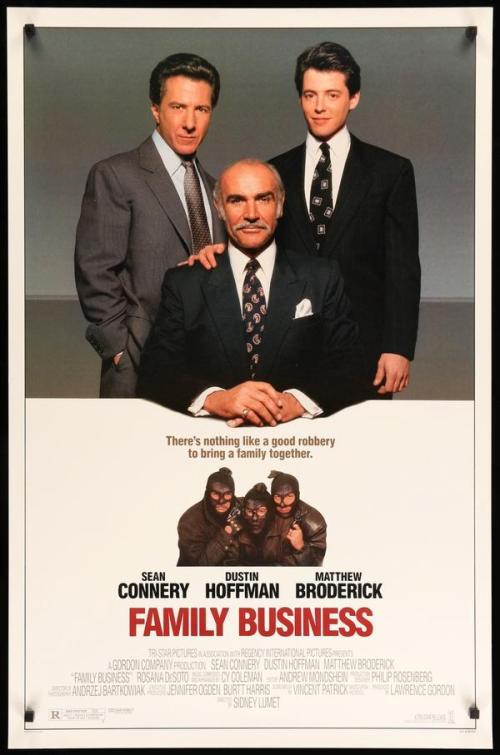
Family Business (1989)

family1

By Richard Winters

My Rating: 4 out of 10

Any movie that casts Dustin Hoffman, Sean Connery, and Mathew Broderick as a father, son, and grandson team of robbers has me hooked before I have even seen the first frame. It was a great bit of inspired casting even if Connery was playing Hoffman’s father and in reality was only seven years older than him.  Throw in the fact that it was directed by the late, great Sidney Lumet and you should have a sure fire winner.

The story involves the grandfather Jessie (Connery) getting out of jail and trying to rekindle relations with both his son Vito (Hoffman) and grandson Adam (Broderick).  Vito wants nothing to do with his father as he has done time himself by getting mixed-up in some of his father’s old schemes and is now trying to go straight by working as a manager at a meat packing facility. However, Adam, who is going to college and has a promising career ahead of him, idolizes his grandfather and relishes the idea of pulling off a robbery himself. He has even come up with one that all three of them can do together. The robbery is unique in that they aren’t stealing from a bank, jewelry store, home of someone rich, or even a priceless artifact at a museum, but instead some important research materials at a science lab.

The crime itself is not elaborate and could have been easily pulled off with just one person. I was anticipating something a little more daring and exciting especially since Jessie and Vito were career criminals. It also takes too long to get to it. The first fifty minutes are spent with them endlessly arguing and rehashing the same old points.

The second part is a little more interesting as it deals with Adam getting caught while the other two are able to get away and all the dilemmas that they then face. Even here the drama becomes strained and talky.  The ending fizzles and leaves no emotional impact.  I saw a lot of similarities with this film and Sidney Lumet’s last film that he did before he died, which was Before the Devil Knows You’re Dead.  Both of these movies deal with robberies and the consequences of family members betraying one another and yet that film was far more gripping while this one falls flat.

I thought Connery was highly engaging and would have enjoyed seeing him take over the movie. Hoffman gives a solid dramatic performance, but his character is bland.

The Adam character got on my nerves. He had been given everything in life and yet refuses to appreciate it and seems almost ungrateful to his father for working so hard to give him a better life. He acts cocky about going through with the robbery and yet when they get there he is ill-prepared and confused. I understand sometimes people become curious about those that live a different lifestyle than they do and that they don’t fully understand, but I still felt there needed to be a little more balance.  I just didn’t understand why this kid would want to throw it all away just so he could be like his career criminal grandfather.

The film gives one a good taste of New York. I liked how it showed the different neighborhoods and boroughs. Not only do we get a good feel of the Bronx, but we also see Flushing, Brooklyn, and downtown Manhattan. Most films that take place in the Big Apple seem to concentrate in only one section of it while this one tried to give a broader feel.

The indoor sets are nicely realized. Everything from the trashed halls of the prison to Vito’s modernistic, sleek apartment, to the science lab and even Jessie’s small, cramped apartment looked authentic and distinct.

I did notice a few logistical errors. One is the fact that they discuss plans of the robbery in a lot of public places, which seemed just plain careless to me especially since these were ‘professional’ thieves. One discussion takes place at a bar, another on a busy sidewalk with pedestrians going by, and the third at a funeral with mourners standing right behind them. There is also the fact that they park their car on the side of the road in front of the lab and put a sign in the windshield stating that they are out of gas and will be back in one hour. I thought this seemed dumb because a policeman could come by and do a check on the license plate to find out who the owner is. Then, the next day when the robbery is reported, they would only have to put the two together to trace the culprits. There is also a scene were Vito fires one of his employees at his plant for stealing. He punches him violently in his office that is surrounded by windows and is in full view of the other workers.  The man leaves with a broken nose and bloodied face, but the workers do not react and go on with their tasks like nothing happened, which didn’t strike me as believable.

The music score is another problem.  It has a big band, show-tune type melody and sound, which might have worked for a Broadway production, but here it seems completely out-of-sync with the mood and tone of the story.

Although competently done this thing still seems like a misfire namely because the material isn’t diverting, or interesting enough for the cast that it has. I was expecting a little more razzle-dazzle and a lot more action and excitement. I almost felt that if this same story had been approached in a comic vein it might have done better.

My Rating: 4 out of 10

Released: December 15, 1989

Runtime: 1Hour 50Minutes

Rated R

Director: Sidney Lumet

Studio: TriStar Pictures

Available: VHS, DVD, Amazon Instant Video

The Verdict (1982)

verdict

By Richard Winters

My Rating: 8 out of 10

4-Word Review: Lawyer makes a comeback.

Frank Galvin (Paul Newman) is a lawyer that has hit rock bottom. He has lost his last four cases and become an alcoholic in the process. His associate Mickey (Jack Warden) hands him what appears to be an open and shut case dealing with a woman who was put into a permanent comatose state after being given the wrong type of anesthesia during the delivery of her child. Both parties are willing to settle out of court and Frank is initially happy to accept the settlement as he is hard up for funds, but after seeing the sad condition of the patient in the hospital he changes his mind.  He becomes convinced that the hospital is trying to hide something, but the other doctors and nurses that where present during the procedure are refusing to talk. He then tracks down the admitting nurse, who was the one person who refused to sign a sworn statement relieving the doctors of any wrong doing. Once he finds her it blows the case wide open.

This marked a turning point in Newman’s career. He was no longer the young, shirtless, virile hero, but now a grey haired, gravely voiced man showing the signs of aging and his roles from then on where all of older characters past their prime. Newman definitely looks tired and washed up and it is so effective that it makes the viewer feel the same way. Yet, he is still able to show the boyish side of his character by way he becomes engrossed with the pinball machine at the bar and getting excited when he achieves a high score.  Newman continues to be one of my favorite actors and his ability to act in a way that seems so effortless never ceases to amaze me. It may seem minor, but I liked when Galvin is forced to take a red-eye flight out of town in order to meet the former admitting nurse (Lindsey Crouse) who has moved to another city, he is shown to be unshaven. Too many times male characters placed in hectic scenarios in most films are clean shaven at all times even when it doesn’t make sense. Yet here Newman’s character isn’t. Being the consummate method actor who was always looking for realism I’m sure he decided to add this extra touch himself. Sometimes what separates the great ones from the average are the little things.

Director Sidney Lumet shows why he is a legend as well. The movie was shot in the late autumn, early winter in Boston. The cold climate and gray skies help accentuate Galvin’s state of mind and stage in life. I remember hearing Lumet state in an interview how he made sure that the color schemes in the entire film where of a dark, brownish color which he felt would reflect the story’s serious tone. In fact the color brown is the one quality I remember most of this film from when I first saw it years ago. I also liked the visual touch Lumet uses of having Frank taking Polaroid pictures of the victim lying motionless in her hospital bed. As the viewer watches the images of the woman on the Polaroids slowly develop it perfectly reflects Galvin’s developing empathy for her. My only quibble is that I wish that Lumet had shown a close-up of the woman so we the viewers could completely take in her sad condition as well. We are only shown the victim from a distance and even then it is never straight on, which doesn’t help us become as upset by her quandary as we should have.

Another thing I appreciated about the script, which was written by David Mamet and based on the novel by Barry Reed who was at one time a practicing attorney, is the fact that is focuses on all the behind-the-scenes tasks that a lawyer must do before the case comes to trial. Most courtroom dramas deal almost exclusively with the trial portion, but here we see how the attorneys prep their clients for questioning and cross-examination. We also take in the process of them interviewing potential jurors, researching legal issues, chasing down witnesses, and even discussing potential strategies with their clients. I found the approach here, as opposed to other legal dramas, to be more thorough, revealing, and satisfying.

The grievances that I had with the film all contain spoilers, so if you are interested in watching this movie then you may want to skip the next two paragraphs.

The first problem I had was with the Lindsay Crouse character who plays the admitting nurse whose bombshell testimony turns the tide of the case in the favor of Galvin’s client. Her scenes are certainly riveting and marked with all the classic ingredients of high drama. Her character states that the admittance sheet that she had filled out that day had been altered by the doctor and that she had the original. Yet neither the viewer nor the jury is shown the original making what she says, as compelling as it may be, seem like hearsay. The judge also orders everything that she said to be stricken from the record and not considered when the jurors come to their final decision. Yet the jurors openly ignore this order and side in Galvin’s favor anyways, which I couldn’t completely buy. I didn’t think all twelve of them would disregard the judge’s order especially when no documentation was ever shown to help verify what the witness stated.

I also did not like the Charlotte Rampling character who plays a woman that Frank meets at a bar and begins to date. She is also paid by the opposing attorney Ed Concannon (James Mason) to spy on Frank and give away all his strategies. I didn’t feel it was necessary to show this, or even bring in the character at all. We are already shown earlier that Concannon is underhanded by the way it is implied that another doctor, who was going to be the star witness for Galvin, was paid off not to testify and then just disappears. Having him go further by using Galvin’s girlfriend as a snitch seemed like over-kill. The movie strives for realism and therefore should keep extreme side-story scenarios like this out of it as I am sure it is not something that occurs every day.

The subject matter is serious and somber. On a dramatic level it is excellent and although some may find it slow and depressing others will appreciate the intelligent script and deliberate pace. It is also an unusually quiet film with long stretches with no dialogue, or music, which is a nice change of pace from most films, which feel it necessary to be loud and noisy, or risk losing the audience’s perceived short attention span.

My Rating: 8 out of 10

Released: December 8, 1982

Runtime: 2Hours 9Minutes

Rated R

Director: Sidney Lumet

Studio: 20th Century Fox

Available: VHS, DVD (2-Disc Collectors Edition), Amazon Instant Video

Re-Animator (1985)

re animator

By Richard Winters

My Rating: 7 out of 10

4-Word Review: The dead come back.

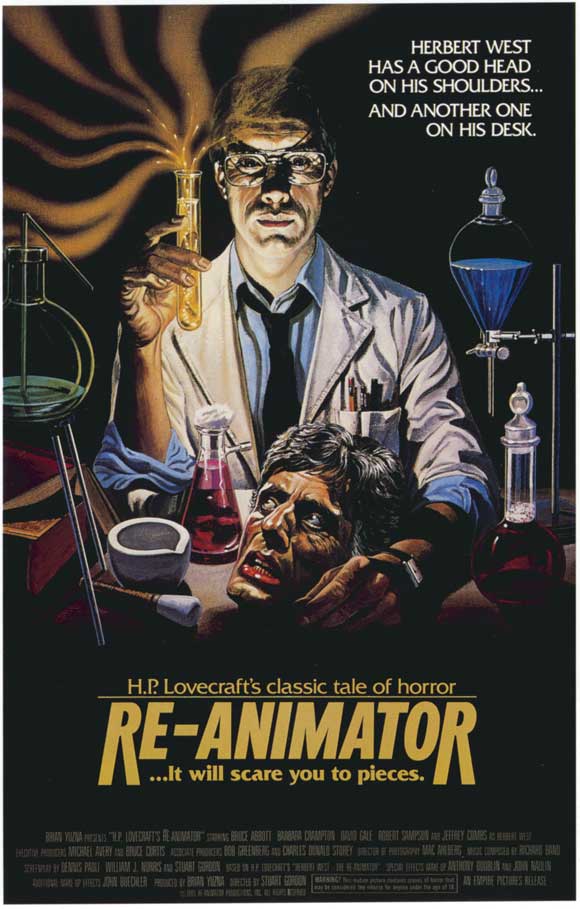
Daniel Cain (Bruce Abbott) is a student at a nearby medical college who decides to take in as a roommate a foreign student named Herbert West (Jeffrey Combs). West seems a bit anti-social and very intense about his work. He sets up a lab in Cain’s basement where he does experiments to bring back the dead by injecting them with his specially formulated serum. He starts with animals, which makes it intriguing enough for Cain to get in on it, but when they start to move onto cadavers at the school’s medical lab things spiral out of control.

Compared to most low-budget horror films of the 80’s, and I have seen many, this thing is nicely compact and well-paced. There is none of that extraneous dialogue and needlessly slow, drawn out scenes before you can get to any type of action, or horror. It grabs your attention right away with a clever, whimsical opening sequence and a musical score that although does sound similar to the one used in Psycho is still quite effective.

The gory special effects are excellent even when compared by today’s standards. Normally I have no problem watching these things no matter how high the gore factor is, but the scene where the instructor peels the skin off the head of one his cadavers during a class lecture and then cuts through the bone of the skull and takes out his brain had me feeling a bit queasy. The best part comes when Dr. Carl Hill (David Gale) gets his head chopped off at the end of a shovel, which is again well-done, and then has both his body and head injected with the serum. The scenes involving the headless body walking around while carrying this talking head are creepy, hilarious, and highly effective. It is realistically enough looking during a couple of sequences that it had me sitting there wondering how they pulled it off. My only quibble in this area would be the part where West reincarnates a cat that comes back to life and turns homicidal.  It is very clear that this ‘killer cat’ is nothing more than a stuffed animal as its fur looks fake and the body is unrealistically thin.

The film is directed by first-timer Stuart Gordon whose only claim to fame before this was when he was a student at the University of Wisconsin in 1969 and he brought in an audience into an auditorium to watch a play he had written and then locked the doors so they couldn’t get out. He intentionally made the play as boring and annoying as possible just to see how long it would take them to rise from their seats and clamor to be let out. Although this was enough to get him expelled I still admire the guy’s panache. That same type of snarky humor is evident here and woven in, in a way that nicely balances the horror. My favorite scene here, and one that I remember most distinctly from when I first saw it back in the 80’s, is when Dan meets his girlfriend Megan (Barbara Crampton) in the school’s hallway. He starts to kiss her passionately and she feels embarrassed and tells him ‘no, no, no’ and then it quickly cuts to show them in bed where she is saying ‘yes, yes, yes’.

Another thing that differentiates this from other low-budget horror films is the fact that the lead characters are not as bland as usual. I liked the way Dan has a moral quandary and teams up with West on some of his experiments. Both Dan and Megan are better fleshed out as characters and believable. Crampton also looks gorgeous and has a good nude sequence at the end.

Kudos must also go to Robert Sampson an actor who has worked steadily since the 1950’s, but has never become a household name. He plays Dean Halsey father of Meagan and his part takes off after he is accidently killed and brought back to life with Herbert’s serum where he turns into a mumbling, crazed lunatic. This isn’t as easy to pull off as you may think and his catatonic stares are fabulous.

David Gale deserves mention as well playing the evil doctor. His pale skin and sullen face make him look like he is dead from the very beginning and he has the perfect look for a horror film. He clearly relishes his role and hams it up nicely. He started to garner a large cult following after his performance here and offers to play similar roles in other horror films began to pour in when he unexpectedly died in 1991.

The only performance I really didn’t like was that of Jeffrey Combs. I know he has pretty much become the face of the Re-Animator franchise, but this guy seemed hammy without ever being amusing, or funny with it. I didn’t like the square, metal rim glasses that he wore as they were much too typical.  An eccentric character should wear eccentric looking glasses and attire to help accentuate his off-beat personality. I also didn’t dig his accent that seemed to waver between Bavarian, German, Russian, and some weird variant in between.

If you are looking for something different this Halloween then I suggest checking this one out. It has just the right amount of ingredients to be both entertaining and scary at the same time and it can still easily hold-up with today’s jaded viewers.

My Rating 7 out of 10

Released: October 18, 1985

Runtime: 1Hour 26Minutes

Rated R

Director: Stuart Gordon

Studio: Empire Pictures

Available: VHS, DVD, Blu-ray

The Bedroom Window (1987)

bedroom

By Richard Winters

My Rating: 7 out of 10

4-Word Review: What did she see?

Terry Lambert (Steve Guttenberg) is having an affair with Sylvia (Isabelle Huppert) the wife of his boss. The two go back to his apartment one night after an office party to engage in sex. In the middle of the night Terry gets up to go to the bathroom and this is when Sylvia is awakened by a scream coming from outside the bedroom window.  She goes to the window and sees a young woman struggling with a man on the sidewalk. When Sylvia opens the window the man runs away and by the time Terry gets there everyone is gone. The next day Terry reads in the paper about a similar murder to a woman that occurred later that night just a couple of blocks down the street. He is convinced there is a connection and that he should report the incident that Sylvia saw. In order to keep the affair a secret he decides to act as the witness and simply relay whatever Sylvia told him. However, in classic Hitchcock style things quickly spiral out of control and Terry soon finds himself in deep trouble.

Overall, this film is highly entertaining from beginning to end and a terrific Hitchcock imitation that should please even his devotees. However, Guttenberg as the lead seemed, at least initially, to be a poor choice.  The guy has always seemed very bland to me and has never shown any real type of strong onscreen presence. I could not buy into the idea that this guy would be cocky and shrewd enough to have sex with his boss’s wife right under his boss’s nose as Guttenberg seems to convey a very wide-eyed persona and looks like someone who is still in puberty and speaks in a high pitched voice. I did soften my stance on this as the story progressed simply because it would take an extraordinarily naïve person to get themselves into the mess that this character does and in that regard Guttenberg fits the bill perfectly.

His two female costars outshine him badly. Huppert is excellent as usual and may very well be one of the top five actresses alive today. I loved how her character starts out as kind and supportive, but eventually devolves into being cold and conniving. Huppert of course pulls this off almost effortlessly. She also looks great naked and has a pretty good nude scene, both front and back, when she is shown looking out the window.

Elizabeth McGovern, who plays Denise the waitress that Sylvia sees getting attacked, does a fine job as well. As Terry gets more involved with the case the two start to hook-up and end up making, dare I say, a cute couple. I did not like McGovern’s overly heavy Eastern accent that sounded too Bostonian to me even though the story takes place in Baltimore.

Bald, eccentric character actor Wallace Shawn, best known for his roles in My Dinner with Andre and Vanya on 42nd Street is terrific as the defense attorney. His clever cross-examining of Terry during the courtroom scene is a classic.

Curtis Hanson’s direction and script is what really makes this thing gel. The story is based off of a novel by Anne Holden and it manages to stay plausible and believable throughout. The direction is compact without the unnecessary flamboyance that can sometimes take away from the action. The pacing is good as it grabs you right away and holds you in throughout without any slow spots. The twists are well plotted and for the most part surprising. I also thought his recreating of a bar atmosphere at both the trendy nightclub and later at a small neighborhood pub was right on target. I liked that the story took place in Baltimore because outside of John Waters that seems to be a forgotten city in most movies. Hanson uses this setting to make some nice directorial touches like having a bar called The Nevermore with a mural of Edgar Allen Poe and there is even shot of a birthday cake with icing made to look like a raven.

Kevin Williamson is set to do a remake of this film and I will be intrigued to see it. Not that this version was bad because it certainly wasn’t, but a bigger budget and a better male lead could help improve what is already a sound plot.

My Rating: 7 out of 10

Released: January 16, 1987

Runtime: 1Hour 52Minutes

Rated R

Director: Curtis Hanson

Studio: 20th Century Fox

Available: VHS, DVD, Amazon Instant Video