Tag Archives: 80’s Movies

The Accidental Tourist (1988)

By Richard Winters

My Rating: 6 out of 10

4-Word Review: Introverts need love too.

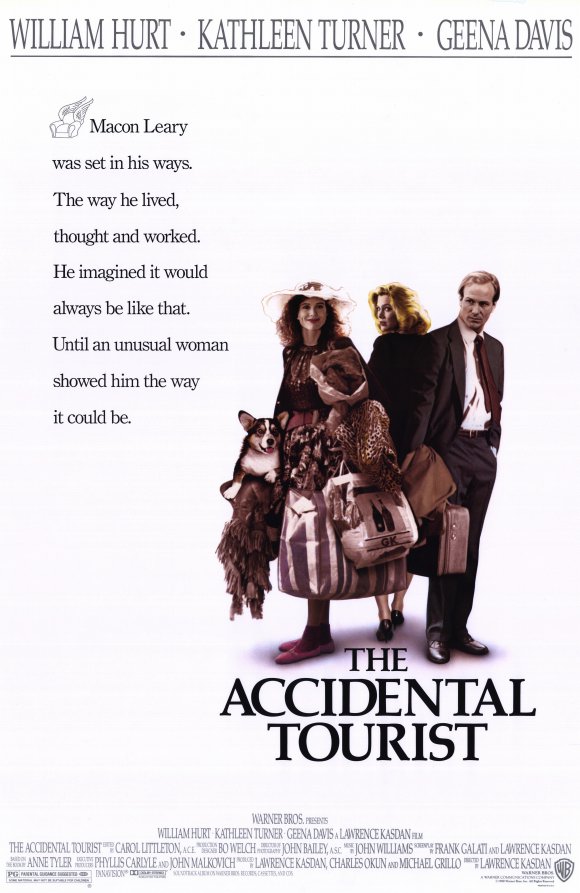
            Macon Leary (William Hurt) is an introvert who writes travel books for a living despite the fact that he dislikes traveling. His marriage to Sarah (Kathleen Turner) ends after the untimely death of their son. His wife used to babysit his dog Edward while he was away, but now he decides to drop him off at the local animal shelter that is run by Muriel Pritchet (Geena Davis). She is colorful and talkative and his complete opposite and eventually a romance begins to blossom.

The film, based on the novel by Anne Tyler, takes its time in telling its story.  In some ways the leisurely pace is refreshing. Trying to get an introvert to be more extraverted is never easy and the way Macon is initially reticent towards Muriel’s advances was realistic. Yet it does drag at certain parts and seems to go on too long. The second hour, in which Sarah comes back in the picture and Macon is forced to choose between the two, is much more interesting and compelling. The side-story where Macon’s publisher Julian (Bill Pullman) romances Macon’s sister Rose (Amy Wright) was unnecessary and does nothing but make a slow movie even longer. I also didn’t find the eccentricities of Macon’s family to be all that amusing as they were exaggerated and portrayed introverts as being freaks instead of people who simply function better independently instead of within groups.

The Muriel character is a bit over-blown as well. She comes on too aggressively towards Macon before she even knows him. There is nothing shown for why she found this man immediately attractive especially when he constantly responds to her in a cold and distant way. Later on we learn that she is poor and possibly found Macon to be well-off financially and a good stable father for her son, but even so her behavior seems a bit too forward and bordering on being shameless. Her outfits are over-the-top. I realize they are supposed to accentuate her kooky personality, but they come off as gaudy and garish and like they are being worn by someone who has no sense of style or taste.  The part where she quietly hugs Macon when he explains to her about the death of his son is moving and the first moment when I began to like the character. However, director Lawrence Kasdan ruins it by then having her strip of his clothes and climb into bed with him, which took things too far. In film sometimes the strongest statements can be made with the simplest of images and it seemed like here they had it and then lost it.

Turner is okay as the ex-wife, but I initially felt the character was unnecessary. I didn’t like it at the beginning when they are breaking-up and she goes into great detail about his character faults sounding almost like she was analyzing him for a psychological assessment. It seemed to me like she was being used to help ‘explain’ his character to the viewer when in a good film the viewer should be able to come to these deductions themselves without the help of an on-screen ‘tutorial’. Later on as she fights to get Macon back the character becomes stronger and better fleshed-out. I even ended up feeling sorry for her as her own insecurities and jealousies do her in.

Hurt is solid in the lead playing an atypical role. I wanted more of an explanation about the death of their son. It takes quite a while before it gets explained and then we are told that it was during some botched robbery at a burger joint, but it was still unclear to me why he was there and not the parents, or how it all played out. Having a flashback with a news report involving the incident would have helped. The film has many other flashbacks, some of them quite good, so another in this area would have been nice.

The music score is pleasing, but too reminiscent of ones used in other films from that era. It also has a bit too much of a whimsical quality that is not fitting for a drama such as this. The Muriel’s eight year old son is cute, but a bit too cute. I found the scenes where Macon bonds with the kid to be touching, but when films seemed compelled to only show children spewing out cutesy, innocuous comments I find it a bit annoying.

Overall this is a quality production made probably more for the female viewer looking for an intelligent, sensitive romance.

My Rating: 6 out of 10

Released: December 23, 1988

Runtime: 2Hours 1Minute

Rated PG

Studio: Warner Brothers

Director: Lawrence Kasdan

Available: VHS, DVD, Amazon Instant Video, Netflix Streaming

Macaroni (1985)

By Richard Winters

My Rating: 3 out of 10

4-Word Review: He writes love letters.

            Due to a business trip Robert Traven (Jack Lemmon) finds himself returning to Italy after four decades. He hadn’t set foot on their soil since World War II. He is old, tired, and grouchy and looking like an extension of the character Lemmon played in Avanti! , which was also took place in Italy.  When he arrives he meets Antonio (Marcello Mastroianni) who tells him he is the brother of Maria, a woman Robert had a relationship with during the war.  Robert decides to go and meet her despite the fact that she is now married. When he gets there he finds that everyone acts as if they already know him. Robert then finds out that Antonio has been writing ‘love letters’ to Maria all this time, but pretending to be Robert. The letters are filled with wild stories and conquests making Robert a cult-hero to the local people.

This movie is high on the charm, but not much else. Mastroianni is engaging and endearing. I wasn’t too crazy about his mustache and I don’t think it was needed, but he otherwise sparkles in every scene he is in and gives the film much needed energy. Lemmon is fun too, but he seems old and tired here. The camera stays locked on his worn, emotionless face during his entire cab ride from the airport to his hotel, which was too much and the main problem with the film in that director Ettore Scola’s scenes are too long. However, together with Mastroianni these two legendary actors make for an interesting duo. The way their friendship blossoms and slowly progresses is natural and pleasing. The best shot of the whole film is watching the two walking along a shore of rocks from a bird’s-eye-view.  Lemmon also plays a bouncy piano piece and I wished they had let him play more of it.

The film gives one a nice sense of Italian city life.  The on-location shooting makes if feel and look authentic. There is a lot of focus on Italian food and desserts that will make one hungry by the time it is over. The soft, melodic music is relaxing and peaceful and perfectly reflects the easy-going nature of the script, but ends up getting a bit over-played.

The film’s main issue is that there is just not enough story here. It is almost a one-joke script dealing with Antonio’s fabricated letters, which is funny for a while  especially when Robert argues with him about some of the lies in the letters and how he would have preferred that they’d be exaggerated differently, but nothing else.  The film takes too long to get there and they tack on a very formuliac and contrived ending dealing with Antonio trying to avoid the mob who is after him for some unpaid debts and Robert’s attempts to save him.  There is also the fact that Maria, who Robert supposedly was in-love with at one time, never speaks a word of dialogue. In fact the two never share much of any type of conversation, which seemed odd. The other family members and friends appear too naïve for believing all of the wild scenarios that Antonio wrote in the letters that would make anyone else skeptical.  By portraying them as being so gullible makes them stereotypes and is unrealistic.

I’m surprised that these two actors of such high stature agreed to take on this limp material, or didn’t demand for more changes when they did. Even if you are fans of these leading men it still isn’t worth seeking out even for a slow night.

My Rating: 3 out of 10

Released: October 24, 1985

Runtime: 1Hour 44Minutes

Rated PG

Director: Ettore Scola

Studio: Paramount

Available: VHS

Hopscotch (1980)

By Richard Winters

My Rating: 6 out of 10

4-Word Review: Matthau goes globe trotting.

            Veteran CIA Agent Miles Kendig (Walter Matthau) is angered when his boss Myerson (Ned Beatty) decides to demote him to a desk job due to a technicality. Miles decides to get his revenge by threatening to write a book about his past exploits and divulge top secret information. He does this while traveling the globe and making it almost impossible for the government agents to find him, or keep up with him.

Matthau’s character is very similar to the one he played in Charley Varrick where we’re given someone who looks very much like an average Joe and is unwisely underestimated by those around him only to get the last laugh when he proves how very shrewd he really is. The concept is great and it is a fantastic role for Matthau, but in Charley Varrick we at least had some tension and intrigue because the bad guys where really nasty and Matthau’s cunning was a necessity for survival. Here the bad guy is nothing more than a pompous ass and Miles’s exploits, while clever and slick, are done for his own ego and to have an excuse to show-off. Without having any real threat this charade becomes derivative and redundant.

The idea to cast Glenda Jackson as his love interest and confidant is a strange one. In House Calls the two worked well because they had such contrasting personalities and styles, but here that never plays out and for much of the movie they are not even seen together. Her character is given very little to do and the sparring that made them a hit in their first feature is nowhere to be found here. However, their wine conversation that the two have near the beginning deserves a few points.

The Myerson character is over-the-top enough to get a few cheap laughs. The best moment in the whole film is when Miles hides out at Myerson’s own home and when the FBI surrounds it in order to get him out Myerson has to watch helplessly as all the windows in his place get shot out with bullets. Herbert Lom as the Russian spy Yaskov is appealing simply because after spending years playing a cat and mouse game with Miles the two end up finding a mutual friendship with the other.

SPOILER WARNING!!

            The biggest issue I have with the film is the ending. Supposedly Miles has been able to rig an old plane to be remote controlled and then when the agents track it down with a helicopter he blows it up making it look like he went down with it and thus freeing him from being chased anymore. However, aside from the fact that rigging a plane to be remote controlled should prove to be quite complex and beyond the scope of Miles, who may be smart but most likely not that smart there is also the fact that the men in the helicopter can see him on the ground running towards the plane like he was going to get into it. Of course he doesn’t, but instead somehow runs back to a shed where he controls the plane with his remote and then eventually explodes it with a press of a button. My question is, and it is the same one that I had twenty-five years ago when I first saw it, is how is he able to run back to the shed without being detected? It was an open field without any bushes, or trees, which should have made him highly visible to anyone once the plane left the ground. To me this is a cop-out ending done because screenwriter Brian Garfield had exhausted all of his clever ideas and didn’t know how else to finish it, but it is never good when a movie ends with a big loophole.

END OF SPOILER WARNING

Matthau’s laid-back charm is always entertaining even with the weakest of scripts, but he seems to be almost sleepwalking through this one. The musical score is filled with some classical works, which helps.

My Rating: 6 out of 10

Released: September 26, 1980

Runtime: 1Hour 46Minutes

Rated R (Due to a plethora of ‘F-Bombs’ said by the Ned Beatty character)

Director: Ronald Neame

Studio: AVCO Embassy Pictures

Available: VHS, DVD (The Criterion Collection), Netflix streaming, Amazon Instant Video

Altered States (1980)

By Richard Winters

My Rating: 5 out of 10

4-Word Review: Blair Brown’s hairy armpits.

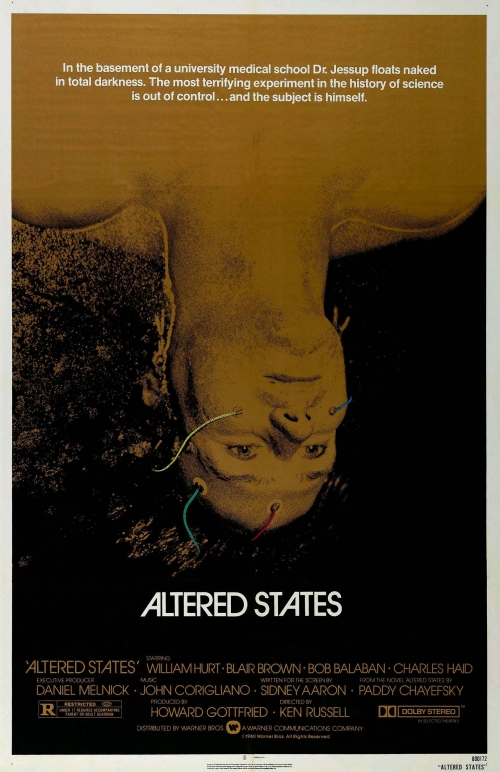
            This film, which is loosely based on the experiences of dolphin researcher John Lily the inventor of the isolation tank, and from the Paddy Chayefsky novel comes this bizarre concoction that is half sci-fi and half surreal fantasy.  The story pertains to Eddie Jessup (William Hurt in his film debut) who spends time in his isolation tank at his Harvard research lab while taking hallucinatory drugs that send him into different states of consciousness that become increasingly more frightening and vivid until they begin to externalize in his everyday life.

It was directed by Ken Russell and if you are familiar with his work you realize that means the presence of lots and lots and lots of strange visuals that come at you in quick and unannounced ways. They are confusing, cluttered, and often times make no sense. However, since the story is pretty wide-open these trippy segments work to the film’s benefit, unlike other Russell productions where I felt they became off-putting.  They also give the movie distinction and momentum. I’ve never done LSD, acid, or meth, but these segments probably come as close to the experience of a drug trip as you will find.  It is best not to demand any logic and instead sit back and allow it to become an assault on the senses, which on that level works to excellent effect. I came away wishing these scenes had been more extended and frequent as they are the best part of the movie. Of course the state-of-art special effects are no longer as impressive and look like images put on a mat screen, but some of the other stuff is cool. My favorite part is where a naked Blair Brown and Hurt are lying on the ground and a strong wind completely covers their bodies with sand and then they slowly evaporate into the air.

Hurt does a competent job and the character isn’t the clichéd kind of sensitive modern man like most Hollywood protagonists. He is emotionally ambivalent and self-centered.  His unromantic marriage proposal to Emily (Blair Brown) is one for the books, but I liked it. Most research scientists probably aren’t a socially skilled, people person to begin with otherwise they wouldn’t be shutting themselves inside a lonely, dingy research lab all day, so in that regards I felt the script hit the target and gave the film a little more of an edge.

Blair does fine in her role as the long suffering wife and it is nice seeing her looking so young and even briefly smoking a joint. She looks great naked, but her armpits where much too hairy during the love-making scene and she should have shaved them. I also found it amusing that during the time the two were separated Eddie started to have relations with a younger student of his who continued to refer to him as ‘Dr. Jessup’ even when they were in bed together.

Charles Haid plays Mason Parrish a friend of Eddie’s who helps him out with his experiments despite strong misgivings. His rants and tirades are well-played and give the film energy when it is not in fantasy mode.

To me the movie became boring and contrived when Eddie started to mutate into that of an ape man and runs around the campus and city terrorizing everyone. It seemed too reminiscent to An American Werewolf in London, which came out around the same time as well as countless other wolf man movies. The part is also not played by Hurt, but instead Miguel Godreau, who was an excellent dancer. I was impressed with his limber body and the way he could climb things, which gave him an animalistic quality, but felt that if it represented the Hurt character then Hurt should have been performing it even if it meant allowing for certain concessions.

The opening sequence showing Hurt locked in a thin, rusty tank in an empty room is terrific. There is a certain starkness and foreboding quality, especially with the eerie music, that makes this one of the better openings to a horror movie. The use of the credit titles is creative and reminded me a bit of The Shining. However, the film’s ending is horrid and one of the worst I have seen. It reeks of being a forced ‘happy’ Hollywood ending that practically ruins the entire picture as a whole. Because of this and the fact that the script seems to only skim the surface of this potentially fascinating subject matter forced me to give it only a 5 rating.

My Rating: 5 out of 10

Released: December 25, 1980

Runtime: 1Hour 42Minutes

Rated R (Language, Brief Nudity, Adult Theme, Intense Visuals)

Director: Ken Russell

Studio: Warner Brothers

Available: VHS, DVD, Blu-ray, Amazon Instant Video 

How to Beat the High Co$t of Living (1980)

By Richard Winters

My Rating: 2 out of 10

4-Word Review: Ball full of money.

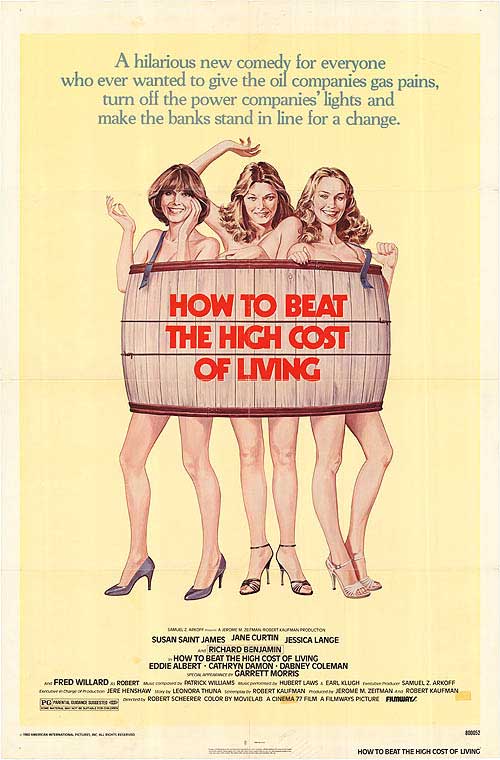
            Jane, Elaine, and Louise (Susan Saint James, Jane Curtain, Jessica Lange) are three women who find themselves in financial straits. They become aware of a contest going on at their local mall that features a giant plastic ball filled with money. The idea is to guess how much money is inside the ball, but the women decide to tunnel underneath the building and suck the money out with a vacuum.

The movie falls flat from the beginning. There is no action, hijinks, jokes, or pratfalls. Everything relies on the dialogue that is boring and conventional. The small attempts at humor including some Abraham Lincoln jokes are stale and unimaginative. It takes a plodding 35 minutes just to detail all of their financial difficulties and then another 40 minutes of going through their planning phase before we ever get to the actual heist, which proves not to be worth the wait.

Having a giant ball in the middle of the mall makes for an interesting visual and the concept of trying to get money out of it managed to hold my interest somewhat in what is otherwise a highly uninspired movie. However, I found it hard to believe that these women, as financially desperate as they were, would decide to pull off such a dangerous and complex heist when they had no experience in robbing anything before. Having them rob a bank, although more standard, would have made more sense and with a little imagination could have been even funnier and more interesting. The actual execution of the crime is dull and I thought it was really reckless and stupid that they chose to do it while security guards where standing around it and tons of people present watching a nearby play instead of waiting until the place closed. Also, it was ridiculous during the planning stage when they decided to force Jane to rob a grocery store in order to get her ‘psychologically ready’ and prove that she had the ‘guts’ to pull off the big heist, but this seemed stupid because if she got caught, which could easily happen, then all their plans would have been ruined.

The only thing that half-way saves it are the female leads and I liked all three of them. Saint James is a very attractive woman and normally I don’t particularly like ladies with husky voices, but with her it is sexy. I also enjoyed the naïve quality of her character. Lange is young and beautiful here and looking light years removed from the southern accented old crone that she has been playing in ‘An American Horror Story’. Her vivaciousness helps propel every scene that she is in. Curtain is a blast as well. She has impeccable comic timing and I always felt her presence on ‘Saturday Night Live’ was one of the main reasons that show was so successful and ground-breaking during its first five seasons. The only problem I had with the character is that she performs a striptease near the end, which isn’t funny or sexy and comes off as stupid and degrading instead. It is also quite clearly a body double and not Curtain herself that you end up seeing topless, so for any voyeurs out there who might think of buying this just for that reason, don’t bother.

The male leads are essentially wasted. Eddie Albert has a meaningless role as Jane’s father and I could see no other reason for why he took the part except that he wanted to stay busy in his old age. Richard Benjamin can be great at times, but here his character is vapid. I also thought it was a bit strange that he was cast as Lange’s husband since in real-life he was eleven years older and given her very youthful appearance here almost made it look like a middle-aged guy bedding a minor. Dabney Coleman is cast against type playing a nice guy for a change instead of a conniving jerk that he usually does. Since he plays conniving jerks so well I have always enjoyed him and the change of pace is interesting for a few seconds before it becomes boring like everything else.

The on-location shooting in Eugene, Oregon does not help. The music score comes about as close to ‘elevator music’ as you can get. The opening animation sequence is lame. Outside of a slightly amusing cameo by Garret Morris this thing never gels and it is one film you can afford to miss.

My Rating: 2 out of 10

Released: July 11, 1980

Runtime: 1Hour 44Minutes

Rated PG (Brief Nudity)

Director: Robert Sheerer

Studio: American International

Available: VHS, DVD, Netflix streaming

Moscow Does Not Believe in Tears (1980)

By Richard Winters

My Rating: 6 out of 10

4-Word Review: Three women three stories.

            Some Russian lady friends of mine suggested I review this film, which is a favorite of theirs and awarded the Oscar for best foreign film of 1980. The story deals with three women who room together at a boarding house and detailing their hopes, dreams, and personalities and then the second half examines them several years later and showing how much they have evolved.

The film has a definite European flair in that characters are well-rounded and believable. I found myself liking them right from the beginning and genuinely interested in their fates.  Lyudmila (Irina Muravyova) is engaging and amusing in her attempts to snare a man with prestige and money. Katerina (Vera Alentova) is equally interesting in the other way. I liked seeing how she starts out as shy and naïve, but blossoms into a strong, successful, self-assured woman by the end. The film takes its time in telling the story, letting you get to know the characters and allowing the scenes and situations to gel without the need for any quick edits, or cuts. I also thought director Vladimir Menshov does an excellent job with the women’s aging, which is natural but impressive without any use of make-up. At first I thought the movie had been filmed over a several year period in order to make the aging look so realistic, but that was apparently not the case. In discussing this with my Russian friend she tells me that the women were already in their 30’s when this was filmed, but even if that was the case then making them look so youthful at the beginning is still a successful feat.

The film is not a completely dour drama and manages at times to have a nice light-hearted touch with good amounts of humor. Lyudmila’s schemes are delightful at the beginning, but I also enjoyed the old man who joins a singles social club and then complains that all the women in his age group are ‘old hags’ forcing the program director to offer him a spot in a younger age group of women between 35 and 50 and he still complains that he would like them ‘even younger than that’, which only goes to prove that there’s always ‘dirty old men’ in every culture no matter where you go.

If you are expecting the film to deal with the oppressive aspects of the communist regime you won’t find it here. Most foreign films, especially those that won awards at the time, usually had this as their running theme, but here it doesn’t even touch on it. Yet I was still able to find traces of it including a scene near the beginning where a couple on a city sidewalk is told by an official that they are showing too much affection. There is another segment where Katia is being interviewed at her job in a factory by a news program. The interviewer exclaims that because Katia has shown signs of being creative that the task of a machine fitter is a ‘perfect’ job for her, which I found funny. She then asks Katia if she will be going to college, so she can get a degree and come right back to the same dreary factory and work as an engineer. I found this to be funny also, but my Russian friend tells me that the title of engineer in her country at the time was a highly regarded position that paid well, even though in America the idea of going to college is so that one can get a good education and not have to work in a factory at any level.

Another part of the film that may confuse American audiences is when Katia finds that she has become pregnant by a man that she is not married to. When she tells him the news he refuses to pay any support and she does not take him to court in order to force him. My friend explained to me that in Russia the single woman will typical not demand support from the man as this is apparently a source of ‘pride’ in their culture although many women here will find that difficult to relate too.

On the technical end the film looks like it was done on a miniscule budget. The color is faded and the images are fuzzy. Everything is filmed in places that show little that is interesting aesthetically. I thought with the word ‘Moscow’ in the title that there should have been more images of the city and scenes done at certain exotic locales to allow the viewer to get familiar with the region. There is a bit too much music. Although it is not in every scene the majority of the film has music going on underneath the conversations almost like a radio playing in the background and in my opinion it gets distracting.

My biggest complaint is that the second half spends too much time focusing on Katia and no one else. The synopsis for the film from several different sources describes this as a story about THREE women, but the by the end it is really only about one. I was disappointed as I found Lyudmila fun and I wanted to see more of her and the third woman, Antonina, is barely shown at all to the point that we get to know little about her.  Katia’s late-blooming romance goes on too long and seems a bit forced. Having her old boyfriend suddenly reappear and try to get back into her life is strained and the fact that he initially didn’t recognize her seemed hard to believe.

The story and scenarios are not original and have to varying degrees been done many times before. Unlike other Russian classics that I’ve liked including Solaris and Stalker this film lacks anything profound and comes off as a typical drama that is passable and entertaining, but not great.

My Rating: 6 out of 10

Released: February 10, 1980

Runtime: 2Hours 22Minutes

Rated NR (Not Rated)

Director: Vladimir Menshov

Studio: Mosfilm

Available: VHS, DVD (Region 1 and 2)

Lost in America (1985)

By Richard Winters

My Rating: 7 out of 10

4-Word Review: Living in a winnebago.

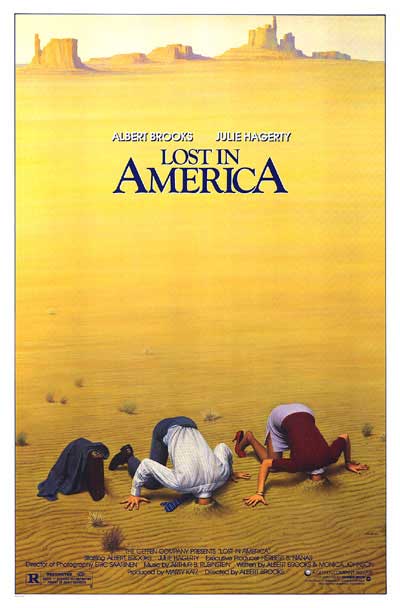
            David Howard (Albert Brooks) becomes upset when he doesn’t get his expected promotion and decides the corporate life isn’t for him and that he and his wife Linda (Julie Hagerty) will drop-out by liquidating all of their assets, buying a Winnebago, and roaming the countryside as free-spirits. Things go horribly wrong right from the start when, in a fit of gambling fever, Linda loses their entire savings at the roulette wheel. This forces David and Linda to desperately look for jobs in the first small town they come to.

The concept is fantastic. Who hasn’t dreamed of doing this at one time or another? Reportedly top executives who saw the film admitted having these very same fantasies at some point. In many ways this film is perfect testament to the 80’s where everything seemed to backtrack to the materialism and conformity of past eras and the idealism of the 60’s became lost. Writer-director Brooks plays it in a realistic and believable way with just enough subtle comedy to bring out the absurdity in each situation, which is what makes it fun.  Had the characters been over-the-top it wouldn’t have worked.

The dry, cynical wit that is Brooks’s signature is in full swing here. It may be an acquired taste to some, but it is distinct and hilarious for those that enjoy it. Some of the best moments include David’s funny rant when he tells off his boss and demands that the company give back the eight years he invested into it and won’t leave until it does. There are amusing conversations between David and the casino owner (Gary Marshall in an excellent cameo) where he begs him to give back the money Linda lost as well as his visit to an employment agency. The couple’s argument at the Hoover Dam is another highlight as is his lecture to Linda about the ‘nest egg’ concept. However, the funniest scene that had me literally laughing out of my seat was when David takes a job as a crossing guard for $5.50 an hour and some ten-year-old boys start to mock him. Even the little things, like when David tells a hotel clerk that they did not make reservations because they have ‘dropped-out of society’ and ‘just living for the moment’ is funny when done with Brooks’s impeccable deadpan delivery.

Julie Hagerty is so ingrained in my mind for her appearance in the cult-classic Airplane that I had a hard time adjusting to her here. Initially, when she is shown in the corporate setting and acting as a serious, responsible adult, I felt it didn’t work because I kept expecting her to say, especially with that high-pitched voice of hers, something dippy and spacey like her character in Airplane always did. However, when she gambles away their savings by incessantly screaming out the number twenty-two she is hilarious and when David lectures her afterwards and she looks up at him with that blank, blue-eyed, deer-in-headlights stare, she is perfect and the casting astute.

The opening sequence is probably the only part that doesn’t work. Having a taped audio interview between talk show host Larry King and film critic Rex Reed played over the opening credits is certainly novel, but David’s prolonged, whiny conversation with Linda while in bed is annoying.  A scene involving a conversation between Linda and a co-worker could have been cut. There is also the fact that everything goes downhill too quickly making the viewer feel almost cheated. It would have been nice to have seen them living the hippie lifestyle for a while and then have the problems begin gradually. There could’ve been a lot of great comedy had it been played straight without the irony of the money problem. Either way it’s entertaining, but brief. Hearing the entire rendition of ‘New York, New York’ by Frank Sinatra is worth the price as is the sight of seeing a giant Winnebago driving up a busy, downtown Manhattan street.

My Rating: 7 out of 10

Released: March 15, 1985

Runtime: 1Hour 31Minutes

Rated R (For a Couple of ‘F-Bombs’)

Director: Albert Brooks

Studio: Warner Brothers

Available: VHS, DVD, Amazon Instant Video

The Blues Brothers (1980)

By Richard Winters

My Rating: 7 out of 10

4-Word Review: A mission from God.

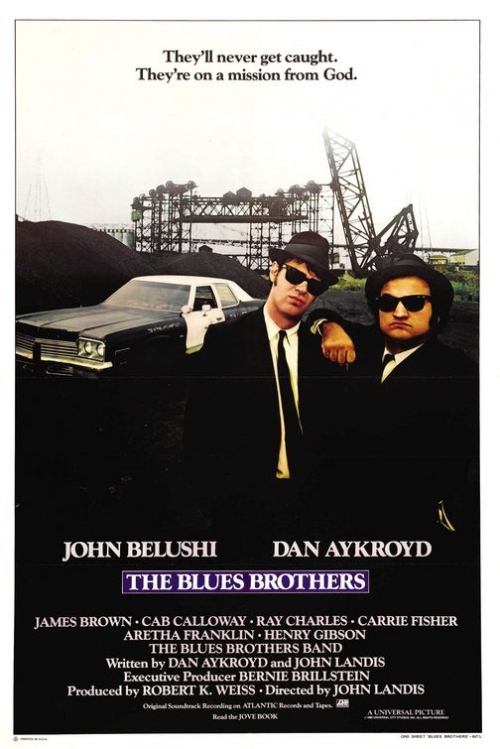
Jake (John Belushi) is released from jail and joins his brother Elwood (Dan Aykroyd) in starting up their old band so as to raise money for their old orphanage. Trying to get the members back proves harder than they thought, but because they are ‘on a mission from God’ nothing deters them including having every police agency in the state (and various other riff-raff) on their tail.

If you take away the songs and the extended car chases you have only 20 minutes of actual comedy and even then it is not real hilarious just amusing. Sometimes it gets downright silly like an old Disney movie with no edginess or satire. There isn’t even the expected crudeness or sophmorics and having this thing rated ‘R’ is ridiculous.

For such a simple comedy it is well staged almost like a grand scale spectacle. The stunts are spectacular and at certain times breathtaking. Director John Landis seems to have shut down the whole city of Chicago to do it and it definitely set a new standard for car chases.

Some of it makes you grab the edge of your seat especially when you see in fast motion, from their viewpoint, careening down the street as they dodge cars and pedestrians that seem to pop up at you. It also helps the validity to have them run into some road construction because in Chicago that’s pretty much all you see. I lived there for 18 years and the saying they have is that there are two seasons ‘winter and road construction’. Yet it would have been nice to see them wearing their seatbelts! Anyone else would have been killed or injured with any number of things they do and this thought takes away from some of the fun. It also would have helped the plausibility to have a couple of the bullets shot at them at least hit the car. There is a scene where over a hundred different policemen shoot at the car and not even one hits it!

The songs are great and it’s more of a musical anyways. There is a nice emphasis on the blues that bring out a distinct Chicago flavor. Cab Calloway is terrific doing his famous rendition of ‘Minnie the Moocher’ while the Blues Band plays along dressed like a 1920’s swing band. The numbers done by the Blues Brothers themselves is the most rousing as they guys can really sing! Their rendition of ‘Rawhide’ is hilarious.

Kathleen Freeman has probably the funniest part in a nifty send up of those Catholic school nuns that loved to use a ruler as a disciplinary tool. Carrie Fisher is engaging as a jilted bride out for revenge as she always did have a very ‘Don’t mess with me’ look in her eyes even when she was doing Star Wars. Henry Gibson shows his usual sinister style as the head of the local Nazi party and yet it is Aykroyd who is the real star as he is at his deadpan best throughout.

Look quickly for Paul “Pee Wee Herman” Ruebens as a French waiter. Also the DVD version has 18 minutes of extra footage.

My Rating: 7 out of 10

Released; June 20, 1980

Runtime: 2Hours 13Minutes

Rated R

Director: John Landis

Studio: Universal

Available: VHS, DVD, Blu-ray, Amazon Instant Video

Maniac (1980)

By Richard Winters

My Rating: 5 out of 10

4-Word Review: He wants their hair.

A loner (Joe Spinell) terrorizes New York City by killing young women and scalping them. He then takes their hair, brings it home, and places it (actually he nails it) onto the heads of some mannequins that he has.

In a lot of ways this is the same old mechanical slasher flick as it has all the predictable characteristics of the others that dominated the early 80’s. The story is simple and strung along by long, drawn-out murder sequences. There is some suspense, but it is minimal since we know exactly what is going to happen. The victims are young, good looking women, who are clueless to the dangers that are lurking until it is too late. One segment in particular features a nurse getting off of work late at night, who mentions her fear of the killer and yet for some reason she still foolishly refuses a ride home from her friend and instead walks down a dark, lonely street and into, of course, eventual carnage.

There are also some rather glaring technical errors. One features a woman (the same one who refused a ride) running from the killer by going into an empty subway. Although isolation is the whole factor here there is one shot, taken from inside a departing subway car that clearly shows a whole bunch of people standing just across from her on the other side of the tracks. There is also a segment where Spinell takes his girlfriend to his mother’s grave. When the car pulls up to the cemetery it is a nice, bright afternoon, but when they reach the actual grave it has become pitch black with a strange unexplained fog that has rolled in. Lastly there is the ending. This is a man that has terrorized a whole city and yet only two policemen in an unmarked squad car come to his residence and when they do they don’t even bother to secure the site.

Despite the low-budget problems there are a few things that raise this slightly above the rest. One is the fact that it actually manages to get inside the killer’s head. You hear the inner conversations between his ‘good’ side and his ‘bad’ side. Of course this only touches the surface of a true schizoid personality, but it does offer a little more depth than most. It also helps create a good portrait of a tormented soul and you end up feeling more sadness than fear for the man. The film also consistently has a dark, grainy look, which helps accentuate the ugly theme. Having it take place in New York City gives it a little more distinction and atmosphere.

The special effects are good. The part where he blows a man’s head off, through a car windshield, looks very realistic and has become the film’s most famous scene. The surreal ending, where the mannequins all come to life and exact a sort of revenge, is also well-handled and imaginative. Makeup artist Tom Savini, who also appears as the character of ‘Disco Boy’, has had a lot of success, but the stuff here may be his best.

Director William Lustig shows some panache and Spinell, who also co-wrote the screenplay, gives a surprisingly strong performance, but their attempts at creating a better understanding of a crazed killer prove placid and simply done for shock value.

My Rating: 5 out of 10

Released: December 26, 1980

Runtime: 1Hour 27Minutes

Not Rated (Graphic Violence, Brief Nudity, Language, Adult Theme)

Director: William Lustig

Studio: Magnum Pictures

Available: DVD, Blu-ray (30th Anniversary Edition)

The Gong Show Movie (1980)

By Richard Winters

My Rating: 5 out of 10

4-Word Review: Jaye P. Morgan topless.

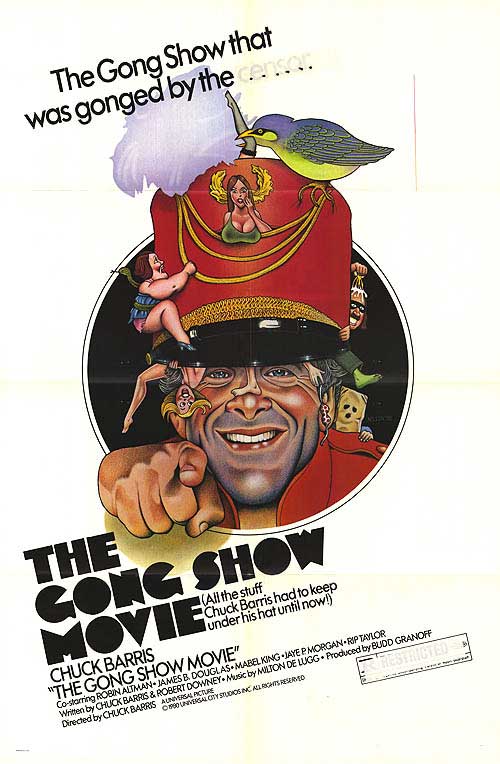
A very fractured, offbeat look at game show host Chuck Barris and his trials and tribulations as producer and host of the hit 70’s game show ‘The Gong Show’. In between there are some very short snippets of acts that never made it past the network censor. If you are unfamiliar with the show it featured three B-celebrities, usually Jamie Farr, Artie Johnson, and Jaye P. Morgan, who would watch talent acts performed by amateurs. The acts were usually done in the comic and absurd vein and could include anything from singing, dancing, or stand-up comedy. If they were really bad the celebrities would get out of their seats and bang a big gong that was behind them, which would have the performer thrown off. If the participant avoided being gonged they would then have the potential of winning a monetary prize at the end.

If you were not a fan of the show then you probably won’t be a fan of this movie either. If you were a fan you still might not like it because Barris acts consistently embarrassed by his creation and seems to want to disown it.

The film lacks cohesion. It mixes absurdity with surrealism and even trashy segments thrown in for good measure. The quirky bits are forced and the ‘hilarious’ dialogue is just plain stupid. There is also too many scenes involving a stuffy, uptight network boss who is so over- the-top clichéd that he becomes annoying.

Barris never seemed completely cut out for a game show host and even less as a leading man. He has no charisma and  spends the whole time moping around. He comes off as very burdened making you wonder if his stories about being a part-time CIA hit man were true. Either way he is not an engaging centerpiece for a movie. It would have been better had it broadened out and shown more of “The Gong Show” cast especially Jaye P. Morgan who is as raunchy as ever in the few scenes that she is in including her topless part!

The show always had a unique and perverse brilliance, which comes out every time it features one of the acts from the show making me feel that using this simply as a highlight reel of all of the best and most outrageous acts would have been a better idea. The ones that they show aren’t bad, but they are cut pretty short. A few of the ones that I liked featured two teenaged girls performing fellatio with their popsicles. Another one has three men standing at a urinal and making music with their zippers until one of their zippers gets caught! There is also two obese Siamese twins singing the Captain and Tennille hit ‘Love Will Keep Us Together’.

My Rating: 5 out of 10

Released: May 23, 1980

Runtime: 1Hour 29Minutes

Rated R (Language, Brief Nudity, Raunchy Humor)

Director: Chuck Barris

Studio: Universal

Available: None