Tag Archives: 70’s Movies

The Eiger Sanction (1975)

By Richard Winters

My Rating: 5 out of 10

4-Word Review: Clint goes mountain climbing.

Dr.  Jonathan Hemlock (Clint Eastwood) is a retired assassin and mountain climber now working as a college art and history professor. However, due to his penchant of collecting rare paintings he is sucked in to doing hits from time to time by an obscure government bureau in order to help pay for his expensive collection of artwork. His assignment this time is to track down the Russian assassin who killed his old army buddy that at one time had saved his life while back in the war. The identity of this killer is not known, the only thing that is known is that the man walks with a limp and is a part of a team of mountain climbers set to scale the foreboding Eiger Mountain in the Swiss Alps.

Eastwood’s foray into the spy genre while entertaining enough to be considered passable still ends up being a misfire. Sure it is fun to see him go a bit against type especially with the accepted image of the spy. Here he wears glasses and actually turns down the advances of beautiful women at least when approached by an attractive student who states she is willing to do ‘anything’ in order to get better grades. It is even fun hearing him speak like a flaming homosexual when he disguises himself as a gay delivering man. However, the overall hokey premise does not suit Eastwood’s rugged persona and mentality. He seems stiff, out-of-place and unemotional most of the way and never believable. I also couldn’t buy into the idea that this paid assassin was actually a deep and philosophical man who abhorred the violence.  A person who becomes as good of a killer as this character is purported to being would have to have some deep dark passion for it in order to spend as much time doing it as he does.

The supporting cast does not fare much better. Dragon (Thayer David) who is head of the secret government bureau that recruits Roger is over-the-top and cartoonish as an albino man who must live in almost complete darkness in an underground temperature controlled room. George Kennedy gets another bland, thankless role this time as Ben Bowman the man who helps train Roger to climb the mountain. It seems like once he won the Academy Award for Best supporting actor in 1967 for Cool Hand Luke his career when straight downward. I also didn’t like the names given to the characters, which were supposedly done as an ‘inside joke’. The last name of Hemlock for the main character is too obvious and naming the black prostitute Jemima seemed even worse.

The only actor and character that comes off well here is Jack Cassidy as the gay man named Miles Mellough who walks around with a pet poodle named Faggot while playing a crafty game of cat and mouse with Jonathan. The character is both threatening and amusing and it was a real shame that he gets killed off in the middle as he could have made the tension more interesting had he stayed on until the end.

Most critics have described the pacing as ‘sluggish’ although I thought it was alright and it gets sprinkled so much with Eastwood’s amusing one-liners that it is always entertaining. The only real issue I had in this area is the first part, which seems unnecessary. It has Jonathan flying out to Switzerland to kill one of the killers only to come back and then fly out again to get the other one. This all becomes redundant and the scene involving the assassination of the first killer is poorly choreographed and edited.

The film’s main redeeming quality is the mountain climbing sequences, which is impressive. I loved the bird’s-eye view camera shots that captured the majestic landscape both in the scenes at Monument Valley as well as in Europe. The fact that Eastwood did almost all of his own climbing and stunts is equally impressive. There looks to be a lot of research put into the making of this film and the climbing segments are well shot and authentic looking. The climax atop of the Eiger becomes a bit drawn out and if anything I found the climb that Eastwood and Kennedy did on the ‘Tootem Pole’ in Utah in the middle of the movie to be more exciting and breath taking.

(Spoiler Alert)

The biggest, most glaring problem that I had with this movie comes at the very end with the ‘surprise’ identity of the killer, which turns out to be the Kennedy character who is finally seen walking with a limp. This though makes no sense because if the man had a limp how was he able to disguise it for so long during the many weeks that he spent with Jonathan during their training and how was he able to climb up the mountain with Jonathan in Utah. The fact that none of this gets answered and almost seems over-looked really makes this thing seem pointless and poorly thought out.

(End of Spoiler Alert)

Rod Whitacker who wrote the novel of which this movie is based labeled this film as being ‘vapid’ and I would have to agree. The story seems to borrow a lot of the same ingredients from other spy films without adding anything new or original of its own.

My Rating: 5 out of 10

Released: May 21, 1975

Runtime: 2Hours 3Minutes

Rated PG

Director: Clint Eastwood

Studio: Universal

Available: VHS, DVD, Amazon Instant Video

The Fury (1978)

By Richard Winters

My Rating: 5 out of 10

4-Word Review: Blow up the body.

Another Brian De Palma/Hitchcock wannabe, this one involving a sinister secret government agent named Ben Childress (John Cassavetes) who wants to use the amazing psychic abilities of a young college-aged man named Robin Sandza (Andrew Stevens) for his own nefarious purposes. While he is in Israel with the father and son he decides to stage a terrorist attack, which he hopes will kill the boy’s father Peter (Kirk Douglas) and allow him to whisk Robin away to an underground research lab where no one will find him. However, Peter manages to survive the attack and goes on a relentless pursuit to find his son. This occurs while a young woman named Gillian Bellaver (Amy Irving) with equally strong parapsychological traits starts to have visions of Robin and his whereabouts while attending a school that specializes in people with these abilities and eventually she teams up with Peter to help him in his quest.

I liked the opening sequence being shot on-location in Israel, which gives the film an exotic feel. The attack is well-handled and comes as a surprise without any set-up, but I felt there was a fatal flaw with the premise. This is namely the fact that with Robin’s amazing psychic abilities you would think he could figure out that his Dad was still alive and be able to find him while also outsmarting the people who are holding him.

The secret agency thing and what they are using him for is vague and we see only a few scenes with him there. I felt this should have been more detailed and less time spent with Gillian at the psychic school, which is not very compelling and rather draggy.     There are a few good action moments, but unfortunately they come at the beginning and end with a talky middle that lacks any real suspense.

However, Peter’s escape from some gunmen by jumping out of an apartment window and onto the ‘L’ tracks along Wabash Avenue in Chicago is amazingly well shot and nerve-wracking.  A scene where Robin tortures a female Dr. (Fiona Lewis) by using his telepathic powers to spin her around a room until  blood oozes from her body and sprays all over the walls and furniture deserves some merits, but I wished it had been more extended. There is also the exploding body that is the film’s final shot and possibly its best and it is shown several times at different angles. I also enjoyed the darkly humorous scene where Robin uses his powers to send a ride at an indoor amusement park out of control and throwing the riders through the window of a nearby restaurant.

De Palma’s trademark over-direction is in full gear. Sometimes it works, but other times it is a distraction. For instance he uses a lot of panning shots showing one person talking and then panning to the other person and then back again. During a funny scene where Peter breaks into an older couple’s apartment while looking for a disguise this really works, but De Palma continues to go to this well throughout and eventually it becomes annoying. There is also a foot chase that is done in slow-motion, which to me sapped the tension and excitement right out of it. He does have a few bird’s-eye view shots, which while not adding anything to the story, are still kind of cool.

Andrew Stevens, son of actress Stella Stevens, is well cast as the young man who starts out likable, but slowly becomes evil as the film progresses. Stevens has a good knack for this as he can go from nice to menacing very quickly and I first noticed this during a classic episode of Murder She Wrote. His clear blue eyes can give off a creepy stare as well.

John Cassavetes is an excellent bad guy.  He is best remembered as an independent film director with a unique vision, but with his dark features, cryptic glare, and intense delivery he can also be a very good villain. I don’t think the film made the most of it, but it was astute casting.

Although billed as the star Douglas does not have the most screen-time and there are long periods where he isn’t seen at all. This was really a vehicle for Irving, who is convincing and makes the viewer sympathetic to her quandary of having super-powers that she does not fully understand, cannot control and doesn’t really want.

It’s an interesting idea, but doesn’t go far enough with it. There weren’t enough twists to justify sitting through almost two hours. The pacing is poor and had it been trimmed to 90 minutes it would have worked better. The special effects are decent, but there needed to be more of them and they might not hold-up to contemporary standards. John Williams’s orchestral sounding score helps elevate what is really just bubblegum material.

This is a great chance at seeing some young stars in their film debuts including Darryl Hannah, Laura Innes, and James Belushi. There is also an amusing scene featuring Dennis Franz with a full head of hair playing a nervous and befuddled Chicago cop.

My Rating: 5 out of 10

Released: March 10, 1978

Runtime: 1Hour 58Minutes

Rated R

Director: Brian De Palma

Studio: 20th Century Fox

Available: DVD, Amazon Instant Video

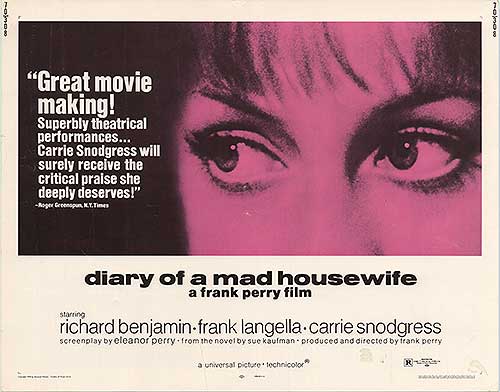
Diary of a Mad Housewife (1970)

diarymad1

By Richard Winters

My Rating: 9 out of 10

4-Word Review: Married to a jerk.

Director Frank Perry may not be a name one throws out when mentioning some of the top directors, but a lot of his early work that he did with his screenwriter wife Eleanor were definite forerunners of the independent film movement and ahead of their time. David and Lisa was their first and it dealt with the budding romance between two patients at a mental hospital. Ladybug Ladybug was their follow-up and it was the true story of what happens when an errant nuclear warning siren goes off and the staff and students of a small rural school think it is for real. There was also the critically acclaimed film Last Summer dealing with the brutal gang rape of a teen girl by her so called ‘friends’.  They also did the revisionist western Doc starring Stacy Keach as well as the brilliantly quirky Rancho Deluxe.  However, it is Diary of a Mad Housewife that I find to be their very best.

It is the story based on the best-selling novel by Sue Kaufman dealing with the character of Tina Balser.  On the outside she seems to be living the American dream. She is married to a up and coming lawyer, living in a swank Manhattan apartment, and the mother of two beautiful girls.  Unfortunately the husband is an obnoxious bore, the girls are spoiled and mouthy, and she feels lonely and depressed.  She decides to have an affair with a novelist, but he ends up treating her just as poorly and when she tells her troubles to a support group, they end up doing the same.

I have seen this film many times over the past twenty years and am always impressed at the fluid way it goes between satire and drama as well as the fact that it doesn’t seem dated at all. The scenes with Richard Benjamin as the jerk husband are hilariously over-the-top.  Yet the scenes involving Frank Langella as the lover who is bitter about his lagging writing career and repressed homosexuality and takes these frustrations out on Tina, are just as interesting, but in a much more subtle way.  In fact these scenes feature some great dialogue and character development and I find them more intriguing with each viewing.  Langella, in his film debut, makes a lasting impression.

The cinematography, editing, and color schemes are also first-rate. Perry does a great job in infusing the counter-culture movement of the time with the old values of marriage and family. The mod party that they go to is well staged with scantily clad mannequins in a provocative poses placed throughout.  The pretentious attitudes of the party goers is nicely captured.  This scene also features the Alice Cooper Band as well as giant pillow fight.

Carrie Snodgrass performance is what really makes this work.  She was nominated for the Academy Award and she should have won it. Her ability to display her characters feelings through such subtle methods as facial expressions, body gestures, and reactions is impressive.  The viewer can easily relate to the character and feel her pain.  Rock singer Neil Young was so impressed with her that he wrote her a fan letter and the two ended up getting into a relationship. Unfortunately because of this she dropped out of Hollywood and didn’t do another movie until almost nine years later.  When she returned all the top roles were no longer accessible and she was relegated to ‘B’ movies and small supporting roles until finally succumbing to cancer in 2004. This was a real shame because her talents were never fully utilized, but at least this was a perfect vehicle for her and one that movie fans today can really appreciate.

In the end though what makes this film so very good is that it makes a great statement on the fact that isolation is a part of modern day living and at some point everyone will have to deal with.  Getting married, having kids, even having a lover or a support group will not necessarily be an effective buffer and may actually only exacerbate it. The whole film kind of reminded me of a statement made by a character on the old ‘Ally McBeal’ TV-show “My loneliest times in life are when someone is lying in bed next to me.”

My Rating: 9 out of 10

Released: August 10, 1970

Runtime: 1Hour 43Minutes (Theater Version) 1Hour 35Minutes (TV Version)

Rated R

Director: Frank Perry

Studio: Universal

Available: VHS

T. R. Baskin (1971)

tr baskin

By Richard Winters

My Rating: 8 out of 10

4-Word Review: Out on her own.

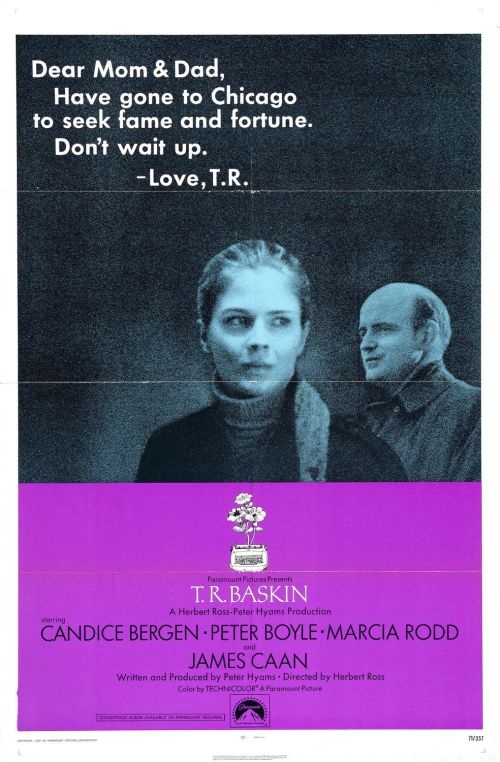
T. R. Baskin (Candice Bergen) is a young woman who leaves the nest by striking out on her own in Chicago. Unfortunately she finds nothing but a lot of loneliness, dead-end dates, crummy apartments, and soul-sucking jobs. Our protagonist becomes so emotionally beaten down that when a traveling salesman named Jack Mitchell (Peter Boyle) calls her looking for a ‘good time’, as he mistakenly is given her number under the impression that she is a prostitute, T.R. accepts his invitation simply as a chance to connect with someone. The film then cuts back and forth between conversations that she has with Jack in his hotel room as well as her experiences when she first gets into the Windy City.

Although this film does have its share of faults I was really taken aback by its strong emotional impact. The film was directed by Herbert Ross who would later do Footloose, The Goodbye Girl, and Steel Magnolias. The screenplay was written by Peter Hyams famous for writing and directing Capricorn One, Narrow Margin, and 2010 to name a few.

The film manages to recreate the monotony and isolation of day-to-day living better than just about any other movie that I have seen. Some of the best scenes include T.R.’s job interview process at an accounting firm as well as a long camera pan showing all the rows and rows of desks in the office and T.R. looking lost in the middle. There is another part where she sneaks back into the office on a weekend day in order to make silly announcements over their intercom system and the images of all the dark shadowy desks looks just as ominous. Another moving moment is when she is shown pacing her lonely apartment as well as her phone conversation with her parents where she tries to convince them that she is doing ‘just fine’, but breaks down into tears the second it ends.

The film leaves you with a strong impression. The music that was selected was first-rate and fits the mood of the picture perfectly. It is a real shame that this sleeper has never been released on either VHS or DVD and has not been shown on television since December of the 1980 when it was broadcast on Cinemax. It is well worth seeking out and certainly deserves more attention.

Bergen is terrific in the lead. This is before she attained her acerbic persona from her ‘Murphy Brown’ days and here comes off as more shy and sensitive. Her delicate and attractive features help capture the viewer instantly.

Boyle is equally good and the introspective conversations that the two have nicely runs the gamut between funny and sad. James Caan, who for some reason appears unbilled, has a nice cameo as an attractive and intelligent man that T.R. falls for only to have him callously break her heart.

If the film has any flaw it is in the fact that it is a bit uneven. It starts out with some terrific dry humor including a hilarious scene when she goes apartment hunting, but eventually the movie becomes too much of a downbeat drama. There are certainly universal truths to many of the sad situations that she goes through, but I found it frustrating that we are never shown her eventual fate. All we see is a small period in her life and then a very abrupt and unsatisfying ending. It would have been nice if the story had cut to five, ten, even twenty years down the road and allowed us to find out if she ever found ‘Mr. Right’ and some happiness.

Despite being made forty years ago this film is as trenchant and timely as it was back then. People who avoid watching older films because they believe that they are ‘dated’ are being foolish. This film has more bearing in reality and the human experience than a lot of the movies out today.

My Rating: 8 out of 10

Released: October 20, 1971

Runtime: 1Hour 30Minutes

Rated PG

Director: Herbert Ross

Studio: Paramount

Available: Amazon Instant Video

Avanti! (1972)

avanti1

By Richard Winters

My Rating: 7 out of 10

4-Word Review: Juliet shows her boobies.

Jack Lemmon plays Wendell Armbruster Jr. a conservative, set-in-his-ways businessman who travels to Italy to arrange the return of his father who died in a car accident. To his shock he finds that his father did not die alone, but instead was with his secret lady lover of twenty years. Apparently they would meet every summer and the two had been carrying on the secret affair without any of their family members knowing. Juliet Mills plays Pamela Piggott the daughter of the other woman. She comes to claim the body of her mother and after the two meet a certain romantic spark slowly begins to ignite.

This film is similar to The April Fools, which was another romantic Lemmon vehicle that was done just a few years earlier.  This film though works much better. For one thing there is a nice bit of mystery as to whether this thing will continue on or not and the ending leaves you guessing. Sometimes the best romances in life are the brief flings one has with someone that they know for only a short period of time and then move on and this film nicely captures that. The relationship grows at a realistic pace without ever being forced, clichéd, or sappy. In fact the two at first don’t even like each other.

Lemmon’s character here is much improved from the one in The April Fools. Instead of just being a bland schmuck he is more crusty, argumentative, and confrontational almost like talk show host Bill O’Reilly. His snappy comebacks and one-liners are fun and help hold the movie together. Mills (sister of Hayley, daughter of Sir John and wife of Maxwell Caulfield) is a delight as always playing a serene good-natured character similar to the one she did in her famous TV-show ‘Nanny and the Professor’. The fact that the two leads have such diametrically different dispositions helps give it a spark and make it intriguing.

Director Billy Wilder nicely captures the ambience and scenic beauty of the region and screenwriter I.A.L Diamond’s script is paced with amusing side-stories and characters. However, a 145 minute runtime is too long for such slight material and it spends a little too much time on side-stories that go nowhere. The scenes themselves are stretched out longer than they should with hardly any action and there is too much emphasis on the Neil Simon-like comical banter that ultimately makes this production seem more like a filmed stage play than a movie.

The film though does have some nice moments of humor. The part where the two go the morgue to identify the bodies and the very particular way the administrator sets out the legal documents to be signed and the way he packs them back up is amusing. There is also a scene where the two go skinny dipping and swim out to a small island. Yes, you do get to see both stars in the buff and although Mills isn’t bad, Lemon with his pale, out-of-shape, middle-aged-body, might be a bit too much for some. However, it is funny seeing him swim in the nude, but still leaving on his brown socks, which is a perfect testament to his uptight character. The best part and by far and away the funniest moment in the film comes when a boat load of sailors come by and start whooping and hollering at the nude Pamela. Wendell then tries to ‘protect Pamela’s modesty’ by taking off his wet, dripping socks and holding them over her ample bosoms while she merrily waves to the passing men. It’s a visual thing, but it had me laughing-out-loud.

I did have two issues with the film that I feel should be discussed. The first is the opening bit where Wendell gets on the plane without any luggage and wearing casual attire because he was given too short a notice to change clothes before he had to board the plane. He sees a man with a nice suit on and asks him if they could change clothes. Yes, it is a bit amusing when everyone on the plane, including the stewardesses and the pilots, crowd around the bathroom door in confusion after seeing two grown men go in, but the joke falls flat because it is not in any way believable. Who in their right mind would go into a small bathroom of a plane with a perfect stranger to change clothes with him, especially when there was no money exchanged? Most would probably think he was a kook and tell him to get lost. The first rule they teach you in comic screenwriting 101 is that for the joke to work there needs to be some grain of truth to it, or otherwise it will come off as stupid, which it does here.

The other problem has to do with Pamela and her apparent ‘weight problem’ that gets mentioned not only by her, but by the other characters as well. The truth of the matter is that she looks great and has a figure most women would die for. I noticed this same thing with the Anne Hathaway character in The Devil Wears Pavda where she was labeled as ‘fat’ when compared to the other models even though she looked terrific. Apparently Hollywood, in their never ending quest for ideal beauty, cannot bring themselves to actually cast a plain, over-weight woman in the pivotal role of a love interest even if the script calls for it so instead they get someone who is just slightly under the gorgeous level, but still way above the average woman, and then hope to pass her off as a ‘plain Jane’. The result becomes not only ridiculous, but highly annoying and even insulting especially when it continues to be brought up and discussed.

Overall romance fans should find it appealing as the story has all the necessary ingredients and fits the formula well.

My Rating: 7 out of 10

Released: December 17, 1972

Runtime: 2Hours 20Minutes

Rated PG

Director: Billy Wilder

Studio: United Artists

Available: VHS, DVD, Amazon Instant Video
Movie Movie (1978)

By Richard Winters

My Rating: 3 out of 10

4-Word Review: Two movies in one.

Initially, the unique concept for this film seems intriguing.  The idea was to recreate the movie viewing experience of the 30’s and 40’s by having a double bill feature along with theatrical trailers in between. The stories would have all the clichés, storylines, and characters from films of that era, but done with a tongue and cheek approach. The same core performers including: George C. Scott, his actress wife Trish Van Devere, Red Buttons, Art Carney, and Eli Wallach would play different characters in all the stories much like doing skits on a variety show. Legendary director Stanley Donen, famous for such films as Singing in the Rain, Royal Wedding, and Seven Brides for Seven Brothers, would direct and the screenplay would be written by Larry Gelbert best known for writing Oh God! and Tootsie.

Unfortunately, it never really takes off. Part of the reason is that the parody is too restrained. There are a few funny lines here and there, but that is about it. This was released two years before the Zucker brother’s groundbreaking hit Airplane that redefined parody and still stands as the standard today. This film doesn’t even come close to that. In fact certain audiences that saw this movie in other countries didn’t get the wry, gentle humor at all and took it seriously. I got the feeling that Gelbert and Donen had gone to the theaters as kids and watched these same types of films. Their affection and nostalgia for this stuff is clearly evident and prevented them from unleashing the over-the-top, in your face farce that would have really made this hilarious and is what most audiences of today expect.

The first feature is entitled ‘Dynamite Hands’ and is a story about a young boxer from the 30’s named Joey Popchik (Harry Hamlin, in his film debut) who becomes a prizefighter in order to pay for his kid sister’s (Kathleen Quinlan) eye operation. This segment features all the expected clichés, but the subtle humor that is injected fails to make it seem fresh or interesting. It was shot in color, but I felt black and white would have been better. The one thing I did like was Hamlin who these days seems pretty washed-up as he appears almost exclusively in direct to video fare, or dumb reality shows with his fat-lipped wife. Yet here he is right on target with his portrayal of the naïve, wet-behind-the-ears, All-American kid and I enjoyed it. Wallach is also fun as the heavy.

The middle segment is a mock theatrical trailer called “Zero Hour” that features Wallach, Scott, and Buttons as WWI flying aces. This was shot in black and white, but is brief and unexceptional. I was disappointed that there wasn’t any silly newsreel footage as this was also a mainstay in theaters during the time and could’ve been a riot.

The third part is a send-up of all the old Busby Berkley musicals and is entitled “Baxter’s Beauties of 1933”.  Scott, who is nicely hammy, plays a famous Broadway producer named Spats Baxter that finds out he is dying from a very rare illness and has only a month to live. He decides to go out on top by putting on the most lavish musical show that he can. Again, like with the others, this segment is a disappointment. The musical numbers, which were choreographed by Michael Kidd, are poorly photographed and with the exception of one routine done on a giant roulette wheel fail to match the spectacular and extravagant quality of Berkley’s. Van Devere’s kitschy performance as an alcoholic, tyrannical leading lady is the only thing that saves it. Gifted actress Barbra Harris is completely wasted in a thankless role of one of the chorus girls that doesn’t take any advantage of her talents.

George Burns, who is credited as the film’s ‘host’, appears only briefly at the beginning, but I would have liked to have seen more of him.

The cast and crew clearly had more fun making this than the viewer had in watching it. The formula is followed too closely and the result is tedium.  Even if you are a fan of films from that period I would still not suggest this as the originals are far better.

My Rating: 3 out of 10

Released: November 3, 1978

Runtime: 1Hour 45Minutes

Rated PG

Director: Stanley Donen

Studio: ITC Entertainment

Available: Amazon Instant Video

Dog Day Afternoon (1975)

dog

By Richard Winters

My Rating: 9 out of 10

4-Word Review: Money for sex change.

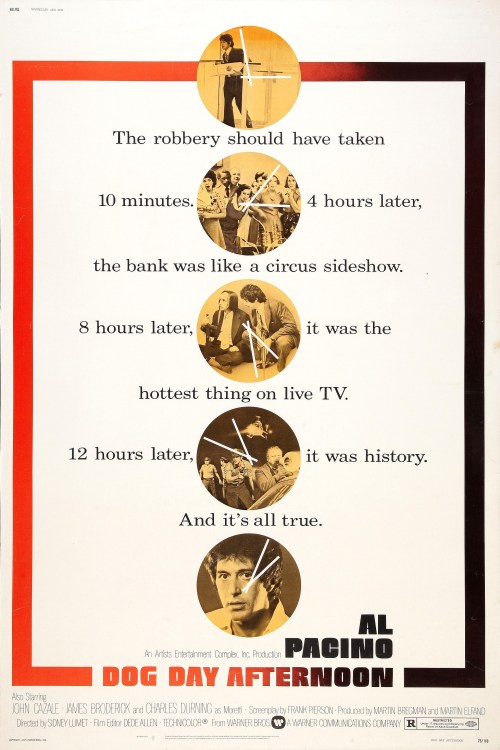
Dog Day Afternoon is a 1975 film based on a true story that took place on August 22, 1972.  It tells the tale of a man by the name of John Wojtowicz, who robbed a Brooklyn bank in order to pay for his gay lover’s sex change operation.  Here the character’s name has been altered slightly to John ‘Sonny’ Wortzik (played by Al Pacino), but otherwise this Oscar-winning script by Frank Pierson pretty much sticks closely to the actual events in this incredible saga about everything that can go wrong will.

Just about everyone who has watched this film will tell you how it manages to grab and pull you in right from the start.  It achieves this without having any special effects, pounding soundtrack, elaborate camera work, or artificial lighting.  Instead of ‘telegraphing all of its punches’ the film draws back and puts more emphasis on the little subtitles like the character’s facial expressions, side conversations, and other nuances that put together make this film very rich and textured.   In essence it successfully ‘shows’ instead of ‘tells’, which is a remarkable achievement since so many Hollywood films seem to want to do the exact opposite.

Director Sidney Lumet allowed for a lot of improvisation by his actors and gave each performer full rein on how to create their character, even the minor supporting ones. The result gives each and every one of the characters a distinct personality. The bank hostages become almost as fascinating as the thieves and it is interesting seeing all the different ways each one responds to the situation and how they interact with the robbers, which at times is both amusing and surprising.

The film also vividly captures 1970’s Brooklyn atmosphere. The sights and sounds of the area as well as the people’s personalities and the anti-establishment sentiment that was still quite prevalent at the time are all right on target.  After you finish watching this movie you feel like you just got back from a trip over there.  I really liked how during the opening credits you are shown all sorts of shots and scenes of Brooklyn, so by the time the story actually begins you are already well entrenched in the setting.

Pacino gives a dynamic performance in the starring role.  Some insist this is the best performance never to be nominated for an Oscar and I might have to agree.  If you are a Pacino fan than you absolutely have to see this, but if you are not a Pacino fan you still should see it because afterwards you might become one.

The supporting cast is stellar.  Sully Boyar, who was a real-life lawyer who did not enter into acting until he was in his 50’s, leaves a strong impression as the stoic bank manager.  As the police captain, the always durable Charles Durning is a blast especially during his frenzied and frantic negotiations with Pacino that almost become the film’s highlight. Another memorable moment is the improvised phone conversation between Sonny and his gay lover played by Chris Sarandon.  John Cazale is also amazing as Pacino’s bank robbing partner.  The partner in the actual incident was only 18 while Cazale was then 39, which created some controversy. However, Cazale is so convincing in the part that it is hard to imagine anyone else doing it as well.

In the end the film’s brilliance comes from its ability to convey the humanity of its characters. You can’t help but feel for the Sonny character despite his many flaws.  This a man who craves acceptance and yet goes through life being betrayed and hurt by everyone he meets. The shocked expression he shows at being betrayed by his own hostages, who he felt he had ‘bonded’ with, is, in my opinion, the most memorable shot of the whole film.

I only have two negative comments about this film and they are both minor.  One is the abrupt ending.  Since the film was made only a few years after the incident there wasn’t much of an epilogue to the characters.  The real John Wojtowicz, who really did look a lot like Pacino, didn’t end up dying until the year 2006.  It would have been a stronger conclusion by showing what happened to the Sonny character through the years and maybe even how he might of changed or grown.  My only other complaint is the fact that actress Carol Kane appears as one of the bank employees, but is shown very little.  A quirky and unique talent such as hers should have been given a bigger role.

Overall this is a great movie that I would recommend to any serious movie fan who can appreciate great film-making in top form.

My Rating: 9 out of 10

Released: September 21, 1975

Runtime: 2Hours 5Minutes

Rated R

Director: Sidney Lumet

Studio: Warner Brothers

Available: VHS, DVD (2-Disc Special Edition), Blu-ray, HDDVD, Amazon Instant Video

W (1974)

w1

By Richard Winters

My Rating: 1 out of 10

4-Word Review: Ex-husband is psycho.

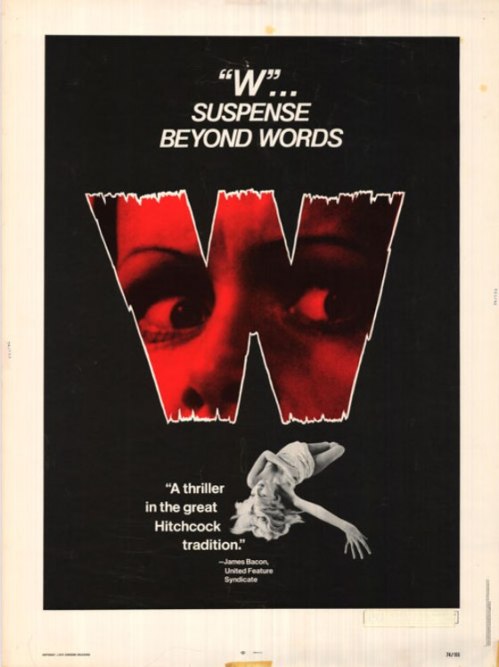
For all you trivia buffs out there it may be good to know that Oliver Stone was not the first person to make a film with the twenty-third letter of the alphabet as its title, although that one technically has a period after it.  The first one was in 1974 and starred British super-model Twiggy. She had just made a splash in Ken Russell’s brilliant musical The Boy Friend and this film was supposed to send her to superstardom by proving that she could act by placing her in a completely different genre. Unfortunately for her it never happened.

The film is a thriller and the tagline read ‘W…suspense beyond words’. It is a story about a woman who has remarried but it still being stalked by her psycho ex-husband (Dirk Benedict). His name is William and at all of the scenes of his murders, or ‘accidents’, he scrawls the letter ‘W’, hence the film’s title.

At the time the critics came down hard on Twiggy’s performance, but I kind of liked it. She comes off as very innocuous and vulnerable and in this kind of role it works.  Her present husband was played by Michael Witney, who at the time was her real-life husband.  He was eighteen years older than her, but the age difference is not apparent.  You can tell that the two are genuinely fond of each other and that chemistry helps.  Yet they have no real onscreen presence and too much of the time is spent with only them in it, which hurts.

Viewers enjoyed Eugene Roche’s performance in a supporting role as a detective.  His gritty, matter-of-fact approach is refreshing and gives him some distinction over the other characters who are very transparent. Unfortunately he gets phased out rather quickly and this is too bad because it is the type of persona that could have really carried the film.

Where this film really fails is that way too much time is given to extraneous dialogue that is not interesting and does not propel the plot along.  The scenes are also excruciatingly slow and in great need of quicker cuts and edits.  I would have like to have seen cutaways showing the Twiggy’s character’s relationship with her ex-husband and how that all started, but it is never shown. She doesn’t even end up talking about it until well over an hour into the film and then it is only done briefly.

This is also one of the first thrillers that I have ever seen that has no creepy or pounding music score.  In fact the music is very soft and melodic like something you would hear in an elevator. There is also extended amount of footage showing the couple going sailing, walking hand in hand in a park, or spending time at their lavish beach house, making it seem more like a dreamy romance movie.  Some scary imagery, or just a few shocks are badly needed.  There is one nightmare sequence that has a little potential, but it lasts less than ten seconds and that just isn’t enough.

The film also has a lot of loopholes that completely throws you out of the story.  One is the fact that as they are becoming increasingly terrorized by this ex-husband they decide not to go to the police, but instead call on the services of a private detective, who has ulterior motives and just ends up making things worse. There is also a scene where the killer cuts off two of his fingers and attaches them to the victim’s burned body so when the police identify the body using the fingerprints they think it is the killer.  However, I wasn’t exactly sure how he pulled this off. Certainly he wouldn’t have the skill or time to actually graft the fingers onto the body and even if he did you would still think that the police would notice that the victim had too many fingers.

The biggest head scratcher of them all has got to be the fact that the prison in which the ex-husband resides gives daily tours to the public.  Now I have toured a prison myself in Boise, Idaho, but that was only after the prison had been closed and the prisoners shipped off to another facility.  Here the visitors can get right up next to the prisoners and observe them without any guards, or protection.  The person leading them around is not armed and dresses and acts like a tour guide to a museum.  I would think one of the prisoners could easily obtain a homemade knife of some kind, grab one of these visitors, and use them as a shield to break out. Of course in this film that doesn’t happen, but in real life I think it would, which just makes you wonder what kind of drugs were they on when they made this.

My only interest in watching this film to begin with was seeing Dirk Benedict playing the psychotic.  He is probably best known for the character of Face in the 80’s TV-show ‘The A-Team’.  Not that he is a real great actor or anything, but he has had a career where he usually always plays the nice guy, so I was interested in seeing him as the bad guy. Unfortunately he doesn’t appear until the final ten minutes and these scenes are strained and probably the most boring of the whole film.  His character is also poorly fleshed out with no reason given to his erratic, crazy behavior thus turning him into a cliche.

I came into this film expecting very little and I went away not even getting that much. Being an avid collector of lost films can be fun because every now and then you can come across a real gem, but that was definitely not the case here.

My Rating: 1 out of 10

Released: June 8, 1974

Runtime: 1Hour 35Minutes

Rated PG

Director: Richard Quine

Studio: Cinerama Releasing Corporation

Available: None

Deep End (1970)

deep

By Richard Winters

My Rating: 7 out of 10

4-Word Review: He will have her.

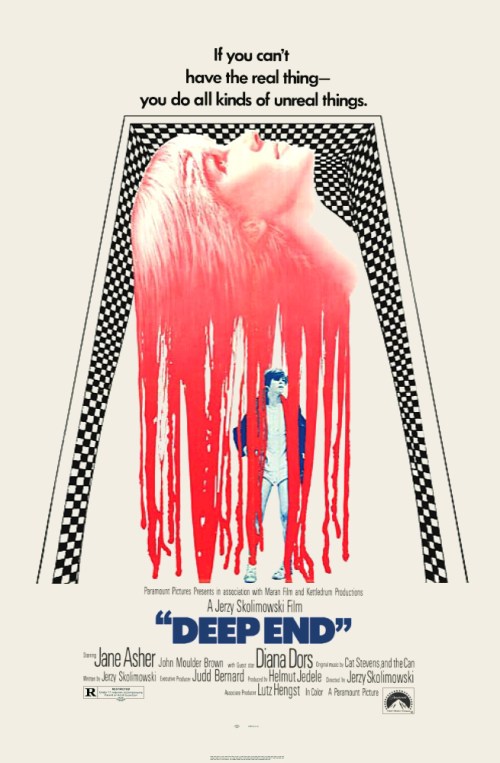
This is a moody drama detailing the story of a 15 year old boy named Mike (John Moulder-Brown) who goes to work at a public bath in London.  There he meets an alluring red-headed woman named Sue (Jane Asher).  She begins flirting with him, which causes him to become infatuated with her.  He starts following her around and even tries to scare off her two boyfriends as she is seeing both a man her own age as well as an older, married one.  Sue, who seems to enjoy manipulating all the men in her life, treats it all like it’s a silly game that ultimately ends with tragic results.

One of the things that really helps this film stand-out is the believability of the Mike character.  It was fascinating seeing all the different sides to his personality and I felt each one rang true for a boy his age.  There are times when he seems streetwise and even savvy and then there are other moments when he is immature, irresponsible, and emotionally out-of-control.  Although his obsession with Sue borders on being frightening I did like how he comes up with clever ways to help her like the ingenious way he finds her diamond that fell from her ring and into the snow.  I also liked how he becomes shocked at seeing a semi-nude poster of Sue outside a club, as she works as a stripper part-time, and how he steals it away in order to ‘protect her honor’.

Sue on the other hand seems almost all bad with very little good traits, but still equally believable.  She is mean and catty with everyone, abuses animals, and comes up emotionally hollow at every turn.  However, I could see how a young man of his age could become trapped by her seductive ways and perceived ‘maturity’, which makes the obsession itself as intriguing as their personalities.

Acclaimed writer/director Jerzy Skolimowski seems very much in control here and what buttons to press and when to do it.  I liked the color schemes especially his use of the color red. Having Cat Stevens do the music score gives the soundtrack and nice distinction.  I also liked how he foreshadows the film’s final shot several times during the movie.

I did end up having a few qualms with the film.  I wanted Mike’s initial interactions with Sue to be a little more extended than just the brief flirting that is shown.  The film takes place in buildings that are all old, rundown, and murky, which in some ways is good because it helps reflect the murky personalities of the characters.  Yet I wasn’t sure if this was all intentional or just the result of working on a low budget.  I would have liked a few scenes done against a more appealing background just to allow for  more visual variety.

The ending, especially the final shot, is very provocative and perverse.  It reminded me in a way of Nicholas Roeg’s excellent film Bad Timing: A Sensual Obsession (1980). Everything gets played out in such an odd way that it keeps you guessing until the final second as to what happens, which ends up staying with you long after the film is over.

Diana Dors, who was a popular British actress during the 50’s and 60’s and even considered a sex symbol for a time, gets a great cameo bit here that has to be seen to really be appreciated.  She plays a sexually frustrated middle-aged woman who rents a room at the public bath and then tricks Mike into coming into the room with her. She grabs his hair and shakes his head while describing a sexual fantasy that she has going on in her head.  When she is done she throws him back to the floor and says “You can go now, I don’t need you anymore.”

My Rating: 7 out of 10

Released: September 1, 1970

Runtime: 1Hour 33Minutes

Rated R (Sexual Situations, Adult Theme, Brief Nudity)

Director: Jerzy Skolimowski

Studio: Paramount

Available: DVD, Blu-ray (Import)

Dirty Mary Crazy Larry (1974)

dirty1

By Richard Winters

My Rating: 5 out of 10

4-Word Review: Fast cars fast women.

During the 70’s car chase movies were all the rage.  Smoky and the Bandit, Convoy, Vanishing Point, and Two-Lane Blacktop were just a few.  Most of these films followed the comedy adventure blueprint closely resembling the politics of the time where the police were the befuddled authority figures and those being chased symbolized the downtrodden masses looking to break free from the values and customs of yesteryear and find their own identities. Dirty Mary Crazy Larry is pretty much the same as the rest with a few notable exceptions the biggest being its very downbeat ending, which was quite talked about at the time of its release and one of the main reasons this film continues to have a strong cult following today.

The story is based on the novel by Richard Unekis called The Chase. It involves an out of work race car driver named Larry and his mechanic (Peter Fonda, Adam Roarke) who decide to rob a grocery store to make ends meet. Much to their dismay they are accompanied by a hooker named Mary (Susan George) and the three spend the rest of the film riding in Larry’s Dodge Charger with a powerful V-8 engine and avoiding the relentless pursuit of the police.

The screenplay follows the book pretty closely, but does make a few ill-advised changes. One is that in the book the two leads characters were career criminals who robbed for a living. I thought this made more sense and gave the characters a little more grounding.  I didn’t understand why a race car driver and his mechanic would suddenly be pushed to robbery, or what lead them into their fix. The robbery is executed in much too sophisticated a way for a pair of novices as they kidnap the store manager’s wife and daughter and then threaten to harm them unless the manager opens up the store’s safe. They also rig his home phone up to a tape recorder device so every time he calls home he hears the voice of the two and thinks they are still there even though they had already hit the road.  Criminals who had done this all their lives would be brazen enough not only to come up with this idea, but to also pull it off.  People with no background in robbery most likely would not.  There is also no explanation as to why they chose this store and how they planned the whole thing out, which would have helped.

Another change that was made was the addition of the Mary character.  In the book it was just the two men, which made it more gritty.  Although easy on the eyes the character serves no fundamental purpose to the story line.  All she does is have very redundant arguments with Larry that quickly become tiring.  I began to realize that these shouting matches were put in solely as filler material and it ends up getting inane.

Although I have like Peter Fonda in other films, most notably Easy Rider, I did not feel his laid back persona fit this part.  Larry is indeed a potentially interesting character as it is a person who can only find solace when he is taking extreme risks and driving real fast, but Fonda seemed unable to bring out this edginess effectively and his incessant gum chewing ends up becoming real annoying.

Vic Morrow probably gives the film’s best performance as the sheriff.  Normally the police are portrayed as bumbling idiots in this type of genre, but here they were a little more human and I liked the way that he was a bit of a non-conformist himself in the relentless way  he pursued the trio.

I also liked the attempt by the film makers to put in more realistic elements to a car chase that is never shown in most movies. One particular scene involves a pick-up truck that has nothing to do with the chase pulling out and getting side-swiped by Larry’s car.  For a minute the film becomes somber as they think they may have killed the other driver, which is good. Too many chase films always show other drivers and pedestrians miraculously getting out of the way and never being hit or injured even though in reality a lot of them probably would. The subject of seat belts also comes up, which is another pet peeve that I have with these films.  The occupants of these cars are never shown wearing them and with the stunts that they do they would all end up injured and killed without them.  They don’t wear them here either, but at least Larry does mention to Mary that she should put one on and there is also an amusing scene where a big yellow billboard stating ‘There is only one word for people that don’t wear seatbelts…STUPID’ which is shown briefly just before one of the out-of-control police cars goes careening through it.

Of course the best thing about the film and the one thing that has made this film so famous is the notorious ending, which is a downer for sure. If you consider this a spoiler then please don’t read any further, but the truth is when I first saw this film many years ago I already knew it was going to have a downbeat ending, but it kept me more intrigued because I didn’t know how it would happen.  Unless you count the film’s opening shot there is no foreshadowing of it and it happens very suddenly where the victims end up not knowing what hit them, which is also realistic.  Personally I loved it and most other viewers seem to also.  Too many chase movies have the good guys being able to escape one close call after another when in reality the odds will catch up with you sooner or later and with this film that is what happens, which in some ways can be considered ‘refreshing’. The scene is captured well and features one of the best explosions I have seen and without any of that tacky computerized special effects. I also liked the way the film ends very abruptly after it happens without any denouncement.

Normally I argue against Hollywood remakes, but this is one instance where it would be a good thing.  One of the main problems here is the film’s low-budget.  Although I felt they captured the central California countryside nicely (it was filmed in and around Stockton) the indoor sets are quite bland and dull. A bigger budget, tighter script, and some flashy camera work could work wonders here.  Too many times Hollywood seems driven to remake films that were already good the first time and only ends up tarnishing the original instead of remaking films that didn’t quite work on the first run and trying to make them better.

My Rating: 5 out of 10

Released: May 17, 1974

Runtime: 1Hour 33Minutes

Rated PG

Director: John Hough

Studio: 20th Century Fox

Available: VHS, DVD, Amazon Instant Video