Tag Archives: 70’s Movies

Harry in Your Pocket (1973)

harr1

By Richard Winters

My Rating: 4 out of 10

4-Word Review: They take people’s wallets

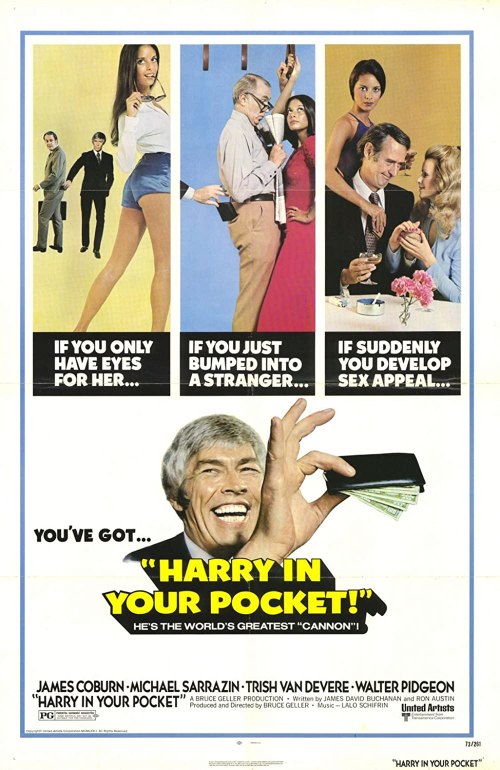
Ray (Michael Sarrazin) is an amateur pickpocket who has no luck trying it on his own. He meets Sandy (Trish Van Devere) who has just lost everything and the two decide to get into the pickpocket racket as a simple means for survival.  They get hooked up with Harry (James Coburn) and his mentor Casey (Walter Pidgeon) who teach them the fine art of pickpocketing while preying on summer tourists in Seattle.

The film’s main selling point is the ensemble cast that work off each other quite well. Coburn is engaging and energetic as usual. It is hard to imagine him giving a poor performance and he can usually make even the dullest material interesting and his appearance here proves no exception.

Pidgeon is equally diverting as the elder member of the group. His career was already fading at this point and this ended up being one of his last performances. It is unique in the fact that his character suffers from a major cocaine habit and it is quite possibly the only time in film history where you will see a 77 year old main sniffing up the white stuff, which he does on several occasions.

Sarrazin, who unfortunately passed away last year, is dependable as always. I know female fans fell in love with his big, sad, baby blue eyes, but some critics lambasted him as being ‘boring’ and ‘transparent’, but I always have found him quite competent in dramatic roles in a nice, quietly understated manner.

Surprisingly though it is Van Devere who comes off best and practically ends up carrying the film. She was never given enough varied roles for me to ever formulate any real opinion of her, but here she does quite well. I liked her savvy nature and some of her snappy comebacks. Despite being surrounded by all men she handles herself with ease and even seems at times to intimidate them.

The only problem I had with her character is how she is introduced.  She meets Ray at a train station and after talking to him finds out that he stole her watch. She goes running after him while leaving her luggage and purse unattended. When she is able to retrieve her watch from him she returns only to find that someone has now stolen her suitcase and purse.  She takes this sudden predicament too much in stride and doesn’t even go to the police about it. Instead she decides to get into Ray’s life of stealing even though she has no criminal past. She even ends up going to bed with Ray later that very same afternoon even though I would think most people would be too stressed out for sex at a time like that let alone doing it with a stranger.

The film was done on-location in Seattle. Normally I always applaud films that are shot outside of the studio back-lot, but here it becomes almost a distraction.  Director Bruce Geller seems much too preoccupied with capturing the scenery than he does in propelling the story. There is one segment that takes place in the middle of the film that deals with the four characters taking a very long, drawn out boat cruise that almost morphs into an advertisement sanctioned by the state of Washington’s department of tourism. It features very little dialogue and no character development and seems only done as an excuse to show the picturesque landscape. It even has them feeding the seagulls in slow motion, which really gets to be too much.

If the film fails anywhere it is in the fact that it is too somber and dramatic for its own good. I would have thought this type of idea would have worked well as a comedy, but instead everything is kept at a generally serious level.  Yes, some of the tactics that they use to rob the people have amusing moments, but it tends to play itself out quickly. It sticks pretty much to the tried and true character driven formula that was trendy during that era, but also very predictable and downbeat. The music score has a depressing quality that I did not like and although on a technical end this film is passable it also unremarkable.

My Rating: 4 out of 10

Released: September 23, 1973

Runtime: 1Hour 43Minutes

Rated PG

Director: Bruce Geller

Studio: United Artists

Available: Amazon Instant Video
Dona Flor and Her Two Husbands (1976)

dona1

By Richard Winters

My Rating: 6 out of 10

4-Word Review: One is not enough.

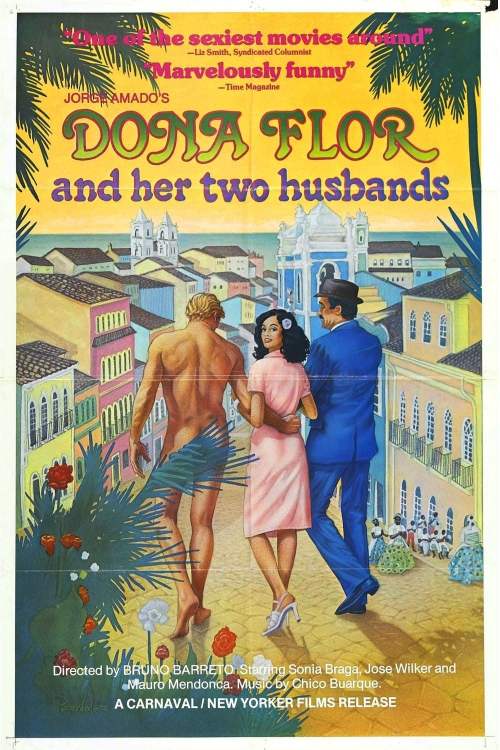
This is an oddly structured Brazilian film that became a world-wide hit due to its explicit, edgy storyline.  It details the account of a woman named Dona Flor (Sonia Braga) whose first husband Valdomiro (Jose Wilker), was a bit on the wild side. After gambling away all of their money he dies. She becomes determined not to make the same mistake twice, so she remarries another man who is a doctor (Mauro Mendonca) and a much more responsible mate, but also stiff and boring. Problems ensue when the first husband, who she misses because he was more erotic and exciting in bed, comes back in the form of a ghost who only she can see.

The movie on a whole is well made. The characters are all likable and the theme music, which is played throughout the film, is appealing. The on location shooting is also quite distinctive. It really gives you a genuine, rare flavor of a small Brazil village and the people who inhabit them.

My main complaint with the film is that it takes the entire first hour just too illustrate her marriage with her first husband and the second hour to show her mourning and eventual remarriage. It’s not until the FINAL FIFTEEN MINUTES that the scenario the whole film is based on actually happens. When it does it is lively and funny, but the majority of the movie is surprisingly low key and melodramatic. The highly touted sex scenes are overrated. They are too brief and spread out very thinly.

Braga does well in her star making vehicle. She is able to convey both a simple, sweet nature as well as a sultry, sensual one. She has a pretty face and really does look great naked.

My Rating: 6 out of 10

Released: November 22, 1976

Runtime: 1Hour 50Minutes

Rated R

Director: Bruno Barreto

Studio: Embrafilme

Available: VHS, DVD (Director’s Cut)

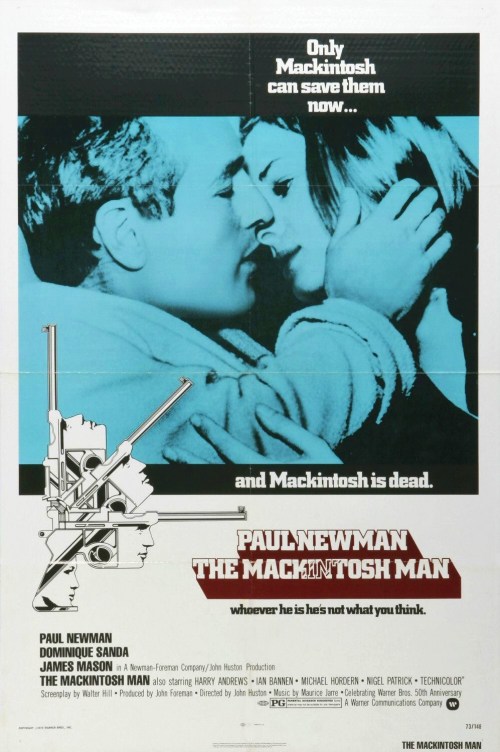
The Mackintosh Man (1973)

mack

By Richard Winters

My Rating: 6 out of 10

4-Word Review: Infiltrating a spy ring.

Joseph Reardon (Paul Newman) is a spy that is recruited by the British Intelligence to infiltrate a secret spy ring in order to expose a traitor from inside a high ranking government office. In order to do so he must assume the identity of an Australian criminal and allow himself to be caught and imprisoned. From there he is able to escape using the help of an inside organization that arranges the escapes for high profile prisoners. He is taken to an isolated mansion at an unknown location and trained to be a part of the criminal spy ring, but he unwittingly gives out his true identity, which forces him to make a daring escape and go on the run in the middle of nowhere.

As much as I like Paul Newman I felt he seemed out of place here and really didn’t completely fit the role. For one thing he is an American, but it is never explained why a foreigner is chosen for the operation instead of a British spy. There is also the fact that his alias is that he is from Sydney, Australia, but his Aussie accent does not sound convincing and tends to go in and out.

There is also the issue of him allowing himself to be put into prison. Normally a viewer has to relate to the protagonists circumstances in order to be wrapped up into their plight, but intentionally getting thrown in the slammer seems a bit hard to fathom. This was the maximum security type of jail with extremely small cells and prisoners asking him if he would ‘like to dance’. I realize this was part of the spy operation and spies are expected to take risks, but this seemed too reckless to me. What is going to guarantee that he is ever going to get out? This is after all a top secret organization, so how is he going to be able to hold them accountable if he gets stuck there. To me it is like asking someone to jump off a cliff and telling them there is a safety net to catch them even though they can’t see one.

The script, by the prolific Walter Hill, does have a few exciting scenes although it takes a while to get going. The best ones come when he is stuck at the isolated manor. I enjoyed how he singlehandedly overpowers them and is able to escape while setting the place on fire in the process. The shot showing the mansion on fire from a distance with the black cloud of flames rising into the grey sky had an artsy flair to it and the movie’s best moment.

I thought the barren landscape that he runs through, that doesn’t even have any trees, was cool. It reminded me a lot of the classic TV-series ‘The Prisoner’. This part also includes a viscous guard dog running after him, which is reminiscent of another memorable Newman role from the film Cool Hand Luke.  Here though he is able to exact his revenge on the mutt when he submerges it under water and drowns it, which might prove upsetting to animal lovers as looks realistic and the hound appears to struggle.

The car chase is excellent and nicely captured. Most chases seem to take place on city streets in the majority of films, so it was nice to see one done on curving, gravel roads in the countryside with Reardon stuck in nothing more than a rusty, rickety old pick-up. I loved how the camera shows in a longshot the car going over a cliff and falling several feet before landing with a loud thud. No intrusive computer effects here, nor flashy explosions. Everything was authentic with no cuts, which ends up making a much stronger impact.

A shout out must also go to James Mason as the villainous Sir George Wheeler. This guy is so effective at playing bad guys, and he does it with such ease, that it is almost scary. His ability to go from refined and dignified to vindictive is what makes him so good.

What hurts the film is a wretched music score that sounds like Russian dance music that has no place in a thriller. It is loud and blaring and does not build the mood, or tension in any way. It gets so bad that it almost ends up ruining the whole movie. The climatic sequence is a letdown as well. It features no action and it ends abruptly with a whimper.

It was a great idea to pair Newman with legendary director John Huston, but this product is not one of their best efforts for either individual. It is entertaining enough to be passable, but culminates in being just your average spy thriller.

Neman and Mason would team up nine years later to play adversaries again in the film The Verdict, which will be reviewed tomorrorow.

My Rating: 6 out of 10

Released: July 25, 1973

Runtime: 1Hour 38Minutes

Rated PG

Director: John Huston

Studio: Warner Brothers

Available: VHS, DVD (The Paul Newman Collection), Amazon Instant Video

Mixed Company (1974)

By Richard Winters

My Rating: 3 out of 10

4-Word Review: Racist coach adopts kids.

Kathy Morrison (Barbra Harris) works at an adoption agency that specializes in placing minority children into stable homes. Although she already has three children of her own, she comes under pressure to ‘practice what she preaches’ and adopt one herself. Her husband Pete (Joseph Bologna) is the head coach of the Phoenix Suns basketball team who are in amidst of a very long losing streak. He is reticent to the idea as he feels he will soon be fired and also harbors certain latent racist feelings. However, when it is found that they can longer conceive a child of their own due to him suffering from the mumps, they decide to go ahead with the idea. At first they adopt a young African American boy and eventually add a Vietnamese girl and an Indian boy.

The film was written and directed by Melville Shavelson, who only six years earlier had done the successful Yours, Mine, and Ours about a widow woman with eight children marrying a widower with ten. Clearly he was trying to go back to the same well, but the concept is uninspired and forced. The plot is too simple and formulaic. I sat through the whole thing feeling like I had seen it all somewhere else before. There is some snappy dialogue at the beginning, but it quickly runs out of gas. The pacing is poor and it plods along with no real momentum or cohesion.  The lighting is flat and the action is captured like it was made for a TV sitcom instead of the big screen.

The children deliver their lines in a robotic fashion and the script gives them little that is clever, or interesting to say. I did like the six year old Indian boy named Joe (Stephan Honanie) who is cute and precocious, but he does have a propensity to pick his nose and there is one icky scene where he appears to eat what he has picked out of it. The film did generate some controversy at the time of its release for featuring the kids swearing, but this amounts to nothing more than a few ‘damns’ here and there. I kind of liked the fact that the kids weren’t portrayed as complete wide-eyed innocents and their salty behavior seemed realistic, but the problems and issues that they deal with are highly contrived.

Joseph Bologna is a standout. His brash, flippant, hard-edged persona is terrific and fun. It is the one thing that holds the movie together and keeps it from being a complete bore.

The basketball sequences are clearly staged. They do edit in some actual footage, but it’s done on a different film stock, which is distracting. I think the one thing that really bugged me in this area is that Pete eventually gets fired as the coach due to the team’s continual losing. Yet, only a few days later the owner of the team comes back and begs him to return. Besides being a movie fan I am also an avid sports follower and I can attest that this has never happened. Yes, sometimes a coach is fired and then many years later he can return to coaching the same team, but that is usually because it is under different management and it is rare. There was also New York Yankees owner George Steinbrenner who hired and fired manager Billy Martin a total of five different times, but that was an extreme anomaly and he never rehired him after just a few games. I know movies and especially TV-shows never want to show our favorite characters getting fired and STAYING fired even though it happens to real people all the time and it only makes sense that film characters should deal with the same types of hardships.

It is difficult to tell what audience this movie was aimed for. There is not enough action or comedy to keep the kids entertained, but it also lacks the sophistication needed for adults. After a total of 105 minutes it becomes strained and tedious.

My Rating: 3 out of 10

Released: October 18, 1974

Runtime: 1Hour 49Minutes

Rated PG

Director: Melville Shavelson

Studio: United Artists

Available: Netflix streaming

The Longest Yard (1974)

longest1

By Richard Winters

My Rating: 8 out of 10

4-Word Review: Prisoners play football game.

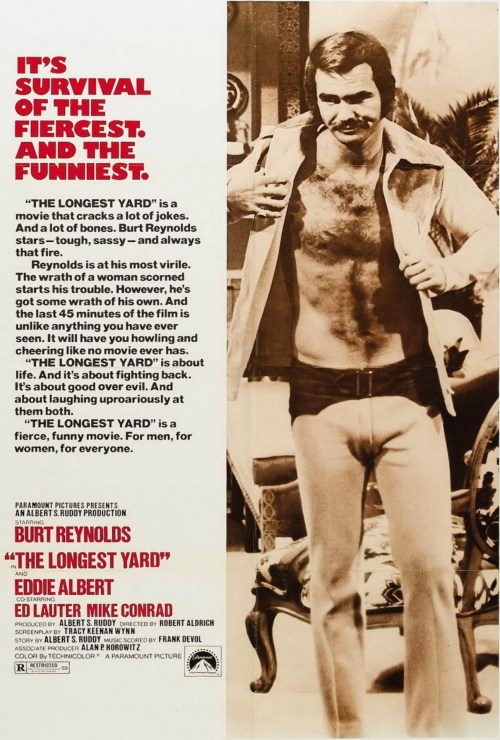
            Burt Reynolds is Paul Crewe a down-on-his-luck former professional football player who was kicked out of the league due to a point shaving scandal. After going on a long car chase with police he is thrown into the Georgia State Penitentiary where the crooked warden (Eddie Albert) tries to get him to coach the prison football team. Initially he refuses, but after some ‘convincing’ he eventually agrees to play in one game that will feature the guards versus the inmates. The prisoners use this contest as a way to get back at the guards and their brutal treatment of them while the guards approach it as a way to instill their authority.

Some consider this one of the best sports movies of all-time and I would have to agree it is up there. One of the things I liked about the movie is the way it taps into the emotional aspect of not only playing the sport, but watching it. There can be deep seated psychological reasons for why a spectator, or fan, roots for one team over the other.  The prisoners that cheer on their team use the game, as fleeting as it may be, as a sort of equalization and revenge factor to the guard’s authority and corruption. Watching the scenes showing the prisoners cheering their team as they score a touchdown is almost as emotionally charging as the action itself.  Director Robert Aldrich does a great job of using the prison setting and the game as a microcosm of 70’s society and the conflict between the counter-culture and the establishment as well as the haves and have-nots.

The game is nicely choreographed.  The hits look real and the plays are shot in a bird’s eye view just like watching an actual game on TV. The action is easy to follow and it is evident that the filmmakers have a good understanding and appreciation for the sport.  Outside of the final play that is done in slow motion there is none of the fluky, theatrical stuff thrown in that you usually see in most other films of this type. I found myself getting emotionally tied into the action even though I had seen the film many times before.

The only misgiving I had was the segment where the Richard Kiel character slams an opposing player to the ground and announces “I think I broke his fucking neck.” Of course this has become one of the film’s most popular lines and is made funnier when other players and even the game announcer repeats it several more times, but when the injured player is unable to come-to even after being given smelling salts and is carted off motionless from the field it starts to seem cruel to be laughing.

Another scene that I found surprising and had almost as much impact as the climatic contest is at the very beginning when Paul is shown arguing with his girlfriend Melissa (played by Anitra Ford one of the original models on ‘The Price is Right’ game show). She calls him a whore, which has to be the first and only time in film history that a woman has called a man that, but what is even more amazing is when he violently slaps her and knocks her to the floor.  I don’t think I can remember another time where a protagonist male character has done that to a female and yet the audience is still expected to sympathize with the male, which is interesting. The ensuing car chase is one of the better ones you’ll see and the part where he drives the car into a lake while the song ‘Saturday Night Special’ by Lynyrd Skynyrd is playing on the car’s radio and gets muffled as it goes under the water is cool.

Burt is perfect for the role. I love the glib way he delivers his lines and his laid back persona. The fact that he is an anti-hero with obvious personal flaws makes him even more fun. He seems right at home in the southern setting and filming it at an actual state prison gives the film a nice gritty subtext.

The supporting cast is unique. John Steadman as Pop, one of the prison’s oldest members, is memorable and he is the only other actor with a nose big enough to rival that of Karl Malden’s. It is nice to see Richard Kiel, one of the tallest actors you will ever see, with a speaking role.  The part where he starts to cry when he gets hit in the nose is funny.  Charles Tyner is perfectly creepy as Unger and Michael Conrad is compelling in his role as Nate Scarboro. This is also a great chance to see Bernadette Peters in an early career role as the warden’s ditzy and amorous secretary Miss Toot. She wears one of the worst looking beehive hairdos you’ll ever see although there probably isn’t a beehive hairdo that looks good anyways. Former football player Joe Kapp is good as one of the evil guards.

My Rating: 8 out of 10

Released: August 30, 1974

Runtime: 1Hour 1Minute

Rated R: (Adult Theme, Language, Violence)

Director: Robert Aldrich

Studio: Paramount

Available: VHS, DVD, Amazon Instant Video, Netflix Streaming

Semi-Tough (1977)

semi

By Richard Winters

My Rating: 7 out of 10

4-Word Review: Got to go pee.

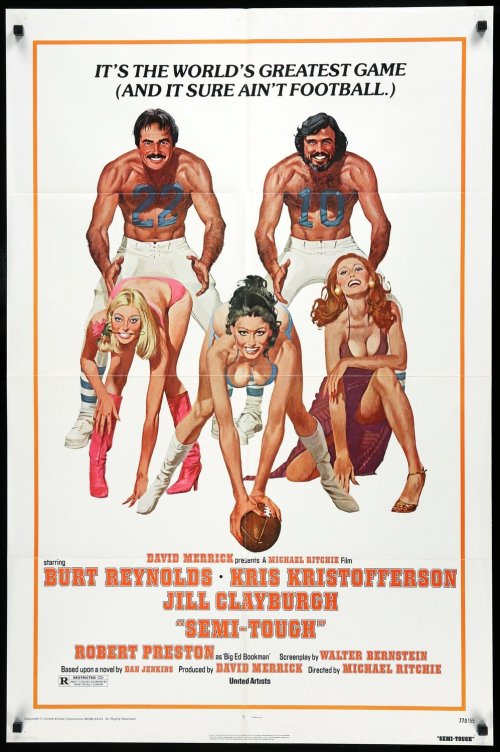
            Billy Clyde Puckett (Burt Reynolds) and Marvin Tiller (Kris Kristopherson) are two players for the Miami football team who just happened to live with the daughter of the team’s owner Barbra Jane Bookman (Jill Clayburgh). Strangely enough they do not have sexual relations and despite seeming like an odd arrangement to others the three manage to get along just fine until Marvin proposes to Barbra, which starts to make Billy jealous. Billy then spends the rest of the time trying to win her over and break-up the impending marriage.

This movie, based on the novel by Dan Jenkins, has an interesting premise, but I was disappointed that it didn’t start from the beginning when the three met and started rooming together. It certainly seemed to be an unusual set-up and I wanted more background to these characters and a history and the film doesn’t give any making it incomplete. The plot itself is a bit under-developed and at times seems to have nowhere to go. To make up for it the film delves into some odd comic scenarios that have nothing to do with the characters, or story. Some of these are interesting on their own terms while the others fall flat.

One of these segments features silent film actress Lotte Lenya in her last film appearance. Today’s audiences will know her for her outstanding performance as the villainess Rosa Klebb in the James Bond classic From Russia with Love. Her she plays a massage therapist named Clara Pelf who has some really weird and painful ideas about physical therapy. The scene seems just thrown in there for its own sake and doesn’t do much for the film as a whole, but seeing Lotte banter with Burt is a lot of fun regardless.

Another and even more bizarre segment features Bert Convy as a motivational speaker who hosts a marathon 48 hour self-help seminar, but will not allow any member of the audience to get up and go to the bathroom for the first 12 hours, which seemed too implausible even for satire. However, this scene does feature the film’s best line and quite possibly one of the best lines in film history, which occurs when one of the female members of the audience gets up and states in front of everyone “I just peed in my pants and it feels great!”

The football scenes don’t gel and in fact I wouldn’t even categorize this as a sports movie, or even a football one. For one thing director Michael Ritchie and writer Walter Bernstein didn’t seem to put much thought, or research into the sport, or how teams function. This becomes obvious in the segment where the players are shown staying up late and drinking at a bar the night before a big game and even bringing women back with them to their hotel rooms without having any type of curfew. There is another scene featuring Brian Dennehy as a big, intimidating player T.J. Lambert who dangles a woman off a roof and threatens to drop her when she does not give-in to his kinky sexual demands. He does this in front of the rest of the team who laugh it off like it is no big deal and state that he does it frequently when in reality the man would probably have a lot of lawsuits on his hands, jail time, and league suspension. It also paints big players too much as a stereotype and being nothing more than dumb out-of-control morons bordering on sociopathic.

The team logos and uniforms worn by the players during the games are unimaginative. The ones worn by the players representing the Denver team in the movie look almost exactly like the Texas Longhorns and I am almost surprised that they didn’t sue.

Burt of course is highly engaging throughout. The guy has terrific comic timing and I love the way he delivers his humorous lines. It is his presence alone that really makes this movie work. My only problem with his casting was that he was forty at the time and looking just a wee bit too old for the part. His hair also resembles a toupee and I don’t know of any player in football history who smokes a long pipe, or listens to Gene Autry records. What is worse is that he plays a lot of Gene’s records and forces the viewer to have to listen to the tunes although he makes up for it a bit with his Gene Autry quotes, which are funny.

Kristopherson as an actor has never connected with me even though I love him as a singer/songwriter. In the movies I have seen him in he always seems either half-a-sleep, or stoned. His presence and delivery is too laid back for my tastes however, the part where he is shown half-naked in bed and doing a commercial for a deodorant and then uses the product to create a mock erection is great.

Clayburgh is passable as the female lead, but I didn’t like her southern accent.  Robert Preston, who plays her father and the team owner, is okay, but his role is rather meaningless. The scene showing him crawling around on his office floor is stupid and pointless.

For some reason, despite certain flaws and an overall superficial treatment I still enjoyed this movie and found it entertaining. This is a great example of a 70’s romance with all the expected elements and clichés nicely put in place. It is also a chance to see Ron Silver in an early role as the team’s kicker who has no lines of dialogue, but ends up being a scene stealer anyways.

My Rating: 7 out of 10

Released: November 18, 1977

Runtime: 1Hour 48Minutes

Rated R

Director: Michael Ritchie

Studio: United Artists

Available: VHS, DVD (Widescreen Edition)

North Dallas Forty (1979)

north dallas forty

By Richard Winters

My Rating: 8 out of 10

4-Word Review: Ugly side of football.

From the very first frame this film grabs your attention. We see football wide receiver Phil Elliot (Nick Nolte) sleeping in his bed with blood spewing out of his nose and soaking his pillow in red. He wakes up and ambles his way to the bathroom looking like a man of 80 instead of 30. We come to realize that his nose is broken and he sleeps with tissue stuffed up his nostril to keep it from bleeding worse than it really does. We soon learn that this is all part of the business. A player is expected not only to play with pain, but live with it as well. Watching Nolte deal with this is so convincing that it will make you feel like you’re having the same symptoms and bring back vivid memories of any physical discomfort that you once had. It gets so bad that when he is making love to his girlfriend he is having to tell her to switch positions, or not touch certain parts of his body because even sex ends up being too painful. When you read about how many players suffer from lifelong injuries from their playing days you feel almost insulted at how other sports movies seem to gloss over it like it is no big deal when it really isn’t.

The movie is based on the best-selling novel by Peter Gent, who once played wide receiver for the Dallas Cowboys. Although fictionalized to a certain extent one can’t help but see the ugly truth seeping through. Many of the characters closely resemble star Cowboy players from that era including the Mac Davis character Seth Maxwell who has the same personality as real-life quarterback Don Meredith.  There is also B.A. Strother (G.D. Spradlin) who resembles legendary coach Tom Landry. Like Landry he seems devoutly religious and even quotes scripture, but he also is very cold, calculating, and psychologically manipulative.

I thoroughly enjoyed this film and found it riveting from beginning to end. If only all films could be this revealing and honest. The ‘feel good sports movie’ can be nice, but it is becoming too much of a cliché. Most players that get into the business don’t win Superbowls, or championships. They becomes used and abused by a relentless system until their only goal is simple survival and trying not to be cut. Of course I have never played football, but I don’t think the viewer really has to, to appreciate the dead-on truth that is displayed here. Simply being out in the ‘real world’ and working in corporate America should be enough for just about anyone to connect to what the characters here go through.

The dialogue is exceptional and endlessly quotable. Every scene and conversation dissects another ugly side of the business. Some of it is expected, but other parts become rather startling particularly the way players are pushed to play with injuries in order to ‘help the team’ even if there is a strong possibility that it could cause serious and permanent harm.  Some may say things have gotten better, or worse since this was made, but I can’t help but feel that if anything it pretty much the same in a lot of ways, which is why I still maintain that this film is quite possibly the best sports movie ever made.

You also gotta love Charles Durning as the assistant coach constantly carrying with him a bottle of Maalox and looking like the one doing most of the coaching and disciplining while coach Strother stands at a calculated distance. The scene where Durning screams at the players during a team prayer giving in the locker room by a priest is the film’s single most funniest moment. Bo Svenson has one of his best roles playing the very large and intimidating player who goes from being obnoxious and even frightening at parties to looking dumb, confused, and even scared during the games. The only actor I wasn’t impressed with was John Matusek, who was a real-life pro player for a while. It was nice seeing a well-built actor to compliment Svenson, but Matusek just does not have the ability to deliver his lines with any dramatic impact and the fiery tirade that gives Durning at the end fails to be as strong as it should’ve been.

The only other problem I had with this film is the scenes involving the actual game itself. It doesn’t in any way resemble a pro game. The field is small and looks like it was shot at a high school. The crowd is darkened out, looking like there were no spectators at all. I also didn’t like the way director Ted Kotcheff incorporated dramatic music during certain key segments. It came off as heavy-handed and unnecessary. Of course the team’s uniforms and logos look tacky and although this is a little distracting you can’t blame this on the filmmakers as the NFL refused to endorse the film because of its frank nature.

This film hasn’t mellowed at all with age and I was surprised how potent it still is. I would recommend this to anyone, sports fan, or not, who wants to see the game from a different perspective by a player who was there.

My Rating: 8 out of 10

Released: August 3, 1979

Runtime: 1Hour 59Minutes

Rated R

Director: Ted Kotcheff

Studio: Paramount

Available: VHS, DVD, Amazon Instant Video

Black Sunday (1977)

blacksunday

By Richard Winters

My Rating:  6 out of 10

4-Word Review: Blimp wrecks the Superbowl

            Based on the Thomas Harris novel this film involves a female terrorist named Dahlia (Marthe Keller) working for a group called Black September. She plans on killing thousands of people at the Superbowl with the help of a blimp captain named Michael Lander (Bruce Dern), who is also a disgruntled Vietnam vet. As they are putting their plan into place their compound is attacked by an Israeli anti-terrorist group headed by Major David Kabakov (Robert Shaw). He decides not to kill Dahlia when he has the chance, but they confiscate all of their materials including a tape recording by Dahlia talking about a massive terrorist attack planned on U.S. soil in the near future.  Kabakov gives this information to the F.B.I. and they go on the offensive trying to track down what their operation is, as the details are vague, before they can pull it off.

Overall, as a spy thriller, the film is pretty good. I had to chuckle a little at the fact that the government takes the vague threats seriously and acts so swiftly based simply on an obscure tape recording when in real-life our government was warned long before the 9-11 attacks that a terrorist plot was being planned, but did nothing because they didn’t think it was possible. It would be nice to think that the government could one day act as semi-efficiently as it does in films.

There are indeed some memorable moments. One includes Kabakov shoving his gun down the throat of a suspect (Michael V. Gazzo) and giving him a very terse ultimatum ‘Blink for yes; die for no’. There is also an exciting well-choreographed shoot-out chase that starts out in a hotel lobby, goes through the streets and alley ways of the city, and ends up on the ocean beach. Another twisted moment is when Dahlia and Michael go to an isolated hanger in the Mojave Desert to try out a gadget that can supposedly shoot thousands of bullets in a single shot. The image of seeing all the tiny holes created on the wall of the shed from the bullets is cool enough that I was willing to overlook the fact that the wooden beams that crisscrossed the same wall were untouched. This scene also has a good bit of black humor when one of the employees of the hanger, who thinks the machine is a camera, and stands in front of it smiling only to have hundreds of bullets go slicing through him.

Shaw is excellent in the lead although it took me awhile to adjust to him in that type of role simply because he has played so many dark characters so well that it was hard to see him as a good guy. I liked that the character is human and admits to his mistakes, namely to the fact that he doesn’t kill Dahlia when he first has the chance. He also professes doubts about himself and his career, which adds to his multi-dimension. He tends to lean towards rogue tactics when forced, which helped reflect the brutal nature of the business that he was in. Certain lines that the character says are made memorable by Shaw’s dialect and tone that probably no other actor in the part could have done quite as well. I was also amazed at the incredible run he does during the game when he races down several flights of stairs and across the entire football field, which almost becomes a highlight in itself. I know the actor suffered from a weak heart and ended up dying from a heart attack just a year after this film came out, but I was almost surprised that he didn’t fall over from one right there.

Keller is great as the female adversary. Her American acting career never really took off, but that still doesn’t mean that she isn’t a strong actress. Her expression when she is caught in the shower with a gun pointing at her is priceless. I liked how initially she is portrayed as the ‘sane’ one in relation to the Dern character, but by the end it becomes quite clear that she is probably more evil and crazier than he could ever be. Her fight with Michael inside his house when they fear that their intricate plot may be falling apart is definitely her finest stuff.

Dern of course is an exceptional actor whose unique style and odd intensity make him a joy to watch even if the script is poor.  He is certainly well cast here, but I wished he was given more screen time and latitude as I don’t think his talents where given quite enough justice. His best moment maybe the long rant he has during one of his counseling sessions at the V.A. Medical center.

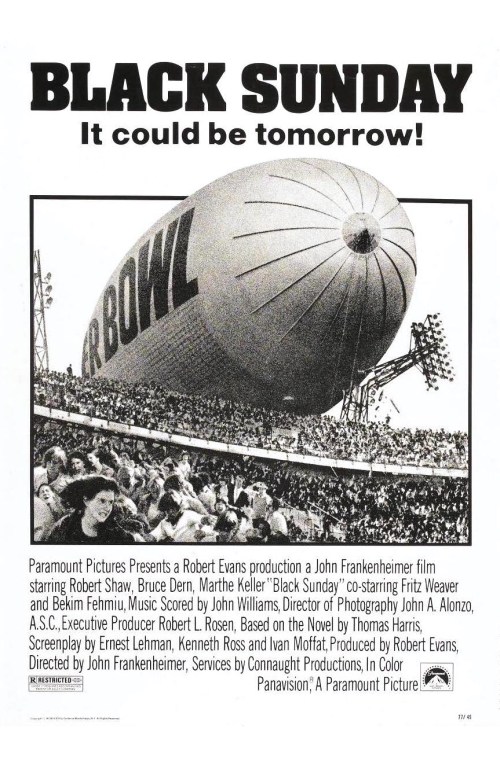
The film’s weakest point is what should’ve been its strongest, which is the segment involving the blimp barreling into the stadium. The set-up is perfect and consists of the some dazzling aerial photography and good up close footage of the football game. However, the actual blimp attack is highly compromised.  For one thing the edits are quick making it hard to follow. A much smaller blimp was used in the long shots and in the scenes where the spectators are running scared onto the field director Frankenheimer put the front end of the blimp onto a crane, which looks tacky and obvious. The blimp’s explosion is fake and when it was all over I felt disappointed. The film’s promotional items, including the film poster as seen above, promised this spectacular event, but then doesn’t come through. It almost makes one feel cheated and ruins the movie’s other good points.

My Rating: 6 out of 10

Released: March 11, 1977

Runtime: 2Hours 23Minutes

Rated R

Director: John Frankenheimer

Studio: Paramount

Available: VHS, DVD, Amazon Instant Video

Straight Time (1978)

straight

By Richard Winters

My Rating: 8 out of 10

4-Word Review: Parolee can’t go straight.

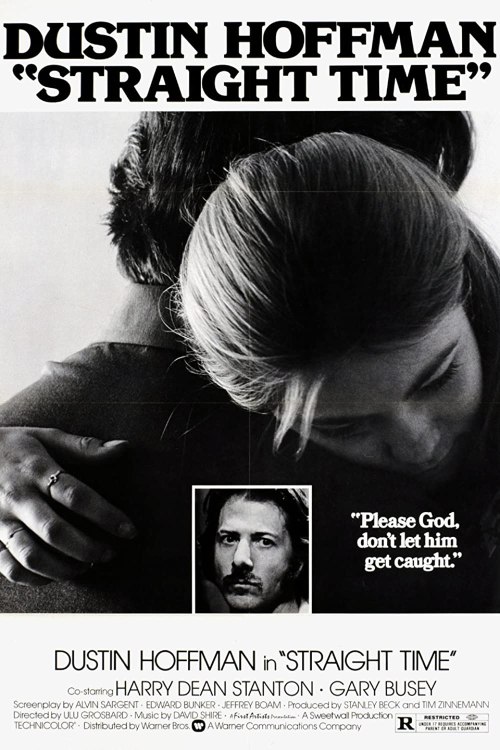
Straight Time is an engrossing, highly realistic drama detailing a parolee by the name of Max Dembo (Dustin Hoffman) who gets released from prison and cannot seem to stay away from the allure of crime despite his initial efforts. The movie is based on the novel ‘No Beast So Fierce’ by Edward Bunker.  Bunker himself was a career criminal who was in and out of jail from 1955 to 1975 and only managed to finally turn his life around when this novel, which he had written while incarcerated and deals with many of his own exploits, got published. Bunker co-wrote the screenplay and appears in a bit part playing a character with a really bad comb-over by the name of Mickey.

I found this film gripping from the second it started and infinitely fascinating the more it progressed. It gives you a whole new perspective on things as you are forced to see it from the viewpoint of the criminal and as an outsider looking in. Every facet of the story and characters is believable and the film does a very good job of being stark and searing without ever getting exploitive, or overtly shocking.  I remember back in 1977 when I toured the new county jail in the town where I grew up when it was first opened and before it housed any inmates. I remember the officer describing the rather degrading procedures all felons had to go through when they were first booked including being stripped searched and forced to take a shower nude while a fully clothed officer stood by and watched them.  The scene where Max and other criminals are ‘welcomed’ to the L.A. County jail worked exactly like that. It was so authentic and frank that it seemed almost like a documentary.

The essence of the story revolves around Max and his relationship with his parole officer Earl Frank that is wonderfully played by noted character actor M. Emmet Walsh. Earl does his job a little too well. He shows a constant distrust of Max and gives him no respect while overzealously tracking his every move until it finally forces Max to snap. It is a terrific indictment on the flawed system as it examines just how hard it is for the criminal to go straight and stay straight even if they want to. It also exposes how it seems almost designed to push the person back into crime in its refusal to ever treat the criminal as a human being. The part where Max finally has enough and overpowers Earl and chains him naked to a fence in broad daylight on a busy L.A. freeway while hundreds of cars drive by him should leave an indelible image on the minds of anyone who sees it.

The remaining supporting cast is great as well. Theresa Russell is surprisingly effective as Max’s girlfriend Jenny Mercer. Usually she has played more glamorous types of roles, but here she is perfect as a very ordinary woman who inadvertently gets caught up in Max’s eventual self-destruction until she finds herself in over her head.  I liked the fact that she wore no makeup and the camera was able to pick up her natural beauty through regular lighting. The only issue I had with her character is that it is never made clear why she would fall in love with Max so quickly and what it was about him that she liked since he shows some clear destructive tendencies right from the beginning. To me it just came off as a bit forced and phony to have an otherwise well-adjusted woman that he meets at an employment agency get so infatuated with him after just one date that she immediately agrees to move in with him, visit him in jail, and even quit her job on the spot and go on the run. I know it is standard practice in a Hollywood film for the anti-hero to always have ‘his girl’ that can be used to humanize and compliment him, but there still needs to be more of an explanation and history shown to her character in order to validate the relationship.

Harry Dean Stanton gives another great performance as Jerry Schue. He was a long-time partner to Max during the robberies he did before landing in prison. Jerry has now turned his life around. He has a nice house in the suburbs, an honest job, and a beautiful wife. However, when Max comes to visit, and the minute his wife leaves the room, Jerry begs him for a crime job that they can do together because he finds his new found life to be boring.  I thought this made a great statement as to how the sterile suburban existence is not the American dream for everyone and how it will not necessarily ‘domesticate’ those that still harbor a reckless urge.  I also found it interesting how Jerry views the art of robbery as an actual profession that he takes a great deal of pride and care in. When one of the men shows up late for a planned robbery Jerry calls him ‘unprofessional’.

The robbery scenes are filmed in a diverting way. In most films the camera gets real close to the action in order to heighten the tension. Here the action is captured from a long shot that allows the viewer to see just how chaotic and frantic a robbery really is as well as showing how the most nervous people in the place are the thieves themselves.

If I have one complaint with the film it is in the fact that the second hour becomes rather difficult to watch as it focuses solely on the self-destructive downward spiral of the main character. Max has some good qualities, which makes it all the more painful to watch. Yes, some of his anger is justified, but his insistence at ‘evening the score’ with everyone who has wronged him ends up only hurting himself. Hoffman is outstanding as usual. It is interesting to compare his role here playing a very violent character with the pacifist one that he played just seven years earlier in Sam Peckinpah’s classic Straw Dogs.

If you are looking for an intelligent, searing drama that is still relevant today then this no-holds-bar character study is highly recommended.

My Rating: 8 out of 10

Released: March 18, 1978

Runtime: 1Hour 54Minutes

Rated R

Director: Ulu Grosbard

Studio: Warner Brothers

Available: VHS, DVD, Amazon Instant Video

Entertaining Mr. Sloane (1970)

By Richard Winters

My Rating: 3 out of 10

4-Word Review: The first gay marriage.

Based on the Joe Orton play of the same name, this film deals with a handsome young stranger named Sloane (Peter McEnery) who becomes a lodger at an isolated household in the English countryside. He is on the run from a murder he committed and feels this will be a safe haven due to the only other inhabitants being a quirky old lady name Katherine (Beryl Reid) and her equally quirky father Kemp (Alan Webb).  Katherine, or Kath, takes a sexual interest in Sloane despite their wide age difference, which Sloane doesn’t mind as he uses this to manipulate her. When Kath’s brother Ed (Harry Andrews) arrives and takes an amorous interest in Sloane as well, he does the same thing to him. Then Kemp recognizes Sloane as the killer and Sloane is forced to kill him, which culminates with ironic results.

Playwright Orton was years ahead of his time. His plays always had a dark, sexual, even explicit nature to them and his characters were always perverse and amoral in a darkly hilarious way. It is unfortunate that he was bludgeoned to death in 1967 by his jealous gay lover and his career was cut short. However, this adaptation done by screenwriter Clive Exton seems to miss the mark. The dialogue is endless with very little action. The other adaptation of Orton’s work that was made into a film, Loot, was much more lively and full of a lot of campy, zany humor as well as quick edits and imaginative camerawork. This film is visually dull and all the action is jammed into a cramped, dark house with bland decorations. It never really gets going until the final 15 minutes when you get to see the world’s very first gay marriage performed, but by then it is much too late.

For 1970 this film does seem edgy and even controversial in certain parts. The gay erotic subtext is quite strong especially the way the camera scans Sloane’s tan, half naked body. There is also Ed’s pink Cadillac that he drives around, which I got a real kick out of. I liked the way it squeaked as he drove it and was constantly bouncing up and down.  There is also his very provocative hood ornament of a naked man that the camera hones in on. The best part comes when Ed washes his car and is more focused on the ornament, which he lovingly caresses with his towel, than the rest of the vehicle.

However, 40 years later this stuff seems pretty tame and there are too many segments where nothing happens and is handled too conventionally.  It seemed like director Douglas Hickox really didn’t get, or appreciate the material enough, or interpret it in some interesting way because the final result is nothing more than a filmed stage play. The music that is used is terrible and almost enough to get you to turn off the film. It also gets overused and played over scenes when it isn’t needed and hurts the film’s mood in the process.

The biggest problem with the film may actually be with actress Reid herself. Don’t get me wrong this is a wonderfully unique actress who has done some memorable work. I especially liked her in The Killing of Sister George, and she is quite good here as well. However, I do have two issues. The first is a small one. It involves the fact that the character wears dentures. In one scene Sloane supposedly knocks them out and breaks them, but then Reid turns around and screams and you can see that she still has teeth in her mouth.  The other, much more serious issue is the fact that near the beginning of the film she is seen walking through a cemetery in broad daylight wearing a see through blouse. Now with some woman this can be quite sexy and I certainly wouldn’t complain, but when they are 60 and looking more like 70 this is a bad idea, even for perversely comical purposes as it is here it is still a bad idea. What is even worse is when she turns around and a gust of wind blows up her skirt and you can see her entire bare backside, which might be enough to make some viewers sick.

Now, before anyone accuses me of ageism let me relate an interesting experience that happened to me. Back in 2003 I was home from work and decided to take in a movie. I was living in Chicago at the time and I went to the neighborhood theater to see the interesting French mystery Swimming Pool starring Ludivine Sagnier and Charlotte Rampling.  It was a Tuesday and little did I know that it was senior discount day and the place was packed, literally, with people all looking well over the age of 70. The lady that sat beside me looked to be at least 80 and came in using a walker. The film featured an abundance of nudity from the young and attractive Sagnier, which I thought might shock and offend the seniors, but no one reacted to it and everyone went on enjoying the film. Then, towards the end of the movie, 58 year-old actress Rampling starts to take off her clothes and this indeed elicited a nervous response from the crowd. The lady next to me even said ‘oh dear’. In all fairness Rampling didn’t look all that bad naked, but it still hits home the point that even old people don’t want to see other old people naked.

My Rating: 3 out of 10

Released: July 27, 1970

Runtime: 1Hour 34Minutes

Rated R

Director: Douglas Hickox

Studio: Continental Distributing

Available: VHS, DVD (Region 2)