Tag Archives: 70’s Movies

Heavy Traffic (1973)

By Richard Winters

My Rating: 6 out of 10

4-Word Review: A world without women.

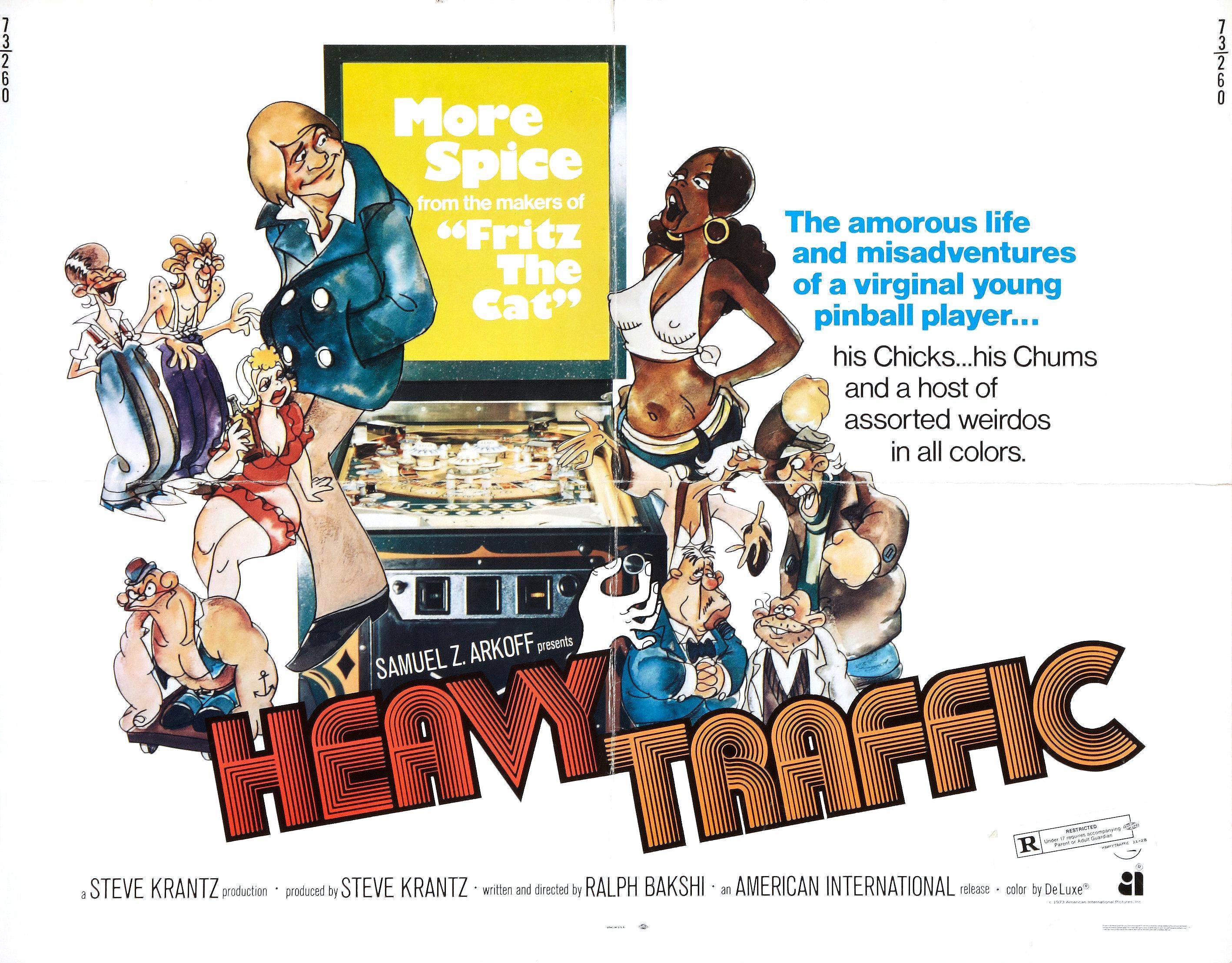
            Animated feature with some live-action scenes dealing with a lonely 24 year old artist named Michael who is still living with his parents in a rundown New York City apartment and aspires to be an underground cartoonist.

The film seems compelled right from the beginning to shock and offend as many viewers as it can. Violence and blood, lots of blood, seems to spurt out of characters heads and bodies every few minutes. Breasts pop out of female dresses with just as much regularity and there is even a segment dealing with spousal abuse that gets rather nasty.  Racial stereotypes abound and the N-word is used liberally by the white characters. Some may consider this groundbreaking while others might think it was done by someone who has been sitting alone in his studio too long and needs to seek professional help.  I can appreciate the no-holed-barred approach and the idea that cartoons don’t have to be just for kids, but the edginess is no longer as potent these days since Family Guy, American Dad, and South Park come quite close to what you see here and in some ways are even more outrageous.

The story is too free-form and lacks focus. It took quite a while before I could get into it and the beginning comes off like a lot torrid, wild images thrown at you without cohesion, or direction. The characters are vulgar, gross, and unlikable. Michael, as the protagonist, as some appeal, but he is too detached.

There were some scenes that I found to be quite funny, but they all come in the second half. The scene where Michael describes a new fantasy comic he wants to create to a very sickly, old publisher is great and nicely symbolizes how the old guard is out of touch with the tastes and ideas of the younger generation. His idea deals with an apocalyptic world that has no women, so the men have sex with a pile of garbage instead only to have a real woman appear and then be taken away by God who wants her for himself. This sequence is by far the funniest and most imaginatively perverse of the whole film and I wished that this had been the main premise.  Another segment has Michael’s father bringing home an obese prostitute for Michael, which in a gross sort of way is highly amusing. Another similar scene has Michael trying to have sex with another woman on the rooftop of a building, but inadvertently knocks her over the side wall and she spends the rest of the film dangling naked by a telephone wire. The Godfather who eats a hearty meal of spaghetti while in front of a row of urinals deserves mention as well.

The film is certainly not for all tastes. The animation may not hold up to today’ s standards and the live action segments are not as interesting. The ending falls flat and gets extended longer than it should. Supposedly the initial idea was to have it end with a climatic car chase with images of penny arcade pinball machines flashed across the sky, which would have been better, but due to budget restraints was scrapped.

My Rating: 6 out of 10

Released: August 8, 1973

Runtime: 1Hour 17Minutes

Rated R

Director: Ralph Bakshi

Studio: American International Pictures

Available: VHS, DVD
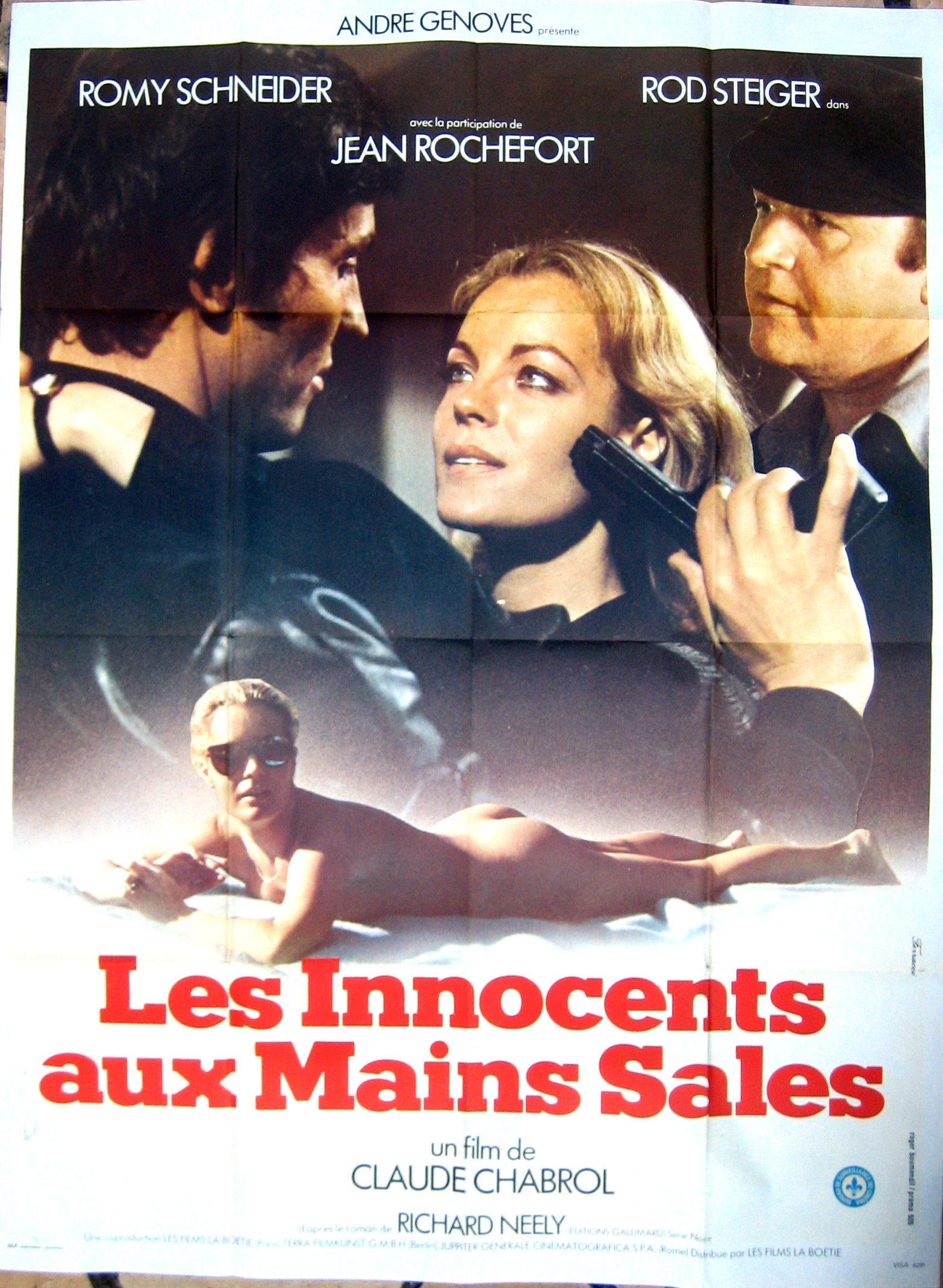
Dirty Hands (1975)

By Richard Winters

My Rating: 7 out of 10

4-Word Review: Their plans go awry.

Julie Wormser (Romy Schneider) is married to Louis (Rod Steiger) who is rich, but also 18 years older and suffering from impotency. A young, virile man by the name of Jeff Marle (Paolo Giusti) comes into her life and the two become lovers. They conspire to murder her husband and run off. However, their elaborate plan quickly unravels leading to many unexpected twists and turns.

Story-wise this is one of the better Hitchcock imitations. There are a lot of twists that are interesting and surprising. They are also well-explained and make sense. Nothing is thrown in that is implausible or creates loopholes.  The script is like traveling on a curving, winding road in a fast car and I found myself delightfully surprised, intrigued, and entertained with each new revelation. The film takes its time in explaining each detail and plot point. I liked how the investigators are given almost as much screen time as the culprits and writer/director Claude Chabrol has everything well-thought out and even manages to get you to care for these people at the end.

Schneider is stunning. I loved her blonde tinted hair and chic outfits. She has a sultry nude scene at the very beginning, but it is only from the backside. This was pretty much her vehicle. Her character goes through a wide-range of emotions and she does a great job of conveying each one. Her facial expressions especially as the case unravels and she is being interrogated by the Judge and questioned by her lawyer are captivating to watch and perfectly realized.

Steiger is always fun. His ability to display raw intense emotion is second to none. The character was a bit cardboard as written, but Steiger manages to make him human and I had genuine sympathy for him towards the end. He does tend to border on over-acting at times, but he injects life into the scenes that otherwise could have gotten boring and slow.

Although Chabrol clearly put a lot of care into the script the visual element is lacking. The camera work is conventional and unimaginative. Certain scenes are too dark and shadowy while others look bright and splotchy. The majority takes place in an exquisite looking French Chateau, but Chabrol fails to take advantage of this. The lack of visual style makes the thing look almost amateurish and the grainy, faded DVD transfer does not help. I also felt the dialogue between the two investigators seemed stale and derivative. There was also a part were Julie complains to the investigators that they have dropped into her house for a visit at much too late an hour and then, only a minute later, she is seen walking out of her house and it is broad daylight. Also, when she hits her husband over the head and supposedly kills him in his sleep he is still seen breathing.

If one is looking for a sharp mystery done in the Columbo style then this pick could be a fun, escapist evening. Schneider’s beauty and acting will carry the rest, but just be prepared for production values that are on a TV-movie level.

My Rating: 7 out of 10

Released: March 26, 1975

Runtime: 2Hours 1Minute

Rated PG

Director: Claude Chabrol

Studio: New Line Cinema

Available: DVD

Fore Play (1975)

By Richard Winters

My Rating: 1 out of 10

4-Word Review: This sex goes limp.

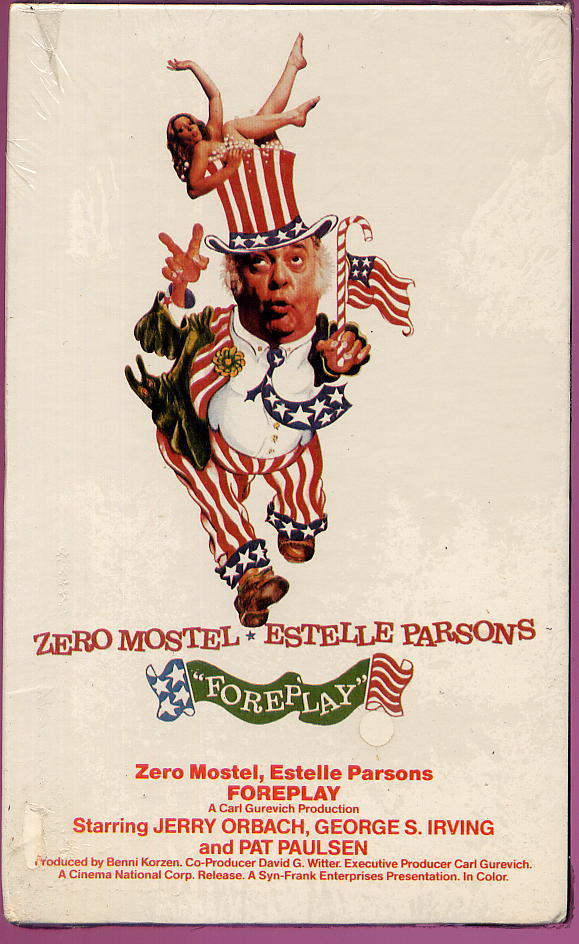
This is a boring, flat, and completely disastrous attempt at sex comedy. This is the type of teaser T & A picture that gives all other T & A pictures a bad name. Out of the entire running time there is less than a minute of any actual nudity. The sex jokes are stupid and a child could watch this and not be overly shocked. It also looks like it was meshed together on the smallest of budgets.

The film is structured much like a horror anthology with three different stories all based on the same theme in this case sex. The first one features comedian Pat Paulsen as a lonely man who buys a realistic looking sex doll (Deborah Loomis). The doll is supposed to be Polish, but her accent sound more like it is Swedish. This segment is somewhat interesting because Paulsen plays against type here. He is much more emotional and hostile. He even ends up swearing at his own mother (Sudie Bond). There is also an amusing bit of seeing him trying to get the doll, with her stiff arms and legs, into a taxi cab. However the segment goes by too fast and the ending is really stupid. Paulsen also sings here and it sounds as bad as you might expect.

The second segment features Jerry Orbach as a writer going through writer’s block. Here you see the film’s one and only offensive sight, which is having to witness George S Irving in a bikini bottom. He plays Orbach’s muse and takes him back into time to reverse certain sexual conquests that he initially bombed at. One amusing bit has him in a game where he must undress a beautiful lady in sixty seconds in order to have sex with her. He does only to find that she is frigid. Like with the first segment this one also has a really stupid ending.

The third and final story sounds like a winner, but fails terribly. It consists of Zero Mostel as the President whose daughter is kidnapped. As ransom he is forced to have sex with his wife (Estelle Parsons) on national television, which ends up being incredibly dull and unsexy. The only amusing bit, and it is a very brief one, is when one of the secret service agents has to frisk the first lady before she is allowed to hug her husband. Both Parsons and Mostel play dual roles neither of which is funny.

The film is sleep inducing. Although many sources list it with a very brief running time it ran a full 90 minutes on the print I saw, which of course only means more minutes of boredom.

My Rating: 1 out of 10

Released: March 24, 1975

Runtime: 1Hour 30Minutes

Rated R

Directors: John G. Avildsen, Bruce Malmuth, Robert McCarty

Studio: Cinema National

Available: DVD (Troma)

The Offence (1972)

By Richard Winters

My Rating: 8 out of 10

4-Word Review: Interrogate the child molestor.

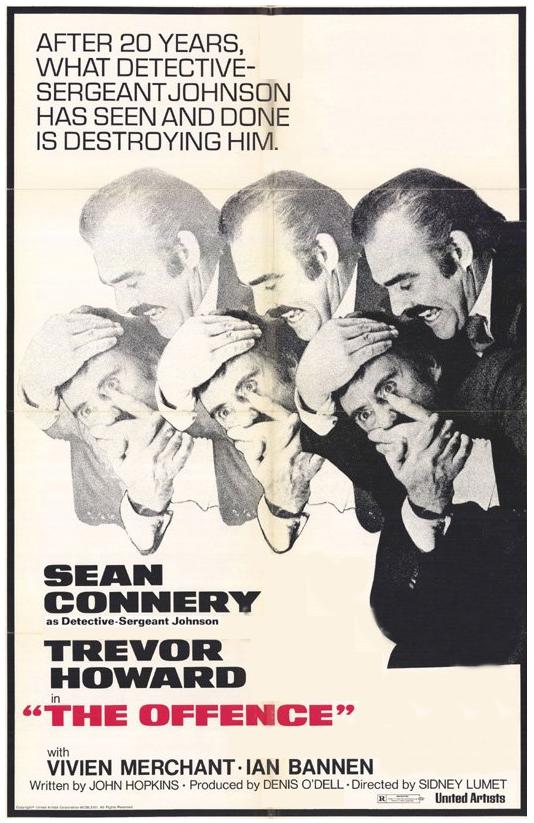
Well respected, longtime police detective Johnson (Sean Connery) becomes so burned-out by all the sickening crimes that he has seen through his career that he snaps during the interrogation of a suspected child molester (Ian Bannen) and ends up beating the man to death.

Based on the stage play by John Hopkins this film has lots and lots of talking and some may say there is too much of it. The script is split into three drawn out conversations between two people. One is between Johnson and the suspect, the second is between Johnson and his wife (Vivien Merchant), and the third is between Johnson and the man brought in to investigate the incident, which is played by Trevor Howard. By the end even the most patient viewer may feel a bit talked out and it gets especially trying when you realize that the same issues are being discussed over and over again.

Yet that is not to say that this is a poor film as the visual element is excellent. In many ways you can appreciate the production for its visual style alone. Director Sidney Lumet displays a good handle on the material and it’s technically sharp on all levels. The lighting is well composed with the center that is bright, but the corners that are shadowy much like the human psyche and society. The overall grayness helps bring out the depression and isolation of the main character. The pacing is slow, but deliberate. Each scene builds to an intense crescendo. The music soundtrack resembles that of a one tone alarm that keeps building to a higher pitch much like the alarm ready to go off in Johnson’s head. The character’s inner tension is made even more vivid by Lumet’s use of interposing the bright light of the interrogation room over the screen. It is hard to imagine this film being any better crafted and it is a terrific training tool for the inspiring filmmaker.

Despite being talky the script in itself isn’t bad as it makes you aware of the ugly side of police work. It focuses not on the system or corruption, like a lot of other police films, but more on the actual work itself. It questions whether someone who is bombarded with the daily gore and societal sickness can remain sane and whether ‘leaving it all at the office’ is even possible. Every officer may eventually suffer scars from his job experience.

In a way this may be Connery’s best role. He shows his usual tough exterior, but also has moments where he unravels into a helpless, scared man. Bannen does an equally good job as the suspect. You are never really sure if he is guilty or not. The fact that he gives off a leering grin even after being beaten gives this film an added edge.

This is an oppressive and unrelenting movie filled with stark and unpleasant imagery that may stay with you long after it is over. Yet it is also expertly crafted and brings up some serious and important issues that are as timely today as they were back then.

My Rating: 8 out of 10

Released: January 11, 1972

Runtime: 1Hour 52Minutes

Rated R (Mature Theme)

Director: Sidney Lumet

Studio: MGM

Available: VHS, DVD (Region 1 and 2), Amazon Instant Video

Jeremiah Johnson (1972)

By Richard Winters

My Rating: 6 out of 10

4-Word Review: Man in the wilderness.

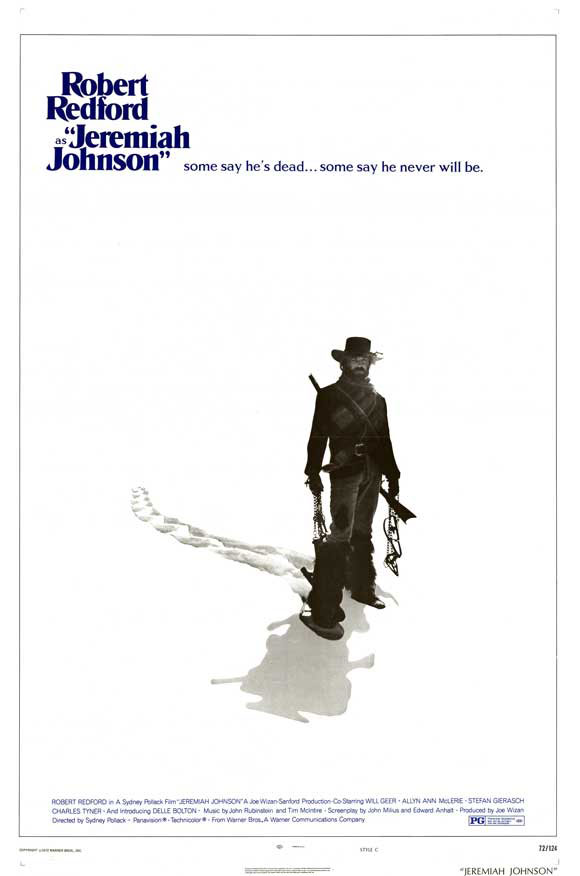
            Jeremiah Johnson (Robert Redford) is a man who wishes to live life alone in the snowy mountains. His peaceful existence comes to an end when after riding through a sacred burial ground of the Crow Indian he becomes the target of young male warriors who attack him one-by-one when he is not expecting it to avenge his ‘desecration’. Jeremiah manages to defeat every warrior that challenges him turning him into a legend among the native tribes.

The film’s on-location shooting is outstanding and one of the chief assets in watching the movie. It was shot entirely in the state of Utah and there are many majestic long-shots where all you hear is the wind blowing and makes you feel like you are outdoors yourself alongside the character. The barren, empty winter landscape is well captured and while watching Jeremiah trudge all alone through the snow it was hard for me to imagine that there was actually a film crew present. The ambience of the natural surroundings is breathtaking and grabbed me immediately. I enjoyed the slow, quiet pace at the beginning and wished there had been more of it. One of the most enjoyable scenes is watching Jeremiah trying to catch fish with his hands out of a river, which could have been more entertaining had it been extended.

The story is loosely based on the real life exploits of fur trapper John Johnston who was known to cut out and eat the liver of every crow warrior that he defeated. There is nothing like that here and in some ways that is part of the problem. The ruggedness and reality seem to have been compromised by 70’s sensibilities with too many quirky scenarios and characters thrown in making the film’s structure reminiscent to Little Big Man, which was released just a few years earlier. That film seemed refreshingly cerebral, but here it becomes imitative and derivative.

Robert Redford is high in the looks department, but so-so in acting. He has always had too much of a detached presence and his range of emotions is limited. In some films this may work, but here the part needed more charisma and flair. The character was more like a modern day, touchy-feely male transplanted from Hollywood and into the wild than an actual 18th century hermit. For a man living off the land far from civilization he has to have the whitest most straightest teeth I have ever seen.

The supporting cast fares better. I loved Will Geer as the aging fur trapper Bear Claw. This guy has all the panache that Redford lacked and the movie would have been better had it made him the focus. Allyn Ann McLerie has a small, but riveting role as ‘the crazy woman’ who is unable to cope, or accept the fact that her family has been slaughtered by an Indian attack.  Stefan Gierasch has his finest hour as Del Gue a fur trapper that Jeremiah comes upon. During the first half you see him as bald only to have him return in the second half with a full head of hair. The scene where he is shown buried in sand up to his head is amusing and disconcerting at the same time.

My biggest issue with the film is when Jeremiah starts to fight off all the Indian warriors who attack him. I just could not believe that one man would be able to defeat and kill so many of them. I could understand maybe a few, but eventually odds would have to catch up with him. There is never any special skill shown for why Jeremiah seems to always get the upper hand during these battles. The fights themselves are not exciting as they are much too brief and edited in a way that it is hard to follow the action. It seems like it takes only a few seconds from when the Indian jumps him to when Jeremiah already has him on the ground dead. Jeremiah is also the only person I know of who can have a large spear pierce his body and all he does is pull it out and go on living without any noticeable injury.

The first half is more compelling than the second, which had me feeling bored. The side-story of having him take on an Indian bride as well as a young boy who does not speak has potential, but doesn’t go far enough with it. For an adventure story there is very little action outside of the Indian battles that to me seemed phony. The best sequence is a wolf attack that is nicely edited and graphic. The Crow Indian burial scene is effectively moody and starkly photographed.

The screenplay by John Milius and Edward Anhalt was written using material from two different novels and the lack of cohesion shows. Part of it wants to be a gritty nature drama while the other half plays like a mystical fantasy, but this uneasy mixture never gels, or works.

My Rating: 6 out of 10

Released: December 21, 1972

Runtime: 1Hour 56Minutes

Rated PG

Director: Sydney Pollack

Studio: Warner Brothers

Available: VHS, DVD, Blu-ray, Amazon Instant Video

The Odd Job (1978)

By Richard Winters

My Rating: 2 out of 10

4-Word Review: Hired to kill him.

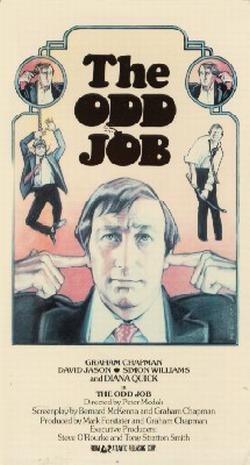
            Arthur Harris (Graham Chapman) comes home one day to celebrate his wedding anniversary only to find that his wife Fiona (Diana Quick) is leaving him. He becomes so despondent that he decides to kill himself. He has a lot of problems doing it, but then he receives a knock on his door by a man (David Jason) looking for some ‘odd jobs’. Arthur decides to hire him to be his killer, but when his wife decides to come back Arthur is thrown into a state of panic trying to avoid being killed.

Normally I love British comedies and this one seemed to have all the ingredients to being a hilarious one, but it never gels. The opening bit where the couple is arguing and Arthur insists that they are ‘happily married’ even if she doesn’t think so is full of great English wit, but everything after that falls into a lull. The jokes become long and elaborate where so much time is spent building the set-up that getting to the punch-line becomes trying. The restaurant scene is particularly drawn-out and unfunny. The ‘zany’ chase sequence in the zoo is derivative and flat.

Quick was not a good casting choice as the spouse. She is too young and beautiful a wife for such a nebbish man. A good comic character actress who was more frumpy and dowdy would have been a better fit. Quick doesn’t show any comic ability, or timing as her affected responses and facial expressions become annoying and tiring. There is also no motivation for why the character decides to come back to her husband and although this is absurd comedy there still needed to be one otherwise the writing comes off as forced and sloppy, which it is.

Chapman doesn’t completely work in his role either.  It seemed strange that he would want to kill himself when a super-hot lady neighbor is more than willing to go to bed with him and even strips off your clothes and hops into the sack before he goes running off in fright. There is also the issue that killing oneself because your wife as left you seems extreme. Most men would probably celebrate if this happened to them and it is hard to relate to a protagonist that seems so pathetic. A stronger motivation, like having him killed in a staged murder, so his family could collect on some life insurance money would have been more effective. There is another part where the police become aware that someone is trying to kill him and for some reason Arthur does not tell them of the bizarre scenario when they ask him about it even though to me it made more sense to let them try to apprehend the man instead of continuing to live in fear of being killed.

The music, which is soft and melodic, was a terrible choice as it does not fit the quirky theme, nor complement the fast-paced comic scenarios. The tacked on ‘surprise ending’ is horrible and pretty much cements the film as a misfire. During his Monty Python days Chapman was famous for walking onto the screen and telling the audience that the sketch they were doing had become too absurd and would now end and I wish he had done that here.

My Rating: 2 out of 10

Released: September 3, 1978

Runtime: 1Hour 27Minutes

Rated PG (Brief Nudity)

Director: Peter Medak

Studio: Columbia-EMI-Warner

Available: VHS

The Terminal Man (1974)

By Richard Winters

My Rating: 7 out of 10

4-Word Review: Can’t control his impulses.

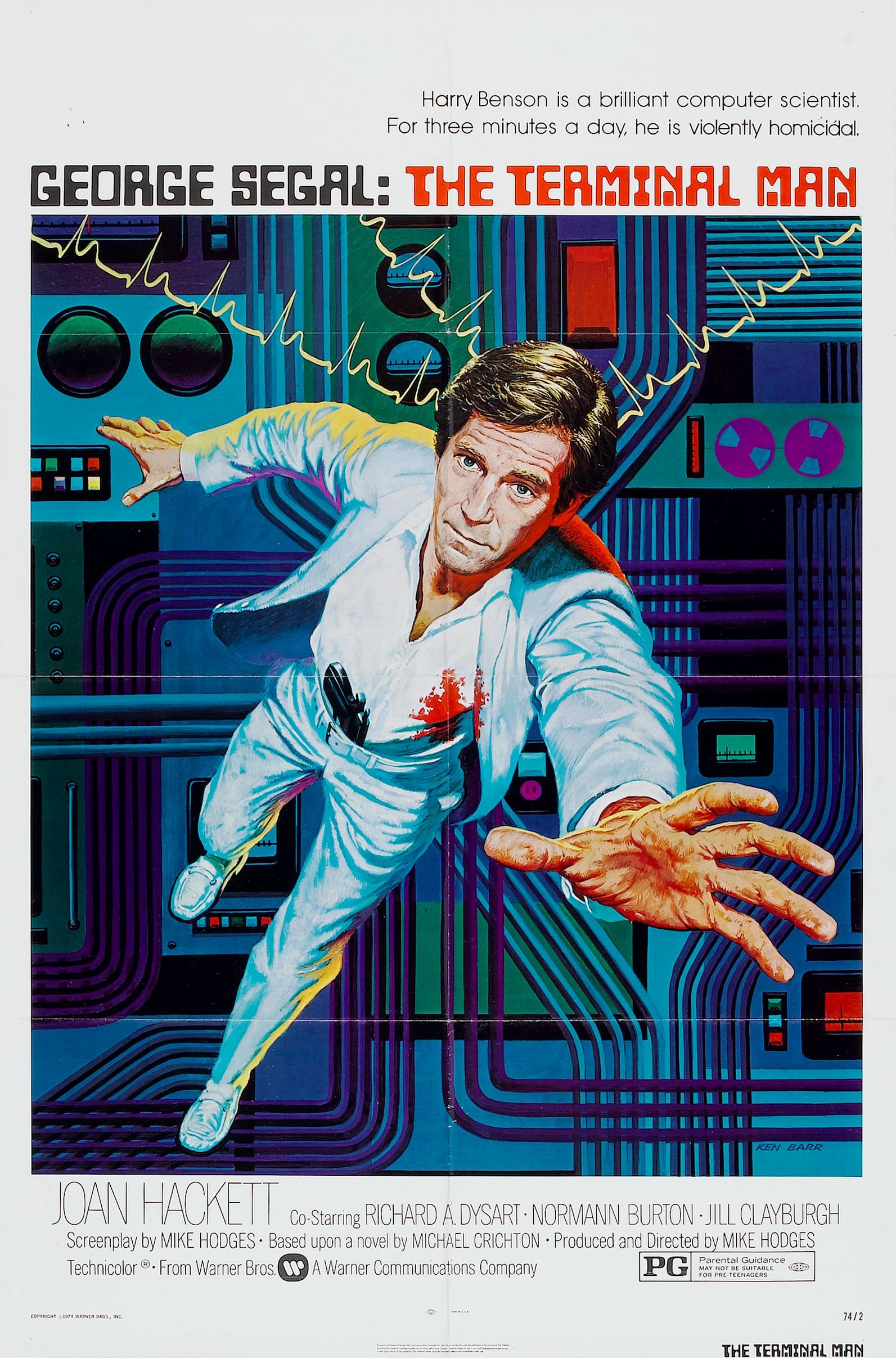
            Harry Benson (George Segal) is a brilliant computer scientist who begins to suffer from blackouts after receiving a head injury in a car accident.  During these blackouts he goes on terrifying violent sprees, which includes the abuse of his own wife and children. To help control the condition a group of doctors come up with an experimental procedure of implanting a computer chip inside his brain that will set off a signal that will alleviate these compulsions when they begin.  Unfortunately things do not go as planned and Harry’s condition becomes frighteningly worse in this cinematic realization of the Michael Crichton novel.

Director Mike Hodges visualization is the stand-out here. Every scene and camera shot fits together into a seamless whole. The first hour is filled with sets and backdrops showing a square, gray, futuristic –like surroundings while the second half features more white interiors while still maintaining the modernistic look.  Hodges shows a terrific awareness of every little sight and sound making each one an integral part of the story. From a visual perspective it is brilliantly handled and a masterpiece in need of more attention.  His use of classical music by Johann Sebastian Bach is equally effective. One particularly unique scene has Harry violently stabbing someone to death during one of his seizures, but instead of hearing the expected pounding music we instead hear the soft strains of Bach while the victim’s blood creates a red pattern on the white tiles of the floor.

The operating sequence and build-up to it is especially captivating and takes up most of the runtime.  I appreciated how a great deal of care was taken to make everything follow a very believable logic. The intricate procedure itself becomes fascinating and riveting to watch as they drill small holes into the patients head and use tiny metal tubes to literally shoot the mechanical pellets into strategic spots in the brain.

Segal, mostly know for light comedies, takes a nice break into drama here. He does a terrific job at getting the viewer to see him as a human being and feel empathy for his situation and when he has his head shaved he looks exactly like Howie Mandel . The part where he screams “Make it stop! Make it stop!” as he goes through another of his violent outbursts is especially moving and disturbing.

The supporting cast is strong as well although I didn’t particularly care for Donald Moffat and his put-on Irish accent, which was too strong and distracting and completely unnecessary.  Richard Dysart is memorable as the surgeon conducting the operation. He has two of the film’s best lines. One is when he is putting the computer chips into the brain and he states “This is the one job that can be both boring and nerve-wracking at the same time.”  Another great line of his occurs when a reporter asks him he if considers this procedure to be a type of mind control and he responds “What do you call compulsory education through high school?”

Joan Hackett gives her usual solid performance as Janet Ross the one doctor who is more concerned with the welfare of the patient then the implications of the experimental procedure. Jill Clayburgh, in an early role, plays against type here as Harry’s ditzy blonde girlfriend and the change of pace is interesting.

The film certainly makes a strong statement at the potential dangers of medical science and how the medical staff can be highly intelligent in one area, but very dense, immature and selfish in others.  The dehumanization element is pounded home to the viewer and in that respect it succeeds magnificently, but I couldn’t help but feel that it was being a bit unfair. In the years since this film was released the advancements in the medical field have improved the life and health of the patients and society as a whole. The film’s negative slant seems to conform too much to the pessimistic sentiments of its era and its unrelentingly doomful outlook is unnecessary.

My Rating: 7 out of 10

Released: June 19, 1974

Runtime: 1Hour 47Minutes

Rated PG

Director: Mike Hodges

Studio: Warner Brothers

Available: VHS, DVD (Warner Archive), Amazon Instant Video

Carrie (1976)

By Richard Winters

My Rating: 4 out of 10

4-Word Review: Prom was a disaster.

A shy, awkward teen (Sissy Spacek) who is a virtual outcast at her school and has a religious zealot for a mother (Piper Laurie), learns that she has telekinetic powers and uses them in terrifying and deadly ways after falling victim to a cruel prank at her high school prom.

Nothing really seems to mesh here and the pacing is poor. For a great deal of time you feel like you are not watching a horror movie, but instead an annoying, clichéd 70’s drama. The majority of the scares occur at the end while the rest of the film has no tension at all.  It’s visually flamboyant, but empty and unable to hide its low budget roots. Like with director Brian De Palma’s other thrillers his style and heavy-handed Hitchcock-like touches become overpowering and you lose touch with the story. Too much is orchestrated and the movie is never allowed to gel and have its own natural flow. The opening, which takes place in a girl’s shower, looks like a soft core porn flick especially with the choice of music.

The teen-age girls are certainly cruel and their snotty attitudes seem valid, but the actresses are all wrong. Yes, Nancy Allen and Amy Irving are hot to look at, but they were too old for their parts. All of them were in their 20’s and look far more like college girls instead of students in high school. The P. J. Soles character is irritating. In an effort to give the role some distinction they have her constantly wearing a pink baseball cap. She even wears it to the prom with her prom dress and looks ridiculous and yet still has the audacity to laugh at Carrie when she shows up when in reality they would most likely be laughing at her instead.

Miss Collins, the physical Ed. Teacher, which is played by actress Betty Buckley is another problem. She goes beyond the call of duty to give Carrie the individualized and sensitive attention that she needs. It sounds nice, but I couldn’t buy into it because in most cases shy students that don’t otherwise cause problems usually get overlooked even by the best of teachers simply because the school systems are too large with too many students to handle.

William Katt was not very convincing in his part as a dumb jock. John Travolta is good, but only because he is playing an extension of his Vinnie Barberino character from ‘Welcome Back Kotter’. In fact I found his portrayal here to be even funnier than his TV counterpart.

Spacek is the best thing about the movie as she brings the Carrie character to life with a vengeance. The part where she tears up the gymnasium with her powers is genuinely creepy and the way she opens her eyes and moves them around is freaky. The use of the split screen during this segment help to make it a uniquely scary moment in cinema history and saves what is otherwise a forgettable production. The famous ‘surprise’ ending isn’t bad either and even managed to startle me a little and I don’t startle easy.

Unfortunately it’s lacking the necessary ingredients overall to make it a classic. It’s based on the Stephen King novel and yet leaves certain crucial elements from the book out, which only creates more questions and confusion. De Palma takes the most simplistic parts of the story and then glossies over the rest leaving the viewer feeling unsatisfied when it is over.

My Rating: 4 out of 10

Released: November 3, 1976

Runtime: 1Hour 38Minutes

Rated PG

Director: Brian De Palma

Studio: United Artists

Available: VHS, DVD, Blu-ray, Amazon Instant Video 

White Lightning (1973)

By Richard Winters

My Rating: 3 out of 10

4-Word Review: Corrupt Sheriff gets smacked.

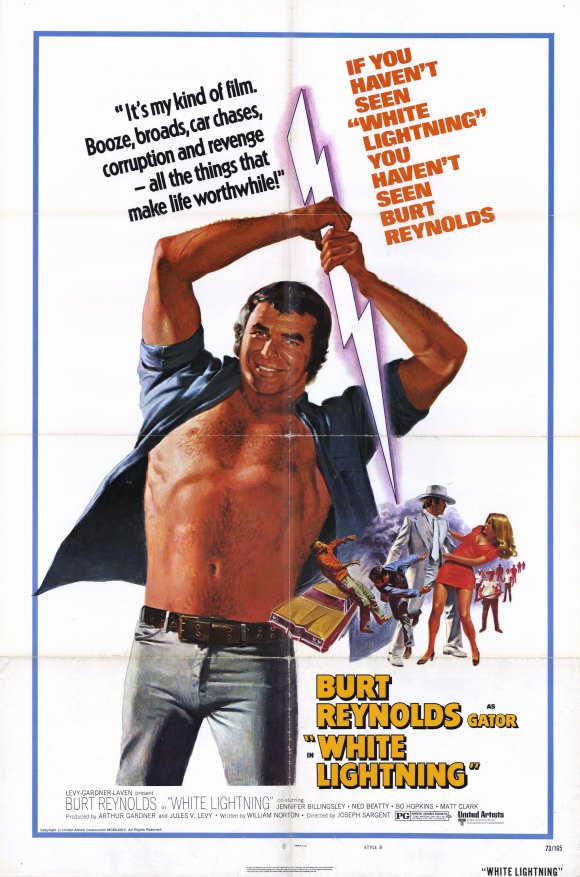
Corrupt sheriff J.C. Connors (Ned Beatty) drowns a young man and woman in a backwoods swamp because they were ‘young hippie protesters’ who dared talk back to him. The victim’s older brother Gator McKlusky (Burt Reynolds) finds out about it and swears revenge. Although he is in prison he is let out when he agrees to work as an undercover agent for the feds who are after the sheriff for various unsolved crimes, but unable to attain enough evidence for a trial and conviction.

The story and scenarios are formulaic to the extreme and offer nothing new to an already uninspired genre. The characters are annoyingly clichéd southern stereotypes.  The pacing is poor and filled with drama that is stale and action that is lacking.  The dialogue is derivative and there is not enough tension, or plot devices to hold the viewer’s interest.

The opening sequence done over the credits is probably the best scene in the film. It takes place in a swamp with just enough dead trees sticking up above the water line to give it a nice gothic feel. There is no dialogue and the slow banjo ballad is perfect for the southern atmosphere. I was dismayed that the score, by Charles Bernstein, didn’t stay on this level throughout as towards the end it starts to sound too much like something from a 70’s action flick, which is not as effective.

A few car chases are the only other thing that allows for mild diversion. They certainly are not on par to the ones from Bullit, or The French Connection, but they are photographed well enough to offer some excitement. I liked how during the final chase the point-of-view shifts back and forth between the police cars and Gator’s. There is a sequence where, in an effort to avoid an oncoming cop car, Gator lofts his car from a river bank onto a moving barge. It was not a perfect landing as only the front end of the vehicle manages to connect with the ship while its rear-end hangs out over the water, which was apparently a mistake. However, I thought this offered good realism as most drivers, especially those going at high speeds, would be unable to judge the distance enough to even hit the boat. This also offered a brief exchange in which Gator is informed that the car’s under carriage is damaged as most car chase films never deal with the good guy’s auto getting wrecked even though it should, but still no explanation for how he was able to pay for it when it his informed it will be costly, which he instead just laughs off.

It was great to see Bo Hopkins, who plays Reynold’s partner in crime, in a likable role for a change. R.G. Armstrong on the other hand gets straddled with doing another slimy character, but he does it so very well that it never gets tiring. Jennifer Billingsley is enticing as the oversexed, flirtatious nymph. Matt Clark is fun as Dude Watson, who argues incessantly with Gator before finally agreeing to work with him.

Ned Beatty is horribly miscast as the sheriff. He has been a terrific character actor in countless other roles, but he is overwhelmed and uncomfortable here. He is unable to convey the necessary menacing and intimidating quality to make him a memorable bad guy. The character never shows enough psychosis, or stupidity for me to believe that he would kill a young couple over something petty and expect to get away with it.

Reynold’s has always been able to convey an almost effortless charm and charisma, but here it is barely able to carry the film. His goofy good-ole-boy laugh becomes obnoxious and irritating. I was also not too impressed with the character’s parents (Dabbs Greer, Iris Korn) who seemed more than willing to let the mysterious death of their younger son go without any investigation, or uproar, which to me seemed pathetic.

The on-location shooting done in Arkansas may be the film’s one and only saving grace. I have traveled to the state and felt that the locale was captured perfectly and allowed for a vivid southern feel, but it is still not enough to make this worth seeing.

My Rating: 3 out of 10

Released: August 8, 1973

Runtime: 1Hour 41Minutes

Rated PG

Director: Joseph Sargent

Studio: United Artists

Available: VHS, DVD, Amazon Instant Video

Murder By Decree (1979)

By Richard Winters

My Rating: 6 out of 10

4-Word Review: Jack the Ripper exposed.

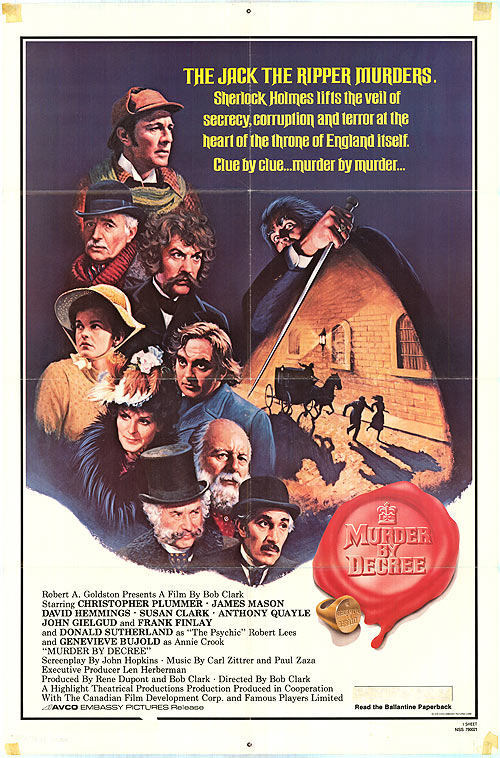
Sherlock Holmes (Christopher Plummer) is asked to investigate the killings of prostitutes by Jack the Ripper and the clues lead to a massive conspiracy that goes all the way up to the British Royalty.

This rendition of the Holmes versus Ripper theme is fun and handsomely produced. My favorite element was the recreation of the dark, dingy, atmospheric streets of old London. The fog, lighting, and sounds of carriages going over the cobblestone streets is perfect and I wanted to see even more of it. The killings are surprisingly graphic, the strangulation of a woman near the beginning looks  quite realistic as does the stabbing of another man in which you can see, from the side, a sword going right through him.

The supporting cast is a treat and includes an almost unrecognizable Anthony Quayle in a beard and a wig, as well as John Gielgud, David Hemmings, Genvieve Bujold, Donald Sutherland, Frank Finley, and Susan Clark. Clark gives the strongest performance in the crucial role of Mary Kelly. She speaks with a believable British accent despite the fact that she was not a native. Sutherland is the only one that is wasted as his character is dull and his screen-time limited.

Both Plummer and James Mason in the role of Dr. Watson are terrific actors, but I don’t know if I was completely sold with them in these parts. Plummer is too polished, handsome, and always displaying a sneering type of grin that I never pictured Holmes having. I would have wanted the character to be just a bit more aloof, awkward, and detached.  Mason is fine, but the chemistry between the two doesn’t seem genuine. I expected more comic interplay. There is some, but not enough. The best moment is the pea scene, which is a howl and written by Mason.

The case is elaborate and well thought out. Normally I find with these types of stories that if you aren’t paying careful attention, or miss one line of dialogue that you become lost and confused, which fortunately did not happen here.  It stays intriguing and the logic is sound for the most part. The wrap-up at the end in which Holmes explains the case and solves the mystery while discussing it in front of the Prime Minister (Gielgud) is satisfying and complete. However, I got a real kick out of the fact that when Holmes starts his dissertation he has a cut on the side of his face from an altercation that he had with Ripper the day before, but in the fifteen minutes it takes him to delivery his speech it turns into a scar before your very eyes.

SPOILER WARNING!

The few misgivings that I had here was that it does not stand out from the myriad of other films that have been done on the same subject.  The mystery and conspiracy angle is interesting, but speculative with no bearing on the actual case. The fact that they turn the Ripper character into being just a couple of idiots who didn’t know what they were doing is clever in one way, but disappointing in a other because it destroys the mystique that has become the Ripper legend and becomes anti-climactic in the process.

My Rating: 6 out of 10

Released: February 9, 1979

Runtime: 2Hours 4Minutes

Rated PG

Director: Bob Clark

Studio: AVCO Embassy Pictures

Available: VHS, DVD