Tag Archives: 60’s Movies

Bedtime Story (1964)

By Richard Winters

My Rating: 5 out of 10

4-Word Review: Con men fleece ladies.

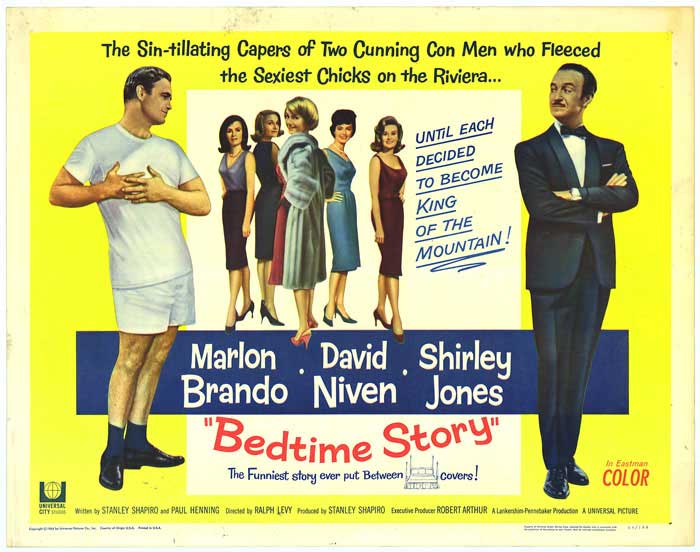
Freddy Benson (Marlon Brando) enjoys conning his way into women’s beds. He uses all sorts of different ruses and has become so good at it he’s made it into a full-time profession. Then he meets Lawrence Jameson (David Niven) and is impressed because not only is Lawrence able to woo them for sex, but he is also able to get into their finances as well. The two work together for a while, but then there is a falling out and they become rivals instead. Along comes Janet Walker (Shirley Jones) a single woman with a supposedly rich father. The two then compete to see which one can con her best.

The movie itself is so-so, but Brando’s performance is excellent. He is far better known for his brooding dramatic performances, but the guy is amazingly engaging here. I loved every scene that he was in and found him to be consistently amusing. I was impressed with how at ease he was in doing comedy and this is a must for all Brando fans as you will see him doing something completely different from anything else he has done. I came away feeling he was perfect for comedy and wishing he had done more of it in his career.

The story though is contrived and formulaic in the worst way. The first hour is particularly tough going as the schemes the two men play are rather lame and something a fifth grader could see through. The women are portrayed as being utter morons and apparently so good-hearted that they will fall for any trick in the book. It would have given it a better balance had a few of them become wise to the men’s antics, but the fact that none of them do makes the whole thing seem horribly stereotyped and insulting to females everywhere. The humor is trite and unsophisticated and it should come as no surprise that the script was written by Paul Henning known for such ‘classics’ as ‘The Beverly Hillbillies’.

If you survive the boring and silly first hour things improve slightly during the second. The antics that Lawrence and Freddy pull on Janet are a little more clever and it is fun to see how each tries to one-up the other. Freddy pretends to be a man stricken to a wheel chair after he becomes traumatized from the rejection of a woman he loved. The only person who can cure him is a famous, but expensive psychiatrist that gets played by Lawrence. Larwrence’s initial examination of Freddy is funny as is the part where Freddy and his wheelchair go wildly out-of-control and crash into a countryside barn.

I was disappointed that there was no twist ending here as I was starting to think there would be and defiantly should have been. Instead it is just another ‘happy’ hollow Hollywood ending that was typical for that era and solidifying this as an empty lightweight exercise that barely deserves any attention at all if not for Brando’s performance.

In 1988 this film was remade as Dirty Rotten Scoundrels that starred Steve Martin and Michael Caine. That film will be reviewed tomorrow.

My Rating: 5 out of 10

Released: June 10, 1964

Runtime: 1Hour 39Minutes

Rated NR (Not Rated)

Director: Ralph Levy

Studio: Universal

Available: VHS 
Those Magnificent Men in Their Flying Machines (1965)

By Richard Winters

My Rating: 4 out of 10

4-Word Review: A big airplane race.

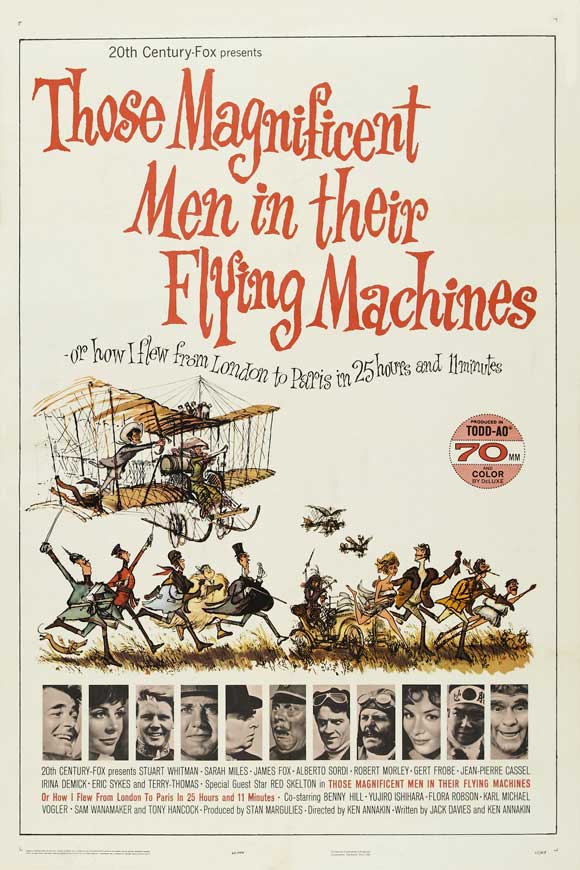
This is a wide open comedy in a similar vein as It’s a Mad Mad Mad Mad World dealing with a 1910 cross country plane race and involving a wide assortment of over-the-top characters.

This is a good film for family viewing and has enough pratfalls to elicit at least a chuckle or two from everyone. The aerial photography is impressive and most of it looks like the actors are actually flying the planes instead of just being propped up in front of a blue screen. Stuart Whitman makes for a solid lead and Gert Forbe is funny as a German Commander. However, it is Benny Hill that practically steals it as the besieged fire captain constantly rescuing the participants from their many accidents.

On the negative side the film seems too similar to all the other comical race movies from that era without offering anything new or original.  The characters are broadly sketched and become tiring after a while. It also takes too long for the race to get going and when it does it isn’t all that exciting, or gripping. The film also has a tendency to miss out on potentially interesting, or even inventive comical moments. One segment has a French pilot crashing into a convent and requiring the services of the nuns to help repair the plane. I thought this scenario could’ve been loaded with hilarious possibilities, but the film pursues none of them.

The non-discriminating viewer may consider this funny and amusing, but everything gets played-out by the standard formula of that era without offering anything that is memorable.

My Rating: 4 out of 10

Released: June 16, 1965

Runtime: 2Hours 18Minutes

Rated G

Director: Ken Annakin

Studio: 20th Century Fox

Available: VHS, DVD, Amazon Instant Video

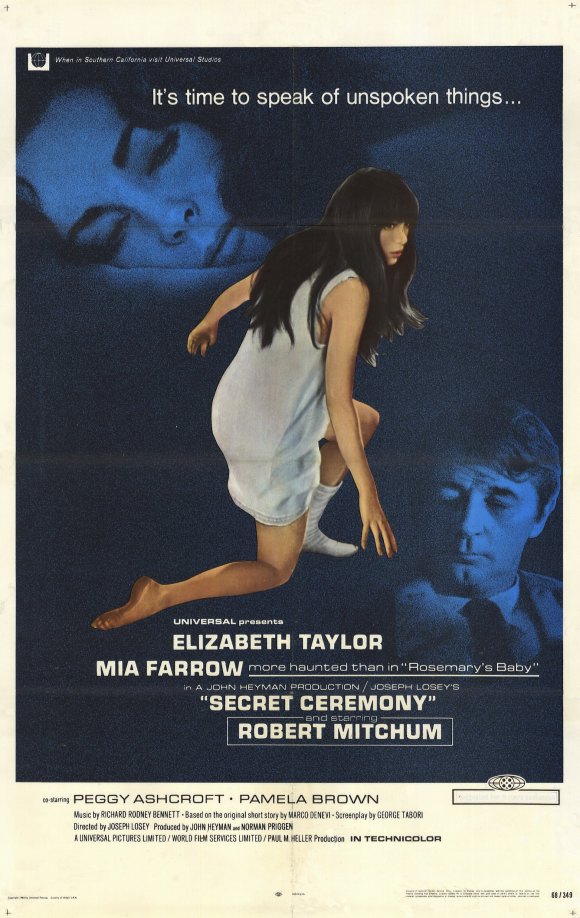
Secret Ceremony (1968)

By Richard Winters

My Rating: 5 out of 10

4-Word Review: Women in weird relationship.

Lenora (Elizabeth Taylor) is a lonely woman who lost her young daughter tragically years before and now finds herself strangely attracted to Cenci (Mia Farrow) a young woman who resembles her. The two move into a large mansion only to have things begin to unravel upon the arrival of Cenci’s weird and menacing father (Robert Mitchum).

The story is bizarre and perverse enough to keep you watching all the way through although it will certainly test the tolerance to those who do not have an affinity for the offbeat. The cinematography is excellent as is the mansion setting. The use of Peggy Ashcroft and Pamela Brown as sneering elderly sisters gives the film some added flavor.

Farrow is genuinely convincing as a grown woman stuck in a childlike trance, but Taylor doesn’t seem completely right for her part. A different actress, especially a character actress would have been much better.

Although the film does manage to come together in the end it does take a long time to get there. There are a lot of slow spots and the patience of some viewers may be tested. There are also many intriguing elements simmering underneath the surface that the film fails to follow through on, but should have.

Fans of Joseph Loosey should find this satisfying while others may be put off by the odd characters and style of narrative.

My Rating: 5 out of 10

Released: October 23, 1968

Runtime: 1Hour 45Minutes

Rated NR (Not Rated)

Director: Joseph Loosey

Studio: Universal

Available: VHS
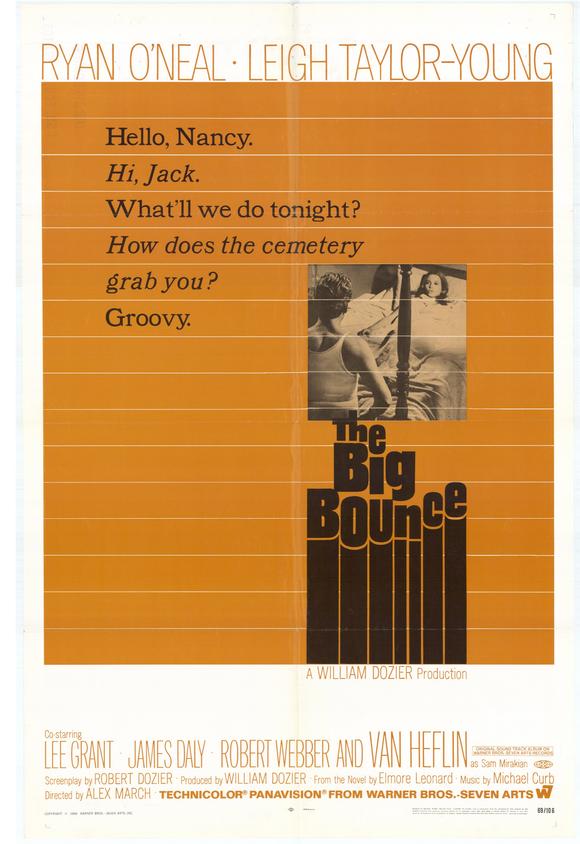
The Big Bounce (1969)

By Richard Winters

My Rating: 3 out of 10

4-Word Review: She is really crazy.

Based on the Elmore Leonard novel and remade in 2004 as a vehicle for Owen Wilson this version stars Ryan O’Neal as Jack Ryan a Vietnam vet on the run when he has a physical altercation with a player during a baseball game that leaves the other man injured and looking for revenge. He meets up with Ray Ritchie (James Daly) and his mistress/secretary Nancy (Leigh Taylor-Young) who is a bit on the wild side. She convinces Jack to help her rob her boss of a large amount of money that he has hidden away in his safe, but Jack becomes wary as Nancy displays more and more psychotic tendencies.

I enjoyed the film’s jaded sensibilities, but unfortunately it doesn’t do enough with them. There is too much talk without enough action. The plot is thin and unfocused. I spent the entire time wanted the story to get moving, but it really never does until the very end and by then it is too late. The scenes are lengthy and the production has too plodding a pace. I also didn’t like the fact that they discuss the robbery, but never go through with it. Nothing is more frustrating than an already draggy movie having a potentially interesting plot progression only to drop it.

I also couldn’t stand the music which sounded like men from a barbershop quartet and gets overplayed until it becomes annoying. The melody was too soft and mellow and did not fit the edgy tone of the script, or characters. This is the type of film that needed an up-tempo score with hard and fast beat.

For what it is worth Taylor -Young is good. She gets convincingly crazy and has a near epic meltdown at the end. She also has a tantalizing scene involving her swimming nude, which is only topped by another scene showing her standing naked in the middle of graveyard while pretending to be a statue.

O’Neal is okay although I felt some other actors might have been better, but at least he improves as the film progresses. The two stars were married in real-life at the time and I presume the producers cast them in the parts hoping that their chemistry would project onto the screen, but it never does and they ended up divorced four years later.

Van Heflin is great in a supporting role as Sam Mirakian a cynical and detached man who has seen it all. He brings the film some much needed energy. Lee Grant is also terrific and it was a crime that she wasn’t given more screen time. She makes her desperate and emotionally brittle character real and interesting. Cindy Eilbacher is quite adorable as her young daughter Cheryl. Robert Webber also deserves mention as he is amusing playing a man trying to be tough and intimidating, but ending up always looking like a schmuck.

I never saw the remake, but heard from several people that it wasn’t too great either. I dare say the novel is the best of the three and both film versions are worth skipping.

My Rating: 3 out of 10

Released: March 5, 1969

Runtime: 1Hour 42Minutes

Rated R

Director: Alex March

Studio: Warner Brothers/Seven Arts

Available: VHS, DVD, Amazon Instant Video

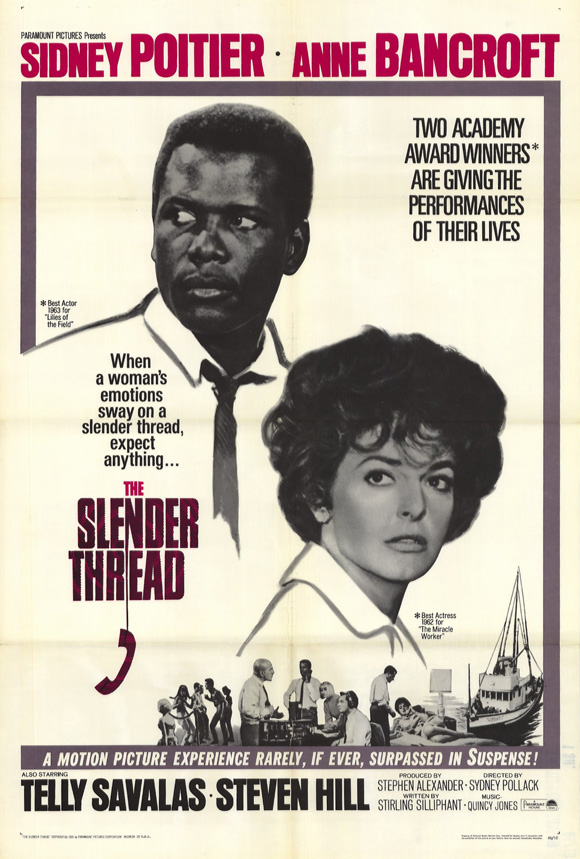
The Slender Thread (1965)

By Richard Winters

My Rating: 7 out of 10

4-Word Review: Desperate cry for help.

Inga (Anne Bancroft) is a middle-aged woman who has fallen into despair. She swallows a bottle of barbiturates and then in a last plea for help calls the local suicide hotline. On the other end is college student Alan Newell (Sidney Poitier) who is volunteering his time at the center and ill prepared for such a call. Despite this he manages to build a connection with her and the rest of the film deals with their conversation and Alan’s attempts at finding her location as well as flashbacks showing what brought Inga to such a desperate state.

This film will finally get its much awaited release onto both DVD and Blu-ray on October 16th and I highly recommend checking it out especially for those that can appreciate great film directing. This was Sydney Pollock’s directorial debut and his calculated touch is clearly what makes what could have otherwise just been a talky script into an intriguing visual showcase. The opening sequence showing an aerial shot of sprawling Seattle is excellent and sure to connect with those that live there. Pollock nicely adds some of the city’s unique architecture into the shots giving the fragmented narrative distinction. He also makes full use of the stark black and white photography. One of the most emotional and memorable scenes in the film is when Inga walks along a lonely beach and tries to help a crippled bird, which wouldn’t have been half as effective had it been done in color. Even the small things like watching a phone technician walking through rows and rows of telephone switchboards is captured with a pristine style that makes it intriguing. The pacing and editing is perfect and at no time does the film ever drag despite the fact that it could have done so if it had been put in less competent hands.

Poitier is exceptional in the lead. Initially I was put off with the idea of a 38 year old man still trying to play a college student, but Poitier is completely believable. It was nice seeing him in a role where the race card never came into play. The film cuts back and forth to the dramatic search by the police to find the woman, but in many ways I found Poitier’s banter with Inga and the many different psychological ploys he uses to try to connect with her far more riveting. Bancroft is equally as good and her distraught facial expressions leave an imprint. Steven Hill lends terrific support as her unhappy husband.

In the complaint department I felt that the music at the beginning seemed much too upbeat and jazzy for a film with such a somber subject. The Inga character gets unraveled too easily and quickly and certain viewers may be put off by her selfishness of trying to kill herself and abandoning her young son. The biggest issue though was with the ‘Hollywoodnized’ ending that devolved a bit too much into the cliché. Otherwise this is a sleeper waiting to be discovered.

Twenty-one years later Bancroft again starred in a film dealing with suicide only this time she played the person trying to talk the other one out of it. That film was entitled ‘Night Mother and will be reviewed on Monday.

My Rating: 7 out of 10

Released: December 23, 1965

Runtime: 1Hour 38Minutes

Rated NR (Not Rated)

Director: Sydney Pollock

Studio: Paramount

Available: VHS, DVD, Blu-ray 

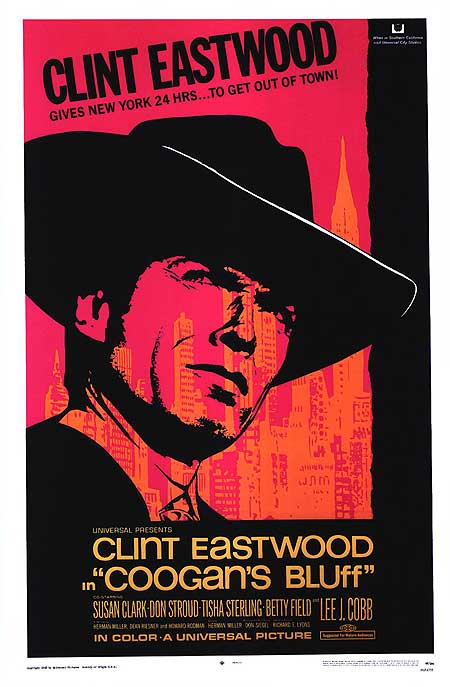
Coogan’s Bluff (1968)

By Richard Winters

My Rating: 4 out of 10

4-Word Review: Cowboy in the city.

            Coogan (Clint Eastwood) is an Arizona Sheriff sent to the Big Apple to extradite a convict back to the desert. The story focuses on the western lawman’s difficulties at adjusting to the big city ways.

One cannot help but compare this film to Dirty Harry. There are vast similarities, but the problem is that Dirty Harry is way better. This film lacks the edge is just plain bland and formulaic. The bad guy here (Don Stroud) doesn’t have the intriguing menacing quality of Andrew Robinson the memorable villain in the Harry film. The villain character is also poorly fleshed out and panics too easily and conveniently. The supporting characters are equally uninteresting and the whole thing seems too much of a showcase for Eastwood and nothing more.

The opening sequence where the viewer is given a bird’s eye view of the majestic desert as Coogan tries to ferret out a renegade criminal is by far the best part of the whole film. One almost wishes that the action had been kept here and not transplanted to the big city as the change of venue really doesn’t create enough intriguing situations.

Tisha Sterling’s performance helps as she does have a few good moments as the deceptive and conniving girlfriend of the convict. David Doyle is also memorable even though his part is quite small. His green corduroy pants is an amusing eye sore and when he unwisely thinks he can beat up Coogan in a barroom brawl it is pretty funny.

I overall like Eastwood and think he has made many superb films in his legendary career, but this one is his most undistinguished and it is easy to see why. It borrows too many elements from his other films without adding anything new in the process. It’s a tired formula the whole way.

My Rating: 4 out of 10

Released: October 3, 1968

Runtime: 1Hour 33Minutes

Rated PG

Director: Don Siegel

Studio: Universal

Available: VHS, DVD, Amazon Instant Video

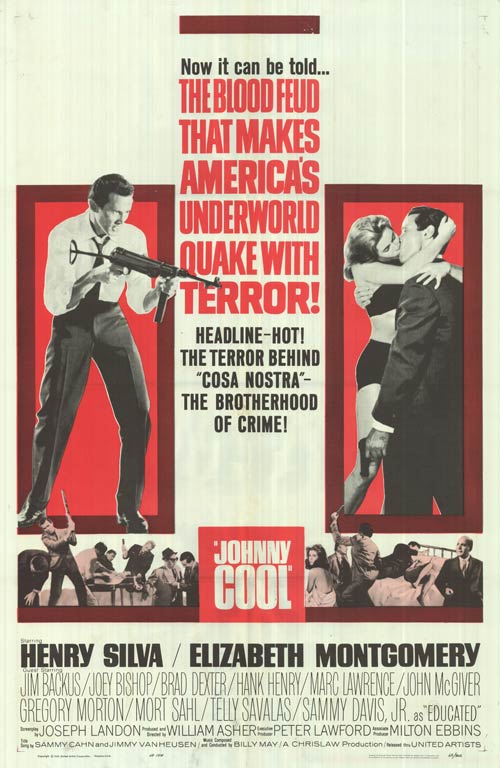
Johnny Cool (1963)

By Richard Winters

My Rating: 7 out of 10

4-Word Review: Top of crime world.

                Johnny Cool (Henry Silva) is really Giordano a man who grew to mythical proportions as an outlaw in a small Italian village after killing off some soldiers who tried to rape his mother. His exploits come to the attention of  Colini (Marc Lawrence) who has been exiled to Sicily because of his gangster past. He stages a fake assassination of Giordano in order to kidnap him and train him to go back to the United States and kill off the men that ordered his downfall. Johnny does this, but then becomes even more powerful than Colini was and soon he is both feared and hunted by the crime world.

The film, which was directed by William Asher, is nicely paced. I liked the fast, gripping action, the pounding music, and raw approach. The black and white photography nicely accentuates the gritty subject matter. Although it may seem a bit tame by today’s standards I still found most of it to be intense and uncompromising especially the ending.

Lots and lots of famous faces pop up everywhere, which is fun for a bit, but then takes you out of the story as it seems to become more like ‘spot the star’. Some of the cameos are small and pointless while others are more interesting. Sammy Davis Jr. has a tense scene playing a man with an eye patch who must role a specific number with the dice or be blown away by Johnny’s gun, which is aimed directly at his temple. Joey Bishop is funny as a fast talking used car salesman and his feeble attempts at making a play at the beautiful Dare (Elizabeth Montgomery). John McGiver is equally fun as a perplexed store manager who brings in a woman to his office after finding that she has been writing a lot of bad checks. The exchange he has with her is a perfect example of why sexual innuendos where a lot more interesting and creative back in the old days when the standard didn’t allow them to be as crass and vulgar as they are now. Here the lady states “I can make those bad checks good.” And McGiver responds after eyeing her figure “Yes, I think you can!”

Telly Savalas is wasted. The man is a great character actor especially as a villain. Playing a tough crime boss from Brooklyn is his forte and he could have really gone with it had they given him a bigger part. Marc Lawrence is equally evil as Colini and showing him only in one scene and then disappearing was disappointing. Jim Backus’s appearance was a mistake. A funny, talented man for sure, but I didn’t like that he did his Mr. Magoo laugh several times here as it did not fit the gritty mood.

Henry Silva has proven to be a great villain throughout his career, but in this role it just doesn’t work. His eyes have a weird type of stare that makes it look like he has been drugged. He delivers his lines in a monotone fashion. The character becomes overblown and some may find his use of the karate chop to be a bit cheesy. He kills a man on an escalator amidst a crowded airport and is able to get away. There are several other scenes where he is able to somehow get into a secure area and kill off people without any explanation for how he was able to do it.

Elizabeth Montgomery, who was at the time the wife of the director, is fantastic. She plays a brunette and does well with a multi-faceted character that goes from helpless victim to conniving double-crosser. She is shown in several scenes wearing no make-up and I liked the naturalistic quality. My only quibble is the scene where she gets roughed up by some gangsters, but the only mark left on her is a bruise on a shoulder even though a few bruises, scratches, and cuts on the face would have been not only more believable, but visually more effective.

My Rating: 7 out of 10

Released: October 2, 1963

Runtime: 1Hour 43Minutes

Rated NR (Not Rated)

Director: William Asher

Studio: United Artists

Available: DVD, Netflix streaming

4 for Texas (1963)

By Richard Winters

My Rating: 4 out of 10

4-Word Review: Frank and Dino vehicle.

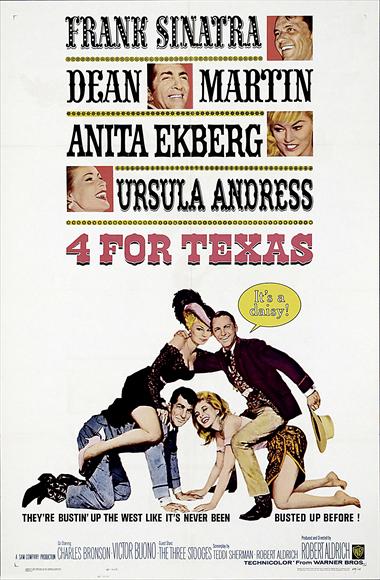
            Sharp-shooter Zack Thomas (Frank Sinatra) and Joe Jarrett (Dean Martin) fight over a cache of money they come upon after fighting off Matson (Charles Bronson) and his gang from a stage coach attack. Eventually Jarrett takes the money and makes his way to Galveston were the two meet up again and continue their bickering. When Joe fixes up an old riverboat and proceeds to turn it into a casino Zack tries to take it over, but not until Matson tracks him down to seek revenge.

The movie opens nicely with a snappy segment between the quarreling Zack and Joe trapped all alone in the middle of the desert. Their banter is great and it makes the most of each star’s appeal. However, after this the movie proceeds to die and very long, slow death. Absolutely nothing gels and the fragmented story lacks any type of singular voice, or vision. The film is also devoid of much action. There is a fistfight that Zack and Joe have at the end, but from the longshots it is clear that stunt doubles are being used for both men, which kind of takes the fun out of it. There is some potential when the two decide to combine their forces to take on Matson and his gang, but this finale moves along too hastily and the action is as uninspired as the rest of the film.

Martin is engaging and he is one of the film’s few bright spots. Sinatra though is stiff and out-of-place and shows no flair for lighthearted comedy. Apparently director Robert Aldrich and Sinatra did not get along at all and it shows.

The female co-stars don’t fare much better. Anita Eckberg who plays Zack’s love interest Elya amounts to not much more than a tired walk-on. The character has little to say or do and minimal connection to the main plot. Ursala Andress as Joe’s girlfriend Maxine fares better simply because she looks great. I’d say she is more striking here than she was in her most famous role in Dr. No.  Her low-cut dress is tantalizing and her tan, curved features have never looked better. The problem though is that there are a few drawn-out romantic scenes between both couples that makes a slow movie drag even more.

Talented character actor Victor Buono is excellent as bank president Harvey Burden. I was impressed with how he managed to hold his own with the rest of the cast despite the fact that he was much younger than all of them. Bronson is effective in the bad guy role and he makes a more interesting villain than he ever did as a good guy.

The Three Stooges appear in a cameo and do their predictable shtick that is strained and forced. Jack Elam who is a veteran support player in many westerns and has a very distinctive cross-eyed gaze is shockingly killed off right at the beginning, which was stupid.

This movie is a perfect example of a big Hollywood production relying too heavily on the star power of its two leads without first having an interesting script for them to work with. The production values are high and it is watchable, but plays itself out in a meandering and pointless fashion.

My Rating: 4 out of 10

Released: December 25, 1963

Runtime: 2Hours 4Minutes

Rated NR (Not Rated)

Director: Robert Aldrich

Studio: Warner Brothers

Available: VHS, DVD, Amazon Instant Video


Harper (1966)

By Richard Winters

My Rating: 9 out of 10

4-Word Review: New-age private eye.

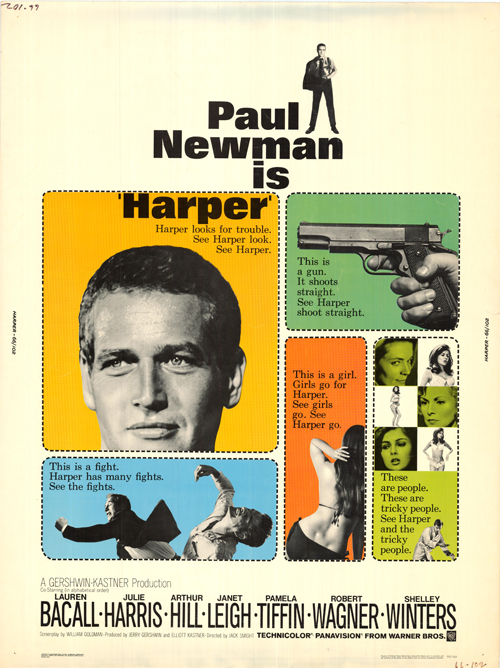
            Detective Lew Harper (Paul Newman) is hired by Mrs. Sampson (Lauren Bacall) a rich woman whose husband has gone missing. She wants a private eye to find him instead of the police due to the fact that her husband was involved in certain illegal business activities, which she doesn’t want to come to light. Harper finds himself immersed in a complex web of intrigue dealing with an array of shady characters, twists, and danger.

Newman is terrific and the Harper character is the perfect private eye for modern audiences. Watching him get out of bed in his dingy, cluttered apartment at the beginning and get ready for the day is excellent and builds characterization in a visual, subtle, and believable way. His cool, laid-back, and detached demeanor is a great contrast to the hyper, jaded, high-strung L.A. types that make up the assortment of suspects. His cynical style attaches the viewer to him right from the start and the banter that he has with everyone is marvelous.

The supporting characters are superb as well and very well-defined. Bacall gets one of her better later career roles as the bitchy eccentric wife. She gets quite a few quotable zingers particularly between her and her step daughter Miranda (Pamela Tiffin) that are close to classic. I also got a kick out of Shelley Winters playing a parody of herself as a way past her prime Hollywood star who is now overweight and an alcoholic. Harper’s attempts to get information out of her by pretending to be a hick who is totally mesmerized by her is quite amusing.

Director Jack Smight is at his directorial peak here. The on-location shooting is splendid. I particularly enjoyed the modernistic building that fronts as a church, but is really used as a cover for criminal activity. It sits out on a sandy hilltop and leaves a strong visual impression as does Harper and Miranda’s car ride along a very winding desert highway to get there. I also liked his ability to capture an abandoned airplane hangar making it almost as evocative to the eye as the foot chase that happens in it. The whole production is consistently slick with color schemes, set design and editing that are all top notch.

William Goldman’s script, which is based on the novel by Ross Macdonald is sensational and one of his best in his already legendary career. The dialogue is sharp one can view it for the lines alone and might need to re-watch it again simply to pick-up on all of them as there are so many your liable to miss some. The mystery is also intriguing and nicely layered to the point that it will keep you guessing and impossible to figure out and fortunately there is a minimum of loopholes. I saw this before and knew the outcome, but still found it an enjoyable and involving ride.

My complaints are few and fortunately do not taint the quality of the picture, which is otherwise high. I didn’t like that Harper had an ex-wife Susan (Janet Leigh) who he is constantly trying to win back. The woman seemed a bit cold and snippy and not the type I would think Harper would fall for, or want to put up with. Having him act so needy to win back her affections hurt the ruggedness of the character who is appealing because of his independent and self-assured nature. There is another scene where a man is shot dead and Harper goes through his coat pockets in order to get some clues to his identity. He finds a matchbook listing a nightclub, which Harper goes to in order to ask questions from the patrons, but I kept thinking it would have been much easier had he just went through the victim’s pants pocket and taking out his wallet and looked at his driver’s license.

If you are looking for a nifty mystery done in the best crime noir tradition then they don’t come much better than this.

My Rating: 9 out of 10

Released: February 23, 1966

Runtime: 2Hours 1Minute

Rated NR (Not Rated)

Director: Jack Smight

Studio: Warner Brothers

Available:  DVD, Amazon Instant Video

Luv (1967)

By Richard Winters

My Rating: 4 out of 10

4-Word Review: Jump off the bridge.

            Based on the play by Murray Schisgal the film follows the exploits of Harry Berlin (Jack Lemmon) a hopeless neurotic who tries to commit suicide by jumping off a bridge only to be saved by his long lost friend Milt (Peter Falk). Milt wants to use Harry to have him fall in love with his wife Ellen, so that way she will agree to a divorce and free him up to get with a hot young blonde named Linda (Nina Wayne).  Things initially work as planned. Harry and Ellen fall in love and marry and Milt does the same with Linda, but then Milt and Ellen find that they are not compatible with their new mates and long to get back together. The problem is that Harry refuses to grant a divorce forcing them to try and coax him back out on the bridge, so he will finally jump off it and get out of their way.

Lemmon’s performance is the best thing about this otherwise strange experiment. He is like his Felix Unger character put on speed. His weird quirks and idiosyncrasies help propel the story to newer and more absurd heights. In his more straight comedies Lemmon has always seemed a bit benign and showing a nervous energy that is more annoying than funny. Here though he falls into his comic niche bringing out the bizarreness of his character with an almost creepy clarity. I thought it was interesting that although he was a leading man he chose to do an ensemble comedy. Although this film can be deemed a failure I still found it commendable that he was willing to test his acting range and image by taking on an unusual role.

Falk doesn’t fare as well. I thought it was great that he reteamed with Lemmon after performing with him in The Great Race, but his character really isn’t all that funny. May is usually great with sardonic material and has made a career out of performing and writing this kind of stuff, but she really isn’t given all that much to say that is amusing. I liked her charts that she creates for both Milt and Harry measuring all the hours they have been married with all the hours that they have had sex, which has a nice goofy element. Wayne is attractive, but her high, squeaky voice can quickly become annoying. Her acting abilities are limited and she clearly seems outclassed by her supporting counterparts. Had a stronger more established actress been cast in the role it certainly would have helped.

Director Clive Donner doesn’t show a good feel for the material. There are certain parts that are funny like when Ellen and Harry spend their honeymoon at Niagara Falls attacking and physically hurting each other just to see if the other will still love them afterwards. I also liked some of the potshots at modern day suburbia, but other than that this thing falls flat. There are too many scenes that go on forever with jokes and comic bits that are more stupid than clever. The opening sequence has a nice distinctive jazz score along with a montage of kitschy artwork and there is interesting camera work and editing during a sequence at an amusement park, but the rest of it becomes a filmed stage play. The pacing is slow and devoid of the unique directorial flair that could make an offbeat thing like this work. The climactic scene at the bridge is particularly strained and helps cement this as a hopeless misfire.

This movie is probably best known for being the film debut of Harrison Ford who has one word of dialogue and appears as an irate motorist who punches Harry in the face. I wished there had been more of him as although it is very brief he is one of the best things in it.

My Rating: 4 out of 10

Released: July 26, 1967

Runtime: 1Hour 33Minutes

Rated NR (Not Rated)

Director: Clive Donner

Studio: Columbia

Available: VHS, DVD