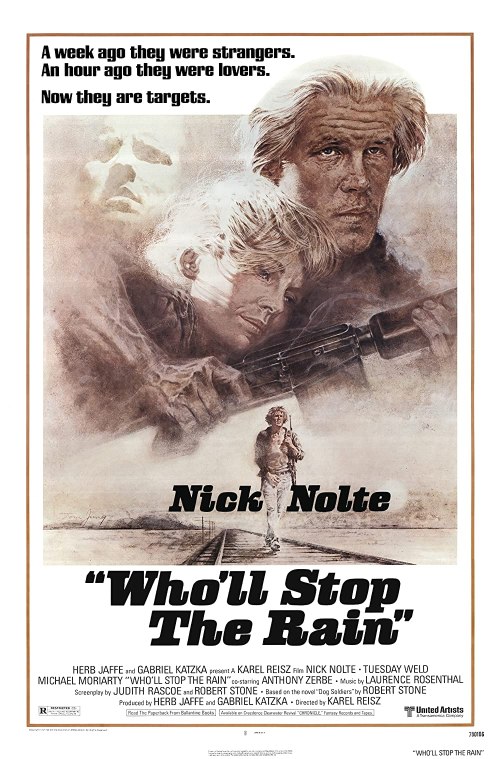
Who’ll Stop the Rain (1978)

wholl

By Richard Winters

My Rating: 8 out of 10

4-Word Review: Drug deal gone bad.

John Converse (Michael Moriarity), a war correspondent working in Saigon, approaches his friend Ray (Nick Nolte), a merchant marine, about smuggling a large bag of heroin out of the country and into the US. Ray has dealt marijuana before, but never the hard stuff and is reluctant at first, but due to his friendship with John he eventually agrees. He is told to go to San Francisco where he’ll drop-off of the drugs for payment with John’s wife Marge (Tuesday Weld). Once he gets there though he realizes he’s been followed forcing both he and Marge to go on a dangerous trip to not only elude the bad guys, but also get rid of the incriminating evidence.

The film is based on the 1974 novel ‘Dog Soldiers’ by Robert Stone, who also co-wrote the screenplay. The theme of the novel was to examine the loss of optimism and youthful ideals of the 60’s and the beginning of the age of cynicism that came during the 70’s, which for that purpose the time period should’ve been 1970 as keeping it in the present day, in this case 1978, makes it seem a bit dated and losses the context of the message. The story itself though is still quite engrossing with some of the most disturbing scenes being the ones dealing with a young, affluent suburban couple (James Granna, Timothy Blake) going to a drug party of sorts that had Ray, Marge and Ray’s friend Eddie (Charles Haid) who give them illicit substance for the first time and their immediate hallucinogenic reaction I found both frightening and impactful.

The performances are uniformly excellent especially Nolte, who was not yet an established movie star and the producers wanting instead Kris Kristofferson for the role only to finally give-in after the persistent lobbying of director Karel Reisz. Tuesday Weld is also dynamic falling into the role of a drab, middle-aged housewife with ease and completely losing the young, sexy starlet appeal that she had previously. My favorite though was Moriarty, whose glazed over eyes and emotionless demeanor perfectly reflects the apathy and soullessness of his character.

On the downside I found the character’s motivations to be confusing particularly the way Marge, who did not know Ray before this, agrees to go with him as he tries to outrun the baddies, but how would know she could trust him, or that he wasn’t in on the scheme? When she dropped her child off with some friends that’s where I felt she should’ve also gone and going back into Ray’s car, instead of calling the police, or advising her friend to do so, seemed reckless and too trusting that this stranger had her best interests at heart. In the book Ray’s intentions are not quite as noble as he decides to bring Marge along more for insurance as he think’s he’s been double-crossed by John, but presumes with Marge along he can use her as a decoy, while in the film it’s because he’s genuinely concerned for her safety. Marge too is betrayed differently as she’s not aware of the drug deal in the film, but in the book she was and I felt these nuances should’ve been brought up in the movie and the fact that they aren’t makes it less realistic and losses the whole point of the story.

John’s relationship with Danskin and Smitty (Richard Masur, Ray Sharkey), the two henchmen to corrupt FBI agent Antheil (Anthony Zerbe) gets botched too. For one thing the make-up effects are too slight as John is put through a wide array of physical tortures by the two in an attempt to get him to tell them where the heroin is and yet after it’s all over the only sign of the struggle is a slight cut on his forehead when instead his entire face should’ve been severely bruised, bloodied, and swelling. Afterwards he becomes too palsy with them even reading a book in their presence and joking around though you’d think he’d remain frightened after what they put him through and never letting down his guard in their presence because he’d know their violent side. I also didn’t like how the two start out as nasty criminals, but by the end become clueless comic foils, which hurts both the tension and grim realism.

The film though does recover especially in the final act when Ray takes Marge to an isolated cabin in New Mexico to hide-out in and then are followed by the villains culminating in a unique showdown. The isolation of the place, which sits amongst the beautiful mountains of the region is both picturesque and tranquil, and is based off of author’s Ken Kesey’s home in California where he wired the nearby trees with lights and sound effects to enhance their LSD experiences, and thus this creates an interesting battle between Ray and the thugs as he uses these same props to disorient them and it helps the movie stand-out with its memorable conclusion.

My Rating: 8 out of 10

Released: August 11, 1978

Runtime: 2 Hours 6 Minutes

Rated R

Director: Karel Reisz

Studio: United Artists

Available: DVD, Blu-ray

Hawks (1988)

hawks1

By Richard Winters

My Rating: 6 out of 10

4-Word Review: Patients hit the road.

Decker (Anthony Edwards) is a former football player stricken with terminal cancer. He’s put in the hospital where his roommate is Bancroft (Timothy Dalton), who’s dying from the same disease. Bancroft though still wants to have some fun and convinces Decker to sneak out of the facility and go on a road trip to Denmark, so they can have one last fling with the prostitutes in the Red Light District. Decker is nervous at first, as he’d rather commit suicide to put himself out of his misery, but eventually decides to go along where they end up meeting two lonely ladies, Maureen (Camille Coduri) and Hazel (Janet McTeer) who’s also harboring a painful secret.

Based on a short story written by Barry Gibb of The Bee Gees the plot has, despite it’s grim theme, a playful quality and comes-off more like a quirky road movie. The scenery is nice especially when they get into Holland and have an extended scene amidst the picturesque windmills, which you can hear slowly rotating in the wind as they speak. There’s also a few funny moments with the best one coming right at the start where Decker takes a frightened SAAB car salesman (Geoffrey Palmer) on a test drive at reckless speeds and right to the edge of a cliff.

The acting is great with Dalton, who did this between his two stints as Bond and used his notoriety to get it made, which he felt wouldn’t have gotten financed otherwise, being standout and putting to great use his piercing blue eyes, which become even more prominent when he’s wearing his stocking cap. Edwards is also good though he looked wimpy to have ever played football. Some may try to argue that the sickness ate away his weight, but in reality this is the body type he’s always had and the producers should’ve, for the sake of authenticity, had him bulk-up before filming began.

What I didn’t like were the unexplained caveats, like where did these two terminally ill patients manage to get the money to pay for fancy hotels and chic restaurants? It seemed like they could buy anything they wanted, so if that were the case then why couldn’t they get themselves clothes so they didn’t have to run around everywhere wearing nothing but their bathrobes? The sex angle was ridiculous too especially for Decker, who’s so weak he had to be carted around in the wheelchair. If he could barely stand then how the hell is he going to get the energy for sex?

Initially I found Hazel and her clumsiness as annoying as Bancroft did, but like with him she eventually grew on me, but I didn’t think she needed to be introduced already in the first act before she even met the two men. She has a scene on a bridge all alone and I didn’t understand what she had to do with the story, only later during the second act when she appeared again did it make sense, but again her personal troubles could’ve waited to be explained when Bancroft and Decker heard about it. I actually enjoyed more Sheila Hancock, who plays Regina, an aging 50-something hooker they meet, who shows a good propensity at fixing things like TV’s and I wished she’d been the one they had befriended long term and the two younger ladies cut out altogether.

Spoiler Alert!

The ending is touching particularly the way the plastic red clown nose comes into play. The wedding in which Bancroft marries Hazel, who’s secretly pregnant by a man who disowns the child, is cute too though I didn’t understand how Bancroft, who had been losing his hair throughout, suddenly seemed to grow it all back as he walked down the aisle. If anything he should’ve been completely bald by that time and it would’ve been more realistic had he been shown that way.

hawks2

My Rating: 6 out of 10

Released: August 5, 1988

Runtime: 1 Hour 47 Minutes

Rated R

Director: Robert Ellis Miller

Studio: Skouras Pictures

Available: VHS, DVD-R (dvdlady.com)

Starting Over (1979)

starting1

By Richard Winters

My Rating: 7 out of 10

4-Word Review: Can’t get over ex.

Phil (Burt Reynolds) gets a divorce from Jessica (Candice Bergen), a successful songwriter, when he finds out she’s been having an affair. He then moves to Boston where his brother Mickey (Charles Durning) and sister-in-law Marva (Frances Sternhagen) set him up with Marilyn (Jill Clayburgh) a nursery school teacher. They don’t initially hit-it-off, so he instead goes out with Marie (Mary Kay Place), but that doesn’t go over well either, so he again calls up Marilyn and this time she relents. Despite the usual ups-and-downs things between them begin to gel and soon they decide to move in together only to have Jessica reappear wanting to get back with Phil and Phil becoming torn as to what he should do.

Based on the novel of the same name by Dan Wakefield with a screenplay by James L. Brooks best known for producing the classic TV-show ‘Mary Tyler Moore Show’. Like with that show the story focuses heavily on the pitfalls of dating life with much of it on-target though it does have a serious out-of-touch quality that’s no longer in-tune with today’s generation. The big one is that they meet on their first date inside the women’s apartments, which because of safety concerns doesn’t happen much now and usually it’s always advised to meet in a public setting and not give out personal addresses until you really get to know the person better. There’s also a scene where Jessica, who wears a highly revealing outfit, meet in Marilyn’s apartment and have what we’re told is a civil three hour conversation though in this day and age it’s hard to believe two women, knowing that the other one is clearly after ‘their man’, could be that composed and most likely a fight would break-out and I’m kind of surprised knowing how emotional Marilyn was and wearing her insecurities on her sleeve, that one didn’t happen here.

On the flip side there’s some terrifically funny moments.  One is when Marilyn and Phil initially get off the bus together, before they’ve officially met, and she thinks he’s a stalker, which has a good true-to-life feel. Another great scene is when Phil and Marilyn briefly break-up and he goes to her school, where they’re having a dunk-a-teacher water party and he manages to hit the bullseye with the ball he’s throwing and she’s goes into the water repeatedly before eventually losing her cool and swearing. Phil’s anxiety attack inside a department store is memorable too as his Jessica’s call to Phil at his apartment while he’s serving Thanksgiving dinner to Marilyn and his guests, which creates quite the awkward moment. Phil’s first date with the aggressive Marie is a terrific bit too.

The acting is top notch especially Clayburgh who creates the perfect composite of single women during the 70’s who desperately wants to get into a relationship, but many times allow her fears and anxieties to get in the way. Reynolds is excellent playing against type. Normally he’s a brash womanizer, but here he’s far more reserved and indecisive.  This is also the last movie where he didn’t have his patented mustache and I felt he looked way better and younger without it. Even Bergen, in a much smaller role, is memorable particularly with her off-key renditions of the songs her character has written.

Overall I consider this one of the best romantic movies made. I will admit a modern remake would give the story a more timely update, but the situations nicely reflect the dating conundrums that affect us all.  My only complaint would be with the Clayburgh character, who seemed too insecure to be able to get into a healthy relationship. Most guys would be scared off with her constant emotional outbursts and accusations and I didn’t see why Phil stuck with it. This is one instance, especially since Phil was pretty much a hunk, that I felt the woman he fell for should’ve been better looking, or at least equal to the Jessica character that he left. I just couldn’t understand exactly why, being that there were a lot of women who could easily get into him, he’d choose, or settle for, Marilyn over all the others. Had they had more in common then maybe, but she came-off like a woman who would eventually become a cat lady and too emotionally needy to be someone you could have a long term relationship with.

My Rating: 7 out of 10

Released: October 5, 1979

Runtime: 1 Hour 45 Minutes

Rated R

Director: Alan J. Pakula

Studio: Paramount Pictures

Available: DVD-R, Amazon Video, YouTube

Night Game (1989)

nightgame1

By Richard Winters

My Rating: 4 out of 10

4-Word Review: Baseball score and murder.

Mike Seaver (Roy Scheider), a police detective, is put in charge of investigating a series of bizarre murders where women, some of them prostitutes, are murdered along the beaches of Galveston, Texas after each Houston Astros home game where pitcher Silvio Baretto achieves a victory. There are initially no suspects and it all seems to be a coincidence until Seaver ties the clues together and hones in on the killer while quarreling with Witty (Lane Smith) a state investigator brought in to help him with the case, but who has opposing ideas as to how to approach it.

The story is a strange mixture wanting to feed-off of the slasher films of the 80’s while also tying it to a sports themed flick, that was also popular during that decade, but manages to fail on both ends. The killings aren’t imaginative enough to attract a horror audience while the gore is much too graphic for those just looking for a slick thriller and thus both types of viewers will get put-off with this pretty quickly. Fans of sports movies won’t like it either as the baseballs scenes are brief and fleeting. While it’s kind of fun to see the Astros old color bar uniforms as well as watching actual game footage shot inside the old Astrodome, which at one time was coined ‘the 8th wonder of the world’ it hardly seems necessary especially since a TV-movie ‘Murder at the World Series’, which came out in 1977, had a very similar storyline that also included the Astros and Astrodome making this seem like a cheap, uninspired rip-off of that one.

The plot at least, while still dated especially on the technology end, takes a realistic approach to being a detective and how hard it is to find clues that can help piece the case together and lead to an actual suspect. Scheider, who was 57 at the time and looking it, manages to give it some energy and this was helped no less than by casting Richard Bradford as his nervous and pensive superior whose white hair and old school ways helps to offset Scheider’s wrinkles despite the fact that Scheider was in real-life 2 years older. The side stories though dealing with Smith coming in to butt heads with Roy doesn’t get played-up enough to be interesting and Scheider squabbling with his mother-in-law over a color TV that he got her drags the pacing down and hurts the tension of the mystery, which is where the sole focus of the script should’ve stayed.

Spoiler Alert!

What really ruins it though is the stupid ending. For one thing people in big cities, and Houston is the 4th largest one in the US, get murdered all the time, so having a cop able to somehow tie it to when a pitcher wins a game was too much of a stretch as technically there’s likely to be a murder happening somewhere whenever ANY pitcher wins a game and there needed to be more direct clues, like the killer sending cryptic notes to the police, or media, stating what his intentions were for it to realistically come together for the investigators.

The man playing the murderer, Rex Linn, who is supposedly a former pitcher who got cut from the team and then ultimately loses his hand in an accident and has it replaced with a hook, looks more like an disheveled, beer bellied truck driver who never played a sports game in his life. His motivations, to kill someone whenever the pitcher, who replaced him on the rotation, wins a game, in order to steal media attention away from the new pitcher’s success, is poorly thought out. It would’ve made more sense had the disgruntled man gone after the pitcher directly by either threatening his life, or those of his family, or maybe even attempting to kill the general manager, or owner, since they were the ones directly responsible for cutting him instead of no-name hookers who usually don’t get a lot of news attention anyways when they’re killed and thus making the whole premise pretty vapid.

My Rating: 4 out of 10

Released: September 15, 1989

Runtime: 1 Hour 35 Minutes

Rated R

Director: Peter Masterson

Studio: Epic Productions

Available: DVD, Blu-ray, Amazon Video, Tubi

How to Frame a Figg (1971)

how

By Richard Winters

My Rating: 1 out of 10

4-Word Review: Tricking a dumb bookkeeper.

Hollis Fig (Don Knotts) is an inept bookkeeper working as an accountant at City Hall. The place is run by the Mayor (Edward Andrews), his staff, and the richest man in town who is also quite elderly, Charley Spaulding (Parker Fennelly). Together this bunch, unbeknownst to Figg, are skimming city funds. They decide though that they must cover their tracks by firing all of the other accountants and keeping only Figg who they deem as not smart enough to catch-on to what they’re doing. They also install a computer to do the bookkeeping and tell Figg it’s his job to maintain it, but nothing more. However, Figg and his friend Prentiss (Frank Walker) become suspicious when the computer readouts involving the city’s budget show that much of the money has gone missing. When Figg brings these findings to the mayor they divert his attention by hiring him a sexy secretary (Yvonne Craig) who will flirt so heavily with him that he’ll forget about everything else that’s going on, but this doesn’t sit well with Figg’s girlfriend Ema Letha (Elaine Joyce) who works across the street as a waitress.

This was the final movie produced from Knotts’ 6-picture deal that he signed with Universal in 1964 after he rose to fame in the ‘Andy Griffith’ TV-show. While none of the movies produced from that contract were very good this one has to be the weakest. The story is slow moving and lacks any action, or sight gags, which will bore most kids who are the intended audience. Visually it’s quite banal and looks like it could’ve easily been an episode for a TV-show with the biggest failing being that it was shot on a studio backlot, so the town is nothing more than propped up buildings. While it would’ve cost more shooting it in a real town it would also have given the production more of a distinct look, but at least it uses the same courthouse that was eventually also in Back to the Future.

Knotts is a funny guy, but he’s just playing the same Barney Fife caricature over and over and thus making everything that he does here quite predictable. Edward Andrews and Joy Flynn are both talented character actors, but together they end-up negating the other. In this instance Andrews totally dominates making Flynn’s efforts negligible and not worth appearing at all. Frank Welker, who later became a very famous voice artist including speaking for the Fred character in the ‘Scooby-Doo’ cartoons, makes for a strange buddy to Knotts since there was over a 20-year difference between the two and it shows. It would’ve been better if they were around the same age and Welker’s character not so painfully stupid as having two dimwits becomes tiring and monotonous.

I did however enjoy Yvonne Craig, best known for playing Batgirl on the ‘Batman’ TV-show, here she enlivens things as the vixen.  Parker Fennelly, who was 80 at the time, but looking more like 100, is very funny, and in many ways the best thing in the movie, as the crotchety, but still conniving codger, who violently slams down his cane when he gets angry and has everyone else at his beck-and-call.

Spoiler Alert!

Had the script not spelled everything out right at the start and instead had the viewer to see things completely from Figg’s perspective would’ve allowed for a few twists and surprises, but the way the plot gets presented here is quite routine. The ending, in which Figg and his new bride travel to Rio de Janeiro for their honeymoon and explicably bump into the Mayor and his staff who are hiding-out there is disappointing.  Do the bad guys ultimately escape justice, or does Figg figure a way to take them down? Or do they kill/kidnap Figg to keep him from talking? Either way none of this gets answered, which is a letdown. At least with the Disney films of that era everything would end with one big car chase, or ultimate showdown of some kind, which is what this film, as dull as it already was, sorely needed.

how2

My Rating: 1 out of 10

Released: February 2, 1971

Runtime: 1 Hour 43 Minutes

Rated G

Director: Alan Rafkin

Studio: Universal

Available: DVD

Surrender (1987)

surrender

By Richard Winters

My Rating: 1 out of 10

4-Word Review: Pretending to be poor.

Sean Stein (Michael Caine) is a successful novelist, who after suffering through two contentious divorces, has decided that women are only after him for his money and considers them off-limits. Daisy (Sally Field) is a struggling artist, who is in a relationship with Marty (Steve Guttenberg), a successful attorney with no interest in making a long term commitment. While attending a charity ball that gets overrun by gunmen who rob the place, Sean and Daisy, find themselves tied-up together and despite the stressfulness of the situation slowly get to know each other. The next day, after they ultimately get freed, Sean asks Daisy for a date, but decides to pretend that he’s poor to make sure she loves him for who he is rather than because of his money.

While Jerry Belson wrote several successful comedies during the 70’s and based this story loosely on his own life experiences where he proudly stated that everything that happened to Sean in this movie happened to him in real-life, the pacing and basic comedy scenarios really don’t work. It starts out alright  as they’re several flashbacks showing Sean with his attorney, played by Peter Boyle, battling his ex-wives in court. The different hairstyles that they have as they go through the years is funny and the most creative thing in the movie. I was though disappointed that the two women who play the ex-wives, Louise Lasser and Iman, are never give a single word of dialogue, which wastes the talents of these well-known actresses.

After the first ten minutes though things quickly fall apart. Having armed thieves crash the party that the two are at is particularly troubling as there is no forewarning for why this is happening. People who attending posh parties usually don’t find themselves at gunpoint, so why are they here? Had there been even a fleeting mention of a group of criminals crashing area get togethers then maybe, but here we get no explanation either before, or after giving the plot a haphazard quality like the filmmakers are happy to throw in any crap they want whether it makes sense, or not. The characters respond to what most would consider to be a traumatic experience like it’s just a ‘run-of-the-mill thing’ and by the next day barely remember it, even though many people would have genuine PTSD after it was over.

Caine’s attempts to woo Sally would in most cases have the woman thinking he was a potential stalker. First he comes to her house six hours before their date saying that he couldn’t wait that long to see her and wanted to spend every waking minute with her that he could, which for any sane woman would be a serious red flag. He then kisses her without her consent and begs for immediate sex, or he might not be able to control himself and instead of calling 9-1-1 she gives him a pity fuck. Not only is this unfunny and stupid, but an insult to the viewer’s intelligence that they would find any of this to be a normal, well-adjusted way to start a healthy relationship.

I also thought Caine, who was a raving misogynist who even had signs on the front gate of his home banning women from entering, came around to liking Sally too quickly. Sure she was kind to him when they were tied-up, but an avowed women-hater doesn’t just change his ways overnight, but in this movie that’s exactly what happens, which isn’t realistic. If anything it should’ve been Sally chasing after Caine, who might’ve liked her a little at first, but so set in his ways would still decide to avoid her and only after an extended period of time, and continual prodding by Sally, would he eventually relent.

The pretending to be poor thing isn’t handled well either. I was expecting there to be a lot of comic moments dealing with Caine trying to desperately hide his wealth and background, but that never gets played out. He isn’t even forced to rent himself a seedy, little apartment in order to hide the fact that he lives in a mansion as Sally was apparently never curious about seeing his place, but how many serious relationships are there where they always go to one partner’s home and never the other?

The third act gets even more ridiculous as it has Caine insisting that Field needs to sign a prenup agreement. She’s resistant at first, and even insulted, but then eventually signs it without ever bothering to read it, which is idiotic. She also goes to Vegas and wins 2 million dollars at the slot machine her very first time playing it, which is beating insurmountable odds.

I did like the scene where Caine hands Sally a manuscript he has written, which was published into a book though he doesn’t tell her this and then becomes insecure when she doesn’t immediately like it, which being a budding screenwriter myself, I found funny and despite all the other absurdity in the film, a bit true to life. I was hoping the movie would explore this situation more, but it doesn’t making the rest of it a sore disappointment.

I was surprised why either of these big name stars agreed to do it. I know Caine was willing to be in almost anything for the money, but I’m not sure what Sally’s excuse was and if you ask me I’d find the old reruns of her TV-show ‘The Flying Nun’ to be more entertaining. It’s easy to see why this dumb thing, despite the star quality, has never gotten a DVD or Blu-ray release and nobody’s been clamoring for it either. It bombed badly at the box office too managing to recoup only $5 million of it’s $15 million budget.

My Rating: 1 out of 10

Released: October 9, 1987

Runtime: 1 Hour 34 Minutes

Rated PG

Director: Jerry Belson

Studio: Warner Brothers

Available: VHS, Tubi

Think Big (1989)

thinkbig1

By Richard Winters

My Rating: 1 out of 10

4-Word Review: Truckers with big muscles.

Rafe and Victor (Peter Paul, David Paul) are brothers who make a living driving a truck though they’re always missing the freight deadline to the constant consternation of their boss (Richard Moll). He gives them the ultimatum: either get this new delivery to its intended destination within 30 hours, or find a new job. Holly (Ari Meyers) is a teen genius who has invented a mechanism that can electronically deactivate any code allowing one to start, or stop any other device without having a key, or password to do it. When she finds out that the company she’s been working at, or more honestly enslaved at, wants to use her invention for unscrupulous means she escapes with her device in hand and then hides inside the brothers’ truck. Initially the brothers want to throw her out as they consider her presence a sign of bad luck, but eventually they help her out in her quest to avoid the bad guys.

The Pauls, who were bodybuilders before they got into acting, made their film debut in D.C. Cab, as The Barbarian Brothers, which lead to guest starring roles in TV-Shows like ‘Knight Rider’ that eventually got them starring in their own movie The Barbarians, that did well enough at the box office that producers gave them this comedic vehicle though it proved to be a disaster. Most of the problems lie with the silly script that’s filled with pseudo science, dated technology, and campy humor, which will amount to one long, continuous eye roll from the viewer.

The brothers are poor actors with their scenes in Natural Born Killers getting deleted because of what director Oliver Stone felt was shameless overacting, and their dialogue here doesn’t help. It’s one thing to be bit dimwitted, but these guys are infantile and their chicken bone chant that they do is highly redundant and annoying. For big guys they’re quite wimpy as they allow their boss to grab them by the neck and during fights they get punched by men who are far smaller and immediately fall down backwards by the power of the blow though you’d think in reality the person doing the punching would get their hand injured and they’d run-off hollering while these two big buys would remain standing. Their profession isn’t interesting either and puts to waste their big muscles. Instead of driving a big rig they should be working as club bouncers, or security for celebrities, or even just owning a workout gym.

The plot is also cluttered with villains. Martin Mull plays the head of the evil agency and while he does get a few funny ad-libs I didn’t feel his part was necessary. David Carradine, who plays this cantankerous repo man that tries to take back the brothers’ truck, gets wasted too. Initially I was surprised why a star with his stature would even appear in this though I did find him amusing and the caricature he creates to be colorful, but the stupidity of the script overshadows him and since he’s only seen sporadically his acting efforts get lost.

Richard Kiel was the one bad guy that I did like.  In his past roles he’s played the one who’s strong, but not bright, but in this film he’s the exasperated leader that gets irritated by the dummies around him. For this reason I thought he should’ve been the main heavy and Mull’s presence cut out completely. It’s also interesting seeing him take-on the Paul brothers as usually his physical presence dominates everyone else, but here it’s a much more of an even fight. I did though find it frustrating that we see him struggling to get out from underneath a car and the film then cuts away, only to see his character appear later, uninjured, with no explanation for how he got out of his predicament.

While Ari Meyers’, who’s best known for her work on the ‘Kate & Allie’ TV-show, acting isn’t the best she’s still easy-on-the-eyes and therefore should’ve been made the lead while the brothers could’ve been cast in support as these bumbling truckers she’d meet along the way, where their presence could be used as comic relief, but having the whole thing centered around them kills the movie right from the start. Throwing-in a sappy ‘life lesson’ speech at the end just makes it even worse and a genuine insult to the intelligence of anyone who sits through it.

My Rating: 1 out of 10

Released: October 23, 1989

Runtime: 1 Hour 26 Minutes

Rated PG-13

Director: Jon Turteltaub

Studio: Motion Picture Corporation of America

Available: VHS, DVD-R (dvdlady.com)

Hot Resort (1985)

hot

By Richard Winters

My Rating: 2 out of 10

4-Word Review: Looking for some action.

Filmed on the island of St. Kitts in the West Indies the story, or what little there is of it, follows around a group o college men lead by Brad (Bronson Pinchot) and Chuck (Dan Schneider) who travel there in order to work at the resort and earn some money over the summer. They hope also to hit-on the bikini-clad babes in-between shifts and seem to have sex much more on their minds than work. The resort manager (David Lipman) hires disciplinarian Bill Martin (Samm-Art Williams) to get them under control, but even he has a hard time keeping them in-line. The boys also clash with a group of snotty ivy leaguers, who are on the island to film a soup commercial. After having several run-ins with them the boys challenge the Ivy guys to a rowboat race and become determined to beat them even if it means cheating.

This yet another low budget production produced by The Cannon Group, which was run by Yoram Globus and his cousin Menaham Golan. They made a business of buying bottom barrel scripts and turning them into low budget productions and while some of them where a delightful surprise and even rivaled a standard Hollywood production this was certainly not one of them. The script was co-written by Boaz Davidson, who had earlier success with the Israeli teen comedy Lemon Popsicle, which was later Americanized into The Last American Virgin that was also written and directed by him, but this one has none of the comic spark of those and seems compelled to reach to the lowest common denominator possible almost challenging the viewer to see how much inane, low brow humor they’re willing to sit through before turning it off.

Granted 80’s teen sex comedies where never meant to be masterpieces, but this thing, even when compared to those others, is incredibly uninspired and adds nothing new to the otherwise tired mix. The only two things that are a bit different from the norms of that genre is that the fat guy, played by Schneider, who later went on to star in the TV-show ‘Head of the Class’, isn’t shown constantly stuffing his face with food, or the butt of all the jokes. In fact he’s portrayed as being just as hip as the others and getting more action than the rest of them.

The film also switches things around in that it isn’t the men that are on the aggressive make, but instead the women, who literally grab the guys as they’re walking and minding their own business and then bring them into a room for hot action. At one point they even swipe an elderly man off the sidewalk though it’s hard to believe that any woman could be that oversexed. It might’ve made the story more funny and at least given it a certain logic by having the females take some sort of drug that causes them to become sexual animals, but that’s not the explanation here, which just makes the shenanigans all the more insane.

I started to wonder too if these gals were on the pill because if not they risked getting pregnant, which would force them to either get a lot of abortions, or raising kids they really didn’t want all by themselves since they didn’t even bother to get the names of the guys they had fucked, and seemed to choose them at random. Also, if you really think about it, it comes-off like rape as the men constantly say no and resist making it more like we’re witnessing a crime than just a carefree sex.

The guys who play Ivy Leaguers speak in such an overblown accent that it’s not even mildly amusing, but genuinely irritating and there’s simply no way that anyone who talked like that, no matter how deluded they were, would think they were cool and not worried that people would be making fun of them behind their backs. I will give some props though to the scene where the emergency medical personal must come to the aid of a couple who get stuck inside a car that they were making love in forcing the fire department to saw off the roof of the vehicle to get them out though anyone who would even think of trying to have sex in the back seat of a tiny VW bug should have their heads examined.

Some of the supporting players are amusing particularly Stephen Stucker, who plays the same type of character that he did in Airplane! where he’d jump into a scene say something quirky and then quickly jump back out. I also enjoyed Frank Gorshin (billed as Mr. Frank Gorshin) a talented impressionist who rose to fame playing the Riddler on the ‘Batman’ TV-show. Here he plays a dirty minded middle-aged man who tries to teach the youngsters the finer points of hitting-on chicks much to the consternation of his wife (Zora Rasmussen) who sits next to him and listens in as he talks about it. Mae Questal though, who’s best known for being the voice of Betty Boop and Olive Oyl gets sorely wasted particularly in the scene where she gets ‘tricked’ into putting on a dress with a giant bullseye on the back, which her husband plans to use as a target to aim his gun at, though it’s hard to imagine any woman wouldn’t have seen this before she put it on, which just shows how stupid and poorly thought out the gags are.

Even on the level of cheap, soft core porn it’s no good. The nudity is infrequent and fleeting and the women aren’t exactly cover girls looking more like they’re around 30 and a bit ‘rough-around-the-edges’, so if you’re looking to grab this thing simply for some healthy voyeurism you’ll still end up sorely disappointed anyways.

My Rating: 2 out of 10

Released: January 14, 1985

Runtime: 1 Hour 33 Minutes

Rated R

Director: John Robins

Studio: The Cannon Group

Available: VHS, DVD-R (dvdlady.com)

Phobia (1980)

phobia1

By Richard Winters

My Rating: 3 out of 10

4-Word Review: His patients are dying.

Dr. Peter Ross (Paul Michael Glaser) is a Canadian psychiatrist who has come up with a radical new therapy to help cure those who suffer from phobias. The program includes having them watch their fears played out visually on the big screen and thus forcing them to conquer those irrational thoughts and be able to go on living normal lives. Peter feels he’s making great progress with his patients only to suddenly have them start to die-off one-by-one with each perishing in ways that reflects their private phobia that they had hoped to overcome.

This is definitely one of those movies where what happened behind-the-scenes had to be far more interesting than anything that occurred in front of the camera. Having John Huston, the legendary director who helmed such classics as The Maltese Falcon and Key Largo doing this one, which is nothing more than a cheap thriller with 80’s slasher instincts, has to be the most baffling thing about it. It wasn’t like his career was on the outs either as he went on to direct several more critically acclaimed flicks in the 80’s that were well financed with big name stars and he had just 5 years earlier did the well received The Man Who Would Be King, so why he decided to take a weird foray into doing this inept thing, which just by reading the script you could tell was a mess upfront, I don’t know.

It starts out with some visual panache, but otherwise could’ve easily been directed by a no-name, two-bit director and no one would’ve known the difference. The one segment dealing with a car chase down the city streets that culminates with a man falling from a tall building had some potential though I would’ve framed the shot differently showing it from a bird’s-eye view where the viewer could see how far off the ground the victim really was versus having the camera on the ground looking up, which is less dramatic. I suppose it might’ve given away the safety net that’s clearly present as you never see him hit the ground, it cuts away while he’s still in mid-air, but in either case it’s the only mildly diverting moment of the whole film.

Everything else is run-of-the-mill including the numerous deaths, which despite the tagline don’t all have to do with their phobias either. For instance one woman fears being in big crowds, so in order to ‘cure’ her, the doctor has her go onto a crowded subway, but she panics and runs back to his place where she ultimately dies when a bomb explodes. The segment dealing with a woman who fears men gets pretty ridiculous as he has her watch a movie of a woman getting gang raped, which would appall anyone and yet when she runs out of the room in disgust and shock he’s confused. The very fact that he talks about ‘curing’ his patients is a major red flag altogether as in psychiatry you never really ‘cure’ anybody, which just shows how poorly researched and shallow the script really is.

Paul Michael Glaser, better known for his work in the TV-show ‘Starsky and Hutch’, makes for a wretched leading man and it’s no surprise that he decided to get into directing after this one and has never starred in a theatrical film since. It’s not completely his fault as his character exudes a cold demeanor, so you never really care about him, or his quandary. John Colicos, as the police detective, is far superior and helps enliven the film with the few scenes that he is in though his interrogation techniques are highly unethical and the fact that he only focuses on one angle as to who the culprit is makes his character come-off as unintentionally inept.

The film does feature a twist at the end as to who the killer really is, but it’s dumb and not worth sitting through. In fact the ultimate reveal is so bad that it ruins everything else that came before it, as it had been watchable up until that point, but the climax solidifies it as a bomb.

My Rating: 3 out of 10

Released: September 26, 1980

Runtime: 1 Hour 30 Minutes

Rated R

Director: John Huston

Studio: Paramount Pictures

Available: Blu-ray

Buster and Billie (1974)

buster2

By Richard Winters

My Rating: 5 out of 10

4-Word Review: Dating a loose woman.

Buster (Jan-Michael Vincent) is a high school senior living in rural Georgia during the late 1940’s. He’s been dating Margie (Pamela Sue Martin), but finds her to be stuck-up and her unwillingness to have sex makes him frustrated. He begins seeing Billie Jo (Joan Goodfellow), who has moved into town and due to having limited social skills puts-out for the other boys by allowing them to have sex with her, one after the other, in the woods late at night. Buster at first dates her simply for the action, but eventually the two get into a serious relationship and he breaks-up with Margie. They begin going out publicly letting the whole town know that they’re a couple, but the other boys become jealous as they can no longer have easy sex like they use to and thus plot a dark revenge.

The story is based loosely on an actual event that occurred in Florence, South Carolina in 1948 that the film’s screenwriter Ron Turbeville remembered hearing about growing up. The recreation of the era though lacks style and this may be in large part due the film’s limited budget. While it gets a zero in  atmosphere I did at least like the way it doesn’t sugar coat things for nostalgic purposes. The teens behave in the same ways they do now and thus it’s gritty on that level.

The acting is good surprisingly even from Jan-Michael who in his other films tended to have a cardboard presence, but here he gives the thing most of its energy. He even appears, shockingly, fully nude and in fact this was the first mainstream American movie to show a male naked from the front, of which Jan stated in later interviews he was quite proud to expose of his well-endowed ‘equipment’. Goodfellow is also seen nude and is quite attractive though I wish she had more to say. Robert Englund, in his film debut, is the most memorable playing an albino with brown hair and his pale complexion makes him look creepier, at least I felt, than he did as Freddy Kruegar.

I didn’t understand though why Buster would risk his social standing for this ostracized girl. I got that Margie was annoying, so breaking-up with her wasn’t a stretch, and Billie was essentially ‘easy-pickings’, but why go public with it? It made more sense that they would’ve seen each other on the sly, but not wanting to risk the social scrutiny of letting everyone know about it. This would’ve clearly lost Buster’s social status not only amongst his friends, but the town as a whole including his own parents, so why add on all that needless stress? Billie too was very shy, so becoming center stage and having all eyes on her would be something she most likely would’ve wanted to avoid, which makes the second act overly idealistic.

It’s also frustrating that Billie doesn’t say much. You want to get to know this person, but never really do. The only time she’s ever given any insight is when Buster explains to his parents why she had sex with all the other guys (in order to be liked), but this is something we should’ve heard coming-out of her lips instead of his. By having Buster do almost all the talking, even when they’re alone together, makes it seem like she’s mentally handicapped, which I don’t believe was the intent and yet ultimately that’s how it comes-off and thus making their romantic moments sterile and uninteresting.

Spoiler Alert!

The final sequence though is where it really falls apart as the boys inadvertently kill Billie when they gang rape her (during a rainstorm even though the sky is still clear and sunny). Buster then tracks them down at a pool hall where he single-handily beats them up and ultimately kills two of them, but the guys just allow themselves to be beaten without attempting to throw a punch, which is not only unrealistic, but boring. Having a big brawl, where each side fights equally would’ve been far more exciting. The twist in which Buster somehow gets released from jail the day after her funeral, so that he can decorate her gravesite with all the flowers that he’s stolen from everyone else in town is far-fetched and overly forces the sentiment.

My Rating: 5 out of 10

Released: August 21, 1974

Runtime: 1 Hour 40 Minutes

Rated R

Director: Daniel Petrie

Studio: Columbia Pictures

Available: Amazon Video