The Andromeda Strain (1971)

andromeda strain

By Richard Winters

My Rating: 7 out of 10

4-Word Review: Isolating a dangerous virus.

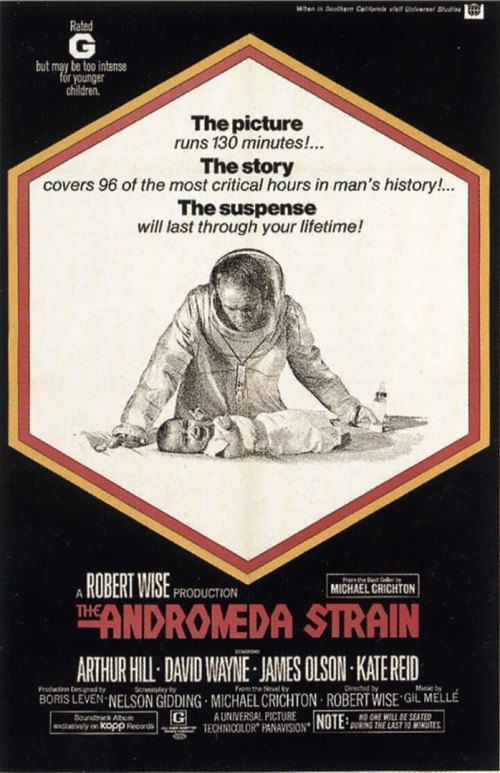
When a satellite returns to earth it brings back a mysterious virus that ends up killing all the residents of a town where it lands. Two scientists Dr. Jeremy Stone (Arthur Hill) and Dr. Dan Hill (James Olson) go to the town to investigate and find that the only survivors are a wino (George Mitchell) and a six-month-old baby. They bring these two people along with the remnants of the satellite back to a secret Nevada lab known as Wildfire that’s buried deep below the ground. It is here after close examination that they are able to observe the virus, which appears as small green dots on the satellite, but they fail to realize that this virus can also mutate and presents an even greater risk to them in the lab.

One of the major selling points of this film is the fact that it keeps everything within the realm of ‘realistic sci-fi’. No bubblegum action, scary monsters, or any other form of over-the-top dramatics get added; instead it’s on a ‘thinking man’s level’ with an extraordinary attention to detail. I enjoyed seeing all of the decontamination procedures that the crew is forced to go through before they are even allowed to begin their investigation. The isolated lab, which is hidden beneath what looks to be just an ordinary farmhouse and shed, is really cool and director Robert Wise’s use of the split-screen during the search of the town is both flashy and slick.

Showing the scientist’s personal lives and how the government agents literally demand that they drop what they are doing and come with them helps humanize the characters to a degree. I also liked how the male character of Dr. Peter Leavitt in the Michael Crichton book from which this is based gets switched to a female character here, which helps add an extra dynamic and is very well played by Kate Reid. In fact the only thing about the character’s that I didn’t like, aside from Arthur Hill’s sterile performance, is when we see the dreams of the doctors as they sleep, which seemed corny and unnecessary.

The mysterious nature of the virus is compelling and I certainly enjoyed the way they were able to detect it by scanning the satellite with cameras that could focus onto the object in minute detail, but the plot itself gets stretched farther than it needs to. There are a few interesting twists, but it starts to feel quite labored around the 2-hour mark and the climatic finish isn’t all that intense and seems rather stagy and predictable.

I was also amazed that this film achieved a G-rating. For one thing there isn’t much action and the narrative is on a more sophisticated level that is clearly aimed at adults and something most children won’t be able to pick up on. Also, one of the victims that the two men come upon is of a woman with no top on. The image is brief, but her breasts are clearly exposed making this one of the few G-rated movies to feature nudity.

My Rating: 7 out of 10

Released: March 12, 1971

Runtime: 2Hours 11Minutes

Rated G

Director: Robert Wise

Studio: Universal

Available: DVD, Amazon Instant Video, YouTube

The Clan of the Cave Bear (1986)

clan of the cave bear

By Richard Winters

My Rating: 5 out of 10

4-Word Review: Girl gets new tribe.

After her mother is killed in an earthquake and escaping from the clutches of a hungry lion a very young Ayala (Daryl Hannah) gets taken in by a tribe of Neanderthals. Her addition causes strife amongst the other members particularly Broud (Thomas G. Waites) who feels she doesn’t conform enough to the subservient female role. When it is found that she has taught herself to hunt by using weapons that the women were forbidden to touch she is kicked out of the tribe and forced to survive on her own.

I realize that this film has been almost universally lambasted by movie goers and critics alike, but overall I found it to be watchable. The biggest issue in many ways were the action sequences. The opening earthquake bit as well as the lion attack comes off as stagy and phony and even border on being unintentionally funny. Later on when Ayala saves a young child from a wolf the movie reverts to slow motion, which gives it too much of an over-the-top Hollywood feel. There is also another segment where the cavemen torment a grizzly bear as part of an ancient tribal ceremony. Some of the men get torn up and killed by the bear, which to me was just fine as they should’ve left him alone in the first place!

Hannah is the perfect choice for this type of role, but for whatever reason her performance seemed a bit off and not as effective as it could’ve been. She was also probably too tall for the part as people back then was much shorter than they are now.

The movie has a little too much melodrama and eventually resembles just another cheesy Hollywood drama. The authenticity is questionable and the grittiness from the more popular Quest for Fire is definitely missing. I also wasn’t too crazy about the outdoor shots, which includes the opening one, that shows sunlight filtering through the tree leaves in a haze-like fog that gives it too much of a fairy tale-like look.

The part where Ayala is forced to survive on her own goes by too quickly and hardly seems as brutal as it should’ve been and I was also confused about how she was able to come upon this fur shawl to wear that protected her from the cold because when the tribe kicked her out she left with nothing but the flimsy outfit that she had on.

Yet despite all this I still found it to be reasonably compelling. Maybe it’s just the idea of seeing an individual learn to survive on her own, standing up to unjust authority and learning to find independence that manages to connect us no matter what the time period, but in either case it’s an okay time filler if you don’t think about it too much.

My Rating: 5 out of 10

Released: January 17, 1986

Runtime: 1Hour 38Minutes

Rated R

Director: Michael Chapman

Studio: Warner Brothers

Available: DVD (Warner Archive), Amazon Instant Video, YouTube

Big Top Pee-Wee (1988)

big top pee wee

By Richard Winters

My Rating: 2 out of 10

4-Word Review: Pee-Wee joins the circus.

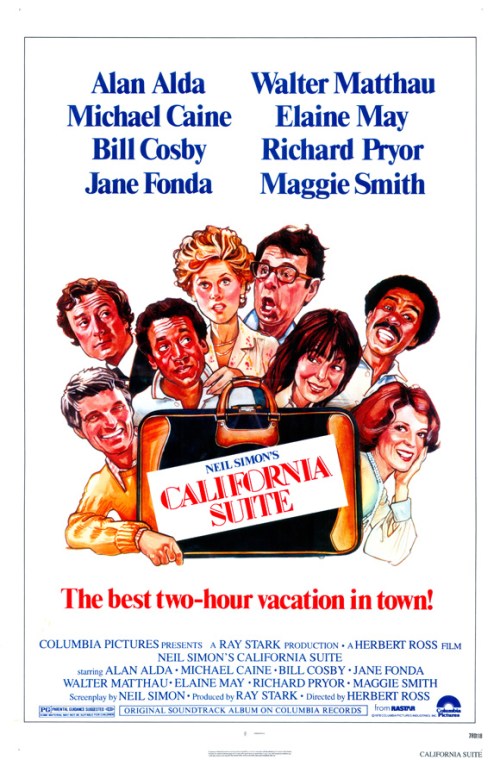
Pee-Wee (Paul Reubens) is now living the quiet life of a farmer. He’s not too popular with the older townsfolk of the neighboring small town where he resides, but manages to find friends with the circus that blows in after a violent storm. Although he is currently engaged to Winnie (Penelope Ann Miller), who is the beautiful local schoolteacher, he soon finds himself entranced with the trapeze artist Gine (Valeria Golino), which causes a great deal of conflict especially after Winnie finds out about it.

I’m not exactly sure why Tim Burton wasn’t brought in to direct this sequel and it could have something to do with the fact that a different studio produced it, but his vision is noticeably missed. Randal Kleiser has directed some good movies of his own, but never anything in this type of genre. It was Burton’s direction and not Pee-Wee’s persona, which is rather one-dimensional and can only be amusing in small doses, that made the first film the success that it was.  Burton infused a lot of garishly colorful sets, oddball characters that complemented Pee-Wees’, and a surreal storyline that all helped to make it strangely intriguing and funny, but here we get none of that.

Instead it is a contrived and conventional storyline that goes nowhere and just isn’t original enough to be worth catching. The first half comes off as disjointed and makes little sense. Pee-Wee seems to have gone back into time as the people in the town where he lives all wear clothes and drive cars that look that they are from the 1940’s, but with no explanation for why that is. The presence of the circus is equally stupid as it seems to have quite literally ‘blown in’ with the storm and into Pee-Wee’s backyard.

The film really gets boring when it focuses on the romantic subplot, which is what takes up the film’s whole second half. One big issue is why would two really beautiful women find this man-child attractive to begin with? A much funnier scenario that would’ve kept more with the bizarreness of the character would be for him to have a romance with one of the sideshow freaks at the circus like the bearded lady, or even the Siamese twins, which could’ve been played up to an even funnier level by having both twins in-love with him and compete for his affections, or having one in-love with him while the other couldn’t stand him.

In either case the film is just not weird enough to be entertaining and it also leans towards the formulaic by having most of its humor aimed at the kiddie crowd, which the first one had thankfully avoided. A definite letdown when compared to the first one.

My Rating: 2 out of 10

Released: July 22, 1988

Runtime: 1Hour 26Minutes

Rated PG

Director: Randal Kleiser

Studio: Paramount

Available: DVD, Amazon Instant Video, YouTube
California Suite (1978)

california suite

By Richard Winters

My Rating: 7 out of 10

4-Word Review: Visitors at a hotel.

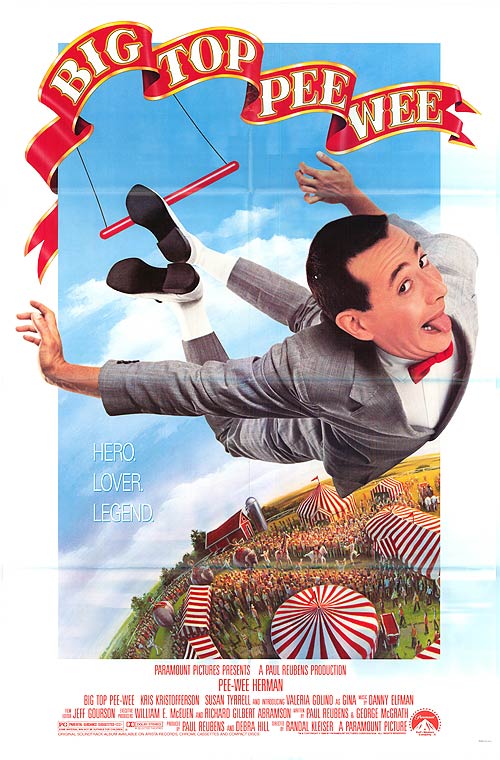
Based on the hit Neil Simon play, who also wrote the screenplay, the film follows five couples all staying at the same posh Beverly Hills hotel. Hannah and Bill (Jane Fonda, Alan Alda) are a divorced couple fighting over the custody of their teenage daughter (Dana Plato). Diana (Maggie Smith) is a famous British actress set to attend the Academy Awards ceremony and being escorted by Sidney (Michael Caine) a man she wants all for herself, but can’t because he is bisexual. Marvin (Walter Matthau) is in town to attend his nephew’s Bar Mitzvah and shocked to find that his brother (Herb Edelman) has sent a prostitute (Denise Galik) to his room to entertain him for the night only for her to promptly pass out drunk the next morning just as his wife (Elaine May) is about to arrive. The final segment deals with two bickering Dr’s (Bill Cosby, Richard Pryor) who can’t get along and seem to get themselves into one over-the-top calamity after another.

Many viewers have commented that they disliked the Fonda character as she came off as too cold and bitchy, but I’ve known many people who are like her who put up a very steely front in order to protect themselves emotionally, so for me her sarcasm worked and the way she delivered her acerbic lines is fun especially as she chews up the already transparent Alda character until it seems like he isn’t even there.

Smith and Caine’s segment seemed a bit trite and generic. The first part of it deals with her nervousness about attending the awards ceremony, which isn’t all that original. The second half examines her frustrations at the fact that Sidney can’t solely commit to her, but I couldn’t completely buy into this because she was playing a rich and famous, globe-trotting actress whom I’m sure could easily find another man if she wanted and didn’t have to cling to someone who didn’t fully want her like she were some lonely, small town housewife with no options.

The third segment dealing with Matthau and the unconscious prostitute is quite funny and had me laughing-out-loud while the scenes involving Cosby and Pryor’s constant arguing is incredibly dumb and even jarring as it features a lot of silly, slapstick humor that does not fit in with the more sophisticated tone of the rest of the film.

I was also not so crazy about the film’s pacing. The first hour deals almost exclusively with the dramatic segments while the second half focuses mainly on the comical ones, which came off as imbalanced. It would’ve worked better had the stories been evenly spread out in a rotating type fashion with a few minutes spent on each one before cutting to the next one. It would also have been cool had it taken a Slacker-like approach where the characters, who never once cross paths in this movie, would have instead passed by each other at certain points and the scene would then shift to the new characters that the other ones just passed.

I was also disappointed that we never get to see much of exterior of the hotel. We do see a bird’s eye view of it during the closing credits, but I thought shots of it should’ve been shown during the beginning. I have nothing against David Hockney’s artwork that does get used, but the hotel is a part of the film’s title and therefore should have taken precedence.

Overall though I felt it was a decent dramedy worth the price of admission. It also features a terrific and distinctive jazz score by Claude Bolling that I wish had been used even more throughout.

My Rating: 7 out of 10

Released: December 15, 1978

Runtime: 1Hour 42Minutes

Rated PG

Director: Herbert Ross

Studio: Columbia Pictures

Available: DVD, Amazon Instant Video, YouTube
Enter Laughing (1967)

enter laughing

By Richard Winters

My Rating: 2 out of 10

4-Word Review: Acting is his dream.

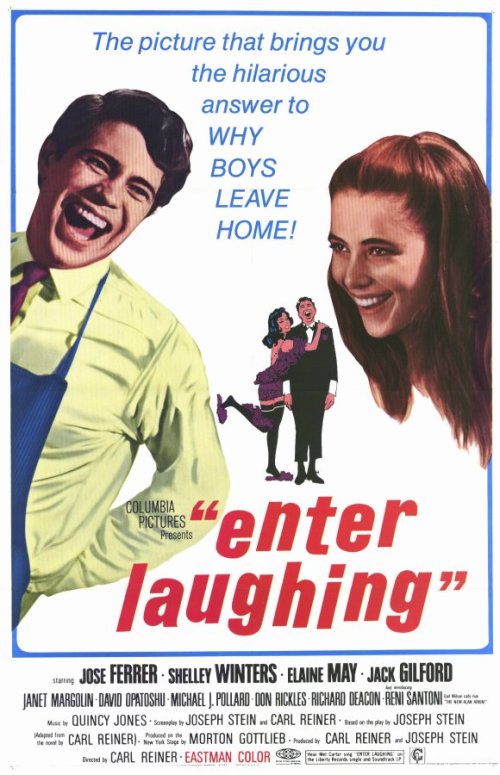
Loosely based on writer/director Carl Reiner’s experiences as a fledgling actor trying to work his way up into the business circa 1938. The story centers on David Kolowitz (Reni Santoni) who works as an apprentice at a machine repair shop, but dreams of one day making a living as a stage actor. He gets his break when he auditions for a part in a low budget stage production run by an aging, alcoholic actor named Harrison Marlowe (Jose Ferrer). Marlowe is not impressed with David’s acting ability, which is marginal at best, but at the insistence of his daughter Angela (Elaine May), who thinks David is ‘cute’, he decides to give him a try under the condition that David must pay them to perform in it and also must come up with his own costume.

Although this was a big success on Broadway as a film is has not aged well and is quite bland. The story is better suited as an episode for a sitcom and stretching out such a thin one-dimensional plot to an almost two-hour runtime becomes quite boring particularly with its plodding pace and direction. The only time it ever gets even mildly funny is during David’s audition scene, but even this ultimately falls flat particularly with the idea that David would be dumb enough to think that words in a script that are in parenthesis would be part of the dialogue and not a stage direction. You would think someone who has spent his entire life dreaming of being ‘the next Ronald Coleman’, who was a big movie star during the ‘30s, would know how a basic script is constructed and therefore this attempt at humor fails.

Santoni, in his first major film role, is terrific and despite being of Hispanic heritage, which Reiner is not, still manages to resemble Carl quite well during Reiner’s younger years. However, the character is too painfully naïve and dumb as he clumsily walks himself into messy situations long after the viewer, or anyone else with some common sense, would clearly see the obvious red flags.

Janet Margolin is beautiful playing David’s girlfriend Wanda and her presence gets an ‘A’ simply for her attractive face alone, but the romantic scenes do nothing but bog this already slow moving film down even further. Also, having David be so oblivious to her insecurities about him working with an attractive leading lady onstage makes him seem insensitive and not funny as intended.

Elaine May is good and so is Jack Gilford as David’s boss at the repair shop. It’s also fun seeing Carl’s real-life son, Rob Reiner, who later became famous for playing Mike Stivic on ‘All in the Family, making his film debut as a nerdy, would-be actor, but overall the film is dated and contrived.

My Rating: 2 out of 10

Released: February 25, 1967

Runtime: 1Hour 52Minutes

Not Rated

Director: Carl Reiner

Studio: Columbia Pictures

Available: VHS

Checkered Flag or Crash (1977)

checkered flag 2

By Richard Winters

My Rating: 2 out of 10

4-Word Review: Drivers race off-road.

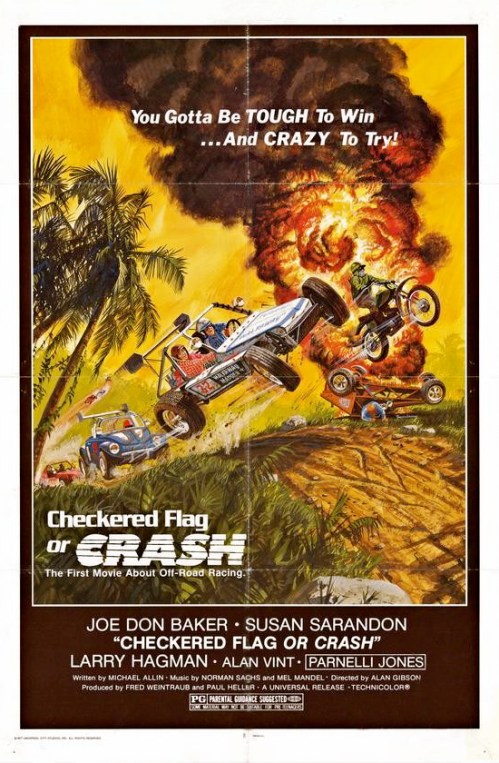
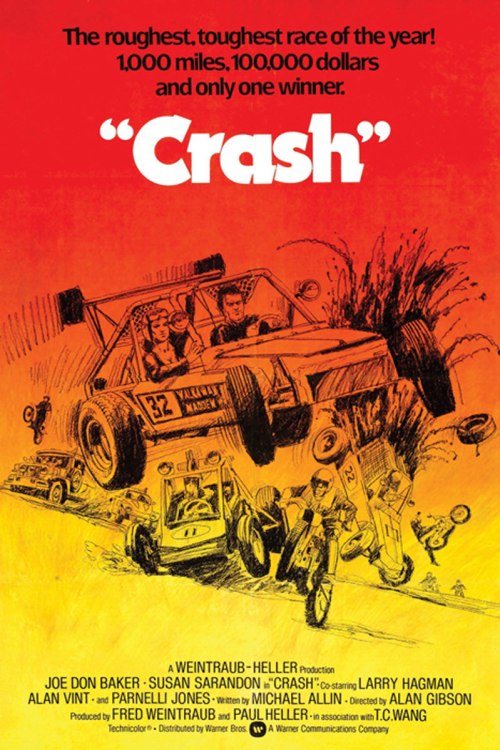
Walkaway Madden (Joe Don Baker) is a lifelong racer who has just broken up with his racing partner of many years and is now going solo, or at least he thinks he is until reporter C.C. Wainwright (Susan Sarandon) arrives and tells him that the company who sponsors his car has hired her to cover the race for their newspaper and thus she’ll be riding along with him. Walkaway isn’t too happy about this as he has very old-fashioned, sexist ideas about a ‘woman’s place’, but begrudgingly accepts it as he has no other choice. Together the two take part in a grueling off-road race that is organized by Bo Cochran (Larry Hagman) and takes them through some of the most treacherous terrain of the Philippines.

The movie might’ve been more exciting had the racing footage been better captured. Instead we get treated to choppy shots of random car wipeouts and flashing, poorly focused images of vehicles buzzing through various locales while shown in a grainy film stock. The editing is so quick that it’s hard to follow what is going on and the only time it is ever impressive is when the camera gets tied to the front of the vehicle and we see firsthand just how bumpy and fast a ride like that must be, but this shot unfortunately is only brief.

There is little or no backstory to any of the racers and therefore no emotionally compelling reason to cheer for any of them. There is also too many of them and all are generic, transparent characters, so when you see someone wipeout it’s hard to remember which one it is, or even care. I did kind of like Daina House as a woman with beautiful model-like features who dresses in all black and just as tough as any of the guys, but her character isn’t shown or played-up enough.

The best thing about the film is the presence of Sarandon who lends a necessary grounded anchor to the silliness that surrounds her. Hagman is terrific as the hyper race promoter and every scene he is in is far more entertaining than any of the racing footage. Baker isn’t bad either. He certainly isn’t any A-list actor, but a very competent B one, who seems at ease in both comedy and action parts.

The film shifts clumsily between being silly and gritty and would’ve done better had it stuck to a more consistent tone. It’s also cheap and amateurish with a terrible, country tinged title tune that gets played throughout. The only reason it gets 2 points is simply for the performances of its three leads.

checkered flag 1

My Rating: 2 out of 10

Released: June 3, 1977

Runtime: 1Hour 31Minutes

Rated PG

Director: Alan Gibson

Studio: Universal

Available: None at this time.

Quest for Fire (1981)

quest for fire

By Richard Winters

My Rating: 6 out of 10

4-Word Review: Cavemen search of fire.

After their tribe is attacked by another one and their only source of fire put out three male members from the group (Everett McGill, Ron Pearlman, Nicholas Kadi) set out to find fire from somewhere else and bring it back to the others.  Their quest is not easy as they are forced to travel through harsh terrain, escape from man eating tigers, and fight off a tribe of cannibals. They also meet up with Ika (Rae Dawn Chong) who comes from a more advanced tribe where the members live in huts instead of caves and who also harbors the secret to starting a fire, which she just might share with the others.

Filmed on-location in Canada, Scotland, and Kenya this film brings to life the true nature of prehistoric times in vivid detail and better than any other movie that has dealt with the same subject. The male actors were fitted with masks that gave them ape-like features and except for one brief moment there is no discernable line of dialogue and communication is spoken through grunts and groans as well as words not connected to modern day language. Some DVD issues do have subtitles, but to me this is taking the viewer out of the experience as the whole idea is to allow one a true sense of how things where like back then and therefore forcing one to try to understand things through the primitives means of communication during that period is the only way to do it and I’m thankful that the theatrical version and the streaming version that I saw did not offer them.

While I applaud the filmmaker’s commitment to keeping things close to the true form as possible and not willing to compromise it simply to make it more accessible to a mainstream audience I still found it to be confusing at spots and even at times boring. The opening battle between the two tribes seemed almost unintentionally funny and the loud, booming music played over most of the movie is a bit off-putting as there was clearly no music at the time of the setting, so silence or natural sounds would’ve kept it truer to the authentic tone.

There is also a scene where the men come upon the remains of some meat left from another tribe. The men are hungry and begin eating the remains only to realize that what they are chewing on is human flesh, which sickens them and they spit it out, but I wasn’t so sure that genuine Neanderthals such as the ones portrayed here would be so ‘civilized’ and instead more concerned with simply satisfying their hunger needs.

Rae Dawn Chong’s presence is a major plus and the movie gets more interesting when her character appears. She remains fully nude at all times while covered in body paint, but isn’t as erotic as you might think. The scene where she gets raped by the men late at night is brutal, but authentic to the animalistic level that I would assume sex would be approached with during that time period. The way her character ends up bonding and even forming a romantic attachment to the one of them as the film progresses is genuinely touching.

The film has a lot of lulls and may be just too unique for some. I found myself intrigued at certain parts and bored at others, but the scene where the men watch in amazement when Chong creates a fire for the first time is a surprisingly exhilarating moment where the viewer feels the same emotion that people back then must’ve felt, which to be able to convey such a feeling to a modern audience is an achievement in itself and a sign of astute filmmaking at its finest.

My Rating: 6 out of 10

Released: December 16, 1981

Runtime: 1Hour 40Minutes

Rated R

Director: Jean-Jacques Annaud

Studio: 20th Century Fox

Available: DVD, Blu-ray, Amazon Instant Video, YouTube

O Lucky Man! (1973)

o lucky man

By Richard Winters

My Rating: 9 out of 10

4-Word Review: A young man’s journey.

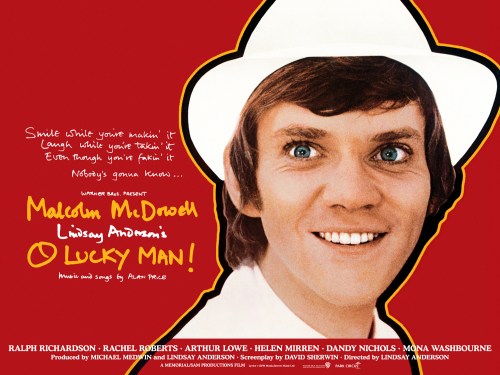
Mick (Malcolm McDowell) is a wide-eyed young man entering into the adult world and full of Horatio Alger-like illusions of working real hard and becoming insanely rich while doing it. His first job is as a coffee salesman where he is told that ‘the-sky’s-the-limit’ in regards to his earning potential, so with the carrot-on-the-string firmly in place he dives into it, but ultimately finds little to show for it. He then meets up with a rich tycoon ( Ralph Richardson) and essentially becomes the man’s lapdog assistant only to learn that this doesn’t work either. After spending time in jail he comes back out into the world as a ‘reformed’ man extoling on the idealistic virtues of humbleness only to again meet with aversion and failure.

The film, which is based on an original idea by McDowell, is essentially a broad look at society’s many socio-economic class levels and how easy it is to fall down it, but hard to move up. Some consider Glengarry Glen Ross to be the bleakest indictment on the sales profession, but having worked in the business when I was like the character here first getting out into the working world I can say that this one is even more searing and accurate.

On a wider scope the film successfully works as a critical statement on capitalism, which due to the purveying political climate of the day most American audiences are just now ready to catch up to. Mick’s journey is more his eventual disillusionment as he slowly realizes that being a ‘go-getter’ and having a ‘good attitude’ isn’t going to be enough as the system is rigged so that the individual is more likely to lose than win and can’t really function otherwise. His efforts then become exploited while helping to make someone else richer as he tolls in the bottom rung doing lateral moves into areas that have potential promise, but only produce the same results.

Although the character’s perpetual delusions of grandeur become a bit annoying McDowell plays the part well. The intent was for him to play against type from the one that he did just previously in A Clockwork Orange by portraying someone who is clean-cut, respectful and obedient, but with all the transitions that the character goes through and at one point even having him strapped to a chair in much the same way that he was in the Kubrick film it eventually comes off more like a continuation of that part than a completely different one.

The fun of watching the film is seeing the supporting cast playing dual roles. Arthur Lowe is great especially in the part where he gets put into heavy black make-up to play the leader of a fictitious foreign nation. Rachel Roberts is good too with the erotic scene where she transfers coffee from her mouth into McDowell’s and then later as a poor woman who commits suicide, which has a foreboding quality to it since Roberts ended up doing the same thing five years later in real-life.

Fans of Helen Mirren will enjoy seeing her when she was much younger and playing the part of a rebellious daughter. I also liked the way Alan Price and his band fits into the film. They do the movie’s soundtrack, which is quite good, but instead of having their music played over the action the movie cuts away and captures them doing their renditions inside a sound studio, which in any other case would be considered distracting, but here helps accentuate the film’s  already cerebral tone. It’s also amusing how the band ends up becoming a part of the story as the McDowell character almost gets hit by their van, which allows the opportunity for Price to say the film’s best line “Are we suing you, or are you suing us?”

The film is full of many surreal and original moments and is so consistently inventive that you hardly notice its three hour runtime. However, to me the best part about it is the way it attacks and criticizes the status quo, which is something that no Hollywood movie ever does.

My Rating: 9 out of 10

Released: March 26, 1973

Runtime: 2Hours 58Minutes

Rated R

Director: Lindsay Anderson

Studio: Warner Brothers

Available: DVD, Amazon Instant Video, YouTube
Steaming (1985)

steaming

By Richard Winters

My Rating: 2 out of 10

4-Word Review: Saving a steam room.

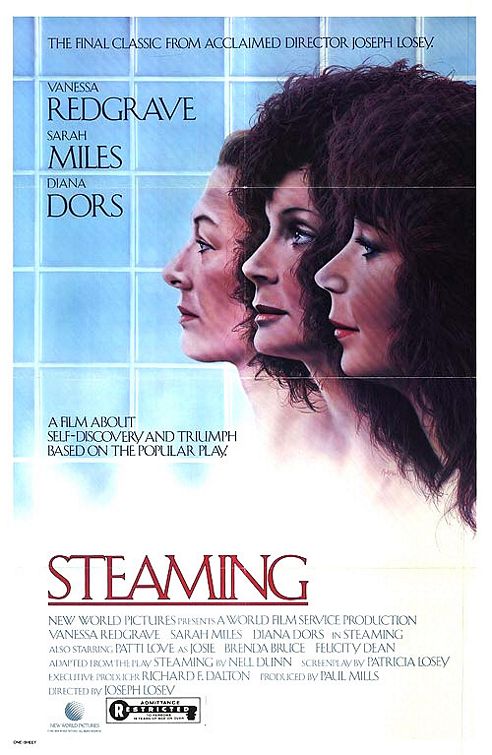
Three women (Vanessa Redgrave, Sarah Miles, Patti Love) congregate at a London steam room designed like a Turkish bathhouse. Despite their lifestyle differences they become good friends as they divulge their problems to one another and learn to lean on each other to help them cope with life’s difficulties. Then one day Violet (Diana Dors), who is the bath house owner, informs them that the place is set for demolition, which causes everyone to go on a mission to try and save it.

The film is based on the Nell Dunn play, which was highly regarded at the time, but makes for a very poor transfer to film. It starts out flat and never recovers. The dialogue has too much of a conversational quality that is not interesting and the problems that they discuss are not compelling, or original. The humor from the play is missing and the dry, somber tone only makes things even more boring. The only time it gains any traction is when it’s announced that the place is closing, but everything gets resolved in such a sitcom-styled way that it hardly seems worth the effort to watch.

The entire cast is made up of women and there is an abundance of nudity particularly from Miles, which doesn’t seem like a big deal these days. The biggest issue though is the fact that everything takes place from inside the bath house, which is gray, grimy, and rundown. The film should’ve had some segments shot from different locales if to only allow for some visual variety and to help the viewer understand the characters better by seeing how they react in different social settings.

Miles and Redgrave are wasted in drab roles and this goes likewise for Dors whose last film role this was. Love is the only one that shows any liveliness and although her character is a bit annoying she at least has an emotional breakdown near the middle, which adds some mild dramatic tension.

Joseph Losey was a competent director who made many interesting films, so it’s a shame that his career had to end with such a dud. He was already sick with cancer while he filmed this and like with Dors died a year before it was released. The disease may have sapped his creative energy and explain why this production is so ponderously sterile. It’s certainly a far cry from his other works as well as the Bruce Jay Friedman play Steambath, which had a similar setting, but a much more imaginative plotline.

My Rating: 2 out of 10

Released: September 28, 1985

Runtime: 1Hour 31Minutes

Rated R

Director: Joseph Losey

Studio: New World Pictures

Available: DVD (Region 2)

One Way Pendulum (1965)

one way pendulum 1

By Richard Winters

My Rating: 4 out of 10

4-Word Review: An absurd little movie.

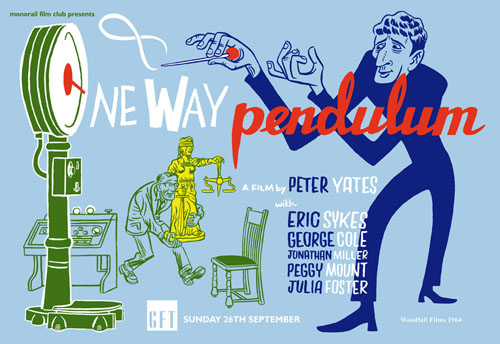
The Groomkirby family is one really absurd bunch. The father (Eric Sykes) wants to build a replica of the Old Baily courtroom in his living room and then have a trial, involving his son Kirby (Jonathan Miller) as the accused, reenacted. His daughter Sylvia (Julia Foster) wishes that she were an ape so that her arms would be longer and discusses this at length with her mother (Alison Leggatt). Kirby steals weight machines, which voices the person’s body weight, off the city streets and brings them back to the family’s attic were he then converts them into machines that sing. There’s also Aunt Mildred (Mona Washbourne) who thinks she’s waiting for a train that never comes as well as Mrs. Gantry (Peggy Mount) who’s paid to come over and eat the family’s unwanted leftovers.

The film is based on the stage play of the same name written by N.F. Simpson and was labeled as being ‘A farce in a new dimension’. John Cleese is purportedly a big fan of the movie and credits it as inspiring many of the absurd ideas that they used in their later Monty Python sketches. It was also directed by Peter Yates who went on to direct such quintessential hits as Bullitt, Breaking Away, and Year of the Comet.

The film certainly does have its share of funny and highly original moments. One of my favorite scenes is where the father carts the props that he needs to build his courtroom down a busy street of London using nothing but a wheel barrow and holding up traffic while he does it. Kirby’s ability to make the weight machines sing and sound like a genuine chorus is fun also as well as the climactic courtroom segment in which a myriad of comically absurd arguments, testimony, motions and reasoning is used until it becomes almost mind bending.

Unfortunately it all gets just a little too weird. Normally I’m a fan of the offbeat, but there still needs to be something to anchor it down and this film lacks it. The dialogue, characters and storyline are so progressively strange that it becomes downright nonsensical. The court case loses its edge as well because the father is somehow able to recreate it and the people in it in some magical way using a machine where kidnapping a magistrate and lawyers and forcing them perform in their makeshift court of law would’ve been funnier.

The movie will certainly satisfy those with inkling for the offbeat and the film seems intent to push the absurdity as far as it possibly can with a cast primed to pull it off, but it ends up being too weird for its own good and parts of it are confusing and hard to get into.

My Rating: 4 out of 10

Released: March 2, 1965

Runtime: 1Hour 20Minutes

Not Rated

Director: Peter Yates

Studio: United Artists

Available: None at this time