Going Ape! (1981)

goingape

By Richard Winters

My Rating: 0 out of 10

4-Word Review: He inherits three orangutans.

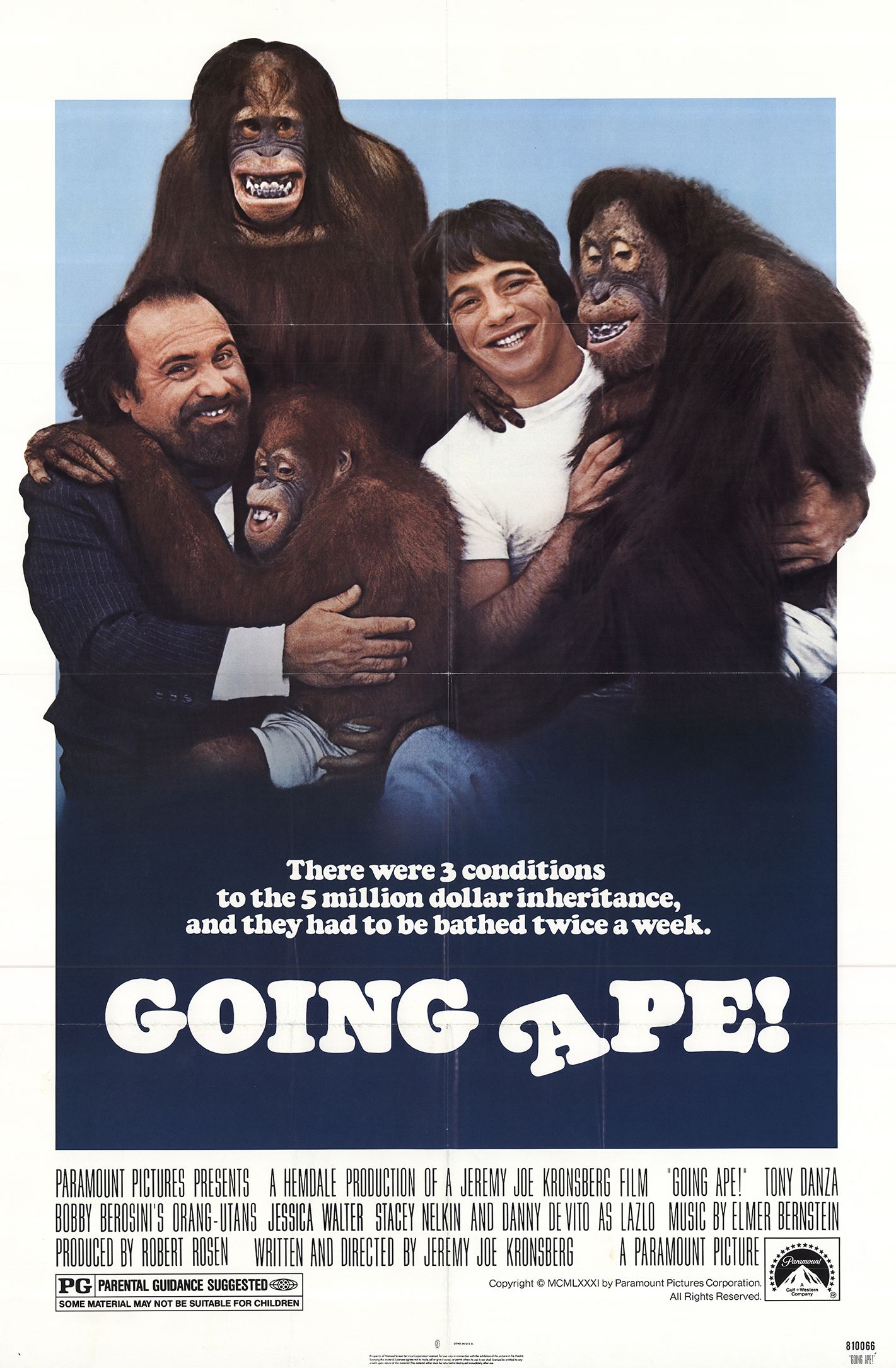
Foster (Tony Danza) is an outcast in his family because when he grew up, he did not get involved in the family’s circus business. Now that his father has died, he’s set to inherit nothing and everything left to his greedy sisters, at least that’s what he presumes. Instead, he’s given custody of three orangutans that were part of his father’s circus business. If he can care for them for 5-years and none of them dies he’s set to inherit the $5 million estate. Foster takes on the challenge, but his live-in girlfriend Cynthia (Stacey Nelkin) doesn’t care for it and moves-out while Foster spends the rest of the time trying to win her back. He also becomes menaced by a couple of mafia-styled hitmen (Art Metrano, Frank Sivero) who want to kidnap the apes and do harm to them because if just one of them dies then the entire fortune would go to the zoo.

In 1977 Jeremy Joe Kronsberg was a struggling writer who had only one writing credit to his name, penning an episode to the short-lived series ‘Code R’. He sent out a script called Every Which Way But Loose, that all the studios rejected it as they considered the storyline and comedy be inane and silly. However, by chance Clint Eastwood came upon it and to the surprise of many decided to take it on as his next vehicle. He had been looking to do a comedy in order to broaden his appeal and thought this script would achieve that despite the advice from his agent and production staff who all insisted it would be a bad idea. The movie managed to make a ton at the box office, which convinced Hollywood studio heads and producers alike that maybe this Kronsberg guy, which they had all considered to be a hack writer, ‘had something’ that they just didn’t see and therefore his next script, no matter how bad it may seem, was going to be automatically green-lit and what’s more he’d even be given the offer to direct it.

It was like the Hollywood dream. The little guy that everybody thought had no talent was suddenly the overnight success story, but like with a lot of Hollywood dreams, it didn’t end so well. This movie became both a critical and box office bomb and lead any potential future offers that Kronsberg may have had thrown off the table. Though he’s still alive today, at the ripe old age of 87, he never got another script or teleplay sold and his entire Hollywood ‘career’ ended up being nothing more than a 3-year flash.

The film starts out alright. I actually chuckled at the Danza character cutting-off splinters from his wood desk and trying to sell it as pieces of Babe Ruth’s bat, but the quirkiness of the beginning gets overtaken by the orangutans, which I found ugly and obnoxious. Their rotted teeth alone are disgusting to look at and every time they open their mouths it’s more unsettling than peering into a hillbilly’s. They were trained  by then world famous Bobby Berosini, a Czech born immigrant who became a famous orangutan trainer that began to do stage shows with them in Las Vega during the 70’s, but then in 1988 a Vegas dancer secretly recorded him abusing the apes, including slapping and punching them, before going onstage and when it was sent to PETA it became available to the public and his career and image took a massive downfall.

The stupid villains, which are nothing more than a hammy, cliched send-up from the Godfather movies, are pathetic and the point where the movie really goes downhill. Their pratfalls are dumber than something you’d see in a kiddie flick and devolve the film into the inanest level possible. It’s also chillingly prophetic as Metrano, who plays the head-honcho, is seen twice falling from a lofty height including once out of high-rise window, which had a creepy similarity to his real-life accident in 1989 when he fell from a ladder and became paralyzed.

Danza is likable enough, but I found his character to be ridiculous with the way he put up with the apes even as they tore-up his apartment and kind of felt he should’ve given-up on them just like his girlfriend did and came to the conclusion the money wasn’t worth the hassle and just pawned them off on somebody else, or even given them away to the zoo who seemed so desperate for the fortune. Despite winning the Razzie award for his performance I really felt it was DeVito, who speaks in an accent, that was the scene-stealer and had he been made the star it might’ve worked better.

Nelkin is cute, so she gets a few points there, and Walter has great potential as her snobby mother, but unfortunately her services here get greatly misused as she soon sides with Danza and his cause instead of working against him and becoming the chief villainess of which she would’ve been great.

There are some reviewers on IMDb who proudly insist that this is ‘the greatest movie ever made’, but I feel they are either desperate for attention and will say any outrageous thing to get it, or haven’t seen any of the timeless classics, so that they really don’t know what they’re talking about. In either case this is a bad movie that will harbor very little enjoyment to anyone who sees it whether they’re young or old. Yes, there’s a big smash-up car chase at the end, but this is just thrown-in to camouflage the lack of originality in the story.

My Rating: 0 out of 10

Released: April 10, 1981

Runtime: 1 Hour 27 Minutes

Rated PG

Director: Jeremy Joe Kronsberg

Studio: Paramount

Available: Blu-ray, Amazon Video, YouTube

One From the Heart (1982)

oneheart

By Richard Winters

My Rating: 2 out of 10

4-Word Review: Break-up/make-up

Hank (Frederic Forrest) and Frannie (Teri Garr) have been together for 5-years but while celebrating their anniversary at home the cracks in their relationship begin to show. Frannie is upset that they can never go out and wants more adventure. Hank doesn’t see this as a problem, so the two break up. Frannie meets Ray (Raul Julia) a waiter who has ambitions to become a singer. Hank gets together with Leila (Nastassja Kinski) who is much younger than him and lives the fast lifestyle. Each spends a night with their new partner, but end-up longing for their former mates when it’s over. Ray offers to take Frannie to Bora Bora, but will she really board the plane, or will Hank catch-up with her in time and convince her to move back with him?

The movie has a weird look about it and this is mainly because director Francis Ford Coppola decided he wanted to film the entire thing on the soundstage of his Zoetrope studios. This in retrospect seemed absurd as the setting was Las Vegas with one of the most flamboyant downtowns of any city, so if the real thing is already visually arresting why trump it with a fake one that isn’t half as exciting? The artificial presence kills the movie from the very start and what’s worse is that it was so painstakingly expensive to create the set design, which is massive, that it sent Coppola and his studio into bankruptcy of which it took many years to recover and all of it wouldn’t have been necessary if they had just shot it on-location, which would’ve been a thousand times better.

The lighting is one of the more annoying aspects particularly the red light that shines through the couple’s home window making it look like they live in the red-light district of Denmark, or near a police station. The outdoor scenes look as phony as you’d expect including having the night sky shown to have a ‘ceiling’ and the distant mountain vistas appearing as nothing more than a cheap matted on paintings. Everything comes-off as loopy like a great director whose ego got the best of him, and he made a massive artistic overreach for no other purpose then just to see if he could. The music interludes by Crystal Gayle and Tom Waits don’t work either. If a movie is intended to be a musical, as this one kind of is, then each song needs to sound distinct and at least moderately peppy, but here it comes-off like the same droning song that just never ends and adds little to the already goofy set-up.

The characters are poorly fleshed-out and, with the modest exception of Harry Dean Stanton and Elia Kazan, wholly uninteresting. The break-up is the biggest problem as the ‘squabble’ appears to be over nothing more than the fact that Hank didn’t take Frannie out on their anniversary, but to move-out because of something like that seems awfully trite. Normally for relationships/marriages to go really bad there needs to be a lot of anger simmering underneath the surface and this thing at best is just a tiff especially when at the beginning they seemed content with other. To make it realistic there should’ve been clear underlining animosity right away and not go from ‘happy couple’ to break-up with a snap-of-the-finger.

Not sure either if it’s exactly possible to get back together after the other partner has slept with someone else. Granted there could be some exceptions, but most people would consider it an extreme betrayal and unforgivable and certainly not something that they could just conveniently forget about and return back to the ‘happy couple’ that they were. Yes, in this instance they both cheated, but that makes things even worse. Who’s to say you can ever trust the other again? If one tiny disagreement can get each one to suddenly jump in the arms of a perfect stranger what’s to say that won’t get repeated in the future?

Garr, who appears topless in several scenes and even fully naked from the back in one moment, is okay. The supporting cast is also good especially Allen Garfield as Julia’s perturbed boss. I even found Kinski a bit mesmerizing with her singing and the way she was able to balance herself on a big orange ball that used to be the sign for the Spirit of 76 gas stations, but overall the thing is so thinly plotted, with too much emphasis being put on the garish set design, that it can all be summed up as a hopeless experiment gone wrong. Even Coppola has admitted in subsequent interviews that it’s a ‘total mess’, so if the director is warning you that his own movie doesn’t have much going for it, you’d better listen.

My Rating: 2 out of 10

Released: February 11, 1982

Runtime: 1 Hour 39 Minutes

Rated R

Director: Francis Ford Coppola

Studio: Columbia Pictures

Available: DVD, Blu-ray, Amazon Video, YouTube
Animal Behavior (1989)

animal

By Richard Winters

My Rating: 4 out of 10

4-Word Review: Cellist falls for biologist.

Alex (Karen Allen) is a biologist employed at a university where she is researching on finding new ways to communicate with chimpanzees including the use of sign language but finding it challenging in getting any funding. Mark (Armand Assante) works at the same school as an orchestra instructor. He meets Alex by chance and while their first encounter is awkward, he immediately takes an interest in her and tries to pursue a relationship. Alex is so involved in her work that she doesn’t pick-up on Mark’s advances initially and then when she does, she comes under the mistaken impression that he’s married which causes her to avoid him and making Mark believe that she doesn’t like him when deep down she really does.

The film, which has never been released on either DVD or streaming and can only be obtained from a very rare VHS print, is more known for its behind-the-scenes troubles than anything that goes on in front of the camera. The main issue was the squabbling, or ‘creative differences’ between director Jenny Brown and the producer Kjehl Rasmussen causing her to leave the project, which began filming in 1984. The production then ran out of money forcing it to be shelved for many years in an unfinished state before Rasmussen was able to receive enough funding to complete it with him as the director. However, out of its initial $3.5 million budget it was only able, after its limited release, to recoup a paltry $41, 526 at the box office making it a huge financial loss. It also came-out 4 years after one of its stars, Alexa Kenin who plays a not very talented cello student, died mysteriously at the young age of 23 for causes that are still unknown to this day.

Despite all of its production problems I came away finding it not too bad and enjoyed the orchestral score and the giant animated musical notes that appear during the opening credits as well as the vast New Mexico landscape. Assante is an interesting casting choice as he plays the romantic lead not in a lovesick way but approaches it instead in more as a matter-of-fact type, which you’d expect a person working in Academia might do. I did though find his ability to handle chimps as relaxed and comfortable was a bit of a missed opportunity as having him afraid of them, which is what I think most people would be like, would’ve given their young relationship more of a challenge to work through and thus more intrigue to the story.

His inability to every criticize Sheila, played by Kenin, who is a very poor cello player, made him in-turn come-off as a failure of a teacher. Granted the film wanted the viewer to like the Assante character and if his criticism of her playing was too harsh it might make them turn-on him, but the guy is her teacher and not her friend. A friend is someone that doesn’t want to hurt the other person’s feelings, but a teacher is paid to get to the source of the problem. If he is just going to allow this student to leave in a delusion that she’s a competent then when is she ever going to get better, or be motivated to improve? A good teacher is obligated to call a student’s attention to their shortcomings and by avoiding doing this he comes-off as weak and ineffective.

While Allen’s performance is also good, I had some problems with why Assante would want to get into a relationship with her. It’s clear from the get-go that she’s so into her chimps that she’s out of touch with everything else around her. Why pursue someone romantically who’s always going to put her monkeys first and make him have to constantly compete with them for her attention?

A far better love interest would’ve been Coral that gets played by Holly Hunter who is an absolute scene-stealer and gives the movie some much needed spunk. This was before she won the Academy Award, so her role is limited, but she still makes the most of it playing a single mother with an autistic child, played by Crystal Buda. She is a neighbor to Assante and the two get into a quasi-style relationship though they don’t have any sex, but I didn’t know why she didn’t want to pursue further past the friendship level as they seemed quite compatible and it would’ve allowed in more drama forcing both her and Allen to compete for the same man, which could’ve lead to some juicy confrontations.

Josh Mostel, as Assante’s friend, is fun, not so much for anything he says, but more for his big white-guy afro. The climactic sequence, which takes place in a large scale maze made out of hay bails is diverting simply because it’s never been used before, or since. However, the characterizations of the University faculty, who are portrayed as being stiff, uptight, while also a bit ‘wacky’ is too broad to be either amusing or insightful.

My Rating: 4 out of 10

Released: October 27, 1989

Runtime: 1 Hour 28 Minutes

Rated PG

Director: Jenny Brown

Studio: CineStar Productions

Available: VHS, DVD-R (dvdlady.com)

Interiors (1978)

interiors

By Richard Winters

My Rating: 8 out of 10

4-Word Review: Artistic family harbors turmoil.

Eve (Geraldine Page) is an interior decorator whose emotions she keeps bottled-up and who also has a controlling and temperamental nature to not only her husband Arthur (E.G. Marshall), but also her three grown daughters: Renata (Diana Keaton), Flyn (Kristin Griffin), and Joey (Mary Beth Hurt). One morning, while at the breakfast table, Arthur announces to not only Eve, but also the two other daughters present, that he wants a separation though he insists it’s not ‘irrevocable’. Eve becomes upset and refuses to face it. While the two do separate she continues to cling to the delusion that they’ll ultimately reunite. When it finally becomes painfully clear that is not going to happen she then attempts suicide. While she’s in the hospital recovering Arthur goes out and meets Pearl (Maureen Stapleton) whom he quickly falls in love with. When he brings her home to meet the family they’re shocked at how he intends to marry her while his former wife is still in the hospital. This then brings out the hidden hostilities that the daughter’s feel towards their parents as well as each other and in Renata’s case the repressed envy that her own husband Frederick (Richard Jordan) feels for her.

This was Woody Allen’s first dramatic film, which was a big deal when it was first released as he’d only done wacky comedies before this and many were curious and apprehensive about him trying something so completely different from his past work. While he’d been trying to get a drama produced for years his investors constantly nixed the idea fearing that because he attracted audiences through his funny stuff that anything with a serious nature would turn-off would-be theatergoers and be a financial flop, but after the monumental success of Annie Hall they finally decidedly to relent and gave Woody the chance to spread his artistic wings.

The result overall is downright impressive. It’s clearly inspired by the films of Ingmar Bergman, his cinematic idol, but in some ways this is even moodier and more poignant than some of his stuff. While his later dramas fell into becoming a cliche of themselves using many of the same elements taken from this one, namely pretentious artistic characters living in New York who suffer from pretentious problems and relationships, here it’s fresh making the issues that they go through seem illuminating versus rehearsed and contrived like in some of his later works.

That’s not to say I didn’t find some problems here. The fact that we have characters, in this case Keaton, talking directly to the screen, apparently in an attempt to show that she’s speaking with a therapist, is a bit of a cop-put as she’s able to convey her deep seated thoughts and feelings verbally without forcing the director to have to show it through her actions and conversations, which may be more difficult to do, but also more rewarding for the viewer. Arthur’s decision to tell Eve that he wanted to leave while sitting a the meal table with the two daughters present seemed rehearsed. Normally when a couple decides to split they do it privately and have it out through a discussion or argument versus a canned speech that Arthur does, which comes-off like he’s orating in front of a group of people.

Woody’s attempts though to show the struggles and challenges people have who pursue creative endeavors I felt were quite well done. In his later dramas I found it annoying how many characters worked as artists because it reality only a very small portion of the populace can make a living that way, but here I was able to forgive it. I liked how we see close-up the challenges of this by the way Renata writes a poem on paper but is constantly scratching out words that she puts down showing the many drafts an author must go through before it eventually might come-out perfectly. The fact that it’s later revealed that her father helps fund her poetic passions made sense too as a poet able to live-off of their writings is about as rare as it gets.

Richard Jordan’s character is the one I found the most fascinating and I was genuinely surprised that while other cast members were nominated for the Oscar he wasn’t even though to me he’s superb.  The way his character broods incessantly about not getting the critical accolades that he expects and how it turns him into a mopping, alcohol drinking mess who snips at his wife’s perceived shortcomings in an immaturely emotional attempt to bring her down to his level was completely on-target composite of the insecure artist. The scene where he tries to rape Flyn, so he can have the pleasure to ‘fuck someone who’s inferior to me’ fit the personality of someone who harbors frustration that they’re able to mask with a veil of civility most of the time but will allow it to come-out when alone in the presence of someone more vulnerable.

The real star though is the cinematography by Gordon Wills, who ironically went on to make his directorial debut in a movie called Windowswhich was the original title for this one. The gray, cold color schemes and shots showing an ice-covered tree branch effectively reflects the icy emotions of the family and the lack of music with long pauses of silence and empty rooms help symbolize how alienated each member is from the other. The most pronounced moment involving the crashing waves of the ocean and the almost dream-like ‘conversation’ that Joey has with her mother is by far the film’s most memorable element and something that will stay with you long after it’s over.

My Rating: 8 out of 10

Released: August 2, 1978

Runtime: 1 Hour 32 Minutes

Rated R

Director: Woody Allen

Studio: United Artists

Available: DVD, Blu-ray, Freevee, Pluto, Amazon Video, YouTube

Uphill All the Way (1986)

uphill

By Richard Winters

My Rating: 2 out of 10

4-Word Review: Bumbling cowboy con-men.

Ben (Roy Clark) and Booger (Mel Tillis) are two con-men living in the old west, who don’t have a dime between them. After getting kicked-off a train for not having tickets they then venture to a saloon in order to win some money at poker, but even though they attempt to cheat, they still end up losing. In desperation they try to trade in their rifle for a loan, but the bank teller (Richard Paul) mistakenly thinks they’re trying to hold him up and sounds the alarm. The two then go on the run while being chased by a posse of sorts that includes the sheriff (Burl Ives) two prostitutes (Elaine Joyce, Jacque Lynn Colton) and the town drunk (Frank Gorshin).

The film is a misguided effort to replicate the campy, rural humor of the TV-show ‘Hee-Haw’, which Roy Clark hosted for almost 17years and which Mel Tillis made several guest appearances, and try to turn it into something resembling a movie. While the show never met any critical acclaim it still managed to succeed because all the humor, much of it being ribald and corny, was set-up into brief segments that only lasted for a few minutes if even that long and relied almost exclusively on one-liners. As soon as the punchline was uttered it would quickly move to another segment much like the variety show ‘Laugh-In’ was styled. However, trying to expand that format and silly comedy into a feature length film is virtually unworkable. Instead of a plot we get a collection of goofy situations coupled with goofy characters saying and doing cartoonish things that gets strung along with a mind numbing 90-minutes before it finally, mercifully manages to end much like putting a sick horse out of its misery.

Had the chemistry between the two stars been better it might’ve had some chance, but Tilis and Clark, both better known as country singers of which they’re very good at, don’t have what it takes to carry a movie. I was thankful at least that Tillis didn’t rely on his old stuttering routine for cheap laughs and here for the most part he articulates quite well, but he fails to have much to say that is amusing. Clark with his tubby physique coupled with his high-pitched voice seems all wrong for different reasons and his attempts at being exacerbated comes-off as affected. The banter between the two is stale and with both being in their 50’s they lack the fresh boyish charm that they might’ve otherwise been able to exude had they done this when they were in their 20’s.

The supporting cast falls equally flat. Burl Ives looks old and tired here and like he’s just phoning-it-in. Gorshin, a great and versatile talent if given the right material, is completely wasted as a drunk who does and says very little. Trish Van Devere, who during the early 70’s was considered a leading lady, reveals how sadly her career had fallen, she officially retired after doing just one more movie after this one and I think it was because she was no longer getting any quality offers, doesn’t appear until 55-minutes in and almost becomes like a background character with not much to do. Burt Reynolds does appear briefly near the beginning, he apparently accepted no fee for his work here, but is quite amusing and had he been in more scenes might’ve saved it. Elaine Joyce stands-out too as she usually played bubble-headed blondes, but here is a bitchy, angry type and does surprisingly well with it though if she’s going to be the best thing about a movie then you know it must be in real trouble.

The story is disjointed too as it starts out as a playful chase comedy then strangely diverts into an extended shoot-out where the two become hold-up in a home with another family trying to fend-off a group of bad guys that are separate from the ones chasing after them making it seem like two different, poorly realized plots meshed into one. I will give it some credit for being a movie with a Texas setting that was actually filmed in Texas unlike some other movies that say the setting is Texas when it really isn’t. You can tell that it is the Lone Star state because of the prickly pear cactus that is seen all about, which is different from the upright variety that’s seen in the deserts of Arizona and California. Though on the negative end it was shot in the month of October when the searing heat of the region was over and any good Texas movie should have the heat play a factor since that’s very much a strong characteristic of the state.

My Rating: 2 out of 10

Released: January 21, 1986

Runtime: 1 Hour 26 Minutes

Rated PG

Director: Frank Q. Dobbs

Studio: New World Pictures

Available: DVD, Blu-ray, Amazon Video, YouTube
Martin (1977)

martin2

By Richard Winters

My Rating: 7 out of 10

4-Word Review: Teenager craves women’s blood.

Martin (John Amplas) is a teenager, who has dreams of living long ago as a vampire, who travels to live with Tateh (Lincoln Maazel) in the outskirts of Pittsburgh. Tateh is an elderly man that is highly superstitious and immediately suspects Martin of being a vampire and puts up certain ‘repellents’ like a crucifix and garlic as a defense against him though these prove to have no effect. Martin gets a job as a grocery delivery boy where he meets Abbie (Elayne Nadeau) a lonely housewife who makes attempts to seduce him. Martin has some attraction towards her, but still craves blood and uses some syringes that he has to attack female victims by injecting them with a serum that will put them to sleep and allow him to cut their arms and drink their blood. He though internally struggles with his actions and feelings and thus calls a radio station to discuss his quandary with the DJ, which goes out over the air and he soon becomes a local celebrity known at ‘The Count’.

By the time this was ready to be made writer/director George A. Romero was deep in debt and struggling to maintain a living as a filmmaker and considering get out of the business altogether. While he had achieved great success with Night of the Living Dead he’s subsequent films failed to generate any profit and where critically panned. Many of the investors of those projects refused to give him any money to make this one fearing it would be a financial dud forcing him to scrape together a meager $100,000 on his own in order to get it produced while leaning on friends and family members, including Romero himself who plays a priest, to fill-in as cast members. However, for the most part the low budget works in the film’s favor. I liked the grainy, faded color that helped accentuate Martin’s fringe, lonely existence and the on-location shooting done in the town of Braddock, Pennsylvania gives it an earthy, rustic appeal.

The best part though is that it works against the vampire stereotypes and gives the age-old folklore a fresh new perspective. The fact that the expected vampire repellents don’t work on him kept it fun by not devolving into the tired cliches. The mystery too as to whether Martin really was a vampire, or just thought he was and no real explanation as to his ‘memories’, which get shot in black-and-white, as being just that, or instead simply fantasies, kept it intriguing. It also forces the viewer to see things from a different point-of-view as in this case it’s not the kid who thinks he’s vampire that’s the real threat, but more the ‘normal’ people around him. This leads to the movie’s best and most memorable moment where he quietly sneaks into the home of a potential female victim that he thinks is alone only to find to his shock that she’s having a secret affair with another man and the chaos that ensues, where both sides misreading the other, is both humorous and exciting while putting a new spin on how we perceive horror.

The only drawbacks are with Martin’s belief that he’s ‘careful’ during his attacks, so that he’ll ‘never get caught’, which is a bit flawed. For one thing he doesn’t wear a mask, so a witness could easily identify him later and there’s no explanation about the injecting sleep potion and how being a kid with little money he’s able to obtain it, or if it’s something he cooked-up himself and if so what did he use to make-it? It is though fun to watch the effects of it as it doesn’t work immediately and his victims will struggle with him quite a bit before they finally go under, which is another element that puts this above most other horror films as the perpetrator is usually always shown as being confident and fully in-control when attacking those he preys on while here it’s the opposite and many times comes close to the victim getting close to overpowering him, which actually heightens the tension.

Having Abie, a middle-aged woman, essentially come-on to Martin right away and even answers her door half-dressed seemed inauthentic. Maybe it’s a product of a bygone era where teens were still considered overall innocent and only the adults with dirty ulterior motives, but she seemed way too unguarded while believing that because he was shy that made him ‘harmless’. While children that are quiet that can sometimes be considered the case, but with teens who don’t say much and being loners can be perceived as anti-social and thus single women would be more defensive around someone like that instead of less.

I also didn’t care for actor Jon Amplas’ teeth as the front tooth appeared capped with a bright white crown while the ones around it where yellowish though I suppose this worked with the character as he was too poor to afford a decent dentist and some could also read into it that the white crown represented possibly a ‘fang’ of some sort. Overall though it’s quite good and helped resurrect Romero’s career. The surprise ending alone makes it worth it. Definitely one vampire movie that deserves more attention and should be listed as one of the best of its genre.

My Rating: 7 out of 10

Released: October 27, 1977

Runtime: 1 Hour 35 Minutes

Rated R

Director: George A. Romero

Studio: Libra Films

Available: DVD, Blu-ray, Tubi

The Nest (1988)

nest

By Richard Winters

My Rating: 3 out of 10

4-Word Review: Cockroaches invade small town.

Richard (Franc Luz) is the sheriff of a small New England town, who wakes-up one morning to find cockroaches all over his home. He goes to the airport to pick-up Elizabeth (Lisa Langlios) a former girlfriend who’s also the daughter of Elias (Robert Lansing) the town’s mayor. During her visit they become aware of several dog deaths where the animal’s entire bodies are rapidly eaten raw by some sort of insect that leaves only the bloody carcass of their prey behind. Elias calls-in Dr Morgan (Terri Treas) who specializes in insect research. She soon determines that these are not the normal kind of cockroaches, but instead an engineered species created inside a lab for the purpose of eating off the other insects on the island that the town is on and then promptly dying-off after one generation. Unfortunately, the mutated species found a way to survive and continues to reproduce while being immune to the regular forms of pest control causing the mayor to consider making the difficult decision of having the entire town’s populace vacate the island before the roaches completely take it over.

The film was directed by Terence H. Winkless who up until this time was best known for having done the short film Foster’s Release in 1971 about a stalker who terrorizes a babysitter that later inspired The Sitter, Halloweenand When a Stranger CallsThis film though, his first feature length release, lacks the tension and atmosphere of those. The biggest detriment is the setting as it’s too bright and sunny and horror films work much better when things are dark and gloomy, which creates an eerie feeling that this thing doesn’t have. While it’s supposed to take place in New England it’s very clear that it’s instead California, which is so obvious that it’s almost embarrassing to pretend it’s anything else. If the producers didn’t have the money to shoot it on-location, then they should’ve changed the story’s location to California and chucked the pathetic charade.

The type of insect that gets used isn’t all that scary. I’ve lived in Texas for 10 years now and have seen first-hand cockroaches that seem to invade everyone’s homes down here. These roaches are far bigger than what you see in the film, and they move very quick and even have a creepy way that they crawl. Had those types of roaches been used in the movie it might’ve actually been scary, but compromising on the smaller version (apparently because they were more plentiful and easier to trap) does it in. We also don’t get to see all that much of them, there’s a fleeting shot here and there, but mostly it relies on a loud hissing sound that they make, which becomes too constant and eventually quite annoying.

The script makes the mistake of revealing its cards too soon. Had it remained more of a mystery of what was killing the pets it might’ve allowed for more intrigue, but by the second act it’s made clear what’s causing it. Thus, the rest of the movie becomes redundant as we’re shown, over-and-over, the bugs and the noise they make until it gets quite boring and seems to be going nowhere. Seeing the bugs actually bite into the animal’s flesh, which would be difficult to do, but still possible with micro photography, might’ve helped add a memorable image, but just seeing a quick glimpse of a bloody carcass isn’t as impressive. The bugs are also somehow able to devour the flesh of an animal in literally seconds, which even with a genetically engineered breed seems wildly exaggerated.

The script was in desperate need of some sort of a subplot. Possibly having a violent confrontation between the sheriff and mayor, which it kind of teases, but never actually happens, or even having the mayor hold the sheriff hostage and thus preventing him from warning others and then him try to find a way to escape in time could’ve helped make things a lot more intriguing. Also, not giving away that Dr. Morgan was a nut until the very end could’ve allowed for a surprise reveal/twist of which there is none.

Spoiler Alert!

The roaches being able to mutate into whatever species they’ve eaten is when the whole thing jumps-the-shark. I suppose some might be impressed with the special effects of seeing the mayor morph into a giant rodent, which the filmmaker’s were clearly banking-on as being the movies’ ‘shock highlight’, but it’s overreaching. Trying to do some hybrid insect/monster movie doesn’t work when the logic isn’t there, which in this case it definitely wasn’t. While I’ve never seen a bug movie that I’ve totally liked there’s still plenty out there that are better than this one.

My Rating: 3 out of 10

Released: November 20, 1987

Runtime: 1 Hour 29 Minutes

Rated R

Director: Terence H. Winkless

Studio: Concorde Pictures

Available: DVD, Blu-ray, Plex, Tubi, Amazon Video

Wedding Trough (1975)

wedding

By Richard Winters

My Rating: 1 out of 10

4-Word Review: Man fucks his pig.

Bizarre, controversial film that was first shown at the Perth International Film Festival in Australia where it was immediately met with outrage and walkouts that quickly got it banned from being shown again by the government, a ban of which still stands today. Since then it’s turned-up sporadically a various film festivals throughout the decades, with the last one being in 2008 in Switzerland, but was never released theatrically and was considered an obscurity before finally getting a DVD issue in 2018. The film has no dialogue and shot in black-and-white at an abandoned farm in the outskirts of Belgium. It was directed by Thierry Zeno who had a noted fascination with all things morbid and followed this one up with a documentary on death and decay called Des Morts. This one deals with taboo subjects of zoophilia and coprophagia, which gets shown graphically. Many label this a horror movie for its grim and unrelenting subject matter, and some have even considered it a forerunner to Eraserhead

The plot description, which will contain SPOILERS, though in this case I feel is a good thing, so you know exactly what you’re getting into if you attempt to watch it, deals with a lonely farmer, played by Dominique Garny, who also co-wrote the screenplay, who begins to have amorous feelings towards his pet pig. One day he gets naked and has sex with it. Later on, the pig gives birth to three piglets. The man tries to bond with his brood by sleeping with them inside a giant basket, but the piglets prefer the comfort of their mother over him. Feeling that he’s now been ‘abandoned by his children’ it sends him into a rage causing him to kill the piglets by hanging them. This causes a great deal of stress for the mother pig who drowns herself in a nearby pond. The farmer now feels guilty about what he’s done, so he ‘punishes himself’ by concocting a drink made of his feces and urine and warms it inside a black pot before then forcing himself to swallow it.

While the sex scenes are simulated, though still graphic enough, the pooping and eating of it isn’t, which many will find gross enough. The hanging of the piglets though is quite unsettling. I’d like to feel that the ones that are hung were stillborn, since they do appear a bit smaller in size from the ones seen running around, but I’m not completely sure. However, the mother pig does become quite stressed in a very real way when she sees the dead piglets and runs around squealing in a high and frantic pitch, which is very disturbing.

Some have for decades sought this movie out as evidenced by the IMDb comments simply their love of shock cinema and this film’s notorious reputation for being at the top of the list. While it is unequivocally gross it’s also boring and disgusting with the abuse of the animals being the worst thing you’ll take from it. Not recommended.

Alternate Titles: Vase de Noces, The Pig Fucking Movie.

Released: April 11, 1975

Runtime: 1 Hour 19 Minutes

Not Rated

Director: Theirry Zeno

Studio: Zeno Films

Available: DVD-R

Don’t Look in the Basement (1973)

dontlook

By Richard Winters

My Rating: 2 out of 10

4-Word Review: Murder inside insane asylum.

Charlotte Beale (Rosie Holotik) gets hired by the director of a rural mental health institute, but when she arrives she finds only one nurse there, Dr. Geraldine Masters (Annabelle Weenick), who reluctantly agrees to take-in Charlotte though warning that the institute’s director was killed earlier by one of the patients, but she is determined to carry-on his work in his absence. The hospital is unusual in that it allows the patients to freely walk around with no perimeters as well as acting-out all of their fantasies versus trying to have them reeled-in back to reality. Charlotte though finds her stay there to be stressful as some of the patients try to attack her and she’s not allowed to leave the premises. She begins to wonder if she’s really there to help treat the insane, or instead slowly turned into becoming like one of them.

The film was shot in the summer of 1972 in the very small town of Tehuacana, Texas, which has a population of only 228 people. While the isolation works to some degree, particularly the exterior shots of the old white building that stands-in as the hospital, the interior action takes place in only 4 of the rooms and a hallway and thus there is no visual variety to the shot selections. You start to see the same shots over and over like a repeating loop that ultimately becomes redundant and boring.

The mentally ill patients are not captured in any type of realistic way as they’re characterized as being simpletons perpetually locked in child-like fantasies. In reality those with mental health issues can still be quite intelligent and simply suffering from dangerous delusions, thoughts, or emotional imbalance versus like here where they’re portrayed as being overgrown children lost in make believe and who never got past age 4. What’s worse is the entire thing gets solely focused on them, their silly antics and inane dialogue, making it seem more like a misguided, unfunny comedy than a horror film.

The staff members, or what little of them there are, are poorly fleshed-out as well. Nurse Charlotte immediately becomes spooked by one of the elderly residents on her first night like she’s had absolutely no training on how to handle mentally ill people. At each and every turn she gets more and more thrown off by them like someone who has no educational background in that field and the part could’ve easily just been some pedestrian thrown in there and you’d never know the difference.

The gore is quite minimal and even pathetic. When the doctor gets axed in the back he immediately falls down to the ground dead. I could understand this happening if the ax got him in the head, but instead it cuts into his shoulder, which shouldn’t have been enough to kill him, at least not instantly, and he instead should’ve been screaming out in pain versus just lying there motionless. The ax killings at the end are equally lame showing only small trickles of blood crawling down the victim’s faces when with a blade that big and that sharp their whole heads, if not entire bodies, should’ve been drowning in red.

Spoiler Alert!

The final 15-minutes are slightly creepy, but it’s not enough to make sitting through the rest of it worth it. The ‘big twist’ in which Nurse Masters is revealed to be a mental patient like the rest of them is no surprise as I had been suspecting it the whole time. There’s also no conclusion to what happens to the main character Charlotte, we see her escape outside into the rain, but not what she does after that. Does she go to the police and report what happens, or does she get committed since it’s intimated earlier that she may be crazy too, or does she just get lost in the wilderness surrounding the place and die? Nothing gets answered on this, but really should’ve.

In 2014 the director’s son, Tony Brownrigg, rebooted the franchise by doing a sequel, which was filmed at the same location as this one with one of the cast members, Camilla Carr, who was the only one still living, returning to play a part, but as a different character from the first one.

My Rating: 2 out of 10

Released: May 16, 1973

Runtime: 1 Hour 29 Minutes

Rated R

Director: S.F. Brownrigg

Studio: Hallmark Releasing Corporation

Available: DVD, Blu-ray (Region B/2), Plex, Pluto, Tubi, Amazon Video, YouTube

Monkey Shines (1988)

monkey

By Richard Winters

My Rating: 2 out of 10

4-Word Review: Chimp terrorizes paralyzed man.

Allan (Jason Beghe) becomes paralyzed after getting hit by a truck one morning while jogging. Since he’s unable to get along with his live-in nurse, Maryanne (Christine Forrest), or his meddling mother (Joyce Van Patten), his friend Geoffrey (John Pankow) suggests he use a monkey specifically trained to help handicapped patients. Initially Allan likes the monkey, whom he names Ella, as he’s able to do a lot of tasks that helps Allan with the situation that he’s in. However, Geoffrey fails to mention that Ella is no ordinary monkey as she’s been injected with human brain serum in an effort to boost her intelligence. He’s hoping that having the chimp interact with a human will prove that his research studies are a success and allow his department to receive some desperately needed funding. Things though start to take a terrifying turn as the monkey falls-in-love with Allan and fights-off anyone she considers a potential rival including Melanie (Kate McNeil), a beautiful young lady who had helped train Ella for this project. Ella also begins carrying-out Allan’s vengeful fantasies and shows an ability to read Allan’s mind and vice-versa.

The film is based on the 1983 novel of the same name written by Michael Stewart. The script follows the story relatively closely with the biggest difference being the setting where in the book it takes place in England and in the movie it’s in Pittsburgh. While the concept is intriguing, I kept watching just waiting to see how it would turn-out, it doesn’t fully work as a horror movie. Having to watch Allan’s difficulty in adjusting to being fully paralyzed, and even his attempted suicide, was horrifying enough and bringing the monkey in, actually alleviated the tension instead of heightening it.

Had the monkey started to rebel on his own without the scientific experiment angle would’ve been more frightening because we wouldn’t know what was causing it. Showing this super sleazy scientist injecting the chimp with a mysterious serum telegraphs to the viewer right away that something terrible is going to happen, so there’s no element of surprise as the viewer is already braced for trouble from the get-go versus having them come-in less guarded. The ability for the monkey to supposedly read Allan’s mind, or for him to visualize things from the chimp’s point-of-view, made no sense. The injections were supposed to make the animal smarter, not acquire ESP, and since Allan doesn’t receive the same injections how then are the emotions and visions between the two transferable?

The whole thing becomes too preposterous to be able to take seriously and thus the interest level ultimately wanes. I might’ve actually gone with the monkey being possessed from something and that caused him to become so aggressive, but only when he’s alone with Allan, but with other people he remains well behaved and thus Allan’s protesting that he’s become a ‘bad monkey’ would initially fall on deaf ears. Since Allan is so helpless due to his physical state having a chimp run amok and nobody believe him could be genuinely scary without any of the extra nonsense that the movie throws-in.

The Melanie character doesn’t really gel either. For one thing she’s super, super hot; a cover girl quality, so why doesn’t this babe have every eligible suitor in the area chasing after her? Since she could, based on her looks, get any guy she wanted why then would she settle for one that couldn’t move? I was willing to overlook this though as some people can have unusual tastes in who they fall for, but the sex scene between the two seemed way over-the-top. I’ve read where certain paraplegics can still have an active sex life, but someone who is fully paralyzed like this one it didn’t seem it would possible. I’m not a medical expert, so I don’t want to say for sure it couldn’t happen, but it’s gotta be quite a stretch especially with the stylized way it gets captured looking like something straight out of a music video, which makes the movie come-off as even more ridiculous than it already is.

Spoiler Alert!

It was director George A. Romero’s intention to have Allan remain paralyzed, just like in the book, but Orion Pictures was desperate for a hit, so they insisted on a more positive conclusion. The alternate ending, which can be seen as part of the bonus feature in the 2014 Blu-ray release, has Geoffrey’s superior, Dean Burbage, played by Stephen Root, inject the rest of the monkeys in Geoffrey’s lab with the serum and then eventually having those monkeys take-over the Dean’s mind.

My Rating: 2 out of 10

Released: July 29, 1988

Runtime: 1 Hour 53 Minutes

Rated R

Director: George A. Romero

Studio: Orion Pictures

Available: DVD, Blu-ray, Amazon Video, Pluto TV, Roku,