Category Archives: Thrillers/Suspense

The Bedroom Window (1987)

bedroom

By Richard Winters

My Rating: 7 out of 10

4-Word Review: What did she see?

Terry Lambert (Steve Guttenberg) is having an affair with Sylvia (Isabelle Huppert) the wife of his boss. The two go back to his apartment one night after an office party to engage in sex. In the middle of the night Terry gets up to go to the bathroom and this is when Sylvia is awakened by a scream coming from outside the bedroom window.  She goes to the window and sees a young woman struggling with a man on the sidewalk. When Sylvia opens the window the man runs away and by the time Terry gets there everyone is gone. The next day Terry reads in the paper about a similar murder to a woman that occurred later that night just a couple of blocks down the street. He is convinced there is a connection and that he should report the incident that Sylvia saw. In order to keep the affair a secret he decides to act as the witness and simply relay whatever Sylvia told him. However, in classic Hitchcock style things quickly spiral out of control and Terry soon finds himself in deep trouble.

Overall, this film is highly entertaining from beginning to end and a terrific Hitchcock imitation that should please even his devotees. However, Guttenberg as the lead seemed, at least initially, to be a poor choice.  The guy has always seemed very bland to me and has never shown any real type of strong onscreen presence. I could not buy into the idea that this guy would be cocky and shrewd enough to have sex with his boss’s wife right under his boss’s nose as Guttenberg seems to convey a very wide-eyed persona and looks like someone who is still in puberty and speaks in a high pitched voice. I did soften my stance on this as the story progressed simply because it would take an extraordinarily naïve person to get themselves into the mess that this character does and in that regard Guttenberg fits the bill perfectly.

His two female costars outshine him badly. Huppert is excellent as usual and may very well be one of the top five actresses alive today. I loved how her character starts out as kind and supportive, but eventually devolves into being cold and conniving. Huppert of course pulls this off almost effortlessly. She also looks great naked and has a pretty good nude scene, both front and back, when she is shown looking out the window.

Elizabeth McGovern, who plays Denise the waitress that Sylvia sees getting attacked, does a fine job as well. As Terry gets more involved with the case the two start to hook-up and end up making, dare I say, a cute couple. I did not like McGovern’s overly heavy Eastern accent that sounded too Bostonian to me even though the story takes place in Baltimore.

Bald, eccentric character actor Wallace Shawn, best known for his roles in My Dinner with Andre and Vanya on 42nd Street is terrific as the defense attorney. His clever cross-examining of Terry during the courtroom scene is a classic.

Curtis Hanson’s direction and script is what really makes this thing gel. The story is based off of a novel by Anne Holden and it manages to stay plausible and believable throughout. The direction is compact without the unnecessary flamboyance that can sometimes take away from the action. The pacing is good as it grabs you right away and holds you in throughout without any slow spots. The twists are well plotted and for the most part surprising. I also thought his recreating of a bar atmosphere at both the trendy nightclub and later at a small neighborhood pub was right on target. I liked that the story took place in Baltimore because outside of John Waters that seems to be a forgotten city in most movies. Hanson uses this setting to make some nice directorial touches like having a bar called The Nevermore with a mural of Edgar Allen Poe and there is even shot of a birthday cake with icing made to look like a raven.

Kevin Williamson is set to do a remake of this film and I will be intrigued to see it. Not that this version was bad because it certainly wasn’t, but a bigger budget and a better male lead could help improve what is already a sound plot.

My Rating: 7 out of 10

Released: January 16, 1987

Runtime: 1Hour 52Minutes

Rated R

Director: Curtis Hanson

Studio: 20th Century Fox

Available: VHS, DVD, Amazon Instant Video
Black Sunday (1977)

blacksunday

By Richard Winters

My Rating:  6 out of 10

4-Word Review: Blimp wrecks the Superbowl

            Based on the Thomas Harris novel this film involves a female terrorist named Dahlia (Marthe Keller) working for a group called Black September. She plans on killing thousands of people at the Superbowl with the help of a blimp captain named Michael Lander (Bruce Dern), who is also a disgruntled Vietnam vet. As they are putting their plan into place their compound is attacked by an Israeli anti-terrorist group headed by Major David Kabakov (Robert Shaw). He decides not to kill Dahlia when he has the chance, but they confiscate all of their materials including a tape recording by Dahlia talking about a massive terrorist attack planned on U.S. soil in the near future.  Kabakov gives this information to the F.B.I. and they go on the offensive trying to track down what their operation is, as the details are vague, before they can pull it off.

Overall, as a spy thriller, the film is pretty good. I had to chuckle a little at the fact that the government takes the vague threats seriously and acts so swiftly based simply on an obscure tape recording when in real-life our government was warned long before the 9-11 attacks that a terrorist plot was being planned, but did nothing because they didn’t think it was possible. It would be nice to think that the government could one day act as semi-efficiently as it does in films.

There are indeed some memorable moments. One includes Kabakov shoving his gun down the throat of a suspect (Michael V. Gazzo) and giving him a very terse ultimatum ‘Blink for yes; die for no’. There is also an exciting well-choreographed shoot-out chase that starts out in a hotel lobby, goes through the streets and alley ways of the city, and ends up on the ocean beach. Another twisted moment is when Dahlia and Michael go to an isolated hanger in the Mojave Desert to try out a gadget that can supposedly shoot thousands of bullets in a single shot. The image of seeing all the tiny holes created on the wall of the shed from the bullets is cool enough that I was willing to overlook the fact that the wooden beams that crisscrossed the same wall were untouched. This scene also has a good bit of black humor when one of the employees of the hanger, who thinks the machine is a camera, and stands in front of it smiling only to have hundreds of bullets go slicing through him.

Shaw is excellent in the lead although it took me awhile to adjust to him in that type of role simply because he has played so many dark characters so well that it was hard to see him as a good guy. I liked that the character is human and admits to his mistakes, namely to the fact that he doesn’t kill Dahlia when he first has the chance. He also professes doubts about himself and his career, which adds to his multi-dimension. He tends to lean towards rogue tactics when forced, which helped reflect the brutal nature of the business that he was in. Certain lines that the character says are made memorable by Shaw’s dialect and tone that probably no other actor in the part could have done quite as well. I was also amazed at the incredible run he does during the game when he races down several flights of stairs and across the entire football field, which almost becomes a highlight in itself. I know the actor suffered from a weak heart and ended up dying from a heart attack just a year after this film came out, but I was almost surprised that he didn’t fall over from one right there.

Keller is great as the female adversary. Her American acting career never really took off, but that still doesn’t mean that she isn’t a strong actress. Her expression when she is caught in the shower with a gun pointing at her is priceless. I liked how initially she is portrayed as the ‘sane’ one in relation to the Dern character, but by the end it becomes quite clear that she is probably more evil and crazier than he could ever be. Her fight with Michael inside his house when they fear that their intricate plot may be falling apart is definitely her finest stuff.

Dern of course is an exceptional actor whose unique style and odd intensity make him a joy to watch even if the script is poor.  He is certainly well cast here, but I wished he was given more screen time and latitude as I don’t think his talents where given quite enough justice. His best moment maybe the long rant he has during one of his counseling sessions at the V.A. Medical center.

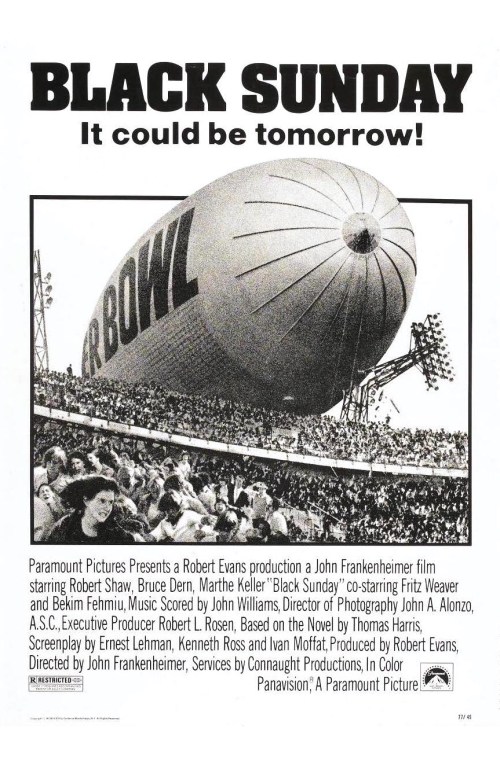
The film’s weakest point is what should’ve been its strongest, which is the segment involving the blimp barreling into the stadium. The set-up is perfect and consists of the some dazzling aerial photography and good up close footage of the football game. However, the actual blimp attack is highly compromised.  For one thing the edits are quick making it hard to follow. A much smaller blimp was used in the long shots and in the scenes where the spectators are running scared onto the field director Frankenheimer put the front end of the blimp onto a crane, which looks tacky and obvious. The blimp’s explosion is fake and when it was all over I felt disappointed. The film’s promotional items, including the film poster as seen above, promised this spectacular event, but then doesn’t come through. It almost makes one feel cheated and ruins the movie’s other good points.

My Rating: 6 out of 10

Released: March 11, 1977

Runtime: 2Hours 23Minutes

Rated R

Director: John Frankenheimer

Studio: Paramount

Available: VHS, DVD, Amazon Instant Video
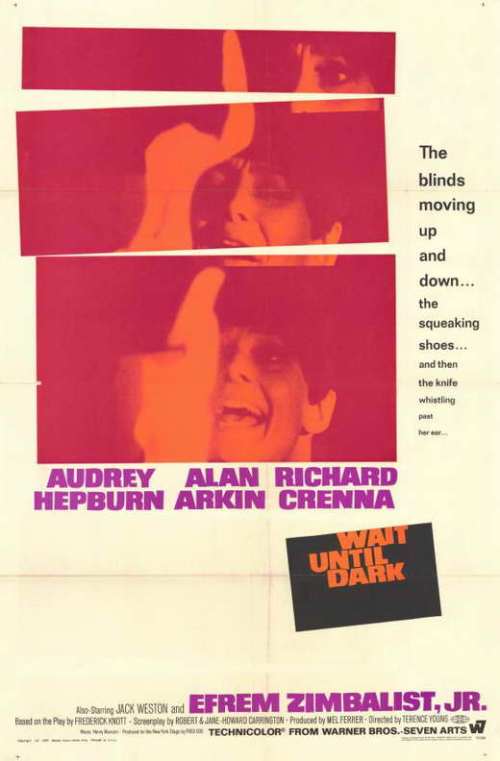
Wait Until Dark (1967)

wait

By Richard Winters

My Rating: 8 out of 10

4-Word Review: They want the doll.

Horror writer Stephan King, in his non-fiction book ‘Dance Macabre’, lists Wait Until Dark as the scariest movie ever made and Alan Arkin as one of the scariest film villains. Of course that is a statement that could be wildly debated, but as a thriller it is very well structured with a original storyline, a fantastic heroine, and a terrific climatic sequence that still rates as one of the best.

The film is based on the hit Broadway play by Frederick Knott and follows that script very closely.  It centers on a recently blinded woman named Susy Hendrix (Audrey Hepburn) who accidently acquires a doll filled with heroin and then becomes terrorized by the three drug dealers (Alan Arkin, Jack Weston, Richard Crenna) when they come to retrieve it. Trapped in her small apartment by the three men with her phone line cut off, she decides her only possible recourse is to smash all the light bulbs and then, in the pitch blackness, use her handicap to her advantage and try to escape.

Normally stage plays transferred to film don’t usually work too well namely because all the action takes place in one setting, which eventually creates visual boredom, but here this becomes an asset.  As the story progresses the viewer begins to feel claustrophobic and as entrapped as Susy as well as successfully tapping into the fear of isolation. The lighting is also impressive.  It may not be something one consciously thinks about, but good lighting can really help accentuate a film’s mood and style, which it does here.  I enjoyed the interesting color schemes and the contrasts between light and shadows that becomes more apparent as it goes along.

Of course the element that really makes this film special is the fantastic performance of Hepburn, which I consider to be her best.  She was nominated for the Academy Award and she should have won it.  She displays just the right level of emotions, which creates empathy from the viewer almost immediately. Her reactions as well as the fear and panic that she shows are very convincing. Arkin, as the villain, tends to get a little too flashy and hammy. I felt Hepburn easily out performed him and everyone else. The film just would not have been as good had anyone else played the part.  This also marks her career pinnacle as she went on a nine year sabbatical after this and when she did finally return, the films she did weren’t all too great.

I also like Julie Herrod as the child named Gloria who lives upstairs and becomes a very crucial link to the story.  So many movies portray children as either total brats, or overly wide-eyed innocents solely put on this planet to say cute and amusing things on cue.  Here the balance is just right and so believable she will remind you of kids that you know in real life as it certainly did with me.  She is sneaky and precocious at certain times, but also genuinely helpful and concerned at others, just like adults are.  The line she says to the Hepburn character just before she runs out to find help is a gem.

The climatic sequence still ranks as one of the best.  The clever ways that this petite, handicapped woman manages to outwit the brutal thugs are classic.  The viewer also gets the satisfaction of seeing the character grow and find an inner strength that she didn’t even know she had. It also features a very well staged scare/shock that sent viewers jumping out of their seats when it was first released and still does today as evidenced by the other people who watched the film with me and all screamed out loud when it happened.

As with any film released 40 years ago, there are some dated qualities that do hurt it.  Some of the ‘tough guy’ talk between the thugs seems a bit stilted.  The film was released a year before the ratings system took effect, so there is no cursing, but a little bit of it would have helped make it more authentic.  It would have also been a little more gritty had the bad guys actually carried guns instead of the brass knuckles and silly looking knives.  Air travelers of today will also be shocked at just how easily it was for people to get through airports in the old days.

However, even with these few weaknesses I still feel this film is a pretty solid, compact thriller that can be used as a blueprint for all other thrillers to follow.  There is also the excellent music score by Henry Mancini that is really creepy although the song played over the closing credits should have been avoided.

My Rating: 8 out of 10

Released: October 26, 1967

Runtime: 1Hour 48Minutes

Rated NR (Not Rated)

Director: Terence Young

Studio: Warner Brothers

Available: VHS, DVD, Blu-ray, Amazon Instant Video

Body Double (1984)

By Richard Winters

My Rating: 6 out of 10

4-Word Review: Sex through a telescope.

During the 70’s and 80’s director Brian DePalma, a fan of Alfred Hitchcock, made a lot of stylized thrillers using many of Hitchcock’s trademark devices.  He even storyboarded every shot that he did just like Hitch. Unfortunately a lot of these films had rather flimsy plots and characters and were over-directed, drowning out what little story there was. DePalma tried so hard to imitate Hitch that he ended up showing no original vision himself and made the viewer crave even more at seeing a genuine Hitchcock film.  This film, which I first saw when it was released 26 years ago, I felt was the best of DePalma’s Hitchcock imitations. Upon viewing it a second time many years later I found a lot more holes despite one clever twist and some good camerawork.

The story is about Jack Scully (Craig Wasson) who is a struggling out of work actor who is offered a place to stay by a man named Sam (Gregg Henry). The house is a very modernistic place looking almost like the Space Needle in Seattle.  Jack is offered the home on condition that he takes care of the place while Sam is away on business.  During his stay Jack becomes obsessed with the attractive neighbor lady named Gloria Revelle (Deborah Shelton) who he watches through a telescope.  She does an erotic dance in her bedroom each night at the same time while wearing a revealing negligee. The dance itself is not real exciting and would probably bore most people after a minute or two, but Jack becomes hooked on it and watches it endlessly night after night.  Eventually he starts following the woman around during the daytime and even tries to start up a relationship with her. He also begins to notice another man, who is very creepy looking, is also following her and eventually he witnesses him murdering her, but Jack becomes convinced there is more to it.  With the help of a porn star named Holly Body (Melanie Griffith), who he meets along the way, the two set out to try and solve the mystery.

Wasson makes for an incredibly weak male lead. This helps somewhat because the character is very weak, but it is hard for the viewer to relate or care about him.  His best scenes come during his endless auditions and rather thankless treatment he receives from directors, producers, and acting coaches.  These are one of the few scenes that the film gets right as it hits the nail right on the head showing just how degrading working as a low paid, nameless actor can be in Hollywood. The porn star character is also weak as she is too cliched and predictable making her more annoying than anything despite the fact that Griffith plays the part pretty well.  The character was based on real-life porn star Annette Haven who gets listed in the credits as a ‘technical advisor’. I did like Gregg Henry though who makes for a great sleazy villain as well as Dennis Franz in a small, comic relief type role as a brash, stressed-out B-movie director.

The film also has a lot of rather implausible elements that prevents the viewer from getting as involved in it as they should. One of the biggest ones is when Jack sees Holly Body performing in a adult video that he has rented and becomes convinced that she may be connected to the case when he sees her do the same type of dance that the neighbor lady did, so in order to meet up with her he auditions as the male lead in her next X-rated production. Now I’m not completely sure how casting in these productions work, but having some guy with no experience starring and having sex with the industry’s biggest female star at the time seems to be a bit of a stretch. I would also think that a guy who was not used to having sex in front of the camera and with everyone staring at him might get nervous and be unable to ‘perform’ especially in what was still the pre-Viagra age.

The porn scenes themselves aren’t too interesting, or exciting.  This industry is no longer quite as underground, or taboo as it once was, so the shock factor is gone.  The characters and situations are handled in such a placid way that the viewer is given no real insight into the business, or the people who work in it.  The industry has evolved a lot in the past twenty-five years, so the scenes here become irrelevant.

There were a few things that I did like.  The scenes where Jack follows Gloria around in the shopping mall are pretty well handled despite the fact that I think they could have had a little more action here and there also needed to be more customers in the background.  However, the bird’s eye view, which is another patented Hitchcock type shot, showing Jack following Gloria around who is also being followed by the killer is good.  This part also features the one definitive moment from the film that I remembered after all these years.  It involves Gloria throwing away her old panties when she buys some new ones and then having Jack fish through the garbage, retrieve the panties, and put them in his pocket as a sort of ‘souvenir’.

Some of the shots during the actual murder are also really innovative especially the way the camera captures the giant drill, which is the killer’s weapon.  Probably the best shot of the entire film occurs when the killer drives the drill into the victim, which then goes through her body as well as the floorboards and then pops out of the ceiling from the floor below.  Yes, it is rather gory, but I still thought it was a really cool shot anyways.  I also thought the innovative design to the house that Jack stays in had potential, but I wished they had shown a little more of the place from different angles and given us more of a feel of the inside instead of having all the action occur in just one room.

Overall the film is slick, but very shallow and superficial.  The neighbor lady especially seems like a male fantasy.  DePalma gets too hyper with the camera.  I really don’t like his ‘spinning camera’ shots.  He spun it around Jack and Gloria as they kissed and it was tacky and cliched.  Once, in the film Blow Out, he spun the camera around so much in one scene that it started to actually make me feel dizzy and nauseous. The film has a scene during the closing credits showing how a body double is used during a film production, which is amusing and interesting, but a bit out of place for a thriller.  You walk away from the movie wondering how much more entertaining it could have been had Hitchcock himself been able to direct it.

My Rating: 6 out of 10

Released: October 26, 1984

Runtime: 1Hour 54Minutes

Rated R

Director: Brian De Palma

Studio: Columbia Pictures

Available: DVD (Special Widescreen Edition), Amazon Instant Video

Targets (1968)

targets

By Richard Winters

My Rating: 6 out of 10

4-Word Review: He kills his family.

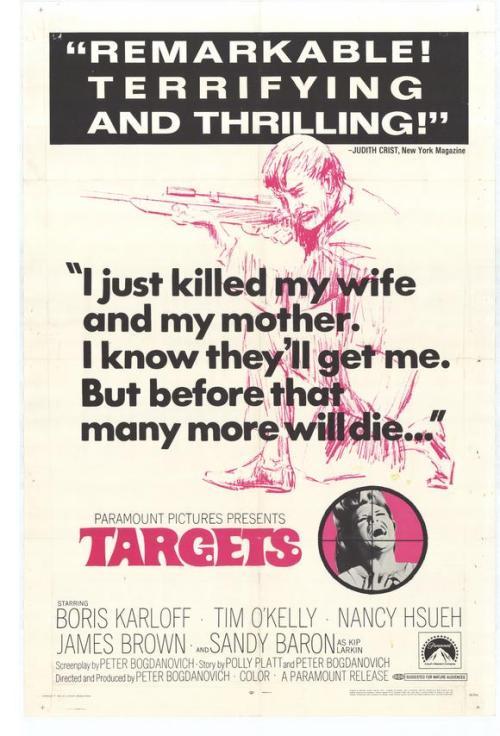
In 1967 producer Roger Corman gave fledgling director Peter Bogdanovich the green light to make any movie he wanted as long as he followed two stipulations.  The first one was that he had to use footage from Corman’s earlier film The Terror and the second one required that he use the acting services of Boris Karloff as Karloff still owed Corman two day’s work per his contract.  This movie is the result of that agreement, which kind of works and kind of doesn’t and seems more like two movies rolled into one.

The first story deals with a young, clean-cut man starting to have homicidal urges. The second scenario involves an aging actor played by Karloff, who decides he wants to retire despite the appeals of his agent and film studio. He plans to attend a showing of one of his films (The Terror) at a local drive-in where the sniper is waiting to shoot him.

I enjoyed the scenes involving the sniper and felt it helped elevate this film from the typical exploitation fare.  The character is based very closely on Charles Whitman, an All-American ex-marine, who on August 1, 1966, climbed to the top of the clock tower at the University of Texas in Austin and shot 32 people, killing 14. It was one of the very first mass-shootings in American history and it caused worldwide headlines.

Tim O’Kelly, the actor who plays the gunman, looks almost exactly like Whitman. What I liked about these scenes is the way it follows the character around and shows his interactions with his family. Like in real life there were no indicators, or violent past.  It is creepy watching him say grace at the dinner table, or having wholesome conversations with his wife when you know what’s going to happen.  The film goes into almost meticulous detail with the build-up and I found it gripping despite the fact that there is little action, or music.

The shootings are uniquely done.  Like in the actual incident, he shoots his mother and wife first and then puts a towel over their blood stains while carrying their dead bodies back to their bedrooms so it would look more ‘tidy’ when the police came.  This is all done with a docu-drama approach, which heightens the impact and realism.

The scenes involving the sniper shooting at people while they drive in their cars along a busy roadway are excellent as well.  It was done on an actual freeway and the viewer watches the action from the killer’s perspective through the telescope of his rifle, which is chilling. The cars veering off the road and people getting shot are vivid.  The only fault here is that Bogdanovich had the killer climb up on top of an ordinary tank at an oil refinery to do the shootings.  The clock tower in the actual incident was a very distinct structure and it would have been stronger visually had they found another one that was similar to it.

The parts involving Karloff are weak and tend to be cluttered with a lot of uninteresting dialogue.  Bogdanovich casts himself as the screenwriter for Karloff’s next proposed project.  I always thought it was a bit weird for a director, especially one that at the time was young and unknown, to cast himself in his own movie.  I know Woody Allen and Spike Lee, as well as others have done this, but it always came off as a bit narcissistic to me. However, I saw Bogdanovich in person a few months ago and he hasn’t seemed to have aged a day.

The climactic sequence in the drive-in is poorly handled. The dark lighting makes it hard to follow the action.  The final confrontation between Karloff and the killer is dull and unimaginative.  The only good points here is that it gives you a chance to see both Randy Quaid an Mike Farrell in their film debuts playing two of the sniper’s victims.

The film ends with a bird’s-eye view of the drive-in’s empty parking lot taken the next day with the sniper’s car being the only one left.  It was shot during the early morning hours so the sunlight gives it a surreal quality.  It also has a moody feel because the only sound is of blowing wind as the credits scrawl over, which I liked. However, the police would certainly have impounded his car and gone through it for clues and not have let it just sit there.

Under the conditions that he was given I think Bogdanovich did a commendable job. It is hard to know what category to put this film into.  At times it seems like a horror movie and then at other points it’s a drama. Some may even argue that it is a sentimental tale dealing with an aging actor moving into the final years of his life. Personally I wished it had gone all out as a horror film because the ingredients were there except that the tension was inconsistent. Fans of Bogdanovich may want to check this out because it is radically different from any of his later works.

My Rating: 6 out of 10

Released: August 15, 1968

Runtime: 1Hour 30Minutes

Rated R

Director: Peter Bogdanovich

Studio: Paramount

Available: DVD, Amazon Instant Video

W (1974)

w1

By Richard Winters

My Rating: 1 out of 10

4-Word Review: Ex-husband is psycho.

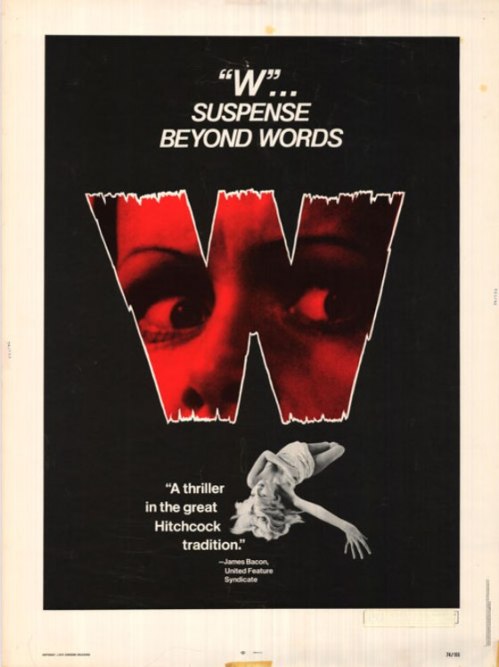
For all you trivia buffs out there it may be good to know that Oliver Stone was not the first person to make a film with the twenty-third letter of the alphabet as its title, although that one technically has a period after it.  The first one was in 1974 and starred British super-model Twiggy. She had just made a splash in Ken Russell’s brilliant musical The Boy Friend and this film was supposed to send her to superstardom by proving that she could act by placing her in a completely different genre. Unfortunately for her it never happened.

The film is a thriller and the tagline read ‘W…suspense beyond words’. It is a story about a woman who has remarried but it still being stalked by her psycho ex-husband (Dirk Benedict). His name is William and at all of the scenes of his murders, or ‘accidents’, he scrawls the letter ‘W’, hence the film’s title.

At the time the critics came down hard on Twiggy’s performance, but I kind of liked it. She comes off as very innocuous and vulnerable and in this kind of role it works.  Her present husband was played by Michael Witney, who at the time was her real-life husband.  He was eighteen years older than her, but the age difference is not apparent.  You can tell that the two are genuinely fond of each other and that chemistry helps.  Yet they have no real onscreen presence and too much of the time is spent with only them in it, which hurts.

Viewers enjoyed Eugene Roche’s performance in a supporting role as a detective.  His gritty, matter-of-fact approach is refreshing and gives him some distinction over the other characters who are very transparent. Unfortunately he gets phased out rather quickly and this is too bad because it is the type of persona that could have really carried the film.

Where this film really fails is that way too much time is given to extraneous dialogue that is not interesting and does not propel the plot along.  The scenes are also excruciatingly slow and in great need of quicker cuts and edits.  I would have like to have seen cutaways showing the Twiggy’s character’s relationship with her ex-husband and how that all started, but it is never shown. She doesn’t even end up talking about it until well over an hour into the film and then it is only done briefly.

This is also one of the first thrillers that I have ever seen that has no creepy or pounding music score.  In fact the music is very soft and melodic like something you would hear in an elevator. There is also extended amount of footage showing the couple going sailing, walking hand in hand in a park, or spending time at their lavish beach house, making it seem more like a dreamy romance movie.  Some scary imagery, or just a few shocks are badly needed.  There is one nightmare sequence that has a little potential, but it lasts less than ten seconds and that just isn’t enough.

The film also has a lot of loopholes that completely throws you out of the story.  One is the fact that as they are becoming increasingly terrorized by this ex-husband they decide not to go to the police, but instead call on the services of a private detective, who has ulterior motives and just ends up making things worse. There is also a scene where the killer cuts off two of his fingers and attaches them to the victim’s burned body so when the police identify the body using the fingerprints they think it is the killer.  However, I wasn’t exactly sure how he pulled this off. Certainly he wouldn’t have the skill or time to actually graft the fingers onto the body and even if he did you would still think that the police would notice that the victim had too many fingers.

The biggest head scratcher of them all has got to be the fact that the prison in which the ex-husband resides gives daily tours to the public.  Now I have toured a prison myself in Boise, Idaho, but that was only after the prison had been closed and the prisoners shipped off to another facility.  Here the visitors can get right up next to the prisoners and observe them without any guards, or protection.  The person leading them around is not armed and dresses and acts like a tour guide to a museum.  I would think one of the prisoners could easily obtain a homemade knife of some kind, grab one of these visitors, and use them as a shield to break out. Of course in this film that doesn’t happen, but in real life I think it would, which just makes you wonder what kind of drugs were they on when they made this.

My only interest in watching this film to begin with was seeing Dirk Benedict playing the psychotic.  He is probably best known for the character of Face in the 80’s TV-show ‘The A-Team’.  Not that he is a real great actor or anything, but he has had a career where he usually always plays the nice guy, so I was interested in seeing him as the bad guy. Unfortunately he doesn’t appear until the final ten minutes and these scenes are strained and probably the most boring of the whole film.  His character is also poorly fleshed out with no reason given to his erratic, crazy behavior thus turning him into a cliche.

I came into this film expecting very little and I went away not even getting that much. Being an avid collector of lost films can be fun because every now and then you can come across a real gem, but that was definitely not the case here.

My Rating: 1 out of 10

Released: June 8, 1974

Runtime: 1Hour 35Minutes

Rated PG

Director: Richard Quine

Studio: Cinerama Releasing Corporation

Available: None

Lady in a Cage (1964)

lady2

By Richard Winters

My Rating: 4 out of 10

4-Word Review: Lady trapped in elevator.

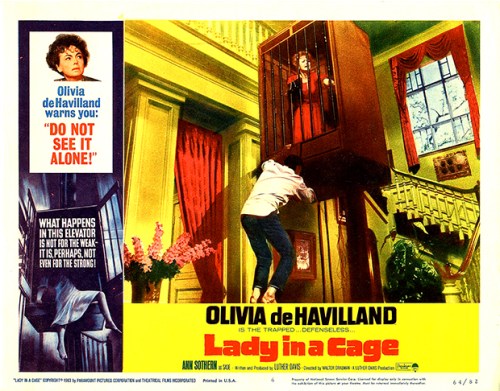
Olivia de Havilland, who as of this writing is the last surviving cast member from the film Gone With the Wind, plays a upper-middle class woman by the name of Cornelia Hilyard who gets stuck in her household elevator when the power goes out. A homeless man (Jeff Corey) becomes aware of her predicament and with the help of his sleazy girlfriend (Ann Southern) tries to rob the place. When they sell some of her items at a pawn shop a trio of juvenile delinquents (James Caan, Jennifer Billingsley, Rafael Campos) follow the two back to the place where they spend the rest of the film terrorizing Ms. Hilyard and ransacking her house further.

As a concept the film has some interesting ideas and imagery. The stark black and white photography looks great and helps accentuate the plot’s grim reality. The opening sequence is pretty good with an announcer reading off various startling news reports that are coupled with troubling images like a young girl on roller skates kicking at a homeless person lying in the street. There is also the fact that this all occurs within a large home amidst an upscale neighborhood that is right next to a busy street, which makes for some intriguing symbolism.

However, as a thriller it ends up being quite dull.  There is very little action and much too much talking that seems to go nowhere. There are no twists of any kind and the climax is forced, unimaginative, and unexciting.  Any violence that does happen is conveniently done out of view. The bad guys are portrayed as being dumb, careless, and just waiting to screw up. It is probably due to the period it was made in, but this potentially brutal subject matter seems way too restrained to the point that there is never much tension. There is also the issue of the elevator, which isn’t all that high up. Cornelia could have dropped herself out of it, which she eventually does, but had she done it earlier none of this would have needed to happen.

De Havilland does a good job here, but at times comes close to over-acting especially with her scared facial expressions, which some might find unintentionally funny. This marked James Caan’s film debut.  He is a great actor with an impressive career, but his performance here is lacking.  He seems uncomfortable in the role as the antagonist and he never manages to reach the level of being menacing. The final shot of his demise though is very graphic especially for the time. Jennifer Billingsley is probably the best thing about the film. She is attractive and gives a solid performance as the most jaded member of the gang.

Normally I always say these one-note thrillers that get stretched too thin at feature length would work better in one of those old horror anthology series like “The Alfred Hitchcock Hour”, however even there this story would be pushing it. Basically, in this instance, if you have read the synopsis then you have essentially ‘seen’ the film.

The trailer for the film and movie poster as seen above is actually much more entertaining than the film itself.  An announcer sends dire warnings that this film is ‘extremely shocking subject matter’ and ‘should not be viewed alone’.  It is pretty funny and even funnier when you see how lame the movie actually is.

My Rating: 4 out of 10

Released: July 8, 1964

Runtime: 1Hour 34Minutes

Rated NR (Not Rated)

Director: Walter Grauman

Studio: Paramount

Available: VHS, DVD, Amazon Instant Video

What Ever Happened to Baby Jane? (1962)

By Richard Winters

My Rating: 7 out of 10

4-Word Review: Living in the past.

This is a classic horror film that managed to resurrect the sagging careers of acting legends Bette Davis and Joan Crawford. It also spawned a whole new ‘psychobiddy’ genre of films. The movie is based on the 1960 bestselling novel by Henry Farrell.

The story takes place almost exclusively in an old, rundown Hollywood mansion where two aging, feuding sisters live. Baby Jane Hudson (Davis) was at one time a big child star, but never managed to cross-over to adult roles. She lives in a fantasy world, refusing to move on with her life, and takes out her frustrations on her crippled sister Blanche (Crawford), who at one time was a big movie star until a horrible car accident left her bound to a wheelchair.

The real-life feud and animosity that the two stars had for each other is now legendary. Some of the things the two said about the other is hilariously over-the-top and too many to quote here, but well worth checking out. When you hear of all the incredible things that the two did to each other behind the scenes you almost become amazed that the film was ever able to get made. I wished that a documentary had been filmed examining the movie’s production as that could have been almost more entertaining than the film itself.

All things considered, Davis is nothing short of fabulous here. She should have won the Oscar hands down and she pretty much steals the film. She also wore gaudy make-up that gives her an almost ghost like appearance. Crawford is very good as well, but her role is not as flashy. Sadly for her this was her last hurrah as her alcoholism took its toll and her roles after this were in B-movies while Davis went on strong for the next twenty years.

Of course some may argue that the real star was director Robert Aldrich. I liked the bird’s-eye shot of Blanche spinning around in her wheel chair in frustration and terror. It is brief, but gives the viewer a very unnerving feeling. The scene where Baby Jane does an old rendition of one of her routines that she did as a child in front of a mirror that she has set-up in her living room that is also surrounded by stage lights is a nice directorial touch. The campy opening that takes place in 1917 that shows Baby Jane at her peak is memorable as is the very offbeat climatic sequence on a crowded beach. I also got a real kick out of all the Baby Jane toy dolls.

Victor Buono deserves mention as he was nominated for the supporting Oscar for his role as Edwin Flagg, the fledgling composer who Baby Jane hires to help resurrect her stage show. Although best remembered for his comedic skills he was also quite good in his serious parts and his immense girth always made his presence known. I enjoyed how they form this weird quasi-relationship that is based solely on each other’s lies and delusions.

I did have a few complaints to what seemed to me to be some serious logistical flaws. One is the fact that Blanche is stuck in her upstairs bedroom with no way to get downstairs. You would think that with all the money that they once made that they would’ve been able to afford building either an elevator, or a chair lift. It also seemed implausible to believe that Blanche had been stuck in her bedroom since 1935 when she had her accident, until present day 1962, which is what the film seems to imply. As much as I liked the African-American housekeeper Elvira Stitt (Maidie Norman), who is well aware of Baby Jane’s psychosis and has no trouble standing up to her, I thought it was awfully dumb the way she set down a hammer that she was holding right in front of Baby Jane and then turned her back to her, which allowed her to be attacked that anyone else could have predicted would happen. I also felt there was a little too much background music that at times got a bit melodramatic.

Still, this is a great film that his highly entertaining from beginning to end. With the exception of some of Baby Jane’s ‘dinner surprises’ the film is devoid of any real scares and there is no gore, which may disappoint today’s younger, more jaded viewers. However, the film has a very strong, dark psychological undercurrent, which proves to be immensely fascinating and will be appreciated by those who are more sophisticated. The film’s theme, which is that of Hollywood’s fickle, vicious cycle of fame, is universal and as strong today as it was back then.

It is interesting to note that the director’s 18 year old son William, who appears at the end as a lunch attendant at the beach, produced  29 years later the made –for-TV remake of this film that starred the Redgrave sisters, but was not as good. Also director Aldrich later made two variations of this same story. One was Whatever Happened to Aunt Alice which he produced and starred Geraldine Page and Ruth Gordon and also the British classic The Killing of Sister George which he also directed.

My Rating: 7 out of 10

Released: October 31, 1962

Runtime: 2Hours 14Minutes

Rated NR (Not Rated)

Director: Robert Aldrich

Studio: Warner Brothers

Available: VHS, DVD, Blu-ray, Amazon Instant Video

Open Season (1974)

By Richard Winters

My Rating: 3 out of 10

4-Word Review: Humans are their prey.

This is the type of film that has a really great concept, but ends up being ruined with its poor execution. It is based on the novel ‘The All-Americans’ by David D. Osborn, who also co-wrote the screenplay. The story involves three ‘All-American’ suburban family men (Peter Fonda, Richard Lynch, and John Phillip Law) who once year go on a ‘hunting trip’ except here they hunt people. They typically pick their victims up at random and then drive them to their isolated hunting lodge in the woods. They feed and entertain them for a week and then give them a few supplies as well as a compass and tell them that the highway is twenty-five miles north.  If they are able to make it to the highway they are free and if not the three men will hunt them down like animals. The victims are always given a thirty minute head start, but none of them ever make it. The movie focuses on a man and woman (Alberto de Mendoza, Cornelia Sharpe) that are having an affair and are kidnapped by the three outside of a truck stop.

The beginning is well-done and quite easily the best part of the whole film. It goes back in time to when the three men where in college and accused of gang raping a young lady.  To the shock of the girl’s mother the prosecuting attorney tells them they have no case because these boys are great athletes with stellar reputations and nobody would believe they would do something like that. I liked this part for two reasons. One is the fact that at least we are given some sort of history to these culprits. A lot of movies never do this and you always wonder how these psychos where able to get away with it for so long. At least here we are given a backstory and somewhat plausible one at that.  Many sociopaths have been able to fool people for years simply because they smart enough to play the respectable role in society and bring out their deviance only when it is completely safe to do so. Also, athletes, especially in the past, where given much more leeway and many of their transgressions would get over-looked. So to me this made a lot sense and helped get me into the movie right away. I also liked the imagery used over the opening credits as well as the very haunting music score.

I also liked how the film then cuts to the present day showing the men at a neighborhood block party and interacting with their wives and kids. The three actors are perfect for their parts.  They were all B-actors who’ve made a career playing sleazy characters and fall into the roles easily. Richard Lynch is especially good. In real life he once set himself on fire in 1967 while taking LSD and his scarred, pale, and rough looking face always makes a creepy impression. Director Peter Collinson does some good camera work with detailed bird’s-eye view shots that show how sprawling the forest is and indeed gives the viewer a very remote feeling.

Unfortunately the rest of the film goes downhill. Part of the problem is that there is just too much talking.  In fact the whole middle section is spent with a lot of drawn out conversations that aren’t interesting, or well-written. It saps the tension out of the film until there isn’t any left.  It isn’t until the very end that they finally get around to letting the victims go out into the woods and then tracking them down. However, this too is poorly handled. The action is limited and not well choreographed. The whole sequence goes by too quickly and comes off like it was nothing more than an after-thought that fails to take advantage of its immense forest setting.  In fact for a film with such a sadistic and exploitive theme there is actually very little violence to speak of and no gore at all. The three bad guys also end up becoming quite banal and one-dimensional. They show no distinctive personalities whatsoever as they agree with each other on everything and seem to do nothing more than laugh and guffaw and each other’s juvenile jokes and antics.

If you are interested in watching this film then please don’t read any further as it may be considered a spoiler:

The film’s twist ending is weak as well. It features actor William Holden (a very accomplished actor and why he took this role, which amounts to nothing more than a cameo, I will never know) playing the father of the girl that the three men raped in college. He secretly followed the men on their hunting trip and decides to have his revenge by gunning them down just like they had done to all their victims. Again, the action here is handled in an unexciting and unimaginative way. I couldn’t buy into the fact that these men, who supposedly fought in Vietnam, would panic so quickly and act like a bunch of scared children the minute they found out that they were being shot at. They show no savvy or survival skills and allow themselves to be easily picked-off in an uninspired fashion.

I have always enjoyed Deliverance and I liked how this film used a variation of that theme where instead of the civilized man going out and coming to terms with the savage of the wilderness they instead go into the wilderness to come to terms with their own, inner savage. More action, better tweaking of the characters, and a faster pace and this film could’ve been a cult classic as the ingredients are all there. As it is now though I think it is much too bland to interest or intrigue anybody.

My Rating: 3 out of 10

Released: November 1, 1974

Runtime: 1Hour 44Minutes

Rated R

Director: Peter Collinson

Studio: Columbia Pictures

Available: VHS