Category Archives: Spy/Espionage

S*P*Y*S (1974)

By Richard Winters

My Rating: 4 out of 10

4-Word Review: Targeted to be killed.

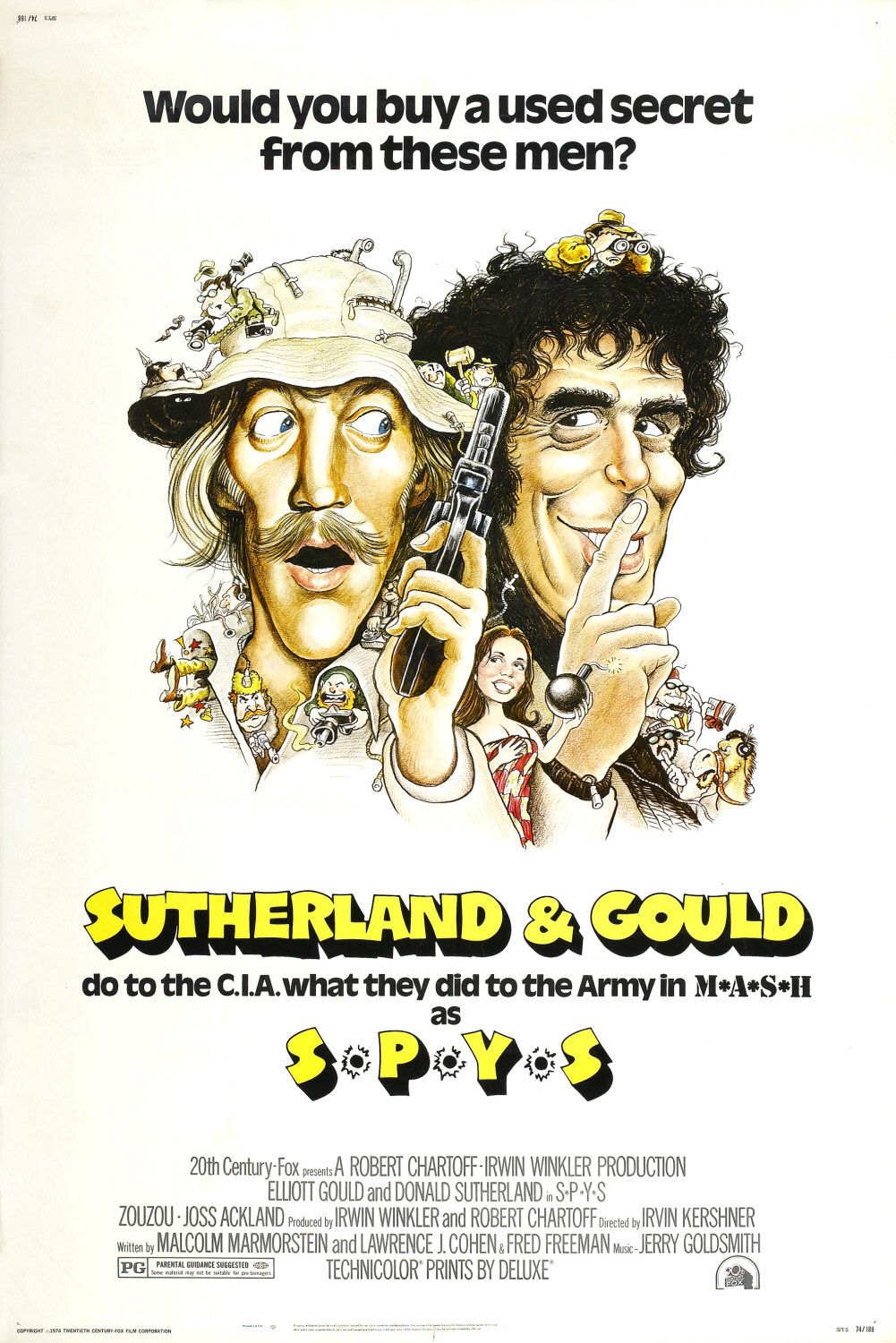
Bruland (Donald Sutherland) and Griff (Elliot Gould) are two CIA agents stationed in France who prove to be inept at every turn. When they accidentally kill a Russian gymnast defector (Michael Petrovitch) the head of the CIA Paris unit, Martinson (Joss Ackland), makes a deal with the soviets to have the two killed. This would then avoid a dangerous retaliation that could lead to a nuclear war. However, neither Bruland or Griff are made aware of this until they start getting attacked by people from all ends including the KGB, the CIA, the Chinese communists, and even a French terrorist group. In their pursuit to survive the two, who initially disliked the other, form an uneasy alliance.

The film’s original title was ‘Wet Stuff’, but the producers wanted a tie-in with M*A*S*H that had been hugely successful and also starred Gould and Sutherland, so they changed it to make it seem similar to that one, but the attempt failed and the movie became a huge bomb with the both audiences and critics alike. Viewers came in expecting the same irreverent humor, which this doesn’t have, so audiences left disappointed and the word of mouth quickly spread causing it to play in the theaters for only a short while. The irony though is that in countries that hadn’t seen M*A*S*H, like the Netherlands and Germany, it fared better because the expectations going in weren’t as high.

On a comic level it’s not bad and even has its share of amusing bits. The way the defector gets killed, shot by a gun disguised as a camera, was clever and there’s also a unique car chase in which Gould takes over the steering wheel from the backseat while someone else puts their foot to the pedal. The initial rendezvous between Sutherland and his on-and-off girlfriend (Zouzou) has its moments too as he finds her in bed with another guy while a second one is in the bathroom forcing him to have to pee in the kitchen sink. Gould then, who thought she was ‘raping him with her eyes’ when they first met, takes over and gets into a threesome while the dejected Sutherland has to sleep on the couch.

On the negative end the characterizations are poor to the point of being nonexistent. Initially it comes-off like Gould and Sutherland are rivals, which could’ve been an interesting dynamic, but this gets smoothed over too quickly. Having the two bicker and compete would’ve been far more fun. There’s also no sense of urgency. While Sutherland does lose his spy job and forced to pretend to feign illness to get out of paying a restaurant bill it’s then later revealed that he did have the money, but this then ruins any possible tension. Had they been in a true desperate situation the viewer might’ve gotten more caught up in their dilemma, but as it is it’s just too playful. The villains are equally clownish and in fact become the center of the comedy by the final act, which takes place at a wedding, while the two leads sit back and watch making them benign observers in their own vehicle.

The film needed somebody that was normal and the viewer could identify with. Buffoons can be entertaining, but ultimately someone needs to anchor it and this movie has no one. I thought for a while that Zouzou would be that person, and she could’ve been good, but she and her terrorist pals end up trying to assassinate the two like everybody else, which adds too much to the already cluttered chaos. The satire also needed to be centered on something. For instance, with Airplane the humor was structured around famous disaster flicks from the 70’s and all the jokes had a knowing tie-in. Here though it’s all over the place. Yes, it pokes fun of spies, but that’s too easy, and having it connected to let’s say James Bond movies would’ve given it a clearer angle and slicker storyline.

Since it did have a modicum of success in certain countries it convinced screenwriter Malcolm Marmorstein to continue to pursue the formula as he was sure it was simply the botched marketing that had ruined this one, so he wrote another parody script, this time poking fun at the army, just a year later, which also starred Gould, and was called Whiffs, which will be reviewed next.

My Rating: 4 out of 10

Released: June 28, 1974

Runtime: 1 Hour 40 Minutes

Rated PG

Director: Irvin Kershner

Studio: 20th Century Fox

Available: DVD-R

For the Love of Benji (1977)

By Richard Winters

My Rating: 6 out of 10

4-Word Review: Secret code on paw.

Benji (Benjean) and his dog mate Tiffany along with Cindy (Cynthia Smith), Paul (Allen Fiuzat), and their nanny Mary (Patsy Garrett) arrive at the airport to board a plane that will take them to Crete, Greece where they plan to vacation. While waiting in-line Mary visits with the man standing behind her, Chandler Dietrich (Ed Nelson), who seems nice and she, along with the two kids, start-up a friendship. Unbeknownst to them he’s not such a swell guy but instead a spy who’s stolen a secret formula that can accelerate the production of oil. He sneaks into the baggage room and imprints this formula onto Benji’s paw while the animal is stuck in a cage. Things though don’t go as planned because Benji and Tiffany don’t arrive in Greece when the plane does causing much confusion. When he does finally get spotted by a baggage handler he escapes from his cage and runs through the city streets lost and alone. He manages to find the hotel that his owners are staying at but is afraid to go up to them when he sees they’re with Chandler. Once Chandler realizes that Benji is in the vicinity he buys a large Doberman dog to go sniff him out and thus retrieve the formula still imprinted on his paw.

For a follow-up this isn’t bad, and the change of scenery helps. The film also features some exciting chase sequences including the climactic one with Benji trying to escape Chandler who attempts to run him down with his sports car. The segments though dealing with Benji roaming the city streets I didn’t find interesting, nor does it have the gripping quality that they had in the first installment and to have added a dramatic quality to it the children should’ve been lost with Benji and thus caused even more of an urgency. Also, the opening scenes get done in Greek with no subtitles, so it’s impossible to understand what’s said and for the sake of clarity should’ve been spoken at the very least in broken English.

Garret is delightful as the tubby nanny and the scene where she tries to nervously hold a suspected criminal, played by Art Vasil, with a gun despite clearly not knowing how to handle one, is entertaining. The children however seem used only as props to get excited when they see Benji and despondent when they don’t. Surprised too that Peter Breck, who played their father in the first one, isn’t here. It’s stated that he’ll be arriving a week later, but his character was the only one in the first film that had any discernable arch as he initially didn’t like the dog but learned to accept it when the pooch saved the kids, so it would’ve been interesting to see how his relationship with the pet had progressed.

Nelson is the most effective as he’s a smart and cunning villain that creates quality tension every moment, he’s on screen and his somber eyes along with his salt and pepper hair create a creepy vibe. My only issue is that there’s no explanation for how he’s able to get into the baggage area without being detected. He’s in there for several minutes as he drugs the dog, so you’d think some employee would’ve walked in on him, but don’t. Did he bop a security guard on the head to gain access, or knock him out with the same drug he used on the dog? Either way it should’ve been shown as well as explained how he was able to just open the door to the room as you would think it would’ve been locked and a key, or pass code needed for entry.

Spoiler Alert!

The climactic sequence gets a bit botched as Benji arrives at the hotel the family is staying at only to see it surrounded by police. Then Nelson drives up in his car with a gun pointed at Cindy’s head in an attempt to get the dog to jump into the vehicle. However, it doesn’t make much sense for Nelson to go into an area where police are visibly all over as there’s no real chance for escape. It would’ve worked better had the police not been seen up front making Nelson’s arrival seem more plausible as he’d be under the impression no cops were there and more tense as the viewer would think it was all up to Benji to save the girl and no one else to help. Once Benji bites Nelson’s arm forcing him to drop the gun then the police could’ve suddenly appeared by jumping out of the bushes, or wherever, and arrested him.

My Rating: 6 out of 10

Released: June 10, 1977

Runtime: 1 Hour 25 Minutes

Rated G

Director: Joe Camp

Studio: Mulberry Square Releasing

Available: DVD, Blu-ray

Avalanche Express (1979)

avalanche2

By Richard Winters

My Rating: 2 out of 10

4-Word Review: Defector on a train.

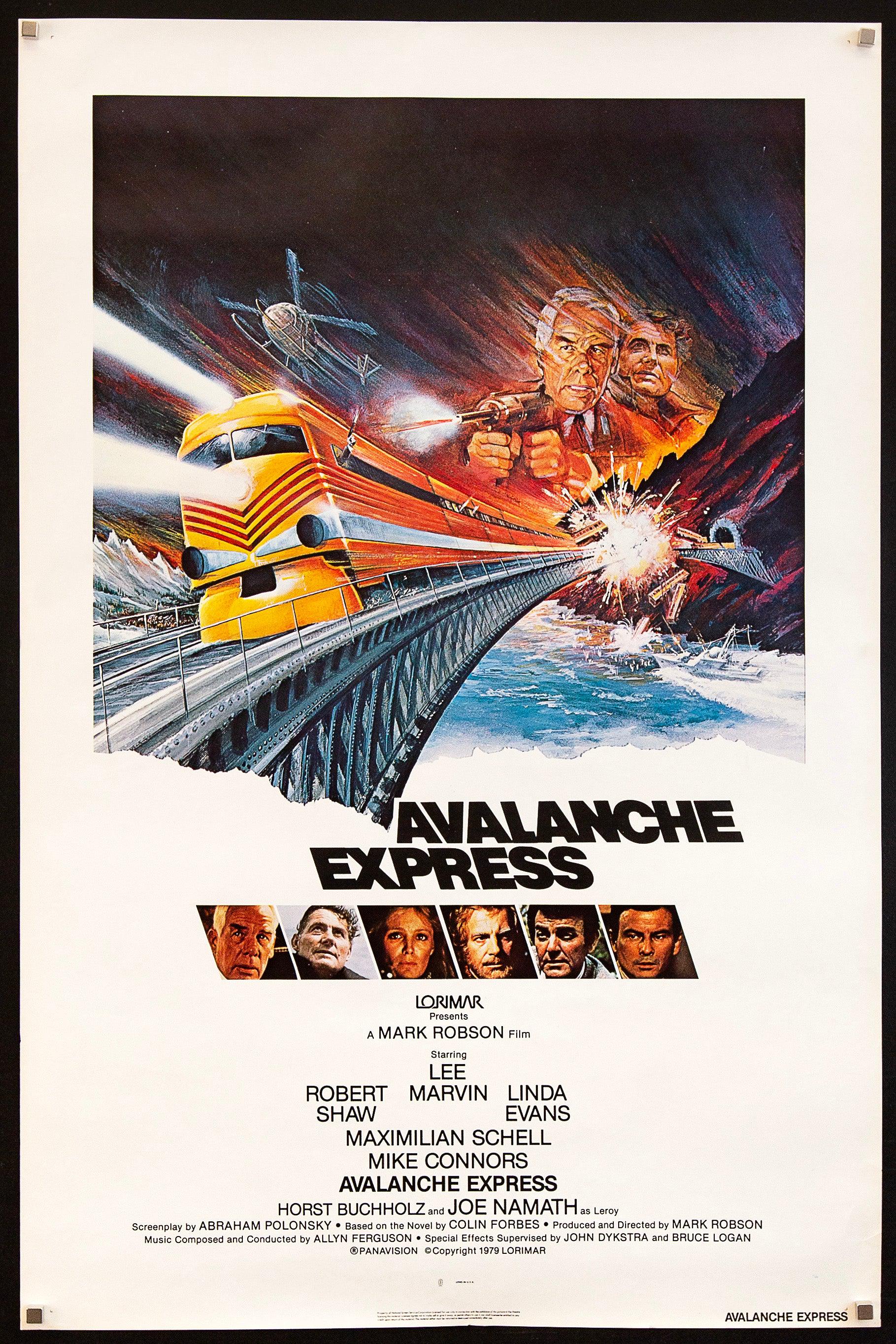
Based on the 1977 Colin Forbes novel of the same name the story centers around General Marenkov (Robert Shaw) a soviet agent who’s decided to defect to the west. Harry (Lee Marvin) is the CIA agent in charge of extraditing Marenkov back to the U.S., but to do so they must travel via train across Europe. Nikolai (Maximilian Schell) is a KGB agent assigned to stop Marenkov’s escape and tries many ways to stymie his trip before finally settling on creating an avalanche, which will not only impede the train ride that Marenkov and Harry are on, but if done right should completely destroy it and end the lives of everyone inside.

The film was noted for its many difficulties during the shoot including the death of its director Mark Robson from a heart attack with only 2-weeks left of filming forcing Monte Hellman to step in and complete the production. The biggest problem though was that during the post-production it was deemed that the opening scene, which featured Shaw speaking to his soviet counterparts in broken English, should be redone with Russian dialogue. However, Shaw too had already died from a sudden heart attack in August and thus was no longer able to come-in for reshoots, so they settled on his voice being dubbed by Robert Rietti for that scene. This would’ve been fine had they stopped there, but instead they came to the conclusion that for the sake of consistency Shaw’s voice should be dubbed by Rietti for the entire film, which was a huge mistake.

Shaw has a highly distinctive and wonderfully articulate delivery and for the viewer to miss out on that is downright criminal. I think most audiences could’ve forgiven that his voice sounded a bit different during the opening bit and probably wouldn’t have even cared or noticed since they were so busy focusing on the subtitles anyway. It becomes like a bait and switch, since Shaw’s name headlines the cast, but since somebody else does his speaking it’s like he’s not really in it and thus a big rip-off to his fans who came to see the movie simply because of him.

The special effects are equally abhorrent. There’s been many movies that have created fake snow scenes, but this one has to be the cheapest looking one yet. The falling flakes look more like Styrofoam and the white stuff on the ground resembles foam from a bathtub especially as the vehicles slush their way through it like it’s a white liquid. The sequence showing the train gliding down the tracks is clearly of the miniature variety and will fool no one.

The casting is a mess too especially the appearance of Joe Namath, a great football player, but a threadbare actor who has no business being in a big budget Hollywood picture. He’d be okay for a TV-movie with other B-performers, but for something that’s supposed to be taken seriously his presence makes the thing even more tacky than it already is. Even stalwart leading man Marvin fails here as he shows no emotion even when it’s warranted, like when he gets word that train they’re on is headed for disaster and yet he remains hyper stoic like he’s a robot with no feelings. Having him get shot dead early on only to return later isn’t the gotcha they thought it would be as I was predicting he’d reappear as there’s simply no way a big-name star like him would sign onto a movie just to be killed off right away.

Linda Evans is good simply because she has the ability of playing a cold, bitchy lady quite well. It could almost be described as her forte and her snippy comments and icy behavior towards Marvin during the first half are engaging and helps give the proceedings a bit of a dramatic flair. Turning the two into lovers though during the second half ruins all the underlying tension and since they don’t share much of a chemistry anyways having them remain adversarial throughout would’ve worked better.

Schell as the villain is as cardboard as he was playing the bad guy in The Black HoleHis career is long and distinguished, but his success is clearly not in these types of roles though he does at least get the film’s one good line. It comes when he’s told he must go undercover in disguise by playing someone who does not smoke. Since his character is a chain smoker, he panics that he won’t be able to go on without a cigarette and exclaims “That’ll kill me’.

My Rating: 2 out of 10

Released: October 19, 1979

Runtime: 1 Hour 28 Minutes

Rated PG

Director: Mark Robson

Studio: 20th Century Fox

Available: DVD-R (Warner Archive), Amazon Video, YouTube
Eye of the Needle (1981)

eye

By Richard Winters

My Rating: 7 out of 10

4-Word Review: Spy infiltrates isolated family.

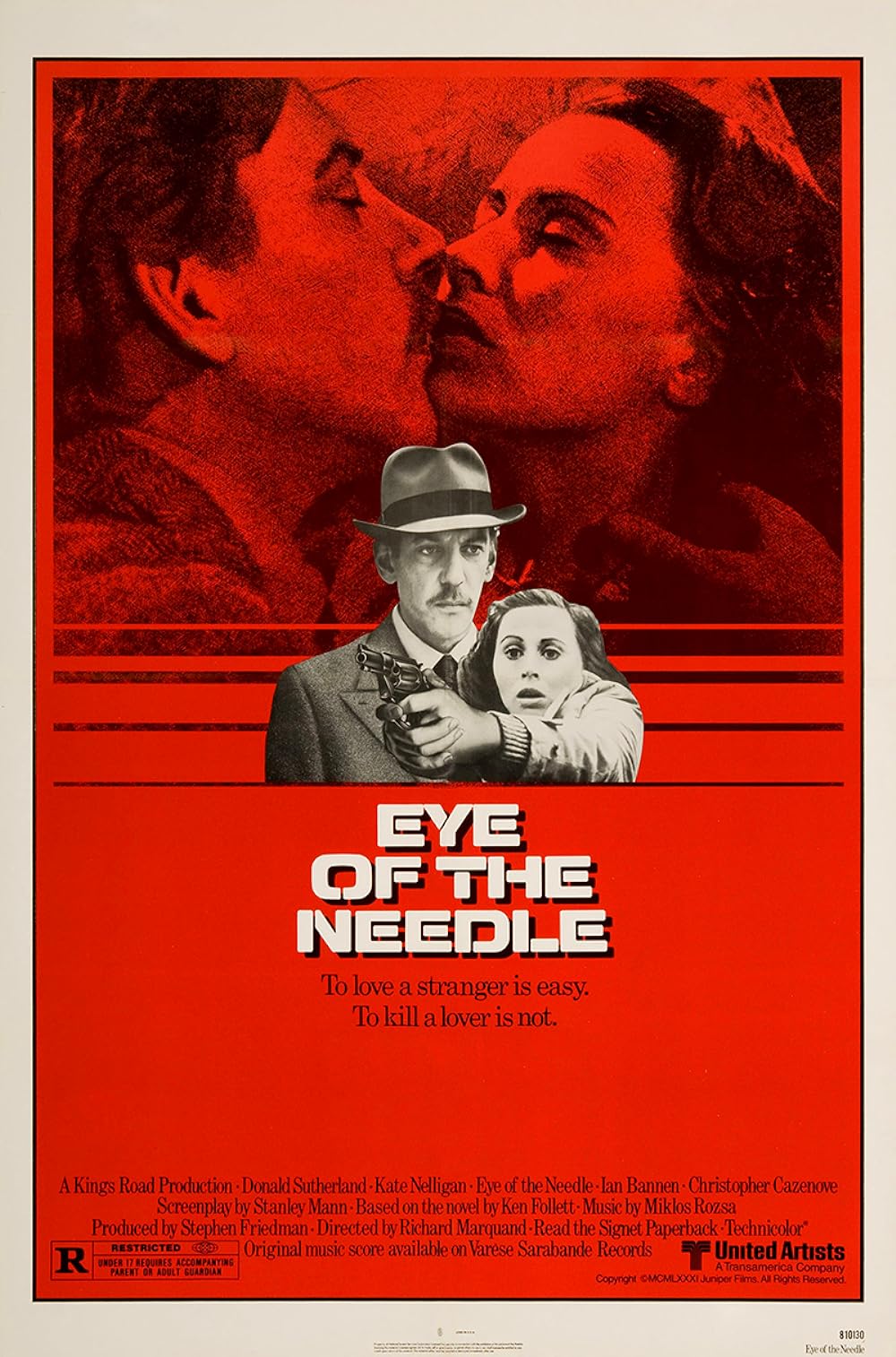
Henry (Donald Sutherland) is a German spy stationed in England during WWII, who comes upon an airplane site that he thinks is the Allied commandment post for the eventual invasion of Normandy, but upon closer inspection he finds out that the planes are all made of wood and the place is simply a decoy. With this information he tries to charter a U-boat to get back to his homeland, so he can hand his findings directly to Hitler and thus potentially change the course of the war. Instead his boat gets hit by a storm and crashes on the beach of Storm Island. Only four people reside there including Tom (Alex McCrindle), a lighthouse keeper and owner of a 2-way radio, which Henry needs to communicate back to Germany, as well as a young family made up of Lucy (Kate Nelligan), her husband David (Christopher Cazenove) and their 5-year-old son Jo. The family allows Henry to stay in their home while he recovers from his accident.  Lucy is sexually frustrated because on their wedding the couple got into a terrible car accident, which has left David paralyzed and unable to perform in bed. Henry catches onto to Lucy’s despondent situation and soon becomes her lover, but David suspects Henry of being a spy and the two have an ugly confrontation, which sends the situation for all those on the island to go spiraling out-of-control.

The film is based on the 1978 novel ‘Storm Island’ by Ken Follet, with the script staying pretty faithful to its source material. The story though kind of acts like two movies in one. The first half almost fully focuses on Henry’s spy exploits with lots of action and thrills while the second-half settles into being more of a subdued romance. Watching Sutherland playing this cold-blooded killer willing to callously off anyone that even slightly gets in his way without any remorse when for most of his career he played peace-loving hippie types, or at least that’s what he’s best known for, makes for an interesting contrast. It also shows as opposed to James Bond movies how being a spy can be a very lonely and unglamorous endeavor where a person is forced to constantly be on the run and can rely on no one, but themselves.

Spoiler Alert!

The shift during the second act where the tone becomes more of a drama doesn’t work as well. I couldn’t understand why Henry, this spy on-the-run and under extreme stress, would suddenly pick this time to get into a romance with a perfect stranger that he’s known for less than a day. If he wants to try and exploit the situation to feign romance so she will let down her guard and possibly defend him when and if the authorities arrive then fine, or maybe he’s just looking for some cheap sex to unwind him, which I could understand also. However, being in extreme survival mode where the welfare of himself and his top secret film are of the uppermost importance and then suddenly to pick this time to get sidetracked, and put himself in a an evermore and needlessly vulnerable position by trying to start-up and an affair while also simultaneously hiding-out made absolutely no sense.

I couldn’t buy into Lucie openly admitting her painful marriage to a perfect stranger either, which she candidly divulges to Henry less than 24-hours after first meeting him. Most people have pride and ego and thus won’t want to admit the harsh truth about their lives when somebody, in this case Henry, exposes it to them. They instead would want to ‘keep up appearances’ and maybe even become defensive, or resentful of someone they don’t know bursting into their home and openly telling them unflattering things about themselves and yet here Lucie melts completely when Henry confronts her about her flawed union and gushes out all the personal details like he’s her own personal therapist, which happens too quickly to being even remotely believable.

Spoiler Alert!

The affair angle didn’t seem necessary anyways since during the third act when she finds out he’s a spy she goes after him violently without any pause. You’d think if she had been intimate with him she might want to ‘hear his side of things’ or consider escaping with him from her dreary life instead of her immediate response being that he’s the mortal enemy.

With all this said I did like the climactic foot chase where Lucie goes after Henry with a gun alongside this rocky cliff ( in the book she throws a stone at him, but the shooting gun makes it more dramatic). Yet even this and some of the other twists that come about during the third act aren’t as effective as they could’ve been because all of the secrets are given away right from the start and instead having it start out in the cottage, where the relationship between Lucie and Henry could’ve taken more time to be realistic, and where Henry’s true identity wasn’t known upfront would’ve made what happens at the end more riveting, shocking and even profound, which with the way it gets done here doesn’t fully gel.

There’s also some problems on the technical end. The music is way too loud and at times obnoxious to the point it becomes heavy-handed and could’ve easily been left out altogether. The scene showing Henry chasing after Lucie who’s driving away in a car gets badly botched. The faraway shots of him running are okay, but the close-up, showing him from the waist up, looks like he’s jogging on a treadmill. The scene too inside the lighthouse where Lucie unscrews a lightbulb in order to insert a key into the socket and cause the fuse to blow looks phoney because if she were handleling a live bulb bare handed, as she does, she would’ve flinched and even let out a bit of a yelp from the scorching heat, but instead she doesn’t.

My Rating: 7 out of 10

Released: July 24, 1981

Runtime: 1 Hour 52 Minutes

Rated R

Director: Richard Marquand

Studio: United Artists

Available: DVD, Blu-ray, Freevee, Roku, Tubi, Amazon Video

The Double McGuffin (1979)

double

By Richard Winters

My Rating: 4 out of 10

4-Word Review: Briefcase full of money.

Homer (Greg Hodges) is walking outside one day behind the boarding school that he attends where he comes upon a briefcase that’s full of a lot of money. He then runs to tell his friends, Specks (Dion Pride), Billy Ray (Jeff Nicholson), and Foster (Vincent Spano) about it, but when they return to the spot where Homer hide it it’s gone. They then see a man named Sharif Firat (Ernest Borgnine) walking about town carrying it. They track him to a nearby hotel where he’s staying and bug his room to find out that he has hired three gunmen (Lyle Alzado, Ed ‘Too Tall’ Jones, Rod Browning) to carry-out an assassination. The boys though don’t tell the local sheriff (George Kennedy) because they’ve played some practical jokes on him in the past and fear now he won’t believe them, so they go about investigating the case on their own with the help of Jody (Lisa Whelchel) who is a student journalist and good at taking pictures with a camera as well as Arthur (Michael Gerard) who’s an uptight nerdy kid, but a whiz with computers.

After the success of Benji, a film that Joe Camp not only directed, but also wrote, produced and distributed, made over $30 million from a paltry initial budget of $450,000 he became motivated to further direct more movies for a family audience. This one though is definitely intended for adolescences and may even shock some viewers with a few of the scenes as it’s not exactly as family-friendly as Camp’s other films. One of the biggest jaw-droppers is that it features nudity, or in this case a glimpse of Elke Sommar’s breasts that occurs right at the beginning. There’s also some shots of the boys bare behinds when they go skinny dipping as well as scenes inside their dorm rooms where they are seen reading Playboy and drinking, or at least harboring, Coors Beer despite being underaged. They also swear though nothing worse than ‘hell’, which are all things that kids at that age would most likely do, or partake in, but some parents may still not be pleased and fear that it might be a ‘bad influence’ for the real young kids to see.

The four leads, which consists of country singer Charley Pride’s son, are an odd looking bunch mainly because three of them look like they’re senior high school age hanging around with this small kid named Homer who could easily pass-off as being a fourth grader. Seemed hard to believe that he’d be housed in the same room as these older guys and worse yet be playing on the same football team as he’d most likely be injured badly and better suited for the Pee-Wee division. His acting though is more dynamic than the rest, including Spano who may have become the most famous of the bunch, but here doesn’t really have much to do, so that may have been the reason he got cast despite his puny size. I also really enjoyed Whelchel, who later became famous for playing the snotty Blair on the TV-show ‘The Facts of Life’. who is engaging and looking quite young, like about 13 though at the time of filming she was actually hitting 15. Gerard as the pensive and androgynist Arthur has a few fun moments too.

The twists are entertaining for awhile though having the briefcase constantly appearing and disappearing gets tiring. Initially it’s kind of creepy and intriguing, but the segment where the boys open it to find a severed hand and they run a few feet away in fright and then go back to have it no longer there makes it seem like it’s almost magical and not realistic. Homer’s ability to unlock anything simply by using a pocket knife gadget gets played-up too much. It’s okay when he uses it to open the briefcase though you’d think something used to hold a lot of money would have a much more sophisticated lock in place, but when he’s able to continue to pick any lock in virtually any door he wants is a bit much to the point you start to wonder why does anyone even bother putting locks on doors if any kid with a small knife can easily pick-it.

Spoiler Alert!

The film’s biggest downfall though is that not enough happens. The lack of action, especially for a film aimed at the younger set, is appalling. There’s only one chase, done on foot when Borgnine tries to catch-up with two of the boys, who you’d think could easily outrun him since he was 60 at the time and out-of-shape and also in broad daylight with plenty of pedestrians on the street who could’ve easily called-out for help, which makes this moment not very tense at all. The climactic sequence really fizzles as the shooters are apprehended inside their hotel room before the assassination even is attempted, which should’ve gotten played-out more. The concept had plenty of potential, but with so little that actually happens it’s quickly forgettable and hardly worth the effort to seek-out.

My Rating: 4 out of 10

Released: June 8, 1979

Runtime: 1 Hour 40 Minutes

Rated PG

Director: Joe Camp

Studio: Mulberry Square Productions

Available: DVD

One of Our Dinosaurs is Missing (1975)

one2

By Richard Winters

My Rating: 3 out of 10

4-Word Review: Nannies to the rescue.

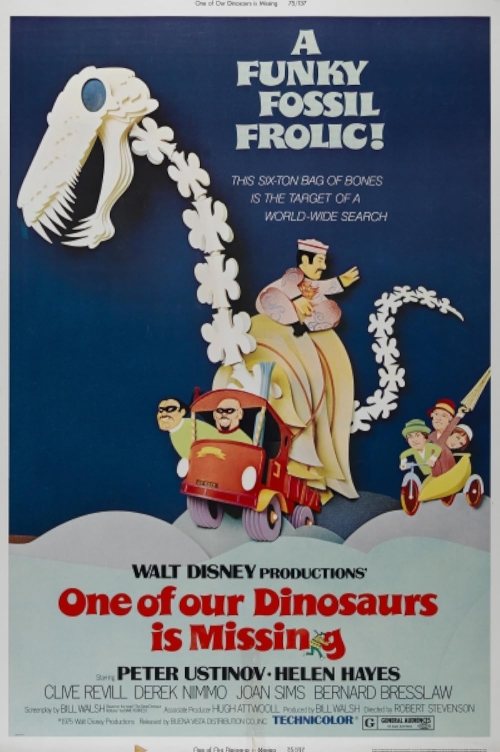
Lord Southmere (Derek Nimmo) is on the run from Chinese spies lead by Hnup Wan (Peter Ustinov) after he gets his hands on a microdot that carries top secret information. After escaping the clutches of an assassin disguised as a chauffeur he runs into a nearby building, which happens to be the Natural History Museum. It is there that he hides the microdot in the skeleton of a dinosaur that’s on display. He then bumps into Hattie (Helen Hayes) who used to his nanny and is taking a tour at the museum with other nannies. Southmere tells Hattie about the microfilm inside the dinosaur just before he faints and is captured by the Chinese. Hattie then takes it upon herself, along with her nanny friends Emily (Joan Sims) and Susan (Natasha Pyne) to retrieve the important hidden document and take it to the proper authorities.

The film is based on the 1970 novel of the same name written by David Eliades and Robert Forrest Webb, but with many changes. The book took place in the 70’s in New York City while in the movie the setting is 1920’s London. The book was also intended for an adult audience and had sex and violence in it, which got taken out for the movie, which angered the authors, who later disowned the film, as they felt the plot got too ‘dummied-down and sanitized’ in an effort to appease children viewers.

The movie really has only two amusing moments. One is where the group of nannies get on the tall skeleton of the dinosaur to search for the microfilm, which from simply a visual perspective is goofy to see and most likely will elicit a few chuckles. The second is when Hayes and company steal the dinosaur on the back of a steam lorry and the spies give chase throughout the streets of foggy London, which offers some moments of humorous reaction shots from bystanders. Otherwise there isn’t much else going for it. The opening bit that supposedly takes place in China clearly has an outdoor backdrop that is a painting and looks tacky like it was done by filmmakers that really didn’t have much heart in the material and didn’t care how cheap it came-off looking. The interior lighting is dark and dingy and having the whole plot revolve around the extreme coincidence of the protagonist bumping into his childhood nanny at the most opportune time is a bit much.

The film’s main controversy, at least by today’s standards, is Ustinov’s portrayal of a Chinese spy. To his credit he at least puts more energy into it than he did as Charlie Chan in the 80’s film Charlie Chan and the Curse of the Dragon Queenwhere he seemed noticeably uncomfortable and just phoning-it-in. Yet even here nothing his character says or does is funny. The humor is intended to come from the broad caricature, which along with his sing-song sounding delivery quickly becomes tiring. Clive Revill, another white European, also gets into the Asian get-up as Quon Ustinov’s chief rival, but he proves to be just as bland. Why they needed to be Chinese at all is hard to answer as they could’ve easily been Russian, or German and might’ve been better had they taken that route.

Hayes for her part is engaging. Most people think of her as just being this sweet old lady of which she’s the perfect caricature, but here she gives her character a feisty side. I enjoyed seeing her strut, which is far funnier than anything Ustinov does and without even hardly trying. Her ordering the other nannies around like they’re on a big-time mission and her interactions with Natasha Pyne, who plays her polar opposite as this naive and fun-loving youth who approaches the whole thing as some cool diversion, are the only things that help keep it mildly watchable.

The twist ending may make it worth it to some, but overall it’s a second-rate Disney effort that’s so poorly shot and dated. I can’t imagine any kids today could get into it. It seems like the only fans of the film were simply kids back in the 70’s who saw it then and now enjoy watching again simply for nostalgic reasons, but everyone else won’t be missing much if they decide to skip it.

My Rating: 3 out of 10

Released: July 9, 1975

Runtime: 1 Hour 34 Minutes

Rated G

Director: Robert Stevenson

Studio: Buena Vista

Available: DVD (Region 2), Amazon Video, YouTube

The Black Windmill (1974)

black

By Richard Winters

My Rating: 5 out of 10

4-Word Review: Agent’s son is kidnapped.

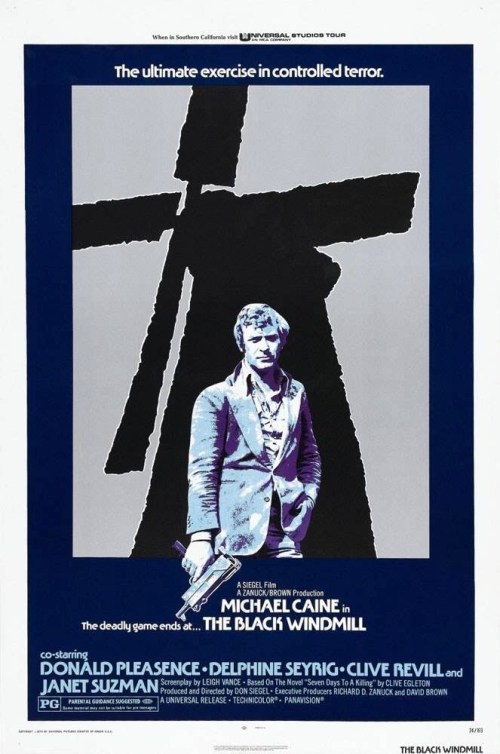
Michael Caine plays Major John Tarrant, a British Intelligence Officer, whose young son David (Paul Moss) gets kidnapped by an underground criminal organization headed by McKee (John Vernon). McKee is aware of John’s profession and insists that to get his son back he must fork-over some uncut diamonds, which had already been purchased to fund another operation. John informs his supervisor, Harper (Donald Pleasance), about their demands, but Harper begins to suspect that John may have orchestrated the kidnapping himself and thus refuses to go along with the turnover of the diamonds. Frustrated John decides to deliver them himself, but finds that he’s put himself into a perilous situation that he might not be able to get out of.

The film is based on the novel ‘Seven Days to a Killing’ by Clive Egleton and directed by Don Siegal who’s most notable for having done Dirty Harry. On the technical end it’s masterful. The lighting and editing are pristine and shot on-location in England in many scenic spots including the historic, but now closed Aldwych underground train station and the Shepherd’s Bush station as well as the climactic sequence, which takes place at the Clayton Windmills, known as Jack and Jill with Jill being built in 1821 and Jack in 1866. There’s also a terrific supporting performance by Pleasance who plays this uppity agent who won’t allow smoking in his office, nervously fiddles with his mustache, and is shocked by the forwardness of one of the other elderly agent’s younger wife, played by Catherine Schell. In fact his eye brow raising expression during his visit with her is one of the more amusing moments in the film.

The story seems a bit pedestrian with elements stolen from other better spy films including a Q-like moment where a  researcher shows Harper and John how they’ve come-up with a new invention, which is a briefcase that can shoot bullets just like a gun. Another segment has John being followed by a bad guy while hopping onto the subway, which looks like it was taken straight out of The French Connection, though much better done there.

There’s also the part where John, upset with Harper’s refusal to deliver the diamonds, breaks into Harper’s office and steals the key to the bank safe that has the diamonds in it, but this seems much too easy. You’d think an operation that has lights on top of the office doors, with green to be allowed in and red to be locked, would have a better contraption to stop someone from breaking in like burglar alarms to sound when somebody trespasses, or laser beams that would trip off and sound alarm on a mobile device carried by a security guard. Yet John is able to break-in with hardly any effort and the way he tries to disguise his voice to sound like Harper is pathetic and should’ve been enough to alert the bank manager that something fishy was going on. Also, you’d think Harper would have his eye on John, or had someone else keep tabs on him since he’d most likely be angry over the news that the agency wasn’t going to help him and thus already be predicting that he’d make an effort to steal the key before it actually happened.

The biggest issue though is that John is not emotional. His stoic nature makes him seem almost inhuman and like he may not actually care about his son’s safety at all. Supposedly this is because he’d been trained as an agent to hide his feelings, but the viewer still needs to see his softer side at some point, so we know he’s suffering inner turmoil about what’s going on and the fact that this is never shown makes it hard for us to side with him. It also gives Caine one of the flattest performances I’ve ever seen and is so stone cold it could’ve been done by a robot and you’d never know the difference.

The kid is far more engaging and if the movie had shown him more it might’ve worked better, or at least shown John and the boy together, we only see a fleeting few seconds of a photo of them, but we should’ve viewed them in a fun activity before the kidnapping, so we could feel the bond that is otherwise quite hollow. John’s relationship with his wife, played by Janet Suzman, doesn’t gel either. They’re already separated apparently because John put his career ahead of the family, but there needed to be more of an arc to make it interesting like having them bitterly at odds at the beginning only to realize they must put their animosities behind them in order to work together to find their son, but here there isn’t enough dramatic friction between the two, so seeing them rekindle things near the end packs no punch at all and like with everything else here emotionally vanquished for the audience.

My Rating: 5 out of 10

Released: May 17, 1974

Runtime: 1 Hour 46 Minutes

Rated PG

Director: Don Siegel

Studio: Universal Pictures

Available: DVD, Blu-ray

The Day of the Dolphin (1973)

dolphin2

By Richard Winters

My Rating: 3 out of 10

4-Word Review: Training dolphins to talk.

Jake Terrell (George C. Scott) along with his wife Maggie (Trish Van Devere) run a remote island research station where, along with a small team of researchers, try to teach dolphins to communicate with humans. They’re prime subject, which they’ve been working with for 4 years, is Alpha whom they’ve successfully trained to speak some English words, but when they team him up with another dolphin named Beta he goes back to his old ways of communicating and no longer speaks with Jake, or his team. Things become further hampered when Curtis (Paul Sorvino) arrives on the island supposedly under the guise of being a journalist, but in reality he’s a spy there to infiltrate what Jake has been doing with the dolphins and report back to a secret government organization who want to then use the dolphins for their own nefarious means.

With the early success of director Mike Nichols and screenwriter Buck Henry, especially The Graduate, it seemed like these two could do no wrong and they both became a much sought after Hollywood commodity and given many top project offers. This production though came crashing down horribly and stymied Nichols career, which had previously been skyrocketing, for the rest of the decade as he helmed only one other film after this during the 70’s before finally getting his reputation back in order with the critically acclaimed Silkwood.

This thing comes-off as a misfire almost immediately and the biggest problem are the dolphins. There’s just so much they can do, liking mainly jumping in and out of water, until it becomes really boring. The long dream-like segment of watching Jake swim around in the tank with the dolphin adds nothing and got so prolonged that it practically put me to sleep. The only part where the dolphins did hold my attention was when Jake decides to split the two up where Beta is put in a pool on one side and Alpha the other and a steel partition between them. This then causes the dolphins much stress as Alpha angrily smashes his tail repeatedly against the partition in anger, but to no avail. While I did find this moment to be rather intense it does backfire in a way in that it makes Jake and the other researchers seem cruel and you start to not like them, which I don’t think was the filmmaker’s intent.

Having them learn to talk was misguided and makes it seem like a silly flick for kids with no barring in reality. Initially I was okay with them learning a few words as it came-off like they were parrots repeating sounds that they had heard, so it was borderline plausible, but then having it graduate to the point that he and others can have ongoing conversations with them and even ask them questions is when it starts to get too absurd for its own good.  In fact the only moment in the film that’s truly fascinating to see is when a mother dolphin gives birth using actual footage, which made me believe this would’ve been better off had it been done as a documentary and the fictional story left out completely.

Sorvino does add some energy with his scenes and pretty much outclasses Scott, who with his $750,000 salary, which would equate to $5,484,886 in today’s dollars, is quite dull and he manages to get completely upstaged by even the dolphins themselves. All of the main characters are quite one-dimensional, especially Van Devere who seems to agree with Scott on everything and echoes whatever point-of-view he has making her presence completely unneccesary as she’s simply him in a female form.

Having one of the research crew members turn out to being a spy doesn’t work either as the viewer is given no forewarning about this. We’re just informed later that this individual had betrayed them, but a good movie should offer hints upfront that a traitor may be in their midst and thus allow the audience to become more of an active participant as they try and figure out which of them it is. The secret government organization thing gets equally botched. A better scenario would’ve had a former friend, or associate to Jake turn on him and seek revenge by trying to destroy the research facility and all of their findings. He would be constantly lurking about, which would’ve added more ongoing tension that is otherwise lacking and given the bad guy more of a personality versus the bland government agents that are too generic to be either frightening, or memorable.

My Rating: 3 out of 10

Released: December 19, 1973

Runtime: 1 Hour 44 Minutes

Rated PG

Director: Mike Nichols

Studio: AVCO Embassy Pictures

Available: DVD, Blu-ray

The Osterman Weekend (1983)

osterman1

By Richard Winters

My Rating: 7 out of 10

4-Word Review: His friends are spies.

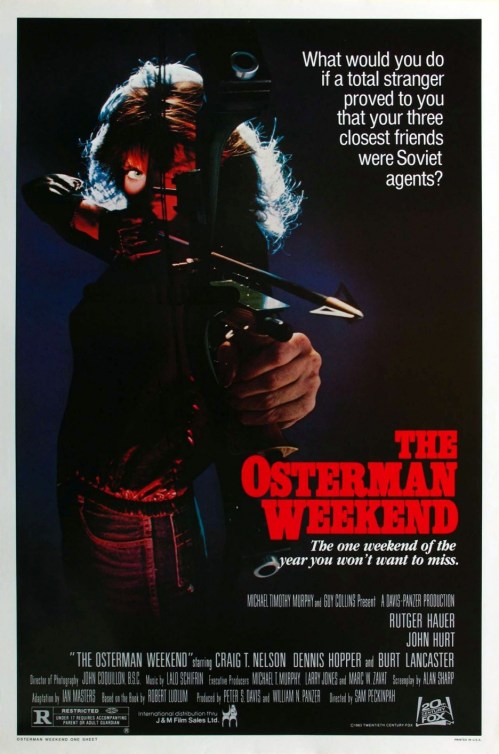
Based on the 1972 Robert Ludlum novel of the same name the story centers around John Tanner (Rutger Hauer) a controversial host of a TV show where government officials are interviewed and many times put on the spot by Tanner who harbors anti-establishment political leanings. Maxwell Danforth (Burt Lancaster) is the director of the CIA who along with fellow agent Laurence Fassett (John Hurt) have uncovered a Soviet spy network within the US known as Omega. The decision is made not to arrest the three members (Craig T. Nelson, Dennis Hopper, Chris Sarandon) that have been identified as the spies, but instead try to get one to turn on the others and thus expose the organizations without tipping-off the KGB that they were aware of it all along. Since Tanner went to college with the three men and plans to have a weekend get-together with them at his place he gets chosen by Fassett to carry-out the trap where he’ll try to get one of his friends during the two-day stay to turn on the others. Tanner initially resists, but eventually agrees and has his whole house rigged with secret cameras and microphones, so the CIA is fully aware of everything that goes on, but ultimately Tanner begins to suspect that things may not be as they seem.

This was director Sam Peckinpah’s final film and 5 years after releasing his last one ConvoyHe was already quite ill due to effects of substance abuse and had to take frequent naps during the shooting day, but still managed to get the movie released on-time and within budget. Many have felt this was one of his weaker efforts, but I came away enjoying it despite the fact that Peckinpah despised the story and the Ludlum novel of which it was based and only agreed to the it because he needed the work. What I liked best was his patented use of slow-motion photography. Here I felt it came into use in excellent ways especially during the car chase. Most chase sequences in movies can get confusing because it’s usually done at fast speeds making it hard to follow and many times done with jump cuts, but here because it gets slowed down it made it more dramatic particularly with the crashes.

Admittedly some of his other directorial touches were a bit odd. The opening sequence showing two naked people in bed together making love, which was shot on video tape and has a romantic music score, making it seem like a soft core porn flick and had many of members of the film’s test audience confused and even walking out in disgust. There is a surprising level of nudity, including seeing Cassie Yates topless, that I didn’t feel was necessary. There’s also touches of humor that I didn’t care for either. Apparently this was Peckinpah’s attempt to balance the violence, but it hurts the tension. The producers didn’t like the comical bits either and cut most of them out when Peckinpah got fired during post production, but a couple do remain, which are amusing, like when Hurt has to be pretend on-the-spot that he’s a television news reader giving an impromptu weather report, but still out-of-place for this type of story.

Many critics complained about the elaborate plot Roger Ebert stated in his review that it ‘made no sense’ and caused him to become ‘angry at it’ as a result. Vincent Canby of the New York Times described it as ‘incomprehensible’ and Dave Kehr of the Chicago Reader labeled it ‘a mess’. I didn’t have such difficulty following it and although it’s a bit intricate it isn’t really all that confusing as long as you pay close attention and the twists that do occur I found enjoyable and many times was already predicting. My one complaint was be the way Tanner gets so easily persuaded that his friends, people he’s known for a long time and is very close to, are spies and he immediately turns against them. This is also a man that is supposedly ‘anti-government’, so you’d think he might like the fact that his friends are spies. A good way to have avoided this was having the character not hosting a liberal talk show, but instead a conservative one where Tanner would be a patriotic, pro-American type guy and thus making his acceptance of what the CIA agents tell him more plausible.

It’s interesting seeing Hauer, who usually plays villains, being a good guy, while Lancaster being a perennial protagonist, mixing it up here as a baddie. Both play against type well and the supporting cast has their share of moments too including Craig T. Nelson as a judo fighting expert and Hopper, who should win the award for best nervous expression. In all though it’s Helen Shaver that steals it as Hopper’s cocaine addicted wife. She’s not likable in any way and actually quite annoying, but she definitely stands-out with has a few choice moments.

Spoiler Alert!

I will admit that the ended, where Tanner tries to out the CIA director during an interview on his TV-show, doesn’t work and becomes one twist too many. Having Hauer simultaneously speak on-the-air in his studio and then show-up at the same time at Hurt’s hide-out didn’t seem realistic. Apparently this occurred because the show was taped early and only given the illusion that it was done live, but how they were able to pull all that off is a stretch and having his friend Nelson suddenly become a seasoned in-studio director when that wasn’t his job otherwise didn’t jive either. It’s not enough to ruin everything that came before it, which I overall enjoyed, but it’s still a lame ending either way.

My Rating: 7 out of 10

Released: September 30, 1983

Runtime: 1 Hour 43 Minutes

Rated R

Director: Sam Peckinpah

Studio: 20th Century Fox

Available: DVD, Blu-ray, Amazon Video, Fandor

Real Men (1987)

real1

By Richard Winters

My Rating: 5 out of 10

4-Word Review: CIA negotiates with aliens.

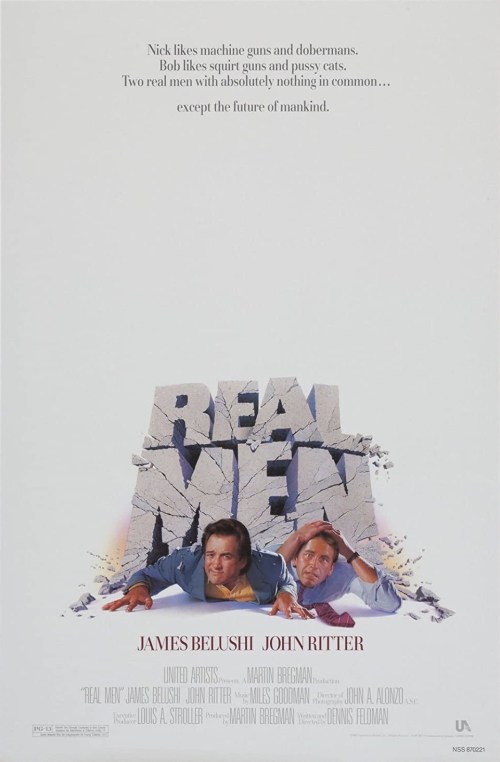
Insurance agent Bob Wilson (John Ritter) gets reluctantly recruited into becoming a CIA agent by another agent named Nick (James Belushi). Nick needs Bob because he looks very similar to an agent named Pillbox (Ritter) who was killed in the line of duty while going through a practice run of delivering a glass of water to some outer space aliens. The aliens had agreed to help the human race when the humans accidentally spilled a deadly chemical into the ocean that’s expected to destroy all life on earth in 5 years. The aliens give the earthlings two choices either the package that will help them clean up the toxic spill, or the other package, which is a deadly weapon that will destroy the planet. The only thing the aliens want in return is a glass of water delivered directly to them by Pillbox, but agents from other countries as well as rogue CIA members don’t want this deal to go through as they’d rather get their hands on the deadly weapon, so they kill Pillbox and now it’s up to Bob to make the water/package trade-off in Pillbox’s place, but Bob thinks Nick is crazy and doesn’t believe the story he’s telling him. Bob is also very timid and hates confrontations, so it’s up to Nick to give him the needed confidence while also stopping him from running away, which he does routinely.

Extremely odd mix of weird humor and sci-fi works for the first half before taking a completely downward spiral by the third. The script was written by Dennis Feldman, who spent years as a still photographer before deciding to try his hand at script writing after his brother Randy sold a couple of his own scripts that were made into movies. Dennis’ first one was Just One of the Guys and then his second was Golden Child, which sold for $330,000 and he was also given the opportunity to direct, but he declined the directing option feeling he wasn’t ready only to regret it when the director who ultimate was hired, Michael Ritchie, changed his story in ways he didn’t like. When the opportunity to direct came again he made sure to choose it.

Much like an indie flick the quirkiness is strong, but engaging. The humor is centered on the way it twists the logic around, so nothing works the way you’d expect while also playfully poking fun at tropes used in other spy genre movies. Ritter is terrific playing against type. Usually he’s the center of the comedy, but here he responds to the zaniness around him with perpetually nervous, shocked expressions. Belushi, with his glib responses and stoic nature where no matter how dire the situation he remains completely calm and collected, is funny as well and the two make a unique pair.

Unfortunately during the second half the chemistry gets ruined when Ritter’s character has this extreme arch where he goes from timid to overly confident. His confident side isn’t as funny and the way he’s able to beat-up anybody with just one punch gets highly exaggerated. I was okay with it occurring once or twice, but at some point his brazenness should catch-up with him. The movie acts like confidence is all you need to find success, but it can also backfire by putting one in situations that gets them way over-their-heads and for balance the story should’ve had this ultimately occur. You’d also think Ritter’s hand would be hurting, or even broken with the way he is constantly punching everybody. Belushi’s diversion into dating a BDSM queen bogs the pace down and takes away from the main action. The wrap-up offers no pay-off and the film despite its bright start fizzles.

Like with most 80’s movies it’s always fun seeing how things have changed as well as stayed the same. Humor-wise there’s a moment where at the time it was considered innocuous, but by today’s standards would be deemed offensive. It occurs when Belushi takes Ritter home to meet his parents where it’s revealed that his father (played by Dyanne Thorne of Ilsa movie fame) has had an operation to become a woman. This is spun as being ‘comically freakish’, but in today’s gender fluid culture would be portrayed differently. The element that remains the same is the portrayal of Russia, which at the time was considered the enemy and rival of the US and now even after the fall of communism and the supposed ending of the cold war, it’s still the same arch rival.

My Rating: 5 out of 10

Released: September 25, 1987

Runtime: 1 Hour 25 Minutes

Rated PG-13

Director: Dennis Feldman

Studio: United Artists

Available: DVD, Blu-ray