Category Archives: Sports Movies

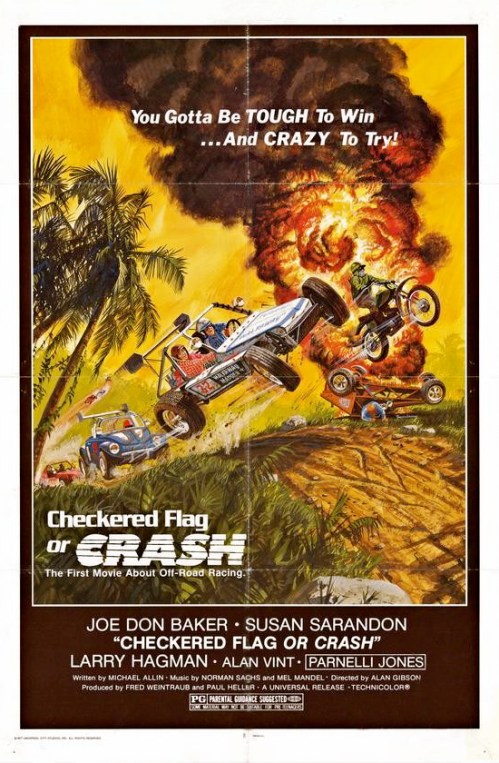
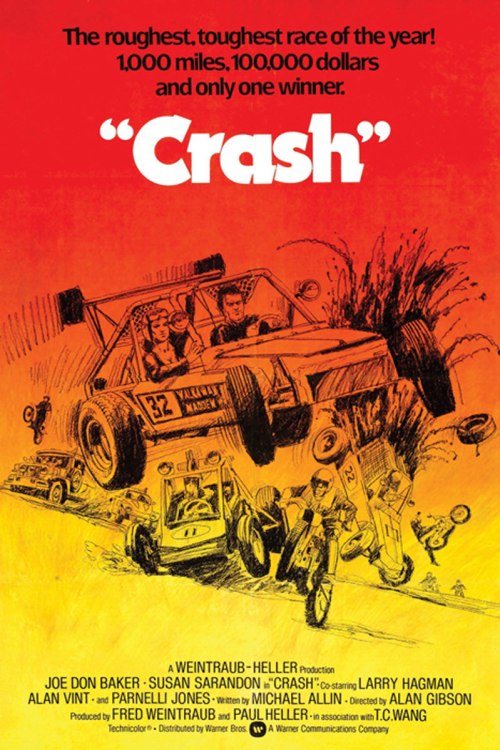
Checkered Flag or Crash (1977)

checkered flag 2

By Richard Winters

My Rating: 2 out of 10

4-Word Review: Drivers race off-road.

Walkaway Madden (Joe Don Baker) is a lifelong racer who has just broken up with his racing partner of many years and is now going solo, or at least he thinks he is until reporter C.C. Wainwright (Susan Sarandon) arrives and tells him that the company who sponsors his car has hired her to cover the race for their newspaper and thus she’ll be riding along with him. Walkaway isn’t too happy about this as he has very old-fashioned, sexist ideas about a ‘woman’s place’, but begrudgingly accepts it as he has no other choice. Together the two take part in a grueling off-road race that is organized by Bo Cochran (Larry Hagman) and takes them through some of the most treacherous terrain of the Philippines.

The movie might’ve been more exciting had the racing footage been better captured. Instead we get treated to choppy shots of random car wipeouts and flashing, poorly focused images of vehicles buzzing through various locales while shown in a grainy film stock. The editing is so quick that it’s hard to follow what is going on and the only time it is ever impressive is when the camera gets tied to the front of the vehicle and we see firsthand just how bumpy and fast a ride like that must be, but this shot unfortunately is only brief.

There is little or no backstory to any of the racers and therefore no emotionally compelling reason to cheer for any of them. There is also too many of them and all are generic, transparent characters, so when you see someone wipeout it’s hard to remember which one it is, or even care. I did kind of like Daina House as a woman with beautiful model-like features who dresses in all black and just as tough as any of the guys, but her character isn’t shown or played-up enough.

The best thing about the film is the presence of Sarandon who lends a necessary grounded anchor to the silliness that surrounds her. Hagman is terrific as the hyper race promoter and every scene he is in is far more entertaining than any of the racing footage. Baker isn’t bad either. He certainly isn’t any A-list actor, but a very competent B one, who seems at ease in both comedy and action parts.

The film shifts clumsily between being silly and gritty and would’ve done better had it stuck to a more consistent tone. It’s also cheap and amateurish with a terrible, country tinged title tune that gets played throughout. The only reason it gets 2 points is simply for the performances of its three leads.

checkered flag 1

My Rating: 2 out of 10

Released: June 3, 1977

Runtime: 1Hour 31Minutes

Rated PG

Director: Alan Gibson

Studio: Universal

Available: None at this time.

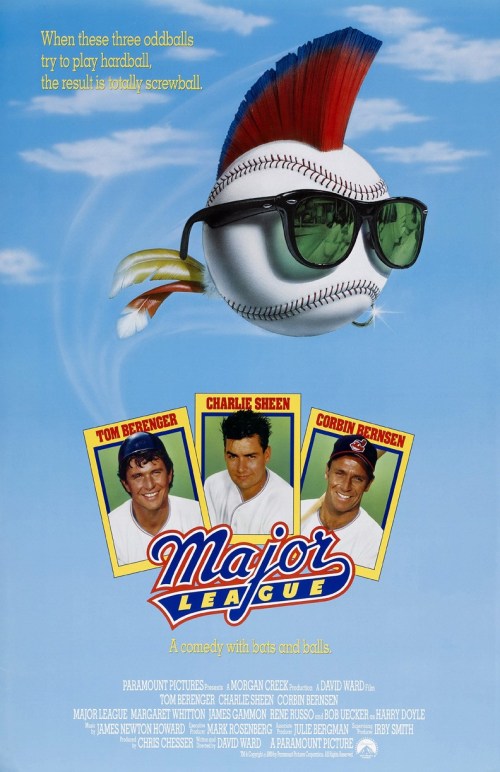
Major League (1989)

major league

By Richard Winters

My Rating: 6 out of 10

4-Word Review: Cleveland Indians become winners.

Rachel Phelps (Margaret Whitton) is the new owner of the Cleveland Indians and her goal is to move the team to the sunnier locale of Miami. She finds a clause in the lease stating that if the team is unable to attract 800,000 in attendance for the season then she will be able to break the contract without penalty. Her plan then is to assemble the biggest bunch of misfits that she can, so that they’ll be so bad nobody will want to watch them, but her idea backfires as the losers somehow find a way to win.

I remember seeing this movie when it was first released and being unimpressed with it as it seemed to be taking the Rocky underdog, lovable-loser theme to redundant heights and beating a tired formula that was already getting stale. It was like The Bad News Bears, but without the interesting subtext. The plot is so obvious that you know where it’s going right from the start and thus making it almost pointless to watch. Unlike Bull Durham it offers no new insights into the nuances of the game and the crude humor is only amiable at best.

However, upon second viewing I found it to be a passable time-filler and the crowd scenes during the film’s climactic game sequence were impressive. Most films, even the good ones, have a hard time recreating the kinetic atmosphere of a live game, but this film manages to hit-the-mark and made me feel like I was watching an actual contest.

The casting is also good with each actor a perfect fit for their part especially Charlie Sheen and Corbin Bernsen. I also enjoyed Chelcie Ross even though he was 46 at that time and looking a bit too old to still be playing. However, his character’s attempts to convert everyone to Christianity particularly the player that practices voodoo is amusing. I also enjoyed James Gammons as the manager as his character is refreshingly sensible and grounded and works as a much needed anchor to the silliness.

Whitton, who hasn’t appeared in a film in over 20 years, is great as the bitchy owner and is hot-looking as well. However, I couldn’t quite buy into the fact that she stubbornly continued to cheer against the team winning even after it became painfully clear that her hoped for low attendance mark would never be reached. If anything their winning would help the team’s market value and she could sell them at a nice profit and move herself to the sunny beach. With all the national cameras most likely trained on her during the playoff game why not, at least at the very end, have her begrudgingly get with the crowd and show some appreciation for what the players had accomplished.

I also got a bit of a kick out of a life-sized cardboard cutout that is created of her and a piece of its dress ripped off with each win that the team gets, but writer-director Ward chickens out on his own outrageous concept by having the figure still wearing pasties and a bikini bottom even after the dress is fully removed. The players still cheer raucously at the sight of it nonetheless, but in real-life I think there would’ve been boos as they most likely would be expecting full nudity and disappointed when it didn’t materialize.

The side story dealing with Tom Berenger’s character trying to reconcile things with his estranged wife that is played by Rene Russo is contrived and unnecessary and with the runtime being so long, especially with such a threadbare storyline, should’ve been cut out entirely. I also found it a bit annoying the way Berenger’s character barges into her apartment and her fiancée’s unannounced and without even bothering to knock. Most people lock their doors behind them once they get inside and thus making his attempts to ‘sneak-in’ unlikely anyways.

The majority of the film was shot in Milwaukee and not Cleveland making me wonder why they didn’t just use the Milwaukee Brewers as the team since their history is almost a dismal as the Indians. It’s also important to note that we are only shown what happens in the pennant and never the World Series, which is just as well as the whole thing is a bit fantastical anyways especially given the rooster’s woeful talent and having them go all the way would’ve been too much of a stretch even for a wishful thinking, feel-good movie such as this.

My Rating: 6 out of 10

Released: April 7, 1989

Runtime: 1Hour 46Minutes

Rated R

Director: David S. Ward

Studio: Paramount

Available: DVD, Blu-ray, Amazon Instant Video, YouTube

The Honkers (1972)

honkers 3

By Richard Winters

My Rating: 5 out of 10

4-Word Review: Rodeo star is selfish.

Lew Lathrop (James Coburn) is an aging rodeo star who returns to his hometown after an extended absence, which stirs up resentment and trouble wherever he goes. His wife Linda (Lois Nettleton) still has feelings for him despite her anger at him leaving her and never being able to stay faithful. It seems that the only true friend that he has and one that remains loyal to him even through his many shortcomings is rodeo clown Clete (Slim Pickens), but even this gets put to the test when Lew decides to jeopardize is family life once again when he decides to go after local hottie Deborah (Anne Archer) a young woman just past the age of consent who enjoys flirting with older men and shows no reluctance in having her way with them.

The film was directed by actor Steve Ihnat who never saw the final product put on the big screen as he died from a sudden heart attack at the young age of 37 five days before the film’s release. Much like with Junior Bonner and JW Coop, which came out at the same time, this has an authentic feel with the necessary level of grittiness and good rodeo footage,  but the scenes go on too long and the pace is too laid back. One shot has Coburn walking down the city sidewalk for a full several minutes with nothing else happening. Extended shots of a downtown parade and broncos bucking off cowboys in the rodeo ring are all nice, but fail to propel the plot, which seems pretty thin anyways and almost makes this come off like a documentary than a feature film.

Coburn is his usual engaging self, but seems genuinely uncomfortable getting on the broncos and even a bit out-of-place in the role. Pickens is outstanding in support it what may be the best film role of his career. Usually, especially with his country accent, he would get subjugated to hillbilly parts, but here he gets to show his dramatic side by playing a rodeo clown, which is what he did for many years in real-life before becoming an actor. Archer, in only her second film role is quite seductive and possibly at her most beautiful though the many shots showing her wearing headbands start to make her resemble Pocahontas.

Filmed entirely on-location in Carlsbad, New Mexico director Ihnat manages to take full advantage of the rustic western landscape and brilliant blue sky of the region, which is a major plus. The ending has a nice surreal quality and the story does manage to pick up a bit during the second half, but it still could’ve been better trimmed and more compact.

My Rating: 5 out of 10

Released: May 17, 1972

Runtime: 1Hour 42Minutes

Rated PG

Director: Steve Ihnat

Studio: United Artists

Available: None at this time.

Against All Odds (1984)

against all odds

By Richard Winters

My Rating: 4 out of 10

4-Word Review: Searching for missing girlfriend.

Terry Brogan (Jeff Bridges) is an aging football player who gets cut from the team and in desperate need of cash. He reluctantly accepts a paying assignment from his friend Jake Wise (James Woods) which has him traveling to Mexico in search of Jake’s girlfriend Jessie (Rachel Ward) who just so happens to also be the daughter of the team’s owner (Jane Greer) that cut Terry from the squad. Terry manages to find Jessie rather quickly and the two promptly fall in love, which propels a string of odd events that soon has Terry embroiled in a complex criminal scheme that threatens both his life and others.

This film is a remake from the 1947 film noir classic Out of the Past, but it does not fare as well as the original. The main problem is that it requires the viewer to make some major leaps in logic and only proceeds to get more implausible as it goes along. The fact that both Jake and the team’s owner want to hire Terry to find Jessie is the biggest issue. Why would these two want to throw gobs of money at someone who has no experience in finding people or know the first thing about the process. They wouldn’t hire him to fix their car if he had no experience in that area, so why expect him to have any ability in finding a missing person. Professional private eyes have spent years tracking down people and have attained skills that a novice wouldn’t, so why not just leaf through the Yellow Pages of their local phone book and hire a private investigator with good credentials to do the job instead?

Terry also locates Jessie much too quickly. Mexico has a population of 125 million people and yet in only a couple days he miraculously spots her buying food from across the street from where he is having a drink. In equally miraculous fashion she is somehow able to, after only speaking to him briefly, figure out which hotel he is staying at and bursts into his room unannounced the next day, which is also dumb because who leaves their hotel room door unlocked especially when staying in a foreign country? Later the Alex Karras character is somehow able to find the two as they make love inside an ancient Mayan temple deep inside the remote jungles of the Yucatan, which again is highly questionable and probably even more implausible than the other two examples mentioned above.

The motivations of the characters are another issue. There’s a scene where the Swoosie Kurtz character, as a favor to Terry, goes into a dead man’s office to retrieve some important files from a safe while having a Doberman growling at her and a corrupt security guard ready to harm her at any second, but why someone would put their life on the line for somebody that they really don’t know that well is nebulous and in reality wouldn’t occur.

There is also a scene involving Jake and Terry drag racing down the busy streets of L.A. in broad daylight. Some fans of the film consider this to be quite exciting, but I found it to be unrealistic as it is hard to believe that they could get away with it without catching the eye of a traffic cop as they were doing it. Having two middle-aged men be so utterly reckless not only with their own lives but those of the other drivers is also hard to imagine and puts their most prized possessions, which is their snazzy sports cars in jeopardy of getting totaled. Going to some other less traveled place to do their off-road racing would’ve made more sense.

On the plus side Larry Carlton’s moody soundtrack is great and helps create just the right tone. I also thought Ward was a perfect choice for her role as she is quite sensual and seductive without ever overdoing it. The film also scores with its breathtaking Mexican scenery.

I liked that Greer, who starred in the original version, gets cast as Ward’s mother and although I felt Richard Widmark does quite well as the heavy I was disappointed that the role wasn’t offered to either Robert Mitchum or Kirk Douglas as they had appeared in the original as well.

The plot features many twists, which keeps it mildly interesting, but it also borders on getting convoluted and is never emotionally compelling. The ongoing love affair between the two leads ends up being annoying as well. For one thing she two-times him while also bailing on him the moment things got tough. If a person does that to someone once they will do it to them again if given the chance, so ‘losing’ her wasn’t much of a loss and makes the image of her crying for him, which gets shown over the closing credits, all the more melodramatic and over-the-top.

My Rating: 4 out of 10

Released: March 2, 1984

Runtime: 2Hours 1Minute

Rated R

Director: Taylor Hackford

Studio: Columbia Pictures

Available: DVD

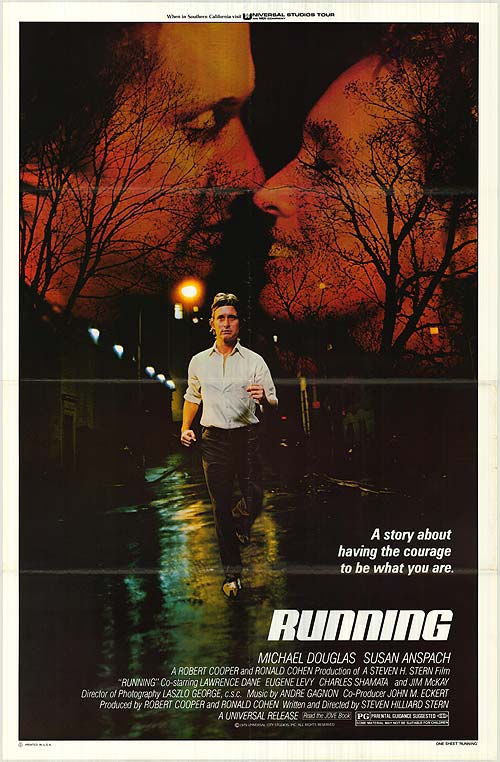
Running (1979)

running 1

By Richard Winters

My Rating: 5 out of 10

4-Word Review: Life of a runner.

Michael (Michael Douglas) is suffering, at the age of 32, a midlife malaise. He goes from one dead end job to another and his marriage is crumbling. He runs to relieve the stress and finds that he has a major passion for it. When he qualifies for the Olympics he is initially excited, but it’s short lived because his former coach (Lawrence Dane) is on hand to constantly remind him how he has a tendency to ‘choke’ at the last minute and can never win a race when the pressure is on, which begins to wear on him psychologically.

The theme of a middle aged man having a passion for something that isn’t exactly ‘practical’ and resisting the pressures from the rest of world that tries to get him to conform to something that is, is highly relatable. I also liked the side-story dealing with the psychological element, which plays a far stronger factor in sports and amongst athletes than one might think. However, the majority of the screen time is spent with Michael trying to reconcile with his wife Janet (Susan Anspach) making it seem more like a romance and seemingly added in as ‘filler’ because the filmmakers believed that the running theme wouldn’t be enough to  carry it.

I also had a hard time understanding why the kids at high school, or at least his daughter’s friends, which gets played by Lesleh Donaldson in her film debut, would make fun of Michael simply because he was frequently seen around town running. I see joggers and runners every day and saw a lot of them back in the ‘70s too, so I don’t get why that would be a source of mockery and it seems like it was yet another manufactured dramatic element put in to give it more conflict. What’s even worse is when Michael finally qualifies for the Olympics then the kids do a full 180 degree turn and get excited about it and even run with him down the city streets, which gets corny to say the least.

Halfway in you realize this is just another variation of the Rocky formula and normally I would’ve found it annoying, but for some reason I actually got into it. I even liked the scene where he spots a giant cross standing on a hill and decides to run up the incline to reach it much like Rocky climbing the steps of the Philadelphia Museum of Art and to some degree it’s invigorating although it would’ve been nice had it shown him standing next to the cross once the climb was achieved. The final segment that takes place during the climactic Olympic race even has a twist to it that I didn’t see coming and to a degree it’s interesting though pushing plausibility. I won’t give it away I’ll just say that he doesn’t win the race, but he doesn’t exactly lose it either.

Douglas did all of his own running and to prepare for the role he would run many miles a day; IMDB states that he ran 50 to 60 miles a day, which I found hard to believe, so we’ll just say it was ‘many’. Anspach is good as the sympathetic wife particularly when the character has a conflict of emotions and breaks out in tears. Eugene Levy appears with a full afro in a rare serious turn as Michael’s attorney. Lawrence Dane is okay as the hardened coach who dispenses a lot of ‘tough love’, but little else.

My Rating: 5 out of 10

Released: November 2, 1979

Runtime: 1Hour 42Minutes

Rated PG

Director: Steven Hilliard Stern

Studio: Universal

Available: DVD (Italian Import Region 0)

Below the Belt (1980)

below the belt 1

By Richard Winters

My Rating: 4 out of 10

4-Word Review: Waitress becomes a wrestler.

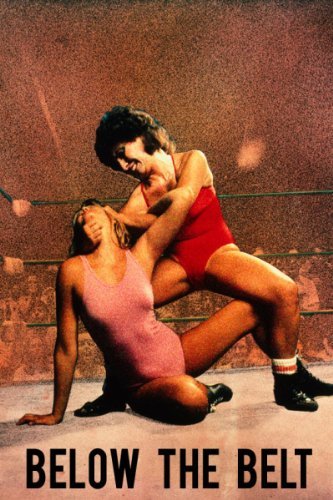
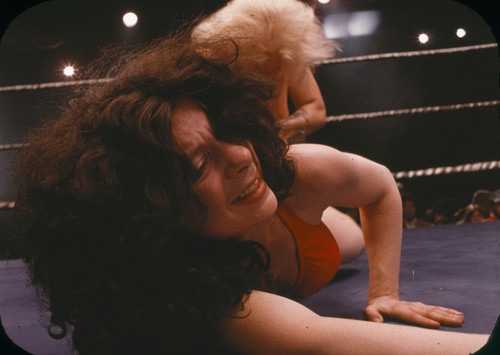
Rosa (Regina Baff) works as a waitress at a sports arena who one day catches the eye of wrestling promoter Bobby Fox (John C. Beecher) after she decks a guy who tries to get fresh with her. Fox is in need for a new wrestler to promote and feels she’d make a perfect fit despite her having no experience in the sport. Since she is bored with her job and low on funds she decides to take him up on his offer, but finds that life in the wrestling world can be quite lonely and grueling and the promises of fame and fortune are fleeting.

Unlike Grunt! The Wrestling Movie, which was reviewed last week, this movie does not take a fan’s perspective of the business nor does it get caught up in the colorful caricatures or silly storylines. Instead it reveals a rather bleak look at the hardships faced by those working the circuit and how emotionally and physically taxing it can be living on the road and going paycheck-to-paycheck. In fact there is more footage shown of them behind-the-scenes preparing for a bout than an actual match although the climax does feature Rosa, dubbed the Mexican Spitfire, taking on defending champion Terrible Tommy (played by real-life wrestler Jane O’Brien) who plays dirty, doesn’t have any front teeth and even beats up on the referee.

Comical moments get spread throughout, but they tend to get overplayed and don’t work. What grabbed me was the main character and how relatable her situation was particularly the way her life was unfocused and her inability to stick with any job for too long, which her boyfriend and father nag her about, but then when she tells them about her new found wrestling passion they scoff and show no support. I also liked how the film examines both side of the age spectrum including Thalia (K.C. Townsend) who lies about her age and pretends to be older than she is simply so she can escape her tedious small-town life and get into the wrestling circuit, which she considers her ‘big break’ while on the other end there’s Verne (Sierra Pecheur) who’s in her late 30’s and been in the business for many years and now feels trapped and unable to get out.

Baff, with her plain looks, is a good representation of the average young woman still struggling for direction, but her thin body made me think she wouldn’t be able to handle the rigor of the sport in real-life. Shirley Stoler is on the opposite end as she was quite overweight and humorously carries around a handgun with her to fight off all the would-be rapists that she feels are lurking in the shadows and ready to attack her at any minute. Dolph Sweet is also memorable as an aging wrestler who reluctantly realizes that the business and his passion for it have passed him by.

There’s a heavy dose of blues music that gets played frequently throughout. To some extent the soundtrack, with songs sung by Billy Preston, Jennifer Holliday and the Voices of Deliverance, lends flavor and distinction to the proceedings, but it also ends up becoming overdone and intrusive in a film that is alright, but tries a little too hard to make its point.

below the belt 2

My Rating: 4 out of 10

Released: December 10, 1980 (Filmed in 1974)

Runtime: 1Hour 34Minutes

Rated R

Director: Robert Fowler

Studio: Atlantic Releasing Corporation

Available: VHS

Rollerball (1975)

rollerball1

By Richard Winters

My Rating: 6 out of 10

4-Word Review: This game gets nasty.

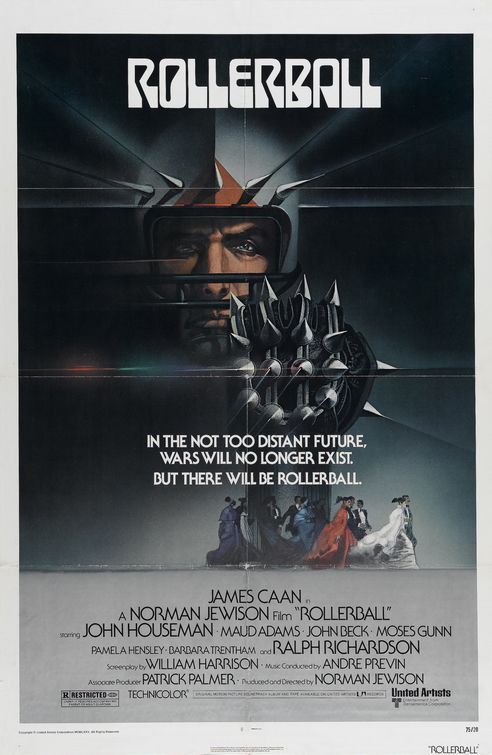
In the not so distant future where no governments or countries exist and corporations control everything a new type of game becomes the rage. It features two teams on roller blades skating around a circular rink while fighting over a silver hand sized ball, which they use to throw into an electronic type of basket and score points. The game features little officiating and can usually cause injury or even death to the players, but one man named Jonathan E. (James Caan) has risen to the top and become a superstar in the sport. Bartholomew (John Houseman) who is the head of the conglomeration doesn’t like this because the idea of the games is to thwart individuality and not promote it. They push Jonathan to retire, but he refuses forcing the games to become even more violent as their way to get rid of him one way or the other, but the more they try to take him down the more he fights back.

The thing I really liked about William Harrison’s script, which is based on a short story of his called ‘Roller Ball Murder’ is how amazingly prophetic it is. Corporations and their rich lobbyists are pulling the strings of the government officials already making them seem as mere puppets and modern day suburbia much like in the movie is really only a tranquilizer  with its comfy lifestyle used to lull everyone into overlooking the many concessions that come with it. The violent games for both the players and fans acts as an escape from their otherwise sterile existence as the outcomes are the only things not already preordained by the corporations and thus giving the players a small sense of control over something.

Unfortunately the film’s set design is not as intuitive as its story and lacks imagination and even seems quite dated. There are no personal computers and the ones that do get shown are quite archaic looking. I have not seen the 2002 version, but this reason alone justifies a remake although the scene where the party guests go outside to play with a ray gun is a keeper.

The game itself isn’t all that interesting and to me came off as a glorified version of roller derby. I thought it should’ve been more graphic and bloody and the film pulls back when it should instead capture the true brutally of the sport. It does get a little more violent as it goes on and I did enjoy the surreal quality of the film’s climatic game where players from both sides end up either killed or severely injured. The segment showing the men preparing for a game by having the Caan character giving pointers to the new players on some of the strategy that is needed helped convey the idea that the sport had a certain technique to it and not simply rollerblading around a rink.

Caan is adequate in the lead, but is upstaged by John Beck as his playing partner as well as Shane Rimmer who plays his coach. It’s great to see John Houseman in his second feature film after his Academy Award winning performance in The Paper Chase, but his close-ups where ill-advised as it made me notice all of his nose hairs and director Norman Jewison should’ve either avoided framing his face from that angle or giving the elderly actor a pair of tweezers to pull them out.

The ending is unsatisfying as it leaves everything on a vague note. We see the fans cheering Jonathan’s moxie, but there is no indication as whether he was able to ultimately stage a revolt, or whether the corporate heads found some other way to get rid of him. In either case I wanted more of a conclusion and the fact that there isn’t any makes it feel like a great concept that wasn’t fully realized.

My Rating: 6 out of 10

Released: June 25, 1975

Runtime: 2Hours 4Minutes

Rated R

Director: Norman Jewison

Studio: United Artists

Available: VHS, DVD, Blu-ray, Amazon Instant Video

The Christian Licorice Store (1971)

christian licorice store 2

By Richard Winters

My Rating: 2 out of 10

4-Word Review: He searches for answers.

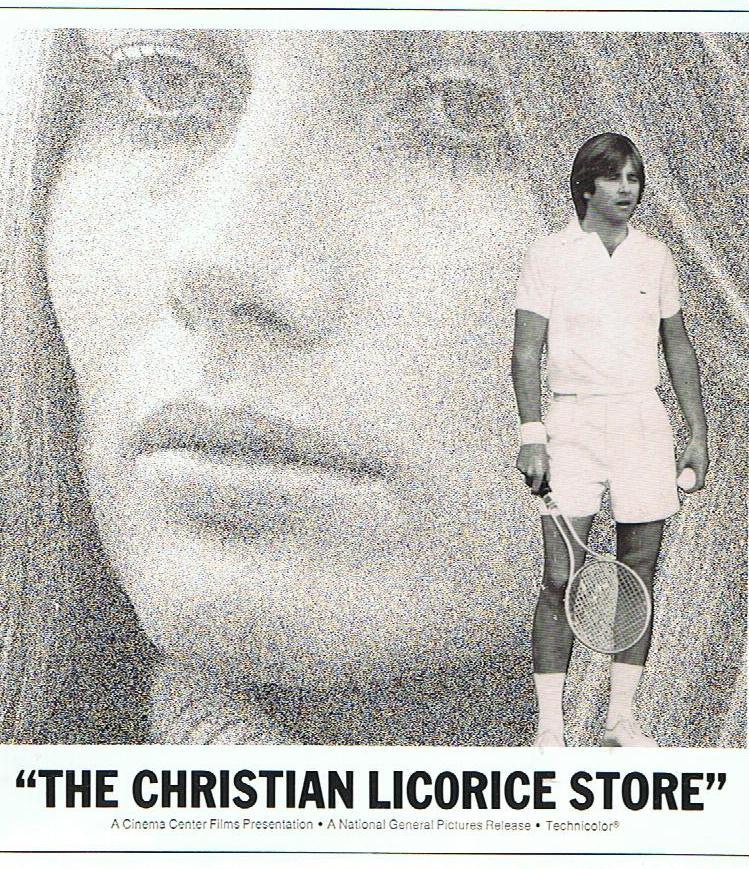
Cane (Beau Bridges) is a successful tennis player who has a close bond with Jonathan (Gilbert Roland) his mentor/coach who at one time during the 30’s was a tennis star himself. Things seem to be going well for him both on and off the court. He even starts fitting in with the chic Hollywood crowd and invited to some of their swanky parties. He meets Cynthia (Maude Adams) a beautiful photographer and their relationship begins to sizzle. Then Jonathan dies suddenly in his sleep and the emptiness in Cane’s life and the people in it come to a head. He begins searching for meaning and finds nothing, which eventually drives him away from his girlfriend, career and life in general.

The film was directed by James Frawley who is the son of actor William Frawley best known for his portrayal of Fred Mertz on the old ‘I Love Lucy’ episodes. James himself dabbled in acting a bit before turning to directing, but proves here to be completely in over-his-head. The attempt to replicate the French new wave type of filmmaking that had become so trendy at that time and done quite well by accomplished directors like Jean Luc Goddard and Michelangelo Antonioni is a disastrous dud and all the more reason why the artsy stuff should stay with the Europeans who have a better handle on it. From the very first shot forward this thing limps along with no pace, story or momentum. The cinema verite-styled takes go on for too long without enough visual flair to help carry it. The perceived ‘sophistication’ is nothing but an empty façade and an embarrassment to watch making it no wonder that the studio shelved this thing for 2 years before finally letting it out to a limited release.

Bridges does well, but the material offers him little to work with. Adams is surprisingly strong and this may be one of her best performances in an otherwise overlooked career. Silent film star Roland is solid as well particularly with the discussion he has with the two leads about aging and the quick passage of time, but he exits the story too quickly. Legendary French director Jean Renoir is the ultimate scene stealer even though he is only in it for less than five minutes, but clearly shows in that brief period how to own the screen and make the most of it in an almost effortless fashion.

The only thing that I liked about this sleep inducing 90-minute bore and actually even found original is the party scene where Beau meets up with several famous directors of the day including Monte Hellman and Theodore J. Flicker. The camera pans between several different side conversations of the various groups of people there and then everyone goes into a small theater to screen a new film where they then watch the opening credits to this film that they are all in, which I found to be kind of cool.

My Rating: 2 out of 10

Released: November 15, 1971

Runtime: 1Hour 30Minutes

Rated R

Director: James Frawley

Studio: National General Pictures

Available: None at this time.

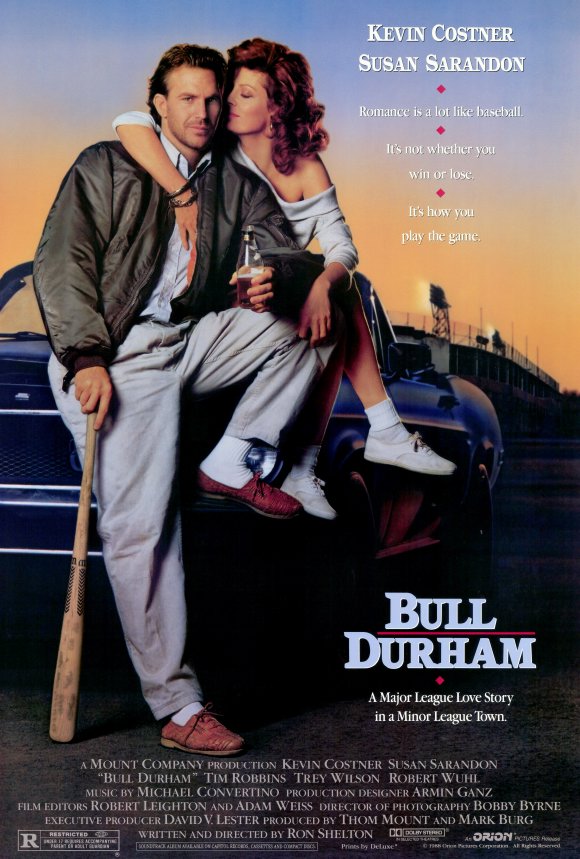
Bull Durham (1988)

bull durham

By Richard Winters

My Rating: 7 out of 10

4-Word Review: Catcher mentors a rookie.

Crash Davis (Kevin Costner) is a veteran of the minor league baseball system and is brought in to the Durham Bulls to help mentor Ebby Calvin ‘Nuke’ LaLoosh (Tim Robbins) a rookie pitcher with a ‘million dollar arm, but a five-cent brain’. Crash teaches Nuke all about the finer points of the game as well as learning to show discipline and control both on and off the field. Annie (Susan Sarandon) is a local fan who each year does some ‘mentoring’ of her own with one of the players by taking them in and having a torrid sexual relationship with them. This year she chooses Nuke much to the consternation of Crash who would like her for his own.

The film is loosely based on the experiences writer/director Ron Shelton had while being a minor league player during the late 60’s.  Keeping the focus solely on the minor league level and never analyzing the majors was to me a big strength. Too many times Hollywood sports movies try to capture that ‘championship season’ or ‘miracle victory’ while forgetting that there are hundreds if not thousands of players who never get to that point, but still have interesting stories to share. The minor league theme puts the game back to its grass roots level where it should be while evoking a wonderful feeling of modern day Americana.

The film makes the viewer feel that they are right down on the field with the players and they gain special insights into the game that they would never have just watching it in the stands on or TV. The thoughts that go through a hitters head as he stands at the plate are interesting as are the interplay between catcher and pitcher. The meeting at the mound scene where the players get together during a game to discuss what wedding gift to get another player who is about to be married is hilarious as is the segment where Crash teaches Nuke all the sports clichés to give when being interviewed by the media.

Robbins is terrific in what I still consider one of the best performances of his career. The character could have been annoying if there weren’t so many young men out there like that. The composite of the young, brash, cocky hot shot who thinks he knows everything, but actually knows very little is so perfectly done that just about anybody will be able to identify with somebody they know or have known who is just like it.

Costner on the other hand is a bit too detached and his performance comes off very much like the restrained way he dances during the closing credits. The character also seems like a flaming alcoholic as he is seen drinking in just about every other scene, but his ongoing exchanges with Robbins are great and the main ingredient that holds the film together.

Throwing in a sex angle was to me a turnoff as personally I never like to mix the two. The Millie (Jenny Robertson) character that is shown and known to sleep with a lot of the players seemed to me to be idiotic especially since this takes place in the 80’s, which was at the height of the AIDS scare.

Sarandon is okay although the part was originally intended for Kay Lenz who I think I would have preferred. The line where her character states that she would never sleep with a player who hit under 250 unless he had a lot of RBI’s and was a great glove man up the middle is classic and the scene near the end where her and Crash make love in a bathtub while surrounded by a throng of lighted candles is on a visual level a highlight.

I loved the bluesy music score as well as the shrine to Thurmon Munson seen at the end. I wouldn’t say this is my favorite sports movie, but the characters are richly textured and the dialogue instantly quotable, which makes it a winner anyways.

My Rating: 7 out of 10

Released: June 15, 1988

Runtime: 1Hour 48Minutes

Rated R

Director: Ron Shelton

Studio: Orion Pictures

Available: VHS, DVD, Blu-ray, Amazon Instant Video

Drive, He Said (1971)

drive he said 1

By Richard Winters

My Rating: 5 out of 10

4-Word Review: Player doesn’t like coach.

This is one of those movies that shows signs of being a really great movie trying to break out, but never does. It’s about Hector (William Tepper) a college basketball star who is being tugged at different directions by those around him and by society at-large. This creates inner turmoil that leads to outbursts, apathy, and even anti-social behavior.

Tepper as the star isn’t the best of actors. He has a constant blank look and way too much hair. The character he plays has potential. It is nice to see a portrait of an athlete that isn’t one-dimensional sports, but instead shows intelligent and sensitivity to things that go well beyond the court. Yet he is also too self- absorbed and displays a selfish behavior that in most cases would alienate him from his teammates. What is supposed to be betrayed as angst instead comes off as an obnoxious, spoiled college kid. His constant rebellion with his coach (Bruce Dern) doesn’t mesh.

The film makes some good observations and brings up great issues. Unfortunately it ends up becoming diluted. In some ways it should have just stuck with the basketball angle. The camera shots that glides with the action during the games is excellent. Some of the scenes during the practice and some of the locker room segments of Dern coaching the team gives the viewer a good taste of the college basketball experience and makes you want to see more of it. However, incorporating late sixties politics into it only makes it redundant and in this area the film offers no new insight.

The film does have its moments and some of them are even memorable. The best ones involve actor Michael Margotta’s character as a student radical wavering on insanity. His assault on the Karen Black character while inside a large, darkened house is striking both visually and emotionally. The scene where he, while naked, runs into a science lab and releases all sorts of rats, rodents, and reptiles is a sight in itself.

Dern with his glazed stare and intense acting style seems like a natural for the part of the hard-driven coach. It’s too bad the film doesn’t make the most of it, but Black is looking at her best.

Jack Nicholson as a director is not as good as Nicholson the actor although he does show potential, but it doesn’t come together as a whole. The film should best be viewed as a curio or artifact of its era. There is also a surprisingly high amount of male nudity as well as homo-erotic overtones.

drive he said 2

My Rating: 5 out of 10

Released: June 13, 1971

Runtime: 1Hour 35Minutes

Rated R

Director: Jack Nicholson

Studio: Columbia Pictures

Available: DVD (Region 1 & 2)