Category Archives: Romance

Two for the Road (1967)

By Richard Winters

My Rating: 6 out of 10

4-Word Review: Couple examines their marriage.

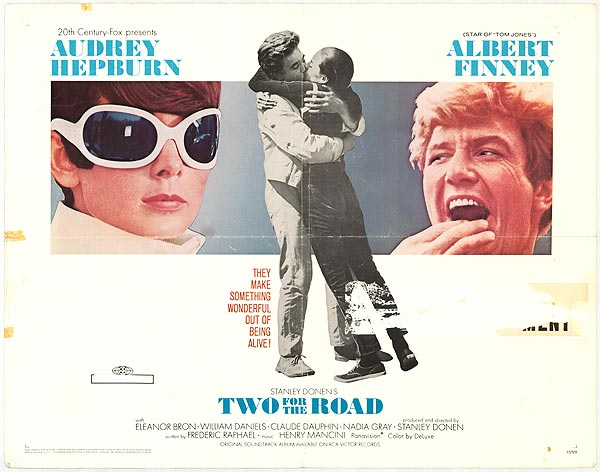
This is a unique and diverting look at a couple (Albert Finney, Audrey Hepburn) traveling the French countryside while dissecting their turbulent marriage. The road of course represents their long and winding relationship. It cleverly cuts between when they first met, which seems to have been on the same road, to twelve years later. The edits between the two stages are creative as is the majority of this fluid and entertaining movie. It wants to be silly, fluffy, serious, complex, exotic, avant-garde, and romantic all at once and most of the time it succeeds proving what an over looked, unsung genius director Stanley Donen is.

It’s a movie made for couples, but probably those who have been married for quite a while and can relate to the characters here who have been through the rough spots and have learned to accept their partner and the flaws that come with them. This film tries to dig a little bit deeper, which helps it stand out. It also has a more relaxed European attitude, especially in regards to ‘indiscretions’.

On the negative side the film contains a lot of old fashioned sexist attitudes. For instance the man is expected to be mechanically inclined and in control of every situation, which becomes very apparent in the scene where he has to get underneath the car to fix it while she sits on top of the vehicle without any care or inclination to what he is going through. The man is also expected to be the sole provider of the family while the woman does the majority of the child rearing.

Audrey, who wears an amazingly high number of stylish, chic outfits, looks more like a runway model sporting the latest fashions than an average housewife on a country drive. I realize that they wanted to accentuate her beauty, but it ends up being a distraction at the same time. If the intention of the story is about an average couple going through average marital problems then at least have them look the part.

The Henry Mancini score is pleasant as usual, but eventually gets overplayed. It’s also not as introspective as it wants you to believe, but on a slickness level it gets an “A”. Also, watch for Little Ruthie who is the world’s most obnoxious child.

My Rating: 6 out of 10

Released: April 27, 1967

Runtime: 1Hour 51Minutes

Rated NR (Not Rated)

Director: Stanley Donen

Studio: 20th Century Fox

Available: VHS, DVD

The Accidental Tourist (1988)

By Richard Winters

My Rating: 6 out of 10

4-Word Review: Introverts need love too.

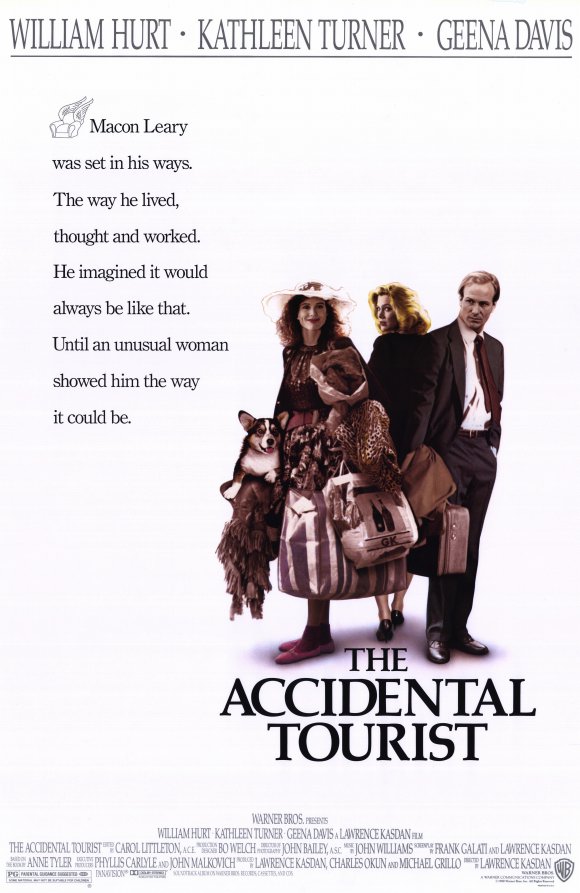
            Macon Leary (William Hurt) is an introvert who writes travel books for a living despite the fact that he dislikes traveling. His marriage to Sarah (Kathleen Turner) ends after the untimely death of their son. His wife used to babysit his dog Edward while he was away, but now he decides to drop him off at the local animal shelter that is run by Muriel Pritchet (Geena Davis). She is colorful and talkative and his complete opposite and eventually a romance begins to blossom.

The film, based on the novel by Anne Tyler, takes its time in telling its story.  In some ways the leisurely pace is refreshing. Trying to get an introvert to be more extraverted is never easy and the way Macon is initially reticent towards Muriel’s advances was realistic. Yet it does drag at certain parts and seems to go on too long. The second hour, in which Sarah comes back in the picture and Macon is forced to choose between the two, is much more interesting and compelling. The side-story where Macon’s publisher Julian (Bill Pullman) romances Macon’s sister Rose (Amy Wright) was unnecessary and does nothing but make a slow movie even longer. I also didn’t find the eccentricities of Macon’s family to be all that amusing as they were exaggerated and portrayed introverts as being freaks instead of people who simply function better independently instead of within groups.

The Muriel character is a bit over-blown as well. She comes on too aggressively towards Macon before she even knows him. There is nothing shown for why she found this man immediately attractive especially when he constantly responds to her in a cold and distant way. Later on we learn that she is poor and possibly found Macon to be well-off financially and a good stable father for her son, but even so her behavior seems a bit too forward and bordering on being shameless. Her outfits are over-the-top. I realize they are supposed to accentuate her kooky personality, but they come off as gaudy and garish and like they are being worn by someone who has no sense of style or taste.  The part where she quietly hugs Macon when he explains to her about the death of his son is moving and the first moment when I began to like the character. However, director Lawrence Kasdan ruins it by then having her strip of his clothes and climb into bed with him, which took things too far. In film sometimes the strongest statements can be made with the simplest of images and it seemed like here they had it and then lost it.

Turner is okay as the ex-wife, but I initially felt the character was unnecessary. I didn’t like it at the beginning when they are breaking-up and she goes into great detail about his character faults sounding almost like she was analyzing him for a psychological assessment. It seemed to me like she was being used to help ‘explain’ his character to the viewer when in a good film the viewer should be able to come to these deductions themselves without the help of an on-screen ‘tutorial’. Later on as she fights to get Macon back the character becomes stronger and better fleshed-out. I even ended up feeling sorry for her as her own insecurities and jealousies do her in.

Hurt is solid in the lead playing an atypical role. I wanted more of an explanation about the death of their son. It takes quite a while before it gets explained and then we are told that it was during some botched robbery at a burger joint, but it was still unclear to me why he was there and not the parents, or how it all played out. Having a flashback with a news report involving the incident would have helped. The film has many other flashbacks, some of them quite good, so another in this area would have been nice.

The music score is pleasing, but too reminiscent of ones used in other films from that era. It also has a bit too much of a whimsical quality that is not fitting for a drama such as this. The Muriel’s eight year old son is cute, but a bit too cute. I found the scenes where Macon bonds with the kid to be touching, but when films seemed compelled to only show children spewing out cutesy, innocuous comments I find it a bit annoying.

Overall this is a quality production made probably more for the female viewer looking for an intelligent, sensitive romance.

My Rating: 6 out of 10

Released: December 23, 1988

Runtime: 2Hours 1Minute

Rated PG

Studio: Warner Brothers

Director: Lawrence Kasdan

Available: VHS, DVD, Amazon Instant Video, Netflix Streaming

The Sweet Ride (1968)

By Richard Winters

My Rating: 4 out of 10

4-Word Review: Bachelor pad on beach.

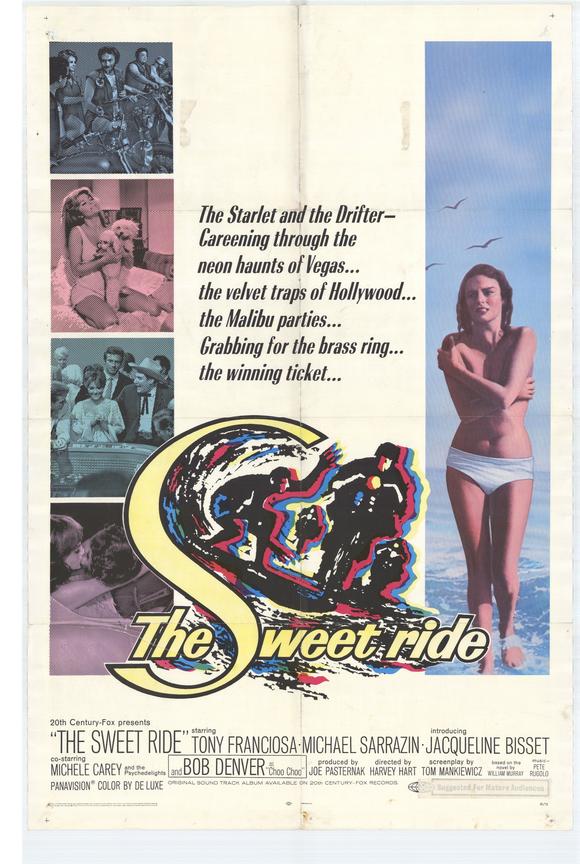
This is an obscure and ponderous film dealing with three bachelors(Anthony Franciosa, Michael Sarrazin, Bob Denver) who live in beach house and one day come upon a beautiful woman named Vickie Cartwright (Jacqueline Bisset) swimming in the ocean. They all make a play for her yet it is Denny (Sarrazin) who she falls for. Eventually though her erratic behavior and secret past become too much for him.

The theme is similar to that of Petulia, which came out around the same time. That film proved more successful because of its intricate, stylish narrative and deeper intellectual understanding. Technically this is well directed, but the color is washed out and there seems to be an ugly brownish tone permeating every shot. Some of the sets look cheesy especially the ones used for the indoor bar scenes. The story is too pedestrian and stretched too thin. It starts with some nice interplay between the three men, but that quickly evaporates and by the second hour it has become really boring. There’s some action at the end, but it’s standard and pointless. The resolution itself is too convenient and the relationship between Denny and Vickie is unexciting.

The story does offer some potentially intriguing undertones, but the film never pursues them. The girl herself is an interesting element. We come to realize through the course of the story that she lives a very, very sad existence. The film could have been meatier had it a given us a wider scope of her life and not just the little tidbits that it does. It also could have shown us more of a background to her character and examined how she came to being the way that she was.

The film’s chief asset is the bachelor pad itself, which is a dream for the single male. It’s well designed and sits right on Malibu beach with a terrific view of the ocean. There is beer and liquor everywhere as well as beautiful women coming in and out. The constant sound of the crashing waves in the background give off a soothing effect and the setting allows this film more points than it might otherwise deserve.

Some credit must also go to Franciosa an actor that never really attained much stature. His role here may actually be his finest moment. He plays the eldest of the three men and is as tan, muscular, and good looking as any forty year old can get. He’s as flippant a character as you’ll ever see and adds zest to each scene that he is in. Some of his sardonic comments about his bachelorhood add insight as to why some people are single and want to stay that way.

Dusty Springfield belts out the opening song and really gives it her all.

My Rating: 4 out of 10

Released: June 12, 1968

Runtime: 1Hour 50Minutes

Rated NR (Not Rated)

Director: Harvey Hart

Studio: 20th Century Fox

Availability: None

Moscow Does Not Believe in Tears (1980)

By Richard Winters

My Rating: 6 out of 10

4-Word Review: Three women three stories.

            Some Russian lady friends of mine suggested I review this film, which is a favorite of theirs and awarded the Oscar for best foreign film of 1980. The story deals with three women who room together at a boarding house and detailing their hopes, dreams, and personalities and then the second half examines them several years later and showing how much they have evolved.

The film has a definite European flair in that characters are well-rounded and believable. I found myself liking them right from the beginning and genuinely interested in their fates.  Lyudmila (Irina Muravyova) is engaging and amusing in her attempts to snare a man with prestige and money. Katerina (Vera Alentova) is equally interesting in the other way. I liked seeing how she starts out as shy and naïve, but blossoms into a strong, successful, self-assured woman by the end. The film takes its time in telling the story, letting you get to know the characters and allowing the scenes and situations to gel without the need for any quick edits, or cuts. I also thought director Vladimir Menshov does an excellent job with the women’s aging, which is natural but impressive without any use of make-up. At first I thought the movie had been filmed over a several year period in order to make the aging look so realistic, but that was apparently not the case. In discussing this with my Russian friend she tells me that the women were already in their 30’s when this was filmed, but even if that was the case then making them look so youthful at the beginning is still a successful feat.

The film is not a completely dour drama and manages at times to have a nice light-hearted touch with good amounts of humor. Lyudmila’s schemes are delightful at the beginning, but I also enjoyed the old man who joins a singles social club and then complains that all the women in his age group are ‘old hags’ forcing the program director to offer him a spot in a younger age group of women between 35 and 50 and he still complains that he would like them ‘even younger than that’, which only goes to prove that there’s always ‘dirty old men’ in every culture no matter where you go.

If you are expecting the film to deal with the oppressive aspects of the communist regime you won’t find it here. Most foreign films, especially those that won awards at the time, usually had this as their running theme, but here it doesn’t even touch on it. Yet I was still able to find traces of it including a scene near the beginning where a couple on a city sidewalk is told by an official that they are showing too much affection. There is another segment where Katia is being interviewed at her job in a factory by a news program. The interviewer exclaims that because Katia has shown signs of being creative that the task of a machine fitter is a ‘perfect’ job for her, which I found funny. She then asks Katia if she will be going to college, so she can get a degree and come right back to the same dreary factory and work as an engineer. I found this to be funny also, but my Russian friend tells me that the title of engineer in her country at the time was a highly regarded position that paid well, even though in America the idea of going to college is so that one can get a good education and not have to work in a factory at any level.

Another part of the film that may confuse American audiences is when Katia finds that she has become pregnant by a man that she is not married to. When she tells him the news he refuses to pay any support and she does not take him to court in order to force him. My friend explained to me that in Russia the single woman will typical not demand support from the man as this is apparently a source of ‘pride’ in their culture although many women here will find that difficult to relate too.

On the technical end the film looks like it was done on a miniscule budget. The color is faded and the images are fuzzy. Everything is filmed in places that show little that is interesting aesthetically. I thought with the word ‘Moscow’ in the title that there should have been more images of the city and scenes done at certain exotic locales to allow the viewer to get familiar with the region. There is a bit too much music. Although it is not in every scene the majority of the film has music going on underneath the conversations almost like a radio playing in the background and in my opinion it gets distracting.

My biggest complaint is that the second half spends too much time focusing on Katia and no one else. The synopsis for the film from several different sources describes this as a story about THREE women, but the by the end it is really only about one. I was disappointed as I found Lyudmila fun and I wanted to see more of her and the third woman, Antonina, is barely shown at all to the point that we get to know little about her.  Katia’s late-blooming romance goes on too long and seems a bit forced. Having her old boyfriend suddenly reappear and try to get back into her life is strained and the fact that he initially didn’t recognize her seemed hard to believe.

The story and scenarios are not original and have to varying degrees been done many times before. Unlike other Russian classics that I’ve liked including Solaris and Stalker this film lacks anything profound and comes off as a typical drama that is passable and entertaining, but not great.

My Rating: 6 out of 10

Released: February 10, 1980

Runtime: 2Hours 22Minutes

Rated NR (Not Rated)

Director: Vladimir Menshov

Studio: Mosfilm

Available: VHS, DVD (Region 1 and 2)

Chilly Scenes of Winter (1979)

By Richard Winters

My Rating: 8 out of 10

4-Word Review: Can’t get over her.

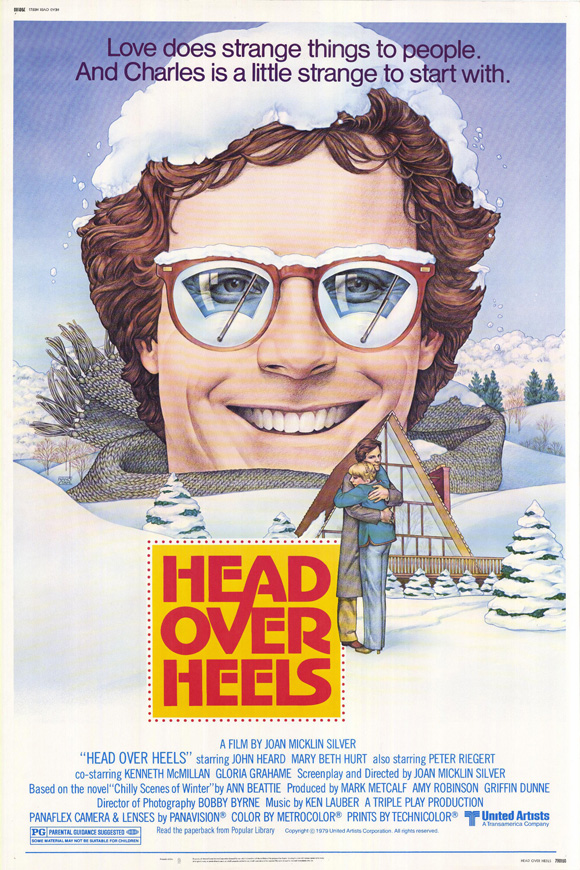
            Charles (John Heard) meets Laura (Mary Beth Hurt) at his job and immediately becomes smitten.  She is married and upfront about it, but since it is not going well she decides to go out with him. They soon move-in together, but it only lasts for a couple of months before Laura goes back to her husband. This is a crushing blow to Charles who obsesses about her constantly and tries any way he can to win her back.

This is in many ways a dated movie and normally I would consider that a detriment, but here I found it to be an asset. It is refreshing and fun to see a person drink a little on the job, or playfully touch a female co-worker as he walks past them and not have it become an immediate sexual harassment lawsuit. There is also the part where Laura invites Charles back to her home after only their first date, which could be considered reckless, but it’s nice to go back to an era that was more trusting and not everyone was labeled a potential psycho until proven otherwise.

There is of course the subject of stalking which is what Charles does, but here it is natural and actually kind of sweet. Some of it may be considered a little ‘creepy’, or even pathetic, but none of it is menacing, or done with criminal intent. To me this makes more sense and is more realistic to expect that when someone has strong feelings for someone else and spent special times with them that they would have trouble ‘moving-on’ when the other person breaks it off and their inability to do so shouldn’t necessarily make them ‘crazy’, or ‘maladjusted’ and this film very effectively shows that.

This is a terrific movie about relationships. The characters are real and relatable. The situations they go through are universal and the best thing is that it stays that way until the bitter end without pulling any punches. Anyone who has gone through difficult relationships will appreciate the honesty and it’s a real shame they don’t make movies like this anymore.

Heard is excellent and plays an extension of the same 60’s radical character begrudgingly moving into adult life that he did in Between the Lines, which was his first collaboration with writer-director Joan Micklin Silver. A young Peter Reigert is appealing as Charles’s roommate Sam. Kenneth McMillan, a looks- challenged character actor who usually plays slimy people, is surprisingly likable as Charles’s stepdad. Legendary screen actress Gloria Grahame, in one of her last roles, is highly amusing as Charles’s crazy mother. I was never quite sure what any of her scenes had to do with the main story, but her presence was fun anyways.

The film also contains some offbeat scenes and an original sense of humor. This includes the scene where Charles makes a miniaturized replica model of the home that Laura lives in and then uses dolls to play the parts of Laura and her husband and child. There is also the part where Charles meets Laura’s husband under the guise of being a home buyer and then stands up in front of him and states his undying love for his wife as well as a goofy conversation that he has with a wacky elderly lady roommate when he visits his mother in the hospital. The best though is the running conversation that Charles has each day with the blind cashier at a candy counter that gets better and better as the movie progresses.

The film nicely captures the wintry Utah landscape and although the original title for the film was Head over Heels this other title works much better and not only fits the season in which the story takes place, but also the ever difficult and complicated dating scene as well.

My Rating: 8 out of 10

Alternate Title: Head over Heels

Released: October 19, 1979

Runtime: 1Hour 32Minutes

Rated PG: (Brief Nudity, Adult Theme)

Director: Joan Micklen Silver

Studio: United Artists

Available: VHS, Netflix Streaming

The Glass Bottom Boat (1966)

By Richard Winters

My Rating: 7 out of 10

4-Word Review: Doris is a spy.

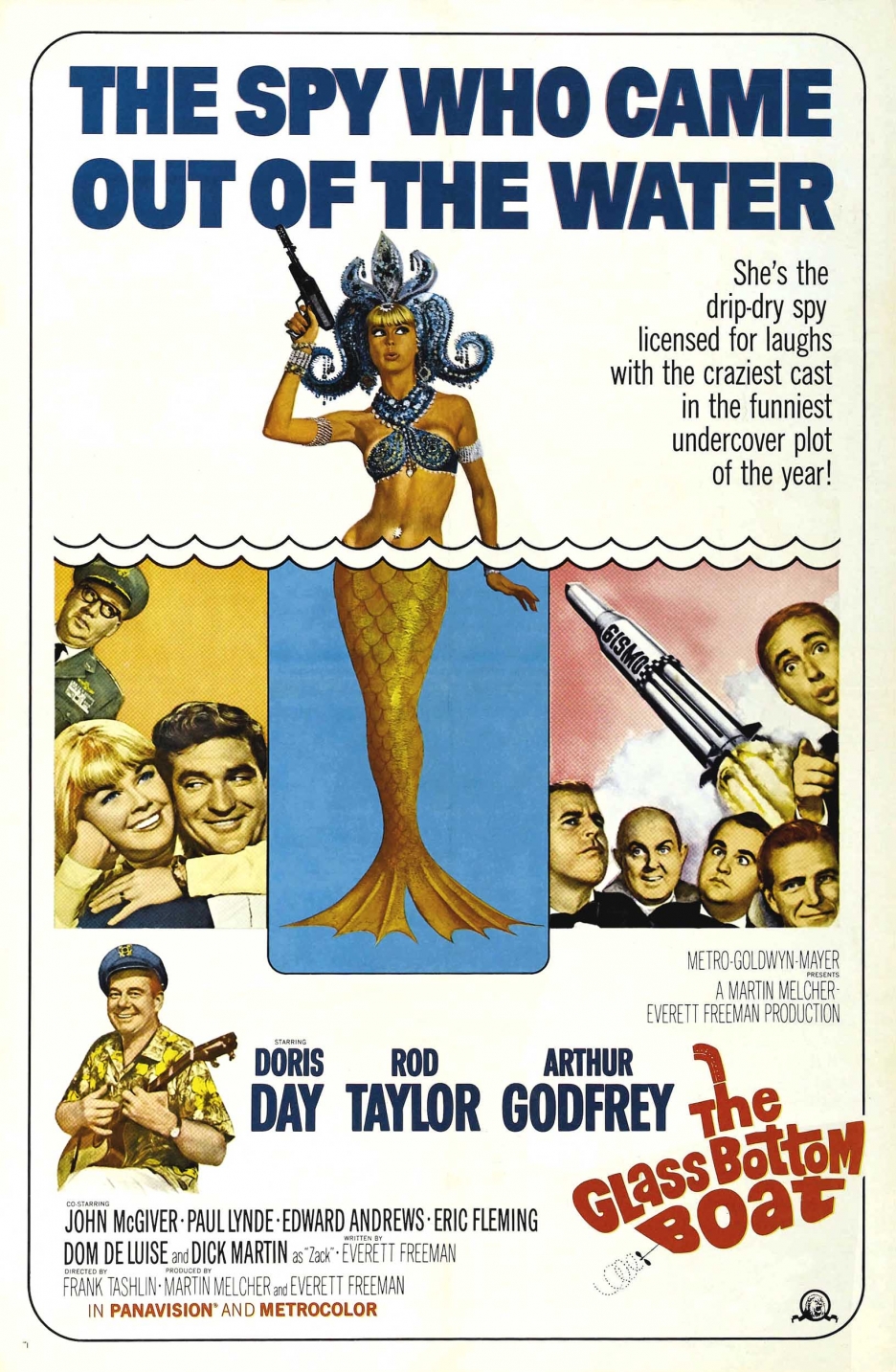
            This is an energetic and zany Doris Day vehicle featuring her as Jennifer Nelson a tour guide at the NASA Space Center. She meets Bruce Templeton (Rod Taylor) who at first she can’t stand, but when she finds out that he is one of the top scientists at the lab and makes a lot of money she immediately becomes infatuated. This certainly does nothing to help fight the gold-digger stigma that some women have, but it was made over forty years ago, so I guess it was more acceptable. Through quirky circumstances she comes under suspicion as being a Russian spy and spends the rest of the time trying to prove otherwise while continuing her romance with Bruce.

Day looks gorgeous and is hammy at just the right level without going overboard and becoming cartoonish. Her best segment is when Taylor imagines here as a Mata Hari spy complete with skimpy outfit, which she looks great in, as well as dreaming that she is blindfolded and speaking in a foreign accent while ready to be shot by a firing squad. She sings the film’s title tune, which is bouncy, and even does, later on, a goofy rendition of her signature song ‘Que Sera Sera’.

Taylor is perfect as the love interest and I think he is the best out of all of Day’s male co-stars. His funniest moment, although brief, is when Day crosses her eyes to be goofy and then keeps them that way, which makes him momentarily panic. I got a kick out of his model of the solar system that he had in his office that displayed the planets in a symbolic fashion after the Greek gods they were named after.

The supporting cast is full of familiar comic pros. Alice Pearce and George Tobias appear as Jennifer’s neighbors and a variation of the Kravitz couple that they played on the ‘Bewitched’ TV-series. Pearce is hilarious and it was a shame that she wasn’t in more scenes and died before the movie’s release. Dom Deluise is amusing as the actual spy, who goes undercover as an electrical repairman. Normally his goofy fat-guy persona becomes tiring, but here it worked especially during the climatic sequence. Paul Lynde, who was always hard to cast and in the process usually got meaningless parts, has one of his best roles as the lab’s security guard and even dresses up in drag at the end. Dick Martin, Edward Andrews, and John McGiver help round out the cast. Arthur Godfrey, as Jennifer’s father, is the only one who is boring, but his part was dull, so it might be hard to completely blame him.

Director Frank Tashlin creates sets with bright, vivid colors and each scene is a Technicolor dream. Being a former cartoonist he creates some nicely played-out comic scenarios including Bruce’s hands-free futuristic kitchen that has a little robot that comes out of the wall and cleans-up any messes that are left behind and ends up attacking Jennifer. The out-of-control boat ride is also amusing, but the best part is the wild, fast-paced ending when Jennifer decides to turn the tables on her accusers.

Sure it is silly, but you know that going in and on a non-think level it is perfect entertainment for all-ages.

My Rating: 7 out of 10

Released: June 9, 1966

Runtime: 1Hour 50Minutes

Rated G

Director: Frank Tashlin

Studio: MGM

Available: VHS, DVD, Amazon Instant Video

Semi-Tough (1977)

semi

By Richard Winters

My Rating: 7 out of 10

4-Word Review: Got to go pee.

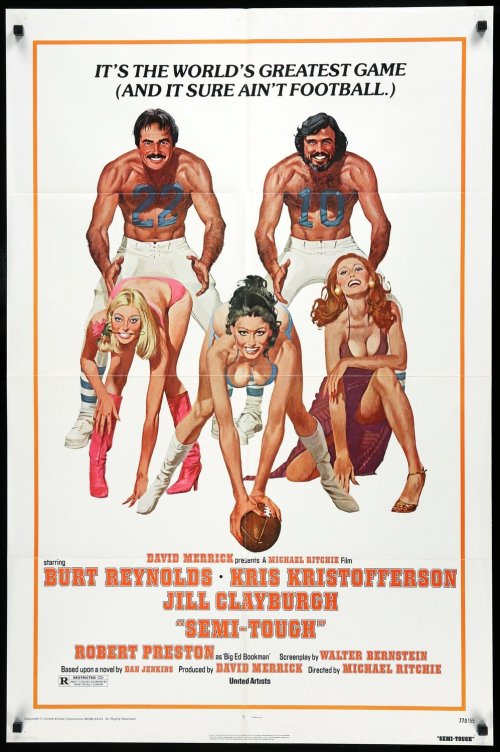
            Billy Clyde Puckett (Burt Reynolds) and Marvin Tiller (Kris Kristopherson) are two players for the Miami football team who just happened to live with the daughter of the team’s owner Barbra Jane Bookman (Jill Clayburgh). Strangely enough they do not have sexual relations and despite seeming like an odd arrangement to others the three manage to get along just fine until Marvin proposes to Barbra, which starts to make Billy jealous. Billy then spends the rest of the time trying to win her over and break-up the impending marriage.

This movie, based on the novel by Dan Jenkins, has an interesting premise, but I was disappointed that it didn’t start from the beginning when the three met and started rooming together. It certainly seemed to be an unusual set-up and I wanted more background to these characters and a history and the film doesn’t give any making it incomplete. The plot itself is a bit under-developed and at times seems to have nowhere to go. To make up for it the film delves into some odd comic scenarios that have nothing to do with the characters, or story. Some of these are interesting on their own terms while the others fall flat.

One of these segments features silent film actress Lotte Lenya in her last film appearance. Today’s audiences will know her for her outstanding performance as the villainess Rosa Klebb in the James Bond classic From Russia with Love. Her she plays a massage therapist named Clara Pelf who has some really weird and painful ideas about physical therapy. The scene seems just thrown in there for its own sake and doesn’t do much for the film as a whole, but seeing Lotte banter with Burt is a lot of fun regardless.

Another and even more bizarre segment features Bert Convy as a motivational speaker who hosts a marathon 48 hour self-help seminar, but will not allow any member of the audience to get up and go to the bathroom for the first 12 hours, which seemed too implausible even for satire. However, this scene does feature the film’s best line and quite possibly one of the best lines in film history, which occurs when one of the female members of the audience gets up and states in front of everyone “I just peed in my pants and it feels great!”

The football scenes don’t gel and in fact I wouldn’t even categorize this as a sports movie, or even a football one. For one thing director Michael Ritchie and writer Walter Bernstein didn’t seem to put much thought, or research into the sport, or how teams function. This becomes obvious in the segment where the players are shown staying up late and drinking at a bar the night before a big game and even bringing women back with them to their hotel rooms without having any type of curfew. There is another scene featuring Brian Dennehy as a big, intimidating player T.J. Lambert who dangles a woman off a roof and threatens to drop her when she does not give-in to his kinky sexual demands. He does this in front of the rest of the team who laugh it off like it is no big deal and state that he does it frequently when in reality the man would probably have a lot of lawsuits on his hands, jail time, and league suspension. It also paints big players too much as a stereotype and being nothing more than dumb out-of-control morons bordering on sociopathic.

The team logos and uniforms worn by the players during the games are unimaginative. The ones worn by the players representing the Denver team in the movie look almost exactly like the Texas Longhorns and I am almost surprised that they didn’t sue.

Burt of course is highly engaging throughout. The guy has terrific comic timing and I love the way he delivers his humorous lines. It is his presence alone that really makes this movie work. My only problem with his casting was that he was forty at the time and looking just a wee bit too old for the part. His hair also resembles a toupee and I don’t know of any player in football history who smokes a long pipe, or listens to Gene Autry records. What is worse is that he plays a lot of Gene’s records and forces the viewer to have to listen to the tunes although he makes up for it a bit with his Gene Autry quotes, which are funny.

Kristopherson as an actor has never connected with me even though I love him as a singer/songwriter. In the movies I have seen him in he always seems either half-a-sleep, or stoned. His presence and delivery is too laid back for my tastes however, the part where he is shown half-naked in bed and doing a commercial for a deodorant and then uses the product to create a mock erection is great.

Clayburgh is passable as the female lead, but I didn’t like her southern accent.  Robert Preston, who plays her father and the team owner, is okay, but his role is rather meaningless. The scene showing him crawling around on his office floor is stupid and pointless.

For some reason, despite certain flaws and an overall superficial treatment I still enjoyed this movie and found it entertaining. This is a great example of a 70’s romance with all the expected elements and clichés nicely put in place. It is also a chance to see Ron Silver in an early role as the team’s kicker who has no lines of dialogue, but ends up being a scene stealer anyways.

My Rating: 7 out of 10

Released: November 18, 1977

Runtime: 1Hour 48Minutes

Rated R

Director: Michael Ritchie

Studio: United Artists

Available: VHS, DVD (Widescreen Edition)

The April Fools (1969)

By Richard Winters

My Rating: 2 out of 10

4-Word Review: Affair between married people.

Director Stuart Rosenberg was on a high note in 1967.  He had just won rave reviews for his cult hit Cool Hand Luke and many felt he was well on his way to being Hollywood’s next top director only to follow it up with this incredibly vapid and stupid romance movie.

It involves a married man by the name of Howard Brubaker (Jack Lemon) who meets an attractive woman named Catherine Gunther (Catherine Deneuve) at a party. They spend the evening walking around outside and having nothing more than a casual conversation, which is enough to make him decide to leave his wife (Sally Kellerman) and child, quit his high paying executive job, and run off with her to Paris.

The story is pretty threadbare and filled with a lot of characters and situations that are not fleshed out at all.  This almost seems like a partial treatment to a main script that never got completed.  This movie provides no real tension, conflict, or subplots.  Most movies dealing with potential romances usually has one or both of the participants second guessing themselves as to whether they should move ahead with the relationship especially when both of the people are married like they are here.  These two fall in love so amazingly quickly that they make the art and act of dating seem completely unnecessary.

A much better idea would have been to have this quick romance act as only the starting point.  The film then should have cut to 5 or 10 years later where we could have seen how this relationship fared, or evolved. This would have given much better perspective to both the movie and characters.

I also have never felt that two people having an affair is a real good catalyst for a love story because it seems to go against the whole ‘true and everlasting love’ theme that propels most romance stories.  After all if someone can’t stay fully committed to one person what is to say that they will be able to do so with someone else.  To give the argument that they are just ‘crazy’ about this new person doesn’t work because at some point they must have been ‘crazy’ about the person they are currently with or they wouldn’t have married them. So what is to say that in a few years time when the newness of the relationship wears off that the whole vicious cycle won’t just get repeated.  I don’t have the exact statistics in front of me, but research has shown that people who cheat on one person are prone to doing it with their next partner simply because it is in their nature.

In some ways I could see why Catherine would consider leaving her husband, which is well played by Peter Lawford, simply because the guy is a womanizing lout in the worst way.  It is understandable that she may have been initially mesmerized by his wealth and charisma and only had her eyes opened to his shallowness years later.  However, Howard’s marriage didn’t really seem that bad and what is worse is the fact that he had a 5 year old son whom he seemed to have no problem abandoning without even a second thought.

The whole thing comes off like some uninspired idea by some studio head who wanted to make a ‘sure-fire’ hit by throwing together every contrived romantic element he could think of, piecing it together with a flimsy script, and then using the star-power of Lemon and Deneuve to cover up all the holes.  Everything here seems forced and that includes the humor.  Lemon’s duel with Charles Boyer is overdone and irrelevant.  There is also a scene where Howard’s friend (Jack Weston) drives him to the airport while being completely drunk and weaving in and out of on-coming traffic.  Today’s audiences would find this to be highly irresponsible and also terribly unfunny, which it is.

There are some potentially funny ideas that scriptwriter Hal Dresner never seems to think of.  For instance Catherine ends up being the wife of Howard’s new boss.  This could have been a goldmine of a lot of funny scenarios as the two tried sneaking around behind his back. The Lawford character does eventually corner Howard at the airport just as he is ready to board the plane and go off to Paris with Catherine, but even this potential confrontation gets botched badly.

I did really like Deneuve and her presence is the only real good thing about this movie. She looks radiant and I enjoyed the cool, chic way she responds to all the situations she is put in. This also marked her American movie debut.

Lemon though does not fare as well.  He overplays the high-strung businessman persona until it becomes tiresome.  He is nervous and befuddles every second that he is on the screen until you wonder how he was ever able to impress anyone enough to be able to obtain the prestigious position that he has at his company.

The supporting cast is stellar, but not used enough.  Jack Weston has a funny bit as he explains the goofy way that he handled an affair of his own.  Harvey Korman is amusing as a man who tries stealing the alluring Deneuve away from Lemon at the last minute.  It is also fun to see Melinda Dillon in her film debut.  She is best known for her supporting dramatic roles, but here she plays a giggling, ditzy blonde.  She is paired up with comic character actor Kenneth Mars and the two have the makings of being a great hammy couple. Unfortunately they are not given enough screen time, nor enough good lines, to really make it gel. Myrna Loy and Charles Boyer, as a long-time married couple, are essentially wasted.

Besides Deneuve there were a few other things that I did like about the movie.  The Burt Bacharach score is certainly pleasing on the ears.  There is a funky, mod 60’s party that takes place at the beginning of the film that features a lot of weird art exhibits that are nicely realized by award-winning set designer Richard Sylbert. I found the exhibit that featured a faucet dangling in mid-air while running a constant stream of water to be fascinating. I also enjoyed the scene where Deneuve and Lemon go to a wild nightclub where they are handed pop guns as they sit down which they can use to shoot at the rear-ends of the waitresses when they want to get their attention. I thought this was a genuinely neat idea that should be used at every restaurant.

My Rating: 2 out of 10

Released: May 28, 1969

Runtime: 1Hour 35Minutes

Rated PG

Director: Stuart Rosenberg

Studio: National General Pictures

Available: VHS, DVD (Import)

Dirty Dancing (1987)

dirtydancing1

By Richard Winters

My Rating: 5 out of 10

4-Word Review: Rubbing bodies is sexy.

Some of my lady friends at the office were surprised to hear that I had never seen this film and suggested that I watch and review it for my next column.  Since Hollywood is now planning on remaking this movie and several websites have already started up protesting it as fans of the original feel this can’t be duplicated, now more than ever seems to be a good time to give this movie a look.

The plot, which is paper thin, deals with a seventeen year old girl named Frances ‘Baby’ Houseman, who while vacationing with her family at a resort in the Catskills Mountains of New York in the early 60’s, becomes involved with the craze of dirty dancing that is done behind the scenes by some of the young people. When one of the lead female dancers named Penny Johnson (Cynthia Rhodes) gets pregnant and has to bow out in order to get an abortion, Francis agrees to take her place in the dance routine. She has no experience with the dancing, but after spending long hours practicing with the male hunk Johnny Castle (Patrick Swayze) she gets pretty good at it and the two fall in love in the process.

The story is loosely based on the real-life experiences of screenwriter Eleanor Bergstein, who traveled to the Catskills during the summers of her youth with her family and got involved with some of the dirty dancing contests that they had up there. The name of Frances that is given to the character was actually the name of her older sister and the nickname of ‘Baby’ was what Eleanor was called in her teen years.

The first thing that impressed me about the film was the on-location shooting. I had also been to upstate New York during the summers in my younger years and felt that the area was quite scenic. The film does a good job in recreating this to the extent that it also becomes like a third character. The only problem was the fact that it was actually filmed in North Carolina and Virginia, but they disguise it well and the ambience of the Catskills is still there.

The chemistry between the two stars is what makes the movie and spiraled it into the hit that it became. I felt the energy and I liked it despite the fact that apparently behind the scenes the stars did not always get along. I thought the casting of Grey, daughter of legendary entertainer Joel Grey, was overall a good choice. The producers wanted someone who could really dance and she fit the bill even though she was actually ten years older than the character she was portraying. However, I did feel it became somewhat of a problem during some of her exchanges with the Johnny character who was supposedly in his twenties. I would have thought that a young lady of only seventeen would have been a little more intimidated dealing with an older man and even a little awkward at times and yet their ‘spats’ came off more like two adults arguing.

I really liked Frances’ relationship with her father Jake (Jerry Orbach). It was a nice and respectful one with neither side talking down to the other. The scene where the two have a falling out and Francis comes to him to ask forgiveness is actually quite emotional. However, the part where Jake, who is also a Dr., helps Penny when she becomes ill after having an abortion with an untrained physician seems a bit glossy. Normally that situation would prove fatal to the woman, but somehow Jake is able to make her ‘all better again’ simply by using medicines inside his doctor bag and she wasn’t even forced to go to the hospital. I also thought that the fact that Frances kept her dancing a secret from her parents seemed to be a bit of a stretch as she spent so many hours with Johnny that I would have thought they would become suspicious as to where she was all that time.

For the most part the recreation of the 60’s era is all right. However, I did not like instituting 80’s songs into the mix. ‘Hungry Eyes’ and ‘She’s like the Wind’ are good songs on their own, but have a distinctly different sound than music from the 60’s. By putting them into the soundtrack they become jarring and, for this viewer at least, threw me out of the time period of the story completely. To me it was a sign of poor filmmaking.

The movie is formulaic and predictable to the extreme, which was the reason that I never went to see it when it first came out because basically if you’ve ‘seen the previews then you’ve seen the movie’. It is always nice if a movie can give you some sort of unexpected twist, or surprise, or even some new level of insight, but this film offers none. Even on a soap opera level the scenarios and complications are awfully light and there are a few moments of hackneyed drama. If one’s only demand is to see a predictable teen romance then on that level it is competently done. If a viewer were to demand anything more than that then they will most assuredly be disappointed.

My Rating: 5 out of 10

Released: August 21, 1987

Runtime: 1Hour 40Minutes

Rated PG

Director: Emile Ardolino

Studio: Vestron Pictures

Available: VHS, DVD, Blu-ray

The Gypsy Moths (1969)

gypsy

By Richard Winters

My Rating: 4 out of 10

4-Word Review: Skydivers travel to Kansas.

Three skydivers, who make a living going around the country doing airshows for the public, stop off at a small Kansas town on a fourth of July weekend that ends up changing all of their lives. Mike Rettig (Burt Lancaster) is the eldest and the leader of the group. He seems unhappy and suffering from some inner turmoil that he is reluctant to elaborate on.  He ends up having an affair with one of the attractive middle-aged women in town named Elizabeth Brandon (Deborah Kerr).  Joe Browdy (Gene Hackman) is restless and impatient and has a fling with the town stripper (Sheree North).  Malcolm Webson (Scott Wilson) is the introspective member of the trio.  He grew up in the town that they are in and uses the visit as a way to reconcile with his demons from the past.

MGM was hoping for a big hit with this one as it reteamed Lancaster and Kerr 16 years after their famous embrace in From Here to Eternity. The film broke ground as it was the first to feature an established and respected actress who was nearly 50 years of age doing a nude scene. Kerr, who looked great both with her clothes on and off, can be seen fully nude from the front and back during a lovemaking scene with Lancaster.  Yet the film failed to gel with the public.

There were some things that I did like. One is the fact that it was filmed on location in Kansas. The opening shots capturing the countryside of the Midwest really gives a strong visual sense of Americana.  The scenes taking place in the neighborhoods of the small town give the film an added dimension that a studio back-lot just couldn’t do.  The skydiving sequences, which take up the majority of the time, are breathtaking and exciting. The aerial photography makes you feel like you are right there jumping out of the plane and free falling into the air.

The basic plot though is dull and uninteresting.  The characters and situations are contrived and derivative.  It is almost like the story was a second thought to the stunt work and put in merely as filler. I also didn’t like the pretentious quality of the production that made it seem like it was making some sort of profound statement when in reality it was nothing more than second rate soap opera.  The whole thing would have worked better had they skipped the story and made it into a documentary on skydiving instead.

Spoiler Alert!

The most frustrating thing about the movie is the fact that the Mike character dies at the end when he decides, for no apparent reason, not to open his chute and goes, literally, splat on the ground right in front of a throng of spectators. I actually thought this was one of Lancaster’s better later career performances and I was intrigued as to what was causing his character’s inner-strife, but the film offers us no clue, or hint.  I thought there should have been a backstory and even some flashbacks. The ambiguity leaves the viewer cold and unsatisfied and makes the film seem incomplete.

The only possible explanation may come through researching actual Gypsy moths and then correlating the species to the characters. Per Wikipedia, the female gypsy moth is unable to fly. This would then explain why Elizabeth refused to run off with Mike despite her unhappy marriage simply because she could not ‘spread her wings’.  The adult male moth always dies in July, which would then explain Mike’s death. No reason for his demise was needed because his life cycle was ending regardless. July is also the time when the moth lays her eggs, which would explain why Joe and Malcolm, who were much younger than Mike, decided to go off on their own separate ways at the end.

End of Spoiler Alert!

I  ended up finding more misses than hits with this one and can’t help but label it as a misfire.

My Rating: 4 out of 10

Released: August 28, 1969

Runtime: 1Hour 47Minutes

Rated R

Director: John Frankenheimer

Studio: MGM

Available: VHS, DVD