Category Archives: Road Movies

Roadie (1980)

roadie1

By Richard Winters

My Rating: 7 out of 10

4-Word Review: Truck driver and groupie.

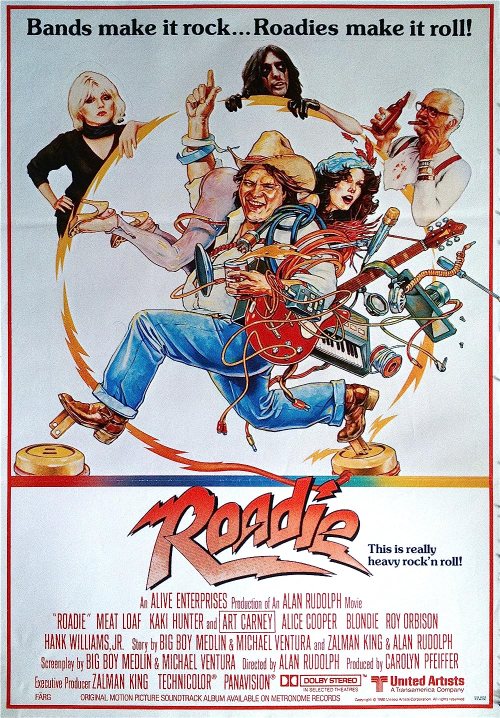
Travis (Meat Loaf) and B.B. (Gailard Sartain) are two truck drivers out making deliveries when they come upon a disabled RV on the side of the highway. Initially they don’t plan to stop, but when Travis sees Lola (Kaki Hunter), a would-be rock ‘n’ roll groupie, peering out the RV window he decides he’s ‘fallen in love’ and pulls-over. His ability to fix mechanical issues using unorthodox tools impresses Ace (Joe Spano) who’s a road manager and wants Travis to drive them to Austin to set-up equipment for a Hank Williams Jr. show. Because of his fondness for Lola he agrees and promptly quits his job as a trucker to travel all over the country meeting such rock ‘n’ roll legends as Roy Orbison and Blondie while also awkwardly courting Lola who’s more infatuated with meeting her idol Alice Cooper.

While director Alan Rudolph has never had a box office hit his movies have usually achieved success amongst the critics except for this one, but  I considered it his most original effort. Roger Ebert described it as being ‘disorganized and episodic’ even though life on the road in a tour group works that way with new issues coming up almost hourly and like driving on the open road there can be many detours and speed bumps as well as fleeting faces, which in that context the film recreates, in quirky comic form, quite well. He also complained about the lack of character development and maybe in Travis’ case there wasn’t much, but he’s such a funny caricature that I didn’t think he needed any. With Lola though I felt there was and impressed me with how much depth she ultimately showed especially since she initially seemed like nothing more than a caricature too. I really liked that she wasn’t as into Travis at the start like he was into her, which can happen a lot, and she has to grow into liking him during their many adventures though still never really openly admits to it to either herself, or others, which I felt was a refreshing change from the ‘love at first sight’ thing in the Hollywood formulas. Ebert also complained that the songs were never played to completion though the ones that are about Texas are.

There’s many unique laugh-out-loud moments. Some of my favorites was the laundromat scene where Travis and Lola have a box of Tide that supposedly holds cocaine. The car chase in Austin done at night in front of the state Capitol building is amusing as is the barroom brawl. Granted there’s been a lot of those in movies, but like with everything else it has a quirky style unlike the others especially as Travis gets hit in the head and begins rambling out incoherent nonsense. The scenes at Travis’ boyhood home where his father (Art Carney) and sister Alice Poo (Rhonda Bates) are a riot including the telephone booth connected to machine belts that allows it to go from the exterior of the home to the inside and the BBQ chicken eating scene, which may be, at least visually, the best moment in the film.

It’s also nice to have a movie that’s all about Texas to actually be filmed in Texas. Too many try to cheat it, a few of them have been reviewed here recently, that mask the Arizona desert, or even the California one to Texas, but anyone from the Lone Star State could easily detect the difference. This one truly has the Texas look and you can see this from the very first shot which features armadillos crossing the highway and because of this it gets the honor of being put into the Scopophilia movie category of ‘Movies that take place in Texas’ versus the ones that say they are set here, but filmed elsewhere.

Spoiler Alert!

Probably the only thing that doesn’t quite work is the ending where Travis and Lola are kissing in the front seat of a pick-up only to see a bright light of a spaceship. I realize the intent was to do a parody of the ‘Paradise by the Dashboard Light’ song and maybe if we had actually seen the ship, which got inadvertently destroyed before shooting began I might’ve forgiven it, or maybe even been impressed, but entering in a sci-fi genre that late becomes almost like a sell-out and too surreal for its own good. Something that stayed true to the playful quirkiness that came before it would’ve tied the bow better.

My Rating: 7 out of 10

Released: June 13, 1980

Runtime: 1 Hour 45 Minutes

Rated PG

Director: Alan Rudolph

Studio: United Artists

Available: DVD, Blu-ray

Hawks (1988)

hawks1

By Richard Winters

My Rating: 6 out of 10

4-Word Review: Patients hit the road.

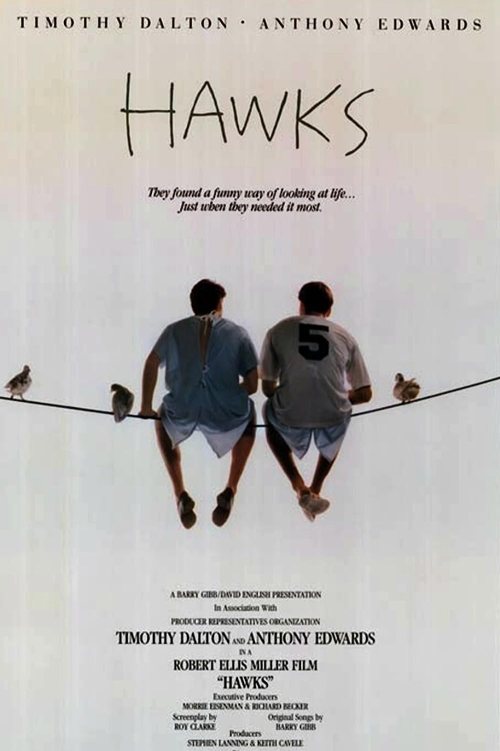
Decker (Anthony Edwards) is a former football player stricken with terminal cancer. He’s put in the hospital where his roommate is Bancroft (Timothy Dalton), who’s dying from the same disease. Bancroft though still wants to have some fun and convinces Decker to sneak out of the facility and go on a road trip to Denmark, so they can have one last fling with the prostitutes in the Red Light District. Decker is nervous at first, as he’d rather commit suicide to put himself out of his misery, but eventually decides to go along where they end up meeting two lonely ladies, Maureen (Camille Coduri) and Hazel (Janet McTeer) who’s also harboring a painful secret.

Based on a short story written by Barry Gibb of The Bee Gees the plot has, despite it’s grim theme, a playful quality and comes-off more like a quirky road movie. The scenery is nice especially when they get into Holland and have an extended scene amidst the picturesque windmills, which you can hear slowly rotating in the wind as they speak. There’s also a few funny moments with the best one coming right at the start where Decker takes a frightened SAAB car salesman (Geoffrey Palmer) on a test drive at reckless speeds and right to the edge of a cliff.

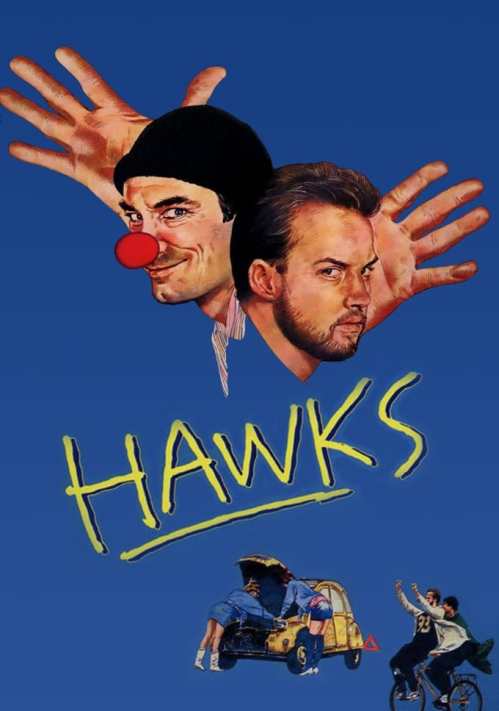
The acting is great with Dalton, who did this between his two stints as Bond and used his notoriety to get it made, which he felt wouldn’t have gotten financed otherwise, being standout and putting to great use his piercing blue eyes, which become even more prominent when he’s wearing his stocking cap. Edwards is also good though he looked wimpy to have ever played football. Some may try to argue that the sickness ate away his weight, but in reality this is the body type he’s always had and the producers should’ve, for the sake of authenticity, had him bulk-up before filming began.

What I didn’t like were the unexplained caveats, like where did these two terminally ill patients manage to get the money to pay for fancy hotels and chic restaurants? It seemed like they could buy anything they wanted, so if that were the case then why couldn’t they get themselves clothes so they didn’t have to run around everywhere wearing nothing but their bathrobes? The sex angle was ridiculous too especially for Decker, who’s so weak he had to be carted around in the wheelchair. If he could barely stand then how the hell is he going to get the energy for sex?

Initially I found Hazel and her clumsiness as annoying as Bancroft did, but like with him she eventually grew on me, but I didn’t think she needed to be introduced already in the first act before she even met the two men. She has a scene on a bridge all alone and I didn’t understand what she had to do with the story, only later during the second act when she appeared again did it make sense, but again her personal troubles could’ve waited to be explained when Bancroft and Decker heard about it. I actually enjoyed more Sheila Hancock, who plays Regina, an aging 50-something hooker they meet, who shows a good propensity at fixing things like TV’s and I wished she’d been the one they had befriended long term and the two younger ladies cut out altogether.

Spoiler Alert!

The ending is touching particularly the way the plastic red clown nose comes into play. The wedding in which Bancroft marries Hazel, who’s secretly pregnant by a man who disowns the child, is cute too though I didn’t understand how Bancroft, who had been losing his hair throughout, suddenly seemed to grow it all back as he walked down the aisle. If anything he should’ve been completely bald by that time and it would’ve been more realistic had he been shown that way.

hawks2

My Rating: 6 out of 10

Released: August 5, 1988

Runtime: 1 Hour 47 Minutes

Rated R

Director: Robert Ellis Miller

Studio: Skouras Pictures

Available: VHS, DVD-R (dvdlady.com)

Think Big (1989)

thinkbig1

By Richard Winters

My Rating: 1 out of 10

4-Word Review: Truckers with big muscles.

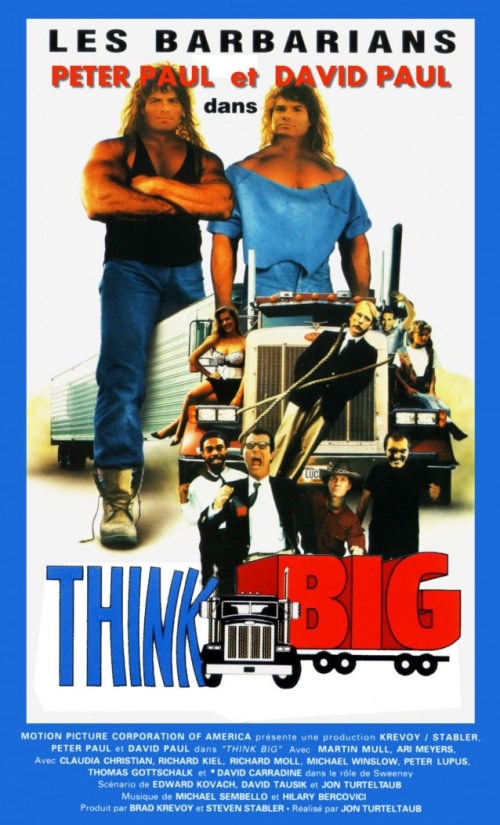
Rafe and Victor (Peter Paul, David Paul) are brothers who make a living driving a truck though they’re always missing the freight deadline to the constant consternation of their boss (Richard Moll). He gives them the ultimatum: either get this new delivery to its intended destination within 30 hours, or find a new job. Holly (Ari Meyers) is a teen genius who has invented a mechanism that can electronically deactivate any code allowing one to start, or stop any other device without having a key, or password to do it. When she finds out that the company she’s been working at, or more honestly enslaved at, wants to use her invention for unscrupulous means she escapes with her device in hand and then hides inside the brothers’ truck. Initially the brothers want to throw her out as they consider her presence a sign of bad luck, but eventually they help her out in her quest to avoid the bad guys.

The Pauls, who were bodybuilders before they got into acting, made their film debut in D.C. Cab, as The Barbarian Brothers, which lead to guest starring roles in TV-Shows like ‘Knight Rider’ that eventually got them starring in their own movie The Barbarians, that did well enough at the box office that producers gave them this comedic vehicle though it proved to be a disaster. Most of the problems lie with the silly script that’s filled with pseudo science, dated technology, and campy humor, which will amount to one long, continuous eye roll from the viewer.

The brothers are poor actors with their scenes in Natural Born Killers getting deleted because of what director Oliver Stone felt was shameless overacting, and their dialogue here doesn’t help. It’s one thing to be bit dimwitted, but these guys are infantile and their chicken bone chant that they do is highly redundant and annoying. For big guys they’re quite wimpy as they allow their boss to grab them by the neck and during fights they get punched by men who are far smaller and immediately fall down backwards by the power of the blow though you’d think in reality the person doing the punching would get their hand injured and they’d run-off hollering while these two big buys would remain standing. Their profession isn’t interesting either and puts to waste their big muscles. Instead of driving a big rig they should be working as club bouncers, or security for celebrities, or even just owning a workout gym.

The plot is also cluttered with villains. Martin Mull plays the head of the evil agency and while he does get a few funny ad-libs I didn’t feel his part was necessary. David Carradine, who plays this cantankerous repo man that tries to take back the brothers’ truck, gets wasted too. Initially I was surprised why a star with his stature would even appear in this though I did find him amusing and the caricature he creates to be colorful, but the stupidity of the script overshadows him and since he’s only seen sporadically his acting efforts get lost.

Richard Kiel was the one bad guy that I did like.  In his past roles he’s played the one who’s strong, but not bright, but in this film he’s the exasperated leader that gets irritated by the dummies around him. For this reason I thought he should’ve been the main heavy and Mull’s presence cut out completely. It’s also interesting seeing him take-on the Paul brothers as usually his physical presence dominates everyone else, but here it’s a much more of an even fight. I did though find it frustrating that we see him struggling to get out from underneath a car and the film then cuts away, only to see his character appear later, uninjured, with no explanation for how he got out of his predicament.

While Ari Meyers’, who’s best known for her work on the ‘Kate & Allie’ TV-show, acting isn’t the best she’s still easy-on-the-eyes and therefore should’ve been made the lead while the brothers could’ve been cast in support as these bumbling truckers she’d meet along the way, where their presence could be used as comic relief, but having the whole thing centered around them kills the movie right from the start. Throwing-in a sappy ‘life lesson’ speech at the end just makes it even worse and a genuine insult to the intelligence of anyone who sits through it.

My Rating: 1 out of 10

Released: October 23, 1989

Runtime: 1 Hour 26 Minutes

Rated PG-13

Director: Jon Turteltaub

Studio: Motion Picture Corporation of America

Available: VHS, DVD-R (dvdlady.com)

Corky (1972)

corky

By Richard Winters

My Rating: 7 out of 10

4-Word Review: Race driver self destructs.

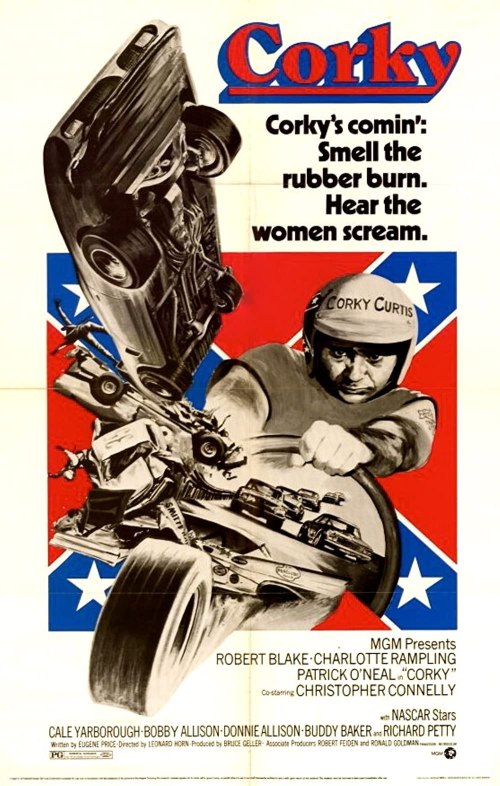
Corky (Robert Blake) works as a car mechanic during the day, but on weekends he drives in some of the local races. He’s aggressive nature though causes many accidents and damages in the race, so his boss Randy (Patrick O’Neal) decides to replace him with another driver named Steve (John Gruber). Corky resents being replaced and thus enters the next race anyways and rigs the front hood of his car, so it will pop-up at a strategic time, so that he can crash into Steve’s car while feigning that it was an ‘accident’ because he couldn’t see where he was going due to the hood. The crash though puts Steve in the hospital and it’s enoough for Randy to fire Corky from his job. Now, with no money left, he goes traveling to Georgia with his buddy Billy (Christopher Connelly). They enter a few races there, but Corky parties away all the winnings and eventually come back to Texas penniless. He tries to get back with his wife Peggy Jo (Charlotte Rampling), but finds that Randy has been helping her out and giving her enough money, so that she can go back to school to get a diploma and eventually be able to earn a living without Corky. This causes him to seethe with rage and he goes back to Randy’s place of work in order to exact a violent revenge.

The film was directed by Leonard Horn, who shot to fame for having directed some of the highest rated episodes of the ‘Mission Impossible’ TV-series, which garnard him enough attention to get him a contract to helm two cinematic features. His first one was The Magic Garden of Stanley Sweatheartwhich starred Don Johnson and while it wasn’t completely successful, and very little seen, it did have an interesting cinema verité style. This works the same way with a strong emphasis on atmosphere that gets small town living in rural Texas just right. Even the little moments like when Corky turns on his friend Billy in the middle of a desolate road during an impending rain storm leaves a memorable impression as does the envelope-pushing moment where Corky decides to strip down and go skinny dipping with two young boys (Matt Nelson Karstetter, Richard McGough) at a country watering hole.

Robert Blake is excellent. Sometimes it’s hard to imagine him as a leading man due to him at one time being a part of the ‘Little Rascals’ ensemble, and then rising to becoming a TV-star before falling into infamy at being accused of killing his child’s mother. However, with all that being said he was still a great actor who probably didn’t get as much starring roles as he deserved, but he plays the angry loner role to a perfect-T. Rampling as his wife, who was born in England, masks her British accent quite well and creates an odd, but interesting sounding Texas one in the process. I also liked that she sports blonde hair. O’Neal is good in support and there’s an fun collage of actual race driving champions like Richard Petty and Cale Yarborough who appear briefly as themselves though I was upset to read that Roddy McDowell’s scenes, where he plays a salesmen, got cut out completely as his appearance could’ve added an intriguing element.

Spoiler Alert!

The story itself is rather tepid at first. There were many films from the 70’s dealing with rugged individualists and hard drinking, womanizing rebels who couldn’t, or didn’t want to conform to societal rules and thus hit the road looking for adventure and to ‘find themselves’. This though, at least during the first two acts, adds nothing to the equation, or give us any new insights and in fact seems more like the same old, same old generic character study, but all that changes in the third act when Corky unravels completely and goes on a shooting spree. The films from that era always had the non-conformist getting ‘reeled-in’ at some point usually through the love of a romantic partner, or some familial obligation, but here it’s a meltdown to the extreme and it’s a movie way ahead of its time as it deals with what’s commonly known as a mass shooter these days. At that time this concept was rarely seen and for that it deserves definite kudos as does the message that being too irresponsible will catch-up with you and one can’t just live the outlaw image and not eventually have to pay the price.

My Rating: 7 out of 10

Released: March 15, 1972

Runtime: 1 Hour 28 Minutes

Rated PG

Director: Leonard Horn

Studio: MGM

Available: DVD-R (Warner Archive)

Cohen & Tate (1988)

cohen

By Richard Winters

My Rating: 6 out of 10

4-Word Review: Child witness gets kidnapped.

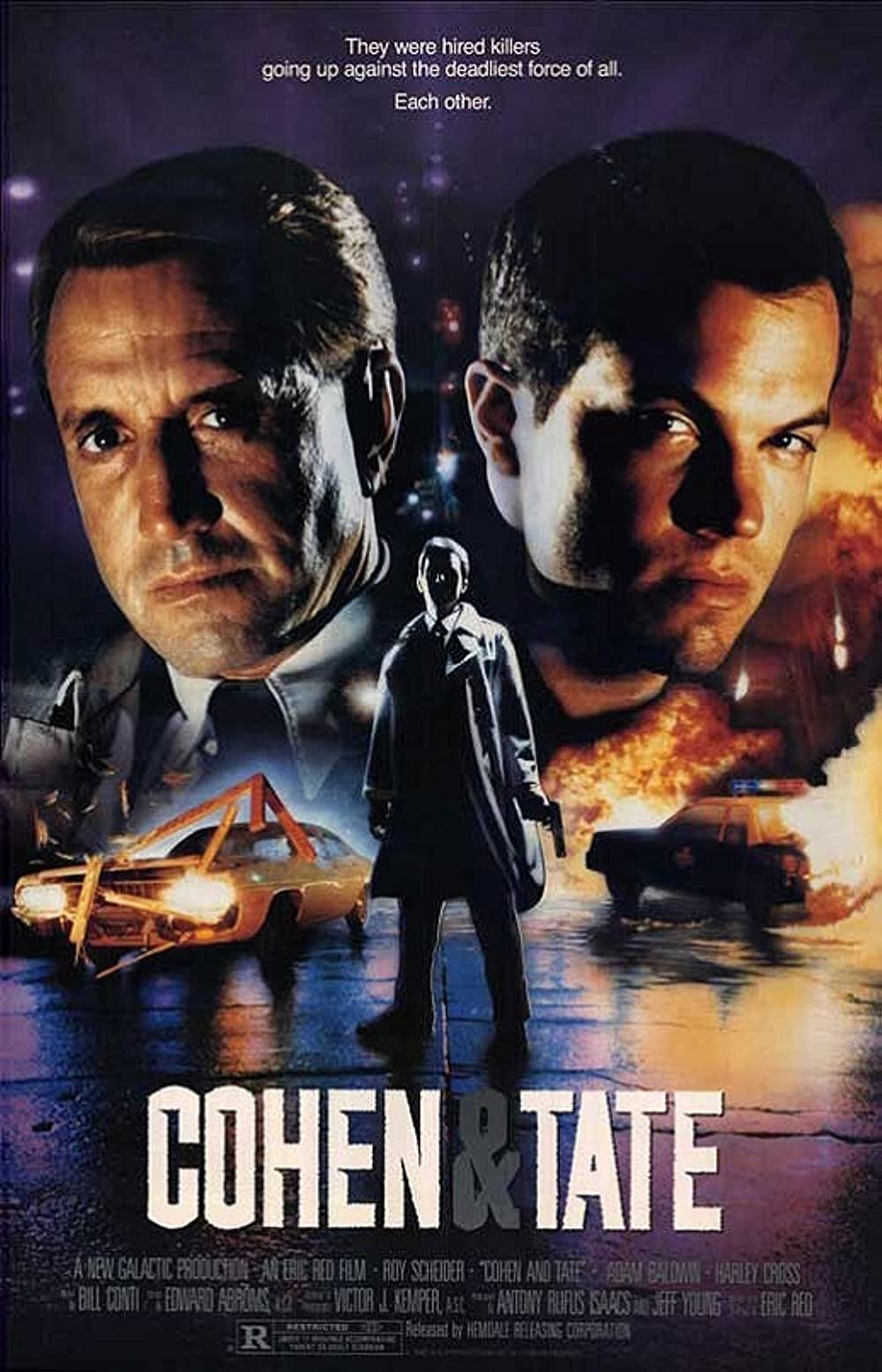
Travis (Harley Cross) is a 9-year-old who witnesses a mob hit and for his own protection both he and his parents (Cooper Huckabee, Suzanne Savoy) are put into a witness protection program where they are uprooted from the home they’d live-in and moved to an isolated place that has federal agents standing guard outside around-the-clock. One day the place gets invaded by Cohen (Roy Scheider) and Tate (Adam Baldwin), who are two hit men working for the mob. The mob wants to prevent Travis from testifying in court, so the two hit men kill the parents and the federal agents and then kidnap the boy and take him on a long road trip to Houston where the mob bosses can question him directly. Along the way Cohen and Tate bicker and make clear they do not like each other and Travis exploits this to get them to fight more and then uses it as a diversion to escape.

After writing the screenplays for The Hitcher and Near Dark Eric Red was finally given the green light to direct his own movie and tension-wise the film is compact, but visually it’s boring. The car ride taking place almost completely a night where we see nothing but the interior shots of an old, grimy car enveloped by pitch blackness is not interesting and having it instead take place in the daylight where the rugged, but scenic Texas landscape could’ve added ambiance would’ve worked better. The night setting also adds in a few logic loopholes like when the kid runs down the highway there’s tons of traffic, but why would there be so many vehicles in the dead of night and the middle-of-nowhere? Also, you’d think a least a few of those drivers who saw a kid running on the road might want to pull over and offer assistance, but none of them do.

The film’s only surprising element is seeing Roy Scheider play a bad guy, which he rarely ever did. The role was originally intended for Gene Hackman, who turned it down, and then offered to John Cassavetes, who also passed on it, which is ashame. Cassavetes, with his tall stature and hawk-like facial features would’ve been perfect. Scheider, for what it’s worth, is okay, but he looks frail especially when seated next to the much bigger and younger Baldwin making his character appear weak and vulnerable. The film wants to portray Scheider as being in-control, but that’s not really how it ever comes-off. 

The in-fighting between the hit men is a big problem as it telegraphs right away the eventual meltdown between the two and Bladwin’s character, as a young thug with a violent, quick triggered temper, is about as cliched as you can get. These guys don’t come-off as being very smart either making the film’s ironic theme at seeing this young kid outsmart them at every turn not that impressive since anyone with an IQ of 5 could’ve easily done the same thing. A well run criminal plan, or any plan for that matter, predicts unexpected possible problems upfront and has a Plan-B already in-place in-case they arise, but these guys seem like they never bothered to think through anything making their constantly perplexed expressions at every blunder that comes along unintentionally comical and more like they’re stooges instead of bad-ass killers.

The boy is another issue as he’s too savvy for his age. Most kids would be paralyzed with fear at being kidnapped by two thugs who’ve just killed his parents (it’s later learned that the father survived the attack, but upfront he didn’t know this). A normal kid would’ve sat in the back of the car crying and not known what to do, but this one acts super street smart and even talks back to the killers, which isn’t interesting or realistic. A better approach would’ve had him terrified and helpless at the beginning and then slowly becoming more emboldened as the story progressed. 

Spoiler Alert!

The ending is anti-climactic. A police helicopter spots the stolen vehicle that Scheider and the kid are in, so at the last second Scheider veers the car off the highway and drives it into the business district of Houston. However, there are no cars or people around even though it’s during the day. The police squad cars then quickly race in and surround them like they were waiting for him, but how would they have known he would end up in that area since he veered off the highway in an impulsive spur-of -the- moment way?

My Rating: 6 out of 10

Released: October 12, 1988

Runtime: 1 Hour 26 Minutes

Rated R

Director: Eric Red

Studio: Hemdale

Available: DVD-R (MGM Limited Edition Collection), Blu-ray


The Baltimore Bullet (1980)

bal

By Richard Winters

My Rating: 7 out of 10

4-Word Review: Pool hustlers travel country.

Nick (James Coburn) is an aging pool hustler who’s best days are behind him. Many years earlier he took a young 15-year-old boy named Billie Joe (Bruce Boxleitner) under his tutelage and taught him the tricks-of-the-trade. Now as a man Billie is able to play the game as well as Nick. The two travel the countryside attending pool halls where they hustle patsies for money. Nick though holds a grudge because a ways back he lost a crucial match to The Deacon (Omar Sharif) another hustler whose just been released from jail. Nick wants a rematch, but The Deacon doesn’t think he’s worthy of his time. Nick though got’s a scheme that will get him to change his mind by playing in a nationally televised pool tournament that The Deacon plans to attend.

For a film that has never had an official US DVD release and was only shown sporadically on late night TV I was surprised at how engaging it is. Screenwriters John Brascia and Robert Vincent O’Neill have written a highly amiable script that features funny vignettes and amusing banter. The focus isn’t on the game of pool, which seems almost like a side-light, but more on the scraps they get into along the way. The two also come into contact with those trying to cheat them and this culminates in an almost surreal like confrontation, that comes around the middle mark, inside a house of mirrors at a carnival side show.

The film also has a segment that seemed prolific in movies that came out during the late 70’s and early 80’s which features what would be considered sexual assault now. The scene has Nick betting Billie Joe that the breasts on a waitress at a cafe that they’re in is silicone and not natural. Billie then proceeds to go into the kitchen to feel-her-up without her consent. While what he does is not shown we do hear her scream and drop her tray of dishes before he walks back out with a broad smile on his face, which back in the day was just considered ‘light comedy’.

Coburn is a great actor, but looks horribly aged. He was only 60, but could’ve easily passed-off as 70 or 75 making his fight scenes look inauthentic as I don’t believe in his elderly condition he would’ve been able to hold his own. Boxleitner is dull and seems only able to display a broad ‘good-ole-boy’ smile and not much else. A more dynamic actor, or one maybe more Coburn’s age, could’ve made the buddy angle better.

I found Sharif to be too soft spoken and he approaches his part in a weird way. For instance when he’s playing a senator at poker he displays moments of outward nervousness, but if he’s truly a cocky, confident player that wouldn’t have been the case. Ronee Blakely is weak as well proving that her appearance in Nashville was her only good performance though her singing is nice and she’ll remind one a lot of Shelley Duvall with her looks. Jack O’Halloran, the former boxer who’s best known for playing Non the henchmen to the evil Zod in the Superman movies, is very funny as Max an inept hit man.

Spoiler Alert!

The ending unfortunately gets convoluted. Having the game broadcast and featuring live play-by-play and commenting by pool legend Willie Musconi is cool, but I wanted to see the ultimate match between Nick and Billie Joe to prove which one was truly better. The script teases this idea, but then adds in too many other unnecessary ingredients like having Nick be pressured to dump the game while there’s also a robbery happening and then eventually the place is raided by the feds. By the time it gets to The Deacon taking-on Nick it’s anti-climactic especially since no one else is around (it should’ve been televised on TV for all to witness). Having it focus more on the game and the strategies, which it starts to do slightly near the end, would’ve given it more substance and what little they do talk about I found to be genuinely interesting.

My Rating: 7 out of 10

Released: April 1, 1980

Runtime: 1 Hour 43 Minutes

Rated PG

Director: Robert Ellis Miller

Studio: AVCO Embassy Entertainment

Available: DVD (Reg 2 Import)

Riding Tall (1972)

riding1

By Richard Winters

My Rating: 4 out of 10

4-Word Review: He can’t stop losing.

Austin Ruth (Andrew Prine) is a rodeo star who hasn’t won a contest in a long while. He’s so down-on-his-luck that the fans routinely boo him as he leaves. He’s so short on cash that he must siphon gas from trucks and drives in a car that forces other passengers to sit on literal springs since he’s too poor to afford seat cushions for his backseat. When his car breaks down he begins walking on the side of the road where he almost gets hit by Chase (Gilmer McCormick) who fell asleep at the wheel. Chase is the preppy daughter from the affluent suburbs who’s running away from her family and their pretensions while also trying to find herself. She has little in common with Austin, but since they’re both alone decide to forge a relationship, but their differing lifestyles, and Austin’s insecurities about his failing life put a damper on their union ever becoming permanent.

This film was released during a period where stories about the modern day rodeo circuit where in seemingly high demand and while some of them like J.W. Coop and Junior Bonner where met with critical praise and box office appeal this one, despite having a CBS Network television broadcast in 1980, has fallen into complete obscurity. Today it’s only known for having been written by Mary Ann Saxon, who was the wife of the late actor John Saxon.

Initially it had a potential. I really like McCormick. Normally I find films that force in a romance that comes out of nowhere to be annoying, but since this guy was having everything working against him I thought he deserved a break and was genuinely interested in seeing the relationship evolve. McCormick is young and cute, but not in the plastic Hollywood sort of way. She also has a great snarky personality, but her character is poorly defined. At one point she angrily snaps at a traffic cop (William Wintersole) and I thought it would be later revealed when she’d be so unusually angry at him, but it never gets explained and seems to simply play-off the fact that because she was young and in college she’d just naturally hate cops, but this is too broad and makes her more of a caricature than a person.

Prine is dull. Granted his character is run-over by life, so it would be expected that he’d mop around, but he still needs to do this in an interesting way, like a good actor would, but he doesn’t. He’s also never shown actually riding a bronco, until the very end. Even if a stunt double needed to be edited in seeing the character actually on an animal riding it, or attempting to stay on it, is needed instead of just a close-up shot of him being bucked high in the air, which was clearly done by having him sit on top of a mechanical bull and looks fake.

There were a couple of amusing moments like when they try to get a hotel room, but the clerk doesn’t want to give them one because she thinks they aren’t married. When Chase states they are the clerk says she doesn’t believe them at which point Chase replies “Why, because we don’t look miserable enough?”. Overall though it just doesn’t click. Not enough happens. A leisurely pace is okay, but there still needs to be some dramatic moments and they never come making this an uneventful and unmemorable viewing experience.

riding2

Alternate Title: Squares

Released: January 17, 1972

Runtime: 1 Hour 32 Minutes

Rated GP

Director: Patrick J. Murphy

Studio: Plateau International

Available: None

Fandango (1985)

fandango

By Richard Winters

My Rating: 6 out of 10

4-Word Review: The privileges of youth.

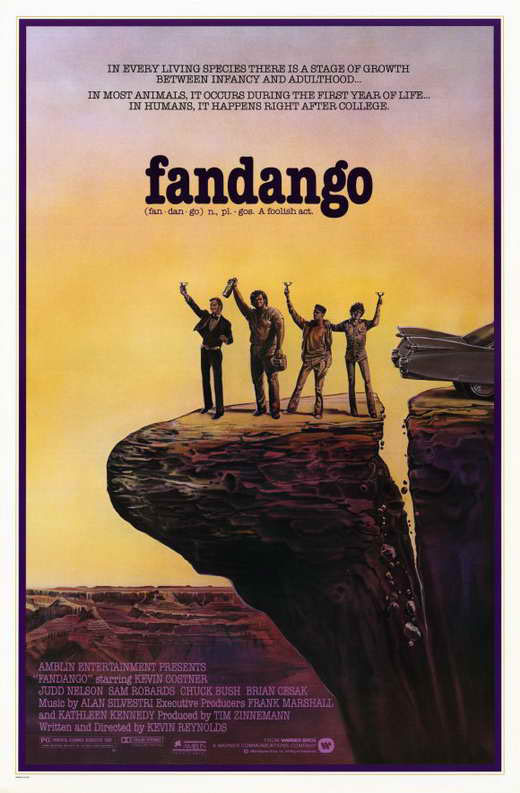
Gardner (Kevin Costner), Phil (Judd Nelson), Kenneth (Sam Robards), Dorman (Chuck Bush) and Lester (Brian Cesak) are five college friends from the University of Texas in 1971, who are getting ready to celebrate their impending graduations when Kenneth announces that he’s been drafted into the Vietnam War and Gardner has too. To help lighten the mood the boys decide to take an impulsive road trip where they travel to unique areas of Texas, including searching for buried treasure in the Rio Grande, sleeping under the stars at the old filming site of Giant, and even taking part in parachute jump near Pecos.

This film is based on a 24-minute film that Kevin Reynolds directed while attending the USC film school. In that movie the boys were all from Baylor University and traveled to Pecos, Texas in order to test the courage of their most frightened member and use the help of eccentric flight instructor Truman Sparks, played by Marvin J. McIntyre, who reprises his role in this one, to teach and train the young man on how to jump from a plane. The student film managed to catch the attention of Steven Spielberg, who was so impressed with it that he offered Reynolds the chance to turn it into a full-length movie. Unfortunately once it was completed Spielberg for whatever reason disliked it and had his name removed from the credits while also refusing to help distribute it forcing the film to suffer a limited engagement though in recent years its cultivated a cult following.

The movie does have many funny moments including the opening bit where Phil’s parents (Stanley Grover, Jane A. Johnston) visit his frat house during one of their raucous parties. The sky diving sequence, which gets copied shot-for-shot from the original is quite engaging as is their attempts to hook their disabled car up to a speeding train. Costner is also very amusing, he had actually auditioned for the student film, but lost out, but when he found out it was going to be remade into a feature film he re-auditioned. I’m so used to seeing him play serious roles that I didn’t realize he had such great comedic timing, but for the most part, he’s the life of the movie.

Where the film fails is that it’s too unfocused. The setting is supposedly 1971, but you’d hardly know it and very little effort is made to give it a feel of that era. Even the opening song sung by Elton John that gets played by over the credits was released 2 years after the events in the movie supposedly took place, so to keep it accurate with the time setting only songs that came out in 1971, or before should’ve been used.

The side-story involving Gardner having dated Kenneth’s fiancee, played by Suzy Amis, seems unneeded and really doesn’t go anywhere. Normally, in most real-life friendships, having a friend date and ultimately marry one’s former girlfriend could be a deal-breaker that would lead to a lot of jealousy and potential anger. I’m sure there’s a minority of friendships where the participants would be mature enough to overcome this issue, like here, though this isn’t interesting, so why bother introducing this wrinkle if its dramatic elements aren’t going to get explored?

The part where it really jumps-the-shark is during the planning of the wedding, which is too full of logic loopholes to be able to buy into even on a whimsical level. It features Gardner and Phil being able to pull off his massive wedding ceremony in the town’s square on very short notice by conning too old guys sitting on a nearby park bench into agreeing to help out, which leads to more people getting involved until the whole town, even the mayor, takes part in a wedding ceremony, and its preparation, of people they don’t even know. If anyone can show me an example in the whole history of the world of when this has ever happened in reality then I’ll take it back, but otherwise I found it ridiculous.

The ending is way too abrupt. The whole reason Phil agreed to go on the parachute jump was for Kenneth and Gardner to agree to not dodge the draft, but whether they withhold their end of the bargain is never shown. Everyone just basically wanders off like they have better things to do, which is how the viewer, despite some fun moments, ends up feeling about the movie, which would’ve had more impact had it chucked the whimsy and had a little more serious drama.

My Rating: 6 out of 10

Released: January 25, 1985

Runtime: 1 Hour 31 Minutes

Rated PG

Director: Kevin Reynolds

Studio: Warner Brothers

Available: DVD, Amazon Video, YouTube

Double Deal (1983)

double1

By Richard Winters

My Rating: 6 out of 10

4-Word Review: Double crossing each other.

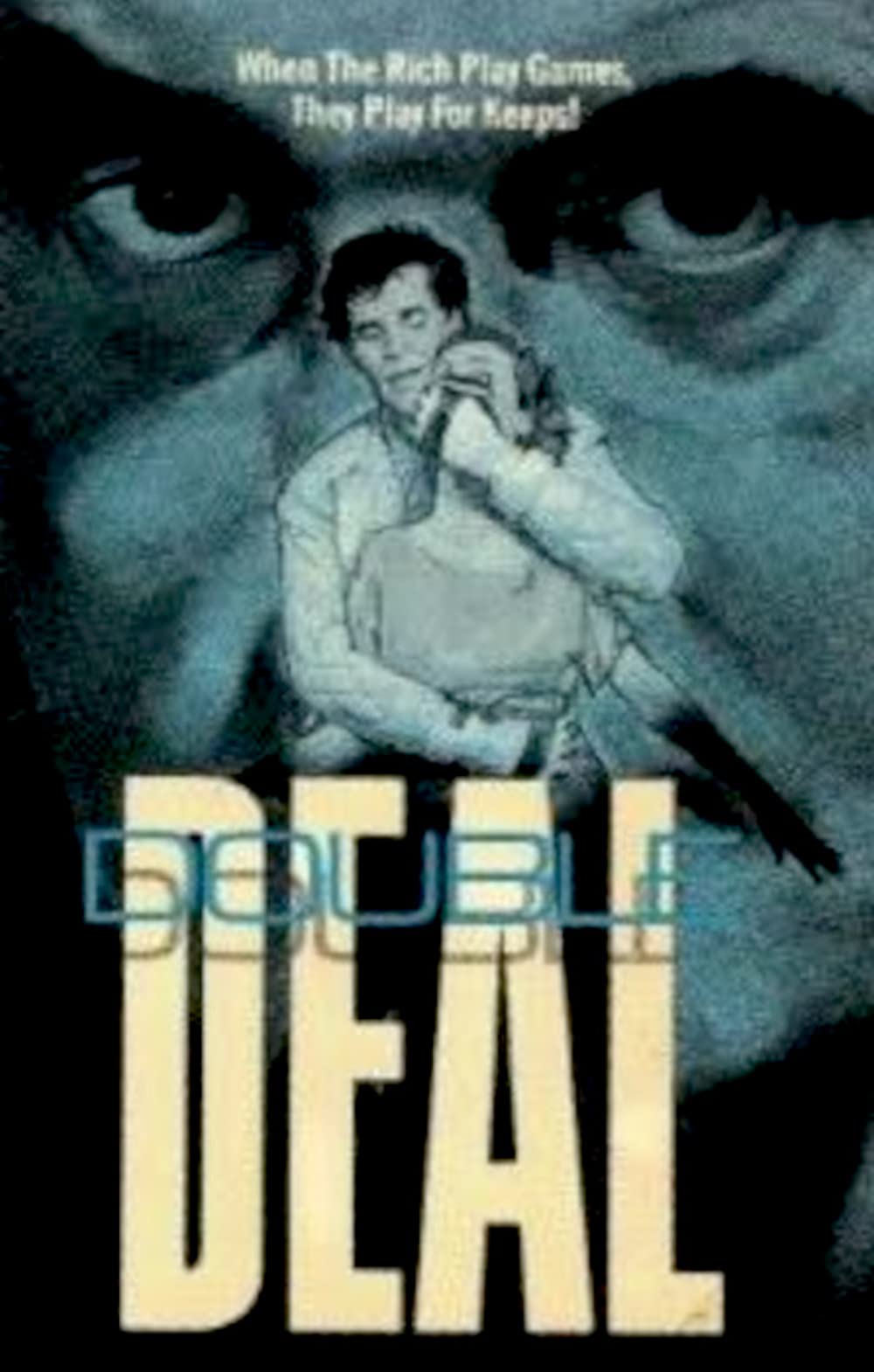
Christine (Angela Punch McGregor) is a young model married to Peter (Louis Jourdan) a much older man. While Peter is rich and they live in a big house their marriage lacks passion and Christine becomes bored with her existence while Peter continues to have a long-running affair with his secretary Miss Stevens (Diane Craig). One day while out shopping Christine meets a handsome young man (Warwick Comber) on a motorbike. Even though she doesn’t know his name she becomes entranced with his good looks and carefree demeanor. He’s the exact opposite of the stuffy and exacting Peter, so she decides to run-off with him. The two go on many quirky adventures including robbing a grocery store while in clown make-up not so much because they need the money, but just for the thrill of it. They then plot a scheme where the man will pretend to have kidnapped Christine and insist that Peter relinquish his prized opal gemstone in order to get her back. Peter complies, but in the process sets off an array of unexpected twists where nothing is as it seems.

Normally I like films with an offbeat slant and this one certainly has its moments, but the characters aren’t well fleshed-out, which makes for a placid experience. A good case-in-point is the way Christine comes upon the young man, which is while she’s in a shopping center parking lot. Having found that someone has double parked their car behind hers she patiently waits for the owner of the vehicle to come out and move it, but in the process the young man comes along, and noticing that the keys of the car are still in the ignition, jumps into the car and drives away with it while also following Christine home. Once there the two proceed to tear up the place before she packs her bags and runs off with him onto the open road without ever even learning what his first name is.

While as an actress McGregor is quite competent she doesn’t have the looks of a fashion model, which she herself admitted to, and her role and that of the secretary should’ve been reversed with Diane Craig looking far more the model type especially with her piercing blue eyes. Comber is a bit off as the handsome stranger as well. He certainly has a hunky build and chiseled face, but his droopy eyelids give him a odd, sad eye appearance. I also got tired of seeing him constantly wearing a silver bike riding suit that seemed to resembled more of an outfit worn by someone on a spaceship.

Jourdan’s presence helps a lot. This was at the twilight of his career where he was no longer getting leading man roles in his home country of France and therefore open to accepting offers abroad, which is what lead to him traveling to Australia to do this. The filmmakers wanted a big name star to help give the production stature and the movie definitely works better with him in it though the scene where he and McGregor are in bed together was reportedly quite awkward for the two stars given their wide age difference of almost 33 years and took many takes to film.

There are a few memorable moments with my favorite being the grocery store robbery, which occurs in a small outback town, where Christine accidentally releases the money they have just stolen into the air as she gets into the getaway car causing the store owners, who had just been robbed, to run out and busily try to recollect the money blowing in the wind. However, the story lacks soul. The twists get thrown in for the sake of being offbeat, but the characters never grow, or resemble real people in any way. The winding plot ultimately burns out and ends with a fizzle.

My Rating: 6 out of 10

Released: September 15, 1983

Runtime: 1 Hour 30 Minutes

Not Rated

Director: Brian Kavanagh

Studio: Roadshow Films

Available: dvdlady.com

The Last Detail (1973)

lastdetail

By Richard Winters

My Rating: 8 out of 10

4-Word Review: Seaman escorted to prison.

Billy Buddusky (Jack Nicholson) and Richard Mulhall (Otis Young) are two navy lifers assigned the task of escorting an 18 year-old seamen named Larry Meadows (Randy Quaid) to prison. Meadows had been caught lifting $40 from a charity fund run by a wife of a senior officer. In return he got court-martialed and given an 8-year sentence in the brig. Buddusky and Mulhall feel the sentence is too harsh and immediately take a liking to the soft-spoken young man who despite his tall height seems harmless and mile-mannered. During the trip, which is expected to take a week, the two men decide to show Meadows a ‘good time’ by taking him on many side-trips including a whorehouse where the young virgin has sex with a prostitute (Carol Kane). As the time grows near for them to turn their prisoner over to the authorities they start to feel reluctant about doing so, but the fear of being kicked out of the navy and losing all of their pay and benefits keeps them grounded in their responsibility even as Meadows tries several times to escape.

It may seem amazing to believe now, but this film, which has won over almost universal appeal both from the critics and film viewers almost didn’t get made due to the fear from the studio that the word ‘fuck’ was spoken in it too many times. Screenwriter Robert Towne, who adapted the story from the novel of the same name by Daryl Poniscan, was pressured to take most of the uses of the profanity out of the script and in fact production was delayed while both sides had a ‘stand-off’ about it with Towne insisting that “this is the way people talk when they’re powerless to act; they bitch.” Eventually the script got green-lit with all the ‘fucks’ intact, which at the time was a record 65 of them. In retrospect I’m glad Towne held his ground as without the F-word being used, or some silly lesser profanity substituted in, would’ve given the film a dated feel when being watched by today’s standards where the word is said hundreds of times on social media and sometimes even in commercials where it’s only slightly bleeped-out. This is a problem when watching other films from the late 60’s and early 70’s where goofy slang gets thrown in to compensate for the lack of the F-word, which in turn hurts the film’s grittiness and edge, which thankfully got avoided here.

The story was a problem too as many studio execs considered it too ‘non-eventful’ to make for an interesting movie, but this is the whole reason why the movie is so special as it doesn’t try to throw in the cheap antics other Hollywood films might to make it ‘more entertaining’. The film remains low-key and fully believable throughout and may remind others, as it did me, of one’s own coming-of-age experiences when they were 18 and hanging out with others who were older and more worldly-wise. Cinematographer Michael Chapman, who appears briefly as a cab driver, insistence at using natural lighting only also helps heighten the realism.

The story takes many amusing side turns that manages to be both poignant and funny including a brawl that the three have with a group of marines inside a Grand Central Station restroom, though I did wish some of the other segments had been strung out a bit more. One is when the three men attend a group encounter, which features Gilda Radner in her film debut, to a bunch of chanting Buddhists. I felt it was weird that the men just stood in the background and didn’t assimilate with the group during the meeting and begin chanting alongside the others, which would’ve been funny. The scene inside the hotel room where Buddusky can’t get his roll-out cot to fold-out right and forcing him to sleep in a uncomfortable position should’ve been played-out more too. Are we to believe that he slept that way the whole night?

Of course it’s the acting that makes this movie so special. While I never pictured Nicholson with his over-the-top persona as being someone who would be a part of the regimented culture such as the navy I ended up loving him in it and felt this was the performance he should’ve won the Oscar for. I especially got a kick out of the way he would get all fidgety when outside in the cold, which I don’t think was acting at all as it was filmed on-location in the Northeast during the very late autumn/early winter and I believe he was really freezing as he was saying his lines.

While his character is not as flashy, Otis Young is every bit as excellent as it takes a good straight-man, which is what he essentially is, to make for a good funny man. The part was originally meant for Rupert Crouse, who unfortunately got diagnosed with cancer just as the production began forcing the producers to bring in Young as a last minute replacement, but he manages to deliver particularly in the scene on the train where he loudly castigates Buddusky for his misbehavior. Quaid is quite good too even though he goes against the physical characteristics of the character, who in the novel was described as being ‘a helpless little guy’, but director Hal Ashby, who can be seen briefly during a barroom scene, choose to cast against type by bringing in a tall, hefty fellow who looked like he could defend himself if he had to, but is just too sheltered to know how.

The ending is the one segment where I wished it had been a little more emotionally upbeat. It’s still a big improvement over the one in the book where Buddusky dies, which fortunately doesn’t happen here, but it still isn’t too memorable either. The film though overall does a good job of conveying the underlining theme of how the navy men where just as imprisoned as Meadows, at least psychologically, and unable to consider life outside of the navy box that they had spent their entire lives in and where thus locked-in more so than Meadows, whose sentence in jail would only last 8-years versus a lifetime like with Buddusky and Mulhall.

My Rating: 8 out of 10

Released: December 12, 1973

Runtime: 1 Hour 44 Minutes

Rated R

Director: Hal Ashby

Studio: Columbia Pictures

Available: DVD, Blu-ray, Amazon Video, YouTube