Category Archives: Revisionist Western

J. W. Coop (1971)

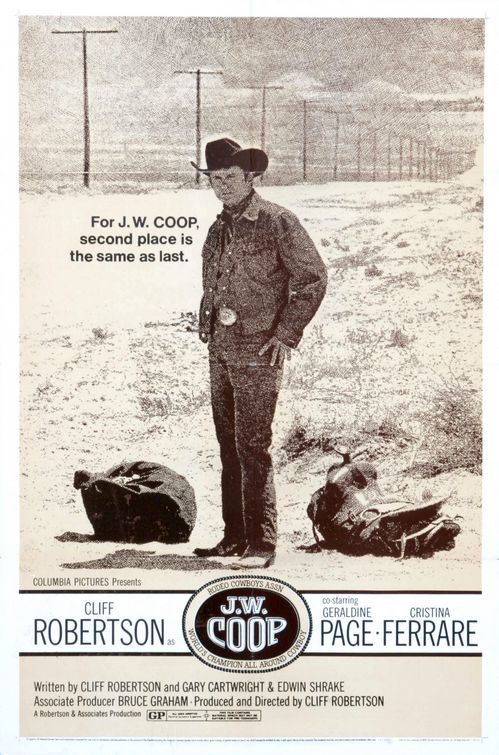
jw 2

By Richard Winters

My Rating: 8 out of 10

4-Word Review: Rodeo star makes comeback.

J.W. Coop (Cliff Robertson) has just spent 9 years in prison. After finally being released he finds that the world has changed quite a bit. He’s no longer the big rodeo star that he once was and younger, more educated men have now taken his place. There’s also the new hippie movement that he isn’t quite sure what to make of. With his mother (Geraldine Page) growing senile and no other friends to turn to he decides to take one last stab at the rodeo circuit and determined to beat the odds and become the champion because for him second place is the same last.

The film has a wonderfully gritty quality to it that fully immerses the viewer into the western rodeo landscape and lifestyle. The rugged characters and conversations seem authentic without ever being condescending. The film reveals a lot about the inner toughness needed to survive in that environment as well as the competiveness and eventual loneliness.

Robertson’s stab at directing is flawless and convinced me that he should’ve done more movies behind the camera. He uses several techniques that make the rodeo experience vivid for the viewer including filming a point-of-view shot from on top of the bronco as well as even more impressively showing one taken from underneath a horse as it is running. I also liked the shot where the screen gets split into four squares with each of them showing some of the many hotels that he stays at during his travels on the circuit, which visually hits home how exhausting life on the road can be. There’s also a haunting segment shot late at night at a lonely oil rig that is brief, but quite memorable.

Former model Cristina Ferrare, who is probably best known as being the ex-wife of automaker John DeLorean as well as host of ‘Home and Family’ gets a rare turn at acting playing a hippie who falls in love with Coop.  Her performance is solid even though I found it hard to believe why such a young woman would fall for a man who is so much older, less educated and having not much more money than she does. Their relationship goes on far longer than I realistically would expect, but I still liked the idea of how two people from two very different backgrounds and generations can still manage to connect. Robertson’s performance is equally good and the film also has the novelty of casting Page as his mother even though in real-life she was actually one year younger than he was.

The segment where a throne of teen girls jump out of a trailer and beg for Coop’s autograph as well as the ending in which Coop, with his leg in a cast, attempts to ride a bull are the only two times that it overreaches in a film that is otherwise quite honest and uncompromising and particular good at mixing subtle comedy with stark drama.

My Rating: 8 out of 10

Released: October 3, 1971

Runtime: 1Hour 52Minutes

Rated PG

Director: Cliff Robertson

Studio: Columbia Pictures

Available: DVD, Amazon Instant Video

Soldier Blue (1970)

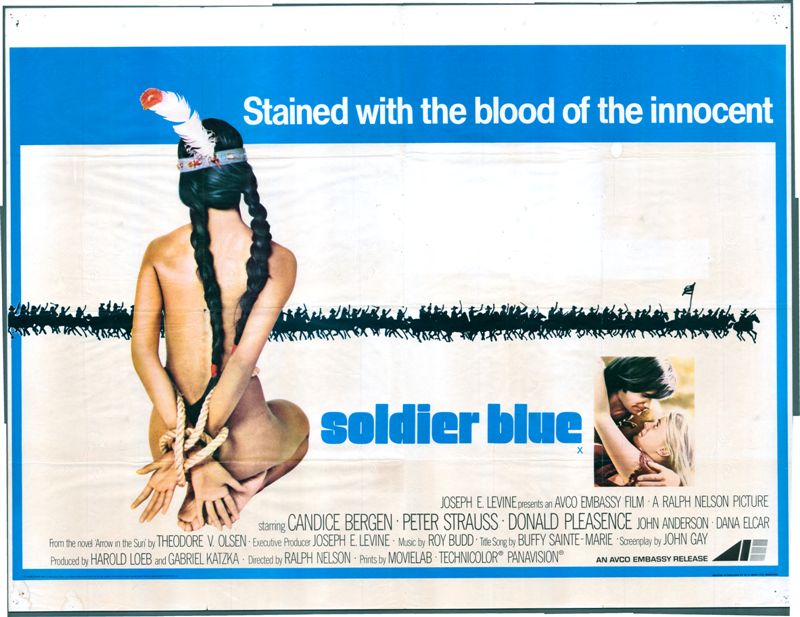
soldier blue 1

By Richard Winters

My Rating: 5 out of 10

4-Word Review: They massacre the Indians.

Two survivors of a Cheyenne Indian attack, the young and beautiful Cresta (Candice Bergen) and Honus (Peter Strauss) a private from the Calvary must travel through treacherous western terrain avoiding other attacks while also finding the Calvary’s base camp. Along the way the two start a romance despite wide differences in their temperaments and perspectives. Honus supports the position of his country and government without question while Cresta is more sympathetic to the Indians, but this all comes to a crashing halt when they witness an assault by the U.S. army on a peaceful Indian camp, which shocks Honus and changes his perspective on things forever.

The film is mainly known for its notoriously violent ending, which at the time was unprecedented for its use of explicitly savage imagery and remains controversial to this day, but before we get to that I’d like to go over what I did liked about the movie, which for the most part is still watchable.

Filmed in Mexico in October of 1969 the stunning views of the wide open terrain  is sumptuously captured by cinematographer Robert B. Hauser, which is enough to keep one enthralled with it despite its otherwise flimsy plot. I also enjoyed Buffy Sainte Marie’s rousing opening title tune, but the rest of the music score by Roy Budd seems misplaced. During the attack that starts out the film it is booming and orchestral almost like it wants to replicate the sound and mood of a conventional western even though this is supposedly a revisionist one. At other times it takes away from the potential grittiness by being played when it was not needed and sounding too modern for the time period.

Strauss in only his second film is marvelous and makes his naïve and rigid character believable and likable, but I was perplexed how someone lost in the wild for days and weeks and sometimes without food or even a gun could still remain clean shaven. Bergen as his female counterpart is great as well and beautiful. The fact that she is foul mouthed and very self-sufficient while Honas is more timid makes for a nice reversal of the sexual stereotypes, which helps propel the film during the first half. However, it eventually gets overplayed as Bergen’s character starts to display too many attitudes and behaviors from someone that was ahead-of-her-time until it seemed like she was really a late ‘60’s student radical that somehow got pulled into a western setting instead of a person that had actually lived during that era.

Donald Pleasence, a highly talented character actor who played many varied roles during his career, gets one of his best ones here while wearing false teeth that make him almost unrecognizable. His chase of the two when they destroy his wagon lends some much needed tension in what is otherwise a dull romance.

The Indian massacre that climaxes the film is based on the Sand Creek Massacre that occurred on November 29, 1864. Although the film incorrectly states during its denouncement that is was led by Nelson A. Mills it was actually U.S. Army Colonel John Chivington who ordered a band of 700 men to attack a peaceful Indian village where between 150 and 200 Indians were killed most of whom were women and children.

The film portrays Bergen’s character as being the only white person outraged at the slaughter, which isn’t true as many people from the era where appalled by the news when it was found out and the attack was condemned by the army after it was investigated.  Chivington was then forced to resign where he lived out the rest of his life in almost total ostracism by every community he moved to. There were also two officers in the Calvary who refused Chivington’s orders to attack and told the men under their command to hold their fire, which doesn’t get shown at all.

Although the movie does leave some effective haunting images it would’ve worked better had it been a documentary, or a reenactment that concentrated fully on the attack while also showing its aftermath and what lead up to it. It should’ve also been better researched, accurate and balanced instead of feeling the need to pander to the political fervor of its day with stagy over-the-top dramatics and a clumsily attempt to tie it into the My Lai Massacre that has forever stigmatized this as being nothing more than dated emotionally manipulative propaganda.

soldier blue 2

My Rating: 5 out of 10

Released: August 12, 1970

Runtime: 1Hour 55Minutes

Rated R

Director: Ralph Nelson

Studio: AVCO Embassy Pictures

Available: VHS, DVD, Blu-ray (Region 2), Amazon Instant Video, YouTube

Jeremiah Johnson (1972)

By Richard Winters

My Rating: 6 out of 10

4-Word Review: Man in the wilderness.

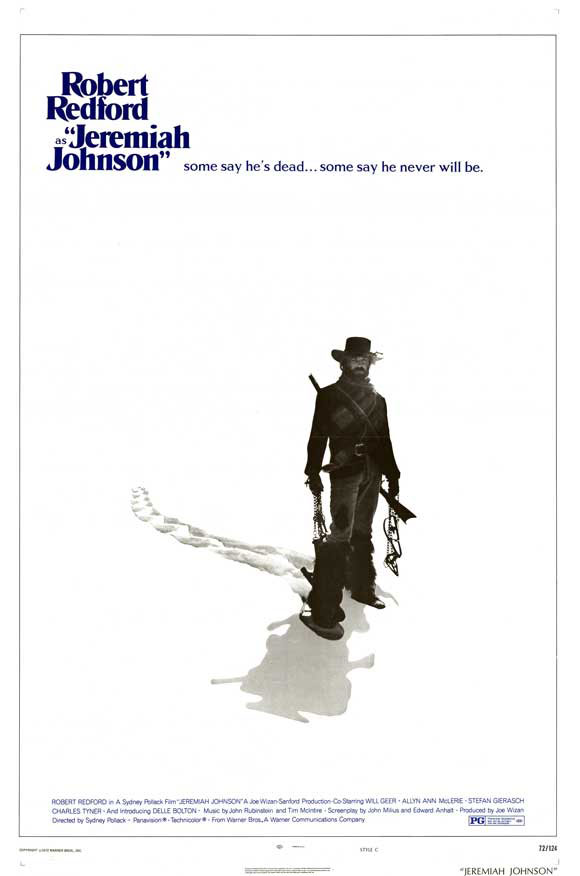
            Jeremiah Johnson (Robert Redford) is a man who wishes to live life alone in the snowy mountains. His peaceful existence comes to an end when after riding through a sacred burial ground of the Crow Indian he becomes the target of young male warriors who attack him one-by-one when he is not expecting it to avenge his ‘desecration’. Jeremiah manages to defeat every warrior that challenges him turning him into a legend among the native tribes.

The film’s on-location shooting is outstanding and one of the chief assets in watching the movie. It was shot entirely in the state of Utah and there are many majestic long-shots where all you hear is the wind blowing and makes you feel like you are outdoors yourself alongside the character. The barren, empty winter landscape is well captured and while watching Jeremiah trudge all alone through the snow it was hard for me to imagine that there was actually a film crew present. The ambience of the natural surroundings is breathtaking and grabbed me immediately. I enjoyed the slow, quiet pace at the beginning and wished there had been more of it. One of the most enjoyable scenes is watching Jeremiah trying to catch fish with his hands out of a river, which could have been more entertaining had it been extended.

The story is loosely based on the real life exploits of fur trapper John Johnston who was known to cut out and eat the liver of every crow warrior that he defeated. There is nothing like that here and in some ways that is part of the problem. The ruggedness and reality seem to have been compromised by 70’s sensibilities with too many quirky scenarios and characters thrown in making the film’s structure reminiscent to Little Big Man, which was released just a few years earlier. That film seemed refreshingly cerebral, but here it becomes imitative and derivative.

Robert Redford is high in the looks department, but so-so in acting. He has always had too much of a detached presence and his range of emotions is limited. In some films this may work, but here the part needed more charisma and flair. The character was more like a modern day, touchy-feely male transplanted from Hollywood and into the wild than an actual 18th century hermit. For a man living off the land far from civilization he has to have the whitest most straightest teeth I have ever seen.

The supporting cast fares better. I loved Will Geer as the aging fur trapper Bear Claw. This guy has all the panache that Redford lacked and the movie would have been better had it made him the focus. Allyn Ann McLerie has a small, but riveting role as ‘the crazy woman’ who is unable to cope, or accept the fact that her family has been slaughtered by an Indian attack.  Stefan Gierasch has his finest hour as Del Gue a fur trapper that Jeremiah comes upon. During the first half you see him as bald only to have him return in the second half with a full head of hair. The scene where he is shown buried in sand up to his head is amusing and disconcerting at the same time.

My biggest issue with the film is when Jeremiah starts to fight off all the Indian warriors who attack him. I just could not believe that one man would be able to defeat and kill so many of them. I could understand maybe a few, but eventually odds would have to catch up with him. There is never any special skill shown for why Jeremiah seems to always get the upper hand during these battles. The fights themselves are not exciting as they are much too brief and edited in a way that it is hard to follow the action. It seems like it takes only a few seconds from when the Indian jumps him to when Jeremiah already has him on the ground dead. Jeremiah is also the only person I know of who can have a large spear pierce his body and all he does is pull it out and go on living without any noticeable injury.

The first half is more compelling than the second, which had me feeling bored. The side-story of having him take on an Indian bride as well as a young boy who does not speak has potential, but doesn’t go far enough with it. For an adventure story there is very little action outside of the Indian battles that to me seemed phony. The best sequence is a wolf attack that is nicely edited and graphic. The Crow Indian burial scene is effectively moody and starkly photographed.

The screenplay by John Milius and Edward Anhalt was written using material from two different novels and the lack of cohesion shows. Part of it wants to be a gritty nature drama while the other half plays like a mystical fantasy, but this uneasy mixture never gels, or works.

My Rating: 6 out of 10

Released: December 21, 1972

Runtime: 1Hour 56Minutes

Rated PG

Director: Sydney Pollack

Studio: Warner Brothers

Available: VHS, DVD, Blu-ray, Amazon Instant Video

Hannie Caulder (1971)

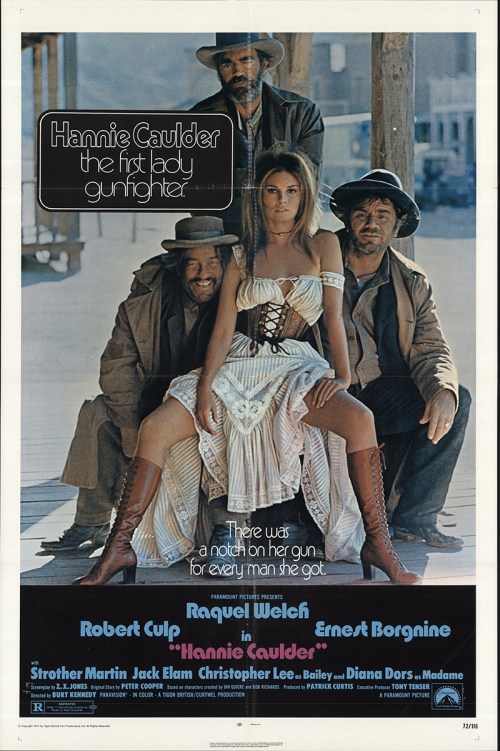
hannie1

By Richard Winters

My Rating: 5 out of 10

4-Word Review: Hannie gets her revenge.

Three outlaw brothers (Ernest Borgnine, Jack Elam, Strother Martin) on the run from a botched robbery come upon an isolated house in the dessert. There they kill the husband and then gang rape the wife whose name is Hannie Caulder (Raquel Welch). They set the house on fire and then ride away laughing.  She manages to escape the blaze and makes a personal pledge to get her revenge. She has never used a gun before in her life, but with the help of a kindly bounty hunter named Thomas Price (Robert Culp) she learns the art of being a gunfighter.

The film nicely symbolizes the emerging force of women in 70’s society while using it inside a western motif. When we first see her she is in the kitchen with an apron on and cooking.  She learns though how to survive in a man’s world, do everything they can, and earn their respect in the process. It follows the same formula used in later cult hits I Spit on Your Grave and Ms. 45 except those titles were far more explicit and violent.

Critic Leonard Maltin, in his review of the film, called it a ‘bizarre, mystical western’, but I saw little of that.  In a lot of ways it was very routine with the only difference coming in the fact that it was a women single-handily seeking revenge instead of a man. There were only a few offbeat qualities that stood out enough to be mentioned. One was detailing the making of a gun, which I found to be interesting as well as the Hannie’s training and the different, subtle techniques that a gunfighter uses. British horror actor Christopher Lee is cast as a Mexican gunsmith. There is also one shootout segment that is done in slow motion, which is very cool.  Otherwise the majority of it is standard fare that is adequate, but not real impressive.

The idea of having the bad guys play it up as comical goofballs was a mistake.  It hurts the tension because we should want to see Hannie get her justice on these guys.  It also seems to minimize the savage act that they do and make the brutal subject matter seem lighthearted and silly when it shouldn’t be. Now, with that said, I still found some of the lines Strother Martin was given to be amusing and he almost became a scene-stealer

Raquel is looking gorgeous and wears a few revealing outfits, but there is no actual nudity, which would have helped. I still feel her acting ability is a bit lacking and the range of characters that she can play is limited. I did like her attempt at portraying a gritty character and taking a role that wasn’t glamorous. For a leading lady she has very few lines of dialogue. It wasn’t until the end when she says a few snappy one-liners at the bad guys that her part begins to click.

Robert Culp is all wrong as the bounty hunter and love interest. He can be a good actor in certain roles.  I always liked him as Peter Falk’s main nemesis in the Columbo series, but here he just doesn’t seem rugged enough. He wears glasses and is middle-aged and looks like a tenured college professor instead of a gunfighter.  The budding romance between the two doesn’t work either. He was about 12 years older than Raquel and always behaved more like a father to her right from the start.  The scene showing them holding hands while walking along a beach seemed almost creepy.

To me the film doesn’t come together until the end when she tracks the outlaw brothers down one by one in unusual locales. One is at a whorehouse, the other in a ladies clothing store, and the third is in an abandoned prison. This is the best moment as the prison itself is very isolated and the sound of the blowing wind and the late afternoon sun gives the scene a lot of atmosphere.

This is not a bad movie, but it is not a particularly good one either.  It is quite compact, running only 85 minutes, and the pace is quick. Despite the subject matter it runs pretty much on the light side. Western and Welch enthusiasts may find this more interesting than others. Borgnine fans may also like it as he is effectively slimy here.

My Rating: 5 out of 10

Released: November 8, 1971

Runtime: 1Hour 23Minutes

Rated R

Director: Burt Kennedy

Studio: Paramount

Available : VHS, DVD, Blu-ray, Amazon Instant Video