Category Archives: Quirky

The Monitors (1969)

By Richard Winters

My Rating: 3 out of 10

4-Word Review: They are watching us.

            Aliens, who dress in suits, long overcoats, and bowler hats, invade earth and an attempt to police everybody’s thoughts and actions while trying to quell a rebel uprising led by Colonel Stutz (Larry Storch). Working for the uprising is Harry (Guy Stockwell) who falls in love with Barbara (Susan Oliver) who secretly sides with the aliens.

The movie starts out with a lot of potential and piqued my interest with unusual montages and camera work. Unfortunately this subsides quickly and soon we are stuck with drab sets, extraneous scenes, and a film unable to hide its low budget roots. I began to wonder if the reason the rebels had their hideout in an abandoned farmhouse was more because the filmmakers could film there without having to pay for a permit than anything else.

The film should have gone completely for parody and farce and if they had done that this might have worked. Instead it seems to drift into a conventional sci-fi narrative complete with a pseudo philosophical climactic debate between the humans and aliens that we have all heard before and does nothing but slow the film down to a tedious level. Adding in the love interest angle between the two leads is contrived and formulaic.

The aliens aren’t too interesting either. There is never any explanation as to how they were able to take over the planet, but the fact that they are unable to even get through a locked door of an old crumbling warehouse made me wonder how they were able to succeed at anything. Equipping them with a little more sci-fi gadgetry would have helped. I realize they don’t have to be carrying around the proverbial ray-gun, but having them break up an angry mob by using ordinary canisters of pepper spray seemed unimaginative.

Spliced into the story are comical TV ads with famous celebrities of the day such as Stubby Kaye and Xavier Cugat promoting the monitors and convincing the public to support them. These commercials are not funny with the only exception being Alan Arkin playing a foreign man who speaks broken English. In the case of former Senator Everett Dirksen it is almost sad. He was very elderly at the time of the filming and he is clearly reading his lines from cue cards and mouthing the words and looking like he is barely functional, or coherent.

The music is another problem. Initially I really liked it as the opening credits feature a computer with a very robotic voice singing the theme. Singer Odetta sings most of the other songs and some of them have a distinctive sound, but they get overplayed and saturated by the end.

The production was shot on-location in Chicago and I loved the aerial shots showing the skyline. I almost wished there had been a little more of them although I did notice that the exact same skyline shots at the beginning get reused in the second half. I didn’t like the idea that it was filmed in the late fall/early winter as the cast is shown shivering in several shots while forced to wear light clothing and their breath is clearly visible.

Susan Oliver gives another solid performance and shown flying an airplane in one sequence as in real-life she was an avid pilot. Sherry Jackson’s presence is minimal, but she is always appealing to the eyes. Avery Schreiber, a comedian known to overact horribly in just every part he is in, comes off as rather amusing here playing the younger brother of Harry who reluctantly joins up with the resistance. Larry Storch, another notorious ham, is engaging as well especially when he appears in drag and later on dressed as General MacArthur.

This is a failed experiment that should have been a lot better. It seems to want to take on the quirky sentiments of the era, but is either too timid, or too unimaginative to go all the way with it.

My Rating: 3 out of 10

Released: October 8, 1969

Runtime: 1Hour 32Minutes

Rated M

Director: Jack Shea

Studio: Commonwealth United Entertainment

Available: Netflix Streaming
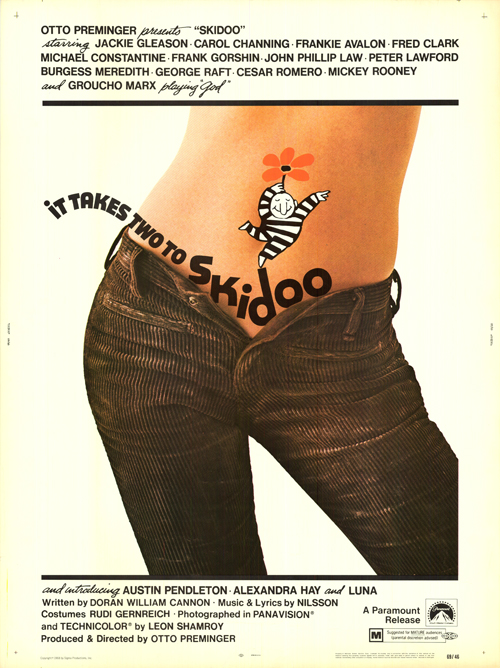
Skidoo (1968)

By Richard Winters

My Rating: 5 out of 10

4-Word Review: They were on LSD.

Jackie Gleason plays family man Tony Banks with mob past who is now trying to go straight yet gets sucked back in by a gangster leader named God (Groucho Marx). He orders Tony to disguise himself as a prisoner so he can infiltrate a prison system and knock off another prisoner and rival named George ‘Blue Chips’ Packard (Mickey Rooney). While in prison Tony mistakenly takes some LSD and goes on a wild drug induced trip.

Story wise it is limp. The humor is weird, but not altogether funny. It tries to satirize a lot of things yet none of it comes together. There is no singular voice or vision let alone cohesion. The pacing is poor and haphazard. It becomes so sloppy and nonsensical that you almost wonder if renowned director Otto Preminger was the one taking the LSD stuff.

The idea of mixing old school comedy with the mod hipness of the day was not new. Many films (and TV shows) of that period tried it with limited success. Yet few went to the extremes as this one. It is still a complete disaster yet odd enough to grab your attention and hold it. In some ways it’s enjoyable and even entertaining if viewed as an oddity and relic of its era.

There are a few good scenes. One involves a weird hippie speech by actor John Phillip Law where he professes a need to be ‘nothing’ which will somehow make him ‘everything’ and ‘anything’. There are also some quirky commercial spoofs at the beginning, a brief glimpse of Packard’s prison cell ‘office’, and the ‘the family tree’ of a crime syndicate. Gleason’s LSD trip really isn’t that funny, but it is still weird enough to stand out.

A lot of talented character actors are wasted with boring bit parts. Gleason though still comes through as his bombastic self. Unfortunately the same cannot be said for Groucho. He looks old and well past his prime. He mouths his lines with little or no energy. His conversation with actress Alexandra Hay seems particularly strange as he ‘talks to her’ but never once actually looks at her. Instead he looks off into another direction in a not so subtle attempt to read his cue cards. He does this in other scenes too. Some may still get a kick out of his presence because at the end he dresses as a hippie and even takes a puff of the weed. You also gotta love his mistress and her very low cut dress.

Austin Pendleton gives the best all- around performance playing the first in what has become a long line of nebbish, bookworm type characters. Carol Channing is a real surprise. She sings and even gives each one of the hippies a shampoo in her kitchen sink. There is also a freaky scene where she does a striptease and then lies half naked on Frankie Avalon’s bed. Her presence also gives Gleason a chance to write her a little love letter where states that how he misses her “even that voice of yours”.

Harry Nilsson’s music in Midnight Cowboy was perfect, but all wrong here. However hearing him sing EACH AND EVERYONE of the credits at the end is a goofy delight.

My Rating: 5 out of 10

Released: December 19, 1968

Runtime: 1Hour 37Minutes

Rated M

Director: Otto Preminger

Studio: Paramount

Available: DVD 

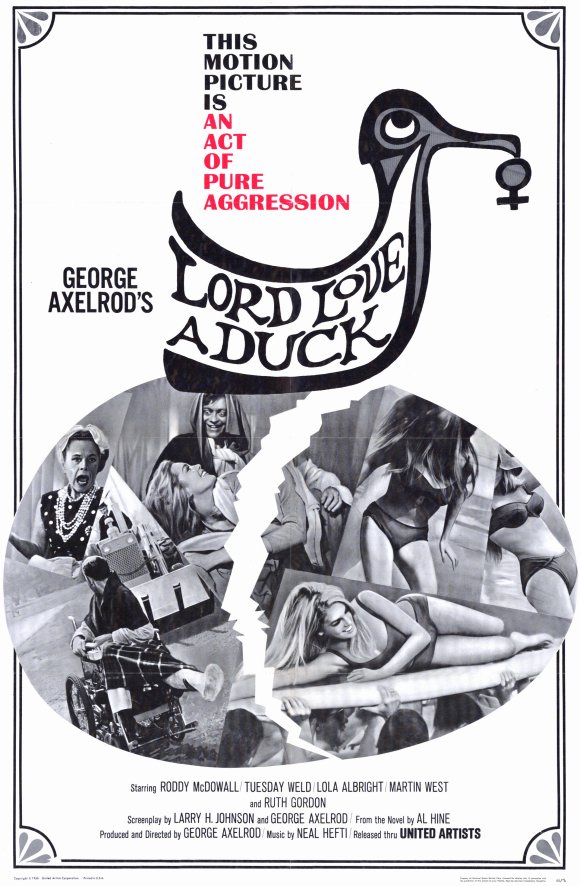
Lord Love a Duck (1966)

By Richard Winters

My Rating: 3 out of 10

4-Word Review: She wants it all.

If you ever wondered where political correctness got its start it was probably southern California in the mid 60’s. Here everything is neutralized and modified so as to ‘keep up with the times’. There’s even a drive-in church where the minister proudly exclaims that the Lord answers every prayer because “whatever happens is the answer”.

Tuesday Weld plays teenager Barbara Ann Greene who can’t be happy unless she has it all. She meets fellow high-schooler Allan Musgrave (Roddy McDowell) who because of his super intelligence is able to figure out ways for her to get what she wants. Yet the more she gets it the more unhappy she becomes.

It’s a satire on our consumer driven society, but it is too restrained and soft. A supposedly cutting edge film looking at our modernized world should have been filmed in color and not black and white. It also should have been faster paced with a heavier emphasis on the zany and outrageous. Instead we only get hints of this with a lot of slow segments and even some clumsy drama. The funny offbeat bits are spread out to thin and do not make up for the other parts that are boring and contrived.

There are some technical problems too including a lot of ‘outdoor’ shots that were really filmed indoors on a soundstage. They fortunately don’t do this anymore, but when they did it looked tacky. There is also a boom mike that is very obvious to see in several shots.

McDowell is not eccentric, nor unique enough for such an offbeat character. Although perpetually boyish looking he was way, way too old to be playing a high school student as he was 37 when this was filmed. Out of all the performers Harvey Korman comes off as the most amusing playing the overtly congenial school principal.

This film does feature an attractive cast. Of course Weld is always alluring, but she has competition from Jo Collins who was Playboy Playmate of 1965. There is also Lynn Carey daughter of the late actor MacDonald Carey from ‘Days of Our Lives’ fame. She is exceptionally good looking and watching here gyrate in a bikini to the latest dance craze is damn near pornographic. For her age Lola Albright, who plays Weld’s mother, is an absolute knockout and she can officially be crowned as a ‘milf’.

My Rating: 3 out of 10

Released: February 21, 1966

Runtime: 1Hour 45Minutes

Rated: NR (Not Rated)

Director: George Axelrod

Studio: United Artists

Available: VHS, DVD

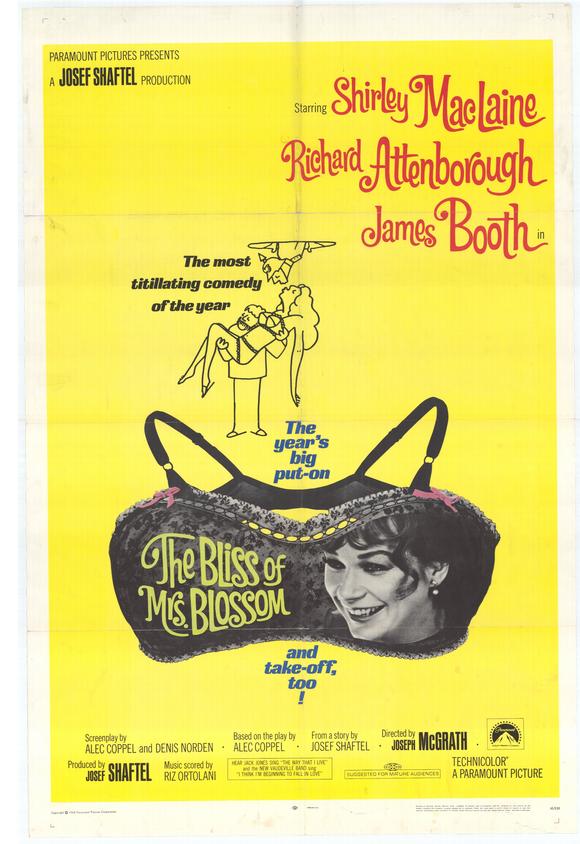
The Bliss of Mrs. Blossom (1968)

By Richard Winters

My Rating: 6 out of 10

4-Word Review: Lover in the attic.

This wacky film nicely exudes the mod, experimental wave of filmmaking that permeated the era of the late 60’s. The story takes place in London and is about a clothing manufacturer’s wife named Harriet Blossom (Shirley MacLaine) who one day calls her husband Robert (Richard Attenborough) while he is at work to tell him that her sewing machine has broken down. Robert sends his lowly assistant Ambrose Tuttle (James Booth) over to their house to help her fix it. Harriet is a bit bored with life and feels neglected by her husband, so she not so subtly seduces Ambrose and then hides him in the attic where he soon takes up residence.  He comes out only when Robert is away, but the unexplained strange noises that Robert hears and the many close calls make him think he is going insane and leads him to a nervous breakdown.

Director Joseph McGrath’s highly visual style is the real star. The lighting, editing, camera angles, set design, and costumes are creative and imaginative.  The home that was chosen for the setting has a nice architectural flair especially the attic and billiards room, which seems to be draped by a large stain glass window. Certain film professors show this movie to their classes as an example of how stylish direction can help accentuate a story as well as deftly define its era. I was disappointed to see that although McGrath is still alive he hasn’t done a film since 1984, which is a shame as it is obvious from this that he is quite gifted and I would have liked to see him doing more.

This is generally considered a vehicle for MacLaine, but to me her performance isn’t interesting. I think she is a first rate actress, but her character here is the only normal one in the film and she acts more like an anchor trying to corral the craziness around her. Booth, as her lover, goes to the other extreme, but doesn’t fare any better. He is too clownish and is always wearing various disguises and going through different personas, which makes the character unrealistic and cartoonish. If anything, out of the three main leads, it is actually Attenborough who does the best. His nervous and confused facial expressions are priceless. The scenes were he comes home from work and to ‘unwind’ pretends to be a conductor of a large orchestra while listening to a loud record, is amusing.

The colorful supporting cast though, full of legendary British Pros, is what steals the film. Some of them appear just briefly, but they still make a memorable and funny impression. Barry Humphries, playing a male character and not Dame Edna, is good as an art dealer. John Cleese, in one of his very first roles, is engaging as an argumentative postal clerk.  The best however is far and away Freddie Jones as the snippy, suspicious, relentless detective that will leave no stone unturned in his pursuit of Ambrose, who once he moves into Harriet’s attic proceeds to completely drop of society and disappear.

Although generally entertaining the plot doesn’t go anywhere and is simply a set-up for a lot of absurdity. What is worse is the fact that this based on a true story that in its own right was very intriguing.  In the real-life incident that took place in 1913 a 33 year old woman by the name of Dolly Oesterreich met a 17 year old named Otto Sanhuber. She, like the character in the movie, was a bored wife of a wealthy textile manufacturer, and took in the young man as her ‘sex slave’, which he readily accepted. To avoid possible suspicion she had him move into their attic, where he remained for five years and despite some close calls was never caught.  When the Oesterreich’s moved to Los Angeles in 1918 Dolly made sure that their new home had an attic as well and Otto then took up residence there and the deception continued until 1920 when Otto finally ended up killing the husband.

Of course none of that happens here. In fact Ambrose is fond of the husband and considers the three to be one big happy ‘family’, which is offbeat for sure, but not particularly satisfying. Again, this film does have some funny moments. I thought the scene where Robert invents the world’s first inflatable bra only to have the system go awry during an exhibition, which forces the model’s breasts to grow to unbelievable proportions before they go floating in the air, to be hilarious.  Still the end result of this production can best be described as cinematic soufflé.

My Rating: 6 out of 10

Released: September 11, 1968

Runtime: 1Hour 33Minutes

Rating: NR (Not Rated)

Director: Joseph McGrath

Studio: Paramount

Available: VHS

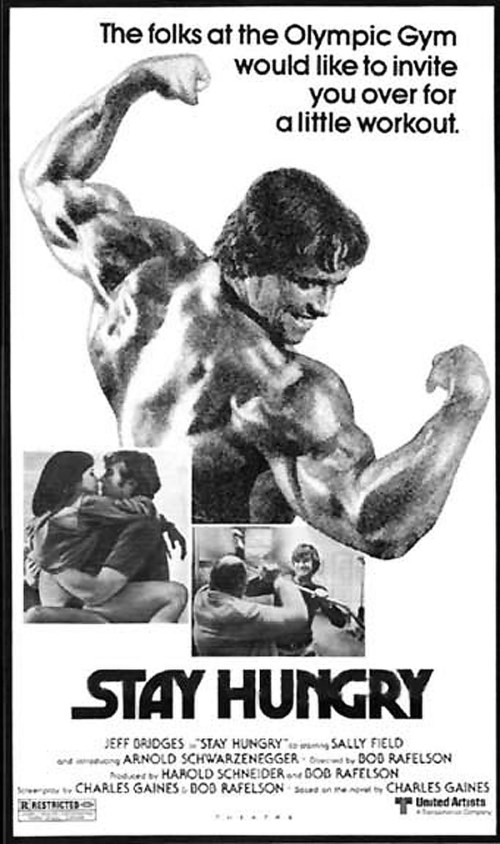
Stay Hungry (1976)


stay hungry 2

By Richard Winters

My Rating: 3 out of 10

4-Word Review: Read the book instead.

Craig Blake (Jeff Bridges) is a young southern man left alone with his butler in a big mansion when both his parents die in a car crash.  He works at a shady investment firm run by the con-man Jabo (Joe Spinnell).  They have managed to purchase all the other buildings on a block except for a workout gym. Craig is told to meet with the owner of the gym named Thor (R.G. Armstrong) and transact a purchase, so the firm can use the space to build a high-rise office complex.  However, once Craig meets with some of the people working there, including Joe Santo (Arnold Schwarzenegger) who is a body builder and uses the gym to prepare for the Mr. Universe title, as well as the pretty receptionist Mary Tate (Sally Field) he starts to have second thoughts about going through with the deal.

The film is based on the 1972 best-selling novel of the same name by Charles Gaines. There are quite a few differences between the book and the film, with the novel being much better. In the book there is no real estate firm, or potential acquisition of the building. Craig is simply bored with life and goes to a gym on a whim and uses the idea of bodybuilding as a way to find an identity. The book also features a camping trip that the group goes on and a fascinating psychedelic experience that Craig has when he takes an illicit drug that was completely cut out of the movie. The book has much richer characterizations and a profound philosophy that is devoid in the movie.

The film is poorly paced. Nothing really seems to happen and it only comes together at the end and by then it is too late.  Director Bob Rafelson tries to make the movie take on too many things. It shifts awkwardly between drama and sardonic comedy, but fails to achieve any type of cohesion, or momentum.  The flow is more like a European style of filmmaking where the story is told in a more relaxed pace and features long takes and side conversations. However, the dialogue isn’t interesting enough to carry it and the film focuses too much on the relationship between Craig and Mary, which happens too fast and doesn’t seem to have enough chemistry.

I also didn’t like how the character of Craig is portrayed. Bridges gives his usual dependable performance, but he has no southern accent even though he is from the area and everyone else speaks in a very thick one. He talks and acts much more like he is from the west coast and, like the viewer, acts as if he is some detached stranger that is just passing through with no real roots in the area, people, or customs. I think the Hollywood producers intentionally did this because they figured mainstream audiences could not relate to a southerner, who are still straddled with the unfair stigma of being hick, redneck, and racist. So the character was modified to bring broader appeal, but in the process becomes unrealistic and a bit annoying.

On the technical end it is okay although the budget looks limited. Filming on-location in Birmingham, Alabama helps, but I would have liked to have seen more of the area. There are a few unique scenes that make it somewhat enjoyable. One includes Craig stealing a painting off the wall of an office and another involves a throng of half-naked body builders spilling out onto the streets of the city and holding up traffic. There is also a very violent altercation at the end between Craig and Thor that features them battling with each other while using equipment from the gym. The action here is choreographed and edited nicely and looks genuinely real. There is also a brief moment where Field and Bridges go water skiing that was done by the actors themselves and not stunt doubles.

Schwarzenegger is appealing in what is considered his first official acting debut since in his previous two films his voice was dubbed and he had no speaking lines in the other. I liked the way the character is humanized here and shown with a different side to him including having him play the fiddle in a country band. Field is good playing a very feisty and rambunctious character. It also features her in a nude scene although it is from the back only. Woodrow Parfrey also deserves mention as Uncle Albert simply because his eccentric acting style always grabs your attention even in the smallest of roles. He also is the film’s narrator and speaks with the most authentic, best sounding Southern accent out of everyone.

R.G. Armstrong is by far and away the most memorable part of the film. He wears a hilariously awful wig throughout and is slimy in a real goofy way in every scene he is in. His best part comes when he has sex with a couple of prostitutes while on some of the workout machines. He also did, at age 60, his own nude scenes, so you have to give him credit there.

stay hungry 1

My Rating: 3 out of 10

Released: April 23, 1976

Runtime: 1Hour 42Minutes

Rated R

Director: Bob Rafelson

Studio: United Artists

Available: VHS, DVD