Category Archives: Psychological

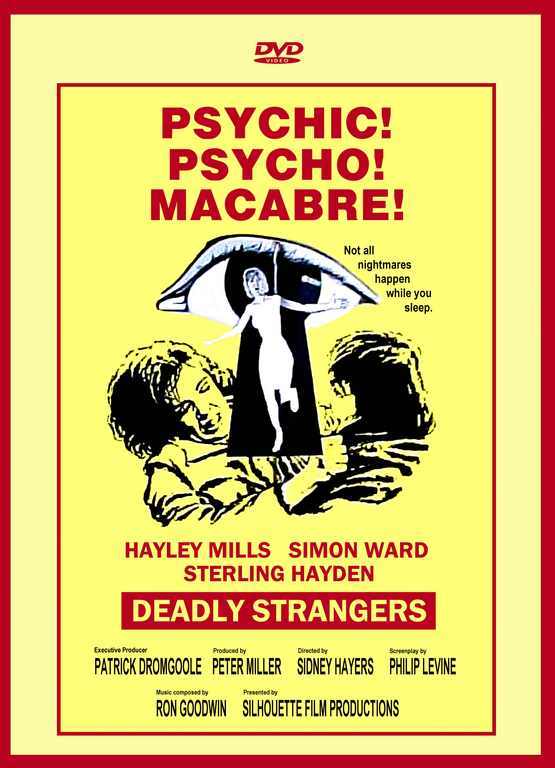
Deadly Strangers (1974)

By Richard Winters

My Rating: 5 out of 10

4-Word Review: Psycho on the loose.

A dangerous mental patient has escaped from a nearby asylum. Belle Adams (Hayley Mills) is the beautiful women whose car has just broken down and she accepts a ride from Stephan Slade (Simon Ward) who just may be that patient.

This seems very similar to See No Evil which also took place in the English countryside and also hid the killer’s identity until the very end. There though it was a big letdown finding out who he was while here it is actually what makes the movie interesting. However, some of the techniques used to conceal the killer’s identity come off as contrived. The opening escape sequence inside the institution, where you see everything from the patient’s point of view is very tacky.

The suspense is minimal and things never really get too intense until the climatic sequence. There are twists and turns throughout, but some of them seem to be put in just to keep the story moving. The overall production values are cheap and the film stock is grainy and faded.

It is nice to see a British movie that doesn’t take place in London. The brown, barren landscape, which looks to have been filmed in the autumn, gives the picture an added visual. The car they drive is another sight as it looks as flimsy as a Yugo.

Mills makes a daring film choice here and it does her well. She no longer has that mousy, awkward look. She is a pretty full grown woman with a nice short haircut. She acts more mature and streetwise without that wide eyed persona that she had in all those Disney movies. Her nude scenes aren’t bad and are even a bit gratuitous.

Ward has never seemed to be that great of an actor. He has always had a tired look on his face and plods through his parts in much the same way. Sterling Hayden is fun playing an aging womanizer and sporting a wild beard and hairstyle. He talks in a goofy Scottish accent and amusingly tries to court Hayley, but unfortunately he is on for only a short time.

The final twist is pretty good, but a real sharp viewer will figure it out before it happens because I did! The film is a nice alternative for Mills despite a tendency to be gimmicky and flat. It is also the only time I have ever seen a policeman pull over a car and when the driver is unable to find his license is simply allowed to drive away.

My Rating: 5 out of 10

Released: February 16, 1974

Runtime: 1Hour 28Minutes

Rated R

Director: Sidney Hayers

Studio: Fox-Rank

Available: VHS

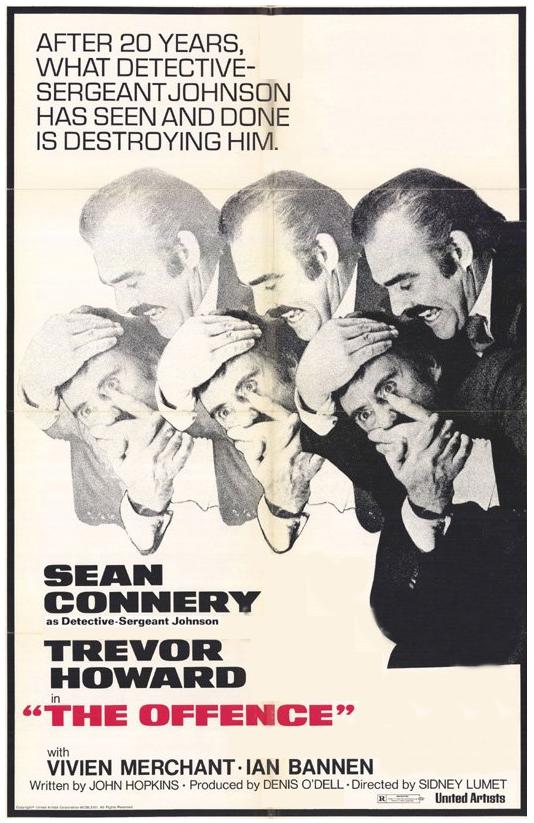
The Offence (1972)

By Richard Winters

My Rating: 8 out of 10

4-Word Review: Interrogate the child molestor.

Well respected, longtime police detective Johnson (Sean Connery) becomes so burned-out by all the sickening crimes that he has seen through his career that he snaps during the interrogation of a suspected child molester (Ian Bannen) and ends up beating the man to death.

Based on the stage play by John Hopkins this film has lots and lots of talking and some may say there is too much of it. The script is split into three drawn out conversations between two people. One is between Johnson and the suspect, the second is between Johnson and his wife (Vivien Merchant), and the third is between Johnson and the man brought in to investigate the incident, which is played by Trevor Howard. By the end even the most patient viewer may feel a bit talked out and it gets especially trying when you realize that the same issues are being discussed over and over again.

Yet that is not to say that this is a poor film as the visual element is excellent. In many ways you can appreciate the production for its visual style alone. Director Sidney Lumet displays a good handle on the material and it’s technically sharp on all levels. The lighting is well composed with the center that is bright, but the corners that are shadowy much like the human psyche and society. The overall grayness helps bring out the depression and isolation of the main character. The pacing is slow, but deliberate. Each scene builds to an intense crescendo. The music soundtrack resembles that of a one tone alarm that keeps building to a higher pitch much like the alarm ready to go off in Johnson’s head. The character’s inner tension is made even more vivid by Lumet’s use of interposing the bright light of the interrogation room over the screen. It is hard to imagine this film being any better crafted and it is a terrific training tool for the inspiring filmmaker.

Despite being talky the script in itself isn’t bad as it makes you aware of the ugly side of police work. It focuses not on the system or corruption, like a lot of other police films, but more on the actual work itself. It questions whether someone who is bombarded with the daily gore and societal sickness can remain sane and whether ‘leaving it all at the office’ is even possible. Every officer may eventually suffer scars from his job experience.

In a way this may be Connery’s best role. He shows his usual tough exterior, but also has moments where he unravels into a helpless, scared man. Bannen does an equally good job as the suspect. You are never really sure if he is guilty or not. The fact that he gives off a leering grin even after being beaten gives this film an added edge.

This is an oppressive and unrelenting movie filled with stark and unpleasant imagery that may stay with you long after it is over. Yet it is also expertly crafted and brings up some serious and important issues that are as timely today as they were back then.

My Rating: 8 out of 10

Released: January 11, 1972

Runtime: 1Hour 52Minutes

Rated R (Mature Theme)

Director: Sidney Lumet

Studio: MGM

Available: VHS, DVD (Region 1 and 2), Amazon Instant Video

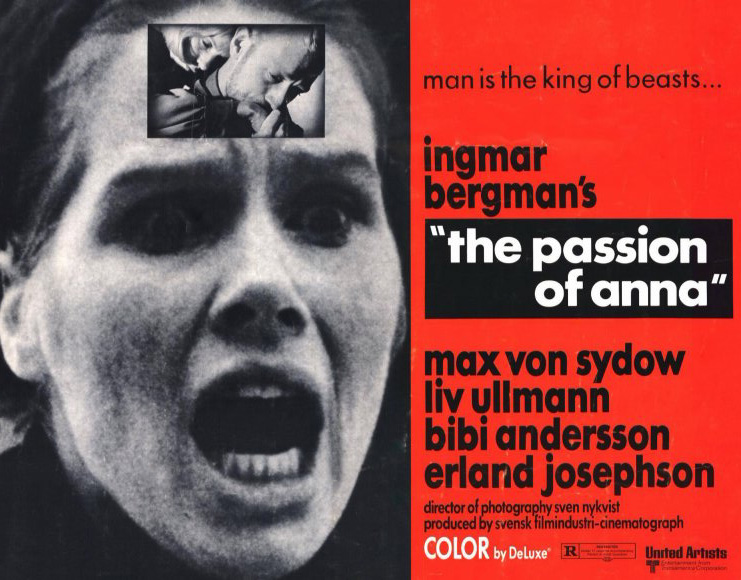
The Passion of Anna (1969)

By Richard Winters

My Rating: 8 out of 10

4-Word Review: Lonely little island retreat.

This is an intriguing film that seems quite similar to Roman Polanski’s Cul-De-Sac. Both films have a unique atmosphere and take place in a remote island setting and deal with a turbulent undercurrent that brews just underneath its deceivingly placid exterior.

Here we have Andreas (Max Von Sydow) living a lonely existence on an island retreat. He meets, by chance, Anna (Liv Ullmann) who is still grieving from the death of her first husband. The two form a tenuous relationship that slowly unravels as the dark corners of their personalities are eventually exposed.

In many ways this film has all the right ingredients. It wraps you up in its surreal nature and adds interesting effects. There are some creepy elements including a mad killer running around the island killing and torturing all the animals. Things work at a deliberate pace and leave no clue as to where it is headed. The characters are unpretentious and introspective. They are open about their faults and failures and give good reason as to why they have them. There are also fascinating cutaways to the actors themselves who help explain and interpret their characters motivations, which is a novel idea that gives the viewer a deeper understanding of the characters and adds an extra dimension.

Unfortunately it doesn’t come together and leaves no real emotional impact. There are a few good twists, but you can’t help but feel that it should have gone farther. There a certain scenarios that get touched on, but are never explored. For instance there is Andreas’s relationship with Elis (Erland Josephson).  Andreas has taken a loan out from him, but has also had an affair with his wife. This of course has some potential for fireworks and there is a moment where it begins to sizzle, but it never goes back to it. The same thing can be said for many of the other segments including the identity and reason for the animal killer.

Overall this is an outstanding experimental-like movie. It is not one of director Ingmar Bergman’s best, but it is still richer and more deeply textured than eighty percent of the other movies that are out there. The crisp and revealing dialogue alone makes it worth it and Bergman displays the most realistic perspective on the union of marriage.

My Rating: 8 out of 10

Released: November 10, 1969

Released: 1Hour 41Minutes

Rated R

Director: Ingmar Bergman

Studio: United Artists

Available: VHS, DVD

Maniac (1980)

By Richard Winters

My Rating: 5 out of 10

4-Word Review: He wants their hair.

A loner (Joe Spinell) terrorizes New York City by killing young women and scalping them. He then takes their hair, brings it home, and places it (actually he nails it) onto the heads of some mannequins that he has.

In a lot of ways this is the same old mechanical slasher flick as it has all the predictable characteristics of the others that dominated the early 80’s. The story is simple and strung along by long, drawn-out murder sequences. There is some suspense, but it is minimal since we know exactly what is going to happen. The victims are young, good looking women, who are clueless to the dangers that are lurking until it is too late. One segment in particular features a nurse getting off of work late at night, who mentions her fear of the killer and yet for some reason she still foolishly refuses a ride home from her friend and instead walks down a dark, lonely street and into, of course, eventual carnage.

There are also some rather glaring technical errors. One features a woman (the same one who refused a ride) running from the killer by going into an empty subway. Although isolation is the whole factor here there is one shot, taken from inside a departing subway car that clearly shows a whole bunch of people standing just across from her on the other side of the tracks. There is also a segment where Spinell takes his girlfriend to his mother’s grave. When the car pulls up to the cemetery it is a nice, bright afternoon, but when they reach the actual grave it has become pitch black with a strange unexplained fog that has rolled in. Lastly there is the ending. This is a man that has terrorized a whole city and yet only two policemen in an unmarked squad car come to his residence and when they do they don’t even bother to secure the site.

Despite the low-budget problems there are a few things that raise this slightly above the rest. One is the fact that it actually manages to get inside the killer’s head. You hear the inner conversations between his ‘good’ side and his ‘bad’ side. Of course this only touches the surface of a true schizoid personality, but it does offer a little more depth than most. It also helps create a good portrait of a tormented soul and you end up feeling more sadness than fear for the man. The film also consistently has a dark, grainy look, which helps accentuate the ugly theme. Having it take place in New York City gives it a little more distinction and atmosphere.

The special effects are good. The part where he blows a man’s head off, through a car windshield, looks very realistic and has become the film’s most famous scene. The surreal ending, where the mannequins all come to life and exact a sort of revenge, is also well-handled and imaginative. Makeup artist Tom Savini, who also appears as the character of ‘Disco Boy’, has had a lot of success, but the stuff here may be his best.

Director William Lustig shows some panache and Spinell, who also co-wrote the screenplay, gives a surprisingly strong performance, but their attempts at creating a better understanding of a crazed killer prove placid and simply done for shock value.

My Rating: 5 out of 10

Released: December 26, 1980

Runtime: 1Hour 27Minutes

Not Rated (Graphic Violence, Brief Nudity, Language, Adult Theme)

Director: William Lustig

Studio: Magnum Pictures

Available: DVD, Blu-ray (30th Anniversary Edition)

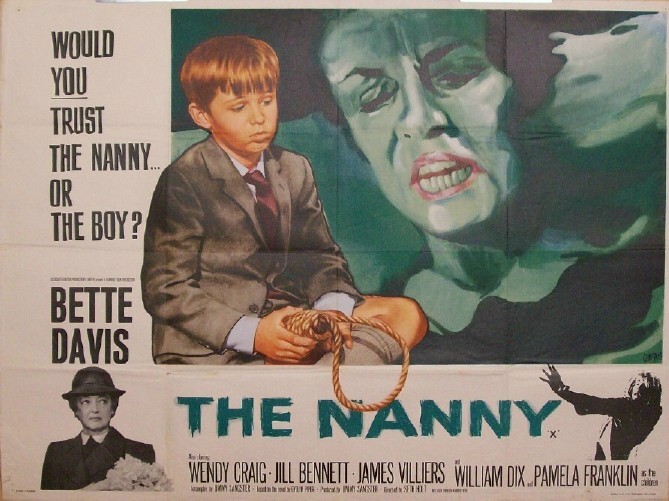
The Nanny (1965)

By Richard Winters

My Rating: 5 out of 10

4-Word Review: Kid doesn’t like nanny.

            Bette Davis plays a nanny to an upper-class British family whose oldest son Joey (William Dix) is accused of accidently killing his younger sister. Joey, who is only 10, is sent away to a home for disturbed children. When he returns he accuses the nanny as the one who did the killing and a psychological game of cat-and-mouse ensues.

Davis is sensational. She plays a type of character that she has never done before and the results are fascinating. She is much more subdued and evasive than usual and she falls into the role of the unassuming nanny in a seamless fashion. The different setting works well for her and I commend her tenacity for taking on a project that was not glamorous. She even puts on some thick eyebrows for her part and at times, especially at the beginning, she starts to resemble her most hated rival Joan Crawford.

Dix is amazingly good as the kid and it is a shame that he did only one other picture after this one. I liked the independent nature of the character and he plays off Davis quite well and showed no signs of being intimated by her. Making the adversaries have such extreme age difference and personalities gives the story an interesting edge that helps carry the picture.

The evocative black and white photography helps accentuate the dark-tone. The British setting along with the expected formalities of that culture, particularly that from the father character Bill (James Villers) give the film some distinction.

The first act though goes on way too long. We are given the general premise right up front and then have to spend the whole first hour going through the scenario that Joey doesn’t like his nanny and is suspicious of her again and again until it becomes derivative. When the second act does finally come about it seems too late. The revelation isn’t all that clever or creative and the climactic sequence desperately needed more action and punch. The final result is unsatisfying. The viewer is given an intriguing premise that it can’t sustain to the end ultimately making this a misfire despite the outstanding presence of Davis and some high production values.

There is also the issue of the three-year-old girl who is adorable and an absolute scene stealer and yet right up front you are made aware that she is killed, which makes the proceedings rather depressing. Having to then watch her actual death is disturbing and, for its time period, rather vivid and startling.

My Rating: 5 out of 10

Released: October 27, 1965

Runtime: 1Hour 31Minutes

Rated: NR (Not Rated)

Director: Seth Holt

Studio: Hammer Productions

Available: DVD

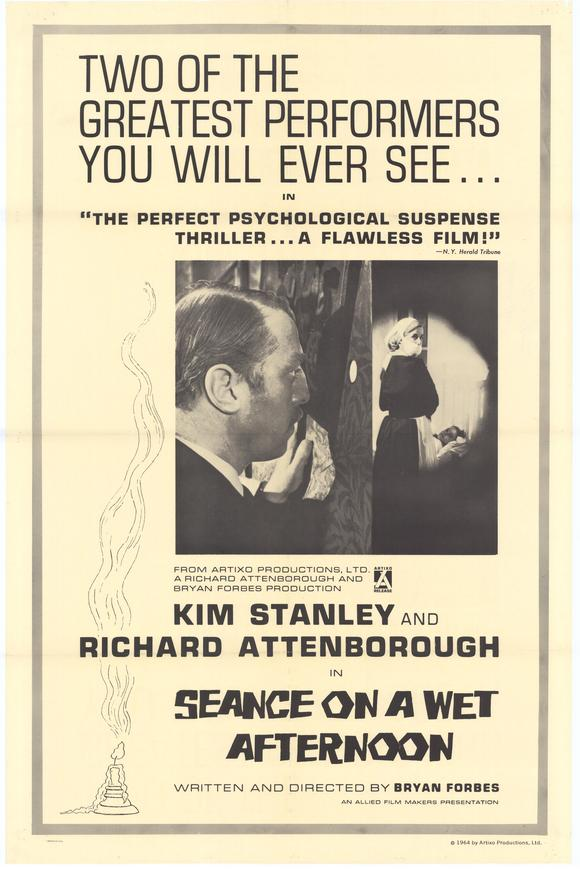
Seance on a Wet Afternoon (1964)

seance on a wet afternoon

By Richard Winters

My Rating: 6 out of 10

4-Word Review: Psychic is a phoney.

Myra Savage (Kim Stanley) is an emotionally unbalanced woman and failed psychic who comes up with an idea that she hopes will revive her career. The plan is for her husband Billy (Richard Attenborough) to kidnap Amanda Clayton (Judith Donner) who is the young daughter of a rich businessman. They will then place her at a strategic location and hold a public séance at which time Myra will ‘miraculously’ predict her whereabouts. This will then, they hope, make her famous and world renowned, but of course things don’t work out as expected.

This is indeed a unique and unusual film that taps into some rare qualities. First and foremost is the black and white cinematography. Every camera shot and angle has a certain evocative flair that is well captured and vivid. The on-location shots pick up just the right amount of ambiance and lighting with each setting. The music score is great and helps create excellent tension. You also will love the little girl that they kidnap. She is adorable without it being forced. Her matter-of-fact sensibilities are a great contrast to Attenborough and Stanley whose characters are child-like and pathetic.

Yet the film doesn’t completely work. The story is handled in a plodding and methodical way without any twists or surprises. There is very little action, some definite slow spots and the conclusion is limp.

If you watch it for the performances then you will be more intrigued. Stage actress Stanley gives a rare film appearance here. It is easy to see why she took the role even though she was known to dislike doing films. The takes are long and give almost unlimited possibilities in creating a character, which is what all stage actors enjoy. She does well and at times may remind one of another legendary actress Geraldine Page who would have also been perfect for the part. Attenborough proves almost her equal. His expressions of shock and worry are memorable. The interplay between the two is fun especially towards the end when this otherwise passive man stands up to the domineering woman.

Overall there are some unique moments, but it is just not suspenseful enough and results in being only slightly above average.

My Rating: 6 out of 10

Released: November 5, 1964

Runtime: 1Hour 55Minutes

Rating: NR (Not Rated)

Director: Bryan Forbes

Studio: Artixo Productions

Available: VHS, DVD (Region 1 & 2)

What Ever Happened to Baby Jane? (1962)

By Richard Winters

My Rating: 7 out of 10

4-Word Review: Living in the past.

This is a classic horror film that managed to resurrect the sagging careers of acting legends Bette Davis and Joan Crawford. It also spawned a whole new ‘psychobiddy’ genre of films. The movie is based on the 1960 bestselling novel by Henry Farrell.

The story takes place almost exclusively in an old, rundown Hollywood mansion where two aging, feuding sisters live. Baby Jane Hudson (Davis) was at one time a big child star, but never managed to cross-over to adult roles. She lives in a fantasy world, refusing to move on with her life, and takes out her frustrations on her crippled sister Blanche (Crawford), who at one time was a big movie star until a horrible car accident left her bound to a wheelchair.

The real-life feud and animosity that the two stars had for each other is now legendary. Some of the things the two said about the other is hilariously over-the-top and too many to quote here, but well worth checking out. When you hear of all the incredible things that the two did to each other behind the scenes you almost become amazed that the film was ever able to get made. I wished that a documentary had been filmed examining the movie’s production as that could have been almost more entertaining than the film itself.

All things considered, Davis is nothing short of fabulous here. She should have won the Oscar hands down and she pretty much steals the film. She also wore gaudy make-up that gives her an almost ghost like appearance. Crawford is very good as well, but her role is not as flashy. Sadly for her this was her last hurrah as her alcoholism took its toll and her roles after this were in B-movies while Davis went on strong for the next twenty years.

Of course some may argue that the real star was director Robert Aldrich. I liked the bird’s-eye shot of Blanche spinning around in her wheel chair in frustration and terror. It is brief, but gives the viewer a very unnerving feeling. The scene where Baby Jane does an old rendition of one of her routines that she did as a child in front of a mirror that she has set-up in her living room that is also surrounded by stage lights is a nice directorial touch. The campy opening that takes place in 1917 that shows Baby Jane at her peak is memorable as is the very offbeat climatic sequence on a crowded beach. I also got a real kick out of all the Baby Jane toy dolls.

Victor Buono deserves mention as he was nominated for the supporting Oscar for his role as Edwin Flagg, the fledgling composer who Baby Jane hires to help resurrect her stage show. Although best remembered for his comedic skills he was also quite good in his serious parts and his immense girth always made his presence known. I enjoyed how they form this weird quasi-relationship that is based solely on each other’s lies and delusions.

I did have a few complaints to what seemed to me to be some serious logistical flaws. One is the fact that Blanche is stuck in her upstairs bedroom with no way to get downstairs. You would think that with all the money that they once made that they would’ve been able to afford building either an elevator, or a chair lift. It also seemed implausible to believe that Blanche had been stuck in her bedroom since 1935 when she had her accident, until present day 1962, which is what the film seems to imply. As much as I liked the African-American housekeeper Elvira Stitt (Maidie Norman), who is well aware of Baby Jane’s psychosis and has no trouble standing up to her, I thought it was awfully dumb the way she set down a hammer that she was holding right in front of Baby Jane and then turned her back to her, which allowed her to be attacked that anyone else could have predicted would happen. I also felt there was a little too much background music that at times got a bit melodramatic.

Still, this is a great film that his highly entertaining from beginning to end. With the exception of some of Baby Jane’s ‘dinner surprises’ the film is devoid of any real scares and there is no gore, which may disappoint today’s younger, more jaded viewers. However, the film has a very strong, dark psychological undercurrent, which proves to be immensely fascinating and will be appreciated by those who are more sophisticated. The film’s theme, which is that of Hollywood’s fickle, vicious cycle of fame, is universal and as strong today as it was back then.

It is interesting to note that the director’s 18 year old son William, who appears at the end as a lunch attendant at the beach, produced  29 years later the made –for-TV remake of this film that starred the Redgrave sisters, but was not as good. Also director Aldrich later made two variations of this same story. One was Whatever Happened to Aunt Alice which he produced and starred Geraldine Page and Ruth Gordon and also the British classic The Killing of Sister George which he also directed.

My Rating: 7 out of 10

Released: October 31, 1962

Runtime: 2Hours 14Minutes

Rated NR (Not Rated)

Director: Robert Aldrich

Studio: Warner Brothers

Available: VHS, DVD, Blu-ray, Amazon Instant Video

Apartment Zero (1988)

My Rating: 8 out of 10

4-Word Review: This friendship gets weird.

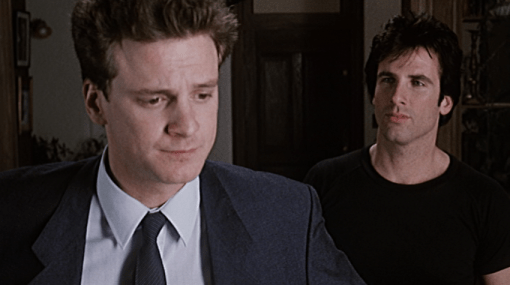
Adrian LeDuc (Colin Firth) is living in Buenos Aires, Argentina and owner of a cinema that specializes in showing classics from Hollywood’s golden era. Unfortunately it is not making enough money and he is having trouble paying for his apartment after his mother has a mental breakdown and forced into an institution.  He decides to rent out the empty bedroom to help defer costs. After going through several would-be candidates he decides to take-in a handsome and mysterious man by the name of Jack Carter (Hart Bochner). Despite Adrian’s anti-social tendencies and extreme fixation on movies and movie trivia he takes an immediate liking to Jack even though Jack has a totally opposite personality. As their relationship progresses different sides to their personalities come out and the two create a very odd co-dependency to the other. Things grow troubling as a serial killer is on the loose and Adrian begins to suspect that it might be Jack.

The film shares some strong elements to two very brilliant films that also happen to be personal favorites: Joseph Loosey’s The Servant and The Tenant. Like with those movies this film delves into the dark human psyche and how the passive-aggressive nature of relationships can bring out sides to a person that had never before been seen. Despite the slow, deliberate pace I found myself almost hypnotically wrapped up in the story and characters from the get go. The leads are full of interesting idiosyncrasies and watching how it all evolves becomes infinitely fascinating.

Firth is splendid as usual in the difficult role. I found it interesting how he is so cold and unforgiving with most everyone, but weak and emotionally needy with both his mother and Jack. His thorough knowledge of movie trivia makes a lot of his conversations that he has with Jack are both fun and unique. The part where tells Jack that he refused to befriend someone simply because he did not know who actress Geraldine Page was is a great line and the only one that I remember from when I first saw it over 20 years ago. I also got a kick out of the game that they play where they name three stars and then the other person must guess what film all of them were in. I appreciated the way director Martin Donovan helps accentuate the characters personality by decorating his apartment with portraits of classic film stars. However, for all of Adrian’s vast cinema knowledge he does get one thing wrong. He states that the film Compulsion was released in 1958 when it really was 1959.

Hart Bochner is alright as Jack, but I did not feel that his performance equaled that of Firth’s. He seemed too much of a male hunk for my tastes. He was also way too normal for too long of a time and I would have liked to have seen a little more hints to his supposed dark side come out earlier. There is also a scene where Jack obtains a fake passport, which he tries to use to board a flight in order to leave the country. He hands the document to a ticket agent for inspection while looking visibly nervous and sweating profusely, which didn’t seem consistent. In every other scenario he had been shown to be cool and confident, so I didn’t understand why he would suddenly lose his composure so badly especially when you take into account he has lived his whole life on the run and most expectedly been through these same situations hundreds of times before. The way he takes off his shirt is also weird and I felt needed explanation even though none is given as he strips it off his body, then rubs it underneath both of his armpits before he then smells it.

The elderly tenants that make up the rest of the building population are amusing, but not really needed. Dora Bryan and Liz Smith are goofy as two elderly sisters who spend their time being snoopy and gossipy, but unfortunately their mannerisms ended up reminding me too much of the Pigeon sisters from The Odd Couple movie. These comical scenes are passable, but tend to take away from the suspense and overall dark theme and seem to be remnants from writer/director Donavan’s career as a TV-sitcom writer, which he did for over three decades before he was finally able to break into film. I also couldn’t buy the one scene showing every one of the tenants watching the same news show at the same exact time as I am sure even in 1980’s Argentina there would have to be a variety of channels and programs to choose from and everyone wouldn’t just be sitting and watching the same thing.

The final hour is when this thing really seems to get going. The last fifteen minutes becomes a barrage of one macabre image, situation, and comment after another and my only complaint was that it took too long to get there, yet it is worth it. The twist at the end is memorably shocking and I wished that the camera had focused in on the grotesqueness of it more and not just shown it for a brief few seconds before cutting away as it would have been more effective. Still if you like intelligent psychological thrillers this one hits the mark and the Buenos Aires setting helps give it an added flavor.

My Rating 8 out of 10

Released: September 30, 1988

Runtime: 2Hours 4Minutes

Rated R

Director: Martin Donovan

Studio: The Summit Company

Available: VHS, DVD