Category Archives: Offbeat

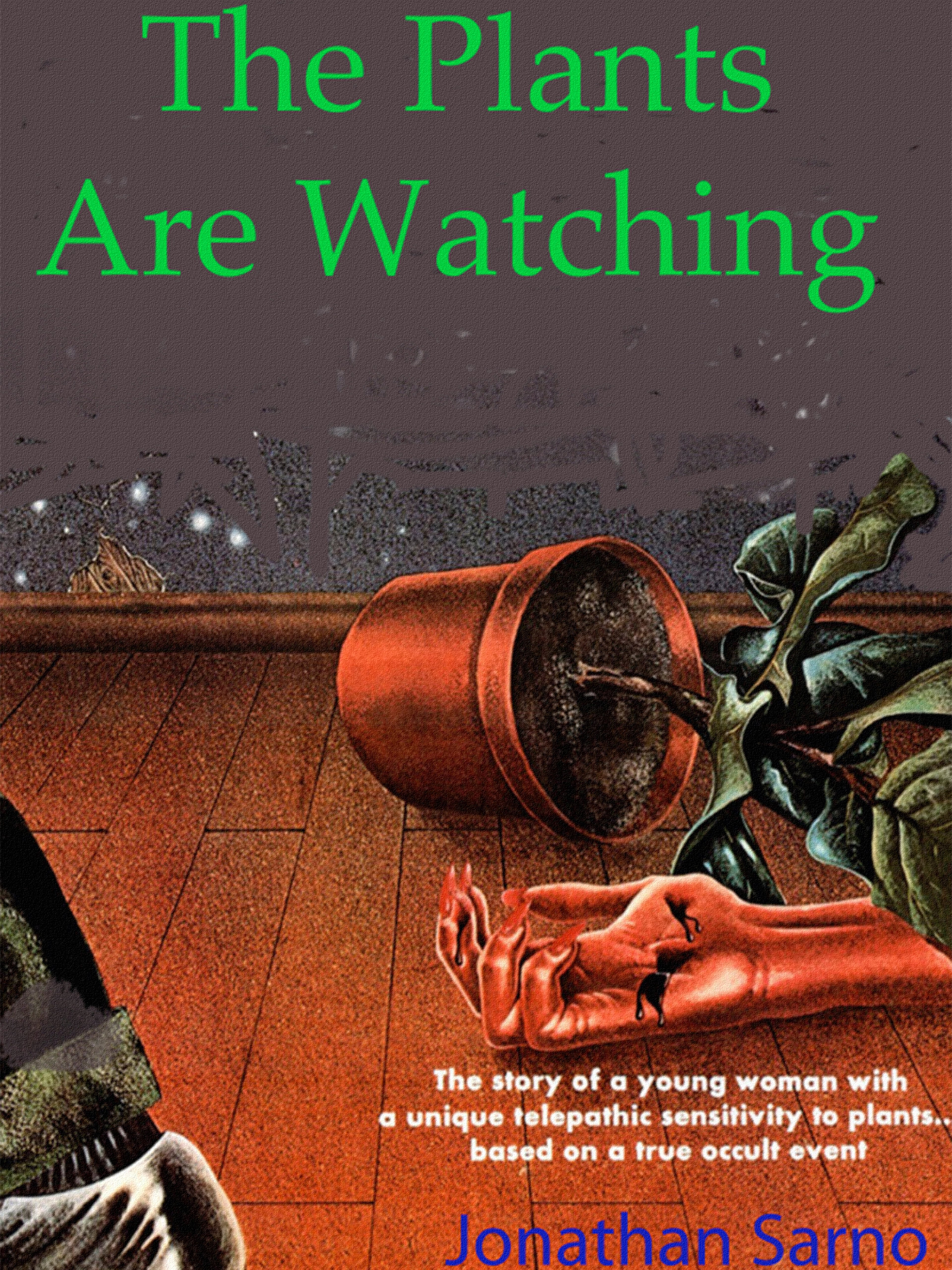
The Plants Are Watching (1979)

By Richard Winters

My Rating: 6 out of 10

4-Word Review: Communicating with a plant.

Laurie (Nancy Boykin) is deeply into plants and has them placed all over her apartment and even feels she has the ability to communicate with them. Directly below her place lives her sister Rilla (Nancy Snyder) along with Rilla’s boyfriend Robert (Joel Colodner). Laurie doesn’t like Robert and the two are continually getting into arguments. One day Laurie is found dead and the police consider it an accident. Rilla though fears that Robert may be responsible and tries on her own to investigate. She reads up on Kirlian photography that can capture electrical discharges from objects including plant life. Her attempt is to see if the plant that was present when Laurie had her ‘accident’ can tell her through its distress signals from its leaves, which can be detected through the photo process, can lead her to what really happened. However, as she’s doing this a new suspect emerges, Dusty (Ted Le Plat), forcing her to have to go through the difficult determination as to who the real culprit is.

Extremely odd idea for a horror film almost works with a really good and creepy beginning and excellent surprise ending. The Kirlian photo technique was one that I was not familiar with, so the movie is educational on that end as it delves into its innerworkings and history and some of the shots that it shows, including the fingerprints of a psycho compared to a regular person and the different colored light charges that it gives off, are quite fascinating as are the variety of discharges that a leaf can emit from one that is under stress, or sick versus a healthy one.

The setting is limited, mainly due to the low budget, where all the action takes place in the apartment building though this does at least give the viewer a good feel for urban New York City living and helps create a certain ambiance. While the plants never do any actual ‘speaking’ you do through the course of the film begin to see them like they’re characters alongside their human counterparts making the moment where Robert throws some of the potted plants against the wall and thus smashing them seem genuinely disturbing like you’ve just witnessed a ‘murder’ and credit goes to the filmmakers for their ability to bring this out.

Despite one good scare, which occurs during a dream sequence, there’s not enough shocks to completely keep it going. The middle drags quite a bit and the main reason is that there’s no real villain. Robert is initially portrayed as being a possible menace, but he’s just too civil to create any adequate tension. Having Rilla break-up with him and move-out only to eventually allow him back into her bed just dilutes everything. A good horror film needs a threatening dark force and this thing tip toes too much around that.

The film cheats too by ultimately having the plant ‘communicate’ with Rilla somehow by showing her a ‘vision’ of what actually occurred though it’s never explained how exactly it does this. I was okay with her hooking the plant up to a machine and monitoring its stress level whenever one of the two men are in the room and thus having her deduct on her own who the killer was from that, but then spelling everything out seemed too easy. The ending twist though is pretty cool and the scene where she’s trapped in the elevator with no escape is nicely intense and surprisingly grisly though it’s a shame that this same kind of tension and violence couldn’t have been carried throughout. 

Alternate Title: The Kirlian Witness

Released: June 14, 1979

Runtime: 1 Hour 12 Minutes

Rated R

Director: Jonathan Sarno

Studio: CNI Cinema

Available: Amazon Video, YouTube

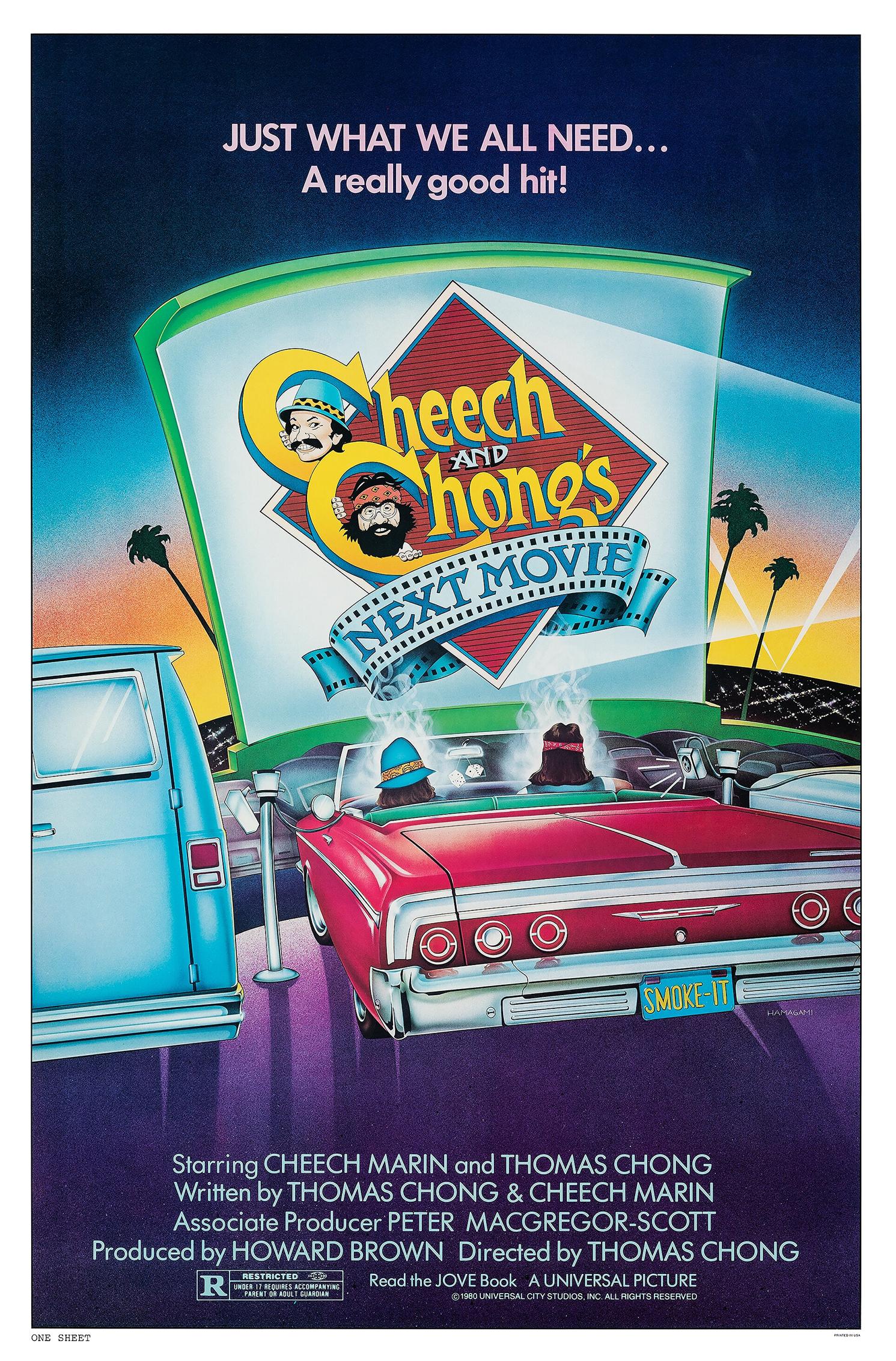
Cheech and Chong’s Next Movie (1980)

By Richard Winters

My Rating: 6 out of 10

4-Word Review: Chong meets Cheech’s cousin.

Chong (Tommy Chong) and Cheech (Cheech Marin) have moved in together in a decrepit place that puts new meaning to the word pigsty. Chong doesn’t have any interest in finding a job and spends his days playing his electric guitar at an ear-splitting level that disrupts the rest of the neighborhood. Cheech does work but gets fired forcing the two to go to the unemployment office where Cheech meets-up with his old girlfriend Donna (Evelyn Guerrero). The two get-it-on inside her office, which soon gets her fired. She then calls Cheech later on and the two agree to a date at his house. To get Chong out of the way Cheech has him get together with his cousin Red (Cheech Marin). Red is getting kicked out of his hotel room for nonpayment, so Chong helps him get his stuff out including a 20-pound bag full of marijuana (in the edited TV-version it’s described as a bag full of ‘diamonds’). The two then spend the rest of the night meeting up with different people and attending various nightclubs before ultimately being kidnapped by some outer space aliens while Cheech sits home alone dreaming of his rendezvous with Donna, who to his knowledge, never gets there.

This is, in my opinion, the best installment of the Cheech and Chong film series and an upgrade from their first film. This one has the same cinema vertite approach as that one but is able to tie it in better with a more consistent atmosphere that at times becomes almost surreal. Chong travels with Red late at night and the goofy people they meet along the way becomes very similar in theme to After Hoursor at least the Los Angeles version of that and had it been amped up just a little more it might’ve been just as good and memorable but just misses the mark yet kooky enough to keep it engaging. Thomas Chong’s direction is leisurely paced, which helps add to the offbeat vibe and his character is more engaged. In the first film Chong was strung-out most of the time making him boring and giving all the funny lines to Cheech, but here it’s more equal, making it a true buddy movie. The drug use isn’t emphasized as much either and doesn’t come off like it’s promoting the use of it like in the first one.

Some of the set pieces are impressive especially their messy house, which is so dirty and unsanitary that it’s almost like an art form the way the production team got it to look that way. I’ve seen some cluttered places before in movies, but never in quite the authentic way as here as it seems great care was taken to give it a legit look and making the scenes shot inside the place both fun and jaw-dropping at the same time. There’s no doubt though that had slacker stoners with no cleaning skills moved in together it would end up looking very similar to the place here. I also enjoyed seeing their neighbor’s place, played by Sy Kramer, who’s overly efficient ways are a far cry from theirs and the confrontations between them needed to be played-up more especially after the two steal and destroy his car and while his vehicle does get returned to him it’s in a highly damaged state, but without seeing his reaction shot we miss half the comedy potential.

It’s fun seeing Cheech play dual roles, speaking in a voice that sounds entirely unlike his own and proving he’s a much more talented actor than one might initially suspect. Edie McClurg gets one of her best roles as a rich uppercrust suburbanite who with only a few drinks becomes increasingly ditzy as the night wears on. Paul Reubens is entertaining as a no-nonsense hotel desk clerk and Michael Winslow has some engaging moments doing ‘sound effects’ while inside the unemployment office and old man John Steadman laughing at every single thing Winslow does.

This film also supposedly is the final onscreen appearance of veteran actress Mary Anderson, who is probably best known for her work in Alfred Hitchcock’s classic thriller Lifeboat. Here she has an uncredited bit as an old lady inside a music store, but the woman is seen for less than two seconds and within a group of other people making it hard to fathom why she’d come out of retirement, her first acting work in 15 years, just to give off an annoyed expression for a brief second and then call it a day. The woman doesn’t really look like her either making me think that since Mary Anderson is a very common name, they got the wrong one and it’s a different actress entirely.

I also can’t end this review without mentioning a glaring continuity error in which the car that Chong and Cheech are riding in goes out of control and ends up crashing into somebody’s front yard but the fence surrounding the yard remains intact. However, for the car to have gotten onto the lawn it would’ve had to have crashed through the fence, so showing it with no damage at all makes no sense.

My Rating: 6 out of 10

Released: July 18, 1980

Runtime: 1 Hour 35 Minutes

Rated R

Director: Tommy Chong

Studio: Universal Pictures

Available: DVD, Blu-ray, Amazon Video, YouTube

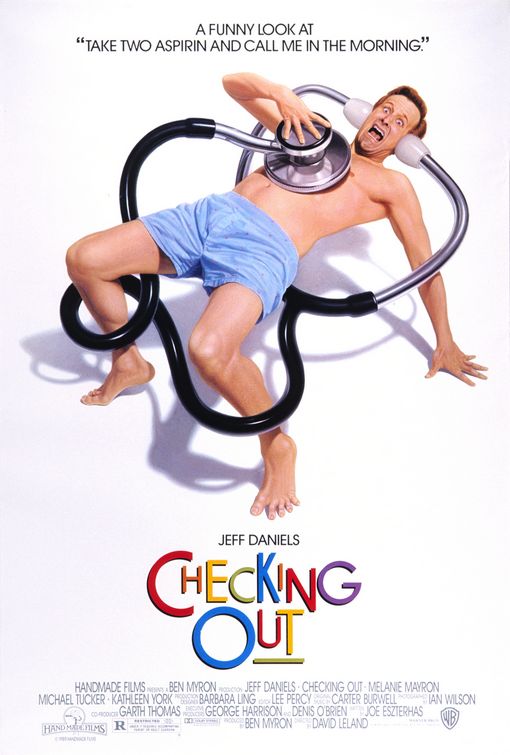
Checking Out (1989)

checking2

By Richard Winters

My Rating: 4 out of 10

4-Word Review: Man becomes a hypochondriac.

Ray (Jeff Daniels) is a middle-aged father who suddenly experiences deep concerns about his health when his boss (Allan Havey), who’s the same age as he is, drops over dead from a heart attack while at a backyard BBQ. His increasing paranoia about being sick, or potentially dying soon puts a strain on his marriage and his whole life gets essentially put on-hold as he constantly goes in and out of doctor visits over any perceived malady that comes-up.

The film certainly had big-name talent behind it as it was directed by David Leland, who got critical acclaim just a year before in his directorial debut with Wishing You Were Here while the screenplay was written by Joe Eszterhas who wrote such hits as Flashdance and Basic Instinct. However, while the film show flashes of interesting potential, even visually creative moments where Daniels, in a dream segment sees himself getting buried in a grave inside his children’s bedroom while the kids look down on him as the dirt gets shoveled over him, it never fully comes together as a whole. The tone shifts from satirical to sitcom and the concept becomes like a one-joke that gets stretched too far. Leland had promised Eszterhas that he wouldn’t change a thing from his script, but then added in several subplots, which angered Eszterhas to the point that he threatened to have his name removed from the credits, so Leland took out the extra sequences, but I’m almost wishing he had kept them in as it might’ve made the movie more interesting.

The one element that really sinks it is the overreaction by Daniels to his boss dying. For one thing the boss was a total jerk that did nothing but spew out corny jokes, so having him suddenly collapse dead, while saying yet another one of his eye-rolling quips, should’ve been a source of celebration and not dread, which might’ve actually been funny. What’s more is that Daniels immediately starts worrying about his own health, which seemed too rash. If his other friends were also dying suddenly then maybe, but just one guy dropping-over didn’t merit such a panic. Maybe the boss had some underlying heart defect that went undetected and that was the cause of his collapse, but either way it shouldn’t have caused such a drastic change in Daniels’ personality. Only if Daniels had already had some concern about his well-being previously, which he doesn’t, and then this incident brought those deep-seated fears to light would it have made sense. Even if it just meant paying better attention to his diet, but going to such extremes so quickly makes him seem like a completely different person.

The humor is too subtle and there’s long, boring segments in-between where nothing funny even happens only to answer it with a light one-liner. The running gag where Daniels becomes obsessed to find out what the answer is to why Italians can’t have barbeques, which was the joke his boss was saying when he suddenly died, gets overdone. The character arch is handled awkwardly as Daniels gets super hyper about his perceived maladies only to by the second act forget about it and then suddenly go back to being a hypochondriac again when his therapist dies, which makes the story seem like it’s not working in a linear fashion by ping-ponging the character from one goofy personality to the next.

Daniels is excellent and the one thing that keeps the movie watchable. I also enjoyed seeing Melanie Mayron, who up to this time had only played young adult women, getting her first stab at portraying a  middle-aged housewife, she even sports a suburban hair-style, and veteran character actor Allan Rich is quite good too as Daniel’s exasperated doctor. Elderly actor Ian Wolfe, who’s second-to-last movie this was, has a few key moments as an old undertaker who Daniels keeps bumping into at indiscriminate moments.

Spoiler Alert!

However, as interesting as the eclectic cast is they can’t overcome the otherwise mish-mash of the shallow script. Even the twist ending, which features Daniels dreaming that he is dying and going to heaven is forgettable as there have been too may other movies that have featured the afterlife in a more interesting and humorous way.

Watching Daniels then wake-up out of his dream and speed out of the hospital in his wheelchair ready now to take-on life again doesn’t really make it seem like the character grew, or learned anything, but more like a bland family man who went crazy for awhile until he finally snapped out of it. A much better way to have ended it would’ve had Daniels wheeling himself out the hospital door only to then get hit by an ambulance. This would’ve conformed better with the film’s otherwise darkish undertone and been a better payoff. It might’ve even made sitting through the rest of it seem worth it.

My Rating: 4 out of 10

Released: April 21, 1989

Runtime: 1 Hour 36 Minutes

Rated R

Director: David Leland

Studio: Warner Brothers

Available: DVD

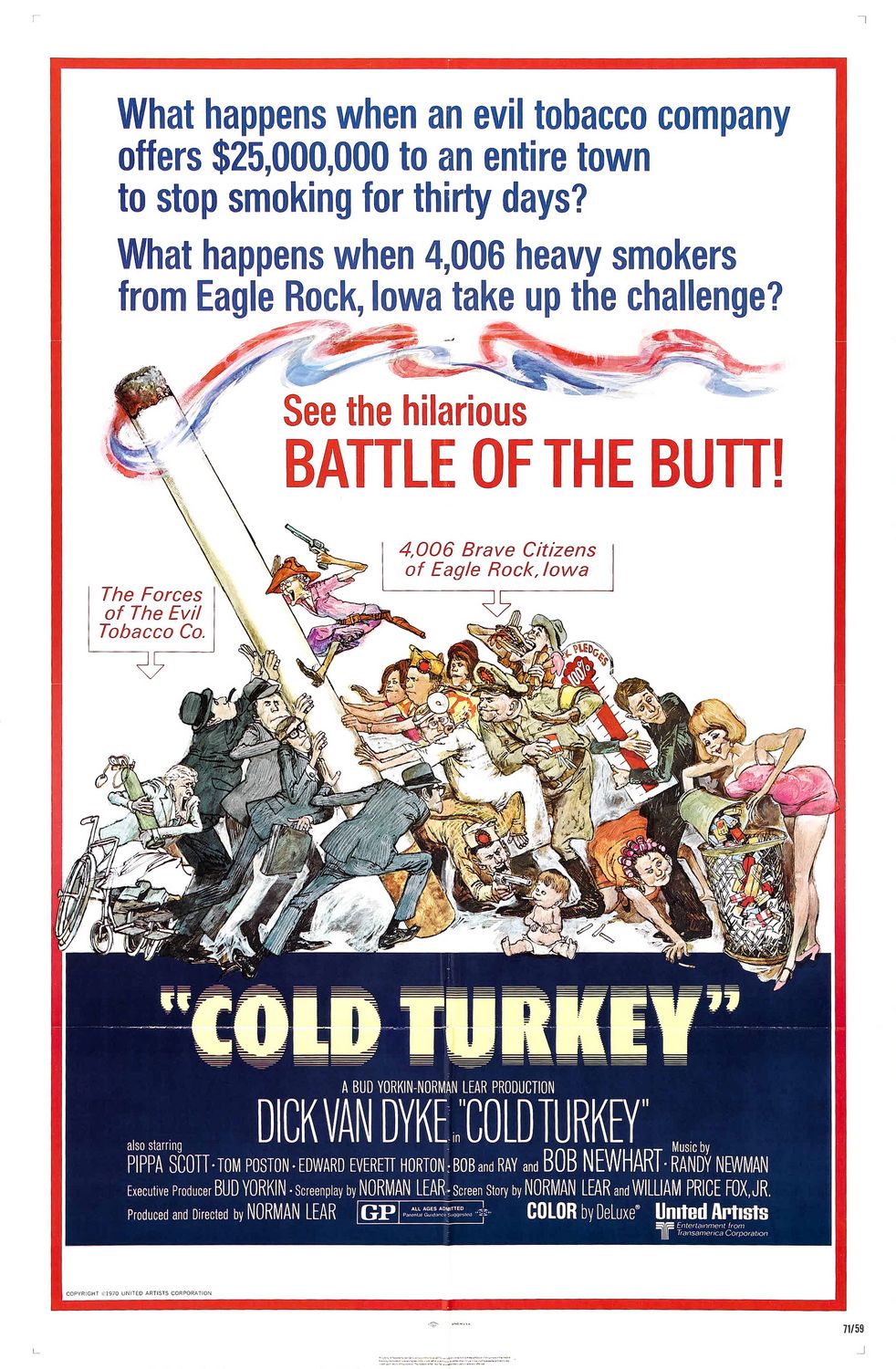
Cold Turkey (1971)

coldturkey

By Richard Winters

My Rating: 7 out of 10

4-Word Review: Small town quits smoking.

To commemorate the passing of Norman Lear last week at the ripe old age of 101 we decided to review the one film that he directed and was shelved for two years by the studio who didn’t think it would be a hit with any audience and only decided to eventually release it once Lear had success with the classic ‘All in the Family’ sitcom. The story revolves around a small town in Iowa named Eagle Rock. The Reverend Clayton Moore would like a bigger congregation in a more prestigious area as he feels trapped in what he considers a ‘dying’ town with limited employment opportunities. He then hears about a contest that a giant tobacco company is sponsoring where they try to see if there’s a town in America that will make a pledge to agree to quit smoking for 30-days and if they succeed will be awarded $25 million. Merwin Wren (Bob Newhart), who works for a tobacco company, bets that there isn’t a place that would be able to make this pledge, but Clayton, figuring this may be his ticket out and onto greater things, pushes the citizens to sign the pledge, which will then put Eagle Rock on the map.

The location of the film shoot was Greenfield, Iowa, which I traveled to in 2009 and was amazed how similar it still looked after 40 years. The opening sequence showing the town from the south end still had many of the same buildings and the courthouse along with the gazebo in which the reverend makes his fiery speech are all still there and looking almost untouched.

The town itself is really the main star. Lear does a terrific job of showing the people who live there as they really are versus in some idealistic, or romanticized way. Too many other Hollywood productions seem to suffer from the Mayberry effect where the citizens are portrayed as simple and content ‘God Fearing’ folk who are devoid of any complex personality. Here they are frustrated individuals who secretly dream of moving away, or ‘hitting it big’ in some way, but because they don’t have the means to achieve this ultimately find themselves stuck and just trying to make the best of it. The people are no more immune from temptation, or corruption, than the ones living in a big city and if anything are even more susceptible since they haven’t been put in that situation much, but when they are, as evidenced when the place gets spoken about all over the media and everyone from all over descends on it including Lottie (Gloria Leroy) a prostitute under the guise of being a masseuse who services all married men.

Beyond the on-target satire the film also scores with its fabulous ensemble of character actors, many of whom would later star, or guest star, in many of Lear’s TV-shows. Each actor plays a distinct personality from Barnard Hughes the fidgety and nervous doctor who resorts to lollipop sucking, or Graham Jarvis the head of a far-right organization, who preaches about the evils of ‘big government’, but then readily accepts for his group, which is mainly made up of senior citizens, to become a voluntary gestapo-like militia that arrests those who are caught smoking and forcibly search all in-coming vehicles. Pippa Scott though, as Clayton’s much put-upon wife, was my favorite. She encompasses what I think a lot of small town people can feel especially those that weren’t originally from the area, who are stuck in a dead-end marriage and perennially forced to ‘put on a happy face’. Her primal scream, which happens during a dream-like segment on the rooftop of one of the houses while neighbors stand around watching I felt was one of the film’s defining moments.

In the lead roles Dick Van Dyke is terrific mainly because he plays against type. Part of what I felt killed his movie career was that he took too many roles that were just an extension of his Rob Petrie persona in his famous TV-show. Here though he’s the opposite playing an egotistical, narcissists who cares about nothing other than his own career ascension, but manages to do it in a way that’s quite amusing. Newhart plays an unusual role for him as well. Typically he’s a buttoned down, strait-laced guy commenting on the insanity around him, but here he is the nutty one and does a trick with his eyes that gives him a psycho appearance.

Spoiler Alert!

The one flaw is the ending in which all three leads (Van Dyke, Newhart, Hughes) get shot in the middle of a crowd of people standing in the town center. The shootings look fake as they show no bullet hole in their clothing, or blood even just a little bit for authenticity. One shot shows people in the crowd holding the heads of the victims as they lay there in an effort to comfort them, but then in the next shot has the three lying all alone as the crowd essentially abandoned them, which seemed unrealistic that absolutely no one would care. Having an ambulance driver trying to drive-in through the mob, but then maybe stopping to run out and grab the cigarettes that rain down on the town from a helicopter, would’ve been amusing and better explanation for why the three didn’t get the help that they needed.

There’s also one shot showing Newhart sitting up and laughing, but what is he laughing about and why would he be doing this when he’s been injured with a bullet? There’s no answer to this, which makes it come-off as a cop-out ending and like Lear had written himself into a hole that he couldn’t get out of.

My Rating: 7 out of 10

Released: January 20, 1971

Runtime: 1 Hour 41 Minutes

Rated GP

Director: Norman Lear

Studio: United Artists

Available: DVD, Blu-ray, Amazon Video, Tubi

Made for Each Other (1971)

made

By Richard Winters

My Rating: 7 out of 10

4-Word Review: Couple argues a lot.

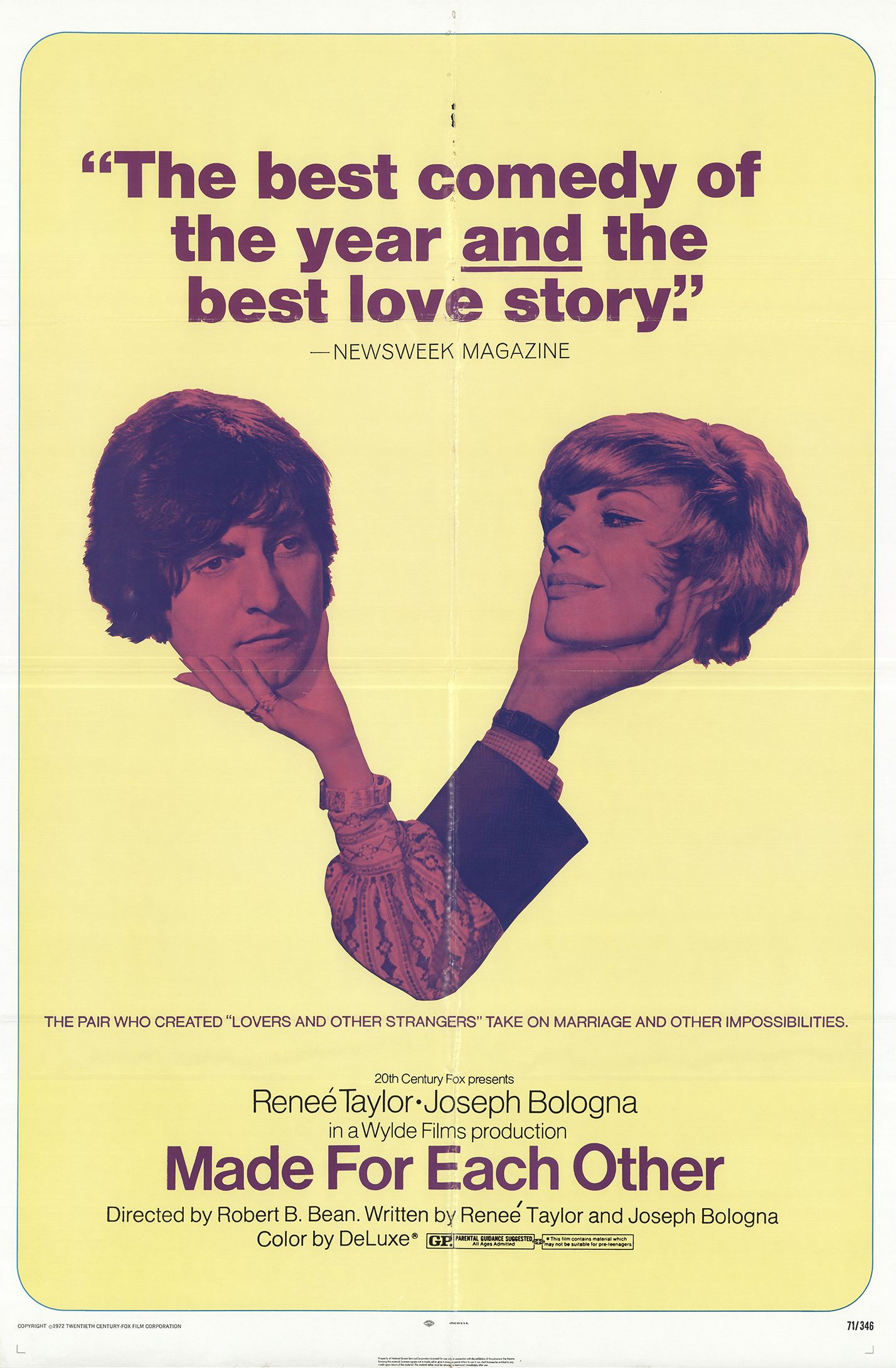
Pandora (Renee Taylor) is an out-of-work actress still clinging to her dreams that she’ll one day become famous something she has hoped for since she was a child. Gig (Joseph Bologna) suffers from not being able to find a stable relationship and guilt-ridden over sending the last one into attempted suicide. Both Pandora and Gig attend a group therapy session and this is where they meet. Initially though things are rocky. Gig does not like Pandora’s stand-up act, something she’s been working on for years, and openly tells her it’s awful. They then break-up, but Pandora eventually returns telling him that he was right and she’s worked out the ‘kinks’ from her act, so it’s now improved. To celebrate Gig takes her to his parents (Paul Sorvino, Olympia Dukakis) for Thanksgiving. The parents though don’t approve of Pandora since she’s Jewish and they’re Catholic and they eventually drive her out of their apartment. Gig and Pandora continue to argue once they’re back in the car, but find, strangely, that no matter how the other one annoys them they still like each other’s company.

After the runaway success of Lovers and Other Strangerswhich Bologna and Taylor wrote initially as a play, but then turned it into a movie, Hollywood studios were interested in them trying another script and gave them upfront money to do so. The first film had been based on their real-life experiences of dealing with all of their in-laws during their wedding, which occurred in 1965, and so they decided to base this one on their lives as well, namely what brought them together. Like with their first project the script is quite broad and focuses in on many different people including the parents of each character who have quite a bit of screentime, particularly Sorvino and Dukakis, and who are quite funny. The film also shows the leads when they were infants and many of their childhood experiences, which gets shot in black-and-white, that is also both insightful and amusing.

Unlike with most movies the scenes are quite extended and seemed better primed for a stageplay. The elusive Robert B. Bean gets credited as director, but he never did anything else, which seems a bit curious and there’s been rumors that he was just a pseudonym for Bologna who took over as the actual director. The long takes though are effective and enhance the comedy. The scene inside Gig’s parents house where the tension builds when they slowly realize that Pandora is ‘not their kind’ is quite good and not unlike what could happen in many families homes of that era who closely identified with their particularly religions and not privy to having their kids marry outside of it. Gig’s inability to appreciate Pandora’s stage act and his blunt assessment of it while at a late night cafe is comically on-targe too as any fledgling artist will tell you sometimes family members, friends, and even those really close to them won’t always connect with their artistic endeavors and regrettably become their biggest critics.

Sorvino scores as the abrasive no-nonsense father though ironically he was actually 5-years younger than Bologna who plays his son and for that reason his hair should’ve been made more gray. Dukakis is equally on-target as the super religious mother whose strong faith amounts to a lot of rituals and ends up inadvertently harming her child psychologically like when she catches him masturbating and informs him that if he continues his ‘little thing will fall off’. Helen Verbit as Pandora’s mother is equally amusing playing the over-protective type who wants so hard to shield her daughter from harsh reality that she tells her that her stage act is ‘brilliant’ when it really isn’t and that because she’s her mother that somehow makes her opinion ‘objective’.

The film’s one drawback is the yelling, which there is a lot of. Sometimes confrontational comedy can be quite amusing and this one works most of the way, but how much the viewer will enjoy is up to each individual. Bologna’s shouting is particularly loud and abrasive. It’s meant to funny and done only out of aggravation, but it does tend to get extended especially by the end. Had Taylor shouted back then it would’ve seemed like a ‘fair fight’, but having her run away and cry takes humor out of it and may ultimately ingrate on the audience. The intent is for there to be an offbeat charm, but not everyone may see it that way and thus this thing won’t be for all tastes.

My Rating: 7 out of 10

Released: December 12, 1971

Runtime: 1 Hour 41 Minutes

Rated GP

Director: Robert B. Bean

Studio: 20th Century Fox

Available: DVD-R (Fox Cinema Archives)

Terror at Red Wolf Inn (1972)

terror1

By Richard Winters

My Rating: 4 out of 10

4-Word Review: An appetite for humans.

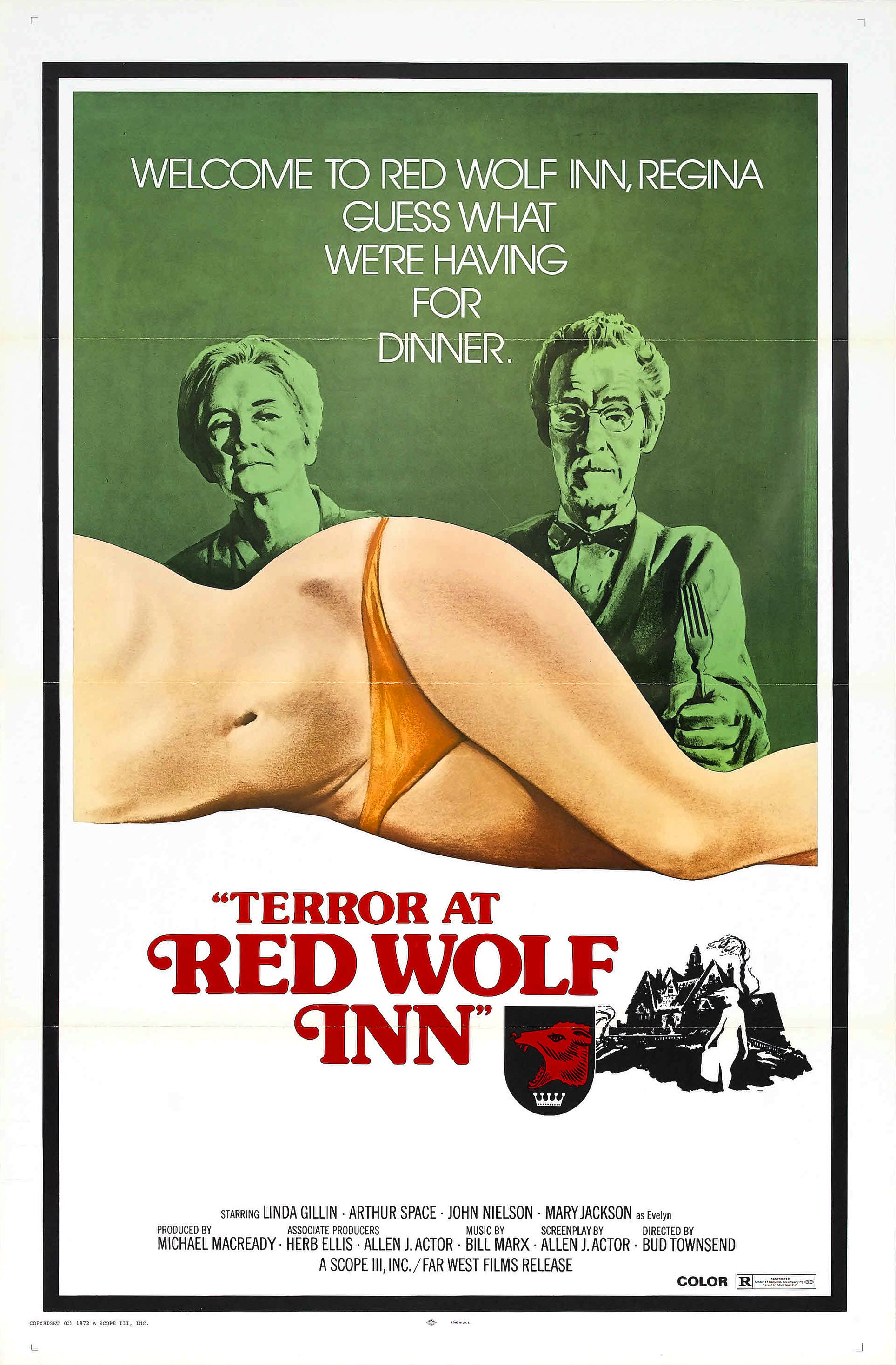
Regina (Linda Gillen) is a shy college student living in a dorm by herself who doesn’t have enough money to go to Spring break with the rest of her friends, so she’s forced to stay on the campus all alone while the others go. Then she receives a letter telling her that she’s won a free trip to a bed and breakfast resort called the Red Wolf Inn. She’s offered a private plane ride to get there and once she arrives she’s greeted by a kindly elderly couple (Arthur Space, Mary Jackson) who own the place and two other women, Pamela (Janet Wood) and Edwina (Margaret Avery), who are also staying there, as well as the couple’s adult grandson Baby John (John Neilson). While things start out well Regina soon grows uncomfortable and convinced that the couple has ulterior motives. When both Pamela and Edwina disappear Regina fears she’ll be next, but her efforts to escape are thwarted trapping her in the home to become the next meal item unless she can convince Baby John, who has fallen for her, to help her find a way out.

This very odd piece of 70’s horror that seems to want to combine a grisly theme with offbeat humor definitely has a few keen moments. My favorite was the way Regina finds out that she’s ‘won something’ and excitedly shouts it out to her otherwise empty dorm building. Some may consider this exaggerated as most people today would be highly cynical of such a letter, but back in the 70’s, (and I was around then), the teens were more trusting and had a propensity to be experimental and act as if life was just one big adventure, so in that respect the movie gets it right and this became for me one of the funnier moments The only caveat is how did the couple find out about Regina to send her the letter? Why was she chosen and how often and how many of these letters did they mail and how many of them got answered, which never gets addressed, but should’ve.

On the horror end its not very scarry and only borderline creepy. There is a dream sequence that had the potential of being cool, but doesn’t go on long enough. Regina’s attempt at escape I did like, but it does leave open plenty of loopholes like why was a motorboat, that wasn’t tied to any dock, conveniently left out in the bay for her to swim to? Initially I though it was an intended trap and she’d get into it and see dead bodies lying there, but that’s not the case as she uses it to get over to a neighbor’s house, but no ones inside and all the other buildings in the area are eerily empty, but why? The dinner scene in which everyone chomps at their food like pigs could’ve been considered revolting and upsetting had it been confirmed that it was people they were eating, but this wasn’t yet established, so the shock effect is lost.

Some have labeled this as a comedy-horror and one of the first films to use this sub-genre, but outside of the opening bit there really isn’t anything all that amusing. There are some moments of extreme awkwardness like when Baby John smashes the head of a baby shark repeatedly against a rock while a shocked Regina looks on in horror before he turns to her and confesses how much he loves her, which is darkly humorous in a distorted type of way, but outside of that the chuckles are as infrequent as the scares.

Spoiler Alert!

I did enjoy Mary Jackson’s performance who goes from nice old lady to threatening matron effectively, but the wrap-up leaves much to be desired. Initially it’s sort-of exciting as Regina and Baby John make a daring run for it only to be chased down by the older couple’s dog and then viciously attacked by both the pet and the old man. The film then cuts to show Regina and Baby John back inside the kitchen of the grandparent’s home having supposedly gotten the upper hand, but this is a struggle that needed to be played-out, the film lacks action anyways and this would’ve offered much needed excitement and tension. Showing the old couple’s decapitated heads inside the freezer had a gory appeal, but then having the old guy look up and wink ruins it and turns the whole movie into one big stupid joke.

Some viewers insist that the 77 minute version, which is what’s available on DVD despite the cover saying it’s 90 minutes, is the edited version with certain scenes of ‘horror’, or other ‘dark’ moments left out and this is based mainly on the fact that IMDb lists the original runtime as 90 minutes and Leonard Maltin’s review book says it’s 98 minutes, but I’m not so sure. As short as the 77 minute runtime is it still came off as draggy. This was also made in an era where implying the violence and gore was considered shocking enough making me believe that the DVD cut is pretty much the whole thing. Even if a longer version may exist it’s doubtful that it would be filled with more carnage as it’s clear that the filmmakers were going for a soft tongue-and-cheek approach making me believe the supposed lost scenes would’ve amounted to being talky bits that wouldn’t have added much.

terror2

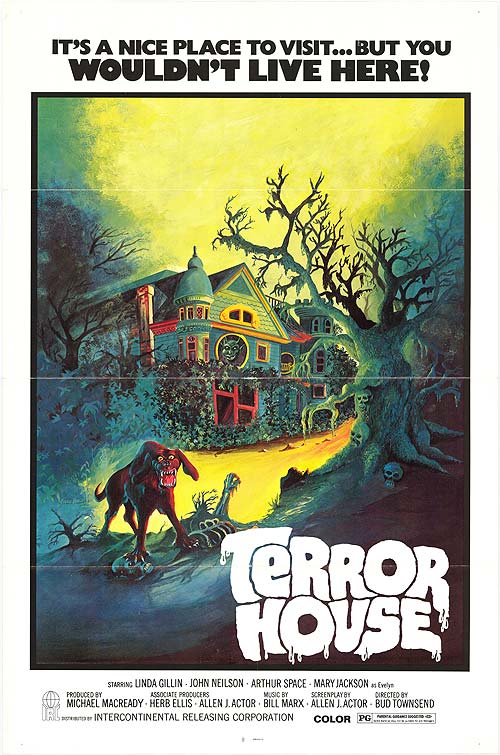
Alternate Title: Terror House

My Rating: 4 out of 10

Released: September 27, 1972

Runtime: 1 Hour 17 Minutes

Rated R

Director: Bud Townsend

Studio: Red Wolf Productions

Available: DVD

Last of the Mobile Hot Shots (1970)

lastmobile

By Richard Winters

My Rating: 4 out of 10

4-Word Review: A game show wedding.

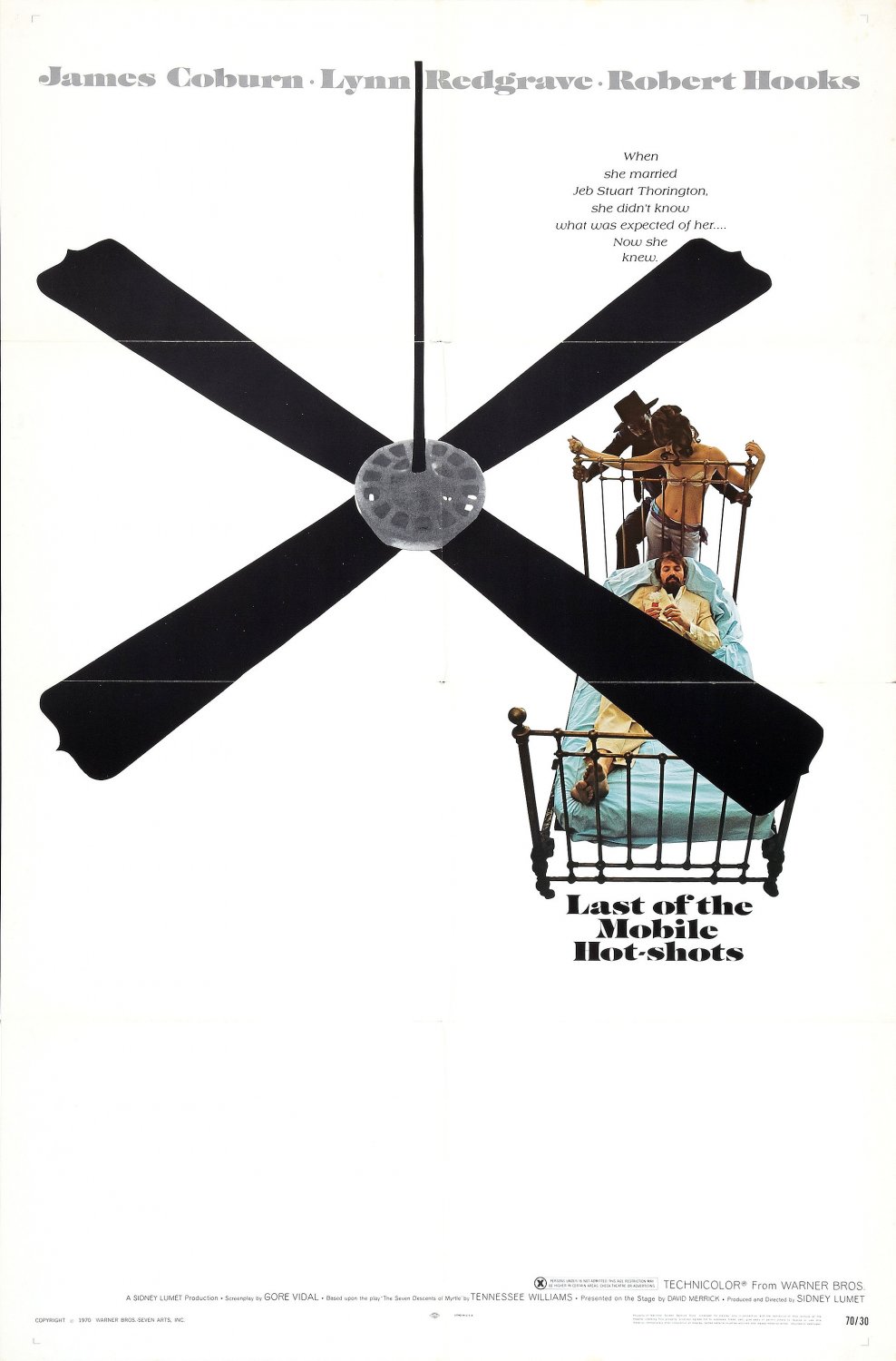
Myrtle (Lynn Redgrave) and Jeb (James Coburn) meet at a game show being taped in New Orleans and find themselves working together as contestants when brought up onto the stage. They end up winning some money, but are told that they cannot collect it until they’re officially married on live television, which they both agree to. After the nuptials they travel to an old mansion known as the Waverly Plantation that has been in Jeb’s family since 1840. Jeb wishes to use the money earned on the game show to fix up the place, but finds his plans being stymied by Chicken (Robert Hooks) a multi-racial half-brother that has been residing at the place and maintaining it for many years. Chicken insists that he’ll become the next owner of the place once Jeb succumbs to terminal cancer, but Jeb wants Chicken off the premises immediately and have the document stating that Chicken is the next of kin to be destroyed. He orders Myrtle to flirt with Chicken until she can get him into a compromising position so that she can steal the document. Once that is retrieved he then wants her to kill him with a hammer while Jeb waits upstairs. Though initially reluctant Myrtle decides to go through with the plan only for Chicken to turn-the-tables on them with an unexpected twist.

While playwright Tennessee Williams is celebrated for his acclaimed work like A Streetcar Named Desire and Cat on a Hot Tin Roof many people don’t realize that his biggest success came early in his career while towards the end,  especially by the mid-60’s through to his death in 1983, his output was very little and what he was able to get produced was generally not well received by either the critics, or the public. This film is based on his play The Seven Descents of Myrtle, which was originally written as a short story in 1942 and published in 1954. Williams then decided to turn it into a one-act play in 1967, but then expanded it to a full length stage production, which premiered on Broadway on March 27, 1968 with Harry Guardino as Chicken and Estelle Parsons playing Myrtle. This version though only ran for 29 performances and was generally considered a failure.

However, director Sidney Lumet saw the production and decided he wanted to take a stab at turning it into a movie. He made several changes to the story with the biggest one being that in the play the Jeb character, who was called Lot, was a closeted transvestite, which is something that the movie doesn’t bring up at all though would’ve been far more interesting had it done this. The play also doesn’t feature the game show segment, which was very surreal and makes the film seem almost like a misguided parody.

I did enjoy the way famed cinematographer James Wong Howe captured the decaying mansion, which was filmed on-location in St. Francisville, Louisiana, a famous small town known for its abundance of historic old buildings. Everything else though falls flat. The opening bit at the game show is funny, but becomes jarring with the second-half, which is more dramatic making it seem like two completely different movies with highly inconsistent tone rammed into one. The Myrtle character is not fleshed-out enough to make any sense, or even seem remotely believable and ultimately like with the rest of them comes-off as an empty composite that is not relatable in any way to real people.

The acting though by Redgrave is quite strong. Normally British actors have a hard time masking their accent, but here she’s able to speak in an authentic Southern dialect without her European voice being detectable in the slightest and she puts on a provocative striptease to boot. Hooks dominates the proceedings and ultimately outclasses Coburn who later admitted regret at doing the project and considered his appearance here to be a low point in his career. Having Williams write the screenplay might’ve helped and I’m not sure why he wasn’t asked, but Gore Vidal doing the task turns the whole thing into an absurd misfire that should never have been attempted.

My Rating: 4 out of 10

Released: January 14, 1970

Runtime: 1 Hour 40 Minutes

Rated X

Director: Sidney Lumet

Studio: Warner Brothers

Available: DVD-R (Warner Archive)

The Purple Rose of Cairo (1985)

purple1

By Richard Winters

My Rating: 7 out of 10

4-Word Review: Breaking the fourth wall.

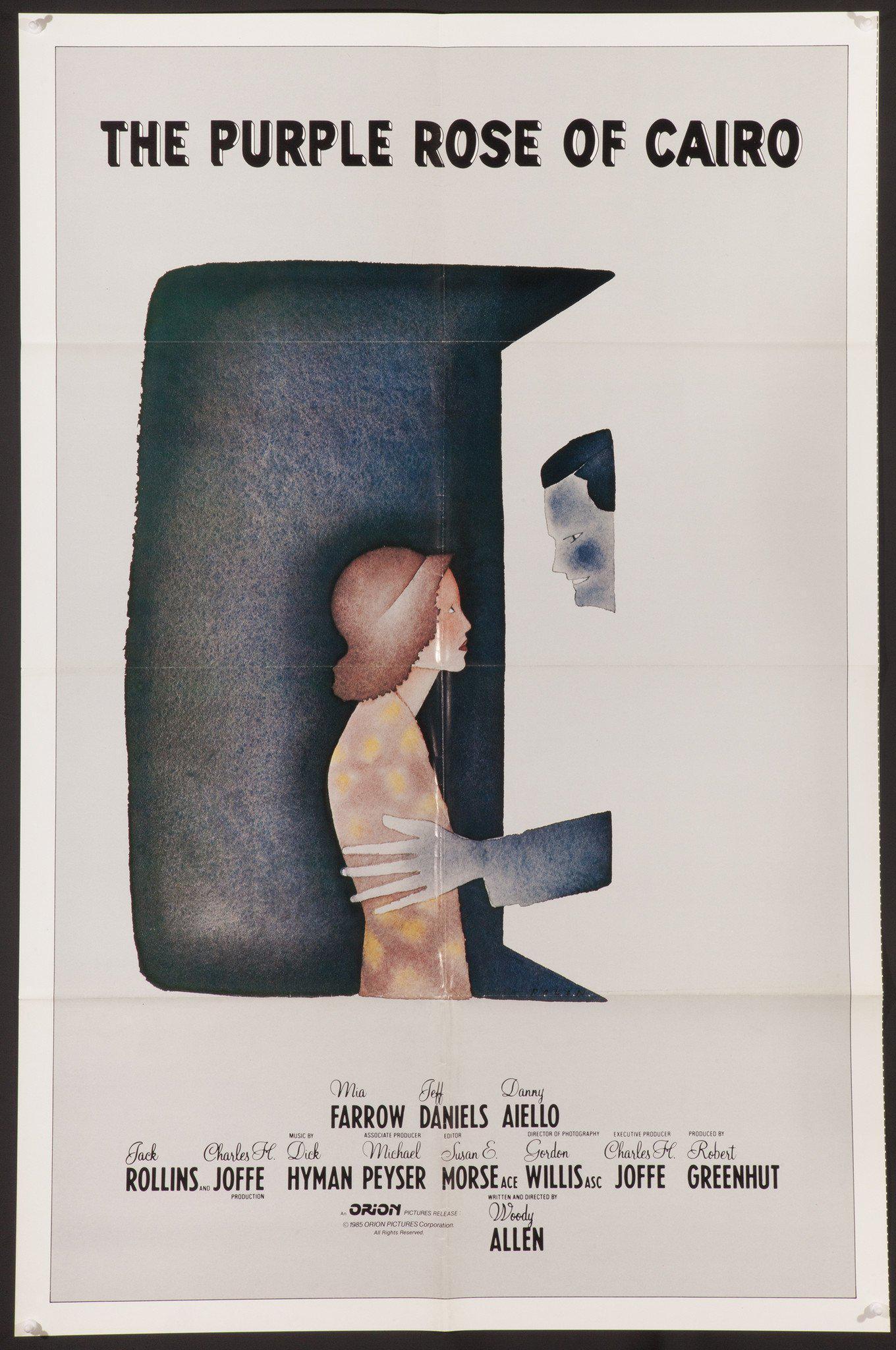
Cecilia (Mia Farrow) is a lonely woman living in 1935 who’s stuck in a dead-end job and an abusive marriage. As an escape she regularly goes to the movies and becomes especially entranced with one called ‘The Purple Rose of Cairo’ particularly the dashing young man character named Tom (Jeff Daniels). Tom notices Cecilia continuing to attend each showing and thus breaks out of the black-and-white movie he is in and into the real world just so he can speak with her as he feels he’s falling in love. Cecilia tours him around the small New Jersey town where she lives while the rest of the cast in the movie he’s left sit around and hope he’ll come back, so they can continue on with the story. The actor, Gil Shepherd (also played by Daniels), who played Tom in the movie hears about Tom jumping out of the screen and heads to New Jersey in order to coax him back, but Tom is having too much fun getting to know Cecilia and has no intention of returning to the phony life of the movie world. In the meantime Gil also meets up with Cecilia and the two begin to hit-it-off. Will Cecilia choose Gil over Tom and if so will this get Tom to go back into the movie once and for all?

This was the first of Woody Allen’s nostalgic picture that would replicate the time and place of when he grew up and in fact the theater where Cecilia watches her movies was the Kent Playhouse, which Allen had gone to when he was 12 and which he describes ‘one of the great, meaningful places of my boyhood’. His ability to capture working class life and Cecilia’s bleak existence is completely on-target making the opening 20-minutes one of the most impactful of the whole film. Farrow is nothing short of excellent and Danny Aiello, who got this part to make-up for getting passed over in Broadway Danny Rose, is quite good too particularly with the way he’s able to show the human side of his character despite him being quite abusive and domineering to his wife otherwise.

The comedy takes off when Tom literally jumps out of the screen and Allen is very creative at thinking out every conceivable angle at not only how the other patrons in theater respond, which is some of the funnier bits in the film, to the characters onscreen, who are also quite amusing most notably Zoe Caldwell who plays the Countess and has some great zingers, but also the film’s producer (Alexander Cohen) and how he responds to the ‘calamity’. Some may argue that it’s missing a cause, since film characters don’t jump out of the screen everyday what allowed it to happen in this case, which the movie never answers, but for me that’s what made it even more amusing as everyone reacts in wildly different ways to the unexplainable and if anything Allen at least doesn’t cop-out by turning it into some sort of dream that Cecilia had, which would’ve been disappointing. I’d rather have as some odd fluke in the universe than reverting to an overused dream gimmick.

My one complaint was Daniels who’s deadly dull. He has a few amusing responses to things, but he’s bland most of the way. Michael Keaton was cast in the part initially, but after 10-days of filming Allen decided he seemed ‘too contemporary’ and thus had him replaced, which is a shame as Keaton has a more dynamic onscreen presence while Daniels seems too transparent. I didn’t like the entering in of the actor character either as that just started to make it too confusing. The actor should’ve been wildly different than the character he played, extreme narcissistic ego, which would’ve been hilarious. While he does show some of these traits it’s not enough and it gets hard telling the difference between the two. Having a rich Hollywood actor, who would most likely already be in a relationship anyways, falling in love with a nondescript housewife didn’t make a lot of sense. While the scenes between Cecilia and Tom are quite endearing, the moments between her and Gil are boring and start bogging the whole thing down.

Spoiler Alert!

Some have complained about the so-called ‘unhappy ending’, which Leonard Maltin in his review described as ‘a heartbreaker’, but I found it to be a perfect. The odds that a relationship between a up-and-coming Hollywood star and a New Jersey housewife would actually work are pretty slim. Besides Cecilia’s love affair wasn’t with people anyways, but with movies and their ability to sweep her away from her sad existence and into a fantasy world and on that level it’s a happy one as Cecilia returns to the theater all broken-hearted only to again forget her troubles when she gets wrapped-up in a Fred Astaire and Ginger Rogers flick proving that movies would always be there for her even when people won’t.

My Rating: 7 out of 10

Released: January 26, 1985

Runtime: 1 Hour 22 Minutes

Rated PG

Director: Woody Allen

Studio: Orion Pictures

Available: DVD, Blu-ray, Amazon Video, Tubi, YouTube

Zelig (1983)

zelig1

By Richard Winters

My Rating: 4 out of 10

4-Word Review: Wanting to fit in.

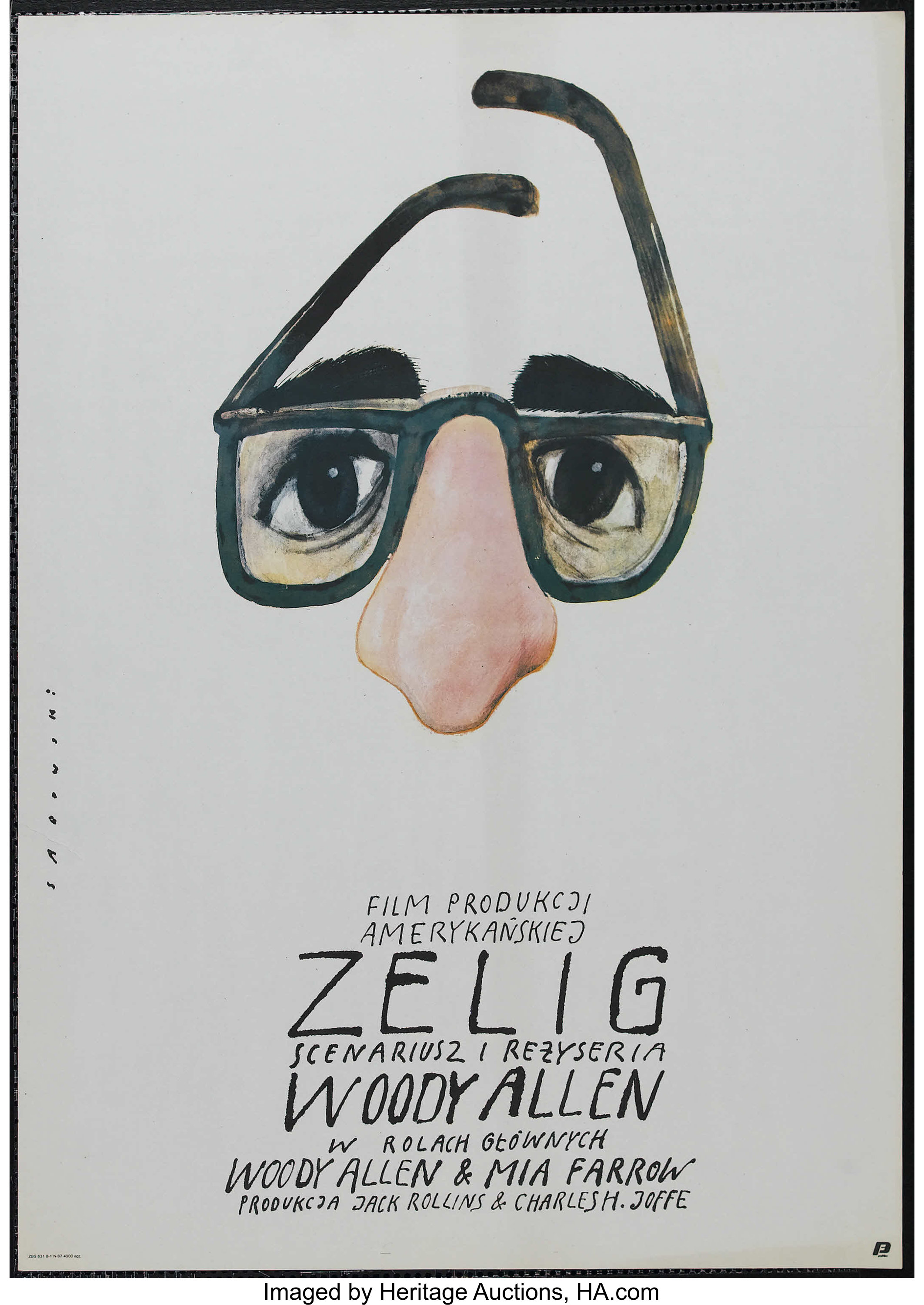
Leonard Zelig (Woody Allen) is a man living in the 1920’s and 30’s who has an uncanny ability to reflect the personalities and features of those he’s surrounded with. Even if he’s in the company of someone of a different race, or ethnicity, he can still acquire their traits, including their skin color, until he looks exactly like them. He becomes known as a the human chameleon and Dr. Eudora Fletcher (Mia Farrow) , a psychiatrist, becomes determined to find the root cause. She takes him on as a patient and under intense hypnosis comes to the realization that his deep need to be liked by others causes him to conform to the most extreme ways imaginable. Through her therapy she gets him to become more confident in expressing his own opinions, but this leads to him arguing with others over the most mundane reasons, which leads to several fights. She again puts him under hypnosis, so that he’ll become more of centrist, but this then leads to even further complications.

Allen was inspired to do this movie when his friend Dick Cavett was hosting a history series on HBO and a segment was done where Cavett’s likeness got spliced into an historical image. While the effects of using old newsreel footage and photos from long ago and inserting in cast members to make it seem like they were there when the picture was taken may not seem like that big of a deal today, but back in the 80’s it was very much talked about. I remember an entire segment of CBS Morning News hosted by Diane Sawyer going in depth about the ‘incredible’ special effects and ‘how did they do it?’ With digital filmmaking and movies like Forrest Gump we’re used to it, but back then it was state-of-the-art and got nominated for several awards. To help make it look as authentic as possible cinematographer Gordon Willis used vintage cameras and lenses from the 20’s and then stomped on the negatives of the film in his shower to help create the crinkles and scratches.

While telling the story through newsreel footage is certainly diverting and many times amusing I was fully expecting after about 20 minutes or so that it would eventually become more like a normal movie with the plot being propelled by actual characters, dialogue, and conventional scene structure, but instead it sticks with the novelty until the bitter end, which for me was a mistake as it makes the viewer too detached from the people in the movie to the point that they become distant caricatures that we really care nothing about. Much comedy is also lost as everything hinges on the voice-over narration of Patrick Horgan and how he describes what’s going on versus having it played out. A great example of this is when Allen gets into an argument with someone over whether ‘it’s a nice day, or not’, but all we see of it is some grainy, black-and-white figures in a distance that appear to be squabbling when witnessing the actual argument in real-time would’ve been so much funnier.

My favorite moment had nothing do with the special effects, but instead was the scene with Farrow and Allen where she tricks him, using reverse psychology, into admitting he really wasn’t a psychiatrist like her, and the movie needed more segments like this one. The vintage footage is nice for awhile and highly creative, but ultimately makes it come-off like a one-note joke, or an experimental film that’s misses the most basic elements of a good story, which is character development. It’s a shame too as Farrow gives a strong performance, which gets overshadowed. Usually she’s best at playing emotionally fragile types, but here is a strong woman and does quite well though I thought it was ridiculous that in color segments where here character is speaking in the modern day as an old woman another actress, Ellen Garrison, plays the part when they could’ve easily had Farrow doing it by dying her hair gray and putting on a few wrinkles. So much effort was put into the black-and-white vintage stuff that they forgot about the simplest of all special effects: stage make-up.

There’s also a host of other famous faces that have cameo bits as they talk about the fictional Zelig in the modern-day like historians discussing a past event, or famous person. Of these includes Susan Sontag, Saul Bellow, Irving Howe, and John Morton Blum, but like with the newsreel element it gets overplayed and derivative. It also brings to question what exactly was the movies’ point. Was it a satire on conformity and if so it could’ve gone much deeper, or poking fun at documentaries, which could’ve been played-up much more too. In either case it’s a misfire that’s engaging for awhile, but eventually, even with its short runtime, wears itself out.

zelig2

My Rating: 4 out of 10

Released: July 15, 1983

Runtime: 1 Hour 19 Minutes

Rated PG

Director: Woody Allen

Studio: Orion Pictures

Available: DVD, Blu-ray

Fools’ Parade (1971)

fools

By Richard Winters

My Rating: 5 out of 10

4-Word Review: Can’t cash his check.

Mattie Appleyard (James Stewart), who lost one of his eyes during a fight years earlier and now wears a glass one, finally gets released from prison after spending 40 years behind bars. Along with him there’s bank robber Lee Cotrill (Strother Martin) and a young convict named Johnny (Kurt Russell) who both get released on the same day. Mattie’s also given a check in the amount of $25,452,32 as payment for his years of prison work. Mattie, Lee, and Johnny plan to use the money to start-up their own grocery store, but since the year is 1935 and many are poor due to the Great Depression they realize they must guard the check carefully and not cash it until it’s fully safe to. During their train ride out of town they become aware after reading the fine print that the check can only be cashed in person at the bank in the town that they’ve just left, so they take another train ride back. Unfortunately for them they don’t know that Mattie’s former prison guard Doc (George Kennedy) has already hatched a plan with the bank manager (David Huddleston) to make sure that the check is never cashed. In-fact the manager has given Doc an advance on the money to have Mattie and his friends wiped-out. Doc has hired a ‘Christian’ hit man  named Junior (Morgan Paull) to do the dirty deed, which Junior agrees to as long as it’s confirmed that people he kills are atheists, which Doc insists they are.

The film is based on the 1969 novel of the same name by Davis Grubb, who is better known for having written Night of the Hunter. It was shot on-location in Moundsville, West Virginia where Grubb was born and raised and it’s the setting that helps give the movie added character. The scenario though is rather odd and seems to want attain a certain quirky tone that it can’t quite reach. Leonard Maltin, in his review, complained about it being ‘unintentionally funny too many times to be taken seriously’. While I’ll agree the tension is lacking I do feel that this was meant to be humorous and some of it is slightly amusing, but it never gels and overall isn’t intriguing. I also felt the Russell character wasn’t needed. Maybe the producers wanted a youthful character added to attract younger members of the viewing public, but he doesn’t say, or do anything that’s funny, or helps move the story along. His romance with Chanty (Katherine Cannon in her film debut) who plays a 16 year-old who’s virginity is up for sale for a price of $100, is too forced, not believable, and adds nothing to the main plot.

There’s also several directorial errors including the first time Stewart takes out his glass eye, which was apparently so painful to wear that shooting could only last for 20-minutes at a time. In the shot we see Stewart put his hand over his eye and then it cuts to Russell’s shocked expression and then back to Stewart where the eye ball is in his hand, but we can see on Stewart’s face, just as he turns that he still has a blue eye in the socket where the glass used to be. When he removes the eye later he keeps the left eye closed in order to represent an empty socket, but the first time he doesn’t.

There’s also issues with Kennedy’s teeth. Initially I thought he was wearing braces, but then during close-ups it looks like there just supposed to be dirty, or rotting, but realistically it’s not done right. If they were truly bad teeth then some of them should’ve fallen out, or broken off instead of looking like they have been covered with black specks. There’s also a scene where he’s sitting in a car putting on his white shoes and his teeth are all white only to have in a later scene going back to them appearing dirty.

The performances are certainly a plus with Stewart’s being especially good and I admire the way he was willing to go out of his comfort zone by playing a type of kooky character he had never done before. Kennedy is also a scene-stealer in quite possibly the funniest thing he ever did. Huddleston is also solid as the corrupt bank manager and the segment where he nervously watches Stewart attempt to light a stick of dynamite inside the bank office is probably the film’s best moment. Kudos though must ultimately go to Anne Baxter who’s quite impressive as an aging, embittered prostitute who runs a whorehouse on a houseboat. I remember being blown away by her performance in The Ten Commandments and then later for her Oscar winning work in All About Eve, but her she’s almost unrecognizable in a role that is both darkly funny and sadly poignant at the same time.

My Rating: 5 out of 10

Released: June 17, 1971

Runtime: 1 Hour 38 Minutes

Rated GP

Director: Andrew V. McLaglen

Studio: Columbia Pictures

Available: DVD-R, Tubi