Category Archives: Mystery

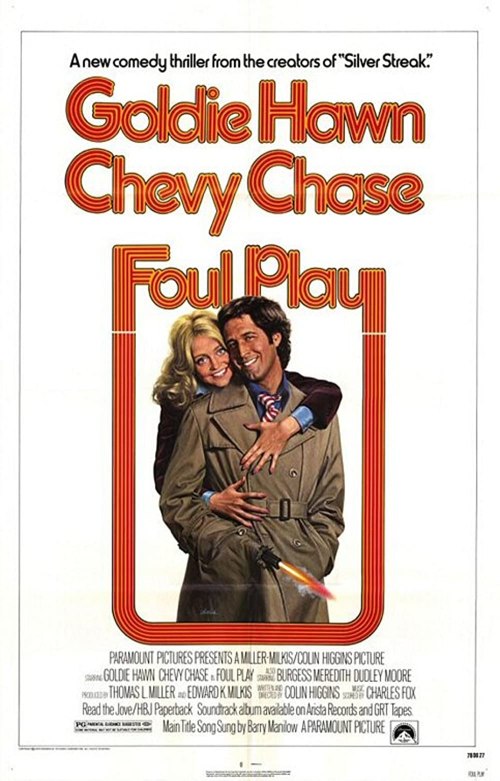
Foul Play (1978)

foul

By Richard Winters

My Rating: 7 out of 10

4-Word Review: Beware of the dwarf.

Gloria (Goldie Hawn) is a recent divorcee who takes a car trip along the San Francisco coast where she comes upon a stranded motorist (Bruce Solomon). Since she is looking to meet new people she decides to give him a ride. The man says his name is Scotty and that he’s looking to give up smoking and gives her his pack of cigarettes in an effort to stay away from them. Unbeknownst to Gloria the pack holds a microfilm that a secret organization is after. That evening the two meet-up at a theater to watch a movie, but Scotty, who has already been stabbed, dies while sitting in his seat. Gloria runs to notify the theater manager (Chuck McCann), but when they return the body is gone. Later that night Gloria gets attacked in her apartment by a man (Don Calfa) with a facial scare. She stabs him with her knitting needles and he falls over dead, at least she thinks so, before she herself passes-out. When the she comes to two policemen are in her place, but with no evidence of a body. One of the officers (Brian Dennehy) thinks she may be nutty, but the other one (Chevy Chase) finds her attractive and therefore makes an effort to research her story and while Gloria and he work together to investigate the case they begin a romantic relationship.

While Leonard Maltin, in his review, or whoever wrote if for him, describes this film as ‘Hitchcock plagiarism’ I found it similar to High Anxiety that came out a year before, and more of a homage. Many other films that try to replicate Hitch’s style usually fail because they go overboard with the theatrics, or too much parody, but this one has a nice balance that is both intriguing and funny.  Another great quality of the film is the way it lovingly photographs the city and landscape of Frisco Bay from its beautiful shore line, to row houses, to the scenic boat houses where the Chase character resides. It’s almost enough to compel one to move there if only a person who wasn’t super rich could afford to live there.

The supporting cast is delightful and everyone of them has some really laugh-out-loud moments. Dudley Moore is the best, in a part written specifically for Tim Conway who shockingly turned it down, as a sex starved bachelor who brings Gloria to his pad filled with blow-up sex dolls thinking the two will have sex only to learn that’s the last thing on her mind. Marilyn Sokol as Gloria’s fiercely feminist friend is quite amusing as is dwarf actor Billy Barty as a bible salesmen who Gloria mistakes as being the killer. Burgess Meredith, as Gloria’s kindly old landlord, doesn’t come-off as well and gets upstaged by his pet python. It also would’ve been good had his character brought-up his judo skills earlier in the story instead of having it introduced later on when they must confront the bad guys, which was just a little too convenient though the karate match that he has with Rachel Roberts is quite entertaining and something I wished had gone on longer.

I did though have some issues withe the two leads. Goldie is as enjoyable as ever, but her character makes what I felt were grossly misguided decisions. One is picking-up a stranded male stranger on an isolated road, which from a simple common sense perspective is a major no-no. She also later-on blithely walks into her apartment even after she becomes aware that the front door has been broken into. In another scene she’s given mace and a pair of brass knuckles from her friend Stella to use for protection and Gloria is able to escape from a locked room and knock-out the bad guy with the help of these items, but then she throws them away before running out, but any logical person would hold onto them in-case they were needed again.

Chase playing a police detective was something that I just couldn’t buy into. He initially comes-off, when Gloria first meets him at a party, as a lecherous lounge lizard looking to hit on hot babes and not serious about much else. He’s also seen as being highly klutzy, so having this clownish womanizer suddenly turn into a dedicated cop doesn’t jive and seemed more like two completely different people. Brian Dennehy gives a far more realistic portrayal of a policeman and is actually funnier in his exasperated responses to Gloria’s crazy story, so he should’ve been the sole investigator and Chase could’ve been this ordinary doofus that she meets and because he has the hots for her he agrees to ‘humor her’ and help her out on the case. The story and romance could’ve remained the same, but casting Chase as a regular Joe, which he’s far better playing at, would’ve made better sense.

The story does become strained at the end with a speeding car sequence that’s more nerve-wracking than fun, though the elderly Asian couple that can speak no English and sit in the back seat of the speeding limo are amusing. The whole reason behind the crime and attempted assassination of the Pope is hooky and it would’ve been better had no explanation been given at all than explaining it away the way they do. However, the climactic sequence done during a performance of ‘The Mikado’ at the San Francisco Opera House, is terrific and a nice finish to what is otherwise perfect escapism.

My Rating: 7 out of 10

Released: July 14, 1978

Runtime: 1 Hour 56 Minutes

Rated R

Director: Colin Higgins

Studio: Paramount

Available: DVD. Blu-ray

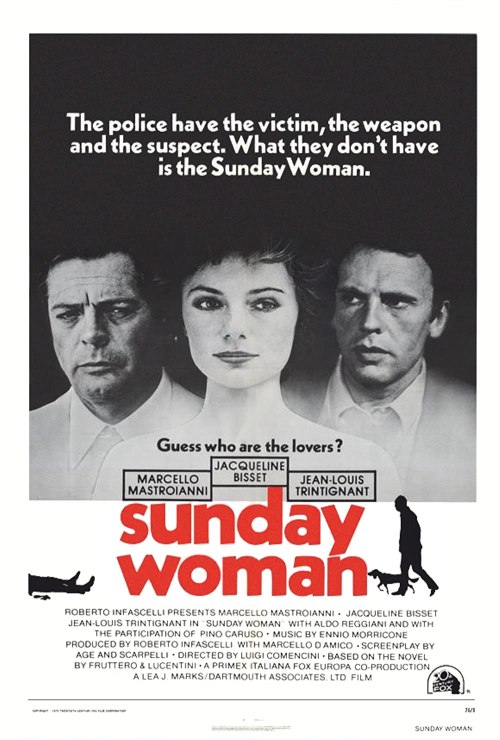
The Sunday Woman (1975)

sundaywoman

By Richard Winters

My Rating: 6 out of 10

4-Word Review: Murdered by phallic object.

Based on the novel of the same name by Carlo Fruttero and Franco Lucentini, the story centers on the investigation of the murder of Mr. Garrone (Claudio Gora). Garrone is found bludgeoned to death inside his apartment by a giant penis statue. Garrone was a well known architect and a lecherous ladies man who couldn’t help but make unseemly passes at every woman he came by. Commissioner Santamaria (Marcello Mastroianni) is put in charge of the case, which has many suspects. Two of the biggest ones are Anna Carla (Jacqueline Bisset) and her platonic male friend Massimo (Jean-Louis Trintignant). Anna had written a note, found by her hired help the next day, stating her desire to ‘eliminate’ Garrone. Anna, who’s quite wealthy, insists that it was all a innocent misunderstanding and Massimo backs her up, but Massimo, who has an alibi, is reluctant to divulge it because it would require him to admit that he’s gay and at Lello (Aldo Reggiani) his lovers’ house. Santamaria begins looking into other potential suspects as does Lello who wishes to get his boyfriend cleared, but the deeper Santamaria gets into the case the more he connects with Anna and despite their age difference they begin to have a romantic relationship all while she remains at the top of his suspect list.

The film, on the technical end, is well done. Director Luigi Comencini nicely captures the visual beauty of the Italian landscape and the posh older homes of Turin a city in northwest Italy where it was filmed. The soundtrack by Ennio Morricone has a nice bounce that keeps the film moving along even while not a lot is happening. There’s an array of suspects and enough red herrings to keep it intriguing and impossible to guess who’s the true culprit.

The story has its share of offbeat moments though it’s disappointing that the funniest character, Garrone, ends up getting killed as he was amusingly sleazy enough to have kept things consistently comical. While the death by giant penis statue, if memory serves me correctly, had already been used in A Clockwork Orange, it’s still a novel idea and it’s funny how Santamaria visualizes each suspect he meets bashing Garrone over the head with it as he interviews them. Traveling to the shop where the statues are made and being surrounded with hundreds of them is certainly good for a chuckle, but outside of this there wasn’t all that much that stood out, or made this any better than any other murder mystery. The ingredients are good enough to keep sufficient interest, but nothing the makes it really memorable.

I was most disappointed that Bisset wasn’t in it more. She’s fabulous, as she is in most of her movies, and though I suspect that her voice, where she speaks fluent Italian, is dubbed, I still felt she gives a spectacular performance. Mastroianni on the other hand looks tired and worn-out and like his peak years of being a international sex symbol had passed. Yet when he’s together with Bisset it clicks and Jacqueline’s superior acting camouflages their extreme age difference making them seem more like a perfect couple than it should. The two should’ve investigated the case together and become a team, as every second Bisset is not seen it flatlines. Had the two shared the screen this might’ve been special, but ultimately it misses-the-mark and never fully gels.

My Rating: 6 out of 10

Released: December 16, 1975

Runtime: 1 Hour 45 Minutes

Rated R

Director: Luigi Comencini

Studio: Fox-Lira

Available: DVD-R (dvdlady.com) (Italian w/English subtitles), Amazon Video (English subtitles)

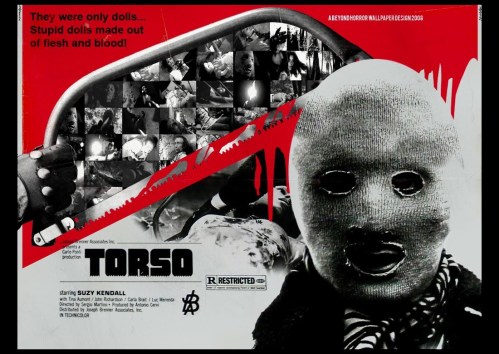
Torso (1973)

torso2

By Richard Winters

My Rating: 4 out of 10

4-Word Review: Strangler stalks college students.

Jane (Suzy Kendall) is a British student attending college in Italy where a rash of grisly murders amongst the female coeds is keeping everybody on edge. The killer’s modus operandi is a red and black scarf that he uses to strangle his victims. Jane’s friend Dani (Tina Aumont) fears that the maniac may be Stefano (Roberto Bisacco) a young man who’s been harassing her for a date and won’t seem to take ‘no’ for an answer. To get away from the terror Jane and her girlfriends decide to go to a villa in the countryside, but find that the killer strikes again, in their home, and with Jane hobbled with a sprained ankle, she’s unable to get away and must use her creative wits to escape.

Horror director Eli Roth has hailed this as being his favorite giallo and a major influence to his Hostel movies, but in retrospect it doesn’t have all that much to distinguish it. Despite its lurid title the emphasis is more on the mystery featuring a cast of lonely men who seem to lack quality social skills to go out with women and instead long for them from afar while also harboring dark violent sexual fantasies of what they’d like to do to them if they could, making this more than anything a forerunner to what’s become known as incels (involuntary celibate) today.

Director Sergio Martino captures Perugia, Italy and its many old and scary looking buildings nicely. The build-up to the murders where the victims find themselves alone in a dark,desolate area of the city, or in one instance an isolated forest, are some of the film’s best moments and could’ve been played-up more.

The deaths themselves though are uninteresting. The average time for a person to die from strangulation is 3 minutes and up to 7 to 14 seconds before they’ll pass-out, but the victim here falls over dead after the flimsy scarf is put around her neck for only 3-seconds, which all looks quite fake. The female victims never, ever fight back and just stand, or lie still and scream loudly, but do nothing else. Police will usually look for scratches on suspects as a sign that the victim fought for their life and there will be defensive wounds on the victim’s arms and hands too, so for the victims here not to attempt any physical defense looks rather pathetic. Some may say that back in this era it was considered more ‘tasteful’ to have the killing get over with quickly and watching someone try to fight-off the attacker would be prolonging it too much, but I wondered if this was also an attempt to feed-in to the male fantasy where once a man decides to make his move the females are virtually ‘helpless’ and must just passively accept their fate.

The special effects are threadbare as well. The close-ups of the knife cutting into the victim’s body has a lighter tone of skin color than the full-shots of the victim making it quite obvious that the close-ups are that of a mannequin. The scene where a car’s bumper crushes a man’s skull against a wall looks realistic enough, but then a few seconds later it cuts back to a shot of the victim and his skull is perfectly intact with only some blood running out of his nose even though the previous shot made it look like his head had been busted in half.

Spoiler Alert!

The third act in which Suzy Kendall sleeps through the murders of her friends downstairs and then awakens to find herself alone in the house with the killer still present is the only time it actually gets intense. Having her quietly observe him cutting-up her friend’s limbs is genuinely horrifying and watching her try to come-up with creative ways to escape is intriguing, but then having a male doctor swoop-in and fight-off the killer for her was disappointing as this was her story and she needed to be the one to find a way to take down the killer herself.

My Rating: 4 out of 10

Released: January 4, 1973

Runtime: 1 Hour 32 Minutes

Rated R

Director: Sergio Martino

Studio: Interfilm

Available: DVD, Fandor, Tubi

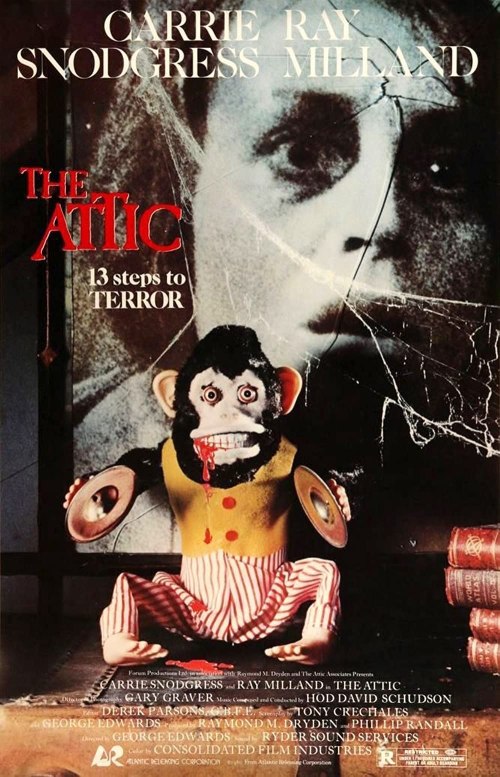
The Attic (1980)

attic1

By Richard Winters

My Rating: 3 out of 10

4-Word Review: Attic holds a secret.

Louise (Carrie Snodgress) is a middle-aged librarian who loses her job when she sets the place on fire, which was deemed an accident, but similar to the one set at her father’s (Ray Milland) department store years earlier that forced him to jump out of a second story window and has left him bound to a wheelchair. She now takes care of him in their home, but finds his tyrannical nature to be overbearing. She fantasizes daily about Robert, a man she was set to marry until he disappeared on their wedding day and has never been seen since. To help aid her in her loneliness her friend Emily (Ruth Cox) buys her a pet chimpanzee, which she names Dickie, but her father does not like the animal and the monkey soon disappears just like Robert did 19 years earlier and Louise begins to wonder if there might be a connection.

Ponderously slow film that has very little of a plot. It seems like the ending twist was the starting point and then the rest of the script was created around it, but the story gets stretched thin and not enough going on to keep it interesting. The dream sequences where Louise fantasizes about killing her father has a campy tone making them more funny than scary and the whole thing lacks even mild shocks until the very end, which may be too late for some. It didn’t help matters that writer/director George Edwards was reportedly detached emotionally from the project and would at times walk-off the set forcing cinematographer Gary Graver to take over and in fact it was his close personal friendship that he attained with Snodgress while working on this that lead to her allowing him to use her home for his own horror movie that he directed 3 years later called Trick or Treat

This was meant as a sequel to The Killing Kindwhich was also directed by Edwards and came out 7 years earlier. The producers of that film though were not thrilled with this script and therefore refused to finance it and it took Edwards several years to find new investors. Once he did they demanded several changes including having the two characters, which had been played by Peter Brocco and Luana Anders in the first one, recast to Milland and Snodgress, who they felt were more famous and could help attract a wider audience. They also insisted that the setting be switched from Los Angeles to Wichita, Kansas a move that was hard on Edwards as he had a fear of flying forcing him to take a train to get there, but he became ill while onboard stranding him halfway and requiring him to take a cab ride the rest of the way, which cost $1,500, or $6,132 in today’s dollars.

The performance by Snodgress is the only thing that’s compelling as she reaches back to her Diary of a Mad Housewife character who’s constantly being ignored and oppressed by the man in her life. In that one it was her husband while here it was the father and her array of tormented emotions is effective, but I couldn’t understand why this otherwise attractive woman couldn’t find another eligible suitor. Certainly there was other men around and 19 years is a long time and since she was reasonably pretty and didn’t mind casual sex as she hooks-up at one point for a brief encounter with a sailor, so why no other boyfriends? If she was made to look ugly, or suffered from a deformity that caused her to remain isolated and a detraction to other men, that would’ve made it more understandable.

Spoiler Alert!

The twist at the end in which it’s revealed that the father can walk is not as surprising as it could’ve been since the viewer is already shown in a scene earlier of him getting out of his chair when he kills the monkey, and for the simple sake of surprise that scene should’ve been cut. The fact that he didn’t need to be confined to a wheelchair and had a lot of money then puts into question why did he play the ruse to begin with? He didn’t seem to like his daughter, so why play crippled just to keep her around? With his wealth he could’ve easily found another woman that he’d like better, so why not take that route? For that matter why did he kill Louise’s suitor so many years before, which is another big reveal we learn about when she finds the dead body in the attic. If it was because the father had a twisted sexual thing for his daughter and therefore didn’t want any other men in her life then that needed to get alluded too, which the film doesn’t do, which ultimately makes the whole scenario quite empty-headed and pointless.

My Rating: 3 out of 10

Released: October 19, 1980

Runtime: 1 Hour 34 Minutes

Rated PG

Director: George Edwards

Studio: Atlantic Releasing Corporation

Available: DVD

Schizoid (1980)

schizoid1

By Richard Winters

My Rating: 4 out of 10

4-Word Review: Killing group therapy members.

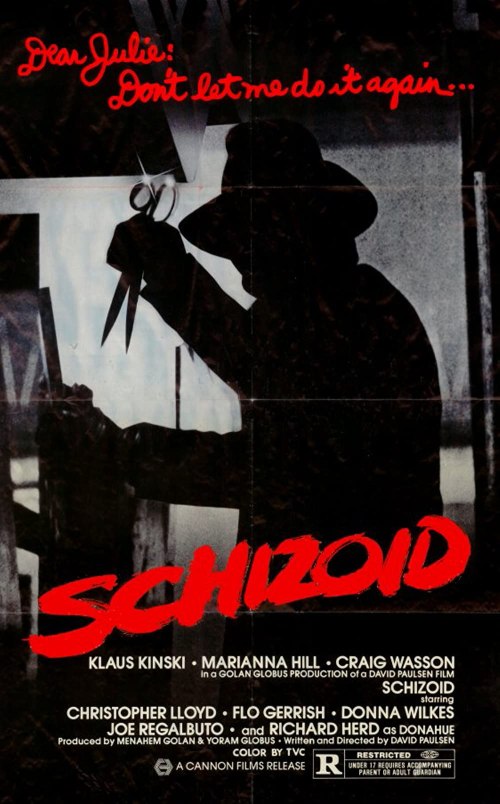
Julie (Marinna Hill) is an advice columnist who after going through a recent divorce begins attending group therapy sessions run by Dr. Pieter Fales inside his home. The Dr. soon falls for Julie and the two form a romantic relationship much to the dismay of both Alison (Donna Wilkes), the Dr.’s teenage daughter whom he live with, and Julie’s volatile ex-husband Doug (Craig Wasson). It’s also around this time that Julie begins receiving anonymous letters threatening to kill her. When she goes to the police they dismiss it as harmless, but then members of her therapy group begin turning-up dead.

This was yet another product of the notorious Cannon Group studio whose output was highly variable. This production proved to be on the low-end where writer/director David Paulsen was assigned to write a script in 1-month that had to be a horror story, which needed come in under $1 million budget and had to have Klaus Kinski in the cast as he was currently under contract. Paulsen is better known for having done Savage Weekendwhich is considered the first slasher movie. While that movie was intended to be a murder mystery, but ended up by accident giving birth to a whole new genre this one worked in reverse as the intent was to make a horror film, but the result is a bland murder mystery.

A lot of the problem stems from the murder scenes, which are too brief and too spread out and no imagination given to how they’re pulled-off. Just one stab with the scissors and the victim goes down, which gets old fast. The killer is never seen. Having a mystery as to his identity is fine, but he still needs to be wearing some sort of mask, or frightening get-up that allows him to be memorable. Having him just be a shadowy figure that’s seen in only brief snippets does not build tension. The group therapy scenes get botched too. The topics discussed could easily be done in polite company over dinner and nothing close to any actual psychological issues making these moments as boring as the killings.

Klaus Kinski is one of the few things that keep it diverting. While he alienated many a director he worked with and wasn’t exactly loved by even his own family members he’s still with his unique facial features a fascinating actor to watch. Having him play a psychiatrist when he was known in real-life to be rather crazy and erratic is inspired casting and he manages to pull-off the good guy role in successful fashion though his presence didn’t come without controversy. Flo Lawrence, who gets billed as Flo Gerish, stated that during a scene where he makes-out with her he touched her in private areas that was not called for in the script and her look of shock and discomfort in the moment is genuine.

Wilkes is equally magnetic and you get to see her fully nude near the beginning and she looks great. She easily steals every scene that she’s in and should’ve been made the star while the cardboard Hill, who gives a flatlined performance, dumped. I was impressed too with the way she was able to hold her own in the scenes that she did with Klauski as he was known to be notoriously difficult with his co-stars. In his autobiography ‘Kinski Uncut’ he alleges that the two had an affair though Wilkes has never confirmed this and while she has a fan page on Facebook this is one movie that she rarely ever mentions.

Spoiler Alert!

While the film remains moderately watchable the end reveal of the killer, which turns out to be Wasson, was a big disappointment. Normally I can start to figure out who the killer is near the end and in some rare cases I can be completely surprised, but I knew the second Wasson’s character gets introduced that he was clearly the bad guy. There is a point in the film where a detective, who’s speaking with Hill, picks up some scissors that she has on a book shelf in her office, making me believe that she might actually be the culprit. Had that been the case this might’ve gotten a few more props it also would’ve helped explain the film’s title as she’d be exposed as having a dual personality, but as it is the title really doesn’t have anything to do with the story.

My Rating: 4 out of 10

Released: September 15, 1980

Runtime: 1 Hour 29 Minutes

Rated R

Director: David Paulsen

Studio: The Cannon Group

Available: DVD, Blu-ray, Amazon Video

Night Games (1980)

night

By Richard Winters

My Rating: 0 out of 10

4-Word Review: Sex with masked stranger.

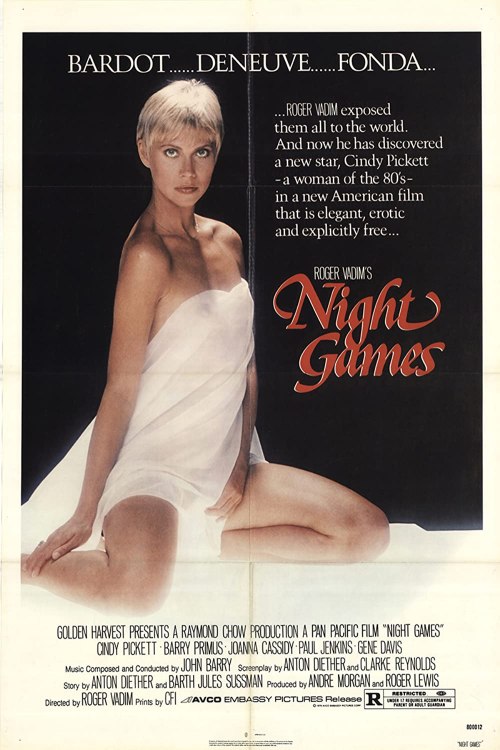
It’s not often that I can say this, but I personally know the man, Anton Diether, that’s credited with writing the screenplay (and story idea) for this film. He’s a member of the Austin Screenwriter’s group that I also attend. He’s harshly critical of everyone else’s screenplays, so I was intrigued to see something that he had written in order to ascertain if his stuff was any better. To give him credit I’ve asked him about this film many months back before I had seen it. He stated that director Roger Vadim had ‘ruined it’ and that he had a big fight with him on opening night when he realized how much Vadim had changed the original story. For his sake I hope he’s telling the truth because this thing is nothing I’d ever want my name to be attached to.

This was also intended at being a star making vehicle for Cindy Pickett, who’s excellent and seen quite a bit in the nude. Vadim was famous for directing films that turned his lady stars into international sex symbols like Bridgitte Bardot, Catherine Deneuve, and Jane Fonda as well as dating them and even marrying two of them. While Pickett did date Vadim as the film was being shot they quickly broke-up once it was over and it failed to make her a superstar like the other three, but much of that can be blamed on the lame script more than anything.

The story centers on Valerie (Cindy Pickett) who’s married to Hollywood producer Jason (Barry Primus). While their marriage may seem perfect to an outsider it’s filled with turmoil behind-closed-doors mainly because Valerie cannot have intimate relations with her husband due to still suffering from bad flashbacks of a rape that happened to her several years before. She is supposed to see a therapist to help her get through the traumatic experience, but she feels it’s not helping her enough, so she quits going. With their sex life stagnant Jason moves-out and goes on an extended ‘vacation’. Home alone Valerie begins hearing strange noises at night and convinced that an intruder has broken-in. She searches around, but doesn’t see anyone, but then the next night the intruder comes back wearing a mask and suit that makes him resemble a giant bird. Valerie finds herself put at ease with his presence and able to enjoy sex again without being tormented by her ugly memories.

The one thing that I did like was showing how difficult it is for the victim to get over a sexual assault. Sometimes people may never full recover from these types of events and this is one of the first films to tackle the post traumatic stress of it, so in that realm it should be applauded, but it never gives any details about the assailant, or whether he was ever caught, which I found frustrating.

The film though fails when it shows Valerie change into this promiscuous vamp who during the first half was hyper-paranoid about any man getting near here and yet when one appears in tacky costume late at night she’s cool with it and lets down her defenses completely. Most women who hadn’t been raped would be panicked at seeing a strange man wearing a wild getup in their home, so why isn’t Valerie and why the sudden flip in her personality, which are never answered (at least not sufficiently).

She also allows a man, played by Gene Davis, that she only knows very casually, to come-over to her place where she is all alone, so that she can paint a portrait of him in the nude. You’d think that if she has such anxiety around men that she wouldn’t do this. Anyone else would be concerned, at least a little, about the man taking advantage of the situation, but Valerie doesn’t until it’s too late, which again given her past doesn’t make any sense.

Spoiler Alert!

The twist ending, where it’s found that the guy in the bird suit is really Sean (Paul Jenkins) a friend and collaborator to Valerie’s husband, is by far the stupidest thing about it. For one thing Sean is shown downing large amounts of alcohol constantly making it seem like he’d barely be able to stand-up let alone make love, or beat-up another man who is much younger and better built. It’s also quite clear that even with his clothes on Sean is middle-aged with a potbelly, but when he’s playing the bird man his stomach is flat and muscular. This is because these scenes were done by a stand-in named Mark Hanks, but the viewer is supposed to believe that it’s really Sean, so why is the body type so different?

For these reasons and for the incredibly corny wrap-up, which should win the award for corniest ending ever, is why this movie was a definite career killer for Vadim whose talent was already considered overrated even before this one came-out.

My Rating: 0 out of 10

Released: April 11, 1980

Runtime: 1 Hour 40 Minutes

Rated R

Director: Roger Vadim

Studio: AVCO Embassy Pictures

Available: DVD-R (j4hi.com)

Dead Mountaineer’s Hotel (1979)

dead1

By Richard Winters

My Rating: 8 out of 10

4-Word Review: Bizarre occurrences at lodge.

Inspector Glebsky (Uldis Pucitis) is summoned to a remote winter lodge known as the Dead Mountaineers due to a climber who fell to his death off a nearby cliff and whose faithful St. Bernard sleeps underneath a portrait of him in the hotel’s lobby. Glebsky was informed from the anonymous call of some unusual activity that was occurring at the place, but once he gets there no one, including the innkeeper Alex (Juri Jarvet), know what he’s talking about. After he meets the strange collection of guests he becomes even more suspicious. Then he’s handed a note stating that Hinkus (Mikk Mikiver), a man supposedly weakened by tuberculosis, is planning to commit murder. When one of the guests, Olaf (Tiit Harm), does turn-up dead, but Hinkus is later found tied-up in his bed, so he couldn’t have done it. A avalanche blocks off all outside roads trapping Glebsky and the guests in the building where more and more weird things begin to occur until the inspector can no longer trust his senses, or even his logic.

Some people ask; what makes a great movie? And the answer is that a good movie needs a unique and distinctive image that impresses the viewer right from the start and which they can take away with them once it’s over. This film has just that image with a bird’s eye view of the hotel that’s so remote, as it’s nestled in the snowy, mountain landscape, and so small when glimpsed from high up, that at first I thought it was a prop, but it’s a real building, which makes it all the more impressive. I don’t know if I’ve ever seen such an isolated place, it doesn’t even seem to have roads leading into it. This shot alone, of which it goes back to it a few times, brilliantly sets the tone for the rest of the movie where everything is totally unique and like nothing you’ve ever seen before.

The fact that this was all shot in what was then the Soviet Union, in this case what is now Kazakhstan, makes it even more jaw-dropping as productions there didn’t receive the same type of budget as a studio driven Hollywood one and yet the visual design is impeccable. The inside of the place has a pronounced, surreal look with excellent shadowy lighting and the special effects, while sparse, come into strong play during the climactic surprise ending that like with the beginning leaves an equally lasting impression. The music by Sven Grunberg has a distinct futuristic tone that helps accentuate the outer worldly quality while the sun glistening off the bright white snow during the outdoor scenes makes it seem almost like another planet.

The story was written by Arkady and Boris Strugatsky and based on their book of the same name. They’re better known for their novel ‘Roadside Picnic’, which was turned into the acclaimed Stalker directed by Andrei Tarkovsky. Both brothers also wrote the screenplay and it pretty much stays faithful to the book though there’s a few missing characters and Glebsky’s motivation for going to the lodge is different. Here it was due a mysterious phone call while in the book it was for vacation. The plot at first gets played-up like it’s just another police/murder investigation complete with interviews with potential suspects and even Agatha Christie-like flashbacks showing what each guest was doing when the murder occurred, which had me getting bored as the movie starts out as something really different, so to have it devolve into the conventional murder mystery was disappointing, but by the second act this all changes and that’s when it gets really interesting.

The acting is solid and I enjoyed Pucitis in the lead, who despite having his voice dubbed, has the perfect chiseled features of a hardened police detective. My only complaint, and it’s a minor one and probably the only one in this potential cult classic that desperately needs more attention and a Blu-ray/dvd release, comes at the beginning during Glebsky’s voice-over narration where he speaks in the present about his time at the hotel and how during a ‘slow shift’ the events that he witnessed there comes back to haunt him. I found it hard to believe that he’d only think about this when there was nothing else to do, or in this case a ‘slow shift’, as I’d think it would be on his mind all the time to the extent that he may never be able to go back to police work again as the events would’ve been too traumatizing.

My Rating: 8 out of 10

Released: August 27, 1979

Runtime: 1 Hour 20 Minutes

Not Rated

Director: Grigori Kromanov

Studio: Tallinnfilm

Available: dvdlady

Cancel My Reservation (1972)

cancel

By Richard Winters

My Rating: 2 out of 10

4-Word Review: Celebrity accused of murder.

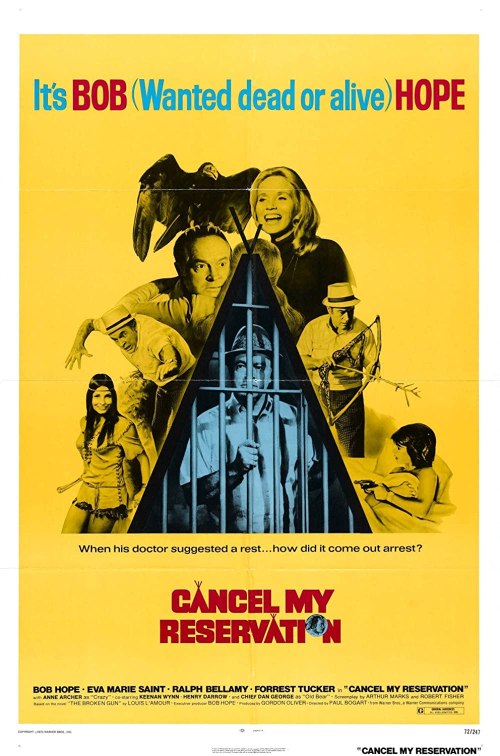
Dan (Bob Hope) is the exhausted TV-personality of a New York talk show that he co-hosts with his wife Sheila (Eva Marie Saint). The two have spent a lot of time bickering and on his Dr.’s advice decides he needs to retreat to a rural area to catch-up on some rest and relaxation. He travels to Arizona where he briefly meets Mary Little Cloud (Betty Ann Carr) at the Phoenix airport. Later on when he arrives at the ranch he discovers Mary’s dead body in his bedroom. When he goes back to the living room to notify the police and then returns to the bedroom her body is gone. Later the police find her corpse in the back of his car and immediately arrest him on the suspicion of murder. Now out on bond he and Sheila must follow the clues in order to solve the case themselves to prevent him from spending the rest of his life in the slammer.

This marked Hope’s last starring vehicle and may be close to being the worst film he did. Reports were that at the premiere he kept complaining to his wife that he looked too old on the screen and felt he was no longer leading man material. A lot of the fault for this goes to Hope himself had he played a character his same age, like a grandpa who enjoys spending his retirement being an amateur sleuth, then it might’ve worked, but instead he tries to play-it like he’s a middle-aged guy, which is just absurd. This comes to a ridiculous head right at the start when he’s brought into the police station and the sheriff, played by Keenan Wynn, asks him his age and Hope, who looks every bit of the 68 years of age that he was, replies that he’s ’42’. I had to actually rewind the film just to make sure I heard it right and the cops don’t look at him with an incredulous look like anyone else would’ve, which makes this the funniest moment in the film even though it’s unintentional.

Pairing with Saint was another mistake. Originally he was supposed to re-team with Lucille Ball, but at the last minute changed course and decided to go with Saint. Presumably this was again for his own vanity as he thought playing a character with a hot, youthful-looking blonde would make him come-off appearing younger even though it does the exact opposite and just makes him seem even older, like an aging daddy going out with his daughter. The two share no chemistry and Saint lacks the comic ability that Ball could’ve brought. The two don’t even fight. They do a little bit at the start while they’re still in New York, but once they reach Arizona they get along even though having them bicker would’ve at least allowed some comic banter, which is otherwise lacking.

The story, which is based on a Louis L’Amour novel ‘The Broken Gun’, is uninspired and gives away the identity of the killer half-way through. What’s the use of sitting through a mystery if you know well before it’s over who the bad guy is? Paul Bogart’s direction has no visual style with bland sets that would be better suited for a TV-sitcom than the big screen.

Hope’s voice-over narration are the only amusing bits. There’s also a dream segment where Hope imagines himself being hung in front of a large group of onlookers, which amongst the crowd is Johnny Carson, Bing Crosby, and John Wayne, who say brief quips as they watch the noose being fitted around his neck, which is the film’s only diverting sequence. I came away thinking it would’ve been more interesting had Carson, Crosby, and Wayne starred in the film alongside Hope playing a group of actors set to do a film, but then turn detectives when one of the cast gets murdered. It might not have been perfect, but certainly couldn’t have been any worse than this.

My Rating: 2 out of 10

Released: September 21, 1972

Runtime: 1 Hour 39 Minutes

Rated G

Director: Paul Bogart

Studio: Warner Brothers

Available: VHS

The Man Who Haunted Himself (1970)

man3

By Richard Winters

My Rating: 3 out of 10

4-Word Review: His doppelganger takes over.

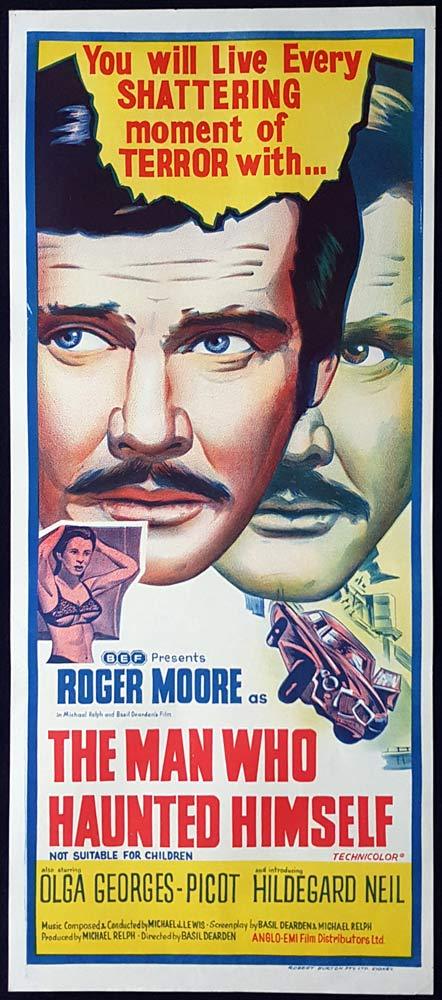
Pelham (Roger Moore) is a conservative, staid businessman who is married with two kids and for all practical purposes leads a predictable life. One day he goes out driving and begins to pretend he’s a race driver in a sports car. He removes his seat belt and accelerates the vehicle before getting into an awful crash. The doctors at the hospital are able to save him, but as he returns to his normal way of doing things he keeps hearing about another man who looks just like him appearing all over town. The man associates with many of his same friends and eventually moves into his home and has relations with his wife while he’s not there. Pelham tries putting at stop to it only to find that his friends and family prefer the new Pelham over the old one.

While the concept has intriguing elements the way it gets handled is a letdown. Supposedly his doppelganger represents his more reckless side that he keeps oppressed, but then having him immediately give into his wild impulses through his driving doesn’t seem like dual personalities, but more like it’s all-in-one. His recovery, especially after such a life threatening accident, happens too quickly and the idea that he can just go back to normal and continue to drive the same car that he totaled (he buys a new one, but the same model) seemed dubious as I’d think in reality his license would’ve been suspended for causing a crash that put both him and others at extreme risk.

The movie makes clear through flashback that there really is a double versus keeping this aspect a mystery and allowing in the idea that it might be a person disguising himself as Pelham. There’s very little difference between the two, so having them both walking around adds nothing. If the twin is supposed to represent his wild side then this needs to be shown through his attire, hairstyle, and speech pattern. The only real difference is that one drives a flashy sports car, but that’s it. You’d also think that those around him, especially his family, would sense something was off instead of having the real one become the odd man.

Moore has stated in interviews that his was his favorite role, but I don’t know why because outside of having a perpetual confused look on his face his character has little else to do. The production values, for what it’s worth, are excellent, but the story is too thin for feature length. The second act gets especially boring as Pelham is constantly hearing from others about his double over and over again until it becomes redundant. It takes too long for the protagonist to become aware of something that the viewer catches onto early on. The ending is vague and offers no suitable conclusion or answers. Normally I’d say this is the type of story, which was based on the novel ‘The Case of Mr. Pelham’ by Anthony Armstrong, that would’ve been better as an episode for an anthology series, but in this instance that’s actually what occurred as 15 years earlier it was a first season episode of ‘Alfred Hitchcock Presents’. with Tom Ewell playing the part of Pelham and the compact 25-minute runtime did a far superior job with the concept than the 94-minutes does here.

My Rating: 3 out of 10

Released: July 18, 1970

Runtime: 1 Hour 34 Minutes

Rated GP

Director: Basil Dearden

Studio: EMI Films

Available: DVD

Freeway (1988)

freeway1

By Richard Winters

My Rating: 5 out of 10

4-Word Review: Killer in a car.

Sunny (Darlanne Fluegel) is an emergency room nurse still grieving over the senseless death of her fiancee at the hands of a highway killer (Billy Drago) who drove-up beside them one late night and shot him through their car window. Sunny is constantly hassling the police for updates on the case, but the police sergeant Lt. Boyle (Michael Callan) is aloof and put-off. Frank (James Russo) is an ex-cop who left the force when a drug gang he was investigating annihilated his whole family. He senses Sunny’s despair and the two team-up to find the killer along with radio talk show host David Lazuras (Richard Belzer) whose show gets calls from an unhinged man, who quotes Bible verses and claims to be the one they’re looking for.

The story has some intriguing elements and I liked how initially we don’t know the identity of the assailant, but the concept, which is based on the novel of the same name by Deanne Barkley, is poorly thought-out. This freeway shooter makes headlines for having killed many people, so Sunny wouldn’t be the only one getting on the police about finding the culprit as the entire city, which would be gripped with panic, would also be and if the city’s force wasn’t doing enough then federal agents would be brought-in.

The car that the killer drives, which is an older model with a broken front grill, is similar to the haunted vehicle used in the cult-classic The Carbut because it has a distinct appearance the guy wouldn’t be able to get away with his crimes for too long as surely other people on the very busy L.A. freeways would’ve spotted him and had his license plate, or general whereabouts, called-in. Some drivers would likely have tailed him and even cornered his car with theirs until the police got there. The car also smashes into several other vehicles, and since it was an old clunker, it would need body work, and thus pique the suspicions of the auto repairman who would likely alert authorities. In either event having the killer get away with as much as he does and with only one person emotionally vested into finding him doesn’t gel.

While the leads are bland the supporting cast is interesting. Callan, who was a semi-star during the 60’s before his career cratered, does well as the non-nonchalant police chief and still looking good despite some weight gain around the face. Clint Howard has a fun bit as a porn obsessed mechanic, who agrees to let Sunny drive his prized sports car while he gets her’s fixed. While allowing some random chick to take his car, which no auto mechanic in the history of the world would do, or feel obligated to do, I was willing to accept it using the rationale that he was hoping it might help him score with her later, but the fact that she keeps this ‘loaner’ for days, even weeks, without returning it gets ridiculous.

Country music legend Roy Clark is listed in the part of a CHP officer, but I didn’t spot him. I had a feeling it was played by someone with the same name, I know when I lived in Indy there were 7 other men in the phone book with my name, and since Roy and Clark are both quite common, it seems reasonable that it was somebody else, so listing it in Roy’s filmography on IMDb is a mistake.

The tension isn’t strong and weakens quite a bit by the third act, which is when it should’ve been the strongest. Director Francis Delia, who before this worked on music videos, tries hard to give the proceeding a stylistic touch, which might’ve fared better had the story and characters been thoroughly fleshed-out.

My Rating: 5 out of 10

Released: September 2, 1988

Runtime: 1 Hour 31 Minutes

Rated R

Director: Francis Delia

Studio: New World Pictures

Available: DVD, Blu-ray