Category Archives: Mystery

The Intruder (1977)

Capture 52

By Richard Winters

My Rating: 4 out of 10

4-Word Review: Terror on the road.

Based on a story by Dean R. Koontz and filmed in France under the title Les Passagers the plot centers on Alex (Jean-Louis Trintignant) who picks up his 11-year-old stepson Marc (Richard Constantini) from school and sets off to drive him across France and into Italy where they are to meet his mother Nicole (Mireille Darc). Along the way they become menaced by a strange man (Bernard Fresson) driving a black van that begins following them. At first Alex thinks nothing of it, but when the van tries driving them off the road they go to the police who prove to be unhelpful, which forces Alex to take things into his own hands in order to save both himself and the boy.

The film starts off well with definite hints to Steven Spielberg’s classic Duel. I enjoyed how initially everything is from Alex’s and Marc’s point-of-view where we do not know the identity of the driver in the black van, which is only seen through the perspective of their rear window that gives the vehicle a creepy presence. The banter between the boy and step father is engaging and the fact that the kid is smart and shows a keen awareness of things and not just there to be cute is great. I also liked the bawdy tune they sing together and the shot of the boy driving the car while the father leans out the passenger side window.

There is an exciting moment where the van tries pushing their car off the highway while they’re on a winding mountaintop road that is well photographed and realistic. The two are subsequently forced to ride the rest of the way in a tattered vehicle that has no windshield and looks almost as beat-up as the automobile in Planes, Trains and Automobiles.

I did not like however that fifteen minutes into the movie we are shown the face of the other driver, which takes away from the intriguing mystery angle that is what made Duel so interesting. The bad guy isn’t frightening and comes off as clumsy and careless, which makes him less threatening. The fact that he does not carry any type of weapon and must resort to grabbing a nearby fire ax in order to attack Trintignant’s character when the two confront each other didn’t make much sense.

Spoiler Alert!

The film’s biggest transgression though is that its twist ending isn’t surprising at all as the mystery man turns out to be the wife’s psycho ex-boyfriend, which is something I had guessed early on and most other viewers probably will too. It also leaves open a tremendous amount of loopholes like why Alex wouldn’t have been made aware of this boyfriend earlier as I’m sure he would’ve been stalking them long before she got remarried and why the boy wouldn’t have guessed that the stranger chasing them was this man as well as most likely he would’ve known about him too. The police investigation, which gets worked in as a sort of side story proves pointless to the plot and the fact that they end up being quite incompetent makes them seem similar to the ‘comic relief’ cops from Last House on the Left, which hurts the tension.

End of Spoiler Alert!

This film has managed to acquire a small cult following and it has good set-up, but it would’ve worked better had it been done solely from the point-of-view of the father and stepson and only revealed the face and identity of the bad guy at the very end.

My Rating: 4 out of 10

Alternate Title: Les Passagers

Released: March 9, 1977

Runtime: 1Hour 36Minutes

Not Rated

Director: Serge Leroy

Studio: Warner Brothers

Available: None at this time.

Brother John (1971)

brother john 1

By Richard Winters

My Rating: 7 out of 10

4-Word Review: Is an apocalypse coming?

Upon the death of his sister, John Kane (Sidney Poitier) returns to his hometown in Alabama to attend her funeral, but the town’s mayor (Bradford Dillman) and sheriff (Ramon Bieri) think he is an outside union agitator there to stir up trouble with the local factory. Doc Thomas (Will Geer) is an old man who’s been in the town his whole life and knows better. He recognizes that John has a special gift of some kind and can see into the future, but what John proclaims is not good as he states that an end of the world is coming and the human race will have to justify their existence to the almighty.

This film, which was written by Ernest Kinoy and directed by James Goldstone, is unique in that it never reveals too much and keeps the viewer in a shroud of mystery the whole time. We’re given certain hints that John may hold a special power, but never any explanation, which in some films could prove frustrating, but here it makes it intriguing and unusual. Everything is given the low-key treatment including a memorable scene where a racist police officer (Warren J. Kemmerling) invades an African American home bent on teaching John ‘a lesson’ by taking him into the basement only to get a surprise whooping of his own when John proves to be far superior.

Poitier is billed as the star, but he seems constrained in a part that allows for very little emotion. Geer is the one that gives the film its biggest impact particularly with the conversation that he has with Poitier while sitting in a jail cell at the end. I also got a kick out of the fact that he was able in a passing conversation to mention Frankfort, Indiana which was the town that he had been born and raised in, in real-life. Bieri is also quite good as the town’s corrupt sheriff who’s racist on one end, but then when things get out-of-control he then ‘negotiates’ with the town’s black pastor (P. Jay Sidney) to see if they can work together to quell the unrest.

Although the setting is supposedly Alabama it was actually filmed in the town of Marysville, California and for the most part it’s successfully able to camouflage it, but not quite. The ending like the rest of the film is vague and answers little of the questions that the plot puts forth, which may be a turn-off to some, but I enjoyed it. In an era where so many other films were intent on making statements and broad characterizations this one pulled back and much like with religion and faith kept things at an elusive level, which gives it a more sophisticated flair.

My Rating: 7 out of 10

Released: March 24, 1971

Runtime: 1Hour 35Minutes

Rated GP

Director: James Goldstone

Studio: Columbia Pictures

Available: VHS, DVD, Amazon Instant Video, YouTube

The Boys from Brazil (1978)

exorcist

By Richard Winters

My Rating: 4 out of 10

4-Word Review: Mad doctor clones Hitler.

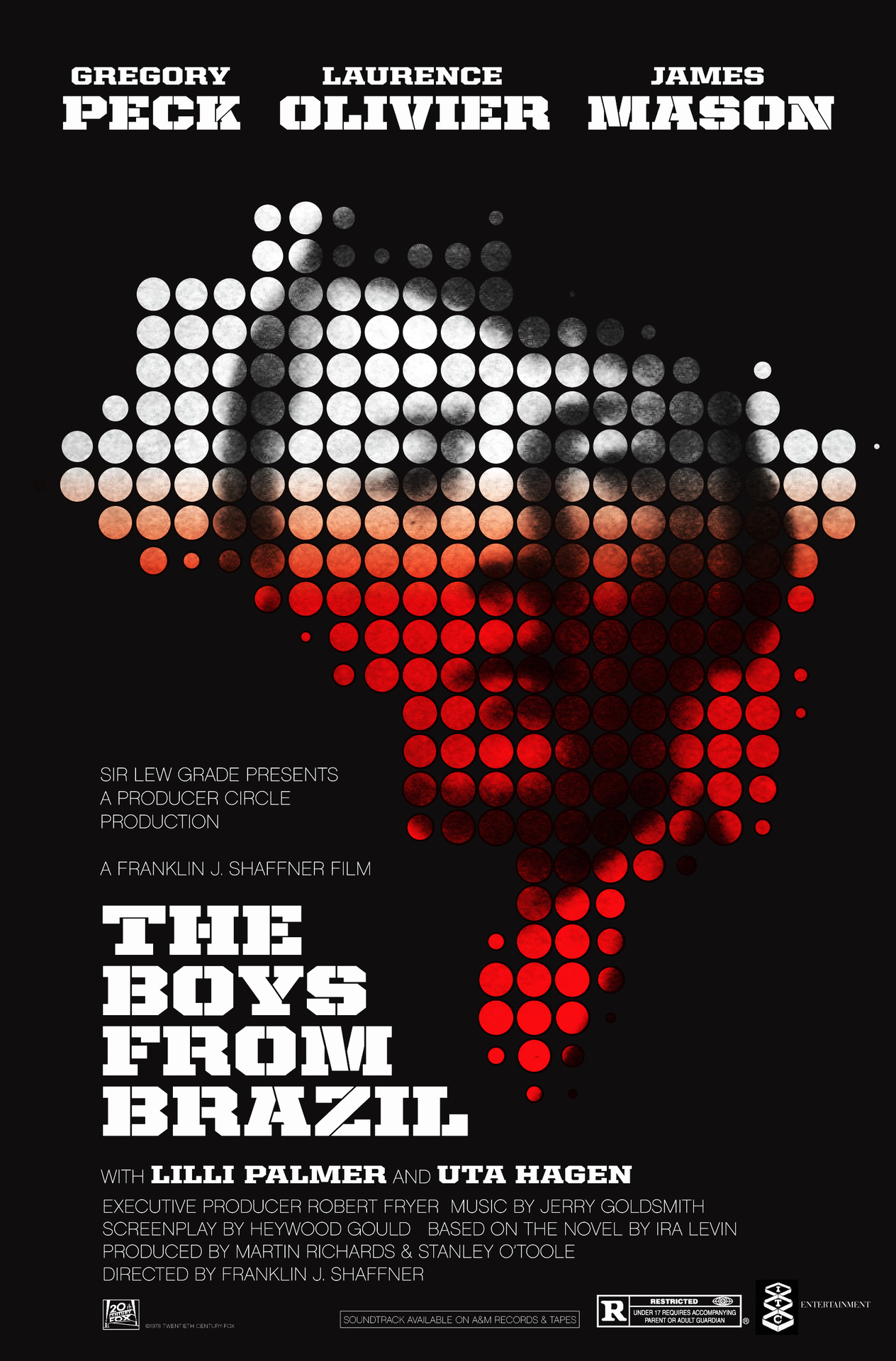
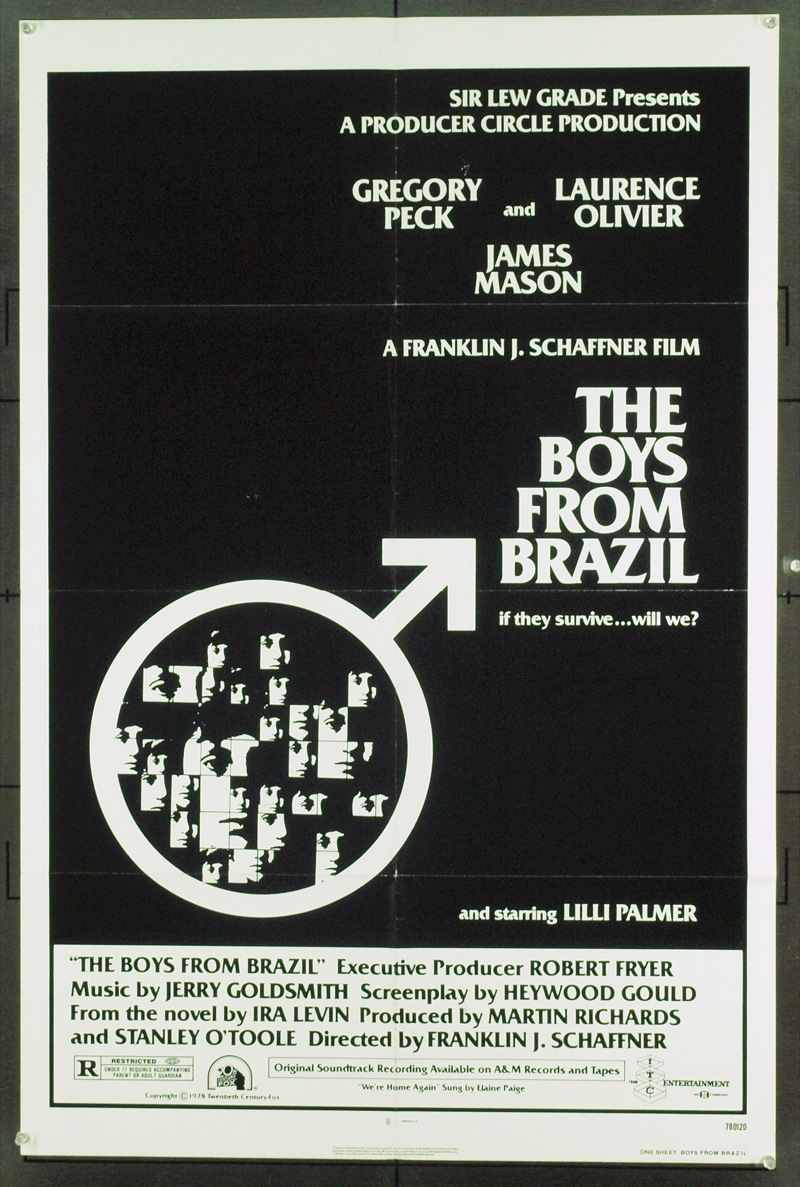
Based on the best-selling novel by Ira Levin the story details an elaborate plan devised by the elusive Josef Mengele (Gregory Peck) who has been hiding out in the jungles of Paraguay and has a secret meeting with several Third Reich war criminals that is overheard by novice Nazi Hunter Barry Kohler (Steven Guttenberg) and relayed to Ezra Lieberman (Laurence Olivier). The plan calls for these war criminals to go out and murder 94 65-year-old men who are living in various parts of the world as Mengele has saved a sample of Hitler’s DNA and impregnated 94 women with it at a Brazilian clinic. These Hitler clones have now grown to adolescence and need to be put in the exact same environment as the real Hitler had been in order to bring out the same personality traits, so it’s important that their fathers die at the same time as Hitler’s real father had. At first Lieberman cannot believe such an outrageous plot, but as the evidence mounts he realizes it is true and he may be unable to stop it.

The film has two great scenes which includes an eye popping death from a steep mountain bridge and a graphic moment where we see in close-up Mengele place the ovum with Hitler’s DNA into the women. Outside of these two moments the film is rather flat and cheesy with certain segments bordering on camp. The plot is intricate enough to keep you involved, but highly implausible and the characters take a long time to realize things that the viewer has already figured out long before.

It is fun seeing Peck playing a bad guy and this was his first villainous role since Duel in the Sun and although he does well in the part the character is so one dimensionally evil that it ultimately makes him boring. Olivier is not effective in the lead and comes off as frail and sickly with certain comical overtones given to the character that don’t work. The final confrontation between he and Peck in which the two roll around on the floor while grappling for a gun looks more pathetic than exciting and apparently the scene had to be reshoot several times because both actors kept breaking out into laughter over the absurdity of it. I did feel though that Guttenberg was perfectly cast as a wide-eyed schmuck that was in way over-his-head.

Spoiler Alert!

My biggest problem with the film though is the ending that turns out to be a big letdown. For one thing it takes place at a remote farmhouse, which seems too similar to a scene in Marathon Man, which came out just two years earlier, had a similar theme and also starred Olivier. It features nine Doberman pinchers with four of them that surround the farm’s owner (played by actor John Dehner) at all times. He uses them for protection as he is convinced someone is out to get him, which could’ve created quite an interesting scenario when Mengele travels to the home to kill him. However, the owner puts the dogs into another room the second Mengele tells him that they make him uncomfortable, which then allows Mengele to shoot the man without any problems, but why have the dogs for protection if you’re just going to put them away the minute some stranger doesn’t like them and if the character is so paranoid why even allow a stranger into your home without at least demanding some form of identification first?

End of Spoiler Alert!

The conclusion is unsatisfying as it leaves open a ton of unanswered questions. Not only is the plot full of loopholes, but it seems like only a springboard to a much more fascinating story, which is trying to hunt down all these Hitler clones that the film fails to realize.

the boys from brazil 1

My Rating: 4 out of 10

Released: October 5, 1978

Runtime: 2Hours 3Minutes

Rated R

Director: Franklin J. Schaffner

Studio: 20th Century Fox

Available: VHS, DVD, Blu-ray, Amazon Instant Video, Netflix Streaming

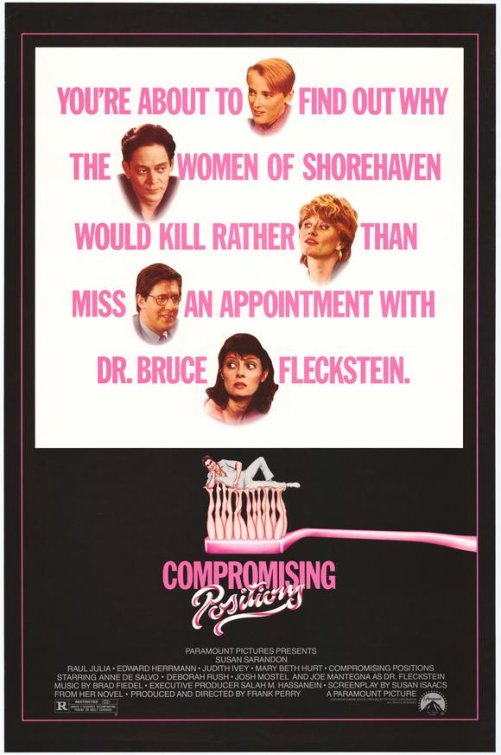
Compromising Positions (1985)

compromising positions

By Richard Winters

My Rating: 5 out of 10

4-Word Review: Who murdered the dentist?

Bruce Fleckstein (Joe Mantegna) is a successful dentist who puts new meaning to the term ‘bedside manner’ as he flirts with all of his female patients and has affairs with many of them. When he turns up murdered it becomes a question of which of the many suspects did it, which intrigues housewife Judith (Susan Sarandon) and propels her to start her own independent investigation much to the consternation of her husband Bob (Edward Herrmann) who thinks it’s too dangerous. As the clues accumulate so do the advances of police detective David (Raul Julia) that she is working with, which quickly puts her marriage into jeopardy.

The film was produced and directed by Frank Perry who made many influential films during the 60’s and 70’s with his screenwriter wife Eleanor, but after their divorce the quality of his films diminished considerably. The last two that he made were in collaboration with Susan Isaacs with this one based on her novel of the same name. To an extent it works as the mystery angle is realistic enough to be interesting and the dark humor keeps it mildly entertaining.

Sarandon’s presence helps a lot and without her it wouldn’t have worked. Julia plays against type and it’s fun seeing him in more of a subdued type of role. The real scene stealer though is Judith Ivey who has some funny sarcastic lines and should’ve been seen more.

I also really liked how Sarandon’s character remains faithful to her husband despite her conflicts with him and the many advances that she gets from the police detective. Too many Hollywood pictures give the impression that marriage should be one long blissful union and the minute one partner isn’t completely receptive to the needs of the other then that entitles the other to cheat on them. Herrmann’s character is a borderline jerk, but he has legitimate reasons for why he feels the way he does and the movie refreshingly even gives him a moment to vent and explain them. I also thought that Julia’s character comes onto Sarandon much too quickly and the way he barrages into her bedroom while making aggressive advances seemed almost creepy.

The story does have a dated quality. Fleckstein is found to be distributing and printing porn, the kind with consenting adults and not kids, which the film portrays as being a ‘shocking revelation’ even though these days with the proliferation of it all over the net it is nothing but an afterthought to most. I also thought the idea that this guy would have BDSM sex with a lot of married women and even take explicit pictures of them, but still turn around and throw them some lines that he ‘loved’ them and they would all fall for it was ridiculous and unfairly portrayed women as being too easily manipulated and unsophisticated.

The resolution is limp and the film lacks anything that would help make it distinctive or memorable. The humor gets lost by the second half and the Ivey character should’ve been given more screen time and possibly even used as Sarandon’s investigative partner as her caustic take on things are the best thing about it.

My Rating: 5 out of 10

Released: August 30, 1985

Runtime: 1Hour 39Minutes

Rated R

Director: Frank Perry

Studio: Paramount

Available: VHS

The Driver’s Seat (1974)

drivers seat 1

By Richard Winters

My Rating: 3 out of 10

4-Word Review: Crazy lady goes traveling.

Lise (Elizabeth Taylor) is a middle-aged woman with seemingly no past who travels to Rome looking for someone to kill her. Her erratic behavior and weird motivations confuse those that she comes into contact with. She then meets Bill (Ian Bannen) a man who’s more interested in her sexually than anything else and he follows her around in a veiled attempt to get ‘lucky’ despite her repeated rebuffs.

The film is basically a mess that goes nowhere. It was based on a novel by Muriel Spark, who had written some acclaimed stuff in her day including ‘The Prime of Miss Jean Brodie’, so I can only imagine that the book made more sense and only bits and pieces of it were taken to create this screenplay. In either case it was a highly strange career move for Miss Taylor who made a lot of weird movie choices in the 70’s, which helped to destroy her once megastar status and tainted her other stellar work.

Her performance by itself isn’t too bad and it’s the one thing that helps keep things watchable. The way that she can go from being passive and helpless to snippy and bitchy within seconds is kind of fun and on a purely camp level even enjoyable. The whole thing seems almost like an extension of the character that she played in Who’s Afraid of Virginia Woolf? , which became her signature role during her later years.

Bannen lends good support as his leering Cheshire cat grin is a perfect counterpart to Taylor’s crazed glare and he effectively equals her nuttiness. I also loved his so-called macrobiotic diet in which he must attain one orgasm a day for it to work and if he misses one then he must make up for it by having two the next day, which ultimately gives him ‘indigestion’. Mona Washbourne a character actress noted for playing delightfully daffy old ladies is also on hand as one of the people Taylor befriends and their encounter inside the stall of a public bathroom is a gem.

Director Giuseppe Patroni Griffi manages to infuse some interesting visuals, which along with its fragmented narrative helps keep things cheaply alluring, but it eventually plays itself out and by the end becomes quite tiring and tedious. The biggest issue is that there never is any explanation for who this woman is or why she’s doing this, which makes the whole thing quite empty and pointless.

My Rating: 3 out of 10

Released: May 20, 1974

Runtime: 1Hour 42Minutes

Rated R

Director: Giuseppe Patroni Griffi

Studio: AVCO Embassy Pictures

Available: DVD-R, Amazon Instant Video

The Laughing Policeman (1973)

the laughing policeman 1

By Richard Winters

My Rating: 7 out of 10

4-Word Review: This policeman isn’t laughing.

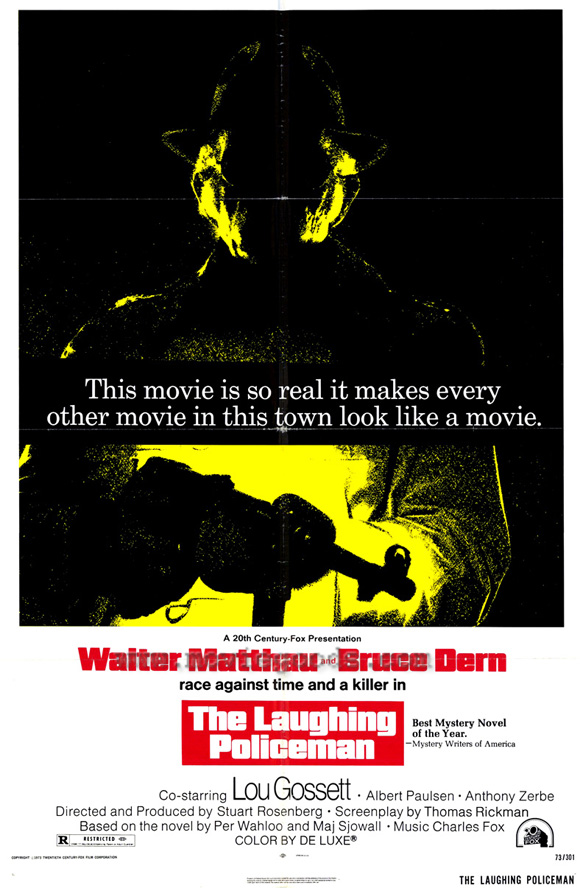
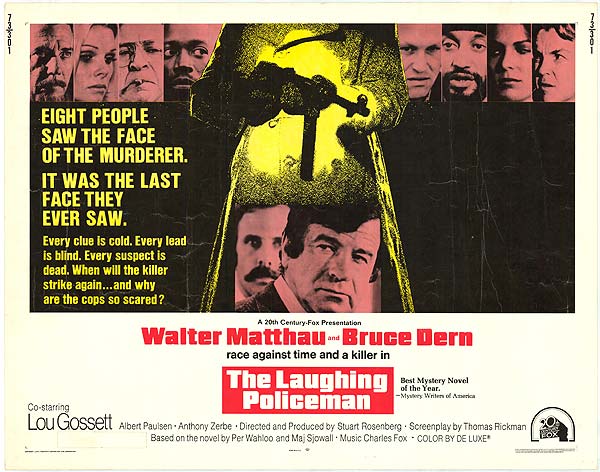
8 passengers on a San Francisco bus are slaughtered to death by a mysterious gunman for no apparent reason. When Police Sargent Jake Martin (Walter Matthau) investigates he finds that his patrol partner is one of the victims. He soon learns that his partner was working on another case during his off hours dealing with a murdered prostitute that Jake had also worked on, but couldn’t crack. He begins to believe the two cases are somehow connected, but his brash department head (Anthony Zebe) doesn’t agree and thinks it is a waste of time to pursue the possible connection while also sticking him with Leo (Bruce Dern) a younger cop who doesn’t always like to play within the rules and whose manner and methods conflicts with Jake’s.

The film, which is based on the novel by Per Wahloo and Maj Sjowall who also did the book version for Man on the Roof, has a finely detailed gritty nature about it that looks at the methods of a police investigation in a realistic and unglamorous fashion, which significantly helps this one stand out from the usual cop dramas. I loved the way they searched for clues on the bus and the autopsies of the victims as well as pursuing leads that never pan out, which is a very common occurrence in most police investigations, but rarely is ever shown in movies. There is even a shot of a tow truck removing the disabled bus from the accident scene once the investigation is completed.

Although the novel’s setting was Stockholm the movie transplants the action to San Francisco making the Bay City almost like a third character. Director Stuart Rosenberg manages to nicely capture the eclectic vibe of the area and the disdain many people had for the police during that era. The movie also uses very little music, which is a major asset and helps accentuate the realism. Outside of the closing credits the only time there is really any other music is near the end when Jake and Leo start following a suspect, which comes off as jarring and should’ve been left out.

Matthau who’s mostly known for his comedic parts does well in an atypical role, which due to his casting and the film’s strange title may make some think it is a comedy though this is far from it. Dern is terrific in a role that takes full advantage of his edgy acting style and I liked how the two characters don’t get along at first, but eventually get past their differences and use each other’s unique strengths to their advantage. I was disappointed though that there is a side-story dealing with Jake’s tumultuous relationship with his teenage son that gets introduced early on, but then dropped and completely forgotten during the second half.

Louis Gossett Jr. gets a star making turn as a brash street cop and Zerbe is superb in support as the gruff police chief. Joanna Cassidy has a brief, but interesting bit as a witness and I liked the shot showing her and Dern sitting amidst a row of tables with table legs made to look like human ones. It’s also amusing to note that Albert Paulsen’s character who becomes the main suspect in the film never utters a single word of dialogue.

Spoiler Alert!

The film’s biggest downfall though is with its ending. It is very hard to believe that a character such as Paulsen’s that is portrayed as being rich and having a lot of connections would feel the need to shoot and kill the bus passengers himself as most if not all rich people simply hire someone else to their dirty work. I also didn’t think that someone who walks down the street surrounded by lawyers would crack as quickly as this one does when Matthau comes to question him about the case. A typical well-off businessman would simply ‘lawyer-up’ and trust that the minimum evidence that the police have would not hold up in court instead of jumping into his car and racing down the city streets in a panic such as he does here. The finale becomes too conveniently Hollywood-like and seems to sell out on the film’s original concept, which left this viewer with a flat and ambivalent feeling towards it when it was over.

the laughing policeman 2

End of Spoiler Alert!

My Rating: 7 out of 10

Released: December 20, 1973

Runtime: 1Hour 52Minutes

Rated R

Director: Stuart Rosenberg

Studio: 20th Century Fox

Available: DVD

Cruising (1980)

cruising2

By Richard Winters

My Rating: 4 out of 10

4-Word Review: Cop infiltrates gay underground.

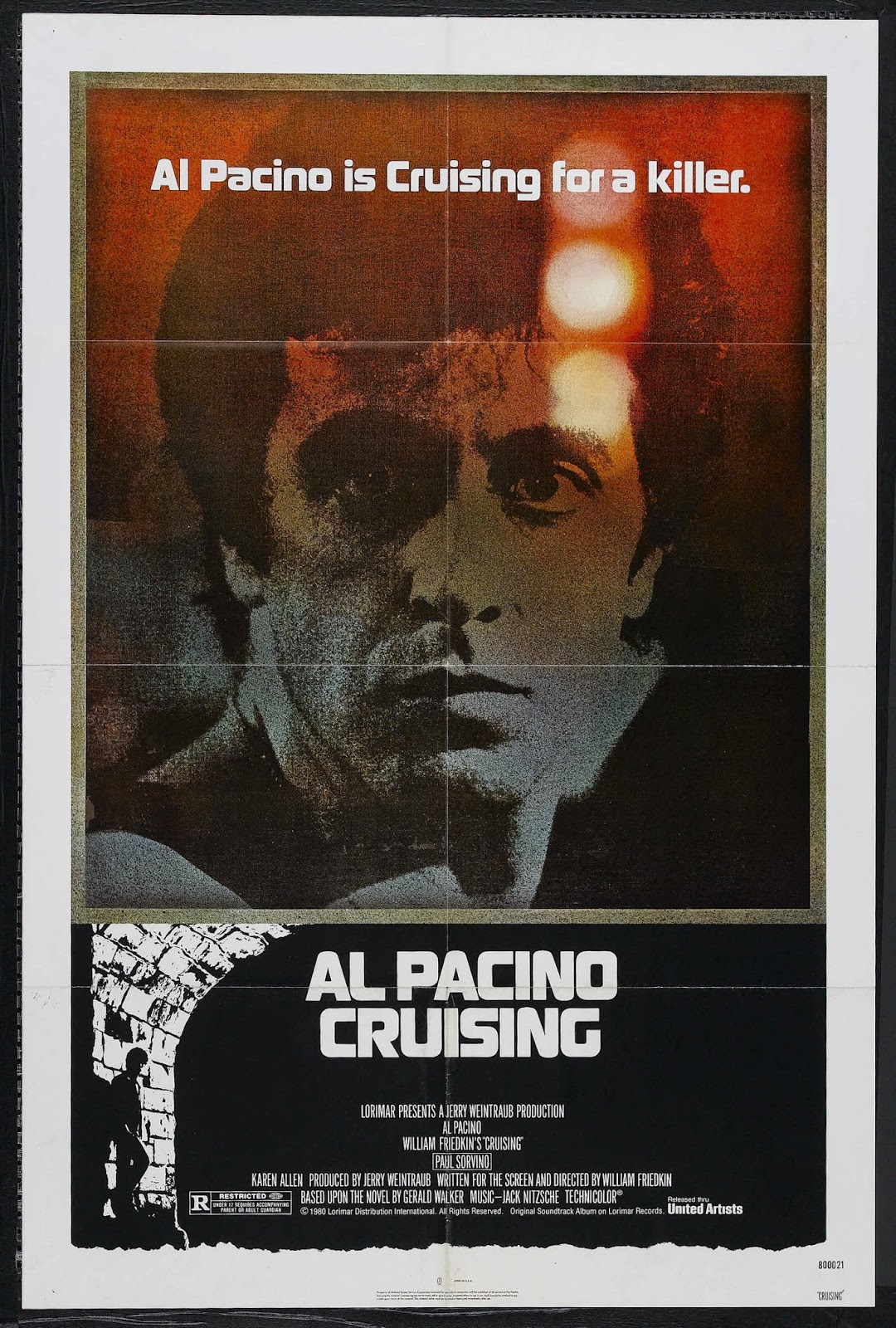
A serial killer is attacking gay men who frequent New York’s S&M bars and young cop Steve Burns (Al Pacino) is chosen to go undercover as a gay and infiltrate these ‘leather clubs’ in order to bring out the killer. However, the job requirements demand that he must be completely isolated from the rest of the force and not carry a gun, which eventually causes a strain on his personal life particularly in his relationship with his girlfriend Nancy (Karen Allen).

The film, which is loosely based on actual events that occurred during the late 70’s and captured in Gerald Walker’s novel of the same name, was considered quite controversial at the time of its production. Protestors who felt the film accentuated the gay stereotype tried to create loud noises during filming and even shine reflective lights on the actors in an attempt to mess up the scenes. In retrospect it is hard to imagine that director William Friedkin is in anyway homophobic as just ten years earlier he did the brilliant adaptation of The Boys in the Band, which remains to this day one of the better films dealing with gay issues. The story certainly does wallow in ugly elements, but also makes the point to describe this as an extreme subculture and  not reflective of the gay lifestyle as a whole, which in my opinion made the film seem more enlightening to New York’s gay underground of a bygone era and less propaganda as its critics ascertained.

To some degree I liked the explicit uncompromising approach, but after a while it became one-dimensional and predictable. The scenes of the killings are unnecessarily prolonged and some of the segments showing large groups of men having sex at a bar come off as overly-stylized and looking reminiscent of a homoerotic scene from a Fassbinder film.

Friedkin does manage to add a few unique touches including having a well-built black man wearing nothing but a jock strap enter the room during police interrogations and violently slap suspects who he felt weren’t telling the truth, which according to one of the film’s advisors was an actual technique used by police at the time.  The way the movie captures the monotony and frustrations of investigating a complex case such as this and leaving open that there may have been more than one killer is also well done and helps elevate this a bit from the usual formulaic cop thriller.

Pacino gives a gutsy performance including one scene showing him tied up in bed naked during some kinky S&M play, but the character’s motivations are confusing particularly the way he so quickly accepts this difficult assignment that most others would be very reluctant to do. The fact that his experiences ends up affecting him psychologically isn’t compelling since that becomes a foregone conclusion right from the start.

Paul Sorvino is perfect as the police captain. His gray hair dye was a little overdone, but his limp was great. Allen has a good moment at the end when she tries on Pacino’s leather hat and coat that he brought home with him and Joe Spinell makes the most of his small role as a corrupt cop who harasses gays only to end up patronizing gay bars on his off hours. You can also spot Powers Boothe in an early role as a hankie salesman and Ed O’Neil as a police detective.

The idea of exposing the dark side of police life is no longer original or interesting and the film’s shock value has lessened through the years and thus failing to leave any type of lasting impression or message.

My Rating: 4 out of 10

Released: February 15, 1980

Runtime: 1Hour 42Minutes

Rated R

Director: William Friedkin

Studio: United Artists

Available: VHS, DVD, Amazon Instant Video

Partners (1982)

partners

By Richard Winters

My Rating: 2 out of 10

4-Word Review: Pretending to be gay.

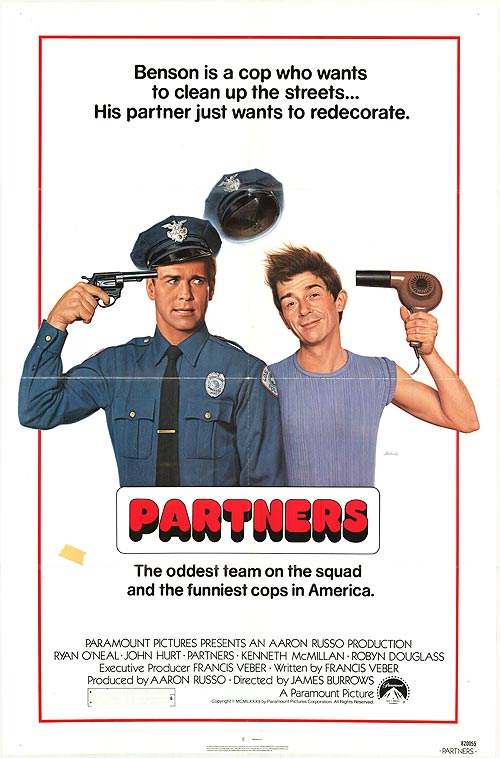
A serial killer targeting gay men is on the prowl. When one of his victims turns out to be the son of an influential politician pressure is put on the police force to find the culprit. The police chief (Kenneth McMillan) feels he has no choice but to pair Sgt. Benson (Ryan O’Neal) a straight cop with Kerwin (John Hurt) who is a gay desk clerk at the station. They are to masquerade as a gay couple in hopes of infiltrating the gay underground and find clues to the elusive killer, but their contrasting personalities and lifestyles threaten to blow their cover before they can make headway.

This film was controversial at the time of its release for its overuse of gay stereotypes and there are indeed some especially at the beginning, but the film’s biggest offense is that it is just plain boring. The idea that two cops could be forced to pretend to be a gay couple or have one of them pose naked for the cover of a gay men’s magazine as part of their investigation is dubious enough, but had it been funny I might have forgiven it. Unfortunately this thing can’t even elicit a few chuckles.

The idea that Kerwin would automatically fall in love with Benson while working together simply because he is another man is absurd and makes about as much sense as a heterosexual male falling for every woman that he meets, which of course doesn’t happen. The Benson character is also quite callous and disrespectful to Kerwin while showing blatant homophobic tendencies and being a confirmed ladies’ man, so I didn’t see what there was about him that Kerwin would have fallen in love with anyways.

Benson’s transformation to being more sensitive to gays and their issues during the course of the story might have been more compelling had it been better written. However, his liberal use of the word ‘faggot’ makes the film seem quite dated and wouldn’t be heard in a movie today especially from a character that is supposedly a protagonist.

Hurt plays the gay caricature well, but the idea of placing someone on such a dangerous mission without having any undercover experience of even knowing how to use a gun seemed stupid and unrealistic. Out of all the characters McMillan’s comes off best and he even manages to be slightly amusing, but unfortunately isn’t seen enough. Character actors Jay Robinson and Sydney Lassick can be spotted very briefly.

This was intended to be a parody of Cruising, which was released 2 years earlier and was a much more serious and graphic look at a true life killer of gay men. That film starred Al Pacino and will be reviewed next Monday.

My Rating: 2 out of 10

Released: April 30, 1982

Runtime: 1Hour 32Minutes

Rated R

Director: James Burrows

Studio: Paramount

Available: VHS, DVD

The Midnight Man (1974)

the midnight man 2

By Richard Winters

My Rating: 4 out of 10

4-Word Review: Security guard solves case.

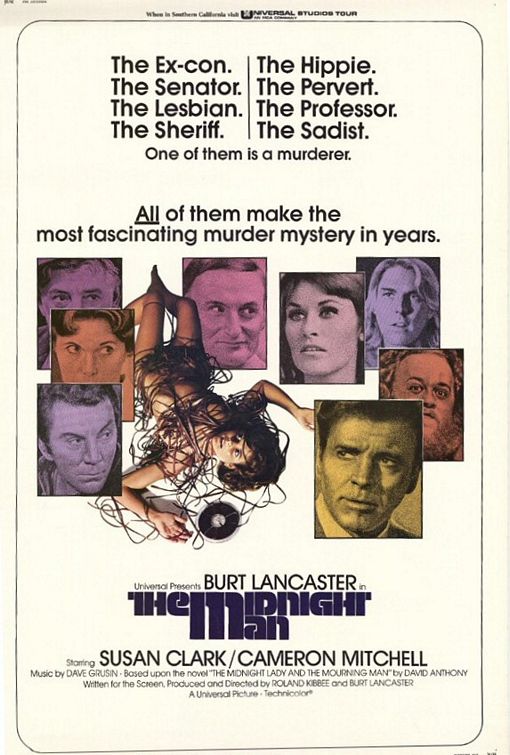
Jim Slade is a 60-year-old out on parole after serving time for killing his wife’s lover. He finds a ho-hum job as a security guard at a local university and soon gets swept up in a murder mystery when a coed (Catherine Bach) is found dead. The local cops nab the town pervert (Charles Tyner) and take him into custody, but Slade is convinced they have the wrong man and goes on a crusade to find the right one only to realize that there are far more suspects than he initially expected and no one no matter who they are is quite innocent.

Many critics at the time and some viewers complained that the mystery was too involved and a bit confusing however I was able to follow it and it manages to remain intriguing enough to be entertaining, but it’s still no better than an average episode of Columbo. The film also doesn’t have enough action although the part where Lancaster finds himself trapped in a rural barn and must use whatever implement he can find to fight off a trio of rednecks and their ferocious dog is nifty.

On the technical end the film is a bore and looks unsuitable for the big screen. Writer Roland Kibbee in his only directorial effort shows no flair for visual style filming scenes in places with dull and ordinary backdrops and fails to capitalize on its South Carolina location where it was shot. The soundtrack though by Dave Grusin is distinctive and the one thing that shows verve, energy and I wished it had been played more, particularly the part at the beginning.

Lancaster, who also co-produced and co-wrote the script, walks through his part in an almost comatose state and the fact that his character seems so very on-top of his game in this investigation leaves little doubt in the viewer’s mind that he will ultimately solve the case, which isn’t as interesting. For a character that is so savvy he does make one glaring error when he finds a dead body in his car and fearing that he will be fingered for it decides to put the body inside a nearby hotel room, which seems foolish. For one thing to check into the room he would have to have faced a hotel clerk who could’ve easily recognized him for the police later and he also doesn’t wear any gloves leaving his fingerprints all over the room when simply dumping the body in a wooded area would have made much more sense.

Out of the entire cast Cameron Mitchell shows the most energy and it certainly is fun to see Bach in her film debut and years before she became Daisy Duke playing a foul-mouthed, snippy college student. Although she has no nude scenes there is a painting of her naked likeness shown at one point, which may be good enough for some viewers.

My Rating: 4 out of 10

Released: June 14, 1974

Runtime: 1Hour 54Minutes

Rated R

Director: Roland Kibbee

Studio: Universal

Available: None at this time.

Wacko (1982)

wacko

By Richard Winters

My Rating: 3 out of 10

4-Word Review: Spoof of horror movies.

On Halloween night the infamous pumpkin head lawnmower killer murders Mary’s (Julia Duffy) older sister. Now, 13 years later, the killer has returned and this time he has his sights set on Mary, but who could he be? Is it her surgeon father (George Kennedy) who tries any chance he can to catch his own daughter disrobing, or maybe it’s her boyfriend Norman (Scott McGinnis) who makes lawnmower sounds every time he is aroused. Either way dogged detective Dick Harbinger (Joe Don Baker) is hot on the trail determined to end the mystery that has been haunting him and the town ever since it began.

This is one of several horror spoofs that came out around the same time and although it is far from excellent it still manages to rise above the rest. The main reason is Baker who’s overacting and mugging is perfect for the part. Just watching him roll out of bed and get ready for the day is a hoot. His funniest moments though are during the flashback sequence where he is seen wearing a dress while being tied up during bondage. The part where he arrives at Mary’s parent’s house to give them the sad news of their daughter’s death while dressed as a clown and then afterwards in an attempt to ‘lift their spirits’ makes a balloon dog for them is absolutely hilarious.

Stella Stevens, sporting a brunette wig and playing Mary’s mother has some amusing moments as well particularly when she recreates an obscene phone call for her daughter as well as when she and Kennedy sniff some laughing gas. Andrew Clay, who’s billed here without the ‘Dice’ is engaging in his film debut as a Fonzie-type high school student and his conversation at the dinner table of his girlfriend’s parents is good.

The segment involving a parody of Psycho with Norman Bates’ skeletal mother being used as a ventriloquist dummy was goofy enough to elicit a few chuckles, but overall there are more misses than hits. The production values are sloppy and the film, particularly during a car chase segment, veers too much into the cartoonish and nonsensical. They could’ve also had a more original soundtrack than simply playing or having a character hum the Alfred Hitchcock TV-show theme, which isn’t all that clever.

Some of the most successful horror parodies like Scream and Shaun of the Dead are ones that manage to have an interesting story of their own as well as a nice amount of gore and scares, but here there is no special effects or horror to speak of and the limp plot makes this whole thing seem more like one long, unending gag reel than a movie.

My Rating: 3 out of 10

Released: November 12, 1982

Runtime: 1Hour 34Minutes

Rated PG

Director: Greydon Clark

Studio: Jensen Farley Pictures

Available: VHS