Category Archives: Movies with Nudity

Coup de tete (1979)

coup de tete

By Richard Winters

My Rating: 6 out of 10

4-Word Review: Soccer player gets revenge.

Francois (Patrick Dewaere) plays soccer (football) for the local amateur team in the French town where he lives. One day, while the rich owner of the team (Jean Bouise) watches, Francois has a physical altercation with the team’s star player Berthier (Patrick Floersheim), which immediately gets the owner and the rest of his teammates to turn on him. Not only does Francois get kicked off the squad, but he loses his factory job too. Francois then gets accused of rape in a crime that was actually committed by Berthier, but the police manipulate the evidence so Francois goes to jail instead. It’s only later when the team bus gets into an accident that Francois is released from prison so he can help them win, which he does, but he also has a very creative plan that he enacts on those who wronged him.

After directing the highly successful Black and White in Color, which won the Academy Award for best foreign film for 1976, director Jean-Jacques Annaud decided to take another stab at social satire. For the most part the film works well and is filled with a lot of intriguing elements. The best part is the way it pokes fun at the fans, who are just regular people that become so obsessed with their team winning that they lose sight of everything else that is important while clinging to the misguided notion that if their team achieves victory then that will somehow make up for all of life’s other transgressions.

Dewaere excels in his usual outsider role and watching him climb up some precarious apartment building walls and at one point even pull his way up a scaffold in his effort to visit his lady friends is entertaining in itself. Dorothee Jemma is attractive as the woman who initially accuses him of rape then retracts it and the side-story dealing with the quirky romance that ensues between them is enjoyable and better than the main one.

However, like with Annaud’s first film, I didn’t find this to be quite as entertaining as all the other critics seemed to. There are certainly some amusing moments and the script by Francis Veber is highly unpredictable, but in the end it doesn’t pack the intended punch. I think the main reason for this is the fact that the townspeople who screw Francois over are just too one-dimensional. They behave like unbridled jerks without ever realizing how hypocritical they really are, which makes their ultimate comeuppance not as satisfying because I could never believe that they were real people and instead just poorly crafted caricatures.

Alternate Title: Hothead (American reissue)

My Rating: 6 out of 10

Released: February 14, 1979

Runtime: 1Hour 29Minutes

Not Rated

Director: Jean-Jacques Annaud

Studio: Gaumont International

Available: VHS (Dubbed), DVD (Region 2), Blu-ray (Multi-region) (Subtitled)

The Steagle (1971)

steagle 2

By Richard Winters

My Rating: 5 out of 10

4-Word Review: Living out his fantasies.

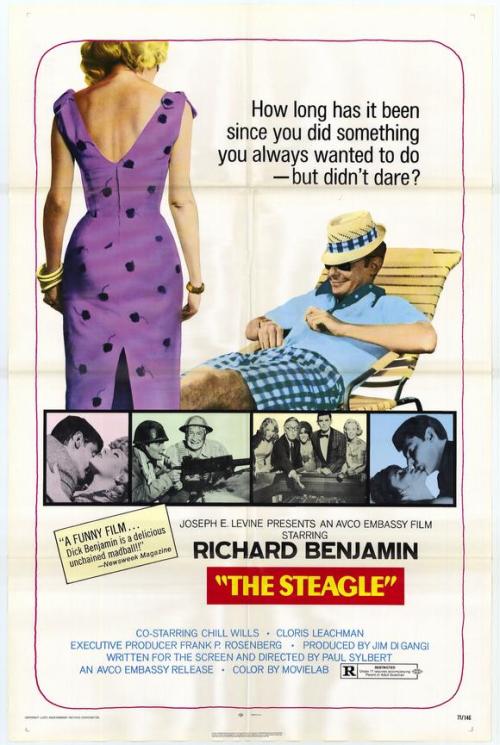
The year is 1962 and the Cuban missile crisis is in full-throttle. The threat of a possible nuclear war has everyone on edge and having to hear about it every night on the news just makes things worse. Harold (Richard Benjamin) decides to use this opportunity to ‘escape’ from his drab existence. Both his marriage to Rita (Cloris Leachman) and his job as a college professor have grown stale. If the end is near then Harold wants to live-it-up to the fullest, so he travels to Vegas, has sex with hot women while also living out other outrageous fantasies.

The film was directed by award-winning set designer Paul Sylbert and for the most part, at least at the beginning, is right on-target. The mood and design looks authentically like the early ‘60s and the story nicely taps into the secret fantasy life that most likely harbor in the back-of-the-minds of just about every middle-age person out there. The viewer effectively feels Harold’s frustration during the first half and then just as effectively feels the rush when he finally decides to break free and go wild.

The story is consistently amusing throughout with the most memorable bit coming when Harold decides to speak in gibberish while giving a lecture to his class. Benjamin is perfect for the part playing a character with a snarky, sarcastic personality that hides just beneath his otherwise formal veneer. Ivor Francis is great in support as a minister who Harold meets on his travels that, like with him, wants to escape from the shackles of his daily existence. Chill Wills is good too playing a loopy ex-actor who thinks he’s Humphrey Bogart and traps a group of men inside a bathroom and won’t let them out until after they hear his rendition of a scene from The Maltese Falcon.

The film’s biggest drawback though comes from the awkward transition between Harold fantasizing about these things and then finally deciding to go through with it. The film never bothers to show how he manages to get away from his wife and kids. Does he sneak out in the middle of the night unannounced, leave a note, or simply tell them that he needs to ‘get away for a while’? Nothing is ever shown even though I felt that this scene was quite crucial and needed to be put in. The ending is equally frustrating as we never find out what happens when Harold finally decides to go back, which makes the film as a whole come off as incomplete and one-dimensional.

My Rating: 5 out of 10

Release: September 15, 1971

Runtime: 1Hour 30Minutes

Rated R

Director: Paul Sylbert

Studio: AVCO Embassy Pictures

Available: VHS, DVD (Mill Creek)

Gimme an ‘F’ (1984)

gimme an f

By Richard Winters

My Rating: 1 out of 10

4-Word Review: Cheerleaders compete for prize.

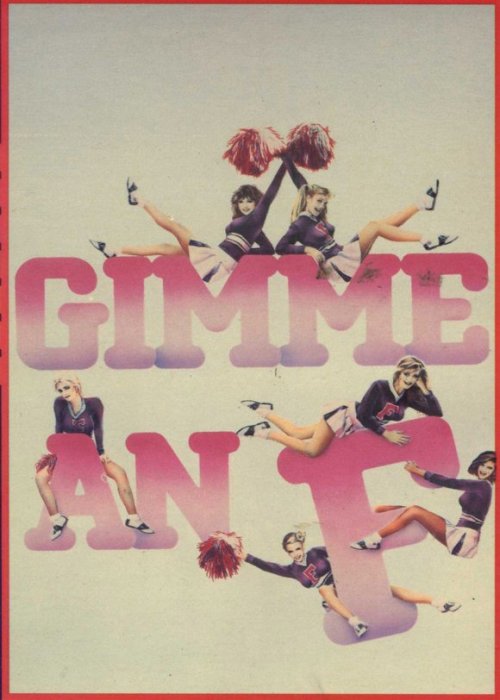
Bucky Berkshire (John Karlen) is the proprietor of a local cheerleading camp. He hopes to build an even bigger one with the help of some Taiwanese investors. However, they will only put up the much needed capital if Bucky agrees to sign Tommy (Stephen Shellen), who works as the cheerleading coach at the camp, to a 5-year contract. Bucky and Tommy do not get along and Tommy, who is 25, thinks he has gotten too old for the position and needs to move on. Yet Bucky feels he has no choice but to cut him a deal. If Tommy can get a group of teen cheerleaders known as the Ducks to beat the perennial winners known as the Falcons at the annual cheerleading competition then he’ll pay Tommy a whopping $10,000, but if they lose then Tommy will be forced to continue to work for Bucky for another 5 years.

I remember this film being scheduled on Cinemax in the ‘80’s during its late night hours, which gave me the impression that it was a raunchy T&A feast, but in reality it really isn’t. In fact during its entire runtime there is less than 10 seconds of actual nudity, which isn’t enough to make it worth watching. Some may say that makes me sound like just another sexist, leering male, but when the material is this inane what else is there about it to sell? Certainly not its so-called comedy, which is virtually laughless and on a 5-year-old’s level if even that and the plot is equally trite as it clearly conforms to the age-old David-and-Goliath formula where the viewer knows from the get-go that loser will obviously end up winning the thing no matter how much the odds are stacked up against them and what’s the reason to watch something if you know exactly how it’s going to end from the very beginning?

One viewer, who admits this is not a very good movie, said its one ‘saving grace’ was the cheerleading routines done at the end during its climactic showdown, which he felt were well choreographed, but to me it was just more cartwheels, twirling and dance line routines that if you’ve seen once then you’ve seen it a million times. Even if it had been spectacular it still wouldn’t warrant sitting through the rest of it, which is quite trifling to say the least.

Venerable character actor Karlen, who was the only veteran member of the cast, lends some credibility with his presence, but it isn’t much. Star Shellen is completely transparent in the lead despite having a teen heartthrob of a face. His character is shown doing very little training anyways and seems to shift the majority of the burden off to his assistant Roscoe (Mark Keyloun).

Beth Miller is equally weak as the female lead and although she is very cute she has no ability to effectively do a comic pratfall of which she is required to do several. The only thing she does get right is the way her eyes well up with tears from her embarrassment after she does one.

Although her character isn’t any better written than any of the others I could still tell right away that Daphne Ashbrook, in her film debut, was a far stronger actress than any of the others and it is no surprise that her career continued to flourish while the rest of them disappeared into obscurity. Although for the record Jennifer Cooke, who plays the bitchy character of Pam, did find success later in her life helping to run the Celestial Seasonings Tea chain.

My Rating: 1 out of 10

Released: November 16, 1984

Runtime: 1Hour 40Minutes

Rated R

Director: Paul Justman

Studio: 20th Century Fox

Available: VHS

The Andromeda Strain (1971)

andromeda strain

By Richard Winters

My Rating: 7 out of 10

4-Word Review: Isolating a dangerous virus.

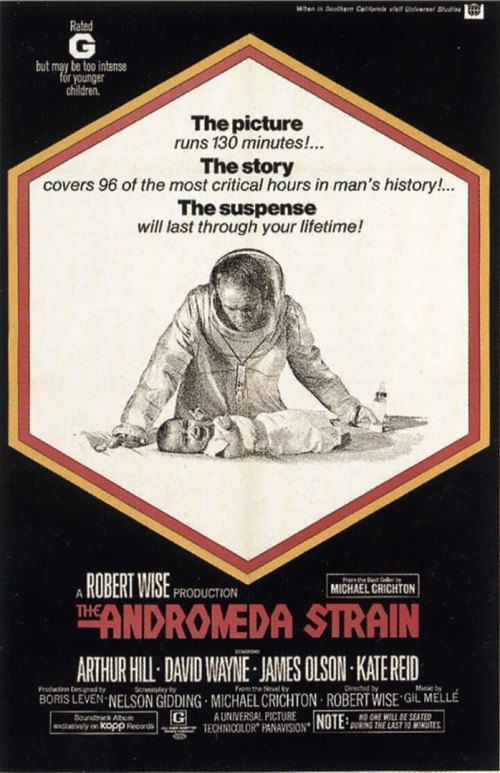
When a satellite returns to earth it brings back a mysterious virus that ends up killing all the residents of a town where it lands. Two scientists Dr. Jeremy Stone (Arthur Hill) and Dr. Dan Hill (James Olson) go to the town to investigate and find that the only survivors are a wino (George Mitchell) and a six-month-old baby. They bring these two people along with the remnants of the satellite back to a secret Nevada lab known as Wildfire that’s buried deep below the ground. It is here after close examination that they are able to observe the virus, which appears as small green dots on the satellite, but they fail to realize that this virus can also mutate and presents an even greater risk to them in the lab.

One of the major selling points of this film is the fact that it keeps everything within the realm of ‘realistic sci-fi’. No bubblegum action, scary monsters, or any other form of over-the-top dramatics get added; instead it’s on a ‘thinking man’s level’ with an extraordinary attention to detail. I enjoyed seeing all of the decontamination procedures that the crew is forced to go through before they are even allowed to begin their investigation. The isolated lab, which is hidden beneath what looks to be just an ordinary farmhouse and shed, is really cool and director Robert Wise’s use of the split-screen during the search of the town is both flashy and slick.

Showing the scientist’s personal lives and how the government agents literally demand that they drop what they are doing and come with them helps humanize the characters to a degree. I also liked how the male character of Dr. Peter Leavitt in the Michael Crichton book from which this is based gets switched to a female character here, which helps add an extra dynamic and is very well played by Kate Reid. In fact the only thing about the character’s that I didn’t like, aside from Arthur Hill’s sterile performance, is when we see the dreams of the doctors as they sleep, which seemed corny and unnecessary.

The mysterious nature of the virus is compelling and I certainly enjoyed the way they were able to detect it by scanning the satellite with cameras that could focus onto the object in minute detail, but the plot itself gets stretched farther than it needs to. There are a few interesting twists, but it starts to feel quite labored around the 2-hour mark and the climatic finish isn’t all that intense and seems rather stagy and predictable.

I was also amazed that this film achieved a G-rating. For one thing there isn’t much action and the narrative is on a more sophisticated level that is clearly aimed at adults and something most children won’t be able to pick up on. Also, one of the victims that the two men come upon is of a woman with no top on. The image is brief, but her breasts are clearly exposed making this one of the few G-rated movies to feature nudity.

My Rating: 7 out of 10

Released: March 12, 1971

Runtime: 2Hours 11Minutes

Rated G

Director: Robert Wise

Studio: Universal

Available: DVD, Amazon Instant Video, YouTube

The Clan of the Cave Bear (1986)

clan of the cave bear

By Richard Winters

My Rating: 5 out of 10

4-Word Review: Girl gets new tribe.

After her mother is killed in an earthquake and escaping from the clutches of a hungry lion a very young Ayala (Daryl Hannah) gets taken in by a tribe of Neanderthals. Her addition causes strife amongst the other members particularly Broud (Thomas G. Waites) who feels she doesn’t conform enough to the subservient female role. When it is found that she has taught herself to hunt by using weapons that the women were forbidden to touch she is kicked out of the tribe and forced to survive on her own.

I realize that this film has been almost universally lambasted by movie goers and critics alike, but overall I found it to be watchable. The biggest issue in many ways were the action sequences. The opening earthquake bit as well as the lion attack comes off as stagy and phony and even border on being unintentionally funny. Later on when Ayala saves a young child from a wolf the movie reverts to slow motion, which gives it too much of an over-the-top Hollywood feel. There is also another segment where the cavemen torment a grizzly bear as part of an ancient tribal ceremony. Some of the men get torn up and killed by the bear, which to me was just fine as they should’ve left him alone in the first place!

Hannah is the perfect choice for this type of role, but for whatever reason her performance seemed a bit off and not as effective as it could’ve been. She was also probably too tall for the part as people back then was much shorter than they are now.

The movie has a little too much melodrama and eventually resembles just another cheesy Hollywood drama. The authenticity is questionable and the grittiness from the more popular Quest for Fire is definitely missing. I also wasn’t too crazy about the outdoor shots, which includes the opening one, that shows sunlight filtering through the tree leaves in a haze-like fog that gives it too much of a fairy tale-like look.

The part where Ayala is forced to survive on her own goes by too quickly and hardly seems as brutal as it should’ve been and I was also confused about how she was able to come upon this fur shawl to wear that protected her from the cold because when the tribe kicked her out she left with nothing but the flimsy outfit that she had on.

Yet despite all this I still found it to be reasonably compelling. Maybe it’s just the idea of seeing an individual learn to survive on her own, standing up to unjust authority and learning to find independence that manages to connect us no matter what the time period, but in either case it’s an okay time filler if you don’t think about it too much.

My Rating: 5 out of 10

Released: January 17, 1986

Runtime: 1Hour 38Minutes

Rated R

Director: Michael Chapman

Studio: Warner Brothers

Available: DVD (Warner Archive), Amazon Instant Video, YouTube

Quest for Fire (1981)

quest for fire

By Richard Winters

My Rating: 6 out of 10

4-Word Review: Cavemen search of fire.

After their tribe is attacked by another one and their only source of fire put out three male members from the group (Everett McGill, Ron Pearlman, Nicholas Kadi) set out to find fire from somewhere else and bring it back to the others.  Their quest is not easy as they are forced to travel through harsh terrain, escape from man eating tigers, and fight off a tribe of cannibals. They also meet up with Ika (Rae Dawn Chong) who comes from a more advanced tribe where the members live in huts instead of caves and who also harbors the secret to starting a fire, which she just might share with the others.

Filmed on-location in Canada, Scotland, and Kenya this film brings to life the true nature of prehistoric times in vivid detail and better than any other movie that has dealt with the same subject. The male actors were fitted with masks that gave them ape-like features and except for one brief moment there is no discernable line of dialogue and communication is spoken through grunts and groans as well as words not connected to modern day language. Some DVD issues do have subtitles, but to me this is taking the viewer out of the experience as the whole idea is to allow one a true sense of how things where like back then and therefore forcing one to try to understand things through the primitives means of communication during that period is the only way to do it and I’m thankful that the theatrical version and the streaming version that I saw did not offer them.

While I applaud the filmmaker’s commitment to keeping things close to the true form as possible and not willing to compromise it simply to make it more accessible to a mainstream audience I still found it to be confusing at spots and even at times boring. The opening battle between the two tribes seemed almost unintentionally funny and the loud, booming music played over most of the movie is a bit off-putting as there was clearly no music at the time of the setting, so silence or natural sounds would’ve kept it truer to the authentic tone.

There is also a scene where the men come upon the remains of some meat left from another tribe. The men are hungry and begin eating the remains only to realize that what they are chewing on is human flesh, which sickens them and they spit it out, but I wasn’t so sure that genuine Neanderthals such as the ones portrayed here would be so ‘civilized’ and instead more concerned with simply satisfying their hunger needs.

Rae Dawn Chong’s presence is a major plus and the movie gets more interesting when her character appears. She remains fully nude at all times while covered in body paint, but isn’t as erotic as you might think. The scene where she gets raped by the men late at night is brutal, but authentic to the animalistic level that I would assume sex would be approached with during that time period. The way her character ends up bonding and even forming a romantic attachment to the one of them as the film progresses is genuinely touching.

The film has a lot of lulls and may be just too unique for some. I found myself intrigued at certain parts and bored at others, but the scene where the men watch in amazement when Chong creates a fire for the first time is a surprisingly exhilarating moment where the viewer feels the same emotion that people back then must’ve felt, which to be able to convey such a feeling to a modern audience is an achievement in itself and a sign of astute filmmaking at its finest.

My Rating: 6 out of 10

Released: December 16, 1981

Runtime: 1Hour 40Minutes

Rated R

Director: Jean-Jacques Annaud

Studio: 20th Century Fox

Available: DVD, Blu-ray, Amazon Instant Video, YouTube

O Lucky Man! (1973)

o lucky man

By Richard Winters

My Rating: 9 out of 10

4-Word Review: A young man’s journey.

Mick (Malcolm McDowell) is a wide-eyed young man entering into the adult world and full of Horatio Alger-like illusions of working real hard and becoming insanely rich while doing it. His first job is as a coffee salesman where he is told that ‘the-sky’s-the-limit’ in regards to his earning potential, so with the carrot-on-the-string firmly in place he dives into it, but ultimately finds little to show for it. He then meets up with a rich tycoon ( Ralph Richardson) and essentially becomes the man’s lapdog assistant only to learn that this doesn’t work either. After spending time in jail he comes back out into the world as a ‘reformed’ man extoling on the idealistic virtues of humbleness only to again meet with aversion and failure.

The film, which is based on an original idea by McDowell, is essentially a broad look at society’s many socio-economic class levels and how easy it is to fall down it, but hard to move up. Some consider Glengarry Glen Ross to be the bleakest indictment on the sales profession, but having worked in the business when I was like the character here first getting out into the working world I can say that this one is even more searing and accurate.

On a wider scope the film successfully works as a critical statement on capitalism, which due to the purveying political climate of the day most American audiences are just now ready to catch up to. Mick’s journey is more his eventual disillusionment as he slowly realizes that being a ‘go-getter’ and having a ‘good attitude’ isn’t going to be enough as the system is rigged so that the individual is more likely to lose than win and can’t really function otherwise. His efforts then become exploited while helping to make someone else richer as he tolls in the bottom rung doing lateral moves into areas that have potential promise, but only produce the same results.

Although the character’s perpetual delusions of grandeur become a bit annoying McDowell plays the part well. The intent was for him to play against type from the one that he did just previously in A Clockwork Orange by portraying someone who is clean-cut, respectful and obedient, but with all the transitions that the character goes through and at one point even having him strapped to a chair in much the same way that he was in the Kubrick film it eventually comes off more like a continuation of that part than a completely different one.

The fun of watching the film is seeing the supporting cast playing dual roles. Arthur Lowe is great especially in the part where he gets put into heavy black make-up to play the leader of a fictitious foreign nation. Rachel Roberts is good too with the erotic scene where she transfers coffee from her mouth into McDowell’s and then later as a poor woman who commits suicide, which has a foreboding quality to it since Roberts ended up doing the same thing five years later in real-life.

Fans of Helen Mirren will enjoy seeing her when she was much younger and playing the part of a rebellious daughter. I also liked the way Alan Price and his band fits into the film. They do the movie’s soundtrack, which is quite good, but instead of having their music played over the action the movie cuts away and captures them doing their renditions inside a sound studio, which in any other case would be considered distracting, but here helps accentuate the film’s  already cerebral tone. It’s also amusing how the band ends up becoming a part of the story as the McDowell character almost gets hit by their van, which allows the opportunity for Price to say the film’s best line “Are we suing you, or are you suing us?”

The film is full of many surreal and original moments and is so consistently inventive that you hardly notice its three hour runtime. However, to me the best part about it is the way it attacks and criticizes the status quo, which is something that no Hollywood movie ever does.

My Rating: 9 out of 10

Released: March 26, 1973

Runtime: 2Hours 58Minutes

Rated R

Director: Lindsay Anderson

Studio: Warner Brothers

Available: DVD, Amazon Instant Video, YouTube

Steaming (1985)

steaming

By Richard Winters

My Rating: 2 out of 10

4-Word Review: Saving a steam room.

Three women (Vanessa Redgrave, Sarah Miles, Patti Love) congregate at a London steam room designed like a Turkish bathhouse. Despite their lifestyle differences they become good friends as they divulge their problems to one another and learn to lean on each other to help them cope with life’s difficulties. Then one day Violet (Diana Dors), who is the bath house owner, informs them that the place is set for demolition, which causes everyone to go on a mission to try and save it.

The film is based on the Nell Dunn play, which was highly regarded at the time, but makes for a very poor transfer to film. It starts out flat and never recovers. The dialogue has too much of a conversational quality that is not interesting and the problems that they discuss are not compelling, or original. The humor from the play is missing and the dry, somber tone only makes things even more boring. The only time it gains any traction is when it’s announced that the place is closing, but everything gets resolved in such a sitcom-styled way that it hardly seems worth the effort to watch.

The entire cast is made up of women and there is an abundance of nudity particularly from Miles, which doesn’t seem like a big deal these days. The biggest issue though is the fact that everything takes place from inside the bath house, which is gray, grimy, and rundown. The film should’ve had some segments shot from different locales if to only allow for some visual variety and to help the viewer understand the characters better by seeing how they react in different social settings.

Miles and Redgrave are wasted in drab roles and this goes likewise for Dors whose last film role this was. Love is the only one that shows any liveliness and although her character is a bit annoying she at least has an emotional breakdown near the middle, which adds some mild dramatic tension.

Joseph Losey was a competent director who made many interesting films, so it’s a shame that his career had to end with such a dud. He was already sick with cancer while he filmed this and like with Dors died a year before it was released. The disease may have sapped his creative energy and explain why this production is so ponderously sterile. It’s certainly a far cry from his other works as well as the Bruce Jay Friedman play Steambath, which had a similar setting, but a much more imaginative plotline.

My Rating: 2 out of 10

Released: September 28, 1985

Runtime: 1Hour 31Minutes

Rated R

Director: Joseph Losey

Studio: New World Pictures

Available: DVD (Region 2)

Watermelon Man (1970)

watermelon man 1

By Richard Winters

My Rating: 7 out of 10

4-Word Review: White man becomes black.

Jeff Gerber (Godfrey Cambridge) is a bigoted white man who wakes up one morning having suddenly turned black. At first he thinks he’s spent too much time under the sun lamp, but after he and his wife Althea (Estelle Parsons) try every concoction they can to return his skin back to its normal color and nothing works they finally accept the inevitable. Jeff’s lifestyle then changes in major ways. He loses his friends, his job and even forced to move out of his neighborhood giving him firsthand experience with how drastic the racial lines are.

The film was directed by Melvin Van Peeples who was at the front of the independent film movement during the ‘60s and doesn’t get enough credit for some of the groundbreaking films he made in that era, but this one remains his best and most famous work. While other films chose to present racial issues in very serious and dramatic ways this one takes the wacky comedy route and in a lot of ways becomes far more compelling. Some of the funniest moments comes when the characters discuss racial stereotypes, something filmmakers of today would shy away from for fear that they would be labeled racist, but here by bringing it all out-in-the-open it trusts that the viewer will see how silly and absurd they are without feeling the need to suppress anything.

Although Cambridge is never completely convincing as a white man despite an admirable job by the make-up department he still gives a splendidly engaging performance and without his presence this movie just wouldn’t have worked. Parsons is great as well with her character being quite supportive initially, but then eventually she turns her back on him like everyone else. Mantan Moreland is funny as a café waiter who laughs politely at all of Gerber’s dumb jokes when he is white, but gives him a completely different response once he turns black. Erin Moran can be spotted as the daughter and songwriter Paul Williams has a brief bit as a would-be employer.

There are moments where it shifts awkwardly between drama and comedy and there’s one scene where the action freezes completely and suddenly begins to display on-screen titles, which does nothing but take the viewer out of the story and should’ve been avoided. It also would’ve been nice had there been some explanation for why this all occurred. A potentially funny idea would’ve been having a scene where God decides to change Gerber into a black man to teach him a lesson and having the Almighty portrayed as being African American, which would’ve been considered quite edgy for the period and helped complement the already outrageous storyline.

Despite all the laughs the issues that it brings out are quite startling and not far from the truth, which makes this an integral part at revealing the problems that the black movement had during the early ‘70’s and still does and a film that deserves more critical praise than it’s been given.

watermelon man 2

My Rating: 7 out of 10

Released: May 27, 1970

Runtime: 1Hour 40Minutes

Rated R

Director: Melvin Van Peeples

Studio: Columbia Pictures

Available: DVD, Amazon Instant Video, YouTube

Black Devil Doll From Hell (1984)

black devil doll 1

By Richard Winters

My Rating: 0 out of 10

4-Word Review: She fucks a doll.

Helen Black (Shirley L. Jones) is a devoutly religious woman living alone and spending most of her time going to church while also believing sex should only be within the bounds of marriage. One day she visits an antique store and spots a puppet that catches her fancy. She decides to buy it despite vague warnings by the store clerk that it possesses strange powers. When she brings it home it suddenly comes alive, ties her up and begins having sex with her, which she finds that she actually enjoys. When the doll disappears she decides to throw away her religion and become the neighborhood slut instead by picking up strange men wherever she can find them and bringing them back home for raunchy action.

This movie could best be described as the low budget, soft core porn version of Trilogy of Terror and while the story has some outrageously voyeuristic elements the production quality is so poor that it never allows the viewer to get into it. The whole thing is shot on a grainy VHS tape giving it a very amateurish look from the get-go. Certain scenes are out-of-focus and director Chester Novell Turner seems to have no understanding of editing as the camera pans wildly when simply cutting to a certain shot would’ve made more sense. There is a lot of extraneous footage as well including watching Jones walking down the sidewalk that seems to go on endlessly and an overplayed thumping music score that becomes headache inducing.

Just about all the action takes place in Helen’s cramped, rundown home, which has no visual appeal whatsoever. The sex scenes are gross and all the nudity comes from star Jones who is not exactly model quality or someone you’d want to see naked.

The only interesting aspect is the doll itself especially with its vulgar dialogue, but unfortunately he’s not in it enough. The effects used to create him are botched as it is clear when it gets shown from behind that it is not a puppet at all, but a small child, or in this case the director’s nephew.

Sitting through this is an arduous challenge. IMDb lists the runtime as 1Hour and 10Minutes, but the version I saw went almost a full 90 minutes. Some may find a few cheap laughs at the beginning due to its technical ineptness, but watching it all the way through becomes torturous and makes having sex with a puppet, or even killed by one seem enjoyable by comparison.

My Rating: 0 out of 10

Released: August 5, 1984 (straight-to-video)

Runtime: 1Hour 27Minutes

Not Rated

Director: Chester Novell Turner

Not Rated

Available: DVD