Category Archives: Movies with Nudity

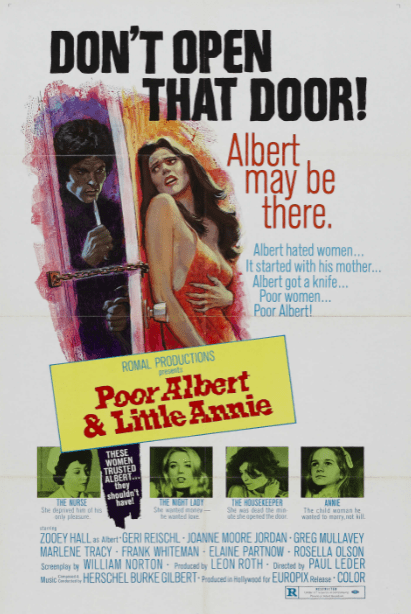
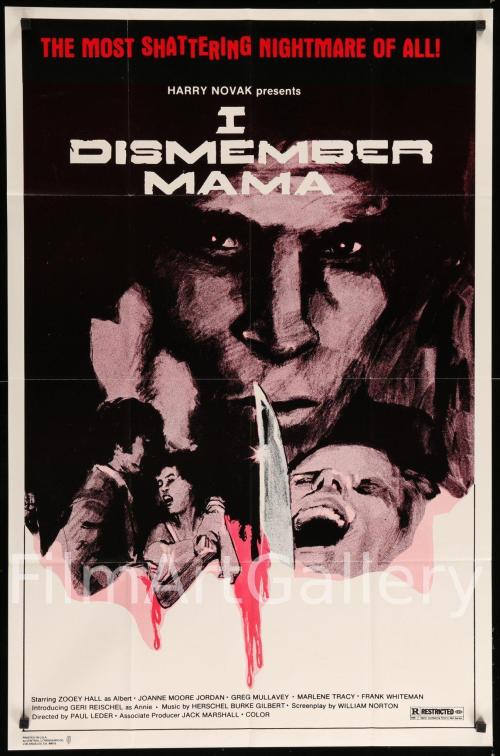
I Dismember Mama (1972)

By Richard Winters

My Rating: 1 out of 10

4-Word Review: He only likes virgins.

Albert (Zooey Hall) hates his rich mother (Joanne Moore Jordan) and at one point attempted to kill her, which got him institutionalized, but he manages to escape and is now back on the streets attempting to kill her once again. When he arrives at his old residence he meets Alice (Marlene Tracy) who’s now working as his mother’s maid. He promptly kills her, but then Alice’s 11-year-old daughter Annie (Geri Reischl) arrives asking for her. Albert is immediately taken in with the child’s innocence and purity and becomes determined to ‘save her’ from the jaded world around them. He concocts a story that her mother suddenly got sick and had to go to the hospital, so the two spend the day frolicking around at a park and later take part in a mock wedding, but by nightfall Albert’s dark urges return and this time his target is Annie.

This is yet another example of an underground 70’s exploitation flick that promises to deliver shocks via its provocative storyline, but ultimately has hardly any. The pacing is poor and filled with talky scenes that get extended far longer than they should. The dialogue lacks bite and there needed to be more action. For instance Albert’s attacking his mother should’ve been shown possibly as a flashback and not just talked about in passing. Albert’s overpowering of a hospital attendant (James Tartan) in order to escape from the institution doesn’t get shown either we just see the guard’s dead body after the carnage is over while in-between we get treated to a long extended conversation between Albert’s mother and his psychiatrist (Frank Whiteman), which is both boring and pointless.

Hall is poor in the lead and unable to convey more than one facial expression or voice tone. I didn’t like the way Reischl’s character gets written either as she’s portrayed as being too innocent and naïve. Sure kids will be more sheltered to real-world horrors than adults, but they’re not stupid and have a fear instinct like anyone else. When a creepy guy unexpectedly answers the door the warning flags would be going off for any typical 11-year-old, which was the age she was when this was filmed, and her character should’ve, and most likely would’ve been in reality, far more defensive and cautious.

I was also confused why Reischl, who is better known as being the ‘fake Jan’ who replaced Eve Plumb in the short-lived ‘The Brady Bunch Variety Hour’, got listed in the credits under the title of being ‘introduced’ like she was brand new to the film scene when she really wasn’t as she had already appeared in another horror flick The Brotherhood of Satan, which had been filmed in 1969 and released to theaters a full year before this one.

When I first watched this movie back in the summer of 1987 it had what I considered at the time one of the dumbest segments I had ever seen. It features Albert walking into a pool hall eyeing an attractive woman (Rosella Olsen) and telling her how rich he is, which is enough to get her to dump the boyfriend (Robert Christopher) she is out on a date with and immediately jump into Albert’s arms, which to me was just to heavy-handed to believe. (If picking up women could only be this easy.)However, after seeing it a second time I now consider this as attempted satire, but the segment should’ve had  a better payoff. Instead of the jilted boyfriend later crying over her dead body, after Albert had killed her, he should’ve laughed and considered it ‘sweet revenge’ for her having publicly dumped him in humiliating fashion earlier.

The film has come under attack by some for its perceived pedophilia storyline. Critic John Kenneth Muir in his review stated that watching it made him ‘feel dirty’ and the pedophilia theme ‘went too far’ for a film that had ‘no aspirations to be anything but entertainment’. Personally I found this take to be virtue signaling and disagree with it on several points.

First I don’t think this was ever meant to be ‘entertainment’. Instead it was intended like a lot of other underground flicks at that time to shock and appall and then bank on the morbid curiosity of people to fill the theater seats simply to see ‘what all the fuss is about’.

Most importantly I don’t think Albert initially saw Alice as a sexual conquest, but more as someone he wanted to protect from the awful world around them. He wanted to save her innocence instead of taking it away. Yes, it’s true there is a scene when she is sleeping in a hotel room and he starts to have impulses to deflower her, but he fights them off and then goes out to a bar where he attacks another woman who is well over 18. The perceived pedophilia theme lasts for only a couple of minutes and really doesn’t take up the bulk of the runtime like some critics seem to think it does, or want you to believe.

My Rating: 1 out of 10

Alternate Title: Poor Albert & Little Annie

Released: April 1, 1972

Runtime: 1 Hour 25 Minutes

Rated R

Director: Paul Leder

Studio: Valiant International Pictures

Available: DVD

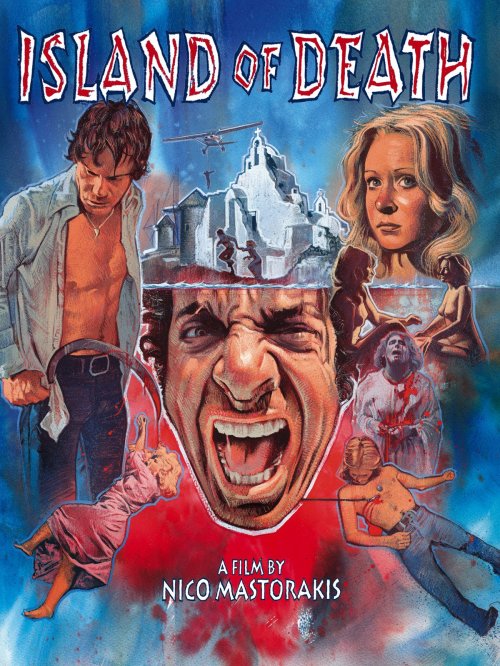
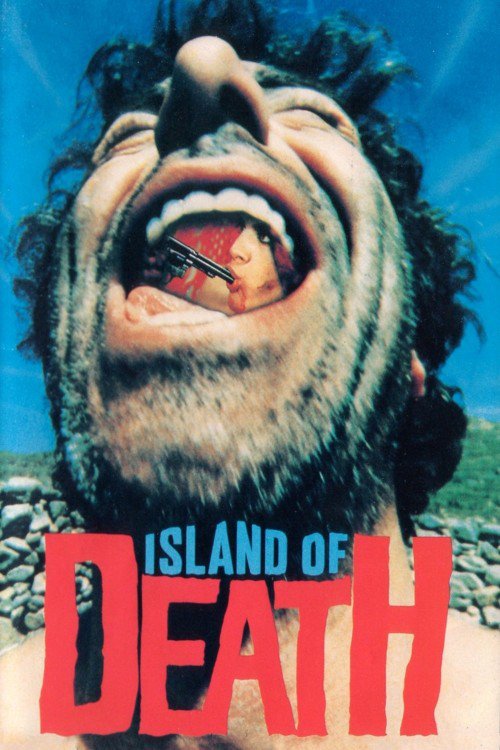
Island of Death (1976)

By Richard Winters

My Rating: 6 out of 10

4-Word Review: Couple on killing spree.

Christopher and Celia (Robert Behling, Jane Lyle) seem like a nice young couple just looking  for a little vacation as they travel to a Greek island. Yet once there they begin killing anyone who they deem ‘perverted’. First it’s a man who makes a pass a Celia, then it’s a gay couple, and a bartender who’s outed as a lesbian. Not only do Christopher and Celia kill their victims with glee, but they also enjoy taking pictures of the carnage, so that Christopher can use them for sexual arousal later.

In 1974 Nico Mastorakis, who at that time was working as an investigative journalist and before that was a popular radio DJ, became impressed with The Texas Chainsaw Massacre, and the amount of money it brought in. He was convinced that making exploitation flicks was a profitable venture and proceeded to create a film that would be as shocking as possible simply for the money benefits it would bring in. The film has certainly achieved a strong cult status and has been one of the most widely banned films in the world.

While its reputation is quite notorious I actually found the violence to be nothing special. There’s one segment where a man gets his hands nailed to a cement ground, which is pretty nasty and the killing of a baby goat, which Christopher then proceeds to have sex with is quite disturbing too, but everything else, at least gore-wise, is run-of-the-mill. The one segment that did get a bit difficult to watch simply because it gets more prolonged than the other killings and therefore makes it seem more real was when Christopher tries to force the lesbian bartender (Janncie McConnell) to swallow a bottle of hard liquor, which she repeatedly chokes on.

On the perversity level the film still scores strongly even after all these years. One of it’s more outlandish moments is when Christopher gives an unexpected golden shower to a 60-year-old woman (Jessica Dublin) who at first reacts in disgust, but then eventually gets into it. The real shocker though for me was the final twist, which I hadn’t seen coming and as jaded as I’ve become with years of watching these underground 70’s flicks, had my mouth agape.

Mastorakis shows good command with solid pacing and a script that continuously reveals many sick twists as it goes. The slow start works in its favor as it creates a romantic feel, especially with its sweet sounding score and picturesque backdrop of Mykonos, which allows for the viewer to let down their guard and then when the shocks gets going it makes it even more emotionally horrific. I also enjoyed Mastorakis use of the hand-held camera and wide angle lens something that only came into vogue many decades later.

Overall I commend the production for going all in. Too many other horror flicks, especially from the 70’s, promised exploitation, but ultimately  delivered little. It seemed like despite their provocative storylines they would end up chickening-out, so it’s nice to see one hyper-focused to truly push the envelope. Obviously this won’t be everyone’s cup-of- tea many, but if you’re compelled to make a truly underground feature then alienating some viewers is a prerequisite.

My Rating: 6 out of 10

Released: October 13, 1976

Runtime: 1 Hour 48 Minutes

Not Rated

Director: Nico Mastorakis

Studio: Omega Pictures

Available: DVD, Blu-ray, Amazon Video, YouTube

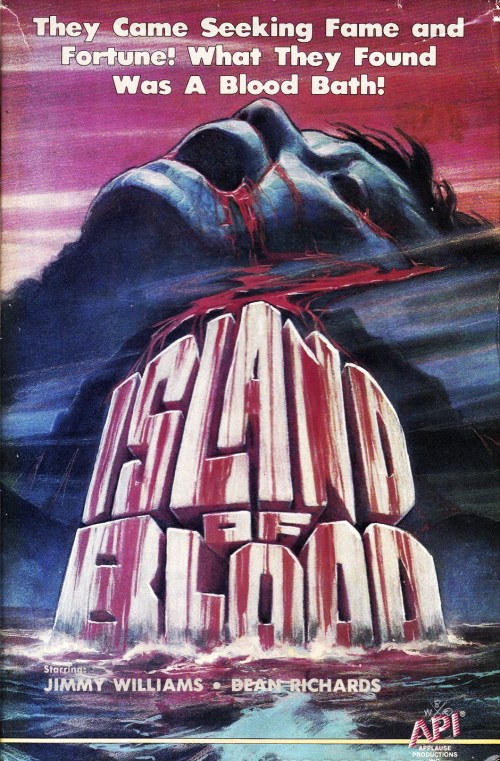
Island of Blood (1982)

By Richard Winters

My Rating: 3 out of 10

4-Word Review: Killer stalks film crew.

The cast for an upcoming horror film travel to an island where the film is to be made. Since the film’s producer and director won’t arrive until the next day they get ready for their parts, but find that each of them is getting offed one-by-one by a mysterious killer that they cannot see, but who leaves a portable tape player hanging near the body of his latest victim that plays a rock song with violent lyrics.

This low budget attempt had potential, but goes about it in all of the wrong ways. One of the things that really stood out to me since I’ve worked as a crew member on several low budget films myself is that the characters here act in a completely opposite way from how a cast and crew would normally behave on a real set. I have found most people when thrown together onto a crew of people that they do not know would make attempts to form friendships and potential contacts with their fellow crew/cast members. Here though the cast members, who are made up of young adults, act like they’re still in high school and more concerned with putting up pretentious facades to prove how ‘cool’ they are while putting down everyone else around them.

I also couldn’t believe the amount of open apathy these same characters show the screenwriter when he hands out the script and describes to them what the plot is about. Someone should’ve advised these ‘up-and-coming’ young starlets that when you’re starting out in the business it might be a good idea to at least fake enthusiasm for what you’re going to be working in, or it just might be the last film you’ll ever be asked to be in. Word-of-mouth travels fast in this business and if you get a reputation of being someone who really doesn’t care to be there then you’ll never get hired again as there’s plenty of other people out there willing to take your place.

As for the killings they’re not very impressive although the shot of a dead woman with nails going through her forehead, via a nail gun, would’ve been creepier had her eyes remained open instead of closed. The fact that we never see the killer does actually make it a little bit scarier simply because it’s completely left up to the viewer’s imaginations about who this person is. The chase sequences though don’t work as they all take place in these darkened buildings, the result of a power outage, so you really can’t see exactly what’s going on. I also thought that having the arriving producer die by having his boat explode, which was apparently caused by the killer, was a bit ridiculous because how could the killer go from being on an island one minute to on a boat at sea the next in order to plant the bomb?

The film does have a twist ending, which reviewers over at IMDb seemed to like and while it is a surprise to some extent it really doesn’t completely work. Way too many unanswered questions and loopholes get thrown in that never get explained.

The concept would’ve worked better, and been ahead-of-its-time, had it taken the BLAIR WITCH PROJECT  approach where a centralized cast member would film the behind-the-scenes action of this upcoming production and interview the other cast members as they got ready for it. She could then use her camera later on to do detective work to try and catch the killer.

My Rating: 3 out of 10

Released: July 9, 1982

Runtime: 1 Hour 22 Minutes

Not Rated

Director: William T. Naud

Studio: Action International Pictures

Available: Amazon Video

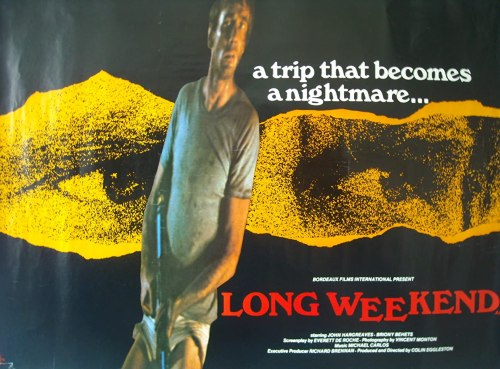
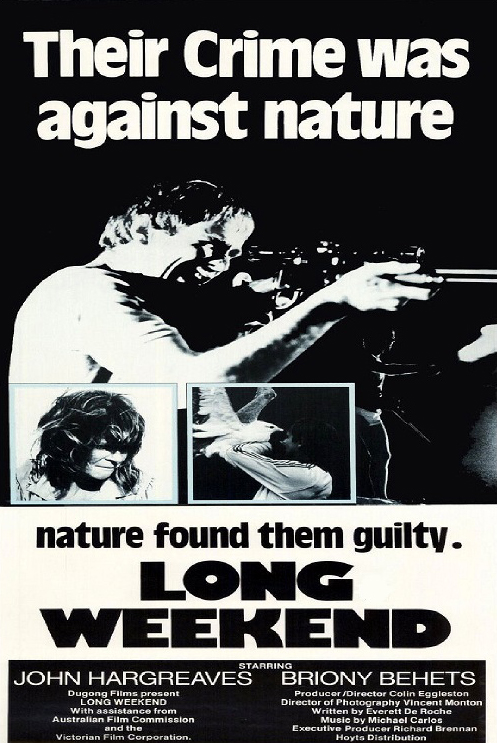
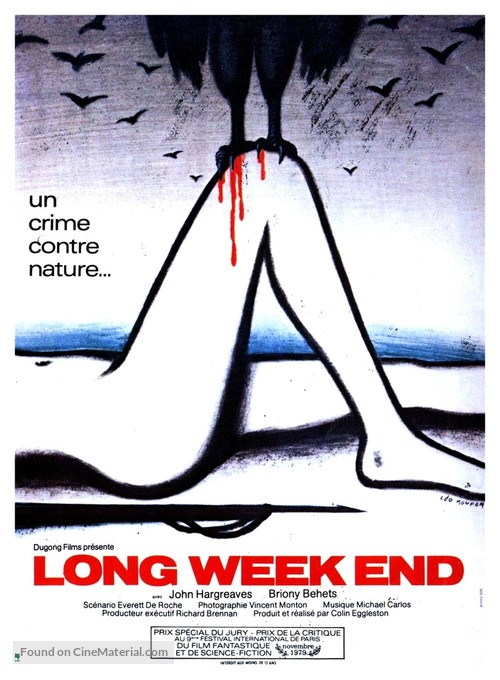
Long Weekend (1978)

By Richard Winters

My Rating: 7 out of 10

4-Word Review:  A couple battles nature.

Peter (John Hargreaves) and Marcia (Briony Behets) are a young couple who are constantly at odds with each other. To help smooth things over they decide to take a trip into the wilderness and enjoy the beauty of the outdoors. Along the way they accidently hit and kill a kangaroo with their vehicle. This sets off a chain-of-events that puts them under the increasing attack of various animals. First Peter must fight off an angry eagle who swoops down at him without warning. Then a possum and even a sea cow who stalks Peter while he is swimming. The two decide they must leave the area in order to save their lives, but everywhere they turn there’s another animal waiting for them.

The story idea is certainly an interesting one, but the concept is too wide-open. Scriptwriter Everett De Roche stated that the premise was all about how Mother Earth had her own auto- immune system and when humans started acting like cancer cells she’d attack, which is great, but why just this couple? There are millions of people who behave just like them, so why don’t they end up getting the same treatment?

The plot needed an extra spin to hold it all together, but it never comes. Having this small remote place hold a mystical power that allowed animals to behave differently than they would normally do elsewhere would’ve at least given it some needed focus. Perhaps a backstory too where other people would’ve gone to this same locale and complained about being attacked. Any extra plotline would’ve helped because the idea that these animals would just randomly attack a generic couple in some isolated moment in time that they never did before or after just doesn’t cut-it.

I didn’t like either that the couple bicker right away, but then later on become lovey-dovey only to proceed back to bickering, which is too bipolar. A better approach would’ve had them getting along at the start and then with the stress of the animal attacks tear their relationship apart, which would’ve created a more interesting character arc, which otherwise is non-existent.

I would’ve preferred that the lead characters been played by macho men who arrogantly tear up the wilderness with their SUV’s and kill the animals for shameless sport. Watching these ‘tough guys’ then unravel once the animals went on the offense turning them into sniveling, frightened cowards would’ve been far more of an entertaining payoff while hitting-home the importance to respect nature  in a more stark way.

The animal attacks aren’t all that riveting and take up very little of the runtime, but the creepy atmosphere is amazing. Filmed on the island of Tasmania I enjoyed the point-of-view shots of the SUV driving through the long, tangled unique looking trees that grow down there where when captured at night and through the beams of the vehicle’s headlights come off looking like gnarled fingers protruding from the ground. The intense music and haunting call of the sea cow are also quite unsettling and get even more so as the couple continues to hear it, which helps to make this a memorable horror flick despite the few drawbacks and a great example at how strong directing can help overcome a flat script. Remade in 2008.

My Rating: 7 out of 10

Released: October 2, 1978

Runtime: 1 Hour 35 Minutes

Not Rated

Director: Colin Eggleston

Studio: Hoyts Distribution

Available: DVD, Blu-ray (Spanish), Amazon Video, YouTube

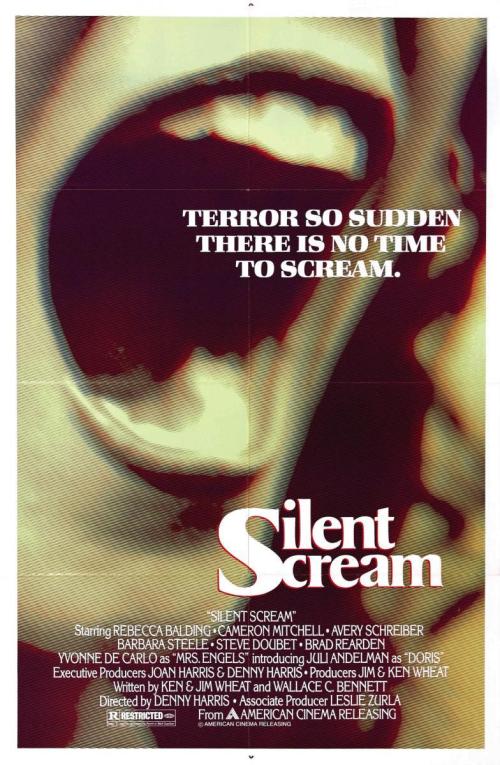
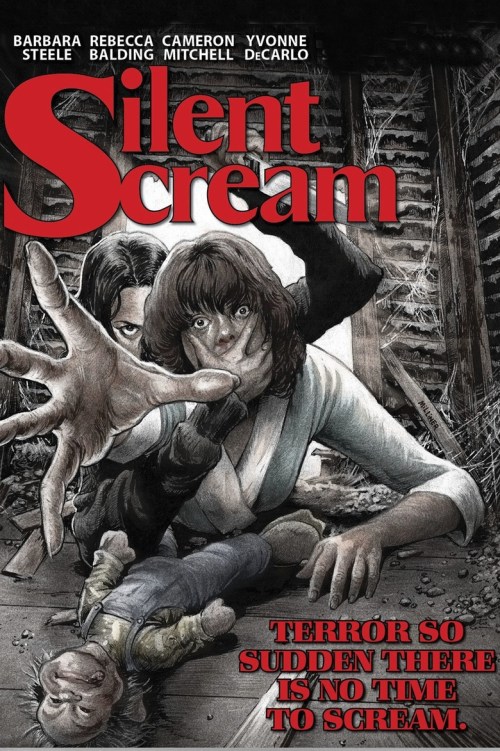
The Silent Scream (1979)

By Richard Winters

My Rating: 3 out of 10

4-Word Review: Family’s dark secret exposed.

Scotty (Rebecca Balding) is a student away at college who finds nearby housing at a large stately mansion owned by Mrs. Engels (Yvonne De Carlo) and her son Mason (Brad Reardon). When Scotty moves in she meets three other college students (Steve Doubet, Juli Andelman, John Widelock) who are also living there, but during the next couple of day those other students start turning up dead. Scotty fears she may be the next victim and suspects the killings may have something to do with the mysterious person that’s hiding in the attic.

In the summer of 1977 Denny Harris, who was at that time a successful commercial director who owned his own studio, decided to take a try at directing a horror movie and he put down $450,000 of his own money to do it. Unfortunately when production wrapped the footage shot was deemed unreleasable, so Jim and Ken Wheat, two brothers, were brought in to try and salvage it, but instead decided to completely rewrite the script and reshoot almost the entire film leaving only 12 minutes of the original footage in the final cut. This includes a scene where the Mason character watches what looks to be a soft core porn flick on his TV in his bedroom, but was actually a scene from the original version with Susan Backlinie, the lady who got attacked by the shark in the opening bit of Jaws, playing one of the characters.

It would be interesting if a Blu-ray could be issued that would show the version that Harris shot alongside the Wheat brother’s one because I suspect it might not have been any worse than what we end up getting here. For one thing the plot is too skimpy and the pacing slow. Too much extraneous footage of Scotty looking for an apartment and conversations she has at a bar with friends, and even her making love with Jack that doesn’t help build the tension at all and should’ve been cut out.

When the ‘scares’ do come they’re not all that great. The stabbing sequences are particularly annoying because the same Bernard Herrmann-like score that was used in Psycho gets played here making it all seem quite cliched. The blood is another issue as it conveniently collects on a hanging white sheet as the victim gets pummeled with a knife as well as a pool of it on the floor, which our protagonist somehow misses seeing when she goes to investigate. Yet I’ve watched enough true-life crime shows to know that blood splatter doesn’t work that way, but instead sprays out all over with droplets of it splattering on the walls, ceiling, and other appliances until it would be quite obvious to anyone entering a room that a murder had occurred there and unlike what happens here.

Spoiler Alert!

The flimsy plot gets played-out too quickly. In a matter of just two days of staying there the dark family secret and all the ugliness behind it gets completely revealed, which makes for an anti-climactic feeling when it’s over. The protagonists seem to be nothing more than dressing with have very little to do as they ultimately stand helplessly on the sidelines while the bad guys kill-off each other, which isn’t very gripping.

A better idea would’ve been to have the villainous family, which are far more interesting and better acted than any of the college kids, be the stars of the film. Then having the film show how they bring in tenants through the years to help defrays costs, but reluctantly forced to kill them when they get too noisy, only to ultimately meet their match with one of them similar to how What Ever Happened to Aunt Alice? was structured.

The only riveting moment in the movie comes when a young woman, played by Tina Tyler, tries to hang herself via a noose hung from a light fixture in her bedroom. Most of the time hangings in films are either shown from the waist up or down, but here we get a bird’s eye shot where her feet clearly leave the floor with the rope around her neck and nothing else to support her making it seem like she really is hanging herself especially as her body begins to struggle, which is impressively graphic.

My Rating: 3 out of 10

Released: November 16, 1979

Runtime: 1 Hour 27 Minutes

Rated R

Director: Denny Harris

Studio: American Cinema Releasing

Available: DVD, Blu-ray, Amazon Video

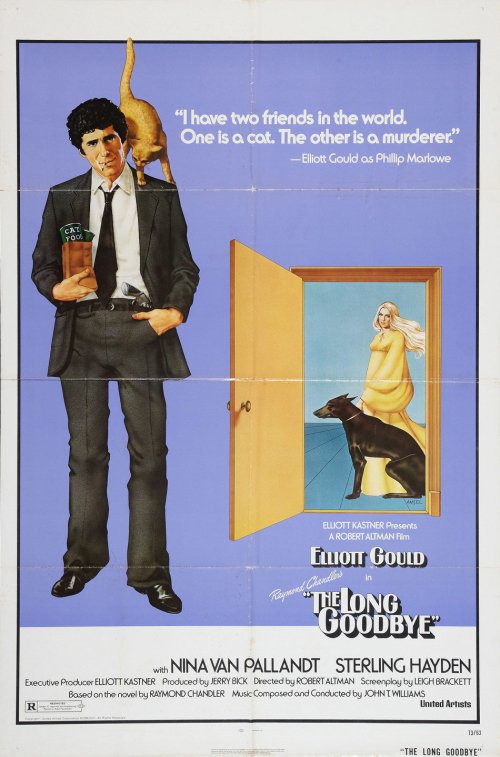
The Long Goodbye (1973)

By Richard Winters

My Rating: 7 out of 10

4-Word Review: His cat is hungry.

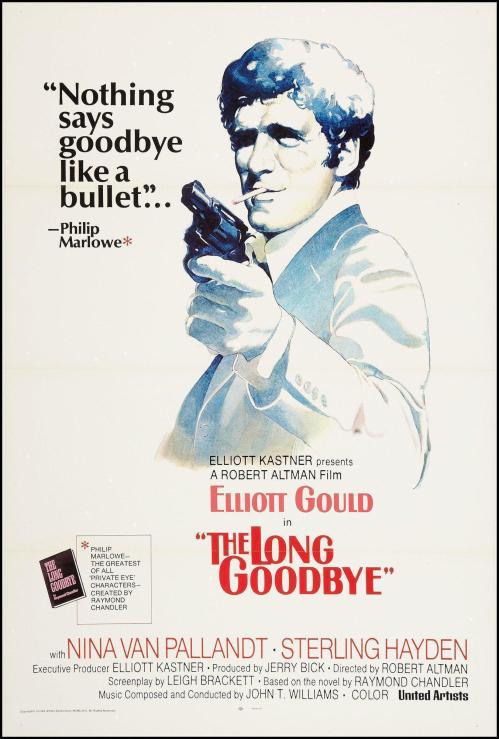
One night detective Phillip Marlowe (Elliot Gould) is visited in his home by his long time pal Terry Lennox (Jim Boulton), who informs Marlowe that he’s had a fight with his wife and asks him if he can have a ride to the Mexican border, which he obliges. When he returns home he is met by two cops (Jerry Jones, John S. Davies) who bring him into the station with questions about the whereabouts of Lennox whom they insist has just killed his wife. When Marlowe refuses to divulge anything he gets put into jail only to released 3-days later when it’s reported that Lennox has killed himself. Marlowe becomes suspicious about the suicide and determined to do his own investigation while also getting involved with Eileen Wade (Nina van Pallandt) and her alcoholic, writer husband Roger (Sterling Hayden) both of whom may hold the secret to Lennox and what really happened.

By the early 70’s only two of Raymond Chandler’s novels had yet to be filmed, this one and ‘Playback’. United Artists agreed to finance the film and commissioned Leigh Brackett, who had been the screenwriter for another Chandler novel turned into a movie 1946’s The Big Sleep, to write the screenplay for this one. Robert Altman was later approached to direct it and while he was not a fan of the Phillip Marlowe character, whom he labeled as being a ‘loser’, he agreed to take on the project due to the unexpected ending, which had not been in the novel, but that Brackett had added into the screenplay.

While Altman may have seemed an odd choice, he never even read the source novel of which the film is based, the eccentric little sidelights that he adds into the proceedings make it worth it. Some of the movies that he did towards the late 70’s became a bit too undisciplined where his films would go off on tangents with stuff that had very little to do with the main plot, but here the story is strong, so the little detours that Altman adds in helped to playfully accentuate the plot instead of drowning it out.

Some of my favorite Altmanisms included  Marlowe looking for food to feed his hungry cat, who I might add for an animal gives a spectacular performance, and how a stocker that he meets at the grocery store while searching for cat food he ends up meeting again at random at the police station. The next door female nudists, who are also into yoga and attract the attention of both the police and the bad guys who come to Marlowe’s place, are fun too.

There’s some marvelous framing by cinematographer Vilmos Zsigmond including capturing Roger and Eileen having an argument inside their home, which was filmed at Altman’s Malibu residence, through a glass patio door while at the same time in the reflection you see Gould walking along the beech. Later while Eileen and Marlowe are having a conversation by an open window you can see in a distance, which the other two are unaware of, Roger walking into the ocean in an attempt to kill himself.

Spoiler Alert!

The film also features what I feel is one of the most shocking and disturbing scenes that I’ve ever seen put into a movie and that’s a statement that I don’t use lightly. I’ve seen hundreds of gory horror films, but what happens here I’ve found far more unsettling. I think the reason is because it’s completely unexpected as it features the character played by film director Mark Rydell smashing a glass coke bottle onto the face of his girlfriend who just seconds earlier he had stated that he was deeply in-love with. Hearing her scream out in unending pain while cupping her hands over her face as blood spews out makes it come-off as very real. Even more amazing is that the part of the girlfriend was played by an amateur named Jo Ann Brody who never appeared in any other film and was a waitress that Altman and Brackett met when they went out to dinner while working on the script and who they asked on-the-spot if she’d like to be in their movie.

Altman admitted that he knew this violent scene, which had not been in the book, would upset some fans, but he felt it was important to bring the viewer back to the reality that these were violent characters at heart. This could also be seen as a foreshadowing to the surprise ending when Marlowe finds Lennox still alive in Mexico and then unexpectedly shoots him. In the novel Marlowe allows Lennox to walk away unharmed, but Altman liked the violent twist.

Personally I was ambivalent with the ending here and might actually have preferred the way it was done in the book. My main issue though with it is that Eileen spots Marlowe leaving the place where Lennox was just shot and since she was in a relationship with Lennox and also had strong criminal connections I’d think she’d end up, one way or another, going after Marlowe once she realized he had killed her lover causing the ending to leave open too many potentially interesting tangents that should’ve been followed through on.

My Rating: 7 out of 10

Released: March 7, 1973

Runtime: 1 Hour 52 Minutes

Rated R

Director: Robert Altman

Studio: United Artists

Available: DVD, Blu-ray, Amazon Video

The Bell Jar (1979)

By Richard Winters

My Rating: 3 out of 10

4-Word Review: She suffers from depression.

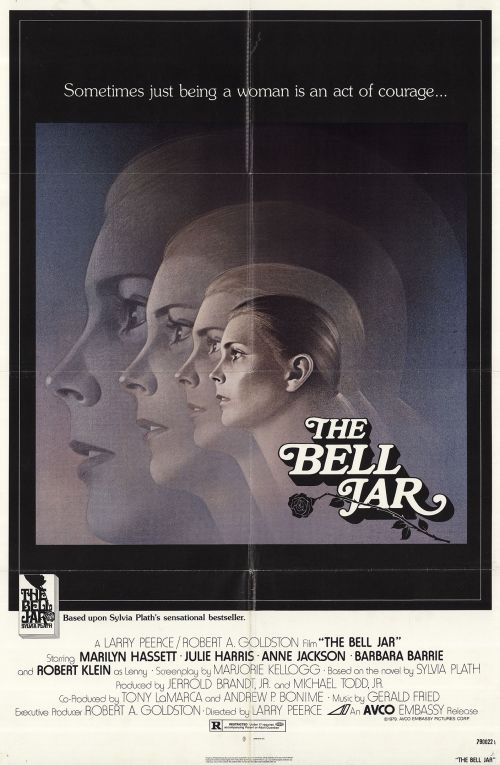
Based on the semi autobiographical novel of the same name by Sylvia Plath, the story centers around Esther (Marilyn Hassett) who suffers from various mental health issues and can’t seem to relate to the world around her. After graduating from college she goes off to work at a women’s magazine in New York, but finds that the demands and inevitable compromises of being a writer for a big city publication are not for her. She returns home to her mother (Julie Harris) only to find her emotional situation deteriorating even more. She’s eventually sent to a mental hospital where she goes through treatment.

In 1975 Hassett was picked from over 500 other actresses to play the part of paralyzed skier Jill Kinmont in the film The Other Side of the Mountain. The movie became a big hit and lead to her marrying the film’s director Larry Peerce.  While that film was a decent heartfelt story their attempts to bring Plath’s complex, multi-faceted novel to the big screen was clearly an overreach.

The major reason this doesn’t work is because of Hassett. During the early 70’s she had a youthful appeal, but by the time this was filmed she had hit 30 and no longer looked like a recent college grad in any way. For the story to work it hinges on the viewer seeing this person as someone who is young, innocent and vulnerable and unable to deal with the harsh realities of the young adult world that she’s experiencing for the very first time, but Hassett looks and in many ways behaves like a world-weary middle-aged person, which then loses the intended effect.

The portrayal of the central character is a weak point as well. In the similar themed film I Never Promised You a Rose Garden, which came out around the same time, the director of that flick did a good job of getting inside that character’s head and allowing the viewer to see the thoughts and fears that she had, but here we get none of that. We are left with no understanding about what’s really bugging Esther and why she behaves the way she does. Instead of us feeling for her we end up finding her off-putting, confusing and at times just downright selfish and bizarre.

The film does still manage to have a few interesting moments. I liked the scene with Jameson Parker, in his film debut who later went onto fame in the TV-show ‘Simon & Simon’, playing Esther’s fiance who strips in front of her so she can see what a naked man looks like upfront for the very first time. The erotic threesome between Hassett, Robert Klein, and Mary Louise Weller is interesting too as is the segment where Hassett is sitting alone at a late night diner and comes into contact with a disturbed, homeless man (Nicholas Guest) who comes in off the street and begins shouting nonsensical things for no reason, which can be a common, frightening reality living in the big city and not tackled enough in most movies.

While the movie stays pretty much faithful to the book it approaches the material in a shallow, mechanical way that offers no insight into the characters or situations and elicits no emotions from the viewer. It also takes some liberties with the material entering in elements that were never in the novel, or only vaguely touched on like the character of Joan, played by Donna Mitchell, being explicitly portrayed as a lesbian while in the book it had been only implied. She’s also shown making a suicide pack with Esther that was never in the original story. This was enough to get Dr. Jane Anderson, a Boston psychiatrist, to sue the film stating that she had been the Jane character in Plath’s novel, but because the movie distorted the truth it had harmed her reputation and career and she ended up winning a $150,000 settlement.

My Rating: 3 out of 10

Released: March 21, 1979

Runtime: 1 Hour 53 Minutes

Rated R

Director: Larry Peerce

Studio: AVCO Embassy Pictures

Available: VHS

Best Friends (1975)

By Richard Winters

My Rating: 4 out of 10

4-Word Review: Road trip turns nightmarish.

Jesse (Richard Hatch) and Pat (Doug Chapin) have been best friends since childhood. Now both are ready to enter into young adulthood. To celebrate they decide to take a road trip via a camper across the American southwest along with their two girlfriends: Kathy (Susanne Benton) and Jo Ella (Ann Noland). As the trip progresses the differences between the two men become more pronounced. Jesse is ready to settle down and get married while Pat remains a free-spirit wanting to party with no limits. Pat also resents the presence of Kathy who he feels is getting in the way of his friendship with Jesse. He tries different tactics to get them to break-up and when that doesn’t work he resorts to a more drastic measures.

The film is interesting to a degree and goes against most other road pictures that usually show the bond between two people growing as the trip progresses while here it devolves. The low key approach allows for a certain diversion including a wonderfully majestic bird’s eye shot of the camper driving along the highway with a beautiful mountain range seen in the background. The pace is slow and the scenes could’ve been trimmed, but first-time director Noel Nosseck manages to at least have some drama flowing in each segment and thus enough to hold a modicum of interest.

Most will be intrigued to see Hatch in his film debut and while his performance is adequate it’s actually Chapin, who’s last film this was to date, that comes off better in a portrayal of a ticking time bomb ready to go off. Although I couldn’t help but notice his severely scarred right hand, which is not a part of the story and only seen briefly in one shot, that looks like the pinkie finger was severed off at some point in an accident and then surgically reattached.

The film’s downfall comes with Pat’s dissent into psychosis, which  needed more context. Friendships ebb and flow and a person could be best friends with a certain individual at one point in their life, but not in another one. When one friend gets married and the other one doesn’t then the single person finds other friends whose lifestyles remain more similar to his. Rarely if ever does it resort to the friend trying to kill the other’s girlfriend. To simply write this all off as being Pat’s inability to adapt to change or his jealousy is not enough. His behavior is too extreme and more of a background on his life and upbringing needed to be shown for us to make sense of it.

It would’ve worked better had it started with the two friends meeting in childhood and showing the good times they had throughout the years before even getting to the road trip, which should’ve been pushed back to the second act instead of right at the beginning. The two talk about their past, but in film it’s better for the viewer to see this for themselves instead of only being told about it. There should’ve also been some explanation for why Jesse didn’t see any red flags to Pat’s psychotic tendencies years earlier as they were so close you’d think he would’ve noticed the imbalanced much sooner instead of it all becoming a shock to him like everyone else at the end.

The ending is weak and offers no resolution. Jesse’s response to Pat’s behavior becomes almost as bizarre making it seem like he’s just as crazy as his friend, but since the characters are so poorly fleshed-out it’s hard to tell if that was the intention or not.

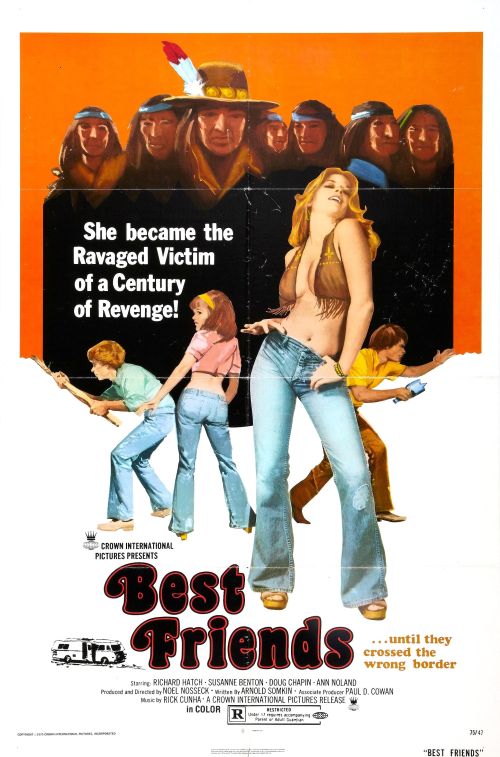
The film’s promotional poster seen above is quite misleading as it implies that’s it’s all about a confrontation between the 4 and a group of Native Americans. It is true there is a scene where a fight breaks-out between them at a bar, but it is brief and does not have anything to do with the main story.

My Rating: 4 out of 10

Released: May 29, 1975

Runtime: 1 Hour 23 Minutes

Rated R

Director: Noel Nosseck

Studio: Crown International Pictures

Available: DVD (Savage Cinema 12-Movie Collection)

The Man with Two Brains (1983)

By Richard Winters

My Rating: 6 out of 10

4-Word Review: Brain in a jar.

Dr. Michael Hfuhruhurr (Steve Martin) is a world famous brain surgeon who accidentally hits Dolores Benedict (Kathleen Turner) one day while driving his car. He immediately does surgery on her and during the recovery the two get married. However, Dolores is only interested in Michael’s money and continues to see other men behind his back. Michael on-the-other hand  meets with Dr. Alfred Necessiter (David Warner) who keeps live brains in jars in his condo. Michael (Steve Martin) begins communicating with one of the brains (voice of Sissy Spacek) via telepathy and decides it is she that he really loves. When he becomes aware that the brain will not survive much longer on its own he desperately tries to find a suitable body to transplant it into.

This Steve Martin/Carl Reiner production, which is their third project together, certainly has its moments and I particularly liked the the mysterious elevator killer although once his identity is finally revealed viewers today will have no idea who that person actually is. However for the most part the film is highly uneven. Having it centered as a horror movie parody would’ve given it better focus and the jokes more of a point-of-view instead of just throwing in any haphazard gag it wants many of which have nothing to do with its already paper thin plot.

I realize this is all meant to be a very silly comedy, but having two victims get hit by a vehicle, once with Turner and then later on with Stephanie Kramer, in her film debut, where neither victim shows any sign of blood, scratches, or bruising is a bit ridiculous. This is where if it had been approached as a horror/comedy then they could’ve thrown in some gore, but in an over-the-top goofy way, that would’ve allowed a new dimension for laughs while also given it just a smidgen of reality to it, which otherwise is lacking.

Martin’s ability to have a conversation with a brain in a jar without any special apparatus connecting the two is equally ridiculous. The excuse is that it’s ‘telepathy’, but why is he able to communicate with just the one brain when there are many others that are also in the room? What special ability does this brain have over the others and why is Martin the only one that can hear it and no one else?

Having Martin hear Spacek’s voice as her thoughts come into his brain doesn’t make sense either. The definition of telepathy is the  communication of thoughts and ideas other than the known senses, but nothing to do with voices. Thoughts in themselves don’t have a distinct voice connected to them unless the brain is attached to a voice box, which this one isn’t.  It is true that thoughts going on in person’t own head may have that person’s voice, so Martin should actually be hearing his own voice as his brain deciphers the messages being sent to it from the other one much like if he were reading out loud a note that had been written by someone else.

This also marks an odd career choice for Turner who burst onto the scene with her sexy performance in Body Heat . I realize that in her effort to avoid typecasting she wanted to do something that was completely different from her first film, but her character is too campy and one-dimensional and she ends up getting completely upstaged by Martin in every scene they’re in. The role also has a creepy foreshadowing as her character gains a lot of weight much like she has in reality due to her rheumatoid arthritis. In real-life it’s the drugs and chemo that caused the weight gain while here it’s created through make-up and a body suit and intended for comical effect.

There’s also an interesting behind-the-scenes story dealing with a scene involving a 5-year-old girl, played by Mya Stark, who must verbally repeat back to Martin from memory a very complicated set of directions that he had just told her. Since she was too young to read no cue cards were used and director Reiner figured it would take all day to film the scene convinced that many retakes would inevitably be required for her to finally get the lines right, but instead to his shock she repeated the lines back correctly the very first time. Then 30 years later in 2012 Reiner was standing in line at a store when a female business executive approached him and introduced herself. She stated that they had met many years before, but Reiner didn’t recognize her until she told him that she was that little girl now all grown up.

My Rating: 6 out of 10

Released: June 3, 1983

Runtime: 1 Hour 31 Minutes

Rated R

Director: Carl Reiner

Studio: Warner Brothers

Available: DVD, Blu-ray, Amazon Video, YouTube

Pennies from Heaven (1981)

By Richard Winters

My Rating: 7 out of 10

4-Word Review: Escaping from the depression.

Arthur (Steve Martin) is a struggling sheet music salesmen during the depression, who’s looking to escape his dreary existence by becoming a songwriter, but finds that no one including his wife (Jessica Harper) cares about what his dreams, which leaves him feeling lost and alone. He then meets perky schoolteacher Eileen (Bernadette Peters) and the two begin an affair despite her not knowing that he is already married. When she gets pregnant and loses her job because of it Arthur is nowhere to be found and instead he gets unjustly tabbed for committing rape on a blind woman (Eliska Krupka) that he did not do.

The film is based on a 6-part miniseries that aired on the BBC in 1978 and starred Bob Hoskins. Martin saw it and was so enamored with the story that he became compelled to have it remade here and the studio even hired the same writer, Dennis Potter, to pen the script although the studio forced him to do 13 rewrites before they finally accepted it. Despite the extravagant musical numbers, which are pretty good, and positive critical reception, the filmed failed to achieve any success at the box office where it took in a paltry 2 million that barely made a dent in its 22 million budget.

A lot of the blame can be placed on the casting of Martin. While I admire him for not allowing himself to be typecast, and for dying his hair brown here, he still comes off as misplaced. You keep waiting for him to say something goofy and absurd like his character in The Jerk would and when he doesn’t you start feeling bored and frustrated. For his part he lashed out at those that didn’t like it calling them ‘ignorant scum’ while anyone who did enjoy the film he labeled ‘wise and intelligent’.

Yet his character is also a problem as he comes off as arrogant and selfish the whole way through. He constantly antagonizes his shy wife pressuring her to submit to his kinky sexual fantasies and when she doesn’t he threatens to walk out. He then lies about his marital status to Peters and is cold and ambivalent when she gets pregnant making him seem like a true jerk and not the funny kind in his earlier film.

Jessica Harper I enjoyed much more. I think she gives her finest performance here and I was genuinely surprised she wasn’t nominated for an Academy Award. Her interpretation of a shy, sheltered Midwestern wife from a more innocent era is completely on-target and I came to sympathize far more with her than Martin. The line that she utters when the police investigators come to her house, after Martin gets accused of rape, is the best moment in the movie. Peters is good too, but I felt her character got in the way and the film would’ve gelled better had it focused solely on the dysfunctional marriage.

The dance numbers are well choreographed with the best one being with Christopher Walken who does a bona fide striptease that took him over 2 months to rehearse. The bit in which Martin and Peters find themselves transported inside a film starring Fred Astaire and Ginger Rogers is quite cool too although Astaire himself tried blocking the footage from being used. He later commented that as a viewer ” I have never spent two more miserable hours in my life” and describing every scene in the film as being “cheap and vulgar.”

The story though starts out too slowly and for the first hour seems like there really isn’t any plot at all. It improves by the second half, but there needed to be more urgency at the beginning and many viewers may not be willing to stick with it.  Having the actors lip-sync the songs was a bad idea too. It gives the whole thing an amatuerish vibe making it seem like it was intended to be a campy comedy when it really wasn’t.

My Rating: 7 out of 10

Released: December 11, 1981

Runtime: 1 Hour 48 Minutes

Rated R

Director: Herbert Ross

Studio: MGM

Available: DVD, Amazon Video, YouTube