Category Archives: Movies with Nudity

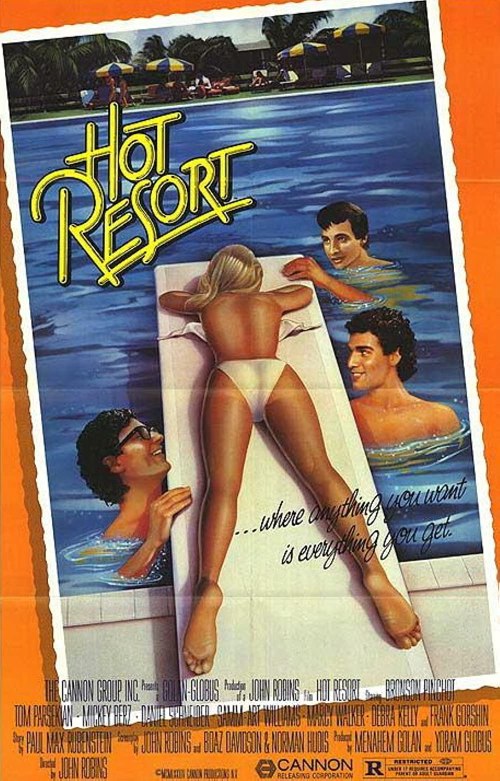
Hot Resort (1985)

hot

By Richard Winters

My Rating: 2 out of 10

4-Word Review: Looking for some action.

Filmed on the island of St. Kitts in the West Indies the story, or what little there is of it, follows around a group o college men lead by Brad (Bronson Pinchot) and Chuck (Dan Schneider) who travel there in order to work at the resort and earn some money over the summer. They hope also to hit-on the bikini-clad babes in-between shifts and seem to have sex much more on their minds than work. The resort manager (David Lipman) hires disciplinarian Bill Martin (Samm-Art Williams) to get them under control, but even he has a hard time keeping them in-line. The boys also clash with a group of snotty ivy leaguers, who are on the island to film a soup commercial. After having several run-ins with them the boys challenge the Ivy guys to a rowboat race and become determined to beat them even if it means cheating.

This yet another low budget production produced by The Cannon Group, which was run by Yoram Globus and his cousin Menaham Golan. They made a business of buying bottom barrel scripts and turning them into low budget productions and while some of them where a delightful surprise and even rivaled a standard Hollywood production this was certainly not one of them. The script was co-written by Boaz Davidson, who had earlier success with the Israeli teen comedy Lemon Popsicle, which was later Americanized into The Last American Virgin that was also written and directed by him, but this one has none of the comic spark of those and seems compelled to reach to the lowest common denominator possible almost challenging the viewer to see how much inane, low brow humor they’re willing to sit through before turning it off.

Granted 80’s teen sex comedies where never meant to be masterpieces, but this thing, even when compared to those others, is incredibly uninspired and adds nothing new to the otherwise tired mix. The only two things that are a bit different from the norms of that genre is that the fat guy, played by Schneider, who later went on to star in the TV-show ‘Head of the Class’, isn’t shown constantly stuffing his face with food, or the butt of all the jokes. In fact he’s portrayed as being just as hip as the others and getting more action than the rest of them.

The film also switches things around in that it isn’t the men that are on the aggressive make, but instead the women, who literally grab the guys as they’re walking and minding their own business and then bring them into a room for hot action. At one point they even swipe an elderly man off the sidewalk though it’s hard to believe that any woman could be that oversexed. It might’ve made the story more funny and at least given it a certain logic by having the females take some sort of drug that causes them to become sexual animals, but that’s not the explanation here, which just makes the shenanigans all the more insane.

I started to wonder too if these gals were on the pill because if not they risked getting pregnant, which would force them to either get a lot of abortions, or raising kids they really didn’t want all by themselves since they didn’t even bother to get the names of the guys they had fucked, and seemed to choose them at random. Also, if you really think about it, it comes-off like rape as the men constantly say no and resist making it more like we’re witnessing a crime than just a carefree sex.

The guys who play Ivy Leaguers speak in such an overblown accent that it’s not even mildly amusing, but genuinely irritating and there’s simply no way that anyone who talked like that, no matter how deluded they were, would think they were cool and not worried that people would be making fun of them behind their backs. I will give some props though to the scene where the emergency medical personal must come to the aid of a couple who get stuck inside a car that they were making love in forcing the fire department to saw off the roof of the vehicle to get them out though anyone who would even think of trying to have sex in the back seat of a tiny VW bug should have their heads examined.

Some of the supporting players are amusing particularly Stephen Stucker, who plays the same type of character that he did in Airplane! where he’d jump into a scene say something quirky and then quickly jump back out. I also enjoyed Frank Gorshin (billed as Mr. Frank Gorshin) a talented impressionist who rose to fame playing the Riddler on the ‘Batman’ TV-show. Here he plays a dirty minded middle-aged man who tries to teach the youngsters the finer points of hitting-on chicks much to the consternation of his wife (Zora Rasmussen) who sits next to him and listens in as he talks about it. Mae Questal though, who’s best known for being the voice of Betty Boop and Olive Oyl gets sorely wasted particularly in the scene where she gets ‘tricked’ into putting on a dress with a giant bullseye on the back, which her husband plans to use as a target to aim his gun at, though it’s hard to imagine any woman wouldn’t have seen this before she put it on, which just shows how stupid and poorly thought out the gags are.

Even on the level of cheap, soft core porn it’s no good. The nudity is infrequent and fleeting and the women aren’t exactly cover girls looking more like they’re around 30 and a bit ‘rough-around-the-edges’, so if you’re looking to grab this thing simply for some healthy voyeurism you’ll still end up sorely disappointed anyways.

My Rating: 2 out of 10

Released: January 14, 1985

Runtime: 1 Hour 33 Minutes

Rated R

Director: John Robins

Studio: The Cannon Group

Available: VHS, DVD-R (dvdlady.com)

Phobia (1980)

phobia1

By Richard Winters

My Rating: 3 out of 10

4-Word Review: His patients are dying.

Dr. Peter Ross (Paul Michael Glaser) is a Canadian psychiatrist who has come up with a radical new therapy to help cure those who suffer from phobias. The program includes having them watch their fears played out visually on the big screen and thus forcing them to conquer those irrational thoughts and be able to go on living normal lives. Peter feels he’s making great progress with his patients only to suddenly have them start to die-off one-by-one with each perishing in ways that reflects their private phobia that they had hoped to overcome.

This is definitely one of those movies where what happened behind-the-scenes had to be far more interesting than anything that occurred in front of the camera. Having John Huston, the legendary director who helmed such classics as The Maltese Falcon and Key Largo doing this one, which is nothing more than a cheap thriller with 80’s slasher instincts, has to be the most baffling thing about it. It wasn’t like his career was on the outs either as he went on to direct several more critically acclaimed flicks in the 80’s that were well financed with big name stars and he had just 5 years earlier did the well received The Man Who Would Be King, so why he decided to take a weird foray into doing this inept thing, which just by reading the script you could tell was a mess upfront, I don’t know.

It starts out with some visual panache, but otherwise could’ve easily been directed by a no-name, two-bit director and no one would’ve known the difference. The one segment dealing with a car chase down the city streets that culminates with a man falling from a tall building had some potential though I would’ve framed the shot differently showing it from a bird’s-eye view where the viewer could see how far off the ground the victim really was versus having the camera on the ground looking up, which is less dramatic. I suppose it might’ve given away the safety net that’s clearly present as you never see him hit the ground, it cuts away while he’s still in mid-air, but in either case it’s the only mildly diverting moment of the whole film.

Everything else is run-of-the-mill including the numerous deaths, which despite the tagline don’t all have to do with their phobias either. For instance one woman fears being in big crowds, so in order to ‘cure’ her, the doctor has her go onto a crowded subway, but she panics and runs back to his place where she ultimately dies when a bomb explodes. The segment dealing with a woman who fears men gets pretty ridiculous as he has her watch a movie of a woman getting gang raped, which would appall anyone and yet when she runs out of the room in disgust and shock he’s confused. The very fact that he talks about ‘curing’ his patients is a major red flag altogether as in psychiatry you never really ‘cure’ anybody, which just shows how poorly researched and shallow the script really is.

Paul Michael Glaser, better known for his work in the TV-show ‘Starsky and Hutch’, makes for a wretched leading man and it’s no surprise that he decided to get into directing after this one and has never starred in a theatrical film since. It’s not completely his fault as his character exudes a cold demeanor, so you never really care about him, or his quandary. John Colicos, as the police detective, is far superior and helps enliven the film with the few scenes that he is in though his interrogation techniques are highly unethical and the fact that he only focuses on one angle as to who the culprit is makes his character come-off as unintentionally inept.

The film does feature a twist at the end as to who the killer really is, but it’s dumb and not worth sitting through. In fact the ultimate reveal is so bad that it ruins everything else that came before it, as it had been watchable up until that point, but the climax solidifies it as a bomb.

My Rating: 3 out of 10

Released: September 26, 1980

Runtime: 1 Hour 30 Minutes

Rated R

Director: John Huston

Studio: Paramount Pictures

Available: Blu-ray

Buster and Billie (1974)

buster2

By Richard Winters

My Rating: 5 out of 10

4-Word Review: Dating a loose woman.

Buster (Jan-Michael Vincent) is a high school senior living in rural Georgia during the late 1940’s. He’s been dating Margie (Pamela Sue Martin), but finds her to be stuck-up and her unwillingness to have sex makes him frustrated. He begins seeing Billie Jo (Joan Goodfellow), who has moved into town and due to having limited social skills puts-out for the other boys by allowing them to have sex with her, one after the other, in the woods late at night. Buster at first dates her simply for the action, but eventually the two get into a serious relationship and he breaks-up with Margie. They begin going out publicly letting the whole town know that they’re a couple, but the other boys become jealous as they can no longer have easy sex like they use to and thus plot a dark revenge.

The story is based loosely on an actual event that occurred in Florence, South Carolina in 1948 that the film’s screenwriter Ron Turbeville remembered hearing about growing up. The recreation of the era though lacks style and this may be in large part due the film’s limited budget. While it gets a zero in  atmosphere I did at least like the way it doesn’t sugar coat things for nostalgic purposes. The teens behave in the same ways they do now and thus it’s gritty on that level.

The acting is good surprisingly even from Jan-Michael who in his other films tended to have a cardboard presence, but here he gives the thing most of its energy. He even appears, shockingly, fully nude and in fact this was the first mainstream American movie to show a male naked from the front, of which Jan stated in later interviews he was quite proud to expose of his well-endowed ‘equipment’. Goodfellow is also seen nude and is quite attractive though I wish she had more to say. Robert Englund, in his film debut, is the most memorable playing an albino with brown hair and his pale complexion makes him look creepier, at least I felt, than he did as Freddy Kruegar.

I didn’t understand though why Buster would risk his social standing for this ostracized girl. I got that Margie was annoying, so breaking-up with her wasn’t a stretch, and Billie was essentially ‘easy-pickings’, but why go public with it? It made more sense that they would’ve seen each other on the sly, but not wanting to risk the social scrutiny of letting everyone know about it. This would’ve clearly lost Buster’s social status not only amongst his friends, but the town as a whole including his own parents, so why add on all that needless stress? Billie too was very shy, so becoming center stage and having all eyes on her would be something she most likely would’ve wanted to avoid, which makes the second act overly idealistic.

It’s also frustrating that Billie doesn’t say much. You want to get to know this person, but never really do. The only time she’s ever given any insight is when Buster explains to his parents why she had sex with all the other guys (in order to be liked), but this is something we should’ve heard coming-out of her lips instead of his. By having Buster do almost all the talking, even when they’re alone together, makes it seem like she’s mentally handicapped, which I don’t believe was the intent and yet ultimately that’s how it comes-off and thus making their romantic moments sterile and uninteresting.

Spoiler Alert!

The final sequence though is where it really falls apart as the boys inadvertently kill Billie when they gang rape her (during a rainstorm even though the sky is still clear and sunny). Buster then tracks them down at a pool hall where he single-handily beats them up and ultimately kills two of them, but the guys just allow themselves to be beaten without attempting to throw a punch, which is not only unrealistic, but boring. Having a big brawl, where each side fights equally would’ve been far more exciting. The twist in which Buster somehow gets released from jail the day after her funeral, so that he can decorate her gravesite with all the flowers that he’s stolen from everyone else in town is far-fetched and overly forces the sentiment.

My Rating: 5 out of 10

Released: August 21, 1974

Runtime: 1 Hour 40 Minutes

Rated R

Director: Daniel Petrie

Studio: Columbia Pictures

Available: Amazon Video

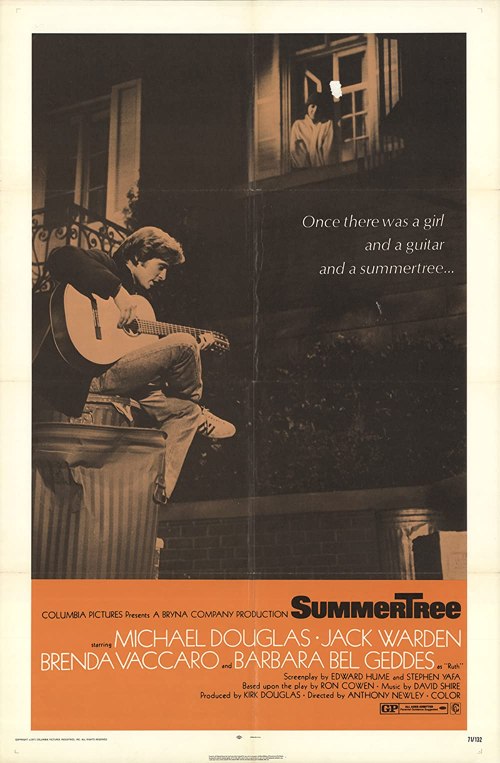
Summertree (1971)

summertree

By Richard Winters

My Rating: 6 out of 10

4-Word Review: Dropping out of college.

Jerry (Michael Douglas) is a 20-year-old university student who finds going to college to be drag as he’s disinterested in the subjects being taught and would rather play his guitar for a living. Since the year is 1970 his parents (Jack Warden, Barbra Bel Geddes) fear that this could get him drafted and advise against it, but Jerry refuses to listen convinced that he’ll get accepted into the conservatorium, which will restore his student draft deferral. In the meantime he also starts up a relationship with Vanetta (Brenda Vaccaro), a local nurse he meets when he brings in Marvis (Kirk Calloway), a black youth he’s spending time with through the big brother program, into the hospital after he skins his knee. Everything seems to be going Jerry’s way, he even gets a job playing his guitar at a local coffeehouse, but then the draft notice comes in the mail and the  music school decides, to his shock, not to accept him. He feels he has no other choice but to escape to Canada, but Vanetta does not want to go with him and his parents don’t think this is a good idea and secretly plot to prevent it.

The film is based on the stageplay of the same name by Ron Cowen that was produced in 1967 and originally had Douglas cast in the lead only for him to get fired during the rehearsal phase and replaced by David Birney, which so incensed his father Kirk, that he bought the rights to the play in order for it to be made into a film that his son could star in. It’s directed by Anthony Newley, which is an unusual choice since Newley was from Britain and not as affected by the Vietnam war and also for the fact that he was mainly known as an actor, writer, and singer with very little hand in directing. Overall he does okay, but the song done over the opening credits, which is sung by actor Hamilton Camp, is atrocious and makes you want to turn it off before it’s even begun. The stop-action ‘comedy’ done through a home movie type look, that gets shown while the horrible song is played, is bad too making this thing really stumble out of the gate though it manages to recover.

The plot works like three stories compressed into one. The segments dealing with Jerry’s relationship with the child, who is very streetwise and foul mouthed, but still quite engaging, are the best. His attempts to form a relationship with Vanetta though prove awkward as he follows her down a lonely dark alley late at night, which would make him seem by today’s standards like a stalker, and then taking her out to a cemetery on their ‘first date’ when it’s pitch black out would not be something most people would find romantic and instead quite creepy. Vaccaro is a great actress though more in roles featuring strong women and not necessarily as a love interest. This did precipitate a long on-going relationship between the two in real-life that lasted 6 years and for voyeurs you also get to see her topless as she rarely ever did nude scenes, but for whatever reason decided to do it here.

Spoiler Alert!

His relationship and conversations with his parents I initially found interesting. Coming into the movie I thought this would be a long, drawn-out arguments of conservative old-school parents and the liberal kid, but that’s not really the way it works. The parents are against him going to war as much as he is and it’s only the staying in school part that they find disagreement, but then when he decides to go to Canada in a last ditch effort to avoid the draft suddenly they’re against that too even to extent of trying to bribe a mechanic to fiddle with Jerry’s car, so he can’t drive it, but why? The shift in their perspectives seemed too quick. If they’re concerned they might not be able to see him much if he’s stuck in another country it would still be better than him coming home in a body bag and even if he does come out of it alive he’d be emotionally scared, or physically disabled for life, which wouldn’t occur if he was in Canada, so from my perspective the parents should’ve supported his ‘escape plan’ and the fact that they don’t needed more explaining.

The ending in which the parents are in their bedroom, with Jerry now off to war, and them acting like ‘everything will work out’, which is a far cry from what they thought before, gets botched. For one thing there’s an issue of Life magazine sitting on top of the TV talking about the weekly body count from the war on it’s cover, but I would think the parents would’ve thrown that out as they wouldn’t want to be reminded that their son may soon become one of those statistics and just leaving it in a place where they’d constantly be reminded of it didn’t seem realistic. They also both roll over and go to sleep while leaving the TV on, but who does that? Seeing an image of Jerry’s dead body being carried away on the TV isn’t the shocking surprise that the filmmakers though it would be as as the film spends a lot of time priming the viewer that is what it’s leading up to making the final image corny and even tacky instead of riveting.

My Rating: 6 out of 10

Released: June 9, 1971

Runtime: 1 Hour 29 Minutes

Rated R

Director: Anthony Newley

Studio: Columbia Pictures

Available: DVD, Amazon Video, YouTube

Corky (1972)

corky

By Richard Winters

My Rating: 7 out of 10

4-Word Review: Race driver self destructs.

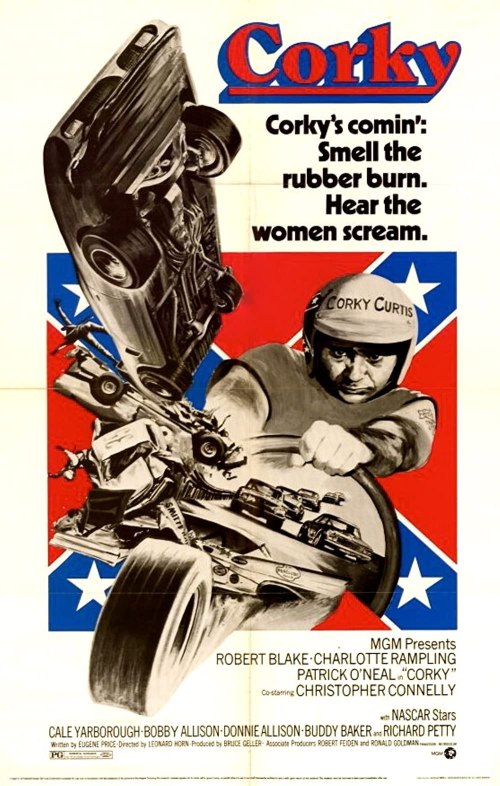
Corky (Robert Blake) works as a car mechanic during the day, but on weekends he drives in some of the local races. He’s aggressive nature though causes many accidents and damages in the race, so his boss Randy (Patrick O’Neal) decides to replace him with another driver named Steve (John Gruber). Corky resents being replaced and thus enters the next race anyways and rigs the front hood of his car, so it will pop-up at a strategic time, so that he can crash into Steve’s car while feigning that it was an ‘accident’ because he couldn’t see where he was going due to the hood. The crash though puts Steve in the hospital and it’s enoough for Randy to fire Corky from his job. Now, with no money left, he goes traveling to Georgia with his buddy Billy (Christopher Connelly). They enter a few races there, but Corky parties away all the winnings and eventually come back to Texas penniless. He tries to get back with his wife Peggy Jo (Charlotte Rampling), but finds that Randy has been helping her out and giving her enough money, so that she can go back to school to get a diploma and eventually be able to earn a living without Corky. This causes him to seethe with rage and he goes back to Randy’s place of work in order to exact a violent revenge.

The film was directed by Leonard Horn, who shot to fame for having directed some of the highest rated episodes of the ‘Mission Impossible’ TV-series, which garnard him enough attention to get him a contract to helm two cinematic features. His first one was The Magic Garden of Stanley Sweatheartwhich starred Don Johnson and while it wasn’t completely successful, and very little seen, it did have an interesting cinema verité style. This works the same way with a strong emphasis on atmosphere that gets small town living in rural Texas just right. Even the little moments like when Corky turns on his friend Billy in the middle of a desolate road during an impending rain storm leaves a memorable impression as does the envelope-pushing moment where Corky decides to strip down and go skinny dipping with two young boys (Matt Nelson Karstetter, Richard McGough) at a country watering hole.

Robert Blake is excellent. Sometimes it’s hard to imagine him as a leading man due to him at one time being a part of the ‘Little Rascals’ ensemble, and then rising to becoming a TV-star before falling into infamy at being accused of killing his child’s mother. However, with all that being said he was still a great actor who probably didn’t get as much starring roles as he deserved, but he plays the angry loner role to a perfect-T. Rampling as his wife, who was born in England, masks her British accent quite well and creates an odd, but interesting sounding Texas one in the process. I also liked that she sports blonde hair. O’Neal is good in support and there’s an fun collage of actual race driving champions like Richard Petty and Cale Yarborough who appear briefly as themselves though I was upset to read that Roddy McDowell’s scenes, where he plays a salesmen, got cut out completely as his appearance could’ve added an intriguing element.

Spoiler Alert!

The story itself is rather tepid at first. There were many films from the 70’s dealing with rugged individualists and hard drinking, womanizing rebels who couldn’t, or didn’t want to conform to societal rules and thus hit the road looking for adventure and to ‘find themselves’. This though, at least during the first two acts, adds nothing to the equation, or give us any new insights and in fact seems more like the same old, same old generic character study, but all that changes in the third act when Corky unravels completely and goes on a shooting spree. The films from that era always had the non-conformist getting ‘reeled-in’ at some point usually through the love of a romantic partner, or some familial obligation, but here it’s a meltdown to the extreme and it’s a movie way ahead of its time as it deals with what’s commonly known as a mass shooter these days. At that time this concept was rarely seen and for that it deserves definite kudos as does the message that being too irresponsible will catch-up with you and one can’t just live the outlaw image and not eventually have to pay the price.

My Rating: 7 out of 10

Released: March 15, 1972

Runtime: 1 Hour 28 Minutes

Rated PG

Director: Leonard Horn

Studio: MGM

Available: DVD-R (Warner Archive)

Bedroom Eyes (1984)

bedroom1

By Richard Winters

My Rating: 1 out of 10

4-Word Review: Voyeur witnesses a murder.

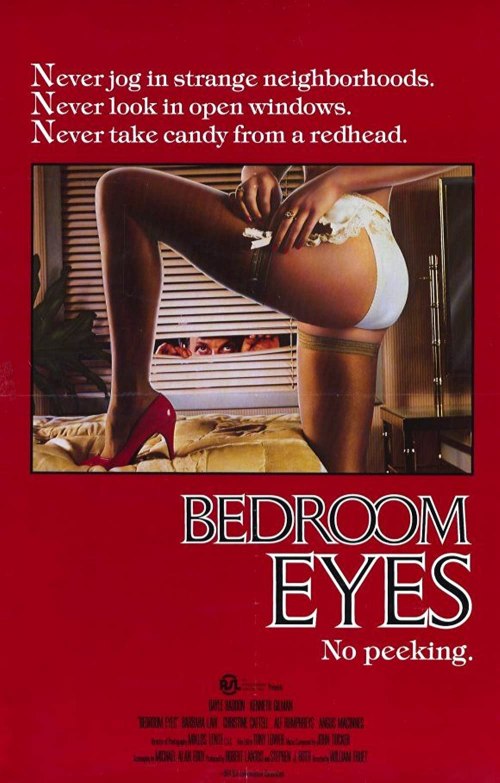
Harry Ross (Kenneth Gilman) is a businessman who enjoys taking a late night jog in the Toronto neighborhood in which he lives. One night he steps in dog poo and as he’s trying to scrape it off he notices a light coming from a nearby window. Out of curiosity he peers in and sees a half-naked woman (Jayne Catling) dancing provocatively. It turns him on and he decides to make it a point to peer into the window each night when he goes for a run. He though begins to feel guilty about what he’s doing and thinks he may be a ‘pervert’ and thus schedules an appoint with Alex (Dayle Haddon), who is a psychiatrist, so that they can talk it through. During their sessions he also becomes attracted to her and things slowly work into a relationship. While this is going on he continues to look into the window each night, but eventually witnesses the woman getting murdered and now must go into hiding inside Alex’s apartment as not only the police, who mistakenly think he did it as they get his prints off of the window, are after him, but so is the killer.

This film was directed by William Fruet, a prolific writer/director from Canada, who shot to fame with the excellent Wedding in White and then followed that up with a lot lame thrillers and horror films. While some of those were diverting this one isn’t and the tacky set-up is the biggest problem. The fact that Harry isn’t portrayed as being a life long voyeur, but instead quite literally just ‘stumbles’ upon it is farfetched and the character would’ve had more depth if this had been a constant trait that he had to deal with. Having him ‘panic’ that he was afraid this made him a ‘pervert’ was ridiculous too as I’d think just about any heterosexual guy would get aroused seeing a hot lady cavorting around erotically. The way he peers in, the camera captures it from the inside looking out, is quite obvious as his face is fully light, from the indoor lamps, and thus all the people needed to do was glance up briefly to see him, which I would think would’ve occurred at some point especially since he continues to do it over multiple nights. The fact that they always leave the window shade half open seems like they’re inviting someone to look in though the movie acts like this is unintentional and just a ‘coincidence’. The place is lit in a way that makes it seem like it’s a set for soft core porn flick and the woman behaves like an adult actress, which completely ruins any sliver of plausibility.

Initially I liked seeing Haddon, who was at one time a super model before she got into acting, cast as the therapist as this was traditionally at that time still more of a man’s profession, so she was playing against type, but having Harry immediately asks her out on a date was dumb. Due to this being a professional doctor and patient relationship he should’ve at least waited until after several sessions before he got up the nerve to do it and even then it’s putting her in an unethical spot and he should’ve known that. Fortunately she tells him ‘no’ the first couple of times, which is what she should’ve done, but I knew, going by how stupid this script had already been, that she’d eventually cave and of course she does, which makes the whole premise become even more ludicrous. Having her spot him at a fancy restaurant was too coincidental in such a big city and having his girlfriend perform a sexual act while inside the place with all sorts of people around was over-the-top. If anything Haddon should’ve just been cast as his girlfriend, who just happens to work as therapist, and he could’ve still spoken to her about his voyeurism in private when they were together and this would’ve helped made it more believable.

It does get a bit intriguing for a few minutes when the police begin to close-in on Harry and I enjoyed the inner-rivalry of the police department where the two lead detectives became irritated at how a young ‘wet-behind-the-ears’ kid (Alf Humphreys) was always coming up with new leads and clues before they did, but other than that there’s very little to recommend. The climactic sequence in which the killer ties Harry up while he’s inside Haddon’s apartment, is quite boring and the female actor who plays the culprit shows no panache and thus making her scenes quite dull. In 1989, at the request of no one, this was made into a sequel, but with a completely different writer, director and actors with the only thing connecting the two being the Harry Ross character.

My Rating: 2 out of 10

Released: November 30, 1984

Runtime: 1 Hour 30 Minutes

Rated R

Director: William Fruet

Studio: Pan-Canadian Film Distributors

Available: DVD-R

Vice Squad (1982)

vice1

By Richard Winters

My Rating: 2 out of 10

4-Word Review: Violent pimp kills prostitutes.

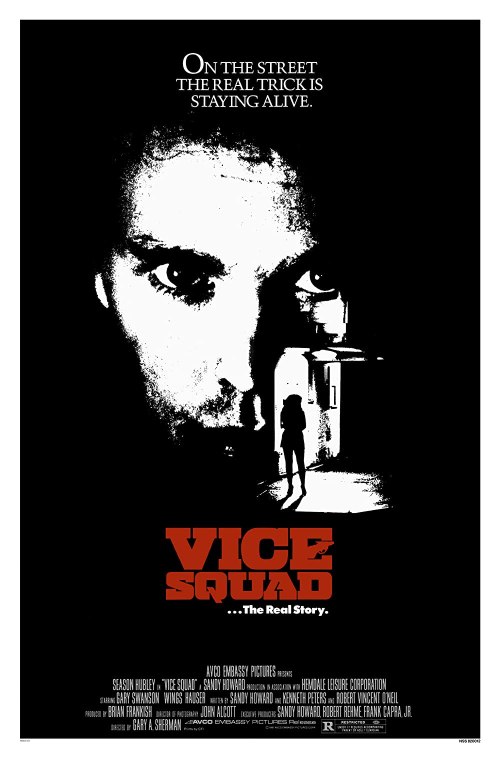
Princess (Season Hubley) is a business woman who is having some financial trouble and thus decides to go back to being a prostitute in Hollywood in an effort to support her young daughter. She becomes aware that her friend Ginger (Nina Blackwood), who is also a prostitute, has been killed after getting beaten-up by a violent pimp named Ramrod (Wings Hauser). Tom (Gary Swanson), a police detective, gets her to agree to be wired, so that she can get Ramrod to incriminate himself when she goes back to his place for a rendezvous.  The sting works and Ramrod is arrested and put into police custody, but he’s able to escape and spends the rest of the night chasing after Princess and determined to exact a revenge on her while the cops remain always one-step behind and unable to apprehend him.

This was Gary Sherman’s fourth theatrical feature and third horror one. He had started out with British cult hit Raw Meat in 1972 about a group of underground cannibals living in a London subway tunnel was met with rave reviews and fans, but his subsequent horror foray Dead and Buried and Phobia, which he co-wrote only, didn’t do as well. This one is more of a sleazy thriller meant to ‘inform’ the viewer about the brutalities of street life, but is really just an excuse to be exploitive and get cheap points for nudity and violence with characters that are cliched and situations highly derivative.

My main issue was with the prostitutes themselves for instance Ginger who runs away from Ramrod and hides out in a seedy hotel only to let him into her room the minute he comes knocking at her door. Once inside he immediately kills her while asking ‘I can’t believe you were that stupid’ and I felt like saying the same thing. It’s hard to sympathize with characters when they do incredibly dumb things and the scene would’ve worked better if Ramrod was only able to get in by crashing through the window, or breaking down the door, but having her allow him in shows no common sense especially from someone that is supposedly ‘street smart’.

This then brings up the second problem that I had, which is the fact that these women have absolutely nothing to defend themselves with in case things get ugly. They should all have guns, knives, or the very least some pepper spray especially if they’re supposedly ‘street smart’, but instead if things get bad they’re virtually helpless as is the case of when one of the male customers decides to rob Princess of her money and all she can do is give him some veiled threat that her pimp would come after him, which seemed almost laughable. Another scene has her being attacked by Ramrod where she manages to get her hands on a metal pipe and she uses it to hit him twice with it and then drops it to go hide somewhere, but why not continue to hit him until he’s either dead, or comatose? She hated his guts for killing her friend, so why back-off from giving it to him when she had the chance? At the very least, if she is going to run-off, at least continue to carry pipe, so she could use it for protection when he gets back up.

The motivations of the Princess character made no sense. She’s supposedly this L.A. businesswoman living in a nice suburban house, who’s now in financial trouble for whatever reason, but why turn to prostitution? There seemed to be hundreds of other income avenues she could’ve considered before leaping into streetwalking. If it was a high end escort gig where the male clientele could be filtered and scrutinized so it would not just be any scumbag and the prices would be high enough and in a safe neutral area, so she would just have to service one a night instead of ten, then maybe. However, here she’s forced to do one after another submitting that whatever crazy kink they wanted in whatever scuzzy locale they took her to. If she was on drugs, or teen runaway with no money, it might be a little more understandable, but the film portrays her as being smart and educated and she somehow ‘chooses’ to do this, which for me made her seem completely insane and therefore not any one that I could relate to.

The film does have some great acting by Hauser, who also sings the closing song, and Gary Sherman is good as the detective as he doesn’t have the chiseled features of a Hollywood good guy, but instead is more non-descript like how most policemen look, which I liked. Sunset Boulevard, where most of it was filmed, gets captured in a cool way giving it a surreal presence where all the action takes place exclusively at night and once the sun rises all the dark characters go symbolically back into their caves. There’s even a nifty car chase, but overall it’s flat, and predictable, and only for those who enjoy sleazy B-movies.

My Rating: 2 out of 10

Released: January 22, 1982

Runtime: 1 Hour 37 Minutes

Rated R

Director: Gary Sherman

Studio: AVCO Embassy Pictures

Available: DVD, Blu-ray, Amazon Video, YouTube, Tubi

Too Scared to Scream (1984)

tooscared3

By Richard Winters

My Rating: 3 out of 10

4-Word Review: Who’s killing the tenants?

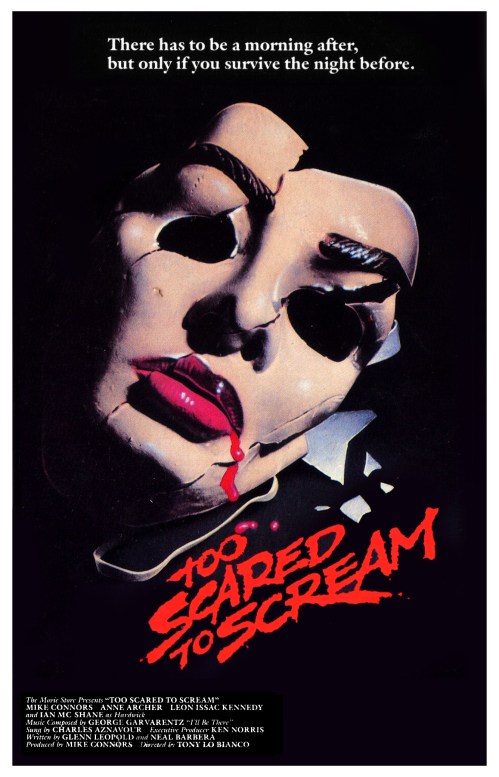
Female tenants living in a New York City high-rise building are turning-up dead in brutal fashion. Lieutenant Alex Dinardo (Mike Connors) and his younger, female partner Kate (Anne Archer) are convinced that the culprit is Vincent (Ian McShane) who works as the overnight watchmen at the apartment building and since all the crimes happen during his shift he quickly becomes suspect number one. Though getting enough evidence in order to arrest him becomes a delicate matter. Alex then decides to asks Kate to move-in to the building as a new tenant and thus keep tabs on what Vincent is doing and hopefully lure him into a situation where he’ll incriminate himself, but Kate soon finds herself in over-her-head as the killer is on-top of what’s going on and he soon bates her into a dangerous game of cat-and-mouse where Alex and the other policemen are not able to help her.

The film was an attempt at creating an American version of an Italian giallo complete with gory murders and an intricate mystery where you don’t know who the real killer is until the final twist ending. It’s also the only film to date to be directed by actor Tony Lo Bianco. Severely straddled during production as it was shot in 1982, but due to the production studio that financed the project going bankrupt it was never released until 3 years later where it was given little fanfare and came and went with few people seeing it.

The biggest problem with it is that it plays-up McShane’s role too much. Granted he’s a gifted actor who’s best known today for his work in the TV-series ‘Deadwood’, but by overemphasizing his character it makes it seem right from the start that he’s the culprit and thus making the investigation uninteresting because you feel it’s just a matter of time before he’s found out and thus little mystery, or intrigue. Granted there are a couple of other suspects, but they seem thrown-in simply as red herrings and aren’t seen much. The story would’ve had better tension had the suspects shared equal screen time and a more balance of clues making it seem like any one of them could’ve done it and thus some genuine interest at getting at what the truth is versus having it seem like it’s all spelled-out from the start. If anything Maureen O’Sullivan, who plays McShane’s near comatose mother whom he takes care of, is far more captivating, despite the fact that she doesn’t speak any line of dialogue and trapped in a wheelchair, then anything McShane himself does.

The unusual pairing of a 60-something male cop alongside a female one that appears to be only around 30 should’ve been what the film focused on as I found their contrasting personalities and different ways they approached their police work to be something that could’ve been played-off of more. Unfortunately the film taps into this just slightly and then quickly moves on and thus misses the opportunity for what could’ve lead to captivating confrontations and debates. Connor does seem a bit too old for this kind of thing and seeing him trying to chase down a young athletic man who was only 20 came-off as almost laughable and I was surprised he didn’t just fall over from a heart attack, or exhaustion before he ever managed to get near the guy. Having him lose a fight to the younger guy and have to depend on his partner to bail him out of it was realistic, so it gets props there, but the way he goes about his police work, which includes physically beating-up on suspects, is highly unethical and should’ve gotten him demoted, or fired.

Spoiler Alert!

I had issues with Archer’s character as well. This comes when she agrees to move into the apartment and work undercover, but seems woefully unprepared for it. She manages to carry a gun with her when she goes down to the basement of the building to do laundry, but then when she gets back to her place she does a goofy aerobics workout where she gets caught off-guard, but wouldn’t a seasoned cop know to carry a weapon on her at all times especially when she’s intentionally making herself a target to the killer? Also, what kind of person walks into their apartment and then doesn’t turn around and immediately lock the door once they’re inside? If you want to argue that this was intentional (I don’t think it was) because she wanted to lure the killer inside, so as to apprehend him, then fine, but she should then make damn sure she was a gun in-hand, pointed at him, when he does, which in this case she didn’t.

You must likely won’t be able to guess who the true killer is, but it’s not worth sitting through. The script doesn’t offer any clues, or hints either, so even an alert viewer won’t figure it out, but that doesn’t mean it’s a good mystery because it really isn’t. The story is sloppily put together without much imagination, or character development. Unlike a true giallo the murders are quick and without much blood, so if you’re a gorehound this thing won’t suffice. The concept had potential, but the execution is half-hearted.

My Rating: 3 out of 10

Released: September 28, 1984

Runtime: 1 Hour 40 Minutes

Rated R

Director: Tony Lo Bianco

Studio: International Film Marketing

Available: Blu-ray (Import), DVD-R

The All-American Boy (1973)

american

By Richard Winters

My Rating: 4 out of 10

4-Word Review: Amateur boxer seeks fame.

While Jon Voight is best known in the world of boxing movies for having done The Champ in 1979, which some consider infamous, his first go-around was actually this one though it remained stuck on the studio shelf long after it was filmed only to be released after his success in Midnight Cowboy. He plays the character of Vic (Jon Voight) a talented, good-looking man whose shown ability in the amateur ring and now is ambitious about making the Olympic team. Arty (Ned Glass) takes him under-his-wing, even lets him stay at his place, while he trains him, but then all of sudden Vic decides he doesn’t want to be a boxer anymore, to the shock of everyone, and never bothers to give anyone any explanation as to why.

The script was written by Charles Eastman, who also directed, and who was the brother of Carole Eastman, who wrote the script for Five Easy Pieces under the pseudonym of Adrien Joyce. Like with his sister’s script it works as a character study and the story is broken up in sections, in this case ‘The Manly Art in Six Rounds’. At various times, usually every 10-minutes, a title will appear on screen such as ‘Round 1’, or ‘Round 2’, but honestly I didn’t see the point  and it doesn’t really make it more interesting and could’ve easily be discarded and probably should’ve been.

On the writing end, particularly the dialogue, it works. Eastman creates a conversational quality where what the characters say is never ‘too on the nose’ (screenwriter’s lingo for being too specific) and the viewer must read into it in order to understand what they mean. In that area the film works, but it’s also highly talky and begins to have a stagnant feel. There’s also very little about the actual sport of boxing. If you’re expecting something like Rocky where there were long segments dealing with the his preparation you’ll be out of luck here. I got particularly frustrated with the scene dealing with Vic getting ready for a contest where he’s seen standing around while other participants and fans enter into the arena, which gets drawn-out, and then just as the fight is supposed to begin it cuts away showing Vic on the phone describing what happened, but to have to sit through a long build-up just to see no action is a letdown.

There finally is some boxing about 50-minutes in and the choreography in the ring, with each participant getting some hits on the other, appears realistic though there’s no blood, or bruising. What makes this segment unusual is more what occurs amongst the audience where one of the spectators, played by Noble ‘Kid’ Chissell, a former professional boxer from 1924 to 1934, begins to masturbate underneath his raincoat, which he has over his lap, which becomes painfully obvious to the other people around him.  Why this was put-in I don’t know. It’s not clear either whether he’s getting-off on the two boxes, or his attraction is to one of the pretty ladies in the audience (I’d presume it was the boxers), but such a bizarre character doing such a strange thing in public needed better fleshing-out and quite frankly more screentime as cringe or not I found his appearance to be one of the few diversions and far more intriguing than the main star.

Seeing a young Anne Archer, who looks almost like an adolescent here, this counts as her film debut since it was filmed before either The Honkers or Cancel My Reservationwhich were both released earlier, is a pleasure though her character doesn’t have a lot to do. E.J. Peaker is quite good as Vic’s on-again, off-again girlfriend, who has a memorable bit inside a recording studio as she attempts to boost her singing career. Jeanne Cooper, better known for her work on ‘The Young and Restless’, which lasted for 5-decades, is quite striking. The best acting though goes to Ned Glass, who is engaging as the foul-mouth manager who spews the F-word seemingly non-stop.

The ending in which Vic gets on a helicopter and is cheered on by his fans and supporters who gather to see him off is the film’s best moment. It’s not like anything super exciting happens, but the location, filmed in the hills just outside of Vacaville, California, where the grass is dark brown, but the trees that dot the landscape remain green gives-off a surreal effect. It goes on for a full 20-minutes all in this vast brown countryside with characters running around in it and at certain points even sliding down the hillsides. The unusual topography leaves a lasting impression and I’ll give props to the filmmakers for taking full-advantaged of it and the one element that allows this otherwise sterile production to stand-out.

My Rating: 4 out of 10

Released: October 24, 1973 (Filmed in 1970)

Runtime: 1 Hour 58 Minutes

Rated R

Director: Charles Eastman

Studio: Warner Brothers

Available: DVD-R (Warner Archive), Amazon Video

Reuben, Reuben (1983)

reuben1

By Richard Winters

My Rating: 6 out of 10

4-Word Review: Housewives lust for poet.

Gowan (Tom Conti) is a middle-aged poet going through writer’s block who hasn’t written anything in 5 years and manages to remain solvent by touring around a college town and reciting his older writings to women’s clubs. The stress though of not being able to produce anything new causes him to turn to alcohol and further rescinds his writing ability. Geneva (Kelly McGillis) is a college student several years his junior who spots him on a train one day and agrees to pay his fare when he’s found not to have any money. This generosity manages to have a profound affect on him and he makes a commitment to mend his ways while also going out with Geneva on casual dates. The awkward love affair doesn’t go far as Gowan continues to drink and embarrass her every time they go out. When Geneva finds out she’s pregnant the two then must decide how they will proceed.

Unusual romantic flick that has all the ingredients of failing, but manages somehow to have a certain light appeal. Much of this is thanks to McGillis, who in her film debut really shines and while this film is not one of her better known ones I still consider it her best work. Normally film’s dealing with May-December romances don’t work because the younger partner is always portrayed as being wide-eyed and naïve, but here it’s Geneva that’s the sensible one who calls all the shots and remains in control. This change of pace gives the old theme a refreshing new spin and made it palatable enough to hold my interest and in certain moments even becomes touching.

Conti gives a good performance, but he seems more like a caricature. He wears the same dowdy outfit all the way through making me wonder if that was the only suit he owned and if so whether he reeked of odor. I found it hard to believe that this guy, who looks like he was living on the streets, would attract all these frustrated housewives who’d be rushing to go to bed with him. With all the alcohol he consumed I’d have serious questions whether he’d be able to perform, or how sex with him could possibly be much better than with their husbands as I would think it might actually be worse.

Supposedly this was all meant as ‘satire’ and based loosely on the life of Dylan Thomas. Possibly in book form, as this was based on the novel of the same name by Peter De Vries and then later turned into a stage play, it might’ve worked, but as a film set in the modern day it’s confounding. Thomas hit his fame in the 30’s and 40’s when movies and television where just getting started and therefore writers held more clout, but by the 80’s there were so many other types of celebrities that some frumpy looking drunk guy who used big words to create long poems wouldn’t be someone a suburban housewife would get all that excited over. The opening sequence shows the reactions on their faces as they listen to him recite some of his writings and while one of them has a confused look on her face I felt they all should’ve and for my money that would’ve been really funny.

Spoiler Alert!

The finale, which Leonard Maltin in his review calls ‘curious’, but I’d describe more as ill-advised is the one thing that really hurts it. I’m not sure what the thinking was other than Dylan Thomas died young so possibly they felt Gowan needed to die too, but it was the wrong decision. Normally I get annoyed with movies that tack-on a happy ending and have everything work-out even when it’s not earned, but this film works in reverse by throwing in a very sad one that comes out of nowhere and doesn’t fit the tone of the rest of the movie, which for the most part had been quite whimsical.

The way it gets done is pretty dumb too as he elects to hang himself inside his apartment after he finds out all of his top teeth, many of which have been rotting for years due to neglect, would have to be removed. While losing teeth is no one’s idea of fun it does happen to a lot of folks of all ages and dentures (this was made before the advent of implants) if fitted properly aren’t always that noticeable, so to kill yourself over something like that seemed awfully rash.

Just as he’s about to hang himself he gets inspired again to write and even excited about finding new women to sleep with, but then a lovable sheep dog named Reuben runs into the room (you’d think someone planning to kill himself would have the sense to shut his door and lock it) and being overly affectionate jumps-up and knocks down the chair that he’s standing on, which comes-off as being more farcical than anything. I was fully expecting the wooden beam that the rope was tied around to break from the stress of all the weight, which in reality I think it would, but instead it doesn’t and he’s left hanging leaving me genuinely baffled. For such an otherwise light and quirky movie to end this way was very jarring.

My Rating: 6 out of 10

Released: December 19, 1983

Runtime: 1 Hour 41 Minutes

Rated R

Director: Robert Ellis Miller

Studio: 20th Century Fox

Available: DVD, Blu-ray