Category Archives: Movies with a rural setting

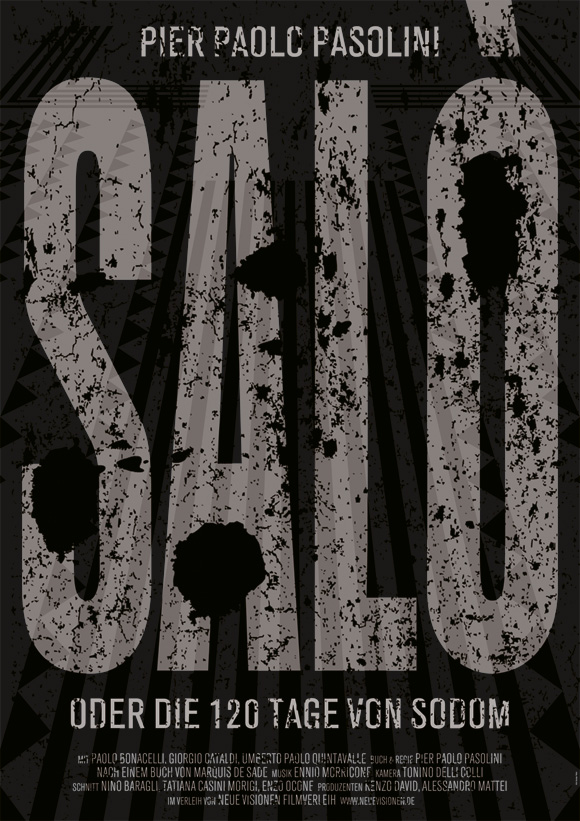
Salo, or the 120 Days of Sodom (1975)

By Richard Winters

My Rating: 5 out of 10

4-Word Review: They want sex slaves.

During the end of WW II in a northern city of occupied Italy a group of bourgeoisie men and women round up a group of teenage boys and girls and take them to an isolated mansion where they are forced to become sex slaves. They are also inflicted with cruel tortures in this story based on the writings of Marquis De Sade.

The film is interesting, but only up to a point. Director Pasolini’s natural lighting fetish really works here and he makes it into an art form. His ability to find the perfect moment in the day to shoot the scene and be able to frame the action within the shadows is amazing and along with the color schemes gives it a very distinctive look and an unusual atmosphere.

The acting by the adults is amazing as they project evilness without flaw. The perverted stories they tell in some ways is more shocking than the actual scenes and the casual way they go about their sick behavior achieves an unprecedented level.

The story itself has some good insights. It shows the veneer of civilized behavior and how the passive nature of the victims and society as a whole only helps to allow evil to flourish. There’s also the main point which is that evil is truly a part of the human make-up and hides itself in everybody and can come out if provoked including the victims themselves.

Yet the film makes its point and then hammers it home without pause. The non-stop perversity becomes excessive and the redundancy eventually makes the shock value and message meaningless. Showing the background of these captors might have helped given it more of a balance.

I have nothing against those who wish to ‘push the envelope’ and there is nothing that says movies need to be tasteful, or even entertaining, but I couldn’t help but wonder if Pasolini simply used the material as an excuse to explore his own dark fantasies. Of course DeSade’s actual writings were far more twisted and unsettling then anything you see here and the film is a significantly toned down version.

Actual teenagers were used and there is an abundance of nudity and perversity. Something like this could never have been made here in the states and exactly how it ever got made is more interesting than the film itself. If there was ever a movie begging for a “Making of…” documentary it’s this one. It is also interesting to note that Pasolini was mysteriously killed by a hit-and-run driver just a few days before the film’s official release.

My Rating: 5 out of 10

Released: November 22, 1975

Runtime: 1Hour 56Minutes

Rated NC-17

Director: Pier Paolo Pasolini

Studio: United Artists

Available: DVD, Blu-ray (The Criterion Collection)

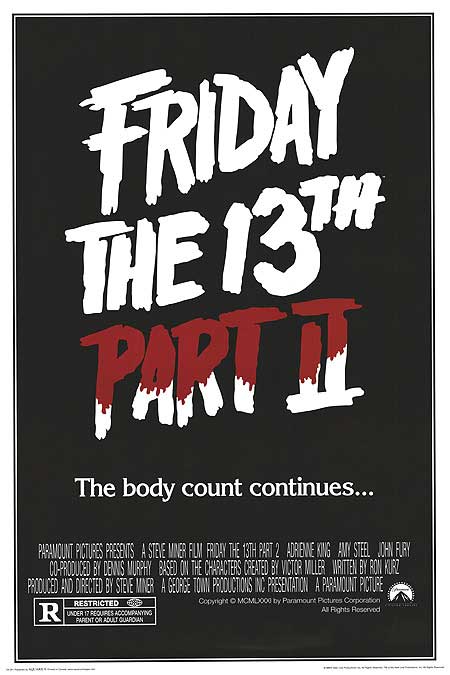
Friday the 13th Part 2 (1981)

By Richard Winters

My Rating: 3 out of 10

4-Word Review: Jason likes to kill.

(This review contains spoilers, but it is such a bad movie, so who really cares.)

A new campsite near where the massacre from the first film took place and still on Crystal Lake opens for business. Soon the counselors begin receiving the same type of bloody fate.

I was a bit surprised how incredibly derivative this movie was. In many ways it is almost exactly like the first one even to the point of having them killed at night during a thunderstorm. My opinion is that if it says ‘Part 2’ in the title then that should mean some sort of story progression, or evolvement, but instead it’s just the same formula getting repeated. The only real difference is that the young counselors aren’t the only ones who get killed as Crazy Ralph (Walt Gorney) ends up being one of the killer’s victims as well. Although I thought his murder looked a bit fake, I was still glad to see it as the idea of having to hear him say “You’re all doomed” for another ninety minutes seemed more horrifying.

It might have been more intriguing had the story centered on Alice Hardy (Adrienne King) the sole survivor from the first film who is now living by herself many miles away. The film starts out with her, but she is then immediately killed and then it’s back to the campsite for the same old, same old. I also found this opening sequence to be a bit baffling.  Here is a woman living alone and still suffering from nightmares of the attack and yet it is only after she wakes up from one of these bad dreams that she decides to lock her front door and close her kitchen window, which has no screen and wide enough for even a large person to crawl through, even though I would’ve thought she should’ve done that from the very start.

One plus to the movie is that the cast here is more attractive than in the first one. Amy Steel as Ginny Field is pretty and looks great in a bikini. I liked how her face has a very natural quality to it, but still quite appealing without any excessive make-up. Kirsten Baker, who plays another counselor named Terry, is really hot and can been seen fully nude from the front and back. For the female viewers I’d say the male cast has more hunks as well. I also found it interesting how the character of Mark (Tom McBride) who is confined to a wheelchair is still portrayed as being sexy and appealing to the other female characters, which is good. Also, for the trivia buffs, McBride was the first actor to portray one of the counselors to end up dying in real-life.

The killings are a letdown. At times it seems that director Steve Miner is trying to put a satirical spin on the bloodshed, but then pulls back at the last minute. For instance when Mark gets ‘the axe’ he is seen in his wheelchair rolling down a long flight of steps and I thought this may be an amusing homage to the classic Battleship Potemkin where a baby carriage rolls down a long flight of stairs while a battle rages all around it. Instead we see the victim and wheelchair go halfway down and then the shot freezes and cuts away without the expected pay-off. Another part that is similar to a famous scene in Mario Bava’s Twitch of the Death Nerve where a couple has a spear go through them while they are making love. Here Jason attacks the couple, but all we see is the end of the spear going through the bottom of the mattress and touching the floor, which seemed unrealistic. It was hard to believe that there would be a spear long enough and a person strong enough to push it through two bodies and what would probably have been two mattresses to get it to reach the floor.

This also brings up the issue of the Jason character. Supposedly this is a ‘mentally and physically challenged’ individual with limited thinking and social capabilities. Yet in the scene where he murders the couple in bed he then removes their bodies, which would be rather difficult as supposedly they have a big spear going through them, and places them somewhere else in the room so when Ginny comes in he is the one lying in the bed where he then jumps out and attacks her, which seemed too sophisticated and elaborately thought out for someone of his supposed mental state. Also, the opening sequence where he kills Alice doesn’t make sense either. How is Jason, who has been living in a ramshackle shed in the woods most of his life able to track her down and figure out where she is? Also, I would think anyone living alone in the woods would be very intimidated and confused coming to a big city, or any populated community for that matter. There is also the fact that with his deformity, even if he is wearing a mask, he would have called a lot of attention to himself, and it is very unlikely that he would have gotten away with her murder undetected. In addition there is the matter of his mother’s decapitated head, which he keeps on top of a candle lit altar in his shack, but even in a shriveled up state it still doesn’t look anything like actress Betsy Palmer who played the role in the first film.

This is the type of film that gives slasher movies a bad reputation. It is very mechanical and unimaginative. There are a few shocks here and there, but I saw them coming and there is no sustained tension at all. Of course at the very end you do get to see what Jason looks like unmasked and my response to that is ‘whoop-te-do’.

My Rating: 3 out of 10

Released: May 1, 1981

Runtime: 1Hour 27Minutes

Rated R

Director: Steve Miner

Studio: Paramount

Available: VHS, DVD, Blu-ray, Amazon Instant Video, Netflix streaming

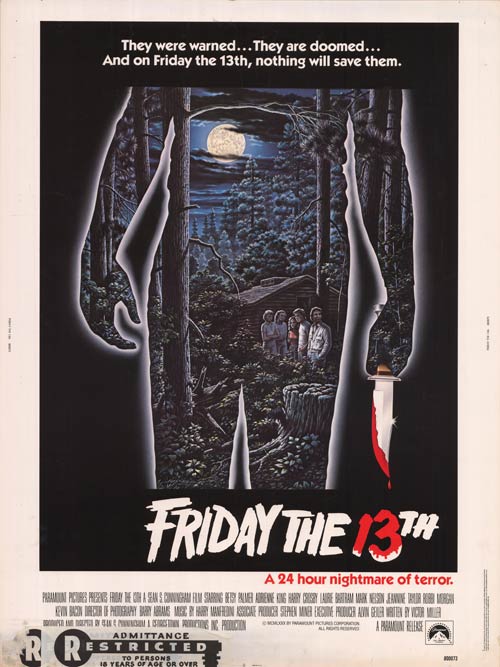
Friday the 13th (1980)

By Richard Winters

My Rating: 6 out of 10

4-Word Review: Don’t reopen the campsite.

(This review contains spoilers. Lots of spoilers)

Twenty-two years after two counselors were brutally murdered Camp Crystal Lake reopens, but as the young staff tries to get the place ready they are killed one-by-one by an unknown assailant.

I first saw this film back in 1986 and thought it was alright. I presumed I would dislike it this time, but instead came away entertained and although certainly not a perfect film it does deserve its classic status. Director Sean S. Cunningham shows more flair than a lot of critics give him credit for. I liked the idea that all the murders take place during one stormy night at a remote location. Every murder sequence has its own beginning, middle, and end and filming it at an actual campsite gives it a lot of flavor. In fact I believe that is the main element for why this film became such a big hit because it reminds everyone when they went to camp as kids and tried to frighten each other by telling ghost stories around a camp fire.

Some of my favorite aspects of the film are what most might consider minor stuff, but stands out for me. For instance when Brenda (Laurie Bartram) goes to the archery range during the storm and the killer turns on all the lights and she becomes blinded by them is an interesting visual sequence. It is just unfortunate that she was not slayed with a shooting arrow as this would have corresponded to an earlier scene where she was almost hit by one shot by Ned (Mark Nelson). They were apparently planning to this, but then for whatever reason changed their minds. I equally liked the part where the killer shuts off the power and the viewer can see the lights slowly fading from the campsite at a distance, which has a nice foreboding quality. The part where Crazy Ralph (Walt Gorney) rides off on his bicycle after warning the staff the they are doomed creates an eerie image because there is no music and the lake is amazingly still proving that sometimes less is more when creating an intended impact. Having shots from the killer’s point of view watching the staff from a distance is creepy.

I watched the film closely thinking that there would be a lot of errors due to its low-budget, but found surprisingly little, or at least none that would create any type of major distraction. I know Betsy Palmer, who played Pamela Voorhees and is exposed as the killer at the end, only participated in a few days shooting. The hand that you see that represents the killer’s during the first half of the film was not Palmer’s, so I presumed that seeing a big ring on the third finger of the left hand would prove a mistake, but when Palmer does finally appear a ring is indeed there and the filmmakers prove to be astute. I know some people consider the scene where Alice (Adrienne King) has trapped herself inside a cabin and piling all sorts of stuff in front of the door to keep the killer out is a mistake because the door pushes out instead of in. However, I don’t agree because in her panic she would not be thinking straight and putting chairs in front of the door gave her a false sense of security, which at the time she may have needed emotionally. About the only real annoying mistake I saw is the fake lightning. Clearly it is a bright yellowish light coming from a flashlight that was shown on the performers from a stagehand that was just off- camera. The effect looks stupid and when are filmmakers ever going to realize that thunder and lightning rarely occur at the same time. You will always see lightning first and then the sound of thunder will usually occur several seconds later.

Too much time at the beginning is spent on the crew getting the campsite ready. These scenes don’t build any tension, the characters are vapid and clichéd, and the dialogue is trivial. I also found Ned to be incredibly irritating as the ‘comedian’ of the group whose attempts at humor where lame to the extreme. I found it funny how his murder is one of the few you don’t see and I think that was because the filmmakers feared that viewers would end up enjoying it too much. A little more nudity during this segment would have helped it along. I found it ironic that the one cast member that does end up going topless, Jeannine Taylor, was in real-life a graduate from a conservative Christian college. There is also a part here where they kill an actual snake and it deserves some mention because it is rather gory and has hints of Cannibal Holocaust where the viewer starts to think ‘if they are willing to kill actual animals in front of the camera what’s to stop them from doing it to the people’.

I like Betsy Palmer and the final climatic segment where she terrorizes Alice who is the last remaining survivor is in many ways the best part of the whole film. However, Estelle Parsons had been their first choice and I was a bit disappointed because Parsons has a unique acting style and a more distinctive face, which could’ve given the character more depth. Still, upon my third viewing I must say that Palmer does well. The close-ups of her face are great as is her gray sweater.

The music of course is another plus. I always thought it sounded like ‘chi,chi,chi; ma,ma,ma’, but it is actually supposed to be ki,ki,ki; ma,ma,ma’ and used to reflect the voice of Jason that Pamela hears inside her head instructing her to ‘Kill her Mommy’. Composer Henry Manfredi actually said ‘ki’ and ‘ma’ into a microphone before using sound effects to get the intended distortion.

Despite the film’s reputation the killings seem rather quick and uneventful. The slitting of the throat is a Tom Savini specialty, but was starting to get old even here. The machete through the head is one of the better ones, but the shot of it is too quick. The decapitation of Pamela is far and away the best. I liked how her hands continue to move even when she is headless. Apparently this is unrealistic and would not happen in real-life, but it is a cool visual nonetheless.

My Rating: 6 out of 10

Released: May 9, 1980

Runtime: 1Hour 35Minutes

Rated R

Director: Sean S. Cunningham

Studio: Paramount

Available: VHS, DVD, Blu-ray, Amazon Instant Video, Netflix Streaming

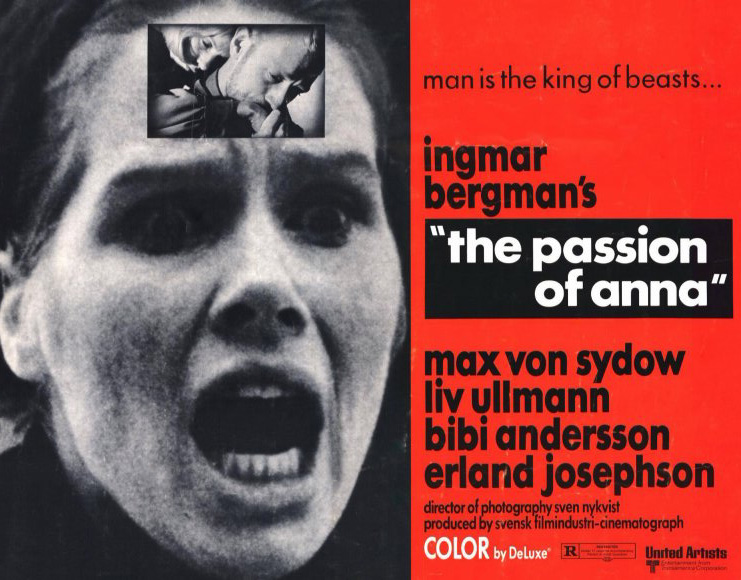
The Passion of Anna (1969)

By Richard Winters

My Rating: 8 out of 10

4-Word Review: Lonely little island retreat.

This is an intriguing film that seems quite similar to Roman Polanski’s Cul-De-Sac. Both films have a unique atmosphere and take place in a remote island setting and deal with a turbulent undercurrent that brews just underneath its deceivingly placid exterior.

Here we have Andreas (Max Von Sydow) living a lonely existence on an island retreat. He meets, by chance, Anna (Liv Ullmann) who is still grieving from the death of her first husband. The two form a tenuous relationship that slowly unravels as the dark corners of their personalities are eventually exposed.

In many ways this film has all the right ingredients. It wraps you up in its surreal nature and adds interesting effects. There are some creepy elements including a mad killer running around the island killing and torturing all the animals. Things work at a deliberate pace and leave no clue as to where it is headed. The characters are unpretentious and introspective. They are open about their faults and failures and give good reason as to why they have them. There are also fascinating cutaways to the actors themselves who help explain and interpret their characters motivations, which is a novel idea that gives the viewer a deeper understanding of the characters and adds an extra dimension.

Unfortunately it doesn’t come together and leaves no real emotional impact. There are a few good twists, but you can’t help but feel that it should have gone farther. There a certain scenarios that get touched on, but are never explored. For instance there is Andreas’s relationship with Elis (Erland Josephson).  Andreas has taken a loan out from him, but has also had an affair with his wife. This of course has some potential for fireworks and there is a moment where it begins to sizzle, but it never goes back to it. The same thing can be said for many of the other segments including the identity and reason for the animal killer.

Overall this is an outstanding experimental-like movie. It is not one of director Ingmar Bergman’s best, but it is still richer and more deeply textured than eighty percent of the other movies that are out there. The crisp and revealing dialogue alone makes it worth it and Bergman displays the most realistic perspective on the union of marriage.

My Rating: 8 out of 10

Released: November 10, 1969

Released: 1Hour 41Minutes

Rated R

Director: Ingmar Bergman

Studio: United Artists

Available: VHS, DVD

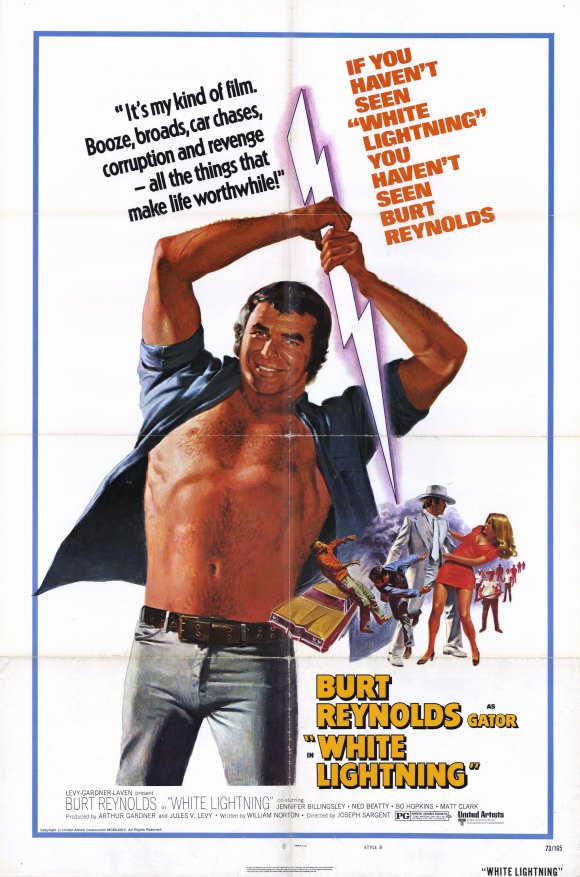
White Lightning (1973)

By Richard Winters

My Rating: 3 out of 10

4-Word Review: Corrupt Sheriff gets smacked.

Corrupt sheriff J.C. Connors (Ned Beatty) drowns a young man and woman in a backwoods swamp because they were ‘young hippie protesters’ who dared talk back to him. The victim’s older brother Gator McKlusky (Burt Reynolds) finds out about it and swears revenge. Although he is in prison he is let out when he agrees to work as an undercover agent for the feds who are after the sheriff for various unsolved crimes, but unable to attain enough evidence for a trial and conviction.

The story and scenarios are formulaic to the extreme and offer nothing new to an already uninspired genre. The characters are annoyingly clichéd southern stereotypes.  The pacing is poor and filled with drama that is stale and action that is lacking.  The dialogue is derivative and there is not enough tension, or plot devices to hold the viewer’s interest.

The opening sequence done over the credits is probably the best scene in the film. It takes place in a swamp with just enough dead trees sticking up above the water line to give it a nice gothic feel. There is no dialogue and the slow banjo ballad is perfect for the southern atmosphere. I was dismayed that the score, by Charles Bernstein, didn’t stay on this level throughout as towards the end it starts to sound too much like something from a 70’s action flick, which is not as effective.

A few car chases are the only other thing that allows for mild diversion. They certainly are not on par to the ones from Bullit, or The French Connection, but they are photographed well enough to offer some excitement. I liked how during the final chase the point-of-view shifts back and forth between the police cars and Gator’s. There is a sequence where, in an effort to avoid an oncoming cop car, Gator lofts his car from a river bank onto a moving barge. It was not a perfect landing as only the front end of the vehicle manages to connect with the ship while its rear-end hangs out over the water, which was apparently a mistake. However, I thought this offered good realism as most drivers, especially those going at high speeds, would be unable to judge the distance enough to even hit the boat. This also offered a brief exchange in which Gator is informed that the car’s under carriage is damaged as most car chase films never deal with the good guy’s auto getting wrecked even though it should, but still no explanation for how he was able to pay for it when it his informed it will be costly, which he instead just laughs off.

It was great to see Bo Hopkins, who plays Reynold’s partner in crime, in a likable role for a change. R.G. Armstrong on the other hand gets straddled with doing another slimy character, but he does it so very well that it never gets tiring. Jennifer Billingsley is enticing as the oversexed, flirtatious nymph. Matt Clark is fun as Dude Watson, who argues incessantly with Gator before finally agreeing to work with him.

Ned Beatty is horribly miscast as the sheriff. He has been a terrific character actor in countless other roles, but he is overwhelmed and uncomfortable here. He is unable to convey the necessary menacing and intimidating quality to make him a memorable bad guy. The character never shows enough psychosis, or stupidity for me to believe that he would kill a young couple over something petty and expect to get away with it.

Reynold’s has always been able to convey an almost effortless charm and charisma, but here it is barely able to carry the film. His goofy good-ole-boy laugh becomes obnoxious and irritating. I was also not too impressed with the character’s parents (Dabbs Greer, Iris Korn) who seemed more than willing to let the mysterious death of their younger son go without any investigation, or uproar, which to me seemed pathetic.

The on-location shooting done in Arkansas may be the film’s one and only saving grace. I have traveled to the state and felt that the locale was captured perfectly and allowed for a vivid southern feel, but it is still not enough to make this worth seeing.

My Rating: 3 out of 10

Released: August 8, 1973

Runtime: 1Hour 41Minutes

Rated PG

Director: Joseph Sargent

Studio: United Artists

Available: VHS, DVD, Amazon Instant Video

The House That Cried Murder (1973)

By Richard Winters

My Rating: 5 out of 10

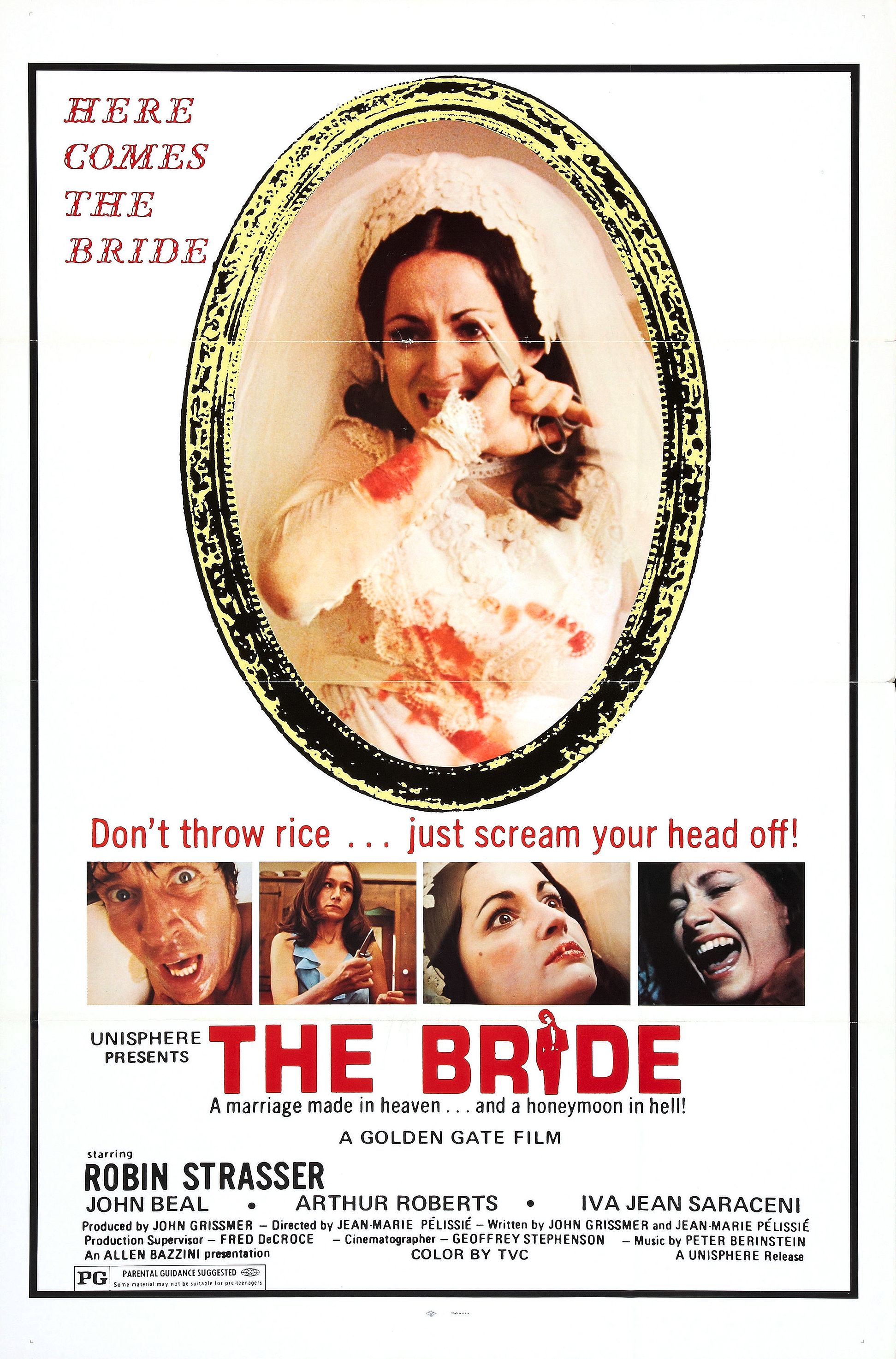
4-Word Review: The bride goes nutzo.

Despite a low budget this is an intriguing horror film with a unique vision. Barbara (Robin Strasser) is a young headstrong woman who designs an ominous looking, modernistic home, which she then has built. She plans on moving into it with her fiancé David (Arthur Roberts) who is caught fooling around on their wedding day, which sends Barbara into reclusion. Soon David begins experiencing strange occurrences, which leads him back to the house where an odd climatic sequence ensues.

This film stands out from the other low budget, cardboard horror movies of the 70’s simply because director Jean-Marie Pelissie shows a good understanding of the genre and how to effectively create eerie sequences. The house itself is an odd spectacle that looks like something designed by Frank Lloyd Wright while drunk. It’s erected in a large, empty field which gives it a very pronounced presence. The inside of the place was unfinished, and Pelisse uses the large windows of the home to casts unusual shadows along its white plastered walls and gives it a spooky look  as the camera goes spinning around it. Some of the imagery used during a nightmare sequence is equally creepy.

Strasser herself is quite frightening and flies into authentic looking rages easily. One good segment has her walking in front of all the wedding guests wearing a blood stained gown while behaving erratically. She then runs off with only hints that she may or may not be lurking in the shadows, which nicely taps into the fear of the unknown and mysterious.

The unfaithful groom is a good character with all the qualities that you love to hate. He is good looking, but amoral. He uses people while climbing the social ladder, but is quite dumb in the process. He tells his bride that he will be gone “for only a minute” and then has the audacity to go to an upstairs room of the house where they are having the wedding party and fools around with his former girlfriend, but doesn’t think to lock the bedroom door. When he gets his eventual comeuppance you have no problem seeing it.

As Strasser’s father John Beal is unimpressive. He is supposed to be a man of money and power, but instead comes off like a wimpy old man. Iva Jean Saraceni,,who portrays David’s old girlfriend Ellen, looks too much like Strasser, which doesn’t help.

Although this film has potential the low production values almost destroy it. The lighting is flat and certain segments are so dark you can barely see what is happening. Many scenes were filmed in small, cramped looking rooms with tacky props in the background. The music used during the scary scenes is good, but the soundtrack played over the rest of the film sounds like a bad rendition of Herb Alpert and the Tijuana Brass.

If you’re into cheap 70’s horror flicks then this is one you should check out. It definitely has some distinctive moments and is an interesting forerunner to A Nightmare on Elm Street since Barbara terrorizes David and his girlfriend through their dreams.

My Rating: 5 out of 10

Alternate Title: The Bride

Released: December 14, 1973

Runtime: 1Hour 25Minutes

Rated PG

Director: Jean-Marie Pelissie

Studio: Golden Gate Productions

Available: VHS, DVD

The Little Girl Who Lives Down the Lane (1976)

By Richard Winters

My Rating: 3 out of 10

4-Word Review: She is all alone.

Rynn (Jodie Foster) is a 13-year-old girl living alone in a big house in the countryside. Her father has leased the place for three years from nosy landlady Mrs. Hallet (Alexis Smith) and her adult son Frank (Martin Sheen) who continually makes lecherous advances towards Rynn. No one has seen her father and when anyone asks for him she comes up with excuses, which starts to make everyone in town suspicious. She meets fellow teen Mario (Scott Jacoby) who she lets in on her secret and the two devise a plan that will rid them of the meddlesome Hallets.

Although she has stated in interviews that this is the least favorite out of all the movies that she has done I can’t think of anyone more perfect for the part of an independent headstrong young woman than Foster, who has always carried that persona. Despite the vast age difference she easily carries the picture from her older co-stars. There is even a nude scene involving her character although it was done by her older sister Connie working as a body double. This was done despite her adamant protests as was a scene where she goes to bed with Jacoby, which she has said made her extremely uncomfortable and probably explains her dislike for the film.

Sheen is menacing as the perverted Frank, who enjoys ‘younger girls’ and his ongoing banter and advances with Rynn is consistently creepy and tense. Alexis Smith is excellent as the mother and her worn face and attitude gives her a witchy presence and it is too bad she couldn’t have remained for the entire movie. I also found Jacoby engaging and amiable and I really enjoyed his character, which I found a bit surprising since he is best known for playing dark, sinister characters in Rivals and the TV-movie Bad Ronald.

The on-location shooting, which was done in both the Canadian province of Quebec and in Maine, is excellent and gives one a nice taste of small town life on the east coast. There is some nice synthesized music that gives the film a dark tone. The premise is offbeat and to some extent, at least during the first half, it is enough to keep you intrigued.

My main issue with the film is the fact that not enough happens. Almost all the action takes place in the main room of the house, which eventually becomes dull, especially visually. There are no scares, or shocks and the twists aren’t all that clever, or surprising. In fact the final twist I saw coming long before it happens. There are times when cutaways would have been helpful and spiced things up particularly when Rynn talks about a visit from her mother and her ‘long red finger nails’, which we never see and is just described. The conclusion leaves A LOT of unanswered questions making this thing empty and incomplete. The final shot is one very long take of a close-up of Foster staring at a subject while the credits role by, which eventually becomes annoying and it would have been better had they done a freeze-frame instead of forcing her to sit and stare at something way longer than humanely possible. Also, composer Mort Shulman is badly miscast as the policeman. His acting abilities are clearly limited and he shows no presence or authority and makes the scenes he is in weak.

It is hard to know what genre to put this in. It is really not scary and the mystery angle has too many loopholes to being taken seriously. The story, based on a novel by Laird Koenig, seems rather tame despite some dark elements and geared more for teens, or young adults.

My Rating: 3 out of 10

Released: December 25, 1976

Runtime: 1Hour 40Minutes

Rated PG (Brief Nudity, Mild Cursing)

Director: Nicholas Gessner

Studio: American International

Available:  VHS, DVD, Netflix Streaming

Entertaining Mr. Sloane (1970)

By Richard Winters

My Rating: 3 out of 10

4-Word Review: The first gay marriage.

Based on the Joe Orton play of the same name, this film deals with a handsome young stranger named Sloane (Peter McEnery) who becomes a lodger at an isolated household in the English countryside. He is on the run from a murder he committed and feels this will be a safe haven due to the only other inhabitants being a quirky old lady name Katherine (Beryl Reid) and her equally quirky father Kemp (Alan Webb).  Katherine, or Kath, takes a sexual interest in Sloane despite their wide age difference, which Sloane doesn’t mind as he uses this to manipulate her. When Kath’s brother Ed (Harry Andrews) arrives and takes an amorous interest in Sloane as well, he does the same thing to him. Then Kemp recognizes Sloane as the killer and Sloane is forced to kill him, which culminates with ironic results.

Playwright Orton was years ahead of his time. His plays always had a dark, sexual, even explicit nature to them and his characters were always perverse and amoral in a darkly hilarious way. It is unfortunate that he was bludgeoned to death in 1967 by his jealous gay lover and his career was cut short. However, this adaptation done by screenwriter Clive Exton seems to miss the mark. The dialogue is endless with very little action. The other adaptation of Orton’s work that was made into a film, Loot, was much more lively and full of a lot of campy, zany humor as well as quick edits and imaginative camerawork. This film is visually dull and all the action is jammed into a cramped, dark house with bland decorations. It never really gets going until the final 15 minutes when you get to see the world’s very first gay marriage performed, but by then it is much too late.

For 1970 this film does seem edgy and even controversial in certain parts. The gay erotic subtext is quite strong especially the way the camera scans Sloane’s tan, half naked body. There is also Ed’s pink Cadillac that he drives around, which I got a real kick out of. I liked the way it squeaked as he drove it and was constantly bouncing up and down.  There is also his very provocative hood ornament of a naked man that the camera hones in on. The best part comes when Ed washes his car and is more focused on the ornament, which he lovingly caresses with his towel, than the rest of the vehicle.

However, 40 years later this stuff seems pretty tame and there are too many segments where nothing happens and is handled too conventionally.  It seemed like director Douglas Hickox really didn’t get, or appreciate the material enough, or interpret it in some interesting way because the final result is nothing more than a filmed stage play. The music that is used is terrible and almost enough to get you to turn off the film. It also gets overused and played over scenes when it isn’t needed and hurts the film’s mood in the process.

The biggest problem with the film may actually be with actress Reid herself. Don’t get me wrong this is a wonderfully unique actress who has done some memorable work. I especially liked her in The Killing of Sister George, and she is quite good here as well. However, I do have two issues. The first is a small one. It involves the fact that the character wears dentures. In one scene Sloane supposedly knocks them out and breaks them, but then Reid turns around and screams and you can see that she still has teeth in her mouth.  The other, much more serious issue is the fact that near the beginning of the film she is seen walking through a cemetery in broad daylight wearing a see through blouse. Now with some woman this can be quite sexy and I certainly wouldn’t complain, but when they are 60 and looking more like 70 this is a bad idea, even for perversely comical purposes as it is here it is still a bad idea. What is even worse is when she turns around and a gust of wind blows up her skirt and you can see her entire bare backside, which might be enough to make some viewers sick.

Now, before anyone accuses me of ageism let me relate an interesting experience that happened to me. Back in 2003 I was home from work and decided to take in a movie. I was living in Chicago at the time and I went to the neighborhood theater to see the interesting French mystery Swimming Pool starring Ludivine Sagnier and Charlotte Rampling.  It was a Tuesday and little did I know that it was senior discount day and the place was packed, literally, with people all looking well over the age of 70. The lady that sat beside me looked to be at least 80 and came in using a walker. The film featured an abundance of nudity from the young and attractive Sagnier, which I thought might shock and offend the seniors, but no one reacted to it and everyone went on enjoying the film. Then, towards the end of the movie, 58 year-old actress Rampling starts to take off her clothes and this indeed elicited a nervous response from the crowd. The lady next to me even said ‘oh dear’. In all fairness Rampling didn’t look all that bad naked, but it still hits home the point that even old people don’t want to see other old people naked.

My Rating: 3 out of 10

Released: July 27, 1970

Runtime: 1Hour 34Minutes

Rated R

Director: Douglas Hickox

Studio: Continental Distributing

Available: VHS, DVD (Region 2)

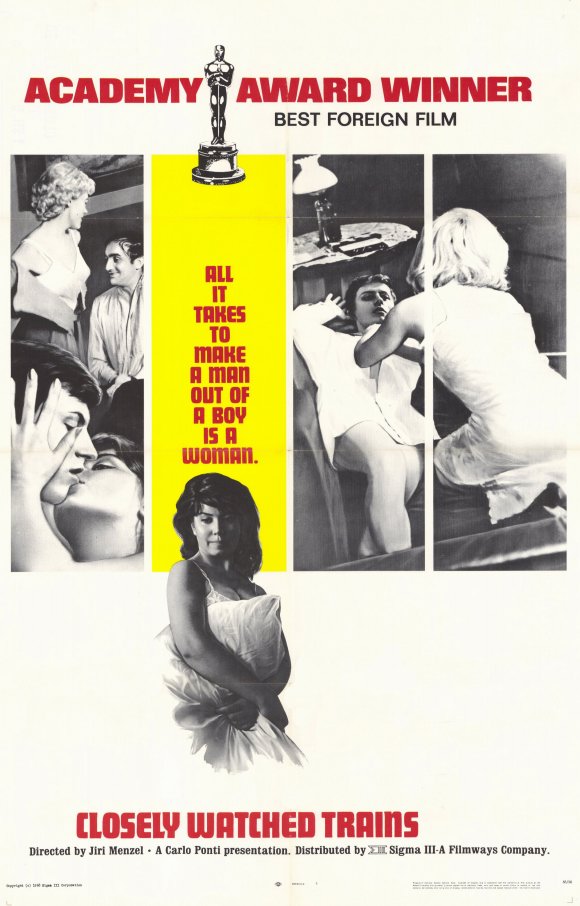
Closely Watched Trains (1966)

closely watched trains

By Richard Winters

My Rating: 7 out of 10

4-Word Review: Boy loses his virginity.

This is an engaging, amiable Czechoslovakian import that won the Academy Award for best foreign film of 1966. The story pertains to a young man named Milos (Vaclav Neckar) who follows in his father’s footsteps and gets a job at the local railway company during World War II. He almost immediately becomes bored with it and gets preoccupied with a beautiful young train conductor named Messa (Jitka Scoffin). The two have a sexual tryst, but Milos is unable to ‘rise to the occasion’.  He becomes despondent and even tries to commit suicide, but is saved at the last minute. While he is recuperating in the hospital the Dr. informs him that he suffers from premature ejaculation.  Milos then spends the rest of the time scouring the village for some prostitutes that he can ‘practice on’ so that he can learn to control his condition and become a ‘real man’.  A subplot involves plans to blow-up a German train carrying some high level ammunition.

Despite the fact that it is very leisurely paced and everything happens at one not very exciting location I still found the film to be immensely enjoyable. I had the feeling that director Jiri Menzel spoke straight from the heart with this one. The bleakness of the characters situation and the poor, hopeless conditions of their country is vivid and yet the ingenuity and perseverance of the human spirit never fades. Anyone who has dealt with an oppressive situation will most assuredly relate. The fact that this film stays so highly amusing and touching despite the depressing elements is what makes this a winner.

In a lot of ways this was years ahead of its time. The very liberal sexual attitudes and provocative scenes were stuff not yet seen in most movies and didn’t really become the norm, even for European films, until the 70’s and 80’s. Although not extreme there is indeed some lingering eroticism and even nudity. One segment involves Milos’s very amorous co-worker Hubicka (Josef Somr) rubber stamping the naked rear of Zdenka (Jitka Zelenohorska) who works as the station’s secretary. When her shocked mother finds out about this she parades her daughter all around town, exposing her rear to everyone, so that they can witness the ‘outrageous crime’ while the amused Zdenka finds it a turn-on.  There is also another scene, which another reviewer considered to be the most unique scene ever put on film that involves an old woman and a goose. I’ll agree it is very different, but I am not exactly sure what she was doing with it, or if I want to know, or if it is even legal, but it does indeed catch your attention.

Of course the drawback to this is the fact that the character’s attitudes seem far too modernistic for the era. At no time did I feel like I was really being transported back into the 1940’s.  There was also a little too much preoccupation with the sex angle and I felt there needed to be a little more balance with the actual war.

The Milos character is a bit too wide-eyed. He looks literally like a ‘deer-in-headlights’ through the entire progression of the movie. He seems overtly naïve for someone of 18. I know it was done for comical purposes, but having his mother dress him for his first day of work was going over the top. For the first half of the film he has hardly any dialogue and it is difficult for the viewer to relate to him, or get inside his head. Things do even out at the end when he ‘transforms into a man’, which I liked, but the opening half paints him too much as a caricature.

If there was one thing that really rubbed me the wrong way it would be the downbeat ending. I didn’t think it was necessary and tended to go against the film’s theme, which was human survival and coping. Still, it’s a good film with a great message. The budget was clearly very low, but it’s entertainment value high.

My Rating: 7 out of 10

Released: November 18, 1966

Runtime: 1Hour 33Minutes

Rated NR (Not Rated)

Director: Jiri Menzel

Studio: Filmove

Available: VHS, DVD (The Criterion Collection)

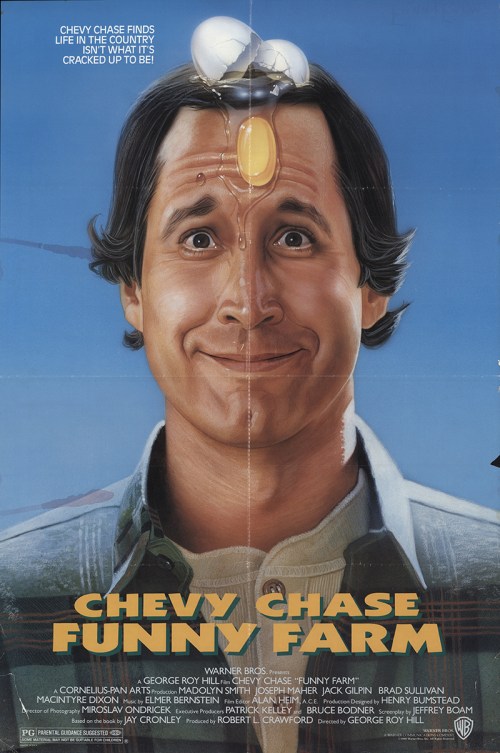
Funny Farm (1988)

funny1

By Richard Winters

My Rating: 3 out of 10

4-Word Review: Novelist moves to country.

Uninspired comedy about a man named Andy Farmer (Chevy Chase) who receives an advance from a publishing company, which he uses to quit his job and buy a cabin out in the country with his wife Elizabeth (Madolyn Smith) in order to write his novel. Unfortunately the local citizens are eccentric in very clichéd ways and their time there is spent dealing with one crazy misadventure after another.

Right from the start this film proves to have no footing in reality. Publishing companies only pay advances to authors who are already published and proven. They do not shell out $10,000 to some average unpublished Joe with only a vague idea for a story. Many publishers won’t even look at a finished manuscript from someone unless they are already represented by an agent and have some sort of track record, which renders this entire premise as ridiculous.

The movie starts off too quickly with them moving to the country without any set-up. The characters themselves are extremely bland and the script does not take advantage at all of Chase’s cynical, sardonic humor, or impeccable comic timing. Smith is certainly pleasant on the eyes, but things could have been more interesting had they been played-up as spoiled city slickers like the Lisa Douglas character from the TV-series Green Acres and then forced to adjust.

The humor is sloppy and uninspired and shows no level of sophistication. It is thrown in haphazardly without any consideration for story progression, or character development.  Much of it is not funny and the whole thing seems like a stretched out episode from the old Newhart TV-series and in fact the film was shot in Vermont were that series took place. The only mildly amusing moment comes when Andy goes fishing with some of the men from town and ends up accidently throwing them all overboard and even that is worth only a small chuckle. The final segment were Andy and Elizabeth convince everyone in the town to act like people from a Norman Rockwell painting and have them study covers from old issues of the Saturday Evening Post, as  they think this will make things seem more appealing to prospective buyers, is utterly preposterous.

The only time this film has any possibilities is when Elizabeth ends up not liking the story that Andy has written. Being a writer myself and having dealt with other writers I can attest that this can happen more than you think. In fact famous horror novelist Richard Laymon stated that his number one rule of things not to do was giving your manuscripts to friends and family members to read because it can create needless acrimony. Things get dicey when Elizabeth writes a story that sells, but the sterile script by Jeffrey Boam fails to take full advantage of this scenario and the results become as disappointing as everything else.

I did like that it was shot on location. The cottage is nestled away in a scenic area and the viewer gets the feeling that they are ‘getting away from it all’ along with the characters.  Capturing it during all four seasons is another plus. I also thought that the realistic looking stuffed squirrel was cool and I wish I could find one of those for myself.

Sadly, this was director George Roy Hill’s last film. He had much more success with Butch Cassidy and the Sundance Kid, Slapshot, and The Sting to name just a few. None of his genius shows up here as it is quite mechanical and formulaic.

My Rating: 3 out of 10

Released: June 3, 1988

Runtime: 1Hour 41Minutes

Rated PG

Director: George Roy Hill

Studio: Warner Brothers

Available: VHS, DVD, Blu-ray, Amazon Instant Video