Category Archives: Movies with a Hospital setting

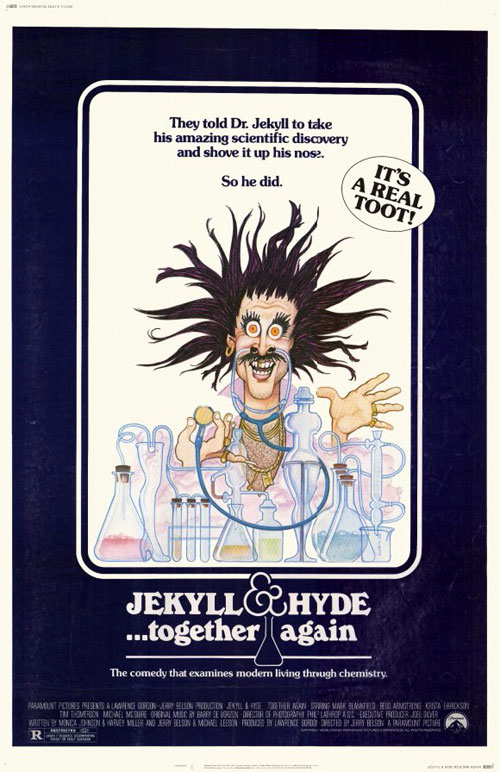
Jekyll and Hyde…Together Again (1982)

By Richard Winters

My Rating: 5 out of 10

4-Word Review: Drug changes surgeon’s personality.

Dr. Daniel Jekyll (Mark Blankfield) is a respected surgeon who’s become tired of the pressures of his job and working for Dr. Carew (Michael McGuire) a hospital administrator whose only concern is the monetary bottom line and who wants Jekyll to perform experimental surgery on ‘the world’s richest man’ (Peter Brocco), which Jekyll resists. In private during his off-hours, he begins experimenting with a white substance while inside his lab, but the demands from his personal and private life cause him to fall asleep where he accidentally inhales the drug, which causes him to have a secondary personality. His new persona is a party animal that is more confident and outgoing to the point of being obnoxious. This split personality causes issues with the two women in his life Mary (Bess Armstrong), a snobby socialite and Ivy (Krista Errickson), a loose living sex worker. 

This marked the directorial debut of Jerry Belson, a very talented comedy writer who wrote for such classic sitcoms as the ‘Dick Van Dyke Show’ before graduating onto movies where he penned scripts for the brilliant satire Smile as well as the dark comedy classic The EndWhile those other films were consistently funny and observational this film panders more on the crude side with a lot of drug references that may have seemed hip at the time but will most likely come off as dated and in bad taste to today’s viewers. It does have a certain Airplane-like element to it where there’s a lot of visually humorous non-sequiturs going on in the background as well as amusing ‘announcements’ that gets said over the hospital’s intercom, which I found to be some of the funniest stuff in the movie. However, there’s just not enough of it to keep it afloat and there’s also a lot of juvenile silly stuff that also gets thrown in, which does nothing but tank the whole thing making it seem like its intent was to be a party movie to be enjoyed by those who are either half-drunk, or high when they viewed it.

The script almost didn’t even see the light of day and stayed stuck in turnaround for several years as most producers and studio execs were not thrilled with it, but in the Spring of 1981 with a director’s strike pending Michael Eisner, the then head of Paramount, choose this script as something that could be shot on the cheap and quickly produced, so that the studio would have something to release should the strike occur. Unfortunately, four different writers were hired on to help doctor it, which only further diluted things making it a comic mishmash that never really gels.

Blankfied, who at the time was best known for his work on the ‘Fridays’ TV-show, which was ABC’s irreverent late-night answer to NBC’s ‘Saturday Night Live’ does not play the main role, at least during his scenes as the strait-laced doctor, all that well, which further hampers things. For one thing he looks creepy when he’s supposed to be normal. As the crazy Hyde character, he’s quite funny, but as a regular guy he’s dull. Tim Thomerson, who plays the narcist plastic surgeon, has the dashing good looks of what you’d expect for a leading man while also being engaging, which is why he should’ve played the Jekyll part and then Blankfield brought in to play Hyde and the whole thing would’ve worked much better. It still could’ve on paper revolved around the split personality of the same person, but just having a different actor play each part. 

Brocco, who’s almost unrecognizable as he sports a long white beard, is good as the elderly, but arrogant rich man and McGuire has one really good scene where he goes on one long, uncontrolled laugh attack. Errickson is cute, which helps things, though it would’ve been great had there been a little nudity on her end, which with the film being so utterly sophomoric and drive-in worthy anyways, you would’ve expected some, but there actually isn’t any. Armstong though plays her part too much like a caricature and thus her moments aren’t interesting and even a bit annoying. 

The scene where Hyde steals a car with the middle-aged lady driver in it and then lodges her head inside the car’s rooftop window, which causes her screams to sound like a siren to others as the vehicle tears down the road, is a gem of a moment. Hyde’s singing performance at an awards ceremony, where he does a striptease to show that he’s got nothing to ‘hyde’, is really inspired too. There’s even a quick scene involving George Wendt as a man with a severed hand who decides he’d rather have his wife ‘sew it back on’ than the doctor. I might even give an extra point to the segment where Blankfield accidentally sniffs up the white stuff in his sleep, but some of the other jokes dealing with the late 70’s drug culture I didn’t particularly care for and hence the movie doesn’t succeed as well, which also most likely helps to explain why it fared poorly at the box office.  

My Rating: 5 out of 10

Released: October 1, 1982

Runtime: 1 Hour 27 Minutes

Rated R

Director: Jerry Belson

Studio: Paramount

Available: DVD, Blu-ray, Amazon Video, YouTube
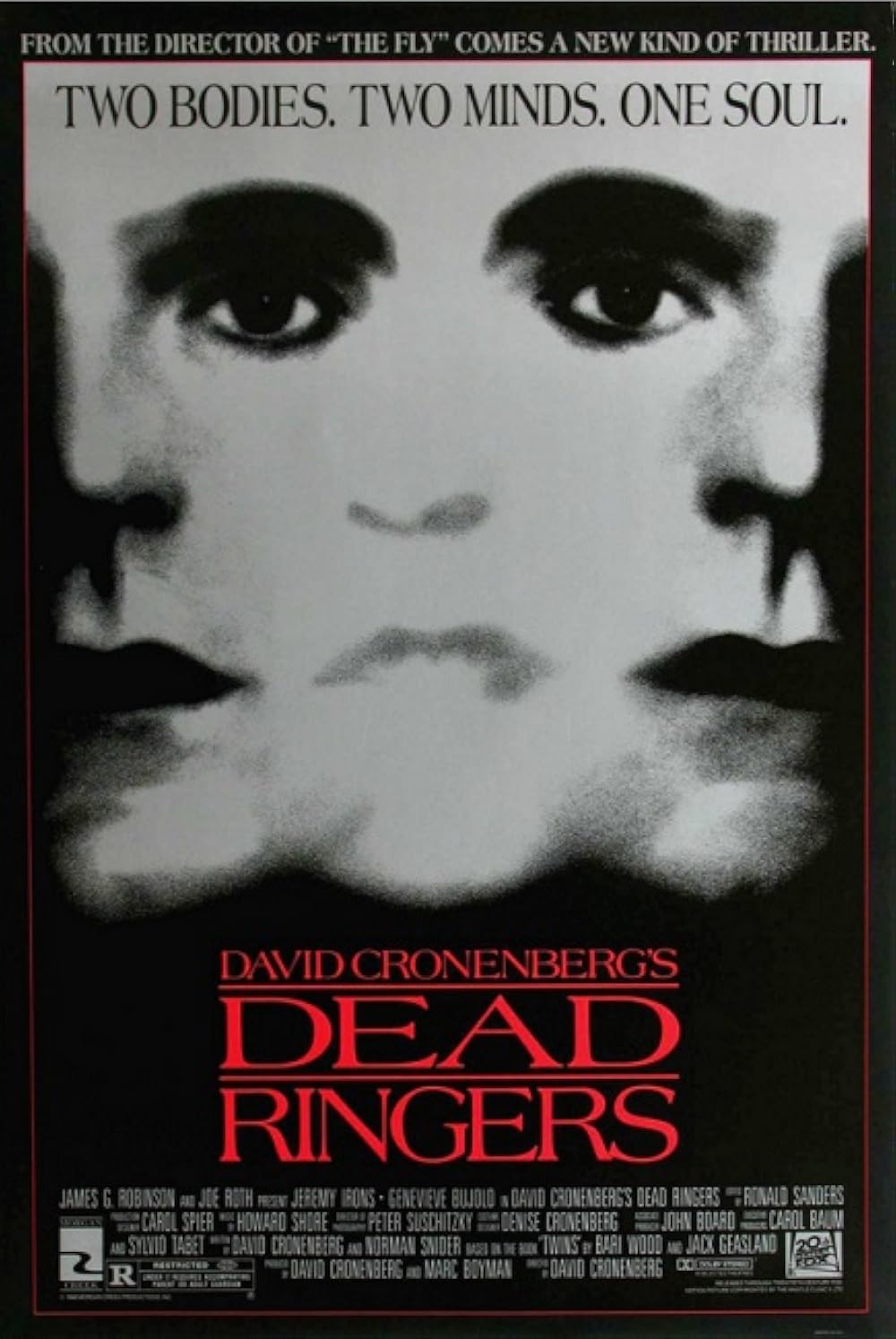
Dead Ringers (1988)

By Richard Winters

My Rating: 7 out of 10

4-Word Review: Twin brother’s relationship erodes.

Twins Elliot and Beverly (Jeremy Irons) work at a clinic as gynecologists with Elliot being the more outgoing of the two. Elliot routinely dates women many of them patients at their clinic but will then ‘hand them off’ to Beverly who is the shyer of the two and unable to get women without Elliot’s help. Since Elliot likes variety in his relationships, he’s okay with Beverly getting the women once he’s lost interest in them and the women can never tell the difference. Things though begin to change when Claire (Genevieve Bujold) enters into the picture. She, like the ones before her, was a patient whom Elliot is quickly able to hook-up with and then after a brief fling is given to Beverly, but this time Beverly falls for her in a deep way and not so eager to drop her. Claire also becomes aware that she’s been tricked by the two and has a confrontation with Elliot about it while she continues to see Beverly on the side. Beverly though becomes conflicted with his dual loyalties unable to handle how fractured his relationship with his brother, who he used to be quite close to, has become spiraling him into a depression that ultimately leads to a dangerous drug addiction. 

In 1981 David Cronenberg became interested in doing a movie about twins and producer Carol Baum sent him articles about Steward and Cyril Marcus. These were identical twins who were gynecologists working and living together in New York City. On the morning of July 17, 1975 both were found dead inside Cyril’s cluttered apartment in what had initially been perceived as being a suicide pact, which was later ruled out, but both did die within a few days of the other. While their deaths generated may articles and even a novel the cause to what circumstances lead to them dying together has remained open and thus Cronenberg decided to ‘answer’ that question with this story though he had to go through many years of different producers, screenwriters, and various different drafts before this version was finally given the green light.

If you’re a fan of Cronenberg, particularly his gore, which he’s best known for, then you may be disappointed with this as there really isn’t much. There are still some disturbing moments including the garish genealogical instruments that Beverly pays an artist, played by Stephan Lack, to create which he then plans on using on one of his patients, to the shock of his medical staff, which is a creepy moment. There’s also a dream sequence where Claire bites off a membrane connecting the two brothers, which is cool, but brief. There was also a scene shot that had the head of one of the twins coming out of the stomach of the other one, but this didn’t go over well with the test audiences, so it got cut, but I really wished had been left in. 

It’s really Irons and his incredible performance as the twins that makes this such an engaging movie to watch. Having one actor playing dual roles has certainly been done before, but never quite this effectively. Even though they look exactly alike I really got the sense these were two different people and Irons ability to craft such diverse personalities and postures, this was achieved by putting his weight on the balls of his feet while playing one of them and having his weight put on his heels while playing the other helps to, in a very subtle way, create a strong distinction and a hypnotic presence that sucks you into the story and never lets you go. 

My only quibble is that rarely have I seen twins that you couldn’t tell apart in some way. I noticed that Irons did have some minor moles on his right cheek and then another on the left side of his head near his eye. In the movie both of the brothers have these lesions in the exact same place, but I think in reality they wouldn’t, so they could’ve masked the moles on one of the characters through make-up, so it would only show on one of them and that could’ve been a way to tell them apart physically. There’s also the issue with one of them given a women’s name, which Claire does question at one point. Beverly gets quite defensive when it’s brought up insisting that his name is spelled in the ‘masculine’ way, but on the credits it’s spelled out just like it would had the name been given to a female, so I felt there should’ve been more explanation of why he’d been given an unusual name as it was something that would certainly come off as odd to many and I don’t think I’ve ever heard of a man with that name. 

I also had some problems with Bujold’s character as she seems to be plopped in solely to get the story going and start the process of having the brother’s strong bond dissolve, but for a character to generate such a pivotal thing I think she should’ve stood out more. What was it about this woman that created a division between the boys that the other women hadn’t? I would’ve liked seeing her more involved in the conflict possibly confronting Elliot in an angry way, not the conciliatory one we see here, and forbidding Beverly to see him, which would’ve helped make her more prominent versus just being a story device. 

My Rating: 7 out of 10

Released: September 23, 1988

Runtime: 1 Hour 53 Minutes

Rated R

Director: Michael Cronenberg

Studio: 20th Century Fox

Available: DVD, Blu-ray, Peacock, PlutoTV, Roku,Tubi, Amazon Video, YouTube

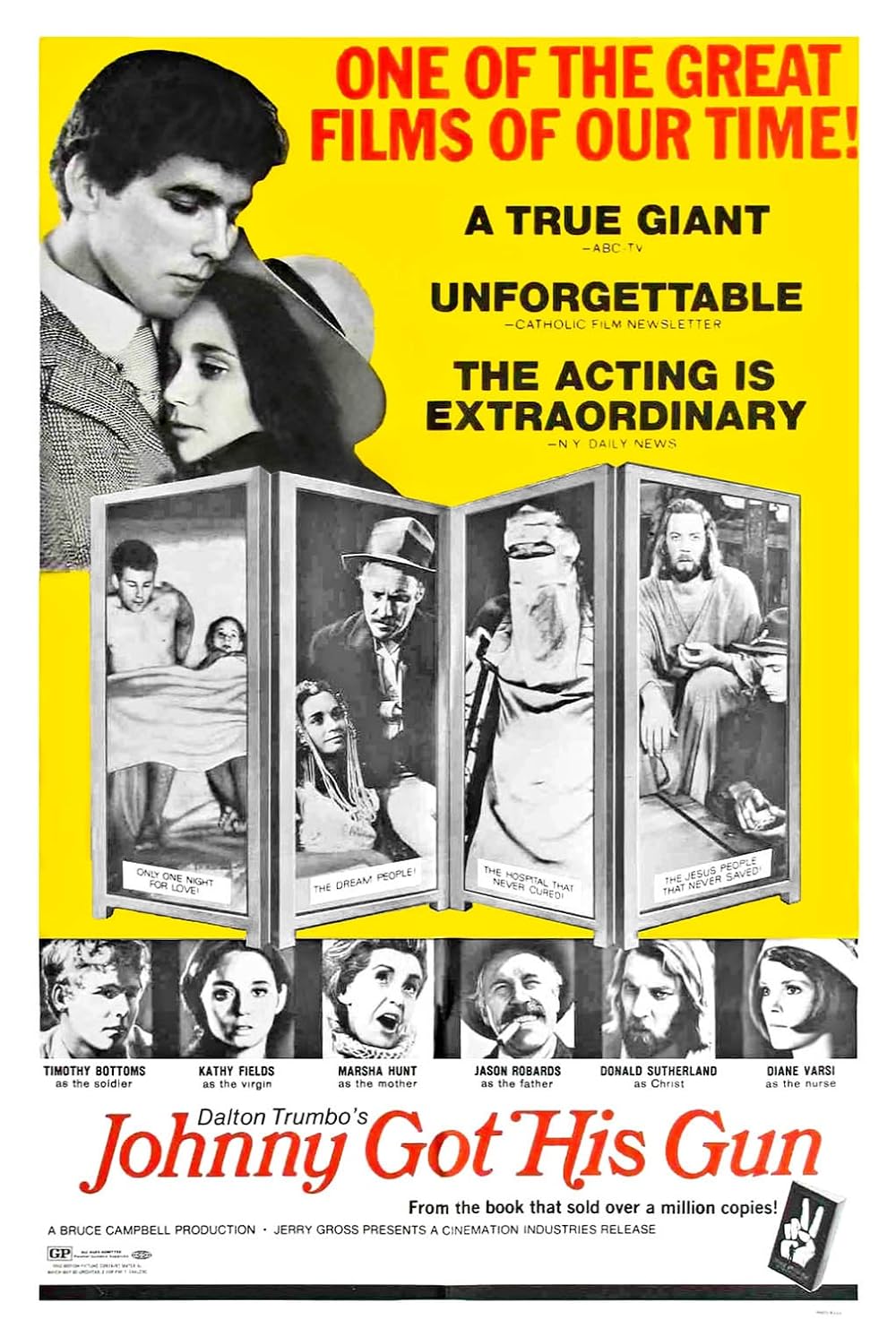
Johnny Got His Gun (1971)

johnny1

By Richard Winters

My Rating: 4 out of 10

4-Word Review: Left with no face.

Joe (Timothy Bottoms) finds himself stuck on a hospital bed, covered with a white sheet and unable to communicate with any of the doctors or nurses. As a soldier fighting in WWI, the last thing he remembers is being hit with an artillery shell and he presumes he’s injured and the medical staff is just trying to make him well again, but ultimately, he comes to the conclusion that he’s lost all of his limbs and even his face. The only thing left is his brain, which allows him to relive the memories of the past, but with no ability to express himself, or see or hear anything, like a prisoner in his own body. Locked away in a utility room, so his disturbing condition won’t be seen by others, he tries to suffocate himself but finds even that to be impossible. Eventually he’s able to use morse code by banging his head against his pillow to alert the staff that he’s still conscious and not a vegetable, but his demands to be toured around in a glass coffin in order to show the public the horrors of war go unheeded.

The film is based on the 1939 novel of the same name by Dalton Trumbo, which was inspired by the real-life case of Curly Christian, a Canadian WWI soldier who lost all four of his limbs during battle. The book was met with many accolades from the critics and was even considered for a movie as early as the 1940’s when it was to star a young William Holden, but funding for the project fell through. By the 1960’s when anti-war sentiment grew during the Vietnam years renewed interest in bringing the novel to the big screen mounted and plans were put in place to have Luis Bunuel direct, but yet again funding became an issue and the pre-production was paused for several years until Trumbo himself decided to take it on by working with private investors to get the required capital. The modestly budgeted film was then given a limited release in the summer of ’71 but was never a hit and largely forgotten until revived in 1989 when the heavy metal group Mettalica used footage from the film in their music video ‘One’.

The film has some interesting aspects including having the present-day scenes shot in black-and-white while Joe’s memories and dreams are done in color. Timothy Bottoms, in his film debut, is excellent. For most of the movie we only hear his voice-over of his thoughts, but within that limitation he plays it well and uses his tone eloquently to convey his emotions and inner angst. The supporting cast such as Jason Robards as Joe’s caustic father help give the movie a bit of an edge and Diane Varsi as the sympathetic nurse who shows compassion with Joe’s dismal predicament and quarrels internally about what to do including considering shirking her professional responsibility in order to put him out of his misery, is quite good too.

The structure though doesn’t fully work. The memories of past events, including his home life and upbringing, are too general, stuff that could’ve happened to anybody and thus nothing stands-out. The dream sequences don’t have enough visual flair and are much too talky. Trumbo may be the master of the written word, but his cinematic sense is lacking, and the film drones along putting the viewer to sleep instead of reeling them in emotionally. The anti-war message may have been ground-breaking for the ’30’s, but by the time of the movie’s release there were too many other art mediums saying the same thing, so what gets said here is nothing new and comes-off as redundant and even preachy.

My biggest complaint though is that we never see Joe’s actual physical state. During the whole movie he remains conspicuously covered by a white sheet, which I found to be a cop-out. I wasn’t opposed to keeping what he looked like a mystery for most of the way as revealing it right away would’ve taken away the shock effect, but at some point, it needed to be exposed to the viewers horrified eyes. Just constantly describing something doesn’t work in movies, maybe in books, but in film one should always go for the visual. Not sure why it wasn’t done here. Maybe they thought it would be too costly to create the special effects, or the gruesomeness would sicken the audience, but wasn’t that supposed to be the whole point? By keeping it at a ‘tasteful’ level it misses-the-mark and one of the main reasons why the movie doesn’t have as strong of an impact as it could’ve.

My Rating: 4 out of 10

Released: August 4, 1971

Runtime: 1 Hour 52 Minutes

Rated PG

Director: Dalton Trumbo

Studio: Cinemation Industries

Available: DVD, Blu-ray, Amazon Video

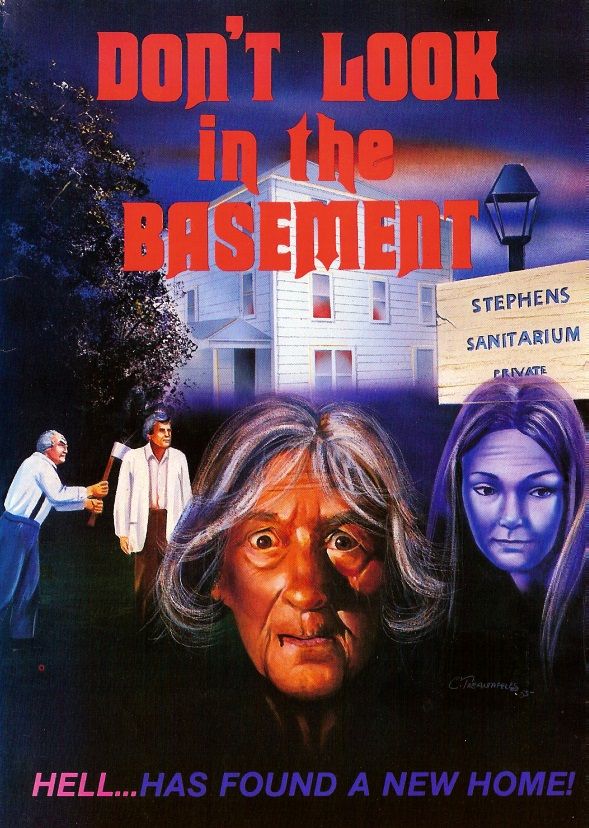
Don’t Look in the Basement (1973)

dontlook

By Richard Winters

My Rating: 2 out of 10

4-Word Review: Murder inside insane asylum.

Charlotte Beale (Rosie Holotik) gets hired by the director of a rural mental health institute, but when she arrives she finds only one nurse there, Dr. Geraldine Masters (Annabelle Weenick), who reluctantly agrees to take-in Charlotte though warning that the institute’s director was killed earlier by one of the patients, but she is determined to carry-on his work in his absence. The hospital is unusual in that it allows the patients to freely walk around with no perimeters as well as acting-out all of their fantasies versus trying to have them reeled-in back to reality. Charlotte though finds her stay there to be stressful as some of the patients try to attack her and she’s not allowed to leave the premises. She begins to wonder if she’s really there to help treat the insane, or instead slowly turned into becoming like one of them.

The film was shot in the summer of 1972 in the very small town of Tehuacana, Texas, which has a population of only 228 people. While the isolation works to some degree, particularly the exterior shots of the old white building that stands-in as the hospital, the interior action takes place in only 4 of the rooms and a hallway and thus there is no visual variety to the shot selections. You start to see the same shots over and over like a repeating loop that ultimately becomes redundant and boring.

The mentally ill patients are not captured in any type of realistic way as they’re characterized as being simpletons perpetually locked in child-like fantasies. In reality those with mental health issues can still be quite intelligent and simply suffering from dangerous delusions, thoughts, or emotional imbalance versus like here where they’re portrayed as being overgrown children lost in make believe and who never got past age 4. What’s worse is the entire thing gets solely focused on them, their silly antics and inane dialogue, making it seem more like a misguided, unfunny comedy than a horror film.

The staff members, or what little of them there are, are poorly fleshed-out as well. Nurse Charlotte immediately becomes spooked by one of the elderly residents on her first night like she’s had absolutely no training on how to handle mentally ill people. At each and every turn she gets more and more thrown off by them like someone who has no educational background in that field and the part could’ve easily just been some pedestrian thrown in there and you’d never know the difference.

The gore is quite minimal and even pathetic. When the doctor gets axed in the back he immediately falls down to the ground dead. I could understand this happening if the ax got him in the head, but instead it cuts into his shoulder, which shouldn’t have been enough to kill him, at least not instantly, and he instead should’ve been screaming out in pain versus just lying there motionless. The ax killings at the end are equally lame showing only small trickles of blood crawling down the victim’s faces when with a blade that big and that sharp their whole heads, if not entire bodies, should’ve been drowning in red.

Spoiler Alert!

The final 15-minutes are slightly creepy, but it’s not enough to make sitting through the rest of it worth it. The ‘big twist’ in which Nurse Masters is revealed to be a mental patient like the rest of them is no surprise as I had been suspecting it the whole time. There’s also no conclusion to what happens to the main character Charlotte, we see her escape outside into the rain, but not what she does after that. Does she go to the police and report what happens, or does she get committed since it’s intimated earlier that she may be crazy too, or does she just get lost in the wilderness surrounding the place and die? Nothing gets answered on this, but really should’ve.

In 2014 the director’s son, Tony Brownrigg, rebooted the franchise by doing a sequel, which was filmed at the same location as this one with one of the cast members, Camilla Carr, who was the only one still living, returning to play a part, but as a different character from the first one.

My Rating: 2 out of 10

Released: May 16, 1973

Runtime: 1 Hour 29 Minutes

Rated R

Director: S.F. Brownrigg

Studio: Hallmark Releasing Corporation

Available: DVD, Blu-ray (Region B/2), Plex, Pluto, Tubi, Amazon Video, YouTube

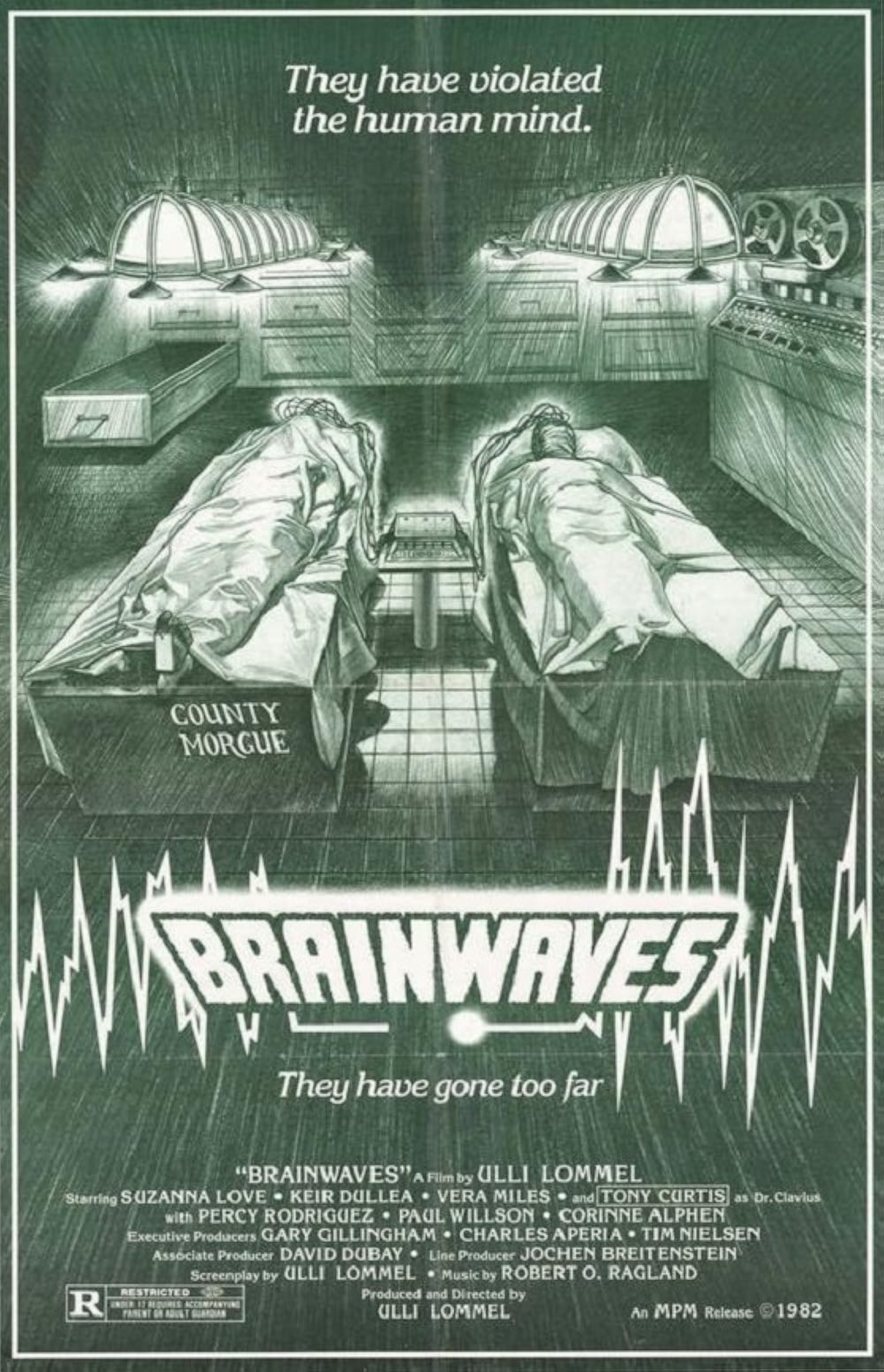
Brainwaves (1982)

brainwaves

By Richard Winters

My Rating: 3 out of 10

4-Word Review: Transferred brainwaves cause nightmares.

Kaylie (Suzanna Love) is a married mother of a young child living in San Francisco. One day while running out to the grocery store she gets the heel of her shoe caught in a trolley car track and this causes her to get hit by a car and suffer severe brain damage. Dr. Clavius (Tony Curtis) is heading experimental surgery that can transfer brainwaves from one victim to another. Kaylie’s husband Julian (Kier Dullea) agrees to the procedure in an effort to bring his wife back to her former state. Unbeknownst to him the other victim was a woman named Leila (Corinne Wahl) who was murdered in her bathtub by an unknown assailant. When Kaylie receives the brain transfer she begins having nightmares about the murderous incident. They then go on a search to try and unravel the mystery, but inadvertently get the attention of the killer who now begins stalking Kaylie in order to silence her before anymore oppressed memories come to light, which could identify him.

The film was directed by Ulli Lommel with a script that he had co-written with Love, who was also his real-life wife. The two had success a couple of years earlier with The Boogeyman and thus it inspired them to attempt another horror film. The concept is great and could’ve created an excellent plot, but the second-half labors too much in the recovery phase inside the hospital, which losses all the tension. The killer, whom we only see from the back, disappears from the story completely during the middle-half to the point you forget about him only to have him finally return by the third act, but by then it’s too late.

Dullea, as the concerned husband, is excellent even though acting here was a major comedown as he was getting leading man roles in major studio productions back in the 60’s, but now was relegated to low budget horror films though with that said he still makes the most of it. The same unfortunately can’t be stated for Tony Curtis, who only got the role because John Huston, who was the original choice, was too ill. Curtis had been a leading man in the 50’s and 60’s, so having to accept a part in such a minor production where he wasn’t even the star was certainly taxing on his ego and it shows as he appears grouchy and irritable throughout and seems like he wanted to be anywhere else, but in this movie.

Spoiler Alert!

The opening murder is okay though you know once she walks into the bathroom and turns on a portable radio that it’s most likely going to end up in an electrocution, so when it does finally occur it’s no surprise. The trolly car incident is nicely shot as well, but the ‘big reveal’ of who the killer is, which turns out to be non other than the victim’s boyfriend, which is the first person you would’ve suspected and thus is a complete letdown. The film should’ve had a wider array of suspects to choose from and played this part out more. The climactic sequence, done near the Golden Gate Bridge, gets shot in slow motion, which gives the proceedings a really tacky look.

The final twist features the dead body of the killer being wheeled into the doctor’s lab where it will apparently be used as a brain donor to another crash victim is cool, but the film then ends when it should’ve continued on with the psycho now chasing after Kaylie inside whatever body his brainwaves got transferred to. By having writer/director Lommel not take full advantage of the myriad plot twists as it could’ve is what really hurts it making it no wonder that it’s box office proceeds was a disastrous $3,111 out of a budget that had been $2.5 million.

My Rating: 3 out of 10

Released: November 19. 1982

Runtime: 1 Hour 20 Minutes

Rated R

Director: Ulli Lommel

Studio: Motion Picture Marketing

Available: VHS, DVD-R (out-of-print)

Second Thoughts (1983)

second thoughts

By Richard Winters

My Rating: 1 out of 10

4-Word Review: Lawyer considers an abortion.

Amy (Lucie Arnaz) is in a relationship with Will (Craig Wasson) a former political activist who found out trying to change the world was too difficult, so now he settles for just being a street musician, who at times gets in minor skirmishes with the law and needs Amy’s assistance as she’s also a lawyer. Amy then also gets ‘hired’ by her ex-husband John (Ken Howard) to represent him in his divorce from his second wife that’s really a ploy to try and get back together with her. Will and John know each other when Will applies for a loan from a bank that John manages though neither of them know about either of their relationships with Amy. Then Amy gets pregnant and considers an abortion. John is fine with her decision and even agrees to drive to the hospital while Will sneaks into the facility and kidnaps her in an attempt at preventing it from happening.

This was the second movie directed by famed producer Lawrence Turman whose first foray behind-the-camera was 12 years earlier with Marriage of a Young Stockbrokerwhich was panned by most critics though I found it interesting. This one got savaged as well and for the most part rightly so. The main issue is the disjointed tone that starts out as a drama with a TV-Movie of the week theme and then by the second act slides over into becoming an offbeat comedy. The unimaginative title and misleading movie poster, which makes it seem like two horny adults frolicking around, which it isn’t, was more than enough to confuse potential audiences and keep them away and thus lead it into being a financial disaster at the box office with a very limited release before falling off into complete obscurity.

To its benefit it does have some unique moments. The segment where Will puts a dead fish into the bank’s safety deposit box as revenge for them not giving him a loan and then stinking up the place to the point that they bring in a whole bunch of cats in order to sniff out where the odor was coming from is commendable. I also enjoyed Lucie’s attempt to escape from the isolated cabin that she’s in, where she’s handcuffed to a bed, by trying to drag the entire bed frame down the stairs, which could’ve been played-up more. I also got a kick out of the scene where John’s ex-wife, played by Ann Schedeen, threatens his beloved potted plants, even holding one ‘at gunpoint’ unless he agrees to pay for her cosmetic surgery.

Unfortunately Lucie Arnaz’s performance kills it. She had the option of either doing this one, or Poltergeistand decided on doing this because she felt it lent her greater dramatic work, but in the end she should’ve gone with the other one as that has obtained a cult following while this one is completely forgotten. Her character is too much of a composite of the modern career woman. There’s nothing unique, or interesting about her and thus you never get emotionally invested in her journey and if anything find the times she is on the screen to being the film’s most boring moments.

Wasson has been lambasted on this blog before with the other movies he’s been in and his appearance here proves no exception. He’s supposed to be playing an American Indian, but doesn’t look the part at all and somebody with an actual Native American ancestry should’ve been given the role. The songs that he sings, many of which have a ragtime quality, I found to be just as annoying as his acting and his character isn’t likable. The way he holds this woman against her will until she agrees to have ‘his baby’ I found genuinely creepy. Now of course if one is on the Pro-Life side of the fence maybe they’d consider what he does to be ‘heroic’, but while having a civil debate on the issue and him voicing his concerns on why he feels she shouldn’t terminate the pregnancy is fine, but then confining someone to a small room against their will is where I feel he takes things too far and is no longer just this benign guy with good intentions.

The film’s ultimate message becomes a murky as its tone. Initially I thought with the casual way that the abortion option gets discussed that this was a typical liberal minded film with a pro-choice sentiment, then by the third act this all seems to get reversed especially with the female doctor character played by Peggy McCay. She has performed abortions before, but now is reluctant to do it on Arnaz while using the excuse that she no longer ‘feels comfortable’ with it, which seemed to be the filmmaker’s attempt to insinuate that abortion doctors know what they’re doing is ‘wrong’ and ultimately start to feel guilty about it afterwards.

There’s another doctor played by Arthur Rosenberg, who has no qualms performing abortions, but is also portrayed as being incredible callous and obnoxious. At first I thought this was just done for misguided comedy, but eventually it seemed that this was the filmmaker’s way of trying to show how doctors that do this type of procedure without an regrets are ‘bad and crass’ people inside and his constantly rude demeanor was just a way of ‘exposing’ this.

In either case both sides will get alienated by it. A pro-lifer won’t want to sit around watching a movie that at the beginning seems to be taking a different viewpoint  just to wait until the very end when it then seems to finally come around to their position. Pro- choice people will dislike the movie for the exact opposite reason and therefore you have to wonder what type of viewer this movie was meant to attract as I can’t think of anyone that would like it.

My Rating: 1 out of 10

Released: February 6, 1983

Runtime: 1 Hour 38 Minutes

Rated PG

Director: Lawrence Turman

Studio: Associated Film Distribution

Available: DVD-R (dvdlady.com)

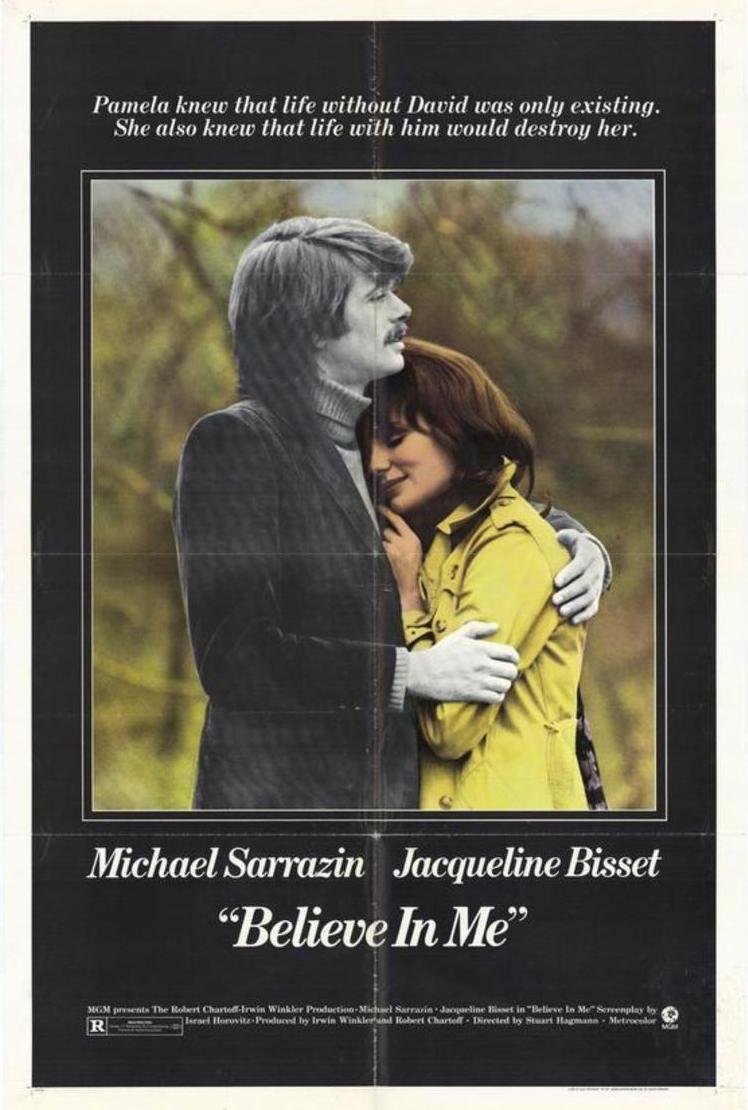
Believe in Me (1971)

believe

By Richard Winters

My Rating: 6 out of 10

4-Word Review: Couple addicted to drugs.

Remy (Michael Sarrazin) is a medical student at a New York hospital, who finds himself increasingly addicted to speed and other drugs available to him through his job. Pamela (Jacqueline Bisset) is the beautiful new girlfriend he meets through his friend and fellow intern Alan (Jon Cypher) who’s also Pamela’s brother. The two hit-it-off and soon move into together, but the romance doesn’t last when Pamela becomes aware of Remy’s addiction. He convinces her that he can handle it and even gets her to try some of it despite her reluctance. This then leads to her becoming hooked as well and their lives quickly spiral out-of-control as they both lose their jobs, their money, and ultimately their dignity.

The early 70’s was  a peak era for drug culture movies with most getting a bad rap from the critics, which included this one. Certainly it does start out cringey with a sappy love song sung by Low Rawls that not only gets played over the opening credits, but also about 30-minutes in, which practically kills the whole thing with its heavy-handed melody and lyrics. The title is not so great either as it seems to imply a totally different type of movie like have someone sticking with another person through thick-and-thin, which really doesn’t happen here and in fact its the complete opposite.  ‘Speed is of the Essence’, which was the working title as well as the title of the New York Magazine article by Gail Sheehy of which the film was based was far more apt and should’ve been kept.

However, what I did like are that the characters aren’t teen agers, or a part of the counter-culture movement, which is where all the other drug movies from that period had. The blame in those films was always the same too: peer pressure and bad influences, but here that all gets reversed. Remy and Pamela are well educated and with Remy’s background is well aware of the dangers of drugs and essentially ‘knows better’ and yet becomes a victim to them anyway. Because he’s at such a high standing initially and not just played-off as being some naive kid, makes his downfall and that of his equally smart girlfriend all the more stark and gripping.

The performances are good too. Sarrazin and Bisset met while filming The Sweet Ride, that started a 6 year relationship and this was the one project that they did together. Sarrazin has been blamed as being too transparent an actor who’s instantly forgettable and melts into the backdrop. While I’ve usually found his acting credible he does have a tendency to be passive and lacking an imposing presence, but here he’s genuinely cranky and snarly. Even has some moments of anger, which is why the movie mostly works because the character is believable. There’s good support by Alan Garfield as his dealer who gets the final brutal revenge on Remy when he can’t pay up as well a Cypher whose advice to his sister when she’s down-and-out and asking for money is shockingly harsh.

Spoiler Alert!

The film has a few strong moments particularly when it focuses on the couple’s teenage friend Matthew (Kurt Dodenhoff) who also becomes hooked and goes through a scary mental and physical decline, but the ending lacks punch. It has Remy sitting outside his apartment saying he’s ‘lost his key’ (not sure if this was meant as a code word for them being evicted, but probably should’ve been). Pamela then leaves him there while she walks to a clinic in order to get sober, which for me was too wide-open. For one thing there’s no guarantee that Pamela would’ve been able to cleanly kick-the-habit as many people enter into drug recovery suffer many relapses. Leaving Remy alone doesn’t offer any finality. Either he dies from his addiction, or finds a way out, but we needed an answer one way, or another like seeing his lifeless body lying in the gutter, which would’ve given the film the brutal final image that it needed. The movie does give an honest assessment of the situation most of the way, so why cop-out at the end and become vague? The viewer had invested enough time with this that they should’ve been given a more complete and concrete character arch.

My Rating: 6 out of 10

Released: December 8, 1971

Runtime: 1 Hour 26 Minutes

Rated R

Director: Stuart Hagmann

Studio: MGM

DVD-R (dvdlady.com)

Equus (1977)

equus1

By Richard Winters

My Rating: 6 out of 10

4-Word Review: Teen blinds six horses.

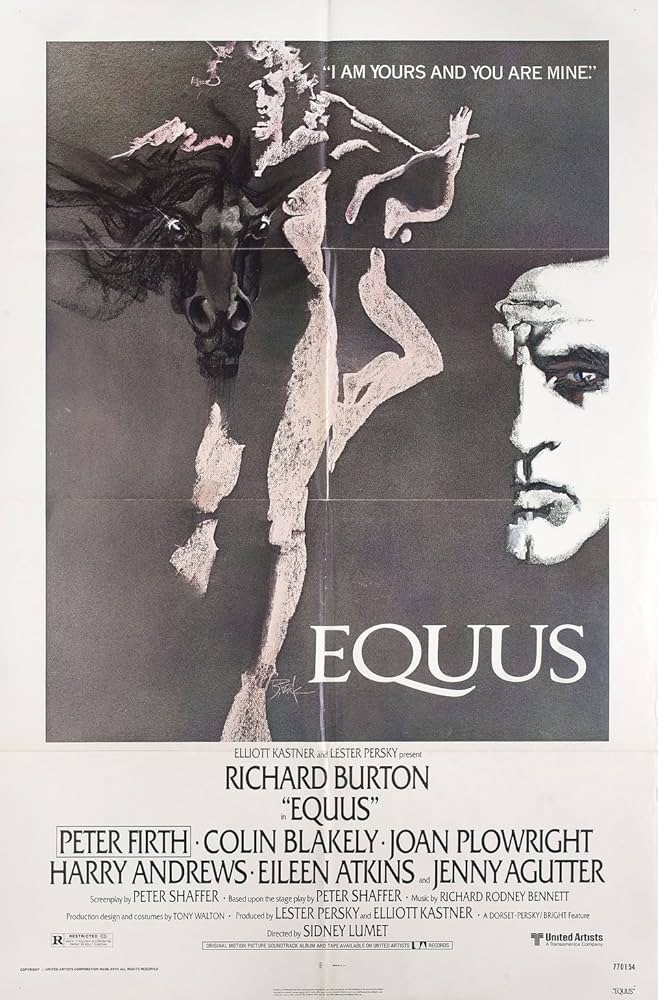
Martin (Richard Burton) is a disillusioned, middle-aged psychiatrist who gets tasked with finding out why a 17-year-old boy named Alan (Peter Firth) blinded six horses one night in a stable with a sickle. At first Alan is uncooperative during their sessions and will not speak to him and instead sings out commercial jingles repeatedly, so Martin must go to Alan’s parents (Colin Blakely, Joan Plowright) in an effort to find some answers. It is here that he learns the mother is highly religious and taught her son that ‘God sees all’ particularly when it comes to sexual transgressions. Alan though has replaced God with his obsession with horses and idolizes them instead where he essentially makes them his ‘deity’. Martin now must try to break the boy away from this fanaticism in an effort to make him ‘normal’, but realizes when he does that the kid will cease to have passion and become like Martin himself who no longer has any emotions for anything including his own wife whom he no longer shares intimate relations.

Director Sidney Lumet has always had a penchant for turning plays into a movies and with some of them he’s had great success like with 12 Angry Men, but some of his other efforts did not fare as well. This project was met initially with a lot of apprehension, but overall Lumet’s directorial flair adds a lot and cinematically it works for the most part. The effort to get away from the staginess of the story by having several scenes done outdoors, like Martin having a discussion with his friend played by Eileen Atkins, about the case while raking leaves I felt really worked. Again, with cinema you have to have the characters doing something during the dialogue even if it’s some sort of chore as there’s nothing more stagnant than talking heads in a movie. The opening sequence done over the credits is well done too as it features Martin dealing with hostile patients hitting home the point of how burnt-out with his career he is without having it told to us and the white color schemes accentuates the tone one is most likely to see in hospitals.

The controversy came with the portrayal of the horses. In the play there were performed by muscular men inside a horse costume, but for the movie Lumet decided they needed to use real animals. This is okay until it comes to the scene where they get blinded. The play version only intimates the violent act, but with the movie you actually see the sickle go right into the horses’ eyes, which is so realistically done I don’t know how they did it without hurting the animal. This was way before computer effects, so just be warned if you’re an animal lover these scenes may be too graphic to bare and could easily take some viewers out of the story to the extent they may not be able to get back into and might just turn it off altogether.

The casting is a bit problematic. Both Burton and Firth played the roles in the stage version, but by this point Firth was no longer looking like a 17-year-old, he was in fact already 23. I admire his bravery to ride a horse in the nude in one of the movie’s more memorable moments, but he still resembles adult features physically taking away the innocence of the character and the shock of how someone so young, i.e. a teen. could commit such a vicious act. Burton too looks too worn out having spent this period of his career battling alcoholism. Some may say that this fit his role, but his presence seems at times almost lifeless and like he’s just walking through his part. The segments where he speaks directly to the camera become long-winded, stagey and aren’t effective.

The story itself may not work for everyone. It was inspired by a true event, which occurred in 1954, that playwright Peter Shaffer heard about, but did not actually investigate. Instead he wanted to come up with his own hypothesis on how someone could do what this character does without learning the real reason that motivated the actual culprit. Some may find the teen’s motivation here to be interpretive and revealing while others will blow-it-off as pseudo psychology and not able to fully buy into. For example certain viewers will find the scene where the father catches the boy kneeling in front of a picture in his bedroom of a horse and ‘worshipping it’ while wearing a make-shift harness to be quite disturbing though with others this same segment may elicit a bad case of the giggles instead.

My Rating: 6 out of 10

Released: October 14, 1977

Runtime: 2 Hour 17 Minutes

Rated R

Director: Sidney Lumet

Studio: United Artists

Available: DVD, Blu-ray

Tribute (1980)

tribute

By Richard Winters

My Rating: 3 out of 10

4-Word Review: Father reconciling with son.

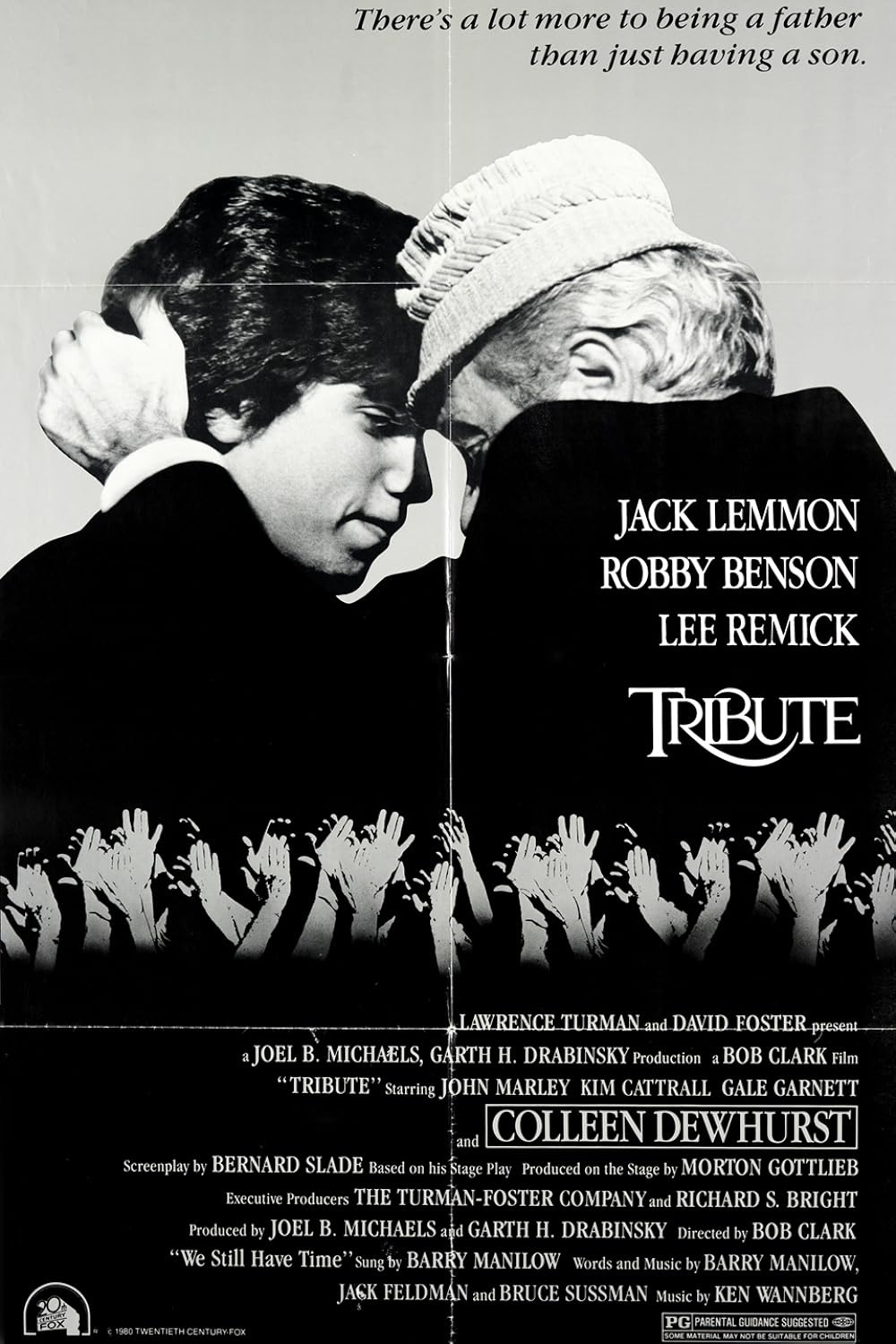
Scottie (Jack Lemmon) has been working in show business for decades and has built up many friends and fans, but finds it all come crashing down when, at the mere of age of 55, he gets diagnosed with leukemia. His greatest regret is not having a close relationship with his now grown son Jud (Robby Benson). He wants to reconcile, but not make it obvious that’s it’s because he’s about to die. When Jud comes over for a surprise visit with his mother (Lee Remick), whom Scottie has long since divorced, he tries to mend things and become the father he never had, but the hurt runs deep and Jud proves to be resistant to everything Scottie tries making him feel even more hopeless and forcing him to come to terms with his personal faults and inadequacies.

The film is based on the stageplay of the same name, which also starred Lemmon, and got sold into a $1 million movie deal before the stage version ever hit Broadway. On the surface it’s deemed a drama, but the script by Bernard Slade, who also penned the play, comes off more like a desperate comedy akin in tone to Same Time Next Year, which is Slade’s most famous work that had a strong dramedy vibe to it. This works on that same level as it attempts to lighten the poignant moments with comical bits, but it fails miserable.

Had some of it managed to actually been funny I might not have complained, but it amounts to cringe instead. The most eye-popping moment is watching Lemmon in a chicken costume run around his place going ‘balk-balk’ and even lay a giant egg on the sofa, which I felt was a career low point. What’s even dumber is his wooing of a young woman, played by Kim Cattrall, who’s also a patient at the hospital. He gets into her room by pretending to be a doctor and then gropes her breasts in a feeble attempt to check her heart rate. A normal woman of today, and even one back then, should respond with outrage for him copping-a-feel by disguising himself into being someone he isn’t, but in this stupid movie she’s instead ‘charmed’ by his antics and it’s enough to get her to go to bed with him later.

What’s worse and even more outlandish is that Scottie then sets her up with his son to have them conveniently ‘bump into each other’ in public and then begin going out. Yet how many sons are going to be cool with Dad sleeping with their girl first? Of course Scottie never tells him that he’s already ‘tested her out’, but it does end up showing inadvertently what a conniving jerk the old guy is and what the film considers to be nothing more than an amusing comic side-story really hurts the likability of the character if you think about it.

The acting is good. Lemmon is expectedly strong and so is Remick as his wife though her part is limited. I liked seeing Benson, who usually got stuck with immature parts due to his young, geeky features, play the mature and sensible, level-headed adult of which he does perfectly. Colleen Dewhurst has some strong moments as the caring nurse and Cattrall, despite the annoying nature of her dippy character, is pleasing enough. Yet the ultimate scene-stealer goes to Gale Garnett famous for the mid-60’s folk song ‘We’ll Sing in the Sunshine’, who plays a hooker and in one segment goes topless (looks great), but it’s a bit jarring when you realize it’s the same person who sang such a sweet-natured tune, tough in some ways you could say it’s also a testament that her creative talents are quite broad.

The third act, where they have this major tribute for Scotty has a touching potential, but gets overdone by filling-up an entire auditorium with all of his ‘close friends’, which even for a social butterfly seemed a bit exaggerated. The scene where the hooker gets a restaurant packed with all of her male clients who have ever slept with her has an amusing quality though again equally hard to believe that all of these men would be cool with everybody knowing that they’ve bedded a prostitute. I’ll give props though to the segment showing Scotty getting treatment in the hospital, which gets shown exclusively through still photos, which I found visually innovative.

Unfortunately everything else falls into second-rate melodramatics. It doesn’t even have the decency to tells us whether Scotty dies or not. When an entire movie deals with a character’s ultimate demise I think it should eventually get answered instead of leaving it open. It makes the whole terminal illness thing seem like a tease done to emotionally manipulate the viewer than an actual reality that it supposedly is.

My Rating: 3 out of 10

Released: December 19, 1980

Runtime: 2 Hours 1 Minute

Rated PG

Director: Bob Clark

Studio: 20th Century Fox

Available: DVD-R

Rage (1972)

rage

By Richard Winters

My Rating: 6 out of 10

4-Word Review: Nerve gas kills son.

Living just outside of Rawlins, Wyoming is rancher Paul Logan (George C. Scott) and his 12-year-old son Chris (Nicholas Beauvy). Since the death of his mother a year earlier the two have shared a special bonding and routinely do many things together as Paul works to guide Chris from being a child to a man. One night they decide to go camping on the outer stretches of their property. While Paul sleeps in a tent his son stays outside in a sleeping bag, but by morning he’s unresponsive and bleeding from the nose. Paul takes his child to a nearby hospital where the doctors aren’t sure what’s caused the condition, but keep him under observation. Behind-the-scenes it’s revealed that Chris has become a unintended victim of a botched military operation from a nearby base where nerve gas was accidentally released to the public. Paul soon comes down with the effects of the exposure as well, but before he dies he intends to get to the bottom of what happened and bring street justice to all those who were behind it.

The film, which was the first theatrical feature that Scott directed, is a handled in an unusual way. Most movies that deal with government cover-ups/conspiracies usually keep it a mystery of who’s behind it. Both the victim and the viewer have no idea what’s going on behind-the-scenes and are left with trying to guess who may be responsible and only at the very end do things get revealed, but in some movies even then many questions remain left open. Here it gets shown right away who’s causing the crisis and why as there are many long, drawn-out meetings between the government agents who almost painstakingly detail of what went wrong and how they’re going to cover it up. In fact there’s more scenes, especially in the first half, with the military brass and their co-horts than with Scott making it almost seem like he’s just a side character.

Spelling everything out may seem like a bad idea as part of what creates the suspense in these types of stories is the unknown. Yet it still held moderate interest though the scenes are overly talky, at least the first two acts. It’s also not explained what happens to Dr. Caldwell (Richard Basehart). He initially goes along with the government agenda to keep things quiet, but eventually changes his mind and decides to tell Paul the truth, but then he’s confronted with the agents who bring him into a hospital room and close the door, but it’s never shown what they do with him. He’s reappears at the very end, but no explanation for where he was in-between, or how the government managed to make him ‘disappear’ for awhile. For a movie that seemed intent to explain everything I felt this was one area that needed to be better played out.

Spoiler Alert!

Where the film goes really off-the-beam is when Paul exacts his revenge, which has him killing many indiscriminate people. Some of it turns quite savage particularly when he blows up a police car and the cops jump out screaming in pain as the hot flames rise off their bodies. At one point he even shoots-up a cat who tries to come to the aid of its owner, which has to be some sort of cinematic first. Normally other movies with this type never have the hero kill anyone and will usually just hold people that they come upon, like cops or security guards, hostage by tying them up. Here though he blasts them away without pause. Some critics have said this was a mistake as the protagonist loses his likability factor with the viewer, but in some ways if you’re really going to try take on something as big as the government then ultimately things will get ugly especially if the person is willing to go ‘all-in’ making it in a nihilistic way quite realistic.

The ending though is what really hurts it as Paul dies while the government agents callously watch on and then flown away via helicopter to some undisclosed location. I know 70’s movies were notorious for their unhappy endings, but this one piles-on that notion a bit too much. Outside of blowing up the research center, which could easily get rebuilt, Paul’s actions made no difference. The viewer likes to see their hero have more of an effect on things and to end it like this makes it overly defeating. Had we gotten to know the Paul character better and there had been more of a backstory then maybe his final rage at the system would have had more of a dramatic effect, but as it gets presented here on an emotional scale it’s unsatisfying.

My Rating: 6 out of 10

Released: November 22, 1972

Runtime: 1 Hour 39 Minutes

Rated PG

Director: George C. Scott

Studio: Warner Brothers

Available: DVD-R (Warner Archive), Amazon Video, YouTube