Category Archives: Movies that take place in the Big Apple

Single White Female (1992)

By Richard Winters

My Rating: 7 out of 10

4-Word Review: A roommate from hell.

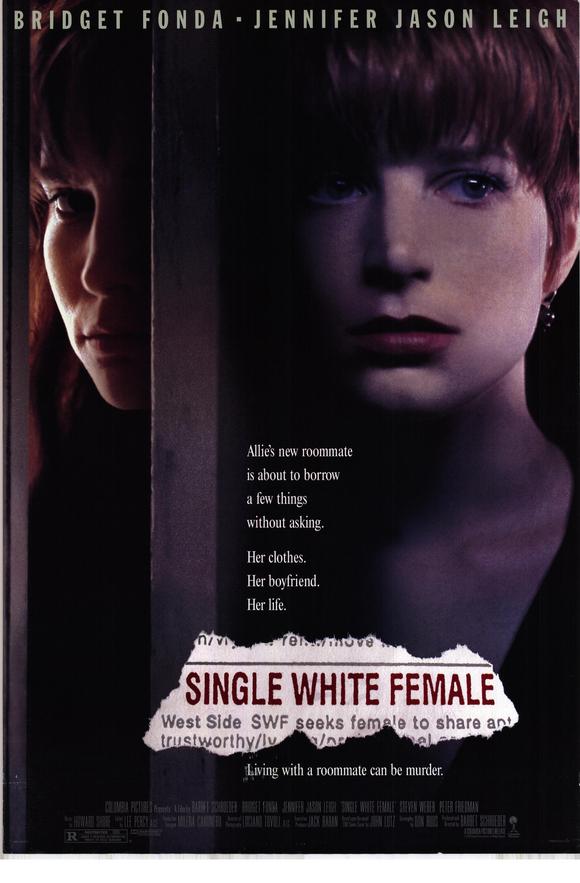
Allison (Bridget Fonda) is a young entrepreneurial business woman who breaks up with her boyfriend and decides she doesn’t want to be in her apartment alone. She finds Hedra (Jennifer Jason Leigh) for a roommate and things go well until the relationship with her boyfriend is rekindled. Hendra then starts to become possessive until it eventually culminates into full blown psychosis.

This thriller really never gets going until the final thirty minutes when it climaxes with a real rock ’em, sock ’em, duke it out showdown, which is full of clever twists and good action. The first third though stagnates. In some ways this is good because it avoids being a formulated thriller that feels the need to always telegraph its punches. The viewer is as in the dark as to Hedra’s psychosis as Allison is. Things work so slowly that at times it almost seems like a drama. In some ways it might have been better had it stayed that way. There are some good ingredients here for an insightful look of two young women from different backgrounds trying to forge a friendship. Having it turn into your general psycho/thriller seems almost like a cheap gimmick that prevents it from being a deeper and more original piece.

Another thing that separates this from the other psycho/thrillers is the fact that the two are on equal footing. Unlike most thrillers the bad guy doesn’t have any unfair advantage over the other or the good guy isn’t impeded with any type of handicap. It all just comes down to smarts, inner strength and determination, which makes it interesting. It’s almost like giving them both a pair of gloves and then putting them into the ring.

Fonda is likable enough. She is normal, but not in a boring way and has vulnerabilities that she must face. Leigh has always had an interesting ‘clenched jaw’ like delivery. Usually this has a sexy appeal yet when she becomes psychotic it makes her more frightening. Leigh is also portrayed as the ‘frumpy’ one, but with her long hair and young girl look she actually is more enticing. Fonda of course is also attractive, but not with the hairstyle that she has here. Both have some good nude scenes.

There are some loopholes. One involves the murder by the heel of a shoe which gets lodged in the victim’s eye socket. This has an almost one in a million chance of happening especially at the angle it is done in. The assailant (Leigh) is a woman who is already shorter than the victim who is male. Added was the fact that she was sitting down while the victim was standing. Logistically she would not have been able to reach his eye and even if she had it would have taken so much effort to reach up there that she wouldn’t have had enough strength to drive it in the way she did especially in the split second that this movie has it happen in. Also, when one is wrestling with a perpetrator who has a gun that they drop it is a good idea to grab the gun before making a run for the door especially when it is in easy reach.

My Rating: 7 out of 10

Released: August 14, 1992

Runtime: 1Hour 47Minutes

Rated R

Director: Barbet Schroeder

Studio: Columbia

Available: VHS, DVD, Amazon Instant Video
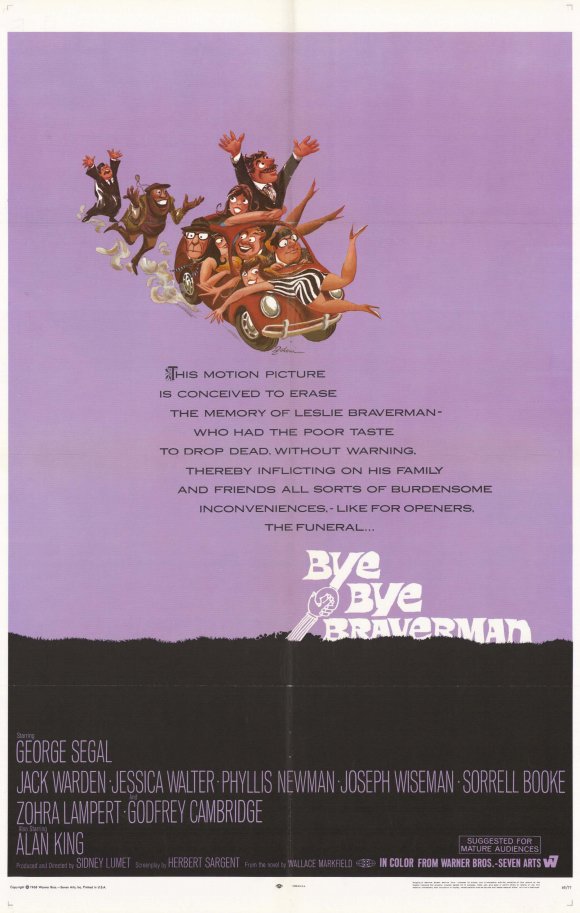
Bye Bye Braverman (1968)

By Richard Winters

My Rating: 6 out of 10

4-Word Review: Where is the funeral?

Four middle-aged Jewish men get together for a mutual friend’s funeral and find that the passage of time has changed many things between them.

There are some really nice vignettes here. The best may be Morroe’s (George Segal) conversation with all the dead people in the grave yard while amidst hundreds and hundreds of tombstones. You also have to love Alan King as the rabbi leading the funeral. Morroe as a middle-aged man becoming disillusioned with life while going through a sort of mid-life crisis is very relatable and his fantasy segments are funny. Godfrey Cambridge also has a great cameo as a black cab driver who runs into them and the group’s difficulties at finding the right funeral are amusingly on-target.

While the film does have its share of delightful moments it fails to ever come together enough to leave any impact. Some of the segments are too talky and the ending fizzles badly. There is also an extraordinarily high amount of footage given to showing a bird’s eye view of the red Volkswagen that they are in driving through the streets of Brooklyn. In some ways this does give one a great glimpse of Brooklyn during the late 1960’s, but it also screams ‘filler’ in the process.

This definitely seems to be the case where the novel by Wallace Markfield that this movie is based on would be the better choice. It’s certainly watchable and mildly entertaining, but the characters and situations need to be better fleshed out.

My Rating: 6 out of 10

Released: February 21, 1968

Runtime: 1Hour 34Minutes

Rated NR (Not Rated)

Director: Sidney Lumet

Studio: Warner Brothers/Seven Arts

Available: DVD (Warner Archive)

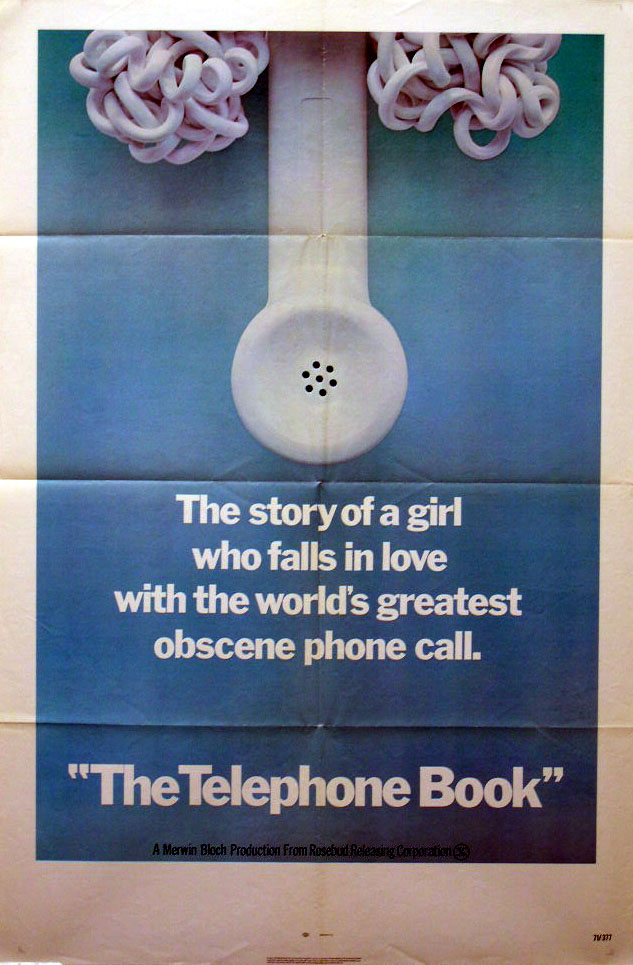
The Telephone Book (1971)

By Richard Winters

My Rating: 7 out of 10

4-Word Review: She likes obscene calls.

            Due to the recent death of writer/director Nelson Lyon on July 17th I felt it was time to dig up my old copy of this bizarre underground cult flick and give it another view. I stated in another review I made about this film that I considered it The Gone with the Wind of underground moviemaking and I still stand behind it. The film is hampered by its low budget and black and white photography, but I was impressed with it creative camera angles, editing, set design and music. Lyon showed a genuine vision and made the most out of what little resources he had. Even the content, which could be seen as pornographic by some, is presented in such a quick paced and diverting style that it becomes engaging and amusing.

The basic premise deals with Alice (Sarah Kennedy) an over-sexed young blonde living alone in an apartment with walls lined with wall paper that has hundreds of pictures of people in various sex acts. One day she gets a call from an obscene phone caller and she falls in love with him because it was the ‘most sweetest and most beautiful dirty call’ she had ever received and although she had received other obscene calls in her life this one ‘had class’. She becomes obsessed with meeting the man. He tells her that his name is John Smith and that he is ‘in the book’.  She goes through the telephone book to call him up, but because she lives in New York City she realizes there are a lot of John Smiths. The rest of the film deals with her encounters of all the various John Smiths that she meets as well as her climatic meeting with the real John Smith and the very weird conversation that she has with him.

The film’s structure is basically made up of a lot of vignettes all dealing with various forms of perversity. Some famous character actors appear in cameos and some of which prove to be quite outrageous and funny. Barry Morse best known for playing Lieutenant Gerard in the 1960’s TV-series ‘The Fugitive’ has one of the film’s best moments playing Har Poon ‘the greatest stag movie actor of all-time’. He has a scene where 10 naked ladies, at least that is how many I was able to count, all jump on top of him and begin sucking on his various body parts. There is Roger C. Carmel as a psychiatrist who enjoys exposing himself to ladies on a subway train, but when Alice decides to do the same thing in return he becomes shocked and repulsed. Character actress Lucy Lee Flippan makes her film debut here as a ‘reformed’ obscene phone caller who describes how when her husband was away at work and her kids where at school she would call up men at their jobs and talk dirty to them while masturbating  with a banana. There is also William Hickey playing a man suffering from a permanent and incurable erection.

The best appearance though comes from Norman Rose famous for narrating many films. Here he appears wearing a mask of a pig and playing the actual obscene phone caller. He describes how he calls 4 different women a night every week of the year except for two when he goes on vacation to ‘get out of the grind’. He also explains how he has perfected his obscene phone skills to the point that he could seduce the president of the United States if he wanted to, but doesn’t because he has ‘no political ambitions’. The conversation gets weirder including telling Alice about his foray into becoming an astronaut while he seductively washes her hair, but Lyon’s use of imagery during this segment keeps it interesting and even memorable. My only complaint would be that I wished he had taken off the mask so we could have seen what he really looked like.

The film ends with an eye popping animation segment dealing with a giant headless naked woman who squats down and has sex with a sky scrapper that needs to be seen to be believed. This is also the only part of the film that is in color.

Despite the fact that it was all done on a shoestring budget and with no character development I had few complaints although I didn’t understand how the obscene caller was always able to call up Alice and get a hold of her even when she was not at home and at someone else’s place. This was of course before cellphones, but I suppose demanding logic from a film that otherwise revels in the absurd would prove futile. The film did not do well on its initial run, but was rereleased in 2011 to much more positive reviews both here and in Europe. Through word of mouth it is expected to gain the cult following it deserves and maybe eventually a DVD or Blu-ray release.

Kennedy is delightful in the lead, but her appeal may depend on one’s personal tolerance. She looks and acts almost exactly like Goldie Hawn and was her replacement on the ‘Laugh-In’ show when Hawn left to concentrate on her movie career. I enjoyed Kennedy’s giddiness and child-like enthusiasm to all the perversions around her, but her voice sounds like she has sucked in helium and could prove annoying to some.

My Rating: 7 out of 10

Released: October 3, 1971

Runtime: 1Hour 24Minutes

Rated X

Director: Nelson Lyon

Studio: Rosebud Films

Available: VHS, DVD, Blu-ray 

Law and Disorder (1974)

By Richard Winters

My Rating: 6 out of 10

4-Word Review: Regular citizens become cops.

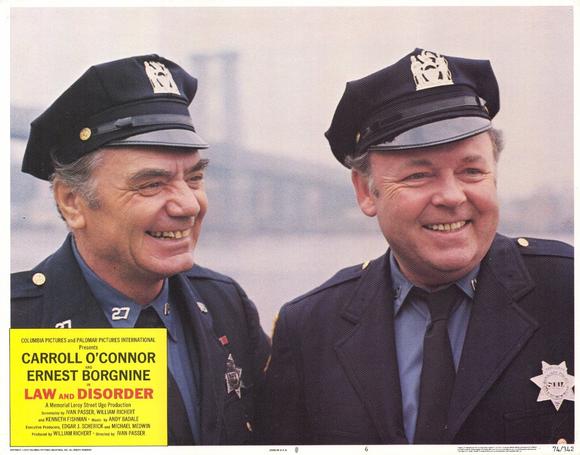
Due to the recent death of Ernest Borgnine I felt a review of this film, which features Borgnine in a very strong and effective performance, would be appropriate. The story deals with two middle-aged men named Willie and Cy (Carroll O’Connor, Ernest Borgnine) who after being robbed decide to join the police force as auxiliary cops. Their escapades start out as lighthearted and comical, but eventually they become faced with some serious consequences.

This is a rare film appearance for O’Connor who performed in a lot of movies during the 60’s, but did very little once he became a household name with ‘All in the Family’. It is fun to see him though the role doesn’t exercise his acting talents enough. He is a toned down version of Archie and comes off as boring and benign with a smiling face button on his coat that is annoying. His two best scenes come when he tries to pretend he is a young urban street punk and as a cab driver with a nice way of handling two obnoxious passengers.

It is actually Borgnine that steals the picture. Usually he is more of an unassuming supporting player, but here he comes into his realm. He is funny in a cantankerous way, but with some good dramatic moments in-between. Watching him angrily smash up a stolen bicycle with a lead pipe is intense and memorable. He proves that he might have made a good Archie Bunker had O’Connor not been available.

The female cast runs hot and cold in terms of performances.  It was fun to see Ann Wedgeworth, a native Texan, transplanted into the role of a Bronx housewife. Karen Black though is outrageously wasted in two very brief and meaningless scenes as an over-sexed hair stylist.

The story on the whole is alright. The beginning features a lot of amusing, fast paced comical adventures. The problem really begins towards the middle when the film shifts to a more serious tone, which bogs down the pace and fractures the narrative. You get roped into thinking this is a good comedy and then find it is anything but. The drama isn’t bad, but it doesn’t mesh well with the silliness. It also veers too much from the main premise making the message and point of view confusing. It tries to tackle too many topics, but fails to make any type of meaningful or lasting statement in the process.

Overall the film is good enough to keep you captivated and on the most part it is entertaining. Yet the story is disjointed and frustrating. The music played over the opening credits sounds like something for a senior citizens dance party and was a horrible choice. However, the on-location shooting of New York City is great and gives the viewer an authentic feel of an average urban neighborhood.

My Rating: 6 out of 10

Released: October 9, 1974

Runtime: 1Hour 44Minutes

Director: Ivan Passer

Studio: Columbia Pictures

Available: VHS, DVD

Lost in America (1985)

By Richard Winters

My Rating: 7 out of 10

4-Word Review: Living in a winnebago.

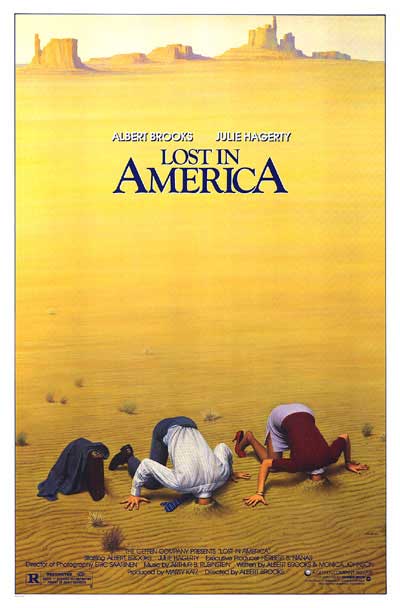
            David Howard (Albert Brooks) becomes upset when he doesn’t get his expected promotion and decides the corporate life isn’t for him and that he and his wife Linda (Julie Hagerty) will drop-out by liquidating all of their assets, buying a Winnebago, and roaming the countryside as free-spirits. Things go horribly wrong right from the start when, in a fit of gambling fever, Linda loses their entire savings at the roulette wheel. This forces David and Linda to desperately look for jobs in the first small town they come to.

The concept is fantastic. Who hasn’t dreamed of doing this at one time or another? Reportedly top executives who saw the film admitted having these very same fantasies at some point. In many ways this film is perfect testament to the 80’s where everything seemed to backtrack to the materialism and conformity of past eras and the idealism of the 60’s became lost. Writer-director Brooks plays it in a realistic and believable way with just enough subtle comedy to bring out the absurdity in each situation, which is what makes it fun.  Had the characters been over-the-top it wouldn’t have worked.

The dry, cynical wit that is Brooks’s signature is in full swing here. It may be an acquired taste to some, but it is distinct and hilarious for those that enjoy it. Some of the best moments include David’s funny rant when he tells off his boss and demands that the company give back the eight years he invested into it and won’t leave until it does. There are amusing conversations between David and the casino owner (Gary Marshall in an excellent cameo) where he begs him to give back the money Linda lost as well as his visit to an employment agency. The couple’s argument at the Hoover Dam is another highlight as is his lecture to Linda about the ‘nest egg’ concept. However, the funniest scene that had me literally laughing out of my seat was when David takes a job as a crossing guard for $5.50 an hour and some ten-year-old boys start to mock him. Even the little things, like when David tells a hotel clerk that they did not make reservations because they have ‘dropped-out of society’ and ‘just living for the moment’ is funny when done with Brooks’s impeccable deadpan delivery.

Julie Hagerty is so ingrained in my mind for her appearance in the cult-classic Airplane that I had a hard time adjusting to her here. Initially, when she is shown in the corporate setting and acting as a serious, responsible adult, I felt it didn’t work because I kept expecting her to say, especially with that high-pitched voice of hers, something dippy and spacey like her character in Airplane always did. However, when she gambles away their savings by incessantly screaming out the number twenty-two she is hilarious and when David lectures her afterwards and she looks up at him with that blank, blue-eyed, deer-in-headlights stare, she is perfect and the casting astute.

The opening sequence is probably the only part that doesn’t work. Having a taped audio interview between talk show host Larry King and film critic Rex Reed played over the opening credits is certainly novel, but David’s prolonged, whiny conversation with Linda while in bed is annoying.  A scene involving a conversation between Linda and a co-worker could have been cut. There is also the fact that everything goes downhill too quickly making the viewer feel almost cheated. It would have been nice to have seen them living the hippie lifestyle for a while and then have the problems begin gradually. There could’ve been a lot of great comedy had it been played straight without the irony of the money problem. Either way it’s entertaining, but brief. Hearing the entire rendition of ‘New York, New York’ by Frank Sinatra is worth the price as is the sight of seeing a giant Winnebago driving up a busy, downtown Manhattan street.

My Rating: 7 out of 10

Released: March 15, 1985

Runtime: 1Hour 31Minutes

Rated R (For a Couple of ‘F-Bombs’)

Director: Albert Brooks

Studio: Warner Brothers

Available: VHS, DVD, Amazon Instant Video
Marathon Man (1976)

By Richard Winters

My Rating: 7 out of 10

4-Word Review: Dentist doesn’t use novocain.

            Thomas ‘Babe’ Levy (Dustin Hoffman) is a post graduate student at Columbia University and part-time marathon runner who spends a harrowing 48 hours being tortured and terrorized by a sadistic Nazi war criminal. It all starts when his brother Henry ‘Doc’ Levy (Roy Scheider) who works for a secret government organization known as ‘The Division’, secretly tracks Dr. Christian Szell (Laurence Olivier) a dentist at Auschwitz who has traveled to New York in order to collect a cache of diamonds. When Doc moves in too close Szell stabs him and despite being covered in blood Doc manages to make it all the way to Babe’s apartment before collapsing. Szell fears that Doc might have told Babe something before he died and has his men kidnap Babe where they then tie him to a chair in an abandoned warehouse and Szell tortures him by drilling into his teeth forcing Babe to use his running skills in an effort to escape.

This is an original thriller that stays intriguing and intense throughout. In the first thirty minutes alone the viewer is treated to some interesting and exciting scenarios including watching two elderly men drag racing with each other in their antique cars down a crowded neighborhood street. There is also an exploding baby carriage and an exciting fight sequence where Doc battles an attacker who tries to strangle him from behind with a metal wire. This scene is unique in that it cuts between seeing the action up close as well as viewing it from the point-of-view of an elderly man watching from across the street.

Director John Schlesinger shows visual flair with a variety of camera angles and settings. I particularly liked the part where Doc meets Szell at the red steps statue in the Arco Plaza. Having the climactic showdown between Babe and Szell take place in a pump room at the reservoir in Central Park gives the sequence added energy and distinction. I also enjoyed Babe’s cramped, drab, and cluttered apartment that had a very lived-in look and resembled exactly what a bachelor pad with someone on a low income would look like. The scene taking place at a country house is memorable simply for its extreme remoteness. I was disappointed though that although Schlesinger does a great job in setting up the atmosphere of the scene by doing a long shot looking out at the barren landscape the weather suddenly goes from cloudy to sunny in the minute it takes for the bad guy’s car to pull up the driveway. I realize certain scenes are sometimes shot over several days and this is not the first movie to have sudden weather changes during outdoor shots, but it is distracting nonetheless.

The infamous torture scene didn’t work for me. I appreciated the set-up especially the prolonged way that Szell plugs the drill into a wall outlet while talking to Babe in a calm tone. Constantly asking Babe the question ‘Is it safe?” has become a classic line and the fact that the dental torture gets extended when you think it is over is well done. Still, it didn’t seem violent enough and although pain is implied I didn’t think that the viewer really ‘feels’ it. I wanted more shots from Babe’s point of view especially as Szell sticks his metal instruments into Babe’s mouth. A close-up of Babe’s tooth and seeing the drill touch it would have helped as well. Also, Babe needs to scream in pain a lot more, he does it once briefly, but someone going through that would be doing it constantly.  Apparently the producer’s cut out portions of this scene when it upset the test audiences who saw it, but I would like that footage put back in as I feel it would make the movie stronger and give it an added kick that otherwise is missing.

Olivier is tremendous in the villainous role. His face exudes evil and this is one of his best later career roles. Scheider has his best role here and I found Marthe Keller impressive as Babe’s girlfriend. She wears an attractive hairstyle and I couldn’t get over how diametrically opposite she was compared to her character in Black Sunday that was done the very same year. She is definitely an under-rated actress that deserves more accolades as well as more parts in American productions. However, the way Babe pursues her for a date seemed to border on ‘creepy’  and overly aggressive and act as a turn-off to most women.

The film does seem derivative at certain points especially the way it portrays New York as an urban hellhole, which was quite common during the 70’s. The fact that Babe avoids confrontation and is picked on by a Hispanic gang that lives across the street seemed too reminiscent of Hoffman’s earlier film Straw Dogs. There are several flashback sequences showing Babe as a child that is done with faded color and no dialogue and look too similar to the childhood sequences done in Midnight Cowboy, which was an earlier Schlesinger/Hoffman project. Hoffman, for what it is worth, gives another one of his dedicated performances, but this film really does show in glaring detail how very puny he is and I really could have done without having to see his naked rear.

The electronic score is nice and the part where Szell gets recognized by an elderly concentration camp survivor on a busy city sidewalk and who then begins to chase after him is memorable. However, when it is all over I still felt it didn’t completely click. I’m not sure what it is. I know the ending was changed from the one in the book, but I liked this one better and felt Babe’s revenge on Szell was creative. Although controversial and edgy for its time, the torture scene seems too toned down for today’s standards. Either way, if you are looking for a competent and entertaining thriller this should fit the bill, but it is not a classic.

My Rating: 7 out of 10

Released: October 8, 1976

Runtime: 2Hours 5Minutes

Rated R: (Violence, Language, Adult Theme, Brief Nudity)

Director: John Schlesinger

Studio: Paramount

Available: VHS, DVD,  Blu-ray, Amazon Instant Video 

Maniac (1980)

By Richard Winters

My Rating: 5 out of 10

4-Word Review: He wants their hair.

A loner (Joe Spinell) terrorizes New York City by killing young women and scalping them. He then takes their hair, brings it home, and places it (actually he nails it) onto the heads of some mannequins that he has.

In a lot of ways this is the same old mechanical slasher flick as it has all the predictable characteristics of the others that dominated the early 80’s. The story is simple and strung along by long, drawn-out murder sequences. There is some suspense, but it is minimal since we know exactly what is going to happen. The victims are young, good looking women, who are clueless to the dangers that are lurking until it is too late. One segment in particular features a nurse getting off of work late at night, who mentions her fear of the killer and yet for some reason she still foolishly refuses a ride home from her friend and instead walks down a dark, lonely street and into, of course, eventual carnage.

There are also some rather glaring technical errors. One features a woman (the same one who refused a ride) running from the killer by going into an empty subway. Although isolation is the whole factor here there is one shot, taken from inside a departing subway car that clearly shows a whole bunch of people standing just across from her on the other side of the tracks. There is also a segment where Spinell takes his girlfriend to his mother’s grave. When the car pulls up to the cemetery it is a nice, bright afternoon, but when they reach the actual grave it has become pitch black with a strange unexplained fog that has rolled in. Lastly there is the ending. This is a man that has terrorized a whole city and yet only two policemen in an unmarked squad car come to his residence and when they do they don’t even bother to secure the site.

Despite the low-budget problems there are a few things that raise this slightly above the rest. One is the fact that it actually manages to get inside the killer’s head. You hear the inner conversations between his ‘good’ side and his ‘bad’ side. Of course this only touches the surface of a true schizoid personality, but it does offer a little more depth than most. It also helps create a good portrait of a tormented soul and you end up feeling more sadness than fear for the man. The film also consistently has a dark, grainy look, which helps accentuate the ugly theme. Having it take place in New York City gives it a little more distinction and atmosphere.

The special effects are good. The part where he blows a man’s head off, through a car windshield, looks very realistic and has become the film’s most famous scene. The surreal ending, where the mannequins all come to life and exact a sort of revenge, is also well-handled and imaginative. Makeup artist Tom Savini, who also appears as the character of ‘Disco Boy’, has had a lot of success, but the stuff here may be his best.

Director William Lustig shows some panache and Spinell, who also co-wrote the screenplay, gives a surprisingly strong performance, but their attempts at creating a better understanding of a crazed killer prove placid and simply done for shock value.

My Rating: 5 out of 10

Released: December 26, 1980

Runtime: 1Hour 27Minutes

Not Rated (Graphic Violence, Brief Nudity, Language, Adult Theme)

Director: William Lustig

Studio: Magnum Pictures

Available: DVD, Blu-ray (30th Anniversary Edition)

Still of the Night (1982)

By Richard Winters

My Rating: 4 out of 10

4-Word Review: This teddy bear bleeds.

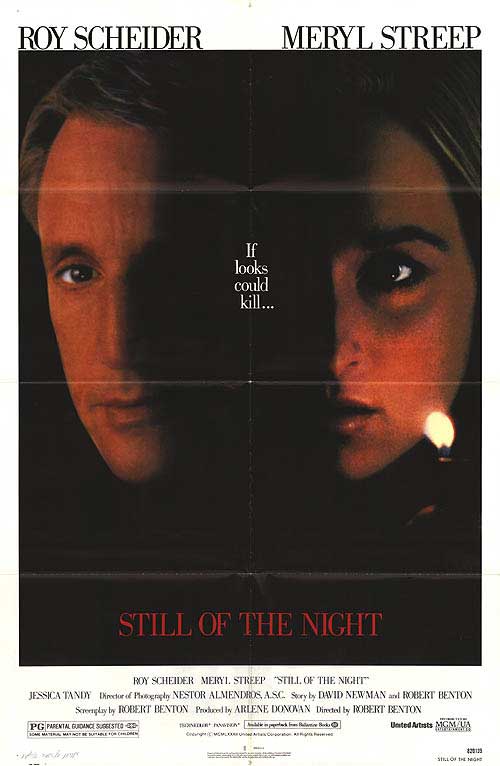
Successful psychiatrist Sam Rice (Roy Scheider) finds himself immersed in a tangled web of murder and deceit. One of his patients, wealthy art dealer George Bynum (Josef Sommar), is found murdered. A mysterious woman named Brooke Reynolds (Meryl Streep) visits him and states that she was George’s mistress and Sam suspects that she may be the killer. He tries to do his own investigation, but the police start to doggedly tail him thinking he may know more than what he is letting on.

This was yet another homage to Alfred Hitchcock, this time done by writer/director Robert Benton, who is an excellent filmmaker in his own right.  This one has all of the style, but none of the substance.  The concept is slickly handled, but it misses Hitch’s flair as well as his wry sense of humor.

Normally I have never been too impressed with Scheider as a leading man.  He has always seemed transparent and his range of characters as well as emotions that he can convey are limited. Here though, as an evasive middle-man, his acting abilities work quite well and I actually found him perfect for the part.

Streep does not fare as well.  Her acting is almost always impressive and I admire her prolific career, but this is one of her few roles that takes no advantage of her talents. She seems to have an almost ghost-like presence. I didn’t find her character to be compelling, nor intriguing. I had no interest in her fate nor her relationship with Rice.

Joe Grifasi was a poor choice as the lead investigator Joseph Vitucci. He showed none of the characteristics of a seasoned police detective and looked and acted more like a disheveled kid just out of college. The rest of the supporting cast is dull and cardboard. It would have been nice if one eccentric character had been put in to liven things up.

Probably the most interesting aspect of the whole movie is a nightmare segment that the George character has that comes in the middle of the story. I liked some of the creepy imagery that was used including a bleeding stuffed teddy bear. I also enjoyed how afterwards Sam debates the dreams meaning with his mother Grace (Jessica Tandy) who also has a background in psychology, but I thought it was a bit of a stretch when she suggests he go to the police about it as dreams can be interpreted in many different ways and hold no relevancy in a court of law. I thought it became even more far-fetched when at the end Sam uses some of the symbolism in the dream to figure out the identity of the killer.

The film has a few plot holes and certain things that just don’t add up.  Some of the ones that hit me was when Brooke talks about seeing George off in a cab that night and then the next morning reading in the papers that he had been murdered, which is preposterous.  Most newspapers go to press between ten and midnight, the dead body might not yet have even been discovered until later that day, or even a few days later. There is also a segment where Sam makes a $15,000 purchase on a painting he doesn’t even want at an auction simply so he can use it as an excuse to write a note on the bidding card warning Brooke that the police are after her. Also, when Sam does not find Brooke at her apartment her friend tells him that she is at her parent’s house in some town called Glen Cove, but she is not sure of the street name and yet Sam is able to find the place in the middle of the night with hardly any effort. Also, I found some of the conversations that George has with Sam during their sessions to be unintentionally funny.

There is enough intrigue to keep you somewhat interested, but the result is mild. I did like the idea of building the tension up through slow subtle means instead of the quick shocks that you see done in a modern suspense movie, but it is still slow going. The music played over the opening credits is more suited for a romance and does nothing to create the right mood for a thriller. The lighting in literally every shot is dark and shadowy, which certainly helps with the atmosphere, but after a while it gets to be too much. I was also not impressed with the climactic sequence. The protagonist is too helpless and defenseless and does not fight back, which severely limits the action. Having it occur at an ocean-side house does create a nice ambience, but the chase that is involved there could have been more extended and the camerawork during the segment is unimaginative.

My Rating: 4 out of 10

Released: November 19, 1982

Runtime: 1Hour 33Minutes

Rated PG

Director: Robert Benton

Studio: MGM/UA

Available: VHS, DVD, Amazon Instant Video
Taking Off (1971)

taking off 1

By Richard Winters

My Rating: 9 out of 10

4-Word Review: Running away from home.

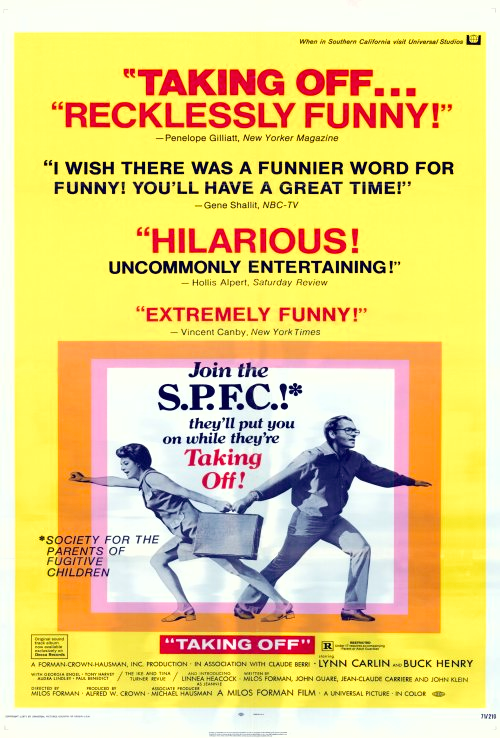
This is a thoroughly entertaining gem that takes a look at the early 70’s American culture through a foreigner’s eyes in this Milos Forman’s first American feature. The comedy bounces playfully from the wry, to the absurd and even the satirical without ever losing its charm.

The film examines what happens when parents Larry and Lynn Tyne (Buck Henry, Lynn Carlin) find that their daughter Jeannie (Linnea Heacock) has run away. Instead of focusing on the teen, as most films tend to do, it instead looks at the parents. It shows that the adolescent years can be as awkward for the father and mother as it is for the teen and parenting is a journey much like growing up is. I especially liked the part of the message showing how people in their forties have a need to run away and find themselves too.

The film matches its unique perspective with offbeat humor. You get to see parents smoking pot for the first time in order for them to experience what the kids go through. Another scene has them getting together for a wild game of strip poker. There are also amusing cutaways of auditioning singers, which is where the daughter runs away too. One of the singers is a sweet young thing who sings a soft melody that is laced with the word ‘fuck’ and has to be heard to be really appreciated.

Both actors who play the parents are excellent. Balding, bespectacled Henry fits the mold as the overworked, henpecked father/husband quite well and it is fun to see him display isolated moments of unexpected rebellion. Carlin conveys a nice characterization of an overwrought mother who wants to communicate with her daughter, but has no idea how.

Jeannie is the one we learn the least about, which is actually to the film’s benefit. This isn’t just the Tyne’s daughter, it’s everybody’s daughter complete with all the trials and tribulations that every parent goes through with their teen. In fact the film’s most definitive moment is probably the freeze-frame shot of disdain on the daughter’s face as her parents try to entertain her and her boyfriend with a song from ‘their’ generation. It’s the type of look that defines the parent/teenager relationship no matter if it’s today, tomorrow, or a hundred years from now, which may help to make it accessible to today’s viewers despite an overabundance of early 70’s period flavor.

Characters actors Audra Lindley, Paul Benedict, and Vincent Schiavelli are terrific in support. This also marked the film debuts of Georgia Engel and Kathy Bates. Ike and Tina Turner appear as themselves.

My Rating: 9 out of 10

Released: March 28, 1971

Runtime: 1Hour 33Minutes

Rated R (Language, Adult Theme, Brief Nudity)

Director: Milos Foreman

Studio: Universal

Available: DVD (Region 2)

Midnight Run (1988)

By Richard Winters

My Rating: 8 out of 10

4-Word Review: Chased by the mob.

Jack Walsh (Robert De Niro) is a bounty hunter that is looking to get into a less stressful profession. He is offered 100,000 to find bail jumper Jonathan Mardukas (Charles Grodin) who worked as an accountant for the mob and skimmed 15 million from them. Jack thinks he can use the money to open up a coffee shop, but finds that the FBI is in hot pursuit of Mardukas as well. There is also rival bounty hunter Marvin Dorfler (John Ashton) who wants his hands on Mardukas and the money. Jack even finds himself chased by the mob looking to silence Mardukas before he can turn states evidence.

The catalyst of the film is the relationship between Jack and Jonathan and how it slowly turns into an unusual friendship during their long adventure. Both Grodin and De Niro have diametrically opposite personalities and acting styles, which is why this thing really works. The relationship ebbs and flows on the antagonistic level most of the time and the friendship really doesn’t build until the very end and even then it is tenuous, which is nice.  Too many times in ‘buddy’ movies such as this the sentiment becomes forced, but fortunately here it is very balanced and their interactions believable throughout.

Grodin was an inspired choice. I have always thought the guy to be a very talented, underappreciated, and unique comic performer. However, he was not a big name star and the studio heads originally wanted Robin Williams for the role and then even considered changing the sex of the Mardukas character to female and having Cher play the part, but director Martin Brest liked Grodin’s style during his audition and held out until he got him even though it meant losing the backing of Paramount and forcing them to go with Universal.

Grodin adds a lot that the other two stars, as very talented as they are, just wouldn’t be able to do.  One is a completely improvised conversation that he has with the De Niro character while they are stuck inside a train car, which is the one scene from this film that I remember most clearly from having first seen it over twenty years ago. There is another improvised scene involving Mardukas and Jack pretending to be FBI agents and going into a local bar looking for counterfeit bills that makes great use of Grodin’s sardonic humor and deadpan delivery.

John Ashton is a riot as Marvin the rival and slightly dim-witted bounty hunter. He is so over-the-top obnoxious and crude that you can’t help but laugh at it. He takes the caricature of the tough, brash, gruff, blue collar Chicagoan to a hilarious extreme. He is like legendary football coach Mike Ditka on speed. Denis Farina, as the mob boss, is also good as is Joe Pantiliano as the frantic bail bondsmen.

Another thing that makes this movie so successful is that it is able to work on three different levels in a very cerebral way. Not only is it a very good comedy and character study, but it’s not half bad with the action either. The best sequence here is when the two men get swept away by a strong river current, which has the actual actors doing most of the stunts.

Of course the script, by George Gallo, does have a few holes and implausibility’s that can’t avoid being mentioned since some of them are integral to the main plot. The biggest one is when Marvin, in an attempt to impede Jack and find his whereabouts, gets on the phone with Jack’s credit card company and identifies himself as Jack and is able to easily find out where the card was last used and have it cut off. However, with every credit card company I have worked with I am forced to give some more identification before I am given any information including my social security number, a secret word or phrase, or a PIN and yet here Marvin isn’t required to give any of that. There is also that fact that when Jack finds out that his credit card is being rejected he doesn’t just get on the phone with his credit card company and get it straightened out, which is what anyone else would do.

There is also a segment where Jack is somehow able to fleece the FBI badge from agent Alonzo Mosely (Yaphet Kotto), which Jack then uses to impersonate him with during his trip with Mardukas. However, this just would not have been possible as the two men met only briefly inside a car with Alonzo sitting in front and Jack in back scrunched between two other agents who keep a close eye on him. The FBI has also been searching for Mardukas for six years and yet Jack is able to find him easily, which to me seemed too convenient.

The excessive swearing is another issue. Yes, sometimes cursing can help build the grittiness of the characters, but here it goes overboard. Officially the word ‘Fuck’, or a variation of it, gets said a total of 119 times, but I was convinced it was more than that. Its overuse is so redundant that it almost becomes a distraction.

            All things considered this is still a winner. This is one of my favorite De Niro roles and in my opinion his best foray into comedy as I feel his work in the Meet the Parents series is generally wasted. There is also an emotionally strong scene when Jack goes back briefly to visit with his ex-wife and fourteen year old daughter. Normally these types of scenes end up being clichéd, but here it really hits the mark, especially Jack’s interactions with his daughter.

My Rating: 8 out of 10

Released: July 20, 1988

Runtime: 2Hours 6Minutes

Studio: Universal

Rated R (Language)

Director: Martin Brest

Available: DVD, HDDVD, VHS, Amazon Instant Video