Category Archives: Movies that take place in the Big Apple

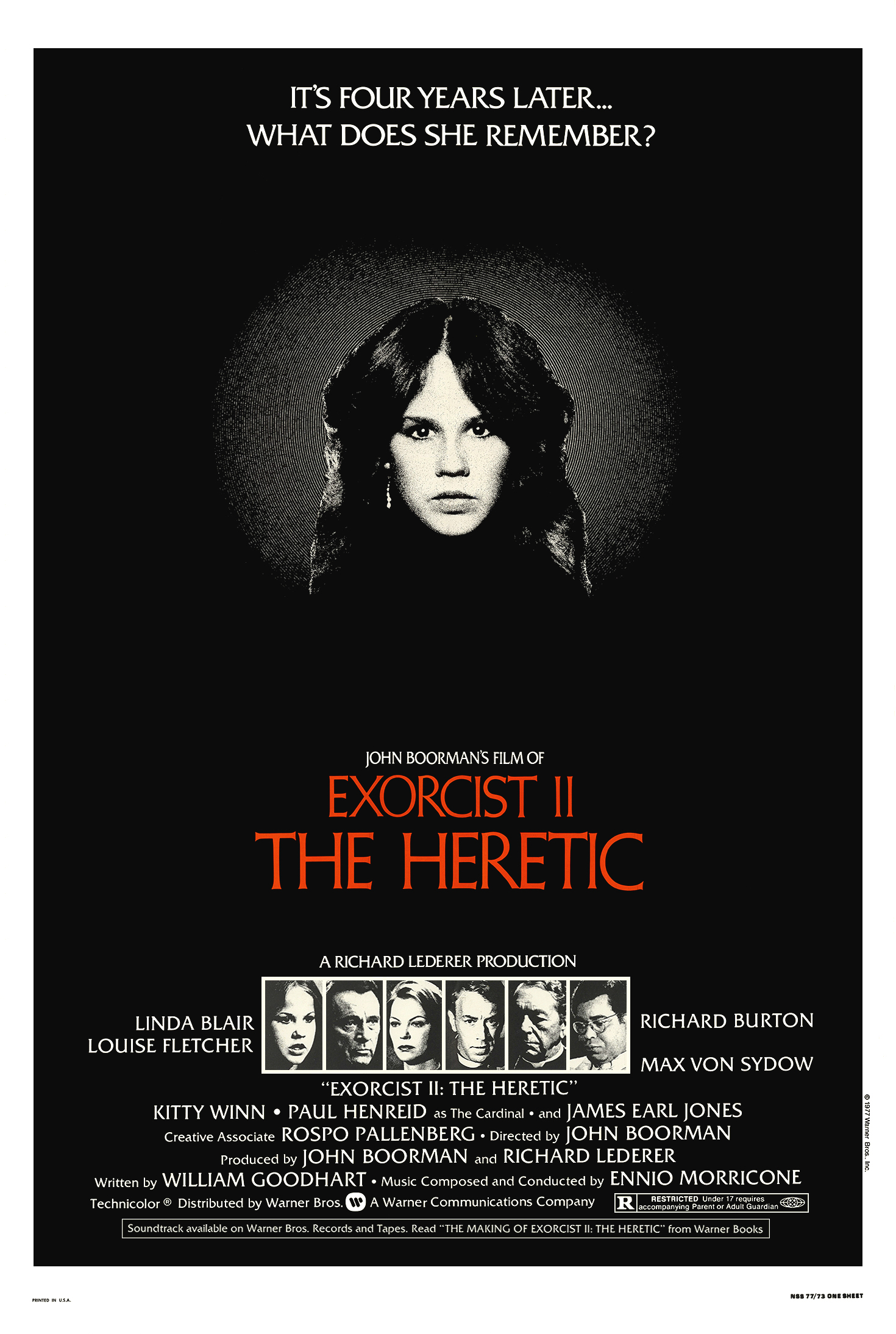
Exorcist II: The Heretic (1977)

By Richard Winters

My Rating: 0 out of 10

4-Word Review: A really awful sequel.

It’s been four years since Regan (Linda Blair) had her bout of possession and is now living a seemingly normal life in New York City with her guardian Sharon (Kitty Winn). Regan does still see a psychiatrist, Dr. Tuskin (Louise Fletcher), who despite Regan’s denials that she can’t remember anything, is convinced that she does have some dormant memories that need to come to the surface. Philip (Richard Burton) is a priest who has been assigned to investigate the death of Father Merrin (Max Von Sydow), who was the priest who died while performing the exorcism on Regan. He meets with Dr. Tuskin and Regan and gets hooked up to a machine called the syncronizer, which allows Philip’s and Regan’s brainwaves to be connected, so he can explore the inner depths of her mind. It is here that he learns about the evil spirit Pazuzu, that was the one that inhabited Regan’s body years earlier, and how Father Merrin had rid a young boy named Kokumo of this same spirit while in Africa. When Philip learns that the now adult Kokumo (James Earl Jones) has developed a special power to defeat Pazuzu he travels to the continent to meet him.

Doing a sequel to the hit movie wasn’t a bad idea per say as there were still some open-ended questions like why did Pazuzu choose Regan’s body to inhabit instead of some other girls and what mental issues would Regan have to deal with after going through such a traumatic event? None of those were ever answered in the first film, but intriguing enough to me that I felt a second film was warranted and could’ve been quite compelling. Unfortunately, what we get wouldn’t even qualify as second-rate. Most of the problem lies with director John Boorman, who admitted in later interviews that his biggest crime was that he didn’t give the viewer what they wanted, which is the truth. I don’t mean to bash the guy as he’s helmed some classics in his own right, but when he professes that he was offered the job to direct the first installment but turned it down because he thought it was ‘repulsive’ then that should’ve disqualified him from getting any consideration to doing the second one.

Everything gets botched right from the beginning including a misguided reenactment of the final segment in the first film that honestly comes-off like a cheap parody. For one thing Father Merrin is seen standing at the end of Regan’s bed, when we know clearly from the first film that he was kneeling on the right side of the bed when he died. Also, due to Blair’s insistence that she didn’t want to go through the grueling routine of having to put on the demon make-up, so a stand-in took her place, but the results are clownish. The silly-‘synchonizer’ further hampers things as it appears more like a child’s toy and the cliched idea of simply attaching a few wires to each participant’s foreheads and that would be enough to get their mind’s ‘in-sync’ looks like something straight out of a tacky B-sci fi flick from the 50’s.

Not able to get Ellen Burstyn to sign-on really hurts though I can’t blame her for being reluctant but trying to use Kitty Winn as her replacement bombs. For one thing the Sharon character didn’t have that much of a prominent role in the first one, I barely even remembered her, and she was Burstyn’s secretary who didn’t interact that much with Blair, so for them to now be so ‘connected’ seemed like a stretch and having Winn sporting short hair, in an attempt I presume to make her ‘seem’ like Burstyn, was tacky. Von Sydow suffers a similar fate. He gets portrayed as being a younger version of his character here but only appears in flashbacks and doesn’t have much to say or do making it seem like it wasn’t even worth the effort.

Fletcher is good in that she played a cold, bitchy nurse in her previous film, One Flew Over the Cuckoo’s Nest, but here shows her great acting ability at playing the total opposite and doing it convincingly. However, her character doesn’t help propel the action and is only there to react to things, which ultimately makes her presence one dimensional. Burton, whose talents I have always greatly admired even when he took less than stellar roles, but his appearance here has to be rock bottom. He admitted that he only did this for the paycheck, due to an expensive divorce he was going through with Liz, but the material doesn’t match his ability and it’s a career low even for him as he was known to make some bad project choices during the 70’s, but this was by far the worst.

To top things off there’s James Earl Jones wearing a giant bug outfit that nearly had me laughing out of my seat. The numerous shots of locusts and the sandy African landscape make it seem more like a nature movie, but whatever it is it’s not scary. It’s so convoluted it’s not even good enough to fall into the ‘so-bad-it’s-good’ category. It is cool though at least see a young Dana Plato playing an autistic child in a small but pivotal part.

My Rating: 0 out of 10

Released: June 17, 1977

Runtime: 1 Hour 57 Minutes

Rated R

Director: John Boorman

Studio: Warner Brothers

Available: DVD, Blu-ray, Amazon Video, Tubi, YouTube

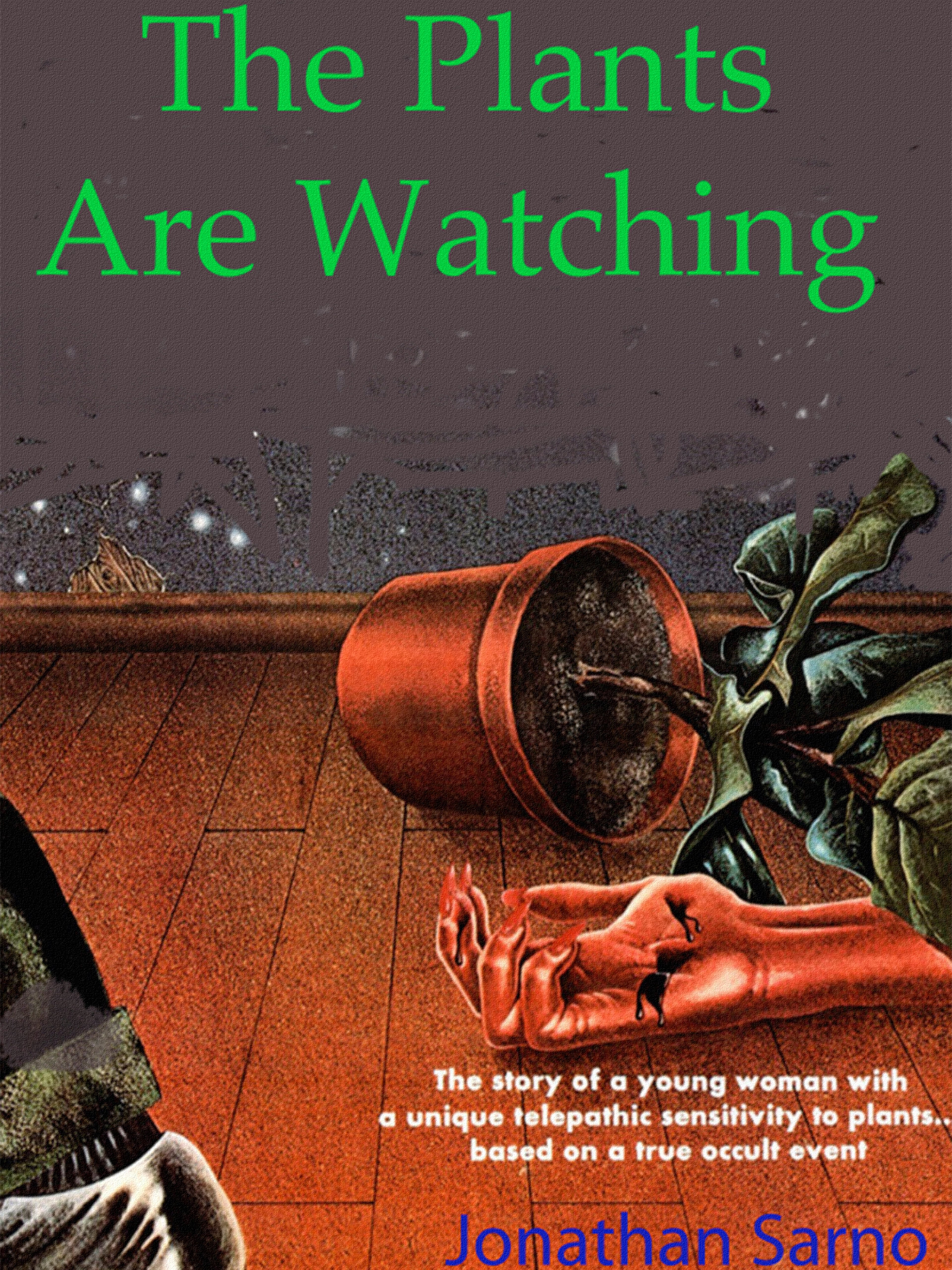
The Plants Are Watching (1979)

By Richard Winters

My Rating: 6 out of 10

4-Word Review: Communicating with a plant.

Laurie (Nancy Boykin) is deeply into plants and has them placed all over her apartment and even feels she has the ability to communicate with them. Directly below her place lives her sister Rilla (Nancy Snyder) along with Rilla’s boyfriend Robert (Joel Colodner). Laurie doesn’t like Robert and the two are continually getting into arguments. One day Laurie is found dead and the police consider it an accident. Rilla though fears that Robert may be responsible and tries on her own to investigate. She reads up on Kirlian photography that can capture electrical discharges from objects including plant life. Her attempt is to see if the plant that was present when Laurie had her ‘accident’ can tell her through its distress signals from its leaves, which can be detected through the photo process, can lead her to what really happened. However, as she’s doing this a new suspect emerges, Dusty (Ted Le Plat), forcing her to have to go through the difficult determination as to who the real culprit is.

Extremely odd idea for a horror film almost works with a really good and creepy beginning and excellent surprise ending. The Kirlian photo technique was one that I was not familiar with, so the movie is educational on that end as it delves into its innerworkings and history and some of the shots that it shows, including the fingerprints of a psycho compared to a regular person and the different colored light charges that it gives off, are quite fascinating as are the variety of discharges that a leaf can emit from one that is under stress, or sick versus a healthy one.

The setting is limited, mainly due to the low budget, where all the action takes place in the apartment building though this does at least give the viewer a good feel for urban New York City living and helps create a certain ambiance. While the plants never do any actual ‘speaking’ you do through the course of the film begin to see them like they’re characters alongside their human counterparts making the moment where Robert throws some of the potted plants against the wall and thus smashing them seem genuinely disturbing like you’ve just witnessed a ‘murder’ and credit goes to the filmmakers for their ability to bring this out.

Despite one good scare, which occurs during a dream sequence, there’s not enough shocks to completely keep it going. The middle drags quite a bit and the main reason is that there’s no real villain. Robert is initially portrayed as being a possible menace, but he’s just too civil to create any adequate tension. Having Rilla break-up with him and move-out only to eventually allow him back into her bed just dilutes everything. A good horror film needs a threatening dark force and this thing tip toes too much around that.

The film cheats too by ultimately having the plant ‘communicate’ with Rilla somehow by showing her a ‘vision’ of what actually occurred though it’s never explained how exactly it does this. I was okay with her hooking the plant up to a machine and monitoring its stress level whenever one of the two men are in the room and thus having her deduct on her own who the killer was from that, but then spelling everything out seemed too easy. The ending twist though is pretty cool and the scene where she’s trapped in the elevator with no escape is nicely intense and surprisingly grisly though it’s a shame that this same kind of tension and violence couldn’t have been carried throughout. 

Alternate Title: The Kirlian Witness

Released: June 14, 1979

Runtime: 1 Hour 12 Minutes

Rated R

Director: Jonathan Sarno

Studio: CNI Cinema

Available: Amazon Video, YouTube

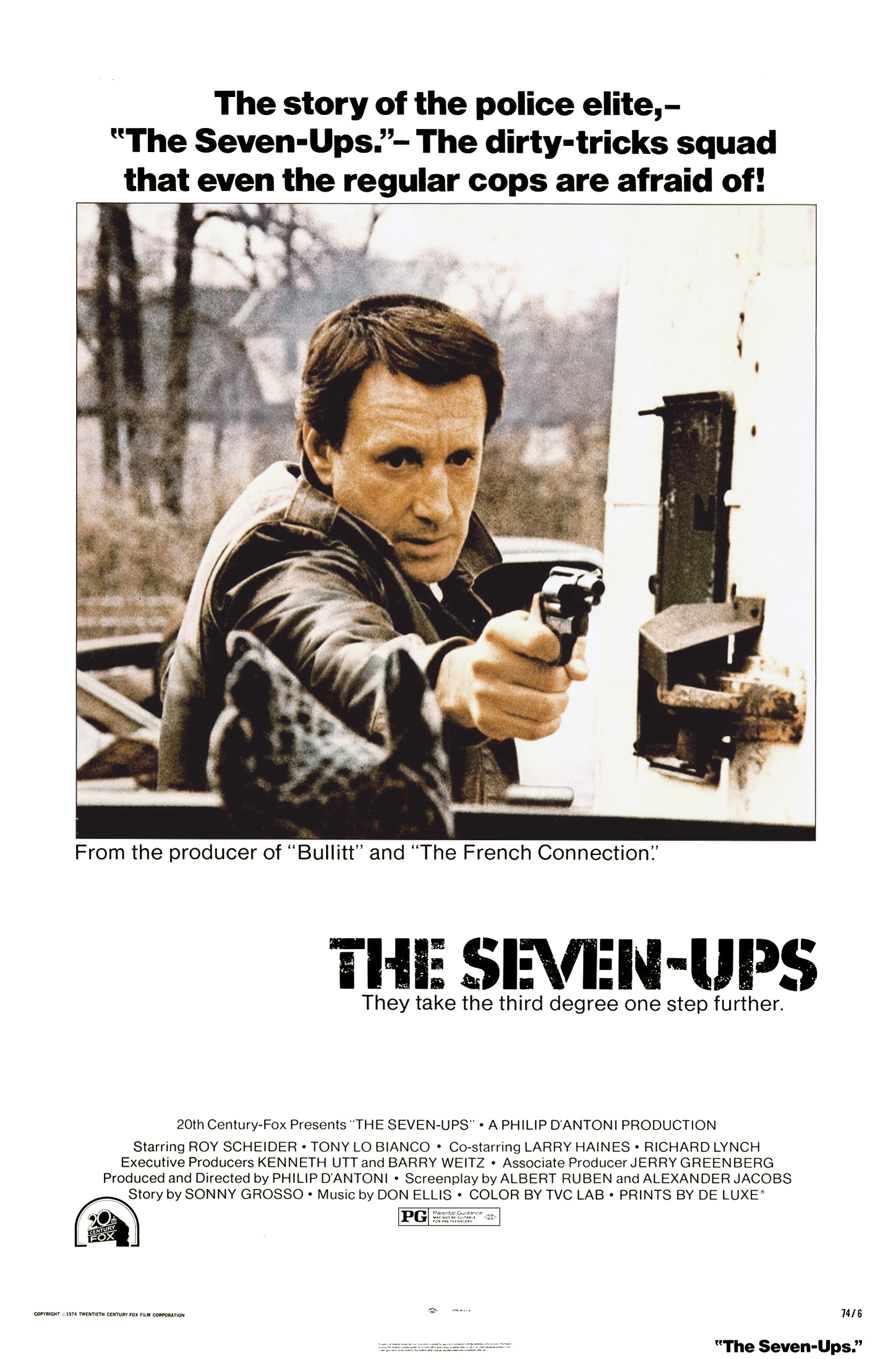
The Seven Ups (1973)

By Richard Winters

My Rating: 7 out of 10

4-Word Review: Cops use unorthodox methods.

Buddy (Roy Scheider) is a police detective who runs a group of renegade cops who employ unusual and sometimes questionable methods to nab crooks. Once apprehended the criminals they arrest usually end up serving 7-years or more in the penitentiary, which gives their group the nickname of the ‘Seven Ups’. The groups most recent mission is investigating kidnappings occurring in the city and Buddy uses the help of Vito (Tony Lo Bianco) a childhood friend who works as an undercover informant for the police, but who unbeknownst to Buddy is actually behind the recent crimes going on and even the orchestrator.

After the success of The French Connection producer Phil d’Antoni became inspired to produce another similar crime film dealing with the true-life event that occurred in the 50’s in New York that had mobsters being kidnapped by criminals posing as cops. He wanted William Friedkin, who had done so well with the first film, to direct this one, but Friedkin didn’t like the script and passed as did several other directors, which eventually lead the studio to choose d’Antoni to take the helm himself in his one and only foray behind the camera with results that are both good and bad.

The production lacks cinematic flair and shot in a flat way almost like a documentary, which to some degree actually helps it. It was filmed between January and April of 1973 and the crisp, gray, frigid look helps build an atmosphere by accentuating the grimy, cold life of the underworld and how the detectives themselves get foisted into it. The plot is basic and linear, so it’s easy to follow and not cluttered with unnecessary mystery angles and tangents as the viewer knows right away who’s behind everything. There’s also a tense scenes inside a car wash, not exactly sure the perpetrators would’ve been able to pull-off as effortlessly as they do, but it definitely keeps you riveted as you feel the same unease as the two guys in the car though having another scene come later that also takes place in a car wash wasn’t needed.

The film though doesn’t have the interesting characters like in The French Connection where Popeye Doyle’s lifestyle and temperament contrasted in fascinating ways with the man he was pursuing and in fact it was Doyle’s fractured personality that made the movie so compelling. Here, through no fault of Scheider who plays the part well for what is asked, but his character is quite one-note. We learn nothing about him, or his home life. He’s just a typical New York cop obsessed with getting the bad guys, which is fine, but doesn’t have the multi-dimensional quality to help make him memorable.

The supporting characters aren’t necessarily much better, but the actors who play them at least help give them some life. Larry Haines, probably best known for playing one of Felix and Oscar’s poker playing buddies in The Odd Couple, has a good turn here as a crime boss who’s nonchalant initially when he thinks he’s being taken to the cop station for a routine arrest only to cower in fright when he realizes he’s been duped and then when he survives shows no mercy in his unrelenting pursuit for revenge. My only quibble though is that Scheider and his cohorts are able to break into Haines’ house too easily and even able to catch him and his wife sleeping in bed, but you’d think with him being a well-known target with the police he’d have burglar alarms set-up all over his home to detect anyone trying to get in and since he’d just had a traumatic kidnapping incident earlier you’d think he wouldn’t be able to sleep soundly again, or paranoid enough to sleep lightly and aware of any noise.

The car chase sequence is by far the best moment, and some may say the only real reason to watch it. It certainly has you holding your breath, but in a lot of ways is too similar to Bullit, another film produced by d’Antoni, so it really doesn’t stand out as much as it should. There’s also the issue of Scheider pursuing the bad guys even as there’s pedestrians all around. Most real-life cops will stop chasing after a culprit’s car if they feel  it will put others at too much of a risk and this comes to a horrifying moment when school children are playing on the street and must quickly run to the curb when the bad guys drive their car through only a few seconds later to almost get hit by Scheider’s car as he plows through at high speeds without even a thought of putting on his breaks making him seem more like an irresponsible cop who’s more of a problem than a solution.

Nonetheless it’s gripping and I enjoyed how it ends with Scheider ducking under the windshield just as his vehicle hits the underside of the backend of a truck in an intended ‘homage’ to Jayne Mansfield’s wreck. It’s also great watching Richard Lynch’s facial expressions as he plays the crook sitting in the passenger’s side of the fleeing car. Some could say it’s great acting, which maybe it was, but I believe his looks of nervousness and fear was genuine, which just helps to make these shots of his face, which get intercut throughout the chase all the more entertaining and help to have a human side to the action as I and almost anyone else would be reacting the same as he does if we were in the same situation.

My Rating: 7 out of 10

Released: December 14, 1973

Runtime: 1 Hour 43 Minutes

Rated R

Director: Philip D’Antoni

Studio: 20th Century Fox

Available: DVD, Blu-ray

Superman IV: The Quest for Peace (1987)

By Richard Winters

My Rating: 3 out of 10

4-Word Review: Fighting for nuclear disarmament.

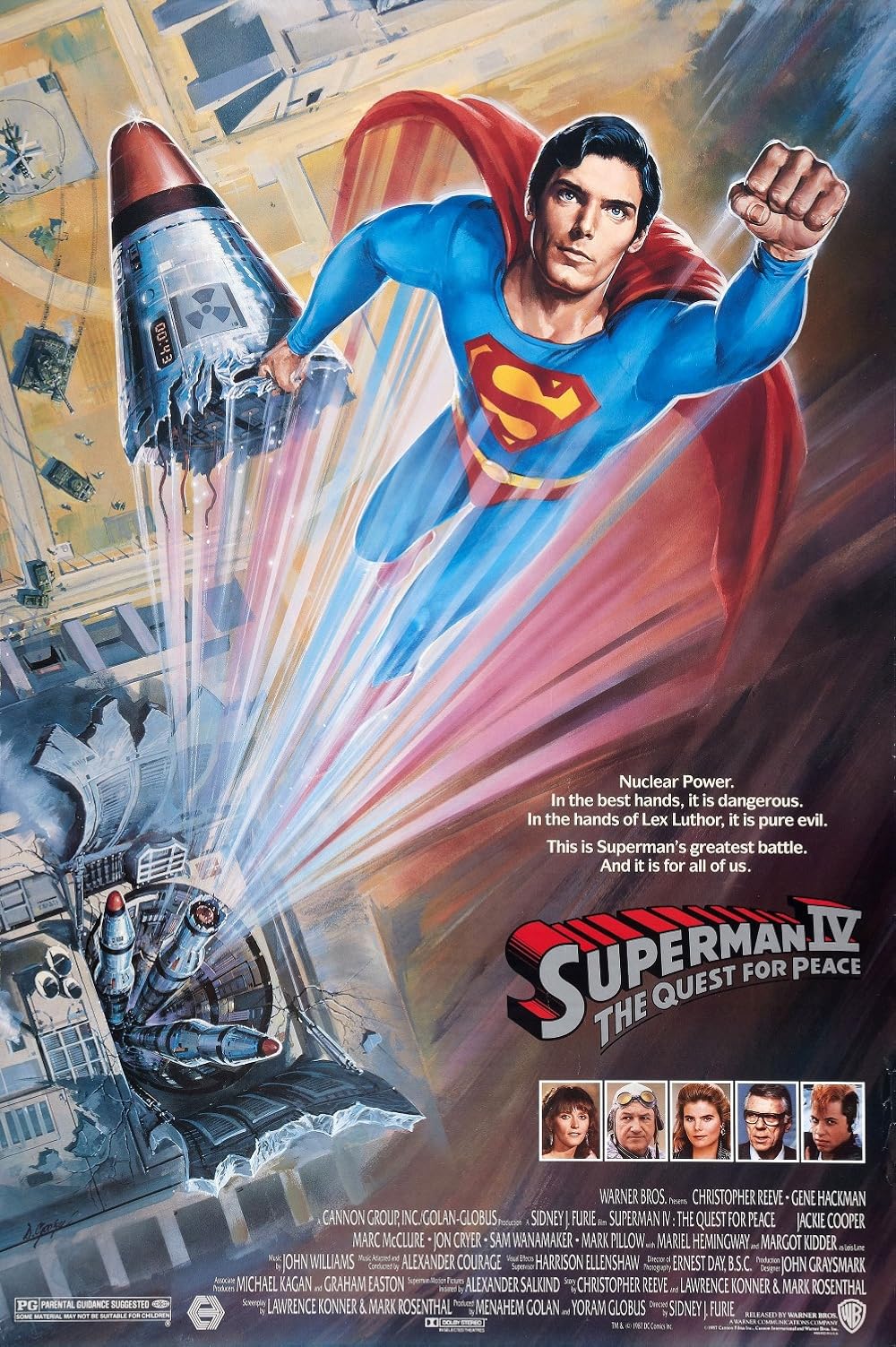
Lex Luthor (Gene Hackman) escapes from prison with the help of his nephew Lenny (Jon Cryer). He is then able to create a powerful villain named Nuclear Man (Mark Pillow) by stealing a strand of Superman’s hair from a museum and using its code to create a genetic matrix. Nuclear Man has many of the same powers as Superman, but, unbeknownst to Superman, he’s only powerful when he’s in sunlight and without that he becomes weakened. Meanwhile Clark Kent is having battles of his own when the newspaper he’s working for, The Daily Planet, gets taken over by a rich tycoon named David Warfield (Sam Wanamaker) who degrades the paper’s integrity by insisting only stories with a salacious bent get printed. David’s daughter Lacy (Mariel Hemingway) takes a liking to Clark and the two soon become an item.

The fourth installment was the first not to be produced by the Salkinds who decided to give up on the franchise after the box office flop of Supergirl and sold the rights to the Cannon Group who were suffering financial strain, which caused the budget for this one to be cut from $36 million down to $17 million. Many have complained that the result of this compromised the special effects though I didn’t find the drop-off to be quite a bad as I feared. The biggest drawback are the flying scenes where it clearly looks like Superman is matted in front of a greenscreen and isn’t nearly as slick looking as the first two. The opening bit though that takes place on a Russian space station I thought was alright, but I did wonder how Superman was able to know that the cosmonauts were in trouble, as he appears to the rescue out of nowhere, and what would tip him off that they were in danger?

The dumbest addition is the Nuclear Man. In the 45-minute deleted footage there were actually two with the first one being portrayed by Clive Mantle and resembling the comic book villain Bizarro. This one gets defeated by the Man of Steel prompting Lex to create a another one. The second creation is the only one shown in the studio cut version and this one looks like a male model wearing a tacky get-up stolen from Clash of the Titans. He speaks with Lex’s voice and I’m not sure why it was done this way outside of actor Mark Pillow, who plays the second incarnation, not having any acting experience, so they had his lines dubbed by Hackman, but the explanation that he has Luthor’s voice because Luthor made him doesn’t make sense. Why just stop at the voice? If he’s going to replicate his creator then he should have the same eyes, ears, and body as Luthor as well.

I was happy that Margot Kidder gets more screentime as in Part III she was relegated to being not much more than a cameo appearance. However, having her Lois Lane character constantly getting into extreme danger, this time on a subway train where the driver passes out, causing the car she’s riding in to accelerate to dangerous speeds, starts to get a bit overbaked. How many times statistically can one person accidentally walk into a life-threatening situation? Once sure, could happen to anyone, but even just twice would be a stretch. However, this lady inadvertently falls into a scary mess seemingly every other day making her more like a walking-talking bad luck charm that everyone else should stay away from for their own protection.

The scenes that she shares with Superman are stupid as he takes her on a flight with him into the night sky, but this was already done in Part I, so why redo it? Then when they land back at her apartment after revealing to her that Clark is really Superman, he does something that makes her forget that, but why even bother to let her know about his secret identity if he’s just going to make her lose her memory of it right after?

Initially I liked the addition of Hemingway as the new love interest as I thought the bratty persona of her character would lend some spice. Unfortunately, she loses her entitled attitude right away becoming benign and boring like everything else. The scene featuring her getting kidnapped by Nuclear Man, who takes her into space with him, is ridiculous because she’d never be able to survive outside of the earth’s atmosphere as there would be no oxygen, which along with the frozen temperature, would’ve had her dead instantly.

I really liked Hackman recreating his role as Luthor, who adds a much-needed campy charm. Cryer isn’t bad either as his young henchman and he does have the film’s one and only funny line. The story isn’t as political and preachy as I thought it was going to be either, which is good, but everything else falls flat. The initial runtime was supposed to be over 2-hours, but I was thankful it got cut down to a mere 90-minutes and even then, it was a drag to sit though. The franchise came to a merciful end after this, and I feel it was for the best.

My Rating: 3 out of 10

Released: July 24, 1987

Runtime: 1 Hour 30 Minutes

Rated PG

Director: Sidney J. Furie

Studio: The Cannon Group

Available: DVD, Blu-ray, Amazon Video, YouTube
Tootsie (1982)

By Richard Winters

My Rating: 7 out of 10

4-Word Review: Pretending to be female.

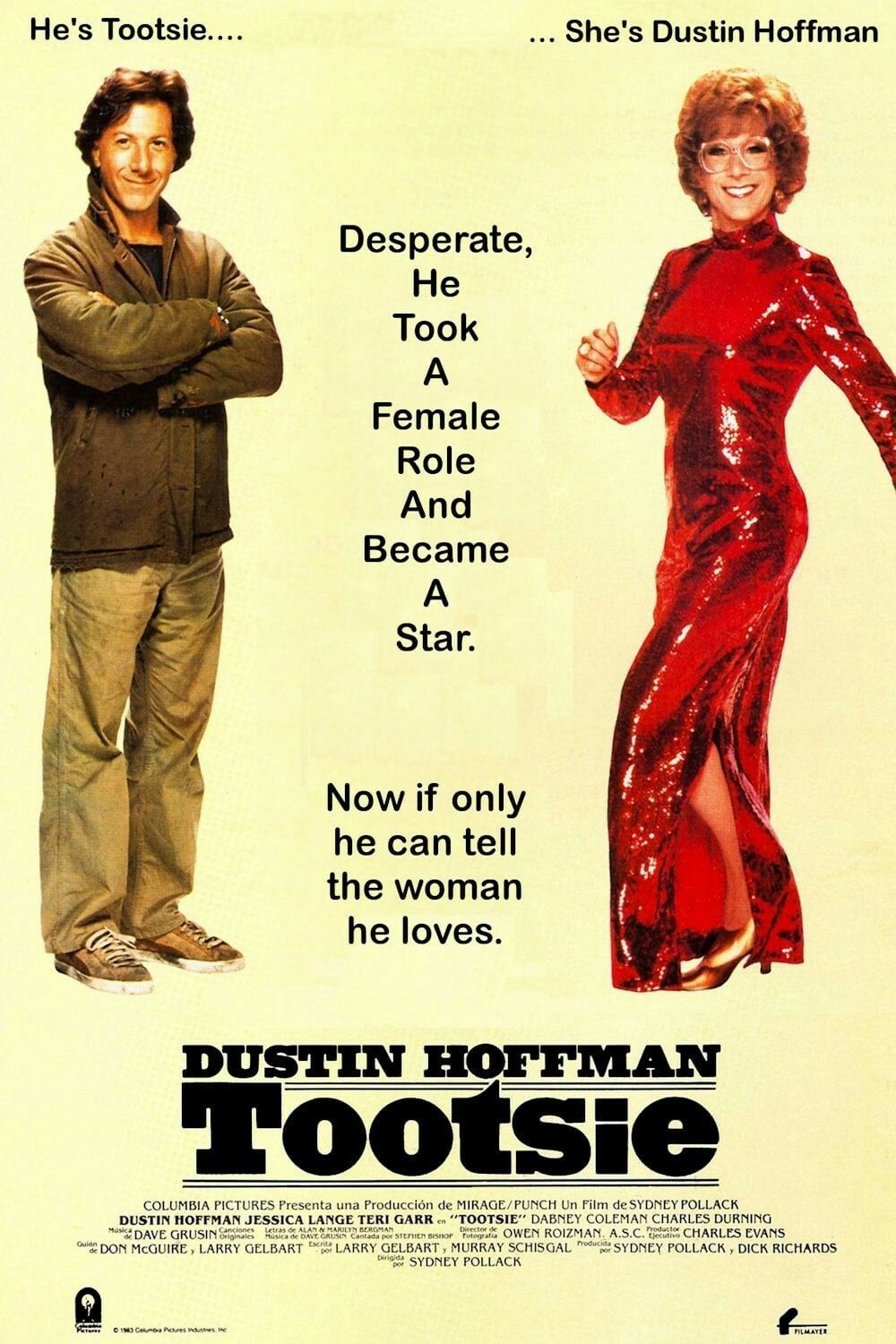
Michael (Dustin Hoffman) is a talented actor but having difficulty finding employment due to his demanding nature and inability to get along with directors. His friend Sandy (Teri Garr) is auditioning for a part in a soap opera, and he helps her prepare for the role and even takes her to the audition only to learn that she was rejected before given any chance to do a screentest. It’s at this same time that he learns his agent George (Sydney Pollack) hasn’t gotten him a chance to audition for another role because in his words ‘no one will work with him’. Michael then decides to disguise himself as a woman named Dorothy Michaels in an effort to get the role that Sandy was turned down for so as to raise money to produce a play that will star Sandy. While he does get the part, he also becomes a big star with everyone believing that Dorothy really is a woman, which cause many complications in both his personal and professional life making him feel like he wants to end the charade and go back to his normal identity, but not quite sure how to do it. 

The genesis for the story began all the way back in 1970 and was based on an off-Broadway play by Don McGuire titled ‘Would I Lie to You?’ about an out of work stage actor who dresses as a woman to get a big part. Director Dick Richards adapted the plot into a screenplay, and it got shopped around for many years, but to no avail. Then in 1980 cross-dressing actor Christopher Morley played the role of a woman named Sally Armitage in the soap opera ‘General Hospital’. The part was played straight with the viewers under the impression that it really was a female, and Sally even gained the romantic interest from the character Luke, played by Anthony Geary, only to eventually reveal that she was really a man, which was a ratings hit and thus lead to renewed interest in this script. Eventually Dustin Hoffman got a hold of it and decided he wanted to take it on under the condition that was given full creative control and even hired his own people, Larry Gelbert and Murra Schisgal, to rewrite the story to his liking. 

Personally, my favorite parts of the film come at the beginning where we see Michael’s struggles as an actor as well as all of his thespian friends giving one a glimpse at just how hard the business is and how few people can make an actual living in it. Watching both him and his roommate Jeff, played by Bill Murray, working as waiters, but still talking about their acting ambitions while on that job was on-target. Garr gives a great performance as a struggling would-be actress who is full of insecurities and letdowns and a perfect composite of many young women who find the auditioning process grueling and thankless and for this reason, I felt she should’ve won the Oscar instead of Jessica Lange as her part as the love interest wasn’t as interesting, or honest. 

Murray is terrific as the roommate in an unusual part for him as his over-the-top clownish, snarky, frat boy persona is kept under wraps and instead he plays the part straight, but his sardonic responses to things are great. Director Pollack, who took on the role of Michael’s agent at the request of Hoffman and thus making it his first acting role in almost 20 years, is quite good too particularly with how his exasperated nature feeds off of Hoffman’s hyper one and their conversation inside his office is the movie’s highlight. Charles Durning has a few key moments as well playing Lange’s lovesick father who begins to fall for Dorothy though any man that would give a woman an engagement ring before they’d even been out on a single date has to be a bit loopy.

Hoffman falls into the woman role easily and it would be hard to recognize him had the viewer not known about the disguise beforehand though I felt the way Dorothy walked and moved her hands and arms made her seem like Mrs. Butterworth the animated character from the maple syrup commercials. It’s also hard to imagine he wouldn’t have been found out a lot sooner especially since he collected a weekly paycheck from the company, which would’ve required him to give them his social security number, which in-turn would’ve exposed who he really was. Being on magazine covers where he supposedly does interviews as Dorothy should’ve been equally problematic as the reporters would’ve asked him (her) about her past like what other stuff did she act in, where was she from, and where did she graduate. Stuff that’s very much standard questions in any interview and when he (she) couldn’t come up with anything or made-up stuff that could easily be background checked would’ve then raised red flags and brought the ruse to a very quick halt.

Spoiler Alert!

Soap operas were no longer broadcast as live and hadn’t been since 1963, so that story angle doesn’t fly either. Yes, I realize the idea was that it was taped and only had to done live as an emergency when one of the tapes got destroyed, but in reality, the taping would’ve been done so far ahead (usually by several weeks) that even if a video did somehow get corrupted there still should’ve been plenty of time to refilm it before reaching the actual air date. 

The ending it a bit disappointing as well. Sure, it’s nice seeing Lange putting her arm around him as they walk down the sidewalk showing that the two had made up after his secret identity was exposed, but it doesn’t answer what happened to his career. He did this whole thing to help finance a play for Sandy, so what became of that? Also, were casting agents so impressed with the way he fooled everybody that they now were willing to hire him, or was he still blacklisted? These were all major motivations for why he did the ruse, so there should’ve been clarity to what became of it. 

My Rating: 7 out of 10

Released: December 17, 1982

Runtime: 1 Hour 56 Minutes

Rated PG

Director: Sydney Pollack

Studio: Columbia Pictures

Available: DVD, Blu-ray, Amazon Video, YouTube
The Pope of Greenwich Village (1984)

pope

By Richard Winters

My Rating: 7 out of 10

4-Word Review: Cousins turn to crime.

Charlie (Mickey Rourke) and Paulie (Eric Roberts) are cousins working at a restaurant who get themselves fired when Paulie is caught skimming checks. Since Charlie’s girlfriend Diane (Daryl Hannah) has a baby on the way he must act fast to bring in some money. Paulie convinces him of a ‘great’ opportunity, which is to hire a former safecracker, now working as a clock repairman, Barney (Kenneth McMillan) to break-open a safe inside the building of a large company that reportedly has a large amount of money inside it. Charlie is cautious as he doesn’t completely trust Paulie whom he finds immature and unseasoned, but he’s so desperate that he reluctantly agrees. Things go smoothly at first, as they’re able to break into the building easily, but the unexpected arrival of undercover cop Walter (Jack Kehoe) soon sends their plans awry. When Walter dies during the melee they’re now on the hook for his death as well as in the bad graces of mob boss Eddie (Burt Young) who’s safe it was that they tried to rob. 

The film is based off of the 1979 novel of the same name by Vincent Patrick who also penned the screenplay. It does an excellent job of creating a vivid feel of Greenwich Village where it was shot on-location and the interactions of the characters seem overall authentic. The only real issue is the way it hinges of extreme Italian American stereotypes where it seems like anyone from that background must be involved in crime and if any other group was portrayed that way it would be deemed problematic if not downright controversial. The cliches are so strong that had it been heightened just a small degree it could’ve been deemed as parody, or even satire and in fact IMDb does list it as being a ‘comedy’ though I really don’t think that’s the case. I believe it’s meant to be a drama, but either way, for the sake of balance, it would’ve helped had there been some Italians even just one who didn’t fall into the tired caricatures. 

The acting is the crowning achievement. Roberts is superb and I really found it hard to believe he didn’t become a star from this. While he’s always been a great character actor I think he should’ve been given more and I do realize he’s still busy in the business and has been consistently, but I don’t think the quality of the parts has always been there and most filmgoers are probably more familiar with his sister Julia, which is a shame. I was completely blow away by him here and genuinely surprised why the Oscar didn’t fall into his lap.

Rourke is excellent too, but more because he wisely underplays his role and allows Roberts to carry all the emotional energy. Had they both been competing for it it would’ve failed, but their different approaches help create a nice contrast and sometimes it’s the best actors who don’t force it and for the most part that’s what Rourke does here. Of course, he too has his moments like when they go to the racetrack, and he bumps into a guy and instead saying ‘excuse me’ like a normal person he instead says, ‘out of my way asshole’. Him beating up on his refrigerator when Diane leaves him has a memorable quality to it though I would’ve thought the fridge would’ve been more damaged and he should’ve at the very least injured his hand, which strangely doesn’t occur despite him punching at it repeatedly.  

On the female end most accolades goes to Geraldine Page who got nominated for the supporting Oscar despite having only 8-minutes of screentime. She gives a powerful performance for her limited presence, but the idea that she could stymie police efforts to search her deceased son’s room by giving veiled threats that she’ll make them look bad in the media I didn’t totally buy. If cops want something bad enough, they’ll get it with the possible exception of money exchanging hands, which in this case didn’t happen. Hannah as the girlfriend has almost the same screentime, maybe a little more, and hits the bullseye as an idealistic young woman who believes she can somehow get her boyfriend to change only to learn the ultimate harsh lesson that it doesn’t work that way. 

Spoiler Alert!

The ending I felt was a letdown. I was actually intrigued with Charlie finding the tape from the deceased cop that implicated Eddie and seeing how he could use that to stay out of trouble for being a part of the robbery. Having Paulie then swoop in by putting lye into Eddie’s drink and poisoning him seemed too easy. Eddie had just gotten done having his men cut-off Paulie’s thumb, so he should expect Paulie would be looking for revenge and not naive enough to have him make his drinks, or if he does at least have one of his henchmen taste it first. You have to wonder how Eddie was able to climb up the crime ladder if he was that stupid and thus the climax really isn’t that clever, or surprising as the camera focuses up-close on the coffee cup making it too evident that something is going to happen. A letdown for a movie that had been relatively smart up until then.  

My Rating: 7 out of 10

Released: June 22, 1984

Runtime: 2 Hours

Rated R

Director: Stuart Rosenberg

Studio: MGM/UA

Available: DVD, Blu-ray, Amazon Video, YouTube, Tubi, PlutoTV

The Out-Of-Towners (1970)

outoftowners

By Richard Winters

My Rating: 6 out of 10

4-Word Review: Travel plans go awry. 

George (Jack Lemmon) is set to have an interview in New York City for a possible job promotion with his company. He brings along his wife Gwen (Sandy Dennis) for what he hopes will be a fun-filled trip in which they can explore the new city they hope to eventually relocate in, but things don’t go as planned. Their flight is forced to circle JFK Airport for hours before it’s diverted to the Logan Airport in Boston and then requiring them to take a train ride back to the Big Apple causing them to arrive there very late. Once they do make it, they find their hotel reservations expired since they hadn’t thought to call or wire, to tell them to hold it. They’re then mugged, and while being escorted by police to a local armory, where they plan on spending the night, they become involved with two liquor store robbers who hijack the squad car they’re in and force them out into Central Park in the middle of the night. This then leads to several more calamities, but despite everything George manages to somehow make it to his interview on time, but when offered the position he’s now not so sure he wants to accept it. 

Originally writer Neil Simon was planning on using this concept as a segment to his 1968 play Plaza Suite, but since that play was already divided up into three other segments it was deemed too many and thus this one got thrown out. He then tried making it into its own stage play but realized it would require too many different set pieces and ultimately came to the conclusion it would work better as a movie. Unlike his other works this one does not rely on dialogue for its primary humor as instead the intended laughs come from the situations, but it’s more like a dumb comedy in that what occurs isn’t all that clever, or original and relies solely on the exasperated reactions of the characters. 

Some of it goes overboard particularly an underground gas explosion that blows a manhole cover that George is standing on into the air and temporarily causes him to lose his hearing, which I found quite disturbing. What’s worse is that the cover comes crashing down just inches from George’s head, which could’ve been fatal and was apparently a mistake as it was intended to go up only a few feet and thus it could’ve really killed him had it hit him, but being the trooper that Lemmon was he remained in character despite the issue. However, exploding gas lines don’t happen that often giving the film an unintended surreal quality, or a piling-on effect and for that reason I would’ve excised that segment completely from the movie. 

The characters aren’t that lovable especially George who comes-off as what would be called today as a female Karen, or ‘Kevin’ as he complains about everything right from the start making him obnoxious and annoying. Had the character shown a laid-back Midwestern mentality, since that’s where he’s from, and been more congenial about things, only to finally get exasperated at the very end as it built up, would’ve worked better as by that time the audience could’ve forgiven him after what they’ve been through, but having him be so quick tempered already at the beginning doesn’t allow for any character arch and having him constantly threaten to sue everyone who has wronged him quickly becomes redundant. Sandy Dennis is better as she takes things in more of a strident fashion and makes a healthy contrast to George. The small bit parts made-up of a recognizable B-list actors are fun though they should’ve been given more amusing things to say. 

Spoiler Alert!

The overall point of the story is muddled. Supposedly it’s a harsh assessment on New York, but the couple’s problems aren’t exclusive to the city as they have issues when they go to Boston and even on their plane ride back when it gets hijacked to Cuba making it seem more like a cursed trip versus a nightmare place. Taking potshots at NYC isn’t hard either as most people have complaints about it even those that have lived there for their whole lives making the premise too obvious. A much more original idea that could’ve given it a fresher perspective would’ve had the couple already living in New York, but tired of the crime and rundown urban conditions, so they decide to move to a small Midwestern town but find unexpected problems at every turn and thus return to the city where they conclude that despite the less-than-ideal elements they’re still better off. 

My Rating: 6 out of 10

Released: May 28, 1970

Runtime: 1 Hour 37 Minutes

Rated G

Director: Arthur Hiller

Studio: Paramount

Available: DVD, Blu-ray (Reg. B/2), Amazon Video, YouTube

The Prisoner of Second Avenue (1975)

prisoner

By Richard Winters

My Rating: 4 out of 10

4-Word Review: Out of a job.

Mel (Jack Lemmon) has just lost his job that he’s had for 22-years and fears that at age 48 it will be hard for him to find another one. Edna (Anne Bancroft) goes out to find employment of her own in order to pay for the bills and while she’s initially sympathetic to Mel’s problems she becomes annoyed at the way he doesn’t do anything about it besides just complain about everything. Having their place get robbed in broad daylight, a garbage collector’s strike, noisy neighbors, and a massive New York heatwave all lead to Mel having a mental breakdown where he begins to believe all sorts of conspiracy theories. He also gets into loud verbal sparring with one of his upstairs neighbors. His brother Harry (Gene Saks) tries to get his two sisters, Pauline (Elizabeth Wilson) and Pearl (Florence Stanley) to chip-in to help pay for Mel’s therapy, but they’re reluctant making Edna feel like she’s in this all on her own while becoming openly frightened at Mel’s deteriorating state.  

The film is based on Neil Simon’s Broadway play of the same name that premiered on November 11, 1971, that starred Peter Falk and Lee Grant. The script was written by Simon but doesn’t do enough to differentiate it from a stage play with a boring visual design that falls flat and barely ever seems to get out of the apartment and when it does the moments are equally uninteresting. The ongoing potshots at New York City living have been done before and nothing that gets said here that is ground-breaking, or even mildly amusing. The plot and humor meanders and are too unfocused to be either riveting, or captivating. 

Lemmon gives a good performance, but he’s played this type of character before and his perpetual complaining about everything and anything quickly becomes tiring. I actually sided with the upstairs neighbor who throws cold water on him when he stands outside bellowing into the night air about his problems, which would annoy anyone. Bancroft’s Brooklyn accent is too affected and her wide-eyed responses to Lemmon’s constant shouting lends no spark making her character come off as transparent. Watching her fight-back a little or even get into a sparring match with Lemmon could’ve added some much-needed comic spark, but for the most part the scenes between them are dull and one-dimensional. 

It’s hard to feel sorry for a guy who makes no effort to help himself. Instead of him being shown moping constantly around the apartment each day in his bathrobe we should’ve seen him going out to job interviews, or even sprucing-up his resume and I was genuinely shocked why none of this happened. How does he really know the job market is so ‘tough’ if he doesn’t venture to go out and test it? Since his wife is able to get a job rather quickly it starts to seem like it’s not so hard to find one making the protagonist and his inactions all the more infuriating. 

Spoiler Alert!

What’s even more confounding is he’s able to somehow ‘snap out of’ his sorry state without actually finding another job. It’s not clear either what event gets him to change his thought patterns he just starts telling everyone that he’s ‘over it’ and back to being his old productive self, but in a good movie this should be seen by the viewer without the character having to explain it. Since he’s still not gainfully employed what’s to say he couldn’t easily fall back into the doldrums and therefore seeing him working at someplace new would’ve been a more complete ending. 

The side-story dealing with him buying a giant snow shovel in order to get back at his neighbor for throwing water on him, isn’t satisfying either. For one thing if money is so tight why waste it on something he really doesn’t need? His revenge plan is a bit confusing too. The idea, I guess, is that he’ll wait for the first big snowfall then climb up on the apartment roof and shovel the white stuff down on the neighbor’s balcony, but this is yet another thing that should’ve been put into action in front of the camera as him just alluding to what he’s going to do isn’t as satisfying. 

My Rating: 4 out of 10

Released: March 14, 1975

Runtime: 1 Hour 38 Minutes

Rated PG

Director: Melvin Frank

Studio: Warner Brothers

Available: DVD, Blu-ray, Amazon Video, YouTube
Night Shift (1982)

nightshift1

By Richard Winters

My Rating: 6 out of 10

4-Word Review: Hookers in a morgue.

Chuck (Henry Winkler) has dropped-out of his former job as a stockbroker due to the stress and decided to work in a more tranquil setting as the night shift manager of a New York City morgue. He’s unhappy though to have to share duties with Bill (Michael Keaton) who’s talkative and partying ways are a complete contrast to Chuck’s introverted manner. Chuck’s home-life isn’t much better as he’s engaged to be married to Charlotte (Gina Hecht) though her habits and constant complaining are at odds with Chuck’s. His only solace is Belinda (Shelly Long) a prostitute whom he sometimes bumps into as she’s servicing his next-door neighbor Luke (Tim Rossovich). When Chuck finds her beaten-up inside an elevator he decides she needs to find a work environment that will afford her more protection, which gives Bill the idea to open-up a prostitution ring inside the morgue, which goes-off surprisingly well for  awhile before rival pimps become aware of it and threaten Bill and Chuck with their lives unless they agree to let them in on the payout.

This marked the second feature length film directed by Ron Howard and was inspired by a New York Times article about a real-life morgue that became a prostitution hang-out during its night hours. He decided to offer the leading role to Winkler, who had the choice of either playing Bill or Chuck but went with Chuck as he felt it would be fun playing against type, or in his words a ‘chance to play Richie Cunningham’. Winkler was still acting in ‘Happy Days’ TV-show at the time, so he’d shoot this on Mondays and Tuesdays in New York and then fly back to Hollywood to play Fonzie on Thursdays and Fridays.

While the change of pace may have shown what a good actor Winkler was it really didn’t help his image as the protagonist here is too wimpy. A somewhat passive guy is okay, but this guy lets people push him around too much making him look pathetic and his buttoned-down personality doesn’t show much energy making most of his moments in front of the camera too subtle to be either funny or engaging.

Keaton on the other-hand is too flamboyant, and his talkative ways become obnoxious instead of endearing and I personally didn’t blame Winkler for telling the guy to shut-up and leave him alone as I would’ve felt the same way. The story could’ve worked just as well if not better had Keaton not been in it at all and let Winkler carry-it alone, which would’ve allowed for a more interesting character arch at seeing this nebbish guy run a prostitution ring and thus learn to open-up more because of it.

Winkler’s relationship with Charlotte made little sense as the two had nothing in common and all she did was nag and complain. Why would anyone want to date someone like that let alone get engaged with them? I realize this was supposed to be part of the ‘comedy’ but for it to be funny there actually has to be some truth in it and these two shared no chemistry and at least one of them would’ve in reality come to their senses and broke it off and logically it’s surprising that it didn’t happen. The Charlotte character wasn’t even needed because the focus is on Winkler’s budding romance with Long, so why not just have him be a single guy who’s lonely and can’t make it with women and thus becomes entranced with Long despite her being a hooker simply because she showed him some attention.

While she gives a really good performance that’s light years removed from her Diane Chambers role from ‘Cheers’ that she’s best known for, and she sure looks great in the scene where she wears skimpy panties, her character here is problematic. She’s too wide-eyed and innocent for a woman whose been working as a call girl on the big city streets and even been badly beaten-up a few times by her pimp and johns. Seems like she should’ve formed a very hardened, crusty exterior for her own basic mental defense and the fact that she doesn’t show any of this and instead is so openly sweet seemed not remotely believable.

The premise has great potential, but it doesn’t do enough with it. For most of the way the pace is leisurely and the comedy subtle. I was expecting dead bodies coming-in amidst the sex and lots of mix-ups and confusion, but that stuff barely even gets touched upon. The prostitutes are portrayed as an extreme caricature with no distinct personalities, which reveals how shallow the whole thing is. Back-in-the-day, and I know because I was around, movies dealing with the subject of prostitution was considered ‘edgy’, but now stuff like this is looks trite and barely even touching the surface in regard to realism.

My Rating: 6 out of 10

Released: July 30, 1982

Runtime: 1 Hour 46 Minutes

Rated R

Director: Ron Howard

Studio: Warner Brothers

Available: DVD, Blu-ray, Plex, Roku, Tubi, Amazon Video, YouTube

The Warriors (1979)

Version 1.0.0

Version 1.0.0

By Richard Winters

My Rating: 7 out of 10

4-Word Review: Back to Coney Island.

The Warriors lead by Cleon (Dorsey Wright) make their way to from Coney Island to Van Cortland Park in order to attend an outdoor rally lead by Cyrus (Roger Hill) who heads the gang called The Riffs. It’s Cyrus’ idea to bring all the gangs in New York City together as one because if they do so they’ll be able to outnumber the police. However, Luther (David Patrick Kelly), who’s a member of the Rogues gang is not privy to this idea and thus shoots and kills Cyrus, which gets witnessed by Fox (Thomas G. Waites) a member of the Warriors. Once Luther realizes he’s been spotted he quickly accuses the entire Warriors gang of carrying-out the murder, which sends the mob into violent chaos and in-turn causing the death of Cleon. Swan (Michael Beck) becomes the group’s new de-facto leader though it receives a frosty reception from Ajax (James Remar), but since they’re in such an urgent situation he has no time to fight him for it as the gang now must make their way back to the safety of their territory while having to trek through the turfs of other gangs who are all out to kill them.

For a film about gang life this one is quite different. Most of the movies before then that dealt with this topic would typically place the protagonist as being someone outside of the gang culture, but here that outside world doesn’t even exist. Everything is fully from inside the gang world, which is what makes it so fascinating as the viewer gets immersed into a universe that most likely they really wouldn’t experience or understand otherwise. However, as big as their turfs wars are one of the most memorable moments in the film doesn’t deal with the action at all, but instead it’s the scene inside the subway car where some suburbanites come-on after a night at the club and sit across from The Warriors, who are quietly judged, through their glances, at the disheveled nature of the gang members, which they’re distinctly aware of, revealing how even though in the gang’s mind their the ‘top dog’ of their universe, they’re still perceived from the mainstream world as being people to look down upon.

I also really dug the gang attire. Some may argue this gets ‘campy’ and hurts the realism with proposed remakes offering to play down some of it, but for me it’s what makes it more fun. Personally, I found the Baseball Furies and roller-skating gang known as The Punks to be generally frightening. Even if the gang carrying baseball bats wears facial make-up resembling the rock band KISS I still in no way would want to meet them in a dark alley and in a lot of ways The Warriors constantly coming into these weird gang types as they cross through their territories creates a surreal nightmare atmosphere.

I did though find some of the action to be problematic. It starts with The Warriors trying to outrun another car driven by a rival gang, which I found unrealistic. Possibly if it was a short distance then maybe, but to go several blocks wouldn’t be fathomable. I would think at least a couple of the gang members would tire-out and slow down and ultimately be hit by the vehicle. Having The Warriors totally annihilate the Baseball Furies even though it was the Furies with the baseball bats while the Warriors had only their fists didn’t make sense either. Maybe you could argue that The Warriors had such good fighting skills they were able to use that to overpower the other side, but logically I think one or two of them should’ve at least gotten hit by a bat, which the Furies were swinging wildly, and the fact that they’re all able to get out of the fight unscathed is a bit of an eye roll. Having a few of them later trapped in a room with a female gang that shoots directly at them with a gun and none of them get hit by even a stray bullet is equally unrealistic. Also, since they all get involved in punching their opponents, you’d think there would be numerous scratches, abrasions, and dried blood on the broken skin of their knuckles, at the very least, but on the subway ride after the fights there’s a quick close-up of Micheal Beck’s hands, who was involved in the majority of battles, and they’re completely unblemished.

The 1965 novel version, the author, Sol Yurick, was not happy with the film, has many differences including the gang rape of the female, played in the movie by Deborah Van Valkenburg, by the protagonist gang members, that doesn’t occur here. The book also delves more deeply into the gang leaders sad home life, which the movie doesn’t tackle at all, but it would’ve helped create a better understanding of the main character’s motivations. If a remake does get made, and it’s been talked about, I think it would be more interesting if it followed the book’s plotline, which ultimately is grittier.

My Rating: 7 out of 10

Released: February 9, 1979

Runtime: 1 Hour 33 Minutes

Rated R

Director: Walter Hill

Studio: Paramount

Available: DVD, Blu-ray, Amazon Video, YouTube