Category Archives: Movies Based on Stageplays

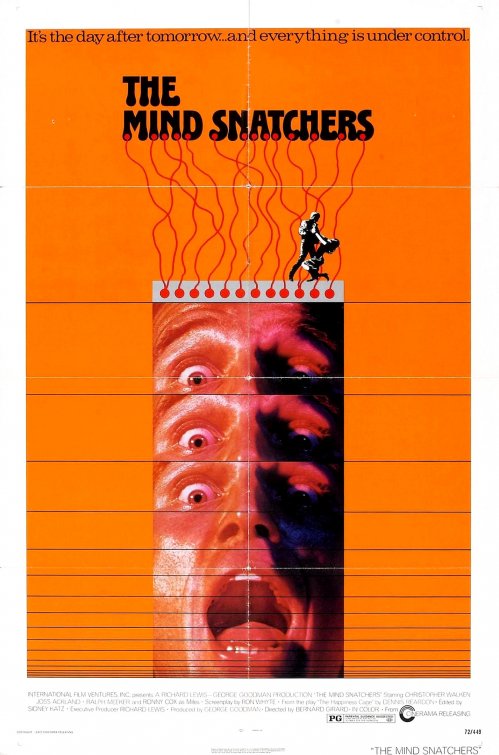
The Happiness Cage (1972)

mind snatchers

By Richard Winters

My Rating: 5 out of 10

4-Word Review: They control his mind.

Christopher Walken plays James Reese a veteran of the Vietnam War who has issues with aggression. After numerous arrests he gets shipped off to a hospital in Europe run by Dr. Frederick (Joss Ackland) and overseen by a U.S. General (Ralph Meeker). There they do tests on the patients by implanting special devices into their brains that connects to their pleasure centers and can quell their aggressive behavior by having them feel a pleasurable sensation every time a button is pressed from a remote.

Walken’s performance is outstanding and Ronny Cox as his fellow patient is also quite good especially the part where he has the device implanted into his own brain, which turns him into a sad, pathetic, child-like state. Bette Henritze gives an interesting performance as well as a naïve, middle-aged nurse hired to make the patient’s stay more ‘happy’ by supplying them with books and board games only to be attacked and raped by Cox and then forced to play a game of checkers with him afterwards.

The story, which was based on a play by Dennis Reardon, certainly has its moments. In fact I was surprised how caught up into I got since the production values are close to appalling. The film was shot in Denmark in a building that looks like it was formerly a rundown mansion converted into a makeshift hospital for the sake of the movie. It all looks embarrassingly cheap and the idea of having a big hospital with a full-time staff and even a barbed wire fence and guard dogs, but only three patients is quite hard to believe.

Had the budget been bigger it might’ve been able to reach a broader audience. Bernard Girard’s direction is okay for the limitations that he was given, but the film’s faded, grainy stock and overall amateurish look becomes a turn off from the beginning and something that it cannot overcome. The plot itself is interesting, but the concept has been filmed before and with better results.

Alternate Title: The Mind Snatchers

My Rating: 5 out of 10

Released: June 28, 1972

Runtime: 1Hour 32Minutes

Rated PG

Director: Bernard Girard

Studio: Cinerama Releasing Corporation

Available: DVD, Amazon Instant Video
The Mafu Cage (1978)

Capture 66

By Richard Winters

My Rating: 3 out of 10

4-Word Review: Her sister is psycho.

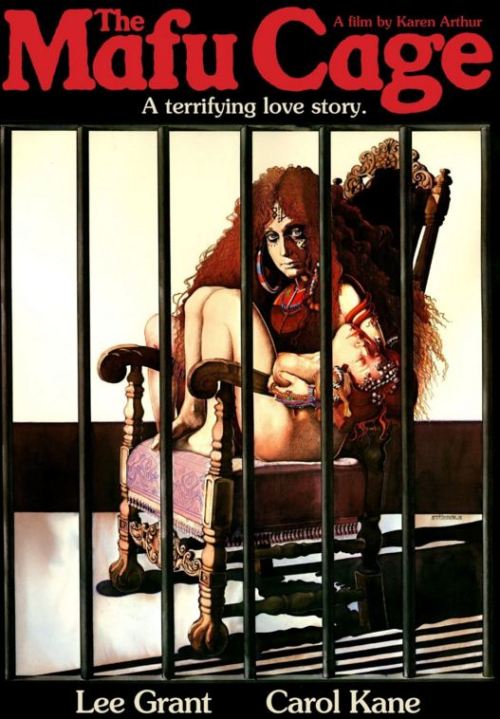
Ellen and Cissy (Lee Grant, Carol Kane) are two sisters living together in a dilapidated mansion, where they keep a pet ape named Mafu locked in a cage that sits in their living room. One day Ellen finds that Mafu has died so at the insistence of Cissy, who says she will kill herself unless they get another one, she goes to a local zoologist (Will Geer) and buys another. Things go well at first, but Cissy’s behavior becomes increasingly more erratic and she takes her frustrations and anger out on the new ape in abusive ways.

The film was directed by actress-turned-director Karen Arthur by a script written by Don Chastian who was another actor and based on a play by Eric Wesphal. I really wasn’t sure what these characters or this bizarre story was supposed to mean. I thought being the ‘70s and a female director that it would have symbolic connections to feminism or even lesbianism, which does get alluded to briefly, but overall the message is confusing and unfocused. The pacing is poor and about 10 minutes in I was already quite bored with it.

The only real saving grace is Kane’s presence who gives a startling performance as a psychotic woman. I had always admired her talent, but became even more impressed with her after seeing this. Her most amazing/bizarre moment is when she dresses up as an African warrior complete with red body paint and then later soaks in a tub filled with blood red water while carrying on an impromptu phone conversion with herself.

I had mixed feelings in regards to Grant whose age difference between Kane is 25 years making her look more like a mother figure than a sister. It was also hard to sympathize with her character as she refuses to have Cissy institutionalized or even examined by a mental health professional even though her behavior is dangerously erratic and only a completely irrational person would choose to ignore it or think that it will somehow ‘magically’ improve, which of course it doesn’t

The ape was the one performer that I enjoyed the most and fortunately a real one was used. The way the chimp responds to things and interacts with Kane are genuinely fascinating to watch and makes him a natural scene stealer without even trying. However, the part where she beats him with a metal chain is quite disturbing supposedly he was never actually hit and the credits do list an animal agency was present during filming and monitored it, but it’s difficult to watch nonetheless.

Patient viewers may find certain segments and imagery to be interesting and the film does improve a bit as it progresses, but overall it’s a weird curio that will leave most people indifferent and confused.

Alternate Title: Don’t Ring the Doorbell

My Rating: 3 out of 10

Released: December 1, 1978

Runtime: 1Hour 42Minutes

Rated R

Director: Karen Arthur

Studio: Clouds

Available: VHS, DVD


Roxanne (1987)

roxanne

By Richard Winters

My Rating: 7 out of 10

4-Word Review: His nose is big.

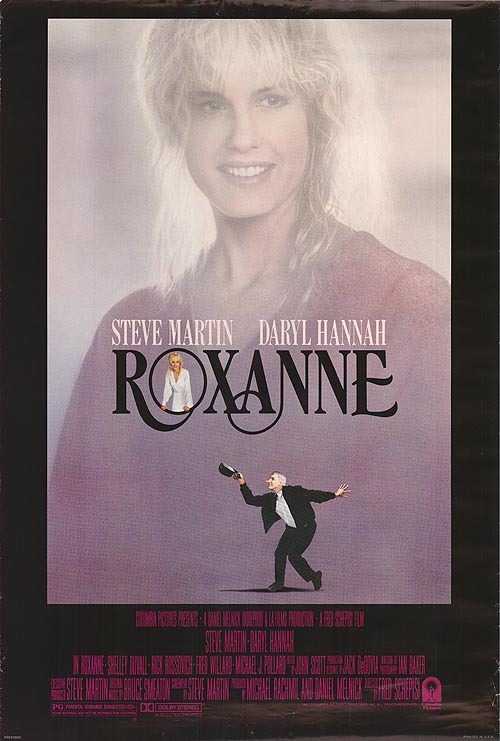
Charley (Steve Martin) runs the local fire department and just happens to have a really long nose, which at times causes him to be the butt of jokes. Roxanne (Daryl Hannah) is a beautiful student of astronomy who is spending the summer in the small town of Nelson studying a comet. Charley becomes smitten with her, but doesn’t dare ask her out due to his fear that she will reject him. Chris (Rick Rossovich) is the good looking guy who moves to the area and immediately catches Roxanne’s eye. The problem is that he is very shy with women, so Charley helps him out by writing letters to her while pretending that they were done by Chris, which captures Roxanne’s heart without her realizing that the man she is really in love with is Charley.

There have been many remakes old movies and in this case an old stage play named Cyrano De Begerac and for the most part they fail and only help to make the viewer long for the original, but this is the rare case where the updating of the story actually works. One of the main reasons is that it doesn’t try, in an effort to be ‘hip’, to go for the crude angle like a lot of modern remakes do and instead keeps it charming and breezy while having a main character with a sense of humor and not drowning in self-pity.

The on-location shooting, which was done in the small town of Nelson, British Columbia, helps as well. The hilly, green landscape gives the film a serene feeling and the quirky supporting characters seem very much like people you’d bump into when passing through one of these places. The humor is also top notch particularly the running gag involving the incompetent fire department.

Martin remains the film’s biggest selling point particularly the scene where he tries to use eye shadow to help darken his nose and make it less conspicuous or the moment when he lets a parakeet perch itself on it. His best part though comes when tries to come up with 20 insults to say to someone with a big nose.

Hannah is stunningly beautiful to the point of being breathtaking and fortunately this was years before she had her ill-advised plastic surgery, which now makes her looks far less appealing. Rossovich is also quite good and tends to be overlooked due to Martin’s presence, but manages to be quite funny as well especially the scene where he tries to meet Roxanne in person while having Charley telling him what to say through a radio transmitter.

Shelley Duvall, Michael J. Pollard and Fred Willard also deserve mention for their supporting work here and this marks the film debut for Kevin Nealon who appears in an early bit as a bully who tries to make fun of Charley’s nose, but learns the hard way that he shouldn’t.

My Rating: 7 out of 10

Released: June 19, 1987

Runtime: 1Hour 47Minutes

Rated PG

Director: Fred Schepisi

Studio: Columbia Pictures

Available: VHS, DVD, Blu-ray, Amazon Instant Video, YouTube

When You Comin’ Back, Red Ryder? (1979)

when you comin back red ryder 2

By Richard Winters

My Rating: 5 out of 10

4-Word Review: Terror at a diner.

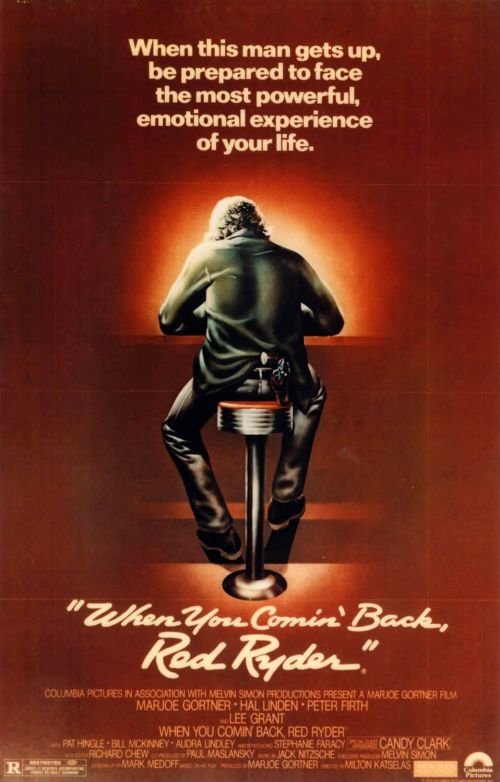
The year is 1968 and the setting is a small, lonely diner nestled at the border of Texas and New Mexico. Richard (Hal Linden) and his violinist wife Clarissa (Lee Grant) arrive for a morning cup of coffee. There is also Angel (Stephanie Faracy) the diner’s lone waitress and Stephen (Peter Firth), who was nicknamed Red during his youth due to his red hair at the time, but besides them the place is empty and peaceful. Then Teddy (Marjoe Gortner), an unhinged Vietnam vet and his hippie girlfriend Chery (Candy Clark) enter. They are without money and stranded with a broken down van, which makes Teddy particularly volatile as he begins harassing the others with evasive questions before eventually terrorizing them all by trapping them inside the place and forcing them to do whatever weird, sick thing he asks.

The film is based on the 1973 Off Broadway play by Mark Medoff, who also wrote the screenplay. In many ways it’s similar to the 1967 black-and-white drama The Incident in which Tony Musante and a young Martin Sheen trap several subway riders inside a subway car and spend the rest of the night terrorizing them simply for their own personal amusement.  Both films are structured the same with the first part examining the characters before they arrive at the scene and revealing a bit of the personal dramas that each of them face and then spending the second half showing them trapped in a claustrophobic setting and forced to deal with their reluctance at confronting their fears.

The 1967 film though outshines this one as there were more characters, which gave it a better variety of personalities as well as bad guys that were menacing and believable. Gortner is too much of a ham making him more irritating than scary. The part was originally played by Kevin Conway during its Off Broadway run and his performance won many accolades, which should’ve been enough for them to have offered him the chance to reprise the role here. Gortner, who also produced seemed intent at trying to use this as a vehicle to promote himself as being a ‘serious’ actor, but he was too old for the role from the beginning since he was already in his mid-30’s at the time this was shot while vets coming back from the war during the ‘60s where only in their late teens or early 20’s.

The film only gets mildly interesting during the confrontation sequence inside the diner, which takes 45 minutes of the film’s 2-hour runtime just to get there. The way the characters respond to Gortner’s scare tactics and the supporting cast’s performances, who are all far better actors than Gortner, is the movie’s only compelling element, but even here there are issues. The biggest one being that the people seem too wimpy and today’s viewers will get frustrated at how overly compliant they are to Gortner’s demands and never once try to overpower him despite having ample opportunity.

The movie is also notorious for featuring some rather shocking moments of nudity. It starts out with a full body shot of Candy Clark in the buff, who was married to Gortner in real-life at the time this was made and that isn’t too bad, but then it proceeds to later show 48-year-old Linden in nothing but speedo shorts doing sit ups with his butt crack clearly exposed. Still later there is a scene where 52-year-old Lee Grant has her shirt hoisted all the way over her head with her breasts in full view and then paraded around the diner in mocking fashion. The film’s most over-the-top moment though comes when Gortner himself is stripped naked and bent over a table while having a proctoscope shoved up his rectum as he continues to have a conversation with the man who’s doing it.

Filmed on-location in Fabens, Texas, which was also the site of a famous scene in The Gateway, and Las Cruces, New Mexico the movie just doesn’t convey enough tension to make it compelling or worth catching. It would’ve worked better had it skipped the first half dealing with the backstories of the characters, which was never a part of the original play anyways and just gone straight into the diner sequence while also casting a leading actor that had some actual acting training.

when you comin back red ryder 1

My Rating: 5 out of 10

Released: February 9, 1979

Runtime: 1Hour 58Minutes

Rated R

Director: Milton Katselas

Studio: Columbia Pictures

Available: VHS

The Chase (1966)

chase 1

By Richard Winters

My Rating: 6 out of 10

4-Word Review: A town on edge.

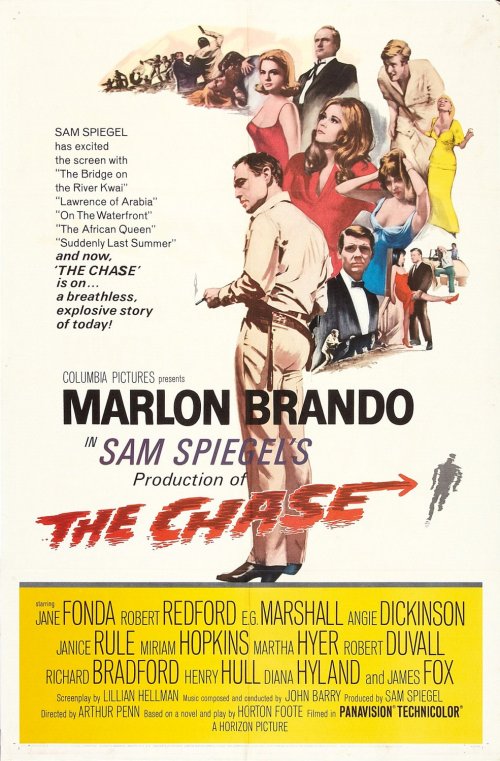
Bubber Reaves (Robert Redford) has escaped from prison and looks to return to the small Texas town where he grew up in. It is there that his wife Anna (Jane Fonda) resides, but she is now having an affair with Jason (James Fox) who is the son of the town’s influential millionaire Val (E.G. Marshall). Deep-seated tensions that had long remained dormant eventually rise and boil over. The sheriff (Marlon Brando), who is not particularly popular with the locals, wants to bring Bubber back alive, but a certain group of men have other ideas and are willing to physically and violently stop the sheriff if they have to in order to get their way.

The film was notorious in its day for its behind-the-scenes discord that was almost as entertaining as the conflicts onscreen. Producer Sam Spiegal gave director Arthur Penn no authority over the final cut and screenwriters Horton Foote and Lillian Hellman who along with Penn where in constant disagreements over the story angles and character focus. Yet with all that going on the final product is still slick enough to remain entertaining and compelling.

Much of this can be attributed to the talented supporting cast. Janice Rule is spicy as the haughty husband stealer and Robert Duvall is memorable in an atypical role as a timid man who avoids all confrontation even when his wife (Martha Hyer) openly makes out with another man while right in front of him. Miriam Hopkins, in her second-to-last film appearance, leaves a strong impression as well playing Bubber’s elderly, but still feisty mother.

On the other end there is Fonda who is wasted in a small role that gives her little to do. Redford, with his All-American good looks is miscast and fails to reflect the grittiness of the rest of the characters. Brando’s presence is also a detriment as his patented moodiness becomes off-putting instead being the portal to the character’s ‘inner angst’ as it’s intended although the scene where he gets beaten to a pulp and then walks all bloodied out in front of the other townspeople who stare at him with indifference is an impactful moment.

The ending culminates with an explosive finale inside a junkyard, but the majority of the film lacks any action. It’s more of a soap opera than a chase, which makes the title misleading and even disappointing to those that may come into it expecting an action flick, which it isn’t. The setting is also supposed to take place in Texas and even though certain shots do resemble the Lone Star landscape it was actually all filmed inside the borders of California.

My Rating: 6 out of 10

Released: February 17, 1966

Runtime: 2Hours 15Minutes

Not Rated

Director: Arthur Penn

Studio: Columbia Pictures

Available: DVD, Amazon Instant Video

Boeing, Boeing (1965)

boeing boeing

By Richard Winters

My Rating: 2 out of 10

4-Word Review: Fooling around with stewardesses.

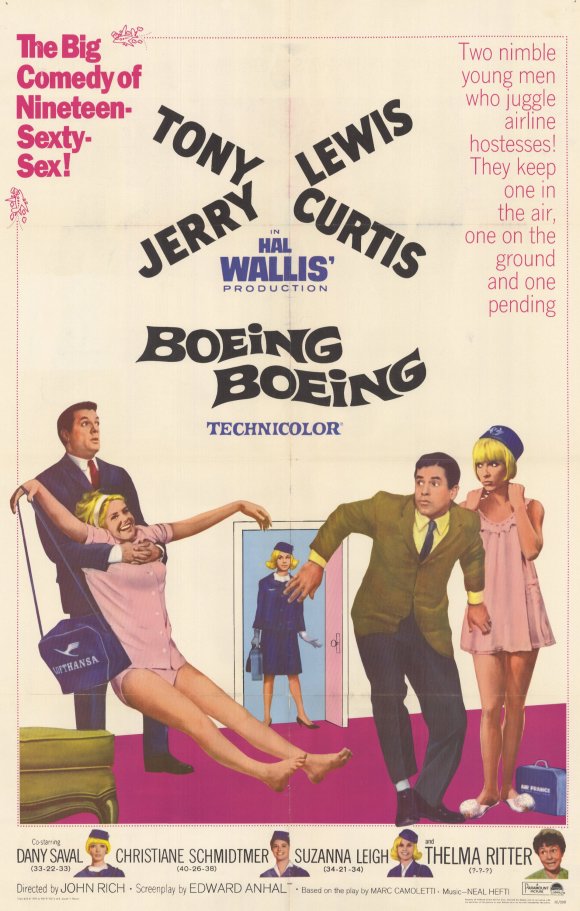
Bernard (Tony Curtis) thinks he’s come up with the perfect plan where as a confirmed bachelor he can enjoy the ‘benefits’ of a relationship without ever having to take the ultimate plunge. Using the timetables of all the airlines he has devised a way where he can date three different stewardesses (Dany Saval, Christiane Schmidtmer, Suzanna Leigh) simultaneously without any of them knowing of the other ones. When one of them is on layover from their flights they come over to his pad for romance and passion and then promptly leave for their jobs only to have another one arrive from another layover. It works for a while before the expected complications ensue. Things get even worse when Bernard’s out-of-town friend Robert (Jerry Lewis) arrives and wants to get in on the action while Bertha (Thelma Ritter) Bernard’s long suffering maid feels that she’s had enough and wants to quit.

The flimsy premise kills itself from the beginning by having a main character that is unlikable. I’m as open-minded as the next person, but if one wants to enjoy the swinger’s lifestyle then they must be open and honest with their partner(s) for it to work. This guy lies to them at every turn, manipulates with their emotions and views them solely as sexual playthings for his own pleasure, which is about as callous and self-centered as they come. His scheme is full of potential holes and any halfway intelligent person would’ve known it wouldn’t work and avoided even attempting it from the start.

The women are portrayed as being painfully naïve and stupid and falling for every pathetic lie and story that the men tell them. I was hoping at some point they would wise up and turn-the-tables, which would’ve been really funny, but that never happens. Instead the viewer gets treated to one ‘madcap’ scheme after another as they try desperately to keep their ridiculous ploy going, which becomes tiring and annoyingly redundant.

The three actresses at least have some acting ability and aren’t just the usual wide-eyed models mouthing their lines, which helps a little. Ritter certainly makes for a good anchor, but even she becomes stifled by the story’s derivative theme. Lewis surprisingly is the best thing about the film and this is mainly due to the fact that he is much more restrained and not allowed to fall into his over-the-top shtick.

Based on the stage play by Marc Camoletti this thing might’ve at one time been considered a fresh and funny bedroom farce, but by today’s standards it is tame and dated and not good for even a few chuckles.

boeing boeing 2

My Rating: 2 out of 10

Released: December 22, 1965

Runtime: 1Hour 42Minutes

Not Rated

Director: John Rich

Studio: Paramount

Available: DVD, Amazon Instant Video, YouTube

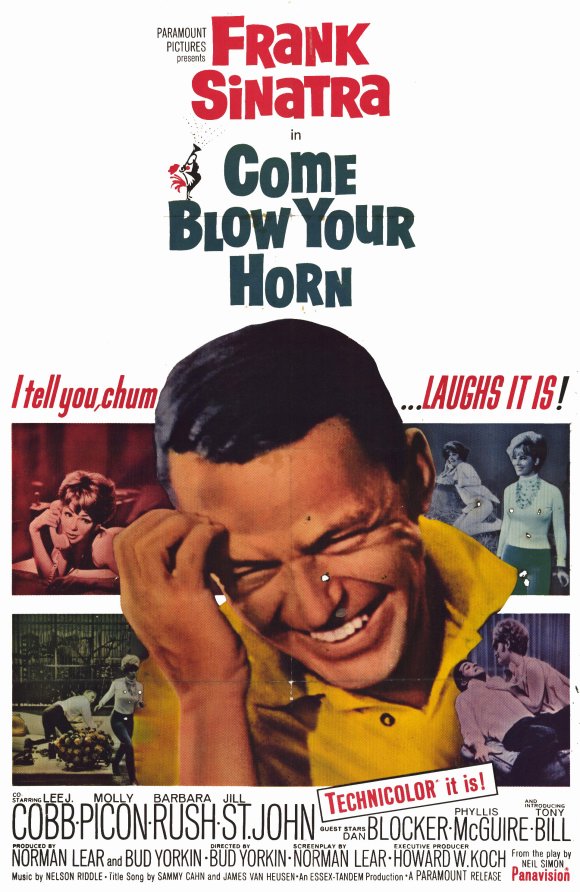
Come Blow Your Horn (1963)

come blow your horn

By Richard Winters

My Rating: 5 out of 10

4-Word Review: Kid brother moves in.

Buddy Baker (Tony Bill) has just turned 21 and is looking to get out into the world by moving in with his older brother Alan. Alan (Frank Sinatra) is living the bachelor’s dream by residing in a luxurious apartment in the heart of Manhattan while entertaining wild parties and a wide array of lovely ladies. Their parents (Lee J. Cobb, Molly Picon) do not feel that Alan and his lifestyle will be a good influence on Buddy and forbid him from doing it, but he does it anyways, which drives the father to disown his sons and cut out all communications with them.

This was the first Neil Simon play to be turned into a movie and it was loosely based on Neil’s relationship with his older brother Danny. For the most part it is talky and stagy while lacking Simon’s patented one-liners and humorous exchanges. It also has for some bizarre reason a musical number that comes out of nowhere at the 40-minute mark where Sinatra sings the film’s title tune and then just as quickly it goes back to being a straight comedy, which came off as jarring, out-of-place and misguided.

I did enjoy the film’s set design, which got nominated for an Academy Award, especially the interiors of Alan’s swanky apartment. However, I was confused why Buddy had to sleep in the same room as Alan as I would think such a large and fancy place would have more than just one bedroom. The movie also strongly implies that Alan is having sexual trysts with his lady friends, which would then imply that he must have a king sized bed somewhere, so why are only twin beds shown? He also has five telephones in the living room, which seemed beyond absurd and made me feel that if he had purchased a few less phones then he might’ve been able to afford a double bed.

Sinatra’s presence is the film’s weakest link as this type of comedy doesn’t mesh well with his otherwise caustic personality. He was too old for the part as he was not only pushing 50, but also only 4 years younger than Cobb who plays his father. I didn’t like Jill St. John’s ditzy character either as she was too dumb to be believable, which was not only painfully unfunny, but stereotypical and insulting to women.

I did like Tony Bill in his film debut and his nicely understated performance helps keep the film balanced. Dan Blocker is also great as a jealous husband and Molly Picon is a scene stealer as the mother. You can even spot Dean Martin as a wino in an uncredited cameo.

The fact that Alan doesn’t want to give up his swinging lifestyle despite the pressures from his girlfriend Connie (Barbara Rush) is the story’s one and only redeeming quality. I could never understand why a single man, who’s enjoying the bachelorhood at its most ideal, such as it is portrayed here, would want to suddenly throw it all for the married life. Most of the of films from that era with a similar theme would portray it as simply being the ‘magic of love’, but here the character is much, much more resistant to the idea and doesn’t change his ways until having a life altering event where he sees things from a different perspective, which made more sense.

Sinatra fans may want to check this out, but it is far from his best stuff and although the material is agreeable it is only slightly engaging and barely worth the time.

My Rating: 5 out of 10

Released: June 5, 1963

Runtime: 1Hour 52Minutes

Not Rated

Director: Bud Yorkin

Studio: Paramount

Available: VHS, DVD, Blu-ray, Amazon Instant Video

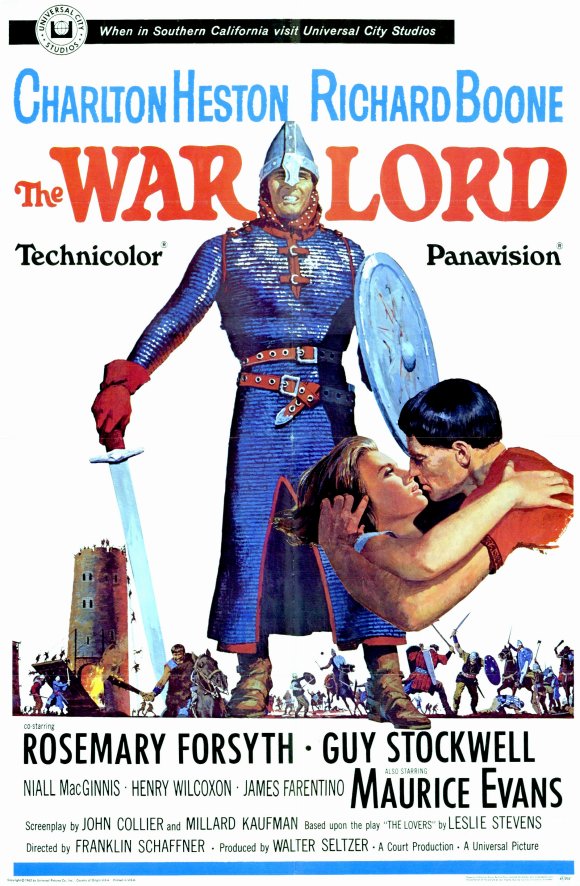
The War Lord (1965)

the war lord 1

By Richard Winters

My Rating: 7 out of 10

4-Word Review: Knight wants a woman.

Medieval tale set in the 11th century dealing with a Norman Knight named Chrysagon (Charlton Heston) who with his group of men take over a Druid’s Village and make it ready for the Duke who will then eventually rule it. During his time there Chrysagon meets the beautiful Bronwyn (Rosemary Forsyth) and becomes smitten. The problem is that Bronwyn has already been prearranged by her father (Niall MacGinnis) to marry Marc (James Farentino) yet Chrysagon imposes a little known right, which allows the Lord of a Domain to sleep with a virgin woman on her wedding night, but only if he agrees to return her back to her suitor by dawn. Her father complies, but then Chrysagon refuses to give her up once the night is over, which causes great outrage with the village as well as Chrysagon’s own men particularly his brother Draco (Guy Stockwell) who begins to challenge Chysagon’s authority.

The film paints a realistic portrait of medieval times by exposing the rigid social caste system that people were forced to live by with almost no ability for individual choice. The plot is compelling, but what I really enjoyed were the fighting sequences that take up almost the entire second hour and are filled with  ingenious maneuvers and creative attempts by each side to try and take advantage of the other without having the benefit of guns or any other form of ammunition.

Outside of Heston who is stiff as always the acting is uniformly strong. Stockwell who was the older brother of Dean lends a good menacing touch particularly with the way he starts out as loyal only to have his darker side slowly seep through. Richard Boone, best known for his starring role in the ‘50’s western ‘Have Gun-Will Travel’ is solid as Heston’s second-in-command and who remains amazingly stoic and sensible throughout. Forsyth is quite alluring as the love interest and Maurice Evans is also good as a meek and ineffectual Priest.

Director Franklin J. Shaffner, Heston, Evans and character actor Woodrow Parfrey all reteamed three years later to star in the much better known Planet of the Apes and while that film has gone on to become an influential classic this one has remained in relative obscurity, which is unfortunate as its production values are equally high, the story just as interesting and action sequence just as exciting making it yet another lost classic awaiting discovery by a new generation of fans.

My Rating: 7 out of 10

Released: November 17, 1965

Runtime: 2Hours 3Minutes

Not Rated

Director: Franklin J. Shaffner

Studio: Universal

Available: VHS, DVD, Blu-ray (Region B)

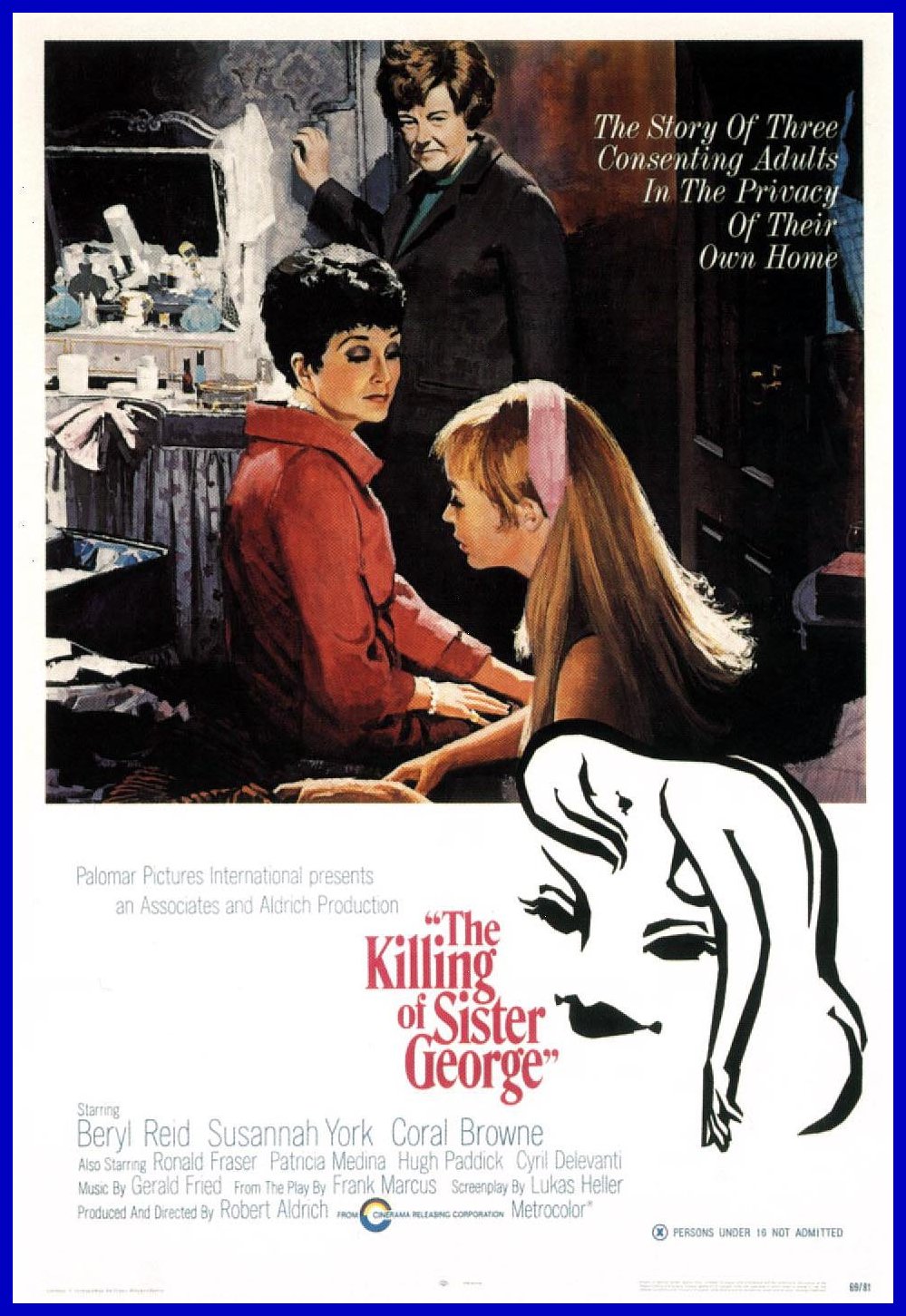
The Killing of Sister George (1968)

killing of sister george

By Richard Winters

My Rating: 6 out of 10

4-Word Review: TV character gets axed.

June Buckridge (Beryl Reid) is an aging actress playing the character of Sister George a scooter riding nun in a long running British TV soap opera. Her character no longer has the popularity that it once had and the producers have decided to kill her off by having her die in an ugly road crash with a truck. June is upset with this news as at her age parts are hard to come by and she takes her frustrations out on Childie (Susannah York) her much younger live-in lesbian lover, but she may lose her as well as one of the show’s producers Mercy (Coral Browne) has inklings to lure Childie away from June so she can have her all to herself.

After the immense box office success of The Dirty Dozen writer/director Robert Aldrich was given free rein to start up his own production company and he choose this as his first project. In many ways it is quite similar to his earlier and more well-known film What Ever Happened to Baby Jane?, but with sexual undertones. The film is based on the Frank Marcus play of the same name that ran for 205 performances and was nominated for the 1967 Tony Award. For its time this was considered quite controversial and groundbreaking especially the final scene that features a highly explicit sex scene between two women. It also is the first film to have a character utter the word ‘bullshit’ and one of the first to say the word ‘fuck’. Although the word itself gets drowned out by a car horn you can still clearly tell by reading Reid’s lips what she is saying.

The three female leads and their snarky exchanges with each other are the film’s chief asset especially Reid who recreates the same character that she played in the stage version that netted her a Tony. Her emotional, angry outbursts are entertaining and the scene where she forces Childie to eat and swallow the butt of her cigarette as ‘punishment’ is still quite edgy. Browne is equally good specifically during her provocative love scene with York, which was made all the more daring since she was 30 years older than York at the time.

The film’s overall staginess is a drawback. Many scenes are too talky and should’ve been trimmed while York and Reid’s Laurel and Hardy routine could’ve been cut out completely. Flashbacks showing how they first met would’ve helped and there needed to be an explanation to the weird child-like manner of York’s character, which quite possibly was based on an age-old gay stereotype. I also didn’t like the foreboding quality of the music that gets played just before Browne and York have their lesbian love scene, which seemed to suggest that something ‘creepy’ and ‘unnatural’ was about to take place and convinced me that despite the daring and ahead-of-its-time nature of the subject that the filmmakers themselves still had some very dated ideas about gays much like the majority of people from that era.

My Rating: 6 out of 10

Released: December 12, 1968

Runtime: 2Hours 18Minutes

Rated X (Reissued as R)

Director: Robert Aldrich

Studio: Cinerama Releasing Corporation

Available: DVD

Mr. Sycamore (1975)

mr sycamore 1

By Richard Winters

My Rating: 4 out of 10

4-Word Review: Mailman becomes a tree.

Bored with his job as a mailman and unhappy in his marriage John Gwilt (Jason Robards) decides one day to turn himself into an oak tree. He digs a hole in his backyard and ‘plants’ himself into it where he stands there day and night waiting to become a tree while his wife Jane (Sandy Dennis) tries desperately to talk him out of it, his neighbor Fred (Robert Easton) laughs at him and his minister (Mark Miller) tries to have him committed.

The film, which is based on a 1942 Broadway play, has a certain whimsical tone to it that might be pleasing to some if in the right mood and there is a certain strange intrigue at wondering just how this thing will end and whether he will eventually turn into a tree or not. However, the material would be better suited as a film short and the offbeat quality gets lost in a script that deals solely with a long parade of people who come into contact with John and their predictably shocked and confused responses when finding out what he is trying to do. The low budget is also an issue and outside of showing the inner-workings of a mail processing machine at the beginning there is no visual style at all.

Robards is a natural for the part, but he had already played a nonconformist looking to drop out of society earlier in the film and stage play A Thousand Clowns making his appearance here seem almost like typecasting. Jean Simmons gets wasted in a small bit as John’s secret love interest. Dennis, who usually plays kooky characters, becomes the most rational one here, which ultimately is the film’s weirdest element.

This definite curio does have a few amusing moments, but it lacks a second act or interesting side story and eventually talks its strange concept to death until it becomes boring.

My Rating: 4 out of 10

Released: December 12, 1975

Runtime: 1Hour 28Minutes

Rated G

Director: Pancho Kohner

Studio: Film Ventures International

Available: VHS