Category Archives: Low Budget

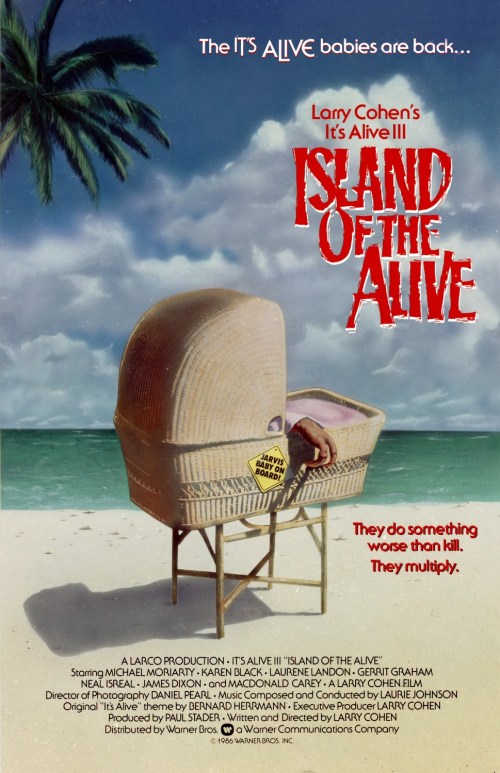
It’s Alive III: Island of the Alive (1987)

By Richard Winters

My Rating: 3 out of 10

4-Word Review: Killer babies shipped away.

Stephen Jarvis (Michael Moriarty) is the father to one of the mutant babies who agrees to have his child shipped away under a court order to a deserted island where it can live freely among the other mutant babies while no longer being a threat to the rest of society. 5 years later Stephen is then asked to join in on an expedition by a group of doctors who want to go to the island to monitor the growth of the children, but when they arrive the children overpower them and force Stephen to return to the mainland in order to meet-up with Stephen’s wife Ellen (Karen Black) who gave birth to one of them years earlier.

Larry Cohen has stated that he wanted to take the theme to its logical conclusion and see what the babies would become like when they grew older, but it was the killer baby plot-line that is what made it so unique and by his point it no longer represents what it initially did. Now they look like overweight versions of the aliens from Close Encounters of the Third Kind and the setting like a whacked-out revision of The Island of Dr. Moreau and instead of being a horror film it’s more like a sci-fi flick and not a particularly good one at that.

It’s only mildly interesting when it’s on island anyways, but surprisingly the story doesn’t remain there and the  ill-advised humor that gets thrown in does nothing but make this already silly idea seem even sillier. We do however get to see more of the babies than in the first two installments, but this doesn’t help because they end up resembling second-rate clay animation figures, which looks tacky as hell.

Moriarty elevates it with a much needed edge and the fact that he’s staunchly pro-life in real-life gives the part an added layer of genuineness.  The only problem is that the character has the same arch as the father’s in the first two films had, which makes it redundant.

Black isn’t in it much, but manages to come on strong at the finish. I was perplexed however as to why in all three films it was the father who went on a crusading mission to save the babies and never the mother. Why couldn’t the wives/mothers have worked with their husbands as a team on this endeavor and the fact that they don’t seems sexist.

Per Leonard Maltin’s review there’s some ‘serious comments’ here on many modern-day social issues, but when it’s as cheaply made as this you really don’t care. There’s also too many tangents including a poorly staged street gang fight that is unconvincing. The first film was a novelty with a few redeeming qualities, but the  sequels do nothing but drive that original idea into the ground and turn the entire concept into a laughable, forgettable grade-Z farce.

My Rating: 3 out of 10

Released: May 15, 1987

Runtime: 1Hour 34Minutes

Rated R

Director: Larry Cohen

Studio: Warner Brothers

Available: DVD, Amazon Video, YouTube
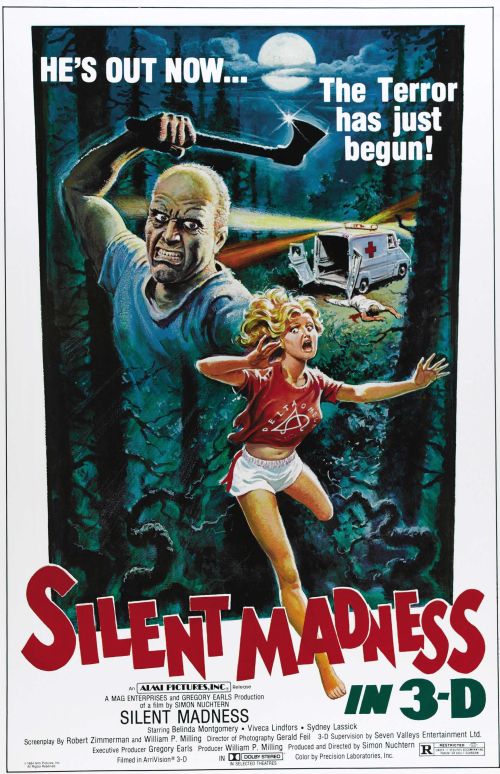
Silent Madness (1984)

By Richard Winters

My Rating: 1 out of 10

4-Word Review: Mental patient stalks sorority.

Due to the similarities in their names a mute mental patient named Howard Johns (Solly Marx) gets accidently released from a psychiatric hospital and returns to the scene of his crime, a college sorority, whose members he slaughtered years before. Dr. Joan Gillmore (Belinda Montgomery) tries to track him down, but finds no help from the staff at the hospital who are more concerned in covering up the error to the extent that they secretly send out two thugs (Dennis Helfend, Philip Levy) to kill Joan so she won’t be able to tell anyone else about it.

It’s hard to tell if this movie wants to be a conventional slasher flick or a parody and the cartoon like opening theme music makes it sound like it’s going for the latter. Either way it’s a one-dimensional, low grade, monotonous excuse of a film that essentially has nothing going for it even when compared to other entries from the genre. Supposedly it was made to cash in on the 3-D craze, but there’s not enough action to justify it. There’s a killing at the start, but the middle drags on with Joan’s plodding investigation as to the whereabouts of the killer that the viewer already knows the answer to and watching these cardboard characters spend 80 minutes coming to the same conclusion that we know from the start is extremely boring to say the least.

This is the type of cheap crap that needs to be approached with tongue firmly in cheek, but Montgomery plays it too earnestly acting like she’s in a serious drama, which just helps to make it more intolerable. The killer is equally dull and for that matter really isn’t scary. I felt that the only reason the character was made to be a mute was because the actor who played him was a stunt coordinator with limited acting experience and therefore the less he had to say the better.

The only bright spot is the presence of Viveca Lindfors a talented and aging star whose career peak was in the 40’s, but who still manages to give this second-rate material here an admirable effort. Unfortunately she appears for only about 5 minutes as the sorority house mother, but then later becomes an integral part to the film’s twist ending, which was enough to earn this thing a measly point.

My Rating: 1 out of 10

Released: October 26, 1984

Runtime: 1Hour 27Minutes

Rated R

Director: Simon Nuchtern

Studio: Almi Pictures

Available: DVD

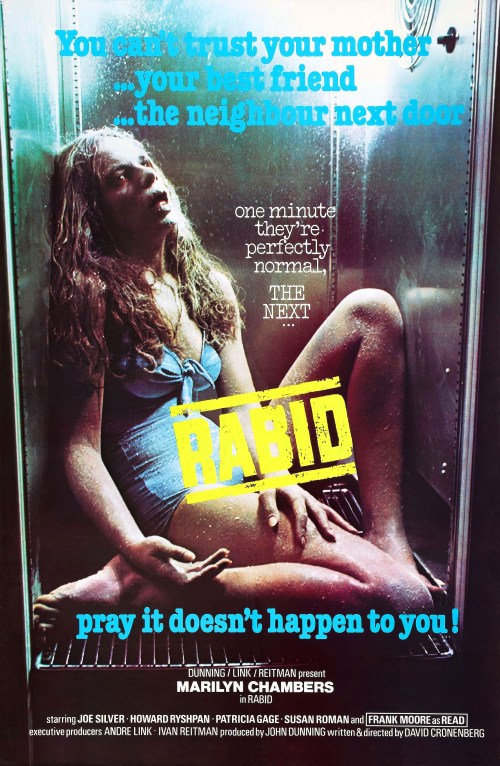
Rabid (1977)

By Richard Winters

My Rating: 5 out of 10

4-Word Review: Graft patient craves blood.

Rose (Marilyn Chambers) becomes the victim of a horrible accident when the motorcycle she goes riding on with her boyfriend (Frank Moore) crashes and she gets pinned underneath the burning wreckage. Fortunately for her the accident occurs near a clinic that specializes in plastic surgery. The head surgeon (Howard Ryshpan) is able to perform an experimental procedure on her that helps graft her burned skin back to normal, but in the process creates a strange orifice in her armpit that sucks blood from everyone she attacks. Her victims then become possessed by a rare form of rabies that sends the city of Montreal into a panic as the authorities try to control the outbreak while also trying to figure out the cause.

This marked director David Cronenberg’s third feature film and from a low budget standpoint the results are impressive. I was especially amazed by some of the car stunts including having an out-of-control vehicle jump a guard rail and crash onto a highway below where a large semi then rams into it. His ability to somehow hire an entire fleet of squad cars is admirable too as most budget-challenged films will make do with just one police car when having authorities investigate the scene of a crime/accident even though in reality there are usually many especially if the crime or accident is severe like here.

I also loved the way he captures the gray/bleak Canadian landscape, which helps supplement the film’s dark and moody tone as well as the bits of dark humor that gets implemented into the story that made me wish the whole thing had been approached as a black comedy from the start.

The horror though isn’t all that much and genuine scares are light including the scenes showing rabid people attacking others, which becomes both clichéd and redundant. The orifice itself looks like an asshole and similar to the giant one that Cronenberg created many years later for his equally provocative film Naked Lunch.

Unfortunately porn star Chambers doesn’t have the presence or talent for mainstream film work. She broke into the business years earlier with a bit part in the Barbra Streisand movie The Owl and the Pussycat, but to her surprise other film offers didn’t follow, which eventually forced her into the X-rated business, which included starring in the cult classic Behind the Green Door, but she always held out hope to one day breaking back into mainstream movies and finally got it here, but it never propelled her further.

Part of the issue is her voice which is abnormally high-pitched and at times sounds like that of a very young child’s. In certain scenes it’s worse than others, but I found listening to her speak to be disconcerting and distracting although she does still look great naked.

The somber, downbeat ending is unusual for a horror film and it might’ve had more impact had the main character been given more depth. The viewer though learns little about her and she fails to have a distinctive personality, which limits the film’s ability to be anything more than just a curio.

My Rating: 5 out of 10

Released: April 8, 1977

Runtime: 1Hour 31Minutes

Rated R

Director: David Cronenberg

Studio: Cinepix Film Properties

Available: DVD, Blu-ray, Amazon Video, YouTube

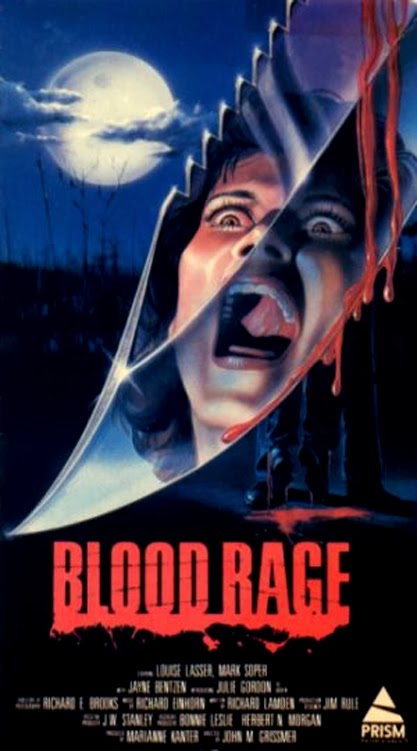
Blood Rage (1987)

By Richard Winters

My Rating: 3 out of 10

4-Word Review: Homicidal twin frames brother.

In the summer of 1974 while his mother (Louise Lasser) watches a movie with her new date at a drive-in 10-year-old Terry (Mark Soper) kills a young couple with a hatchet and then pins the murders on his brother Todd. Todd is sent away to an asylum while Terry goes on living with his mother. 10 years later Todd escapes from the mental hospital and Terry uses this as an excuse to murder people at the apartment complex that he and his mother live at while again trying to make it look as though Todd is the culprit.

The film was directed by John Grissmer who in the early 70’s produced The House that Cried Murder an interesting horror flick and a clip from that one gets shown here. He also later directed Scalpel and although that was not perfect it’s still better than this, which outside of some very gory special effects is about as routine and boring as a slasher film can get.

The identical twin/murder storyline, which has been done many times before, is a the biggest problem because even in the most extreme cases you can usually tell one twin from the other and therefore having a plot where people can easily mix the two up is just not realistic. What makes things worse is that one of the twins has curly hair while the other one’s hair is straight and combed back, so the fact that people can still somehow get the two confused is ridiculous.

The film also has too many unexplained plot holes like why is Terry so homicidal in the first place? Does mental illness run in his family, or is there something else that triggers it? And why does Todd so passively allow himself to put into an institution without protest and only after 10 years does he finally begin to profess his innocence?

The film was shot in Jacksonville, Florida, but the places used for the setting are deadly dull visually especially what was then known as the La Miranda apartment complex. This might’ve been done for budgetary reasons, but apartments are cramped places with unimaginative architecture so filming the majority of a movie inside one gives the film a flat, one-dimensional look and the exteriors, which were shot at the University of Northern Florida, were too limited and the action goes back several times to the same spots already used before like a nature bridge, which gives the film a redundant feel.

The acting is poor with the worst coming from Julie Gordon who plays Karen. I’ll admit the dialogue that she is given is pretty stupid anyways, but still watching her pathetic attempts at running or even screaming is so bad that you just wish the bad guy would kill her to put us the viewer out of our misery of having to watch her and the more she stays on the more unbearable the film gets.

The film’s only saving grace is Louise Lasser who helps bring some quirky depth into it. She’s unquestionably a unique talent that can sometimes give a brilliant performance if given the right material. Her neurotic persona and ad-libs add a terrific edge and just seeing her reactions is more fascinating than anything else in the movie. The film might’ve had a chance had she been in every scene and the stupid teen cast scrapped, but unfortunately she appears only sporadically, which just isn’t enough to mask the otherwise threadbare material.

My Rating: 3 out of 10

Alternate Title: Nightmare at Shadow Woods

Released: March 29, 1987 (Filmed in 1983)

Runtime: 1Hour 22Minutes

Rated R

Director: John Grissmer

Studio: Film Limited Partnership

Available: DVD, Blu-ray, Amazon Video, YouTube

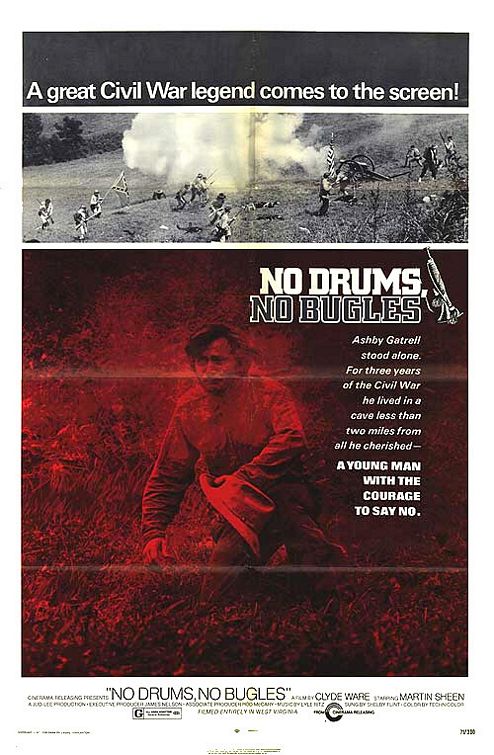
No Drums, No Bugles (1972)

By Richard Winters

My Rating: 6 out of 10

4-Word Review: Living in a cave.

Ashby Gatrell (Martin Sheen) is a conscientious objector. When the Civil War begins he wants nothing to do with it, so he escapes into the West Virginia wilderness where he hides out inside a cave for the 4 years that it goes on. He talks to no one during this time, which becomes a strain on him mentally and emotionally.

The one cast member concept is interesting, but few films have succeeded using it. Even Castaway doesn’t really count because the Tom Hanks character is only stuck by himself during the first two acts, but then comes home at the end to interact with others, but here it’s all just Sheen and if it weren’t for his brilliant performance it wouldn’t have worked.

What I liked most is that it shows how isolation can have its benefits. Watching the scenes where Sheen runs uninhibited through the endless fields with no one else around almost like he were a playful child brought out just how freeing being alone can sometimes be and something that other films dealing with the same subject never effectively tackle instead it gets portrayed as being a complete negative, which it isn’t.

I was also impressed at how the film captures all four seasons. I felt that this was needed, but presumed with its low budget that it wouldn’t be and was willing to forgive it for that reason and yet to my surprise it gets shown anyways. What’s even more amazing is that they have the camera stay focused on a certain natural setting for instance a grove of trees and then merge the summer season slowly into the winter one, so you see how these exact same trees and area looks during both times of the year, which I found to be really cool!

On the negative end there are segments where the character overhears conversations from other people as he hides nearby and listens in. The conversations though sound stilted like they were spliced in later after they had been recorded inside a sound studio and not the natural surroundings. We also never see the faces of these other characters as they speak, or very few of them, with the camera instead focusing only on their lower body making them seem unintentionally dehumanized.

The film should’ve started out with the war not yet begun and Sheen still in his family man role, which would’ve created a vivid character arch that is otherwise lacking. The brief scene where he does go back to his home late at night doesn’t work since he never speaks to any one there and we are given no real understanding of what he was like before he became a nomad.

Spoiler Alert!

The ending is confusing as it shows the war ending and he goes back into his town, but finds no one there almost like they’d been kidnapped by some alien being or something. He finally hears some people singing inside a church, but the film never has him going inside, so the viewer doesn’t experiences his readjustment, or whether he was ever accepted back into the community at all, which makes the story incomplete. Too much time is spent on the wilderness scenes when that should’ve only been a part of the plot with the other stages of his life being examined as well.

End of Spoiler Alert!

My Rating: 6 out of 10

Released: February 23, 1972

Runtime: 1Hour 25Minutes

Rated G

Director: Clyde Ware

Studio: Cinerama Releasing Corporation

Available: VHS

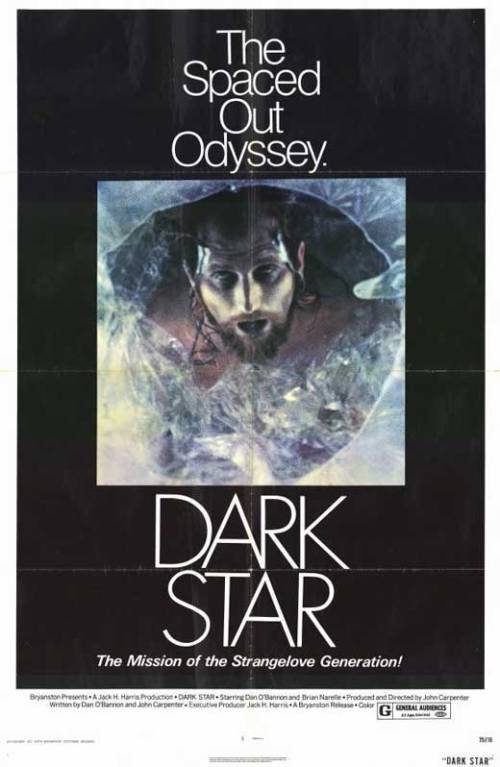
Dark Star (1974)

By Richard Winters

My Rating: 7 out of 10

4-Word Review: Four guys in space.

Dark Star is a scout ship used to destroy planets in the galaxy that are considered unstable. Its crew consists of four men: Pingback (Dan O’Bannon) who keeps a pet alien resembling a beach ball in the back storage room, Talby (Dre Pahlich) who spends all his time sitting alone in the ship’s observation deck, Boiler (Cal Kuniholm) who enjoys playing around with the ship’s emergency laser rifle, and Doolittle (Brian Narelle) who spends his time dreaming about being able to water surf again. The men have all spent 20 years on the ship and its begun to take a toll on their mental state as well as the ship’s mechanical framework, which ultimately challenges their survival.

This started as a student project while director John Carpenter and O’Bannon were attending USC’s film school back in 1970 and it was met with such enthusiasm that they decided to lengthen it into a feature film. Although critics at the time loved it the public didn’t, which caused the film to be shown to virtually empty theaters only to finally find a second life on the DVD market where it has now achieved a strong cult following.

Despite being an obvious parody of 2001: A Space Odyssey it doesn’t just play it up for cheap laughs, which why it works. Too many times parodies overplay the comedy elements by using an Airplane-like structure that is just one slapstick gag after another. Here there’s an actual story with character’s motivations that make sense given their circumstances and coming off more like a quirky observation of the psychological effects of space isolation instead of just a cheesy comedy.

The special effects are impressive especially given its limited budget. Sure some of it is tacky including having the ship’s console board made up of ice cube trays turned upside down, or space suits made of muffin tins and helmets worn by the crew that were actually designed for children. Yet there’s a share of cool moments too like the flashing lights used to represent a meteor storm in space or a scene involving a former commander (John Carpenter) kept in cryogenic suspension and even a nerve-wracking moment inside an empty elevator shaft.

The most memorable segment involves an alien that resembles a beach ball with little feet. Initially this looks absurd and makes the film seem too silly, but when the alien manages to escape from its holding cell and begins creating havoc on the ship it starts to seem, as surprising as this may sound, creepy and gives the film a certain chilling edge that was later used as the basis for Alien.

There are enough original moments here for it to be appreciated by just about any sci-fi fan with a funnybone. The fact that the story focuses on the crew’s mental deterioration and the ship’s eroding structure is not all that far off from reality either. Many other big budget sci-fi flicks, in their quest to bombard the viewer with the latest overblown special effects, usually ignore the psychological angle of being trapped on a spaceship for long periods of time would have, which thus gives this movie, as campy as it ultimately is, a certain insightful edge.

My Rating: 7 out of 10

Released: March 30, 1974

Runtime: 1Hour 23Minutes

Rated G

Director: John Carpenter

Studio: Jack H. Harris Enterprises

Available: DVD

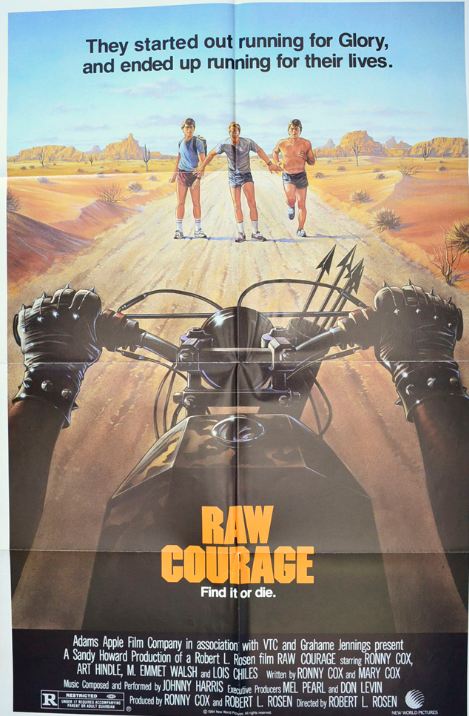
Raw Courage (1984)

By Richard Winters

My Rating: 1 out of 10

4-Word Review: Harass the marathon runners.

Three male friends (Ronny Cox, Art Hindle, Tim Maier) decide to challenge themselves by running through a 72-mile span of the New Mexico desert. Along the way they come into contact with a right-wing militia known as The Citizen’s Brigade that is headed by Colonel Crouse (M. Emmet Walsh). Initially the military unit toys with the runners making them a part of their exercise, but when one of the runner’s insults their members things turn ugly and the three friends find themselves running for their lives amidst the harsh terrain and from soldiers better conditioned to handle the elements.

The script, which was written by Ronny Cox and his wife Mary, has such a stupid premise that it’s hard to take any of it seriously. Aren’t there parks or a contained outdoor survival course that the men could take where they could still prove how ‘tough’ they were without throwing themselves into the barren wide-open desert? The men bring along NO FOOD, I repeat NO FOOD is brought along on this 72-mile trek by foot and their water bottles are so puny that they wouldn’t last them 10 miles let alone 70. These suicidal men don’t need a nutty right-wing militia to end their lives as they seem quite capable of doing it just fine all by themselves.

The second-half drags as the runners evade the militia while occasionally coming into contact with them and having very fake looking fights. The militia members are extreme caricatures that border on unintentional camp and Walsh, who has had a great career playing colorful character roles, is not effective as the menacing colonel

The climactic finish in which a large crowd of observers stand at the finish line waiting for the three runners to appear has to be the dumbest part of the movie. Why are all these people so excited to see who wins when they hadn’t seen any part of the race as it was run nor where there when it began? Who’s sponsoring this race and where the participants required to sign a legal waiver before they joined? What kind of a race has no checkpoints that the runners are forced to pass through to make sure that they hadn’t cheated? What’s to say they couldn’t have jumped into a car when no one was looking and drove the whole way and then when they neared the finish line they simply got out of the car and acted like they had run it when they really hadn’t?

Watching the men hobble to the finish looking all beaten down from their self-imposed foray into the harsh desert didn’t seem ‘courageous’ at all, but instead incredibly moronic. A better title for this film would be RAW INSANITY.

Alternate Title: Courage

My Rating: 1 out of 10

Released: August 4, 1984

Runtime: 1Hour 30Minutes

Rated R

Director: Robert L. Rosen

Studio: Adams Apple Film Company

Available: VHS

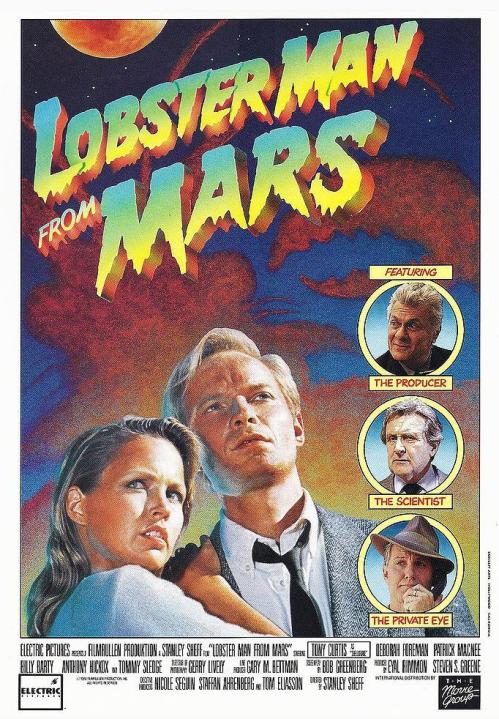
Lobster Man from Mars (1989)

By Richard Winters

My Rating: 0 out of 10

4-Word Review: Teen makes bad movie.

J.P. Shelldrake (Tony Curtis) is a desperate Hollywood producer looking for a film that will be guaranteed to bomb at the box office so he can use it as a tax write-off to help him pay off his back taxes. He thinks he’s found the potential answer when he receives a film directed by a young novice Stevie Horowitz (Dean Jacobsen) entitled ‘Lobster Man from Mars’, which comprises to be a tacky send-up to cheesy ’50s sci-fi flicks, but the film surprisingly does well sending the desperate Shelldrake even further into a hole.

The film is the so-called brainchild of Stanley Sheff and Bob Greenberg who in 1977 were offered $50,000 by a studio to write a script in the vein of a low budget ‘50s movie, but the two decided instead to make it a movie-within-a-movie and use it as an excuse to poke fun at all the clichés many of those films had. Unfortunately once they completed the script the studio pulled out of the deal forcing them to spend the next 10 years looking for another studio to fund their project. Finally in 1987 they were able to secure financial backing and then just two days before filming was to commence Greenberg died in a car accident and thus never got to see the script he worked so hard on come to fruition and this film ended up being dedicated to his memory.

However, what may sound funny and clever in concept does not always reflect what ultimately comes out on the screen. The film relies too heavily on lame, corny humor as well as broad caricatures to propel it. Cheesy B-movies and Hollywood studio bigwigs are easy targets that have been satirized many times before and this parody fails to supply any new spin to it.

The benign, blank personality of the young filmmaker is completely wrong. I went to film school during the ‘80’s and met first-hand some ‘up-and-coming’ young directors to-be and they behaved nothing like the dull kid here. They always had a pretentious attitude about them like they were the next Kubrick or Spielberg in waiting. They would never have made a corny ‘50s styled flick as that would’ve been considered ‘unhip’ and instead they would’ve tried to emulate the latest trendy hit like Dune or Rambo or maybe even a gory slasher movie.

Bad movies are fun when the filmmakers were trying to make something serious, or ‘profound’ only to have it end up being unintentionally humorous yet this kid’s movie has obvious gags in it like he was trying to make something campy, which then kind of loses the whole point. I also kept wondering how the kid managed to find so many different actors to play the parts and how he was able to fund it.

Things would’ve been funnier had everything been filmed in his own house or backyard while they tried to poorly disguise it as being someplace else. All the parts should’ve been played by his high school friends or family members some of whom would be forced to double-up and play two or maybe even three different parts. The film should’ve also of had a third running storyline dealing with the behind-the-scenes calamity of how the silly movie got made in the first place. I’ve worked on several low budget 48-Hour projects and believe me the stuff that goes on behind the camera on those amateur productions is far more interesting than what you end up seeing on screen.

The ‘innovative’ movie-within-a-movie concept fails to work because it doesn’t cut back to the film producer screening the movie enough. Instead we’re forced to watch 15 to 20 minutes of the cheesy flick only to see the producer’s reaction for a brief half-minute and then back to the cheesy flick until it seems like that’s all there is and the secondary storyline becomes an afterthought.

The ‘twist’ where the kid’s movie inexplicably becomes a giant moneymaking hit is nothing more than a plot rip-off from the far superior and funnier The Producers and it doesn’t really make sense. First there’s no way the American public, as dumb as their movie tastes can sometimes be, would flock to see this kid’s awful flick to the tune of it becoming the highest grossing movie of all time. Even if it did make that much money wouldn’t it then mean that the producer would have enough money to pay off his back taxes and thus stay out of jail?

If you want to watch something genuinely funny then check-out an actual B-movie from the ‘50’s that was trying to be serious, but ended up not being instead of this thing that tries to be intentionally lame until it becomes just plain too lame. You’ll be far more entertained I guarantee it.

My Rating: 0 out of 10

Release: January 29, 1989

Runtime: 1Hour 22Minutes

Rated PG

Director: Stanley Sheff

Studio: Electric Pictures

Available: DVD

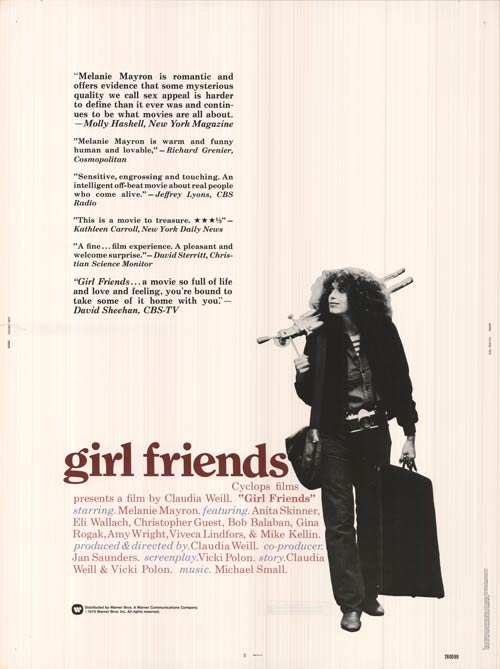
Girlfriends (1978)

By Richard Winters

My Rating: 6 out of 10

4-Word Review: She misses her friend.

Susan (Melanie Mayron) and Anne (Anita Skinner) are best friends and roommates, but when Anne decides to get married to Martin (Bob Balaban) and move out Susan can’t handle the solitude. She picks-up a hitch-hiker named Ceil (Amy Wright) who moves in for a bit, but it doesn’t work out. She then gets into a relationship with Eric (Christopher Guest) and even a 60-year-old married rabbi (Eli Wallach), but both of these end in heartache. The more Susan tries to ‘move-on’ the more she longs for the old days with Anne and Anne starts to feel the same way.

This was Claudia Weill’s feature film debut that met with high accolades including director Stanley Kubrick who considered it his favorite film of 1978. There’s a nice understated quality here that not only brings out a vivid late ‘70s feel, but also the very real day-to-day struggles of a young adult trying to swim through the quagmire of relationship and career obstacles. Melanie Mayron is certainly not a beauty by the conventional standard, but her plain appearance helps accentuate the challenges of the regular person trying to break-out and get noticed.

Susan’s struggles at trying to become a full-time photographer had me hooked the most as it portrays the universal challenges anyone can have in trying to get ‘their foot-in-the-door’ no matter what the profession, but I was a bit stunned when she forgets about the exhibition of her work at an art show. If someone is truly excited about getting their first big break then there is simply no way that would happen. It’s also hard for the viewer to completely empathize with someone’s career struggles if they themselves aren’t doing all they can to achieve it.

Another misguided wrinkle to the story was Susan’s relationship with a married rabbi who was almost 40 years older than her. These types of relationships suffer from extraordinarily long odds  and just about anyone would realize that from the get-go, which makes Susan’s ‘shocked’ reaction when the rabbi is unable to get together for a date due to family obligations seem almost  irrational. How a relationship like this could even begin to blossom is a whole other issue that never even gets addressed.

The film suffers from a few awkward scenes too. One has Wallach sitting down to play a game of chess with Melanie only for him to get up a minute later and leave for no reason. Why does he bother to show up for a chess game if he isn’t even going to make a single move on the board? Later Viveca Lindfors appears wearing a neck brace and yet no explanation is ever given for why she has it on. Later she’s shown without it, so why did she have it in one scene and not the other? Maybe it was for a minor accident, which can happen, but film is a visual medium and when something slightly askew gets shown it needs to get addressed even if it’s just in passing otherwise the viewer will key in on that and not the story.

Even more amazingly, and I can’t believe I’m saying this as I’ve never seen it in any other movie that I’ve ever watched before, but there’s an actual scratch on the camera lens that can be spotted in just about every scene. It appears on the top right hand side as a small white mark. If the sun is shining through a window it will reflect the light and be more pronounced. If a character walks in front of the window it fades a bit, but you can still see it and this continues throughout the entire run of the film. I can only presume that cinematographer Fred Murphy was aware of this, but due to the budget constraints they didn’t have enough money to replace the lens and decided to simply chug along with the scratch in place and hope no else would notice.

Ultimately though I found the story, in its simple way, to be touching and poignant this is particularly evident at the end where the viewer can see firsthand how friendships help add insight and support to a person’s life and are an important dimension to the human experience.

My Rating: 6 out of 10

Released: August 4, 1978

Runtime: 1 Hour 26 Minutes

Rated PG

Director: Claudia Weill

Studio: Warner Brothers

Available: DVD-R (Warner Archive), YouTube

The Little Dragons (1980)

By Richard Winters

My Rating: 1 out of 10

4-Word Review: Karate kids save girl.

Zack and Woody (Chris and Pat Petersen) are two young brothers taking a class in karate. While on a weekend camping trip with their Grandfather (Charles Lane) they meet and befriend a cute young girl named Carol (Sally Boyden) as well as her parents (Rick Lenz, Sharon Weber). Unfortunately Carol also catches the eye of two backwoods hillbilly brothers (Joe Spinell, John Davis Chandler) who along with their hick mother (Ann Sothern) concoct a scheme to kidnap her and hold her for ransom. Zack and Woody then use their newfound karate skills to save their new friend when the local law enforcement proves to be inept.

For a film directed by Curtis Hanson, who gained a cult following for the many horror films that he directed, I was really hoping for something a bit more than just the bland family entertainment stuff, but this couldn’t even come up to that humble level. This stale, B-level movie is devoid of much action and as an adult I was quite bored and could only imagine that children of today would be even more so. Despite the title not much karate action is seen and it’s questionable, with the little that does get shown, whether kids could really pull of the stunts that they do with me feeling that in real-life they probably couldn’t.

Films aimed for kids should then have kids as the main attraction and yet we mainly see the boring adults who are clueless while uttering a corny (supposedly funny) lines here and there. The Petersen brothers have photogenic faces, but not enough acting talent to propel it. The bad guys are just broad caricatures from Deliverance that are neither scary nor humorous. Even in a family film there still needs to be a villain that conveys menace and tension, which goes completely missing here.

To some extent it was fun seeing veteran character actor Charles Lane as a kindly old man as he was usually of the crotchety variety in most of his other roles. Spinell hams it up as a backwoods yokel and earns his acting medal by playing a part outside of his normal realm, but the otherwise limp story and technical approach is a waste of talent and time.

Alternate Title: Karate Kids USA

My Rating: 1 out of 10

Released: July 18, 1980

Runtime: 1 Hour 29 Minutes

Rated PG

Director: Curtis Hanson

Studio: Eastwind

Available: DVD-R, Amazon Video