Category Archives: Gay/Lesbian

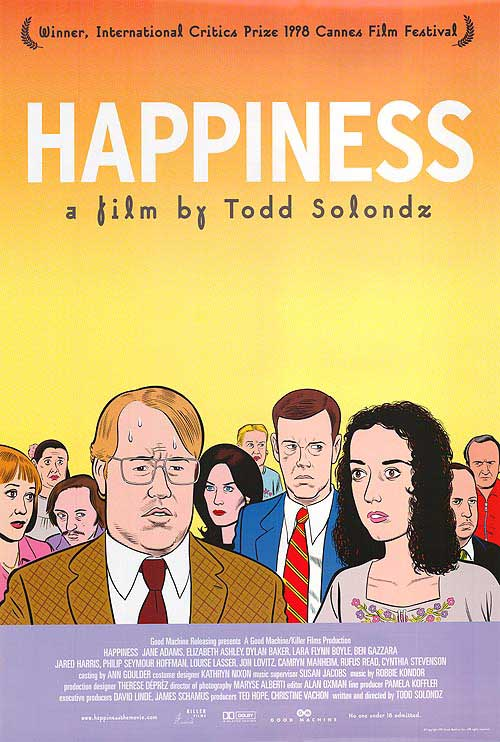
Happiness (1998)

happiness 1

By Richard Winters

My Rating: 8 out of 10

4-Word Review: Happiness can be elusive.

Sharply tuned, interweaving group of vignettes all pertaining to that elusive paradox known as happiness. Jane Adams plays the single woman who is never able to find Mr. Right. Then when she thinks she does he turns into very much of a Mr. Wrong. Louise Lasser and Ben Gazzara, who are in what is probably the funniest segment, play an older couple whose marriage has lost its zing. Phillip Seymour Hoffman, in another dynamic performance, plays the composite nerd who gets off on giving obscene phone calls. Then there’s Camryn Manheim a woman everyone overlooks, but shouldn’t because she holds a dangerous secret.

There are times when this otherwise good film tries to be a little too hip and trendy, which doesn’t help. Although the characters are quite interesting in their eccentricities, they never seem to interact with each other like real people even if they are a little strange. In the case of Lara Flynn Boyle her affected way of talking becomes quite annoying.

On the whole though this film is quite compelling and has moments that really pack a punch. Although billed as a dark comedy it is really more of a drama. In the case of the affluent psychiatrist (Dylan Baker), who has a sexual penchant for his young son’s friend, it becomes downright unsettling and disturbing.

Yet it is the inner angst of these characters and how they deal with modern daily life that truly is what hits home. These people are complex and at times very confused with themselves. They are socially and sexually dysfunctional. They may, despite your reluctance, remind you or your own friends, co-workers, and family or even yourself. It truly shows how fragmented our society is and even gives us a hint as to why. After all how can one connect with someone else when they are so disconnected with themselves?

This is, as a whole, a great movie. It has scenes and characters that will stay with you long after it is over. However, only a select few will really enjoy it. Namely those who enjoy seeing things torn down and then exposed for what they really are.

My Rating: 8 out of 10

Released: October 16, 1998

Runtime: 2Hours 14Minutes

Rated R

Director: Todd Solondz

Studio: Good Machine

Available: DVD

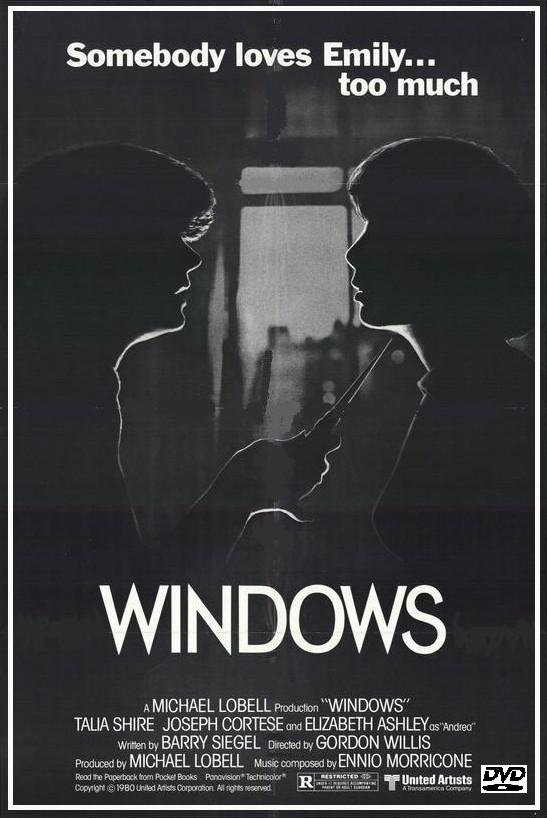
Windows (1980)

windows 3

By Richard Winters

My Rating: 1 out of 10

4-Word Review: She’s obsessed with her.

Emily (Talia Shire) is attacked in her apartment by a rapist (Rick Petrucelli) and when the police come to investigate the crime she starts to fall in love with Bob (Joe Cortese) the handsome police captain. Little does Emily know that her friend Andrea (Elizabeth Ashley) was behind the attack. She is a closet lesbian with a secret psychotic obsession for Emily who hired the man to rape her and record it, so Andrea could get-off on listening to the sounds of Emily moaning during the struggle. Now that Emily is going out with Bob it makes Andrea angry and her behavior becomes more dangerous and erratic.

For a thriller this film is extraordinarily low-key to the point that it also comes off like a drama, but fails on both ends. There is no mounting tension and little if any scares. The only one that they do have is when Andrea sticks Emily’s cat into a freezer and later it drops out of it like it was a Popsicle, which is actually unintentionally funny. There is also hardly any music. Ennio Morricone was hired to be the composer, but they don’t use him as much as they should. An amazing amount of the movie deals with the natural street sounds and ambience from life in New York, which is interesting for a while, but does nothing to elevate the tension, or create any excitement. Famed cinematographer Gordon Willis in his directorial debut seems more interested in capturing the New York skyline and creating shadowy interiors than actually making a movie with an original story, or interesting characters.

Shire is so quiet and awkward that she seems to be in a mental stupor. Her screen presence here is transparent and lifeless and it is easy to see why her leading lady status was brief. Cortese is no better as the male lead and the romantic side-story has no energy or chemistry and only helps to bog down an already boring story. Intercutting this with Andrea’s visits to her psychiatrist (Michael Lipton) successfully creates the first thriller to have no suspense whatsoever.

Ashley seems like the perfect choice for a homicidal lesbian, but the part is written in a way that doesn’t allow her to go over-the-top with it, which she should have although you do get to see her wearing quite possibly the biggest pair of sunglasses that I have ever seen. It might have worked better had the viewer not been aware from the start about Andrea’s psychosis and instead only revealed it at the end as a twist.

The climatic sequence between Emily and Andrea would be laughable if it weren’t so mind numbingly stilted and prolonged. The scene goes on for almost twenty minutes and features the two women standing in front of a window with Emily weeping incessantly while Andrea rambles incoherently. How anyone who was involved in the making of this movie would think anyone would flock to see this dull and contrived thing should have their brains checked. Has an air of pretense to it like it is trying to be a ‘sophisticated’ thriller, but it is pointless. If ‘Mystery Science Theater’ were still around this would be a great candidate for it.

My Rating: 1 out of 10

Released: January 18, 1980

Runtime: 1Hour 36Minutes

Rated R

Director: Gordon Willis

Studio: United Artists

Available: DVD, Amazon Instant Video

Can’t Stop the Music (1980)

By Richard Winters

My Rating: 2 out of 10

4-Word Review: Somebody stop this movie.

It’s an extraordinary achievement that this actually got made. It’s a relic of its time that is beyond words and is like nothing you have ever seen or will ever see again. This is one of those bad movies that you just have to see and, for a while, even enjoy in all its awfulness as it tells the story of the Village people and their rise to fame.

Unfortunately it’s not overdone enough to achieve that coveted cult status. The humor isn’t corny enough the storylines are not dumb enough and the costumes are not gaudy or the sets garish enough. They don’t even let the Village People try to act and make complete fools of themselves. They do have some speaking lines, but they are wisely brief. Eight minutes is all you need of this phenomenon before its long takes and general empty headedness become overwhelming.

Steve Guttenburg is probably the most annoying even more than he usually is. He is too clean cut and eager to please and his swift rise to success is artificial. The songs he writes are bad even for disco. Hearing lines like “he’s a genius” and “he knows what people want to hear” are probably the film’s single most insulting element.

Most youth oriented movies don’t cast too many older actresses, but this one does. Tammy Grimes, June Havoc, and Barbra Rush put a lot of energy into their parts and in the case of Grimes a lot of camp too. It’s a strange sight to see these three jump onto stage and line dance with the Village People during their last number. Paul Sand is fun in a part that goes against his persona as he plays an aggressive, no-nonsense record producer. Even Bruce Jenner, and I hate to say it, has his funny moments as an uptight lawyer. Yet it is Valerie Perrine that comes off best as her down to earth sensibilities helps to hold the whole thing together.

It is hard to tell what type of audience this film was aiming for, or even what the thinking was. The overall banality seems best suited for pre-teen girls yet the gay overtones snub that. Anyone over sixteen just isn’t going to buy into it and having the whole thing directed by 60-year-old Nancy Walker best known for play Ida Morgestern on the TV-Show ‘Rhoda’ makes it even more confounding. Even members of the Village People have stated in interviews that they dislike this movie. The only possible explanation is that it was made by people on cocaine for other people on cocaine.

My Rating: 2 out of 10

Released: June 20, 1980

Runtime: 2Hours 4Minutes

Rated PG

Director: Nancy Walker

Studio: Associated Film Distributors

Available: VHS, DVD, Amazon Instant Video

Sunday Bloody Sunday (1971)

By Richard Winters

My Rating: 9 out of 10

4-Word Review: A bi-sexual love affair.

Bob (Murray Head) is having a relationship with middle-aged divorcee Alex (Glenda Jackson) as well as a family doctor named Daniel (Peter Finch). He jumps between the two of them whenever the mood hits. Both Alex and Daniel are aware of the other and are not happy about it, but feel if they push the issue Bob will simply leave them. The film focuses on the frustrations and loneliness that Alex and Daniel feel in dealing with Bob and their less than ideal situation.

This film is engrossing from beginning to end. Director John Schlesinger was still in top form as the camera work, cinematography, and editing is first rate. Everything is meticulously orchestrated to the point that every shot seems to tell its own little story. The narrative is done in a fragmented style going back and forth between the present day to scenes from when both Alex and Daniel were younger. Much of it comes off like thoughts going on inside someone’s head and the film’s style is masterful and flawless.

What I really liked about this movie is the fact that it focuses not so much on each person’s time with Bob, but actually more on their time away from him. The points this film makes about the difficulties of communication that people have when they are in a relationship as well the glass wall that sometimes gets created is completely on-target. The film’s subtitles and nuances are perfectly balanced and if you are a viewer with more sophisticated tastes then this will be time well spent.

Things are revealed about the characters through visual and subtle means, which I loved. When Alex drops an ashtray and then proceeds to clean it up simply by rubbing the ashes into her rug, or the precarious way she makes herself on cup of coffee in the morning while rushing off to work nicely reflects her out-of-control life and the topsy-turvy way she approaches it. The scenes where Daniel attends a Bar mitzvah is excellent and for me some of the strongest moments in the movie.

The portrayal of the children here is above average as well. They are not cute and well-behaved, but instead realistically rambunctious and mischievous. I liked the wild, endless energy that they display and how easily chaotic they turn their household into, or how the parents had become immune and deaf to all of it. Having the 4-year-old smoke pot while Alex and Bob, who are babysitting, decide to overlook it may be pushing things a bit far, but I still liked the mod approach the film takes, which reflects nicely the unconventional lives of the characters.

The film’s biggest flaw is Head himself. The man is mainly known for his singing career and his acting ability is clearly limited in comparison to Finch and Jackson who are both excellent. The character is dull and the film does not make much of an attempt to analyze him like it does with the other two. In a way Head’s one-dimensional performance works because the character seems to be used as a ‘pretty boy’ who the other two are attracted to because of his looks and youth and therefore revealing the insecurities that they have about themselves as well as giving a pertinent warning that when one pursues someone solely based on their sex appeal the relationship is doomed.

I liked how at the very end Daniel and Alex do meet and have a brief conversation though I wished it had been just a little more extended. Having Finch talk directly to the camera at the closing is a bit disconcerting though what he says is interesting.

My Rating: 9 out of 10

Released: September 8, 1971

Runtime: 1Hour 50Minutes

Rated R

Director: John Schlesinger

Studio: United Artists

Available: VHS, DVD, Blu-ray (The Criterion Collection), Amazon Instant Video

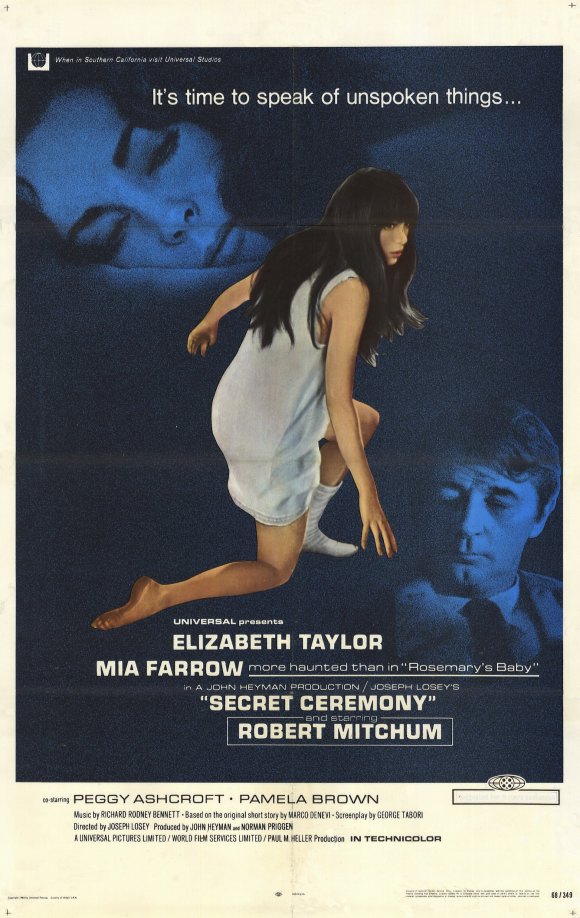
Secret Ceremony (1968)

By Richard Winters

My Rating: 5 out of 10

4-Word Review: Women in weird relationship.

Lenora (Elizabeth Taylor) is a lonely woman who lost her young daughter tragically years before and now finds herself strangely attracted to Cenci (Mia Farrow) a young woman who resembles her. The two move into a large mansion only to have things begin to unravel upon the arrival of Cenci’s weird and menacing father (Robert Mitchum).

The story is bizarre and perverse enough to keep you watching all the way through although it will certainly test the tolerance to those who do not have an affinity for the offbeat. The cinematography is excellent as is the mansion setting. The use of Peggy Ashcroft and Pamela Brown as sneering elderly sisters gives the film some added flavor.

Farrow is genuinely convincing as a grown woman stuck in a childlike trance, but Taylor doesn’t seem completely right for her part. A different actress, especially a character actress would have been much better.

Although the film does manage to come together in the end it does take a long time to get there. There are a lot of slow spots and the patience of some viewers may be tested. There are also many intriguing elements simmering underneath the surface that the film fails to follow through on, but should have.

Fans of Joseph Loosey should find this satisfying while others may be put off by the odd characters and style of narrative.

My Rating: 5 out of 10

Released: October 23, 1968

Runtime: 1Hour 45Minutes

Rated NR (Not Rated)

Director: Joseph Loosey

Studio: Universal

Available: VHS

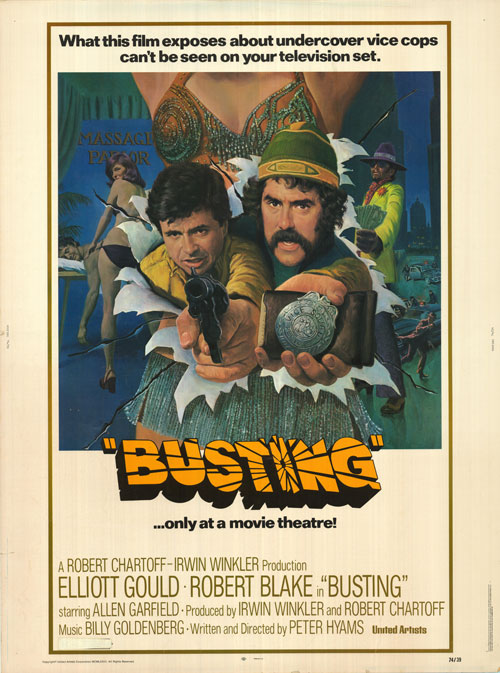
Busting (1974)

By Richard Winters

My Rating: 7 out of 10

4-Word Review: Cops on a mission.

            Michael (Elliot Gould) and Patrick (Robert Blake) are two vice cops hauling in prostitutes and drug dealers only to find that are being let go without being charged. They eventually realize that local crime boss Carl Rizzo (Allen Garfield) has an inside influence with the police department allowing these criminals to get off. Michael and Patrick decide to turn-the-tables, but this proves dicey as Rizzo’s influence is strong and could cost the two not only their jobs, but also their lives.

The film has a gritty style that nicely captures the rugged street life of its characters. Director Peter Hyams uses his background as a news producer and documentary filmmaker to give the film an authentic quality. His tendency for natural lighting is perfect for this kind of material. The film lacks music at least at the beginning, which is effective as it gives you the feeling that you watching some sort of underground police video especially during the opening sequence. The pounding soundtrack during the chase scenes is okay, but what impressed me was the haunting melody used in some of the other parts that sounded like something you might hear in a thriller, or horror film, but it works because it is an unusual sound for a cop picture. The dialogue is great as it manages to be acerbic and insightful while still remaining realistic.

The first half is hampered by the two’s preoccupation with nabbing a prostitute. I remember watching the old ‘Cops’ TV-show where there would be many episodes detailing elaborate stings that the police would use to nab some otherwise harmless schmuck who was simply looking for a little action. Most who are arrested will go right back to doing it again after being given a light fine, or jail sentence, which to me always seemed wasteful both to the law enforcement’s time and the taxpayer’s money when there are far more serious crimes out there. When the Carl character mocks the two with the line ‘You arrest ten-dollar hookers and think you are Captain Marvel’ I had to laugh and agree. What is even worse is when Michael is off-duty he ends up paying for the services of a call-girl meaning I guess that when he is in the mood himself then it is alright.

The film improves during the second half and includes an exciting foot chase at night inside a sprawling inner-city fruit market. Hyams use of tracking camera shots helps build the tension and I found it interesting that an innocent bystander ends up getting shot and killed as I don’t think I’ve seen that happen in any other police movie. Another chase that happens at the end and involves two ambulances careening down city streets is equally well done.

The cat and mouse game that they play with the crime boss was intriguing enough to keep this viewer interested. Garfield plays the part with his usual hyper-style that makes the character both repellent and human at the same time. The best thing about the film though is that fact that it chooses a somber tone and then sticks with it. Too many times ‘statement movies’ with a downbeat message end up selling-out and become an audience pleaser at the most unlikely moment, but this film doesn’t. I’m not saying that it ends on a depressing note, but it does effectively hit home the fact that police are hampered by a lot of bureaucracy that limits their effectiveness. It also examines the boredom and monotony that can come with the job, which other police dramas rarely if ever touch on.

The film was controversial because of its over-reliance on gay stereotypes during a barroom scene. I was a bit surprised by this because the scene itself is short and the stereotypes shown weren’t too different from other films of the period dealing with the same topic. Michael does refer to them by using the derogatory ‘F-word’, but I am pretty sure that a lot of cops in 1974 used that very same word and since this film was intended to show how things were I was able to go with it. The two also get ganged up on and viciously beaten by the gay patrons that I found to be amusing.

I also have to mention Cornelia Sharpe a former model who had a brief 10 year film career in mostly grade B exploitation pictures. She looks her best here not only during a nude scene that she has with a doctor at his office where she pretends to be one of his patients while really being a prostitute, but also during her appearance in court where she wears a pink hat and dress. I also liked that despite being a hardened hooker she still gives a warm smile to a lonely child sitting in the waiting room.

My only real complaint with the film is that it features one of the tackiest make-up jobs in the history of movies and seriously affects the film’s realism. The scene I refer to is when Michael and Patrick get beat-up by some of Carl’s thugs. The ‘injuries’ to Patrick’s face clearly look like it was smeared on in two seconds with some light red paint.

My Rating: 7 out of 10

Released: February 27, 1974

Runtime: 1Hour 31Minutes

Rated R

Director: Peter Hyams

Studio: United Artists

The Detective (1968)

detective

By Richard Winters

My Rating: 8 out of 10

4-Word Review: Up against the system.

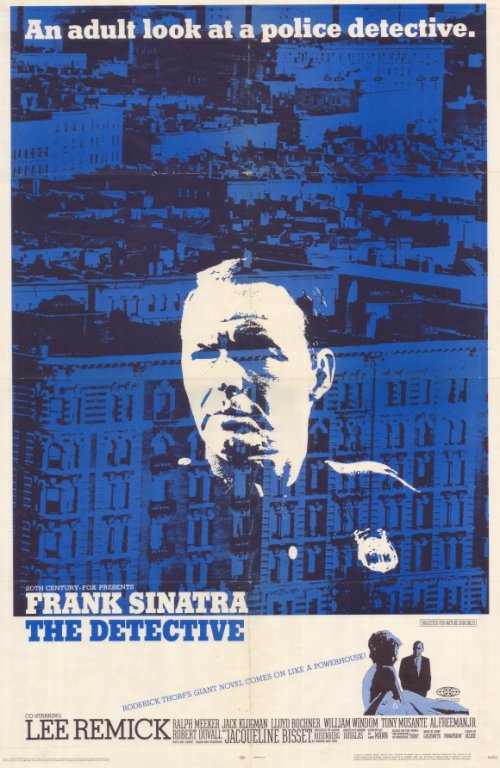
Many people may not realize that Frank Sinatra was the original choice of Harry Callahan for Dirty Harry.  Due to various reasons he turned down the part despite the fact that he was interested.  You can’t help but wonder what that film might have been like had he accepted.  A good indication may be the character of detective Joe Leland that he plays hereIt has a similar theme of a tough cop tired of ‘the system’ and breaking off on his own to solve a bizarre case.

The murder itself is particularly gruesome and ahead of its time as it deals with the killing of a gay man found nude on the floor of his apartment with his genitals cut off. The actual shot of the victim is conveniently framed so that a fern, yes a fern, is strategically placed over the offending area, which is a little corny.  Yet the dialogue and description of the case seems incredibly graphic for the time. Ol’ Blue Eyes even says the word penis, which I think has to be a movie history first.

The way it deals with the homosexual topic is also surprisingly enlightening. Gays are not labeled as ‘sick’ and ‘perverse’, at least not by the Leland character. In one good bit the Sinatra character even slugs another officer, played by Robert Duvall, in retaliation for getting  rough with a gay man that he was questioning for no apparent reason except that he was gay.

There is another electrifying sequence involving Leland questioning the victim’s live-in lover and chief suspect. The part is well played by actor Tony Musante who gives his character all sorts of weird body gestures and nervous ticks, which makes the viewer feel uneasy but still compelled to keep watching until it becomes a fascinating experience. The Leland character again shows an amazing amount of compassion and enlightenment for the gay lifestyle during the interrogation, which should be enough to give this film a landmark status.

However, for all of its apparent sophistication, there are also things that hold it back and make it dated. One is reverting to what was a trend in the 40’s and 50’s, which was to film a person driving their car while sitting in front of a blue screen and holding onto a steering wheel that is not connected to any dashboard. It was considered a ‘ingenious’ way to stay under budget and not having to go through the ordeal of mounting a camera onto an actual car, but for today’s sharp audiences it comes off looking obvious and cheesy.

The casting of Sinatra is another drawback. He was already 53 at the time and he looked it.  The part seems to be screaming for a younger, more rugged method type of actor like Steve McQueen or Paul Newman, who would have done better.  Sinatra overplays the tough guy thing too much until it becomes one-dimensional and boring. The character needed more personal quirks and odd habits in order to make him more filled out and interesting.  He also wears outfits worn by the ‘old school’ investigators of yesteryear even though the character is one looking to break from tradition and fighting the mainstream.

I also wasn’t quite sure why Lee Remick’s role as Sinatra’s love interest was necessary. I usually dislike it when crime dramas feel the need to work in a romance angle as a side story because it usually bogs everything down and in this case was no different. Now Remick is always reliable and her character was interestingly flawed, but how that was supposed to connect with everything else was not clear.

The story works in three different parts. The first deals with the murder and the homosexual community of the period.  The second analyzes the politics of the police department while the third involves a mysterious suicide of a successful businessman. The third part, which doesn’t start until the second hour of the film, was the most intriguing for me. The suicide is shown from the point-of-view of the victim. They literally took a camera and heaved it over the edge of a building until it crashes directly onto the pavement below, which actually made me flinch. It is not until the very end where you see how all three of these parts come together, but the twist is excellent and made viewing this film well worthwhile.

Overall the cinematography, editing, writing, directing, and supporting acting are first rate.  There are a lot of familiar faces in supporting roles including: Jack Klugman, William Windom, Lloyd Bochner, Jacqueline Bisset, Horace McMahon and Al Freeman Jr. They all do splendidly. The subject matter and the way it is handled easily elevates this from other melodramas of the period.  The resolution should make this entertaining even for today’s viewers and enough to overlook a few dated elements.

My Rating: 8 out of 10

Released: May 28, 1968

Runtime: 1Hour 54Minutes

Rated R

Director: Gordon Douglas

Studio: 20th Century Fox

Available: VHS, DVD

Entertaining Mr. Sloane (1970)

By Richard Winters

My Rating: 3 out of 10

4-Word Review: The first gay marriage.

Based on the Joe Orton play of the same name, this film deals with a handsome young stranger named Sloane (Peter McEnery) who becomes a lodger at an isolated household in the English countryside. He is on the run from a murder he committed and feels this will be a safe haven due to the only other inhabitants being a quirky old lady name Katherine (Beryl Reid) and her equally quirky father Kemp (Alan Webb).  Katherine, or Kath, takes a sexual interest in Sloane despite their wide age difference, which Sloane doesn’t mind as he uses this to manipulate her. When Kath’s brother Ed (Harry Andrews) arrives and takes an amorous interest in Sloane as well, he does the same thing to him. Then Kemp recognizes Sloane as the killer and Sloane is forced to kill him, which culminates with ironic results.

Playwright Orton was years ahead of his time. His plays always had a dark, sexual, even explicit nature to them and his characters were always perverse and amoral in a darkly hilarious way. It is unfortunate that he was bludgeoned to death in 1967 by his jealous gay lover and his career was cut short. However, this adaptation done by screenwriter Clive Exton seems to miss the mark. The dialogue is endless with very little action. The other adaptation of Orton’s work that was made into a film, Loot, was much more lively and full of a lot of campy, zany humor as well as quick edits and imaginative camerawork. This film is visually dull and all the action is jammed into a cramped, dark house with bland decorations. It never really gets going until the final 15 minutes when you get to see the world’s very first gay marriage performed, but by then it is much too late.

For 1970 this film does seem edgy and even controversial in certain parts. The gay erotic subtext is quite strong especially the way the camera scans Sloane’s tan, half naked body. There is also Ed’s pink Cadillac that he drives around, which I got a real kick out of. I liked the way it squeaked as he drove it and was constantly bouncing up and down.  There is also his very provocative hood ornament of a naked man that the camera hones in on. The best part comes when Ed washes his car and is more focused on the ornament, which he lovingly caresses with his towel, than the rest of the vehicle.

However, 40 years later this stuff seems pretty tame and there are too many segments where nothing happens and is handled too conventionally.  It seemed like director Douglas Hickox really didn’t get, or appreciate the material enough, or interpret it in some interesting way because the final result is nothing more than a filmed stage play. The music that is used is terrible and almost enough to get you to turn off the film. It also gets overused and played over scenes when it isn’t needed and hurts the film’s mood in the process.

The biggest problem with the film may actually be with actress Reid herself. Don’t get me wrong this is a wonderfully unique actress who has done some memorable work. I especially liked her in The Killing of Sister George, and she is quite good here as well. However, I do have two issues. The first is a small one. It involves the fact that the character wears dentures. In one scene Sloane supposedly knocks them out and breaks them, but then Reid turns around and screams and you can see that she still has teeth in her mouth.  The other, much more serious issue is the fact that near the beginning of the film she is seen walking through a cemetery in broad daylight wearing a see through blouse. Now with some woman this can be quite sexy and I certainly wouldn’t complain, but when they are 60 and looking more like 70 this is a bad idea, even for perversely comical purposes as it is here it is still a bad idea. What is even worse is when she turns around and a gust of wind blows up her skirt and you can see her entire bare backside, which might be enough to make some viewers sick.

Now, before anyone accuses me of ageism let me relate an interesting experience that happened to me. Back in 2003 I was home from work and decided to take in a movie. I was living in Chicago at the time and I went to the neighborhood theater to see the interesting French mystery Swimming Pool starring Ludivine Sagnier and Charlotte Rampling.  It was a Tuesday and little did I know that it was senior discount day and the place was packed, literally, with people all looking well over the age of 70. The lady that sat beside me looked to be at least 80 and came in using a walker. The film featured an abundance of nudity from the young and attractive Sagnier, which I thought might shock and offend the seniors, but no one reacted to it and everyone went on enjoying the film. Then, towards the end of the movie, 58 year-old actress Rampling starts to take off her clothes and this indeed elicited a nervous response from the crowd. The lady next to me even said ‘oh dear’. In all fairness Rampling didn’t look all that bad naked, but it still hits home the point that even old people don’t want to see other old people naked.

My Rating: 3 out of 10

Released: July 27, 1970

Runtime: 1Hour 34Minutes

Rated R

Director: Douglas Hickox

Studio: Continental Distributing

Available: VHS, DVD (Region 2)

Happy Birthday Gemini (1980)

happy1

By Richard Winters

My Rating: 5 out of 10

4-Word Review: Gay son comes out. 

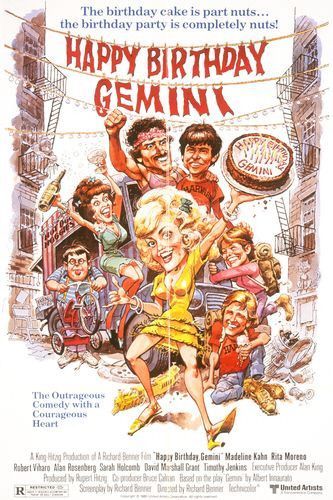
A brother and sister by the name of Judith and Randy Hastings ( Sarah Holcomb, David Marshall Grant) travel to Philadelphia over the summer to visit their college friend Francis Geminiani (Alan Rosenberg).  Judith dated Francis during the school year and wants to continue the relationship. Francis though has come to terms with his homosexuality and realizes that he is now more attracted to her brother.  The story examines their adjustments and attitudes to this news as well as the many eccentric characters that make up the neighborhood.

Despite not rating well with the critics, I kind of liked this movie for the most part. The film was directed by Richard Benner who received acclaim for the directing the groundbreaking Canadian film Outrageous. I think he captured the row houses and inner-city neighborhoods of Philadelphia well. My Mother is from the city and I spent many summers visiting there. I enjoyed the bright color schemes of the different houses as well the character’s costumes. The movie has a very European feel featuring a lot of long takes and a leisurely pace. The characters are also much more open-minded and accepting of each other’s transgressions than you would usually find in an American film.  The toe-tapping ragtime music and upbeat ending help fill it out.

Kudos must also go to Madeline Kahn and her performance as Bunny Weinberger. I was very impressed with this woman’s comedic skills after seeing her in What’s Up Doc as well as in Paper Moon. I didn’t think anything could top those, but this comes close. Her portrayal of a foul-mouthed, ditzy blonde with a very heavy eastern accent is outstanding and a highlight of the whole movie.  Her scenes in a courtroom where she has to defend herself from a battery charge as well as a nicely photographed scene where she threatens to jump off an abandoned building are two of her best moments.

Where the film fails is in the fact that there is little cohesion between the scenes. The film goes off on long tangents, particularly with the Bunny character, until it seems like Francis’s problem is only a side-story. There is a lot of extraneous dialogue that goes nowhere and was not needed. A 115 minute runtime is much too long for this kind of material.  For a comedy the laughs are lacking and the script needed to be injected with a lot more witty conversations and sharp one-liners. Rita Moreno is completely wasted as the character of Lucille Pompi.  She has nothing funny to say and it would have been more entertaining if they had built up more conflict between her and the Bunny character as the two had very contrasting values. The subject matter itself is no longer fresh or groundbreaking and the film failed to put any new or interesting spin on the topic. Although I liked the positive message I still felt that it glossed over the homophobic sentiments that are still out there and did not do its subject matter any real justice.

Fans of Kahn should see this, but others may find it placid and lacking in any type of distinctive quality.

My Rating: 5 out of 10

Released: May 2, 1980

Runtime: 1Hour 47Minutes

Rated R

Director: Richard Benner

Studio: United Artists

Available: VHS