Category Archives: Gangster Movies

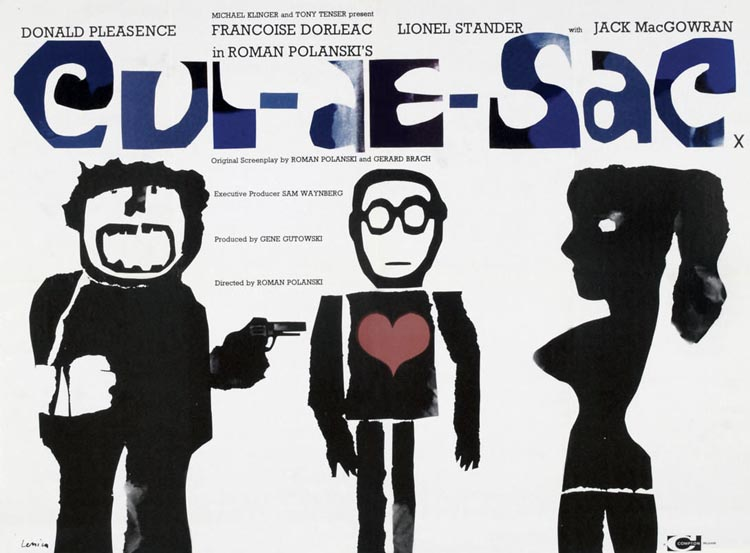
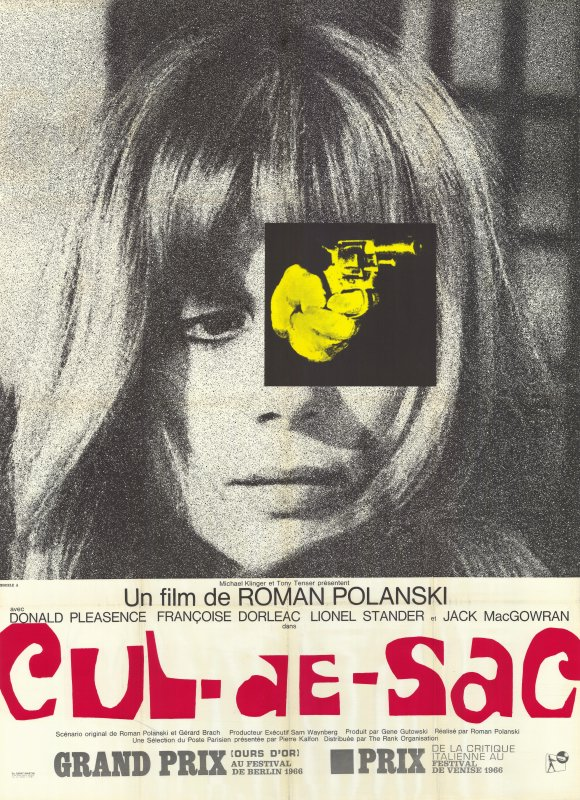
Cul-De-Sac (1966)

cul de sac 2

By Richard Winters

My Rating: 8 out of 10

4-Word Review: Bubbling beneath the surface.

Albie and Richard (Jack MacGowran, Lionel Stander) are two gangsters on the run. Albie is injured with a gunshot wound and their getaway car has broken down. They come upon an isolated castle owned by George (Donald Pleasance) who lives there with his new wife Teresa (Francoise Dorleac, who tragically died in a car accident just one year after this film was released). George is very passive and timid and pretty much allows Richard to have his way as he takes over the place and his wife and yet as the situation progresses different shades of the character’s personalities begin to come to light.

Roman Polanski leaves his strong directorial touch from the exquisite opening shot, which shows an old car being pushed along on a desolate road amidst a very flat landscape until the end. In the hands of any other director this otherwise odd story probably would not have worked. Like with A Knife in Water Polanski makes great use of the quiet and serene atmosphere and as a viewer you feel like you are right there with the characters.  Filmed on-location at the Lindisfarne Castle on Holy Island in Northumberland, England the movie makes great use of the tranquil setting. I found it almost hard to believe that there was a film crew there as the isolation really grabs you and sucks you in. The quiet moments are the film’s strongest and I just loved the hooting owl heard in the background. The idea of filming it in black and white nicely compliments the film’s dark psychological undertones.

The film’s novelty is watching how the characters evolve and interact with one another. Donald Pleasance gives one of his best performances as the cowardly George. There have been many weak and frighten characters in cinema history, but Pleasance makes the character here quite interesting and the way he finally shows some bravado at the least likely moment is fascinating. Stander also excels with a character that initially comes off as a brute, but at strange times reveals a trusting and even child-like manner.

The movie can be viewed in different ways and doesn’t fit distinctly into any type of genre. To a degree it can work as a dark psychological character study, a mystery, film noir, a thriller, or macabre comedy. Approaching it as a comedy works best Polanski has not always had great success in that area and some of his comedies in particular the ill-advised Pirates have been complete disasters, but this one works. The best scene is when some of George’s old friends come to visit and bring along their bratty son who becomes an absolute terror to everyone.

The odd ending is open to interpretation and leaves a lasting impression. This is also a great chance to see Jacqueline Bisset in her film debut. She appears during the second half wearing glasses and saying little, but is as beautiful and alluring as ever.
cul de sac 1

My Rating: 8 out of 10

Released: November 7, 1966

Runtime: 1Hour 57Minutes

Not Rated

Director: Roman Polanski

Studio: Tekli British Productions

Available: DVD (The Criterion Collection) Blu-ray, Amazon Instant Video, Netflix streaming
The Valachi Papers (1972)

the valachi papers 1

By Richard Winters

My Rating: 7 out of 10

4-Word Review: Testifying against the mob.

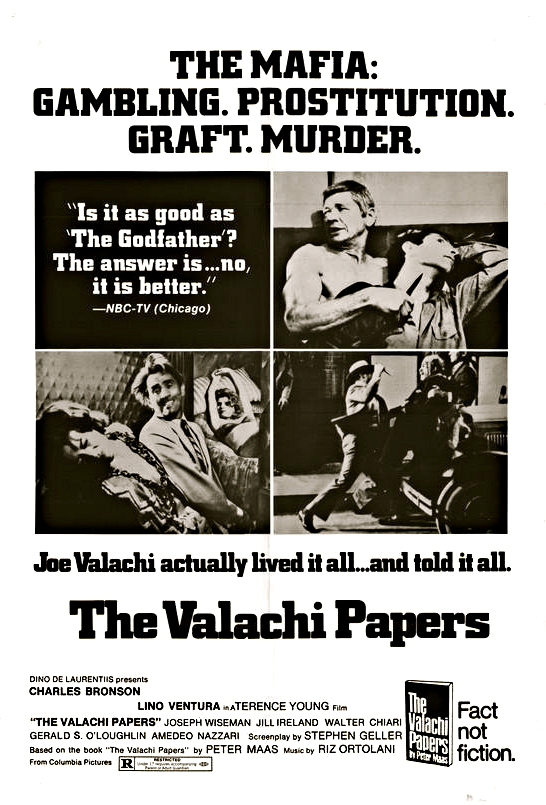
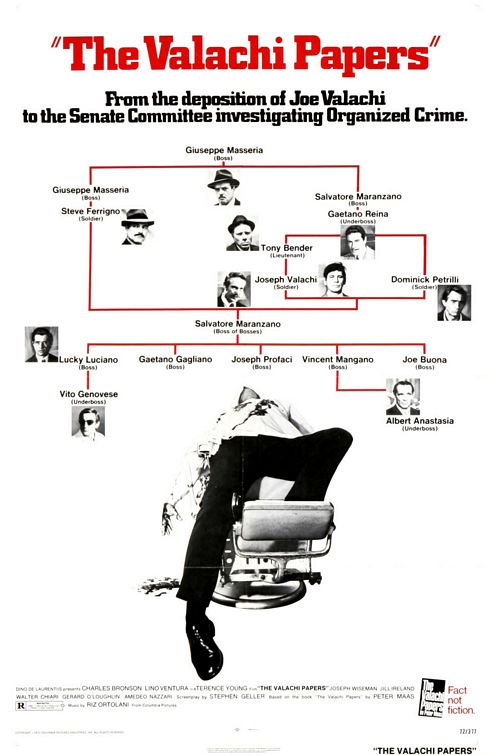
Based on the bestselling novel by Peter Maas this film chronicles the life of Joseph Valachi (Charles Bronson) who became the very first informant for the Mafia in their history. The story chronicles his life from a young man getting involved in the mafia culture to his eventual imprisonment and testifying in front of congress.

At the time of release this was compared closely to The Godfather with some critics outrageously saying it was better, but clearly it doesn’t come close. This film lacks the in-depth characterizations, lyrical quality, and an overall slick design. This film is also rather sloppily produced including one scene involving an exciting car chase taking place in the 1930’s. When the two cars go crashing through the wall of a warehouse and into the East river one can clearly see the Twin Towers of the World Trade Center, which weren’t built until 1970. There is also the Lucky Luciano character played by actor Angelo Infanti who wears a type of glasses that did not come into style until well into the 1970’s. However, as a whole the film is still amazingly compelling flick that ends up being both entertaining and somewhat informative. The music score has a terrific ominous tone to it and the prison scenes have a nice starkness.

The film was known at the time for its violence, which by today’s standards may not seem quite as startling or as excessive although the blood and bullets do come at regular intervals. My favorite was the shooting of an old crime boss inside a barbershop although the castration of a victim on top of a table inside a restaurant is pretty wild. However, for all of its violence the film does manage to have a sense of humor as well including a very amusing scene where one of Joe’s mob bosses sits in the living room of the mother of Joe’s girlfriend and asks the mother for her permission to allow Joe to marry her daughter while Joe sits nervously behind and tries to look proper.

Lino Ventura has the perfect face of a mob boss and was ideally cast. The scene of him inside the prison where he has stays in a well-furnished cell and even seems to have his own barber is funny. Joseph Wiseman displays great zest as the opposing crime boss Salvatore Maranzano and his agonizing yells of pain as he lies dying are effective.

Bronson seems perfectly cast as an uneducated simple man who is a follower and has his own quiky code of morality, which makes him strangely endearing. His wife Jill Ireland does not fare as well. She ports a brunette wig and her Italian accent borders on being horrendous to non-existent. Fortunately she is not given very many speaking lines as her British accent is constantly seeping through.

In many ways this film could best be described as an ugly cousin to Goodfellas. While this film lacks that film’s fluid directorial flair it still manages to be an engrossing true-life gangster soap opera like that one.

the valachi papers 2

My Rating: 7 out of 10

Runtime: 2Hours 5Minutes

Released: November 3, 1972

Rated R

Director: Terence Young

Studio: Columbia Pictures

Available: VHS, DVD

Pulp (1972)

pulp

By Richard Winters

My Rating: 6 out of 10

4-Word Review: Running for his life.

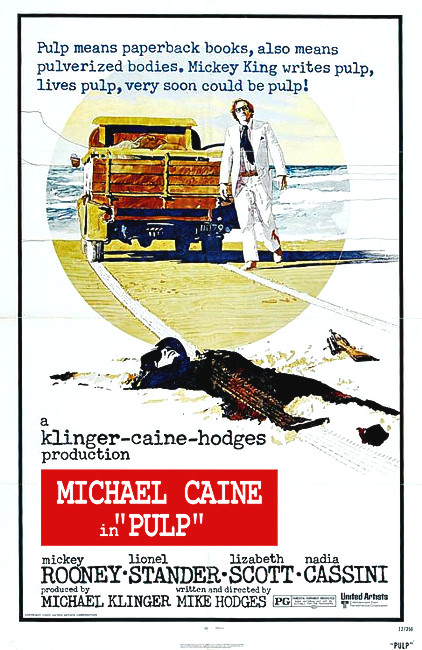
Michael Caine and director Mike Hodges teamed up again one year after doing the gritty classic Get Carter with this breezy oddity dealing with a pulp fiction writer Mickey King (Caine) who is hired to pen the autobiography of ex-Hollywood star Preston Gilbert (Mickey Rooney) who is now living in exile in Malta. The problem is that Gilbert has ties to the underworld and Mickey soon finds himself running for his life while meeting up with a barrage of oddball characters along the way.

The movie has a wonderfully quirky sense of humor with a few memorable laugh-out-loud sequences especially at the beginning. I got a real kick out of the man with a weak bladder who says a prayer to God to open up a locked bathroom door when he can’t get into it. The scene in the bus where we hear the different thoughts going on inside each of the passenger’s heads is great as well. The opening sequence featuring a row of lady typists writing up King’s latest manuscript is cute, but the one thing that holds it all together is Caine’s wry voice-over narration that remains consistently amusing.

Rooney though manages to steal the whole thing with his hilarious send-up of an aging actor. In fact this may be one of the funniest roles of his entire career. Even the scene showing him shadow boxing in his underwear is engaging although thankfully the camera doesn’t stay on it for too long. I was a bit disappointed that the character didn’t last through the film’s duration, but his death scene is so funny that it almost makes up for it.

It is nice to see Lizabeth Scott in her last film to date and first since 1957 when she was essentially blacklisted from Hollywood purportedly for her lesbian leanings. Although only 50 at the time her aging face looked like she was almost 70 and her deep, raspy voice sounded similar to the demon’s in The Exorcist. I thought she could’ve been given more to do and played a character that was more integral to the story as her screen time is much too brief.

The on-location shooting done on the island nation of Malta is another asset. The sunny weather has a nice exotic feel and the old architecture of the buildings helps give the film a visual distinction. The melodic piano soundtrack is pleasing and I wished it had been heard a little bit more.

The story is full of a lot of unexpected twists and turns that manages to be engaging for a while, but I felt it runs out of steam by the end. During the final 15 minutes I found myself a bit bored and no longer caught up in it. While I do like the scene where the gunmen gets run over by a pick-up and shown from the point-of-view of the driver I still felt that the ending lacked the finesse and quirkiness of the beginning. The offbeat ideas that writer/director Hodges showers into the film become dried up with a finish that lacks any payoff and unfortunately sullies what is otherwise an offbeat gem waiting to be discovered.

My Rating: 6 out of 10

Released: August 4, 1972

Runtime: 1Hour 35Minutes

Rated PG

Director: Mike Hodges

Studio: United Artists

Available: DVD, Amazon Instant Video

Love and Bullets (1979)

love and bullets

By Richard Winters

My Rating: 5 out of 10

4-Word Review: Chuck falls for Jill.

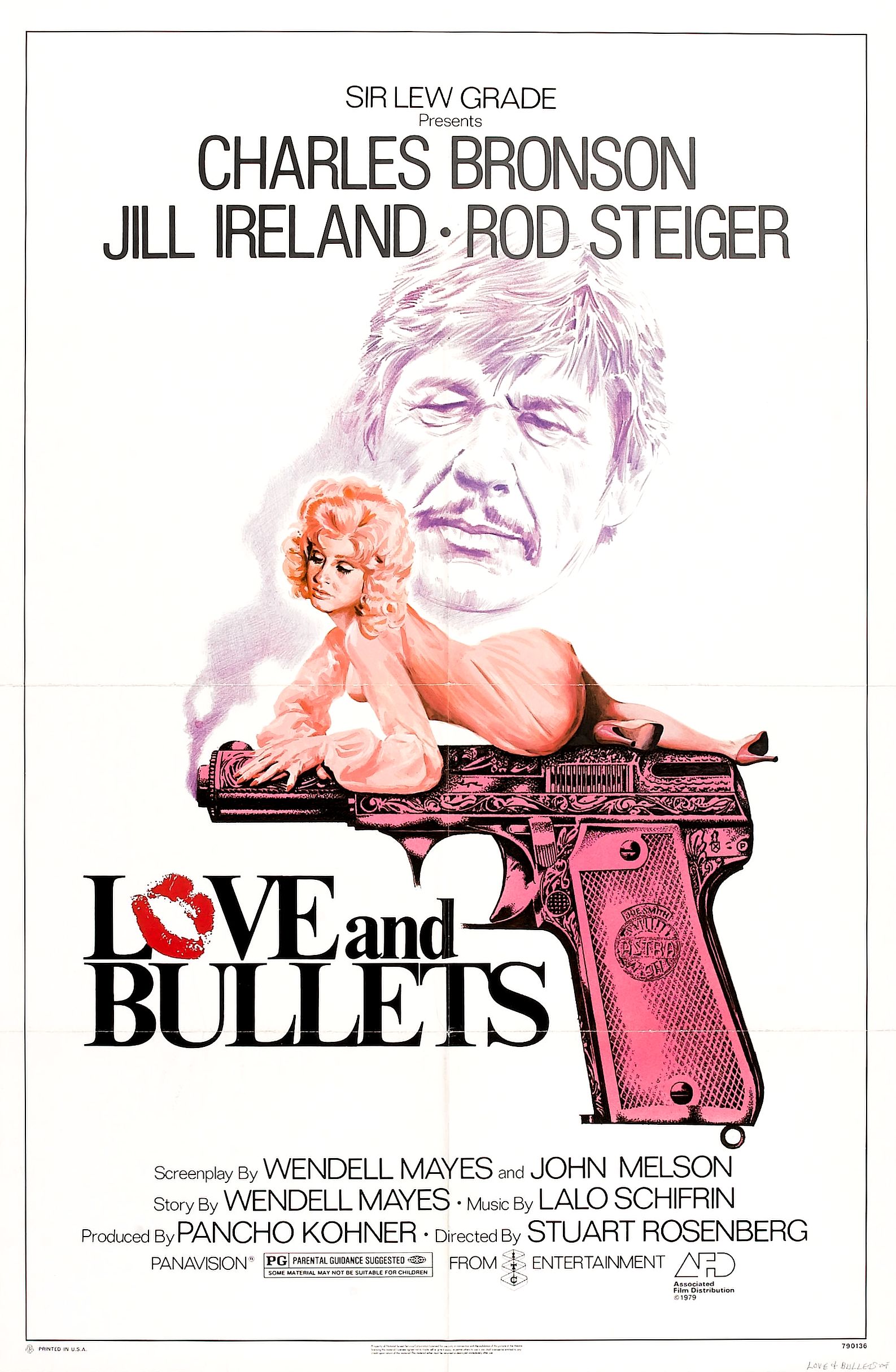
Jackie Pruit (Jill Ireland) the one-time girlfriend of mob boss Joe Bomposa (Rod Steiger) is being marked for death by him as she has the potential to turn states evidence. Undercover cop Charlie Congers (Charles Bronson) is hired to go to Switzerland and nab her before they do so that he can bring her back to the states and allow her to testify for the FBI, but along the way he ends up falling in love with her.

Ireland and Bronson where married in real-life, which is why this is just one of many movies that they did together during the 70’s. The strange thing is that they really don’t seem to have much chemistry. Bronson is much older and has more of a grounded, stoic personality while Ireland, at least here, comes off as ditzy and flighty making it seem more like a father and daughter relationship than two equal adults.  The ditzy behavior of Ireland’s character is not amusing or interesting and eventually becomes annoying making most men want to kill her instead of falling for her. Her character initially wears a wig and gaudy make-up, but Charlie insists that she take it off and when she does he states that she looks much better, but personally I thought she looked better with it on.

For whatever reason the Bronson character does not use a gun and is required to resort to unusual weapons for defense one of them being a standing lamp that he finds in a hotel room. He takes off the top and bottom of it and then uses the middle part as a pipe in which he blows nails through to kill off the bad guys. Initially this seemed like a neat idea, but I found it hard to believe that he would have such good aim and able to hit victims from several yards away. He also makes himself highly conspicuous walking around the busy streets of Zurich carrying a pipe.

Steiger gives another interesting performance. Although his character is the villain Steiger manages to give him depth and a humanistic quality. He speaks with a stutter and wears big glasses making him seem almost like a lovable galoot. The part where he stresses over ordering the hit on Jackie and at the end when he sits alone watching a classic romantic movie and insists that he not be interrupted for any reason are two of his best moments.

The supporting cast is full of familiar faces, but Bradford Dillman and Henry Silva are wasted and Michael V. Gazzo gets killed off too quickly. Paul Koslo has the perfect face for a cold-blooded hit man and it is neat seeing Strother Martin dive into the water because in his younger years before he got into acting he was a gifted diver and almost even made it onto the Olympic team. His death scene is good because it is done from his perspective as he is pushed under water giving the viewer a definite drowning feeling.

The action and story are standard and the scenic wintry landscape of Switzerland can help it only so much. The explosive finale gives it a few points, but the drama is weak and the action is only fair. Nothing real impressive and made for die-hard action fans only.

My Rating: 5 out of 10

Released: September 14, 1979

Runtime: 1Hour 43Minutes

Rated PG

Director: Stuart Rosenberg

Studio: AFD

Available: VHS, DVD (Region 2), Amazon Instant Video

The Happening (1967)

the happening

By Richard Winters

My Rating: 3 out of 10

4-Word Review: Kidnap him for kicks.

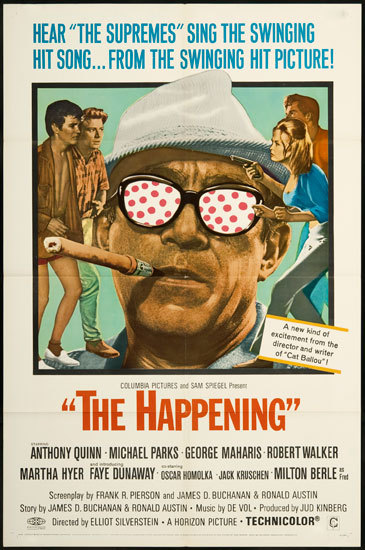
After a night of partying a group of hippies wake up the next morning hung over. Sandy (Faye Dunaway) and Sureshot (Michael Parks) are two strangers that find that they’ve slept together outside for the night and slowly become acquainted. To escape a police raid that is rounding up the drunken partiers and arresting them for vagrancy they hop onto a nearby boat with two other men that they’ve just met Taurus (George Maharis) and Herby (Robert Walker Jr.). They happily go along the lake until some neighborhood kids who are dressed in army gear shoot at them with their toy guns. Taurus doesn’t appreciate this and docks the boat and chases them into their house. Inside is the boy’s father Roc Delmonico (Anthony Quinn) who is a former Mafia Kingpin. He thinks these four strangers are aware of his past and there to kidnap him. The group decides to play along with the ruse hoping to get some money from the ransom and also because they are just bored and looking for some kicks.

The set-up has to be one of the flimsiest I have ever seen and the fact that it took four writers to come up with something that is full of holes and ludicrous is all the more confounding.  The concept seems like something that never got past the first draft and very poorly thought out by everyone involved. The idea that four strangers who have known each other for just a few minutes could get together and kidnap someone that they don’t know on a mere lark is ridiculous. I would think a former kingpin would be better prepared for something like this and have a back-up plan instead of passively and stupidly falling into the kid’s clutches with no idea of what to do. The story would have been far stronger had this been a planned crime.

The film’s overall vapid nature is shocking when you realize that is was done on a good budget by a major studio and top director Elliot Silverstein making me wonder if anyone even cared or thought about what they were making, or simply more interested in getting into the mod mood of the times. The filmmakers portray the younger generation as being one-dimensional thrill seekers with no real or discernible personalities and in the process creates characters that are boring, unrealistic, and uninteresting. The attempts at hipness are shallow, flat, and ultimately annoying.

Despite the low plausibility the movie is slickly done making for periods of fluffy entertainment. Case in point is when the kids have their car pulled over by a policeman (Eugene Roche) when they go through a red-light and carrying Roc tied up in the trunk. In an attempt to create a ‘diversion’ Sureshot decides to get out of the car with his hands up in the air. When the cop tells him to put his hands down he refuses, which then somehow makes all the other cars on the road crash into each other. Yes, it is fun to see a big pile-up, but believing that something like that could happen over something so silly is pushing things too much to the extreme like with a lot of things in this movie.

Things improve during the second half when Roc with the help of the kids turns the tables on everyone he knows after finding out that no one is willing to pay for his ransom. The scene where they tear up his house is kind of funky despite the fact that all the furniture they smash up looks like obvious stage props. Unfortunately the ending is as weak as the beginning and offers no pay off, which most likely will make most viewers feel like they’ve wasted an hour and 45 minutes of their time.

Quinn is good and gives the script and character a lot more energy and heart than it deserves. Dunaway, in her film debut, is hot and plays the part of an immoral lady looking for cheap thrills even when she knows better quite well. Walker Jr. is good simply because he plays the only character that has any type of believability, but unfortunately he is not on enough to be completely effective. Maharis who is best known for his excellent work as Buz Murdock in the classic TV-show ‘Route 66’ is solid as the volatile and slightly unhinged member of the group.

Oskar Homolka has a few memorable moments as an aging crime boss. One scene has him in a steam room along with his henchman wrapped tightly in towels and looking like giant carrots while another segment shows him at a poolside surrounded by a bevy of beautiful bikini clad women, which like the first scene, is visually funny.

The Supremes sing the film’s theme song, which became a top ten hit, but it doesn’t get played until the closing credits and even then not in its entirety.

My Rating: 3 out of 10

Released: May 17, 1967

Runtime: 1Hour 41Minutes

Rated NR (Not Rated)

Director: Elliot Silverstein

Studio: Columbia

Available: None

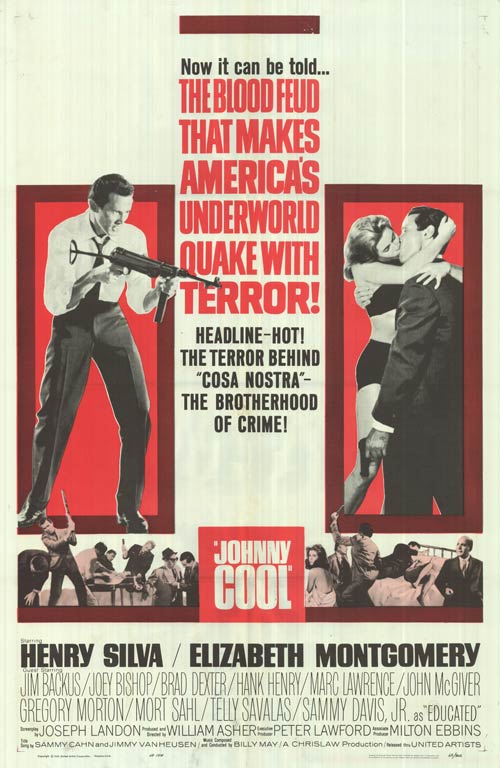
Johnny Cool (1963)

By Richard Winters

My Rating: 7 out of 10

4-Word Review: Top of crime world.

                Johnny Cool (Henry Silva) is really Giordano a man who grew to mythical proportions as an outlaw in a small Italian village after killing off some soldiers who tried to rape his mother. His exploits come to the attention of  Colini (Marc Lawrence) who has been exiled to Sicily because of his gangster past. He stages a fake assassination of Giordano in order to kidnap him and train him to go back to the United States and kill off the men that ordered his downfall. Johnny does this, but then becomes even more powerful than Colini was and soon he is both feared and hunted by the crime world.

The film, which was directed by William Asher, is nicely paced. I liked the fast, gripping action, the pounding music, and raw approach. The black and white photography nicely accentuates the gritty subject matter. Although it may seem a bit tame by today’s standards I still found most of it to be intense and uncompromising especially the ending.

Lots and lots of famous faces pop up everywhere, which is fun for a bit, but then takes you out of the story as it seems to become more like ‘spot the star’. Some of the cameos are small and pointless while others are more interesting. Sammy Davis Jr. has a tense scene playing a man with an eye patch who must role a specific number with the dice or be blown away by Johnny’s gun, which is aimed directly at his temple. Joey Bishop is funny as a fast talking used car salesman and his feeble attempts at making a play at the beautiful Dare (Elizabeth Montgomery). John McGiver is equally fun as a perplexed store manager who brings in a woman to his office after finding that she has been writing a lot of bad checks. The exchange he has with her is a perfect example of why sexual innuendos where a lot more interesting and creative back in the old days when the standard didn’t allow them to be as crass and vulgar as they are now. Here the lady states “I can make those bad checks good.” And McGiver responds after eyeing her figure “Yes, I think you can!”

Telly Savalas is wasted. The man is a great character actor especially as a villain. Playing a tough crime boss from Brooklyn is his forte and he could have really gone with it had they given him a bigger part. Marc Lawrence is equally evil as Colini and showing him only in one scene and then disappearing was disappointing. Jim Backus’s appearance was a mistake. A funny, talented man for sure, but I didn’t like that he did his Mr. Magoo laugh several times here as it did not fit the gritty mood.

Henry Silva has proven to be a great villain throughout his career, but in this role it just doesn’t work. His eyes have a weird type of stare that makes it look like he has been drugged. He delivers his lines in a monotone fashion. The character becomes overblown and some may find his use of the karate chop to be a bit cheesy. He kills a man on an escalator amidst a crowded airport and is able to get away. There are several other scenes where he is able to somehow get into a secure area and kill off people without any explanation for how he was able to do it.

Elizabeth Montgomery, who was at the time the wife of the director, is fantastic. She plays a brunette and does well with a multi-faceted character that goes from helpless victim to conniving double-crosser. She is shown in several scenes wearing no make-up and I liked the naturalistic quality. My only quibble is the scene where she gets roughed up by some gangsters, but the only mark left on her is a bruise on a shoulder even though a few bruises, scratches, and cuts on the face would have been not only more believable, but visually more effective.

My Rating: 7 out of 10

Released: October 2, 1963

Runtime: 1Hour 43Minutes

Rated NR (Not Rated)

Director: William Asher

Studio: United Artists

Available: DVD, Netflix streaming