Category Archives: Foreign Films

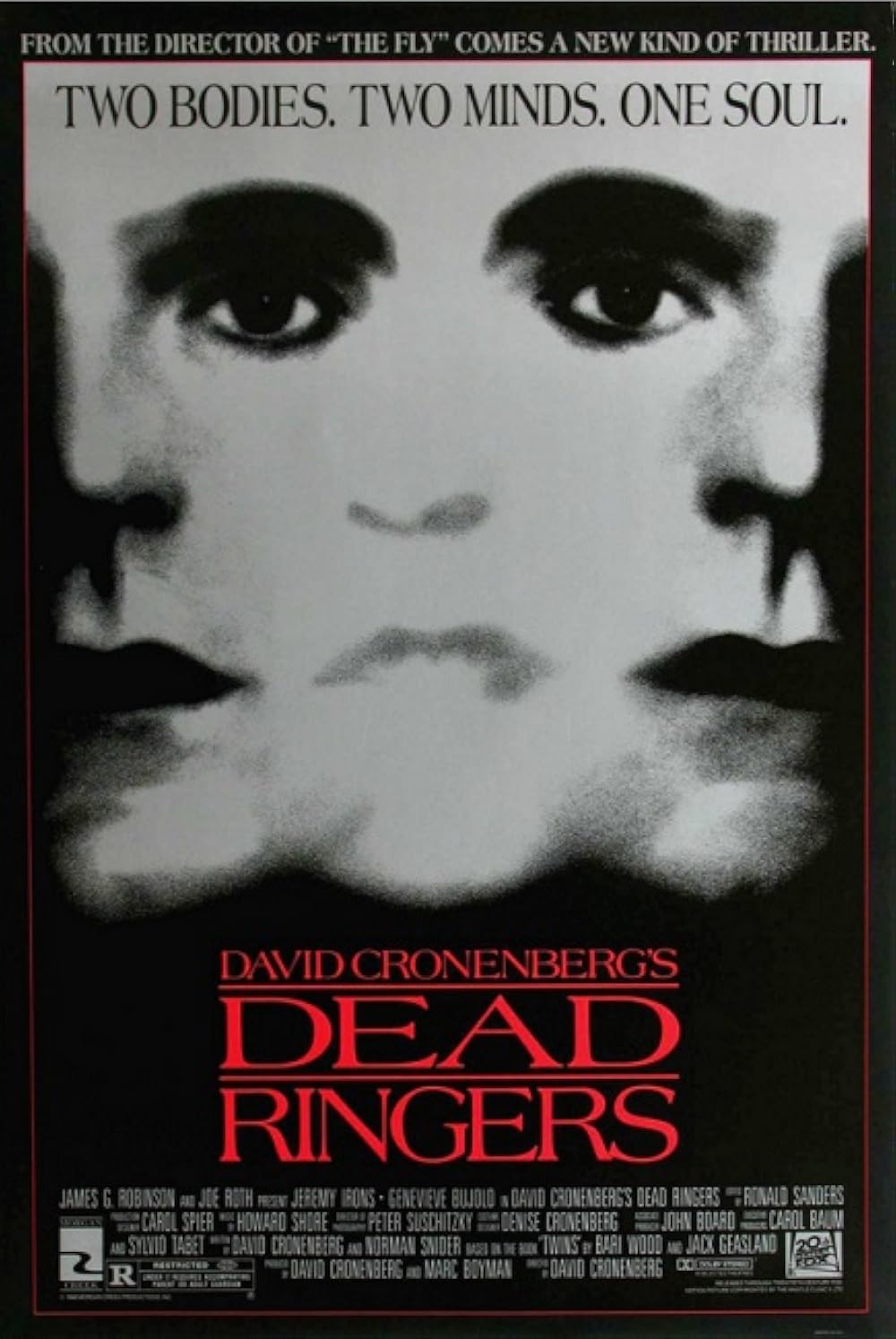
Dead Ringers (1988)

By Richard Winters

My Rating: 7 out of 10

4-Word Review: Twin brother’s relationship erodes.

Twins Elliot and Beverly (Jeremy Irons) work at a clinic as gynecologists with Elliot being the more outgoing of the two. Elliot routinely dates women many of them patients at their clinic but will then ‘hand them off’ to Beverly who is the shyer of the two and unable to get women without Elliot’s help. Since Elliot likes variety in his relationships, he’s okay with Beverly getting the women once he’s lost interest in them and the women can never tell the difference. Things though begin to change when Claire (Genevieve Bujold) enters into the picture. She, like the ones before her, was a patient whom Elliot is quickly able to hook-up with and then after a brief fling is given to Beverly, but this time Beverly falls for her in a deep way and not so eager to drop her. Claire also becomes aware that she’s been tricked by the two and has a confrontation with Elliot about it while she continues to see Beverly on the side. Beverly though becomes conflicted with his dual loyalties unable to handle how fractured his relationship with his brother, who he used to be quite close to, has become spiraling him into a depression that ultimately leads to a dangerous drug addiction. 

In 1981 David Cronenberg became interested in doing a movie about twins and producer Carol Baum sent him articles about Steward and Cyril Marcus. These were identical twins who were gynecologists working and living together in New York City. On the morning of July 17, 1975 both were found dead inside Cyril’s cluttered apartment in what had initially been perceived as being a suicide pact, which was later ruled out, but both did die within a few days of the other. While their deaths generated may articles and even a novel the cause to what circumstances lead to them dying together has remained open and thus Cronenberg decided to ‘answer’ that question with this story though he had to go through many years of different producers, screenwriters, and various different drafts before this version was finally given the green light.

If you’re a fan of Cronenberg, particularly his gore, which he’s best known for, then you may be disappointed with this as there really isn’t much. There are still some disturbing moments including the garish genealogical instruments that Beverly pays an artist, played by Stephan Lack, to create which he then plans on using on one of his patients, to the shock of his medical staff, which is a creepy moment. There’s also a dream sequence where Claire bites off a membrane connecting the two brothers, which is cool, but brief. There was also a scene shot that had the head of one of the twins coming out of the stomach of the other one, but this didn’t go over well with the test audiences, so it got cut, but I really wished had been left in. 

It’s really Irons and his incredible performance as the twins that makes this such an engaging movie to watch. Having one actor playing dual roles has certainly been done before, but never quite this effectively. Even though they look exactly alike I really got the sense these were two different people and Irons ability to craft such diverse personalities and postures, this was achieved by putting his weight on the balls of his feet while playing one of them and having his weight put on his heels while playing the other helps to, in a very subtle way, create a strong distinction and a hypnotic presence that sucks you into the story and never lets you go. 

My only quibble is that rarely have I seen twins that you couldn’t tell apart in some way. I noticed that Irons did have some minor moles on his right cheek and then another on the left side of his head near his eye. In the movie both of the brothers have these lesions in the exact same place, but I think in reality they wouldn’t, so they could’ve masked the moles on one of the characters through make-up, so it would only show on one of them and that could’ve been a way to tell them apart physically. There’s also the issue with one of them given a women’s name, which Claire does question at one point. Beverly gets quite defensive when it’s brought up insisting that his name is spelled in the ‘masculine’ way, but on the credits it’s spelled out just like it would had the name been given to a female, so I felt there should’ve been more explanation of why he’d been given an unusual name as it was something that would certainly come off as odd to many and I don’t think I’ve ever heard of a man with that name. 

I also had some problems with Bujold’s character as she seems to be plopped in solely to get the story going and start the process of having the brother’s strong bond dissolve, but for a character to generate such a pivotal thing I think she should’ve stood out more. What was it about this woman that created a division between the boys that the other women hadn’t? I would’ve liked seeing her more involved in the conflict possibly confronting Elliot in an angry way, not the conciliatory one we see here, and forbidding Beverly to see him, which would’ve helped make her more prominent versus just being a story device. 

My Rating: 7 out of 10

Released: September 23, 1988

Runtime: 1 Hour 53 Minutes

Rated R

Director: Michael Cronenberg

Studio: 20th Century Fox

Available: DVD, Blu-ray, Peacock, PlutoTV, Roku,Tubi, Amazon Video, YouTube
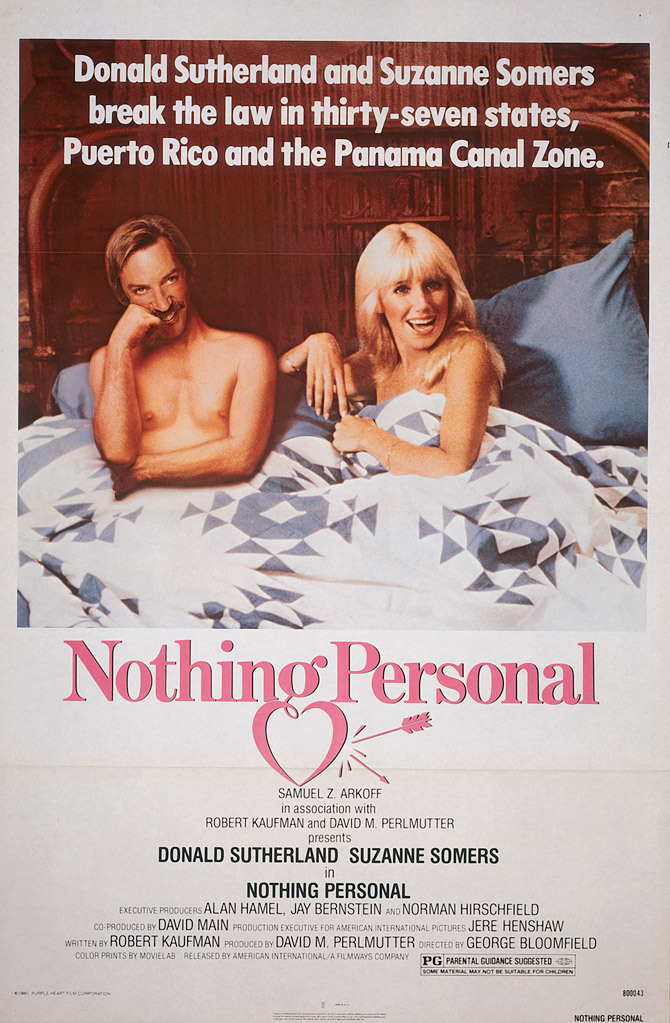
Nothing Personal (1980)

By Richard Winters

My Rating: 2 out of 10

4-Word Review: Saving seals from slaughter.

Roger (Donald Sutherland) is a college professor who becomes aware by one of his students, Peter (Michael Wincott), that seals are being systematically slaughtered by a construction company trying to build homes in an area populated by them. Roger then goes on a crusade to stop this and hires the services of Abigail (Suzanne Somers) a young lawyer bent on proving herself. The two though come up with major roadblocks when they attend the stockholder meetings of the company. While the CEO Ralston (Lawrence Dane) seems to listen to their concerns the company still decides to push through their construction agenda prompting Roger and Abigail to find other ways to prevent the homes from going up, which then causes the heads of the company to resort to nefarious means to stop them.

The screenplay was written by Robert Kaufman and sold in 1972 but then languished in the studio’s slush pile as it couldn’t find any director interested in filming it. Then in 1980 after the success of Love at First Bitewhich had also been penned by Kaufman, director George Bloomfield decided to take a stab at this one, but for tax write-off purposes it was filmed in Canada despite the setting being Washington D.C.

A lot of the issue with the movie, which was not well received by audiences or critics alike, and ended up tanking at the box office, is that it’s just not all that funny. The humor is dry and amounts to a few throwaway lines said by the characters just before the scene cuts away and if you’re not listening carefully enough, you’ll miss it though even if you do catch it it’s nothing that’s going have you rolling-in-the-aisles. Would’ve worked better had it been done as a drama, or even a thriller, as neither the comedy or romantic elements add much and in a lot of ways detracts from the main story.

While Sutherland is traditionally a good actor his presence here hinders things. He comes off initially as completely oblivious to what’s happening and only manages to get informed by Peter who’s very passionate about the cause and even interrupts a class that Sutherland is teaching to inform him about it. Sutherland immediately poo-poo’s the news and only after doing more research does he decide to take on the cause, but I felt that Peter, who gets largely forgotten and not seen again, should’ve been the one to lead the charge since he was already heavily into the issue and being a student would have more time on his hands while Sutherland was working a job and therefore shouldn’t have been able to devote his full attention to it like he does. Having a romantic relationship grow between Peter and Somers would’ve worked better as they seemed more around the same age while Sutherland looks to be more like her father.

Somers’ character is quite problematic. Initially she’s someone that wants to prove herself and be taken seriously but then turns into a complete slut almost overnight as she gets in bed naked when she invites Sutherland into her room and immediately makes overtures that she wants to get-it-on. This though is not a proper way that someone who wants to gain the respect of her peers and clients as she moves up in the business world should be behaving and therefore it’s hard for the viewer to take anything that she says or does seriously.

Too much time also gets spent on them fooling around to the point that it seems they’re more into sex than saving the seals. The movie should’ve waited until the very end to introduce some romantic overtures after they had succeeded with their mission when it would’ve been more appropriate, but the way it gets done here makes them seem like vapid juveniles with hyper hormones and not much else.

The film though really jumps-the-shark when the CEO of the company and his trusted assistant, played by Dabney Coleman, resort to criminal means in an effort to stop Sutherland and Somers from shutting down their project. Even going as far as trying to kill them by trapping them inside a barn and then setting it on fire. There are certainly CEO’s out there that can be corrupt, but they have enough money that they’d pay someone else to do their dirty work and would most certainly not be doing it themselves. Supposedly these are successful businessmen that have worked their way up the corporate ladder, so why throw it all away by so obviously going after their foes, which is something that could easily be handled through bribery.

Spoiler Alert!

The ending, which was described by one IMDb reviewer as being of the ‘surprise’ variety and makes sitting through the rest of the movie ‘worth it’, had me more confused than anything. It has Dane and company planning to build more homes on a different site that would require them to kill off more wildlife. They then get a knock at the door and when they open it, it reveals a smiling Sutherland and Somers, but it’s not clear whether they appear in order to stymie this new project or are somehow in on it. Since Dane and Coleman have annoyed expressions when they see them I think it’s meant to show the former, but the IMDb reviewer thought it meant the later and I really couldn’t blame anyone for not being sure, which makes this yet another problem for a movie that already had a ton of them.

My Rating: 2 out of 10

Released: March 28, 1980

Runtime: 1 Hour 40 Minutes

Rated PG

Director: George Bloomfield

Studio: American International Pictures

Available: DVD-R, Tubi, Amazon Video

Double Negative (1980)

By Richard Winters

My Rating: 4 out of 10

4-Word Review: Who killed his wife?

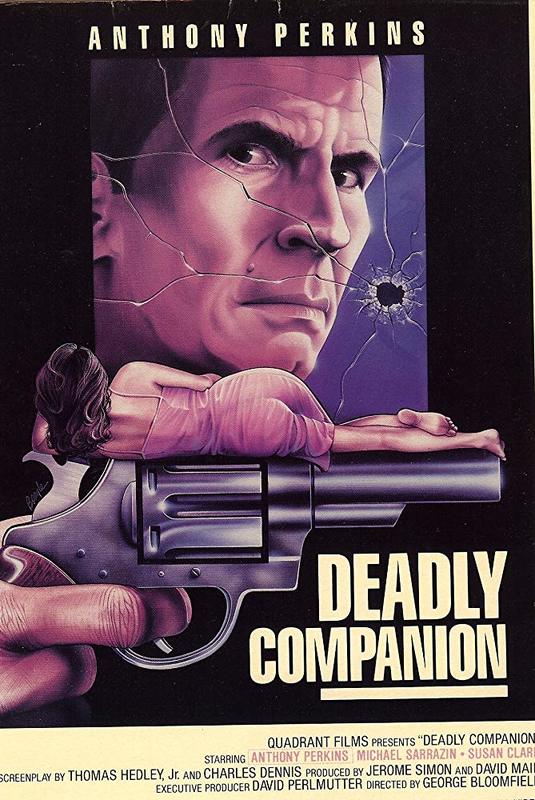
Michael (Michael Sarrazin) is a photojournalist tormented by fragmented memories of his wife’s murder. Paula (Susan Clark) is his girlfriend who’s trying to help him sort through these flashbacks, so he can find some answers. However, she too has things to hide as she’s busily paying off a man named Lawrence Miles (Anthony Perkins) who threatens to go to the police about what he knows about the killing. There’s also Lester (Howard Duff) a private investigator who sticks his nose too deeply into the case and finds himself at deadly odds with both Lawrence and Paula.

The film is based on the 1948 novel ‘The Three Roads’ written by Ross Macdonald under his real name Kenneth Millar. Macdonald later went on to have a stellar career writing novels about private investigator character Lew Archer and this story has plenty of potential but gets mishandled and ultimately becomes a misfire. A lot of the problem stems from the production employing three different writers who all had different perspectives on where they wanted the story to go and then relying on director George Bloomfield to cram it all together, which he doesn’t succeed at. The result is a fragmented mishmash that takes a long while to become intriguing and even then, remains interesting only sporadically. Lots of extended scenes particularly at the beginning that should’ve been trimmed and a poor pacing that barely manages to create any momentum.

It doesn’t help that the main characters are wholly unlikable and uninteresting. Clark especially comes off as arrogant right from the beginning when we see her drive by what appears to be Amish people in a horse and buggy fighting through the snow and cold while she enjoys things in her warm ritzy car, which makes her seem detached and uncaring. The scene where she’s trying to procure an important real estate deal and then gets hampered by Michael playing loud music in the other room, so she then excuses herself and promises to be right back. I was fully expecting her to yell at Michael for his misbehavior, but instead she strips off her clothes and the two make love, but it seemed like sex should be the last thing on her mind during such an serious business meeting and what would happen if the clients, who were just a door away and waiting for her return, would walk in on them? 

Sarrazin doesn’t cut it either. I know he’s been lambasted by critics in his other film appearances for being too transparent and forgettable and yet I’ve usually defended him as I feel he can sometimes be effective even given the right material. Here though he falls precariously flat. Some of it is the fault of the writing which doesn’t lend him to create a character with any nuance, or likability, but in either case he’s a complete bore and the viewer isn’t emotionally invested in his predicament. His flashback moments where he sees himself in some sort of prisoner of war camp doesn’t make a lot of sense, or have much to do with the main plot, and seems like something for a whole different movie. 

On the other hand, Perkins is fantastic and the only thing that livens it up to the extent that he should’ve been given much more screen time as the film sinks whenever he’s not on. It’s great too at seeing SCTV alums like John Candy, Eugene Levy, Joe Flaherty, Dave Thomas, and Catherine O’Hara in small parts where with the exception of Candy they’re not comical but instead make a rare turn at being dramatic. Duff is kind of fun and has one great moment, really the only good one in the movie, where he gets trapped in an elevator and must escape being shot by Perkins, who has his arm lodged in the otherwise closed doors, by desperately running back and forth in the closed space that he’s given. Michael Ironside has a memorable bit too as a bar patron who becomes incensed at Sarrazin when he refuses to allow him to buy him a drink. 

Spoiler Alert!

The denouement just leaves more questions and fails to tie up the loose ends as intended. For one thing it shows Sarrazin as being the one who strangled his wife, which I had started to suspect a long while earlier, so it’s not a ‘shocking surprise’ like I think the filmmakers thought it would. It also has Perkins leaving the scene, as he was having an affair with the woman, and even briefly speaking to Clark who witnesses him going, so why he’d insist Clark needs to pay him hush money didn’t make much sense. Sure, he could still go to the police and say that it was Sarrazin that did it, but Perkins fingerprints were at the scene of the crime, so I’d think either way he’d get implicated, and Clark could come forward saying she was a witness who saw him leaving. If anything, Clark should’ve been pushing him to go to the cops versus bribing him to stay away.  

Also, the way it gets shown, Clark comes into the bedroom after Sarrazin has already strangled his wife, so all she sees is him weeping over his wife’s dead body. For all she knew, from that perspective, is that Perkins really did kill the woman and Sarrazin was simply the first to come upon her dead body and thus for it to be crystal clear Clark should’ve entered while he was still in the middle of the act versus when he was already done.

Beyond that is that question of why would Clark want to stay with someone she knew had such violent tendencies? Wouldn’t she be afraid he could get upset at some point and do that to her? Sarrazin even asks her at the very end if she is afraid and her only response is: ‘aren’t you’? This though only muddles things further cementing it as a botched effort. 

Alternate Title: Deadly Companion

My Rating: 4 out of 10

Released: May 12, 1980

Runtime: 1 Hour 36 Minutes

Director: George Bloomfield

Studio: Quadrant Films

Available: Amazon Video

Diversion (1979)

By Richard Winters

My Rating: 5 out of 10

4-Word Review: Sex fling becomes problematic.

Guy (Stephan Moore) is a writer who is happily married to Annie (Morag Hood) with a toddler son named Charlie (Dickon Horsey). Annie decides to take a trip with Charlie to visit her parents and Guy stays home to work on a writing assignment. While he’s typing away, he remembers meeting Erica (Cherie Lunghi) at a party some months earlier where she gave him her phone number. Now with the wife gone he concludes this would be a good time to give her a call. Erica is excited to hear from him and they go on a mini date before ultimately ending up in her bed. The next morning, he tries to leave but she won’t let him go easily and insists that she’s not a one-night-stand material and instead wants to have a relationship with him. Guy reminds her that he’s married, but she says he can divorce her, which Guy is reluctant to do as he still considers himself content in his marriage and simply had sex with another woman as a diversion. Erica continues to call him, and his phone is constantly ringing even after Annie returns. Guy tells her it’s a wrong number, but Annie becomes suspicious and the next time Erica calls she decides to pick-up. 

If this synopsis sounds familiar it’s because it was the basis for Fatal Attraction. Producer Stanley R. Jaffee became aware of this short film and was convinced it could be expanded into a feature length movie. He even hired James Dearden, the writer-director of this one, to write the script. However, Paramount, the studio that agreed to finance the film, ordered all existing copies of this one to be destroyed, but fortunately a few survived including a bootleg version that was recorded straight off of an A&E broadcast from several decades back. 

I’m a big fan of Fatal Attraction and didn’t feel this version was as good. Too much time is spent at the beginning of Guy taking his wife and child to the airport, which I didn’t think was necessary. The party scene where Erica gives Guy her phone number should’ve been shown in flashback and the Guy character comes off like a geek that probably would only be able to fantasize about having sex with a hot woman like Erica, but not brazen enough to follow through nor would a woman like Erica want to go to bed with him as she could’ve found a better looking guy just about anywhere. In Fatal Attraction, both participants were equally attractive and working at the same firm, so their fling was more organic and made far better sense. 

Fortunately, in this one we don’t see any of the wild sex, which I felt was good as I thought that got in the way in the remake and became a distraction from the main story. Much of the dialogue though between Erica and Guy is almost word-for-word from what gets said between Glen Close and Michael Douglas though here Erica is portrayed as being this cold psychotic while in the other one Close played the role more as a desperately lonely woman, which humanized the character and helped the story be three-dimensional. 

Spoiler Alert!

My biggest grievance is that it leaves open too many loose ends. There is one scene where Guy calls Annie, while she’s still on her trip and supposedly knows nothing about what is going on, to touch base, but Annie is strangely aloof, and Guy doesn’t know why. She had always been very peppy before, which made it seem like Erica had called Annie and informed her of the affair, at least that’s what I thought, but this never gets confirmed and Annie arrives home later back to her perky self, so why did she behave differently during that one call?

The ending works like a gimmick as it has Annie answer the phone, which may or may not be Erica, while Guy stands nervously by. However, once Annie picks-up the receiver the film cuts to the closing credits, so we never know what happens next, which to me was a cop-out. 

My Rating: 5 out of 10

Runtime: 40 Minutes

Not Rated

Director: James Dearden

Studio: Dearfilm

Available: None at this time. 

A Private Function (1984)

privatefunction

By Richard Winters

My Rating: 6 out of 10

4-Word Review: Couple hides a pig.

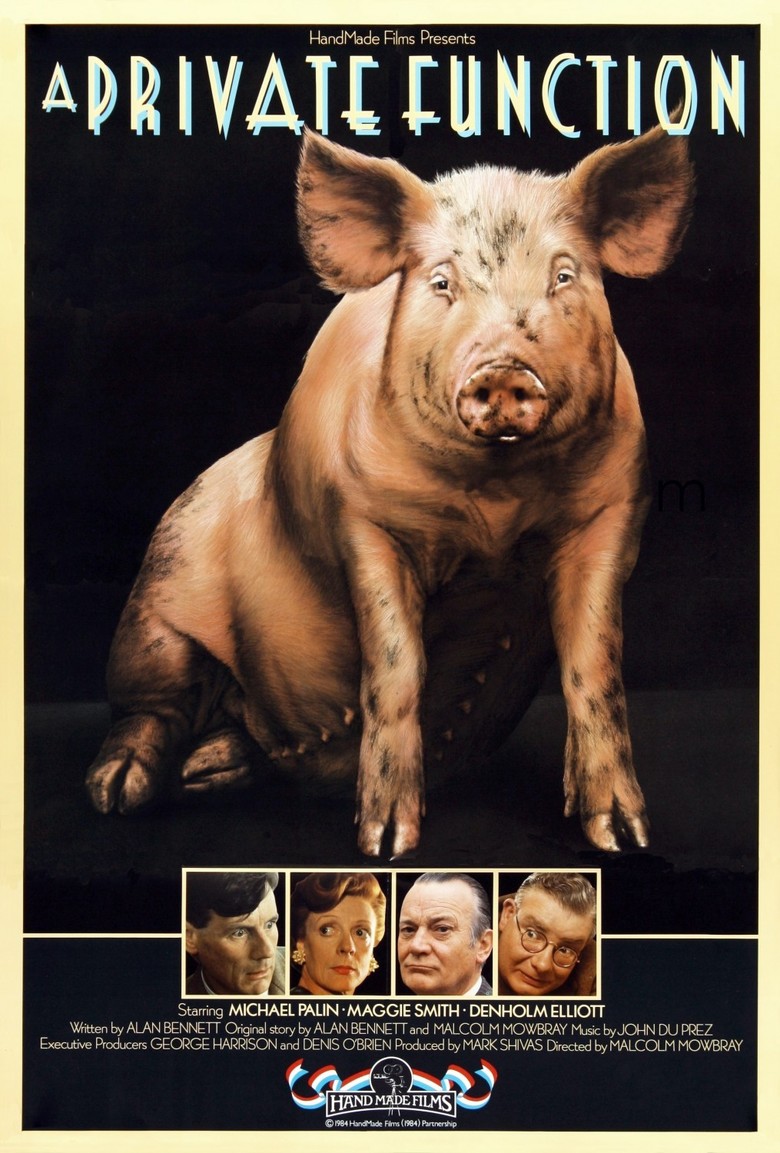
The year is 1947 and even though the war has been over for 2 years there’s still food rationing going on in this small England town. Gilbert (Michael Palin) works as a podiatrist and travels to residential homes where he cuts the toenails of the women who live there. During some of his visits he comes upon families who are hiding meat in their homes, and they must rush to cover-up any evidence of it when the local food inspector (John Normington) comes around to investigate. One such home has been illegally raising a pig in hopes to use it for a private party to celebrate the upcoming Royal Wedding between Princess Elizabeth and Prince Philip. Gilbert tells his wife Joyce (Maggie Smith) about it, and she convinces him to steal the pig, so that they can sell it off to the bacon black market but trying to hide a pig from both their neighbors as well as Joyce’s noisy elderly mother (Liz Smith) let alone being able to kill it proves quite challenging.

The film is a perfect mix of droll English humor and quirky moments. It starts out with a very original idea and manages to add one amusing moment, or sly comment, after the other becoming one of the better foreign comedies of the year where you can pick-up on funny little things that you might’ve missed on the first viewing, each time you watch it. Palin is especially good as a timid man who finds himself in the middle of chaos that he didn’t want and his unique profession along with the giant plastic foot that he orders to help represent his business are all on-target as are his engagingly consternated facial expressions.

Initially I thought Smith, a two-time Academy Award winner, was wasted here as she isn’t seen much during the first act and pushed mainly to the background making it seem almost like a token role that doesn’t have much pizazz, but she comes on strong by the end by having an interesting arch where she is just a passive, doting wife at first, but proves to be quite controlling, conniving and even demanding by the end. Liz Smith is equally engaging as the sometimes-confused aging mother ‘she’s 74’ whose dialogue is limited, but the few lines that she does say are doozies.

Spoiler Alert!

The pig though becomes the main star even though behind-the-scenes it made things quite difficult to film. This led to one 12-year-old boy getting his ‘big break’ into show business. When he heard that they were going to be making a movie in his area he proudly proclaimed that he’d be ‘willing to do anything’ in order to ‘get into the movies’ so the producer handed him a pail and told him to follow the pig around and collect its droppings every time it defecated and for this he got his name proudly billed during the final credits as ‘the bucket boy’.

As pigs go this one struck me as being quite small. Apparently, this was intentional as the filmmakers were advised by animal experts to choose a 6-month-old female pig as it was deemed, they’d be easier to control and less unpredictable, but visually she looked too scrawny and certainly not the type of pig to be used as the centerpiece for a giant feast such as the one that the townspeople were excitedly planning. It’s also a bit of a downer, even depressing, when the animal is eventually killed and served up on a platter. There’s a lot of close calls where the animal evades death and it makes it seem almost like the human captors were ultimately too afraid to do it, but when it does finally occur it hurts the film’s levity and makes it feel like murder when it does die and thus sucks all of the comedy that came before it right out.

The climactic party isn’t eventful either making the story go out with a whimper. It had been relatively lively up to then with all sorts of subtle twists and goofy turns only to end things on a dry note. There needed to be some sort of ultimate confrontation between the couple and the former owners of the pig, so things could’ve ended with more of a bang as it’s not quite able to hold-up feeling almost like it ran out of ideas with an uninspired conclusion.

My Rating: 6 out of 10

Released: November 9, 1984

Runtime: 1 Hour 32 Minutes

Rated R

Director: Malcolm Mowbray

Studio: HandMade Films

Available: DVD

The Devils (1971)

devils1

By Richard Winters

My Rating: 9 out of 10

4-Word Review: Burned at the stake.

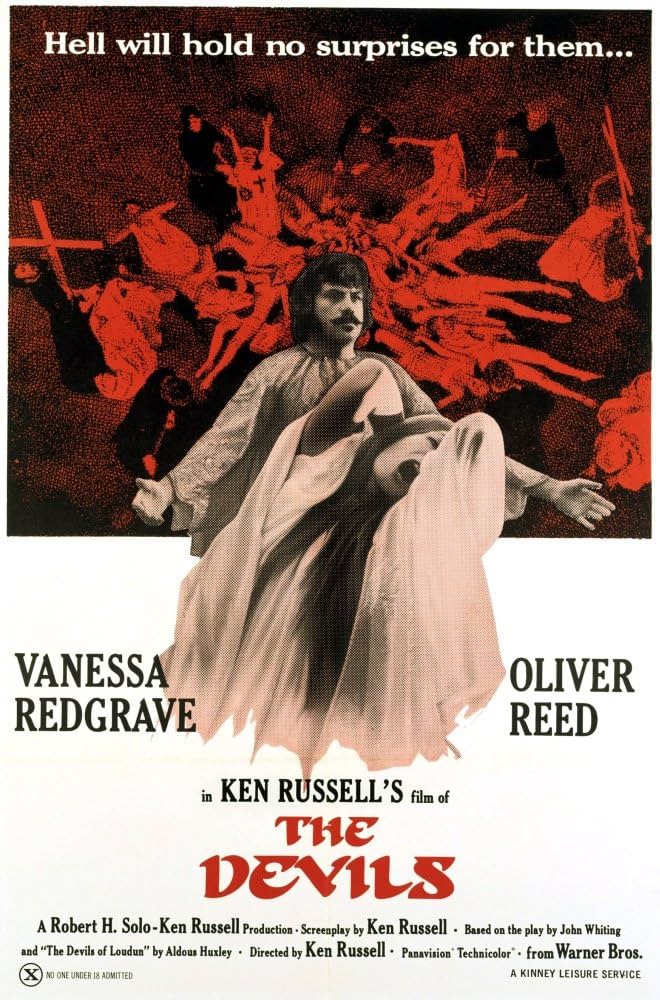
In the year 1634 the governor of Loudon, a small fortified city, dies, making Urbain Grandier (Oliver Reed), a priest with a secretly decadent lifestyle, the one in control. He’s idolized by the townspeople and the head nun at the local convent, Sister Jeanne des Anges (Vanessa Redgrave), secretly has sexual fantasies about him though because she suffers from having a hunch on her back is rarely ever seen outside and Urbain himself doesn’t know she exists. When Urbain secretly marries Madeleine (Gemma Jones) Jeanne becomes jealous causing her to confide to Father Mignon (Murray Melvin) that she’s been possessed by Urbain as well as accusing him of dabbling in witchcraft. This then leads to an inquisition headed by Father Pierre Barre (Michael Gothard) and a public exorcism, which has the nuns in the church strip and perform perverse acts before Urbain and his new wife are arrested and put on trial.

The story is based on the actual event, which was written about in the book ‘The Devils of Loudun’ by Aldous Huxley that was later turned into a stageplay. After the play’s success United Artists became interested in turning it into a movie and signed-on Ken Russell to direct due to his recent success in helming Woman in Love. Russell read the source material and became in his words ‘knocked-out by it’ and ‘wanted others to be knocked-out by it too’. This then compelled him to write an extraordinarily over-the-top script full of sex, violence, and graphic torture that so shocked the studio execs when they read it that they immediately withdrew their initial investment and refused to fund the picture threatening the project from being made even though many of the sets, constructed by set designer Derek Jarman, has already been painstakingly completed, but fortunately for them Warner Brothers swooped-in at the eleventh hour, which allowed the production to proceed.

The film’s release was met with major controversy with many critics of the day, including Roger Ebert who gave the film a very rare 0 star rating, condemning it. Numerous cuts were done in order to edit it down to a version that would allow it to get shown with the original British print running 111 minutes while the American one ran 108. Both were issued with an ‘X’ rating though even these cut out the most controversial scene, known as ‘The Rape of Christ’ segment, in which a group of naked nuns tears down and then performs perverse acts on a giant-sized statue of Jesus. This footage was deemed lost for many years before it was finally restored in a director’s cut version, that runs 117 minutes, that was shown in London in 2002. Yet even today this full version is hard-to-find with Warner Brothers refusing to release it on either DVD, or Blu-ray. They’ve even turned down offers from The Criterion Collection who wanted to buy it. While there was a print Warner released onto VHS back in the 80’s, this same version, got broadcast on Pay-TV, it’s edited in a way that makes the story incomprehensible, and only the director’s cut is fluid enough for the storyline to fully work.

It’s hard to know what genre to put this one into as this isn’t your typical movie and watching it is more like a one-of-a-kind experience that very much lives up to its legend and just as shocking today as it was back then. Yet, outside of all of its outrageousness it is quite effective. Each and every shot is marvelously provocative and the garishly colorful set pieces have a mesmerizing quality. The chief color scheme of white that lines the walls of the inside of the convent seemed to interpret to me the interior of a mental hospital, which helps accentuate the insanity of the frenzied climate. While things are quite over-the-top its ability to capture the mood of the times, the cruel way people treated each other and how they’re all steeped in superstition as well as the dead bodies from the plague that get stacked about, are all on-target and amazingly vivid.

The acting is surreal with both Reed and Redgrave stating in later interviews that they consider their performances here to be the best of their careers. Reed’s work comes-off as especially exhausting as he gets his head shaved and then is ridiculed in a large room full of hundreds of people before burned to death with make-up effects that are so realistic it’s scary. Redgrave, who walks around with her head twisted at a creepy angle, is quite memorable during the scene where she physically punches herself for having sexual fantasies, even puts a crucifix in her mouth at one point and masturbates with a human bone. Dudley Sutton and Murray Melvin with their very unique facial features and Michael Gothard, who initially comes-off with his long wavy hair as an anachronistic hippie flower child, but who becomes aggressively evil as the makeshift exorcism proceeds, all help round-out a most incredible supporting cast.

While the cult following for this remains strong and getting stronger and demand for a proper, director’s cut studio released DVD/Blu-ray is high Warner continues to rebuff the requests. There are though ways to find versions through Bing searches. Streaming services Shudder and Criterion Channel have shown the most complete prints to date, running roughly 111 minutes with most of the controversial scenes, including the Rape of Christ moments though these scenes are of a poorer, grainy and faded color quality since they never went through a professional digital transfer, but overall it’s still one of those movies you should seek-out because not only is it fascinatingly brilliant, but it’s something that could never be  made today and a true testament to the wild, unfiltered cinema of the 70’s that will forever make it the groundbreaking, unforgettable decade that it was.

My Rating: 9 out of 10

Released: July 16, 1971

Runtime: 1 Hour 57 Minutes (Director’s Cut)

Rated R (Originally X)

Director: Ken Russell

Studio: Warner Brothers

Available: DVD-R

Wedding Trough (1975)

wedding

By Richard Winters

My Rating: 1 out of 10

4-Word Review: Man fucks his pig.

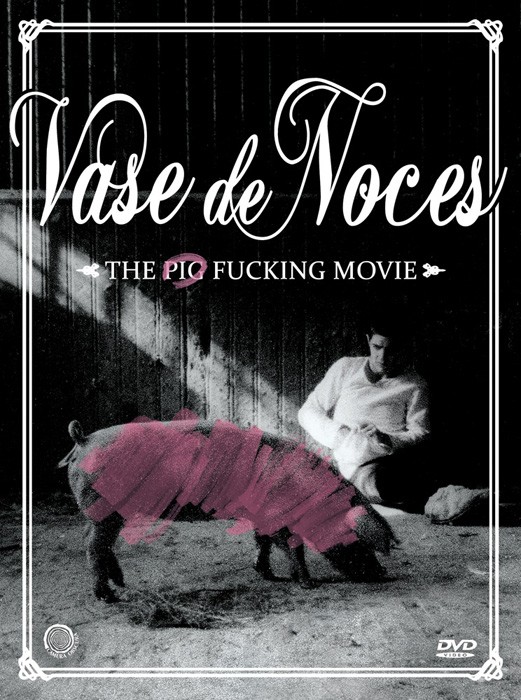
Bizarre, controversial film that was first shown at the Perth International Film Festival in Australia where it was immediately met with outrage and walkouts that quickly got it banned from being shown again by the government, a ban of which still stands today. Since then it’s turned-up sporadically a various film festivals throughout the decades, with the last one being in 2008 in Switzerland, but was never released theatrically and was considered an obscurity before finally getting a DVD issue in 2018. The film has no dialogue and shot in black-and-white at an abandoned farm in the outskirts of Belgium. It was directed by Thierry Zeno who had a noted fascination with all things morbid and followed this one up with a documentary on death and decay called Des Morts. This one deals with taboo subjects of zoophilia and coprophagia, which gets shown graphically. Many label this a horror movie for its grim and unrelenting subject matter, and some have even considered it a forerunner to Eraserhead

The plot description, which will contain SPOILERS, though in this case I feel is a good thing, so you know exactly what you’re getting into if you attempt to watch it, deals with a lonely farmer, played by Dominique Garny, who also co-wrote the screenplay, who begins to have amorous feelings towards his pet pig. One day he gets naked and has sex with it. Later on, the pig gives birth to three piglets. The man tries to bond with his brood by sleeping with them inside a giant basket, but the piglets prefer the comfort of their mother over him. Feeling that he’s now been ‘abandoned by his children’ it sends him into a rage causing him to kill the piglets by hanging them. This causes a great deal of stress for the mother pig who drowns herself in a nearby pond. The farmer now feels guilty about what he’s done, so he ‘punishes himself’ by concocting a drink made of his feces and urine and warms it inside a black pot before then forcing himself to swallow it.

While the sex scenes are simulated, though still graphic enough, the pooping and eating of it isn’t, which many will find gross enough. The hanging of the piglets though is quite unsettling. I’d like to feel that the ones that are hung were stillborn, since they do appear a bit smaller in size from the ones seen running around, but I’m not completely sure. However, the mother pig does become quite stressed in a very real way when she sees the dead piglets and runs around squealing in a high and frantic pitch, which is very disturbing.

Some have for decades sought this movie out as evidenced by the IMDb comments simply their love of shock cinema and this film’s notorious reputation for being at the top of the list. While it is unequivocally gross it’s also boring and disgusting with the abuse of the animals being the worst thing you’ll take from it. Not recommended.

Alternate Titles: Vase de Noces, The Pig Fucking Movie.

Released: April 11, 1975

Runtime: 1 Hour 19 Minutes

Not Rated

Director: Theirry Zeno

Studio: Zeno Films

Available: DVD-R

What Have You Done to Solange? (1972)

solange

By Richard Winters

My Rating: 7 out of 10

4-Word Review: Bearded priest murders schoolgirls.

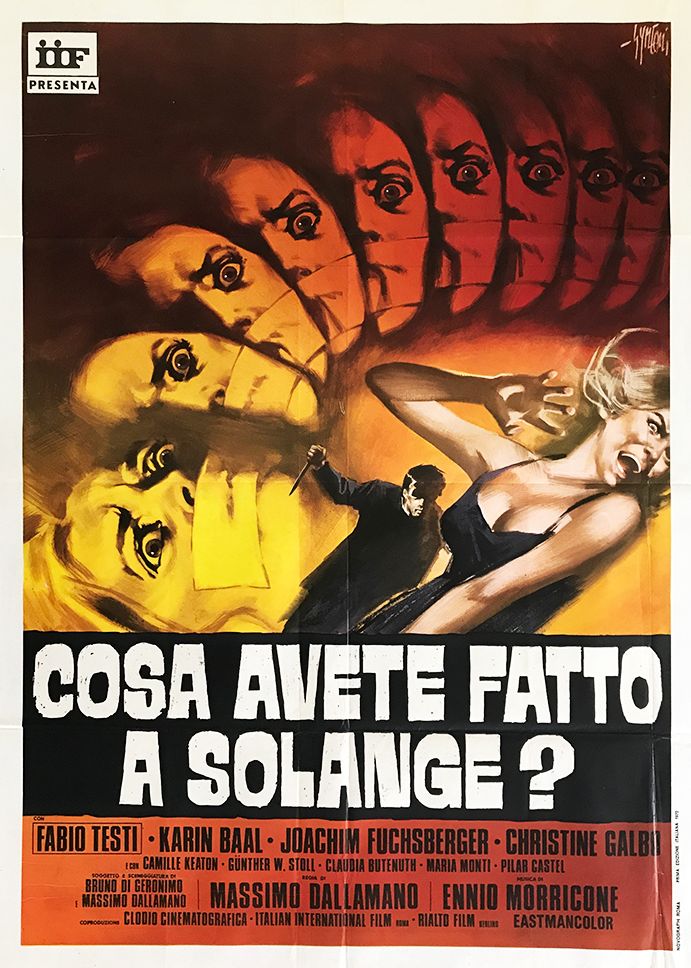
Enrico (Fabio Testi) is a high school teacher who’s having an affair with Elizabeth (Cristina Galbo) who’s one of his students. While making-out with her on a boat at a park Elizabeth spots a shadowy figure murdering a young girl in a nearby wooded area. The girl turns-out to be one of her classmates, but Enrico convinces her not to tell anyone for fear that it could jeopardize his job. Once the murder gets discovered and reported on the news Enrico goes back to the scene to check for clues only to be photographed by the police who are there doing the investigation. Inspector Barth (Joachim Fuchsberger) spots Enrico in the photo and brings him in for questioning. Enrico denies any knowledge of the killing, but comes under suspicion especially after Elizabeth is later found murdered in her bath tub. Enrico then reconciles with his frigid wife Herta (Karin Baal) in order to have her help him do their own investigation, so they can unmask who the real killer is before the police are able to close in on him.

The film is a unique partnership between a West German production company and an Italian one that was filmed on-location in London. While there are many German actors in the cast the film as a whole is modeled after an Italian giallo and has many of the mystery, gore, and sleaze elements that you’d expect from those. The direction, by Massimo Dallamano, who was a cinematographer of Spaghetti westerns during the 60’s, approaches the material with a visual elegance. The photography is crisp and detailed with some evocative camera work and angles as well as a few graphic shots including the murderers modus operandi, which is shoving a large knife up his victim’s vaginas, which not only gets revealed on the corpses, but also in x-ray version, but also a drowning death in a bath tub that gets played-out moderately well. In most slasher flicks the victim goes down easily when they’re attacked by surprise by their killer, but here this one struggles quite a bit making the killing more drawn-out and thus more realistic.

The plot though, particularly the second act, gets stretched too thin. We have an intriguing set-up and a zesty conclusion, but in-between it meanders. The biggest reason for this is that the protagonist and his quandary becomes neutered and thus all the potential drama from his situation evaporates. Having the inspector tell him upfront that he doesn’t think he did it hurts the tension and would’ve been intriguing if they thought he did, or he even became their prime suspect. Having Enrico make amends with his wife, at the beginning they’re at extreme odds and even close to fully hating each other, further moderates things as the wife could’ve been an interesting possible suspect too, killing the school girls and trying to make the hubby look like he did it in order to get back at him for cheating on her, but then having the two team-up just fizzles away a potentially dark undercurrent to their relationship. Showing Enrico working with the inspector ultimately makes him seem more like a side character in his own movie and by the end like he’s not really the star at all as the inspector completely takes over.

The one performer that does stand-out is Camille Keaton. She’s better known for her starring role in the cult hit I Spit On Your Grave, but here in one of her first performances in the front of the camera she’s quite impressive and she does so without uttering a single line of dialogue. She comes-in real late too to the extent I was starting to think she’d have some minor part and be spotted for only a few seconds, but her character comes-on strong despite not saying anything and is an integral component to the whole mystery. What I liked most about her was her trance-like demeanor and glazed over look in her eyes that’s both effective, creepy, and disturbing at the same time.

Spoiler Alert!

The film’s wrap-up could’ve been better done as it elaborates about the motives of the killer and the elements of the case too much saying things that the viewer should’ve been able to pick-up on during the course of the movie. For instance it describes the sex parties that these teen girls attended, but snippets of these orgies should’ve been shown and not just discussed. The film had no qualms with the violence, so why not have a little explicit sex as well. Also, Keaton’s character going in to have an abortion like it’s going to be some ‘fun activity’ didn’t seem believable. The attempt was to show that she was naive about how rough the procedure would be and thus became ‘traumatized’ by it afterwards, but she still should’ve shown some trepidation upfront as just about anybody else would.

My Rating: 7 out of 10

Released: March 9, 1972

Runtime: 1 Hour 47 Minutes

Rated R

Director: Massimo Dallamano

Studio: Italian International Films

Available: DVD, Blu-ray, Amazon Video, CONtv

White Mischief (1987)

whitemischief

By Richard Winters

My Rating: 7 out of 10

My Rating: Unsolved murder in Kenya.

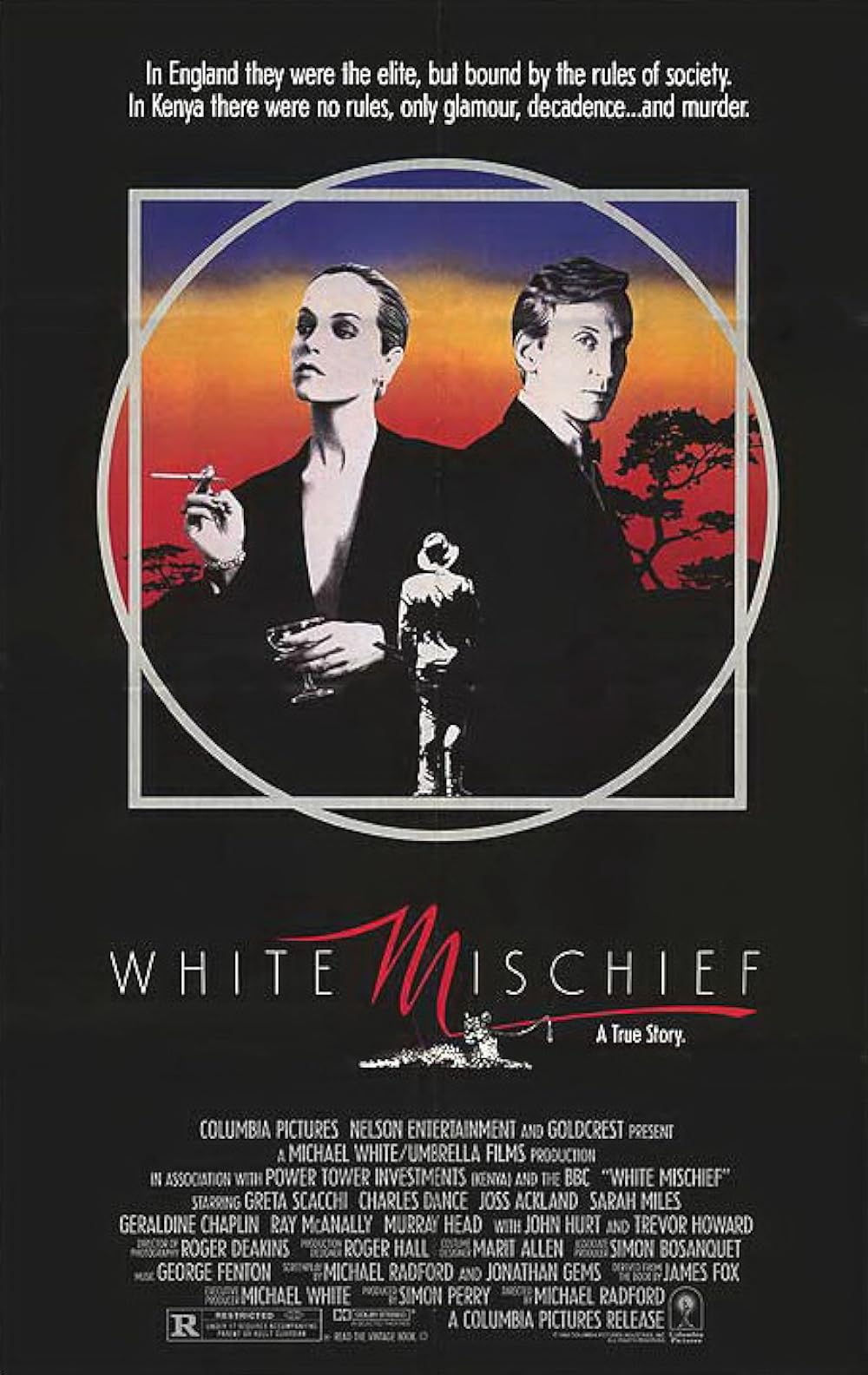
During the Second World War many British aristocrats with money escaped the tensions and horror in Europe by relocating at a settlement in Kenya that became known as Happy Valley. Here without the typical societal restraints of back-home they were able to indulge in all their provocative desires including rampant drug use and promiscuous sex. One such philanderer, possibly the most notorious of the bunch, was Josslyn Hay the Earl of Erroll (Charles Dance). He had already had various trysts with many of the women there including Alice (Sarah Miles) before dumping her due to her drug addiction. He then sets his sights on Diana (Greta Scacchi). She is married to Jock (Joss Ackland) who is older than her by several decades, and the two share a marriage of convenience with a pre-nuptial agreement that if either falls in love with someone else the other person will not impede it. Earl goes after Diana aggressively and despite some initial reluctance the two eventually become an open couple. Jock puts up a stoic front and allows her to go with him without any resistance, but internally he seethes with rage. Then one night Earl gets shot dead while driving his car in an isolate area. Did Jock pull the trigger?

The film is based on the book of the same name written by James Fox that was published in 1982 and in-turn based on the real-life incident that occurred on January 24, 1941 where the Earl of Erroll, like in the movie, is was found dead in his car and Jock, being the prime suspect, was put on trial, but then found not guilty due to a lack of evidence. For decades it sat as an unsolved case with no answers to what really happened until 1969 when Fox, along with fellow writer Cyril Connelly, became fascinated with the subject and began researching it vigorously. The book contains many interviews with people who lived through the ordeal and give first person accounts of the trial proceedings. Fox even traveled to the Kenya region to get a better understanding of the area and people and came to the conclusion that Jock had been the culprit with new evidence he unearthed, which makes up the book’s entire second-half though officially the case remains open.

The movie’s best quality is its visual element especially its ability to capture the expansive beauty of Africa as the film’s director Michael Radford proudly proclaimed before production even started that “films of Africa should be made by Africans” and you really get that sense here. The screenplay by noted playwright Jonathan Gems is also superb with it’s use of minimalistic dialogue where the conversations and characters never say too much, many times just brief sentences, and the emphasis is much more into what is implied.

On the negative end the attempts at eroticism are pathetic and overdone. The most absurd moment comes when the Sarah Miles character, during the open casket viewing portion of Earl’s funeral, reaches under her skirt and masturbates in full view of everyone before eventually putting her ‘love juices’ on the deceased, which came off as ridiculous and simply put in for a cheap laugh, or misguided ‘shock value’ and hard to imagine it occurred in reality. Both Scacchi’s and Dance’s characters are quite boring and their love scenes lack spark making the whole affair angle seem quite predictable.

The film’s saving grace though is with Ackland’s character where you really get inside his head and see things from his perspective. Normally in most films the jilted spouse is portrayed as someone to fear and a one-dimensional jealous machine who serves no purpose other than to get revenge. Here though we feel his quandary and sympathize with his internal struggle of trying to take the high road while also wracked with hurt and betrayal. Instead of being the culprit we ultimately see him as a sad victim even as his personality completely unravels by the end and because of this aspect I felt the movie works and is worth seeking out. Director Radford probably said it best when he stated that the film was about “people who have everything and yet have nothing. It’s about people who want to possess what they can’t possess” and with the excellently crafted Josh character you can really see that.

This is also a great chance to see acting legend Trevor Howard in one of his last performances. He was suffering severely at the time from his alcoholism and cirrhosis that he comes-off appearing like a wrinkled corpse put upright and there’s several scenes where he’s seen just standing there, but says nothing due to the filmmakers fear that he wouldn’t remember his lines, or if he did wouldn’t be able to articulate them. However, he does come through during a pivotal moment inside the prison when he visits Ackland and what he says and does there is great. John Hurt’s performance is the same way as initially he’s seen little and says no more than a couple of one word responses to the point I thought he was wasted, but then at the end he reappears and comes-on strong in an unique way.

My Rating: 7 out of 10

Released: November 10, 1987

Runtime: 1 Hour 47 Minutes

Rated R

Director: Michael Radford

Studio: Columbia Pictures

Available: VHS, DVD (Import Reg. 2), Amazon Video, Roku 

The Dogs (1979)

dogs

By Richard Winters

My Rating: 4 out of 10

4-Word Review: Canines on the attack!

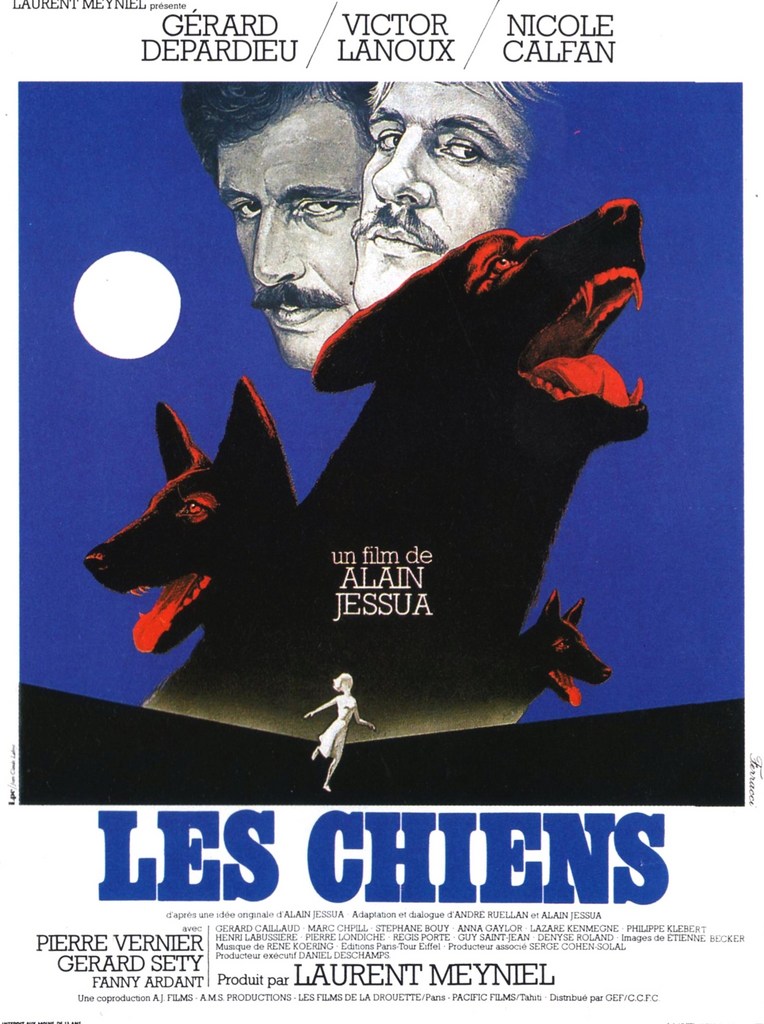
Henri (Victor Lanoux) is a doctor who opens up a clinic in a planned community. He finds to his surprise that many of his patients are coming in complaining about dog bites. He then becomes aware of Morel (Gerard Depardieu) who runs a club were participants learn how to train their dogs to protect them from attacks. However, these same dogs have now become more of a menace that’s putting other citizens in the town in danger including the mayor who becomes a victim. Henri is soon at odds with his girlfriend Elisabeth (Nicole Calfan) who gets a guard dog after she is raped and she is more attached to the dog than him.

The story certainly has some interesting ingredients including the fact that the dogs themselves  aren’t really the threat, but more their owners who train them to be aggressive, which is a nice change of pace from other films from that era that would show animals attacking for seemingly no reason, or that they had become possessed by something evil. Here the set-up is more realistic and plausible and the residents are wealthy living in plush homes helps convey the idea that even ‘nice’ neighborhoods can have evil dwelling underneath and no place is ever completely ‘safe’.

Depardieu goes against type playing the villain and he approaches the part in a fascinating way where he’s not outwardly creepy at the start, but more just an awkward individual who genuinely believes, which is a mindset that he continues to have to the very end, that he’s the ‘good guy’ who’s simply helping vulnerable people find ways to adequately protect themselves. He also has a profound love for his dogs whom he likes more than people, that comes to prominence during a graphic birthing seen where the mother dog isn’t able to come through it. His performance is even more impressive when you factor in that he suffered a dog attack of his own in real-life just a few months before being offered the role and he took the part hoping it would alleviate his pent-up fears and he certainly goes all out here including allowing the dogs to attack and bite him while wearing protective clothing during the training exercises that he conducts.

On the other end, as his adversary, I didn’t find Lanoux to be half as impressive. For one thing he never comes-off seeming like much of a doctor nor ever seen wearing a white physician jacket and works inside a place that resembles a rented out business office than a legitimate clinic. He looks and behaves more like a detached business man walking through his role and never being as emotionally charged as the part demanded.

Calfan, as the girlfriend isn’t convincing either. She leaves her job late at night all alone even though she’s well aware of the crime in the area, which makes it seem like she’s foolishly walking into trouble and the subsequent rape attack gets played-out in a cliched and mechanical way. He recovery is too quick as she’s back to be her normal self again almost instantaneously without showing any of the post traumatic effects that victims of the crime typically do. Her character’s arch offers some intrigue as she at one moment ‘jokingly’ tells her dog to attack Lanoux and then at the last second calls him off, which understandably frightens Lanoux and made me believe she was mentally moving into a dark mindset and she would become the source of danger, but this doesn’t lead to anything. By the end she ‘snaps out of this phase’ and goes back to being her normal self even to the extent turning into the hero, which I didn’t find interesting at all and it would’ve been far more memorable had she slowly became the threat.

The film is too leisurely paced. We know upfront that these dogs, and the people who own them, are something to be feared, but the actual attacks take too long to get going and when they do they’re too quick and ultimately start to play-out in a redundant fashion. The chills and thrills are limited and there’s not enough surprises or twists. There are also some disturbing segments including a dog getting kidnapped and then bound with a muzzle while dangling in the air by a rope as it whimpers, which many viewers including animal lovers will most likely find highly unsettling.

Alternate Title: Les Chiens

My Rating: 4 out of 10

Released: March 7, 1979

Runtime: 1 Hour 40 Minutes

Not Rated

Director: Alain Jessua

Studio: A.J. Films

Available: DVD (French), DVD-R (dvdlady.com)