Category Archives: Drama

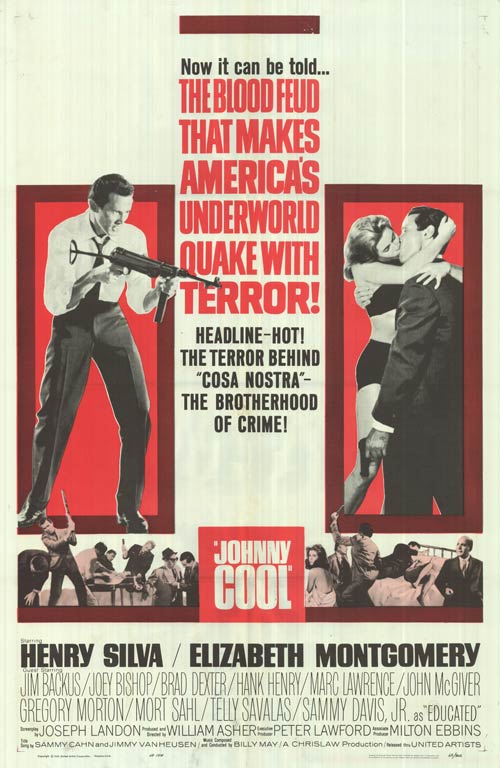
Johnny Cool (1963)

By Richard Winters

My Rating: 7 out of 10

4-Word Review: Top of crime world.

                Johnny Cool (Henry Silva) is really Giordano a man who grew to mythical proportions as an outlaw in a small Italian village after killing off some soldiers who tried to rape his mother. His exploits come to the attention of  Colini (Marc Lawrence) who has been exiled to Sicily because of his gangster past. He stages a fake assassination of Giordano in order to kidnap him and train him to go back to the United States and kill off the men that ordered his downfall. Johnny does this, but then becomes even more powerful than Colini was and soon he is both feared and hunted by the crime world.

The film, which was directed by William Asher, is nicely paced. I liked the fast, gripping action, the pounding music, and raw approach. The black and white photography nicely accentuates the gritty subject matter. Although it may seem a bit tame by today’s standards I still found most of it to be intense and uncompromising especially the ending.

Lots and lots of famous faces pop up everywhere, which is fun for a bit, but then takes you out of the story as it seems to become more like ‘spot the star’. Some of the cameos are small and pointless while others are more interesting. Sammy Davis Jr. has a tense scene playing a man with an eye patch who must role a specific number with the dice or be blown away by Johnny’s gun, which is aimed directly at his temple. Joey Bishop is funny as a fast talking used car salesman and his feeble attempts at making a play at the beautiful Dare (Elizabeth Montgomery). John McGiver is equally fun as a perplexed store manager who brings in a woman to his office after finding that she has been writing a lot of bad checks. The exchange he has with her is a perfect example of why sexual innuendos where a lot more interesting and creative back in the old days when the standard didn’t allow them to be as crass and vulgar as they are now. Here the lady states “I can make those bad checks good.” And McGiver responds after eyeing her figure “Yes, I think you can!”

Telly Savalas is wasted. The man is a great character actor especially as a villain. Playing a tough crime boss from Brooklyn is his forte and he could have really gone with it had they given him a bigger part. Marc Lawrence is equally evil as Colini and showing him only in one scene and then disappearing was disappointing. Jim Backus’s appearance was a mistake. A funny, talented man for sure, but I didn’t like that he did his Mr. Magoo laugh several times here as it did not fit the gritty mood.

Henry Silva has proven to be a great villain throughout his career, but in this role it just doesn’t work. His eyes have a weird type of stare that makes it look like he has been drugged. He delivers his lines in a monotone fashion. The character becomes overblown and some may find his use of the karate chop to be a bit cheesy. He kills a man on an escalator amidst a crowded airport and is able to get away. There are several other scenes where he is able to somehow get into a secure area and kill off people without any explanation for how he was able to do it.

Elizabeth Montgomery, who was at the time the wife of the director, is fantastic. She plays a brunette and does well with a multi-faceted character that goes from helpless victim to conniving double-crosser. She is shown in several scenes wearing no make-up and I liked the naturalistic quality. My only quibble is the scene where she gets roughed up by some gangsters, but the only mark left on her is a bruise on a shoulder even though a few bruises, scratches, and cuts on the face would have been not only more believable, but visually more effective.

My Rating: 7 out of 10

Released: October 2, 1963

Runtime: 1Hour 43Minutes

Rated NR (Not Rated)

Director: William Asher

Studio: United Artists

Available: DVD, Netflix streaming
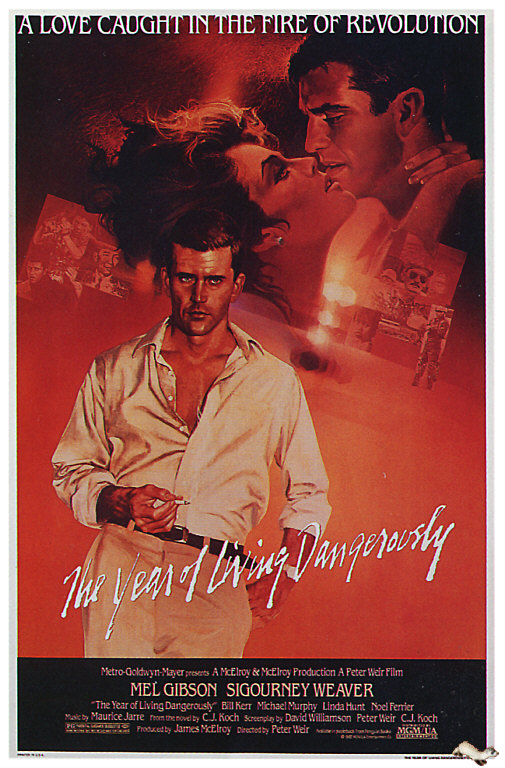
The Year of Living Dangerously (1982)

By Richard Winters

My Rating: 5 out of 10

4-Word Review: Experiencing life in Indonesia.

      Guy Hamilton (Mel Gibson) is a reporter who travels to Indonesia in 1965 just as the government is ready to be toppled. He experiences all the chaos as well as the poverty of the people and apathy from his fellow newsmen. He falls in love with a beautiful diplomat Jill Bryant (Sigourney Weaver) who works with a dwarf photographer named Billy Squires (Linda Hunt in her Academy Award winning performance), and eventually finds himself reluctantly thrust into the middle of the turmoil.

     The film is great at recreating the environment and atmosphere of that period. One gets a very good understanding and feeling at just how poverty stricken and desperate the Indonesian people where. Linda Hunt is unique and memorable as the male dwarf. She also has a great line when a fellow photographer asks her opinion of a picture that he took of a naked woman. He wants to know if she thinks it is art or pornography. Her reply, “If it is out of focus it’s art, if it is in focus it is pornography.” It is also fun to see journeymen supporting actor Michael Murphy playing against type. Usually he is saddled with rather transparent types of roles, but here his character is quite obnoxious.

      It would have been better had the film given the viewers a little bit more of a historical background before it just plopped the characters into a very chaotic and confusing situation. Most people probably have no clue as to the history of Indonesia let alone finding it on a map. It would have also been more interesting had the film been based on real people who really lived through the situation instead of predictable prototypes. A very young Gibson seems a bit overwhelmed with his role. His character seesaws from being boring to exasperating. He gets a huge crush on the Weaver character and chases after her like she is the only thing on his mind and then when she gives him an important piece of information he pounces on it even if it means losing her and their relationship. The pace is hurt by having the film spend too much of its middle section focusing on the romance, which really isn’t all that interesting or diverting. The ending is much too pat for a story that takes place in such a dangerous and complex environment.

      This is a grand idea that becomes too muddled and doesn’t place enough emphasis on the historical background and context. The lead character is boring and the pace is not compelling enough.

My Rating: 5 out of 10

Released: December 17, 1982

Runtime: 1Hour 55Minutes

Rated PG

Director: Peter Weir

Studio: MGM/UA

Available: VHS, DVD, Amazon Instant Video

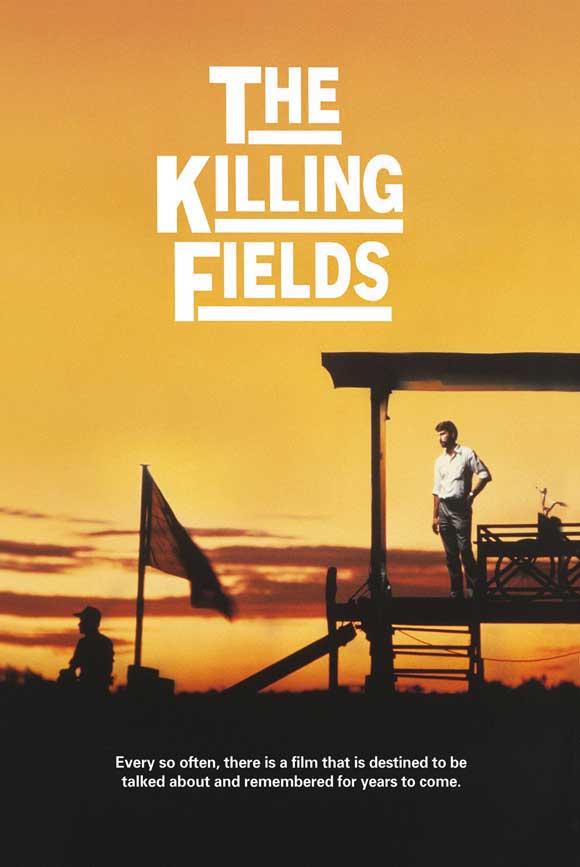
The Killing Fields (1984)

By Richard Winters

My Rating: 9 out of 10

4-Word Review: Journalists trapped in Cambodia.

This is an excellent fact based drama of Cambodian photo-journalist and English interpreter Dith Pran (Haing S. Ngor) who gets swept up in the Khmer Rouge revolution of the 1970’s and forced to survive for four years in their harsh work camps of ‘year zero’.

This film is intense, compelling, and uncompromising. The story stays very close to the true account and it is recreated with a believable atmosphere. Mike Oldfield’s unique music score is fabulous. The music that is played during the evacuation of the U.S. Embassy is one of the creepiest sounding scores that I have ever heard and it is quite effective. Oscar winner Ngor is good in the lead role and creates a tremendous amount of sympathy from the viewer and the ending still has a major emotional impact. Yet the most lasting images of the film are from the children. During one of the battle scenes a close-up of a child is shown holding his ears and crying while another scene has a screaming child in a hospital who is having shrapnel taken out of her spine. This is then correlated with the work camp scenes where the children are protrayed to be the most brainwashed by the party line and become the biggest instigators and purveyors to the torture and mayhem making it even more disturbing. In the end this film makes you ponder and feel the ugly depths of this very bleak and historical event.

On the negative side I felt it could have used some voice-over narration to help connect the scenes especially at the beginning. Some subtitles would have also been helpful during the scenes where none of the characters speak any English. The Sydney Schanberg character, played by Sam Waterston, seems at times to be quite obnoxious. He acts like being a journalist should somehow entitle him to everything and make him above everyone else. Also during scenes when he is photographing and covering the war ravaged victims he is more concerned with getting a nice graphic picture so it will sell more copy then he does with the actual suffering of the victim.

Overall this an extremely powerful and well-staged account of a horrific event that should not be forgotten, but unfortunately probably has for a lot of people.

My Rating: 9 out of 10

Released: November 2, 1984

Runtime: 2Hours 21Minutes

Rated R

Director: Roland Joffe

Studio: Warner Brothers

Available: VHS, DVD (Region 1 and 2), Amazon Instant Video

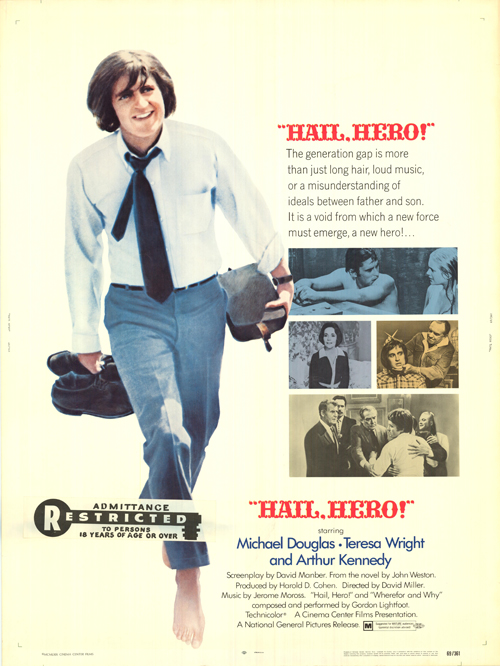
Hail, Hero! (1969)

By Richard Winters

My Rating: 5 out of 10

4-Word Review: Michael Douglas film debut.

Okay all you Michael Douglas fans out there, you know him, you love him, and you’ve seen all his movies, but what was his film debut?  I say this because I have known other fans of stars who are a bit vague when asked about early films of their favorite actors. I remember one lady who was in her 20’s, who I knew from work and professed to be a ‘huge’ Jack Nicholson fan, but when I asked her about some of his early films, which I had enjoyed including Five Easy Pieces, and King of the Marvin Gardens, she drew a complete blank. In fact she was not aware of any of the movies he did before The Shining. I had a similar experience with another lady friend I knew from a different job who professed to be a big Goldie Hawn fan and yet had no idea what film she had won the Academy Award for, which was in 1969 for Cactus Flower a movie that she hadn’t even heard of.  So I was curious how many Michael Douglas fans are actually aware of some of his early work. In fact this film, which was his first, was released when his future wife Catherine Zeta-Jones was only 11 days old.

It is the story of Carl Dixon (Douglas) who is an idealistic, peaceful young man that joins the army simply to please his conservative father (Arthur Kennedy). The film is a pleasant, even touching look at a someone learning to face the difficult and complex issues of adult life and realizing there are no easy answers. The movie doesn’t try to make any type of statement while carefully examining both sides of the issue. There isn’t any ‘bad guy’ here. The characters are real and multi-dimensional. The conversations and debates that they have are ones that went on in many households across the country at that time.

Douglas looks expectedly younger and initially I didn’t even recognize him. His hair is long, at least initially until his father cuts it, and his eyebrows are bushy and his voice much higher pitched. His performance is excellent and the  character his likable and engaging especially with the way he treats everyone with respect and is so generous that he gives his entire suitcase of clothes to a poor family in need.

Kennedy is perfect as the old-school father and my only complaint here is that I wished he had been in more scenes. Theresa Wright, as Carl’s mother, is okay, but she is not given enough screen-time either. She is also caught having an affair, but the film does not delve enough into this, but should have. Louise Latham is terrific giving one of the best performances of her career as a hermit-like woman living alone in a cave alongside the skeletal remains of an Indian baby.

There are some good scenes including Carl’s visit to a senior home where he comes face-to-face with the difficulties of aging as well as when he finds himself ready to strike someone at a party whom he does not agree with and realizing that violent tendencies lurk within anyone even those purporting to be pacifists. Yet the film fails to leave any lasting impression. The ending is weak and the story does not progress enough. The viewer is left feeling almost cheated because we are never shown how these characters evolved. In my opinion the material was insufficient for a feature film.

My Rating: 5 out of 10

Released: October 4, 1969

Runtime: 1Hour 40Minutes

Rated M

Director: David Miller

Studio: National General Pictures

Available: VHS

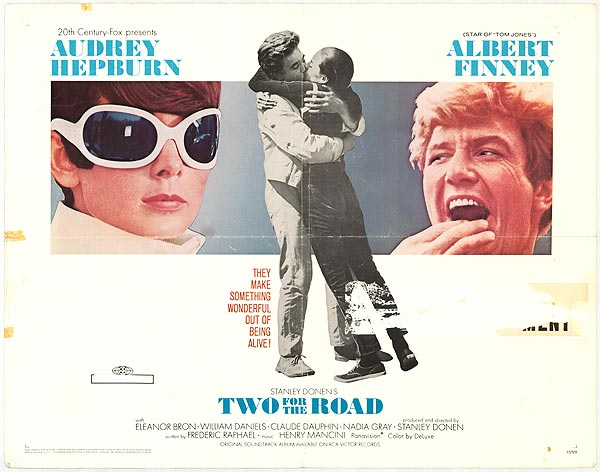
Two for the Road (1967)

By Richard Winters

My Rating: 6 out of 10

4-Word Review: Couple examines their marriage.

This is a unique and diverting look at a couple (Albert Finney, Audrey Hepburn) traveling the French countryside while dissecting their turbulent marriage. The road of course represents their long and winding relationship. It cleverly cuts between when they first met, which seems to have been on the same road, to twelve years later. The edits between the two stages are creative as is the majority of this fluid and entertaining movie. It wants to be silly, fluffy, serious, complex, exotic, avant-garde, and romantic all at once and most of the time it succeeds proving what an over looked, unsung genius director Stanley Donen is.

It’s a movie made for couples, but probably those who have been married for quite a while and can relate to the characters here who have been through the rough spots and have learned to accept their partner and the flaws that come with them. This film tries to dig a little bit deeper, which helps it stand out. It also has a more relaxed European attitude, especially in regards to ‘indiscretions’.

On the negative side the film contains a lot of old fashioned sexist attitudes. For instance the man is expected to be mechanically inclined and in control of every situation, which becomes very apparent in the scene where he has to get underneath the car to fix it while she sits on top of the vehicle without any care or inclination to what he is going through. The man is also expected to be the sole provider of the family while the woman does the majority of the child rearing.

Audrey, who wears an amazingly high number of stylish, chic outfits, looks more like a runway model sporting the latest fashions than an average housewife on a country drive. I realize that they wanted to accentuate her beauty, but it ends up being a distraction at the same time. If the intention of the story is about an average couple going through average marital problems then at least have them look the part.

The Henry Mancini score is pleasant as usual, but eventually gets overplayed. It’s also not as introspective as it wants you to believe, but on a slickness level it gets an “A”. Also, watch for Little Ruthie who is the world’s most obnoxious child.

My Rating: 6 out of 10

Released: April 27, 1967

Runtime: 1Hour 51Minutes

Rated NR (Not Rated)

Director: Stanley Donen

Studio: 20th Century Fox

Available: VHS, DVD

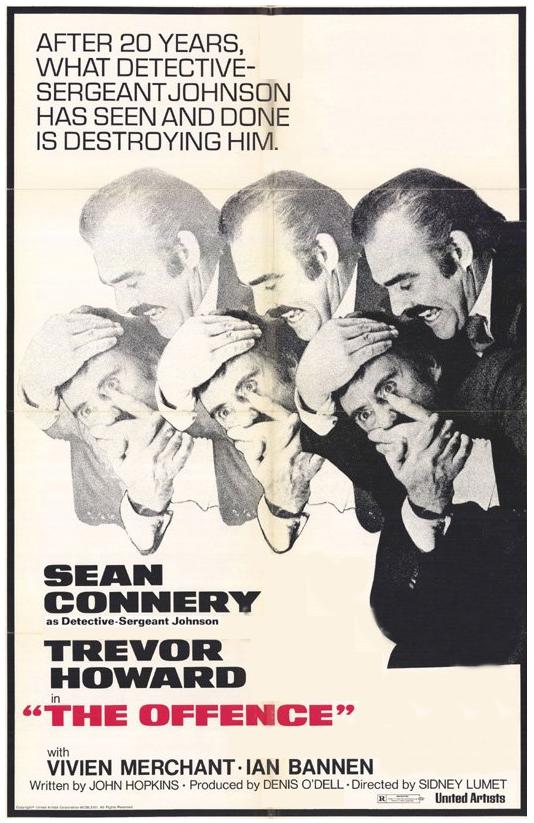
The Offence (1972)

By Richard Winters

My Rating: 8 out of 10

4-Word Review: Interrogate the child molestor.

Well respected, longtime police detective Johnson (Sean Connery) becomes so burned-out by all the sickening crimes that he has seen through his career that he snaps during the interrogation of a suspected child molester (Ian Bannen) and ends up beating the man to death.

Based on the stage play by John Hopkins this film has lots and lots of talking and some may say there is too much of it. The script is split into three drawn out conversations between two people. One is between Johnson and the suspect, the second is between Johnson and his wife (Vivien Merchant), and the third is between Johnson and the man brought in to investigate the incident, which is played by Trevor Howard. By the end even the most patient viewer may feel a bit talked out and it gets especially trying when you realize that the same issues are being discussed over and over again.

Yet that is not to say that this is a poor film as the visual element is excellent. In many ways you can appreciate the production for its visual style alone. Director Sidney Lumet displays a good handle on the material and it’s technically sharp on all levels. The lighting is well composed with the center that is bright, but the corners that are shadowy much like the human psyche and society. The overall grayness helps bring out the depression and isolation of the main character. The pacing is slow, but deliberate. Each scene builds to an intense crescendo. The music soundtrack resembles that of a one tone alarm that keeps building to a higher pitch much like the alarm ready to go off in Johnson’s head. The character’s inner tension is made even more vivid by Lumet’s use of interposing the bright light of the interrogation room over the screen. It is hard to imagine this film being any better crafted and it is a terrific training tool for the inspiring filmmaker.

Despite being talky the script in itself isn’t bad as it makes you aware of the ugly side of police work. It focuses not on the system or corruption, like a lot of other police films, but more on the actual work itself. It questions whether someone who is bombarded with the daily gore and societal sickness can remain sane and whether ‘leaving it all at the office’ is even possible. Every officer may eventually suffer scars from his job experience.

In a way this may be Connery’s best role. He shows his usual tough exterior, but also has moments where he unravels into a helpless, scared man. Bannen does an equally good job as the suspect. You are never really sure if he is guilty or not. The fact that he gives off a leering grin even after being beaten gives this film an added edge.

This is an oppressive and unrelenting movie filled with stark and unpleasant imagery that may stay with you long after it is over. Yet it is also expertly crafted and brings up some serious and important issues that are as timely today as they were back then.

My Rating: 8 out of 10

Released: January 11, 1972

Runtime: 1Hour 52Minutes

Rated R (Mature Theme)

Director: Sidney Lumet

Studio: MGM

Available: VHS, DVD (Region 1 and 2), Amazon Instant Video

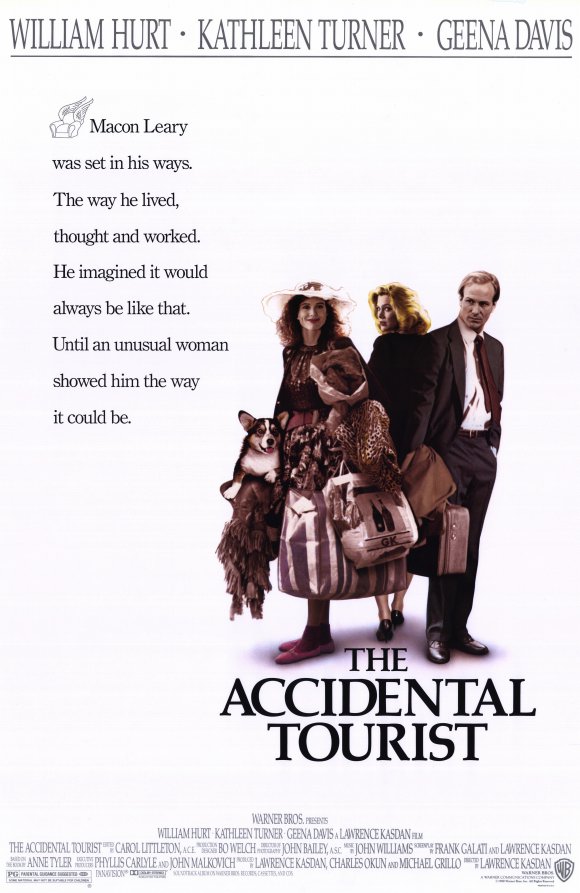
The Accidental Tourist (1988)

By Richard Winters

My Rating: 6 out of 10

4-Word Review: Introverts need love too.

            Macon Leary (William Hurt) is an introvert who writes travel books for a living despite the fact that he dislikes traveling. His marriage to Sarah (Kathleen Turner) ends after the untimely death of their son. His wife used to babysit his dog Edward while he was away, but now he decides to drop him off at the local animal shelter that is run by Muriel Pritchet (Geena Davis). She is colorful and talkative and his complete opposite and eventually a romance begins to blossom.

The film, based on the novel by Anne Tyler, takes its time in telling its story.  In some ways the leisurely pace is refreshing. Trying to get an introvert to be more extraverted is never easy and the way Macon is initially reticent towards Muriel’s advances was realistic. Yet it does drag at certain parts and seems to go on too long. The second hour, in which Sarah comes back in the picture and Macon is forced to choose between the two, is much more interesting and compelling. The side-story where Macon’s publisher Julian (Bill Pullman) romances Macon’s sister Rose (Amy Wright) was unnecessary and does nothing but make a slow movie even longer. I also didn’t find the eccentricities of Macon’s family to be all that amusing as they were exaggerated and portrayed introverts as being freaks instead of people who simply function better independently instead of within groups.

The Muriel character is a bit over-blown as well. She comes on too aggressively towards Macon before she even knows him. There is nothing shown for why she found this man immediately attractive especially when he constantly responds to her in a cold and distant way. Later on we learn that she is poor and possibly found Macon to be well-off financially and a good stable father for her son, but even so her behavior seems a bit too forward and bordering on being shameless. Her outfits are over-the-top. I realize they are supposed to accentuate her kooky personality, but they come off as gaudy and garish and like they are being worn by someone who has no sense of style or taste.  The part where she quietly hugs Macon when he explains to her about the death of his son is moving and the first moment when I began to like the character. However, director Lawrence Kasdan ruins it by then having her strip of his clothes and climb into bed with him, which took things too far. In film sometimes the strongest statements can be made with the simplest of images and it seemed like here they had it and then lost it.

Turner is okay as the ex-wife, but I initially felt the character was unnecessary. I didn’t like it at the beginning when they are breaking-up and she goes into great detail about his character faults sounding almost like she was analyzing him for a psychological assessment. It seemed to me like she was being used to help ‘explain’ his character to the viewer when in a good film the viewer should be able to come to these deductions themselves without the help of an on-screen ‘tutorial’. Later on as she fights to get Macon back the character becomes stronger and better fleshed-out. I even ended up feeling sorry for her as her own insecurities and jealousies do her in.

Hurt is solid in the lead playing an atypical role. I wanted more of an explanation about the death of their son. It takes quite a while before it gets explained and then we are told that it was during some botched robbery at a burger joint, but it was still unclear to me why he was there and not the parents, or how it all played out. Having a flashback with a news report involving the incident would have helped. The film has many other flashbacks, some of them quite good, so another in this area would have been nice.

The music score is pleasing, but too reminiscent of ones used in other films from that era. It also has a bit too much of a whimsical quality that is not fitting for a drama such as this. The Muriel’s eight year old son is cute, but a bit too cute. I found the scenes where Macon bonds with the kid to be touching, but when films seemed compelled to only show children spewing out cutesy, innocuous comments I find it a bit annoying.

Overall this is a quality production made probably more for the female viewer looking for an intelligent, sensitive romance.

My Rating: 6 out of 10

Released: December 23, 1988

Runtime: 2Hours 1Minute

Rated PG

Studio: Warner Brothers

Director: Lawrence Kasdan

Available: VHS, DVD, Amazon Instant Video, Netflix Streaming

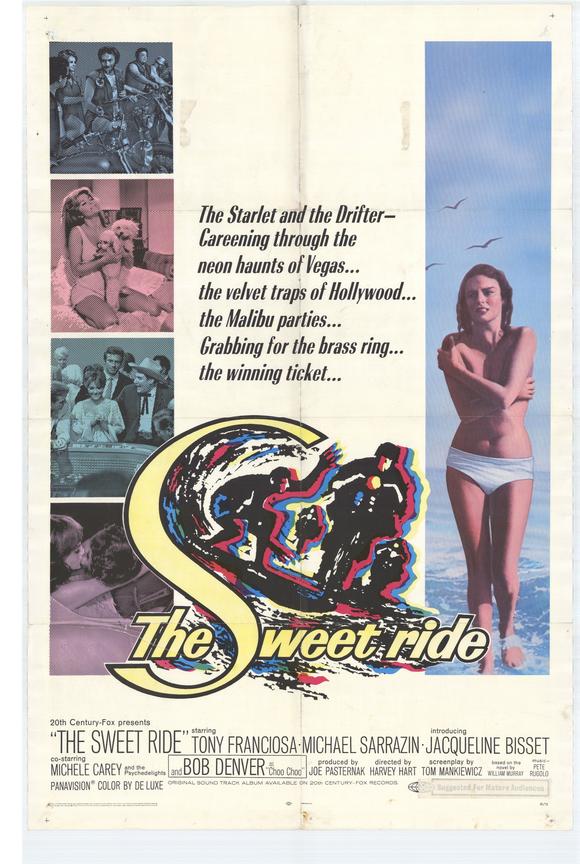
The Sweet Ride (1968)

By Richard Winters

My Rating: 4 out of 10

4-Word Review: Bachelor pad on beach.

This is an obscure and ponderous film dealing with three bachelors(Anthony Franciosa, Michael Sarrazin, Bob Denver) who live in beach house and one day come upon a beautiful woman named Vickie Cartwright (Jacqueline Bisset) swimming in the ocean. They all make a play for her yet it is Denny (Sarrazin) who she falls for. Eventually though her erratic behavior and secret past become too much for him.

The theme is similar to that of Petulia, which came out around the same time. That film proved more successful because of its intricate, stylish narrative and deeper intellectual understanding. Technically this is well directed, but the color is washed out and there seems to be an ugly brownish tone permeating every shot. Some of the sets look cheesy especially the ones used for the indoor bar scenes. The story is too pedestrian and stretched too thin. It starts with some nice interplay between the three men, but that quickly evaporates and by the second hour it has become really boring. There’s some action at the end, but it’s standard and pointless. The resolution itself is too convenient and the relationship between Denny and Vickie is unexciting.

The story does offer some potentially intriguing undertones, but the film never pursues them. The girl herself is an interesting element. We come to realize through the course of the story that she lives a very, very sad existence. The film could have been meatier had it a given us a wider scope of her life and not just the little tidbits that it does. It also could have shown us more of a background to her character and examined how she came to being the way that she was.

The film’s chief asset is the bachelor pad itself, which is a dream for the single male. It’s well designed and sits right on Malibu beach with a terrific view of the ocean. There is beer and liquor everywhere as well as beautiful women coming in and out. The constant sound of the crashing waves in the background give off a soothing effect and the setting allows this film more points than it might otherwise deserve.

Some credit must also go to Franciosa an actor that never really attained much stature. His role here may actually be his finest moment. He plays the eldest of the three men and is as tan, muscular, and good looking as any forty year old can get. He’s as flippant a character as you’ll ever see and adds zest to each scene that he is in. Some of his sardonic comments about his bachelorhood add insight as to why some people are single and want to stay that way.

Dusty Springfield belts out the opening song and really gives it her all.

My Rating: 4 out of 10

Released: June 12, 1968

Runtime: 1Hour 50Minutes

Rated NR (Not Rated)

Director: Harvey Hart

Studio: 20th Century Fox

Availability: None

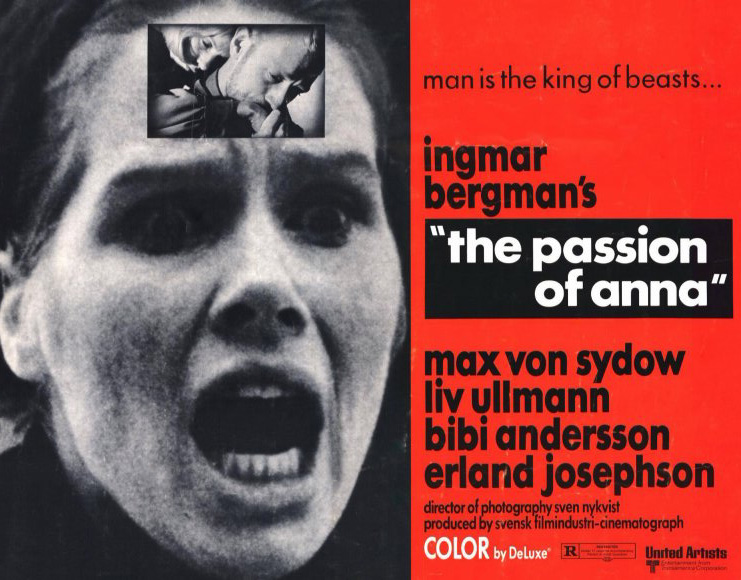
The Passion of Anna (1969)

By Richard Winters

My Rating: 8 out of 10

4-Word Review: Lonely little island retreat.

This is an intriguing film that seems quite similar to Roman Polanski’s Cul-De-Sac. Both films have a unique atmosphere and take place in a remote island setting and deal with a turbulent undercurrent that brews just underneath its deceivingly placid exterior.

Here we have Andreas (Max Von Sydow) living a lonely existence on an island retreat. He meets, by chance, Anna (Liv Ullmann) who is still grieving from the death of her first husband. The two form a tenuous relationship that slowly unravels as the dark corners of their personalities are eventually exposed.

In many ways this film has all the right ingredients. It wraps you up in its surreal nature and adds interesting effects. There are some creepy elements including a mad killer running around the island killing and torturing all the animals. Things work at a deliberate pace and leave no clue as to where it is headed. The characters are unpretentious and introspective. They are open about their faults and failures and give good reason as to why they have them. There are also fascinating cutaways to the actors themselves who help explain and interpret their characters motivations, which is a novel idea that gives the viewer a deeper understanding of the characters and adds an extra dimension.

Unfortunately it doesn’t come together and leaves no real emotional impact. There are a few good twists, but you can’t help but feel that it should have gone farther. There a certain scenarios that get touched on, but are never explored. For instance there is Andreas’s relationship with Elis (Erland Josephson).  Andreas has taken a loan out from him, but has also had an affair with his wife. This of course has some potential for fireworks and there is a moment where it begins to sizzle, but it never goes back to it. The same thing can be said for many of the other segments including the identity and reason for the animal killer.

Overall this is an outstanding experimental-like movie. It is not one of director Ingmar Bergman’s best, but it is still richer and more deeply textured than eighty percent of the other movies that are out there. The crisp and revealing dialogue alone makes it worth it and Bergman displays the most realistic perspective on the union of marriage.

My Rating: 8 out of 10

Released: November 10, 1969

Released: 1Hour 41Minutes

Rated R

Director: Ingmar Bergman

Studio: United Artists

Available: VHS, DVD

Moscow Does Not Believe in Tears (1980)

By Richard Winters

My Rating: 6 out of 10

4-Word Review: Three women three stories.

            Some Russian lady friends of mine suggested I review this film, which is a favorite of theirs and awarded the Oscar for best foreign film of 1980. The story deals with three women who room together at a boarding house and detailing their hopes, dreams, and personalities and then the second half examines them several years later and showing how much they have evolved.

The film has a definite European flair in that characters are well-rounded and believable. I found myself liking them right from the beginning and genuinely interested in their fates.  Lyudmila (Irina Muravyova) is engaging and amusing in her attempts to snare a man with prestige and money. Katerina (Vera Alentova) is equally interesting in the other way. I liked seeing how she starts out as shy and naïve, but blossoms into a strong, successful, self-assured woman by the end. The film takes its time in telling the story, letting you get to know the characters and allowing the scenes and situations to gel without the need for any quick edits, or cuts. I also thought director Vladimir Menshov does an excellent job with the women’s aging, which is natural but impressive without any use of make-up. At first I thought the movie had been filmed over a several year period in order to make the aging look so realistic, but that was apparently not the case. In discussing this with my Russian friend she tells me that the women were already in their 30’s when this was filmed, but even if that was the case then making them look so youthful at the beginning is still a successful feat.

The film is not a completely dour drama and manages at times to have a nice light-hearted touch with good amounts of humor. Lyudmila’s schemes are delightful at the beginning, but I also enjoyed the old man who joins a singles social club and then complains that all the women in his age group are ‘old hags’ forcing the program director to offer him a spot in a younger age group of women between 35 and 50 and he still complains that he would like them ‘even younger than that’, which only goes to prove that there’s always ‘dirty old men’ in every culture no matter where you go.

If you are expecting the film to deal with the oppressive aspects of the communist regime you won’t find it here. Most foreign films, especially those that won awards at the time, usually had this as their running theme, but here it doesn’t even touch on it. Yet I was still able to find traces of it including a scene near the beginning where a couple on a city sidewalk is told by an official that they are showing too much affection. There is another segment where Katia is being interviewed at her job in a factory by a news program. The interviewer exclaims that because Katia has shown signs of being creative that the task of a machine fitter is a ‘perfect’ job for her, which I found funny. She then asks Katia if she will be going to college, so she can get a degree and come right back to the same dreary factory and work as an engineer. I found this to be funny also, but my Russian friend tells me that the title of engineer in her country at the time was a highly regarded position that paid well, even though in America the idea of going to college is so that one can get a good education and not have to work in a factory at any level.

Another part of the film that may confuse American audiences is when Katia finds that she has become pregnant by a man that she is not married to. When she tells him the news he refuses to pay any support and she does not take him to court in order to force him. My friend explained to me that in Russia the single woman will typical not demand support from the man as this is apparently a source of ‘pride’ in their culture although many women here will find that difficult to relate too.

On the technical end the film looks like it was done on a miniscule budget. The color is faded and the images are fuzzy. Everything is filmed in places that show little that is interesting aesthetically. I thought with the word ‘Moscow’ in the title that there should have been more images of the city and scenes done at certain exotic locales to allow the viewer to get familiar with the region. There is a bit too much music. Although it is not in every scene the majority of the film has music going on underneath the conversations almost like a radio playing in the background and in my opinion it gets distracting.

My biggest complaint is that the second half spends too much time focusing on Katia and no one else. The synopsis for the film from several different sources describes this as a story about THREE women, but the by the end it is really only about one. I was disappointed as I found Lyudmila fun and I wanted to see more of her and the third woman, Antonina, is barely shown at all to the point that we get to know little about her.  Katia’s late-blooming romance goes on too long and seems a bit forced. Having her old boyfriend suddenly reappear and try to get back into her life is strained and the fact that he initially didn’t recognize her seemed hard to believe.

The story and scenarios are not original and have to varying degrees been done many times before. Unlike other Russian classics that I’ve liked including Solaris and Stalker this film lacks anything profound and comes off as a typical drama that is passable and entertaining, but not great.

My Rating: 6 out of 10

Released: February 10, 1980

Runtime: 2Hours 22Minutes

Rated NR (Not Rated)

Director: Vladimir Menshov

Studio: Mosfilm

Available: VHS, DVD (Region 1 and 2)