Category Archives: Drama

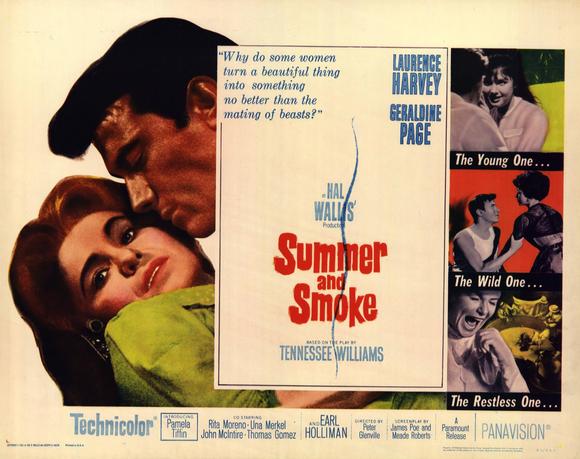
Summer and Smoke (1961)

By Richard Winters

My Rating: 7 out of 10

4-Word Review: She is sexually repressed.

Alma (Geraldine Page) is an adult woman still single and living with her parents. Her father (Malcolm Atterbury) is a minister while her mother (Una Merkel) having suffered a mental breakdown several years’ earlier acts and behaves in a perpetual child-like state. Alma yearns for the affections of John (Laurence Harvey) the dashing doctor who lives next door with his father (John McIntire). However, John’s lifestyle is much too wild for Alma’s repressed tastes, but when she tries to change she finds that it may be too late in this film version of the Tennessee William’s play.

I have been a fan of Geraldine Page for years. She has a terrific ability to play fragile and eccentric characters while doing it with a panache and style. Her characterizations are always vivid and revealing and executed in a seamless fashion. One can become so entranced with her performances that sometimes it becomes more interesting than the story itself. Her appearance here proves to be no exception. She became known for playing a lot of dark, sinister characters, so it was a nice change seeing her play this part. She even does some singing and in fact the scene where she sings to John’s father as he lies on his deathbed for me left the most lasting impression. I always love watching the woman’s body language, gestures, and facial expressions and how she uses them to create a three-dimensional character. Her acting discipline should be studied and emulated by students of the craft everywhere.

Harvey as her co-star was an interesting choice. Despite his reputation as being an over-rated actor and possessing a strange personality off-camera I have found some of his performances to be excellent particularly the one in the original Manchurian Candidate. However, he seems to be better suited playing parts with a cold and aloof presence. The role here demanded more emotion and I didn’t think he could quite hit it. By the end Page was acting circles around him and turning the production into her own vehicle.

The supporting performers aren’t bad. It is fun seeing Rita ‘Hey you guys’ Moreno in an early role playing a young vixen with eyes for John. McIntire is fine in his small role and the part where comes home to find all sorts of drunken people lying about passed out in his living room and hallways is good. Thomas Gomez is memorable simply to glimpse his large almost unbelievable waist size.

I really didn’t like Merkel’s part as the crazy mother. I found it frustrating that there really was never any explanation for why she behaved in such a strange way. Simply saying that she had a ‘breakdown’ wasn’t enough and I wanted more of a scientific or medical reason. It also would have been more interesting to see what she was like before her breakdown, but that is never shown.

Technically the film is well produced. The sets, costumes and performances are all very turn-of-the-century and it helps draw you into the mood and thinking of the era right away. I did not like that the outdoor scenes where done on a soundstage as the foliage and sky look annoyingly artificial.

Most of William’s plays deal with sad, lonely, and pathetic characters and this one proves no exception. However, I was pleasantly surprised that after the expected histrionics this one manages to have a somewhat upbeat ending, which helped distinguish it above some of his others. The characters and situations are all too real and Alma reminded me very much of someone I know and others may know someone like her as well, which on a personal level made this story all the more fascinating.

My Rating: 7 out of 10

Released: November 16, 1961

Runtime: 1Hour 58Minutes

Rated NR (Not Rated)

Director: Peter Glenville

Studio: Paramount

Available: DVD, Amazon Instant Video, Netflix streaming
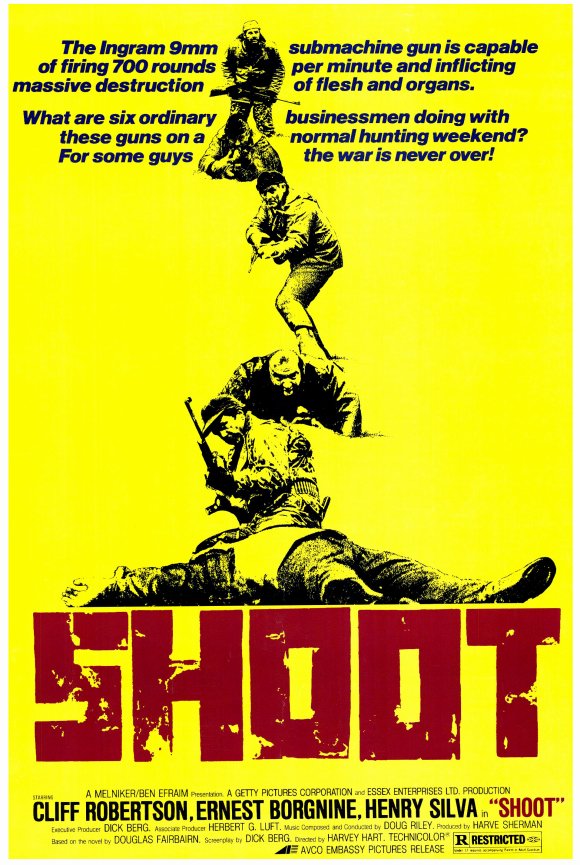
Shoot (1976)

By Richard Winters

My Rating: 2 out of 10

4-Word Review: Hunters out for revenge.

Rex (Cliff Robertson) is a man who really enjoys hunting and especially likes his guns, just watch the way he cleans and caresses it at the beginning, it’s almost obscene. He takes his buddies out on a hunting party in the woods. They come upon a group of other hunters and for some inexplicable reason they begin shooting at each other until one of the men in the other party dies. Rex and his group go back home sure that the police will be contacted and an investigation to pursue, but that doesn’t happen, so Rex thinks they are out for revenge instead. He becomes convinced that the other party plans to attack his group at the exact same spot the very next week. He gets his men ready for battle and dressed in army gear as they prepare for what they believe will be all out warfare.

Part of the problem with this film, which is based on the novel by Douglas Fairbairn, is that it doesn’t make any sense. Rex and his buddies meet the other party from across the river and then the two groups proceed to just stand there in silence like zombies before all the shooting breaks out. There is no reason for why any of it happens and I found it hard to believe this could ever occur in real-life. I am not a hunter myself, but I presume different hunting parties come into contact with each other all the time and it doesn’t end up with them trying to kill each other. I would also think that they may politely greet each other and share some sort of brief conversation in passing. Having all the men not say anything seemed odd and unfounded. The story would have made more sense had the groups spoken to one another and then somebody said something that was insulting and then it escalated. Doing it the way it is done here seems stupid and it is hard for any viewer to get into the plight of characters when there is no reasonable motivation.

The logic for the second half of the story works just as strangely. There is absolutely no reason to believe that the other hunters are planning any type of revenge at the same spot for the next week. The men don’t even know who any of them are. It would have worked better had the other group sent Rex’s group some sort of threatening message, or harassed them in some way to make the threat more real. Watching them prepare and discuss at length for a battle that may never occur is a waste not only of their time, but the viewers as well.

In between there is a long, boring middle part, which includes a scene where Rex visits the widow (Kate Reid) of the man that his group shot while under the pretense that he was an old friend of the deceased. Reid gives an interesting performance, but having her come on to Rex so shamelessly and even tells him that she wasn’t wearing any underwear seemed absurd and unnecessary. A similar scene happens in Rex’s office when the wife (Helen Shaver) of one of his friends aggressively flirts with him as well. Neither of the scenes helps propel the story, or characters and just another clue of a sloppy and unfocused script. There are a few too many shots exposing the boom microphone making me wonder if director Harvey Hart was only going through the motions on this one.

Robertson and Ernest Borgnine as Rex’s friend Lou are adequate, but the characters are painted in one-dimensional ways. The hunters are portrayed as violent prone loons with a penchant for shooting at anything and unable to display any type of sophistication, or rationale. The ultimate anti-gun, anti-violence message is heavy-handed and predictable. This was a trendy theme during the 70’s, but there had been so many better films on the subject that the producers shouldn’t have even bothered to make this one.

The on-location shooting in Ontario, Canada is poorly done. The buildings used for the interior scenes are dull and unimpressive with no visual style or sense. The outdoor scenes are flatly shot and done in the dead of winter, which gives the film a very brown, gray, and drab look. It would have been better had this been done in the summer as the green foliage would have been more scenic. There is also the issue of snow cover. On the first Saturday during their initial hunting trip there is no snow, then on the following Tuesday when Rex visits the grieving widow of the man that they shot there is a good six inches of the white stuff. Then on the following Saturday when they meet in town to get ready for their trip the snow is all gone only to again appear when they get to their hunting site.

I did like the solo trumpet soundtrack although it gets overplayed. The unexpected violent ending is indeed a surprise, but only helps in creating more loopholes. This was another attempt at cashing in on the success of Deliverance by coming up with a similar theme, but lacking the superior execution of the original. Another Deliverance-rip-off that came out in the 80’s Southern Comfort will be reviewed on Monday.

My Rating: 2 out of 10

Released: May 28, 1976

Runtime: 1Hour 39Minutes

Rated R

Director: Harvey Hart

Studio: AVCO Embassy Pictures

Available: YouTube

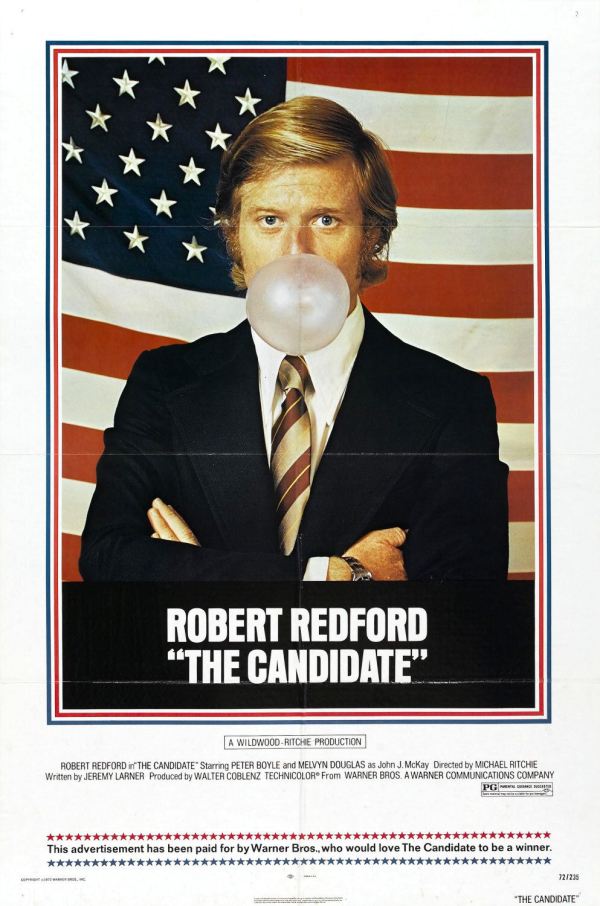
The Candidate (1972)

By Richard Winters

My Rating: 8 out of 10

4-Word Review: Robert Redford for President.

In commemoration of Election Day and the fact that all the campaigning and political punditry will finally be coming to a merciful end we present a rare Tuesday post here at Scopophilia. Although done 40 years ago this wry look at the inner-workings of the political campaign trail is as incisive and timely as ever and hasn’t lost any of its punch. The story deals with Bill McKay (Robert Redford) a young lawyer from California who is persuaded to run for senate against the incumbent Crocker Jarman (Don Porter). McKay represents the youthful idealism while Crocker is very entrenched with the establishment.

The film was directed by Michael Ritchie who may not be a household name, but he is the creator of his own genre. He took the examination of competition and how embedded it is in American culture to new heights. Through his various movies he showed how it infiltrates every aspect of our society and no one is immune to it. From Smile to The Bad News Bears and Downhill Racer he showed how even the most unlikely of individuals can become fiercely competitive when driven. He also made his characters strangely endearing no matter how sordid or ugly the competition made them become.

This film works along those same lines only it shows it from a political perspective. It is smart, fast, cynical, funny, dramatic, revealing, and entertaining all at the same time. This should rank as one of the best movies made about political campaigning. It’s still timely and cutting edge and works almost like a documentary. The quick editing creates a seamless style. The film makes interesting observations without taking away from the flow of the story. In fact one of the reasons it is so captivating is because it is downright educational. When the film is over you feel much wiser to the business of politics and as exhausted as the candidate himself.

Redford is terrific. He has a real gift for underplaying everything to the point that it looks like he isn’t even acting at all. He plays off his pretty boy looks, but doesn’t stay trapped to a heroic image. He harbors a lot of idealistic traits one would want in a candidate and yet he is still quite human. There are some definite shades of John F. Kennedy here. He has a troubled marriage and is even caught fooling around with an admiring female supporter. Although he has honorable ideas he is far from having all the answers. Probably the most interesting insight of this movie is the fact that he ends up getting as sucked into the mechanics and compromises of the political machine as his ‘old school’ foe. It perfectly illustrates how immense and encompassing the political machine is and how no one is really going to change it.

This is an excellent and well-crafted picture that not only hits the bulls- eye, but does it many times over. I love Redford’s final line and Boyle, as his campaign manager, has never been better.

My Rating: 8 out of 10

Released: June 29, 1972

Runtime: 1Hour 50Minutes

Rated PG

Director: Michael Ritchie

Studio: Warner Brothers

Available: VHS, DVD, Amazon Instant Video 

Sunday Bloody Sunday (1971)

By Richard Winters

My Rating: 9 out of 10

4-Word Review: A bi-sexual love affair.

Bob (Murray Head) is having a relationship with middle-aged divorcee Alex (Glenda Jackson) as well as a family doctor named Daniel (Peter Finch). He jumps between the two of them whenever the mood hits. Both Alex and Daniel are aware of the other and are not happy about it, but feel if they push the issue Bob will simply leave them. The film focuses on the frustrations and loneliness that Alex and Daniel feel in dealing with Bob and their less than ideal situation.

This film is engrossing from beginning to end. Director John Schlesinger was still in top form as the camera work, cinematography, and editing is first rate. Everything is meticulously orchestrated to the point that every shot seems to tell its own little story. The narrative is done in a fragmented style going back and forth between the present day to scenes from when both Alex and Daniel were younger. Much of it comes off like thoughts going on inside someone’s head and the film’s style is masterful and flawless.

What I really liked about this movie is the fact that it focuses not so much on each person’s time with Bob, but actually more on their time away from him. The points this film makes about the difficulties of communication that people have when they are in a relationship as well the glass wall that sometimes gets created is completely on-target. The film’s subtitles and nuances are perfectly balanced and if you are a viewer with more sophisticated tastes then this will be time well spent.

Things are revealed about the characters through visual and subtle means, which I loved. When Alex drops an ashtray and then proceeds to clean it up simply by rubbing the ashes into her rug, or the precarious way she makes herself on cup of coffee in the morning while rushing off to work nicely reflects her out-of-control life and the topsy-turvy way she approaches it. The scenes where Daniel attends a Bar mitzvah is excellent and for me some of the strongest moments in the movie.

The portrayal of the children here is above average as well. They are not cute and well-behaved, but instead realistically rambunctious and mischievous. I liked the wild, endless energy that they display and how easily chaotic they turn their household into, or how the parents had become immune and deaf to all of it. Having the 4-year-old smoke pot while Alex and Bob, who are babysitting, decide to overlook it may be pushing things a bit far, but I still liked the mod approach the film takes, which reflects nicely the unconventional lives of the characters.

The film’s biggest flaw is Head himself. The man is mainly known for his singing career and his acting ability is clearly limited in comparison to Finch and Jackson who are both excellent. The character is dull and the film does not make much of an attempt to analyze him like it does with the other two. In a way Head’s one-dimensional performance works because the character seems to be used as a ‘pretty boy’ who the other two are attracted to because of his looks and youth and therefore revealing the insecurities that they have about themselves as well as giving a pertinent warning that when one pursues someone solely based on their sex appeal the relationship is doomed.

I liked how at the very end Daniel and Alex do meet and have a brief conversation though I wished it had been just a little more extended. Having Finch talk directly to the camera at the closing is a bit disconcerting though what he says is interesting.

My Rating: 9 out of 10

Released: September 8, 1971

Runtime: 1Hour 50Minutes

Rated R

Director: John Schlesinger

Studio: United Artists

Available: VHS, DVD, Blu-ray (The Criterion Collection), Amazon Instant Video

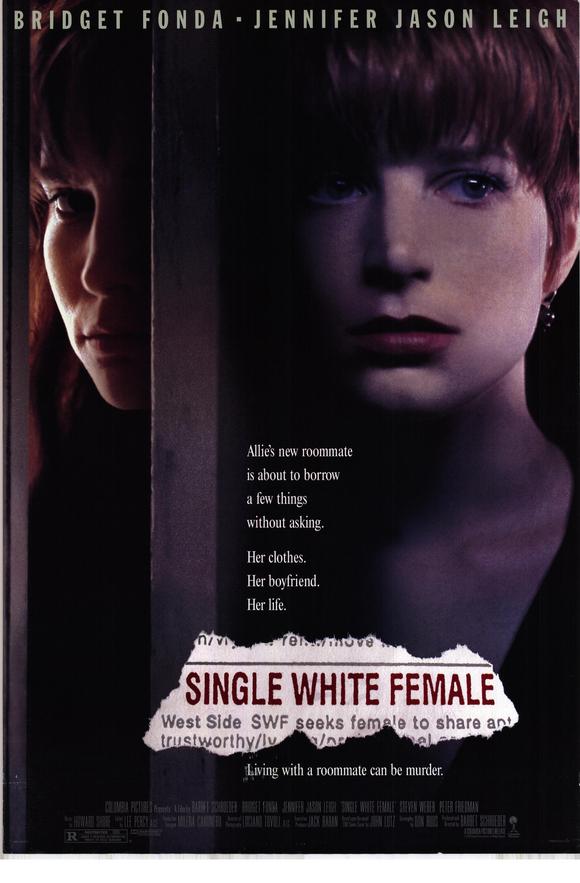
Single White Female (1992)

By Richard Winters

My Rating: 7 out of 10

4-Word Review: A roommate from hell.

Allison (Bridget Fonda) is a young entrepreneurial business woman who breaks up with her boyfriend and decides she doesn’t want to be in her apartment alone. She finds Hedra (Jennifer Jason Leigh) for a roommate and things go well until the relationship with her boyfriend is rekindled. Hendra then starts to become possessive until it eventually culminates into full blown psychosis.

This thriller really never gets going until the final thirty minutes when it climaxes with a real rock ’em, sock ’em, duke it out showdown, which is full of clever twists and good action. The first third though stagnates. In some ways this is good because it avoids being a formulated thriller that feels the need to always telegraph its punches. The viewer is as in the dark as to Hedra’s psychosis as Allison is. Things work so slowly that at times it almost seems like a drama. In some ways it might have been better had it stayed that way. There are some good ingredients here for an insightful look of two young women from different backgrounds trying to forge a friendship. Having it turn into your general psycho/thriller seems almost like a cheap gimmick that prevents it from being a deeper and more original piece.

Another thing that separates this from the other psycho/thrillers is the fact that the two are on equal footing. Unlike most thrillers the bad guy doesn’t have any unfair advantage over the other or the good guy isn’t impeded with any type of handicap. It all just comes down to smarts, inner strength and determination, which makes it interesting. It’s almost like giving them both a pair of gloves and then putting them into the ring.

Fonda is likable enough. She is normal, but not in a boring way and has vulnerabilities that she must face. Leigh has always had an interesting ‘clenched jaw’ like delivery. Usually this has a sexy appeal yet when she becomes psychotic it makes her more frightening. Leigh is also portrayed as the ‘frumpy’ one, but with her long hair and young girl look she actually is more enticing. Fonda of course is also attractive, but not with the hairstyle that she has here. Both have some good nude scenes.

There are some loopholes. One involves the murder by the heel of a shoe which gets lodged in the victim’s eye socket. This has an almost one in a million chance of happening especially at the angle it is done in. The assailant (Leigh) is a woman who is already shorter than the victim who is male. Added was the fact that she was sitting down while the victim was standing. Logistically she would not have been able to reach his eye and even if she had it would have taken so much effort to reach up there that she wouldn’t have had enough strength to drive it in the way she did especially in the split second that this movie has it happen in. Also, when one is wrestling with a perpetrator who has a gun that they drop it is a good idea to grab the gun before making a run for the door especially when it is in easy reach.

My Rating: 7 out of 10

Released: August 14, 1992

Runtime: 1Hour 47Minutes

Rated R

Director: Barbet Schroeder

Studio: Columbia

Available: VHS, DVD, Amazon Instant Video

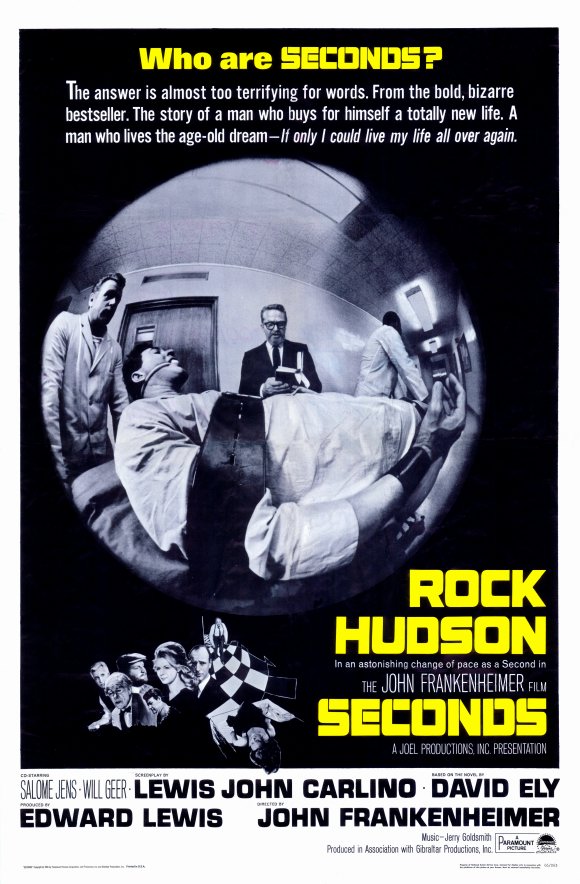
Seconds (1966)

By Richard Winters

My Rating: 8 out of 10

4-Word Review: Starting a new life.

Arthur Hamilton (John Randolph) is a middle-aged man just going through the paces of life. He is stuck in a marriage that no longer has any spark and a job that is boring. His life is confined to the basic suburban rituals and he is quietly looking for a way out. Then he gets a call from Charlie Evans (Murray Hamilton) who he thought was dead. Charlie tells him that he is very much alive, but with a new identity. Arthur goes to a address that Charlie gives him and there he is told for $30,000 dollars he can be ‘reborn’ and given a completely new identity via plastic surgery as well as a whole new life with new friends and no connection to his dreary past. He would even be given a new set of fingerprints and new teeth while the death of his former self would be created in a way that it would leave no question, or suspicion.

This story is unique and fascinating on many levels. It pinpoints the monotony of middle-aged life and views living in suburbia not as the great American dream, but more as the American trap. I enjoyed the part where one of the Doctors named Davalo (Khigh Dhiegh) tells Arthur who has now been changed into Tony Wilson (Rock Hudson) that his new identity will be that of an established painter and he will no longer have to be quarantined with any responsibility and will instead be able to live the rest of his life pursuing is own individual interests, which is probably what everyone secretly desires.

The second half of the story where Tony tries to adjust to his new ‘dream’ lifestyle is equally as interesting if not more. Tony finds that his new friends and neighbors are other ‘reborns’ who will not allow him to backtrack into his old identity and seem compelled to keep in line with his new environment whether he was completely happy with it or not. During this segment I couldn’t help but think of the characters from Easy Rider and how Tony’s situation wasn’t much different. Both longed for complete personal freedom, but the more they tried to escape the societal strings the more they seemed to be dragged back into it. The part where Tony goes back to visit his wife while under the disguise of being a long lost friend of her late husband is revealing and dramatically the strongest part of the whole film.

John Frankenheimer’s direction is superb and intoxicating. The opening sequence featuring a lot of distorted imagery is excellent and creates a terrific mood for the story. The dream sequence where Arthur finds himself in a hotel room with another woman is captured in such a way that it looked almost like a Salvador Dali painting. The use of the fish-eyed lens that is put in at certain strategic moments is effective as well as stylish. The black and white cinematography is evocative and the organ playing soundtrack is distinct and moody.

Rock Hudson has always seemed to me as a weak leading man and apparently Frankenheimer considered him ‘lightweight’ as well, but when his first two choices turned down the role he decided to go with him and here it actually worked. I felt Hudson’s blank expression and confused demeanor fit well with the character’s situation. The part where he is shown tied to a bed and struggling to get out while his mouth is gagged is convincing. Veteran actor Randolph is quite good in the beginning playing Arthur a man who seems run over by life. The close-up of his nervous and sweating face leaves a strong impression. Will Geer is also excellent in support as the founder and head of the secret organization.

The twist ending is well done although I saw it coming long before our naïve protagonist did. Unlike the book it is clearer and less vague. This is one case where the film can make a great companion piece to the book, or vice versa. This is a definite sleeper of a movie screaming for more attention and has strong cult potential.

My Rating: 8 out of 10

Released: October 5, 1966

Runtime: 1Hour 46Minutes

Rated NR (Not Rated)

Director: John Frankenheimer

Studio: Paramount

Available: VHS, DVD,  Blu-ray (Criterion Collection) Amazon Instant Video

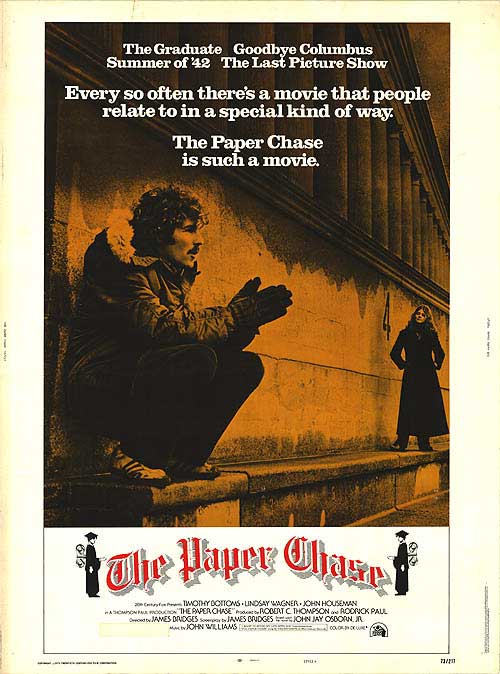
The Paper Chase (1973)

By Richard Winters

My Rating: 9 out of 10

4-Word Review: He can’t please Kingsfield.

James Hart (Timothy Bottoms) attends his first year at Harvard Law School and finds himself obsessed with the notoriously stern Professor Charles Kingsfield (John Houseman). His fascination increases after he begins a relationship with Kingsfield’s daughter Susan (Lindsey Wagner). The rest of the story deals with the pressures and demands of being a law student.

This quite possibly is the quintessential movie about college life. Everything is captured in such a real and revealing way that it will very likely send the viewer back to their college days. Despite being nearly forty years old it doesn’t seem dated at all as it touches on many universals that every generation goes through at that age. If anything it is still quite topical. The few dated elements are actually fun to see including the scene in the pre-cellphone days where the students would line up and wait their turn to make a call on the dorm’s one and only pay phone.

The student characters have diverse personalities and seem like young adults one would meet during their college days, or even see on a campus today. It is nice to have a college movie where students are actually studying. In fact these scenes are some of the best moments in the film including Hart’s dealings with difficult people in his study group.

The Hart character is appealing and relatable. I liked how he is multi-faceted and displays elements from both his own era including his counter-culture hairstyle as well as past ones.

Having it filmed on-location and capturing the different seasons of the year makes the viewer feel like they are attending the school year right along with him. I particularly liked the scene shot in the historic Harvard stadium.

The film also makes terrific use of silent moments as there is very little music. Many college movies dwell on the loud and raucous partying, but there is a lot of quiet time as well particularly the first day of class in a large auditorium wondering what the instructor will be like. The opening sequence done underneath the credits showing an empty classroom quietly filling up with students was not only novel, but brilliant.

Houseman deservedly won the Oscar for his portrayal of the crotchety professor. Outside of a small and unaccredited role in Seven Days in May this was technically, at age 71, his film debut. Some may complain that the character is one-dimensional. We are never shown any type of softer side to him and I am sure most films would have thrown some in, but the fact that they don’t do it makes his mystique more interesting. My favorite moment of his is when at the end of the year the students give him a standing ovation while Kinsgfield responds with his trademark scowl before walking out of the room.

The supporting cast of students is terrific and many were making their film debuts. There is Graham Beckel as Hart’s study partner Franklin Ford who looks like a twin of Brad Dourif. There is also Edward Herrmann and James Naughton as Kevin Brooks a man with a photographic memory, but no analytical ability. My favorite though was Craig Richard Nelson as the moody and belligerent Willis Bell.

Blair Brown can also be seen as one of the female students during the classroom scenes. She speaks in a strange accent and I think she was trying too hard to get the Bostonian sound, but I ended up kind of liking it anyways.

The implementation of Kingsfield’s daughter into the story really didn’t work with me. Lindsey Wagner is a competent actress, but the way they meet on a sidewalk seemed too forced and random. It is also beating extreme odds that Hart would by chance get into a relationship with the daughter of a man that is the complete center of his universe and the fact that she turns out to be hip, sexy, and gorgeous even though she is related to a man who is anything but was also a stretch. It would have been interesting had there been a few scenes and dialogue between Kingsfield and Susan, but none is ever shown.

There is a part involving Hart sneaking into the library when it is closed in order to get into a section that houses the notes taken by the professors when they attended the school as students, which I found to be odd. I have never known any college that has done this and talking with others no one else has either. I was still willing to roll with it but found it frustrating that when Hart takes out the notes written by Kingsfield in 1927 that the camera doesn’t focus in on the page to allow the viewer to see it for themselves. Having Hart simply describe what he sees including some doodling that Kingsfield apparently made on the side of the page is not as satisfying.

I had a few problems with the end as well although it was not enough to ruin what is otherwise a great movie. However, there is a scene showing Kingsfield grading his student’s tests by himself even though most tenured professors who teach large classes have graduate assistants do this for them. It may be more cinematically satisfying especially for the general viewer to see Kingsfield doing the grading, but that is not how it actually works.

Also, when Hart receives the grades in the mail he doesn’t bother to open the letter, but instead turns it into a paper airplane and floats it into the ocean. I didn’t understand the motivation of this because during the film Hart spends an enormous amount of time preparing for the test, so I would think anyone who went through that would want to see what they got. If he wants to turn it into a paper airplane afterwards that is fine, but at least see the results. I spoke to a fan of the film who says he interprets this scene to mean that Hart was more interested in learning the subject for his own enjoyment and not concerned with what he got out of it, but if that is the case the film fails to bring that out earlier and instead seems to show the exact opposite.

My Rating: 9 out of 10

Released: October 16, 1973

Runtime: 1Hour 53Minutes

Rated PG

Director: James Bridges

Studio: 20th Century Fox

Available: VHS, DVD, Amazon Instant Video

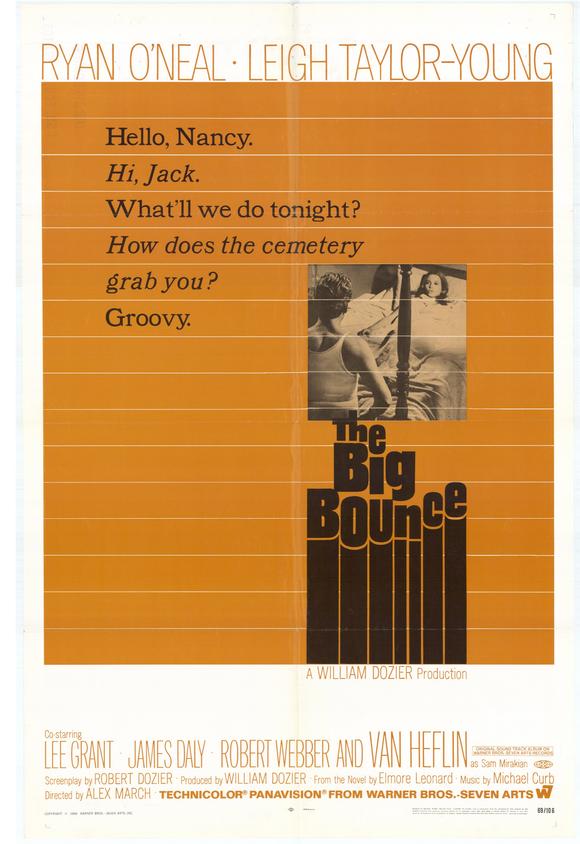
The Big Bounce (1969)

By Richard Winters

My Rating: 3 out of 10

4-Word Review: She is really crazy.

Based on the Elmore Leonard novel and remade in 2004 as a vehicle for Owen Wilson this version stars Ryan O’Neal as Jack Ryan a Vietnam vet on the run when he has a physical altercation with a player during a baseball game that leaves the other man injured and looking for revenge. He meets up with Ray Ritchie (James Daly) and his mistress/secretary Nancy (Leigh Taylor-Young) who is a bit on the wild side. She convinces Jack to help her rob her boss of a large amount of money that he has hidden away in his safe, but Jack becomes wary as Nancy displays more and more psychotic tendencies.

I enjoyed the film’s jaded sensibilities, but unfortunately it doesn’t do enough with them. There is too much talk without enough action. The plot is thin and unfocused. I spent the entire time wanted the story to get moving, but it really never does until the very end and by then it is too late. The scenes are lengthy and the production has too plodding a pace. I also didn’t like the fact that they discuss the robbery, but never go through with it. Nothing is more frustrating than an already draggy movie having a potentially interesting plot progression only to drop it.

I also couldn’t stand the music which sounded like men from a barbershop quartet and gets overplayed until it becomes annoying. The melody was too soft and mellow and did not fit the edgy tone of the script, or characters. This is the type of film that needed an up-tempo score with hard and fast beat.

For what it is worth Taylor -Young is good. She gets convincingly crazy and has a near epic meltdown at the end. She also has a tantalizing scene involving her swimming nude, which is only topped by another scene showing her standing naked in the middle of graveyard while pretending to be a statue.

O’Neal is okay although I felt some other actors might have been better, but at least he improves as the film progresses. The two stars were married in real-life at the time and I presume the producers cast them in the parts hoping that their chemistry would project onto the screen, but it never does and they ended up divorced four years later.

Van Heflin is great in a supporting role as Sam Mirakian a cynical and detached man who has seen it all. He brings the film some much needed energy. Lee Grant is also terrific and it was a crime that she wasn’t given more screen time. She makes her desperate and emotionally brittle character real and interesting. Cindy Eilbacher is quite adorable as her young daughter Cheryl. Robert Webber also deserves mention as he is amusing playing a man trying to be tough and intimidating, but ending up always looking like a schmuck.

I never saw the remake, but heard from several people that it wasn’t too great either. I dare say the novel is the best of the three and both film versions are worth skipping.

My Rating: 3 out of 10

Released: March 5, 1969

Runtime: 1Hour 42Minutes

Rated R

Director: Alex March

Studio: Warner Brothers/Seven Arts

Available: VHS, DVD, Amazon Instant Video

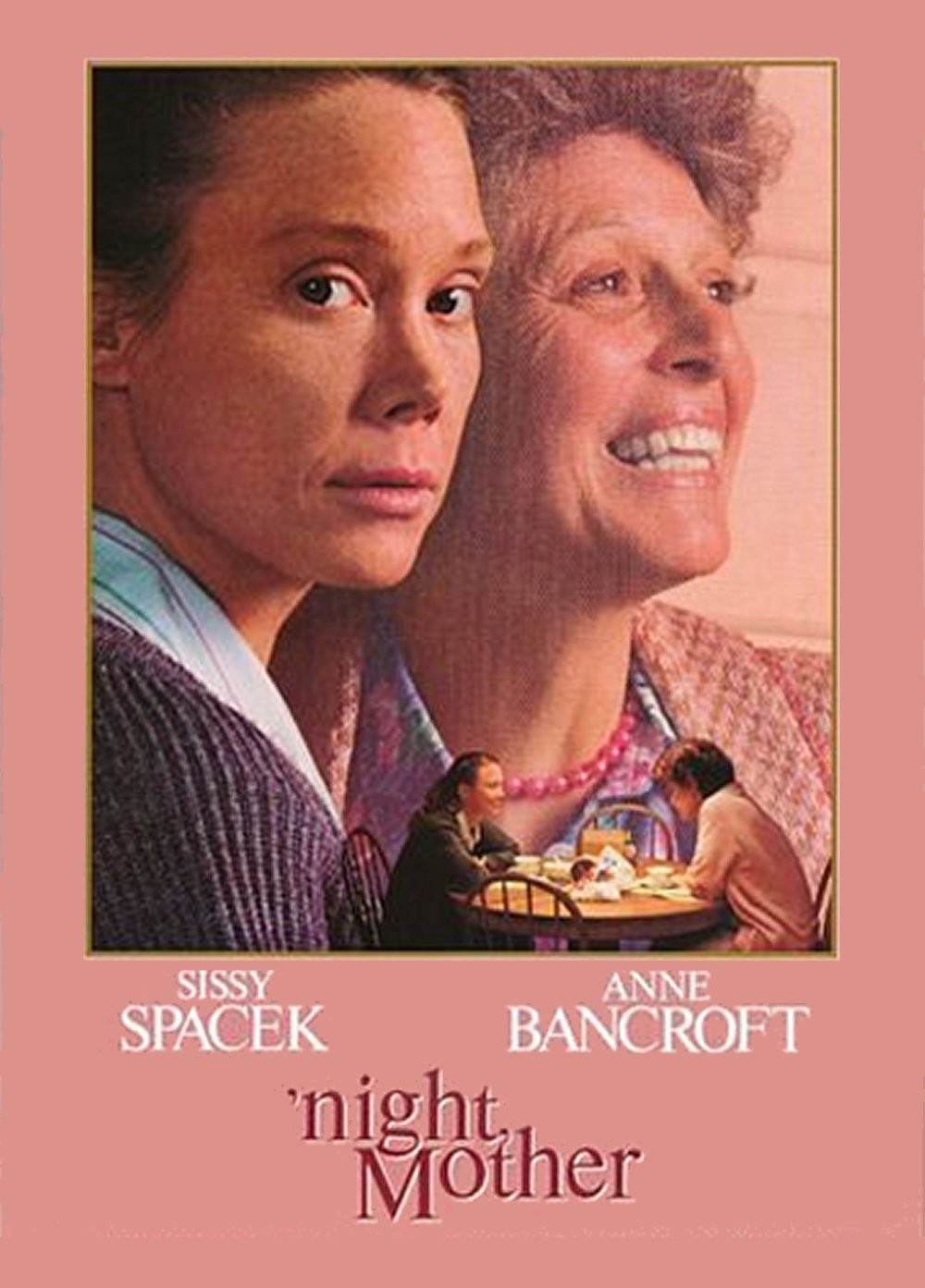
‘Night Mother (1986)

By Richard Winters

My Rating: 6 out of 10

4-Word Review: Please don’t kill yourself.

Jessie Cates (Sissy Spacek) informs her mother Thelma (Anne Bancroft) that she plans on killing herself during the night and her distraught mother spends the rest of the evening trying to convince her not to do it.

It is hard to imagine a more maudlin and static production. The film consists of just two people talking inside a small, isolated house with no cutaways, flashbacks, inventive camera angles, interesting scenery, music, or editing. Louis Malle once did a film entitled My Dinner with Andre that featured two men sitting at a table and filling the film’s entire runtime with one long conversation, but at least there the topics were fascinating while here it is depressing. I was expecting some profound intellectually stimulating talk dealing with the meaning of life much like the one in Igmar Bergman’s classic The Seventh Seal, but instead it is general and banal. Part of the problem is that the Thelma character lacks sophistication and is unable to debate Jessie on any type of deeper level. The result then is a rather rhetorical 95 minute banter revolving around Thelma pleading with Jessie not to do it ‘because she needs here’ while Jessie glibly replying ‘I can if I want to’. The screenplay, written by Marsha Norman, who also penned the play from which it is based, fails to deliver that lyrical, poetic quality of dialogue that most films based on stage plays seem to have.

I kept wondering what the point to this was.  We never seem to get to the bottom of what is bothering Jessie and only seem to skim the emotional surface. The film does not dig deep enough into the human psyche but should’ve as her issues here are rather derivative and typical. Her main complaints is that she suffers from epilepsy, which is now under control through medication, and she has gone through a painful divorce, but there a lot of people with similar problems and worse who are not trying to kill themselves. Most viewers might be disgusted and appalled at Jessie’s selfish nature and the way she callously ignores her mother’s emotional pleas and insists on moving forward with the suicide despite how clearly devastating it will be to her mother. In the end the film will probably leave most people cold and unable to connect to either character.

The one thing that does save the film and even makes it riveting to an extent is the brilliant performances. Although I could’ve done without her southern accent I still found Bancroft to be fantastic and was impressed with the way she hit all the right emotional peaks. Spacek is superb in every facet and I liked that she wore no make-up and her face had a natural and worn look.

Tom Moore’s direction has a few nice touches. I liked the opening shot showing the remoteness of the home and how the rugged western landscape helped accentuate the hard-living of the characters. The music although only played at the beginning at end has an ominous tone to it that effectively hits the mood and theme of the material.

Of course suicides are always an on-going issue and if this film had given some insight into it I would have given it more credit, but it really doesn’t. I was surprised that Aaron Spelling who was usually known for producing shallow, glitzy stuff like the TV-show ‘Dynasty’ was the producer here.

My Rating: 6 out of 10

Released: September 12, 1986

Runtime: 1Hour 35Minutes

Rated: PG-13

Director: Tom Moore

Studio: Universal

Available: VHS, DVD, Netflix streaming

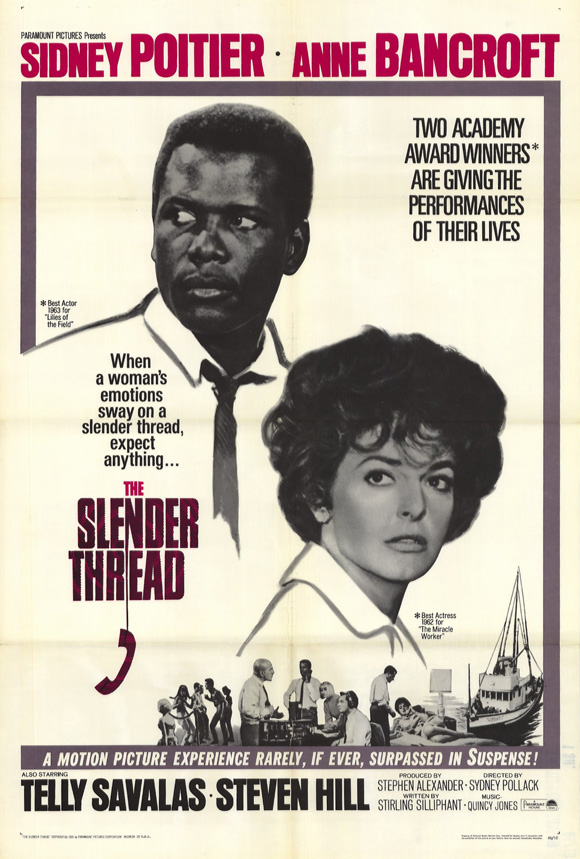
The Slender Thread (1965)

By Richard Winters

My Rating: 7 out of 10

4-Word Review: Desperate cry for help.

Inga (Anne Bancroft) is a middle-aged woman who has fallen into despair. She swallows a bottle of barbiturates and then in a last plea for help calls the local suicide hotline. On the other end is college student Alan Newell (Sidney Poitier) who is volunteering his time at the center and ill prepared for such a call. Despite this he manages to build a connection with her and the rest of the film deals with their conversation and Alan’s attempts at finding her location as well as flashbacks showing what brought Inga to such a desperate state.

This film will finally get its much awaited release onto both DVD and Blu-ray on October 16th and I highly recommend checking it out especially for those that can appreciate great film directing. This was Sydney Pollock’s directorial debut and his calculated touch is clearly what makes what could have otherwise just been a talky script into an intriguing visual showcase. The opening sequence showing an aerial shot of sprawling Seattle is excellent and sure to connect with those that live there. Pollock nicely adds some of the city’s unique architecture into the shots giving the fragmented narrative distinction. He also makes full use of the stark black and white photography. One of the most emotional and memorable scenes in the film is when Inga walks along a lonely beach and tries to help a crippled bird, which wouldn’t have been half as effective had it been done in color. Even the small things like watching a phone technician walking through rows and rows of telephone switchboards is captured with a pristine style that makes it intriguing. The pacing and editing is perfect and at no time does the film ever drag despite the fact that it could have done so if it had been put in less competent hands.

Poitier is exceptional in the lead. Initially I was put off with the idea of a 38 year old man still trying to play a college student, but Poitier is completely believable. It was nice seeing him in a role where the race card never came into play. The film cuts back and forth to the dramatic search by the police to find the woman, but in many ways I found Poitier’s banter with Inga and the many different psychological ploys he uses to try to connect with her far more riveting. Bancroft is equally as good and her distraught facial expressions leave an imprint. Steven Hill lends terrific support as her unhappy husband.

In the complaint department I felt that the music at the beginning seemed much too upbeat and jazzy for a film with such a somber subject. The Inga character gets unraveled too easily and quickly and certain viewers may be put off by her selfishness of trying to kill herself and abandoning her young son. The biggest issue though was with the ‘Hollywoodnized’ ending that devolved a bit too much into the cliché. Otherwise this is a sleeper waiting to be discovered.

Twenty-one years later Bancroft again starred in a film dealing with suicide only this time she played the person trying to talk the other one out of it. That film was entitled ‘Night Mother and will be reviewed on Monday.

My Rating: 7 out of 10

Released: December 23, 1965

Runtime: 1Hour 38Minutes

Rated NR (Not Rated)

Director: Sydney Pollock

Studio: Paramount

Available: VHS, DVD, Blu-ray