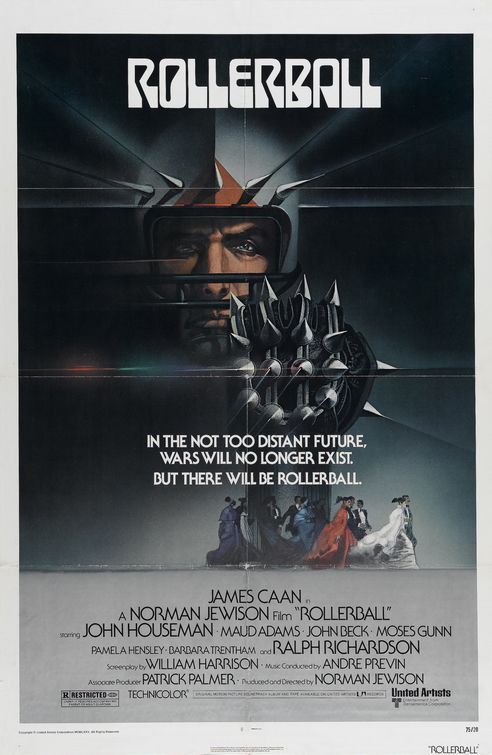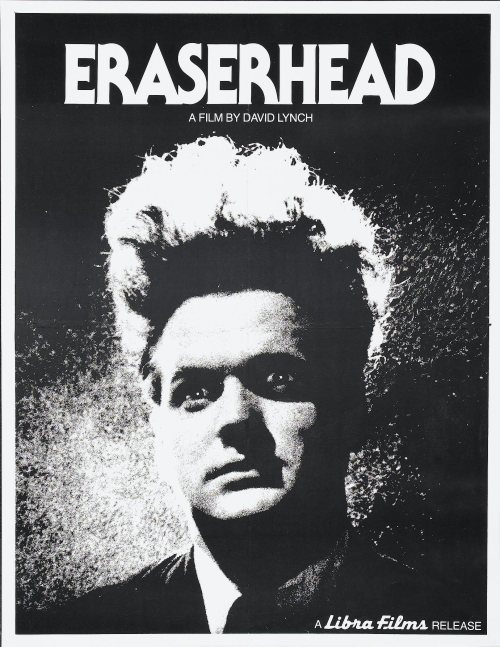
Category Archives: Cult

Eraserhead (1977)

Eraserhead

By Richard Winters

My Rating: 6 out of 10

4-Word Review: Couple has deformed baby.

In David Lynch’s first feature length film, a movie that took almost 5 years to make and had a good deal of it financed by Sissy Spacek and her husband, we have a surreal almost cryptic-like tale detailing a lonely man named Henry (Jack Nance) and his ultimate descent into a madness as he is forced to take care of severely deformed child while also harboring the dark urge to kill it.

It is hard to say whether one can like or dislike this as it goes so far out of the conventional form of film narrative that it seemingly defies all genres and puts itself into a category all its own. On a sheer technical level it is quite impressive especially when you factor in its shoestring budget and array of production set-backs. Each scene is meticulously detailed with wild and unsettling imagery that on a purely visual level will be more than enough to leave an impact. Overall the film is cold, ugly and unyielding, but helped tremendously by Nance’s presence as a sort of detached everyman who seems as confused and aloof to his surroundings as the viewer.

To me the most jarring image is the baby, which is incredibly lifelike. Had it came off looking fake, or like some puppet or Claymation attempt the film would’ve been a failure, or deemed laughable, but this thing is freaky looking to the extreme and Lynch spares no expense in getting the camera close up to it, which could force some viewers to turn away. Supposedly it was made from the embalmed fetus of a calf, but no one knows for sure and the crew was forced to blind fold themselves when Lynch set it up, so the secret would never come out. Either way it is effective and it manages to move its eyes and mouth almost like it were real and coming off as far more authentic than any computerized effect.

Spoiler Alert!

Of course the most confounding thing about the film is its story and symbolism’s that can be interpreted in a million different ways depending on the viewer’s own perspective. For what it’s worth I’ll give you my interpretation, which isn’t that complicated. To me the deformed baby symbolizes Henry’s soul, which has been mangled by the soulless world that he lives in, which would explain why he is so extremely passive because he is simply a walking zombie. The scene where his head pops off and the ugly child’s head pops into its place only reinforces this. The lady that he sees in the radiator is an angel from heaven and the beautiful lady that lives across the hall from him is the devil who entices him with sex, but when she realizes he has no soul to take, just an ugly mangled remnant of one, which gets exposed to her when she sees him standing in the doorway, she quickly loses interest and moves onto someone else. When he finally kills the baby he is essentially killing himself, which then explains why he ends up in the final scene in heaven with the lady in the radiator.

The man in the planet that we see at the beginning represents Henry’s own subconscious as he quarrels within his mind at the thoughts of killing the child. The man could also represent the world at large and how it controls everyone with its levers, which when Henry finally kills himself they start to have sparks fly from them and the man struggles in containing them, which shows that Henry has now ‘broken free’ from the man and this world by taking his own life.

End of Spoiler Alert!

Some consider this a horror pic, but I found certain parts of it to be quite funny in a darkly humorous way particularly the segment where Henry goes to visit his girlfriend’s parents. To me the most horrifying thing about is the way it challenges the viewers to question their own morality by forcing them to face the difficult quandary or what they would do if put into the same situation as Henry and forced to care for a hideous looking baby that some would consider would be better off dead.

My Rating: 6 out of 10

Released: September 28, 1977

Runtime: 1Hour 29Minutes

Not Rated

Director: David Lynch

Studio: Libra Films International

Available: DVD (Criterion Collection), Amazon Instant Video
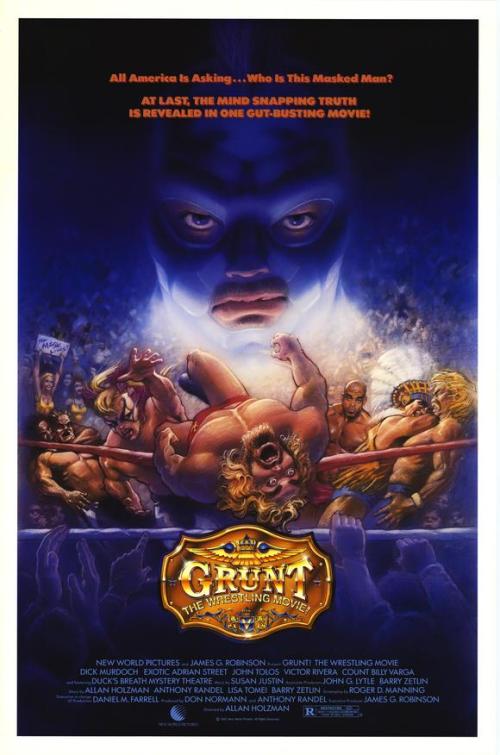
Grunt! The Wrestling Movie (1985)

grunt

By Richard Winters

My Rating: 4 out of 10

4-Word Review: Who is masked wrestler?

On October 13, 1979 Mad Dog Joe De Curso (Greg ‘Magic’ Schwarz) has a violent wrestling match with defending champion Skull Crusher Johnson (Greg Rivera). During the melee Johnson accidently gets his head stuck in the ringside ropes where Mad Dog decapitates him with one swift kick. The wrestling world then goes into an uproar with the biting question on everyone’s mind ‘Does a defending champion lose his title when he loses his head?’ that nobody, not even the commissioner seems willing to answer. After spending 90 days in jail Mad Dog gets released, but suffers from severe depression and eventually jumps to his death off of a bridge. Yet documentary filmmaker Leslie Uggams (Jeff Dial) thinks that Mad Dog is still alive and working under the disguise of a masked wrestler whose identity is unknown. Uggams begins a crusade of trying to unravel the mystery by interviewing those who knew Mad Dog best while also following the masked wrestler around to his events and trying to get to know both him and his French lady manager Angel Face (Lydie Denier).

The first 10 minutes of this thing is brilliantly bizarre that has just the right mix of offbeat humor, wrestling action and cinematic quality to make it interesting, original and hilarious. I am no wrestling fan myself, but director Allan Holzman manages, at least in the opening segment, to draw the uninitiated into the wrestling world by unfolding all the side dramas, storylines and over-the-top characters that fans of the spectacle find so enjoyable. The bit is also filmed in black-and-white with a sort-of foggy back drop that helps give it a surreal effect while also playfully making fun of the event and those who watch it.

Unfortunately the remainder of the movie is unable to sustain that same momentum becoming instead an overplayed one-joke that goes nowhere. It also spends too much time in the ring where the viewer is forced to watch one wrestling bout after another until it becomes more like a pay-per-view event than a movie.

One of the few non wrestling segments that I did enjoy is when the masked man and Angel Face go onto Wally George’s ‘Hot Seat’ TV-Program. George was a notoriously combative conservative talk show host during the ‘80s and the precursor to Rush Limbaugh and Bill O’Reilly. He was also the father to actress Rebecca De Mornay who has spent her entire career trying desperately to downplay that fact. Liberal guests would come onto his show and almost immediately be berated before being thrown off, which is what happens to the masked man and Angel Face, but not before George gets into the masked man’s face and demands he take it off, which is pretty funny.

Adrian Street, a wrestler who dresses in drag, is a scene stealer and the segment with the masked man being interviewed on his show is equally good. I also enjoyed Denier as the rambunctious manager who flashes an opposing player during one of the mask man’s wrestling matches and carries around a pet poodle who wears a mask similar to her clients.

The scene involving a bout between two lady wrestlers with the song ‘She Was a Mighty Big Girl for Her Age’ is good and the match where the masked man takes on four dwarf wrestlers is an absolute howl, but the film is geared too much to the hardcore fan and those with very little interest in the ‘sport’ will find it off-putting and overtly silly.

My Rating: 4 out of 10

Released: November 24, 1985

Runtime: 1Hour 29Minutes

Rated R

Director: Allan Holzman

Studio: New World Pictures

Available: VHS, DVD-R, Amazon Instant Video

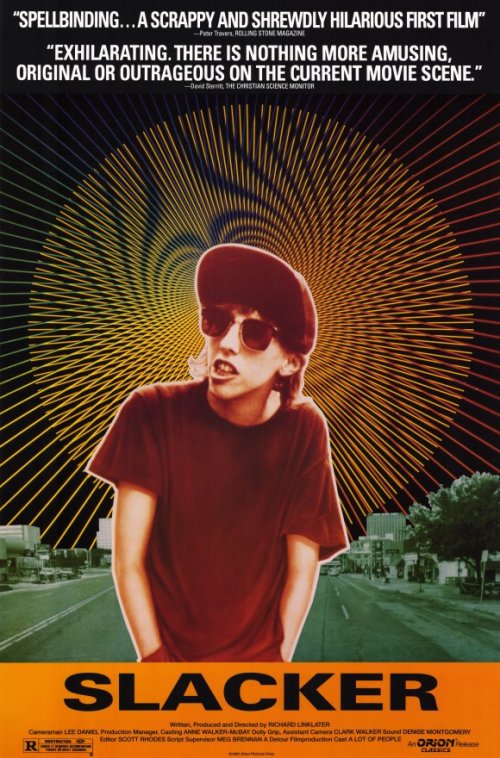
Slacker (1991)

slacker

By Richard Winters

My Rating: 8 out of 10

4-Word Review: A movie about nothing.

A look at a day-in-the-life of society’s left behinds that filter the streets, bars and coffee shops of Austin, Texas. The viewer hears a wide variety of weird topics, theories and extreme political points-of-view from the detached 20-something crowd as the camera winds its way from one conversation to the next and never stopping on any one person for longer than a few minutes.

This was considered at the time of its release to be a major breakthrough for the independent film movement and one that remains an inspiration for many indie filmmakers today. It succeeds because it proves you don’t need a big budget, state-of-the-art effects or even a compelling story to work. It washes all those things away and gets down to the very essence of why we watch movies, which is because we are all secretly voyeurs intrigued with seeing how the ‘other half’ lives without having to get our own feet wet in the process. The characters, as offbeat as they and their conversations may be, have a definite element truth to them and this film manages to convey reality far better than 95 percent of the other movies out there.

Some of my favorite conversations, which seem mostly ad-libbed, involved the one with the guy who was obsessed with the JFK assassination and his ‘shocking’ new revelations involving Jack Ruby’s dog. There are also the two young men inside a bar who talk about the ‘subliminal messages’ of the Smurf cartoons and the film’s director Richard Linklater who opens the film with a discussion on how every choice that we don’t make continues off and has a reality of its own. I also liked the anarchist (Louis Mackey) who talks about the man who assassinated President McKinley simply because all you ever hear about are the Kennedy and Lincoln assassinations and never anything about anything about the other two.

I also liked Teresa Taylor, who was the former drummer for the Butthole Surfers, playing a woman trying to sell a vial containing singer Madonna’s Pap smear and the guy who locks himself inside a room with what seems like hundreds of TV’s that run all day and night. However, I was a bit disappointed that during this scene we get shown a video of a man who supposedly shots the camera with his rifle and although he does indeed aim his gun at the lens he never fires it, which I found to be a letdown.

Some may consider these characters, in our very job oriented culture, to be ‘losers’ simply because they ‘aren’t working’ and being ‘productive members of society’, but director Linklater takes a different perspective by stating in an interview that he feels slackers are instead a ‘step ahead’ and ‘rejecting the social hierarchy before it rejects them’.

To some extent I agree as I was pretty much the same way at that age, but I also couldn’t help but think what these same characters were doing now 20 years later. It’s easy to be detached when you’re younger, but when a person reaches middle-age and the financial responsibilities become stronger, it’s not, so I kept wondering if these same people may have now ‘sold-out’ or even ‘grown up’. I also wondered how they may have evolved in other ways for instance the guy who was so into the conspiracies of the JFK assassination may now have crossed over to ones involving 9/11 and the young man that was really into TV’s may now be a Blu-ray player nut instead. If anything this is a movie crying out for a sequel and one that could easily be just as fascinating as the first one especially if it involved the same people.

My Rating: 8 out of 10

Released: March 22, 1991

Runtime: 1Hour 37Minutes

Rated R

Director: Richard Linklater

Studio: Orion Classics

Available: VHS, DVD, Blu-ray (Criterion Collection), Amazon Instant Video


The Princess Bride (1987)

princess bride 1

By Richard Winters

My Rating: 7 out of 10

4-Word Review: Grandson likes bedtime story.

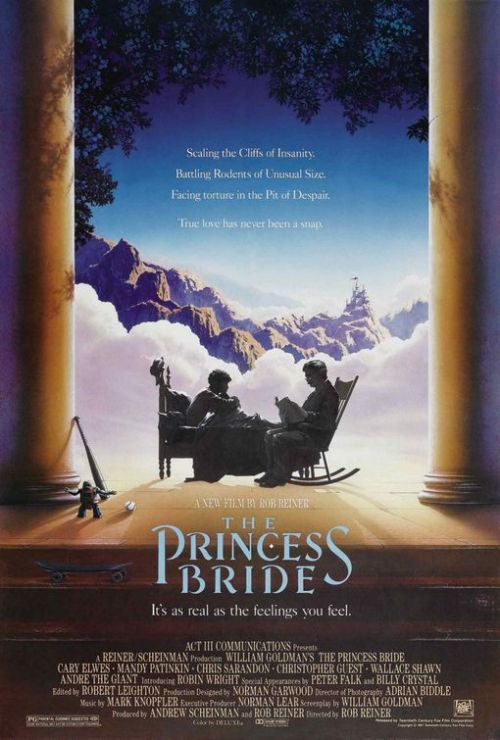
Based on the 1973 William Goldman novel, who also wrote the screenplay, a grandfather (Peter Falk) arrives to read to his sick grandson (Fred Savage) a fairytale. Initially the grandson is more interested in playing video games, but soon finds himself enraptured with the story despite his initial reluctance. The tale involves a country girl named Buttercup (Robin Wright) who falls in love with a farmhand named Westley (Cary Elwes). When Buttercup mistakenly thinks that Westley has been killed by some pirates she agrees to marry Prince Humperdinck (Chris Sarandon) only to end up getting kidnapped before her wedding and saved by Westley who was never dead to begin with. The two then must fight off the evil Prince who still insists on marry Buttercup and doing away with Westley.

The film, which was directed by Rob Reiner and produced by his former ‘All in the Family’ creator Norman Lear, is engaging from beginning to end and filled with endlessly funny dialogue and exciting adventures that remain pleasantly amusing throughout. My favorite moment is seeing a completely unrecognizable Billy Crystal hamming it up as an old man magician who tries to revive Westley while sounding like a comedian from vaudeville.

The special effects are impressive especially the shot showing Buttercup’s three kidnappers climbing a rope up a steep mountain while being followed close behind by Westley. To me though the best part is when Westley gets attacked by what appears to be a giant rodent that, with the exception of his fake looking fur, looks amazingly real and not like a stuntman in a body suit or a computerized image.

The performers are well cast with my favorite being former wrestler Andre the Giant who steals it despite having no acting experience and at times difficulty enunciating his words. The only negative is Christopher Guest as a six fingered man who supposedly attacked the Mandy Patinkin character when he was a child, but now that Patinkin has grown he faces Guest again even though Guest looks to be practically his same age and not someone who should be significantly older.

The story is basic and lacks the grandiose and dark quality that many of the classic Grimm fairytales possess. The banter between the grandson and Grandfather is fun and I wished it had cut back-and-forth between the two and the story more often than it does. The context is simple and straight forward and its ‘message’ of teaching kids to learn to enjoy reading is a bit too obvious, but overall as non-think escapism it scores a bullseye and through the years has managed to acquire a strong cult following.

My Rating: 7 out of 10

Released: September 25, 1987

Runtime: 1Hour 38Minutes

Rated PG

Director: Rob Reiner

Studio: 20th Century Fox

Available: VHS, DVD, Blu-ray, Amazon Instant Video, YouTube


The Visitor (1979)

visitor 1

By Richard Winters

My Rating: 6 out of 10

4-Word Review: Her daughter is evil.

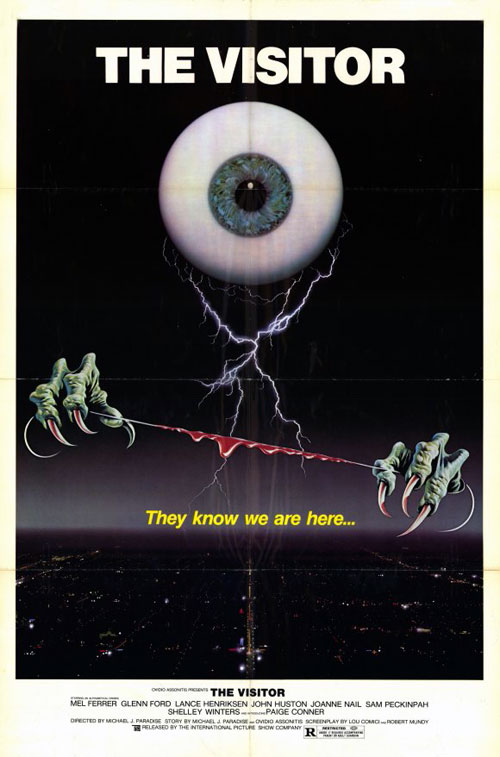
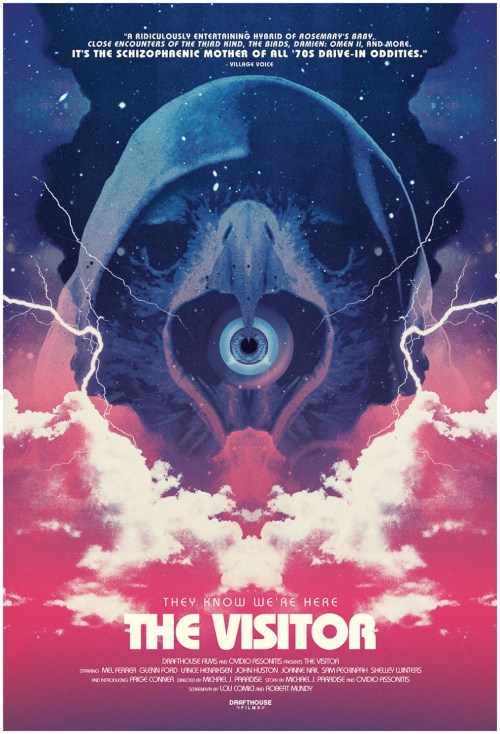
Dark forces from another dimension conspire to use an 8-year-old girl named Katy (Paige Conner) as their centerpiece in creating an evil empire on earth. Dr. Walker (Mel Ferrer), while working under the cover of being a noted surgeon, heads the secret organization. He instructs local millionaire Raymond Armstead (Lance Henriksen) who made a pact with the group years earlier in order to receive his fortune, that he must impregnate his girlfriend Barbara (Joanne Nail) again, so that she can give birth to an evil son to complement their already wicked daughter Katy and allow the two to eventually reproduce a new offspring. Barbara though, who does not know of Raymond’s secret pact and feels leery of her child already, is unwilling to have another one, which forces him to use unethical ways to get her to change her mind.

This Italian production, which was filmed in Atlanta, Georgia, has gotten a bad rap from the critics and there have been several different cuts issued with some making more sense than others. For the most part it’s a mixed bag with lots of story loopholes and an ill-advised music score that seems better suited for an NFL highlight reel. The movie also defies any genre and jumps between several, but ultimate fails at all of them.

However, if taken as a cheesy over-the-top production then it’s not half-bad. The camera work, editing, special effects and sets are to a degree impressive. The scene where Glenn Ford’s character is driving down a busy highway only to have his eyes pecked out by an evil hawk, which creates a major road accident that culminates with the car tumbling onto a softball field is quite exciting. Katy’s cat-and-mouse foot chase with the John Huston character through the Atlanta streets and some abandoned buildings is also well done as is her ice skating foray in which she single-handedly takes out a group of much older and bigger boys by sending them flying through the windows of some nearby shops and restaurants.

Conner’s bad girl performance with her angelic face making a perfect contrast to her otherwise dark personality is great. Nail as her mother is equally beautiful and creates enough sympathy from the viewer to make the torment that she goes through unsettling to watch. Shelley Winters, in a rare turn playing a normal, likable character, is also excellent as the family’s housekeeper

The male cast though is wasted including Franco Nero who appears briefly only at the beginning and very end. John Huston and Glenn Ford were too old for their respective parts and casting younger actors in their roles would’ve made more sense, but seeing director Sam Peckinpah in a brief acting bit is fun.

The ending can’t quite equal the audaciousness of the rest of it, but there is enough weird, wacky, one-of-a-kind shit here to keep anyone especially those with an affinity for the bizarre entertained and amused.

visitor 3

My Rating: 6 out of 10

Released: March 22, 1979

Runtime: 1Hour 48Minutes

Rated R

Director: Giulio Paradisi

Studio: American International Pictures

Available: DVD, Blu-ray, Amazon Instant Video

Don’t Torture a Duckling (1972)

don't torture a duckling 2

By Richard Winters

My Rating: 4 out of 10

4-Word Review: Who’s killing the children?

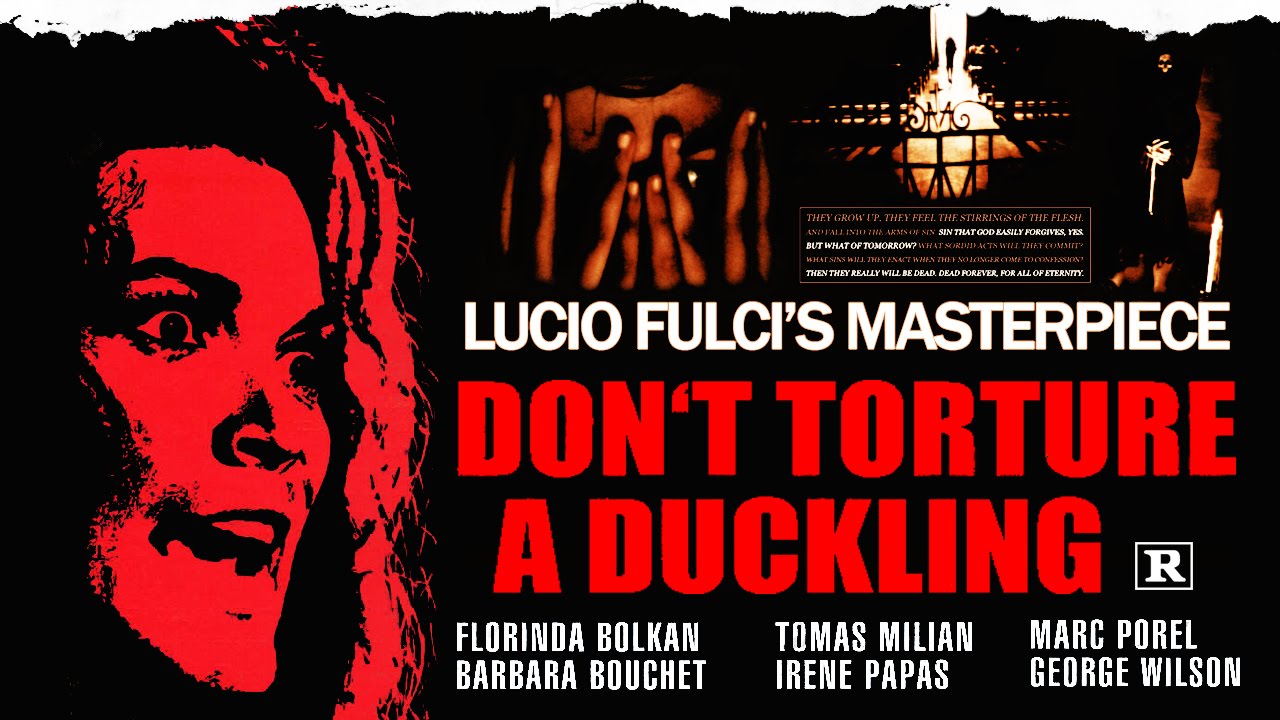
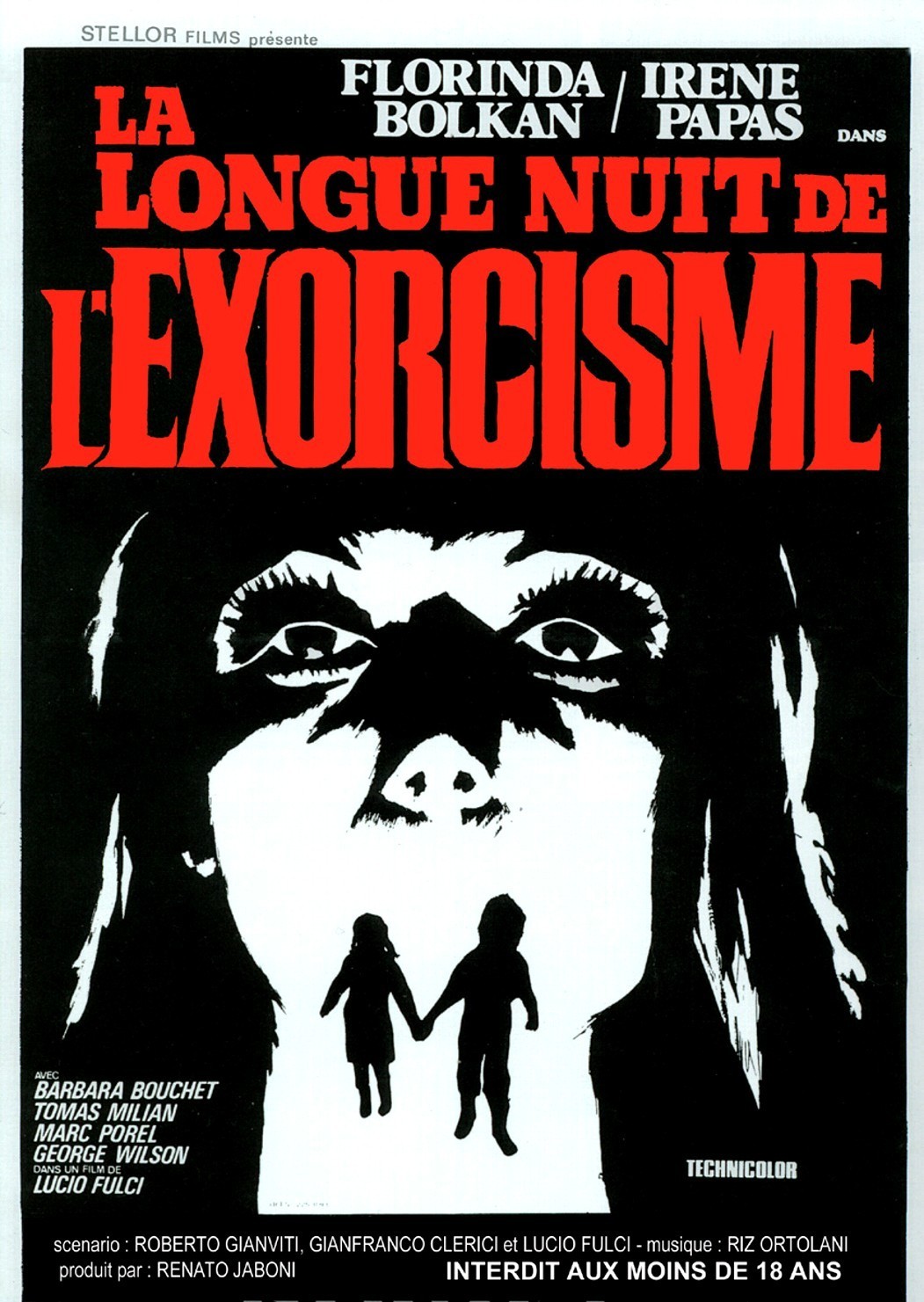
The setting in this Italian giallo is a small, rural village where the children of the townspeople are being murdered. At first the police suspect and arrest a mentally handicapped man (Vito Passeri), but the killings continue. Soon even more suspects turn up including Maciara (Florinda Bolkan) the mother of a dead child herself who secretly practices voodoo using dolls made by her father and yet every time the authorities believe they’ve found the culprit more clues arise that leads them to someone else creating panic in a town already steeped in fear, suspicion and the superstitious.

As a story detailing a police investigation it’s not too bad. The plot works in a linear fashion that’s easy to follow without entering in too many subplots or red herrings although it’s still no better than your average episode of ‘Murder She Wrote’. I did enjoy the rural Italian landscape and the bird’s eye shot of the village whose decrepit, rundown buildings visually hit home the stifled, bleak nature of the residents and why they would turn so heavily to the spiritual world as their sole escape.

Balkan’s performance as the nutty lady is effective particularly when she has a seizure during her interrogation and the scene where she gets surrounded by men who belt her with chains is quite graphic and realistic.

The film though, like with a lot of Italian productions from that era, does have dubbing issues particularly director Lucio Fulci’s use of adding in all the sound effects giving it a certain over-the-top cartoon quality. For instance when a victim is being slapped by a man’s hand it sounds more like the lashing of a whip and even simple stuff like the shoveling of dirt comes off wrong because the sound effect is not in sync with the action on the screen.

The film also has a uncomfortable moment where an adult character (Barbara Bouchet), who is one of the protagonists, walks around naked in front of a 12-year-old boy and even asks him how many women ‘he’s done it with’.

Spoiler Alert!

Guessing who the real killer is was easy and I had the whole thing figured out after about 30 minutes making the rest of the mystery predictable and boring. The idea of a priest killing children might’ve been considered shocking at the time, but now as with Fulci’s criticism of the Catholic Church it comes off as heavy-handed and redundant.

The close-up, slow motion shot of the priest falling down a cliff at the end is the film’s most controversial moment as it is clearly a dummy whose blank eyes and unnaturally agape mouth looks incredibly fake. Some have argued that this was Fulci’s attempt at revealing the ‘inner ugliness’ of the character by showing something with such a distorted face, but since a similar looking mannequin is also used to portray one of the boy victim’s submerged in a tub of water earlier I think it can safely be said that it was more just the cheapness of the production than anything else.

End of Spoiler Alert!

don't torture a duckling 4

My Rating: 4 out of 10

Released: September 29, 1972

Runtime: 1Hour 42Minutes

Not Rated

Director: Lucio Fulci

Studio: Medusa Distribuzione

Available: DVD, Amazon Instant Video

Frightmare (1974)

cover up 2

By Richard Winters

My Rating: 5 out of 10

4-Word Review: Mother likes eating humans.

After 15 years of being locked up in an asylum Dorothy and Edmund Yates (Sheila Keith, Rupert Davies) are freed, Dorothy was in there for killing 6 people and eating their flesh while Edmund helped cover it up from authorities. Now that they are deemed sane they are free to start their lives over. Jackie (Deborah Fairfax) is their oldest daughter and she secretly visits them on the side, but their youngest daughter Debbie (Kim Butcher) was just an infant when they were put away and does not know that they are out. Jackie tries to keep their parents past from her, but this proves difficult when Dorothy starts killing again and Debbie begins showing the same homicidal traits.

On the technical end this British made horror isn’t too bad. Director Pete Walker makes the most of his limited budget by keeping the story moving and never allowing it to get bogged down with endless dialogue. There is a surprising amount of gore that looks relatively realistic and the recent Kino Lorber Blu-ray transfer is excellent with sharp color and no graininess.

However, it’s not scary at all. Yes, the subject matter is a bit unsettling, but there are no shocks or surprises and no atmosphere or tension either. The twist ending might’ve been effective had the script not telegraphed it, so by the time that it does occur it’s a letdown since the viewer had already been anticipating it for quite a while.

The idea that anyone could ever be considered ‘sane’ after killing and eating 6 people is absurd as mental illness isn’t something that can be ‘cured’ and freeing anyone at any time after committing such a heinous crime is illogical. It made me wonder what test was given to see if Dorothy no longer had cannibalistic urges and had therefore ‘earned’ her freedom. Did they throw a human body in front of her and if she didn’t jump up and bite into it was she then deemed ‘normal’?

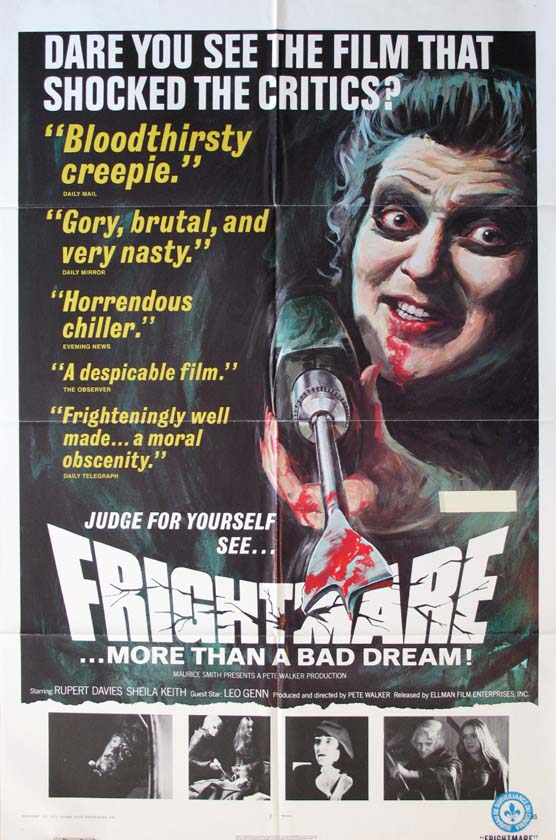
Although she doesn’t look anything like the drawing on the film’s promotional poster I did enjoy Keith in the lead especially the way she could quickly go from menacing to child-like. I also liked Butcher, who despite looking like she was way over 15, which was the supposed age of her character is fun as the rebellious teen particularly the scenes where she challenges the authority of her older sister.

My Rating: 5 out of 10

Released: November 6, 1974

Runtime: 1Hour 22Minutes

Rated R

Director: Pete Walker

Studio: Miracle

Available: DVD, Blu-ray, Amazon Instant Video

A Bell from Hell (1973)

bell from hell

By Richard Winters

My Rating: 4 out of 10

4-Word Review: A psycho returns home.

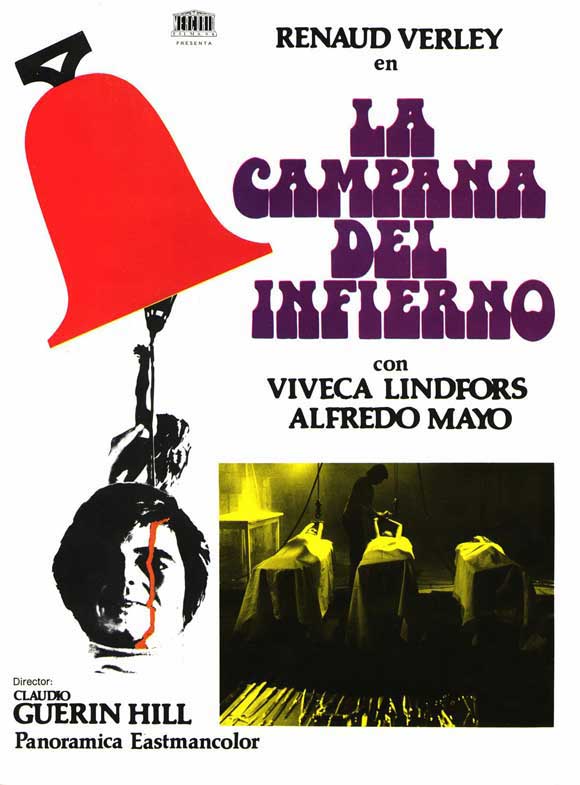
After being locked up for years in an insane asylum Juan (Renaud Verley) is released and allowed to return home to his wheelchair bound mother Marta (Viveca Lindfors) and three sisters who had him put away in an attempt to get at his inheritance. Now Juan wants revenge and does so by trying to have his mother stung to death by a horde of angry bees and his sisters cut up at a meat processing plant, but both of his attempts fail. They survive and turn-the-tables by having him encased alive at the local church’s bell tower that is being erected, but just when they think he’s dead they find that he may not be.

This film’s most notorious claim to fame is that its young director Claudio Guerin fell to his death from the very bell tower he had constructed for the movie on the last day of shooting, which is a shame since he showed strong potential for being a gifted filmmaker. If there is one thing that holds it all together and keeps it captivating it’s with its visual quality. Despite the limited budget Guerin shows a keen eye for an array of interesting camera angles and shots. The atmosphere is thick and remains creepy throughout even though it doesn’t have any actual scares.

Unfortunately the script by Santiago Moncada lacks the same type of creativity with a cliché-ridden storyline that meanders and at times feels like it’s going nowhere. The muffled English dubbing makes it hard to hear all of the words that the characters are saying and the ending plays like a tired rehashing of an Edgar Allan Poe story that provides no surprises.

The film’s most provocative moment is when Juan kidnaps his sisters and hangs them naked on meat hooks at the processing plant, which is filled with imaginative close-ups and edits and a major precursor to the so-called ‘horror porn’ that we’ve become used to today. However, the film doesn’t go far enough with it and pulls back after an interesting set-up, which becomes a testament to the production as a whole that has great potential, but only mediocre results.

bell from hell 2

My Rating: 4 out of 10

Released: October 1, 1973

Runtime: 1Hour 33Minutes

Not Rated

Director: Claudio Guerin

Studio: AVCO Embassy Pictures

Available: DVD, Amazon Instant Video

Disco Godfather (1979)

disco godfather

By Richard Winters

My Rating: 2 out of 10

4-Word Review: Don’t try angel dust.

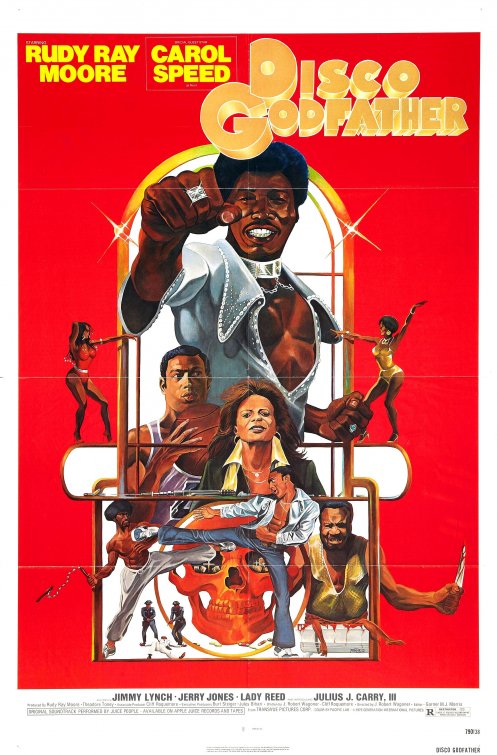
Tucker (Rudy Ray Moore) is the DJ at a local discotic known as Blueberry Hill who becomes concerned when his nephew takes a new drug called angel dust that causes him to have weird hallucinations and forces him into the hospital. Since Tucker is also a former cop he decides to use his connections with the police force to take down the drug dealers and clean up the streets before they can corrupt any more of the youth, but the dealers have other ideas including kidnapping Tucker and forcing him to ingest the drug via a gas mask.

This was the fifth feature for Moore and the last one where he was credited as the star. The former comedian created a character for his stage act called Dolemite that proved so popular that in 1975 it was turned into a movie and Moore became a star at the age of 48. Yet by this time the act was starting to get old. He still had the energy, but seeing a man who was clearly in his 50’s somehow able to beat up guys who were much younger and bigger than him didn’t make a lot of sense.

The story itself is run-of-the-mill and splicing in disco dance numbers where the camera conspicuously focuses in on the scantily-clad gyrating bodies of the females doesn’t help and if anything makes it even more boring. The fight sequences looked quite staged and it’s obvious that the actors are pulling their punches and kicks.

The only thing that makes this otherwise uninspired low budget mess slightly diverting are the drug sequences in which the characters start tripping out on all sorts of weird hallucinations as well as a segment dealing with a religious group trying to ‘cure’ one of the victims through an exorcism. The final segment in which Moore sees his mother turning into a devil is goofy enough to give this thing 2 points and had this movie cut out the derivative drama and emphasized more of a surreal quality it would’ve done better.

My Rating: 2 out of 10

Released: September 3, 1979

Runtime: 1Hour 33Minutes

Rated R

Director: J. Robert Wagoner

Studio: Transvue Pictures Corporation

Available: DVD

Rollerball (1975)

rollerball1

By Richard Winters

My Rating: 6 out of 10

4-Word Review: This game gets nasty.

In the not so distant future where no governments or countries exist and corporations control everything a new type of game becomes the rage. It features two teams on roller blades skating around a circular rink while fighting over a silver hand sized ball, which they use to throw into an electronic type of basket and score points. The game features little officiating and can usually cause injury or even death to the players, but one man named Jonathan E. (James Caan) has risen to the top and become a superstar in the sport. Bartholomew (John Houseman) who is the head of the conglomeration doesn’t like this because the idea of the games is to thwart individuality and not promote it. They push Jonathan to retire, but he refuses forcing the games to become even more violent as their way to get rid of him one way or the other, but the more they try to take him down the more he fights back.

The thing I really liked about William Harrison’s script, which is based on a short story of his called ‘Roller Ball Murder’ is how amazingly prophetic it is. Corporations and their rich lobbyists are pulling the strings of the government officials already making them seem as mere puppets and modern day suburbia much like in the movie is really only a tranquilizer  with its comfy lifestyle used to lull everyone into overlooking the many concessions that come with it. The violent games for both the players and fans acts as an escape from their otherwise sterile existence as the outcomes are the only things not already preordained by the corporations and thus giving the players a small sense of control over something.

Unfortunately the film’s set design is not as intuitive as its story and lacks imagination and even seems quite dated. There are no personal computers and the ones that do get shown are quite archaic looking. I have not seen the 2002 version, but this reason alone justifies a remake although the scene where the party guests go outside to play with a ray gun is a keeper.

The game itself isn’t all that interesting and to me came off as a glorified version of roller derby. I thought it should’ve been more graphic and bloody and the film pulls back when it should instead capture the true brutally of the sport. It does get a little more violent as it goes on and I did enjoy the surreal quality of the film’s climatic game where players from both sides end up either killed or severely injured. The segment showing the men preparing for a game by having the Caan character giving pointers to the new players on some of the strategy that is needed helped convey the idea that the sport had a certain technique to it and not simply rollerblading around a rink.

Caan is adequate in the lead, but is upstaged by John Beck as his playing partner as well as Shane Rimmer who plays his coach. It’s great to see John Houseman in his second feature film after his Academy Award winning performance in The Paper Chase, but his close-ups where ill-advised as it made me notice all of his nose hairs and director Norman Jewison should’ve either avoided framing his face from that angle or giving the elderly actor a pair of tweezers to pull them out.

The ending is unsatisfying as it leaves everything on a vague note. We see the fans cheering Jonathan’s moxie, but there is no indication as whether he was able to ultimately stage a revolt, or whether the corporate heads found some other way to get rid of him. In either case I wanted more of a conclusion and the fact that there isn’t any makes it feel like a great concept that wasn’t fully realized.

My Rating: 6 out of 10

Released: June 25, 1975

Runtime: 2Hours 4Minutes

Rated R

Director: Norman Jewison

Studio: United Artists

Available: VHS, DVD, Blu-ray, Amazon Instant Video