Category Archives: College Life

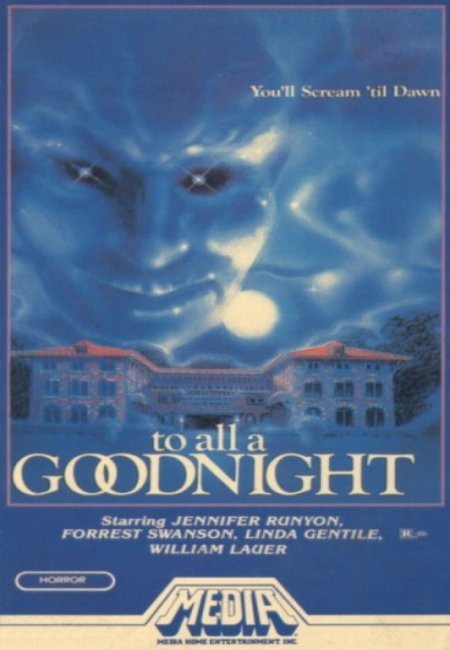
To All a Goodnight (1980)

to all a goodnight

By Richard Winters

My Rating: 2 out of 10

4-Word Review: Santa stalks sorority babes.

An initiation stunt at a girl’s sorority house goes horribly wrong and one young woman falls to her death off of a balcony. Two years later the girls get ready for a Christmas party by inviting some boys over and soon they are all getting down-and-dirty, but then someone dressed in a Santa Claus suit begins hacking them off one-by-one.

I’m a big fan of David Hess who directed this feature as I feel his performance as Krug in the classic horror movie Last House on the Left was effectively intense and this film is also written by Alex Rebar who starred in the cheesy cult flick The Incredible Melting Man, so I wanted to cut this movie some slack, but found that I couldn’t. Things start out bad from the very beginning with a tacky flashback sequence that is wretchedly acted and photographed and then things go straight downhill from there. Part of the problem is that the scenes featuring extraneous dialogue between a lot of bland, cardboard characters that is usually used at the beginning of most 80’s slasher flicks as a sort of set-up, but here they get strung along throughout the entire movie. The killings themselves are brief and paced so infrequently that you start to forget that this is supposed to be a horror film. The tension is nil and having a setting dealing with snarky, snotty and horny sorority babes is a tiresome cliché.

The killings themselves are poorly photographed in dark lighting, so it is difficult to follow the action. The special effects are cheap and unimpressive. One scene features a couple getting killed while they have sex, which is a poor rip-off of the same scene that was done in Mario Bava’s Bay of Blood. Some fans of the film boast about the scene featuring a death of two people by an airplane propeller, but this is really no big deal because all you see are a few seconds of blood splattering on the outside of the plane and that’s it.

The script is illogical and full of a lot of loopholes. The identity of the killer turns out to be two people using the same disguise, which doesn’t make sense for several different reasons, which is too may to elaborate here. There is also a Leia character played by Judith Bridges who gets accosted by the killer in a shower stall while being completely naked, but for some reason is not killed and instead we see her at the end dancing some nutty dance, but with no explanation as to why. The policemen hired to protect the girls after the first victim is found dead do not dress in uniform and instead look like they are ready to go out to a club to pick up chicks and behave like it, which seemed wholly unprofessional and ridiculous.

Jennifer Runyon makes her film debut here. She had a brief 13-year-run, which included a co-starring role in the 80’s series ‘Charles in Charge’, but has not appeared in anything since 1993’s Carnosaur. She is certainly easy on the eyes, but her voice is too high-pitched and sounds almost like she is 8 or 9 years old or someone who has sucked up helium. Hess also casts his mother Judy Hess in a small role as Mrs. Ronsoni although in the closing credits it gets incorrectly listed as Mr. Ronsoni.

Despite being set at Christmas the action takes place in the warm tropical climate of California, which is okay, but the expectation for a Christmas movie is to have snow and cold. Having the girls trapped in their house because of the frigid weather or being chased by the killer while trudging through deep snow could’ve helped heighten the tension and added an atmosphere.

The pounding electronic music score is the only thing that I liked and helped give this otherwise static and forgettable production a slight distinction.

My Rating: 2 out of 10

Released: January 30, 1980

Runtime: 1Hour 23Minutes (VHS Print)

Rated R

Director: David Hess

Studio: Intercontinental Releasing Corporation

Available: VHS

The Magic Garden of Stanley Sweetheart (1970)

the magic garden of stanley sweeheart

By Richard Winters

My Rating: 3 out of 10

4-Word Review: An aimless, carefree lifestyle.

Based on the novel by Robert T. Westbrook who also wrote the screenplay the film centers on Stanley (Don Johnson in his film debut) an underground filmmaker living in an apartment that is almost continually bombarded with the noise of a construction site next door. He has big dreams and ambitions, but at times seems awkward and unsure of himself. He meets Cathy (Dianne Hull) who he initially is just interested in for sex, but then he starts to fall-in-love with her and when she breaks up with him he finds it hard to handle.

The movie starts out well. I enjoyed the free-style direction and narrative. Cutting back and forth showing things as they are versus how Stanley would like them to be is fun, but the film deviates away from this when it would have been more interesting had it stayed this course all the way through. There is a certain element of one of Andy Warhol’s anti-movie movies here where the film tries to challenge the viewer’s conventional understanding of protagonists, plot, character development and all around narrative structure and it is no surprise that Warhol really liked this movie. It does have a strong cinema vertite approach that gives you a feeling like you are right there with the characters and to a certain extent helps bring the 60’s back to life.

Unfortunately the direction is too lackadaisical and unfocused and the story is uninteresting. Looking more at Stanley’s underground films could have given it a little more bite, but we only get a glimpse of one of his movies and then that thread is pretty much forgotten. The second half of the film centers on Stanley’s relationship and ultimate break-up with Cathy, which is too contrived and does not compliment the film’s otherwise offbeat approach. Funky and irreverent moments of humor are lost with a storyline that doesn’t seem to know where it wants to go or what to say. Tighter editing could’ve helped avoid some long stretches where nothing seems to happen.

The film though still has some interesting and unique scenes. I got a kick out of Stanley’s cluttered apartment and how he has to smell his food in his refrigerator to see what is still edible and for entertainment he stamps on cockroaches crawling across his floor. The part where he masturbates in a bathtub while reading a letter written by his mother is hilarious. His attempts at making a porno by getting his actress (Holly Near) good and drunk only to get her hornier than he is amusing. The naked body painting sex orgy that he has with two young nubile roommates has a nice sensual quality.

Don Johnson is excellent and the one thing that keeps this wandering film together and he can be seen totally nude from both the front and back. Hull allows for some diversion as a sheltered young lady who is initially shocked by the open sexuality around her, but eventually learns to embrace it. Native American actress Victoria Racimo is hot with her clothes on and off and reminded me a lot of 70’s adult film star Hypathia Lee. Brandon Maggart makes the most of his small bit as a gay man trying to come onto Stanley while inside a café. Michael Greer offers some edginess as Stanley’s slightly menacing friend Danny. His violent death that occurs near the end of the film and in front of his shocked mother does leave an impression, but we don’t know enough about the character for it to make much sense and just another thing put into the film without seemingly much thought.

My Rating: 3 out of 10

Released: May 26, 1970

Runtime: 1Hour 50Minutes

Rated R

Director: Leonard Horn

Studio: MGM

Available: None at this time.

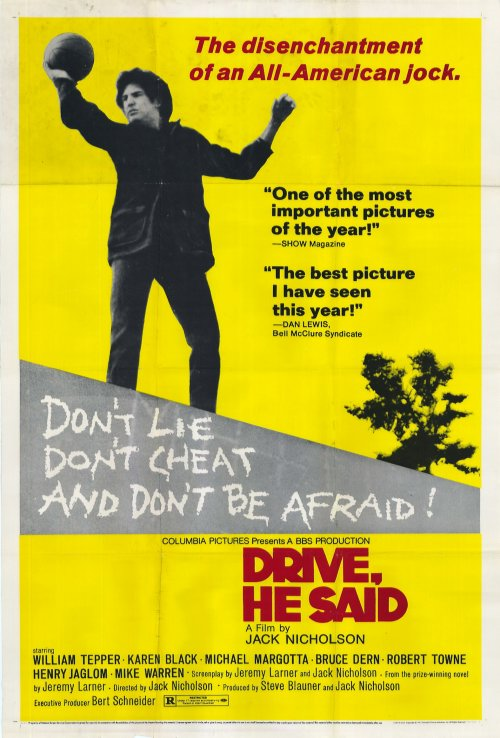
Drive, He Said (1971)

drive he said 1

By Richard Winters

My Rating: 5 out of 10

4-Word Review: Player doesn’t like coach.

This is one of those movies that shows signs of being a really great movie trying to break out, but never does. It’s about Hector (William Tepper) a college basketball star who is being tugged at different directions by those around him and by society at-large. This creates inner turmoil that leads to outbursts, apathy, and even anti-social behavior.

Tepper as the star isn’t the best of actors. He has a constant blank look and way too much hair. The character he plays has potential. It is nice to see a portrait of an athlete that isn’t one-dimensional sports, but instead shows intelligent and sensitivity to things that go well beyond the court. Yet he is also too self- absorbed and displays a selfish behavior that in most cases would alienate him from his teammates. What is supposed to be betrayed as angst instead comes off as an obnoxious, spoiled college kid. His constant rebellion with his coach (Bruce Dern) doesn’t mesh.

The film makes some good observations and brings up great issues. Unfortunately it ends up becoming diluted. In some ways it should have just stuck with the basketball angle. The camera shots that glides with the action during the games is excellent. Some of the scenes during the practice and some of the locker room segments of Dern coaching the team gives the viewer a good taste of the college basketball experience and makes you want to see more of it. However, incorporating late sixties politics into it only makes it redundant and in this area the film offers no new insight.

The film does have its moments and some of them are even memorable. The best ones involve actor Michael Margotta’s character as a student radical wavering on insanity. His assault on the Karen Black character while inside a large, darkened house is striking both visually and emotionally. The scene where he, while naked, runs into a science lab and releases all sorts of rats, rodents, and reptiles is a sight in itself.

Dern with his glazed stare and intense acting style seems like a natural for the part of the hard-driven coach. It’s too bad the film doesn’t make the most of it, but Black is looking at her best.

Jack Nicholson as a director is not as good as Nicholson the actor although he does show potential, but it doesn’t come together as a whole. The film should best be viewed as a curio or artifact of its era. There is also a surprisingly high amount of male nudity as well as homo-erotic overtones.

drive he said 2

My Rating: 5 out of 10

Released: June 13, 1971

Runtime: 1Hour 35Minutes

Rated R

Director: Jack Nicholson

Studio: Columbia Pictures

Available: DVD (Region 1 & 2)

Tall Story (1960)

tall story

By Richard Winters

My Rating: 6 out of 10

4-Word Review: The game is rigged.

June Ryder (Jane Fonda) is a boy-crazy college coed who has her sights set on Ray Blent (Anthony Perkins) the star of the school’s basketball team. Ray ends up being as infatuated with June as she is with him and the two decide to get married, but before they do they purchase a motor home from Ray’s friend Fred (Tom Laughlin). Unfortunately they don’t have enough of the required money until a mysterious stranger gives Ray $2,500 to blow the upcoming game his team has with the Russians, which puts Ray in a difficult quandary.

The film has a nice fluffy appeal and was based on the hit stage play, which in turn was based on the novel ‘The Homecoming Game’ by Howard Nemerov. The college campus atmosphere for its time period seems realistic. It is refreshing to have the adult faculty portrayed as normal human beings relating to the students on a relatively equal level and vice versa as opposed to the trend that started in the 70’s and went full-throttle in the 80’s where adults in these types of films were written as preachy, oppressive, out-of-touch, authoritative humorless pricks. In fact Marc Connelly as Professor Osman was my favorite character as he looked and spoke like a true professor and helped balance the silliness by being the most normal of the bunch. Anne Jackson as the wife of Professor Sullivan (Ray Walston) comes in a close second and has some amusing moments and a few good comeback lines particularly near the end.

Fonda is perfect as a character lost in her own little world and enthusiastically going by the beat of her own drummer while oblivious to the consternation she causes to those around her. Initially the character is written a little too aggressively making her too deluded and like a stalker, but fortunately that gets toned down and she becomes likable enough. Perkins is great as her boyish counterpart and the two even sing a duet together.

The pacing is a bit poor. Initially it is very zany and fast paced making the thing seem almost like a live action cartoon, which doesn’t work at all. The film then slows down and becomes a draggy only to rectify things with a funny conclusion. If you like things that are cute and undemanding then this should work although the sequence in which Ray comes into the game and singlehandedly wins the game after the team is far behind is just too contrived and over-blown for even Hollywood standards. The humor is light and comes in spurts with some of it managing to elicit a few chuckles. One of the few interchanges that I liked consisted of:

June: “Did you know that elephants only mate once every seven years?”

Ray: “There are some that do it every six years.”

June: “They’re nymphomaniacs”

Spoiler Alert!

One of the biggest problems with the film is the ending as Ray decides to play in the game and win it for his team despite keeping the money that he was paid in order to throw it. However, there is just no way a criminal organization would let anyone keep that money especially when the other party did not uphold their end of the bargain. Most likely they would track down Ray and June and exact a very unpleasant revenge. However, the film never even touches on this and instead shows Ray and June buying the motorhome and riding happily off into the sunset while leaving open a major loophole in the process.

My Rating: 6 out of 10

Released: April 6, 1960

Runtime: 1Hour 31Minutes

Not Rated

Director: Joshua Logan

Studio: Warner Brothers

Available: VHS, DVD (Warner Archive), Amazon Instant Video

Dealing: or the Berkeley-to-Boston Forty-Brick Lost-Bag Blues (1972)

dealing

By Richard Winters

My Rating: 5 out of 10

4-Word Review: Drugs are a trip.

This review was originally slated to post in February, but due to the death on Christmas Eve of Charles Durning I decided to post it now. Durning was one of the all-time great character actors who always brought an amazing amount of energy to every role he played and could do a wide variety of character types well. Although he has very few lines of dialogue in this movie he still manages to become the most interesting part of the proceedings and helps enliven an otherwise slow moving film.

The plot, based on a novel by Michael Crichton, pertains to Peter (Robert F. Lyons) who is a recent Harvard graduate hired by John (John Lithgow) to transport a suitcase full of marijuana from Boston to Berkeley, California. Peter is new at this and things do not go as planned, but he meets beautiful Susan (Barbara Hershey) along the way and the two fall in love. John next hires Susan to transport another suitcase of narcotics, but when she loses the luggage at the airport and then tries to go back and get it she is arrested by corrupt cop Murphy (Durning) who resells some of the recovered stash back out onto the street. In order to get Susan out of jail Peter plays an elaborate game of cat-and-mouse with the cop, which culminates in a violent showdown.

The story is done in a laid-back style similar to the approach taken by many European films. The emphasis is on mood and subtle nuance yet when the Europeans do it this style seems refreshing, but here it is more off-putting. I really had a hard time getting into it as the first hour is slow with too many scenes going on longer than it should. The set-up is too quick and there is not enough background, or history shown to the main character.

The second hour improves. Durning gives the proceedings some pizazz and Peter’s scheming is fun. The shootout done in the snow has flair and style.

The music by Michael Small is impressive. It is one of the most original scores I have heard and really fits the mood of the script. The best is over the opening credits.

Hershey is as always gorgeous and fans may like that she is shown topless. The part of a free-spirited hippy chick seems to be her forte and she excels. However, having her fall for a guy that is rather dull and ordinary didn’t make sense. Sure they make love right away, but I thought that was more just because it was a part of her lifestyle and she does after all go around in a dress without wearing any underwear. She just seemed to be diving into the free love atmosphere of the era. Obviously having Peter fall for her made sense because she is hot, but why would she go head-over-heels for this schmuck when there are so many other guys that would be more than willing to do it with her. The romantic angle was forced and hurt the credibility of the story.

Lithgow is okay in his film debut, but I had problems with the character. One minute he is cool, conniving, brash, and arrogant and then in the next instant he becomes scared, confused, and meek, which was too much of a quick transition.

The under-rated Lyons is excellent and makes for a terrific lead especially with this type of part. Despite being in his 30’s he looks and acts very much like a college kid from that period. His performance is nicely understated and believable throughout.

The on-location shooting in Boston is vivid and people from the area may like to view this just to see how much it has changed. The DVD transfer from Warner Archive is excellent with a nice clarity and vivid colors. The movie itself is slick, but it also has a detachment to it that doesn’t allow the viewer to get as connected with the characters, or the situations like they should and thus making it an interesting period artifact, but nothing more.

Also, Demond Wilson can be seen briefly as one of the drug dealers. He did this just before his signature role of Lamont in the hit TV-series ‘Sandford and Son’. Ellen Barber is real cute as Peter’s girlfriend and so is Joy Bang who later became a registered nurse. Normally I don’t like women with buck teeth, but with her it actually looks sexy.

My Rating: 5 out of 10

Released: February 25, 1972

Runtime: 1Hour 28Minutes

Rated R

Director: Paul Williams

Studio: Warner Brothers

Available: DVD (Warner Archive)

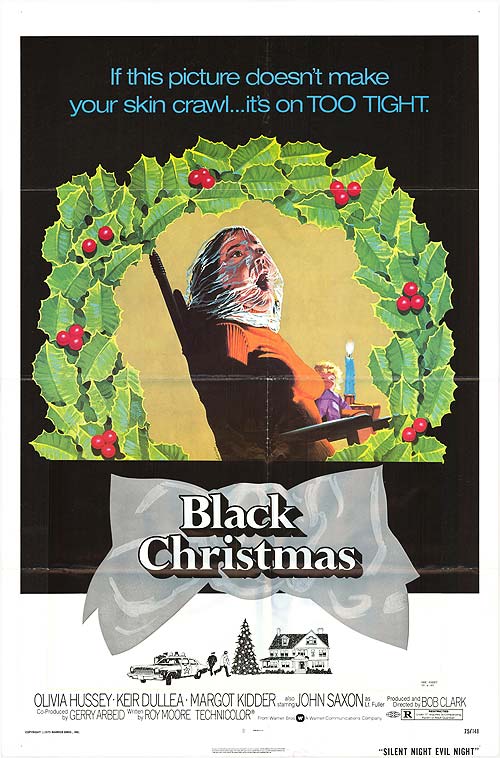
Black Christmas (1974)

black christmas 1

By Richard Winters

My Rating: 8 out of 10

4-Word Review: He’s in the attic.

It’s Christmas time at the sorority house, but as the girls celebrate the season they continue to get harassing phone calls from a strange man who speaks in different and frightening voices. Unbeknownst to them the man has snuck into the attic of their house and the calls are coming in from another room. As the night progresses the girls begin to disappear forcing the lone survivor to fight off the killer by herself.

I have not seen the remake of this film and due to negative response that I have heard I don’t think I want to either. This review pertains to the original only. If you have seen the remake and disliked it you should still give this film a try.  Despite its low budget it is quite effective and it slowly builds up the tension in a nice compact style with a great twist ending.

Of course one of the things that make this movie so good is the humor. I loved Marian Waldman as the alcoholic house mother Mrs. McHenry who stashes bottles of whiskey in all sorts of goofy places. The vulgar Santa who swears even as the kids are sitting on his lap is a hoot and a nice precursor to Bad Santa, but my favorite is the poster of a sweet old lady giving the finger.

One of the best moments on the terror end is the part where the killer’s eyeball can be seen looking through a small crack in the doorway, which is memorable. The scene where the camera pans from each girl’s nervous and frightened face as they listen to the weird voices emanating from the phone receiver is very well done although it would have been even stronger had the Christmas music not have been playing in the background.

The performances are top rate and I liked the fact that the girls all have distinct personalities from one another. Margot Kidder as the vulgar and obnoxious sorority sister Barb is a scene stealer and I’d say this is the best performance of her career. I loved when she calls one of the more conservative members of the group a ‘professional virgin’, or has the audacity to call her own mother a ‘gold-plated whore’. The part where she gets a young kid drunk and even swears in front of him is also funny as is her conversation about a species of turtle that can have sex for three straight days without stopping. Yet through all of her outrageousness director Bob Clark still manages to create a three-dimensional character by showing her as also being lonely, moody, and suffering from asthma, which is good.

Olivia Hussey as Jess is terrific. She is poised, confident, intelligent, and sweet and the type of character the viewer can immediately connect with and care about. Her face has a wonderful fragility about it as well a natural beauty. The look of terror coming from her eyes seems genuine and the horror is made more effective because she responds to it in a believable and relatable way.

Keir Dullea is good as Jess’s high strung boyfriend Peter. I had to chuckle a bit seeing him here as it brought back memories of what playwright Noel Coward once said about him “Keir Dullea gone tomorrow”, which seemed to have some credence since he was starring in the masterpiece 2001: A Space Odyssey just a few years earlier and now delegated to a supporting role in a low budget horror film. I always felt that his reserved and emotionless delivery can work when given the right role and for the most part it clicks here despite the fact that he was pushing 40 at the time and not quite looking college age.

I read one review where the critic complained that he did not feel it was believable for a killer to be hiding in an attic and no one else in the house aware of it, but the house was a big old building and for me it seemed possible especially since it was only for a short period of time. Overall I felt this was a very plausible premise that is handled in a realistic fashion without all the glaring loopholes, which is one reason I continue to enjoy it no matter how many times I’ve seen it.

However, there are a few quibbles. One is the policeman who gets his throat slashed while sitting in an unmarked police car just outside of the sorority home. I would think a seasoned office would be able to spot someone sinking up on him while he is inside a car especially since it was otherwise not a busy street and since it was wintertime I think it would be highly doubtful that he would be sitting there with the driver’s side window rolled down. I also had to roll my eyes at the scene where Jess is trying to get out of the house as she is being chased by the killer and yet for some inexplicable reason the front door conveniently jams even though no had a problem with it before.

Bob Clark shows what a talented director he is and it is too bad his career and life was cut short in a car accident in 2007. It is one thing to have a big budget and access to all the state-of-the-art special effects, but it is another to make a memorable movie on a shoestring. Despite its low budget it doesn’t seem hampered by many of the limitations that other similar films suffer.

Some may prefer lots of gore, which this one has very little of, and a bigger-than-life monster or bad guy, but the reason this is a classic is because they go with the philosophy that less is more. Any self-respecting horror fan should see this film and most likely appreciate it.

My Rating: 8 out of 10

Released: October 11, 1974

Runtime: 1Hour 38Minutes

Rated R

Director: Bob Clark

Studio: Warner Brothers

Available: VHS, DVD (Special Edition), Blu-ray

Up in the Cellar (1970)

up in the cellar 3

By Richard Winters

My Rating: 5 out of 10

4-Word Review: Senior citizens watch porno.

This is a variation of the film Three in the Attic and for a time was called Three in the Cellar to try and capitalize off of the success of that one. Ironically both films starred Judy Pace. In this one Colin Slade (Wes Stern) is a nerdy college student who loses his scholarship to a computer glitch. When he can’t get college president Maurice Chamber (Larry Hagman) to help him, he decides to get revenge by seducing both his wife (Joan Collins) and daughter (Catlin Adams).

The production proudly proclaims to be filmed on location in New Mexico, which is obvious from the start and nothing to really boast about since it hurts the film as a whole. Shot in wintertime it’s dusty, desolate landscape leaves the viewer with a cold, lonely feeling, which configures poorly with a story that is supposed to be lighthearted and whimsical. The big, modern cement buildings used as the campus looks like they would be better suited for a corporation than a student body. The students themselves, or what little you see of them, look all suspiciously over the age of 24.

Director Theodore J. Flicker nicely camouflages the fact that this is a very low budget production. His script is compact and well-paced. He frames and cuts his shots so you don’t notice how lacking in personality or energy it really is. Yet he also shows little connection to the student uprisings that dominated the campuses of that era and seems to view it as a sort of silly amusement. He keeps the film at this tone the whole time and thus makes it as silly and forgettable as the characters and situations he tries to satirize

Hagman comes off best. He plays it with a fun mixture of traits from two of his best known characters. He has J.R. Ewing’s arrogance coupled with Major Nelson’s frantic anxiety.

The film also has two fun and unique scenes. One has Hagman climbing up an actual radio tower to save Stern who is threatening to jump off. The second one has a pornographic movie shown to a group of unsuspecting and shocked senior citizens

My Rating: 5 out of 10

Released: August 12, 1970

Runtime: 1Hour 34Minutes

Rated R

Director: Theodore J. Flicker

Studio: American International Pictures

Available: Amazon Instant Video

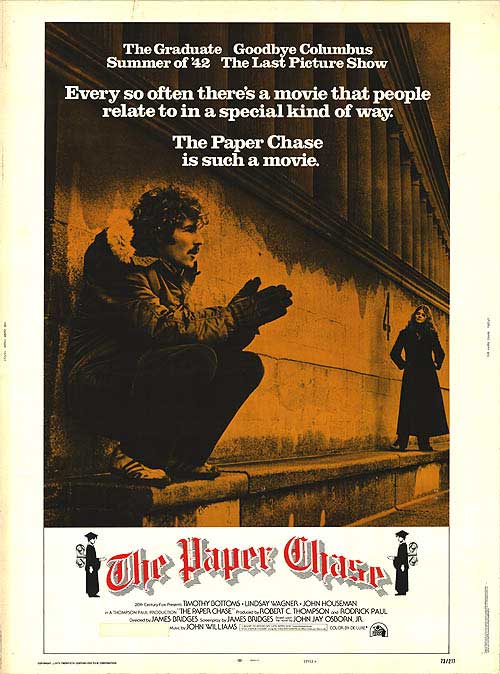
The Paper Chase (1973)

By Richard Winters

My Rating: 9 out of 10

4-Word Review: He can’t please Kingsfield.

James Hart (Timothy Bottoms) attends his first year at Harvard Law School and finds himself obsessed with the notoriously stern Professor Charles Kingsfield (John Houseman). His fascination increases after he begins a relationship with Kingsfield’s daughter Susan (Lindsey Wagner). The rest of the story deals with the pressures and demands of being a law student.

This quite possibly is the quintessential movie about college life. Everything is captured in such a real and revealing way that it will very likely send the viewer back to their college days. Despite being nearly forty years old it doesn’t seem dated at all as it touches on many universals that every generation goes through at that age. If anything it is still quite topical. The few dated elements are actually fun to see including the scene in the pre-cellphone days where the students would line up and wait their turn to make a call on the dorm’s one and only pay phone.

The student characters have diverse personalities and seem like young adults one would meet during their college days, or even see on a campus today. It is nice to have a college movie where students are actually studying. In fact these scenes are some of the best moments in the film including Hart’s dealings with difficult people in his study group.

The Hart character is appealing and relatable. I liked how he is multi-faceted and displays elements from both his own era including his counter-culture hairstyle as well as past ones.

Having it filmed on-location and capturing the different seasons of the year makes the viewer feel like they are attending the school year right along with him. I particularly liked the scene shot in the historic Harvard stadium.

The film also makes terrific use of silent moments as there is very little music. Many college movies dwell on the loud and raucous partying, but there is a lot of quiet time as well particularly the first day of class in a large auditorium wondering what the instructor will be like. The opening sequence done underneath the credits showing an empty classroom quietly filling up with students was not only novel, but brilliant.

Houseman deservedly won the Oscar for his portrayal of the crotchety professor. Outside of a small and unaccredited role in Seven Days in May this was technically, at age 71, his film debut. Some may complain that the character is one-dimensional. We are never shown any type of softer side to him and I am sure most films would have thrown some in, but the fact that they don’t do it makes his mystique more interesting. My favorite moment of his is when at the end of the year the students give him a standing ovation while Kinsgfield responds with his trademark scowl before walking out of the room.

The supporting cast of students is terrific and many were making their film debuts. There is Graham Beckel as Hart’s study partner Franklin Ford who looks like a twin of Brad Dourif. There is also Edward Herrmann and James Naughton as Kevin Brooks a man with a photographic memory, but no analytical ability. My favorite though was Craig Richard Nelson as the moody and belligerent Willis Bell.

Blair Brown can also be seen as one of the female students during the classroom scenes. She speaks in a strange accent and I think she was trying too hard to get the Bostonian sound, but I ended up kind of liking it anyways.

The implementation of Kingsfield’s daughter into the story really didn’t work with me. Lindsey Wagner is a competent actress, but the way they meet on a sidewalk seemed too forced and random. It is also beating extreme odds that Hart would by chance get into a relationship with the daughter of a man that is the complete center of his universe and the fact that she turns out to be hip, sexy, and gorgeous even though she is related to a man who is anything but was also a stretch. It would have been interesting had there been a few scenes and dialogue between Kingsfield and Susan, but none is ever shown.

There is a part involving Hart sneaking into the library when it is closed in order to get into a section that houses the notes taken by the professors when they attended the school as students, which I found to be odd. I have never known any college that has done this and talking with others no one else has either. I was still willing to roll with it but found it frustrating that when Hart takes out the notes written by Kingsfield in 1927 that the camera doesn’t focus in on the page to allow the viewer to see it for themselves. Having Hart simply describe what he sees including some doodling that Kingsfield apparently made on the side of the page is not as satisfying.

I had a few problems with the end as well although it was not enough to ruin what is otherwise a great movie. However, there is a scene showing Kingsfield grading his student’s tests by himself even though most tenured professors who teach large classes have graduate assistants do this for them. It may be more cinematically satisfying especially for the general viewer to see Kingsfield doing the grading, but that is not how it actually works.

Also, when Hart receives the grades in the mail he doesn’t bother to open the letter, but instead turns it into a paper airplane and floats it into the ocean. I didn’t understand the motivation of this because during the film Hart spends an enormous amount of time preparing for the test, so I would think anyone who went through that would want to see what they got. If he wants to turn it into a paper airplane afterwards that is fine, but at least see the results. I spoke to a fan of the film who says he interprets this scene to mean that Hart was more interested in learning the subject for his own enjoyment and not concerned with what he got out of it, but if that is the case the film fails to bring that out earlier and instead seems to show the exact opposite.

My Rating: 9 out of 10

Released: October 16, 1973

Runtime: 1Hour 53Minutes

Rated PG

Director: James Bridges

Studio: 20th Century Fox

Available: VHS, DVD, Amazon Instant Video