Category Archives: Cold Climate/Wintertime Movies

The Seven Ups (1973)

By Richard Winters

My Rating: 7 out of 10

4-Word Review: Cops use unorthodox methods.

Buddy (Roy Scheider) is a police detective who runs a group of renegade cops who employ unusual and sometimes questionable methods to nab crooks. Once apprehended the criminals they arrest usually end up serving 7-years or more in the penitentiary, which gives their group the nickname of the ‘Seven Ups’. The groups most recent mission is investigating kidnappings occurring in the city and Buddy uses the help of Vito (Tony Lo Bianco) a childhood friend who works as an undercover informant for the police, but who unbeknownst to Buddy is actually behind the recent crimes going on and even the orchestrator.

After the success of The French Connection producer Phil d’Antoni became inspired to produce another similar crime film dealing with the true-life event that occurred in the 50’s in New York that had mobsters being kidnapped by criminals posing as cops. He wanted William Friedkin, who had done so well with the first film, to direct this one, but Friedkin didn’t like the script and passed as did several other directors, which eventually lead the studio to choose d’Antoni to take the helm himself in his one and only foray behind the camera with results that are both good and bad.

The production lacks cinematic flair and shot in a flat way almost like a documentary, which to some degree actually helps it. It was filmed between January and April of 1973 and the crisp, gray, frigid look helps build an atmosphere by accentuating the grimy, cold life of the underworld and how the detectives themselves get foisted into it. The plot is basic and linear, so it’s easy to follow and not cluttered with unnecessary mystery angles and tangents as the viewer knows right away who’s behind everything. There’s also a tense scenes inside a car wash, not exactly sure the perpetrators would’ve been able to pull-off as effortlessly as they do, but it definitely keeps you riveted as you feel the same unease as the two guys in the car though having another scene come later that also takes place in a car wash wasn’t needed.

The film though doesn’t have the interesting characters like in The French Connection where Popeye Doyle’s lifestyle and temperament contrasted in fascinating ways with the man he was pursuing and in fact it was Doyle’s fractured personality that made the movie so compelling. Here, through no fault of Scheider who plays the part well for what is asked, but his character is quite one-note. We learn nothing about him, or his home life. He’s just a typical New York cop obsessed with getting the bad guys, which is fine, but doesn’t have the multi-dimensional quality to help make him memorable.

The supporting characters aren’t necessarily much better, but the actors who play them at least help give them some life. Larry Haines, probably best known for playing one of Felix and Oscar’s poker playing buddies in The Odd Couple, has a good turn here as a crime boss who’s nonchalant initially when he thinks he’s being taken to the cop station for a routine arrest only to cower in fright when he realizes he’s been duped and then when he survives shows no mercy in his unrelenting pursuit for revenge. My only quibble though is that Scheider and his cohorts are able to break into Haines’ house too easily and even able to catch him and his wife sleeping in bed, but you’d think with him being a well-known target with the police he’d have burglar alarms set-up all over his home to detect anyone trying to get in and since he’d just had a traumatic kidnapping incident earlier you’d think he wouldn’t be able to sleep soundly again, or paranoid enough to sleep lightly and aware of any noise.

The car chase sequence is by far the best moment, and some may say the only real reason to watch it. It certainly has you holding your breath, but in a lot of ways is too similar to Bullit, another film produced by d’Antoni, so it really doesn’t stand out as much as it should. There’s also the issue of Scheider pursuing the bad guys even as there’s pedestrians all around. Most real-life cops will stop chasing after a culprit’s car if they feel  it will put others at too much of a risk and this comes to a horrifying moment when school children are playing on the street and must quickly run to the curb when the bad guys drive their car through only a few seconds later to almost get hit by Scheider’s car as he plows through at high speeds without even a thought of putting on his breaks making him seem more like an irresponsible cop who’s more of a problem than a solution.

Nonetheless it’s gripping and I enjoyed how it ends with Scheider ducking under the windshield just as his vehicle hits the underside of the backend of a truck in an intended ‘homage’ to Jayne Mansfield’s wreck. It’s also great watching Richard Lynch’s facial expressions as he plays the crook sitting in the passenger’s side of the fleeing car. Some could say it’s great acting, which maybe it was, but I believe his looks of nervousness and fear was genuine, which just helps to make these shots of his face, which get intercut throughout the chase all the more entertaining and help to have a human side to the action as I and almost anyone else would be reacting the same as he does if we were in the same situation.

My Rating: 7 out of 10

Released: December 14, 1973

Runtime: 1 Hour 43 Minutes

Rated R

Director: Philip D’Antoni

Studio: 20th Century Fox

Available: DVD, Blu-ray

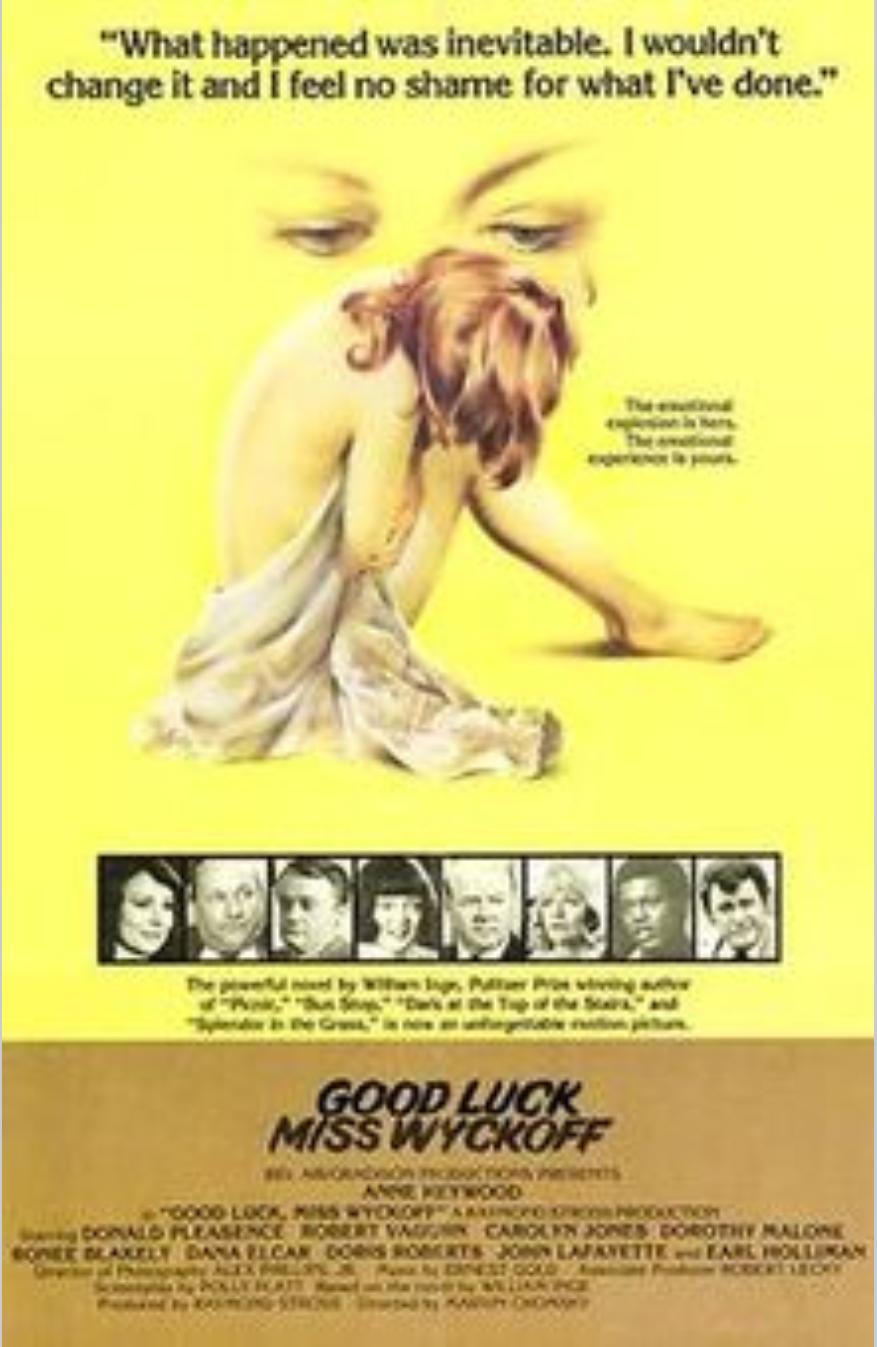
Good Luck, Miss Wyckoff (1979)

By Richard Winters

My Rating: 1 out of 10

4-Word Review: Spinster teacher is raped.

Evelyn Wyckoff (Anne Heywood) is a middle-aged single woman who teaches high school in a small town in Kansas. She has never married and is showing signs of severe depression, which alarms her best friend Beth (Carolyn Jones) as well as the older couple (R.G. Armstrong, Joycelyn Brando) whom she’s living with. Both her doctor (Robert Vaughan) and her psychiatrist (Donald Pleasance) believe it’s because she is not in a relationship or having any sex and that she needs to get out more and meet people. She attempts at starting something with fellow teacher Chester (J. Patrick McNamara) but finds him to be too shy and embattled with his own problems to be able to recognize her interests. She also considers friendly bus driver Ed (Earl Holliman) only to call it off when she learns he’s married. Left alone after school one evening she comes into contact with Rafe (John Lafayette), a black man who works as the janitor, who sees her loneliness as a weakness that he can exploit. He comes onto her strongly and abrasively eventually forcing her to submit to his sexual demands, but she doesn’t go to the authorities and instead starts to enjoy the degradation and continues to come back for more until the rest of the students and teachers find out about it putting her job and reputation in peril.

The story is based on the 1970 novel of the same name written by William Inge. The film rights were sold in 1971 but sat on the shelf for many years until producer Raymond Stross found it and felt it would be a good vehicle for his actress wife Heywood who had already made a name for herself in tackling controversial, edgy material and even sought it out, so this was considered a perfect next project. While she had received critical accolades for her earlier work, The Fox, where she played a lesbian in a  relationship with Sandy Dennis, which was envelope pushing for its era, this one did not go over as well and was genuinely lambasted causing her career to take a downfall from which it couldn’t recover and she ended up retiring from acting just a decade later.

On a surface level it’s okay. The recreation of the 1950’s Kansas, while shot in Stockton, California, is still effective and the personalities of the people isn’t as cliched. There are those that show prejudices and oppressive mind sets, but there’s a healthy balance that don’t, which helps make it feel more realistic. The supporting cast is full of familiar faces though most of them are wasted in small roles that don’t add much and Carolyn Jones, in her last feature film appearance, stands out best albeit with an awful hairstyle.

The biggest detriment, besides the flat direction and booming music score, is Heywood who doesn’t offer enough nuance to her part. I’ll commend her for taking on a very difficult role that required at age 48 to be fully nude and allowing herself to be put into some very vulnerable and demeaning positions, but her facial expressions and responses are one-note. Her constant crying for no reason, which alarms those around her, and unexplained impulsive behavior, like smashing a mirror during a party, is too dramatic. Instead of using this to reveal that she’s unhappy it makes her seem more like a complete mental case that has far worse issues than just being lonely and I felt more sympathy for her friends trying to put up with her erraticism than I did with the main character who for the most part is rather whiny and annoying.

There’s never any explanation for why she’s unable to get into a relationship. She’s attractive, so you’d expect there would be eligible suitors who’d ask her out. All we see is a bus driver who’s already married, but what about other single men who would have to be out there? Why don’t we ever see one of them make a move and if so, how would she respond to them, which would be far more revealing than anything she says to her shrink, which amounts to talky pseudo-science.

The rape scene isn’t either shocking or effective and seems to come out of nowhere. It occurs in the middle of the second act, but before then we see the Rafe character only once while cleaning the chalk boards for a few seconds, so we have no idea what makes him tick, or why he chooses to prey on this woman and none of the others. Had she made the first move in an attempt to connect with someone and relieve her of her isolation, and this then inadvertently incited some inner aggression with him it might’ve made more sense and worked with the flow of the story, but the way it gets handled here makes it seem like two different movies: one dealing with the pain of being alone and the other about a man who enjoys exploiting women.

Ultimately nothing comes together. We don’t learn much about the protagonist. Yes, she’s sexually repressed, but the root cause is never made clear. The fact that she accepts her degradation at the hands of Rafe makes her even more confusing. When her friend Beth says that she feels like she didn’t really know her at all I the viewer felt like saying the same thing. The result is shallow using shock elements that are no longer effective causing the film to be both forgettable and boring.

My Rating: 1 out of 10

Released: April 13, 1979

Runtime: 1 Hour 46 Minutes

Rated R

Director: Marvin J. Chomsky

Studio: Bel Air/Gradison Productions

Available: DVD, Blu-ray, Tubi

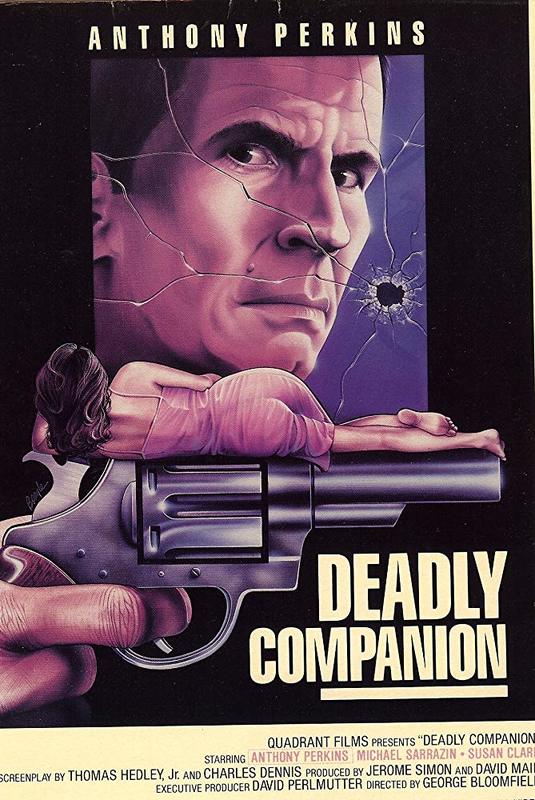
Double Negative (1980)

By Richard Winters

My Rating: 4 out of 10

4-Word Review: Who killed his wife?

Michael (Michael Sarrazin) is a photojournalist tormented by fragmented memories of his wife’s murder. Paula (Susan Clark) is his girlfriend who’s trying to help him sort through these flashbacks, so he can find some answers. However, she too has things to hide as she’s busily paying off a man named Lawrence Miles (Anthony Perkins) who threatens to go to the police about what he knows about the killing. There’s also Lester (Howard Duff) a private investigator who sticks his nose too deeply into the case and finds himself at deadly odds with both Lawrence and Paula.

The film is based on the 1948 novel ‘The Three Roads’ written by Ross Macdonald under his real name Kenneth Millar. Macdonald later went on to have a stellar career writing novels about private investigator character Lew Archer and this story has plenty of potential but gets mishandled and ultimately becomes a misfire. A lot of the problem stems from the production employing three different writers who all had different perspectives on where they wanted the story to go and then relying on director George Bloomfield to cram it all together, which he doesn’t succeed at. The result is a fragmented mishmash that takes a long while to become intriguing and even then, remains interesting only sporadically. Lots of extended scenes particularly at the beginning that should’ve been trimmed and a poor pacing that barely manages to create any momentum.

It doesn’t help that the main characters are wholly unlikable and uninteresting. Clark especially comes off as arrogant right from the beginning when we see her drive by what appears to be Amish people in a horse and buggy fighting through the snow and cold while she enjoys things in her warm ritzy car, which makes her seem detached and uncaring. The scene where she’s trying to procure an important real estate deal and then gets hampered by Michael playing loud music in the other room, so she then excuses herself and promises to be right back. I was fully expecting her to yell at Michael for his misbehavior, but instead she strips off her clothes and the two make love, but it seemed like sex should be the last thing on her mind during such an serious business meeting and what would happen if the clients, who were just a door away and waiting for her return, would walk in on them? 

Sarrazin doesn’t cut it either. I know he’s been lambasted by critics in his other film appearances for being too transparent and forgettable and yet I’ve usually defended him as I feel he can sometimes be effective even given the right material. Here though he falls precariously flat. Some of it is the fault of the writing which doesn’t lend him to create a character with any nuance, or likability, but in either case he’s a complete bore and the viewer isn’t emotionally invested in his predicament. His flashback moments where he sees himself in some sort of prisoner of war camp doesn’t make a lot of sense, or have much to do with the main plot, and seems like something for a whole different movie. 

On the other hand, Perkins is fantastic and the only thing that livens it up to the extent that he should’ve been given much more screen time as the film sinks whenever he’s not on. It’s great too at seeing SCTV alums like John Candy, Eugene Levy, Joe Flaherty, Dave Thomas, and Catherine O’Hara in small parts where with the exception of Candy they’re not comical but instead make a rare turn at being dramatic. Duff is kind of fun and has one great moment, really the only good one in the movie, where he gets trapped in an elevator and must escape being shot by Perkins, who has his arm lodged in the otherwise closed doors, by desperately running back and forth in the closed space that he’s given. Michael Ironside has a memorable bit too as a bar patron who becomes incensed at Sarrazin when he refuses to allow him to buy him a drink. 

Spoiler Alert!

The denouement just leaves more questions and fails to tie up the loose ends as intended. For one thing it shows Sarrazin as being the one who strangled his wife, which I had started to suspect a long while earlier, so it’s not a ‘shocking surprise’ like I think the filmmakers thought it would. It also has Perkins leaving the scene, as he was having an affair with the woman, and even briefly speaking to Clark who witnesses him going, so why he’d insist Clark needs to pay him hush money didn’t make much sense. Sure, he could still go to the police and say that it was Sarrazin that did it, but Perkins fingerprints were at the scene of the crime, so I’d think either way he’d get implicated, and Clark could come forward saying she was a witness who saw him leaving. If anything, Clark should’ve been pushing him to go to the cops versus bribing him to stay away.  

Also, the way it gets shown, Clark comes into the bedroom after Sarrazin has already strangled his wife, so all she sees is him weeping over his wife’s dead body. For all she knew, from that perspective, is that Perkins really did kill the woman and Sarrazin was simply the first to come upon her dead body and thus for it to be crystal clear Clark should’ve entered while he was still in the middle of the act versus when he was already done.

Beyond that is that question of why would Clark want to stay with someone she knew had such violent tendencies? Wouldn’t she be afraid he could get upset at some point and do that to her? Sarrazin even asks her at the very end if she is afraid and her only response is: ‘aren’t you’? This though only muddles things further cementing it as a botched effort. 

Alternate Title: Deadly Companion

My Rating: 4 out of 10

Released: May 12, 1980

Runtime: 1 Hour 36 Minutes

Director: George Bloomfield

Studio: Quadrant Films

Available: Amazon Video

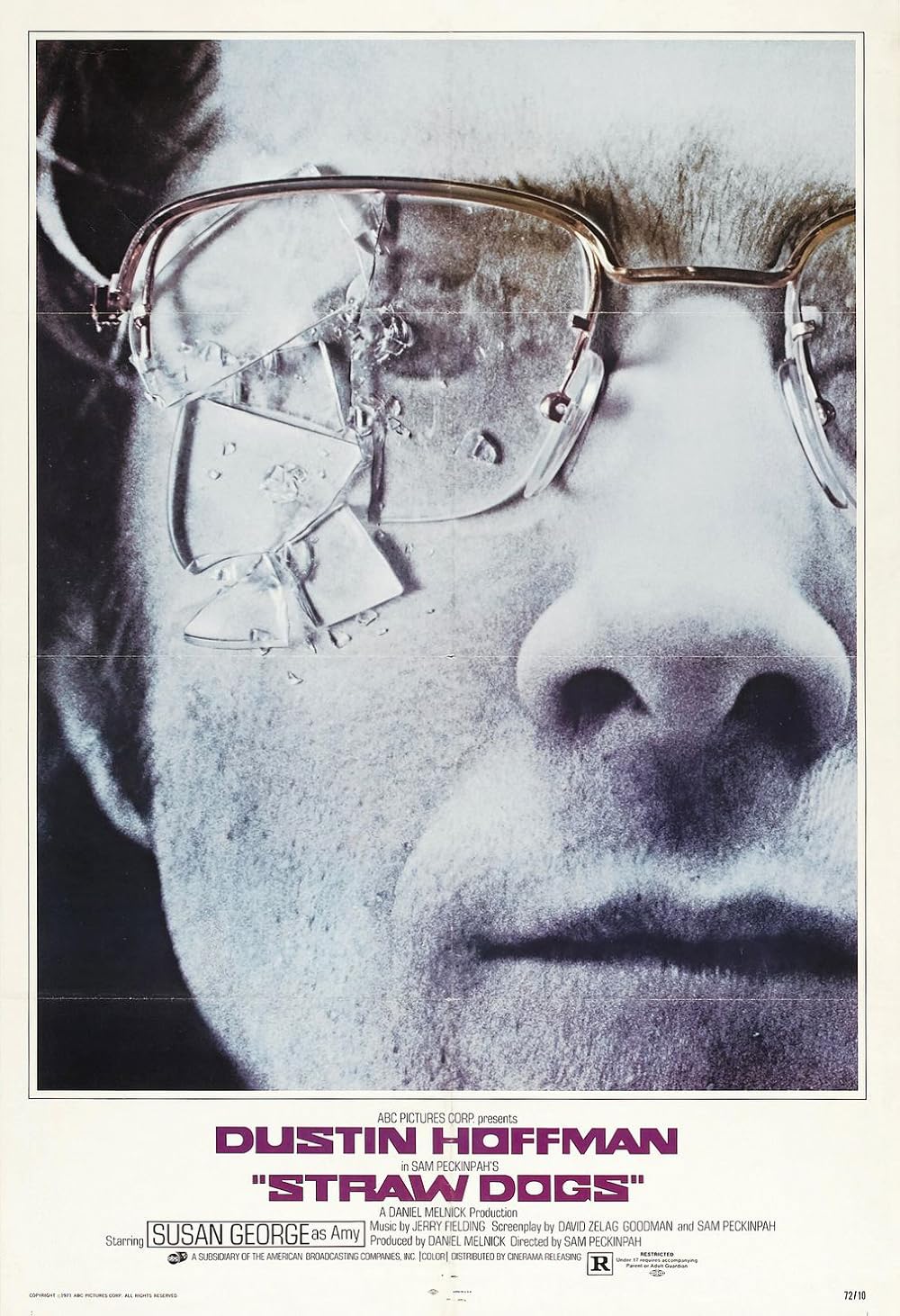
Straw Dogs (1971)

By Richard Winters

My Rating: 8 out of 10

4-Word Review: Man defends his home.

David (Dustin Hoffman), a nerdy mathematician, has been given a research grant and uses it to relocate to the rural countryside of England with his wife Amy (Susan George). They move into a farmhouse that was once owned by Amy’s father and they hire four men (Del Henney, Ken Hutchinson, Jim Norton, Donald Webster) to fix up the roof. The men though don’t work much and spend most of the time making fun of David and ogling Amy. After several bad encounters, including the grizzly death of their pet cat, David fires them and hopes that’ll be the last it, but things only get worse. When a teen girl named Janice (Sally Thomsett) disappears her violently drunken father Tom (Peter Vaughan) thinks it was caused by Henry (David Warner) a mentally handicapped man that Janice had shown an affinity for. Tom, along with the four other men, become a lynch mob determined to find Henry and bring him some ‘street justice’. David and Amy, while returning from a church service, hit Henry with their car as he’s running from the other men. David agrees to take the injured Henry into his home until a doctor can arrive, but the five men insist on getting inside to beat and kill Henry for his perceived crime. Since David had avoided having any confrontation with the men previously even when they had openly mocked him, they presume he’ll be a pushover this time as well, but David has finally decided to take a stand and will defend his home from the intruders in any way he can. 

While it was controversial at the time many now consider this the pinnacle of director Sam Peckinpah’s career and his directorial touches are supreme. The capturing of the brown empty vast landscape of nothingness, shot during the winter of 1971, brings out a surreal sense making it seem like the characters are living in a purgatory outer world where everything is dead and helps explain the deadness of the men’s souls that have been forced to endure their entire lives there. The climactic sequence where David’s home comes under siege is deftly handled. Normally in thrillers pounding music gets played during these segments to ramp up the tension, but here there’s only the sound of a distance foghorn, which makes it much more creepy, distinct, and helps accentuate the isolation. 

Some have been critical of the film’s violence especially at the time when there was activism going on that tried to stymie violent material on both TV and movies with the idea that violence was a ‘learned’ behavior and if people didn’t see it so much in entertainment, then they wouldn’t do it in real life. Peckinpah though saw it differently as he felt violence was an instinctual reaction that couldn’t just be ‘unlearned’ and that in certain situations it was necessary and not every conflict could be resolved peacefully, a message the film brings out quite well. 

While Susan George gives an excellent performance, as do the four villainous men, particularly Vaughan as their ringleader making them some of the creepiest bad guys in film history, I did find her character confusing. I didn’t understand why she’d marry a guy that she found by her own admission cowardly even bringing up that he was ‘running away’ from problems he was having at his university and his ‘hiding behind his studies’ in order to avoid it. She also shows no respect for his work and several times even vandalizes his chalk board that has his mathematical equations, so what attracted her to him in the first place? Would’ve made more sense had she initially idolized him for his academic status and then became painfully aware of his meekness as the film progressed, which would’ve made for a more interesting arch.

Spoiler Alert!

The film is based on the 1969 novel The Siege of Trencher’s Farm by Gordon Williams, but with many changes some of which worked while others didn’t. In the novel the couple had an 8-year-old girl, but in the film there is no child. To a degree it doesn’t make that much of a difference though when the bad guys attack the house it might’ve heightened the urgency more knowing that David was not only defending his ‘home’, but also the safety of his terrified daughter. The biggest change that the film does is that it creates a connection between Henry and Janice where Janice sneaks away with him during a church party where she invites him to be intimate with her, but in the process, he accidentally kills her, which seemed too similar to Of Mice and Men. It’s confusing too why this teen girl, who outside of her buck teeth seems reasonably attractive, would feel the need to throw herself at a mentally handicapped man, or get flirty with David, who is married. Why can’t she find guys her own age to fool around with? Knowing the hormones of most teen boys that shouldn’t be too hard, so without further explanation to her psyche, which doesn’t happen, her ‘inviting’ of Henry is quite unnatural and forced. 

In the book Henry is instead a child killer who’s being transported back to prison when the vehicle he’s in gets stuck in the snow, which allows him to escape. At the same time Janice, who’s mentally disabled, which isn’t made clear in the movie, runs away from a Christmas party where she ends up dying from the exposure to the cold, but otherwise it has nothing to do with the escape of Henry and is only presumed to have a connection by the five men, which makes more sense and the screenplay should’ve have kept it this way.

On the other hand, in the book none of the attacking men die and are only badly injured, but I think death gives it a more final resolution, so the movie scores there. I also liked how David is forced to resort to items he can find around the house, much like in the film Last House on the Left, which came out a year later, to fight off the bad guys versus the cliched machoism of having a big gun to blow them away and it also helps to show how intellectual wits can ultimately be used to overpower the otherwise physically stronger attackers. 

The rape scene in which the wife gets assaulted by not only one, but two men was another problematic moment as the book had no such segment. For one thing it makes it seem like she’s actually enjoying the attack, at least with the first one, and she recovers from it much too quickly and doesn’t even bother to tell David about it and able to go on relatively normally afterwards, which didn’t seem realistic and thus I think it should’ve been excised since it comes off as exploitive and doesn’t have that much to do with the main plot. 

My Rating: 8 out of 10

Released: December 22, 1971

Runtime: 1 Hour 57 Minutes

Rated R

Director: Sam Peckinpah

Studio: 20th Century Fox

Available: DVD, Blu-ray (Criterion Collection)

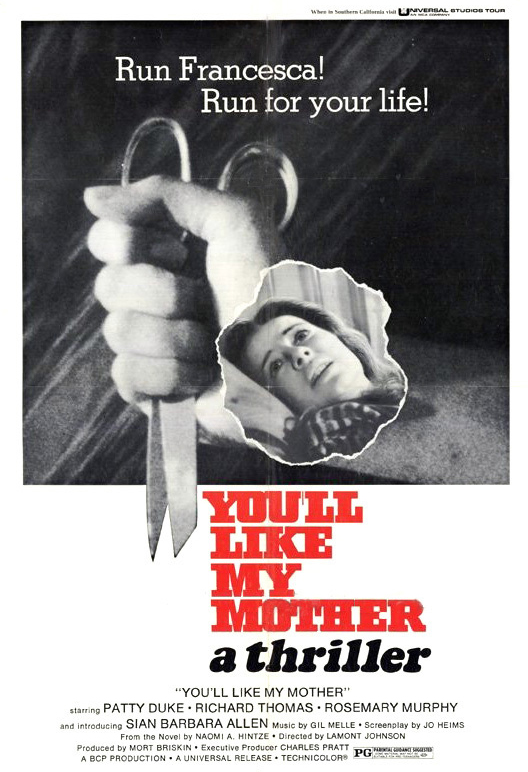
You’ll Like My Mother (1972)

By Richard Winters

My Rating: 3 out of 10

4-Word Review: Pregnant woman held captive.

Francesca (Patty Duke) travels by bus to Duluth, Minnesota in order to meet her mother-in-law (Rosemary Murphy) after her husband dies in a plane crash in Vietnam leaving her alone and pregnant. When she arrives, she finds the woman to be cold and indifferent unlike how her husband had described her where he always insisted that ‘you’ll like my mother’. Francesca also finds out that he apparently had a sister, a mute girl named Kathleen (Sian Barbara Allen) that he had never mentioned. A snowstorm blocks her from leaving forcing her to stay in an upstairs bedroom where more troubling secrets come out including the fact that a young man named Kenny (Richard Thomas) is secretly residing in the home and has been accused in the past of being a serial rapist.

Blah thriller based on the 1969 novel of the same name by Naomi A. Hintze. The only interesting aspect about the film is that it was shot on-location at the Glensheen Historic Estate, which 5 years later became the site of a real-life crime when the mansion’s owner, Elisabeth Congdon and her nurse, were murdered by her son-in-law. The movie also marks the debut of Sian Barbara Allen, who died just recently and was quite active in TV and movies during the 70’s before retiring in 1990 in order to focus full-time on being an activist. She was, particularly in her prime, a great beauty with the most mesmerizing pair of blue eyes you’ll ever see. Unfortunately, her role doesn’t have her saying much outside of a few words she manages to mumble out and her character seems to be put in simply to help the protagonist figure out the mystery.

The story unfolds slowly and because the majority of it takes place in one building it becomes visually static. Since it was filmed in Minnesota during the winter the white stuff on the ground is real, which helps with the authenticity, but because it didn’t actually snow when it was being shot the crew was forced to use fake falling flakes in a feeble attempt to replicate a snowstorm, which they’re not able to pull off. Anyone who’s ever experience a real blizzard will see how tacky this one looks and thus the premise that ‘nobody can get through this storm’ is lost.

Patty Duke is good, but her character doesn’t do much outside of staying cooped up in room while Allen does most of the leg work. Her insistence that she didn’t need any help financially makes you wonder then why did she come at all? If it was just for a visit, she could’ve done that in the summer when Minnesota weather is more hospitable and after the baby was born. In many ways having her in need of money would’ve made more sense and heightened the dramatic tension since that would make her desperate with nowhere else to turn.

Murphy is a weak villain as half the time she’s more nervous than Duke and easily fooled making it seem that anyone could outfox her and get away. It doesn’t help that she stupidly gives away who she really is and why she’s there when she has a conversation with Thomas that gets overheard by Duke, which ruins the mystery when the film is only halfway through and thus killing what moderate intrigue there had been.

The foot chase through the snow at the end does offer some tension but waiting all the way until the finale for any action was a mistake and Duke should’ve tried to escape earlier. The plot twists aren’t enough to make sitting through worth it. It’s not adequate material for a 90-minute feature length film as there’s 30-minute episodes of the old ‘Alfred Hitchcock Presents’ with more plot wrinkles than what you get here.

My Rating: 3 out of 10

Released: October 13, 1972

Runtime: 1 Hour 33 Minutes

Rated PG

Director: Lamont Johnson

Studio: Universal Pictures

Available: DVD (Warner Archive)

Things Are Tough All Over (1982)

By Richard Winters

My Rating: 5 out of 10

4-Word Review: Stoners on the road.

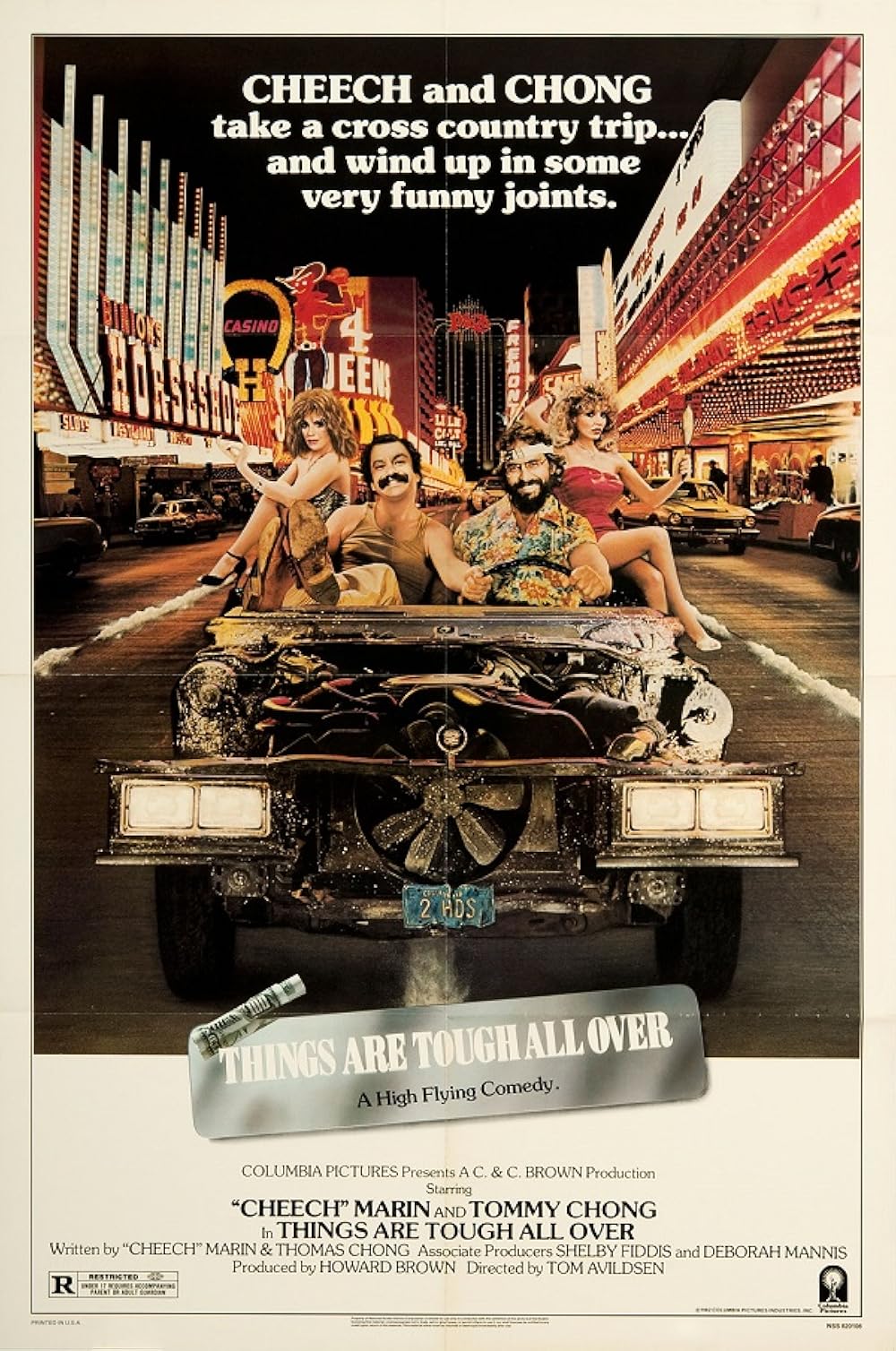
Cheech (Cheech Marin) and Chong (Tommy Chong) have moved to Chicago and are working at a car wash, but when they accidentally destroy a customer’s car they are fired. The owners of the car wash Mr. Slyman (Cheech Marin) and Prince Habib (Tommy Chong) hire the two for another job, which is driving a limousine across the country to Las Vegas. The two stoners think it will be an easy task but are unaware that the seats of the vehicle are stuffed with illegally collected cash. The boys though are given no money for gas, so each time they have to fill up the tank they’re forced to do away with a part of the car as payment forcing them to eventually have to drive down the road with only the vehicle’s main frame left. However, along the way they give up the seat with the money in it to an old-time gas station owner (John Steadman) and when the Arab owners find out that the money is gone, they set out to kill the two, who have become lost on foot inside the burning hot desert.

Cheech and Chong’s fourth installment is a definite improvement thanks mainly to the fact that it wasn’t directed by Chong, but instead the reins were handed over to Tommy K. Avildsen who had worked as an editor on their previous two movies. The pacing is much better, the gags come about in a more rhythmic order and the scenes don’t seem to go on forever. Avildsen’s editing background clearly helps keep the pace going and it’s nice to have a bona fide plot versus just trying to string together a bunch of comedy bits like in the first three films. Here there’s a better structure and focus. Things are still quite zany and surreal, but at least weird stuff don’t just get thrown in for no reason. 

Of course, there’s still the issue of why these guys are suddenly in Chicago. When we last left them, they were hanging out in East L.A., which served as the duo’s cultural and atmospheric background. If they are to move to a different city then we need to see if occur in the movie and not just between installments and there needs to be a reason why, which is never given. As I’ve explained before in my reviews of their past movies having each new film change the settings and their living circumstances so drastically makes it seem like we’re not really seeing sequels that’s progressing things forward, but more just starting things over from scratch. Same goes with Cheech suddenly having to do voice-over narration, which they had never done before, and in this instance added little and could’ve been skipped. 

However, it’s at least funny. Watching these guys shivering in the snow is a good change of pace from they’re pampered beach surroundings. The way they destroyed the car as it goes through the wash had me laughing as did the dismantling of the limo. Planes, Trains, and Automobileswith Steve Martin and John Candy, is the most well-known movie for having two guys riding down the highway inside a skeleton vehicle, but this movie did it first and in just as hilarious way. A couple of other comic highlights are when the stoners pick-up Donna (Evelyn Guerrero), who’s hitch-hiking, and she brings along a bunch of Mexican illegals who crowd into the limo like they’re stuffing themselves into a bus. The scene where the two sit in a movie theater and watch themselves star in a porno film, that was captured without them knowing it, is another great moment. 

The best thing about the movie though is that it features C&C in dual roles as they also play the rich Arab businessmen and it’s really impressive how these two can get into other characters and speak in completely different accents. They play the stoner parts so well that you start to believe that it’s really them and they’re not acting until you witness how seamlessly they can morph into other roles. Chong had me especially surprised as for a while I didn’t think it was him, he puts on a prosthetic nose that completely changes his appearance when he plays the prince, and it took me awhile before I caught on. Having them play the so-called heavies gives the movie a much-needed bump of energy and the only thing that’s missing is seeing all four in a scene together with some sort of over-the-top confrontation between them in the desert, which could’ve easily been done using trick camera work. 

This is also the first C&C movie where the drug use gets played down. This was apparently Chong’s idea as he felt it had become too much of a prop and they needed to challenge themselves and prove to audiences that they could still be funny without it. I also liked how Chong goes through a bad drug trip while inside a restaurant as the negative side of taking drugs had never been shown in any of their previous movies, but here does at least get lightly touched upon, which helps create a better balance especially for young and impressionable viewers.  

My Rating: 5 out of 10

Released: August 6, 1982

Runtime: 1 Hour 30 Minutes

Rated R

Director: Thomas K. Avildsen

Studio: Columbia Pictures

Available: DVD, Amazon Video, YouTube

The Further Adventures of the Wilderness Family (1978)

By Richard Winters

My Rating: 1 out of 10

4-Word Review: Family battles the winter.

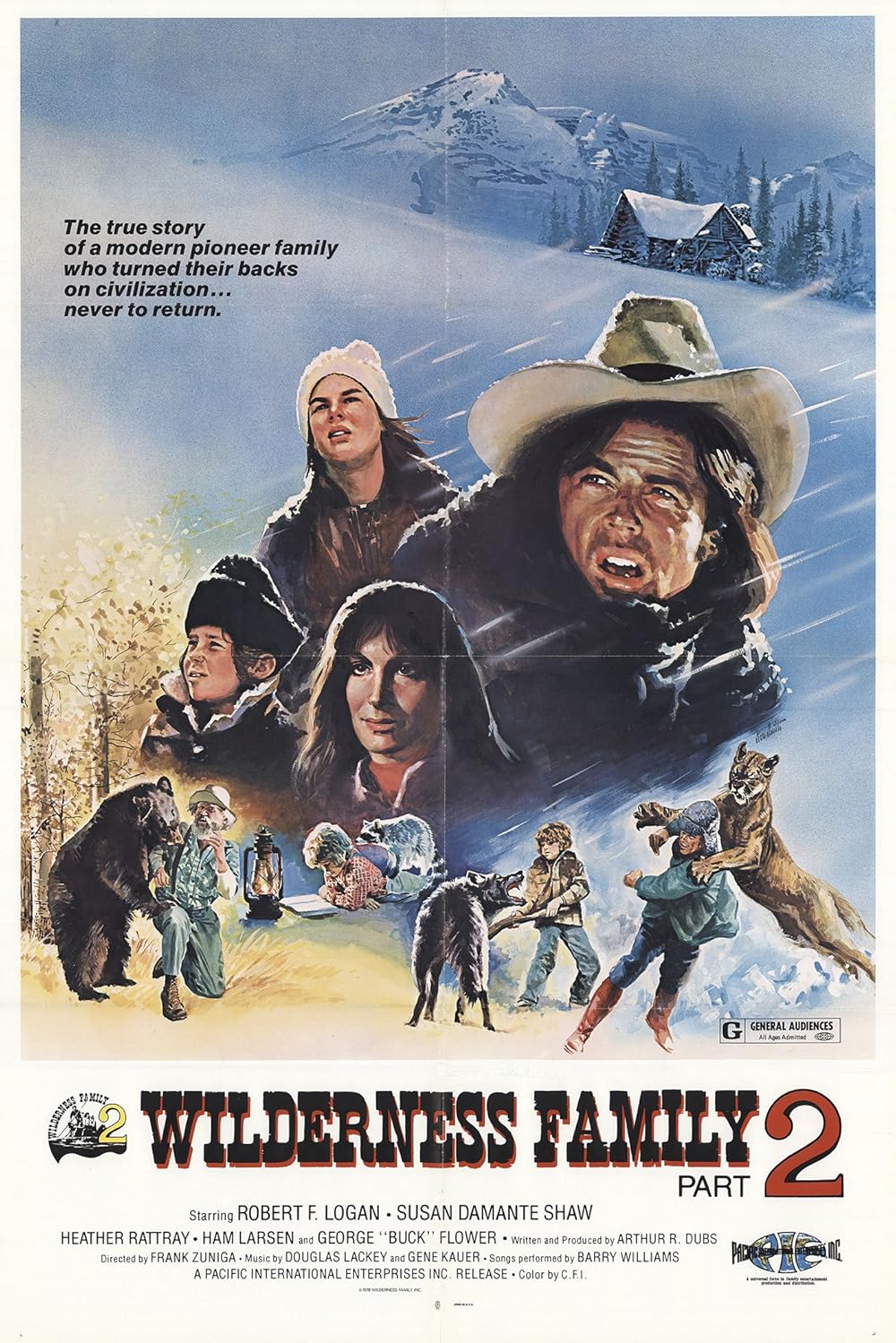
The Robinson family (Robert Logan, Susan Damante Shaw, Heather Rattray, Ham Larsen), who moved from Los Angeles to the wild of Colorado during the summer, now must contend with their initial winter there. The first snowfall they find beautiful and enjoy sledding down the hill, but once the holiday season has passed, they face the coldest month and excessive snow. This brings out a hungry pack of wolves lead by ‘Scarface’, which is a black wolf with a disfigured appearance. The wolves are so desperate for food they try breaking into the cabin while the father is away forcing the young boy of only 8 to try to shoot them with his rifle while his sister and sick mother take cover.

At this point it’s hard to believe that the family ever even lived in a city as they seem so well-adjusted to the wild it’s like they must’ve been born there. In fact they’re more able to rough-it than Boomer (George ‘Buck’ Flower) an old-timer who has been living in the mountains his whole life and yet when he sleeps alone as a guest in their back cabin and he becomes scared at seeing bear cubs and raccoons come in during the middle-of-the-night it’s actually the family that is shocked why that should bother anyone even though you’d think them originally being from an urban area it would be the reverse. The father also displays an uncanny knowledge like knowing that when a wolverine sprays a scent onto some meat that they had stored they can no longer eat it, but how the hell does somebody who had lived in Los Angeles his whole life prior be aware of that fact? It’s like he has a direct line to Wikipedia before cellphones, internet, or wi-fi was even a thing.

Like in the first there are more animal attacks though this time it all comes from roaming pack of wolves. However, since they had been through some hair-raising attacks before you’d think they wouldn’t venture back outside unless everyone was armed with a rifle. Yet they foolishly go out in the snow with no guns and then become frozen in terror when the wolves move in, but how many times does this same thing need to happen before they learn to come prepared? The previous attacks from the first movie had been so traumatic I was surprised they weren’t looking over their shoulders at every second versus frolicking around in the open without a care in the world until of course it’s too late.

The mother continues to be the only one who has any misgivings about the move, but then all the father needs to do is remind her of the traffic jams of the city and she immediately backs-off. However, those aren’t the only choices. They could just move to a small town, which wouldn’t have traffic congestion either, but still have running water, electricity, neighbors, and no wild animals breaking into their home in the middle of the night, so why not consider that option?

Spoiler Alert!

The climactic sequence is quite similar to the first one where the two kids and the mother are left fighting off animals’ intent on getting inside though here the anti is upped a bit by having the mom bedridden with illness and a raccoon accidentally setting fire to the place, which just makes it more contrived and isn’t gripping, or exciting. What’s worse is that a doctor flies in afterwards via a helicopter to take a look at the ailing mom and announces she is suffering from pneumonia, but then instead of taking her to a hospital he just leaves her there in the cabin with a big gaping hole in the roof with snow and cold pouring in, which will only make her condition worse.

End of Spoiler Alert!

I’ll give some credit to the picturesque wintertime scenery, but the corny song segments, sung by Barry Williams better known for having played Greg on the ‘Brady Bunch’ TV-show, act as nothing more than filler, which bogs an already anemic story down even further. Young children may be a little more forgiving, but adults should find it flat and one-dimensional. What’s worse is that they actually went on to make a third installment, which will be reviewed next.

My Rating: 1 out of 10

Released: November 15, 1978

Runtime: 1 Hour 45 Minutes

Rated G

Director: Frank Zuniga

Studio: Pacific International Enterprises

Available: DVD, Amazon Video, Tubi, Freevee, YouTube

Superman II (1980)

By Richard Winters

My Rating: 8 out of 10

4-Word Review: Superman loses his powers.

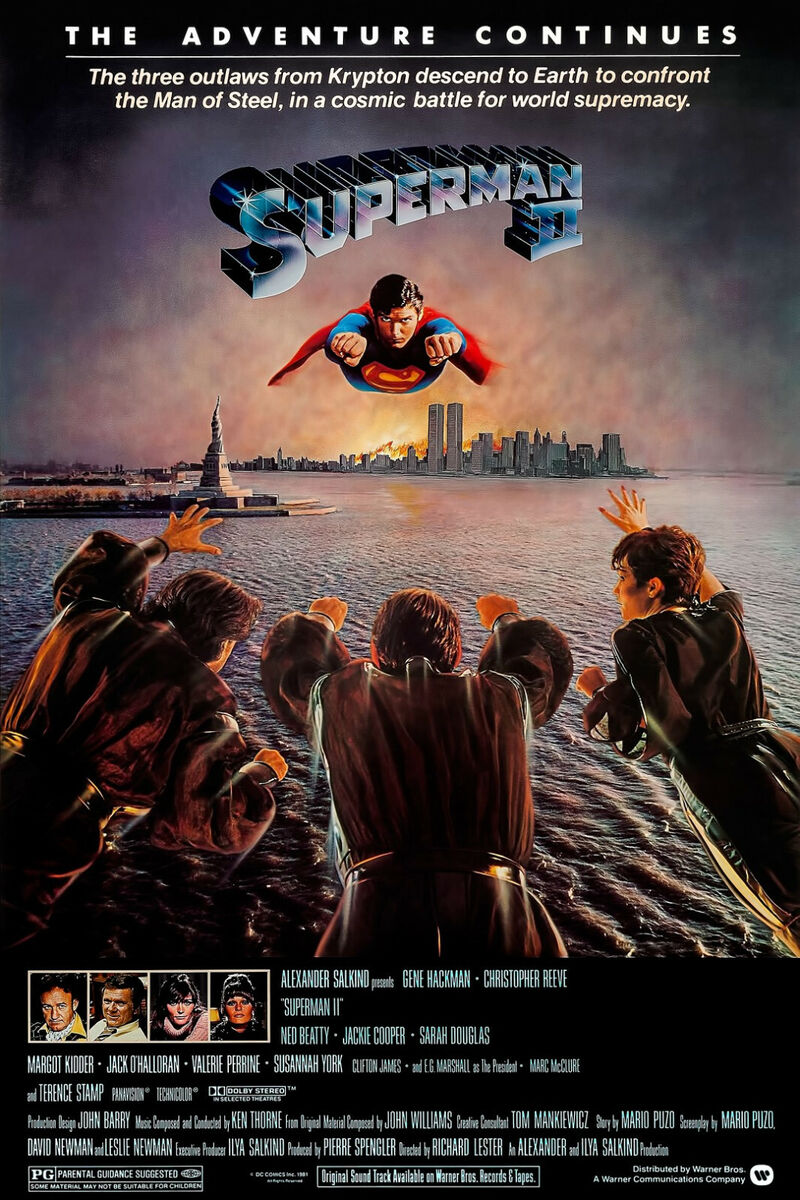
Superman (Christopher Reeve) flies to Paris in an attempt to save Lois Lane (Margot Kidder) who was assigned to go there to cover terrorists who’ve taken over the Eiffel Tower and threatening to detonate a hydrogen bomb unless their demands are met. Superman manages to take control of the bomb and lift it into outerspace where it goes off, but unbeknownst to him the explosion also releases Zod (Terrence Stamp), Ursa (Sarah Douglas) and Non (Jack O’Halloran) from their imprisonment inside the phantom zone. The three now fly towards earth planning to take it over with the superpowers they’ve been given from the sunlight. Meanwhile Clark falls in love with Lois and admits to her that he’s Superman. He takes her to the artic to see his Fortress of Solitude and it’s there that he listens to a past recording of his mother Lara (Susannah York) advising him that if he wishes to marry Lois that he will then have to enter a crystal chamber where he’ll then lose his powers, which he does. Now that Zod and his evil associates have taken over the country by invading the White House he becomes powerless to do anything about it as he desperately searches for a way to regain what he gave up.

The production had many behind-the-scenes upheaval including run-ins between director Richard Donner and the producers who insisted that he was going over budget. Initially it was deemed necessary to film both the first segment and the sequel at the same time, but due to money concerns they stopped filming part 2 with 75% of it already completed in order to finish the first part and get it out to theaters. During the pause the producers then fired Donner and replaced him with Richard Lester. Lester was known more for his zany comedies and had a different directorial style than Donner. His approach was to insert campiness into the story and move it away from the dark elements. This caused several scenes to be refilmed some of which without the original cast including Hackman who refused to come back to do reshoots causing a few of his scenes to be dubbed while Brando had sued the producers for his share of the gross profits causing all of his scenes to be taken out completely and replaced mostly with York who ended up speaking the lines that he would’ve and for the most part does a far better job of it.

While the Donner version was released onto DVD in 2006 and is a bit different this review will stick with the one that was shown in the theaters and I felt is quite well done. Unlike with part 1 this one gets right to the action without the stagy back story from the first, which I found boring. The showdown between Superman and the evil three done on the streets of Metropolis as well as the massive destruction that the villains cause the small redneck town of East Houston are very exciting with great special effects that should please anyone. The comedy bits that Lester inserted I didn’t feel went that over-the-top and in some ways were helpful as it released some of the tension as these were some really nasty bad guys, who caused massive destruction, so inserting a campy chuckle here and there I didn’t feel was that out of order.

The script doesn’t have as many plot holes like in the first one. The only major issue to quibble about is when Superman goes into the chamber that sucks away his powers. Why though is it necessary that he should have to give up his powers just because he wants to get married is a whole different discussion that’s worth questioning, but I get that there needed to be a dramatic conflict, so we’ll roll with it. However, it’s never explained how Clark and Lois get themselves out of the artic and back to civilization as they ‘flew’ into the Fortress using his flight powers, but once he was made mortal, they couldn’t rely on that on the way out and without any other mode of transportation I wasn’t sure how they were able to travel and nothing gets shown, but should’ve.

Spoiler Alert!

His long trek back to the Fortress in an attempt to retrieve the powers is equally problematic as he is shown doing it completely on foot, which could take many weeks, or longer to do. He’s also shown wearing nothing more than a light jacket while he does it without any head covering, which now that he’s human, wouldn’t be enough to shield him from the brutal elements and frigid cold and he most likely would’ve died before he got there from either frost bite, or pneumonia. How he’s able to get the powers back aren’t sufficiently explained either. Supposedly it’s because of a green crystal that Lois dropped and is still there when he returns, but if the control module was already destroyed then how would this get it to work again?

End of Spoiler Alert!

The acting is again what really makes it fun. Hackman is once more excellent as Luthor as here he plays it both ways as the ‘middleman’ between Zod and Superman where one minute he’s arrogant and confident and then the next he’s nervous and pleading. It’s a shame though that Perrine and Beatty, his cohorts in crime, aren’t in it as much as I felt the three together had a great chemistry. Gotta love Kidder as a brash Lois who manually squeezes oranges for Vitamin C as she’s become a self-described ‘health nut’ all the while a cigarette dangles from her mouth. Stamp is really good too as the main villain and his intense performance is what keeps the tension going, which again is why the comedy bits aren’t a problem here, though in Part III this does become a major issue, which will be discussed in the next review.

My Rating: 8 out of 10

Released: December 4, 1980

Runtime: 2 Hour 7 Minutes

Rated PG

Directors: Richard Donner, Richard Lester

Studio: Warner Brothers

Available: DVD, Blu-ray, Amazon Video, YouTube
Avalanche Express (1979)

avalanche2

By Richard Winters

My Rating: 2 out of 10

4-Word Review: Defector on a train.

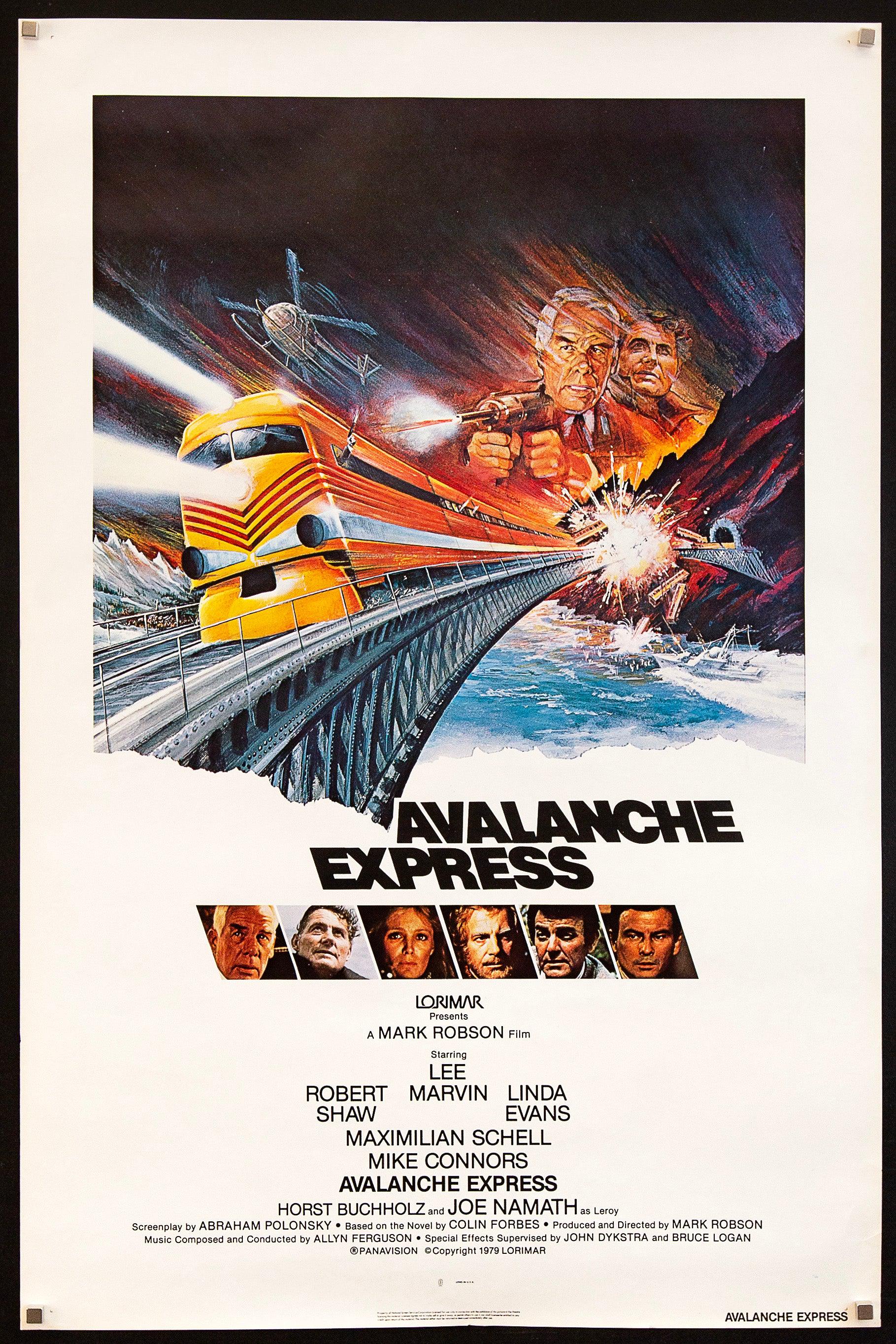
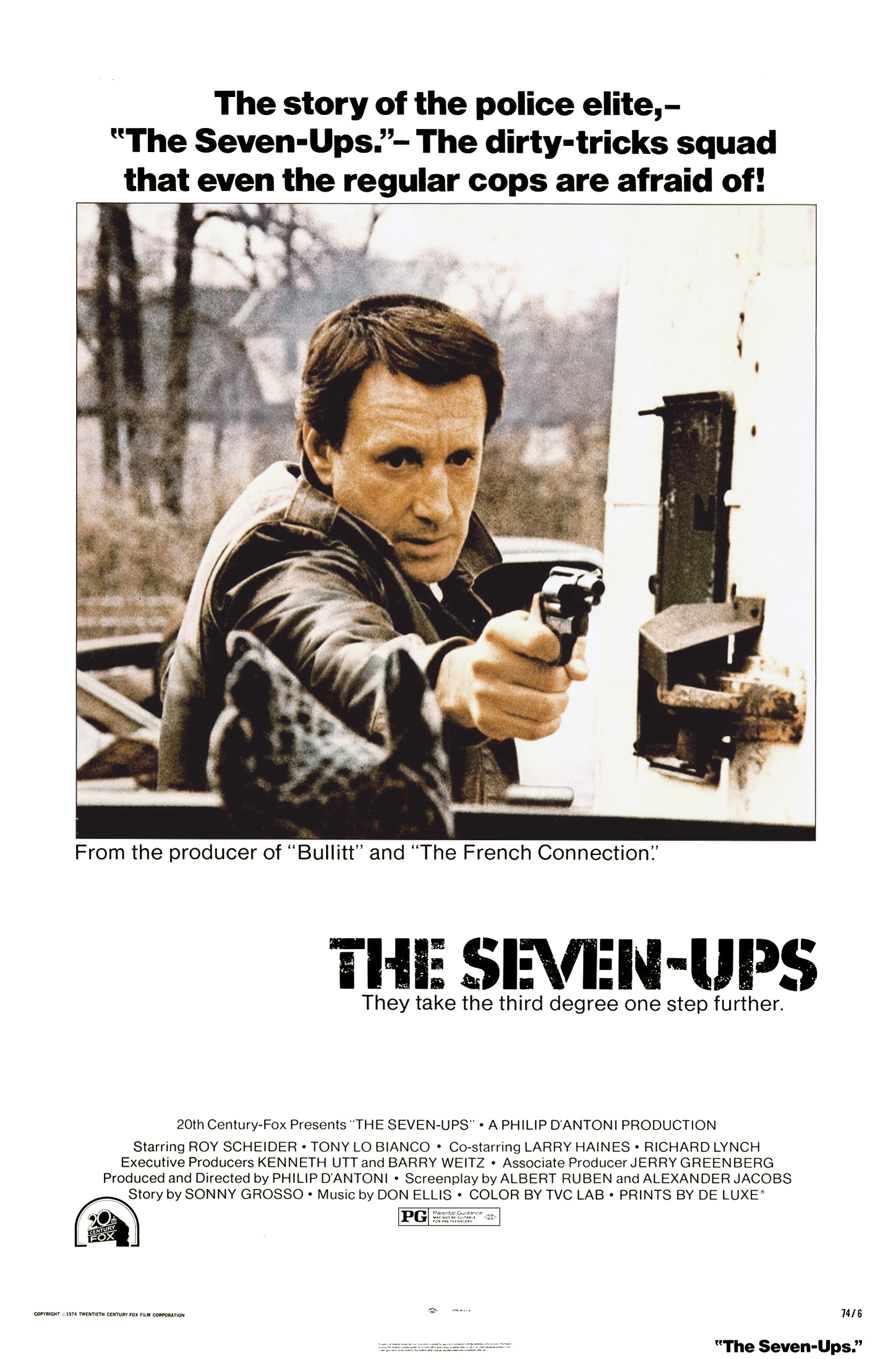
Based on the 1977 Colin Forbes novel of the same name the story centers around General Marenkov (Robert Shaw) a soviet agent who’s decided to defect to the west. Harry (Lee Marvin) is the CIA agent in charge of extraditing Marenkov back to the U.S., but to do so they must travel via train across Europe. Nikolai (Maximilian Schell) is a KGB agent assigned to stop Marenkov’s escape and tries many ways to stymie his trip before finally settling on creating an avalanche, which will not only impede the train ride that Marenkov and Harry are on, but if done right should completely destroy it and end the lives of everyone inside.

The film was noted for its many difficulties during the shoot including the death of its director Mark Robson from a heart attack with only 2-weeks left of filming forcing Monte Hellman to step in and complete the production. The biggest problem though was that during the post-production it was deemed that the opening scene, which featured Shaw speaking to his soviet counterparts in broken English, should be redone with Russian dialogue. However, Shaw too had already died from a sudden heart attack in August and thus was no longer able to come-in for reshoots, so they settled on his voice being dubbed by Robert Rietti for that scene. This would’ve been fine had they stopped there, but instead they came to the conclusion that for the sake of consistency Shaw’s voice should be dubbed by Rietti for the entire film, which was a huge mistake.

Shaw has a highly distinctive and wonderfully articulate delivery and for the viewer to miss out on that is downright criminal. I think most audiences could’ve forgiven that his voice sounded a bit different during the opening bit and probably wouldn’t have even cared or noticed since they were so busy focusing on the subtitles anyway. It becomes like a bait and switch, since Shaw’s name headlines the cast, but since somebody else does his speaking it’s like he’s not really in it and thus a big rip-off to his fans who came to see the movie simply because of him.

The special effects are equally abhorrent. There’s been many movies that have created fake snow scenes, but this one has to be the cheapest looking one yet. The falling flakes look more like Styrofoam and the white stuff on the ground resembles foam from a bathtub especially as the vehicles slush their way through it like it’s a white liquid. The sequence showing the train gliding down the tracks is clearly of the miniature variety and will fool no one.

The casting is a mess too especially the appearance of Joe Namath, a great football player, but a threadbare actor who has no business being in a big budget Hollywood picture. He’d be okay for a TV-movie with other B-performers, but for something that’s supposed to be taken seriously his presence makes the thing even more tacky than it already is. Even stalwart leading man Marvin fails here as he shows no emotion even when it’s warranted, like when he gets word that train they’re on is headed for disaster and yet he remains hyper stoic like he’s a robot with no feelings. Having him get shot dead early on only to return later isn’t the gotcha they thought it would be as I was predicting he’d reappear as there’s simply no way a big-name star like him would sign onto a movie just to be killed off right away.

Linda Evans is good simply because she has the ability of playing a cold, bitchy lady quite well. It could almost be described as her forte and her snippy comments and icy behavior towards Marvin during the first half are engaging and helps give the proceedings a bit of a dramatic flair. Turning the two into lovers though during the second half ruins all the underlying tension and since they don’t share much of a chemistry anyways having them remain adversarial throughout would’ve worked better.

Schell as the villain is as cardboard as he was playing the bad guy in The Black HoleHis career is long and distinguished, but his success is clearly not in these types of roles though he does at least get the film’s one good line. It comes when he’s told he must go undercover in disguise by playing someone who does not smoke. Since his character is a chain smoker, he panics that he won’t be able to go on without a cigarette and exclaims “That’ll kill me’.

My Rating: 2 out of 10

Released: October 19, 1979

Runtime: 1 Hour 28 Minutes

Rated PG

Director: Mark Robson

Studio: 20th Century Fox

Available: DVD-R (Warner Archive), Amazon Video, YouTube

Silent Night, Deadly Night (1984)

silent

By Richard Winters

My Rating: 6 out of 10

4-Word Review: A killer Santa Claus.

When he’s only 5-years-old Billy Chapman (Jonathan Best) has a very traumatic experience. It starts when he and his family are visiting their grandfather (Will Hare) inside a senior living facility. While his parents and younger brother are temporarily out of the room his grandfather, who usually never says a word, suddenly speaks by warning him about Santa Claus and how he punishes those who’ve been naughty. On the car ride home, his family is attacked by a gunmen dressed as Santa (Charles Dierkop) who has just robbed a liquor store. Both his parents are killed by the man, but Billy manages to escape by running out of the vehicle and hiding behind some bushes. Things now flash forward to the year 1984 where Billy (now played by Robert Brian Wilson) is 18 and still suffering from the dark memories of the event as well as the abusive upbringing inside the orphanage he was sent to that was ruled by a tyrannical Mother Superior (Lilyan Chauvin). Working as a stock boy at a nearby toy store, he gets asked to fill-in as Santa when the man who usually plays him calls-in sick. Playing the part though brings back up all the repressed emotions of what happened years earlier causing him to have a mental breakdown and turning him into a killer. 

This film ended up becoming quite controversial and it all started when producer Scott J. Schiend accepted story submissions from the public to help him decide what movie project he’d like to finance next. One of those submissions was short story written by a recent college grad named Paul Caimi entitled ‘He Sees You When You’re Sleeping’, which involved a killer Santa. Schnied became intrigued by the concept and hired Michael Hickey to write a full-length screenplay around the premise. Once completed the script was shopped around until Tri-Star Pictures decided to pick-it-up and finance it as well as act as its distributor. 

Since there were already two other films that had been released that dealt with a killer Claus including the 1972 horror anthology Tales from the Crypt, and the 1980 slasher You Better Watch Out! no one behind-the-scenes was expecting this one to create much controversy since neither of those had. However, mainly because of an aggressive marketing campaign, it soon caused the ire of many parents who felt based off of the TV-ads that this film would tarnish the image of Santa Claus and make children fear him and thus a movement to have the movie removed from theaters was created. Even Siskel and Ebert got in on it by focusing an entire episode of their show to it and reading out the names of the cast and crew in order to ‘shame’ them for having worked on the production. The movie was soon pulled after having been in theaters for only a week, but the controversy ended up having a Streisand effect as it garnered it more attention than it would’ve otherwise, and it made a hefty profit at the box office and ultimately became a cult hit that spawned 4 sequels as well as a reboot.  

It seems to me that most people that protested the movie didn’t actually watch it because if they had they’d realize that it’s made very clear that the guy doing the killings isn’t really Santa nor does he even look much like him. The kid who plays him doesn’t even bother putting the beard on and his own face is constantly exposed while he does the butchering, so at no point does the viewer ever see him as being anyone other than a troubled teen with severe mental issues. I actually wished the part had been played by Dierkop who portrays the initial Santa during the hold-up and puts far better energy into the role and genuinely looks more like the classic Claus both in his age and physical build. 

The movie puts a lot of effort into showing how Billy became the way he does, but for me that was a problem as it gets too plodding and seems to take forever for the carnage to get going, which for a slasher fan is what you really want to see. Would’ve been better had it started out right away with this guy Santa killing people, maybe even one of the kids who sits on his lap at the store, and with no reason why he was doing it, and then through intermittent flashbacks allow his back story to be revealed versus having the background painfully elaborated from the start, which takes away any mystery, or surprise. There’s also the issue of young Billy having prominent brown eyes, but when he reaches adolescence his eye color suddenly turns to blue. 

Spoiler Alert!

My biggest complaint though is with the Mother Superior. Chauvin plays the part quite well making the nun scarier than the killer and somebody you really love to hate, but she’s never killed off, which is a huge disappointment. Many people who grew up going to a strict Catholic School might’ve enjoyed seeing a disciplinarian nun get hacked and it might’ve been cathartic and thus having it not occur doesn’t give the film a sufficient payoff. 

My Rating: 6 out of 10

Released: November 9, 1984

Runtime: 1 Hour 25 Minutes

Rated R

Director: Charles E. Sellier Jr.

Studio: Tri-Star Pictures

Available: DVD, Blu-ray, Amazon Video