Category Archives: Adolescence/High School

Porky’s Revenge (1985)

By Richard Winters

My Rating: 4 out of 10

4-Word Review: Rescue from shotgun wedding.

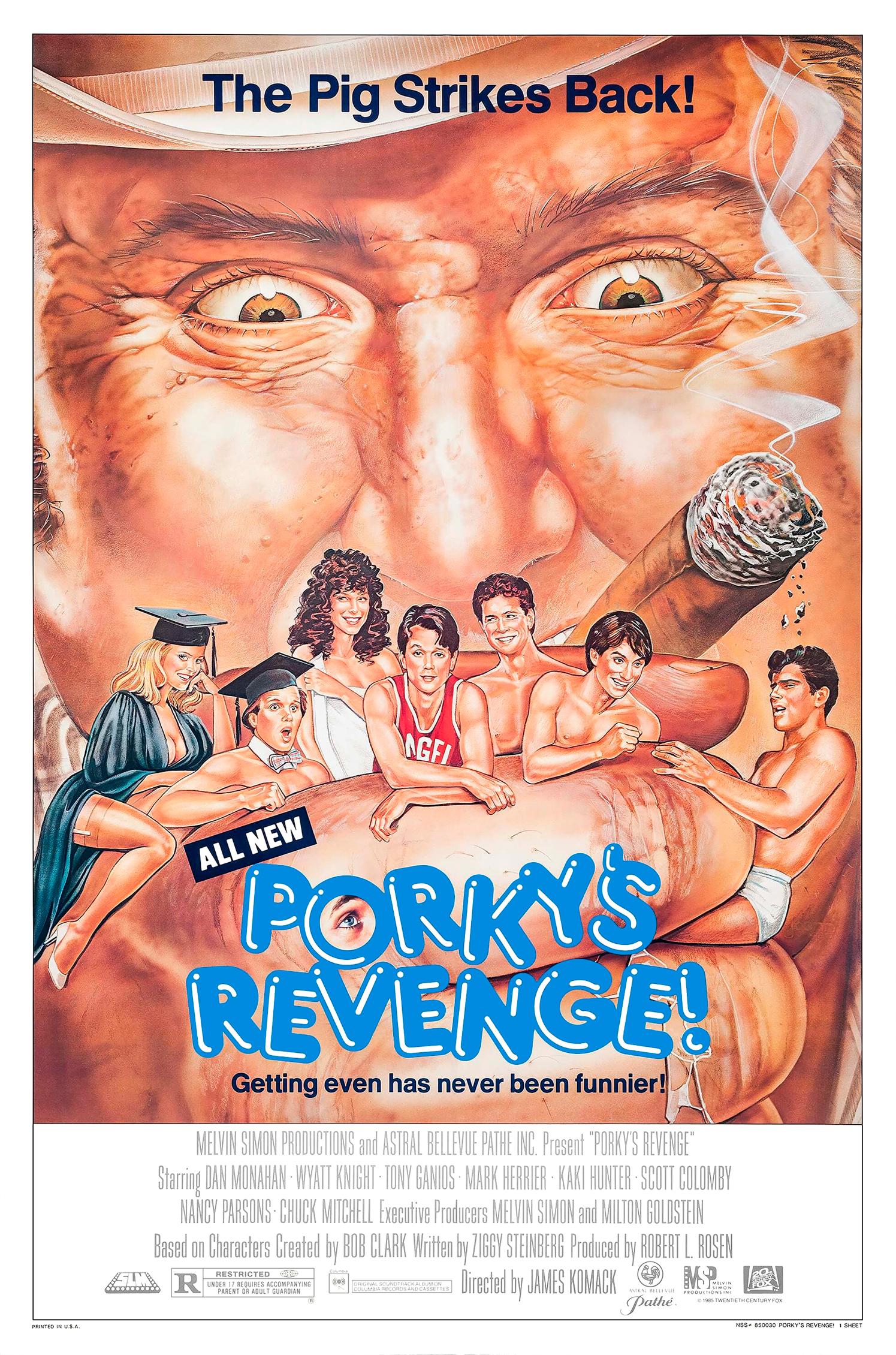
Porky (Chuck Mitchell) has rebuilt his casino that was destroyed by the teens in the first film by turning it into a riverboat. To help pay for this he extorts Coach Goodenough (Bill Hindman) for money and other such favors since he owes him on a gambling debt. Pee Wee (Dan Monahan) and his friends try to come to their coach’s rescue by sneaking onto the boat and taking pictures of the illegal gambling activity, which they hope to show to the district attorney. Porky though catches them in the act and threatens revenge, so to get out of their jam they agree to throw their next basketball game, so that Porky can bet against them and win a lot of money. Meanwhile Meat (Tony Ganios) is having problems of his own when he gets ‘forced’ into having sex with Porky’s daughter Blossom (Wendy Feign) causing Porky to insist that the two now must get married.

While fans of the franchise traditionally rate this at the weakest of the three films I found it to be a step up and even, at least at the beginning, to be moderately amusing particularly the pool scene where the cheerleaders concoct a scheme to get the boys to take off their bathing suits and prance around in front of the parents naked. The script was written by Ziggy Steinberg, whose career is the perfect encapsulation of Hollywood, where if you’re considered ‘up and coming’ you can find plenty of work, but the second your material is perceived as getting stale you can quickly become a leper and no offers to be found. This though came at a point where he was still a sought-after commodity, and I felt the script was better structured and seemed much more like a sequel continuing the elements from the first one versus going off on wild tangents like the second one did.

It helps having Chuck Mitchell back as the title character. It’s not like his acting is all that great, but his big presence and gruff, unfiltered delivery keep it fun and he offers a bona fide nemesis for the kids to go after. The casino boat is impressive, and the majority of the film’s $8 million budget was used just to build it. Seeing it get destroyed, which comes near the end, is exciting too and probably more memorable than the destruction of Porky’s original backwoods casino.

The characters though lack growth. Pee Wee for example is still obsessed about getting laid even though he had already lost his virginity in the first film, so his personality needed to evolve into something else. He should, especially being a senior, be the confident one who now takes some insecure freshman under his guidance to show him how it’s done instead of acting as a perpetually immature junior high kid, which by this point is no longer even remotely interesting.

The pranks continue to go overboard and boarder on cruelty. The one that gets played on Beulah Balbricker (Nancy Parsons) is especially stupid. She is set up to believe that she’s going to have a rendezvous with her long-lost boyfriend Snooky (Sandy Meilke), so she goes to a hotel room lying in bed in her nightie waiting for him to enter, so that they can return to their ‘passionate ways’ of the past. In reality though it would never work that way. These two had not seen, or corresponded with each other in many years, so there was no guarantee that both would still have the same feelings for the other. Since so much time had passed they were by this point theoretically strangers, so to avoid embarrassment and possible rejection they would instead get together at a restaurant, or over drinks in order to ‘catch up’ with things and then if they still both felt the same spark they might check into a hotel room, but nobody would just do that right off the bat.

I did though like the way her character changes, she’s the only one that does, by having her behaving like a completely different person once she’s finally able to get together with the real Snooky. However, I feel it would’ve made more sense had she been portrayed as someone who had never had sex versus one that just hadn’t had it in a while. Having her being lifelong frigid would’ve explained better why she was so hyper obsessed with suppressing everyone else’s sexuality. A better payoff would’ve had her really have sex with Tommy (Wyatt Knight) and found much to her surprise to liking it and this would then inspire her evolution.

Spoiler Alert!

The prank involving the bridge operator (Mal Jones) gets botched as well. It hinges on him believing that Wendy (Kaki Hunter) and Tommy are jumping off it to commit suicide, which distracts him enough so that he leaves to bridge operator room and allows Pee Wee to go in and close the bridge and thus destroy Porky’s boat that is trying to go underneath it. However, the bridge isn’t high enough from the water to be that dangerous. In fact, if it was truly that dangerous then both Tommy and Wendy would’ve died when they jumped off of it, but they don’t so the operator would never have been fooled. If anything, he would’ve thought they were just a couple of teens going out for a late-night skinny dip and wouldn’t have panicked at all.

My Rating: 4 out of 10

Released: March 22, 1985

Runtime: 1 Hour 32 Minutes

Rated R

Director: James Komack

Studio: 20th Century Fox

Available: DVD, Blu-ray
Porky’s II: The Next Day (1983)

By Richard Winters

My Rating: 0 out of 10

4-Word Review: Banning a Shakespeare play.

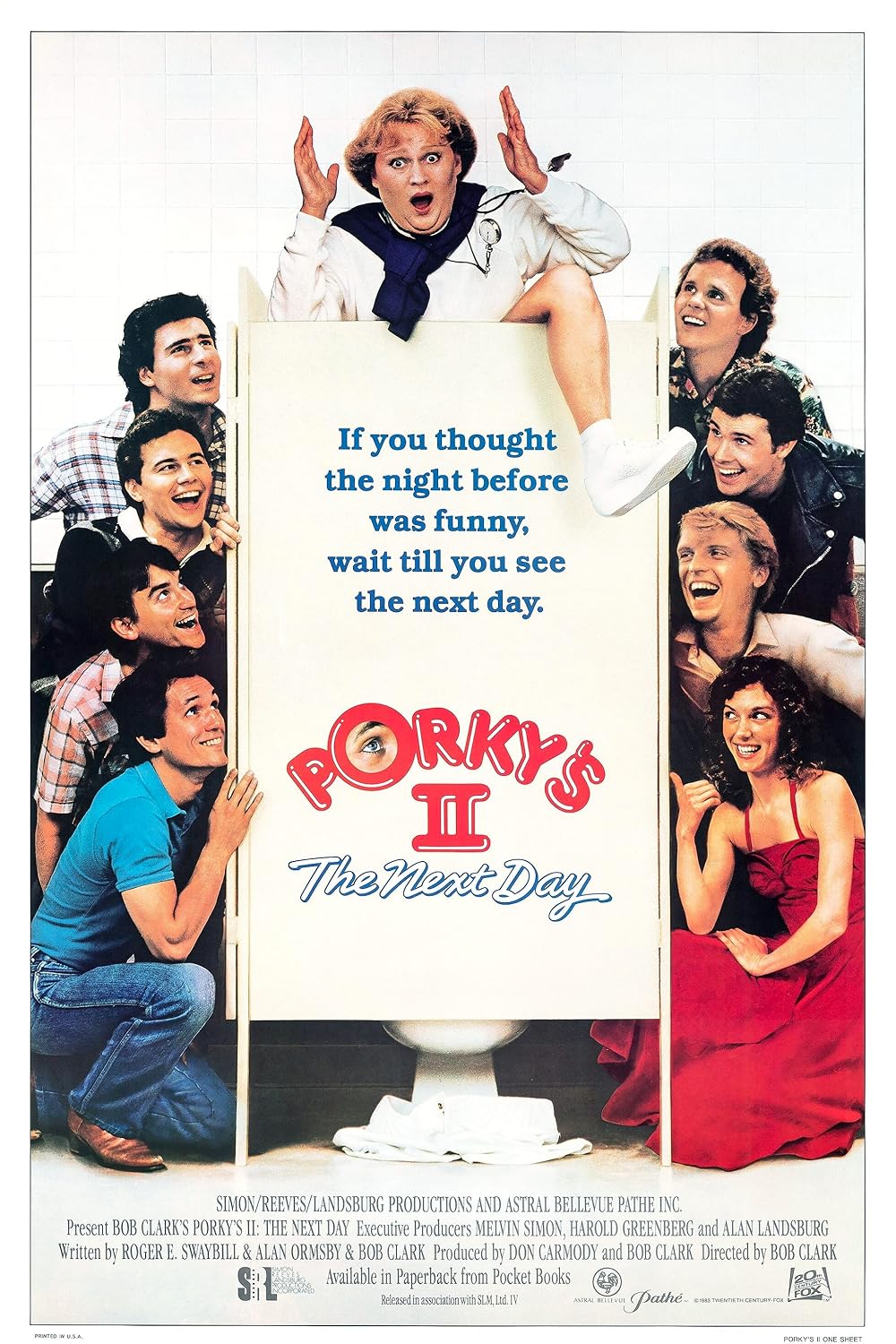
Now that Pee Wee (Dan Monahan) has lost his virginity to Wendy (Kaki Hunter) they decide that their next project will be putting on a production of ‘Romeo & Juliet’ at their high school, which will be directed by Mrs. Morris (Ilse Earl) Pee Wee’s mother. Problems though ensue when John Henry (Joseph Runningfox), a Seminole Indian, gets cast in the lead where he will then kiss Wendy, a white woman, on stage, which gets the local Klux Klan upset and they proceed to ambush things, so it won’t be able to proceed. There’s also outcry from a local Reverend named Bubba Flavel (Bill Wiley) as he and his religious constituents feel that the play is ‘obscene’ and therefore must be shut down in the name of ‘decency’. The teen cast then visits the office of County Commissioner Bob Gebhardt (Edward Winter) hoping he can use his influence to help keep the play going and while he initially promises them that he will, he eventually renegades. This angers the kids, and they devise an elaborate revenge on not only him, but the Klan and Reverend Flavel.

It’s quite clear that writer/director Bob Clark, who was working on Christmas Story while helming this one, had no idea that the first installment was going to be as big of a success as it was and there had clearly been no plans for a sequel. When the studio came begging for one, he felt obliged and spent 6 months, with the help of two other screenwriters, to come up with something. The result though is a movie in desperate search for a story with a script that’s a mishmash of over-the-top nonsense. What made the first one so good was that as crude as it was it still showed teens as they were with dialogue and situations that rang true, but here all of that gets thrown out with everything played up in an extreme way simply for the sake of a cheap laugh.

The most annoying aspect are the one-dimensional characters particularly the Reverend who is a cartoonish caricature in a silly send-up of a southern preacher. The same goes with the City Commissioner that is well played by Winter, which helps keep it remotely entertaining, but portraying a politician as being sleazy and two-timing is quite cliched and redundant. The return of Beulah Ballbricker, played by Nancy Parsons, is problematic as well. In the first film she was very strict with the rules, but here she’s turned into a religious fanatic, which seems like two different people. The scene where she sits on a toilet and begins singing loudly is dumb. Sure, people may talk on the phone while taking a dump, or read a magazine, or even browse the internet, but bellowing out a loud rendition of ‘That Old Black Magic’ while in a public stall is not one of them making her beyond ‘goofy’ and more into someone who should be institutionalized.

The pranks come off as unnecessarily cruel especially the scene in a graveyard where Pee Wee is made to believe that he accidentally killed a prostitute while having sex with her, which could be quite traumatic for someone and yet his ‘friends’ act like it’s ‘all in fun’. What’s worse is that Pee Wee never brings it up afterwards apparently having no qualms whether a sex worker dies at his hands or not just as long as he’s not blamed, which unintentionally makes him cold and uncaring.

The climactic bit where Wendy dresses up as a big bosomed 17-year-old prostitute who makes a major scene at a posh restaurant in an effort to embarrass the commissioner gets overdone too. For one thing it’s seems awfully extreme to put so much effort to get revenge on what’s nothing more than a tacky high school play with cheap props that isn’t going to make any money and cast members who weren’t all that excited about being in it, so why get so upset if it gets canceled? It also begs the question why these kids are so sure they can get away with their hijinks and not suffer any consequences. The ‘prank’ that gets done inside the restaurant causes a lot of damage and since these teens live in the same community as the adults they would most assuredly get recognized by someone and be either arrested for causing a disturbance and handed a very hefty bill for the repairs, or their parents would, which for them would be just a bad.

The only small funny bit, and I kid you not, comes at the very end during the closing credits, when the head waiter at the now ravaged restaurant tries to save face by convincing the patrons that it had all been an ‘April Fool’s joke’, which got me to chuckle. It’s also kind of amusing how Pee Wee gets so aroused by pics in National Geographic, or sexually stimulated by strippers who aren’t even naked, but just scantily clad enough to excite him anyways, which in this porn saturated era probably wouldn’t be deemed all that titillating, so in that aspect it’s interesting, but everything else is a disaster. It doesn’t even have Porky. How can you have a film titled ‘Porky’s’ if that character never actually shows up though he does reappear in the third installment, which will be reviewed next.

My Rating: 0 out of 10

Released: June 24, 1983

Runtime: 1 Hour 38 Minutes

Rated R

Director: Bob Clark

Studio: 20th Century Fox

Available: DVD, Blu-ray

Porky’s (1981)

By Richard Winters

My Rating: 6 out of 10

4-Word Review: Revenge on nightclub owner.

Pee Wee (Dan Monahan) is a teen living in the Florida everglades during the 1950’s who suffers from a small penis size, which has prevented him from losing his virginity. He and his high school pals have hatched a plan of pooling their money together and then hiring a prostitute, which they can then all have sex with. Their first attempt doesn’t work out, so they decide to go to a nightclub that sits in a lagoon on stilts and is called Porky’s, which is the nickname of the owner of the establishment, ‘Porky’ Wallace (Chuck Mitchell) that he attained for being overweight. The boys feel they’ll be able to hire one of the strippers at the club to have sex with and Porky agrees to ‘set it up’ and takes their money only to then have the teens fall through a trap door and into the water below. This enrages Mickey (Roger Wilson) who set-up the deal and he becomes consumed with getting revenge on Porky, but when he goes there to ‘settle things’ he gets badly beaten-up, which sends him to the hospital and convinces his friends that even sterner justice is needed in order to get the proper payback.

I remember when this movie came out and there were TV ads capturing people as they left the theaters and getting their first reaction. At the time this was considered ‘outrageous’ and many of the folks in the ad seemed either shocked or embarrassed. Nowadays though it’s unlikely most will consider it extreme, and some might even call it boring particularly in between the moments when it’s raunchy. The idea for it was conceived in 1972 by writer/director Bob Clark who based the story on his own experiences as a teen going to school in rural Florida during the 50’s. The studios though didn’t like the script, and it got shopped around for years before finally getting modest funding out of Canada where it could be used as a tax write-off and thus even though it was filmed in the U.S. by an American director it still gets labeled as one of the highest grossing films in Canadian movie history.

The critics like with the studio heads, didn’t care for it with both Siskel and Ebert naming it one of the worst movies to come out of the 80’s though when compared to the other teen sex comedies from that decade this one doesn’t seem all that bad. The characters have distinct personalities and much of the dialogue while raunchy seemed realistic for that age group and not all that different from what got talked about during my own high school days. The film also manages to tackle some serious topics like antisemitism, which was also a part of that era, so it has an adequate balance and doesn’t just stay hyper-focused on the sex.

On the negative end Nancy Parsons as the female coach version of Nurse Ratched is one-dimensional and Kim Catrall, playing a cheerleader nicknamed ‘Lassie’, plays too much of the bimbo caricature to be even remotely interesting. Neither is the fault of the actresses, who are okay, but more the writer. On the other hand, I loved the bit part of Susan Clark playing a prostitute. She had been in a few Disney movies just before this and later the TV-show ‘Webster’, so seeing her playing against the family image is fun.

I also loved Kaki Hunter who seems just as dirty minded as the guys and how she’s very average looking as I’ve found those types tended to be a little more ‘easy’, as evidenced by her doing it with Pee Wee, in order to get the guys’ attention and make up for not being as attractive versus in other teen flicks where it’s only the super-hot ones that sleep around. In that vein too I enjoyed the fact that during the shower scene when the boys are peeping at the girls there’s an overweight one impacting Pee Wee’s ability to see the thin ones, which is realistic too as in most high schools there’s a mix of body types and not all skinny like most other teen comedies would make you believe.

I did have some problems though with the nicknames mainly with Pee Wee and ‘Meat’ the name for Tony Ganios’ role. Supposedly this is for their penis size, but how would anyone know what their penises looked like? Normally one gets nicknames for physically attributes that everyone can see for instance if they’re a short height they could be called ‘shorty’. Yes, there is a scene where all the boys strip naked together, but their nicknames had already come about long before then. One could argue that maybe it started while they took showers after gym class, but in my high school if some guy was caught looking at another’s genitals, they’d be accused of being ‘gay’, which during that time period would be considered a stigma.

While the plot is lean and there are a few lulls there are enough comical moments to keep it afloat. The segment dealing with Nancy Parsons character going to the principal to ‘report’ seeing a penis in the girl’s shower and advocating for all the boys to undress so she could spot which one had a dick with a mole on it, is a gem especially with the way the camera zooms in on a hanging portrait of a smiling Dwight Eisenhower like even he too is in on the humor. The demolishing of Porky’s bar, which comes near the end, isn’t bad either and helps to make this thing a minor cult classic.

My Rating: 6 out of 10

Released: November 13, 1981

Runtime: 1 Hour 38 Minutes

Rated R

Director: Bob Clark

Studio: 20th Century Fox

Available: DVD, Blu-ray
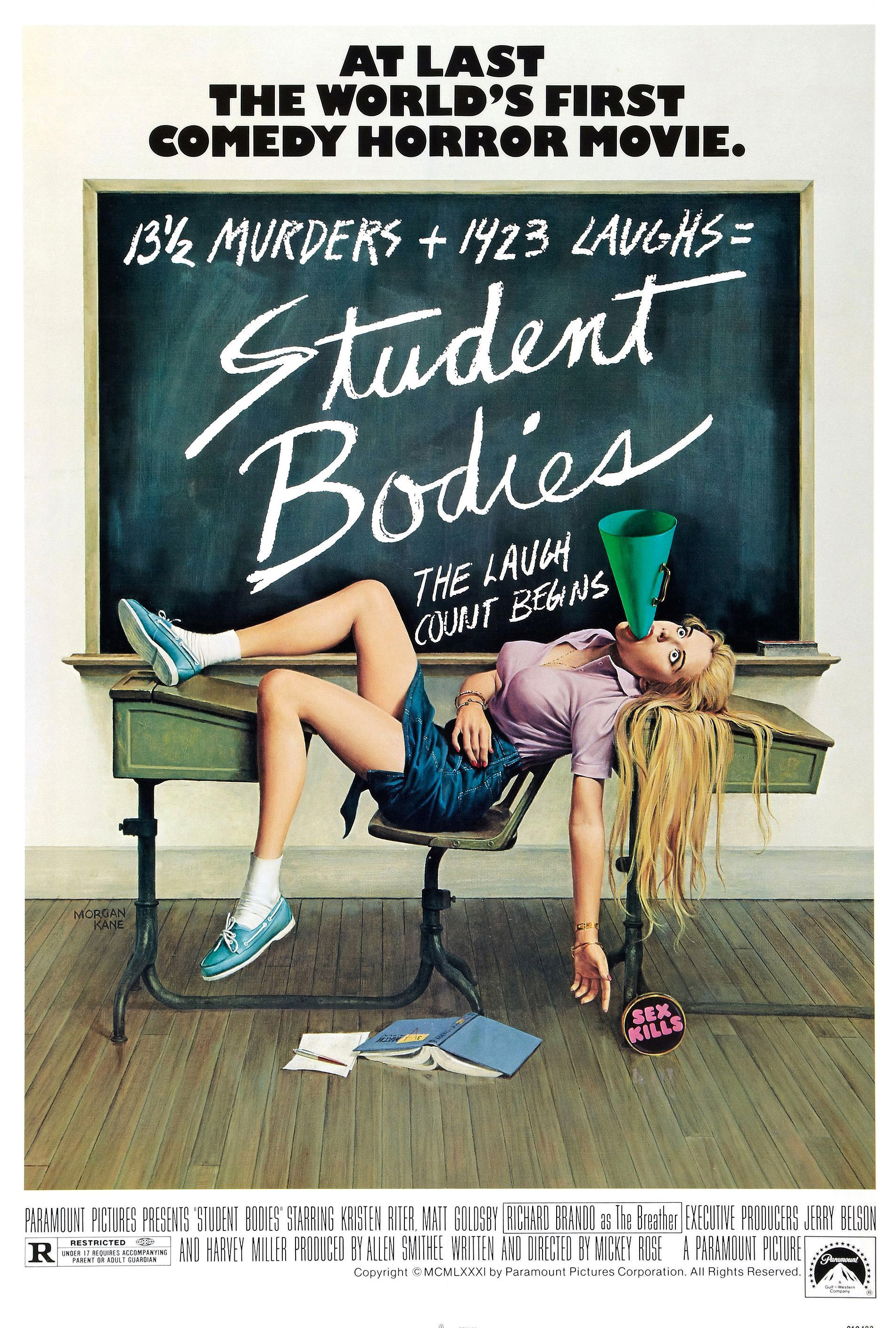
Student Bodies (1981)

By Richard Winters

My Rating: 6 out of 10

4-Word Review: Who is ‘the breather’?

A killer, simply known as ‘the breather’, is stalking students of Lamab High School. His first victims are Julie (Angela Bressler) and her boyfriend Charlie (Keith Singleton). He then proceeds to hack away more students with the police seemingly unable to do anything about it. Fellow student Toby (Kristen Riter) decides to take matters into her own hands by investigating things on her own only to end up getting incriminated as the killer, which forces her to try and convince others that she’s not the one.

This film, like Jekyll and Hyde…Together Again, is the product of the 1980 writer’s strike where Paramount was looking for scripts that could be produced on a modest budget with a nonunion crew in an effort to have some movies released to the theaters while the strike wore on. This was deemed at the time to be a perfect fit as studio heads were impressed with the box office smash Airplane that had come out a year earlier and been a parody of disaster flicks and they were hoping this film would not only cash in on audiences that had liked that one, but also for those who were into slasher films, which at the time were proving to be quite popular. The end result was a modest success with the movie making a $5.2 million profit off of a $510,000 budget. Though it really didn’t obtain its cult following until it began airing on late night cable TV during the 90’s.

While there had been horror movie parodies before those made fun of the standard haunted house theme while this was the first to satirize slasher movies, which up to that point had only been around for a few years. I was though leery as this was written and directed by Mickey Rose, best known as a script collaborator on many of Woody Allen’s movies, but who had ventured on his own to write and direct I Wonder Who’s Killer Her Now? 5 years earlier, which I considered incredibly lame and feared more of the same here. However, to my surprise, this one wasn’t bad, with probably the best moments coming right at the start, which is a perfect send-up of When a Stranger Calls. What makes this one work is that those behind the scenes, including the talented writer Jerry Belson and producer Michael Ritchie, is that they had clearly watched a lot of horror movies and therefore the humor, at least at the beginning, is laser sharp, versus other horror parodies, including Pandemonium, which came out a year later, that seemed to be made by people who really hadn’t watch horror and were just throwing in any dumb gag that they could.  The film also has an engaging protagonist, played by Riter who gives a splendid performance and it’s a shame this was her only movie.

Of course there are some detractions. The onscreen titles that flash on every once in a while, get annoying. I didn’t mind it alerting us to the body count, including when Riter kills a fly, which gets considered as a ‘1/2’ a death, but flashing on every time someone leaves a door unlocked, became a bit overdone and heavy-handed. There’s also a few ‘ program interruptions’ like when a spokesman comes on to advise that he must say the work ‘fuck’ in order to get an R-rating as those movies tend to make more money, which while somewhat funny, gives the film too much of a skit-like feel.

The film also lacks any gore or violence even though that was the whole mainstay of slasher movies to begin with. There could’ve been several reasons for this, but I think the main one was that the cultural elites at the time, and I know because I was around then, considered slasher films to be ‘lowbrow’ and onscreen blood effects as ‘tasteless’. The chic argument was that horror movies shouldn’t need gore to be scary and slasher flicks were simply a ‘passing fad’ that would eventually die off into obscurity though 40 years later the exact opposite has happened. Horror movies are now the fastest growing genre and the ‘distasteful’ slasher films of the 80’s are now considered classics. Films like Shaun of the Dead have proven that you can have a lot of blood and guts and still be funny, so this movie misses out and leads to a very boring middle half in which the humor starts to become strained mainly because they run out of ideas, which some funny gore could’ve helped fill-in. It also makes it seem like only half a parody when the main modern horror ingredient, the violence, gets completely glossed over. 

Spoiler Alert!

I did though really like the wrap-up, despite Leonard Maltin, who called the ending ‘really bad’. I considered it one of the best aspects especially the dream sequence where Riter goes down the school’s hallway and victims seemingly come back to life and pop-out of the classroom doors. The Wizard of Oz spin in which the characters from the dream, which is basically the entire movie, are shown to have the exact opposite personalities in ‘real-life’ when Riter wakes-up, I found to be quite creative. I got kick out of the Carrie take-off too, which I knew had to be coming at some point, that had Riter’s hand bursts out of the ground after she’s dead. My only quibble here is that, since it was her boyfriend who killed her and he’s the one bending over her grave, there should’ve been a knife in her hand when it comes out of the ground and thus stabbing him in revenge. 

My Rating: 6 out of 10

Released: August 7, 1981

Runtime: 1 Hour 25 Minutes

Rated R

Director: Mickey Rose

Studio: Paramount

Available: DVD, Blu-ray, Amazon Video, YouTube

Pretty Poison (1968)

By Richard Winters

My Rating: 7 out of 10

4-Word Review: Manipulated by attractive teen.

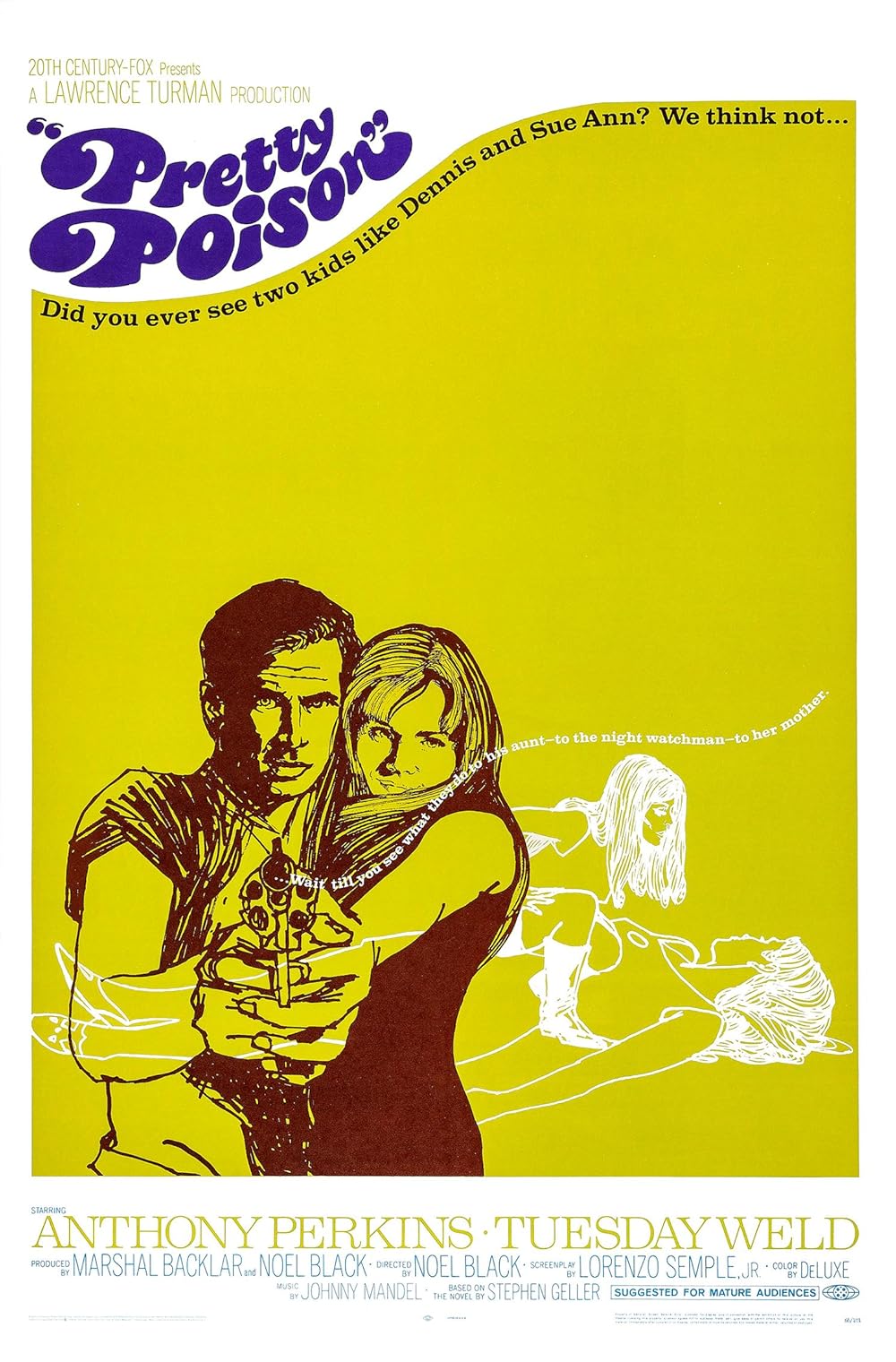
Dennis (Anthony Perkins) has been released from the mental institution after serving several years there for setting a home on fire. He gets a job at the local factory but finds it boring and begins to escape into fantasies. He spots pretty 17-yeard-old Sue Ann (Tuesday Weld) while she rehearses with her high school marching band and immediately becomes smitten. He’s never had experience dating anyone, so he decides he’ll pretend to be a CIA agent on a secret mission as a way to impress her and get her attention. He’s disgusted at the way the factory where he works at dumps pollution into the river and thus comes up with a scheme to destroy it using her help, but when a security guard spots them, Sue Ann kills him. Dennis is shocked with Sue Ann’s brazenness and realizes she’s not as innocent as she appears. He tries to cover-up the killing but finds that Sue Ann’s only getting started as her next target is her mother (Beverly Garland). Will Dennis try and stop it, or figure that appeasing her murderous desires may be the only way to keep her from going after him?

The film is based on the 1966 debut novel ‘She Let Him Continue’ by Stephen Geller and directed by Noel Black, who was just coming off the success of his award winning short Skaterdater and this was considered perfect material for his feature film debut. He described the story as “a Walter Mitty type who comes up against a teenybopper Lady MacBeth”. It was shot on-location in Great Barrington, Massachusetts, which gives it a quant small town atmosphere where supposedly ‘nothing ever happens’ and Beverly Garland gives a terrific supporting performance as the caustic mother.

However, Black had no background in working with actors leading to many confrontations behind-the-scenes between he and Weld and keeping the shooting production on schedule proved equally challenging, which got the studio to believe they’d hired a director who was in over-his-head and helped bring in added pressures. When the movie finally did get released, it fared poorly at the box office. Black felt this was because of the recent assassinations of Martin Luther King and Robert Kennedy, which made the studio timid to distribute it and thus few people saw it though in recent years its acquired a small cult following. 

One of the elements that really makes it work is Perkins who gives a splendid performance. Initially I thought it was a mistake to cast him as he would seem too much like his earlier, more famous character of Norman Bates, but he plays this part much differently. Here he comes off as smarter and less crazy. He does dabble in make believe at times but only does it to mask his insecurities and lack of life experience. Watching his emotional arc where he goes from feeling confident, thinking he’s in control with this supposedly naive young teen, only to ultimately have to grapple with his slow realization that it’s really she who’s pulling-the-strings is the most captivating thing in the movie. 

Weld seemed initially to be perfectly cast as she had already shown a propensity at playing characters quite similar to this one in classic episodes of ‘Route 66’ TV-show and ‘The Fugitive’. However, her age clearly belies her as she was 24 at the time it was filmed and looking nowhere near 17. Having a true teen playing the role may have made what she does even more shocking. She later said in interviews that she hated working on this project mainly because Black wouldn’t let her improvise her lines and you could see she just wasn’t fully into it, and it diminishes somewhat the full effect.  

Spoiler Alert!

While it’s intriguing the whole way the ending, which has Dennis calling the police and allowing himself to be put into jail, didn’t have quite the bang I was hoping for. Dennis had fallen hard for Sue Ann to the extent he felt she had ‘changed his life’ and gave meaning to his otherwise lonely existence. When people are in love with someone, they tend not to see the same red flags that others do, so even though she does some evil things I was expecting him to make excuses for it. Like she killed the nightwatchman not so much because she was a sociopath, but more because of her ‘love’ for him and knowing it would help him in his ‘secret mission’. The murder of the mother could’ve been approached the same way in his mind. She killed her only so they could be together, and he would view it as an ‘unselfish’ act versus a selfish one.

Seeing someone who starts out a bit cocky thinking he can ‘trap’ others with his fantasies only to learn that his own fantasy had trapped him would’ve been quite ironic. He could still be convinced of her love even as he’s arrested and thus his final meeting with her, in which he realizes that she’s betrayed him by going to the police, would’ve had more of an impact.

I didn’t feel that Dennis should’ve had to spoon-feed to his psychiatrist, played by John Randolph, that Sue Ann was really the killer, as the doctor should’ve been smart enough to figure this out for himself. Watching the psychiatrist then follow Sue Ann around in his car as she finds another man (Ken Kercheval) that she intends to manipulate leaves things too wide open. What exactly will this lead to? Will the doctor stop her from killing again before it’s too late, or will Sue Ann realize she’s being followed and have the doctor killed? This is something I feel the film should’ve answered. 

My Rating: 7 out of 10

Released: September 18, 1968

Runtime: 1 Hour 29 Minutes

Rated R

Director: Noel Black

Studio: 20th Century Fox

Available: DVD, Blu-ray, Amazon Video, YouTube

The Chocolate War (1988)

chocolate

By Richard Winters

My Rating: 7 out of 10

4-Word Review: Teen challenges the hierarchy.

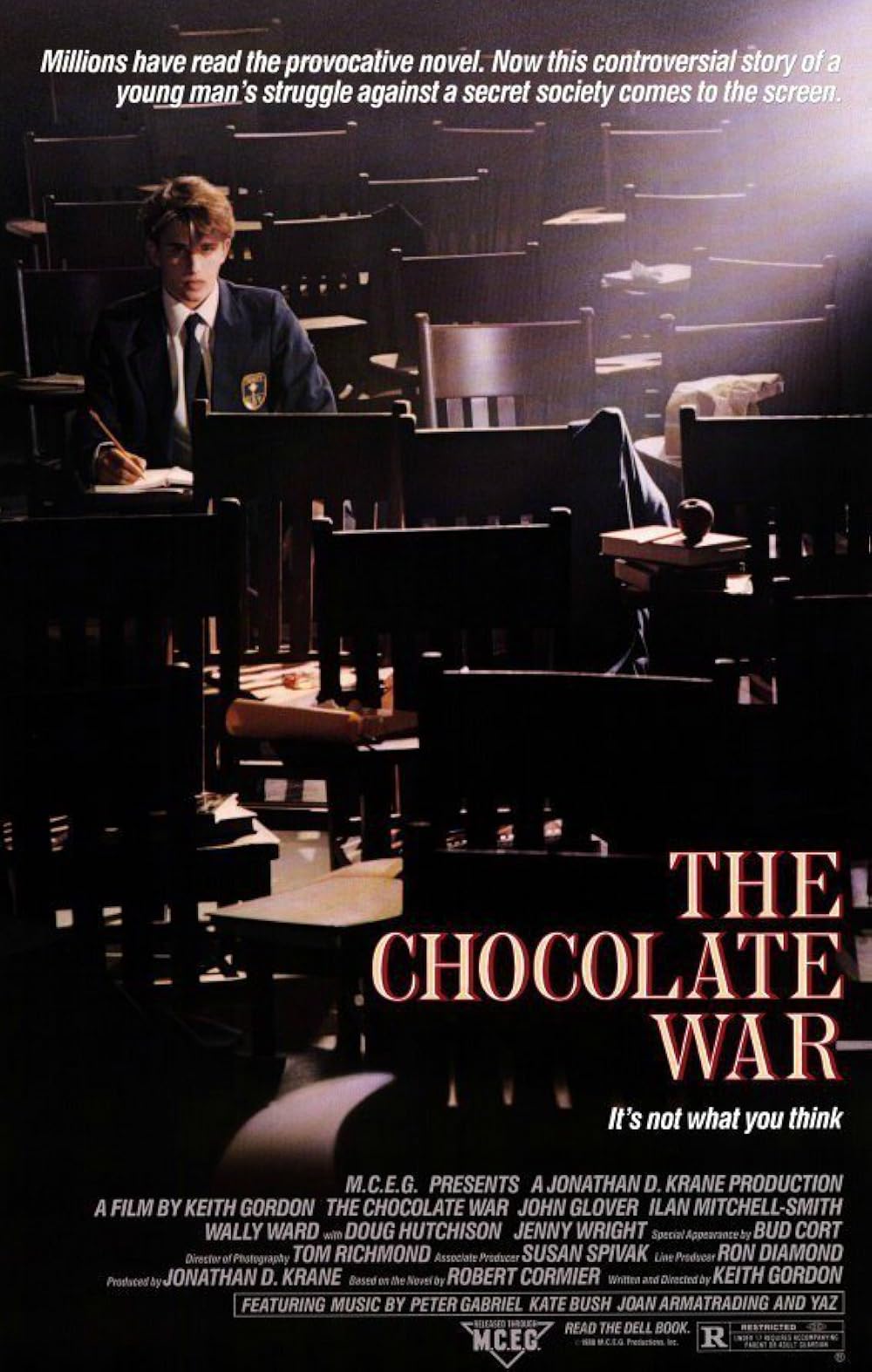
Jerry (Ilan Mitchell-Smith) is the new student at an all-boys Catholic School that finds himself insnared into a controversy that wasn’t of his making. Brother Leon (John Glover), the school’s headmaster, promotes a program in which all the students must sell a certain allotment of chocolates in order to bring in much needed revenue for the school. While it’s technically voluntary the students are strongly pressured to take part in it and all of them do except for Jerry who for ten days refuses to get involved. This it turns out was the result of a hazing ritual brought on by a secret fraternity of students known as The Vigils. The idea was for Jerry to prove himself as being mentally strong enough to join the group by standing up to the intimidating Leon. Leon though becomes aware of what’s going on and since he’s in close contact with Archie (Wally Langham), the Vigil’s leader, he forgives the action convinced that once the 10-days are up Jerry will conform like all the others and take part in the sales drive. However, to everyone’s shock this doesn’t happen. Instead, Jerry continues to rebel, and his nonconformity has an infectious quality causing other students to take part, which challenges the strength of the school’s hierarchy to keep everyone in line. 

The film is based on the 1974 novel of the same name by Robert Cormier, which many critics have deemed one of the best young adult novels every written, but also one that routinely shows up as being on the top 10 list of banned or challenged books in high school libraries. It marks the directorial debut of Keith Gordon, who up until this time was better known for his acting particularly his starring role in the horror classic Christine. As a director I think he does a splendid job. I loved the eclectic camera angles, the zooms and hand-held shots. The soundtrack is distinctive featuring songs by artists who allowed their music to be used at a significantly lower price due to the movie’s low budget. The on-location shooting done at an abandoned seminary in Kenmore, Washington is perfect with the gray and dreary Northwest late autumn landscape perfectly reflecting the grim characters and situation. 

The acting is impeccable especially Glover who creates a three-dimensional villain who’s bullying at times, but at other points nervous and insecure. Mitchell-Smith, whose teen heart throb appearance belies is high-pitched voice, which I’ve never cared for and the reason I believe his acting career didn’t last, is quite good mainly because he isn’t forced to say much and instead relies on his reactions to what goes on around him, which in that element he excels. Langham is the perfect composite of the preppie bully particularly with that hairstyle that has ‘attitude’ written all over it, but his best moment is when he picks at a pimple on his arm after he gets off the phone with someone. I had noticed it during his conversation and was almost stunned when he picked at it. So many other teen movies show adolescents with unblemished skin, with maybe only a few geeky kids that have acne, but here one of the ‘cool’ kids was shown with it, which coupled with him actually trying to squeeze, which teens in reality will do, was genuinely groundbreaking and not something I’ve ever seen in any movie before or since. 

While there’s many memorable moments there’s a few loopholes as well. The fact that the students didn’t have any locks on their lockers, and thus allowing the Vigils to put trash into Jerry’s locker, didn’t seem valid as virtually every high school I’ve been in, past or present, does. The running segment dealing with Jerry and his father receiving harassing anonymous calls is quite dated due to now having caller ID, but even then, they could’ve still called the authorities to have their phone line tapped and thus the calls would’ve been traced, which is something you’d think they’d ultimately would do as it continued to occur. It’s also unclear how the students are able to sell the boxes of chocolates and achieve such a high quota. The film intimates they’re using unscrupulous methods, but not explicit enough as to the exact method. 

Spoiler Alert!

The film’s most controversial moment, and one that may have led to it doing poorly at the box office, is the way it changes the original ending. In the book Jerry gets defeated by Archie in the climactic boxing match, but in the movie, Jerry wins, and Archie is subsequently replaced as The Vigil’s leader. Personally, both endings have interesting nuances, so I can’t say I favor one over the other though the movie version does bring out some intriguing elements. However, fans of the novel tend to hate it feeling it was an attempt by Hollywood to give the story a more ‘uplifting’ conclusion. 

My Rating: 7 out of 10

Released: November 18, 1988

Runtime: 1 Hour 40 Minutes

Rated R

Director: Keith Gordon

Studio: MCEG

Available: DVD, Blu-ray, PlutoTV, Tubi

Max Dugan Returns (1983)

max1

By Richard Winters

My Rating: 4 out of 10

4-Word Review: Estranged father comes back.

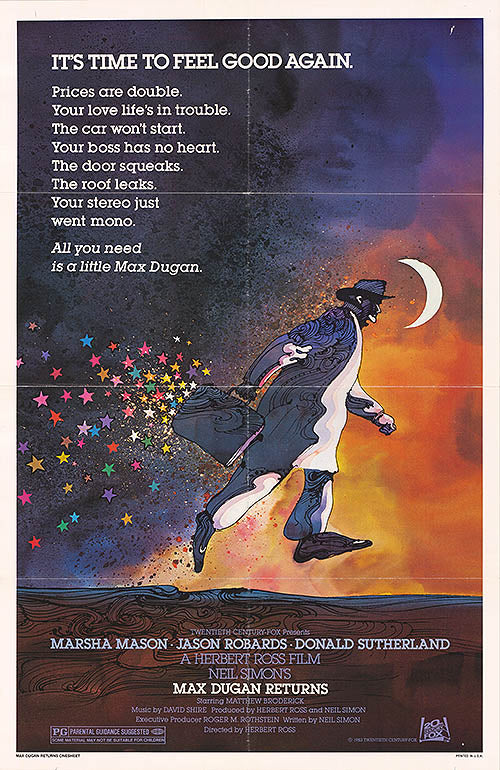
Nora (Marsha Mason) is a single mother living with her 15-year-old son Michael (Matthew Broderick) who’s struggling to make ends meet as a High School English Teacher. Things become particularly desperate when her beat-up 1964 Volvo car gets stolen and she no longer has any transportation to get to work nor the money to afford buying a new car, or even a used one. Fortunately, the officer working on the case, Brian (Donald Sutherland) takes a liking to her and offers her to use his motorbike even though she needs training on how to drive it. Once she goes through the crash course and begins using it she still has other financial concerns to worry about until one night she receives a mysterious visitor, which turns-out to be her estranged father Max Dugan (Jason Robards) who ran-out on his family 29 years earlier. Now he has returned with a briefcase full of $687,000, which he skimmed from a crooked casino that he used to work at. He tells her he has only 6-months to live and advises her to take the money, so that she and her son can live stress-free, but Nora isn’t so sure she wants to accept it, so Max goes about buying her stuff anyways including a fancy new car.

This has to be one of Neil Simon’s least imaginative efforts and the concept seems so contrived it’s like he thought it up for the 10-minutes that he was sitting on the john. I’ll admit when I was a teen and watched it when it first came out, I enjoyed it. I especially remembered the scenes dealing with Charley Lau, who regrettably died less than a year after the film’s release, where he plays himself the hitting coach for the Chicago White Sox baseball team, who Max hires to help Michael become a better hitter and these teaching scenes I found to be engaging. Unfortunately, the foundational premise has a lot of holes.

The idea that a father would suddenly want to see his daughter after 29 years of being away didn’t seem authentic. If he longed to reconnect then why not reach out earlier? Granted he was in jail for 6 of those years, but what about the other 23? If family was so important to him then why run out on them in the first place? Why doesn’t he at least make some attempts in-between those years to communicate like sending letters of phone calls before just showing up and expecting to be welcomed with open arms? The idea of throwing her and his grandson a lot of money comes-off in bad taste like he’s simply trying to buy their love and if anything seems quite shallow. During those 29 years away you’d think he would’ve met other people he’d become friends with, or other women he dated that he might’ve wanted to give the money to instead, or are we to presume that for 3-decades he lived in a cave and made no contact with anyone else?

I didn’t get why Nora didn’t recognize her father when he called. Yes, it had been awhile since she had last heard or seen him, it’s stated that she was 9 when he left, but he has a distinctive voice, so I’d think it would set something off in the back of her brain that she knows who this is, but can’t quite place it, versus having her immediately call the police in panic after getting a call from some ‘strange man’. He also tells her at one point that he may not actually be Max Dugan, but again she wasn’t a month-old infant when she last saw him, but instead someone entering the fourth grade, which should’ve given her a solid enough memory of what he looked like and thus know if this was her real father, or not.

To help solve all of this Nora should’ve been made a divorcee instead of a widow. The husband/father could’ve been the one who went to jail and then returned a 6 years later with stolen money hoping to use it to win back his wife’s and son’s favor. It would’ve made more sense because less time would’ve passed, and he’d have a more vested emotional interest in bonding with his son since he was directly his versus an elusive grandfather who didn’t even know the kid existed until being ‘tipped off’ that Nora had one by some secondary source.

Matthew Broderick’s character is problematic too. He seems just too obedient and goody-goody to be a believable teen as he promptly makes his bed every morning, even his mother’s, asks to be excused from the dinner table, and even lets his mother kiss him while in full view of his friends. Yes, there’s one brief moment where he tries to sneak a smoke, but otherwise I didn’t detect the typical rebellion to authority that most teens that age have, and it would’ve been improved had the kid been 9 or 10 where still being compliant with their parents’ wishes is a little more understandable.

Sutherland’s character was off as well as he seems way too aggressive about asking out a woman that he had just met while on-duty and actively investigating her case making it ethically questionable whether he should even be doing it. If a guy does come-on to a woman so quickly, simply because she’s attractive and single, as he knew nothing else about her, you’d presume he’s done this to other available women as well and thus should have a throng of casual girlfriends and Nora would just be one of many. The film should’ve just had him already her boyfriend from the start and thus avoided this otherwise awkward and rushed relationship. I also thought it was dumb that Kiefer Sutherland, who appears early on in a brief non-speaking role as one of Broderick’s friends, wasn’t cast as Donald’s son in the climactic baseball sequence at the end and instead the part was given to another young actor.

Spoiler Alert!

The money issue becomes yet another problem as Max spends it on so many lavish gifts that I started to wonder if there would be any left to put into savings. The idea that he could’ve had workers refurbish the house in just one day while Nora and son where in school is ridiculous as something that massive would take weeks if not months. He even ends up driving away with the car he had bought her leaving her again without a vehicle. Yes, he does open-up a bank account in her name and puts in $400,000, but her cop boyfriend was already aware of this and made clear he put his duty to uphold the law over his personal relationships making it very probable that she’d be forced to give it all back. Worse she might be considered an accomplice forcing her to hire an attorney, which would’ve sent her into even more debt making it seem like she’d be better off had the whole thing not even happened to begin with.

My Rating: 4 out of 10

Released: March 25, 1983

Runtime: 1 Hour 38 Minutes

Rated PG

Director: Herbert Ross

Studio: 20th Century Fox

Available: DVD, Amazon Video, YouTube

What Have You Done to Solange? (1972)

solange

By Richard Winters

My Rating: 7 out of 10

4-Word Review: Bearded priest murders schoolgirls.

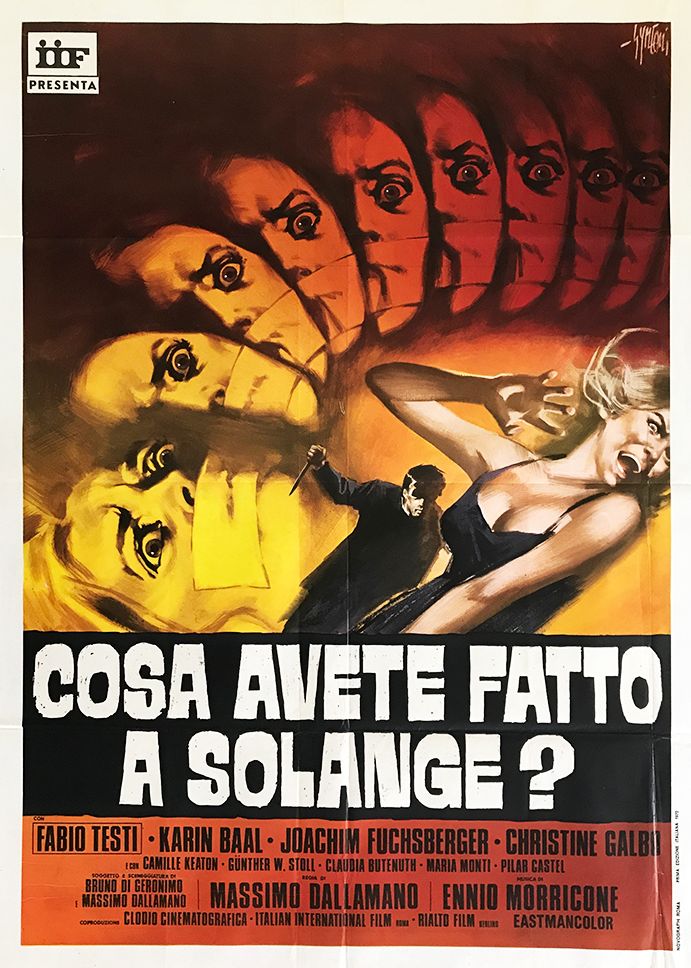
Enrico (Fabio Testi) is a high school teacher who’s having an affair with Elizabeth (Cristina Galbo) who’s one of his students. While making-out with her on a boat at a park Elizabeth spots a shadowy figure murdering a young girl in a nearby wooded area. The girl turns-out to be one of her classmates, but Enrico convinces her not to tell anyone for fear that it could jeopardize his job. Once the murder gets discovered and reported on the news Enrico goes back to the scene to check for clues only to be photographed by the police who are there doing the investigation. Inspector Barth (Joachim Fuchsberger) spots Enrico in the photo and brings him in for questioning. Enrico denies any knowledge of the killing, but comes under suspicion especially after Elizabeth is later found murdered in her bath tub. Enrico then reconciles with his frigid wife Herta (Karin Baal) in order to have her help him do their own investigation, so they can unmask who the real killer is before the police are able to close in on him.

The film is a unique partnership between a West German production company and an Italian one that was filmed on-location in London. While there are many German actors in the cast the film as a whole is modeled after an Italian giallo and has many of the mystery, gore, and sleaze elements that you’d expect from those. The direction, by Massimo Dallamano, who was a cinematographer of Spaghetti westerns during the 60’s, approaches the material with a visual elegance. The photography is crisp and detailed with some evocative camera work and angles as well as a few graphic shots including the murderers modus operandi, which is shoving a large knife up his victim’s vaginas, which not only gets revealed on the corpses, but also in x-ray version, but also a drowning death in a bath tub that gets played-out moderately well. In most slasher flicks the victim goes down easily when they’re attacked by surprise by their killer, but here this one struggles quite a bit making the killing more drawn-out and thus more realistic.

The plot though, particularly the second act, gets stretched too thin. We have an intriguing set-up and a zesty conclusion, but in-between it meanders. The biggest reason for this is that the protagonist and his quandary becomes neutered and thus all the potential drama from his situation evaporates. Having the inspector tell him upfront that he doesn’t think he did it hurts the tension and would’ve been intriguing if they thought he did, or he even became their prime suspect. Having Enrico make amends with his wife, at the beginning they’re at extreme odds and even close to fully hating each other, further moderates things as the wife could’ve been an interesting possible suspect too, killing the school girls and trying to make the hubby look like he did it in order to get back at him for cheating on her, but then having the two team-up just fizzles away a potentially dark undercurrent to their relationship. Showing Enrico working with the inspector ultimately makes him seem more like a side character in his own movie and by the end like he’s not really the star at all as the inspector completely takes over.

The one performer that does stand-out is Camille Keaton. She’s better known for her starring role in the cult hit I Spit On Your Grave, but here in one of her first performances in the front of the camera she’s quite impressive and she does so without uttering a single line of dialogue. She comes-in real late too to the extent I was starting to think she’d have some minor part and be spotted for only a few seconds, but her character comes-on strong despite not saying anything and is an integral component to the whole mystery. What I liked most about her was her trance-like demeanor and glazed over look in her eyes that’s both effective, creepy, and disturbing at the same time.

Spoiler Alert!

The film’s wrap-up could’ve been better done as it elaborates about the motives of the killer and the elements of the case too much saying things that the viewer should’ve been able to pick-up on during the course of the movie. For instance it describes the sex parties that these teen girls attended, but snippets of these orgies should’ve been shown and not just discussed. The film had no qualms with the violence, so why not have a little explicit sex as well. Also, Keaton’s character going in to have an abortion like it’s going to be some ‘fun activity’ didn’t seem believable. The attempt was to show that she was naive about how rough the procedure would be and thus became ‘traumatized’ by it afterwards, but she still should’ve shown some trepidation upfront as just about anybody else would.

My Rating: 7 out of 10

Released: March 9, 1972

Runtime: 1 Hour 47 Minutes

Rated R

Director: Massimo Dallamano

Studio: Italian International Films

Available: DVD, Blu-ray, Amazon Video, CONtv

I Am the Cheese (1983)

iam

By Richard Winters

My Rating: 6 out of 10

4-Word Review: Dealing with past memories.

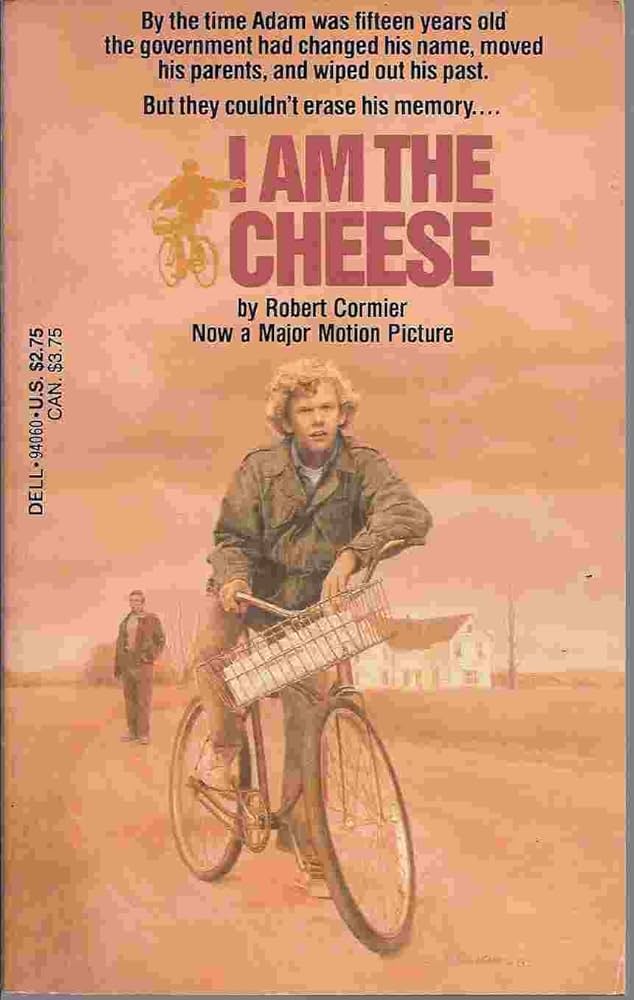
Adam (Robert MacNaughton) is an adolescent boy taking a bike trip through Vermont in order to deliver a present to his father (Don Murray). During his ride memories from the past that had been stuck in his subconscious come to the surface including his on-and-off relationship with Amy (Cynthia Nixon) as well as the sometimes odd behavior of his father. Helping sort through these things including him finding in his father’s desk drawer two different birth certificates with his name on it, is Dr. Brint (Robert Wagner) a therapist at a mental hospital that Adam is currently residing in.

The film is based on the book of the same name written by Robert Cormier, who appears briefly as Amy’s father, who wrote many young adult novels with his best known one being The Chocolate War. The screenplay was written by David Lange, who was also the producer, and the brother of Hope Lange who gets cast as Adam’s mother and is a reunion of sorts for her with Don Murray, who plays Adam’s father, and whom she’d been married two from 1956-62. She had also co-starred with Robert Wagner in The Young Lions in 1957 though here they don’t share any scenes together.

The film, which was the one and only directorial foray of Robert Jiras who worked as a Hollywood make-up artist for many years, is decidedly low budget though since most of the action takes place with Adam on his bike it really doesn’t hurt the effect of the story and the lush summertime New England scenery becomes an added benefit. MacNaughton, who’s better known for playing the older brother in E.T. before leaving the acting business after the 80’s and becoming a mail sorter, is quite good as he effectively channels his character’s inner anxiety and confusion. Nixon is also a stand-out playing against the cliche of a typical teenage girl, who are usually portrayed as being giggly, insecure, and into the latest fads, but instead she is cultured, poised, confident, and smart and she adds a wonderful addition to the movie and it’s just a shame she wasn’t in it more.

The plot follows the book pretty closely including the constant shifting between the present and the past and also the therapy sessions. While I usually like non-linear narratives I initially found this structure off-putting. The publishers in fact felt, when the they read the initial manuscript, that it would too confusing for young readers and pressured Cormier to simplify the structure, which he refused. Despite this it does become genuinely riveting by the second act.

Spoiler Alert!

The twists are good and makes sitting through it worth it though the moment when the bad guys catch-up with Adam and his parents should’ve been played-out more since it’s such a traumatic moment. It’s possible that because this was aimed at teen viewers the producers felt this violent element required being toned down, but crucial scenes like these have to stand-out and the way it gets done here it just doesn’t.

In the film, like in the book, the psychiatric sessions are ultimately revealed to be a sham where Robert Wagner’s character isn’t a doctor at all, but instead part of the government conspiracy to make sure Adam doesn’t know more than he should about his parent’s past as otherwise he would be deemed a ‘risk’ and ‘terminated’. However, in the movie they have Adam escaping from the place and riding off on his bike like he’s now ‘free’, but he really isn’t. He has no job skills, no family, no money, and no place to live. He’s be better off just staying at the clinic even if it was a fake one, as he at least had a roof over his head and food to eat. Being on his own at 16 was unlikely to end well and such a sophisticated government operation such as this one was at some point going to track him down, dead or alive, so the tacked-on ‘happy ending’ doesn’t jive.

My Rating: 6 out of 10

Released: November 11, 1983

Runtime: 1 Hour 36 Minutes

Rated PG

Director: Robert Jiras

Studio: Almi Pictures

Available: VHS, DVD-R

Rich Kids (1979)

richkids

By Richard Winters

My Rating: 5 out of 10

4-Word Review: Dealing with divorcing parents.

Franny (Trini Alvarado) is a 12-year-old who’s learning that her two parents (Jon Lithgow, Kathryn Walker) are getting a divorce. She is unhappy about this and thus turns to her friend Jamie (Jeremy Levy) whose parents also went through a divorce a couple of years earlier. He gives her guidance and tips on how to deal with it. She turns to him as a confidant and begins spending time with him at his place even overnights. Her parents are under the impression that Jamie’s father (Terry Kiser) is keeping a watchful eye on them, but in reality he’s over at his new girlfriend’s pad and not paying the least bit of attention to what the kids are doing who then get into all sorts of mischief including alcohol. Once Franny’s parents do catch-on and head over there along with Jamie’s mother and her new husband (Roberta Maxwell, Paul Dooley) they fear it may be too late especially after Franny’s mother finds the book ‘The Joy of Sex’ that her daughter had hidden away and been reading.

On the surface this film, which was produced by Robert Altman, should’ve been a winner and on the technical end it does everything right.  The color schemes and docu-drama approach gives it a vivid day-in-the-life vibe and captures growing up on the Upper West Side neighborhood quite well to the extent that you feel like you’ve visited the area yourself once the film is over. The acting, particularly Alvarado in her film debut, is terrific though kudos must also go to Lithgow and Walker whose portrayal of fraught parents trying to shield their child from life’s ugly realities while also still attempting to be upfront and honest with her is well done. Director Robert M. Young shows a good eye for detail and keeps things visually interesting particularly when they go to Jamie’s dad’s place and interact with the exotic pets he has and make goofy faces with his bedroom full of wall mirrors on every side, which I felt was the movie’s highlight.

Story-wise there are a few profound moments and everything that occurs rings true, but in the process it’s not particularly riveting either. I sat through the whole thing expecting at some point to be grabbed in and it just never occurred. Part of the issue is that it takes too much of a minimalistic approach. So much effort is put in to keeping it realistic that nothing every stands-out. It’s like one of those 70’s after school specials that gets stretched out to 2-hours length, but could’ve easily said what it wanted to in only half that time. It’s all pleasantly done, but ultimately rather meh.

I didn’t like the sex difference of the two kids as it made me cringe all the way through fearing that even at age 12 things might start to get a little kinky like they’d play a game of ‘doctor’, or get drunk, which they kind of do, and dare each other to take their clothes off. It seemed at that age children still like playing with members of their own sex and are quite clicky about it and don’t really begin to reach out to the other side until maybe 14 or 15, so it would’ve been more believable if Jaimie had been a girl instead of a boy.

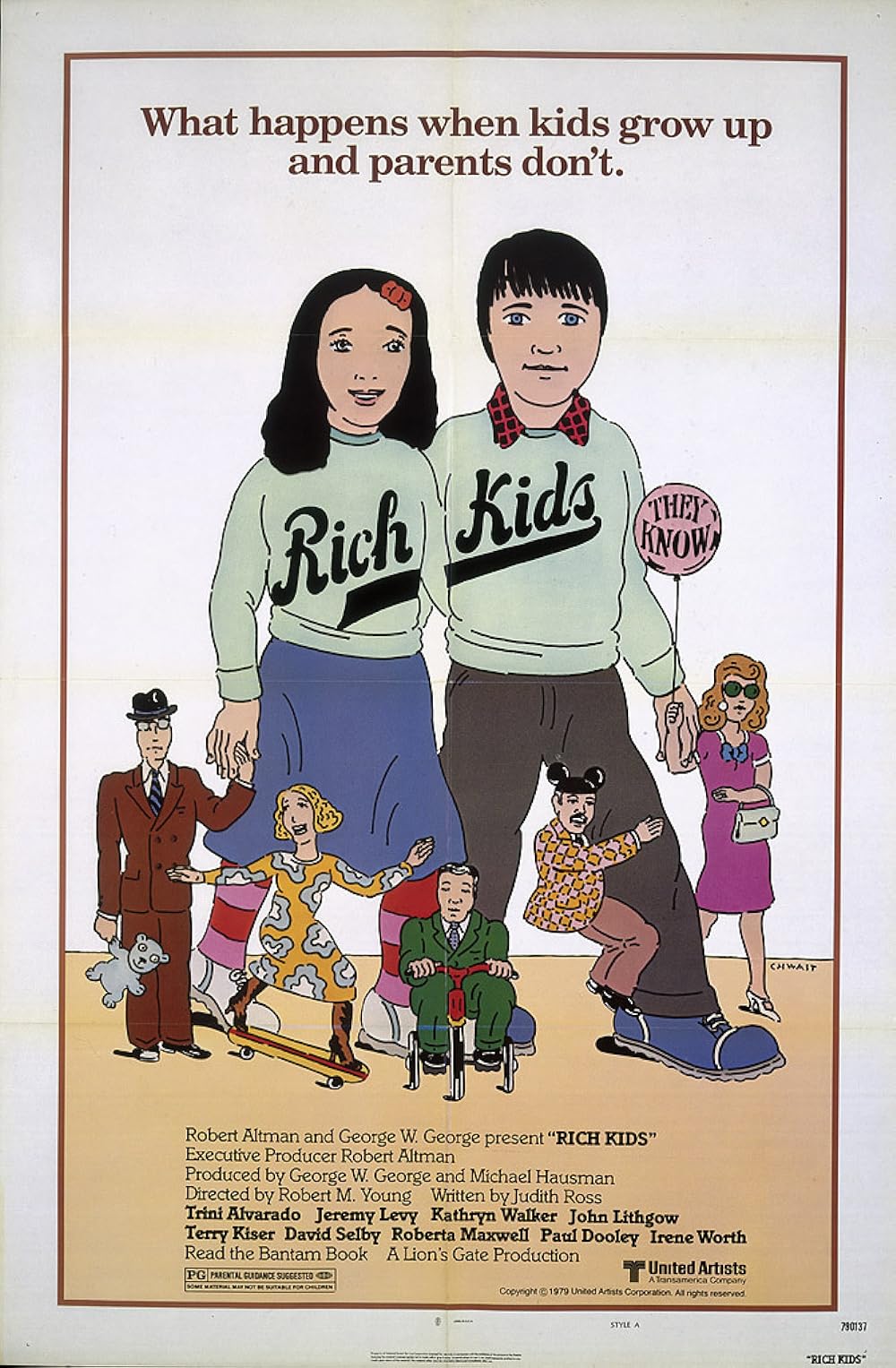
The title is a bit confusing as these really aren’t wealthy families sure they aren’t poor, but there’s nothing about their lifestyles or home life that isn’t of the middle-class variety making it misleading to have the word ‘rich’ in there. The promotional poster is awful too as the drawings don’t look anything like the real stars and depicts the two leads like they’re dorky looking, which they really aren’t. It also gives one the impression this might be an animated feature, which it certainly isn’t. Actual picks of the two stars would’ve been better especially since Alvarado has such expressive blue eyes, photogenic face, and wonderfully natural smile that one shouldn’t pass-up the opportunity to have her sweat face plastered on the promotional materials whenever possible.

My Rating: 5 out of 10

Released: August 17, 1979

Runtime: 1 Hour 41 Minutes

Rated PG

Director: Robert M. Young

Studio: United Artists

Available: DVD