Category Archives: 80’s Movies

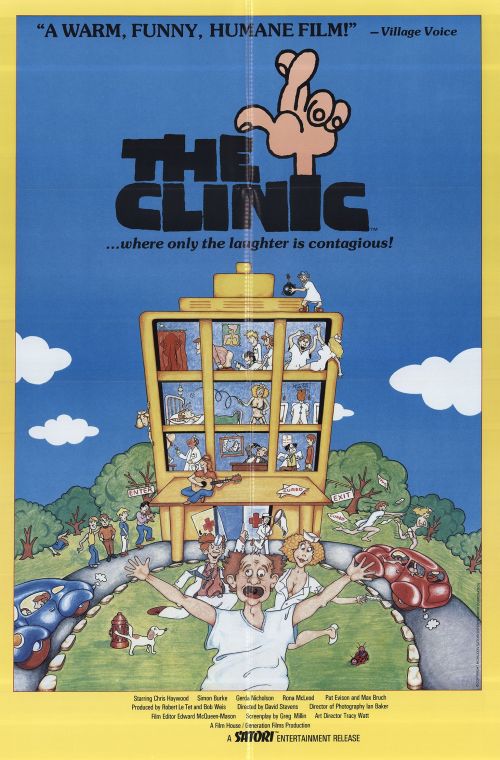
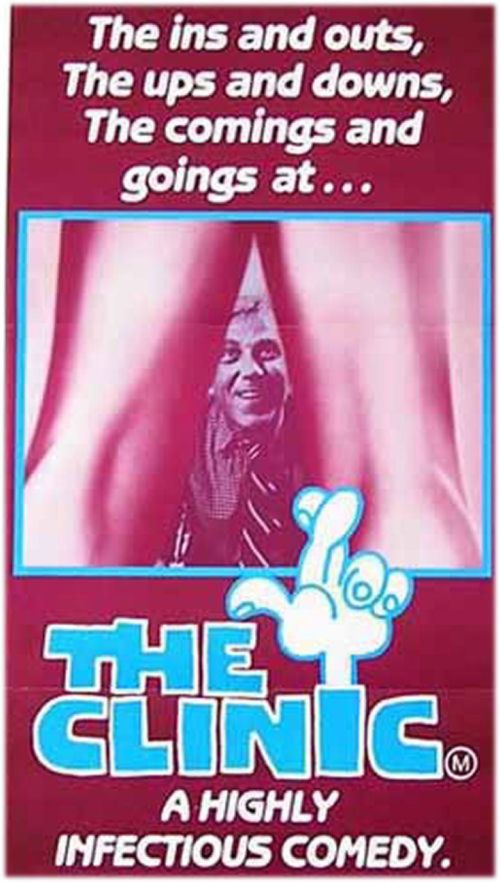
The Clinic (1982)

By Richard Winters

My Rating: 7 out of 10

4-Word Review: Helping those with V.D.

A day in the life of a clinic in Melbourne, Australia that specializes in treating people with venereal disease.  Both the doctors and the patients have many issues to deal with, but not all of them have anything to do with sexually transmitted diseases including Dr. Eric Linden (Chris Haywood) who after spending the day treating patients is more worried about meeting the mother of his gay partner for the first time. There’s also Dr. Hassad annoyed with the lamp on his office desk that he can’t get to work right no matter how many times he tries to fix it and three men visiting from China who think they’re at a health clinic, not a VD one, but nobody can translate to them that they’re in the wrong place.

For the most part this is a funny engaging ensemble comedy similar to Britannia Hospital, a satirical comedy done in the U.K., or The Hospital done here in the US and starring George C. Scott.  There’s also distant shades to the 80’s TV-show ‘St. Elsewhere’ that toed the line between being surreal and serious.  The editing is fast paced as it cuts back and forth between various scenarios happening at the same time throughout the different offices in the building.

There are also many characters and it’s hard to keep track of all them. They’re introduced at such a dizzying pace that the viewer isn’t allowed to get attached to any of them as you see them for only a couple of minutes and then it cuts away to someone else and never going back to the previous one until much later when you’ve almost forgotten about them, or their dilemma. Some may consider this the hallmark of bad filmmaking as in Hollywood the idea is to have, even in an assemble comedy such as this, one central character for the audience to connect with and then colorful people surrounding them, but here no one takes center stage. Director David Stevens admitted in interviews that he was pressured by producers to go more the conventional route, but he resisted and in many ways it succeeds better because it gives you a true day-in-the-life feel of the inter-workings of a clinic and the constant hustle-and-bustle of patients coming in and out that a story more focused on one person might not be able to convey as effectively.

The lack of music is another thing that is unusual. During the opening sequence all that is heard is traffic noise while the credits roll and it’s not until 1 hour 5 minutes that any type of soundtrack is heard in a rare moment that does not take place at the Hospital, but instead on a beach. There is a bouncy tune sung by Alistair Jones over the closing credits, but other than that there’s nothing, which again I found okay as it uses the ambience of the people walking around and talking as the film’s soundtrack, which helps heighten the realism. The nudity is different here too as it’s solely close-ups of male genitals, but none from females, which bothered some viewers, but I found alright. What I did question though was the males so obediently disrobing in front of a female Dr. as I felt some of them would be uncomfortable and even hesitant to do this.

The conversations and throwaway lines are quite funny, which is the film’s centerpiece as are the quirkiness of the characters who say one thing, but end up doing the complete opposite much like people in real-life. There’s also a few serious moments that brings up the stigma that people with V.D. had to deal with including one who loses his job, but these don’t come to satisfying conclusions and should’ve been explored more.

Overall it’s an enjoyable 90-minutes although by the final 15 it starts to exhaust itself. Had it been done with a smaller cast might’ve helped although technically it’s still quite fluid throughout though some may point to its poor box office showing where it managed to only recoup $414,000 profit from its $1 million budget as a sign that the unconventional narrative was a failure. This though is more likely because of distributors at the time being reluctant to show the film fearing public backlash at what was still considered a taboo subject.

My Rating: 7 out of 10

Released: September 17, 1982

Runtime: 1 Hour 28 Minutes

Not Rated

Director: David Stevens

Studio: Roadshow Films

Available: None at this time.

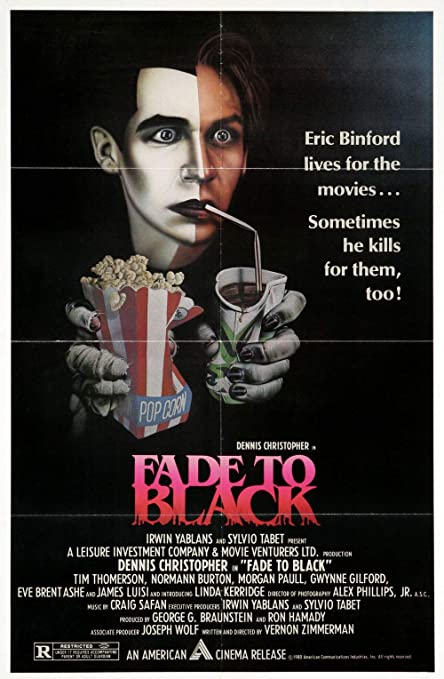
Fade to Black (1980)

By Richard Winters

My Rating: 2 out of 10

4-Word Review: A cinephile becomes homicidal.

Eric Binford (Dennis Christopher) is thoroughly engrossed in movies to the extent that he watches them all day in his bedroom and does little else. Aunt Stella (Eve Brent), whom he lives with, nags him constantly about what a loser he is as does Richie (Mickey Rourke) who he works with at his job inside a film distribution center. One day he meets Marilyn (Linda Kerridge) who looks exactly like his favorite actress Marilyn Monroe. The two agree to go out on a date to see a movie, but when Eric shows up at the theater and Marilyn is nowhere to be found he becomes unhinged. All of his pent-up rage gets released and soon he goes on a killing spree by slaughtering all of the people who have made fun of him in the past.

Writer/director Vernon Zimmerman has insisted in interviews that this wasn’t meant to be a horror film, but then what exactly was it supposed to be? I admit initially it has some intriguing elements, but like with Zimmerman’s other directorial efforts it misses the mark. Ultimately despite the offbeat touches it  devolves into a mechanical slasher flick by the second act, but in this case a really bad one, as the killings are handled in a very unimaginative way with the victims dying way too easily to the point that the segments become boring and very predictable.

Some felt that this was an odd follow-up project for Christopher to take after his critical success starring in the acclaimed Breaking Away, but I’ll give him credit for not playing it safe and taking a role outside of mainstream Hollywood. He actually plays the part pretty well, but that’s actually the problem as his skinny, geeky build makes him seem too Norman Bates-like and falls into the lonely stereotypical psycho mold too easily and thus witnessing his eventual melt down is neither surprising nor revealing. His attempted impressions of  famous characters/stars are quite poor too and makes these moments very annoying.

Having a cinephile only into classic old movies didn’t seem realistic. You’d think someone like him had seen films others hadn’t even heard of, so referencing obscure flicks and lesser known actors should’ve been added into the mix. I was also confused where he was able to get the money to pay for all the elaborate costumes, make-up, and props that he uses during the killings as at the beginning he was so broke he had to beg people for money just to fill-up his bike with gas, or go out on a date. Some may argue that when his Aunt died she willed him the money, but this is never mentioned or shown.

I did like Rourke and I felt he would’ve been more interesting in the lead role as he plays a movie fanatic as well, but also didn’t fall into the tired nerdy cliché like Christopher. Kerridge though as the love interest proves to be a dud. She certainly is easy-on-the-eyes, but seems uncomfortable playing the Marilyn caricature and her presence ultimately is rather transparent.

The production values are slick and the climactic sequence that takes place both in and on top of the famous Grauman’s Chinese Theater has some pizazz, but everything else falls flat. It’s just not offbeat enough, scary enough, nor darkly humorous enough to ever catch its stride, or sustain any consistent interest.

My Rating: 2 out of 10

Released: October 17, 1980

Runtime: 1 Hour 42 Minutes

Rated R

Director: Vernon Zimmerman

Studio: American Cinema Releasing

Available: DVD, Blu-ray, Amazon Video, YouTube
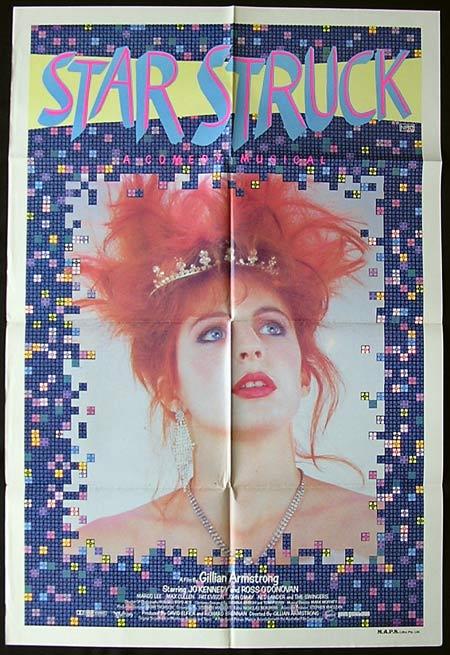
Starstruck (1982)

By Richard Winters

My Rating: 7 out of 10

4-Word Review: Teens dream of stardom.

Jackie (Joey Kennedy) is a teen working as a waitress at her mother’s pub, but dreams of becoming a famous singer. Her 14-year-old cousin Angus (Ross O’ Donovan) acts as her manager trying to get her a spot on the local talent TV-show called ‘The Wow! Show’, but Terry (John O’May) the program’s host, refuses to see her, so they decide to have her perform a publicity stunt by walking across two high rise buildings in downtown Sydney on a tightrope while nude. This gets so much news coverage that Terry can’t help but bring her on his show, which initially proves to be a great success until Jackie becomes pressured to cut her backing band and tone down her quirky style. After alienating all of her friends she then tries to win them back by plotting to crash a New Year’s Eve talent contest at the Sydney Opera House where they hope to win the $25,000 cash prize in order to save their now dying pub.

After the success of My Brilliant Career director Gillian Armstrong set out to make a movie that was completely different in style from that one and eventually came up with the idea of doing a musical parody and on that level it works. The musical numbers are not only quite funny, especially the one done inside the pub where all the customers and staff join together to create one long line dance, but impressively staged too. I was literally blown away with the segment done inside Terry’s penthouse pool that was meant to be a take-off on the old Busby Berkley numbers from the 40’s, but in many ways just as good if not better.

The film also gets filled with a lot of humorous moments, most of which, like Angus’ elaborate attempts to try and make contact with Terry and even ditching school to do so, are quite funny. The segment dealing with Jackie’s high wire act I found initially preposterous. How exactly where they able to connect the tightrope between the two buildings, which would’ve been a massive feat in itself and never shown, but the outcome, as silly as it is, still had me chuckling.

The film has a terrific supporting cast especially Pat Evison as the elderly and overweight Nana, who shows exuberant support for Jackie’s ambitions even when the other adults don’t. O’Donovan and his constant scheming is also engaging, but I found Kennedy’s performance in the all important lead role to be flat. Singing-wise she is quite good, which is the whole reason she got the part, but her acting doesn’t have the same energy. Her character really isn’t very funny either and it’s Angus doing all the hard work to get her noticed and she never seems to appreciative it making the viewer not as emotionally invested at seeing her succeed as they should’ve been.

The film gets a bit too quirky for its own good too. It’s got a lot of visual pizazz, but no substance whatsoever and it would’ve been nice had there been some grittiness tied in. Everything happens too easily making it seem like a fairy tale and convincing me that the most suitable ending would’ve had Jackie waking up and realizing it had all been a dream because that’s exactly what it comes-off like.

On a side note I was surprised how much the Sydney Harbour Bridge, which was completed in 1932 and stands as the world’s tallest, gets shown. Not only is it featured in every skyline shot of the city, but there’s also a mural of it on the wall of the pub, a toy model of it on top of the pub’s TV, and even a replica of it put on stage during the film’s climactic dance number. I’m not sure what the exact shot count number is that features it in one form or another, but if you take a shot of whiskey every time you see it you’ll be drunk and passed out on the floor by the time it’s over.

My Rating: 7 out of 10

Released: April 8, 1982

Runtime: 1 Hour 45 Minutes (Australian Version) 1 Hour 35 Minutes (US Release)

Rated PG

Director: Gillian Armstrong

Studio: Cinecom International Films

Available: DVD, Amazon Video, Pluto TV, Tubi

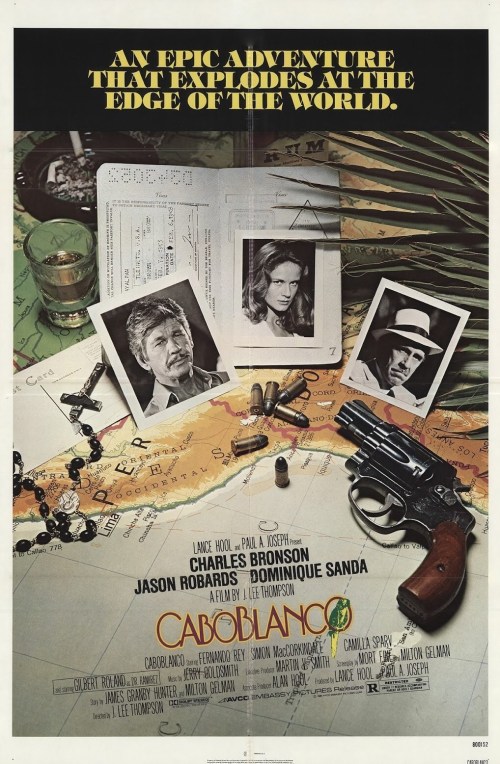
Cabo Blanco (1980)

By Richard Winters

My Rating: 4 out of 10

4-Word Review: Search for sunken treasure.

Giff (Charles Bronson) is an American living in the small fishing village of Cabo Blanco, Peru where he runs a cafe/bar just after the end of WW II. It is here that he becomes inadvertently embroiled for the search of sunken treasure somewhere off the coast where one searcher dies mysteriously while looking for it. Captain Terredo (Fernando Rey) the local police chief insists that the death was an accident, but Giff disagrees and becomes even more suspicious with the arrival of Marie (Dominique Sanda). Terredo almost immediately begins insisting she must leave the village at once convincing Giff that she must hold the secret.

For a film starring Charles Bronson this thing is incredibly tame and non-violent. His name became so synonymous with action movies during the 70’s that you’re expecting that there be at least some of it here, but outside of a half-minute where Chuck clobbers a would-be assassin there is very little of it. I was also presuming that since the storyline did have something to do with sunken treasure that the cast would be on or in the water for most of the runtime, but after the first 5 minutes it becomes completely land-locked.

Initially I thought putting Bronson inside an ensemble cast with performers like Jason Robards, who had a completely different acting style, would prove interesting, but the two don’t share a lot of screen time together and when they do are mostly adversarial. Chuck otherwise is his same old self, playing the one-dimensional character that he did all through the 70’s only here he stands out like a sore thumb as the supporting players give a more nuanced performance that he’s unable to do. He was also nearing 60 and having Sanda play the object of his desires looks like a grandfather coming onto his granddaughter. The youthful Simon MacCorkindale shows more energy and more up to physical demands, which should’ve made him the star.

Sanda’s presence helps especially with her beauty and a face that makes her appear like she was just 18 and for whatever reason looking younger here than she did in The Conformistwhich had been filmed 10 years earlier. I also enjoyed Denny Miller, best known for playing Tarzan as well as Tongo, the ape man on an episode of ‘Gilligan’s Island’. Here he’s one of Robard’s henchman complete with German accent and neo-nazi bowl haircut.

The film doesn’t start to get interesting until the very end when Bronson is forced to speak to a parrot in order to get a secret password that the bird was apparently trained to say. I also like the bit involving a jukebox that goes on the fritz, but otherwise there’s nothing inspiring or original and looks like it was written simply to cash-in on the big name stars. It’s almost worth checking out though simply for the location. While it wasn’t filmed in the real Cabo Blanco, but instead in Barra de Navidad, Mexico, it still has a very sunny, exotic look that gives off a soothing, relaxing feel, so forget the story and just take in the sights.

My Rating: 4 out of 10

Released: January 23, 1980

Runtime: 1 Hour 27 Minutes

Rated R

Director: J. Lee Thompson

Studio: AVCO Embassy Pictures

Available: DVD, Blu-ray

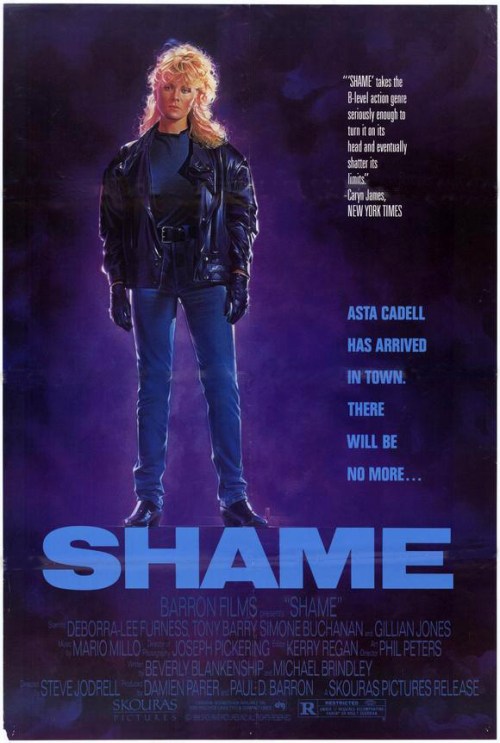
Shame (1988)

By Richard Winters

My Rating: 5 out of 10

4-Word Review: Lawyer uncovers town’s secret.

Asta (Deborra-Lee Furness) is enjoying her vacation holiday from work as a lawyer by traveling through the Western Australian countryside on her motorbike only to get into an unexpected accident late one night when she inadvertently drives into a flock of sheep in the road that due to the darkness she didn’t see. With her bike now damaged she brings it into a repair shop run by Tim (Tony Barry). Since the parts for the bike need to be shipped in Asta agrees to stay at Tim’s residence in a spare room. It is there that she overhears a conversation involving Tim’s daughter Lizzie (Simone Buchanan) and her sexual assault by a group of young men at the town’s bar. No one seems to want to press any charges and everyone in the town places the blame on Lizzie by openly implying that she’s a ‘slut’, but Asta gives her the confidence to go to the police and press charges only to find that those same men are now after her and consider her to be their next ‘conquest’.

The film is loosely based on a true story, that also inspired The Accused, which starred Jodie Foster.  However, here the approach is different where the rape victim isn’t the main protagonist, but instead someone who wasn’t even involved in the actual incident and mainly just stands on the sidelines as an observer, which isn’t as compelling. The Asta character almost becomes like a transparent ghost who’s always in the middle of the action, but overall doesn’t really do much to help propel the story along. The producers had wanted Asta to be more violent and vigilante-like, but the director nixed this idea even though I felt it would’ve helped.

While I liked the segments dealing with the parents of the boys who committed the rape and their denial of what happened and at one point even agreeing to pay-off the victim’s family not to press charges, as it’s interesting to see things from the family of accused, which most rape movies don’t do, but overall I found the story structure to be lackadaisical. I was a bit confused during the first act about what had occurred as everything is handled in a subtle and conversational fashion. We never see the actual crime happen it’s just spoken about in passing, but I felt at some point there should’ve been a flashback to the build-up of it and I was fully expecting it to come along at some point, but it never does.

The characterizations of the males is too extreme and stereotyped. I’m okay with some of the men being bad apples, as this can occur anywhere, but in this movie they’re all portrayed as being leering savage animals with no conscience or self-control. The fact that they’ve apparently raped other women in the town the same way just made it all the more over-the-top. I’ve never heard of small towns dealing with marauding, serial rape gangs and wondered what made this one so special. Was it something in the water?

There is a certain Mad Max vibe to it, which was apparently what the filmmakers were aiming for, but the results are only so-so. At least in Mad Max it had a surreal, futuristic setting, but this thing has extreme behavior happening amongst the men in an average place in the modern-day, which didn’t make much sense.

My Rating: 5 out of 10

Released: February 26, 1988

Runtime: 1 Hour 31 Minutes

Rated R

Director: Steve Jodrell

Studio: Barron Films

Available: DVD, Amazon Video

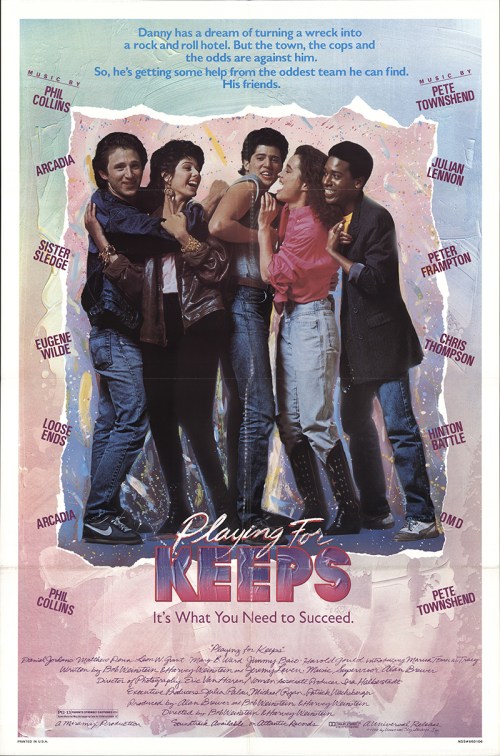
Playing for Keeps (1986)

By Richard Winters

My Rating: 3 out of 10

4-Word Review: Teens refurbish rundown hotel.

Danny (Daniel Jordano) has just recently graduated from high school and has big entrepreneurial dreams.  He becomes aware that his family has inherited a place called Hotel Majestic in Bethany, Pennsylvania and decides he wants to turn it into a nightclub for teens, but first he must first pay off the $8,000 due in back taxes. Together with his two friends: Spike (Mathew Penn) and Silk (Leon W. Grant) they devise a way to earn the money by pretending to be Boy Scouts and selling cookies to office workers. When they finally payoff the debt they find an even bigger challenge, which is fixing up the decrepit place while also fighting off a man named Harry Cromwell (Robert Milli) who runs a Chemical Company and wants to turn the hotel property into a waste dump.

This was Harvey Weinstein’s first directorial effort, which he did alongside his brother Bob and released under the then new Miramax studio, which was named after their parents Miriam and Max. This also marks Harvey’s first known case of sexual harassment when he invited an attractive 20-year-old waitress named Tomi-Ann Roberts, who was waiting tables in the town where they were shooting in, up to his hotel room to audition for a role he felt she’d be ‘perfect’ for and when she arrived she found him naked in a tub and requesting that she should disrobe as well to make sure she’d be ‘right for the part’ even though there’s no nudity in the movie.

If Weinstein’s name wasn’t so famous and you didn’t know who the director was you’d be convinced it was done by some talentless hack whose first and last film venture this was. While it does remain at least lively everything else about it is stupid including the corny, cliché-ridden comedy that permeates every scene. I found the three leads, who seem to be cast to meet some sort-of politically correct quota as they’re different races, to be quite bland particularly lead star Jordano who shows no varied emotions or facial expressions other than the same glossy smile all the way through no matter what other emotional situation he may be in.

The townspeople are boring caricatures too with their café jukebox having no other selections of music to play than Kate Smith, and the people behaving like they’d never heard of Billy Idol or Michael Jackson, which is ridiculous as I grew up in a small Midwestern town during the 80’s and our radio stations and juke boxes had a wide selection of the latest hits just like the big city. Having the only other open-minded person in the town being the farmer’s super hot daughter (Mary B. Ward) who magically falls for Danny was just a little too convenient.

The process of renovating the place, which takes up almost the entire runtime, gets so drawn-out that it becomes boring. I also couldn’t believe that all of Danny’s high school friends, which he recruits as ‘stockholders’, would be willing to stick through the arduous challenge of the fixing up the hotel like they do and most would’ve walked away pretty quickly. When they are finally able to complete the project the place gets filled with such tacky 80’s deco art that I found it better looking when it was rundown.

Marisa Tomei, who makes her film debut here, is quite engaging and I enjoyed her better in this role than her more famous Academy Award winning one from My Cousin VinnyI also liked Kim Hauser, who plays Danny’s kid sister, and has an appealing Karen Black-like cross-eyed look. Had these two been made the stars instead of the three transparent guys it would’ve been better.

It seems like, based off of the imdb reviews that I read, that the only reason people like this movie is because of its 80’s cheesiness and if that’s what you’re into you’ll be more than satisfied as this thing sure has a hell of a lot of it. Others though will find it shallow and mindless.

My Rating: 3 out of 10

Released: October 3, 1986

Runtime: 1 Hour 42 Minutes

Rated PG-13

Directors: Bob and Harvey Weinstein

Studio: Miramax

Available: DVD

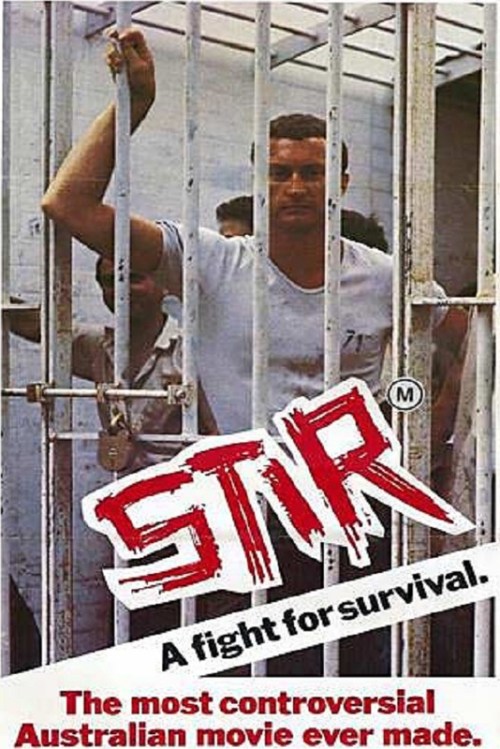
Stir (1980)

By Richard Winters

My Rating: 8 out of 10

4-Word Review: Prisoners stage an uprising.

China Jackson (Bryan Brown) was a part of an earlier prisoner revolt and when he was released he became a media advocate informing the public about the rotten conditions of the South Australian prison system and the abusive tactics of those running it. When China returns to prison after committing another crime while on parole the guards make sure that life for him on the inside is made as miserable as possible to get back at him for what he said. Yet as stirrings inside the jailhouse begin to grow and fears of a violent uprising manifest, the guards begin working with China in an attempt to quell it, but even his efforts to calm things backfire leading to a massive revolt.

The screenplay was written by Bob Jewson, which as the epilogue states, was a prisoner inside the Bathurst Jailhouse in February, 1974 where rioting lead to the place being almost entirely destroyed. The story here touches on many of the elements that Jewson faced while incarcerated and several of the supporting cast members in this film were actual prisoners during that riot.

The film has an impressively gritty feel that far exceeds most other prison flicks. Similar to Fortune and Men’s Eyes the camera gets situated inside the cell instead of being placed outside of it and then looking in. The result gives the viewer the feeling of being locked into the cramped, dingy cell alongside the  prisoners leading to a claustrophobic and uneasy feeling, which lasts for the entire duration of the movie. When the guards burst into it for no apparent reason and begin riffling through the prisoners things and pushing them up against the wall you sense their tension and can relate to the ongoing stress that they must live with.

I also loved how when the riots break out the camera takes a point-of-view perspective by running along with the prisoners has they tear the place apart making you think that you’re one of them. Later, when the guards reclaim control, the camera again takes the point-of-view perspective this time making you feel like you’re being marched through the gauntlet as they take turns beating each prisoner with their rubber batons, which literally made me wince as I could imagine the same type of pain that they were going through.

The casting of Bryan Brown I initially didn’t like. He’s a good actor, but too well known of a face, even for back then, so it was hard for me to detach who he was from some of the other parts he has played though his increasingly intense performance does help. I did like that one of his front teeth appears decayed here and they left it that way for filming, which enhances the gritty quality versus doing the Hollywood treatment and having it capped. I did though have a problem with him getting shot in the back of his shoulder, but he continues to be able to move his arm easily without any apparent pain, which I surmised would’ve been doubtful.

Spoiler Alert!

While the film does have its slow, talky moments I did appreciate how we see things from both the prisoner’s and guard’s perspectives. Most other prison flicks like to paint the guards as being all bad, but here we’re made to understand their fear and how not all of them were on the same-page and at times even openly at odds with each other. The third act is where the violence explodes and it’s effective, but what I found most disturbing was the aftermath where the prisoners get rounded up and put into pens that were even smaller than the cells the they came from looking almost like animals herded into a cage and making their protest and anger, some of which was quite justified, seem futile and pointless as things just went right back to the way they were before.

My Rating: 8 out of 10

Released: August 31, 1980

Runtime: 1 Hour 36 Minutes

Director: Stephen Wallace

Studio: New South Wales Film Corporation

Available: None at this time.

Wedding Band (1989)

By Richard Winters

My Rating: 1 out of 10

4-Word Review: He loves his job.

Marshall (William Katt) is the lead singer for a band that plays at weddings. Karla (Joyce Hyser) is a wedding planner, who has been dating Marshall for 5 years. The two finally get engaged, but now Karla wants Marshall to ‘become responsible’ by getting a ‘real job’, but Marshall loves his band so much that he doesn’t want to give it up even if it doesn’t pay that well.

Misfire comedy, written by Tino Insana who also plays the character of Hugh Bowmont, that tries hard to be a rom-com while also mixing in a playfully surreal element, but it doesn’t gel.  The problem lies with a storyline that is too basic and offers no insight or nuance. I worked as a DJ for weddings back in the 90’s and none of the experiences I or my friends went through gets examined here. In real-life there’s always concerns about getting paid, or tipped, or how much of a tip you’ll get. Or there’s the issues of dealing with a Bridezilla, or Groomzilla for that matter that insist everything must be perfect and if even one thing isn’t they refuse to pay, or demand a refund. Faulty equipment and obnoxious, drunk party guests are other headaches that just about every wedding DJ, singer, or photographer will have horror stories about and yet none of these things gets touched upon here. It’s almost like the filmmakers never worked as a wedding singer themselves, had no idea what it was really like, and just made up goofy scenarios that have no bearing in reality whatsoever.

The relationship angle comes off as quite sterile as the two don’t seem to have anything in common and you wonder what attracted them to each other in the first place. I couldn’t understand why Karla would be surprised that Marshall didn’t want to quit his job and do something that he didn’t enjoy. She was supposedly ‘really into him’, so she should’ve known about his passion for his job and if she got into a relationship with him that most likely the job would come with it. It’s clear to the viewer right away that he enjoys being a wedding singer, so after dating him for 5 years why is it not clear for her?

There are a few quirky moments like the segment dealing with a bug exterminator, but this has nothing to do with the main story and doesn’t even have either of the main characters in it. If they wanted to show part-time work that Marshall needed to do on the side to help supplement his income then great, but having a lot of drawn-out scenes dealing with what his bandmates do in their private time does not work because it’s the main characters that the viewer should be into not the minor supporting ones.

Some familiar faces who were not yet famous pop-up in bit parts. Some of these include Robert Wuhl as a waiter, David Rashe as a man who loves his DeLorean car above all else, Eddie Deezen as a would-be professional clown, and Pauly Shore as a a guy who does band rehearsals in his garage that annoy his neighbors. Cult film director Penelope Spheeris also appears as Shore’s defensive mother, but she delivers her lines in such a poor way that it’s clear she’s best behind the camera. My favorite actor out of all of them was Fran Drescher, who plays Karla’s friend and is so good, without having to try all that hard, that she should’ve played the main character as both Hyser and Katt are deadly dull, which is another reason why this already botched film doesn’t work.

My Rating: 1 out of 10

Released: October 28, 1989

Runtime: 1 Hour 22 Minutes

Rated R

Director: Daniel Raskov

Studio: IRS Media

Available: VHS

Fair Game (1986)

By Richard Winters

My Rating: 7 out of 10

4-Word Review: Woman harassed by poachers.

Jessica (Cassandra Delaney) runs an animal sanctuary deep in the heart of the Outback. Sunny (Peter Ford), Ringo (David Sandford), and Sparks (Gary Who) are three big-game hunters, who grow bored shooting at kangaroos and set their sights at taking on some of the animal’s inside her property. They decide that Jessica herself may fun to ‘toy’ with too and begin a campaign of harassment that starts with them trying to run her car off the road with their big truck and just proceeds to get more violent and confrontational. Jessica though is determined to turn-the-tables on them even as the stakes against her survival grow continually more dim.

This is the type of film that right from the start goes against the rules of conventional storytelling as there’s very little character development or backstory. The viewer is immediately thrust into the battle while barely even knowing who these people are. Normally, I’d say it should’ve slowed up a bit and let us get some grounding before getting smacked with the action, but honestly in this instance it really wasn’t needed. You get enough of the general idea to know who to root for and the more violence that happens the more enthralled you get with it.

This is how many real crime happen where the perpetrators attack their victim out of nowhere and without warning giving the person very little time to think and forcing them to immediately respond to the danger without being able to ponder their options and in that regard this film, which was intended to be, by admission of the director, nothing more than a ‘comic book’ adventure actually does quite well. Usually I’d like a chance to catch my breath, but here any minor slow-up makes you feel off-kilter as it’s the action that propels it and the whole thing becomes more like an ‘experience’ than a movie.

Many have labeled this as Australia’s version of I Spit On Your Grave, but this is actually better. The different ways that the men terrorize our protagonist is far more interesting than the gratuitous rape that took up so much of the other one. While the men are at times a bit stupid I did like their relentless quality. They don’t get killed off as easily as in a Hollywood film. There were many times when I thought they should’ve been doomed, but they manage to survive it, which made me start to believe they might actually win the battle and thus allowed the tension to grow even higher.

Cassandra, who gained fame by being a co-singer with her mother Lorraine in a rock ‘n’ roll band called The 50’s and then later ended-up marring singer/actor John Denver, is quite good though I initially felt there needed to be more of an arc to her character. Perhaps having her be more timid at the start only to eventually bring out her warrior nature at the end as she’s a little too self-assured right from the beginning, but overall I came to believe it wasn’t necessary. I did think though it was unrealistic that she ran this sanctuary in the middle of nowhere, but didn’t own a gun, but ultimately having her tote a big rifle might’ve looked cliched and it also forces her to come up with creative ways to get rid of the bad guys, which is ultimately more intriguing.

The Outback gets used perfectly as the viewer gets both charmed by it’s beauty and terrified by some of the creatures that live in it including the weird lizard-like things that congregate on Jessica’s front porch and that she’s forced to shoo-away each morning when she walks out. The desolate landscape is also a good metaphor to the men’s soulless nature and also helps heighten the odds to just how alone and desperate Jessica’s situation truly is.

My Rating: 7 out of 10

Released: July 24, 1986

Runtime: 1 Hour 26 Minutes

Rated R

Director: Mario Andreacchio

Studio: CEL Film Distribution

Available: DVD, Blu-ray (Region A/B/C)

The Emerald Forest (1985)

By Richard Winters

My Rating: 6 out of 10

4-Word Review: Amazon tribe kidnaps boy.

Bill (Powers Booth) is a hydro-electric engineer who’s designed a dam that’s being built deep in the jungle of the Amazon. One day while he’s having a picnic outside with his wife Jean (Meg Foster) and daughter Heather (Yara Vaneau) he notices his son Tommy (William Rodriguez) wandering off. He tries to catch up with him, but not before the child gets snatched away by an Indian tribe known as the Invisible People. Bill spends the next 10 years searching for him, but to no avail. Meanwhile Tommy (now played by the director’s son Charley Boorman) has grown into a man and become a full-fledged member of the tribe, but before he can marry the beautiful Kachiri (Dira Paes) he must retrieve some sacred stones in a remote spot of the jungle. It is there that he comes into contact with his father, who is still searching for him. The two bond once again and work together to escape the clutches of The Fierce People another native tribe that is violent and cannibalistic.

The film is loosely based on two true stories. The first one is an article printed in October, 1972 in the Los Angeles Times, which was read by the film’s scriptwriter Rospo Pallenberg, having to do with a Peruvian boy who had been kidnapped by an Indian tribe and when found 16 years later he didn’t want to leave as he, by that time, had become fully assimilated in it. The second one deals with the autobiographical novel from 1971 in which the author, Manuel Cordova-Rios, details his account of being kidnapped by an Amazon tribe in the early 1900’s as a boy and how he eventually grew to become a member of that tribe.

On a technical level director John Boorman achieves the same type of success that he had with Deliverance where the vivid on-location shooting makes the viewer feel fully immersed in the setting to the extent that you think you’ve physically traveled to another part of the planet. The chase sequence in which the protagonists must battle their way through a dense underbrush to escape an enemy that hides behind the foliage and that they can’t see is also quite similar to the one in Deliverance, but in many ways more exciting. The film also has a very strong masculine theme where the women are seen very little and in the case of Meg Foster get completely wasted.

My main issue is that the kidnapping segment happens too quickly and the boy’s transition into the tribe is too unrealistically seamless. I would think a kid at that age, he seemed to be around 10, would’ve been horrified about being taken away from his parents, the only family he had ever known, and yet the film glosses completely over the adjustment angle and makes it seem like it was no big deal.  The parents devastation at losing a son gets handled in the same shallow way where after the kidnapping occurs the story immediately jumps to 10 years later without every showing any of the grieving process that the family most assuredly would’ve had and in some ways unintentionally makes it seem like they were able to move-on with their lives without much problem.

The story does have its share of riveting moments, if you’re patient, with the best parts coming when the two tribes go to battle with each other, but the film unwisely straddles the fence between reality and fantasy. I don’t mind a fantasy if it’s that way all the way through, but this one tries to sneak it in at ill-advised times. The scene that got me is when Tomme goes searching for his father in the big city and even though he doesn’t know where his father lives he’s able to connect with some sort of Indian spirit that shows him a vision of his father’s condo and he uses that to find it, but that vision never gives him a specific address, so I’d think he’d remained just as lost and confused.

Spoiler Warning!

I didn’t care for the double ending either. Having the film finish after the father helps Tommy fight off the Fierce People and save the tribal women from a life of prostitution was good enough, but then tacking on Tomme again praying to his Indian spirits to create massive rain storm that damages the damn was too much. It also becomes a bit preachy with its denouncement about environmentalism making it seem more like a political propaganda piece and less like a feature film. Casting Boorman’s son Charley in the lead was a mistake too as his constant wide-eyed, deer-in-headlights expression becomes monotonous. The part was originally intended for C. Thomas Howell and while he may not be the greatest of all actors he still would’ve been a better pick here.

My Rating: 6 out of 10

Released: July 3, 1985

Runtime: 1 Hour 54 Minutes

Rated R

Director: John Boorman

Studio: Embassy Pictures

Available: DVD