Category Archives: 80’s Movies

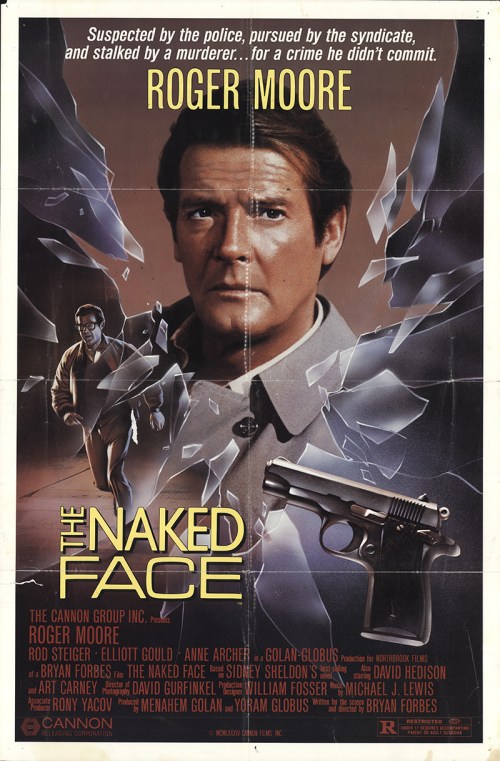
The Naked Face (1984)

naked1

By Richard Winters

My Rating: 7 out of 10

4-Word Review: Is psychoanalyst being targeted?

Judd Stevens (Roger Moore) is a psychoanalyst residing in Chicago who suddenly finds that people he knows are turning up dead. First it was one of his patients, whom he let borrow his raincoat. Then it’s his secretary and soon the police are suspecting him of the killings. Lieutenant McGreavy (Rod Steiger) doesn’t like Judd as it was Judd’s expert testimony that got a cop killer sent to an institution versus a jail cell where McGreavy felt he belonged. In order to get the cops off his back and find the real killer Judd  hires Morgens (Art Carney), private investigator, who seems to get a lead when he calls Judd and tells him that a ‘Don Vinton’ is behind it, but then Morgens ends up dead too, so Judd puts his trust in another police detective named Angeli (Elliot Gould) only to learn that he has ulterior motives.

The story is based on the Sidney Sheldon novel of the same name that was written in 1970 and besides this one has been remade two other times: in 1992 in Ukraine as Sheriff’s Star and then again in 2007 in India as Kshana Kshana. This version was produced by the notorious Cannon Group, which always makes me hold my breath in apprehension every time I see their logo come up before the movie begins as I’m never sure if this is going to be one of their cheaper productions, or one that was given a decent budget. While Leonard Maltin, in his review, describes it as ‘low budget’ I’d say this was one of their passable efforts as the production standards aren’t compromised in any way and if anything is rather slick. The on-location shooting done in Chicago, this was changed from the novel where the setting was Manhattan, is excellent and the plot is well paced with incremental twists to keep it flowing.

The film’s main selling point is seeing Moore playing against type as he was known as an action star, but here plays an intellectual. For the most part he does quite well and even able to hold his own when sharing a scene with Steiger, who otherwise likes to chew up the scenery and everyone else in it, but I didn’t like the big Harry Caray-type glasses that he wears. I guess this was done to make him look ‘smart’, but it wasn’t needed. The best part is seeing him get beat-up by the bad guys. When Moore was playing Bond it always seemed a bit absurd that this aging 50-something would be able to take-on virtually any villain, no matter the size, and come-out on top every time. Here he gets flattened with one punch and it’s kind of funny.

Steiger, with  his intense delivery, dominates. He’s given a lot of screen time during the first half almost making him seem like he’s the star and his stewing anger lends adequate tension, but his good-cop/bad-cop routine doesn’t work because he’s the type of character who’s impossible to like, so he needed to stay bad all the way. I also couldn’t stand the wig. He supposed to be an ugly, unlikable guy, so might as well have him naturally bald, as the rug gives him a campy look.

Gould is the outlier. He was during the 70’s a major headlining star, so seeing him pushed to the background where Steiger takes center stage is almost shocking. I remember him saying once in an interview that he didn’t like the pressure of being a leading man, so maybe this supporting bit was right for him. His character does become more prominent towards the end, but for the most part he comes-off like a faceless walk-on  and a sign of a career decline.

Spoiler Alert!

The twist ending in which it’s found that the crime syndicate was behind the killings due to the wife (Anne Archer) of the crime boss seeing Judd and fearing she may be giving him secret information during their sessions was not particularly original. It also opened up some loopholes. For instance Judd’s patient at the beginning is stabbed on the streets because he was mistaken for being Judd, but later when Judd is kidnapped and in the crime boss’ presence he isn’t immediately killed as they first want him to divulge what his wife told him, but if the idea was to extract information then why was the patient offed right away instead of taken somewhere for interrogation?

At the very end Moore is walking with Archer outside and suddenly she gets hit with a bullet, but not Moore. If she was shot by a hit man for giving out secret info then Moore should’ve received a bullet as well because it was he that she had confided in, or at least that was what they had presumed.

My Rating: 7 out of 10

Released: June 6, 1984

Runtime: 1 Hour 45 Minutes

Rated R

Director: Bryan Forbes

Studio: Cannon Film Distributors

Available: DVD, Tubi

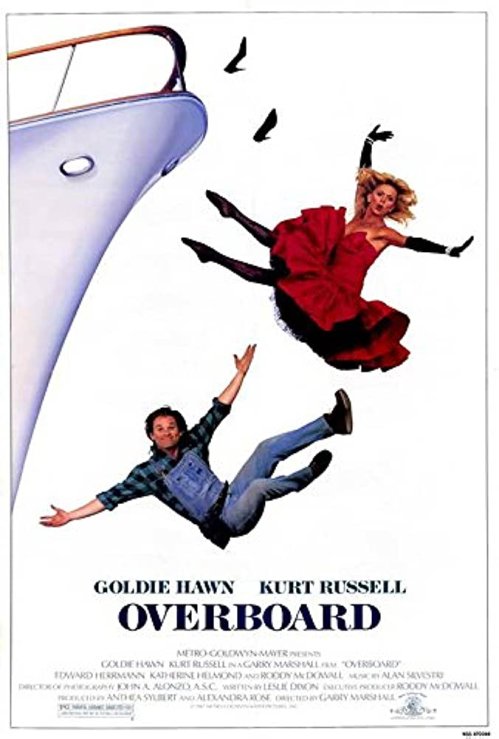
Overboard (1987)

overboard

By Richard Winters

My Rating: 1 out of 10

4-Word Review: Rich bitch loses memory.

Heiress Joanna (Goldie Hawn) is a wealthy and snobby woman who hires Dean (Kurt Russell), a carpenter, to remodel the closet that she has on her yacht. Since Dean is a widowed father of four boys (Mike Hagerty, Jared Rushton, Jeffrey Wiseman, Brian Price) he’s more than happy to take on the job in order to bring in extra money, but Joanna, treats Dean poorly, is unsatisfied with his work and refuses to pay him. She ends up throwing him overboard with his tools. Later that night while still on the yacht she goes on deck to retrieve a lost ear ring and falls overboard causing her to hit her head and lose her memory. She is rescued and taken to a local hospital. News shows report on the incident along with pictures of Joanna asking if anyone knows who she is. Dean, who is with friends at a bowling alley, sees the report and concocts a scheme to take advantage of her amnesia by pretending she is his wife and bringing her to his home to do chores and take care of his kids in order to repay her debt to him. The  plan starts out seamlessly, but eventually she begins to bond with both the kids and Dean and then her real husband, Grant (Edward Herrmann) arrives at Dean’s residence in order to take her back with him.

Russell and Hawn began their real-life relationship while working on Swing Shift and wanted to do another picture together. This uninspired script, which was written by Leslie Dixon who had better success with Outrageous Fortuneis a misguided hybrid between Houseboat, a 50’s romantic comedy that starred Cary Grant and Sophia Loren, and Swept Away, a classic 70’s Italian film involving a rich, snotty woman stranded on an island with a working-class man. Unfortunately all nuance gets thrown overboard (pun intended) and we get left with the most extreme caricatures possible. While Hawn is certainly a fine actress her over-the-top character is too cliched and heavy-handed to be even remotely interesting or believable and the film falls hopelessly apart before it even gets going.

The basic premise is full of loopholes. The idea that just anyone could show up at a hospital and insist that some woman is his wife when that women shows no recollection of him and he’s able to bring her home without showing any type of documentation, marriage license, or photograph of the two together is beyond ridiculous. Just saying he recognizes a tattoo on her rear end wouldn’t be enough; maybe the two had a one-night-stand, but it wouldn’t be proof positive that he was married to her and yet for this hospital staff it was. Also, it’s very unlikely that Grant, Joanna’s real husband, would be able to get away with denying her existence as long as he does. He pretends he doesn’t recognize her when he goes to the hospital, so he can then bring young women onto his yacht to fool around with, but his friends and most certainly Joanna’s meddlesome mother, played by Katherine Helmond, would’ve seen the news reports too and gotten on him to go retrieve her, but for some reason in this movie rich people don’t watch the news only the poor folks.

Russell seems to enjoy his part, but like with Hawn his character is a tired caricature that’s not remotely original, or unique in any way. While the movie tries hard to get you to like him I still felt what he does with Joanna by tricking her into thinking she’s his wife was highly exploitive and not forgivable even when factoring in the poor way she had treated him.

The four boys are yet another issue. With the exception of the one who talks in Pee Wee Herman’s voice, which was apparently ad-libbed and not a part of the script, there was no distinction between any of them and they all could’ve been combined into just one. It’s also hard to believe that they’d all agree to play along with Dean and pretend she was their mother when they really knew she wasn’t as most kids are notorious for not be able to keep a secret. I was surprised too that the kids would all accept this new woman into their life and forget that their real mother ever even existed. These kids, or at least one of them, would’ve had some bonding with the real one and been reluctant to just let that go and welcome in her ‘replacement’. The kids were also used to having no rules and doing what they wanted while their dad was away at work, so having a new person come in out of nowhere and start enforcing discipline would most likely caused a rebellion instead of them all embracing this newfound orderly lifestyle.

Had the characters and comedy been more subtle like perhaps having the Hawn character not being a super rich heiress, but just a suburbanite living in a better part of town who has a slight disagreement with Russell when he comes to her house to do some work, then this idea might’ve had potential. However, as it is, the caricatures are too silly and overblown for any viewer with discernable tastes to get into. Also, for such slight and predictable material it takes way too damn long to play-out. Should’ve only been 80 minutes not almost 2-hours.

My Rating: 1 out of 10

Released: December 16, 1987

Runtime:  1-Hour, 52 Minutes

Rated PG

Director: Gary Marshall

Studio: MGM

Available: DVD, Blu-ray, Amazon Video

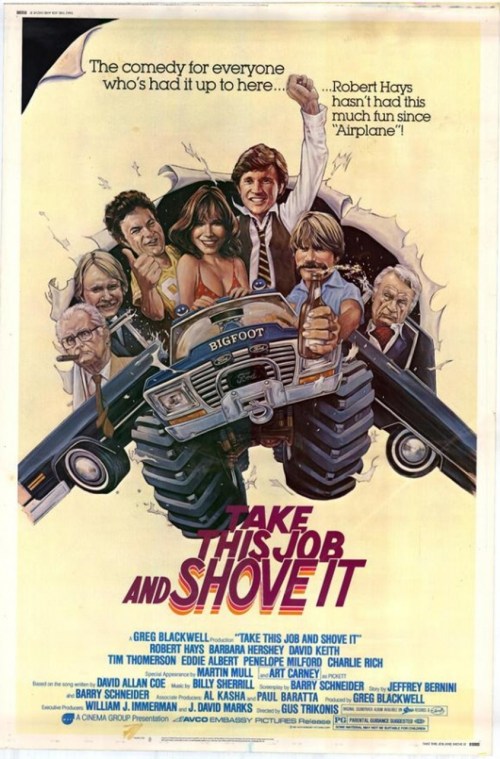
Take This Job and Shove It (1981)

job

By Richard Winters

My Rating: 3 out of 10

4-Word Review: Modernizing a beer factory.

Frank (Robert Hays) is hired by a conglomerate called The Ellison Group to find ways to improve a beer factory that they own and get it in the black. Since Frank is originally from the small town where the factory is located he excitedly takes-on the task, but soon finds himself at odds with many of the workers, some of whom he was friends with in highs school, but who now look at him as a threat to their jobs. While the ideas that he implements are at first resisted the situation in the factory improves and the place begins turning a profit. Unfortunately it becomes such a success that The Ellison Group decides to sell it to a man with a background in the oil business, who doesn’t know the first thing about beer production, which gets everyone in the factory to rebel from the acquisition in very physical ways when the new owner and his cronies arrive for a visit.

The movie was filmed at an actual beer factory, The Dubuque Star Brewery, in Dubuque, Iowa, that is listed in the National Register of Historic Places and although no longer functioning as a brewery it still stands today. The history of the place is similar to the movie as it was bought by Joseph Pickett in 1971 who implemented a massive renovation when he found that it was still using equipment from the 1930’s. The story itself was inspired by the hit country song that sat on top of the country charts for 2-weeks and was performed by Johnny Paycheck and written by David Allan Coe, both of whom appear in the movie.

The production has some nice on-location shooting of not only Iowa, but also the Twin Cities and I really dug the basketball court in the mansion owned by Eddie Albert’s character. The working class issues and the gritty nature of their jobs and lifestyles is basically on-target, but the movie bills itself as a comedy, and the trailer makes it seem almost like it’s going to be a farce, but in reality it’s more of drama with very little action until the end. There’s not much that’s funny either and the thin, predictable premise gets stretched-out longer than it should ultimately making it boring and a strain to sit through.

The main defect is the Robert Hays character. While he performs the part well he’s not enough of a jerk, or nemesis and thus the confrontational drama is missing. Having him from the area originally was a mistake as he seems too different from everyone else around him and creating him as an outsider from the big city that had little to no regard for the people working under him would’ve created the necessary fireworks that this otherwise benign film lacks. It also would’ve made a more interesting character arch where he’d go from arrogant, city-slicker to a humble man who would learn to appreciate those that he initially looked down on instead of having him already a semi-part of the group to begin with. It also hopelessly wastes the talents of Barbra Hershey, who gets cast as an idealistic, pro-labor lady, a perfect part for her, and I was expecting the two to quarrel over their contrasting viewpoints, but it never gels and she’s seen far too little.

The script also suffers from logic loopholes and continuity errors. While a hotel room door may seem like a minor thing to quibble about it became a big deal for me. The scenario starts out funny enough, possibly the only amusing bit in the movie, with Fran Ryan playing the owner of the hotel touring him around the cramped, rundown room and acting like it’s a more ritzy place than it really is. Later though while Hays is asleep, his buddies from the factory rip the door off its hinges by attaching a chain to it that’s connected to a pick-up truck, but there’s no scene showing, or explaining, how the door ends up getting reattached. The door is also apparently always unlocked as both Hershey and the Martin Mull character walk into the room from the outside unheeded, but most if not all hotel room doors automatically lock when they’re closed, so why doesn’t this one? In the case of Martin Mull he walks in on Hays while he’s still asleep, but you’d think Hays definitely would’ve locked the door from the inside and put the security chain on it before going to bed, so again how is Mull able to just open it? He doesn’t even bother to knock, which is absurd too since he’s never been to that hotel before, so how would he even know for sure he had the right room and wasn’t walking in on a stranger?

My Rating: 3 out of 10

Released: April 1, 1981

Runtime: 1 Hour 41 Minutes

Rated PG

Director: Gus Trikonis

Studio: AVCO Embassy Pictures

Available: DVD-R, Blu-ray-R

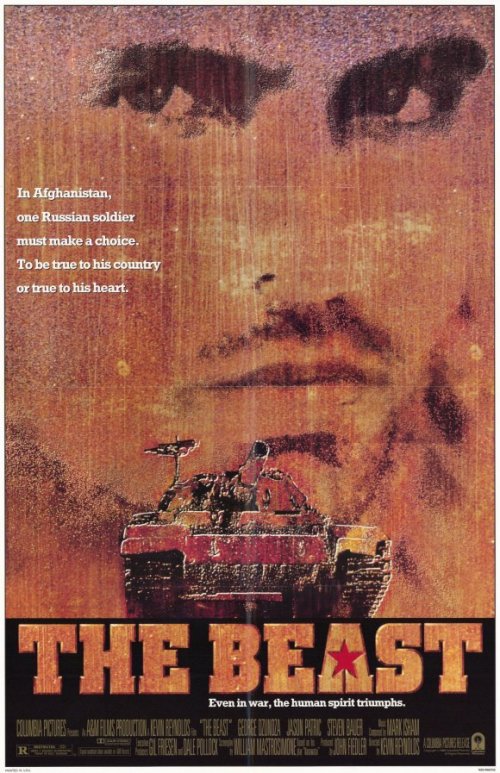
The Beast (1988)

beast1

By Richard Winters

My Rating: 9 out of 10

4-Word Review: Tankers stranded in desert.

During the invasion of Afghanistan in 1981 a group of Soviet tanks roll into a small village and callously bomb every home and building to a cinder. One of the tanks, led by Commander Daskal (George Dzundza), orders his driver Konstantin (Jason Patric) to run over an Afghan man to the shock and horror of everyone else. When Taj (Steven Bauer), who is one of the Afghan fighters, returns to the village and sees all the carnage, including the death of his father and brother, he becomes committed to seek revenge. He assembles a small group of fighters to go out into the desert to search for the tank, which they call the beast, and which has become lost when it takes a wrong turn and thus stranding them in the middle of nowhere with no option but to turn around and go back to where they came from, which they want to avoid. As the gas and rations become scarce the tensions mount particularly between Daskal and Konstantin who share widely different viewpoints as well as with Samad (Erick Avari) an Afghan interpreter who Daskal no longer trusts and now considers to be a traitor.

This film was requested for review by a reader of this blog named Nick (it was requested over a year ago and I do apologize that I got caught up with things and forgot about watching it). What struck me though is how he said it was such a gripping film and one of the best war movies, in his opinion, ever made and yet few people, including myself, had ever heard of it. I figured if the movie was as great as he said it should be better known and feared it might not live up to his billing, but when I watched it I found myself just as caught up in it as he said and impressed with how emotionally compelling it was from beginning to end.

Why this great film fell into obscurity and was dismal at the box office where it managed to only recoup a paltry $161,000 out of an $8 million budget is yet another example of the cruelty of the Hollywood business. It was directed by Kevin Reynolds who had just come-off doing the breezy road comedy hit Fandango and who wanted to follow that up by doing something completely different. He decided to do a filmization to the stageplay ‘Nanawatai’ by William Mastrosimone who was inspired to write the play after witnessing a group of mujahideen fighters capture and execute a Soviet tank crew in 1986. David Puttnam, the then head of Columbia Pictures, loved the script and threw his full support to the project. However, during the course of the filming Puttnam was ousted and Dawn Steel took over. She wasn’t as enthusiastic about the movie and when it was completed it got released to only a few theaters with no promotion. Few people heard or saw it and it went into oblivion only to finally several decades later get the recognition it deserved through the release of the DVD and has now acquired a fairly sizable cult following.

The use of a hand-held camera and graphic violence, including seeing the man get run over by a tank and then afterwards the remains of his mangled body, all help accentuate the harsh realism of war. Having it shot in a desert in Israel helps add to the authenticity as deserts in North America look different and cannot match the distinct topography of a Middle Eastern one. Leonard Maltin in his review, which I didn’t read until after viewing the film, describes the plot as ‘predictable’ and the pace ‘ponderous’ while the characters are in his opinion ‘stereotyped’, which I couldn’t disagree with more. While I haven’t seen every war movie out there I found this one to have many intriguing twists that I wouldn’t have guessed. The characters have distinct personalities and the pace is perfect with each scene and line of dialogue opening up a new story wrinkle.

My only two complaints is that the Afghan townspeople at the beginning are a bit too blissful as after all a war was going around them, which they were aware of, so I’d have thought they’d be more guarded and only cautiously gone outside if completely needed versus behaving as if they’re in a bubble with no worries about the horrors around them until it finally happens. The Russian soldiers are too Americanized. Great effort was put into the Afghans to make them seem authentic including having them speak in their native tongue with subtitles, but actors playing the Russians not only speak in English, but do it with American accents. I’m okay with them talking in English as forcing them all to learn Russian would’ve been too exhausting and requiring the movie to be completely subtitled, so I’m okay with that compromise, which seemed almost necessary. I presume for the project to get financed the studio insisted on American actors to play the parts in order to make it more marketable, so I understand that concession as well, but at least have them sound Russian should’ve been a requirement as many times throughout the movie  I had to keep reminding myself this was a Russian army as outside of George Dzundza’s brilliant performance, the rest hardly seemed foreign in any way.

Alternate Title: The Beast of War

My Rating: 9 out of 10

Released: September 16, 1988

Runtime: 1 Hour 51 Minutes

Rated R

Director: Kevin Reynolds

Studio: Columbia Pictures

Available: DVD, Amazon Video, Tubi

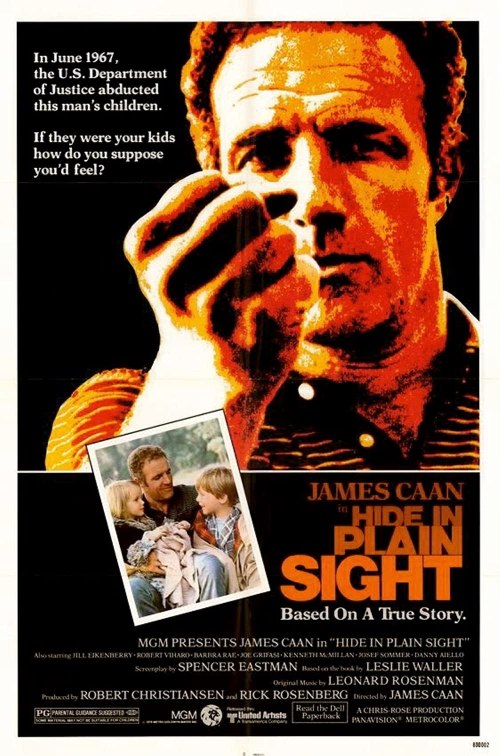
Hide in Plain Sight (1980)

hide

By Richard Winters

My Rating: 6 out of 10

4-Word Review: Searching for his children.

Thomas Hacklin (James Caan) is a divorced father of two children who has visiting rights to see his kids every weekend. One day when he arrives at his ex-wife Ruthie’s (Barbra Rae) residence he finds the home abandoned and no one around. He eventually learns that her and the kids have been put into the Witness Protection Program due to her remarriage to Jack (Robert Viharo) a gangster who qualified for the program when he became a state’s witness against the mob. Thomas’ efforts to find his kids prove futile and the authorities are no help, but he becomes relentless and hires a lawyer (Danny Aiello) to represent him in court, but even then the odds remain seemingly insurmountable.

The film is based on the novel of the same name by Leslie Waller, which in-turn was based on the actual experiences of Thomas Leonhard who one day in 1967 when he went to pick-up his kids for his weekly visitation found them gone and the house that they had been living in with his ex-wife Rochelle to have been abandoned. This then precipitated an 8-year crusade by Thomas to get them back, which proved to be a landmark legal battle, but on July 4, 1975 he was eventually reunited. The film though changed several things from the true story including adding in a subplot where Thomas gets followed by the mob and eventually leads to a violent confrontation. It also compresses the time span from 8 years to 18 months.

While I enjoyed the movie more than when I first saw it over 10 years ago the issues that I had with it during the first viewing remained the same. Most of it had to do with Caan’s, in this the only film that he directed, non-use of close-ups, which the studio heads complained about during the production. A good example of this is when Thomas and ex-wife are arguing on a public sidewalk the camera does not move-in, like in most movies, to allow us to hear what they’re saying, but instead pulls back, so they go further away, but what’s the point of seeing characters on the screen argue if we can’t hear what it’s about? Another scene has Thomas arriving at his ex-wife’s abandoned home, but instead of having the camera go inside with him as he enters it, it remains outside and then tracks around the home to the back door, which Thomas is seen leaving. This though lessens the impact as having the viewer visually witness the suddenly empty house would’ve been far more dramatic.

I did though like that many of the scenes were shot in Buffalo at the exact locations where the real-life incidents happened. The film reconstructs the look and feel of the 60’s quite nicely and many of the participants from the actual events coached the actors on how to perform their roles accurately. The acting is impressive especially by Viharo who’s mafia mobster caricature is right on-target. Kenneth McMillan is quite entertaining as a police detective who initially impedes Thomas’ efforts, but eventually has a change-of-heart. As with any great character actor, which McMillan clearly is, it’s what they add to the part that makes it interesting and here it’s his excessive eating with virtually each scene he’s in has him stuffing his face though I wondered how many takes were required to do each scene and if he ultimately overate and got himself sick while performing the role.

Spoiler Alert!

I was annoyed though with how certain fictional things that got added-in like Thomas’ dealings with the mob got played-down instead of up. The original script by Spencer Eastman called for a lengthy car chase and violent fist-fight, but Caan chose to take the subtle route making these moments less tension filled and possibly too slow and uneventful for some people to sit through. I was also amused how the actual reunion between the father and kids was different from the one in the movie where it’s portrayed as being a happy one. In real-life the kids disliked their father’s rules and ended up moving back with their mother showing how ironic life can be where you fight hard for something and then when you finally get it it ends up not being as great as you thought it would be.

My Rating: 5 out of 10

Released: March 21, 1980

Runtime: 1 Hour 32 Minutes

Rated PG

Director: James Caan

Studio: MGM

Available: DVD-R (Warner Archive Collection), Amazon Video

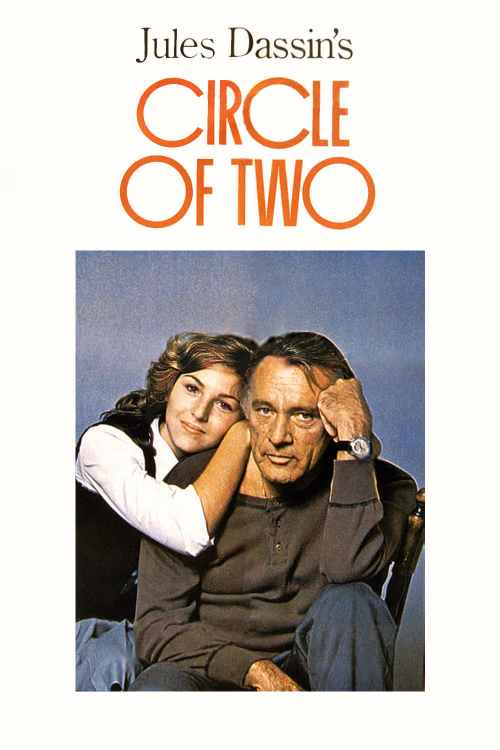
Circle of Two (1981)

circle3

By Richard Winters

My Rating: 4 out of 10

4-Word Review: Old man/young teen.

Ashley St. Clair (Richard Burton) is an aging painter of 60 who has lost his passion and hasn’t either sold, or attempted to do a painting in over 10 years. Sarah (Tatum O’Neal) is an unhappy 15-year-old who’s tired of dating guys her own age as she finds them to be immature and only interested in one thing…sex. She then meets Ashley, first after she sneaks into an adult theater to watch an X-rated movie and then later at a coffee shop. Despite the extreme differences in their ages they still connect through their mutual interest in art. Ashley even begins to paint again and the two share an enjoyable, but platonic friendship. However, once Sarah’s parents (Robin Gammell, Patricia Collins) find out about they put an immediate stop to it by locking her in her room and and in protest Sarah refuses to eat.

Based on the novel ‘A Lesson in Love’ by Marie-Terese Baird this film marks the final one to be directed by famed Greek director Jules Dassin and in many ways this may be the weakest one that he did. The whole way the relationship gets going is very rushed and forced. Bumping into the same person twice in one day, in the big city of Toronto, doesn’t seem likely and then having Sarah fall so head-over-heels for him to the point she starts spouting out the ‘L’ word quite quickly is dingy. A more plausible scenario would’ve had Ashley teaching an art class (he no longer paints, but still has to bring in an income somehow) of which Sarah attends and then through the course of several months a bond is slowly created.

The sex angle is a complete mess. Fortunately Ashley makes no moves on her, but Sarah does aggressively begin to come-on to him and at one point stands completely naked in front of him. In her autobiography ‘A Paper Life’ O’Neal expressed great discomfort in having to do this scene though I didn’t detect this, but maybe that’s just because she’s such a great actress, but either way the scene was completely unnecessary.  It’s also inconsistent with the character as she broke-up with her boyfriend Paul (Michael Wincott) because he was trying to pressure her into having sex and she was still a virgin, so if she didn’t want sex with a guy her own age why would she want it with one who was way older and is this era of pre-Viagra how could she even be sure he could do it? A better scenario would’ve had sex never coming into play and it was simply their other mutual interests that connected them and it was only outsiders, like Sarah’s parents, that presumed the worst when it really wasn’t occurring.

The one bright spot is the acting with both leads being superb. O’Neal proves that her strong and memorable performance in Paper Moon was no fluke and the only thing that keeps the film watchable. Burton is excellent as well. Although he usually has a strong presence here he wisely takes a step back playing someone who’s weak and tentative, which in many ways reflected his own career at the time where many felt he was washed-up and the years of alcohol abuse certainly did age him making him look even older than 60 when he really wasn’t, and thus a perfect fit for the part. The only issue here is that Tatum seems way too mature for 15 both physically and personality-wise and having her play someone who was 17 would’ve been more appropriate.

While the film remains marginally compelling the talky ending in which Burton goes on a long speech like a tenured professor lecturing to a college class practically ruins it. I was also frustrated that we never learn much about the old man, played by George Bourne Sr., an elderly gentleman who agrees to let Ashley paint his portrait for a fee, which in-turn revitalizes his career and I felt this character should’ve been in it more, or at least a few scenes showing what they talked about as his portrait was being done.

Tatum’s abstaining from all food plays-out poorly as well. For one thing she doesn’t change physically, so we’d never know she wasn’t eating if it weren’t mentioned. She then travels to New York and I was fully expecting her to pass-out in the middle of crowded Grand Central Station from a lack of nutrients, but apparently in-between time she had eaten something, but this should’ve been shown and the fact that it isn’t is a sign of shoddy film-making, which despite Dassin’s previous output, this whole movie ends up pretty much being.

My Rating: 4 out of 10

Released: May 7, 1981

Runtime: 1 Hour 46 Minutes

Rated PG

Director: Jules Dassin

Studio: World Northal

Available: DVD-R, Amazon Video

Protocol (1984)

protocol

By Richard Winters

My Rating: 0 out of 10

4-Word Review: Goldie goes to Washington.

Sunny Davis (Goldie Hawn) works as a cocktail waitress at a Washington D.C. bar, who one evening while driving home from work, she notices a crowd of media people surrounding an event where foreign dignitaries are leaving a dinner gala, which piques her curiosity enough to pull over and get out to see it in person. Once she’s in the crowd she rubs against another man and feels what she thinks is a gun and she accuses him of such, which gets the man to take the gun out and point it at the visiting Emir (Richard Romanus) from the country of El Othar. When Sunny sees this she tackles the would-be assassin and becomes an instant American hero in the process. Overnight she becomes the top of every news story. Politicians in Washington begin to believe she’d be an asset and offer her a position within the protocol department in government. She readily accepts as it pays more than her old waitress job, but it comes with a catch. The US wants to establish a military base on the country run by the Emir whose life Sunny saved, but in order to achieve this deal they offer Sunny to become another one of the Emir’s wives without her knowledge.

This was the second attempt at political satire for screenwriter Buck Henry who did First Family 4 years earlier, which I thought was bad enough, but this thing manages to be even worse. The majority of the problem is that politics and government can be very messy and if one is going to analyze the topic in any type of realistic way then it needs to get messy and dirty as well and yet this movie glosses over all of the negative aspects and tries to make American politics uplifting and inspiring, which might’ve worked in the 30’s and 40’s, but in this more cynical age it comes-off as corny and ill-conceived.

The political and media landscape has changed so drastically that most viewers living today will find the humor to be completely unrelatable. Politics today, for better or worse, has become highly divisive, so having a benign President that everyone supports such as here seems almost like a fairy tale. The satirical jabs at the news media will also prove hollow as we no longer live in a world where the mainstream press as all the clout and instead now takes a backseat to social media and thus making the majority of the jokes here quite dated. The way it portrays Muslims will also be considered problematic and even back then while it was being filmed it was protested by the Arab-American Anti-Discrimination Committee over what they felt was a disrespectful approach to Islam.

Goldie is certainly likable, but her character is blah and poorly defined. Outside of living with two gay guys there’s nothing unique about her and the viewer gets no sense of what makes her tick. A good example of this is when she gets offered the position she isn’t even sure what the word protocol means and has to look it up in a dictionary and yet after she gets the job she quickly becomes an expert on all the protocol by-laws. This was apparently because she read-up on all the literature she was given, but this isn’t shown making her newfound sudden expertise come-off as weird and hard to explain. The fish-out-of-water concept really needed to be played-up more. There are a few comically awkward moments, but in order to make it consistently funny it needed to continue through the whole movie.

The fact that she becomes so famous over preventing the assassination of the leader of a foreign (fictional) nation that most people probably couldn’t find on a map didn’t make sense. If she had saved a popular President’s life then I could see everybody getting excited about it, but doing it for a foreign dignitary might be enough for a ‘feel-good’ story, but that would most likely be it. Also, there’s no concept of the 15-minutes of fame here. Even if she did become an overnight sensation it would only have lasted until the next news cycle when another media hero would replace her and yet this movie has her remaining popular for months and even years later.

What really killed it for me though was the Mr. Smith Goes to Washington-like ending, which I found to be utterly nauseating. For political satire, if you can even call this that, it fails on all levels. Being There on the other-hand is an example of how to do it right, which this thing unfortunately doesn’t even come close to.

My Rating: 0 out of 10

Released: December 21, 1984

Runtime: 1 Hour 36 Minutes

Rated PG

Director: Herbert Ross

Studio: Warner Brothers

Available: DVD, Amazon Video

The Night the Lights Went Out in Georgia (1981)

night

By Richard Winters

My Rating: 3 out of 10

4-Word Review: Not like the song.

Travis (Dennis Quaid) is an aspiring singer with some talent, but little discipline. He’s achieved one hit song,but his drinking and partying keeps getting him in trouble. Amanda (Kristy McNichol) is his younger sister and though she’s only 16 she is more mature and responsible. She tries to manage Travis’ career by getting him to Nashville, so he can cut a record and get an agent, but his wild ways and their lack of funds, keeps preventing them from getting there. Eventually he gets arrested for public drunkenness and in order to pay the fine is forced to get a job at a local bar. It’s there that he meets Melody (Sunny Johnson) and tries to pursue a relationship, but becomes aware that Seth (Don Stroud), the deputy sheriff, has a thing for her as well and he won’t allow any other guy to talk to her as he’ll fly into a jealous rage and warns Travis of this, but Travis being reckless as always doesn’t let this phase him. As this goes on Amanda begins a romance of her own with with Conrad (Mark Hamill) who works as a state trooper.

Although in theory it’s ‘inspired’ by the song of the same name it technically doesn’t have anything to do with it. In other films that were made from songs like Convoy, Harper Valley PTAand Ode to Billy Joethe central theme was maintained and then expanded on, but here we don’t even get that. The song, with lyrics written by Bobby Russell and then sung by his then wife Vicki Lawrence, had to do with a man getting executed for killing another man who had an affair with his wife even though it was really his kid sister that did the crime. A plot like that could’ve had great potential for being an interesting movie, so why the producers didn’t just go with that original concept I don’t know, but it seems like a travesty for them to retain the song title and I’m surprised the producers of the record didn’t sue.

The plot, as it is here, is limp and uninspired. It basically feeds off of a lot of predictable shenanigans like Travis getting caught in a hotel bed with another man’s wife and then being chased around both on foot and in a vehicle until both he and Amanda are able to get away. In between we get treated to a lot of songs, which normally I’d say was nothing more than filler, which it still is, but since the rest of it is so lame, it comes off more like the best thing in it. Quaid and McNichol do all of their own singing and even wrote their own lyrics and they give energetic performances when onstage, so if you decide to see this thing then I’d suggest fast-forwarding through the rest of it and just stick with the music and you might be pleased.

The acting by Quaid is excellent and Don Stroud is great as the nemesis. McNichol is alright, at least when she’s singing, but otherwise gets pushed to the background and with her super short hair and nagging personality lacks sex appeal and at times looks almost like she could’ve been Quaid’s kid brother instead. The fact that they’re so close and do everything together would make one wonder if there’s something incestuous going on. In the more innocent times of the early 80’s maybe this wouldn’t be the first thought that would pop into people’s minds, but these days I’d suspect others would be wondering the same thing. There’s also no explanation for what happened to their parents. At one point McNichol mentions that she’s orphaned, so there really needs to be a backstory showing of what caused that.

Spoiler Alert!

The biggest gripe though is with the ending in which Travis gets shot and killed by Seth, who also dies in the gunfight. It then concludes with McNichol getting with Hamill, who quits his job as the state trooper, and the two drive-off in her rickety old truck to God knows where. Since the story was mainly about the brother/sister relationship then I felt that’s where it should’ve ended with them in Nashville either getting the record deal, or not. The Hamill character is bland and seemed to be added in with no other purpose, but to extend the already anemic plot. There’s also the fact that he was 29 at the time while McNichol plays someone who was only 16, so them getting into a relationship doesn’t exactly look kosher. Granted the age of consent in the state of Georgia is 16, so I guess in the eyes of law it’s okay, but many today will consider this kind of romance to be cringey, and I can’t help but wonder if that’s the main reason why this film has never had a proper DVD release nor any streaming option.

My Rating: 3 out of 10

Released: June 5, 1981

Runtime: 1 Hour 52 Minutes

Rated PG

Director: Ron Maxwell

Studio: AVCO Embassy Pictures

Available: DVD-R

Impulse (1984)

impulse

By Richard Winters

My Rating: 3 out of 10

4-Word Review: The townspeople act crazy.

Jennifer (Meg Tilly) and her boyfriend Stuart (Tim Matheson) return to the small town she grew up in to help care for her mother (Lorinne Vozoff) who suddenly and quite impulsively shot herself in the head while talking to Jennifer over the phone. When they arrive they find the people behaving in strange ways by acting on their inner impulses without any social restraint. Stuart, who is a chemist, believes it may have something to do with what’s in the water, but when he tests it he finds nothing unusual. The people though continue to behave in a more aggressive manner where even the kindly old doctor (Hume Cronyn) who was looking after Jennifer’s mother in the hospital begins showing homicidal tendencies. The couple fear they might not be able to get out of there alive and begin to suspect that the ultimate cause has some connection to the earthquake that shook the town just days before they arrived.

The premise is certainly intriguing and there are a share of weird moments, but director Graham Baker approaches the material in the wrong way. The original screenplay by Nicholas Kazan, which was entitled ‘Animals’, was intended as a horror film and closely inspired by George Romero’s similarly themed The Crazies, which came out 11 years earlier. For whatever reason Baker didn’t pursue it with a horror bent and that in my opinion is where it all goes wrong. It’s hard to actually know what genre to place it in. At times it seems a little bit like sci-fi and other moments like a drama, but either way the tension is lacking. You see the townspeople doing crazy stuff, which initially piques your interest, but then it goes nowhere with it. The weird acts just continue to go on and on until it becomes redundant and ultimately boring until you really don’t care what the explanation is behind it.

Spoiler Alert!

It’s not until 45-minutes in before even gets slightly suspenseful when Jennifer finds herself trapped in a burning garage, but even this goes by too quickly. There was one moment where Jennifer’s former boyfriend, apparently jealous at seeing her with Stuart, decides to bend his own fingers back, as a sort-of self mutilation, until they break, which I found genuinely shocking and cringy. However, there are other moments, which I found to be unintentionally funny making me believe it might’ve worked better as a quirky comedy.

The ending though is the most annoying. The explanation for why this all occurred is that chemicals from a nearby toxic waste dump got into the facility that produced the milk that the townspeople drank. The leak apparently caused by the earthquake that jostled one of the overhead pipes that then leaked the toxins into the milk vat. Since Jennifer didn’t like the milk she wasn’t affected, but I felt it was a stretch that all 900 of the other people in the town did drink it, as there are many folks who aren’t into milk, so there should’ve been others like Jennifer, who didn’t behave nutty instead of her remaining the only normal one.

What I found really stupid though is that the movie acts like 900 people suddenly dying in a town is apparently ‘no big deal’ and the rest of the country just ‘moves-on’, which I found preposterous. There is simply no way the media would let something like this go unchecked and the rest of the nation would be demanding answers and a federal investigation. It would become the news story of the year if not the decade and something that would be heavily talked about.

Somebody would have to be held accountable at some point, which then brings up the final issue of who the hell was the organization that dropped the crop dusting poisons onto the town via airplanes that ultimately is what killed everybody? The movie doesn’t bother to answer this, which is really frustrating making the whole thing a big build-up to nothing and not worth anyone’s time.

End of Spoiler Alert!

On a lighter note I couldn’t end this review without mentioning Tim Matheson. As an actor I found his performance here to be incredibly dull. Granted the character he played was benign to begin with, but he certainly didn’t do anything to make him interesting. However, with that said, his bare ass steals it. Many ass aficionados have felt, and even debated, that Dabney Coleman’s bare behind seen in Modern Problems wins the prize for best ass put onscreen in a Hollywood movie, but Matheson’s exposed tush, seen at the 17:49 mark, definitely deserves honorable consideration.

My Rating: 3 out of 10

Released: September 28, 1984

Runtime: 1 Hour 31 Minutes

Rated R

Director: Graham Baker

Studio: 20th Century Fox

Available: DVD-R, Blu-ray

The Osterman Weekend (1983)

osterman1

By Richard Winters

My Rating: 7 out of 10

4-Word Review: His friends are spies.

Based on the 1972 Robert Ludlum novel of the same name the story centers around John Tanner (Rutger Hauer) a controversial host of a TV show where government officials are interviewed and many times put on the spot by Tanner who harbors anti-establishment political leanings. Maxwell Danforth (Burt Lancaster) is the director of the CIA who along with fellow agent Laurence Fassett (John Hurt) have uncovered a Soviet spy network within the US known as Omega. The decision is made not to arrest the three members (Craig T. Nelson, Dennis Hopper, Chris Sarandon) that have been identified as the spies, but instead try to get one to turn on the others and thus expose the organizations without tipping-off the KGB that they were aware of it all along. Since Tanner went to college with the three men and plans to have a weekend get-together with them at his place he gets chosen by Fassett to carry-out the trap where he’ll try to get one of his friends during the two-day stay to turn on the others. Tanner initially resists, but eventually agrees and has his whole house rigged with secret cameras and microphones, so the CIA is fully aware of everything that goes on, but ultimately Tanner begins to suspect that things may not be as they seem.

This was director Sam Peckinpah’s final film and 5 years after releasing his last one ConvoyHe was already quite ill due to effects of substance abuse and had to take frequent naps during the shooting day, but still managed to get the movie released on-time and within budget. Many have felt this was one of his weaker efforts, but I came away enjoying it despite the fact that Peckinpah despised the story and the Ludlum novel of which it was based and only agreed to the it because he needed the work. What I liked best was his patented use of slow-motion photography. Here I felt it came into use in excellent ways especially during the car chase. Most chase sequences in movies can get confusing because it’s usually done at fast speeds making it hard to follow and many times done with jump cuts, but here because it gets slowed down it made it more dramatic particularly with the crashes.

Admittedly some of his other directorial touches were a bit odd. The opening sequence showing two naked people in bed together making love, which was shot on video tape and has a romantic music score, making it seem like a soft core porn flick and had many of members of the film’s test audience confused and even walking out in disgust. There is a surprising level of nudity, including seeing Cassie Yates topless, that I didn’t feel was necessary. There’s also touches of humor that I didn’t care for either. Apparently this was Peckinpah’s attempt to balance the violence, but it hurts the tension. The producers didn’t like the comical bits either and cut most of them out when Peckinpah got fired during post production, but a couple do remain, which are amusing, like when Hurt has to be pretend on-the-spot that he’s a television news reader giving an impromptu weather report, but still out-of-place for this type of story.

Many critics complained about the elaborate plot Roger Ebert stated in his review that it ‘made no sense’ and caused him to become ‘angry at it’ as a result. Vincent Canby of the New York Times described it as ‘incomprehensible’ and Dave Kehr of the Chicago Reader labeled it ‘a mess’. I didn’t have such difficulty following it and although it’s a bit intricate it isn’t really all that confusing as long as you pay close attention and the twists that do occur I found enjoyable and many times was already predicting. My one complaint was be the way Tanner gets so easily persuaded that his friends, people he’s known for a long time and is very close to, are spies and he immediately turns against them. This is also a man that is supposedly ‘anti-government’, so you’d think he might like the fact that his friends are spies. A good way to have avoided this was having the character not hosting a liberal talk show, but instead a conservative one where Tanner would be a patriotic, pro-American type guy and thus making his acceptance of what the CIA agents tell him more plausible.

It’s interesting seeing Hauer, who usually plays villains, being a good guy, while Lancaster being a perennial protagonist, mixing it up here as a baddie. Both play against type well and the supporting cast has their share of moments too including Craig T. Nelson as a judo fighting expert and Hopper, who should win the award for best nervous expression. In all though it’s Helen Shaver that steals it as Hopper’s cocaine addicted wife. She’s not likable in any way and actually quite annoying, but she definitely stands-out with has a few choice moments.

Spoiler Alert!

I will admit that the ended, where Tanner tries to out the CIA director during an interview on his TV-show, doesn’t work and becomes one twist too many. Having Hauer simultaneously speak on-the-air in his studio and then show-up at the same time at Hurt’s hide-out didn’t seem realistic. Apparently this occurred because the show was taped early and only given the illusion that it was done live, but how they were able to pull all that off is a stretch and having his friend Nelson suddenly become a seasoned in-studio director when that wasn’t his job otherwise didn’t jive either. It’s not enough to ruin everything that came before it, which I overall enjoyed, but it’s still a lame ending either way.

My Rating: 7 out of 10

Released: September 30, 1983

Runtime: 1 Hour 43 Minutes

Rated R

Director: Sam Peckinpah

Studio: 20th Century Fox

Available: DVD, Blu-ray, Amazon Video, Fandor