Category Archives: 70’s Movies

Death Weekend (1976)

death weekend

By Richard Winters

My Rating: 3 out of 10

4-Word Review: She can defend herself.

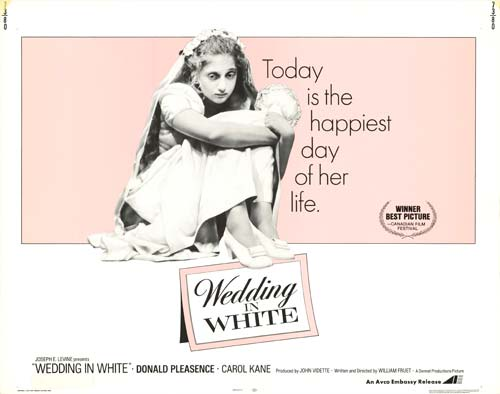
This Canadian thriller, which is loosely based on actual events deals with a rich playboy named Harry (Chuck Shamata) who invites Diane (Brenda Vaccaro) who is also a model to spend the weekend with him at his isolated lakeside cabin that is miles from anywhere. On their way there they run into a biker gang whose leader (played by Don Stroud) takes an intense disliking to Harry. The gang tracks the two down at their cabin where they proceed to terrorize them before eventually killing Harry and forcing Diane to defend herself alone, which she does valiantly.

In a way this is a poor man’s version of I Spit on Your Grave or Straw Dogs, but not nearly as effective. For one the violent scenes aren’t very intense. This is due mainly to the fact that writer/director William Fruet keeps the camera too removed from the action and never once uses a hand held. There is also no gore as Fruet always cuts away just before anything happens and what little you do see looks tacky. Of course a film doesn’t have to be gory to be scary or intense, but if it is going to have this type of violent theme then it should at least equal it in style. The tension also ebbs and flows and the four hoodlums are too dumb and seem like cardboard cutout caricatures that possess no human qualities whatsoever.
The Harry character does allow for some added dimension, which helps and hurts. I liked the way he sees himself as this ‘refined’ gentlemen and yet views women in the same Neanderthal way as the thugs. He brags of having money and power, but when that gets stripped away from him he becomes amazingly spineless. This makes for a good commentary of the rich and successful, but unfortunately also turns him into being too much of a jerk and when the bad guys proceed to tear his place apart we are not ‘horrified’ at all, but instead enjoy seeing it.

There are actually a few good elements one of which is the music score, which effectively creates an ominous feeling. It was also filmed in Ontario Canada during the autumn and the desolate, bleak landscape helps match the bleakness of the situation and characters. I also loved the morning mist captured during the final chase sequence that gives things a very eerie look. There is also a well-staged car chase at the beginning that was done at high speeds and features some great stunt driving.

The film is saved somewhat by Vaccaro’s interesting performance as a victim. She is independent and self-sufficient and refuses to allow herself to be seen or used as a sex object. This goes along with the film’s overall theme which seems to run on the emergence of the woman in a man’s world and the basic redefining of the female role in society. Yet I felt it would have worked better had the character harbored the old female traits at the beginning and then had these new traits come out as the film progressed.

death weekend

My Rating: 3 out of 10

Alternate Title: House by the Lake

Released: September 17, 1976

Runtime: 1Hour 27Minutes

Rated R

Director: William Fruet

Studio: American International Pictures

Available: VHS

The Silent Partner (1978)

silent partner 2

By Richard Winters

My Rating: 8 out of 10

4-Word Review: Bank teller outsmarts robber.

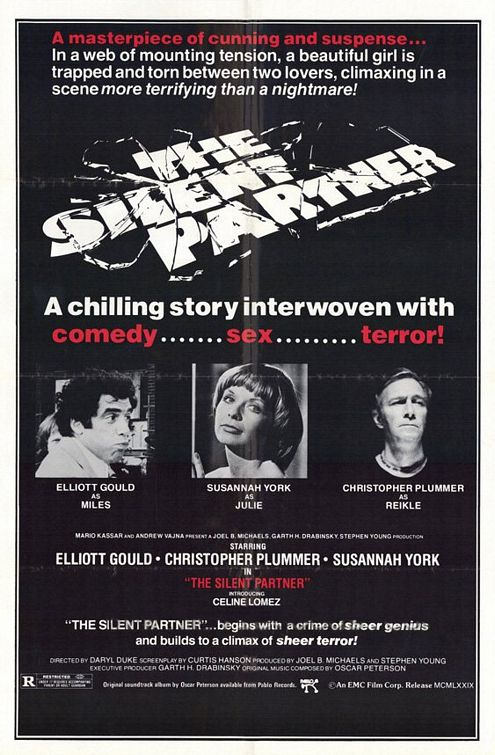
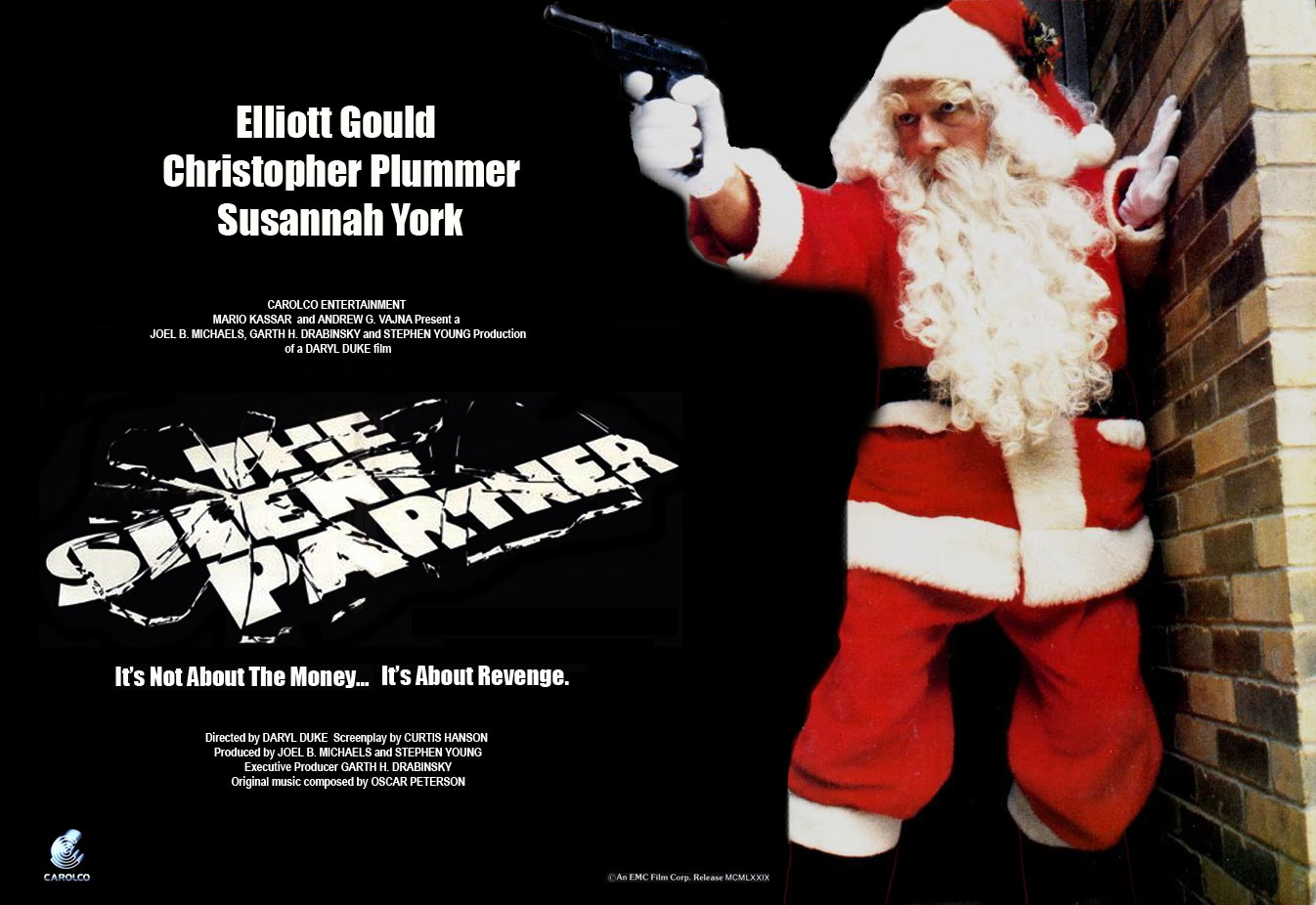
This is an ingenious, slick, and really fun caper movie that puts a whole new spin on the old bank robbery theme. Here Elliot Gould plays a bank teller named Miles who, by sheer accident, becomes aware that a man named Harry (Christopher Plummer) is planning on robbing his bank. Miles decides to take the money from his till and put it into his lunchbox. Then when Harry robs the bank it is actually Miles the teller that gets the money while Harry goes away with very little. Yet this is only the beginning as Harry and Miles continue to play a crafty game of cat- and-mouse, which leads from one interesting twist to another.

Gould plays against type here and he does quite well. Usually he tends to be loud, argumentative, and anti-authority, but here he is quiet and unassuming. It’s the type of character you think wouldn’t have the guts to pull off what he does, which makes him all the more intriguing. In fact he just keeps surprising you all the way along, stringing the very psychotic and dangerous Harry in ways you couldn’t imagine. It is only his final move that seems to be testing the odds too much.

Plummer makes a terrific adversary. He is dashing and handsome as ever, but with an intensely sinister edge and an icy cold gaze.

Susannah York as Miles’ love interest Julie is wasted. Her character seems thrown in for good measure and at no time seems interesting. There is no chemistry between them and the whole love angle is forced and unnecessary. Celine Lomez, as Elaine the other female character, is different. She is stunningly beautiful and much cagier. She plays between both Harry and Miles and you are never sure which side she is really on. Her acting isn’t spectacular, but she is sensual and has a nice French accent. Her gory and gruesome demise though is unwarranted and works as a drawback to the movie.

There are a few other negatives about the film. One is the drab setting that takes place in Toronto and yet we hardly see any of it. Having the bank itself set inside a boring shopping mall is not too visually exciting. The same goes for Miles’s bland apartment. The supporting characters, especially the other bank employees are incredibly dull. Their lines and basic presence all seem to have been written in simply as ‘filler’. A young John Candy plays one of these co-workers and his comic talents are wasted.

Still the story is creative and has enough unique twists that it overcomes the technical shortcomings and manages to be a highly entertaining flick.

silent partner 1

My Rating: 8 out of 10

Released: September 7, 1978

Runtime: 1Hour 46Minutes

Rated R

Director: Daryl Duke

Studio: EMC

Available: VHS, DVD, Amazon Instant Video

Why Shoot the Teacher? (1977)

why shoot the teacher 2

By Richard Winters

My Rating: 8 out of 10

4-Word Review: Not a good job.

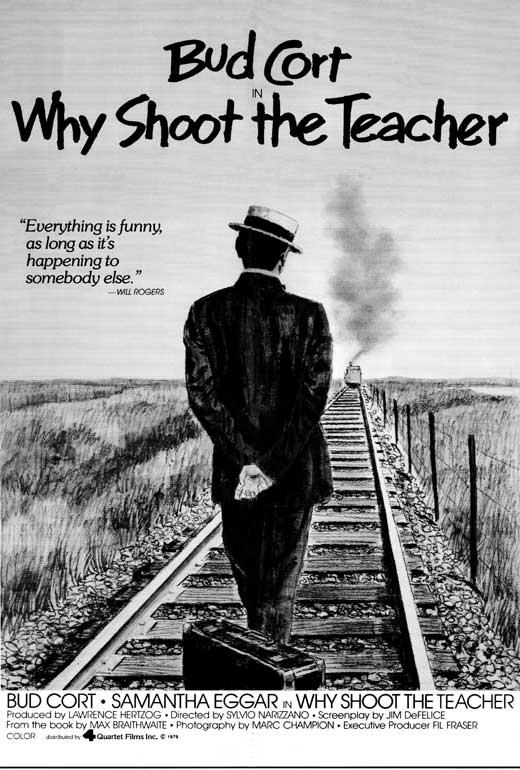
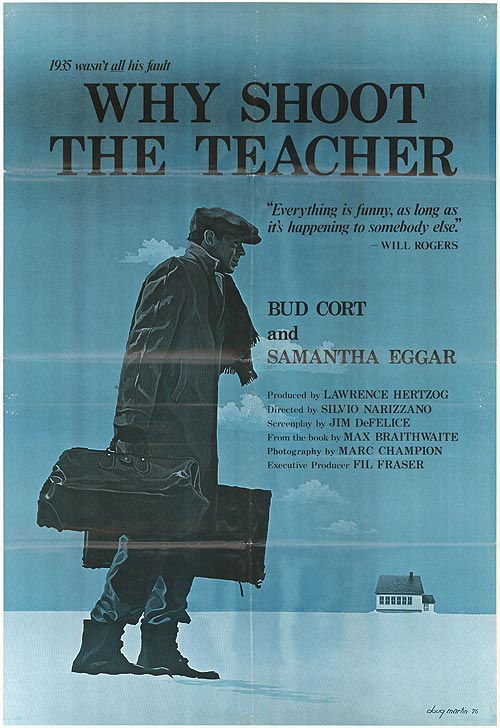
If you hate your job then watching the escapades of Max Brown (Bud Cort) dealing with his should make you feel a lot better about yours, or even lucky. The setting is 1935 and Max has traveled to an isolated farming community in Saskatchewan Canada in order to live out his dream of being a school teacher. The problem is that he must live in the dingy basement of the school that has no running water and an outhouse that gets regularly overturned by the rowdy school children, sometimes with Max in it, and he is only paid $20 dollars a month for his efforts, which even back then was a paltry amount. What is worse is that the district can’t even afford to pay him so instead gives him promissory notes and forces him to be dependent on the generosity of the townspeople for his food. Since he had to borrow money for his train ride up there he is unable to go back and forced to spend the harsh Canadian winter all alone while dealing with difficult students and indifferent parents and adults.

Cort really shines. The fact that through all his diversity he still remains civil and upbeat makes the character quite appealing even though he does evolve and at times compromises from his initial ideals. The best example of this is when he eventually, despite his initial reluctance, uses the strap on one of the older bigger students while the rest of the school children watch through the school windows. Although Cort is best known for his starring role in Harold and Maude I’d actually say this is his best all-around performance.

Samantha Eggar another under-appreciated and underused performer is terrific in support as Alice Field a woman transplanted from England who like with Max finds herself alienated and unconditioned to the harsh climate. She also has a really amusing line when she states “Canada is a nice country…sometimes…in the spring.”

Filmed on-location in the tiny town of Hanna, Alberta the sprawling wheat fields create a tremendous sense of isolation as well as a distinctive sense of natural beauty. The story is filmed during all three seasons, which makes the viewer feel like they are battling the rigorous Nordic climate right alongside Max. One of the funniest moments is when the word ‘Spring’ is flashed on the screen while a raging blizzard goes on behind it making Canada one of the few places that can make Minnesota, where I am originally from, seem like a mild climate.

The film is wonderfully vivid and creates a rich multi-textured tapestry of life on the prairie. By keeping everything on a realistic level it helps recreate what life must have been like for a lot of rural school teachers during the period, which is what makes it so fascinating. The film’s faded washed-out color and archaic low budget technical approach only helps to accentuate the look and feel of the period. There are shades of Wake in Fright here that also dealt with a man teaching school in an isolated school house while battling the elements and I found it interesting to note that Ted Kotcheff who was the director of that film was listed as a production consultant on this one.

My only complaint about the film was the misleading title. There is no shooting of any kind of the teacher, or even any talk of it. Why they came up with that title, which is based on the book with the same title is a mystery. Unfortunately it may give some people the idea that this is a violent film when nothing could be further from the truth and may turn-off potential viewers from enjoying this endearing slice-of-life comedy/drama.

why shoot the teacher 1

My Rating: 8 out of 10

Released: June 23, 1977

Runtime: 1Hour 39Minutes

Rated PG

Director: Silvio Narizzano

Studio: Lancer Productions Limited

Available: VHS, DVD, Amazon Instant Video, YouTube

Going Places (1974)

going places

By Richard Winters

My Rating: 9 out of 10

4-Word Review: Guys with no morals.

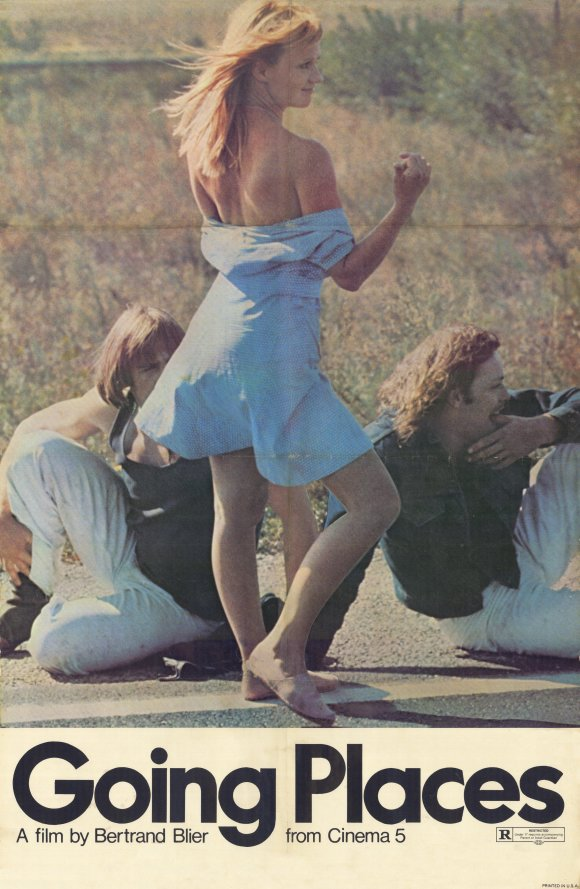
Two small time hoods (Gerard Depardieu, Patrick Dewaere) spend their days roaming the streets, robbing stores, and molesting women. In some ways this is truly an amazing film in what it is able to get away with. The two main characters are immoral, ignorant, insensitive, and brutal and the women are demeaned and degraded. The overall content is vulgar and perverse and yet somehow this thing comes off as a lyrical, offbeat delight that is pure entertainment.

It’s a definite original with every scene being an ingenious comic set-up. The scenario structure and use of locations is perfect. The pacing is fluid and director Bertrand Blier’s eye for detail near brilliant. The two hours move along like a breeze. It never gets boring and I actually almost wished it could have been longer.

The comic threads are hilarious and they get funnier and funnier as they go along. The guys’ constant, futile and very explicit attempts at getting a frigid woman (Miou-Miou) excited are a particular standout.

This is the type of black comedy that should be used as an example for all others. It’s consistently unique and manages to balance the ugly elements with the lighthearted without going overboard on either. It even throws in a surreal angle without a hitch.

Veteran French actress Jeanne Moreau has one of her finest latter career roles playing a lonely lady in desperate need of male attention. Her scene is well played out and even has a shocking conclusion. Depardieus ‘friendly’ conversation with a shopping mall security guard is another standout. The ultimate joke though may be in the film’s title as these guys are truly going nowhere.

My Rating: 9 out of 10

Released: March 20, 1974

Runtime: 1Hour 57Minutes

Rated R

Director: Bertrand Blier

Studio: Universal Pictures France

Available: VHS, DVD (Region 1 & 2), Amazon Instant Video

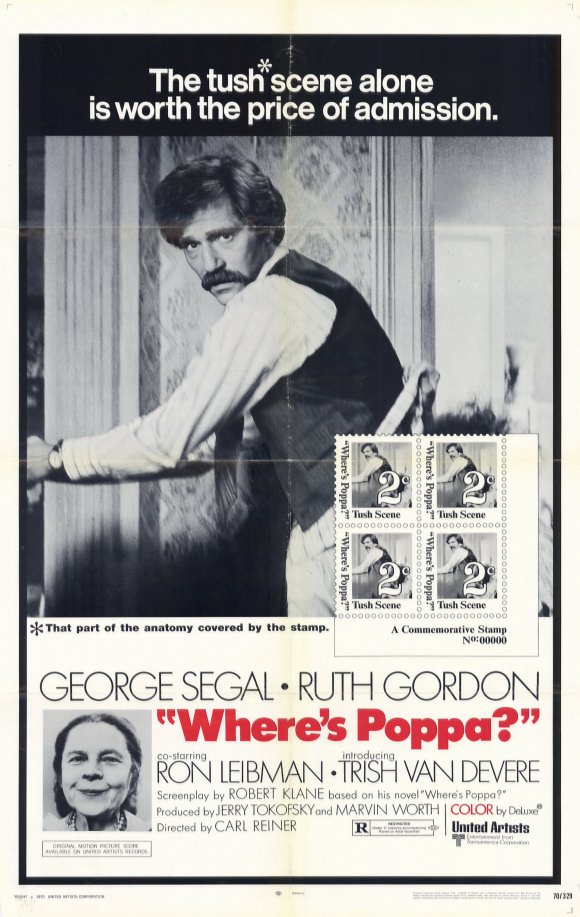
Where’s Poppa? (1970)

wheres poppa 2

By Richard Winters

My Rating: 9 out of 10

4-Word Review: Mother has to go.

A beleaguered Gordon (George Segal) is a man who must take care of his invalid mother (Ruth Gordon). Despite being a handsome young lawyer he has literally become trapped by this very difficult woman. The majority of the film takes place in a 1940’s styled apartment. It’s gray, dusty bleakness permeates every shot and shows just how lodged Gordon is in his mother’s world. He is a normal man that is slowly being sucked into madness. He is becoming mad because the world he lives in and life in general is driving him to it. The wall between what he really wants to do in life and his obligations have become so thick that going crazy may be the only real answer.

In fact madness maybe pretty much is what this film is really about. It seems to be saying that there is a certain functioning normality to it and at times even a necessity for it. Everyone in this film conveys their own unique form of madness. There’s the overzealous war general (hilariously played by Barnard Hughes) There’s also the henpecked brother/husband Sidney (Ron Leibman) who goes to almost absurd lengths to make sure everyone is happy. Even innocent, conservative Louise (Trish Van Devere) opens into the crazy world when explaining her rather unique honeymoon experience. The film delves so deeply and consistently into the world of the absurd that at times the senile Mother really doesn’t seem so nutty.

This is the film’s genius. It takes everything we have always accepted and turns it inside out. It takes some of life’s most depressing things and then makes it into an inspired and creative masterpiece. A trip to the old folk’s home has never been considered by many to be funny or memorable, yet a trip to Paul Sorvino’s old folk’s home is. In fact it maybe one of the funniest scenes you’ll ever see.

Writer Robert Klane and director Carl Reiner show an amazing grasp of their material, which is crucial for its success. Everything is fluid and consistent in tone. It shows how you can indeed have an offbeat idea, do it in an offbeat way, and still succeed without compromising.

My Rating: 9 out of 10

Released: July 9, 1970

Runtime: 1Hour 22minutes

Rated R

Director: Carl Reiner

Studio: United Artists

Available: VHS, DVD

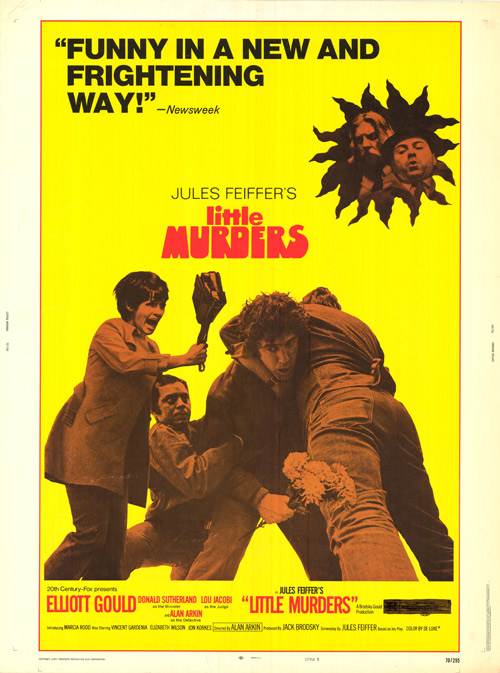
Little Murders (1971)

little murders

By Richard Winters

My Rating: 7 out of 10

4-Word Review:  They shoot at people.

Patsy (Marcia Rodd) is a woman who practices the art of positive thinking despite her dismal urban surroundings. She meets Alfred (Elliot Gould) who is very detached and dropped out of society and no longer shares any hope in humanity, but she decides to marry him anyways and ‘reform’ him.

For a black comedy this one has got to be tops. It stays on a grimly humorous level from the beginning and doesn’t let up especially with its wicked ending. Everything gets the offbeat treatment and if it starts out conventional it is soon turned upside down until it is absurd. The funniest scenes involve Patsy taking Alfred home to meet her parents where things become very odd until they are absolutely hilarious. The wedding scene is also a classic where Donald Sutherland plays a hippie minister and gives a speech about masturbation that is as outrageously funny today as it was back then. Yet it is the surreal scene of seeing Alfred riding a subway car while dripping with blood and nobody saying anything that leaves the strongest impact. The targets that this film satirizes are just as potent today as they were back then. The film also manages to dig a bit deeper than most and successfully analyzes the myriad of societal complexities while not siding with any particular social movement or philosophy.

Rodd is terrific in her film debut and Gould is good in a surprisingly restrained performance. Jon Korkes is also excellent as an infantile adult son in an over-the-top send-up of grown children still living at home. However, it is Vincent Gardenia that ultimately steals it playing a hard-liner conservative father who finds himself becoming literally imprisoned by the increasingly insane world around him.

Although still potent this outrageous story seems to have lost some of its zing through the years and doesn’t seem to be as offbeat or ‘out there’ as it once did. It also lacks any type of cinematic flair and at times seems to be nothing more than a filmed stage play.

However, for fans of black comedy and relics of a bygone era it doesn’t come much better than this. Although it has softened a bit there are still enough bizarre and funny moments to please those with an acquired taste.

My Rating: 7 out of 10

Released: February 9, 1971

Runtime: 1Hour 50Minutes

Rated R

Director: Alan Arkin

Studio: 20th Century Fox

Available: VHS, DVD

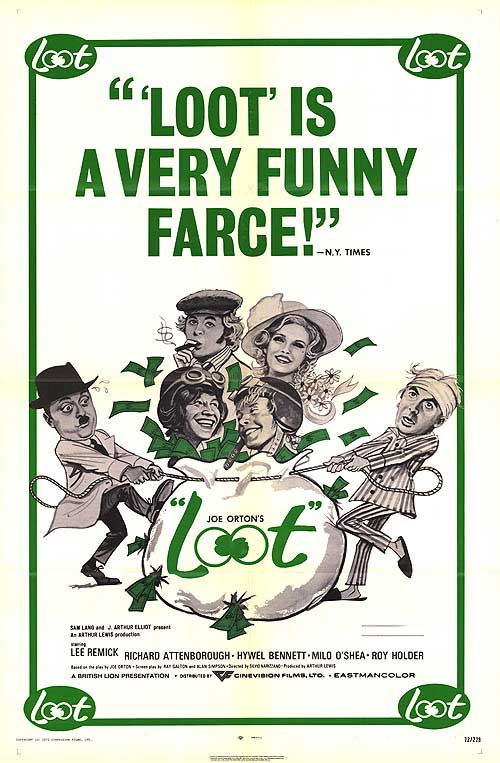
Loot (1970)

loot 3

By Richard Winters

My Rating: 8 out of 10

4-Word Review: They are all greedy.

Every Friday this month I will review the Top 5 best and most outrageous black/dark comedies from the 70’s. There were many to choose from, but these five have stood the test of time and remain as potent and hilarious as they were when first released. Today’s film was written by Joe Orton who died before ever seeing his play made into a movie and despite being top-notch in every aspect remains unjustly overlooked and hard-to-find.

The story deals with Dennis and Hal (Hywell Bennett, Ray Holder) two friends who decide to rob a bank next to a funeral home and hide the stolen money inside the coffin of Hal’s late mother. Problems ensue when Inspector Truscott (Richard Attenborough) starts to suspect the boys have something to do with it and incorporates brutal interrogation tactics to get the truth out of them. Then there is Nurse Fay (Lee Remick) who may have had something to do with Hal’s mother’s death and is inclined to want a piece of the action. All of this occurs inside Hal’s house, which is also a bed and breakfast run by Hal’s Father McLeavy (Milo O’Shea) who remains oblivious to all of the shenanigans and only worried about getting a decent burial for his departed wife.

The film is fast and funny and retains all of Orton’s dark and acidic wit. It is full of one-liners, sight gags, odd characters, and bizarre, unexpected comical twists, with ninety-eight percent of it being clever and funny. The best is the funeral procession when Dennis, who is driving a hearse that is carrying the deceased, finds out that the vehicle has lost its brakes and careens down the streets at high speeds with all the other cars in the procession try to keep up with it while driving equally fast.

Director Silvio Narizzano shows a terrific grasp on the material. Unlike Entertaining Mr. Sloane the only other film adaption of Orton’s work this film has a terrific pace that starts with a bang and never lets up. Narizzano also infuses a lot of imaginative camera angles, edits, and set design to give the thing a nice edgy, off-color feel. Outdoor action is nicely balanced with the indoor scenes to create a good cinematic feel and it never seems like a filmed stage play. There are some interesting homoerotic overtones as well including having Dennis and Hal blow a hole in the bank wall, crawl through it and take the money, then crawl back out and stuff it into the coffin while being completely naked.

Remick has one of her most interesting and unique performances in her already illustrious career as she is quite amusing looking almost like Marilyn Monroe with her dyed platinum blonde hair and authentic sounding British accent. Attenborough is memorable playing against type. Usually he is best at meek and passive types, but here he almost steals the film as the aggressive Inspector with a Hitler mustache. His best moment comes when he picks up a glass eye from the floor and in one brief second sticks out his tongue and licks it, which is done in vivid close-up.

The bouncy, psychedelic score by Steve Ellis helps give the proceedings attitude and personality. Why this film has never been released on DVD or Blu-ray is a mystery. The humor remains sharp and a whole new throng of fans could be acquired if they were just able to see it.

My Rating: 8 out of 10

Released: May 1, 1970

Runtime: 1Hour 41Minutes

Rated R

Director: Silvio Narizzano

Studio: British Lion Film Corporation

Available: VHS

King of the Gypsies (1978)

king of the gypsies

By Richard Winters

My Rating: 5 out of 10

4-Word Review: Daddy is a psycho

Dave (Eric Roberts) is the rebellious son of Groffo (Jud Hirsch) who no longer wants to be a part of the gypsy clan that he was raised in and instead a part of the American dream. However, when Dave’s grandfather Zharko (Sterling Hayden) lies dying in his hospital bed he gives the coveted medallion to Dave making him the new king of the gypsies. This sends Groffo into a jealous rage and orders two men to go out and kill Dave who now must elude them while trying to get his life together and help get his younger sister Tita (Brooke Shields) out of the clan as well.

Although far from being a complete success the film does manage to have a few unique and even memorable moments. The best is when a young Dave is used as a decoy in an attempt to rob a jewelry store. His mother Rose (Susan Sarandon) pretends to be a customer looking over some diamonds. When Dave creates a ruckus she tries to calm him down by having him drink a glass of water while also having him swallow a diamond that she has discreetly lifted from the display table. They are then able to walk out of the store when the merchants are unable to prove that they stole it only to have Rose later retrieve the jewel when Dave poops it out. Having Groffo put a 10-year-old Dave behind a wheel of a car and drive it down a busy Brooklyn Street is about as nerve-wracking as any car chase I’ve seen. The scene where Groffo tries to physically force Dave to have sex with his own mother is also incredibly startling.

However, despite these few interesting moments the film overall never really gels. The first half showing how the gypsy people live seems a bit clichéd and the way they openly cheat other people in order to make a living makes them unlikable and uninteresting. The only time it ever gets half way compelling is when it shows Dave struggling to survive on the mean streets of New York after he runs away from his psychotic father. Unfortunately this gets ruined when it constantly brings his family and past coming back to haunt him. The cat and mouse game that he plays with his father is not original and Hirsch makes for a very boring villain. He is unable to convey a menacing quality and thus there is never any real tension. The violin soundtrack compliments the gypsy tradition, but eventually becomes annoying.

Roberts is solid in his film debut. His voice-over narration coupled with his raw delivery is effective. Had the film focused solely on him and left out the silly gypsy sub-plot it would have worked much better.

Sarandon gives it some energy and she has the most effective accent. Shields is pretty much wasted and appears in only a handful of scenes. The biggest irony here is that the two played a mother and daughter before in Pretty Baby, which came out just 7 months before this one.

Hayden really seems to be having fun as the bombastic self-proclaimed King Gypsy. Watching him feud at the beginning with Michael V. Gazzo who plays the head of another gypsy clan is somewhat diverting. It is also interesting to see Shelly Winters in a part that has less than three speaking lines. This woman never seemed to ever want to shut up both on-screen and in interviews, so seeing her in a part that allows for so little dialogue is quite a novelty, but she still succeeds with it particularly in the part where she grieves over her dead family members.

It is fun to see a young Danielle Brisebois as well as Matthew Labyoreaux who later went on to play Albert in ‘Little House on the Prairie’. Annie Potts is good in a brief part and Patti LuPone makes her film debut in an uncredited bit.

My Rating: 5 out of 10

Released: December 20, 1978

Runtime: 1Hour 52Minutes

Rated R

Director: Frank Pierson

Studio: Paramount

Available: VHS, DVD, Amazon Instant Video

Wanda Nevada (1979)

wanda nevada

By Richard Winters

My Rating: 3 out of 10

4-Word Review: Go for the gold.

Wanda Nevada (Brooke Shields) is a 13-year-old runaway from an orphanage. Beaudray Demerille (Peter Fonda) is a drifter/con-man who ‘wins’ her during a poker game. The two don’t get along at first, but then they come into contact with an old prospector (Paul Fix) who tells them of gold that can be found in the Grand Canyon. They follow his map, but find weird unexplained events begin to occur the closer they get to the treasure.

Uneven mix of gritty western/comedy doesn’t ever gel. This is a far cry from The Hired Hand, which Fonda directed 6 years earlier. Although that was not a perfect film it still had a great cinematic style and moody flair that this one completely lacks. The story is slight and predictable and goes on much too long with a laid back pace that while not completely boring is never very interesting either. The biggest hurdle though is the fact that we have a 13-year-old girl and a man in his 30’s not only expressing their love for each other, but forming a relationship, which many viewers will probably find quite creepy.

Shields is great and helps give energy and flair to an otherwise lackluster production. She displays a nice sassy attitude and her facial expressions are amusing. She looks ready to blossom into late adolescence and many times seems to show more acting ability and charisma than her older counterpart.

The supporting cast is good although they appear much too briefly. Unique character actor Severn Darden is on hand who tries to steal Wanda away from Beaudray, but just when his character starts to get interesting they have him killed off. Peter’s dad Henry appears in a cameo looking almost unrecognizable in a long beard and bug-eyed goggles. Brooke’s real-life mother Terri has an amusing scene as a hotel clerk. Fix is also good in what turned out to be his last film.

On the flip side Luke Askew and Ted Markland are boring as the bad guys who chase after Wanda and Beaudray through the canyon. Their comical banter is unfunny and their bumbling ways allows for no tension.

The scenery is gorgeous and if you’ve never made it out west you’ll feel like you have after you’ve seen this. The best views are the bird’s-eye shots of the two rafting down a river. The color is bright and vivid and an overall excellent transfer from MGM’s Limited Edition library.

In some ways this film reminded me of Mackenna’s Gold as both films had a similar plot and both also added in a mystical element at the end. However, like in the other one the special-effects look cheap and hokey. The light pleasing quality is hampered by an otherwise bland execution. Why it was chosen for the setting to be the 1950’s instead of the present day I am not sure as it doesn’t add anything to the plot.

My Rating: 3 out of 10

Released: June 10, 1979

Runtime: 1Hour 45Minutes

Rated PG

Director: Peter Fonda

Studio: United Artists

Available: VHS, DVD, Blu-ray (Import)

Tilt (1979)

tilt 2

By Richard Winters

My Rating: 4 out of 10

4-Word Review: She’s a pinball wizard.

Brenda (Brooke Shields) who goes by the nickname Tilt is a 14-year-old pinball machine champion. When she becomes fed up with her overbearing father she decides to run away from home. She meets Neil (Ken Marshall) a man in his 20’s who is struggling to establish himself as a country music singer. He schemes to use Tilt’s pinball talents by hustling pinball patrons at bars and arcades around the country, but his real motivation is to have Tilt beat Harold Remmens (Charles Durning) who is nicknamed ‘The Whale’ due to his immense weight. The Whale is an arrogant bar owner who seems unbeatable at pinball and due to a few run-ins that he has had with Neil the two have become bitter enemies. Neil hopes to shatter his ego by having him get beat by an adolescent girl in a so-called pinball showdown, but Tilt has other ideas.

It is easy to see why this movie bombed at the box office and basically sat on the studio shelf for years. It seems to have no idea what audience to play too. There are too many adult references in it to make it suitable for teens especially preteens, but the story itself is so vapid that adults will be bored with it. The concept is offbeat enough that it might have worked as a comedy, or even parody, but director Rudy Durand approaches it as a standard drama, which due to the subject matter seems almost awkward. The 110 minute runtime is much too long for this kind of material and although it manages to move itself along it is never all that interesting with extraneous footage that should have been cut. Having faster cuts, juxtapositions, and even a non-linear narrative would have given it more energy and cinematic flair.

Having the action revolve solely around pinball games isn’t interesting. It is hard to follow the games and the constant footage of showing the inside of the arcade game as they are playing it becomes monotonous and fails to elicit any excitement. They is never any explanation as to what special skills Tilt or The Whale have that allows them to be so good, but it might have been a little more enlightening had one been forthcoming.

Shields is terrific and helps keep things afloat. She looks cute and wears pants with the words ‘pinball champ’ stenciled along her rear. Her ability and confidence at sharing scenes and holding her own with her much older adult counterparts is what makes her so special. One of the best scenes is when she hitches a ride with an ornery trucker (Geoffrey Lewis) who complains about the lack of morals in today’s world, but then turns around and tells her he has condoms in his shirt pocket and invites her to a rendezvous in the nearest hotel. Tilt says she will just as long as she can do it with both him and his wife, which gets her immediately booted out of the truck for being a ‘pervert’.

Marshall doesn’t have as much charisma as his younger female co-star and his Texas twang was a bit too strong for my taste. He travels the country and stays in the same hotel room with the girl knowing full well that she is only 14, but makes no sexual advances, which of course is good, but I kept wondering if this where the real world that he would most likely have tried something. I also found it strange that Tilt’s father (amusingly played by Gregory Walcott in a brief bit) wouldn’t have every police force in the country looking for her and once caught Neil would be thrown in jail even if he didn’t do anything because most likely no one would ever believe him.

Durning is excellent as always and gives the part a nice hammy turn and makes the movie, at least when he is in it, like the campy comedy that it should be. The little dance and moves that he makes while he plays the pinball games are amusing. His stomach bulges out even more than normal making it seem almost like he is pregnant. When Neil meets him after several weeks of not seeing him and states “You look like you have lost some weight” is the film’s one and only funny line.

The film’s final sequence in which Tilt and The Whale get together late at night in an empty bar and challenge each other to a pinball contest is the best scene in the whole movie. Their banter and interactions with each other gives the film a unique flavor. The surprise twist that occurs at the very end is cute and endearing and helps give this otherwise flat film more points than it deserves.

Also, look quick for Lorenzo Lamas and Fred Ward in small roles.

tilt

My Rating: 4 out of 10

Released: April 3, 1979

Runtime: 1Hour 50Minutes

Rated PG

Director: Rudy Durand

Studio: Warner Brothers

Available: VHS