Category Archives: 70’s Movies

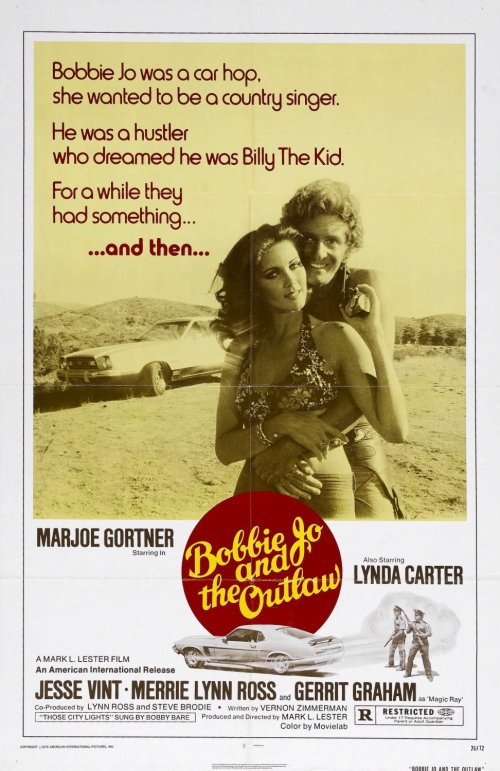
Bobbie Jo and the Outlaw (1976)

bobbi jo and the outlaw

By Richard Winters

My Rating: 3 out of 10

4-Word Review: Looking for some kicks.

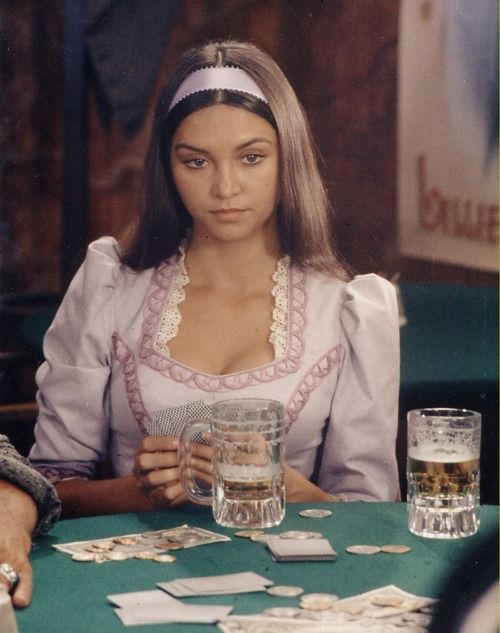
Lyle (Marjoe Gortner) is a quick draw with a gun and uses his ability to win many a contest, but when his car breaks down and he has no money to pay for the repair he decides to steal another and uses the vehicle’s souped-up engine to outrun any cop who’s after him. While stopping to eat at a drive-thru he spots attractive carhop Bobbi (Lynda Carter) who’s bored with her life and willing to take on a new adventure with a complete stranger if only to escape the clutches of her alcoholic mother (Peggy Stewart). They travel throughout New Mexico robbing banks while avoiding the relentless pursuit of Sheriff Hicks (Gene Drew) who pledges to bring them to justice dead or alive.

I was expecting something a little bit better than what I got here as it’s directed by the normally reliable Mark L. Lester with a script by Vernon Zimmerman who has helmed a few cult films of his own. Unfortunately it’s just a boring and uninspired rip-off of Bonnie and Clyde and Badlands filled with hooky dialogue and cardboard caricatures. If it weren’t for the action sequences this thing would’ve been a complete dud and comes close to being one anyways.

One of the biggest issues is the really dumb way the Bobbi Jo character decides to get with Lyle who has been stalking her for a while and parks his car outside of her home. She has no idea who he is or his name, but decides one day to hop into his car by calling him ‘loverboy’ and telling him to ‘take her away’ and all simply because she is bored. Now there are many ways to relieve boredom, but hopping into a strange man’s car isn’t one of them. Had she been strung-out on drugs, homeless, a prostitute, or suffering from some mental illness then it might have made more sense, but as it is it comes off as a really stupid way to set-up the plot and off-putting enough that it didn’t allow me to get into the rest of it.

Carter wasn’t a good choice for the part anyways as she does not come off as someone who is reckless or free-spirited. I remember watching her on the ‘Wonder Woman’ series during the late ‘70s and stories swirled that she was a real bitch/prima donna on the set who would slap actors if they messed up on their lines and would routinely make major demands. Her acting always seems rather restrained, formal, and proper like someone who was a privileged beauty queen-type growing up and who looked down on hippies as being ‘freaks’.

Belinda Balaski, who plays her friend Essie and tags along with the two on their crime spree, is far more effective and would’ve been a more believable Bobbi Jo. She also looks just as good as Carter both with her shirt on and off.

Merrie Lynn Ross who plays Bobbi Jo’s sister Pearl was another bad casting choice as she looks nothing like Carter as Ross is a brown-eyed blonde while Carter is blue-eyed and raven-haired. Gortner is expectedly terrible in the lead and much of the reason for this is because he was already in his 30’s at the time and too old for this type of part. Carter was too old as well and the whole thing would’ve worked better and been more believable had the parts been played by actual teens.

The film, which was shot on-location throughout the state of New Mexico, has a few good moments.   The best one comes when they crash their pick-up through a bank’s window and then hook a chain from their truck to the bank’s safe and drag the safe down the street, which is cool to an extent, but weakened by the fact that we are never shown how far the safe gets dragged nor what they use to finally get it open. A gun duel at a lonely, isolated gas station is another highlight as are the car chases particularly the one at the beginning. There is even an amusing take-off to the famous ‘squeal-like-a-pig’ scene in Deliverance, but other than that it’s vapid, pointless and cheesy.

My Rating: 3 out of 10

Released: March 1, 1976

Runtime: 1Hour 28Minutes

Rated R

Director: Mark L. Lester

Studio: American International Pictures

Available: DVD, Blu-ray, Amazon Instant Video
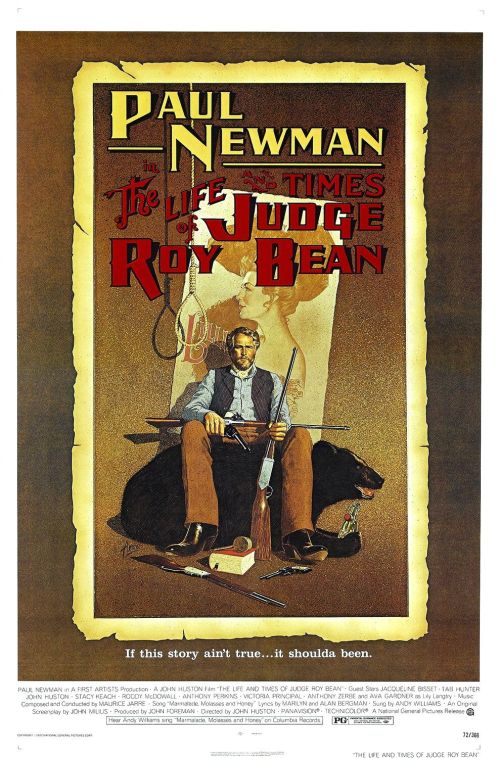
The Life and Times of Judge Roy Bean (1972)

life of judge 1

By Richard Winters

My Rating: 7 out of 10

4-Word Review: He rules the town.

Roy Bean (Paul Newman) rides into a lonely western town that is being ruled by a group of violent vagrants that attack and rob him as he enters their saloon and then they tie him to an end of a wagon and drag his body through the dusty desert landscape. Fortunately for him he manages to survive the ordeal and gets his revenge by returning to the saloon and killing off the others. After which he appoints himself as the judge who oversees all issues of law and order in the vicinity, which quietly begins to prosper under his leadership.

Although based on an actual historical figure the script by John Milius goes wildly off-the-mark that has no bearing to anything that actually occurred and ends up becoming highly fanciful in the process. There are certainly some amusing bits here and there, but the tone is too whimsical and loses any semblance of grittiness until it doesn’t seem like a western at all. The story also lacks a plot and the overall theme that is way too similar to The Ballad of Cable Hogue, which was directed by Sam Peckinpah and came out just two years before this one.

During my trip this summer I traveled to Langtry, Texas where the real Judge Roy Bean lived and where most of this movie was filmed.  I was surprised to find how interesting the true events of his life were and how the movie would’ve been much more fascinating had it just stuck to what really happened instead of making it all up. In real-life Bean entered the town in the spring of 1882 where he opened up a saloon and soon was appointed the Justice of the Peace by the state since the next nearest court was 200 miles away. The jurors for the cases that he heard were made up of his own bar patrons who were required to buy drinks in between court hearings. No one was sent to jail since he did not own a cell and all those accused were simply fined in the amount of cash that they had on them at the time.

I also found it was amusing at how different the performers looked in comparison to their real-life counterparts. Newman shows some resemblance to the actual man, but Victoria Principal, who plays Bean’s Mexican bride Maria Elena, clearly looks far sexier than the real one did.

judge 2pic 21

judge 5

pic 22

Overall, the film is passable for those wanting nothing more than an evening of light entertainment. The scene where Bean travels to San Antonio so as to meet Lily Langtry (Ava Gardner) a stage actress who he adores his quite good as it takes the character, who had by then achieved almost a mythical quality, and turned him back into being quite mortal when he fights through the city crowds and becomes nothing more than just another-face-in-the-crowd to the people there.

I also enjoyed seeing the town grow into a big oil boom city although in reality this never happened and the place as of today only has a population of 18 people. Stacy Keach’s cameo where he wears heavy make-up to resemble an albino renegade who rides into town and challenges Bean to a gunfight is quite amusing, but it’s probably Principal’s performance in her film debut that ends up becoming the film’s most enduring quality.

pic 18

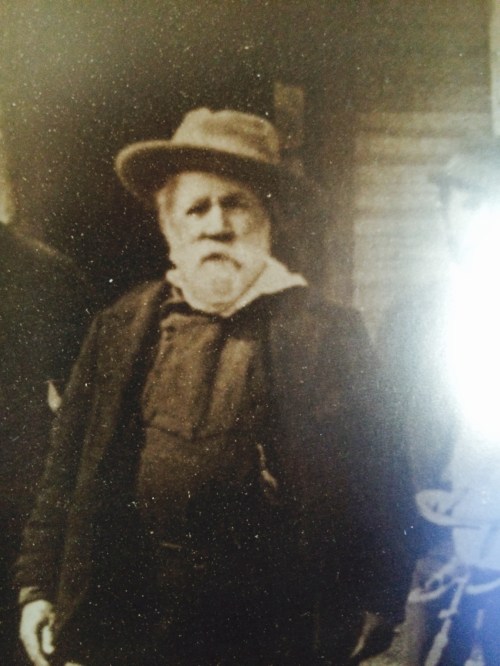
(The actual saloon where Judge Bean tried heard his cases, which still stands today.)

My Rating: 7 out of 10

Released:  December 18, 1972

Runtime: 2Hours 2Minutes

Rated PG

Director: John Huston

Studio: National General Pictures

Available: DVD, Amazon Instant Video

King Kong (1976)

king kong 1

By Richard Winters

My Rating: 7 out of 10

4-Word Review: Giant ape terrorizes Manhattan.

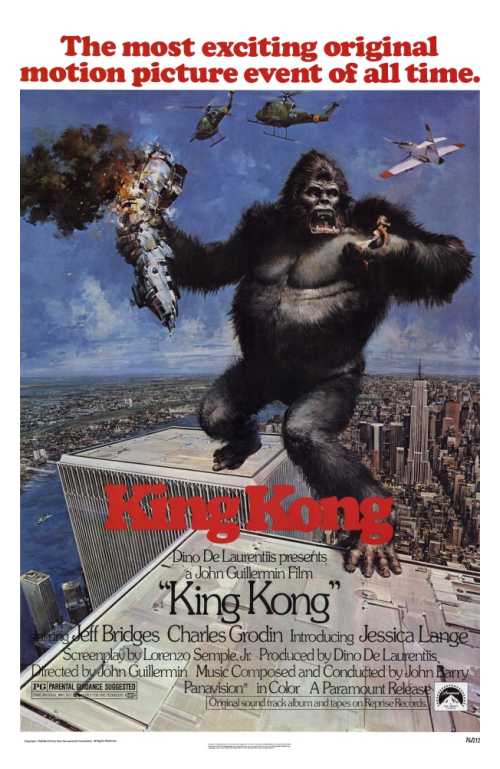
Fred Wilson (Charles Grodin) works for the Petrox Oil Company and heads an expedition in search of hidden petroleum reserves. He is particularly interested in a small, isolated island that is perpetually shrouded in fog and along the way they rescue Dwan (Jessica Lange) a beautiful, but flighty girl that is a lone survivor of a shipwreck. When the crew arrives at the island they find that it is inhabited by natives who perform some ancient, tribal ritual for a beast that they have caged inside a fenced-in area. They are intent in sacrificing one of their women to the beast, but when they spot Dwan they decide to use her instead where she then becomes the source of fondness to a giant gorilla named Kong. The crewmen are able to rescue Dwan and take the gorilla back to New York where Fred hopes to exploit the beast for his own monetary gain, but the gorilla escapes from his cage and goes on a rampage through the streets of New York looking for Dwan who he considers to be his.

This is a remake of the 1933 classic, which was later remade for a third time in 2005. Out of the three this one is considered to be the weakest, but I found that to be unfair as it still, while not being perfect, holds up well. The story itself is a bit dull and it takes too long until we are finally able to see the ape, a whole 50 minutes to be exact, but once the special effects get going it is impressive.

Some of the best moments come when he goes on a rampage in Manhattan and singlehandedly derails a subway car from its tracks and shakes it until all the people come tumbling out. His ride back to the states inside a freighter and the moment when he bursts through the giant fence on the island are equally exciting visually.

The gorilla is played by special effects artist Rick Baker inside an ape suit, which is something that he has done in other films as well. For the most part he does an excellent job, but I was bothered at the way the animal’s walk gets portrayed. To me it was too fast like the way a human walks instead of an animal and most apes walk on all-fours most of the time, so the fact that this one didn’t appeared unnatural. There are times too when the fur clearly looks like its sewn into a suit and not coming from the skin.

I also didn’t like the moment when the ape gets unveiled for the first time to the American spectators and he is shown wearing a giant crown. Adding in the crown gave it too much of a campy flair and hit home the exploitation theme in a heavy-handed way that was not needed. I also found it hard to believe how they were able to measure the beast’s head, build the crown to a correct proportion and then somehow get it on as they would’ve had to use a crane to do it and he would’ve fought with them while they did and most likely ripped it off the second it was put on.

Grodin is fun as the egoistical, but clearly clueless leader of the expedition and he ends up getting most of the film’s laughs.  Lange though in her film debut is fantastic and I loved her free-spirited, thrill-seeking character who is partially scared of the beast, but also intrigued by him and so consumed with getting media attention that she compromises her better judgement in the process.

My Rating: 7 out of 10

Released: December 17, 1976

Runtime: 2Hours 14Minutes

Rated R

Director: John Guillerman

Studio: Paramount

Available: DVD, Blu-ray, Amazon Instant Video
Don’s Party (1976)

dons party 1

By Richard Winters

My Rating: 8 out of 10        

4-Word Review: This party gets wild.

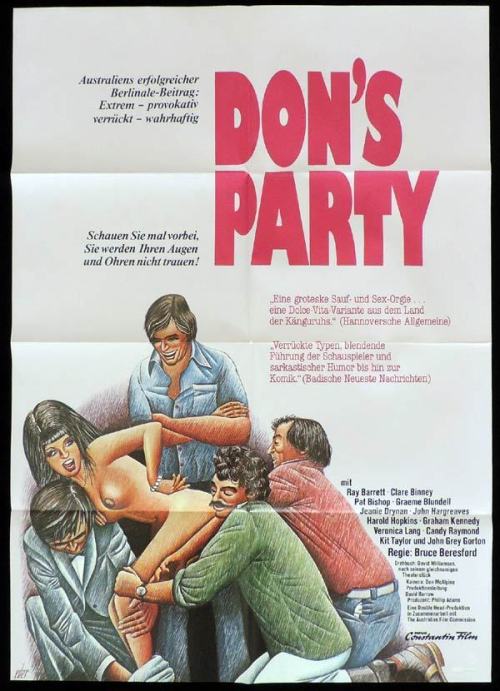
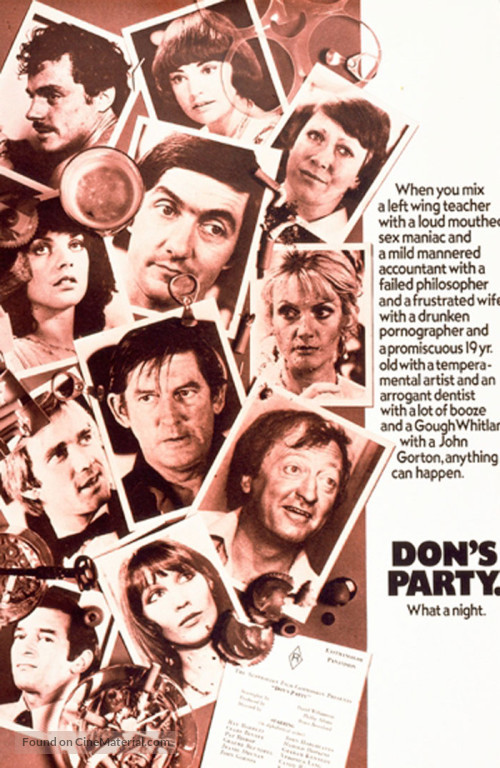
It’s October 25, 1969 and the election for Australian Prime Minister is being broadcast all over the nation. Don Henderson (John Hargreaves) is a Sydney suburbanite hoping that the Labor Party will unseat the incumbent Liberal one and invites his friends over to his home to watch the results. Things start out cordial at first, but as the night wears on and the alcohol takes its toll it heats up. Sexual escapades, arguments and fistfights breakout as the veil of civility comes off and their true selves come out.

This is playwright David Williamson’s most famous work and one that was not only a giant hit in his homeland, but has achieved worldwide acclaim. What I loved about the movie and what makes it so funny is that it cuts out the pretense and shows people as they really are while becoming a scathing indictment on suburbia. Most movies tend to pullback and sanitize things, but this one takes the opposite approach with a crude, in-your-face style that pokes holes at every level of suburban lifestyle that is refreshingly honest and totally accurate. The characters are excessively crass and there’s an abundance of sex and nudity, but sprinkled with a definite grain of truth that makes it more revealing about human nature than shocking.

An actual house was used for the setting, which helps avoid the static feeling and director Bruce Beresford does a good job of taking advantage of all the different rooms in the place and uses a variety of camera angles and shots to give it a nice visual flow. The performances are unilaterally superb and the actors appear genuinely intoxicated making the viewer feel drunk with them as they watch them down one beer after another.

The film’s drawback is that the characters lose their inhibitions too quickly and behave in an unnaturally aggressive way right from the start. It would’ve been more fun had they been overtly civil at the beginning only to watch it slowly deteriorate as the film progresses. There are also a few scenes where the background music is too loud and it’s impossible to hear what the characters are saying, which makes this otherwise slick production come off as a bit amateurish.

I first saw this movie back when I was in college and at the time I just didn’t get it. It seemed excessively profane without any redeeming qualities and filled with characters who were hateful and crude, but then I saw it years later after I’d lived in suburbia and become middle-aged it all suddenly made sense. In fact it made a little too much sense as the message it conveys and portrait it creates is not a pleasant one, but I admire the filmmakers for having the tenacity to bring it to light without compromise or hesitation.

dons party 3

My Rating: 8 out of 10

Released: November 10, 1976

Runtime: 1Hour 30Minutes

Not Rated

Director: Bruce Beresford

Studio: 20th Century Fox

Available: DVD

The Removalists (1975)

removalists 1

By Richard Winters

My Rating: 6 out of 10

4-Word Review: Cops abuse their authority.

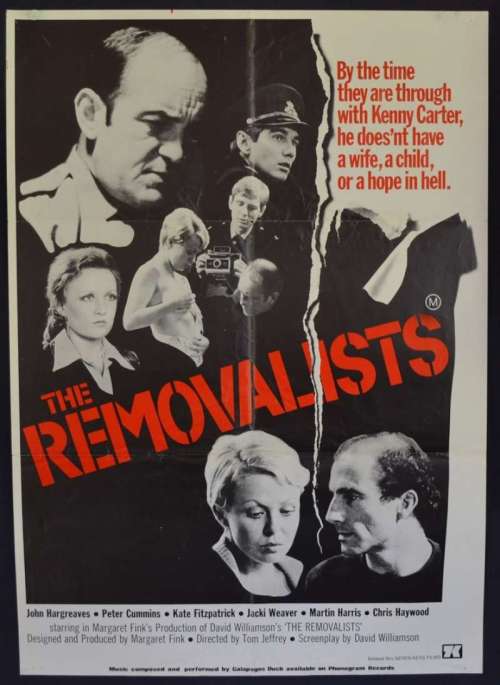
Having just graduated from police training Neville (John Hargreaves) is both excited and nervous about joining the force. His first day on the job working at a small police station with the conservative and boisterous Sargent Dan Simmonds (Pete Cummins) as his new boss gets off to a rocky start and then gets even worse when two sisters arrive to report an incident. Kate (Kate Fitzpatrick) is the older of the two who says that her shy younger sibling Marilyn (Jacki Weaver) has been abused by her husband Kenny (Martin Harris) and will require the services of the two policemen to help move her things out of her apartment and keep Kenny under control while they do it. The two cops oblige, but to everyone’s shock the Sargent immediately becomes physically abusive to the husband when he enters the place and while he has him handcuffed. The beatings escalate throughout the day until Kenny looks to be on the brink of death forcing the two officers into a heated argument over what type of alibi they should use should the victim eventually die.

The film was written by the talented David Williamson and based on one of his stage plays. Williamson is noted, especially in Australia, for his darkly humored subject matter and scathing wit with this one being no exception. It starts out with a caustic tone that just proceeds to get stronger as it progresses. The actions by the Sargent are disturbing and reprehensible, but the fact that the character doesn’t see it that way and expounds on the importance of ‘self-control’ and having a rigid morality shows just how out-of-touch he is with his own contradictions, which makes him quite human and strangely engaging while also making a great commentary on the abuse of police power.

This also marks the film debut of legendary Australian actor John Hargreaves who went on to have a remarkable film career with a wide array of interesting roles before unfortunately dying at age of 50 from AIDS. His portrayal of a nervous and hesitant new recruit is humorously on-target, but the way his character becomes more emboldened as the day wears on is even more interesting.

The film’s downfall is the fact that the sets are visually dull. To some extent this works particularly in the rundown apartment that the majority of the action takes place in because it helps to symbolize how trapped the characters are with their own deteriorating and misguided value system, but it still ultimately gives the film too much of a low budget and unimaginative look. The story itself is predictable and although laced with darkly amusing moments could’ve been funnier and played-up more.

My Rating: 6 out of 10

Released: October 16, 1975

Runtime: 1Hour 33Minutes

Not Rated

Director: Tom Jeffrey

Studio: Seven Keys

Available: DVD (Region 0)

Doctors’ Wives (1971)

doctors wives

By Richard Winters

My Rating: 4 out of 10

4-Word Review: His wife sleeps around.

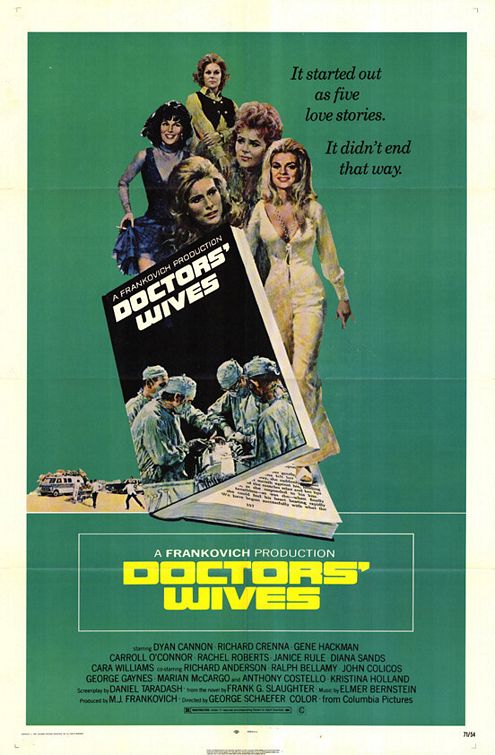
Several wives of prominent surgeons at a prestigious hospital get together for a game of cards, but one of the women, the oversexed Lorrie Dellman (Dyan Cannon), gives them a shocking proposition. Seeing that they are not satisfied with their sex lives, she tells them that she will sleep with each of their husbands and then critique their ‘performances’, so as to enlightened them as to what they might be doing wrong. The women turn down her ‘friendly’ offer, but then panic when Lorrie tells them that she has slept with ’50 percent’ of them already.  They have no time to worry though because the next day Lorrie is shot dead by her brain surgeon husband (John Colicos) after she is found in bed with one of the physicians. Now the women must try to figure out which doctor it was while worrying if their husbands were also involved with Lorrie at some other point.

The film, which is based on a novel by Frank Slaughter, is just too trashy and soap opera-like to take seriously. The productions values are strong and director George Schaefer shows a flair for the visual, which makes it watchable, but the characters are one-dimensional and the dialogue seemingly stripped straight out of a potboiler paperback.

Cannon, who’s billed as being the star, is on-screen for less than five minutes, which has to set some sort of record. Who on earth would ever accept a part to be the film’s ‘star’ if they are going to only be in it for that short of a period, or why bill someone as being such if they ultimately will have that little to do? In some ways I wished the character had remained as she is so outwardly slutty that it becomes campy and her initial proposition would certainly have created a more interesting scenario than what ultimately gets played out. Besides any character whose first words out of their mouth is “God, I’m horny” can’t be all that bad.

The supporting cast, which is made up of many familiar faces, are essentially wasted especially Gene Hackman in what may be the dullest role of his otherwise illustrious career although the way he repeatedly slaps his wife (Rachel Roberts) across the face after she confides in him that she once had a lesbian affair does have a certain outrageous quality.

Colicos is competent as the heavy, but Anthony Costello steals it as a young intern who sleeps with the middle-aged wives of his superiors. In real-life he was gay and ended up dying of AIDS at the young age of 45, but here successfully comes off as a flaming heterosexual who brags of his conquests and acts like going to bed with married women is as common place as taking out the garbage. His best bit comes when he beds fellow intern Sybil (Kristina Holland) who is making a sex documentary and narrates a ‘play-by-play’ of her sexual intercourse with him as it happens.

The film’s most memorable moment, and it’s a doozy, is when it shows in incredibly graphic style the operation of taking a bullet out of a man’s heart. A real pumping human heart was used and the footage would rival that of any educational film. Not only do we see them tear off the organ’s outer membrane, but we also watch as the doctor sticks his finger into it and then in one truly ghoulish shot pop the bullet out of it. It’s all real and done in close-up making it far more explicit than any gore movie out there and one of the most stomach churning things ever to be put in a mainstream Hollywood movie.

My Rating: 4 out of 10

Released: February 3, 1971

Runtime: 1Hour 41Minutes

Rated R

Director: George Schaefer

Studio: Columbia Pictures

Available: DVD-R

The Only Game in Town (1970)

only game in town 1

By Richard Winters

My Rating: 7 out of 10

4-Word Review: A Vegas love story.

Fran (Elizabeth Taylor) is an aging Las Vegas showgirl living alone in a two-bit hotel room while awaiting the return of her lover (Charles Braswell) who has disappeared yet again while he goes off to his wife that he consistently promises he will eventually divorce. In her loneliness she decides to go out to a piano bar and order a pizza. It is there that she meets Joe (Warren Beatty) and the two quickly hit-it-off while also spending the night together. Joe has a gambling problem, but promises that the minute he saves up $5,000 he’ll be out of Vegas for good. He moves into her hotel room where she helps him save up the necessary dough to achieve his dreams even though with his gambling addiction he will fritter it all away the moment he gets his hands on it. Then Fran’s long lost lover returns and ready for marriage. Will she go back with him, or stay with the self-destructive Joe that she has despite her better judgement fallen in love with?

The script by Frank D. Gilroy is based on his stage play and it’s not particularly rich in character development or plot. In fact the play itself fared poorly when it ran on Broadway and had only 16 performances before being shut down. However, despite its lack of originality I still found myself enjoying it and a major reason for this is the casting.

Taylor shines in a role that didn’t seem to be a particularly good fit for her. She spent the latter part of her career playing bitchy old dames that always seemed one step away from the sanitarium or a nervous breakdown. Here her character merits some sympathy and her usual overacting is actually entertaining and helps propel the flimsy plot along. The pairing of her with Beatty is an odd one, but then again the relationship is supposed to be awkward, so it ends up working to the script’s advantage.

Beatty’s performance is equally impressive. Normally he specializes at playing characters that are cool, calm and in control, but here he portrays one that is quietly crumbling and manages to pull it off to complete perfection. The scenes of him at the craps table and compulsively blowing all of his hard-earned money away is genuinely difficult to watch, especially since real cash gets used, and one of the most effective looks at the gambling addiction that I’ve seen.

This also marks the last film to be directed by the legendary George Stevens. He was known for helming some epic Hollywood productions, so it is a bit surprising that he choose to do this one since the storyline and setting were far more constrained from what he was used to working with. In fact the majority of it was shot in Paris, France and not Las Vegas, which many critics at the time felt was a detriment, but to me it made it even more fascinating to watch because of it. For one thing the crew did spend 10 days in Vegas shooting some of the outdoor shots, so you still get some legitimate Sin City scenery regardless. What I enjoyed though was the way Stevens was able to camouflage the rest of the scenes including having the bright daytime light seeping through the hotel room windows, which convincingly looked like the natural sunlight reflecting off of the sandy desert landscape. The recreation of the giant Las Vegas grocery store was impressive as well and strangely one of my favorite moments from the movie.

If you enjoy quirky love stories particularly between characters who are painfully human and less than glamorous you may enjoy this film better than most. It’s also a terrific chance to see two very fine actors playing against type and doing so in splendid fashion.

My Rating: 7 out of 10

Released: January 21, 1970

Runtime: 1Hour 53Minutes

Rated M

Director: George Stevens

Studio: 20th Century Fox

Available: Blu-ray

Lawman (1971)


lawman

By Richard Winters

My Rating: 5 out of 10

4-Word Review: He does not compromise.

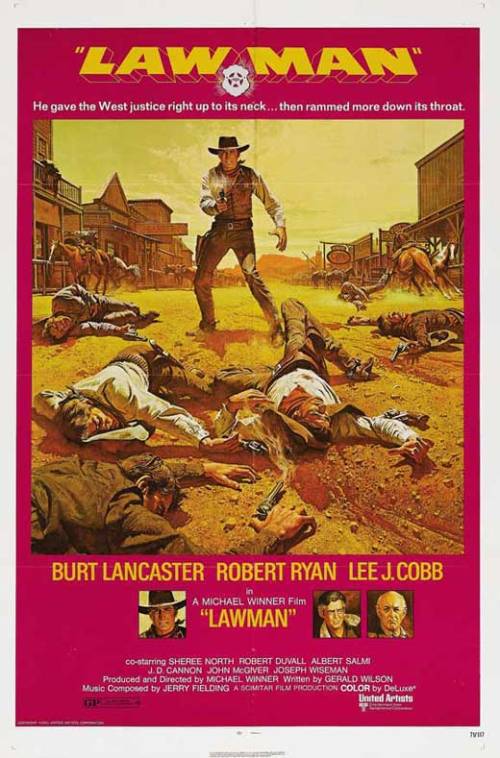
Aging western marshal Jarrod Maddox (Burt Lancaster) rides into the town of Sabbath determined to retrieve five ranchers whose drunken revelry the year before resulted in the death of one of his town’s older citizens. The marshal of Sabbath (Robert Ryan) is reluctant to help Maddox while informing him that the town is ruled by land baron Vincent Bronson (Lee J. Cobb) with a judicial system that is less than stellar. However, Maddox refuses to compromise on any issue no matter what odds or obstacles lay in the way.

During the ‘70s there was a trend to reinvent the western by instilling storylines that did not go along with the age-old, black-and-white formula while questioning the cowboy heroes of yesteryear and putting a grittier slant to the realism. Typically these newer westerns proved to be a refreshing change-of-pace and more in-tune with a hipper generation, which I normally would applaud, but in this rare case I wished that it had fallen back to the old ways.

For one thing Lancaster was still identified with the older film-goer and not in tune with the younger ones. His stiff and detached manner was a better fit to the film’s rigid character and quite frankly I was just plain intrigued to see how this man was somehow going to get all of these other men back to his town to stand trial when everyone else was entrenched to stop him.

Director Michael Winner however decides to switch gears on it and in an apparent attempt to make it more ‘relevant’ to the modern viewer slows the pace down to an almost screeching halt by implementing long-winded conversations and containing the action to only brief interludes while having an initially strong-willed character turn weak and indecisive. To me it was like slashing a tire and watching the air slowly drain out of it. The showdown at the end is anti-climactic and any potential tension is lost by a talky script and a bad guy (Cobb) who is dull and benign. The supporting cast of old pros is the only thing that saves it and I enjoyed the way each of them one-by-one got caught in bed with a prostitute at the town’s local whorehouse throughout the course of the film.

The Maddox character does indeed become an interesting enigma and even going against his supposedly upstanding nature by not only stealing two horses out of a nearby ranch when his is shot dead, but also at one point shooting an unarmed man in the back. Maybe this was the filmmakers attempt to show that western heroes where really human like the rest of us and full of the same contradictions, which could’ve elicited more discussion had the script been tighter.

This also marks the film debut of Richard Jordan a gifted character actor who died much too young, but managed to make some memorable movie appearances along the way. Here he portrays an young gunslinger attempting to stand up to Maddox, but unable to and at one point displays a cut on his face that looks more like a red leech stuck to his cheekbone.

My Rating: 5 out of 10

Released: August 4, 1971

Runtime: 1Hour 39Minutes

Rated R

Director: Michael Winner

Studio: United Artists

Available: DVD, Amazon Instant Video, YouTube

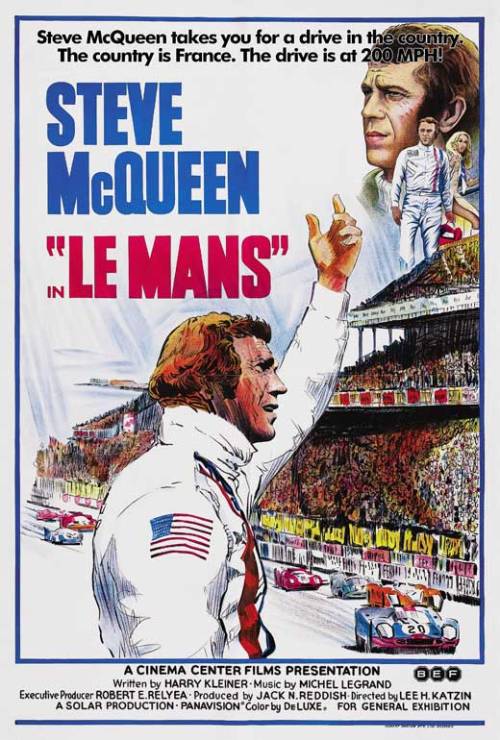
Le Mans (1971)

le mans 1

By Richard Winters

My Rating: 6 out of 10

4-Word Review: Car race of endurance.

Le Mans is a car race held annually in France in which the test is to show not only how fast the vehicle is, but also its reliability as cars are forced to drive for 24 straight hours with a minimum of pit stops. Michael Delaney (Steve McQueen) is the driver who represents the American team and who is under a great deal of duress because of the fact that he caused an accident that killed another driver just a year before.

The film’s first thirty minutes may be its most captivating and has been described by many fans as being their favorite part of the movie. I loved seeing the empty stands fill up with people as it gives the viewer an authentic race day feeling. Every little facet of the race gets captured almost like it is a documentary with the emphasis more on ambience and the adrenaline it creates instead of a story and in fact no one utters a single line of dialogue until almost 40 minutes in. Watching the cars whizz by with the camera set directly on the pavement just inches away was enough to make me flinch and the wipeouts are particularly graphic and up close.

The film has very little of a backstory to the characters and one gets propelled into the race without much distinction between the various drivers, or even any emotional stake for who wins. Normally I’d say this is a good thing because the dramatic elements in these types of films can get overly drawn out and soap opera-like, but it also makes it a rather detached experience like watching a football game with no concern for either team, or the outcome. The drama that does get played out is boring with dialogue that is only on a conversational level. It also gets confusing as to which driver is in the lead and the constant shots of loud cars speeding by eventually becomes tedious.

Things manage to recover by the end with an exciting finish between three of the race’s drivers that even features a very dramatic tire blow-out. Unfortunately the middle half bogs it down so much that by the time it gets there you feel pretty worn out already. It also wastes the acting talents of McQueen. Granted I was impressed that he did his own driving, but the script doesn’t give him enough to do outside of that.

The film was known for its troubled production in which John Sturges the film’s original director left after being unable to deal with McQueen’s constant meddling and replaced with Lee H. Katzin. Katzin was mainly known for doing TV-Movies and I honestly don’t think had the skill to create the movie’s impressive visual style. I believe it was McQueen’s presence that forged that and I almost feel he should’ve been credited ultimately as the being the director, or at least co-director. The irony is that McQueen ended up not receiving any salary for his work here, or even a percentage of the profits and in fact refused to even attend the film’s premiere.

My Rating: 6 out of 10

Released: June 23, 1971

Runtime: 1Hour 46Minutes

Rated G

Director: Lee H. Katzin

Studio: National General Pictures

Available: DVD, Blu-ray

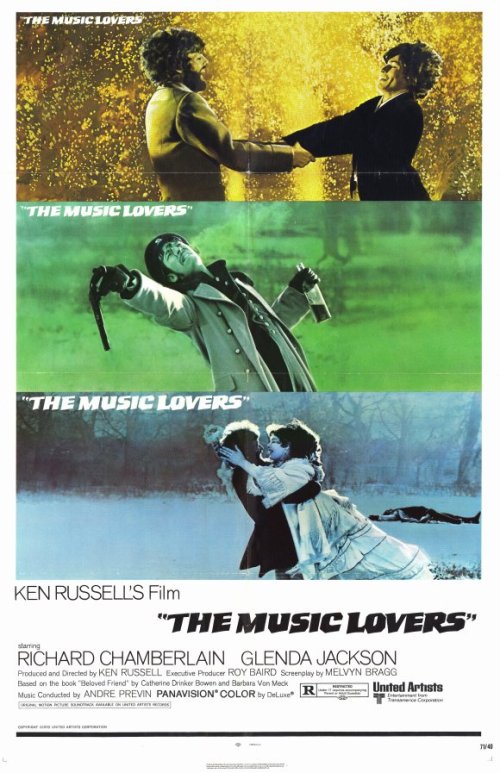
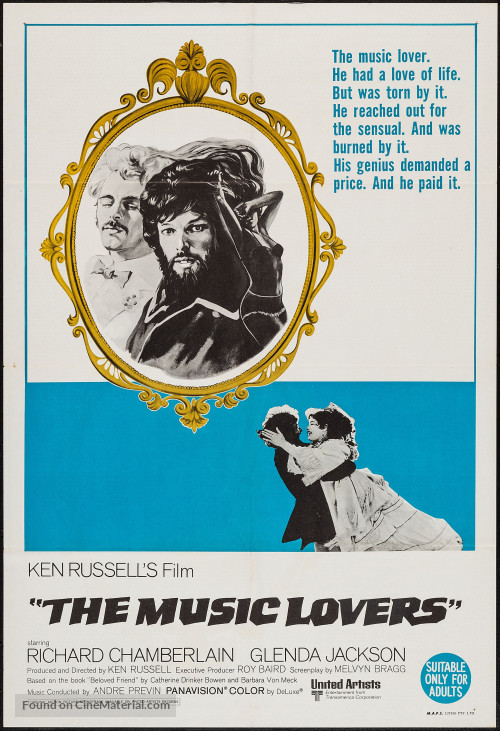
The Music Lovers (1971)

music lovers 1

By Richard Winters

My Rating: 6 out of 10

4-Word Review: Madness has no bounds.

This is a revealing look at Russian composer Pyotr Ilyich Tchaikovsky (Richard Chamberlain) and based on his own personal correspondences as he fought his homosexual tendencies by marrying Nina (Glenda Jackson) a woman he really did not love. Her nymphomania becomes something he cannot satisfy and he eventually abandons her where they then both go on to suffer their own personal forms of madness.

Pianists and composers were like what rock stars are today and I liked how director Ken Russell handles the concert sequence by infusing in the thoughts of the people as they listen to the music and therefore allowing the viewer to visualize the experience of a concert goer.

The scenes with Nina in the asylum are a good example of the grotesque imagery, but they are also well orchestrated and quite memorable. However at times it also gets overdone and unintentionally comical especially the sequence involving Chamberlain’s ill-fated attempt at lovemaking to Jackson on a shadowy, bouncing train car.

Russell shows no feeling for the subject and seems more interested in using it only as an excuse to show off his flashy style. The viewer is never allowed to get emotionally attached to the characters as we are only given a fragment of what these people were like and never the whole picture. The emphasis seems exclusively on their dark and self-destructive sides and watching their descent into madness is not very inspiring or insightful.

The casting of Chamberlain was a poor choice as the guy seems to have a very limited acting range. He is good looking, but lacks the charisma and his facial expressions rarely change while he shifts badly from underplaying the part to overplaying it.

Jackson fares far better and this could be considered a real find for her fans because she plays a type of character that she has never done before, or since. Usually she plays strong willed people, but here her character is weak allows herself to be dominated and exploited shamelessly even by her own mother while also taking part in a very provocative nude scene.

Overall if you like Russell’s style then you will enjoy it more than others. Otherwise it comes off as shallow, moody, and fragmented with some real slow spots during the middle half.

music lovers 2

My Rating: 6 out of 10

Released: January 24, 1971

Runtime: 2Hours 4Minutes

Rated R

Director: Ken Russell

Studio: United Artists

Available: DVD, Amazon Instant Video