Category Archives: 70’s Movies

Thumb Tripping (1972)

By Richard Winters

My Rating: 5 out of 10

4-Word Review: Hitchhiking across the country.

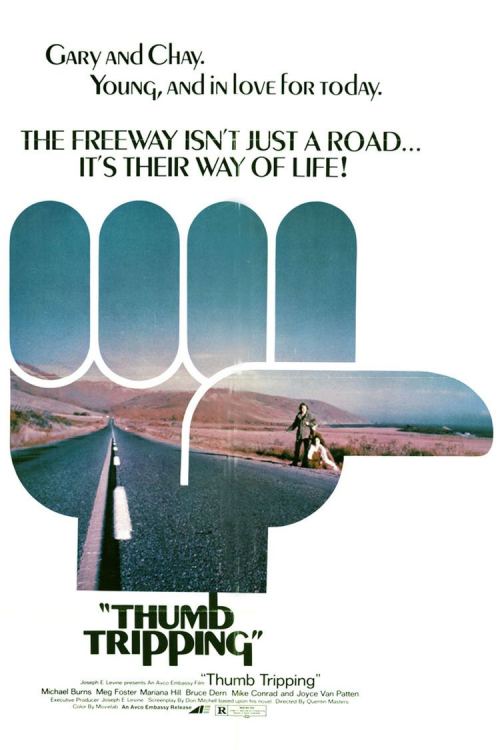
Gary (Michael Burns) is a college kid from a good family who decides he’s not ready to settle down just yet and wants to ‘drop-out’ for awhile by taking part in the hitchhiking scene that was popular in the early 70’s with the counter-culture. While accepting rides he meets up with fellow hitchhiker Chay (Meg Foster) and the two immediately hit-if-off. They decide to accept every ride that comes along, which gets them into trouble when they get into a car driven by two violent men (Bruce Dern, Larry Hankin) and then later when they hop into a truck driven by Diesel (Michael Conrad) who seems kindly at first, but ultimately sets his sights on having sex with Chay, who willingly accepts his invitation, much to the consternation of Gary.

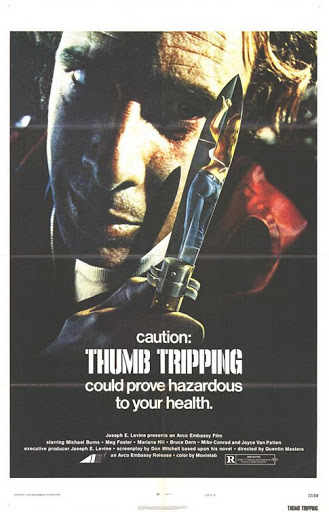
This film never really clicked with the public and much of the problem stemmed from the inability of knowing how to effectively market it, or even what genre it belonged in. Leonard Maltin, in his review, describes the film as being ‘amusing’ even though there is nothing in it that is funny or light-hearted. I remember in the 80’s going to my local video store where this film was put into the horror section and played-up like it was a thriller with Bruce Dern listed as the star even though his segment happens early on, is quickly forgotten, and only lasts for about 5 minutes.

If anything it works as a period piece at seeing how different and more free-spirited things were back then where accepting rides from strangers was considered fun and adventurous and not something to fear. It’s based loosely on the real-life experiences of Don Mitchell, a self-described hippie in the late 60’s who eventually moved to Vermont and became a sheep farmer. He wrote the story first as a novel before getting commissioned into turning it into a screenplay. For the most part it has an authentic feel particularly the segment showing the young people of the day hitch-hiking at various locations making it seem like it was an informal community all to its own.

What’s fascinating is seeing how the ‘responsible’ people that give the hitchhikers rides are usually just as unhappy with societal demands as the hippies, but with no idea or confidence on how to get out of their situations. The segment with Michael Conrad is the best as at first he’s the family man doing long over-the-road hauls to feed his wife and kids and yet his commitment to them takes an immediate backseat the second he becomes sexual aroused by Chay when he sees her dancing at a bar revealing that middle-aged men never become fully ‘domesticated’ no matter how hard they may try to play the part.

The two leads though are not fleshed-out enough. There’s a brief voice-over segment dealing with Burns’ conversation with his mother describing why he wants to drop-out and travel, which helps to give him some backstory, but we never get the same treatment with Foster. She’s this elusive enigma we want to know more about, but never understand. She’s far more compelling than Burns and should’ve been made the star and having her hitchhike alone would’ve  improved the movie.

Despite a few interesting moments it never comes together as a whole. The scenes are too loosely tied together and the story never feels like it’s progressing or has any momentum. The ending leaves everything wide-open particularly the fate of Chay who was the only intriguing element in it, which makes the viewer feel cheated when it’s over.
My Rating: 5 out of 10

Released: October 28, 1972

Runtime: 1 Hour 34 Minutes

Rated R

Director: Quentin Masters

Studio: AVCO Embassy Pictures

Available: VHS
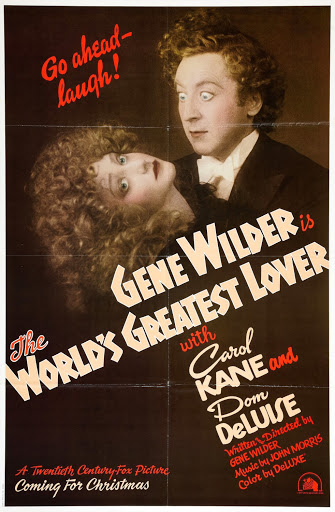
The World’s Greatest Lover (1977)

By Richard Winters

My Rating: 7 out of 10

4-Word Review: Seeking silent film stardom.

Adolph Zitz (Dom DeLuise) is upset that Rainbow Studios, which he heads, is not making as much of a profit as his rival and figures it’s because they don’t have silent film star Rudolph Valentino. He decides, after a meeting with his yes men who constantly surround him, to put out a national search for the world’s greatest lover who will come to Hollywood for a screen test to then become the next big star to rival that of Valentino. Rudy (Gene Wilder) is a hapless baker recently fired from his job who figures that entering this contest could be his ticket out of his penniless doldrums and travels to Hollywood for a screen test. However, once they get there his wife (Carol Kane) breaks away from him and sneaks off to the rival studio in order to try and have a chance encounter with her screen idol Rudolph Valentino (Matt Collins).

While the film did well at the box office bringing in a profit of $21 million off of a $4.8 million budget it flopped badly with the critics who ravaged both Wilder’s screenplay and direction. In a lot of ways they had valid points as the script veers off from the main theme quite a bit and seeming more like a collection of broad gags than a story. The comic bits take a long time to play out becoming almost like skits within a movie. The period atmosphere is poor and you never feel like you’re being transported back to a different era, or that there was even much thought or effort in this area to be authentic. Wilder’s character is problematic too. He can be great when he’s in an exasperated, frantic state and shouting at the top of his lungs, but he goes to this well too often making his character come-off as abrasive.

The one thing that saves it is that it’s surprisingly quite funny. I found myself laugh- out-out-loud at a lot of the bits no matter how meandering they became and really enjoyed the reaction shots from the supporting players. My favorite segment is when Wilder and Kane stay at a hotel with a sunken living room, which accidently gets filled up with water and then Wilder goes swimming in it and pretends it’s a pool when some family members of his come to visit. I also liked how it ultimately drains out onto some guests below who are ordering dinner. I even found the running joke dealing with DeLuise and his man servant barber (played by Michael Huddleston the son of character actor David Huddleston who also appears in the movie) and how he eventually learns to trust his business advice after always beating him up about it first.

The film manages to also make some interesting observations about people although this too borders a bit on getting botched particularly the scene where Kane goes into a tent to meet with what she thinks is Valentino, but really Wilder wearing a veil over the bottom of his face. However, it is clear to the audience just by looking at his eyes, which are very distinct, that it’s Wilder, so if it’s obvious to us it should be obvious to her since she’s been living with him for many years, but it isn’t. I did do like the point that the scene makes where she never enjoyed the sex with her hubby, but when she thought her hubby was somebody else suddenly the sex was ‘great’, which shows how much fantasy works into love making and a fundamental part of its enjoyment.

Wilder’s screen tests are quite amusing too and overall I found myself laughing consistently all the way through. If you’re looking for something light and comical that’s even a bit romantic then this should do the trick.

My Rating: 7 out of 10

Released: December 16, 1977

Runtime: 1 Hour 29 Minutes

Rated PG

Director: Gene Wilder

Studio: 20th Century Fox

Available: DVD

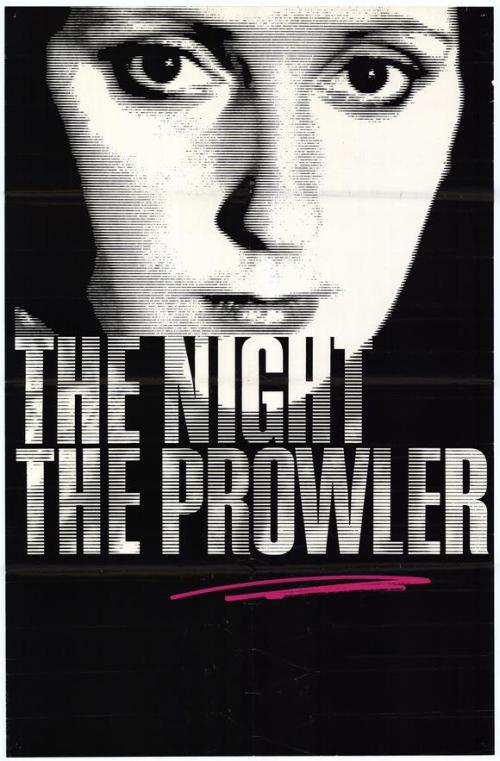
The Night, The Prowler (1978)

By Richard Winters

My Rating: 6 out of 10

4-Word Review: Victim turns into prowler.

Late one night Felicity (Kerry Walker), who is an adult woman still living at home with her parents (John Frawley, Ruth Cracknell), finds that a prowler (Terry Camilleri) has invaded her bedroom. After getting into a conversation with him she is surprised to learn that he’s a married man with kids, who enjoys prowling as a side gig to make up for the monotony and stresses of his home life. Felicity then realizes that the suburban lifestyle that her parents want her to live does not fully satisfy the individual and therefore decides she doesn’t want it. She breaks off her pending engagement with her fiancé (John Derum)  and turns into a prowler herself breaking into men’s homes late at night and learning to enjoy the underbelly of society by socializing with the homeless and other people that her parents always told her to stay away from. She soon finds a sense of empowerment by thumbing her nose at the elitists that make her her suburban community and doing all the forbidden things that her former cloistered lifestyle never allowed.

The film was directed by Jim Sharman best known for having done The Rocky Horror Picture Show. The basis for this project comes from his collaboration with playwright Patrick White and the many plays of his that he directed while doing experimental theater in Sydney during the 70’s. White wanted to expand one of his short stories into a screenplay and Sharman suggested this one had the best chance of working. The two had both grown up in the eastern suburbs of Sydney and wanted to create a film that showed their inner disdain for the arrogant, privileged people that populated the neighborhoods there and how the sterility of those environments may have been a comfort to the adults, but stifling and alienating to the teenagers.

To some level the film is interesting, but the fragmented narrative becomes an intrusive turn-off. Normally I like films that to get away from the mainstream approach and use different cinematic styles to tell a story, but the presentation here never allows you to get emotionally invested into the characters or their situations. There’s too much cutting back and forth between the present day, the past, and even some dream-like segments that ultimately makes the whole thing confusing and off-putting. That’s not to say that there aren’t some provocative moments as there are, but the non-linear approach never allows it to catch its stride, or feel like its progressing forward.

I did enjoy though the scenes with Felicity in the park late at night talking to the homeless while inadvertently scaring off a gang of young hoodlums by chasing after them and demanding that they assault her. When she breaks into a rich couple’s home and systematically destroys it and their subsequent over-the-top facial reactions when they come home to witness it is a hoot too. There are though some very disturbing moments too including Felicity’s conversation with a naked, starving homeless man (Harry Neilson) that she finds lying inside the filthy squalor of an abandoned building.

The one thing that holds it all together is the acting. Walker is perfectly cast in the lead as her plain looks and perpetually despondent expression visually signals her inner angst and alienation. Cracknell though completely steals it in a campy send-up of the suburban housewife/ mother that is at times both comically absurd and over-the-top funny. Her odd behavior keeps the interest going even as the story and direction at times lull and in fact it was enough to have nominated for the Best Actress Award by the Australian Film Institute.

My Rating: 6 out of 10

Released: June 2, 1978

Runtime: 1 Hour 25 Minutes

Not Rated

Director: Jim Sharman

Studio: New South Wales Film Corporation

Available: DVD, Amazon Video

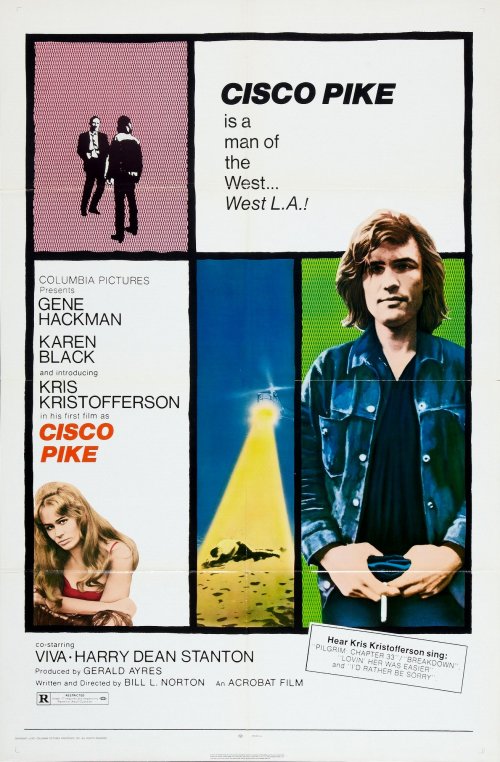
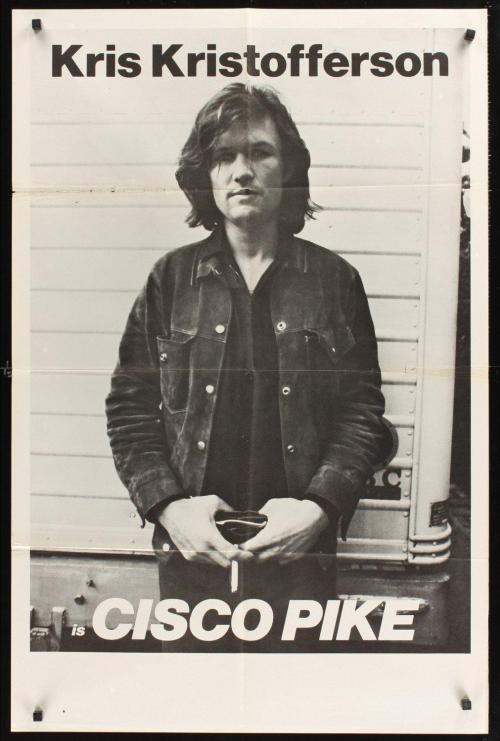
Cisco Pike (1971)

By Richard Winters

My Rating: 8 out of 10

4-Word Review: Blackmailed into dealing drugs.

Cisco Pike (Kris Kristofferson) is a down-on-his-luck singer who once was playing to sell-out crowds, but finds his popularity declining and resorting to selling drugs to maintain a living, but under pressure from his girlfriend Sue (Karen Black) has stopped. Leo Holland (Gene Hackman) is a police detective looking to retire and needing enough money to do so. He steals a sizeable quantity of high-grade marijuana from a gang leader and then tells Cisco he must sell it within 59 hours while giving Leo $10,000 of the profits and Cisco can keep anything that he makes beyond that. At first Cisco resists knowing it will interfere with his relationship with Sue, but eventually gives in when Leo threatens to kill him unless he complies.

While this film has achieved a cult status in recent years critics at the time of its release were not kind. Many felt it promoted drug use just as the nation was starting its war on drugs, which caused the film to get a limited release and eventually bombed at the box office. Personally I found it to be a riveting look at the drug dealing culture and a fabulous directorial/screenwriting debut for Bill L. Norton the son of William W. Norton who was also a successful screenwriter.

What I liked most was the cinema vertite style that made it seem almost like a documentary. I enjoyed the camera following Cisco around in a non-stagy way and revealing the variety of people that he sold to with not all of them being hippies either, but also middle-aged suburbanites and even business executives. The film nicely shows how some of the encounters would be non-eventful while others could ended up being a trap and eventual police chase. The unpredictable quality of the transactions replicated the anxiety the dealers would face and how hyper observant they needed to be to the immediate environment around them.

Many films try to recreate things that the filmmakers themselves haven’t gone through, but here I got the feeling that the director and much of the cast had experienced the same situations as the characters which in-turn makes the viewer feel, when it’s over, that they’ve lived it too. The dialogue is excellent as well with a conversational style that doesn’t overexplain things and allows the viewer to read in a bit to what the characters are saying.

Kristofferson, who had been a singer up to that point, makes an outstanding acting debut and all the more impressive when you realize that he had no acting training before he was given the part. Many of his friends advised him not to take the role fearing his lack of experience would hurt the movie and cause him not to be given any more roles, but after reading the script he felt he could relate to the character by simply being honest with his emotions, which he does splendidly and it’s nice too seeing him in a rare appearance without any beard or mustache.

Hackman is excellent as well playing a character that was not in the original treatment, but added in later by Robert Towne when he wrote the revision. It’s unusual seeing him in such a relatively small part with large chunks of time, especially during the second act, where he’s not seen at all, but when he is onscreen he’s effective. It was fortunate that this was filmed just before he won the Academy Award for The French Connection as that turned him into leading man material and it’s unlikely that he would’ve accepted this part had it been produced any later.

Black is interesting, she usually always is, despite, like with Hackman, not having all that much screen time, but she makes the most of what she has particularly her physical reactions to Hackman when he invites himself into her apartment late at night and begins rambling on about his heart condition. Honorable mention too needs to go to Joy Bang, an attractive supporting actress during the early 70’s who later retired from show business to get into nursing. Her toothy smile always looks sexy, at least to me, and I loved when she gives her female companion, played by Viva, an open-mouth kiss while riding in a car and then turns around and gives Kristofferson, who is sitting on her other side, the same treatment.

Harry Dean Stanton, as an aging musician, doesn’t appear until near the end, but has some of the movie’s most profound moments particularly his exchange with Kristofferson were he laments about no longer being sexy enough for the stage while Kristofferson reminds him that it’s not his body that the music business wants, but his soul instead.

My Rating: 8 out of 10

Released: November 2, 1971

Runtime: 1 Hour 35 Minutes

Rated R

Director: Bill L. Norton

Studio: Columbia Pictures

Available: DVD

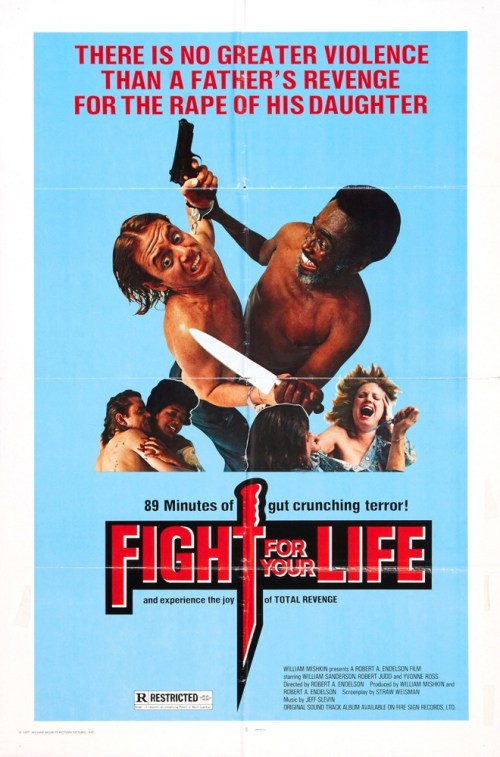
Fight for Your Life (1977)

By Richard Winters

My Rating: 4 out of 10

4-Word Review: Racist thugs terrorize family.

Three escaped convicts (William Sanderson, Daniel Faraldo, Peter Yoshida) find an isolated home in a woodsy are of upstate New York where they barge in on a black family headed by Reverend Turner (Robert Judd).  Jessie, the gang’s leader, is quite racist and uses the opportunity to spew out his hateful side forcing the home’s occupants, particularly the father, to do all sorts of humiliating things all to the amusement of the three men, but the family remains stoic determined to turn-the-tables on their captors the moment they get their chance.

The film could best be described as a variation on the Last House on the Left theme and in some ways does it much better. There’s none of the campy ‘comic relief’ humor here that almost ruined that one and the film is unrelentingly violent and grim. So many exploitation flicks from the 70’s would usually sell-out and never be half as provocative as advertised, but on that regard this movie delivers in ways that would still be considered jaw-dropping today and most likely not have any chance in this modern PC-era of getting filmed.

However, with that said, it’s still quite obnoxious and even repulsive to watch. There seems to be no other reason to have made this then to shock and appall and I’m genuinely surprised why anyone would’ve agreed to act in this particularly the black performers, who get forced to go through some truly tasteless and degrading acts.

The directing at times comes off as amateurish. It’s supposed to take place in the fall with leaves having turned color and almost fully off the trees, which is what we see when the thug’s car pulls up to a toll booth on a cloudy day and yet when the camera cuts to show the car leaving the toll booth the sky is now sunny and full green foliage on all of the trees. The music is also too loud, gets in the way of the action where natural ambience would’ve created more tension, and seems like a soundtrack better suited for a blaxploitation flick.

I wasn’t real happy with Sanderson’s presence either. Don’t get me wrong, he’s a gifted character actor, who’s best known for having played Larry in the ‘Newhart’ TV-show where he’d enter every scene by introducing himself as well as his two brothers named Darryl. In the comic realm as a backwoods hick his accent and talents are perfect, but here I could never take him seriously. His voice is too high pitched to be menacing and his wiry physique isn’t imposing. This might’ve been the intention at showing how without a gun he wasn’t much of man, but for the film to be truly scary there needed to be someone with a very intimidating look running the show.

Spoiler Alert!

The ending just about destroys what little potential this production had as it features an entire police force coming to the home, but instead of rescuing the occupants they choose to instead just stand outside and do nothing even as two of the women get raped. Supposedly this wasn’t for racist reasons, but more because they feared the victims might accidently get killed should they rush in to save them, but what’s the use fitting a police department with weapons and training if they’re going to be too timid to use it when they need to?

The idea that the black family would become aware that the police where outside, but stall them simply so they could enact their own revenge on the bad guys was too much of an overreach. The ending would’ve worked better, and been more believable, had the police not arrived at all and thus forcing the victims to use their own wits and ingenuity to overtake the brutes and then allowing their anger to spill over causing them to become far more vindictive than anyone could’ve imagined.

My Rating: 4 out of 10

Released: October 1, 1977

Runtime: 1 Hour 26 Minutes

Rated R

Director: Robert A. Endelson

Studio: William Mishkin Motion Pictures

Available: DVD, Amazon Video, YouTube

Petersen (1974)

petersen1

By Richard Winters

My Rating: 7 out of 10

4-Word Review: Going back to school.

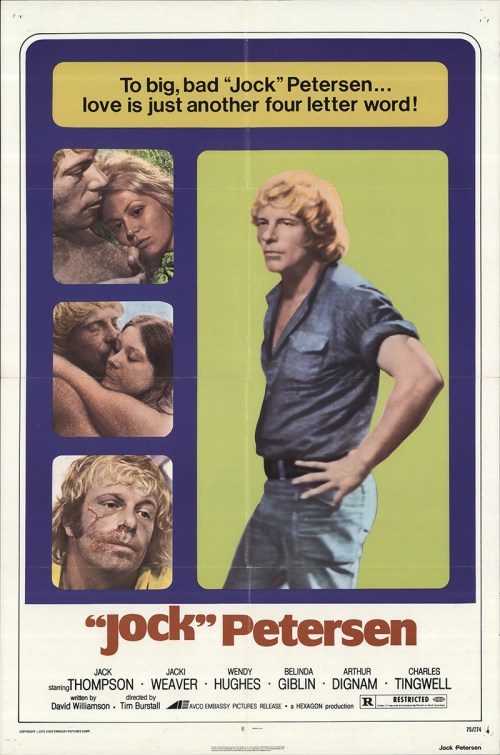
Tony Petersen (Jack Thompson) is an electrician who decides to go back to school and major in English. He feels people look down on him because he works a blue collar job and hope that by returning to college to get a degree that will change, but instead he finds he’s still not getting the respect that he desires particularly from his stuffy professor (Arthur Dingnam), so he ends up having an affair with the man’s wife (Wendy Hughes),  but things don’t stop there. He has sex with the coeds too including right out in the open on the campus grounds for public display while hundreds of onlookers surround them.

The screenplay was written by acclaimed Australian playwright David Williamson, who’s best known for having penned the cult hit Don’s Party However, this film lacks the fluidity of that one and seems more like a selection of vignettes than a story. The leader character isn’t likable either and comes off as selfish while in Don’s Party we were able to understand the protagonists frustration with his marriage here the domestic situation doesn’t seem as bad and therefore watching him mess around isn’t cute, funny, or sexy and instead just tiring and off-putting.

The biggest problem though is that the film starts right away at the halfway point where Petersen has already been attending school and neck-deep in an affair instead of going back to where it all began. Showing Petersen’s frustrations with his job and income, instead of just being told about it through dialogue, would’ve helped the viewer empathize more with his situation and emotionally invested with his quandary instead of feeling lost and ambivalent in the jumbled narrative.

There are a few good scenes here-and-there including a very ugly moment where a group of obnoxious bikers crash an upscale party and make things quite tense for the guests who are seemingly unable to do anything about it. Later there’s a poignant segment involving a discussion that Petersen has with his father (Charles Tingwell), who works as a reverend at a church despite professing to having lost his faith. Petersen’s public sex act has great potential too and even though it does contain full frontal male nudity, which at the time was still considered shocking to see in a mainstream film, it doesn’t get played-up enough to really being as funny or irreverent as it should’ve been.

Spoiler Alert!

There’s also several moments though that needed more context, which is frustratingly lacking. One includes Petersen getting caught making-out with his friend’s wife by his own spouse (Jacki Weaver) who looks very disappointed in him, but we never get any follow-up almost  like the whole situation just gets forgotten by the next day. There’s another scene where Petersen rapes his lover inside her own office, but without showing any aftermath. Such a violent, disturbing act deserves some denouncement and not treated like a throwaway bit such as it is.

End of Spoiler Alert!

Overall if you stick with it the characters do have a way of growing on you, but the story needed to be more developed. Too much emphasis on being edgy and provocative, but filled with characters in desperate need of depth and better connecting pieces between scenes.

My Rating: 7 out of 10

Released: October 25, 1974

Runtime: 1 Hour 43 Minutes

Rated R

Director: Tim Burstall

Studio: Hexagon Productions

Available: DVD (Import Region 2)

End Play (1976)

By Richard Winters

My Rating: 6 out of 10

4-Word Reviews: Feuding brothers hold secret.

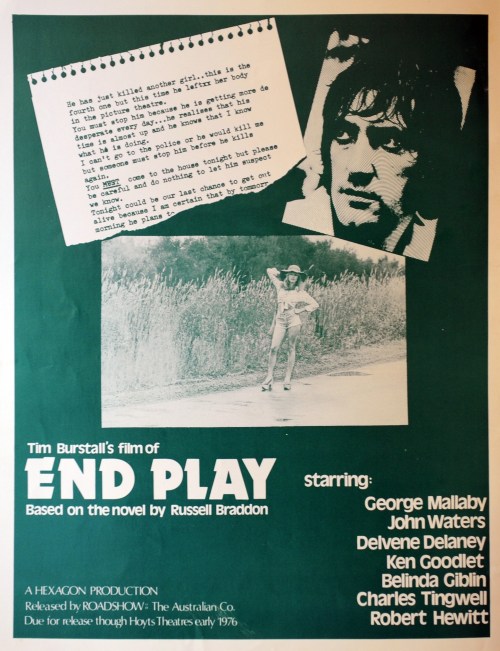
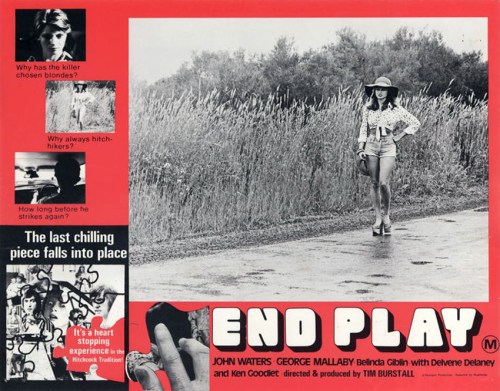
Mark (John Waters) picks up a hitchhiker (Delvene Delaney) on a lonely road and then promptly kills her. He then travels to his brother Robert’s (George Mallaby) house for a visit. When Robert leaves to go target practicing Mark brings the dead hitchhiker’s body inside and dresses her up to make it appear that she is still alive. He then disguises himself while taking the corpse to the local movie theater and once there he sneaks leaving the dead body to be discovered by others. Once the news of the grisly discovery hits the airwaves Robert immediately suspects Mark, but decides not to go to the authorities since he is already a paraplegic and at risk, due to lesions on his neck, of losing the movement of his arms, which will ultimately render him under the care of Mark. He also dislikes the police due to a childhood issue that he had with them, so for these reasons he covers for Mark’s actions, but when he realizes that his girlfriend (Belinda Giblin) has cheated on him with Mark he decides to carry out a stern revenge of his own.

The film, which is based on the novel of the same name by Russell Braddon, takes a unique spin on the mystery angle. Instead of delving into the action we get treated to the psychological interplay of the two leads and the many twists and turns their relationship takes where one minute they seem like comrades and the next enemies. Mallaby, who ironically ended up wheelchair bound in real-life after suffering a series of strokes in 1994, gives an edgy performance where his personality is so strong and aggressive that you really don’t notice the handicap at all. I liked the soundtrack by Peter Best too as it has a nice subtle quality that accentuates the creepiness without ever calling attention to itself.

While the film manages to hold interest it is somewhat slow. With the exception of a violent confrontation between the two brothers that occurs near the end there’s no action to speak of, so unless the viewer is really into the psychological aspect they may find the pace to be a bit boring. The two leads aren’t likable either. Normally the tension is created because you care about the protagonist and don’t want to see them harmed or in trouble, but in this case that’s all missing.

Spoiler Alert!

The biggest letdown though comes with its twist ending in which we find that Mark wasn’t the killer after all, but instead it was Robbie. However, director Tim Burstall completely botches this by showing the back of Mark’s head during the opening scene when the hitchhiker enters the vehicle. The two have completely different hair color with Mark’s being brown and Robbie’s being blonde and I even went back to the scene to make sure and there’s no mistaking it, it’s Mark’s head. This could’ve been completely avoided by simply having the camera act as the killer’s point-of-view where we only see the face of the hitchhiker as she enters the vehicle and is then killed. The fact that this wasn’t done was a big mistake and nullifies the intended surprise.

My Rating: 6 out of 10

Released: January 1, 1976

Runtime: 1 Hour 48 Minutes

Director: Tim Burstall

Studio: Hexagon Productions

Available: None at this time.

Getting Straight (1970)

getting straight1

By Richard Winters

My Rating: 5 out of 10

4-Word Review: Student unrest plagues campus.

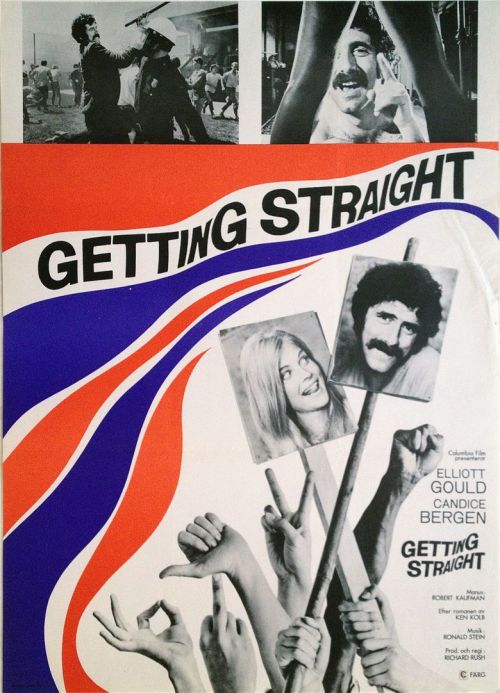
Harry Bailey (Elliot Gould) was at one time a student radical, but after returning to campus from serving time in Vietnam his perspectives have changed. Now he simply aspires to get a teaching degree, but the other students want him to take part in their campus protests, which he resists. His girlfriend Jan (Candice Bergen), who is much younger, starts to get active in the student movement, which creates further pressure for Harry. He sees the absurdity on both sides, but as the protests become more violent and the response from school administrators more inept, Harry comes to the conclusion that he can no longer sit on the sidelines.

If there is one thing that really stands out it’s Gould’s performance in a part he was clearly born to play. In fact the studio refused to go ahead with the project unless Gould made a commitment to star in it. Had he decided not to take the part the studio would’ve shelved the project permanently as they felt there was no other actor that was right for the role and they were correct. Fortunately Gould did accept and his running, raucous, irreverent commentary is the most entertaining thing about it.

Unfortunately his presence is so powerful that he dominates Bergen who comes off as transparent and overwhelmed. She certainly looks quite beautiful and I particularly enjoyed her cowgirl look with two ponytails, but her presence is blah. Maybe the producers wanted a weaker performer to expose how unequal the character’s relationship was with each other, but the result makes the conversations that the two have dull and tepid because Bergen can simply not keep up with Gould’s rapid-fire delivery.

Their fights are a little more entertaining with some of the jabs Gould throws out being downright funny especially when he accuses Bergen of being ‘just a guy with a hole in the middle.’ Yet the fact that the two get back together after flinging out some very nasty insults made no sense. There are certain things that were said here that got personal and couldn’t just get written-off as having been said in a ‘fit of anger’ like they do here. In most real-life relationships it would’ve created a rift that would never have returned things to the way it was before.

The protests come-off looking too staged, which includes one scene where Gould and Bergen stand in the middle of all of the chaos and manage to somehow hold an extended conversation even as everyone around them is getting beat-up.  In the original novel by Ken Kolb there weren’t any student protests and were only added in by director Richard Rush to give the story a more topical feel, but there were too many other films with a similar theme that  were more effective. Even The Strawberry Statement starring Bruce Davison, which had its share of faults, still at least managed to make the student’s confrontations with the police look more authentic and intense.

Some of the arguments that Gould dishes out as he battles with administrators, and sometimes with the students too, are on-target and even funny like when he challenges the new curfew rule by pointing to one of the students (played by John Rubinstein) and stating: “At the start of the school year he just wanted to get laid. Now he wants to kill somebody…you should’ve just let him get laid.”

Gould’s angry confrontation with Jon Lormer who plays one of the school board members has a riveting quality and that’s where this movie should’ve ended. Having it continue to where Gould then later confronts Leonard Stone, who plays another school board member, gets too heavy-handed and ultimately kills the film’s best moments with a lot of talky bits that seem insightful, but really aren’t.

My Rating: 5 out of 10

Released: May 13, 1970

Runtime: 2 Hours 5 Minutes

Rated R

Director: Richard Rush

Studio: Columbia Pictures

Available: DVD, Amazon Video, Youtube

The Hoax (1972)

hoax2

By Richard Winters

My Rating: 3 out of 10

4-word Review: Hiding H-bomb for ransom.

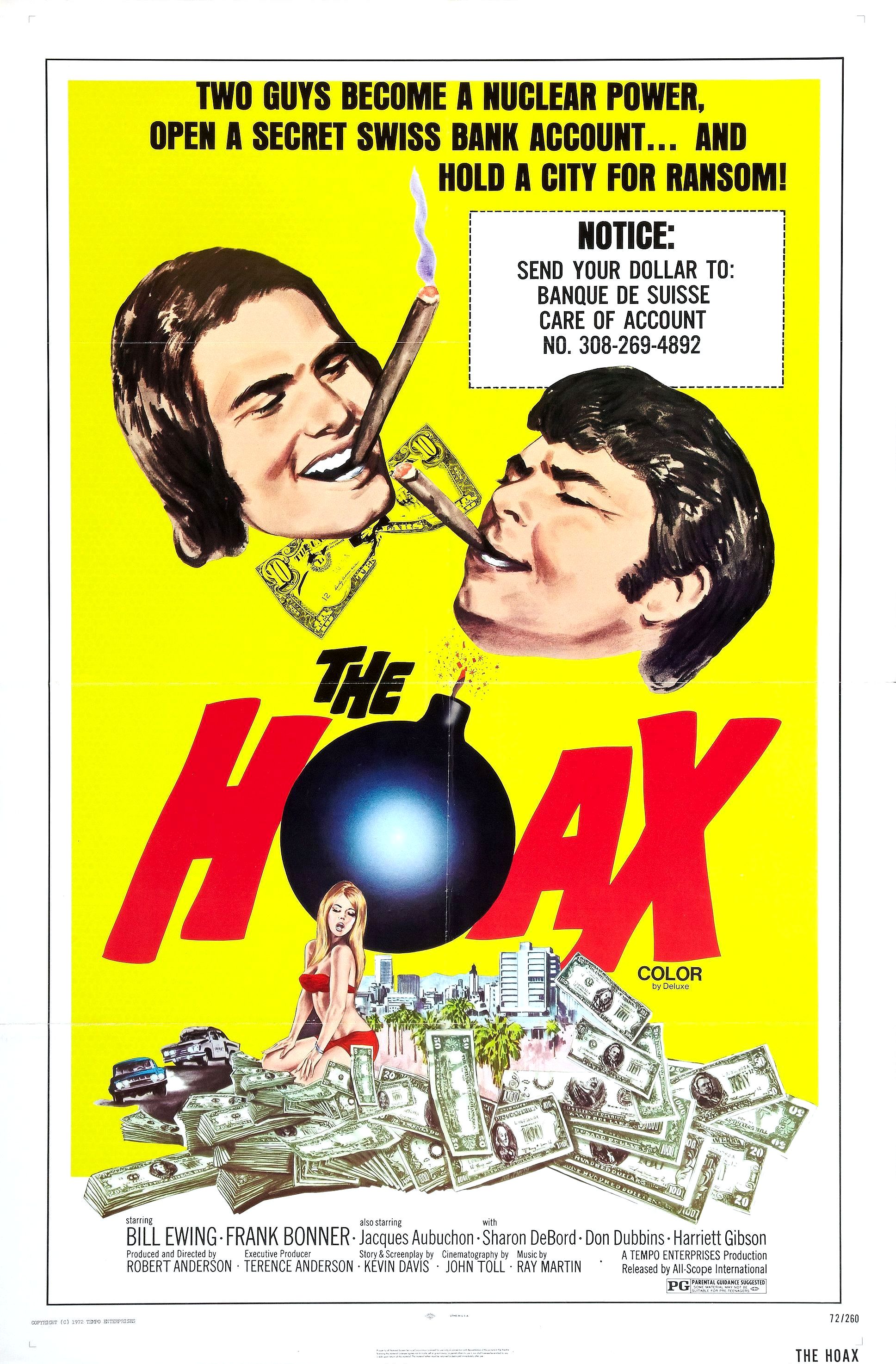
Cy (Bill Ewing) and Clete (Frank Bonner) are two friends who enjoy scuba diving. One day while at the beach they come upon a missing H-bomb hidden in some shallow water. Cy comes up with the idea of holding it for ransom by sending a letter to the press stating that they have the bomb, which has been reported missing by the military, and will detonate it unless each citizen of Los Angeles sends them one dollar to a specific bank account that they’ve opened in Switzerland. Things go smoothly at first until the police chief (Jacques Aubuchon) figures out who they are and begins tracking them down.

The only reasons that this film is worth catching is to see Frank Bonner, who later became famous for playing Herb Tarlek in the TV-show ‘WKRP in Cincinnati’, in an early role. In WKRP he played a character who wore loud suits and was obnoxious, but here that’s what his buddy does while he is more like a geek. Seeing him play an opposite type of character is amusing, but besides that there’s not much else that’s interesting.

For one thing the viewer should’ve actually seen the bomb, which we never do. We see its sharp metal edge that sticks up above the waterline, but not the bomb itself and since movies are a visual medium it’s important to use that as much as possible. The two also never remove the bomb from where they find it, which seemed dumb because anyone else could come along and take it away and then their scheme would be ruined. It made more sense to move it to a place where it could be hidden and this then would open the door for a lot of comical antics dealing with their difficulties carrying it around and keeping it undercover, but the film doesn’t take this route and becomes quite stagnant in the process.

The two friends share no comical banter either and are also in too much agreement, so there’s never any underlying tension. Sometimes onscreen realtionships/friendships are more compelling when there’s discord. It also seemed odd why they even felt the need to hatch such a scheme in the first place as both were doing okay financially. Cy was living with his girlfriend (Sharon DeBord), who had money, in a nice pad on the beach while Clete had a good job. In order for these otherwise law abiding citizens to suddenly go to criminal extremes there should’ve been a more desperate reason like having them homeless, which would’ve garnered more sympathetic from the viewer instead of just being two doofuses doing something nutty on a lark.

Turning the cops into buffoonish clowns was a mistake too as the humor becomes forced and their ineptness offers no intrigue. The running joke involving a vagabond drunk gets ridiculous as he’s always inadvertently showings up wherever the two men are making it seem like he might’ve been an undercover cop, which would’ve made more sense, but instead his occasional appearances have no bearing to the story at all and just gets thrown in for cheap laughs.

The final five minutes do offer a few unexpected twists, but by then it’s too late. I felt the script had gotten written with the ending as the starting point since that was the only inspired part of the movie, but this just proves that having a novel finish will do you no good if everything that comes before it is a bore.

My Rating: 3 out of 10

Released: April 19, 1972

Runtime: 1 Hour 23 Minutes

Rated PG

Director: Robert Anderson

Studio: All-Scope International

Available: None at this time.

The Spider Will Kill You (1976)

By Richard Winters

My Rating: 6 out of 10

4-Word Review: Blind man with dummies.

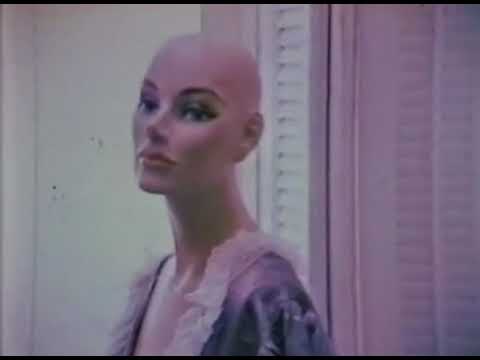
Jonathan (Robert Palter) is a blind man living alone in a cramped apartment surrounded by two mannequins who he speaks to as if they’re his parents and in his head he hears their voices in response. One day he comes upon another mannequin made in the form of a female, which he names Christine (Shirley Anderson). Christine eventually comes to life and becomes, at least to him, human and the two fall-in-love. Christine though starts to reveal a dark side and begins taunting Jonathan while trying to break into a chest in his apartment that supposedly holds deadly spiders and that Jonathan has been told by his parents never to open.

This was a student film directed by David Schmoeller, which went on to finish in second place at the 2nd Annual Student Academy Awards festival, but ultimately losing out to another student film directed by a guy named Robert Zemekis. The concept for this film was the basis for Tourist Trap, which Schmoeller directed 3 years later.

This film is far better, even at only 30 minutes, than its big budgeted revision. First there’s no annoying generic college kids here just three characters and the setting takes place entirely inside Jonathan’s apartment, which has a really dark and creepy atmosphere. The mannequins also at various times take human form and there’s some spooky effects including having Christine remove her own arm.

There’s also surprisingly nudity and explicit sex. ( I was a bit surprised with the nudity bit since Schmoeller stated that he was ‘too shy’ to ask the actresses to take off their clothes in Tourist Trap, but apparently didn’t have any problem asking the one here to disrobe even though this was done before that one.) The sex is an odd sight to see too since we initially see it from Jonathan’s point-of-view where it appears he’s making love to a human, but then it cuts to the next-door-neighbor’s (Donald Weismann) viewpoint, who peers in from the door, and it’s clearly a mannequin that Jonathan madly humps, which is a freaky sight.

The ending is quite weird and leaves a lasting impression. If Tourist Trap had stayed more inline with this film it would’ve been far more intriguing. I liked the surreal quality and the scenes involving the mannequins are scary it’s just a shame it wasn’t played-up more. Overall though, it’s still an impressive first attempt especially when dealing with the constricted confines of a typical student project.

My Rating: 6 out of 10

Runtime: 30 Minutes

Not Rated

Director: David Schmoeller