Category Archives: 70’s Movies

Payday (1973)

By Richard Winters

My Rating: 8 out of 10

4-Word Review: A self-destructive singer.

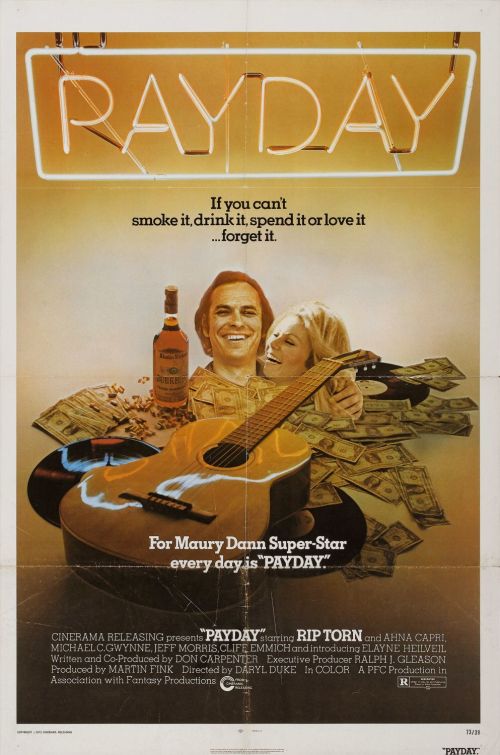
Maury Dann (Rip Torn) is a popular country singer who performs at many clubs throughout the southeast. While he is loved by his many fans he routinely takes advantage of those around him including sleeping with married women while openly seducing the others even when it’s right in front of his current girlfriend Mayleen (Ahna Capri). When Maury is confronted by the father (Walter Bamberg) of one of the young women he’s seduced they get into an ugly fight and Maury accidently ends up killing him, but since he’s so used to exploiting others he asks his loyal limo driver Chicago (Cliff Emmich) to take the blame for him.

The film, which was directed by Daryl Duke, is a masterpiece in penetrating drama to the point that I’m surprised that Duke, who had only directed TV-shows before this, didn’t go on to have a long career in making Hollywood movies instead of going right back to doing episodic TV-work after this. The script though, which was written by Don Carpenter, is completely on-target as it paints a very trenchant, no-holds-barred portrait of the seamier side of show business life and most importantly the people who work in it.

The atmosphere of the smoke-filled bars/nightclubs is vividly captured and the dialogue has a nice conversational quality that makes its point, but never in too much of an obvious way. The characterizations though are the most revealing and include Maury’s loyal manager Clarence (Michael C. Gwynne) who secretly despises Maury and is well aware of his many faults, but does whatever he can to cover them up to the adoring public.  Cliff Emmich as the faithful limo driver, who secretly aspires to be a gourmet chief, is terrific too. He doesn’t say much, but when he does it’s always quite interesting and his facial reactions are great.

My favorite characters though were Maury’s two girlfriends particularly the young, wide-eyed Rosamond (Elayne Heilveil in her film debut) who excitedly jumps into bed with Maury as his new star crush groupie only to become more apprehensive about things, which get revealed through her wonderfully strained facial expressions, the ugliness that goes on around her. Since her character has the most obvious arc I thought she should’ve been the story’s centerpiece.

Capri is quite enjoyable as well playing on the opposite end of the spectrum as a jaded woman who’s been in the groupie scene too long, but desperate enough to stay in it. The film’s most memorable moment is when Maury kicks her out of his limo, without any money, in the middle of a cornfield. She’s able to find another ride quickly, but I would’ve liked seeing a scene later on showing where she ultimately ended-up, or having her return to the story near the end where she could’ve had a climactic final confrontation with Maury, which is what her character deserved.

The only thing that I didn’t like was Maury himself. Torn plays the part in a masterful way, although his singing over the opening credits, which he insisted on doing himself, isn’t so spectacular, but his acting is. The only problem is that his character is just too much of a jerk. Supposedly it’s loosely based on Hank Williams and I’m sure there’s a lot of truth to it, but it would’ve been nice had there been at least one fleeting moment when he did something redeeming as his constant jerkiness becomes almost an overload for the viewer making it border on being too obnoxious to watch, but it’s so well crafted in every other aspect it’s still a worthwhile view.

My Rating: 8 out of 10

Released: February 22, 1973

Runtime: 1 Hour 43 Minutes

Rated R

Director: Daryl Duke

Studio: Cinerama Releasing

Available: DVD

Nickel Queen (1971)

By Richard Winters

My Rating: 4 out of 10

4-Word Review: Bar owner gets rich.

Meg Blake (Googie Withers) is a widow who owns a pub in a small desert town that has only 10 people living in it. She finds it hard to make ends meet until she hears about a nickel discovery in the outback and decides to be the first one to stake her claim to the land. Little does she know that corrupt executive Ed Benson (Alfred Sandor) fabricated the rumor of a nickel discovery simply so he could sell shares to gullible investors and Meg’s stake of land is actually worth nothing, but because Ed wants other people to also buy shares he pretends that Meg has already gotten rich through her investment and gives her $100,000 up front and parades her around the media while calling her the Nickel Queen. Meg laps up the publicity and spends her newfound fortune lavishly only to ultimately learn, once all her money is gone, that it was a hoax, which causes her and the other angry investors to go after Ed for revenge.

The story was inspired by the real-life event known as the Poseidon Bubble, which occurred in Australia in 1969, where shares in mining soared upon the discovery of a nickel deposit in September of that year only to quickly crash by early 1970 once it was found that the nickel was of a lower quality than initially thought causing many investors to loose a lot of money. Had the film stuck more to the true life event it might’ve had potential, but the way it gets played-out here is rather tepid.

It starts off alright and Withers, acting in front of the camera for the first time in 13 years, creates an engaging character who doesn’t back down to anyone and never hesitates to speak-her-mind. Unfortunately her tenacious personality does not get played-up enough. Once she becomes a media darling her wisecracks no longer have any zing and she falls into Ed’s trap too easily.  During the second half her presence is rather minor as she becomes this naïve person who must depend on her old friend Harry (Ed Devereaux) to get her out of her jam and exposing the corrupt Ed instead of she being the one to do that on her own.

The supporting cast is equally wasted. Initially the hippie guru character of Claude (played by John Laws who was and still is a famous Australian radio personality) seemed interesting as his values and outlook on things, particularly his refusal to work, contrasted greatly with Meg’s making it seem like the two would be sharing some wildly over-the-top confrontations. Instead Claude takes an extreme pivot midway through by showing up as a clean-shaven man willing to sell-out for money and even ends up becoming Meg’s lover, but what’s the point of him starting out one way if he’s just going to end up being the polar opposite? The transition is not revealing or introspective and shows how the filmmakers, who were all over 50, had no understanding of the counter-culture movement at all.

Doreen Warburton, who plays Ed’s gluttonous wife, is equally problematic.  The running joke of seeing her constantly stuffing her face with food gets pretty old, pretty fast to the point that it starts to get kind of disgusting to look at. Not having her utter a single word of dialogue is weird too making it seem like she’s not even human, but simply an unfunny and highly stereotyped caricature.

I liked how the first half was shot in an actual ghost town known as Broad Arrow and having the action take place in some of the town’s abandoned buildings gave the film an added visual flair, but this gets completely lost during the second-half when everything moves to the big city of Perth. The music is yet another issue as it sounds like something from the 40’s or 50’s and completely out-of-touch with the times. A lot of the cast is made up of hippies, so the soundtrack should’ve reflected more of their tastes.

Ultimately the film suffers from being too much of a family project. Writer/director John McCallum was star Googie’s husband and there’s even a part for their daughter Joanna McCallum, who plays Meg’s hippie daughter. While this may have been a fun project to work on from their perspective it offers little in the way that is satisfying to the viewer. The plot is poorly constructed and the wrap-up too tidy making it seem like material better suited for a TV-sitcom than the big screen.

My Rating: 4 out of 10

Released: April 1, 1971

Runtime: 1 Hour 27 Minutes

Director: John McCallum

Studio: British Empire Films Australia

Available: None

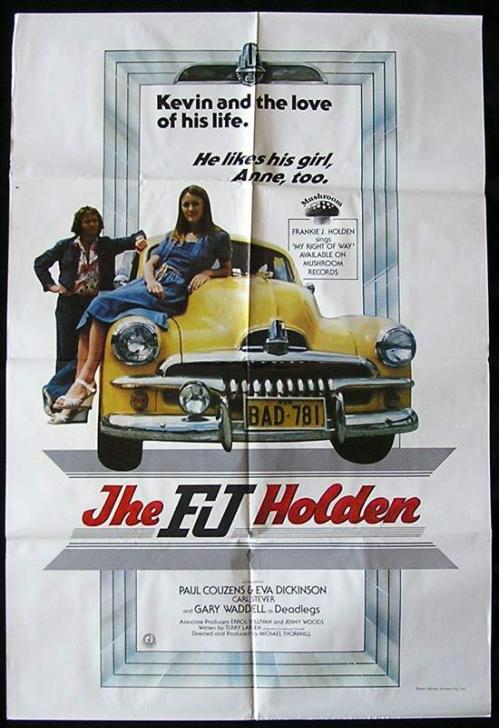
The FJ Holden (1977)

By Richard Winters

My Rating: 3 out of 10

4-Word Review: A youth’s aimless life.

Kevin (Paul Couzens) is a teen over 18 still living at home with his parents (Roy Corbett, Beryl Marshall). Most of his time is spent being idle while driving around in his refurbished FJ Holden and getting drunk with his best friend Bob (Carl Stever). One day while hanging out at a mall Kevin spots Anne (Eva Dickinson) and gives her a ride in his car and eventually the two start going out. Everything goes well for awhile until Kevin makes love to Anne with the bedroom door still open, so that Bob can watch. When Anne realizes what’s going on she kicks Kevin out of the house and breaks off their relationship, but Kevin refuses to let it go and tries to rekindle things with her later at a party, which causes tensions with the other partygoers and the home owner.

I’ve stated many times that I wished Hollywood movies wouldn’t feel so compelled to rush through a story as they do and allow scenes more time to be strung-out and not edit things so quickly. Allowing things to unfold at a more leisurely pace gives the viewer a chance to soak in the setting and characters better without having to be told what to think or feel, but this film goes to the other extreme. The pace meanders so much you become bored and lose focus. There’s just not enough going on to keep you interested or intrigued.

That’s not to say it’s a bad movie as I liked the technical approach, which puts the actors in public settings, but with regular people in the back drop as opposed to film extras. You get more of a realistic atmosphere this way particularly the scenes at the mall, which before the advent of social media, skype, and texting was a social hotspot for most teens to meet other people and hang-out. The story though, which was based on loosely constructed comic poems, is not structured enough to remain engaging. The dialogue is too generic and the situations they go through, whether it’s making love in the backseat of a car, or drag racing, have all been done in many other teen flicks, so watching it here just makes it seem all the more redundant and pointless.

There manages to be a a few interesting bits here and there, but overall it’s a sluggish experience. Only at the very end when Kevin confronts Anne at the party is there are any real potential for dramatic sparks, but it doesn’t get played-out enough. I was hoping for a full-out brawl to make-up for all the boredom that had come before it, but director Michael Thornhill, who has found critical acclaim with some of his later films, just wasn’t confident enough apparently to push this thing full-throttle, which ultimately makes it bland and forgettable.

The car itself doesn’t play as much into the plot as you’d expect and in a lot of ways I didn’t find it all that impressive. It’s a model of car that was built in Australia between the years of 1953 to 1956 and through the decades over 20 car clubs have been formed in Australia committed to preserving the vehicle, and every other year thousands of car enthusiasts gather to celebrate the old-style car, but to me it came off looking old and clunky like something your grandfather would drive and did not have the sleek sports car design that most young men like to be seen in. The car eventually, during the film’s second half, gets painted bright yellow, which makes it look like a taxi cab, but during the first part it’s not painted at all and looks rusty like it had been pulled from the junkyard and what most people would be embarrassed to be seen with and not something to invite a girl for a ride in to impress her even though that’s what happens here.

My Rating: 3 out of 10

Released: April 29, 1977

Runtime: 1 Hour 41 Minutes

Rated M (Originally rated R)

Director: Michael Thornhill

Studio: FJ Films

Available: DVD

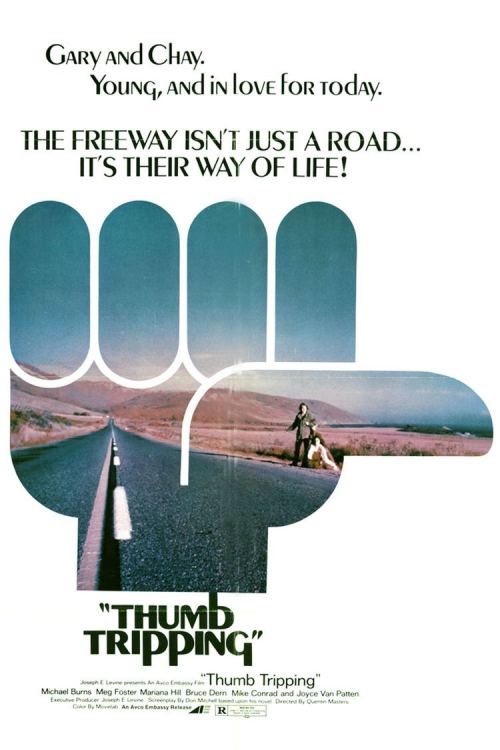
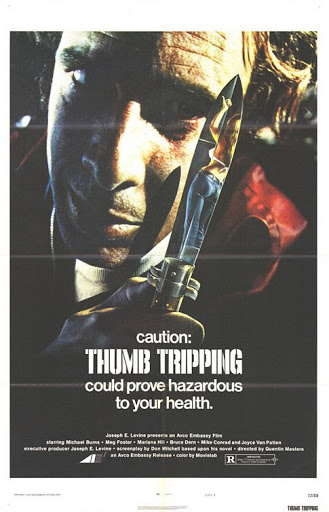
Thumb Tripping (1972)

By Richard Winters

My Rating: 5 out of 10

4-Word Review: Hitchhiking across the country.

Gary (Michael Burns) is a college kid from a good family who decides he’s not ready to settle down just yet and wants to ‘drop-out’ for awhile by taking part in the hitchhiking scene that was popular in the early 70’s with the counter-culture. While accepting rides he meets up with fellow hitchhiker Chay (Meg Foster) and the two immediately hit-if-off. They decide to accept every ride that comes along, which gets them into trouble when they get into a car driven by two violent men (Bruce Dern, Larry Hankin) and then later when they hop into a truck driven by Diesel (Michael Conrad) who seems kindly at first, but ultimately sets his sights on having sex with Chay, who willingly accepts his invitation, much to the consternation of Gary.

This film never really clicked with the public and much of the problem stemmed from the inability of knowing how to effectively market it, or even what genre it belonged in. Leonard Maltin, in his review, describes the film as being ‘amusing’ even though there is nothing in it that is funny or light-hearted. I remember in the 80’s going to my local video store where this film was put into the horror section and played-up like it was a thriller with Bruce Dern listed as the star even though his segment happens early on, is quickly forgotten, and only lasts for about 5 minutes.

If anything it works as a period piece at seeing how different and more free-spirited things were back then where accepting rides from strangers was considered fun and adventurous and not something to fear. It’s based loosely on the real-life experiences of Don Mitchell, a self-described hippie in the late 60’s who eventually moved to Vermont and became a sheep farmer. He wrote the story first as a novel before getting commissioned into turning it into a screenplay. For the most part it has an authentic feel particularly the segment showing the young people of the day hitch-hiking at various locations making it seem like it was an informal community all to its own.

What’s fascinating is seeing how the ‘responsible’ people that give the hitchhikers rides are usually just as unhappy with societal demands as the hippies, but with no idea or confidence on how to get out of their situations. The segment with Michael Conrad is the best as at first he’s the family man doing long over-the-road hauls to feed his wife and kids and yet his commitment to them takes an immediate backseat the second he becomes sexual aroused by Chay when he sees her dancing at a bar revealing that middle-aged men never become fully ‘domesticated’ no matter how hard they may try to play the part.

The two leads though are not fleshed-out enough. There’s a brief voice-over segment dealing with Burns’ conversation with his mother describing why he wants to drop-out and travel, which helps to give him some backstory, but we never get the same treatment with Foster. She’s this elusive enigma we want to know more about, but never understand. She’s far more compelling than Burns and should’ve been made the star and having her hitchhike alone would’ve  improved the movie.

Despite a few interesting moments it never comes together as a whole. The scenes are too loosely tied together and the story never feels like it’s progressing or has any momentum. The ending leaves everything wide-open particularly the fate of Chay who was the only intriguing element in it, which makes the viewer feel cheated when it’s over.

My Rating: 5 out of 10

Released: October 28, 1972

Runtime: 1 Hour 34 Minutes

Rated R

Director: Quentin Masters

Studio: AVCO Embassy Pictures

Available: VHS

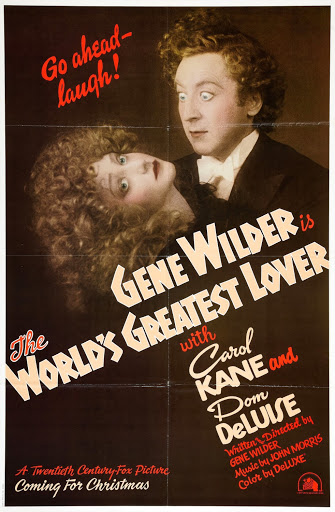
The World’s Greatest Lover (1977)

By Richard Winters

My Rating: 7 out of 10

4-Word Review: Seeking silent film stardom.

Adolph Zitz (Dom DeLuise) is upset that Rainbow Studios, which he heads, is not making as much of a profit as his rival and figures it’s because they don’t have silent film star Rudolph Valentino. He decides, after a meeting with his yes men who constantly surround him, to put out a national search for the world’s greatest lover who will come to Hollywood for a screen test to then become the next big star to rival that of Valentino. Rudy (Gene Wilder) is a hapless baker recently fired from his job who figures that entering this contest could be his ticket out of his penniless doldrums and travels to Hollywood for a screen test. However, once they get there his wife (Carol Kane) breaks away from him and sneaks off to the rival studio in order to try and have a chance encounter with her screen idol Rudolph Valentino (Matt Collins).

While the film did well at the box office bringing in a profit of $21 million off of a $4.8 million budget it flopped badly with the critics who ravaged both Wilder’s screenplay and direction. In a lot of ways they had valid points as the script veers off from the main theme quite a bit and seeming more like a collection of broad gags than a story. The comic bits take a long time to play out becoming almost like skits within a movie. The period atmosphere is poor and you never feel like you’re being transported back to a different era, or that there was even much thought or effort in this area to be authentic. Wilder’s character is problematic too. He can be great when he’s in an exasperated, frantic state and shouting at the top of his lungs, but he goes to this well too often making his character come-off as abrasive.

The one thing that saves it is that it’s surprisingly quite funny. I found myself laugh- out-out-loud at a lot of the bits no matter how meandering they became and really enjoyed the reaction shots from the supporting players. My favorite segment is when Wilder and Kane stay at a hotel with a sunken living room, which accidently gets filled up with water and then Wilder goes swimming in it and pretends it’s a pool when some family members of his come to visit. I also liked how it ultimately drains out onto some guests below who are ordering dinner. I even found the running joke dealing with DeLuise and his man servant barber (played by Michael Huddleston the son of character actor David Huddleston who also appears in the movie) and how he eventually learns to trust his business advice after always beating him up about it first.

The film manages to also make some interesting observations about people although this too borders a bit on getting botched particularly the scene where Kane goes into a tent to meet with what she thinks is Valentino, but really Wilder wearing a veil over the bottom of his face. However, it is clear to the audience just by looking at his eyes, which are very distinct, that it’s Wilder, so if it’s obvious to us it should be obvious to her since she’s been living with him for many years, but it isn’t. I did do like the point that the scene makes where she never enjoyed the sex with her hubby, but when she thought her hubby was somebody else suddenly the sex was ‘great’, which shows how much fantasy works into love making and a fundamental part of its enjoyment.

Wilder’s screen tests are quite amusing too and overall I found myself laughing consistently all the way through. If you’re looking for something light and comical that’s even a bit romantic then this should do the trick.

My Rating: 7 out of 10

Released: December 16, 1977

Runtime: 1 Hour 29 Minutes

Rated PG

Director: Gene Wilder

Studio: 20th Century Fox

Available: DVD

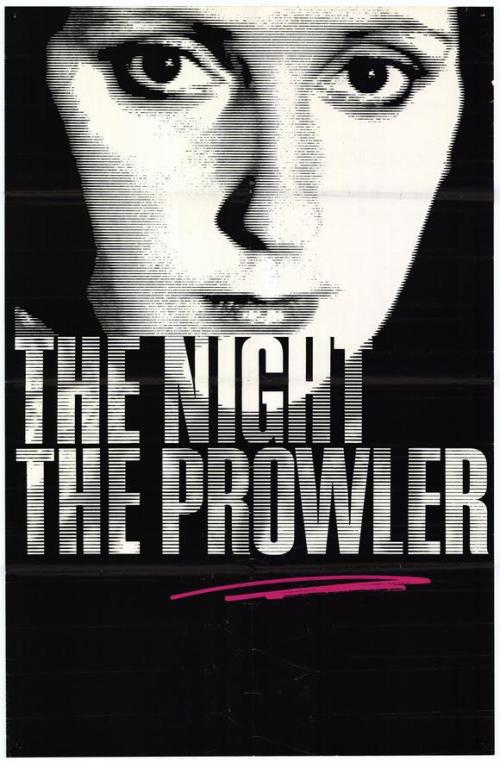
The Night, The Prowler (1978)

By Richard Winters

My Rating: 6 out of 10

4-Word Review: Victim turns into prowler.

Late one night Felicity (Kerry Walker), who is an adult woman still living at home with her parents (John Frawley, Ruth Cracknell), finds that a prowler (Terry Camilleri) has invaded her bedroom. After getting into a conversation with him she is surprised to learn that he’s a married man with kids, who enjoys prowling as a side gig to make up for the monotony and stresses of his home life. Felicity then realizes that the suburban lifestyle that her parents want her to live does not fully satisfy the individual and therefore decides she doesn’t want it. She breaks off her pending engagement with her fiancé (John Derum)  and turns into a prowler herself breaking into men’s homes late at night and learning to enjoy the underbelly of society by socializing with the homeless and other people that her parents always told her to stay away from. She soon finds a sense of empowerment by thumbing her nose at the elitists that make her her suburban community and doing all the forbidden things that her former cloistered lifestyle never allowed.

The film was directed by Jim Sharman best known for having done The Rocky Horror Picture Show. The basis for this project comes from his collaboration with playwright Patrick White and the many plays of his that he directed while doing experimental theater in Sydney during the 70’s. White wanted to expand one of his short stories into a screenplay and Sharman suggested this one had the best chance of working. The two had both grown up in the eastern suburbs of Sydney and wanted to create a film that showed their inner disdain for the arrogant, privileged people that populated the neighborhoods there and how the sterility of those environments may have been a comfort to the adults, but stifling and alienating to the teenagers.

To some level the film is interesting, but the fragmented narrative becomes an intrusive turn-off. Normally I like films that to get away from the mainstream approach and use different cinematic styles to tell a story, but the presentation here never allows you to get emotionally invested into the characters or their situations. There’s too much cutting back and forth between the present day, the past, and even some dream-like segments that ultimately makes the whole thing confusing and off-putting. That’s not to say that there aren’t some provocative moments as there are, but the non-linear approach never allows it to catch its stride, or feel like its progressing forward.

I did enjoy though the scenes with Felicity in the park late at night talking to the homeless while inadvertently scaring off a gang of young hoodlums by chasing after them and demanding that they assault her. When she breaks into a rich couple’s home and systematically destroys it and their subsequent over-the-top facial reactions when they come home to witness it is a hoot too. There are though some very disturbing moments too including Felicity’s conversation with a naked, starving homeless man (Harry Neilson) that she finds lying inside the filthy squalor of an abandoned building.

The one thing that holds it all together is the acting. Walker is perfectly cast in the lead as her plain looks and perpetually despondent expression visually signals her inner angst and alienation. Cracknell though completely steals it in a campy send-up of the suburban housewife/ mother that is at times both comically absurd and over-the-top funny. Her odd behavior keeps the interest going even as the story and direction at times lull and in fact it was enough to have nominated for the Best Actress Award by the Australian Film Institute.

My Rating: 6 out of 10

Released: June 2, 1978

Runtime: 1 Hour 25 Minutes

Not Rated

Director: Jim Sharman

Studio: New South Wales Film Corporation

Available: DVD, Amazon Video

Cisco Pike (1971)

By Richard Winters

My Rating: 8 out of 10

4-Word Review: Blackmailed into dealing drugs.

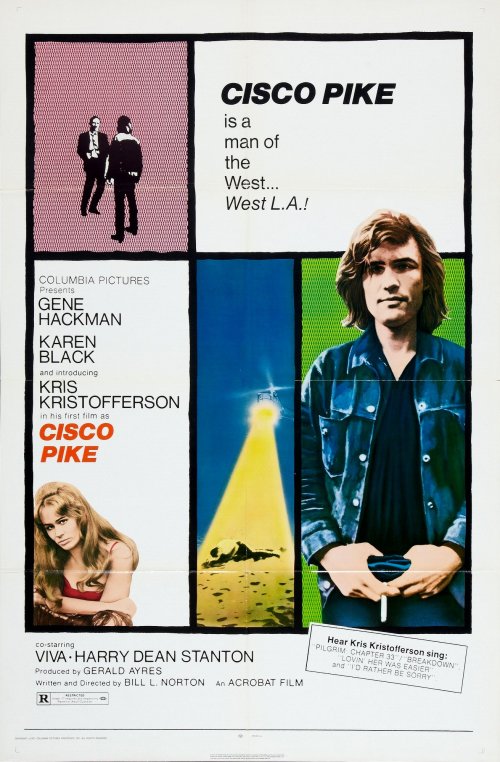
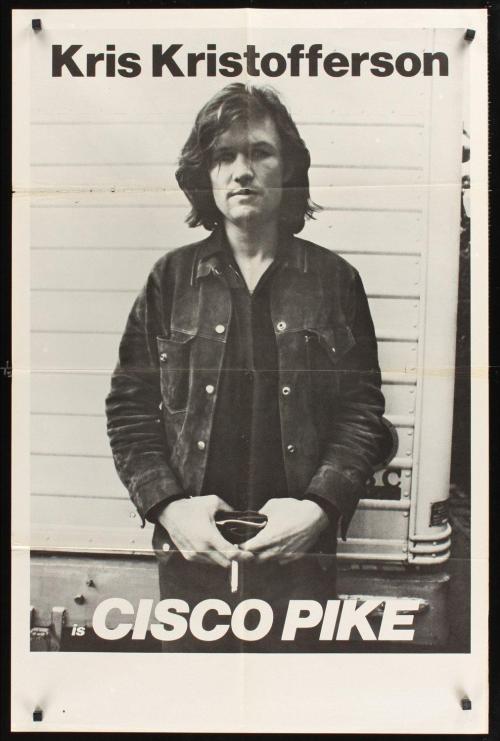
Cisco Pike (Kris Kristofferson) is a down-on-his-luck singer who once was playing to sell-out crowds, but finds his popularity declining and resorting to selling drugs to maintain a living, but under pressure from his girlfriend Sue (Karen Black) has stopped. Leo Holland (Gene Hackman) is a police detective looking to retire and needing enough money to do so. He steals a sizeable quantity of high-grade marijuana from a gang leader and then tells Cisco he must sell it within 59 hours while giving Leo $10,000 of the profits and Cisco can keep anything that he makes beyond that. At first Cisco resists knowing it will interfere with his relationship with Sue, but eventually gives in when Leo threatens to kill him unless he complies.

While this film has achieved a cult status in recent years critics at the time of its release were not kind. Many felt it promoted drug use just as the nation was starting its war on drugs, which caused the film to get a limited release and eventually bombed at the box office. Personally I found it to be a riveting look at the drug dealing culture and a fabulous directorial/screenwriting debut for Bill L. Norton the son of William W. Norton who was also a successful screenwriter.

What I liked most was the cinema vertite style that made it seem almost like a documentary. I enjoyed the camera following Cisco around in a non-stagy way and revealing the variety of people that he sold to with not all of them being hippies either, but also middle-aged suburbanites and even business executives. The film nicely shows how some of the encounters would be non-eventful while others could ended up being a trap and eventual police chase. The unpredictable quality of the transactions replicated the anxiety the dealers would face and how hyper observant they needed to be to the immediate environment around them.

Many films try to recreate things that the filmmakers themselves haven’t gone through, but here I got the feeling that the director and much of the cast had experienced the same situations as the characters which in-turn makes the viewer feel, when it’s over, that they’ve lived it too. The dialogue is excellent as well with a conversational style that doesn’t overexplain things and allows the viewer to read in a bit to what the characters are saying.

Kristofferson, who had been a singer up to that point, makes an outstanding acting debut and all the more impressive when you realize that he had no acting training before he was given the part. Many of his friends advised him not to take the role fearing his lack of experience would hurt the movie and cause him not to be given any more roles, but after reading the script he felt he could relate to the character by simply being honest with his emotions, which he does splendidly and it’s nice too seeing him in a rare appearance without any beard or mustache.

Hackman is excellent as well playing a character that was not in the original treatment, but added in later by Robert Towne when he wrote the revision. It’s unusual seeing him in such a relatively small part with large chunks of time, especially during the second act, where he’s not seen at all, but when he is onscreen he’s effective. It was fortunate that this was filmed just before he won the Academy Award for The French Connection as that turned him into leading man material and it’s unlikely that he would’ve accepted this part had it been produced any later.

Black is interesting, she usually always is, despite, like with Hackman, not having all that much screen time, but she makes the most of what she has particularly her physical reactions to Hackman when he invites himself into her apartment late at night and begins rambling on about his heart condition. Honorable mention too needs to go to Joy Bang, an attractive supporting actress during the early 70’s who later retired from show business to get into nursing. Her toothy smile always looks sexy, at least to me, and I loved when she gives her female companion, played by Viva, an open-mouth kiss while riding in a car and then turns around and gives Kristofferson, who is sitting on her other side, the same treatment.

Harry Dean Stanton, as an aging musician, doesn’t appear until near the end, but has some of the movie’s most profound moments particularly his exchange with Kristofferson were he laments about no longer being sexy enough for the stage while Kristofferson reminds him that it’s not his body that the music business wants, but his soul instead.

My Rating: 8 out of 10

Released: November 2, 1971

Runtime: 1 Hour 35 Minutes

Rated R

Director: Bill L. Norton

Studio: Columbia Pictures

Available: DVD

Fight for Your Life (1977)

By Richard Winters

My Rating: 4 out of 10

4-Word Review: Racist thugs terrorize family.

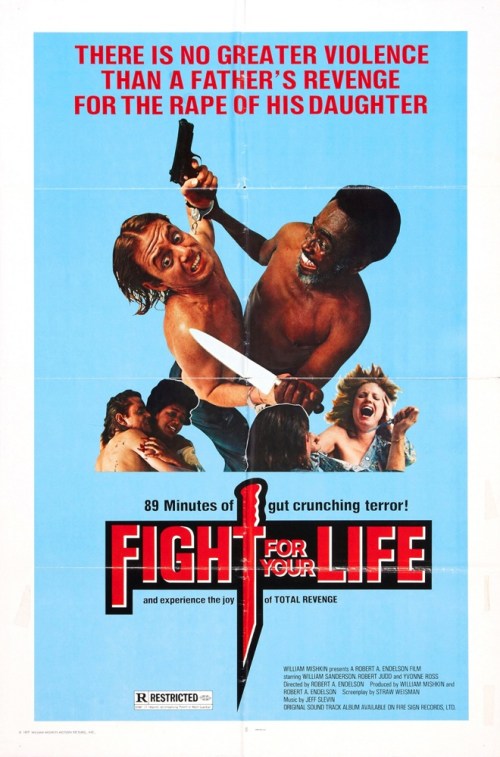
Three escaped convicts (William Sanderson, Daniel Faraldo, Peter Yoshida) find an isolated home in a woodsy are of upstate New York where they barge in on a black family headed by Reverend Turner (Robert Judd).  Jessie, the gang’s leader, is quite racist and uses the opportunity to spew out his hateful side forcing the home’s occupants, particularly the father, to do all sorts of humiliating things all to the amusement of the three men, but the family remains stoic determined to turn-the-tables on their captors the moment they get their chance.

The film could best be described as a variation on the Last House on the Left theme and in some ways does it much better. There’s none of the campy ‘comic relief’ humor here that almost ruined that one and the film is unrelentingly violent and grim. So many exploitation flicks from the 70’s would usually sell-out and never be half as provocative as advertised, but on that regard this movie delivers in ways that would still be considered jaw-dropping today and most likely not have any chance in this modern PC-era of getting filmed.

However, with that said, it’s still quite obnoxious and even repulsive to watch. There seems to be no other reason to have made this then to shock and appall and I’m genuinely surprised why anyone would’ve agreed to act in this particularly the black performers, who get forced to go through some truly tasteless and degrading acts.

The directing at times comes off as amateurish. It’s supposed to take place in the fall with leaves having turned color and almost fully off the trees, which is what we see when the thug’s car pulls up to a toll booth on a cloudy day and yet when the camera cuts to show the car leaving the toll booth the sky is now sunny and full green foliage on all of the trees. The music is also too loud, gets in the way of the action where natural ambience would’ve created more tension, and seems like a soundtrack better suited for a blaxploitation flick.

I wasn’t real happy with Sanderson’s presence either. Don’t get me wrong, he’s a gifted character actor, who’s best known for having played Larry in the ‘Newhart’ TV-show where he’d enter every scene by introducing himself as well as his two brothers named Darryl. In the comic realm as a backwoods hick his accent and talents are perfect, but here I could never take him seriously. His voice is too high pitched to be menacing and his wiry physique isn’t imposing. This might’ve been the intention at showing how without a gun he wasn’t much of man, but for the film to be truly scary there needed to be someone with a very intimidating look running the show.

Spoiler Alert!

The ending just about destroys what little potential this production had as it features an entire police force coming to the home, but instead of rescuing the occupants they choose to instead just stand outside and do nothing even as two of the women get raped. Supposedly this wasn’t for racist reasons, but more because they feared the victims might accidently get killed should they rush in to save them, but what’s the use fitting a police department with weapons and training if they’re going to be too timid to use it when they need to?

The idea that the black family would become aware that the police where outside, but stall them simply so they could enact their own revenge on the bad guys was too much of an overreach. The ending would’ve worked better, and been more believable, had the police not arrived at all and thus forcing the victims to use their own wits and ingenuity to overtake the brutes and then allowing their anger to spill over causing them to become far more vindictive than anyone could’ve imagined.

My Rating: 4 out of 10

Released: October 1, 1977

Runtime: 1 Hour 26 Minutes

Rated R

Director: Robert A. Endelson

Studio: William Mishkin Motion Pictures

Available: DVD, Amazon Video, YouTube

Petersen (1974)

petersen1

By Richard Winters

My Rating: 7 out of 10

4-Word Review: Going back to school.

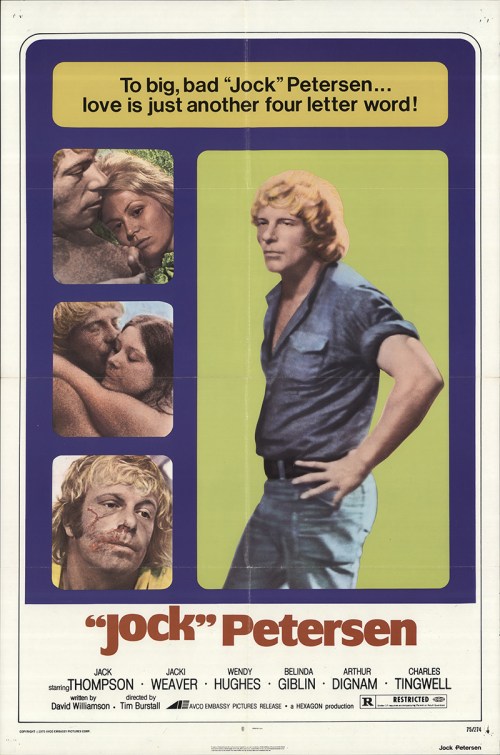
Tony Petersen (Jack Thompson) is an electrician who decides to go back to school and major in English. He feels people look down on him because he works a blue collar job and hope that by returning to college to get a degree that will change, but instead he finds he’s still not getting the respect that he desires particularly from his stuffy professor (Arthur Dingnam), so he ends up having an affair with the man’s wife (Wendy Hughes),  but things don’t stop there. He has sex with the coeds too including right out in the open on the campus grounds for public display while hundreds of onlookers surround them.

The screenplay was written by acclaimed Australian playwright David Williamson, who’s best known for having penned the cult hit Don’s Party However, this film lacks the fluidity of that one and seems more like a selection of vignettes than a story. The leader character isn’t likable either and comes off as selfish while in Don’s Party we were able to understand the protagonists frustration with his marriage here the domestic situation doesn’t seem as bad and therefore watching him mess around isn’t cute, funny, or sexy and instead just tiring and off-putting.

The biggest problem though is that the film starts right away at the halfway point where Petersen has already been attending school and neck-deep in an affair instead of going back to where it all began. Showing Petersen’s frustrations with his job and income, instead of just being told about it through dialogue, would’ve helped the viewer empathize more with his situation and emotionally invested with his quandary instead of feeling lost and ambivalent in the jumbled narrative.

There are a few good scenes here-and-there including a very ugly moment where a group of obnoxious bikers crash an upscale party and make things quite tense for the guests who are seemingly unable to do anything about it. Later there’s a poignant segment involving a discussion that Petersen has with his father (Charles Tingwell), who works as a reverend at a church despite professing to having lost his faith. Petersen’s public sex act has great potential too and even though it does contain full frontal male nudity, which at the time was still considered shocking to see in a mainstream film, it doesn’t get played-up enough to really being as funny or irreverent as it should’ve been.

Spoiler Alert!

There’s also several moments though that needed more context, which is frustratingly lacking. One includes Petersen getting caught making-out with his friend’s wife by his own spouse (Jacki Weaver) who looks very disappointed in him, but we never get any follow-up almost  like the whole situation just gets forgotten by the next day. There’s another scene where Petersen rapes his lover inside her own office, but without showing any aftermath. Such a violent, disturbing act deserves some denouncement and not treated like a throwaway bit such as it is.

End of Spoiler Alert!

Overall if you stick with it the characters do have a way of growing on you, but the story needed to be more developed. Too much emphasis on being edgy and provocative, but filled with characters in desperate need of depth and better connecting pieces between scenes.

My Rating: 7 out of 10

Released: October 25, 1974

Runtime: 1 Hour 43 Minutes

Rated R

Director: Tim Burstall

Studio: Hexagon Productions

Available: DVD (Import Region 2)

End Play (1976)

By Richard Winters

My Rating: 6 out of 10

4-Word Reviews: Feuding brothers hold secret.

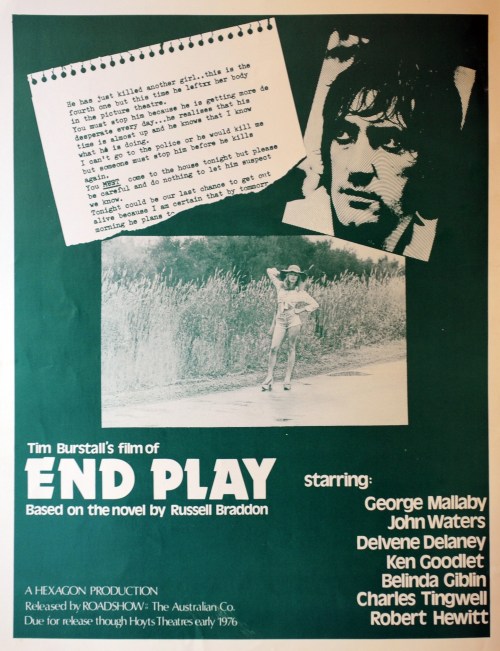
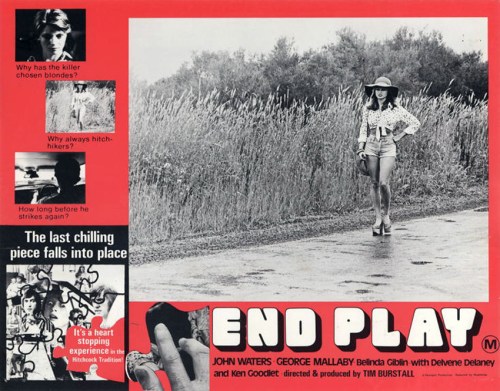
Mark (John Waters) picks up a hitchhiker (Delvene Delaney) on a lonely road and then promptly kills her. He then travels to his brother Robert’s (George Mallaby) house for a visit. When Robert leaves to go target practicing Mark brings the dead hitchhiker’s body inside and dresses her up to make it appear that she is still alive. He then disguises himself while taking the corpse to the local movie theater and once there he sneaks leaving the dead body to be discovered by others. Once the news of the grisly discovery hits the airwaves Robert immediately suspects Mark, but decides not to go to the authorities since he is already a paraplegic and at risk, due to lesions on his neck, of losing the movement of his arms, which will ultimately render him under the care of Mark. He also dislikes the police due to a childhood issue that he had with them, so for these reasons he covers for Mark’s actions, but when he realizes that his girlfriend (Belinda Giblin) has cheated on him with Mark he decides to carry out a stern revenge of his own.

The film, which is based on the novel of the same name by Russell Braddon, takes a unique spin on the mystery angle. Instead of delving into the action we get treated to the psychological interplay of the two leads and the many twists and turns their relationship takes where one minute they seem like comrades and the next enemies. Mallaby, who ironically ended up wheelchair bound in real-life after suffering a series of strokes in 1994, gives an edgy performance where his personality is so strong and aggressive that you really don’t notice the handicap at all. I liked the soundtrack by Peter Best too as it has a nice subtle quality that accentuates the creepiness without ever calling attention to itself.

While the film manages to hold interest it is somewhat slow. With the exception of a violent confrontation between the two brothers that occurs near the end there’s no action to speak of, so unless the viewer is really into the psychological aspect they may find the pace to be a bit boring. The two leads aren’t likable either. Normally the tension is created because you care about the protagonist and don’t want to see them harmed or in trouble, but in this case that’s all missing.

Spoiler Alert!

The biggest letdown though comes with its twist ending in which we find that Mark wasn’t the killer after all, but instead it was Robbie. However, director Tim Burstall completely botches this by showing the back of Mark’s head during the opening scene when the hitchhiker enters the vehicle. The two have completely different hair color with Mark’s being brown and Robbie’s being blonde and I even went back to the scene to make sure and there’s no mistaking it, it’s Mark’s head. This could’ve been completely avoided by simply having the camera act as the killer’s point-of-view where we only see the face of the hitchhiker as she enters the vehicle and is then killed. The fact that this wasn’t done was a big mistake and nullifies the intended surprise.

My Rating: 6 out of 10

Released: January 1, 1976

Runtime: 1 Hour 48 Minutes

Director: Tim Burstall

Studio: Hexagon Productions

Available: None at this time.