Category Archives: 70’s Movies

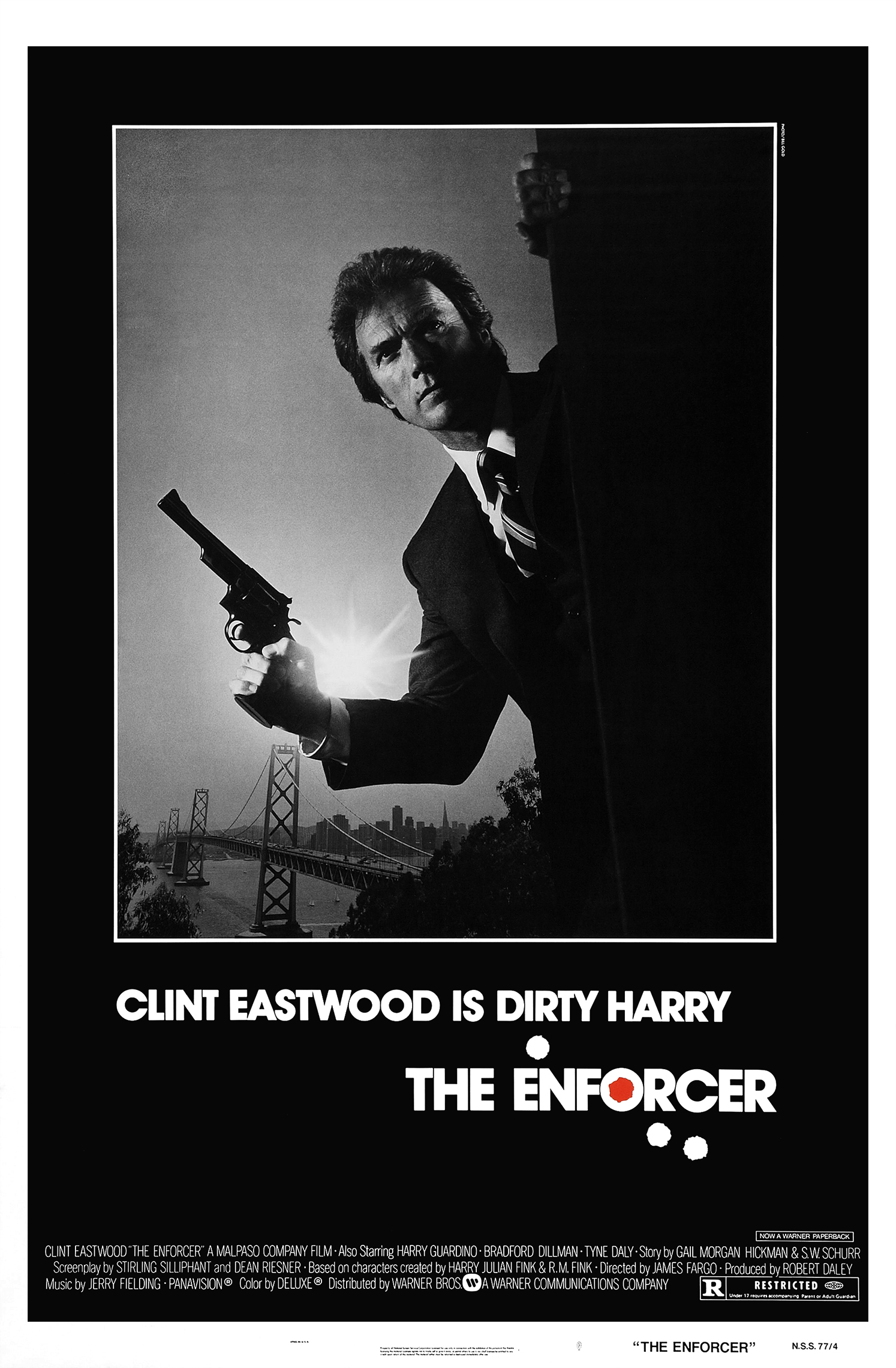
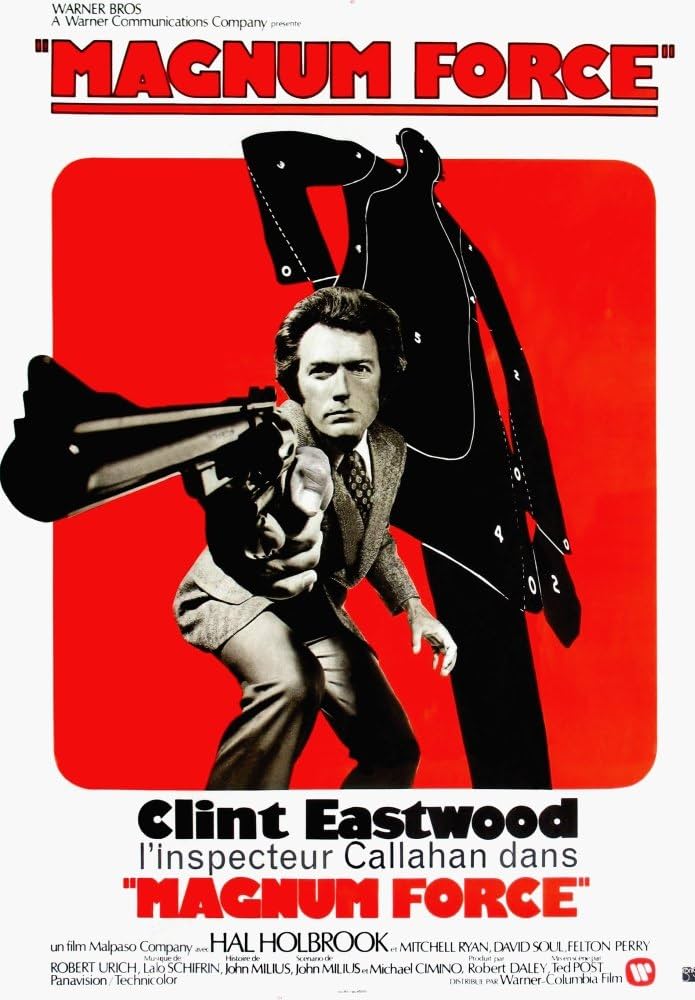
Dirty Harry (1971)

By Richard Winters

My Rating: 10 out of 10

4-Word Review: Cop doesn’t like rules.

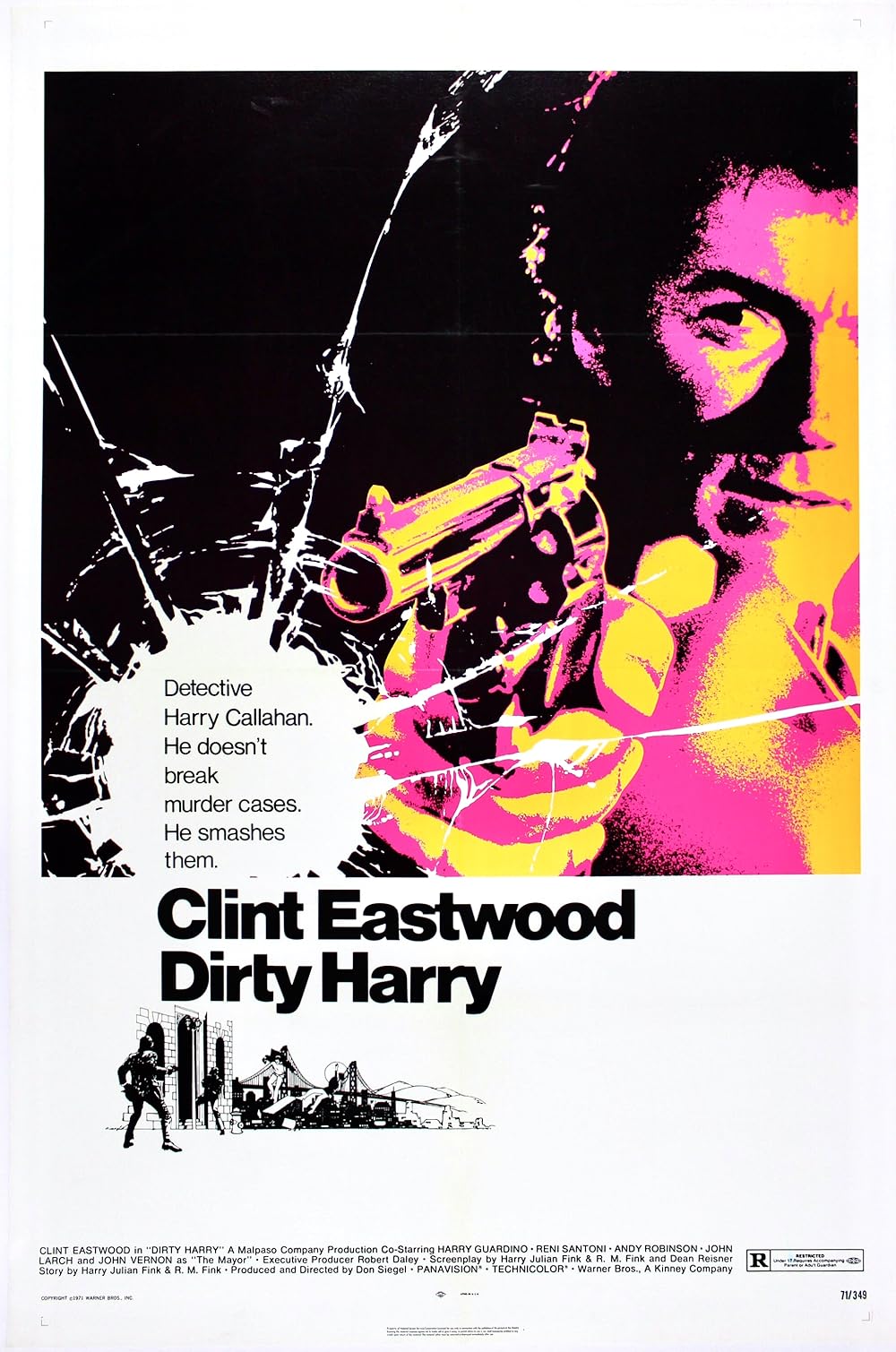
A psychotic who goes by the nickname of Scorpio (Andrew Robinson) has pledged to kill one person a day unless the city of San Francisco forks over $100,000 with his first victim being a woman (Diana Davidson) taking a swim in a pool on a rooftop of a high rise. The mayor (John Vernon) agrees to give into the killer’s demands much to the objections of Harry Callahan (Clint Eastwood) a hard-nosed cop who believes criminals are coddled by the system at the expense of their victims. Yet Harry, who’s known by his fellow cops as Dirty Harry, which he acquired for his well-known ability to circumvent rules that he doesn’t agree with, must go along with the demands of his department forcing him to act as the delivery of the ransom. This causes him to go through the humiliation of running all around the city at the whim of Scorpio who gives him directions of where to go next via different pay phones in the area. When Harry almost gets killed by doing this and then asked to be the delivery guy again, he walks out insisting that appeasing the killer is the wrong way to go. This causes even further irritation when Scorpio is later caught by Harry and then freed on a technicality convincing him that he must work on his own time in order to get the Scorpio put away permanently.

The script was written by the married team of Harry Julian Fink and his wife Rita. The inspiration came from the real-life Zodiac case who terrorized the city of San Francisco during the late 60’s and was never caught. The main character was supposed to be someone in their 50’s and was originally offered to Frank Sinatra, who had difficulty holding the Smith and Wesson gun, and decided to bow out. It was then offered to Paul Newman, Steve McQueen, who had just gotten done playing a cop in a movie and didn’t want to have to do another one, as well as George C. Scott and Burt Lancaster who both rejected it due to their feelings that the story’s theme was right-wing.

As a cop film it’s by far one of the best and has a lot of unique moments. Because Bullit had come out just a few years earlier, which featured a very famous car chase, it was decided not to replicate that one and instead we get treated to some very exciting foot chases with one occurring inside a factory mill and another at Kezar Stadium late at night. What makes these chases so interesting is that there’s no musical score played over them like in most movies, but instead we hear the pounding of their feet on the pavement and other outside ambience that helps to make these sequences grittier and more captivating. When the music does get played it’s when Scorpio is aiming his rifle to kill someone, but has the distinct sound of female vocals, which composer Lalo Schifrin put in to represent the voice he felt Scorpio was hearing inside his head.

Eastwood has made a career of playing this type of role, but here it comes off as fresh and like it was perfectly written for him and no one else could’ve played it better. His patented grimace and squint really work here and it’s interesting seeing the way his crusty exterior softens a bit as the film progresses and I liked the contrast of pairing him with a younger, less experienced cop, played Reni Santoni, that Harry initially thinks very little of, but eventually grows to like and respect. The conversation that he later has with Reni’s wife, played by Lyn Edgington, in which they discuss the emotional toll that being a cop can do to an individual really exposes the challenging job that it is as does Harry’s night on patrol where he’s forced on the spot without preparation to take on many difficult tasks including talking a man down from jumping off a building. This all helps to unglamorized the life of a cop while also revealing the underlying stressful nature of the position and why so many men and women that do it will eventually get burned out. 

Andrew Robinson, in his film debut, is excellent as well with a distinct eyes and face that looks constantly creepy. Normally I’d complain that we learn very little about his character nor the motivation for why he kills, but keeping him as an enigma helps put the focus on the main message, which is the rights of the victims and cops who try to protect them and by making Scorpio have a distinct personality would’ve humanized him and thus deluded the theme. Even so Robinson makes the most of each scene he’s in and he consistently stands out no matter what he’s doing, like the almost comical facial expression he makes when he gets stabbed in the leg. I also liked how after he does get stabbed that he then continues to walk and run with a limp versus other films where someone gets injured and they quickly recover, and it eventually becomes all but forgotten. 

Spoiler Alert!

My only complaint is how at the very end Harry throws away his badge and walks off the job. Director Don Siegel and Eastwood argued about this with Eastwood feeling Harry wouldn’t do this as being a cop was the only job he knew and his relentless pursuit for justice and putting bad guys away would overpower his urge to quit. Even if he was unhappy with some of the police procedures, he’d still put up with it, or fight to improve things from within. This is why at the end he should’ve taken out his badge and looked at it like he was thinking of throwing it, but then eventually put it back into his pocket. 

My Rating: 10 out of 10

Released: December 23, 1971

Runtime: 1 Hour 42 Minutes

Rated R

Director: Don Siegel

Studio: Warner Brothers

Available: DVD, Blu-ray, Amazon Video, YouTube

The Seven Ups (1973)

By Richard Winters

My Rating: 7 out of 10

4-Word Review: Cops use unorthodox methods.

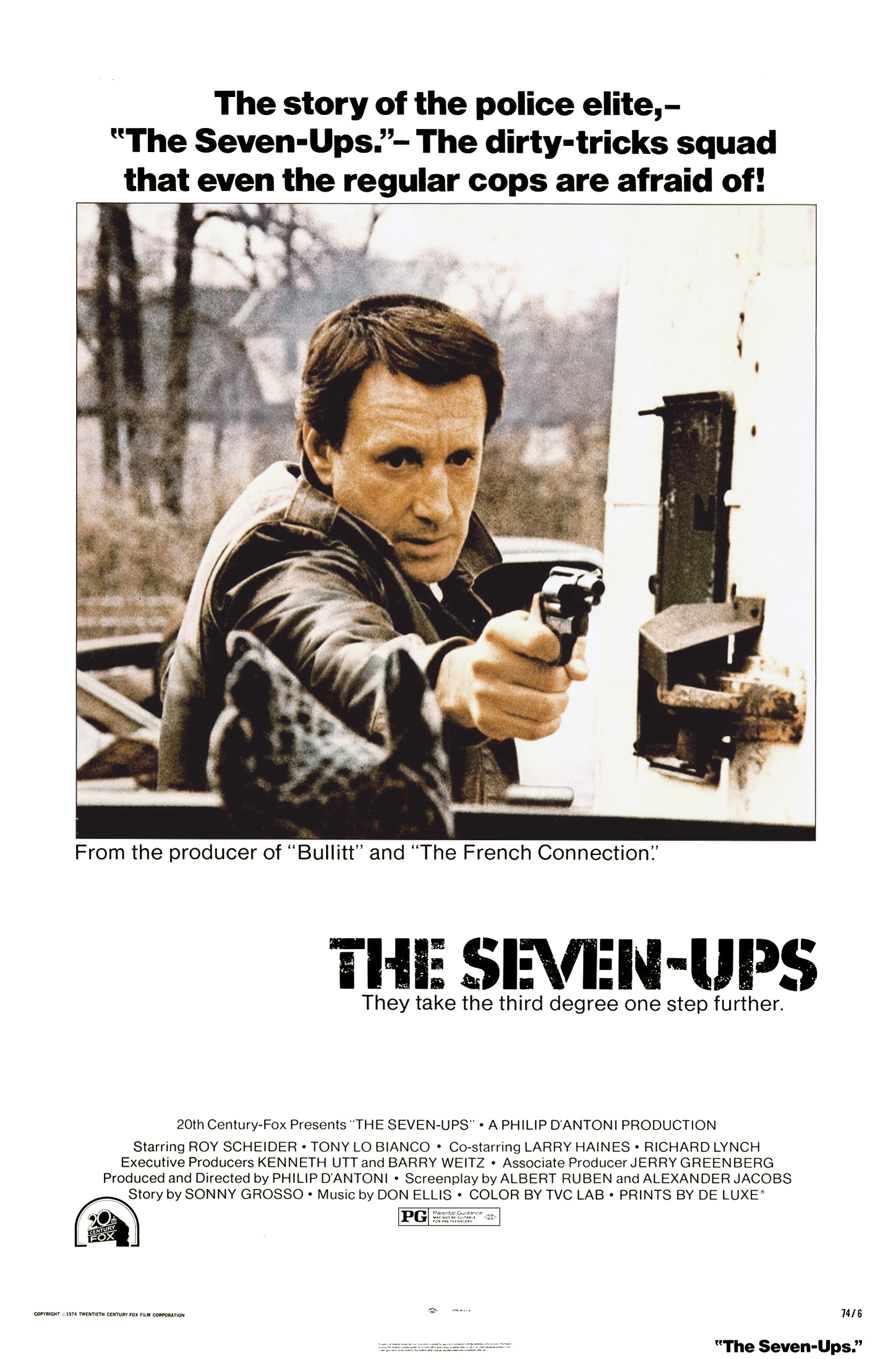
Buddy (Roy Scheider) is a police detective who runs a group of renegade cops who employ unusual and sometimes questionable methods to nab crooks. Once apprehended the criminals they arrest usually end up serving 7-years or more in the penitentiary, which gives their group the nickname of the ‘Seven Ups’. The groups most recent mission is investigating kidnappings occurring in the city and Buddy uses the help of Vito (Tony Lo Bianco) a childhood friend who works as an undercover informant for the police, but who unbeknownst to Buddy is actually behind the recent crimes going on and even the orchestrator.

After the success of The French Connection producer Phil d’Antoni became inspired to produce another similar crime film dealing with the true-life event that occurred in the 50’s in New York that had mobsters being kidnapped by criminals posing as cops. He wanted William Friedkin, who had done so well with the first film, to direct this one, but Friedkin didn’t like the script and passed as did several other directors, which eventually lead the studio to choose d’Antoni to take the helm himself in his one and only foray behind the camera with results that are both good and bad.

The production lacks cinematic flair and shot in a flat way almost like a documentary, which to some degree actually helps it. It was filmed between January and April of 1973 and the crisp, gray, frigid look helps build an atmosphere by accentuating the grimy, cold life of the underworld and how the detectives themselves get foisted into it. The plot is basic and linear, so it’s easy to follow and not cluttered with unnecessary mystery angles and tangents as the viewer knows right away who’s behind everything. There’s also a tense scenes inside a car wash, not exactly sure the perpetrators would’ve been able to pull-off as effortlessly as they do, but it definitely keeps you riveted as you feel the same unease as the two guys in the car though having another scene come later that also takes place in a car wash wasn’t needed.

The film though doesn’t have the interesting characters like in The French Connection where Popeye Doyle’s lifestyle and temperament contrasted in fascinating ways with the man he was pursuing and in fact it was Doyle’s fractured personality that made the movie so compelling. Here, through no fault of Scheider who plays the part well for what is asked, but his character is quite one-note. We learn nothing about him, or his home life. He’s just a typical New York cop obsessed with getting the bad guys, which is fine, but doesn’t have the multi-dimensional quality to help make him memorable.

The supporting characters aren’t necessarily much better, but the actors who play them at least help give them some life. Larry Haines, probably best known for playing one of Felix and Oscar’s poker playing buddies in The Odd Couple, has a good turn here as a crime boss who’s nonchalant initially when he thinks he’s being taken to the cop station for a routine arrest only to cower in fright when he realizes he’s been duped and then when he survives shows no mercy in his unrelenting pursuit for revenge. My only quibble though is that Scheider and his cohorts are able to break into Haines’ house too easily and even able to catch him and his wife sleeping in bed, but you’d think with him being a well-known target with the police he’d have burglar alarms set-up all over his home to detect anyone trying to get in and since he’d just had a traumatic kidnapping incident earlier you’d think he wouldn’t be able to sleep soundly again, or paranoid enough to sleep lightly and aware of any noise.

The car chase sequence is by far the best moment, and some may say the only real reason to watch it. It certainly has you holding your breath, but in a lot of ways is too similar to Bullit, another film produced by d’Antoni, so it really doesn’t stand out as much as it should. There’s also the issue of Scheider pursuing the bad guys even as there’s pedestrians all around. Most real-life cops will stop chasing after a culprit’s car if they feel  it will put others at too much of a risk and this comes to a horrifying moment when school children are playing on the street and must quickly run to the curb when the bad guys drive their car through only a few seconds later to almost get hit by Scheider’s car as he plows through at high speeds without even a thought of putting on his breaks making him seem more like an irresponsible cop who’s more of a problem than a solution.

Nonetheless it’s gripping and I enjoyed how it ends with Scheider ducking under the windshield just as his vehicle hits the underside of the backend of a truck in an intended ‘homage’ to Jayne Mansfield’s wreck. It’s also great watching Richard Lynch’s facial expressions as he plays the crook sitting in the passenger’s side of the fleeing car. Some could say it’s great acting, which maybe it was, but I believe his looks of nervousness and fear was genuine, which just helps to make these shots of his face, which get intercut throughout the chase all the more entertaining and help to have a human side to the action as I and almost anyone else would be reacting the same as he does if we were in the same situation.

My Rating: 7 out of 10

Released: December 14, 1973

Runtime: 1 Hour 43 Minutes

Rated R

Director: Philip D’Antoni

Studio: 20th Century Fox

Available: DVD, Blu-ray

Sunburn (1979)

By Richard Winters

My Rating: 2 out of 10

4-Word Review: Couple investigates insurance fraud.

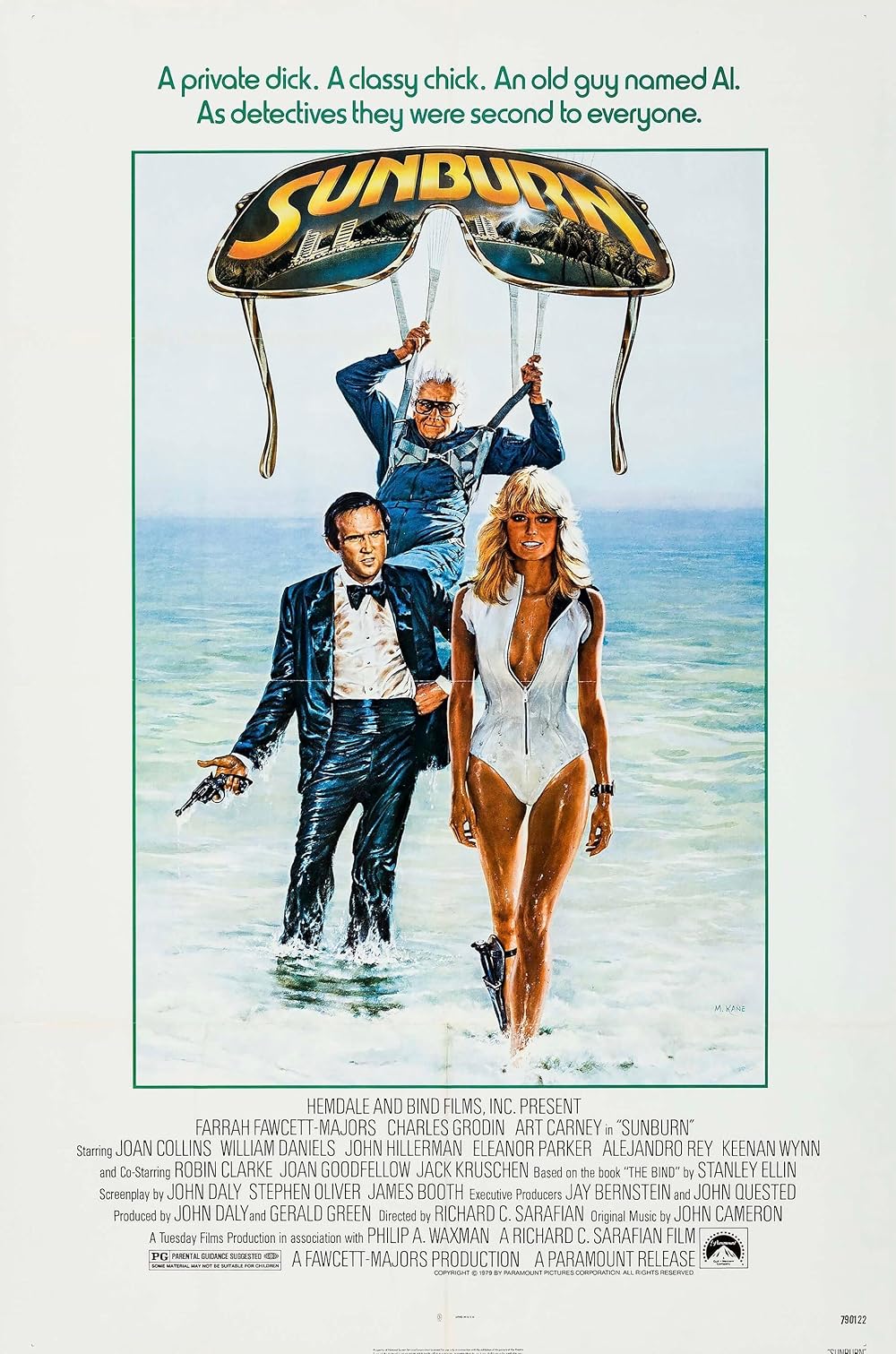
Jake (Charles Grodin) works as a private eye and gets hired by an insurance company wanting him to investigate a case that took place in Acapulco of a man who crashed his car into a building and died. The authorities have labeled it an ‘accident’, which would put them on the hook to have to pay out a large sum of money, so they’d like Jake to travel down there and find out if that were really the case, or if it could be deemed as a suicide. Jake decides to hire an actress from a modeling agency named Ellie (Farrah Fawcett-Majors) to act as his wife. Ellie takes an interest in the case and helps him search for clues while also forming a romance with him, which starts out rocky but becomes stronger as they find themselves sucked further into the mystery and the potential dangers.

The film is based on the 1970 novel ‘The Bind’ by Stanley Ellin, which had a grittier tone than the movie. Farrah’s agent Jay Bernstein felt this would be a good vehicle for her, but wanted the script turned into more of a lighter and comical story that the book did not have. This was at a crucial point in her career as the first film he got her cast in Somebody Killer Her Husbanddid badly with both the critics and public, so it was important that she prove her box office ability with this picture and when this one also bombed she fired him complaining that both movies had been ‘put together with hustle and bubble gum’.

One of the elements that really hurts it is the casting of Charles Grodin, who by his own admission was their sixth choice for the role as they had initially pursued Robert Redford and even Harrison Ford, who would’ve both been way better. Grodin can certainly be funny, but this part doesn’t give him much to work with. He has a few amusing moments when he’s trying to scare away a lizard from entering their bedroom and then in an effort ‘to protect her’ from a further ‘lizard invasion’ agrees to sleep on a nearby chair, which cause him to do nothing but toss and turn the whole night in an effort to find a ‘comfortable’ position.

His character though didn’t seem all that professional as he leaves it up to her to place a listening device into one of the suspect’s phones, but she had no background in this kind of thing, so what would happen if she screwed it up? The insurance company is promising him a lot of money so it should be up to him to do most of the legwork to make sure it gets done right and if any ditzy amateur blonde can be pulled in off the street to do what he does then what’s the point in hiring him to begin with?

Farrah does much better here than her previous film. I enjoyed her dialogue with Grodin and how just because she was hired to play his wife didn’t mean she was automatically going to be one during their off hours when he for some chauvinistic reason expects her to make him a sandwich, which she immediately declines to do. I was confused though why her character would want to get so involved in the case. She’s just there to play a part, so why not just do her job and enjoy the sun? Instead, she constantly puts herself in increasingly dangerous situations for no real reason. She’s gets paid whether the case gets solved or not, so why jeopardize her life over something that she has no emotional or financial investment in?

It’s also hard to believe that such a hot looking lady wouldn’t be in a relationship. It would’ve been far more enjoyable had there been a jealous boyfriend who secretly followed her on her mission and even threw a few monkey wrenches into the investigation, which could’ve added extra spark into a movie that’s otherwise too leisurely. For her to then fall in love with Grodin was equally dumb. The guy could’ve been her father and lacked any type of sexual pizazz. Had Redford or Ford been cast then the romance might’ve made more sense, but such a beautiful woman like her would have no reason to settle for a doofus like him and would simply be there for the payout and then be long gone.

Art Carney is great in support and actually does most of the work making it seem like Grodin’s character wasn’t even necessary and in fact having Carney and Farrah team up would’ve made it unique and more entertaining as Carney despite his advanced age shows a lot of energy particularly when he goes out onto the disco floor. The rest of the cast though gets wasted with many of them having only one or two lines making you wonder why they’d bother to sign on at all.

The film does have one memorable moment where Carney and Farrah, in an effort to escape the bad guys who are pursuing them, inadvertently crash their car into a bull fighting ring and then must avoid the bull who goes after them. This action is both humorous and exciting, but otherwise unless you’re some super Farrah fan the movie offers little else that’s interesting.

My Rating: 2 out of 10

Released: August 10, 1979

Runtime: 1 Hour 45 Minutes

Rated PG

Director: Richard C. Sarafian

Studio: Paramount Pictures

Available: DVD-R (MGM Limited Edition Collection)

Good Luck, Miss Wyckoff (1979)

By Richard Winters

My Rating: 1 out of 10

4-Word Review: Spinster teacher is raped.

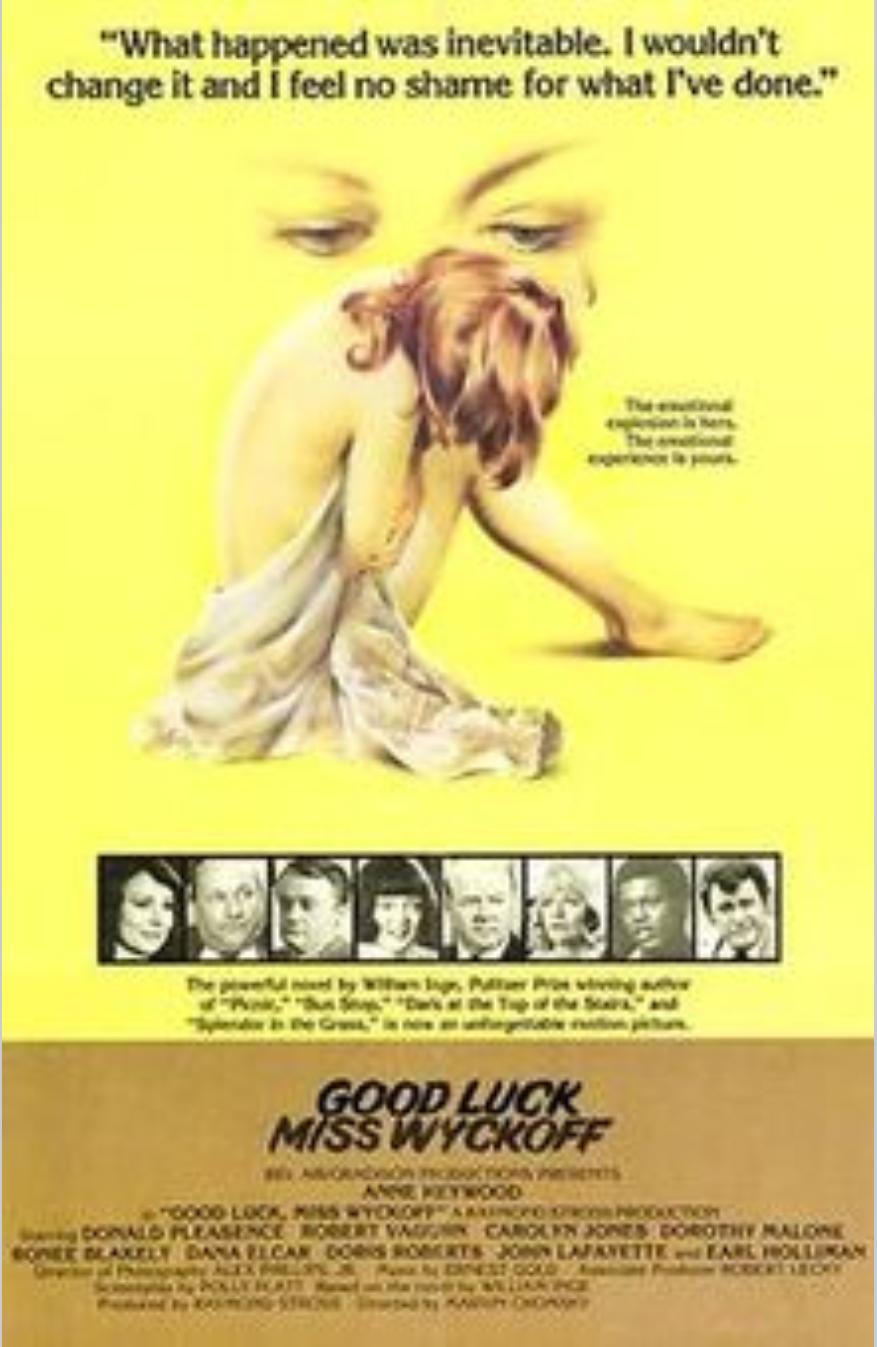
Evelyn Wyckoff (Anne Heywood) is a middle-aged single woman who teaches high school in a small town in Kansas. She has never married and is showing signs of severe depression, which alarms her best friend Beth (Carolyn Jones) as well as the older couple (R.G. Armstrong, Joycelyn Brando) whom she’s living with. Both her doctor (Robert Vaughan) and her psychiatrist (Donald Pleasance) believe it’s because she is not in a relationship or having any sex and that she needs to get out more and meet people. She attempts at starting something with fellow teacher Chester (J. Patrick McNamara) but finds him to be too shy and embattled with his own problems to be able to recognize her interests. She also considers friendly bus driver Ed (Earl Holliman) only to call it off when she learns he’s married. Left alone after school one evening she comes into contact with Rafe (John Lafayette), a black man who works as the janitor, who sees her loneliness as a weakness that he can exploit. He comes onto her strongly and abrasively eventually forcing her to submit to his sexual demands, but she doesn’t go to the authorities and instead starts to enjoy the degradation and continues to come back for more until the rest of the students and teachers find out about it putting her job and reputation in peril.

The story is based on the 1970 novel of the same name written by William Inge. The film rights were sold in 1971 but sat on the shelf for many years until producer Raymond Stross found it and felt it would be a good vehicle for his actress wife Heywood who had already made a name for herself in tackling controversial, edgy material and even sought it out, so this was considered a perfect next project. While she had received critical accolades for her earlier work, The Fox, where she played a lesbian in a  relationship with Sandy Dennis, which was envelope pushing for its era, this one did not go over as well and was genuinely lambasted causing her career to take a downfall from which it couldn’t recover and she ended up retiring from acting just a decade later.

On a surface level it’s okay. The recreation of the 1950’s Kansas, while shot in Stockton, California, is still effective and the personalities of the people isn’t as cliched. There are those that show prejudices and oppressive mind sets, but there’s a healthy balance that don’t, which helps make it feel more realistic. The supporting cast is full of familiar faces though most of them are wasted in small roles that don’t add much and Carolyn Jones, in her last feature film appearance, stands out best albeit with an awful hairstyle.

The biggest detriment, besides the flat direction and booming music score, is Heywood who doesn’t offer enough nuance to her part. I’ll commend her for taking on a very difficult role that required at age 48 to be fully nude and allowing herself to be put into some very vulnerable and demeaning positions, but her facial expressions and responses are one-note. Her constant crying for no reason, which alarms those around her, and unexplained impulsive behavior, like smashing a mirror during a party, is too dramatic. Instead of using this to reveal that she’s unhappy it makes her seem more like a complete mental case that has far worse issues than just being lonely and I felt more sympathy for her friends trying to put up with her erraticism than I did with the main character who for the most part is rather whiny and annoying.

There’s never any explanation for why she’s unable to get into a relationship. She’s attractive, so you’d expect there would be eligible suitors who’d ask her out. All we see is a bus driver who’s already married, but what about other single men who would have to be out there? Why don’t we ever see one of them make a move and if so, how would she respond to them, which would be far more revealing than anything she says to her shrink, which amounts to talky pseudo-science.

The rape scene isn’t either shocking or effective and seems to come out of nowhere. It occurs in the middle of the second act, but before then we see the Rafe character only once while cleaning the chalk boards for a few seconds, so we have no idea what makes him tick, or why he chooses to prey on this woman and none of the others. Had she made the first move in an attempt to connect with someone and relieve her of her isolation, and this then inadvertently incited some inner aggression with him it might’ve made more sense and worked with the flow of the story, but the way it gets handled here makes it seem like two different movies: one dealing with the pain of being alone and the other about a man who enjoys exploiting women.

Ultimately nothing comes together. We don’t learn much about the protagonist. Yes, she’s sexually repressed, but the root cause is never made clear. The fact that she accepts her degradation at the hands of Rafe makes her even more confusing. When her friend Beth says that she feels like she didn’t really know her at all I the viewer felt like saying the same thing. The result is shallow using shock elements that are no longer effective causing the film to be both forgettable and boring.

My Rating: 1 out of 10

Released: April 13, 1979

Runtime: 1 Hour 46 Minutes

Rated R

Director: Marvin J. Chomsky

Studio: Bel Air/Gradison Productions

Available: DVD, Blu-ray, Tubi

Smile (1975)

By Richard Winters

My Rating: 9 out of 10

4-Word Review: Producing a beauty pageant.

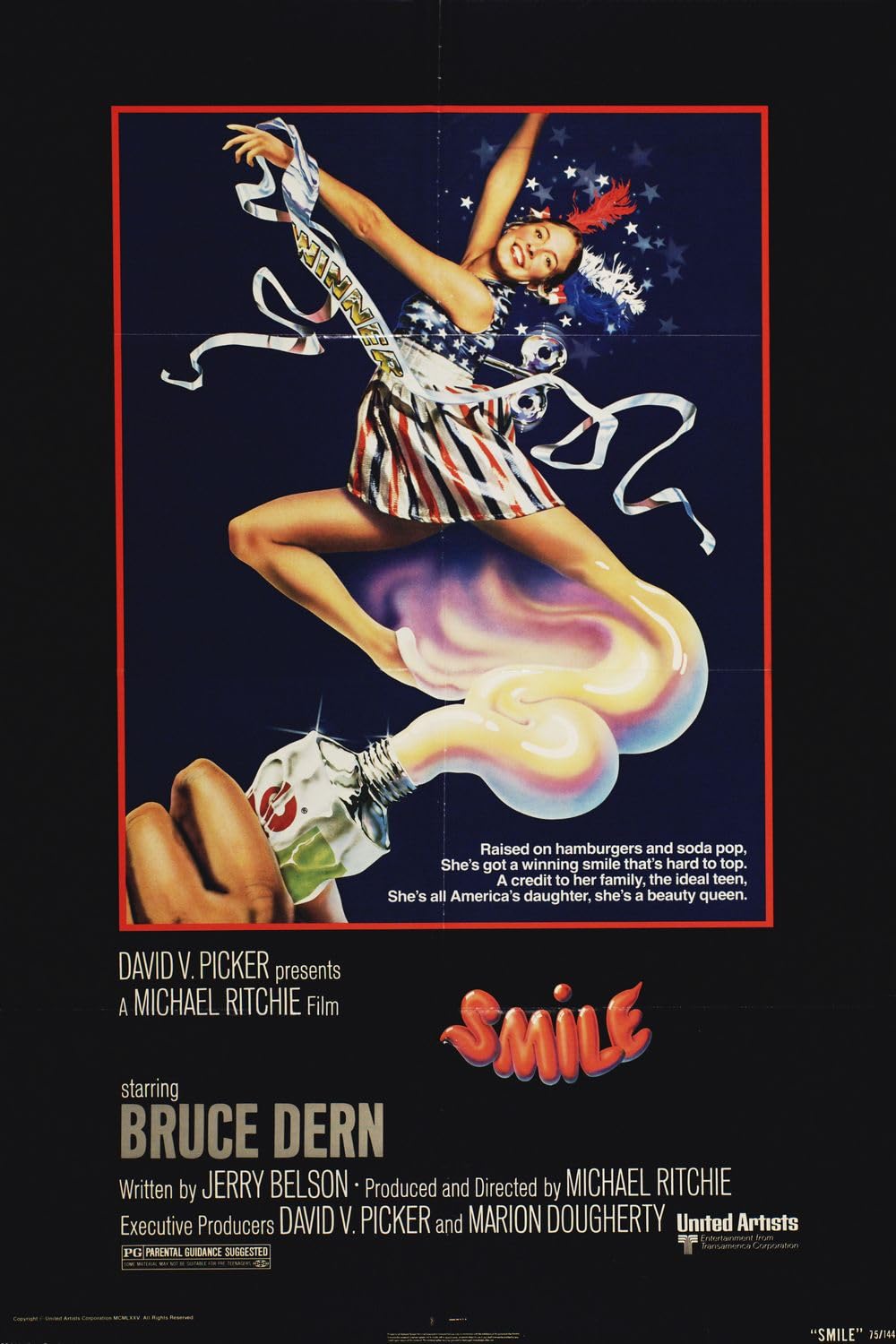
Santa Rosa, California is the site of this year’s Young American Miss Pageant. Each person that’s involved in the pageant approaches it differently. Bob (Bruce Dern), a middle-aged man who works as a car salesman, sees his position as a judge on the panel as a diversion from his otherwise mundane suburban life. Brenda, the pageant’s executive director, considers it a way to display her perfectionist qualities of control and leadership. Her husband Andy (Nicholas Pryor) views the proceedings in a much more cynical fashion and another added element to their already troubled marriage. Tommy (Micheal Kidd), the dance choreographer, approaches it as just another paycheck while Doria (Annette O’Toole), one of the contestants, considers it an opportunity to bolster her name and face even though Robin (Joan Prather), who’s competing against Doria, enjoys the whole thing just for the experience and isn’t concerned with who wins it, at least not initially.

The film marks the third entry in director Michael Ritchie’s American Dream trilogy and one of many he did dealing with competition and how this can change people in both good and bad ways with The Bad News Bears being the most famous of those. The gifted Jerry Belson wrote the script that was based on Ritchie’s own experiences as a pageant judge and many of the situations shown here were ones he went through. Unfortunately, despite the script being absolutely top notch to the extent of being one of the best satires ever written and equal to the more well-known Network that came out a couple years later the movie has not been seen by many, and the title has in recent years been eclipsed by the horror movie franchise. The is because the film’s studio, United Artists, had no confidence in the material and didn’t believe it would generate any profit and thus released it to only 4 theaters nationwide and thus few people ever saw it though in the following decades it has generated a small cult following and even a stage musical.

The finely etched, well-defined characters are what really sets it apart and each of them could be the centerpiece of their own movie if they wanted. Dern, who usually plays psycho roles, is excellent as a father who’s still clinging to his optimism even as everything around him deteriorates. Pryor equally good as his friend and counterpart who finds the suburban dream to be full of letdowns and lies and tries adamantly to break through Dern’s upbeat shield in order to get him to see the truth too. Feldon, best known as Agent 99 in ‘Get Smart’ TV-show, is terrific as well as a complete control freak and her defining moments coming during a scene in her living room, with all the furniture draped in protective plastic, and where she tries to literally goad her husband Andy into killing himself.

Even the minor characters display a unique angle and perspective on things including the janitor (Titos Vandis), who seemingly has a bottle of alcohol hidden everywhere, and makes keen observations on the others as well the music director (William Traylor) whose sarcasm and sexism knows no bounds. Geoffrey Lewis is memorable too as a marketing director who tries to promote the wholesome image of the contest only to in one really funny moment blurt his true cynical feelings about it. Prather and O’Toole though are the ones who drive it as it’s through them we see the inside mindset of those being judged and it’s interesting how at the start it’s O’Toole who’s the more jaded of the two while Prather is the wide-eyed one, but by the end after her experiences here Prather has more than been able to catch up with her.

Spoiler Alert!

The direction is done in a way that makes it seem like a docudrama where everything is captured through an unfiltered lens showing it as it happens with none of the scenes being set-up in a way that makes it feel staged, which is to its benefit. However, this gets ruined, in one of the movie’s few weak points, when Dern’s son Little Bob (Eric Shea) gets caught taking polaroids of the women in their undress. Instead of hearing the dialogue of the people when they catch him, as well as Dern’s when he finds out, which could’ve been quite revealing, music gets played over it, which is jarring as it reminds the viewer they’re watching a movie, even though it had spent the rest of the time trying to convince us we were seeing reality as it unfolded.

The ending is a bit of letdown too. Ritchie and Belson wanted the winner to be a complete surprise both to the cast and crew, which explains why the camera swerves around in a jerky style as even cinematographer Conrad Hall didn’t know who it was and thus had to try to find her when her name is announced. However, having it be a girl (Shawn Christianson) who has no lines of a dialogue, and only seen briefly in a few group shots, was a mistake. The attempt was to show how pointless these contests are and how not much thought or care goes into who’s picked, as evidenced by one of the judges seen flipping a coin before he makes his decision, but it still should’ve been someone we had seen and heard earlier. Maria O’Brien, who plays an obnoxious contestant who annoys the others so much they even sabotage her talent act, would’ve been a better choice and the film would’ve still made the same point and allowed a little more of a lasting emotional effect. With the way it gets done here the viewer leaves feeling miffed and confused.

My Rating: 9 out of 10

Released: March 20, 1975

Runtime: 1 Hour 57 Minutes

Rated PG

Director: Michael Ritchie

Studio: United Artists

Available: DVD, Blu-ray

Little Big Man (1970)

By Richard Winters

My Rating: 8 out of 10

4-Word Review: Raised as an Indian.

Jack Crabb (Dustin Hoffman) has reached the age of 121 and agrees to a taped interview with a reporter (William Hickey). He recounts his life events including being kidnapped by Cheyenne Indians in 1859 when he was 10 and befriending their tribal leader Old Lodge Skins (Chief Dan George) who gives him the nickname Little Big Man. He then goes on to elaborate other life events like being captured by the U.S. Calvary where he is placed in the home of a Reverend (Thayer David) and his beautiful wife (Faye Dunaway) who despite her professed Christianity is having an affair with a soda shop owner, which disillusions Jack from religion altogether. He also goes through his marriage to a Swedish immigrant named Olga (Kelly Jean Peters) and how she gets kidnapped by the Cheyenne during a stagecoach ride and Jack’s attempts to find her, which reunites him with Old Lodge Skins and leads him to meet General Custer (Richard Mulligan), who he initially admires, but eventually learns to despise.

The film is based on the 1964 novel by Thomas Berger of the same name and wonderfully mixes the whimsical style of that book into the movie and maintains overall an excellent balance between quirky moments, of which there’s many and jarring scenes dealing with Indian Massacres by the U.S. Calvary, which remains effectively disturbing and impactful despite all the humor that goes on in between. The impressive cinematography by Harry Stradling Jr. that manages to capture the Big Sky Country, filmed on-location in Montanna where many of these historical events actually occurred, in all of its glory and makes you feel like you’ve genuinely been physically transported back to that era.

The most amazing element though, which comes up right away, is the makeup effects on Hoffman where he’s made to look about as elderly as you can get and hats-off to makeup artist Dick Smith to achieve it in such an effective way. While aging of characters has been attempted in other films, I’ve never seen it so realistic as here and in fact it still holds claim even after all these years in the Guiness Book of World Records as ‘The Greatest Age Span Portrayed by a Movie Actor’. My only quibble is that his eyes as an old man appear to be blue even though for the rest of the movie Hoffman’s eyes are clearly brown.

The acting all around is superb starting of course with Hoffman and then moving onto Dunaway whose first attempt at comedy this was and she’s really funny if not a complete scene-stealer. Thayer David awesome too as her bombastic minister husband and I wished there had been more scenes with him. Chief Dan George is quite memorable as the Indian Chief, he became the first Native American ever nominated for an Oscar for his work here, in a part that was originally intended for Marlon Brando who thankfully turned it down as having a genuine Native American makes it so much more compelling. Great work too by the lesser-known Kelly Jean Peters whose frantic screams of terror, as she’s being kidnapped, I found to be both funny and frightening at the same time.

While it doesn’t affect one’s enjoyment of the movie, the film does have a few drawbacks, or moments that could’ve been done slightly better. Having Hoffman constantly come back into contact with people he had been with years earlier got a bit too cute for its own good. I was okay with some of it, like his reunion with the Indian Chief, but having him literally re-meet everyone he had known before got unrealistic and almost monotonous. I also couldn’t understand why the people he meets again don’t recognize him right away as is the case with Dunaway, as Hoffman has a very distinct face that really doesn’t change much even as he ages, so forcing him to have to remind her who he was should’ve been quite unnecessary. Same goes in reverse with the reunion with his sister, played by Carole Androsky, I immediately recognized her voice even before seeing her face, but for Hoffman it takes a long time to remember who she is, but if I the viewer could detect her voice right away why couldn’t he?

Another issue is when he meets his wife Olga many years later when she’s become a part of an Indian tribe. When he married her she had a very strong Swedish accent and due to the language barrier could only say a very few words, basically just ‘Yah’. Then, when he sees her again, she speaks fluent English, but how could she have learned that by being in an Indian tribe? Also, she had completely lost her accent, which I don’t believe would happen. I’ve known people who have lived in this country for 30 or 40 years, but where originally from somewhere else and no matter how long they’ve been here, or how ‘Americanized’ they may become they still retain their original accent, or at least sufficient hints of it.

Spoiler Alert!

There’s also issues with the General Custer character. Acting wise I felt Richard Mulligan nailed it as he integrates a great blend of comic self-importance to him, but on the satire end it goes a little too far. He gets portrayed as being a complete buffoon with a clownish logic and such a severe narcissistic ego he’s unable to realize when everyone else around him thinks he’s an idiot. There were many different issues that went into the Battle of Little Big Horn, or more commonly known as Custer’s Last Stand, and this movie answers it by saying the guy running it was a self-deluded moron, which I suppose comically and emotionally is satisfying, but doesn’t sufficiently tackle the others nuances that were also involved. There’s also the argument over the demise of Wild Bill Hickok though having him get killed by a little kid was historically inaccurate I felt it was so humorously ironic that I was willing to forgive it.

The ending, where in the book Old Lodge Skins dies, but in the movie he doesn’t, annoyed some fans as well. Director Arthur Penn admitted in interviews that the earlier script drafts had him dying, but then he felt that would be ‘too depressing’ so they had him live, but I felt with such a picturesque back drop that having him lay down for his final resting place was appropriate. He was really old anyways and had also become blind, so having him get up and be led away by Hoffman was just prolonging the inevitable anyways, so they might as well have him go down when it was his time as ‘cheating it’ like they do here doesn’t really add all that much.

My Rating: 8 out of 10

Released: December 23, 1970

Runtime: 2 Hours 27 Minutes (Uncut) 2 Hour 19 Minutes (Studio Version)

Rated GP

Director: Arthur Penn

Studio: National General Pictures

Available: DVD, Blu-ray, Amazon Video, PlutoTV, YouTube

Fun with Dick and Jane (1977)

By Richard Winters

My Rating: 7 out of 10

4-Word Review: Suburban couple become robbers.

Dick (George Segal) suddenly gets laid-off from his job at an aerospace company and finds his financial situation to be dire. His wife Jane (Jane Fonda) tries to get a job modeling dresses but is soon fired. They then attempt to collect unemployment, but Dick is caught taking money on a side hustle, which then causes him to be disqualified. Having run out of all other options they then decide to begin robbing people. They start out small by holding up a drug store, which doesn’t go over well, and then sleazy hotels and even a TV Evangelists (Dick Gautier). Eventually Dick comes-up with the idea of robbing his old boss (Ed McMahon) as Dick knows that his boss has a safe in the closet of his office that is filled with illegal bribe money, so the couple can rob it, and his boss would not go to the police to report it.

The first half is absolutely on-target maybe even more so today as it analyzes just how easy it is to go from being middle-class to destitute in only a matter of weeks and how one’s ascent in society is totally contingent on their jobs and how quickly those places can cut their employees without much thought or concern. The couple’s attempts to rectify things by finding part-time employment that they’re overqualified for is very close to the truth as are the scenes dealing with a ‘friendly’ loan company that advertises they’re easy to work with but really aren’t. Dick’s interview with a potential employer, played by Walter Brooke, that’s interested in hiring him as long as he doesn’t get the vibes that he’s desperate is a keenly observant and a sadly true element in the real world as well. 

The film though veers away from its satirical elements when it gets too into the robbery moments, which takes up the bulk of the second half. The first one, where Dick attempts to rob a pharmacy, but only gets some condoms out of it, is quite funny, but after that it starts to become redundant. Seeing them steal from a sleazy adult hotel where the desk clerk, played by Richard Crystal, begs them not to as it will get him into trouble, but they do it anyways makes them seem callous and less likable to the viewers. The couple commit the robberies without disguises, or just meager attempts at one where they could be easily recognized in a line-up. They also at one point use their real names making it seem that they would be caught and it’s surprising that they aren’t.

Spoiler Alert!

Having them then ‘graduate’ into becoming safe crackers is too much of a stretch. They get only one week to prepare for it, which Jane feels confident they can do since they’re ‘quick learners’, but why even bother to have a safe at all if novice people can simply read up on how to crack one in only a short time and then be able to do it without a single hitch? Would’ve been better had they made partners with someone who was experienced in it and then agreed to give him half, which would’ve been more believable. Better yet would’ve been having Dick and Jane walking away with the loot thinking that they’re now ‘home free’ but then finding themselves surrounded by the police for the other robberies that they committed earlier. 

End of Spoiler Alert!

I also didn’t care for Segal’s performance who I’ve come to feel as an actor is a bit overrated. His character is obnoxious and initially laughs off his dilemma confident he’d land on his feet and remains in that arrogant mode until well into act two and even then, has a brash attitude that makes you want to see him fail versus siding with him in his predicament. Fonda is much more sympathetic giving her a far better presence to the extent it could’ve completely revolved around her, possibly as a single mother, and the movie would’ve worked better. I also really enjoyed McMahon who’s better known for his announcing work but perfectly cast as the corrupt boss and John Dehner is also memorable, particularly with the way he peels an apple, playing Jane’s father, who despite being financially well-off refuses to loan her any money and the goofy logic he comes-up with to justify it. 

This same story got remade in 2005 with Jim Carrey and Tea Leoni playing the leads, but that version doesn’t work as well. Granted I haven’t seen it since its release, but I remember that its theme is much softer and pretty much puts all the blame on Alec Baldwin, who played Carrey’s boss, and acted like he was the sole source of the problem, while this movie’s take is that the system as a whole is screwed up.  

My Rating: 7 out of 10

Released: February 9, 1977

Runtime: 1 Hour 35 Minutes

Rated PG

Director: Ted Kotcheff

Studio: Columbia Pictures

Available: DVD, Blu-ray, Amazon Video, YouTube

Love and Death (1975)

By Richard Winters

My Rating: 5 out of 10

4-Word Review: Attempting to assassinate Napolean.

Boris (Woody Allen) is a scrawny guy who gets overlooked by others as his three brothers tower over him. He’s secretly in love with Sonja (Diane Keaton) who he’s been friends with since childhood, yet she’s instead infatuated with Ivan, one of Boris’ brothers. However, none of his brothers are into her, so she marries someone else while Boris remains a bachelor who occasionally fools around with beautiful women like a Countess (Olga Georges-Picot), which causes her lover Anton (Harold Gould) to challenge Boris to a gun duel. Thinking Boris won’t be able to survive the dual Sonja agrees to marry him if he survives, which he miraculously does. Once married they then concoct a plan to assassinate Napolean (James Tolkan) unaware that who they’re really going after is actually an undercover double.

Allen was in the midst of writing a screenplay dealing with a New York couple who try to solve a murder, which became Manhattan Murder Mystery, but was going through a writer’s block, so he began reading a novel about Russian history, which then inspired him to write this script. Since it was nearing the deadline to have a script ready for production, he decided to submit this one, which immediately went into filming while the other one didn’t end up getting completed until 1993.

Many critics and fans at the time liked this one and it ended up making $9 million at the box office off of a $3 million budget with Gene Siskel especially enjoying it as he gave it 4 stars while commenting that he liked Allen’s return to a ‘gag driven dialogue’ versus ‘attempting to develop a story’, but personally for me I felt this was what was wrong with it. While it does start out funny as it parodies 18th Century Russian society and has one really great bit dealing with a ‘hygiene play’ warning soldiers about VD and condoms it does tend to meander quite a bit. The middle part is the most sluggish with many of the gags falling flat almost like he’d run out of ideas and was just trying to desperately throw anything in to keep it going making it come off more like an unending skit instead of a movie.

Allen’s presence while amusing most of the way becomes a bit of a detriment. Much of this can be blamed on the fact that he’s playing essentially the same character that he does in all of his movies. Case in point comes at the beginning before he officially says anything on screen and I thought to myself I bet he’s going to mention something about atheism and sure enough that’s exactly what he does talk about making it predictable and redundant. Would’ve been nice for irony’s sake had he played someone who had a deep belief in God only to lose his faith after he goes through the war, which would’ve created a nice character arc of which there really isn’t one.

There’s also the issue of him having no Russian accent nor making even a slight attempt at one. Granted Keaton doesn’t speak in an accent either though maybe you can chalk it up to her great acting that she still seems of the period anyways while Allen very much comes off like someone who doesn’t really belong there. He repeatedly makes anachronistic statements, which from time to time are amusing, but technically don’t fit within the setting. It actually would’ve made more sense to have Allen simply be a modern-day New Yorker who finds a time machine and gets zapped away into 18th Century Russia and then wanders around making comments about things, which wouldn’t have disrupted the film all that much and besides adding one little scene at the beginning showing him going into the time travel contraption there wouldn’t have needed to be anything else changed. It literally would’ve been the exact same movie and in some ways been a lot funnier, and perceptive, because of it.

It does end on a strong note as it pokes fun of Ingmar Bergman movies and even has Jessica Harper showing up. Yet I still felt most of the way it throws in whatever it can for a cheap laugh with much of the jokes, particularly in the middle, not really landing. Many fans didn’t like the way Allen crossed over to doing drama just a few years later, but after watching this I started to believe he had used up all of his comical concepts that by this time was just repeating itself and thus his foray into more serious subjects was inevitable.

My Rating: 5 out of 10

Released: June 10, 1975

Runtime: 1 Hour 25 Minutes

Rated PG

Director: Woody Allen

Studio: United Artists

Available: DVD, Blu-ray, Amazon Video, YouTube

The Muppet Movie (1979)

By Richard Winters

My Rating: 7 out of 10

4-Word Review: How they became famous.

Kermit (Jim Henson) is a lonely frog living in a Florida swamp who dreams of one day making it to Hollywood and becoming famous. He then meets talent agent Bernie (Dom Deluise) who hears Kermit singing a song with a banjo and becomes convinced that the frog has what it takes to become a star. He hands him his card and tells him to give him a visit when it makes it to California. Kermit then sets-off on a cross-country trip and along the way meets several other characters all looking for their big-break including Fozzie Bear, a struggling comedian, and Miss Piggy (Frank Oz) who wants to become a fashion model. They tag along on the trip with Kermit while pilling into Fozzie’s Studebaker as he drives them to the west coast, but then they meet up with Doc Hopper (Charles Durning), an owner of restaurants who specializes in frog legs, who wants Kermit to be his new spokesmen in some commercials that he’s producing, but Kermit declines. However, Doc refuses to take no for answer and chases after the gang and using increasingly more sinister methods in order to get the frog to change his mind. 

Due to the success of ‘The Muppet Show’ creator Jim Henson was given financing to produce his own movie featuring the same puppet characters audiences had grown to love from the program. Since this would be a large-scale production great effort had to be put into making the muppets appear real and able to blend into an actual outdoor setting versus having everything done on a sound stage like it was in the TV-show. Henson refused to compromise on anything and insisted that money would not be a limitation, and this included the segment where Animal, one of the muppet characters, grows to giant proportions. Initially the idea was to keep the puppet the same size and place him on a miniaturized set, which would’ve cut down on costs, but Henson felt this didn’t look convincing enough, so instead they constructed Animal’s head to gigantic proportions that measured over sixty feet, which called for way more money and was very time consuming, but ultimately worth the effort. 

The story itself is pedestrian and relies, similar to the TV-show, with rapid fire quips and comebacks much like in old vaudeville. On the surface the humor is corny, and some could find the whole thing silly, but enjoyment comes with the puppet characters that are made to be like caricatures of humans, and their amusing responses and reactions. It’s also filled with a lot of great songs all written by the talented Paul Williams, who appears briefly. Normally in movie musicals the songs end up sounding the same and it starts to feel like we’re just listening to the same loop done over and over, but here each music bit has a distinct beat and a good toe-tapping quality, which not only adds to the fun, but actually helps move the story along versus holding it up. 

The only drawback is the massive amount of guest star appearances. There are many familiar faces, but most of them are only in it for a half-minute, or so and few of them have anything that’s actually funny to say, or even moderately clever. Performers like Bob Hope, Richard Pryor, Madeline Kahn, and Edgar Bergen, in his last screen appearance before dying just a couple weeks later, are essentially wasted in bits that add nothing and could easily have been excised and not missed. However, there’s a few cameos that do work including Steve Martin as an annoyed waiter, Cloris Leachman as a receptionist allergic to animal hair and Orson Welles who comes on near the end and has the film’s best line. Mel Brooks also quite memorable in an over-the-top send-up of a German mad scientist. 

Durning though is the one exception as he is more like a main cast member and in it quite a bit. Of course, he’s an outstanding character actor and a personal favorite and he shines here as well particularly with his attempt at a Cajun accent, but it seemed a bit ridiculous for a guy to go to such extreme measures just to get Kermit to be in his commercials. A better storyline would’ve had Kermit witness Durning turning one of his family members, perhaps one of his distant frog cousins, into a frog legs meal and thus threaten to turn Durning into the authorities and this would cause him to chase after him in order to try and keep him from squealing.  It also would’ve been nice had he shown a change-of-heart at the end and come around to being a friend to the muppets versus remaining an adversary. It comes close at one point when Durning realizes he doesn’t have any real friends like Kermit does, but I would’ve liked to have seen him come to grips with his aggressive personality and make amends to do better moving forward. 

My Rating: 7 out of 10

Released: June 22, 1979

Runtime: 1 Hour 35 Minutes

Rated G

Director: James Frawley

Studio: Associated Film Distribution

Available: DVD, Blu-ray, Amazon Video, YouTube

Straw Dogs (1971)

By Richard Winters

My Rating: 8 out of 10

4-Word Review: Man defends his home.

David (Dustin Hoffman), a nerdy mathematician, has been given a research grant and uses it to relocate to the rural countryside of England with his wife Amy (Susan George). They move into a farmhouse that was once owned by Amy’s father and they hire four men (Del Henney, Ken Hutchinson, Jim Norton, Donald Webster) to fix up the roof. The men though don’t work much and spend most of the time making fun of David and ogling Amy. After several bad encounters, including the grizzly death of their pet cat, David fires them and hopes that’ll be the last it, but things only get worse. When a teen girl named Janice (Sally Thomsett) disappears her violently drunken father Tom (Peter Vaughan) thinks it was caused by Henry (David Warner) a mentally handicapped man that Janice had shown an affinity for. Tom, along with the four other men, become a lynch mob determined to find Henry and bring him some ‘street justice’. David and Amy, while returning from a church service, hit Henry with their car as he’s running from the other men. David agrees to take the injured Henry into his home until a doctor can arrive, but the five men insist on getting inside to beat and kill Henry for his perceived crime. Since David had avoided having any confrontation with the men previously even when they had openly mocked him, they presume he’ll be a pushover this time as well, but David has finally decided to take a stand and will defend his home from the intruders in any way he can. 

While it was controversial at the time many now consider this the pinnacle of director Sam Peckinpah’s career and his directorial touches are supreme. The capturing of the brown empty vast landscape of nothingness, shot during the winter of 1971, brings out a surreal sense making it seem like the characters are living in a purgatory outer world where everything is dead and helps explain the deadness of the men’s souls that have been forced to endure their entire lives there. The climactic sequence where David’s home comes under siege is deftly handled. Normally in thrillers pounding music gets played during these segments to ramp up the tension, but here there’s only the sound of a distance foghorn, which makes it much more creepy, distinct, and helps accentuate the isolation. 

Some have been critical of the film’s violence especially at the time when there was activism going on that tried to stymie violent material on both TV and movies with the idea that violence was a ‘learned’ behavior and if people didn’t see it so much in entertainment, then they wouldn’t do it in real life. Peckinpah though saw it differently as he felt violence was an instinctual reaction that couldn’t just be ‘unlearned’ and that in certain situations it was necessary and not every conflict could be resolved peacefully, a message the film brings out quite well. 

While Susan George gives an excellent performance, as do the four villainous men, particularly Vaughan as their ringleader making them some of the creepiest bad guys in film history, I did find her character confusing. I didn’t understand why she’d marry a guy that she found by her own admission cowardly even bringing up that he was ‘running away’ from problems he was having at his university and his ‘hiding behind his studies’ in order to avoid it. She also shows no respect for his work and several times even vandalizes his chalk board that has his mathematical equations, so what attracted her to him in the first place? Would’ve made more sense had she initially idolized him for his academic status and then became painfully aware of his meekness as the film progressed, which would’ve made for a more interesting arch.

Spoiler Alert!

The film is based on the 1969 novel The Siege of Trencher’s Farm by Gordon Williams, but with many changes some of which worked while others didn’t. In the novel the couple had an 8-year-old girl, but in the film there is no child. To a degree it doesn’t make that much of a difference though when the bad guys attack the house it might’ve heightened the urgency more knowing that David was not only defending his ‘home’, but also the safety of his terrified daughter. The biggest change that the film does is that it creates a connection between Henry and Janice where Janice sneaks away with him during a church party where she invites him to be intimate with her, but in the process, he accidentally kills her, which seemed too similar to Of Mice and Men. It’s confusing too why this teen girl, who outside of her buck teeth seems reasonably attractive, would feel the need to throw herself at a mentally handicapped man, or get flirty with David, who is married. Why can’t she find guys her own age to fool around with? Knowing the hormones of most teen boys that shouldn’t be too hard, so without further explanation to her psyche, which doesn’t happen, her ‘inviting’ of Henry is quite unnatural and forced. 

In the book Henry is instead a child killer who’s being transported back to prison when the vehicle he’s in gets stuck in the snow, which allows him to escape. At the same time Janice, who’s mentally disabled, which isn’t made clear in the movie, runs away from a Christmas party where she ends up dying from the exposure to the cold, but otherwise it has nothing to do with the escape of Henry and is only presumed to have a connection by the five men, which makes more sense and the screenplay should’ve have kept it this way.

On the other hand, in the book none of the attacking men die and are only badly injured, but I think death gives it a more final resolution, so the movie scores there. I also liked how David is forced to resort to items he can find around the house, much like in the film Last House on the Left, which came out a year later, to fight off the bad guys versus the cliched machoism of having a big gun to blow them away and it also helps to show how intellectual wits can ultimately be used to overpower the otherwise physically stronger attackers. 

The rape scene in which the wife gets assaulted by not only one, but two men was another problematic moment as the book had no such segment. For one thing it makes it seem like she’s actually enjoying the attack, at least with the first one, and she recovers from it much too quickly and doesn’t even bother to tell David about it and able to go on relatively normally afterwards, which didn’t seem realistic and thus I think it should’ve been excised since it comes off as exploitive and doesn’t have that much to do with the main plot. 

My Rating: 8 out of 10

Released: December 22, 1971

Runtime: 1 Hour 57 Minutes

Rated R

Director: Sam Peckinpah

Studio: 20th Century Fox

Available: DVD, Blu-ray (Criterion Collection)