Category Archives: 60’s Movies

4 for Texas (1963)

By Richard Winters

My Rating: 4 out of 10

4-Word Review: Frank and Dino vehicle.

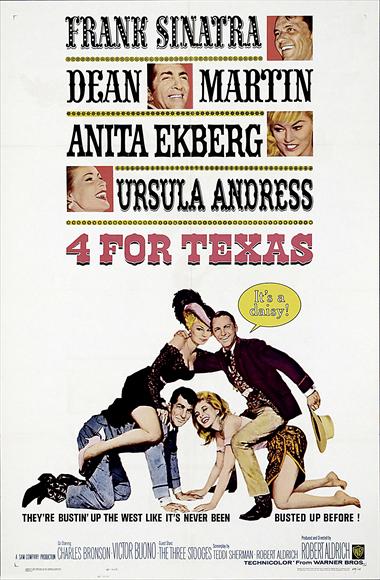
            Sharp-shooter Zack Thomas (Frank Sinatra) and Joe Jarrett (Dean Martin) fight over a cache of money they come upon after fighting off Matson (Charles Bronson) and his gang from a stage coach attack. Eventually Jarrett takes the money and makes his way to Galveston were the two meet up again and continue their bickering. When Joe fixes up an old riverboat and proceeds to turn it into a casino Zack tries to take it over, but not until Matson tracks him down to seek revenge.

The movie opens nicely with a snappy segment between the quarreling Zack and Joe trapped all alone in the middle of the desert. Their banter is great and it makes the most of each star’s appeal. However, after this the movie proceeds to die and very long, slow death. Absolutely nothing gels and the fragmented story lacks any type of singular voice, or vision. The film is also devoid of much action. There is a fistfight that Zack and Joe have at the end, but from the longshots it is clear that stunt doubles are being used for both men, which kind of takes the fun out of it. There is some potential when the two decide to combine their forces to take on Matson and his gang, but this finale moves along too hastily and the action is as uninspired as the rest of the film.

Martin is engaging and he is one of the film’s few bright spots. Sinatra though is stiff and out-of-place and shows no flair for lighthearted comedy. Apparently director Robert Aldrich and Sinatra did not get along at all and it shows.

The female co-stars don’t fare much better. Anita Eckberg who plays Zack’s love interest Elya amounts to not much more than a tired walk-on. The character has little to say or do and minimal connection to the main plot. Ursala Andress as Joe’s girlfriend Maxine fares better simply because she looks great. I’d say she is more striking here than she was in her most famous role in Dr. No.  Her low-cut dress is tantalizing and her tan, curved features have never looked better. The problem though is that there are a few drawn-out romantic scenes between both couples that makes a slow movie drag even more.

Talented character actor Victor Buono is excellent as bank president Harvey Burden. I was impressed with how he managed to hold his own with the rest of the cast despite the fact that he was much younger than all of them. Bronson is effective in the bad guy role and he makes a more interesting villain than he ever did as a good guy.

The Three Stooges appear in a cameo and do their predictable shtick that is strained and forced. Jack Elam who is a veteran support player in many westerns and has a very distinctive cross-eyed gaze is shockingly killed off right at the beginning, which was stupid.

This movie is a perfect example of a big Hollywood production relying too heavily on the star power of its two leads without first having an interesting script for them to work with. The production values are high and it is watchable, but plays itself out in a meandering and pointless fashion.

My Rating: 4 out of 10

Released: December 25, 1963

Runtime: 2Hours 4Minutes

Rated NR (Not Rated)

Director: Robert Aldrich

Studio: Warner Brothers

Available: VHS, DVD, Amazon Instant Video
 

Harper (1966)

By Richard Winters

My Rating: 9 out of 10

4-Word Review: New-age private eye.

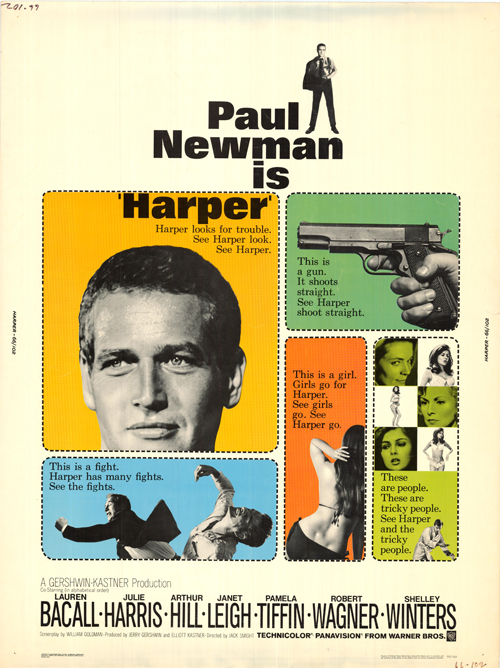
            Detective Lew Harper (Paul Newman) is hired by Mrs. Sampson (Lauren Bacall) a rich woman whose husband has gone missing. She wants a private eye to find him instead of the police due to the fact that her husband was involved in certain illegal business activities, which she doesn’t want to come to light. Harper finds himself immersed in a complex web of intrigue dealing with an array of shady characters, twists, and danger.

Newman is terrific and the Harper character is the perfect private eye for modern audiences. Watching him get out of bed in his dingy, cluttered apartment at the beginning and get ready for the day is excellent and builds characterization in a visual, subtle, and believable way. His cool, laid-back, and detached demeanor is a great contrast to the hyper, jaded, high-strung L.A. types that make up the assortment of suspects. His cynical style attaches the viewer to him right from the start and the banter that he has with everyone is marvelous.

The supporting characters are superb as well and very well-defined. Bacall gets one of her better later career roles as the bitchy eccentric wife. She gets quite a few quotable zingers particularly between her and her step daughter Miranda (Pamela Tiffin) that are close to classic. I also got a kick out of Shelley Winters playing a parody of herself as a way past her prime Hollywood star who is now overweight and an alcoholic. Harper’s attempts to get information out of her by pretending to be a hick who is totally mesmerized by her is quite amusing.

Director Jack Smight is at his directorial peak here. The on-location shooting is splendid. I particularly enjoyed the modernistic building that fronts as a church, but is really used as a cover for criminal activity. It sits out on a sandy hilltop and leaves a strong visual impression as does Harper and Miranda’s car ride along a very winding desert highway to get there. I also liked his ability to capture an abandoned airplane hangar making it almost as evocative to the eye as the foot chase that happens in it. The whole production is consistently slick with color schemes, set design and editing that are all top notch.

William Goldman’s script, which is based on the novel by Ross Macdonald is sensational and one of his best in his already legendary career. The dialogue is sharp one can view it for the lines alone and might need to re-watch it again simply to pick-up on all of them as there are so many your liable to miss some. The mystery is also intriguing and nicely layered to the point that it will keep you guessing and impossible to figure out and fortunately there is a minimum of loopholes. I saw this before and knew the outcome, but still found it an enjoyable and involving ride.

My complaints are few and fortunately do not taint the quality of the picture, which is otherwise high. I didn’t like that Harper had an ex-wife Susan (Janet Leigh) who he is constantly trying to win back. The woman seemed a bit cold and snippy and not the type I would think Harper would fall for, or want to put up with. Having him act so needy to win back her affections hurt the ruggedness of the character who is appealing because of his independent and self-assured nature. There is another scene where a man is shot dead and Harper goes through his coat pockets in order to get some clues to his identity. He finds a matchbook listing a nightclub, which Harper goes to in order to ask questions from the patrons, but I kept thinking it would have been much easier had he just went through the victim’s pants pocket and taking out his wallet and looked at his driver’s license.

If you are looking for a nifty mystery done in the best crime noir tradition then they don’t come much better than this.

My Rating: 9 out of 10

Released: February 23, 1966

Runtime: 2Hours 1Minute

Rated NR (Not Rated)

Director: Jack Smight

Studio: Warner Brothers

Available:  DVD, Amazon Instant Video

Luv (1967)

By Richard Winters

My Rating: 4 out of 10

4-Word Review: Jump off the bridge.

            Based on the play by Murray Schisgal the film follows the exploits of Harry Berlin (Jack Lemmon) a hopeless neurotic who tries to commit suicide by jumping off a bridge only to be saved by his long lost friend Milt (Peter Falk). Milt wants to use Harry to have him fall in love with his wife Ellen, so that way she will agree to a divorce and free him up to get with a hot young blonde named Linda (Nina Wayne).  Things initially work as planned. Harry and Ellen fall in love and marry and Milt does the same with Linda, but then Milt and Ellen find that they are not compatible with their new mates and long to get back together. The problem is that Harry refuses to grant a divorce forcing them to try and coax him back out on the bridge, so he will finally jump off it and get out of their way.

Lemmon’s performance is the best thing about this otherwise strange experiment. He is like his Felix Unger character put on speed. His weird quirks and idiosyncrasies help propel the story to newer and more absurd heights. In his more straight comedies Lemmon has always seemed a bit benign and showing a nervous energy that is more annoying than funny. Here though he falls into his comic niche bringing out the bizarreness of his character with an almost creepy clarity. I thought it was interesting that although he was a leading man he chose to do an ensemble comedy. Although this film can be deemed a failure I still found it commendable that he was willing to test his acting range and image by taking on an unusual role.

Falk doesn’t fare as well. I thought it was great that he reteamed with Lemmon after performing with him in The Great Race, but his character really isn’t all that funny. May is usually great with sardonic material and has made a career out of performing and writing this kind of stuff, but she really isn’t given all that much to say that is amusing. I liked her charts that she creates for both Milt and Harry measuring all the hours they have been married with all the hours that they have had sex, which has a nice goofy element. Wayne is attractive, but her high, squeaky voice can quickly become annoying. Her acting abilities are limited and she clearly seems outclassed by her supporting counterparts. Had a stronger more established actress been cast in the role it certainly would have helped.

Director Clive Donner doesn’t show a good feel for the material. There are certain parts that are funny like when Ellen and Harry spend their honeymoon at Niagara Falls attacking and physically hurting each other just to see if the other will still love them afterwards. I also liked some of the potshots at modern day suburbia, but other than that this thing falls flat. There are too many scenes that go on forever with jokes and comic bits that are more stupid than clever. The opening sequence has a nice distinctive jazz score along with a montage of kitschy artwork and there is interesting camera work and editing during a sequence at an amusement park, but the rest of it becomes a filmed stage play. The pacing is slow and devoid of the unique directorial flair that could make an offbeat thing like this work. The climactic scene at the bridge is particularly strained and helps cement this as a hopeless misfire.

This movie is probably best known for being the film debut of Harrison Ford who has one word of dialogue and appears as an irate motorist who punches Harry in the face. I wished there had been more of him as although it is very brief he is one of the best things in it.

My Rating: 4 out of 10

Released: July 26, 1967

Runtime: 1Hour 33Minutes

Rated NR (Not Rated)

Director: Clive Donner

Studio: Columbia

Available: VHS, DVD

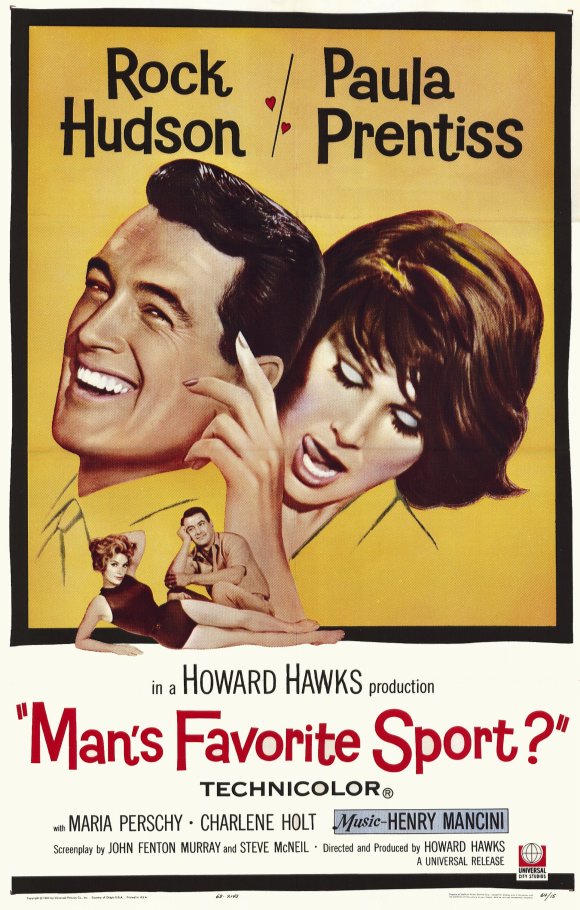
Man’s Favorite Sport (1964)

By Richard Winters

My Rating: 2 out of 10

4-Word Review: Winning a fishing contest.

            Roger Willoughby (Rock Hudson) works at a sporting goods department store and uses the information he overhears from his customers to become an ‘expert’ at fishing and best-selling author on the subject despite never having done it himself. Things unravel when his boss (John McGiver) enters him into a fishing contest and he must use the help of beautiful brunette Abigail Page (Paula Prentiss) to show him the techniques and save his reputation.

Billed as another screwball comedy much in the same vein as Howard Hawk’s classic Bringing Up Baby. However, this film doesn’t even come close to that one. It is extremely slow and the comedy bits are thrown in with a haphazard style. The pacing is none existent and the plot is far-fetched and contrived. I was willing to forgive it a little figuring that by the second half things would kick-in, but it never does. The jokes are simplistic and unimaginative.  I found none of it to be funny and mainly strained and labored. With the slight exception of the scene involving Roger’s inflatable wading pants I didn’t find any of it to be even engaging. Roger’s attempts at fishing are particularly disappointing as this scenario could have been played up a lot more.

Hudson is weak as the lead. His voice always has a hollow tone and his delivery is wooden. Cary Grant would have been a much better choice and the film could have been a lot funnier with his presence. When Grant became irritated it was always amusing, but with Hudson it comes off as forced and boring.

Paula Prentiss is the best thing about the movie. Many fans agree that this is her best performance of her career. She has a nice free-form style to her delivery and avoids having that stiff drama school touch. I liked the gaze of her brown eyes and at times it reminded me a lot of Karen Black’s. Her younger, more relaxed presence helps compensate against Hudson’s stiff older one. I’m surprised her career fizzled in the 70’s as she has an interesting and unique style that I would have liked to have seen more of. Her sparing with Hudson is the only thing that gives this film any energy. However, having them end up falling in love was formulaic and forced. The two really didn’t have the right chemistry and showing them not getting along, or getting on each other’s nerves was more entertaining.

My Rating: 2 out of 10

Released: January 29, 1964

Runtime: 2Hours 1Minute

Rated NR (Not Rated)

Director: Howard Hawks

Studio:  Universal

Available: VHS, DVD

The Monitors (1969)

By Richard Winters

My Rating: 3 out of 10

4-Word Review: They are watching us.

            Aliens, who dress in suits, long overcoats, and bowler hats, invade earth and an attempt to police everybody’s thoughts and actions while trying to quell a rebel uprising led by Colonel Stutz (Larry Storch). Working for the uprising is Harry (Guy Stockwell) who falls in love with Barbara (Susan Oliver) who secretly sides with the aliens.

The movie starts out with a lot of potential and piqued my interest with unusual montages and camera work. Unfortunately this subsides quickly and soon we are stuck with drab sets, extraneous scenes, and a film unable to hide its low budget roots. I began to wonder if the reason the rebels had their hideout in an abandoned farmhouse was more because the filmmakers could film there without having to pay for a permit than anything else.

The film should have gone completely for parody and farce and if they had done that this might have worked. Instead it seems to drift into a conventional sci-fi narrative complete with a pseudo philosophical climactic debate between the humans and aliens that we have all heard before and does nothing but slow the film down to a tedious level. Adding in the love interest angle between the two leads is contrived and formulaic.

The aliens aren’t too interesting either. There is never any explanation as to how they were able to take over the planet, but the fact that they are unable to even get through a locked door of an old crumbling warehouse made me wonder how they were able to succeed at anything. Equipping them with a little more sci-fi gadgetry would have helped. I realize they don’t have to be carrying around the proverbial ray-gun, but having them break up an angry mob by using ordinary canisters of pepper spray seemed unimaginative.

Spliced into the story are comical TV ads with famous celebrities of the day such as Stubby Kaye and Xavier Cugat promoting the monitors and convincing the public to support them. These commercials are not funny with the only exception being Alan Arkin playing a foreign man who speaks broken English. In the case of former Senator Everett Dirksen it is almost sad. He was very elderly at the time of the filming and he is clearly reading his lines from cue cards and mouthing the words and looking like he is barely functional, or coherent.

The music is another problem. Initially I really liked it as the opening credits feature a computer with a very robotic voice singing the theme. Singer Odetta sings most of the other songs and some of them have a distinctive sound, but they get overplayed and saturated by the end.

The production was shot on-location in Chicago and I loved the aerial shots showing the skyline. I almost wished there had been a little more of them although I did notice that the exact same skyline shots at the beginning get reused in the second half. I didn’t like the idea that it was filmed in the late fall/early winter as the cast is shown shivering in several shots while forced to wear light clothing and their breath is clearly visible.

Susan Oliver gives another solid performance and shown flying an airplane in one sequence as in real-life she was an avid pilot. Sherry Jackson’s presence is minimal, but she is always appealing to the eyes. Avery Schreiber, a comedian known to overact horribly in just every part he is in, comes off as rather amusing here playing the younger brother of Harry who reluctantly joins up with the resistance. Larry Storch, another notorious ham, is engaging as well especially when he appears in drag and later on dressed as General MacArthur.

This is a failed experiment that should have been a lot better. It seems to want to take on the quirky sentiments of the era, but is either too timid, or too unimaginative to go all the way with it.

My Rating: 3 out of 10

Released: October 8, 1969

Runtime: 1Hour 32Minutes

Rated M

Director: Jack Shea

Studio: Commonwealth United Entertainment

Available: Netflix Streaming

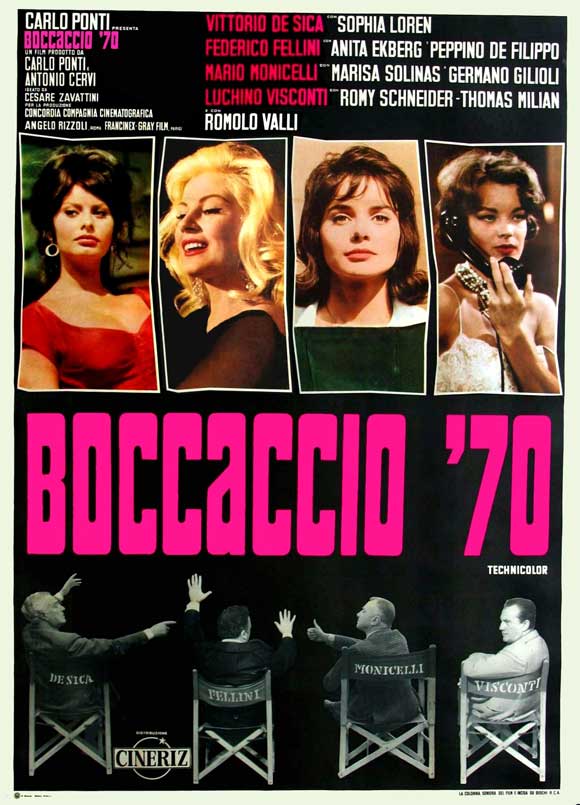
Boccaccio ’70 (1962)

By Richard Winters

My Rating: 7 out of 10

4-Word Review: It’s all about sex.

            This film, which is well over 3 hours, is a compilation of four different sex tales directed by legendary Italian greats: Federico Fellini, Vittorio De Sica, Luchino Visconti, and Mario Monichelli. The segments also star some of the most beautiful and sexiest women to ever grace the screen including: Sophia Loren, Anita Ekberg, and Romy Schneider. These ladies are at their most stunning and really light up the screen with their presence. Despite the extreme length the film moves along in a breezy fashion and I was actually surprised how quickly the time went.

The first segment directed by Monichelli and entitled ‘Renzo e Luciana’ was cut from the initial American theatrical release and it is easy to see why as it lacks the energy and flair of the others. It stars Marisa Solinas who doesn’t have the sex appeal and star power of the other leading ladies and apparently this was the reason why it was cut, but now has been restored on the recent Blu-ray release. The story is rather simple and deals with Luciana (Solinas) getting married to Renzo (Germano Gilioli), but having to move-in with her parents as they are unable to afford a home of their own. She also must keep her marriage a secret because the contract that she signed at the accounting firm that she works at strictly states that the female employees must remain single. This is so their overweight, lecherous boss can flirt and go out with them and threaten to fire them if they resist. Because of her financial situation and sparse job market Luciana is forced to put up with his advances. Although seeing two young newlyweds struggling as they start out can at times be touching this segment doesn’t have enough comedy, or drama to keep it afloat. The only lasting image one remembers from this is when Luciana goes to a public pool and sees her fat boss prancing around in nothing but a skimpy bikini bottom, which might be enough to make some viewers sick.

‘Le tentazioni del dottor Antonia’ is the second segment and directed by Fellini with his usual visual flair and style. The plot is about an older gentleman named Antonio (Peppino De Filipo) who is quite prudish and protests and tries to ban any type of public display of sexuality. When a giant billboard is erected in front of his apartment showing an alluring model (Ekberg) in a provocative pose while holding a glass of milk he becomes irate. His initial anger turns to horror as the giant model comes to life and begins to terrorize him in all sorts of comical ways. The special effects are pretty good. Filipo plays his role to a delightfully hammy level and Ekberg is striking. The ironic ending, which features a lot of surreal elements, is amusing.

The third feature is entitled ‘II lavaro’ and is directed by Visconti.  Here a rich young husband (Thomas Milian) can’t seem to avoid being caught cavorting with prostitutes despite the fact that he is married to the beautiful Pupe (Schneider). She decides that the only way to prevent this is by becoming a prostitute herself and then having him pay her to be his mistress. This segment starts out with a humorous and engaging tone, but eventually becomes talky, static, and stagy. Schneider is the best thing about it and is intoxicating in every scene that she is in. She not only speaks fluent Italian here, but German as well.

The final segment entitled ‘La riffa’ and directed by De Sica is by far the best. It is about a raffle that all the men in a small village get involved in to see who will win one night with the beautiful Zoe (Loren).  The irony here is when timid Cuspet (Alfio Vita) who looks and acts exactly like Rowan Atckinson’s Mr. Bean character, ends up winning it. De Sica nicely plays everything up to its full potential and captures the nuances and eccentricities of the characters well. Loren is both sexy and funny and shows a flair for frantic comedy. The sequence involving Cuspet and Zoe’s rendezvous is amusing, touching, and even a bit surprising.

My Rating: 7 out of 10

Released: June 26, 1962

Runtime: 3Hours 25Minutes

Rated NR (Not Rated)

Directed by: Federico Fellini,  Vittorio De Sica, Mario Monichelli, Luchino Visconti.

Studio: Cineriz

Available: VHS, DVD (Region 1 and 2), Blu-ray, Netflix Streaming

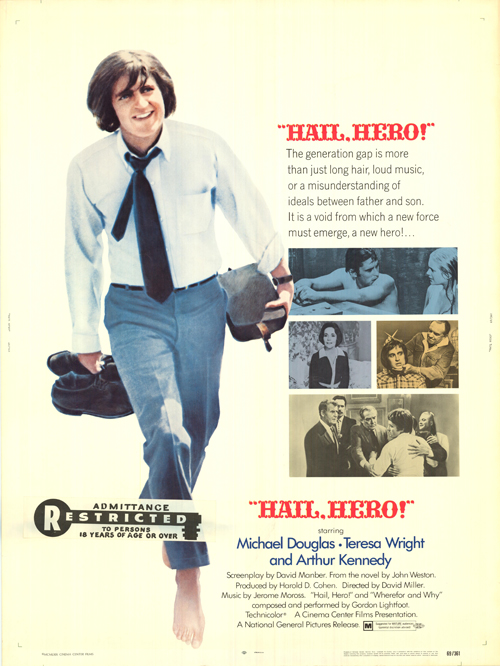
Hail, Hero! (1969)

By Richard Winters

My Rating: 5 out of 10

4-Word Review: Michael Douglas film debut.

Okay all you Michael Douglas fans out there, you know him, you love him, and you’ve seen all his movies, but what was his film debut?  I say this because I have known other fans of stars who are a bit vague when asked about early films of their favorite actors. I remember one lady who was in her 20’s, who I knew from work and professed to be a ‘huge’ Jack Nicholson fan, but when I asked her about some of his early films, which I had enjoyed including Five Easy Pieces, and King of the Marvin Gardens, she drew a complete blank. In fact she was not aware of any of the movies he did before The Shining. I had a similar experience with another lady friend I knew from a different job who professed to be a big Goldie Hawn fan and yet had no idea what film she had won the Academy Award for, which was in 1969 for Cactus Flower a movie that she hadn’t even heard of.  So I was curious how many Michael Douglas fans are actually aware of some of his early work. In fact this film, which was his first, was released when his future wife Catherine Zeta-Jones was only 11 days old.

It is the story of Carl Dixon (Douglas) who is an idealistic, peaceful young man that joins the army simply to please his conservative father (Arthur Kennedy). The film is a pleasant, even touching look at a someone learning to face the difficult and complex issues of adult life and realizing there are no easy answers. The movie doesn’t try to make any type of statement while carefully examining both sides of the issue. There isn’t any ‘bad guy’ here. The characters are real and multi-dimensional. The conversations and debates that they have are ones that went on in many households across the country at that time.

Douglas looks expectedly younger and initially I didn’t even recognize him. His hair is long, at least initially until his father cuts it, and his eyebrows are bushy and his voice much higher pitched. His performance is excellent and the  character his likable and engaging especially with the way he treats everyone with respect and is so generous that he gives his entire suitcase of clothes to a poor family in need.

Kennedy is perfect as the old-school father and my only complaint here is that I wished he had been in more scenes. Theresa Wright, as Carl’s mother, is okay, but she is not given enough screen-time either. She is also caught having an affair, but the film does not delve enough into this, but should have. Louise Latham is terrific giving one of the best performances of her career as a hermit-like woman living alone in a cave alongside the skeletal remains of an Indian baby.

There are some good scenes including Carl’s visit to a senior home where he comes face-to-face with the difficulties of aging as well as when he finds himself ready to strike someone at a party whom he does not agree with and realizing that violent tendencies lurk within anyone even those purporting to be pacifists. Yet the film fails to leave any lasting impression. The ending is weak and the story does not progress enough. The viewer is left feeling almost cheated because we are never shown how these characters evolved. In my opinion the material was insufficient for a feature film.

My Rating: 5 out of 10

Released: October 4, 1969

Runtime: 1Hour 40Minutes

Rated M

Director: David Miller

Studio: National General Pictures

Available: VHS

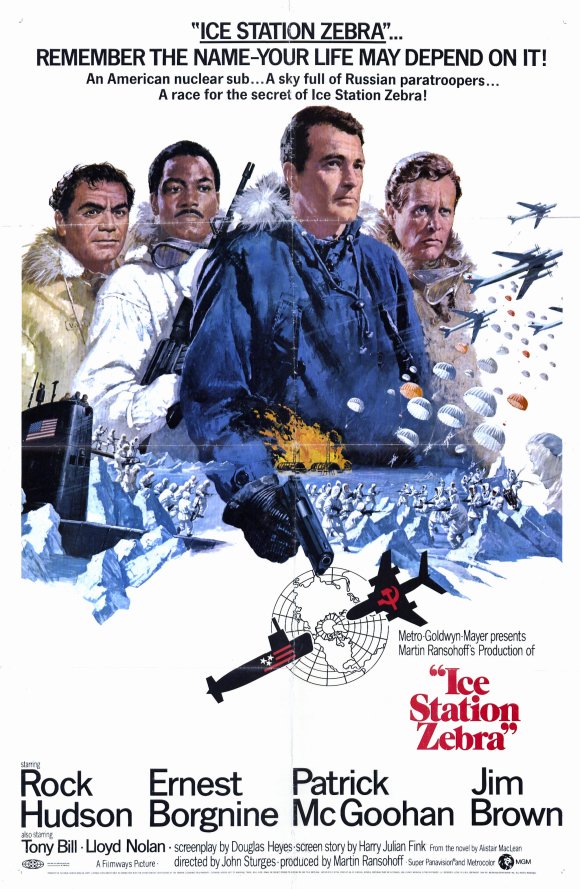
Ice Station Zebra (1968)

By Richard Winters

My Rating: 6 out of 10

4-Word Review: It’s cold up there.

Commander James Ferraday (Rock Hudson) is assigned to head a submarine crew up to the North Pole to rescue stranded members of a weather station called Ice Station Zebra. He is told that there is another reason for the mission, but that is top secret and it will not be disclosed to him until he gets there. In addition to the crew he will be bringing along another man named David Jones (Patrick McGoohan) who is aware of the secret details. When they arrive at the location they find themselves amidst a major international crisis.

The photography is outstanding. This movie marks the first ever continuous filming of a submarine dive and the footage is breathtaking. The scenes showing the submarine trapped beneath the ice is incredible and some of the best stuff in the film. This was also done on an actual sub and the shots showing its interior are interesting. I had no idea how very roomy they can be and found it fascinating to realize how many different compartments there are. My only quibble here is that when Boris Vaslov (Ernest Borgnine) gazes at the nuclear power that propels the sub the viewer only sees the reflection of the orange glow that it gives off. The camera should have been pointed straight down, so the viewer could have witnessed the same thing as Boris.

The scenes taking place at the North Pole are impressive as well, but flawed due to the fact that it was all clearly done on a sound stage.  The snowy artic formations look like they were made from ceramic. The men are shown outside not wearing any hoods and it that bitter climate it would have mean instant frostbite. I didn’t notice it at the time, but other viewers have called to attention that their breath is not showing and in cold weather it always will. Still I was willing to forgive these small oversights because overall the production design is imaginative. The bird’s eye view of the weather station amidst the icy landscape is sprawling and the longshot of parachutes dropping from the sky is exciting.

Hudson would not have been my choice for the lead. He managed to give one really great performance, which was in Giant, but otherwise he is just a good-looking well-built guy with limited acting abilities. He always says his lines with hollow sounding voice and never any emotion. Pairing him with McGoohan, who is a much more creative performer and stronger personality, doesn’t work.

Legendary football player Jim Brown is great as Captain Leslie Anders. He may not be the best actor, but you have to love his badass stare. It has to be the best badass stare of all-time and helps give the proceedings an extra point. However, the character he plays is a bit of letdown especially when he loses in a confrontation to Borgnine, which seemed a little pathetic. Borgnine, who speaks in a Russian accent here, is fun as always.

The plot, based on the novel of the same name by Alistair MacLean, is nicely complex. The viewer is kept in the dark about the secret, which helps with the intrigue. There are some exciting moments, but it is never riveting. The movie is overlong and could have been trimmed substantially, which would have helped with the pacing.  Viewers should still find this enjoyable, but as a whole it is average at best.

My Rating: 6 out of 10

Released: October 23, 1968

Runtime: 2Hours 28Minutes

Rated G

Director: John Sturges

Studio: MGM

Available: VHS, DVD, Blu-ray, Amazon Instant Video

Skidoo (1968)

By Richard Winters

My Rating: 5 out of 10

4-Word Review: They were on LSD.

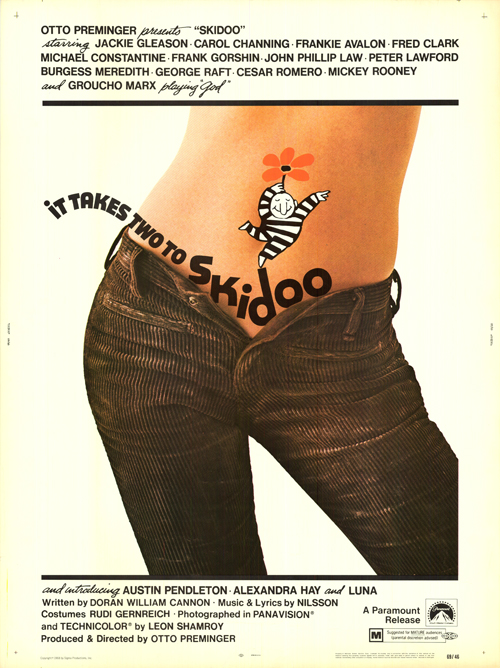
Jackie Gleason plays family man Tony Banks with mob past who is now trying to go straight yet gets sucked back in by a gangster leader named God (Groucho Marx). He orders Tony to disguise himself as a prisoner so he can infiltrate a prison system and knock off another prisoner and rival named George ‘Blue Chips’ Packard (Mickey Rooney). While in prison Tony mistakenly takes some LSD and goes on a wild drug induced trip.

Story wise it is limp. The humor is weird, but not altogether funny. It tries to satirize a lot of things yet none of it comes together. There is no singular voice or vision let alone cohesion. The pacing is poor and haphazard. It becomes so sloppy and nonsensical that you almost wonder if renowned director Otto Preminger was the one taking the LSD stuff.

The idea of mixing old school comedy with the mod hipness of the day was not new. Many films (and TV shows) of that period tried it with limited success. Yet few went to the extremes as this one. It is still a complete disaster yet odd enough to grab your attention and hold it. In some ways it’s enjoyable and even entertaining if viewed as an oddity and relic of its era.

There are a few good scenes. One involves a weird hippie speech by actor John Phillip Law where he professes a need to be ‘nothing’ which will somehow make him ‘everything’ and ‘anything’. There are also some quirky commercial spoofs at the beginning, a brief glimpse of Packard’s prison cell ‘office’, and the ‘the family tree’ of a crime syndicate. Gleason’s LSD trip really isn’t that funny, but it is still weird enough to stand out.

A lot of talented character actors are wasted with boring bit parts. Gleason though still comes through as his bombastic self. Unfortunately the same cannot be said for Groucho. He looks old and well past his prime. He mouths his lines with little or no energy. His conversation with actress Alexandra Hay seems particularly strange as he ‘talks to her’ but never once actually looks at her. Instead he looks off into another direction in a not so subtle attempt to read his cue cards. He does this in other scenes too. Some may still get a kick out of his presence because at the end he dresses as a hippie and even takes a puff of the weed. You also gotta love his mistress and her very low cut dress.

Austin Pendleton gives the best all- around performance playing the first in what has become a long line of nebbish, bookworm type characters. Carol Channing is a real surprise. She sings and even gives each one of the hippies a shampoo in her kitchen sink. There is also a freaky scene where she does a striptease and then lies half naked on Frankie Avalon’s bed. Her presence also gives Gleason a chance to write her a little love letter where states that how he misses her “even that voice of yours”.

Harry Nilsson’s music in Midnight Cowboy was perfect, but all wrong here. However hearing him sing EACH AND EVERYONE of the credits at the end is a goofy delight.

My Rating: 5 out of 10

Released: December 19, 1968

Runtime: 1Hour 37Minutes

Rated M

Director: Otto Preminger

Studio: Paramount

Available: DVD 

Two for the Road (1967)

By Richard Winters

My Rating: 6 out of 10

4-Word Review: Couple examines their marriage.

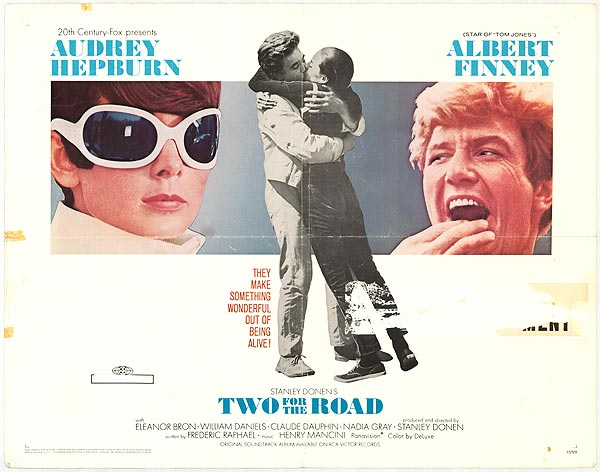
This is a unique and diverting look at a couple (Albert Finney, Audrey Hepburn) traveling the French countryside while dissecting their turbulent marriage. The road of course represents their long and winding relationship. It cleverly cuts between when they first met, which seems to have been on the same road, to twelve years later. The edits between the two stages are creative as is the majority of this fluid and entertaining movie. It wants to be silly, fluffy, serious, complex, exotic, avant-garde, and romantic all at once and most of the time it succeeds proving what an over looked, unsung genius director Stanley Donen is.

It’s a movie made for couples, but probably those who have been married for quite a while and can relate to the characters here who have been through the rough spots and have learned to accept their partner and the flaws that come with them. This film tries to dig a little bit deeper, which helps it stand out. It also has a more relaxed European attitude, especially in regards to ‘indiscretions’.

On the negative side the film contains a lot of old fashioned sexist attitudes. For instance the man is expected to be mechanically inclined and in control of every situation, which becomes very apparent in the scene where he has to get underneath the car to fix it while she sits on top of the vehicle without any care or inclination to what he is going through. The man is also expected to be the sole provider of the family while the woman does the majority of the child rearing.

Audrey, who wears an amazingly high number of stylish, chic outfits, looks more like a runway model sporting the latest fashions than an average housewife on a country drive. I realize that they wanted to accentuate her beauty, but it ends up being a distraction at the same time. If the intention of the story is about an average couple going through average marital problems then at least have them look the part.

The Henry Mancini score is pleasant as usual, but eventually gets overplayed. It’s also not as introspective as it wants you to believe, but on a slickness level it gets an “A”. Also, watch for Little Ruthie who is the world’s most obnoxious child.

My Rating: 6 out of 10

Released: April 27, 1967

Runtime: 1Hour 51Minutes

Rated NR (Not Rated)

Director: Stanley Donen

Studio: 20th Century Fox

Available: VHS, DVD